


Abstract
In a diffusion model of risk, we focus on the initial capital needed to make the probability of ruin within finite time equal to a prescribed value. It is defined as a solution of a nonlinear equation. The endeavor to write down and to investigate analytically this solution as a function of the premium rate seems not technically feasible. Instead, we obtain informative bounds for this capital in terms of elementary functions.
1. Introduction and Rationale
In this paper, we focus on the solutions (w.r.t. u and c) of the nonlinear equation
where is a sufficiently small number and is the probability of ruin within finite time in the standard diffusion risk model, i.e., when the annual risk reserve at time is defined as
Here is the initial risk reserve and is the premium rate. By , , we denote a standard Brownian motion. The aggregate claims payout process , , is a diffusion with continuous time, starting at zero. Its drift coefficient is and diffusion coefficient is . The variance is .
Bearing in mind the well known result for diffusion with linear drift (see, e.g., Equation 1.1.4 in Part II, Chapter 2 of [1]), we have in this model
Here and are the standard normal c.d.f. and p.d.f. respectively.
The solution of Equation (1) with respect to u is called the α-level initial capital, or ruin capital. We denote it by . The solution with respect to c is called the α-level premium rate. We denote it by . Since (see Equation (3)) for any , and since monotone decreases, as () increases, the solution exists for all , but only small α are of interest. This solution is bounded from above by and monotone decreases to zero, as c increases.
It is easy to see that for any
and for any
The inverse functions for both and obviously exist1. From Equation (4) and Equation (5), we have for any and for any . So, enough is to focus on the ruin capital .
The idea to look at the dependence of the initial capital u on the premium rate c, or vice versa, holding the probability of ruin at a prescribed level α, i.e., to use this probability merely as a binder, agrees with insurance regulation. In a nutshell, each insurance year the premium may be set within sensible limits, while the corresponding initial capital must be so large that the probability of ruin remains at a prescribed level.
Developing a sensible control over the years2, insurance managers are interested not in the probability of ruin as itself, but in a good balance between the control leverages, such as the initial capital and premium rate, which makes the solvency controllable. Typically, the expressions for the probability of ruin within finite time like Equation (3) are either absent or intractable, and the decision makers perform their calculations numerically3.
Even when an explicit formula like Equation (3) exists, to find in an explicit form, using elementary functions, is a tremendous endeavor. This can not be done even in our diffusion model Equation (2). However, in order to develop a sensible control, we need to scrutinize the behavior of for all possible values of . To this end, we propose in this paper informative and elementary upper and lower bounds. These bounds are compound and give valuable information about in the both cases of profitable () and unprofitable () risk reserve process. The fundamental observation underlying the proof in the former case is the convexity (concavity downward) of , as a function of c.
In [5], we have considered the similar problem in the classical Lundberg model. The classical Lundberg model yields the second exceptional case where the analytical expression for the probability of ruin within finite time is known. Unlike in [5], the bounds in this paper are given for each t rather than asymptotically, as .
The rest of the paper is arranged as follows.
In Section 2, we formulate some background results obtained previously.
In Section 3, we formulate the main results. The fundamental remark about convexity of as a function of c, as , is proved by showing that is positive. To find this second derivative, we apply the implicit function theorem. The other technical tool are the inequalities for the Mill’s ratio proved in [6].
In Section 4, we formulate some auxiliary results.
2. Some Background Results
For completeness, we present a number of related results obtained in [2,3,4]. Because of lack of space we do not give details of their proof.
2.1. Some Equalities
We put for -quantile (). If γ increases from 0 to , i.e., decreases from 1 to , the quantile monotone decreases from to zero. By symmetry, we have and . For , we have the following representation4.
Theorem 1 (Theorem 2.1 in [2]) In the diffusion model Equation (2), the solution with respect to u of Equation (1), as , is
For and , we have the following representations.
Theorem 2 (Theorem 4.4 in [3]) In the diffusion model Equation (2), the solution with respect to u of Equation (1) is
where the function for satisfies the equation
for satisfies the equation
is continuous, positive for all x, monotone increasing, as x increases from to 0, and monotone decreasing, as x increases from 0 to , and such that5
Corollary 1 (Theorem 2.1 in [4]) In the diffusion model Equation (2), the solution with respect to c of Equation (1) is
where and the function , , is continuous, monotone increasing, as x increases, and such that6
For , being positive, is convex and satisfies the equation
For , being negative, is concave and satisfies the equation
Moreover, for we have
Since the functions and can not be written explicitly, Theorem 2 and Corollary 1 do not give the explicit solutions of Equation (1).
2.2. Some Inequalities
The following upper and lower bounds on follow from Theorem 2. They are illustrated in Figure 1.
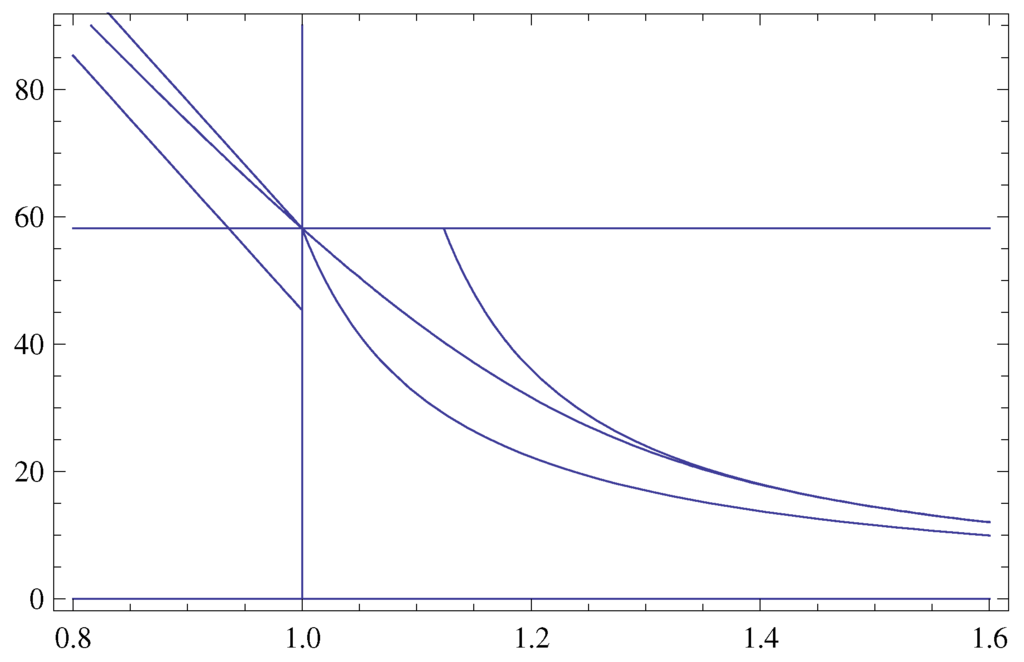
Figure 1.
The function of the variable (X-axis), as , , , and the bounds of Theorem 3. Horizontal line: .
Figure 1.
The function of the variable (X-axis), as , , , and the bounds of Theorem 3. Horizontal line: .
Theorem 3 In the diffusion model Equation (2), the solution with respect to u of Equation (1) is such that for
and for
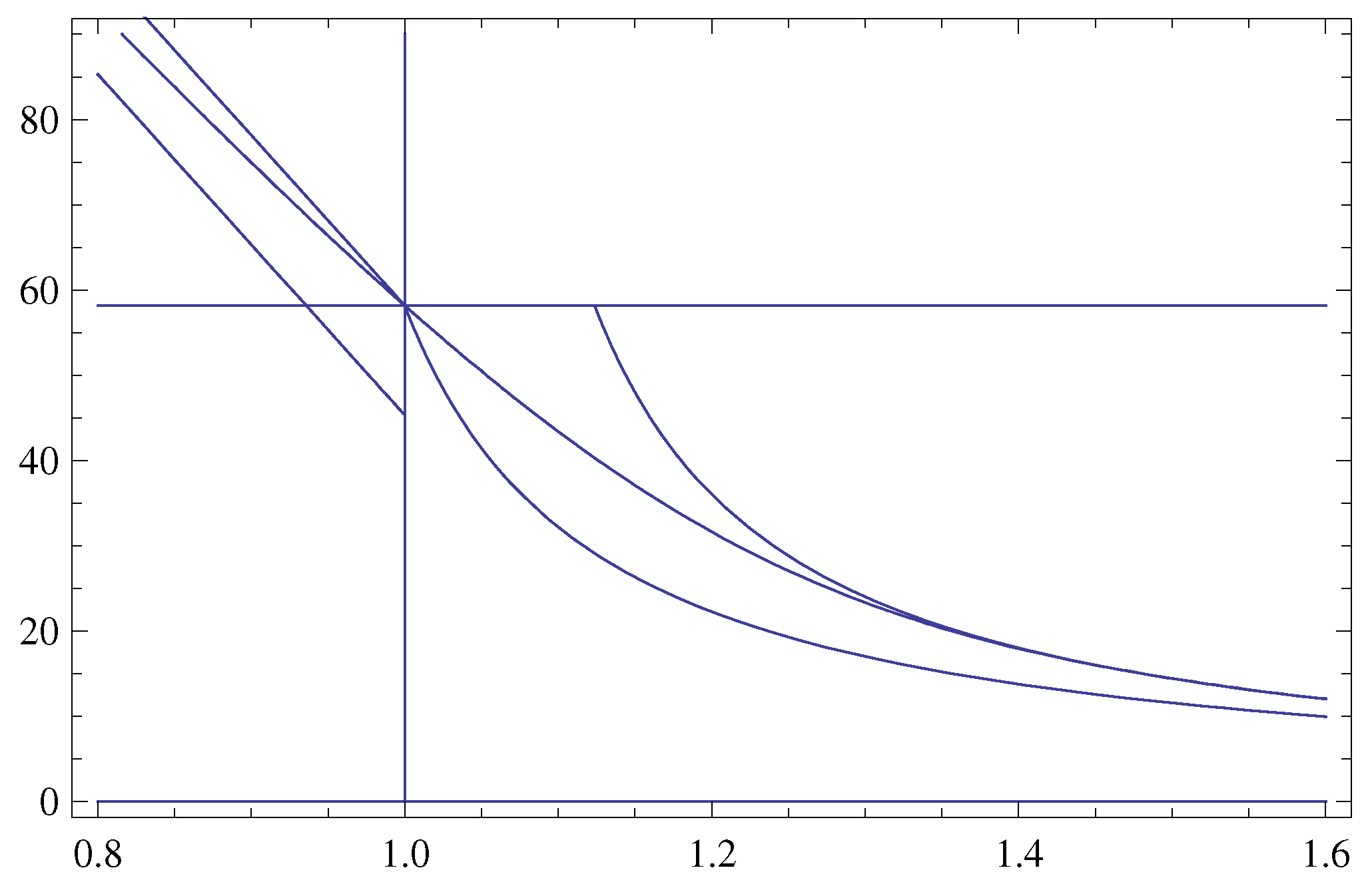
It is noteworthy (see Figure 1) that the upper bound for in Theorem 3 is compound: it is horizontal line until and hyperbola otherwise. This hyperbola is the solution of the equation .
The following upper and lower bounds on follow from Corollary 1.
3. The Main Results
In this section, our goal is to improve the upper bounds in Theorem 3, as , and in Corollary 2, as . This improvement makes these rather rough upper bounds much more accurate and informative.
Our plan regarding Theorem 3 is as follows. First, for , we prove the convexity (concavity downward) of , as a function of c. Then we enhance Theorem 3, as illustrated in Figure 2 and Figure 3. We draw the tangent line to hyperbola which is an upper bound for the ruin capital for . Since is a convex function of , this tangent line is the required upper bound on to the left of the point of tangency.
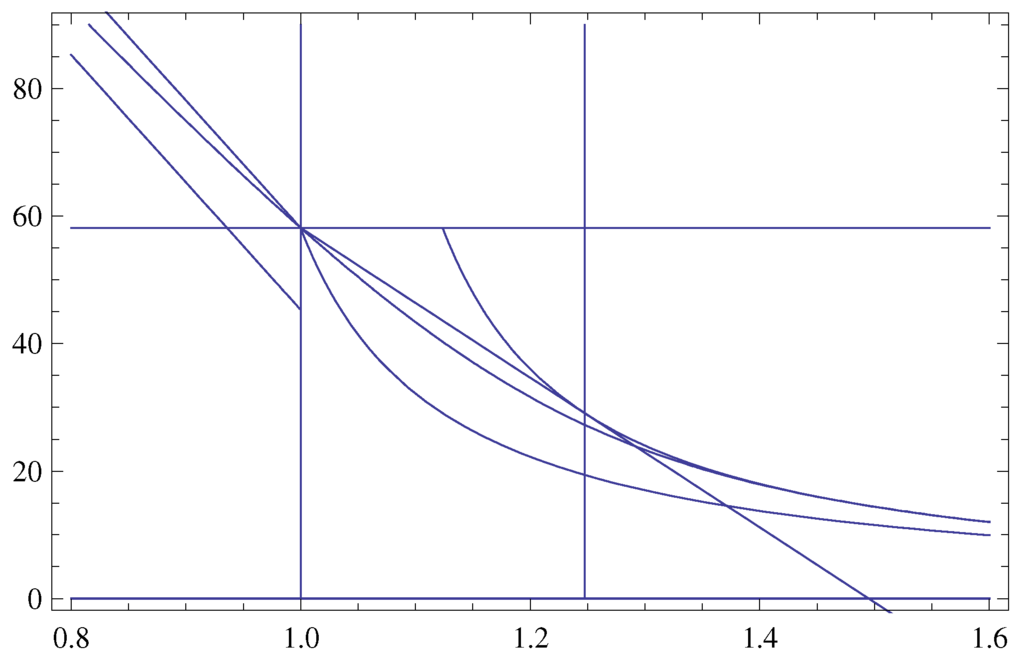
Figure 2.
Graphs shown in Figure 1, with the graph of sloping straight line starting from the point with abscissa ϑ and ordinate , and tangent to the hyperbola at (right vertical line) .
Figure 2.
Graphs shown in Figure 1, with the graph of sloping straight line starting from the point with abscissa ϑ and ordinate , and tangent to the hyperbola at (right vertical line) .
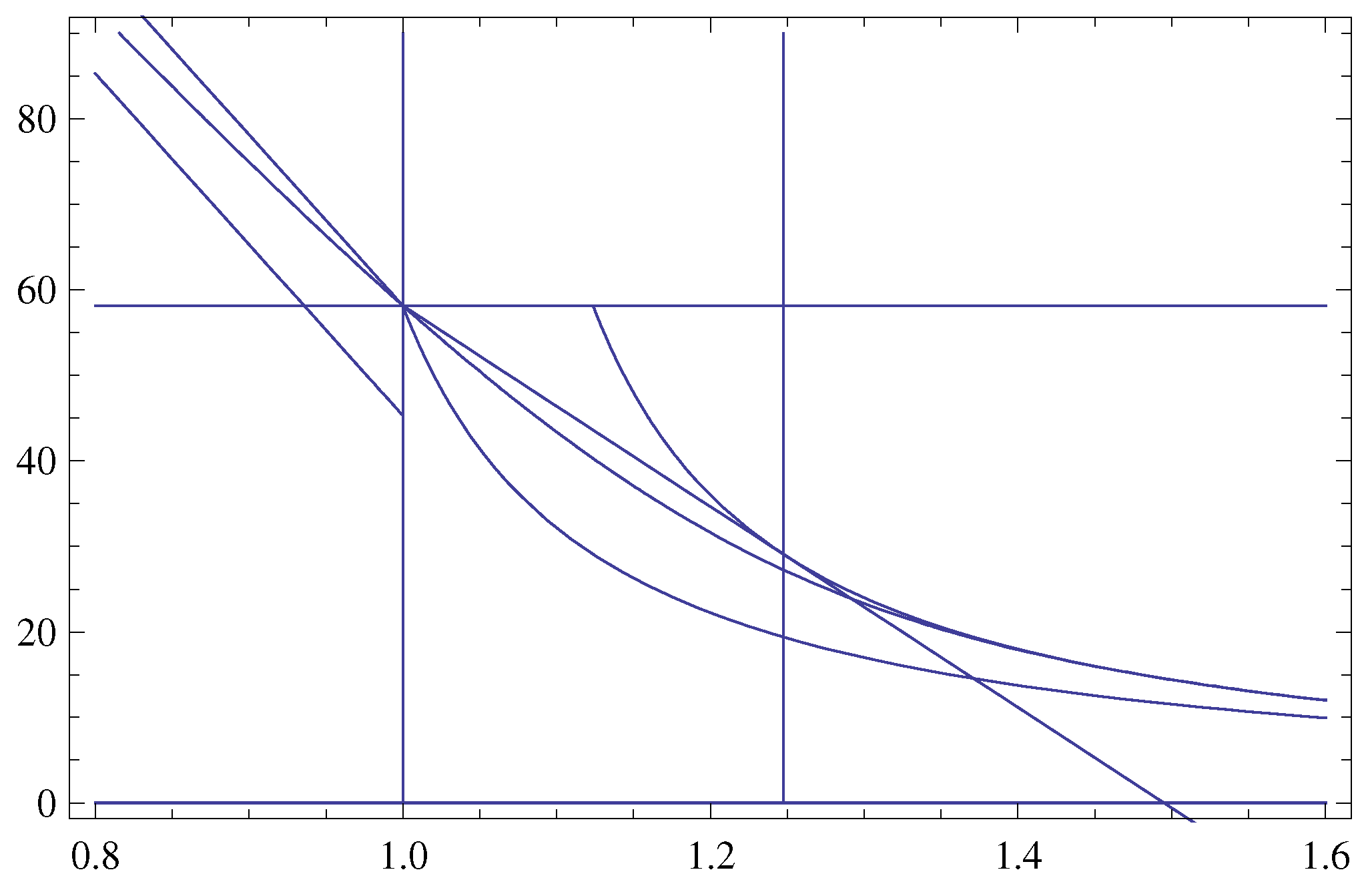
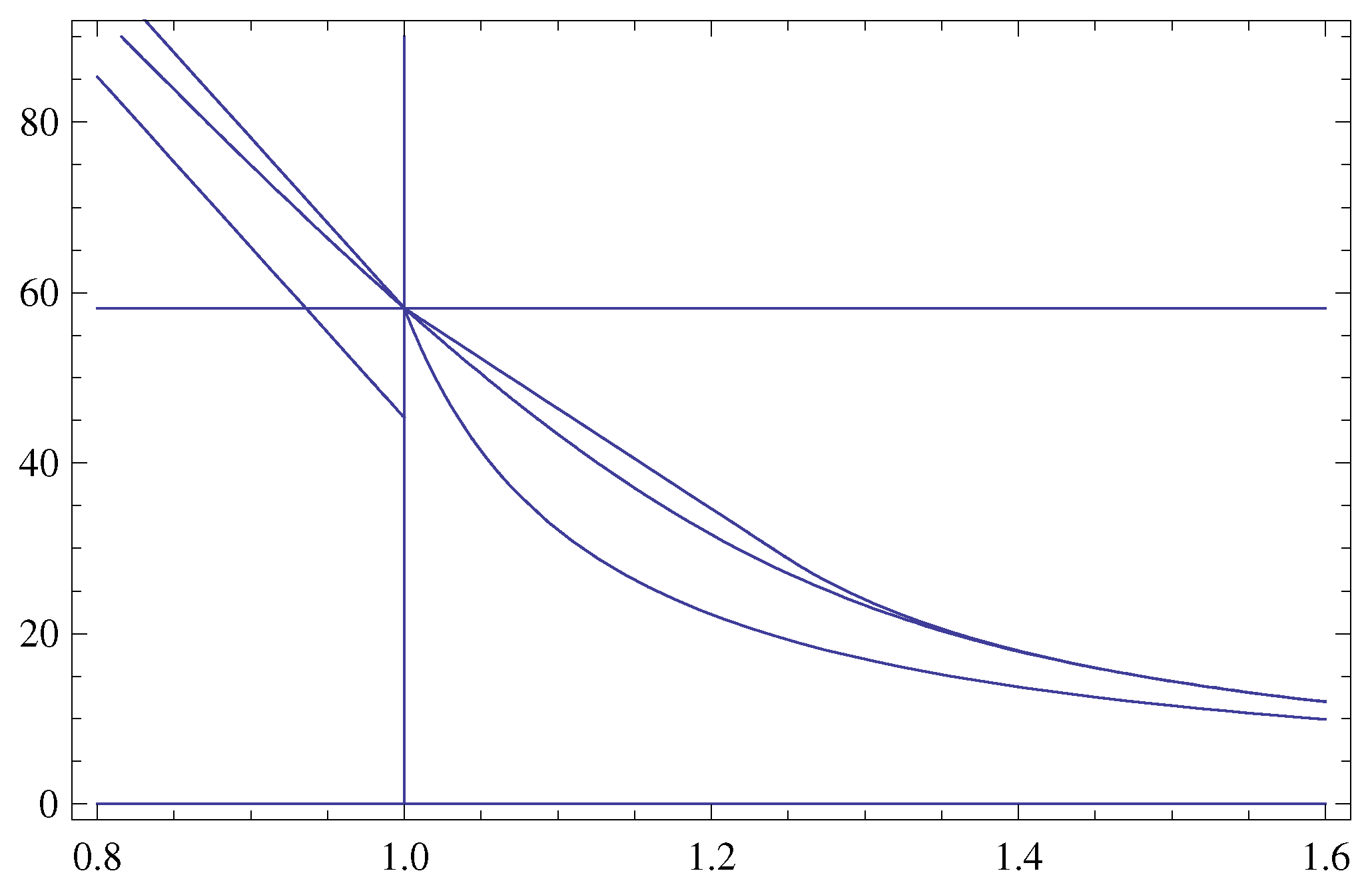
We formulate the following Theorem 4 which yields the improved upper bounds for , as . It is illustrated in Figure 3. The proof of Theorem 4 is illustrated in Figure 2 and will be presented at the end of this section.
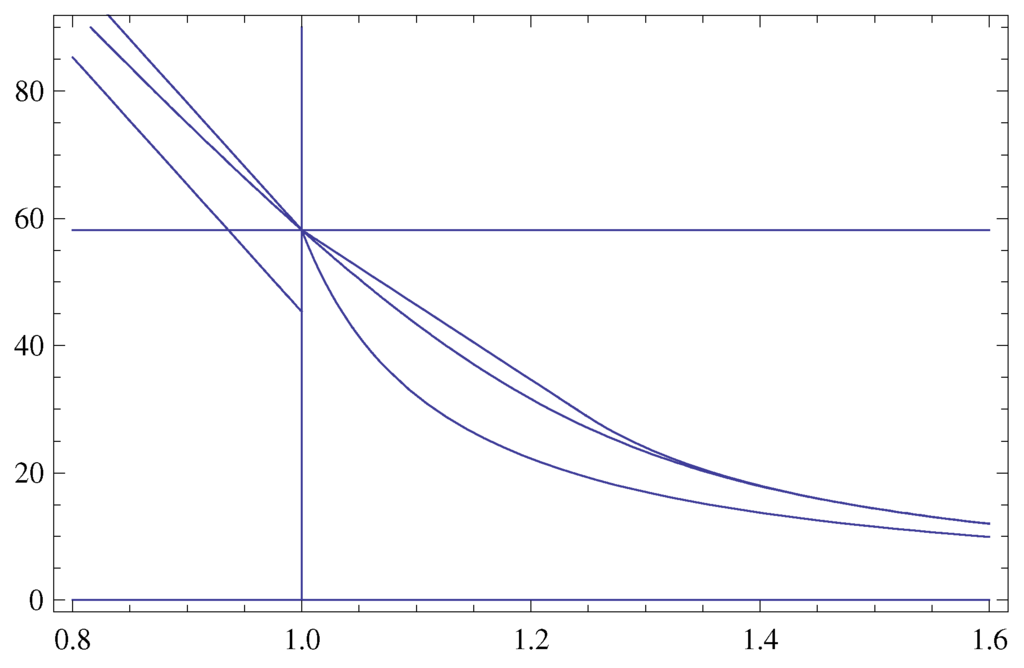
Figure 3.
The function of the variable (X-axis), as , , , and the bounds of Theorem 3 improved in Theorem 4.
Figure 3.
The function of the variable (X-axis), as , , , and the bounds of Theorem 3 improved in Theorem 4.
Theorem 4 In the diffusion model Equation (2), for we have
The following result yields the improved upper bounds for , as .
Corollary 3 In the diffusion model Equation (2), for we have
The following result is fundamental.
Theorem 5 For , the function of the variable c is convex.
Proof of Theorem 5 It suffices to show that . Bearing in mind Equation (1), apply Theorem 6. We have
and7
Bearing in mind Equation (3), introduce8
We have
and
Furthermore9, for
Direct algebraic manipulations yield
where
and (see Section 4.2)
is Mill’s ratio. Note that
where
and
Prove that for . Bearing in mind that and for any finite w (see inequalities Equation (14)), it follows from
true for , and from
We finally have for all and
and the proof is complete.
Proof of Theorem 4 Bearing in mind the convexity10 of established in Theorem 5, apply Theorem 6 with , , . We have the straight line
tangent to the hyperbola
This hyperbola is (see Theorem 3) the upper bound for , as .
Abscissa and ordinate of the point of tangency are and . Taking the tangent line as the bound for and the hyperbola as the bound for , we complete the proof.
Proof of Corollary 3 It follows straightforwardly from Theorem 4 and from the fact that for any .
4. Auxiliary Results
4.1. Mill’s Ratio
For finite x, Mill’s ratio is defined as
Evidently, for all finite x. The most well-known results about Mill’s ratio are and , so is convex and decreasing from ∞ to 0, as x increases from to .
4.2. Differentiation of Implicit Functions
The following implicit function theorem is well known in analysis (see e.g., Chapter I, § 5.2 and § 5.3 in [7]).
Theorem 6 Let F be a function that possesses partial derivatives up to second order continuous in some neighborhood of some solution, , of the equation . If , there are an and a unique continuously differentiable function ϕ such that and for . Moreover, when , we have
and
4.3. Straight Line and Hyperbola
The following theorem is straightforward.
Theorem 7 For , the straight line with a negative slope passing through the point with abscissa C and ordinate A, is tangent to the hyperbola at the point with abscissa and ordinate .
Acknowledgments
This work was supported by RFBR (grant No. 11-06-00057-a).
Conflicts of Interest
The authors declare no conflicts of interest.
References
- A.N. Borodin, and P. Salminen. Handbook of Brownian Motion. Facts and Formulæ. Basel, Switzerland: Birkhäuser, 1996. [Google Scholar]
- V.K. Malinovskii. “Zone-adaptive control strategy for a multiperiodic model of risk.” Ann. Actuar. Sci. 2 (2007): 391–409. [Google Scholar] [CrossRef]
- V.K. Malinovskii. “Scenario analysis for a multi-period diffusion model of risk.” ASTIN Bull. 39 (2009): 649–676. [Google Scholar] [CrossRef]
- V.K. Malinovskii. “Level premium rates as a function of initial capital.” Insur.: Math. Econ. 52 (2013): 370–380. [Google Scholar] [CrossRef]
- V.K. Malinovskii. “Improved asymptotic upper bounds on ruin capital in Lundberg model of risk.” Insur.: Math. Econ. 55 (2014): 301–309. [Google Scholar] [CrossRef]
- M.R. Sampford. “Some inequalities on Mill’s ratio and related functions.” Ann. Math. Stat. 24 (1953): 130–132. [Google Scholar] [CrossRef]
- D.V. Widder. Advanced Calculus. New York, NY, USA: Prentice-Hall, 1947. [Google Scholar]
- 1.Being the inverse function, is defined accordingly for . For completeness, it is set zero for .
- 2.In [2,3,4], the framework of this paper was embedded in the multi-year controlled diffusion models of risk and the controls were built annually, depending on the past years financial results.
- 3.This paper deals with analytical methods rather than numerical evaluation. There is no need to say about the difference between analytical and numerical analysis.
- 4.In what follows, we will make extensive use of both entries, and . It will not be difficult to convert into each other the expressions using either of these two forms.
- 5.Since , one has .
- 6.Recall that since , we have .
- 7.Here and in what follows, the symbols denote i-th and j-th partial derivatives of with respect to the first and the second variables, respectively.
- 8.Note that Equation (1) rewrites as where and .
- 9.To observe that for , note that . For , we have , which is positive since both summands are positive.
- 10.The graph of a convex function , , lies below the straight line connecting the points with abscissa and ordinate and with abscissa and ordinate , where and .
- 11.The lower limit in Equation (14) is easy. Since for finite x, the function is increasing from to 1, as x increases from to .
© 2014 by the authors; licensee MDPI, Basel, Switzerland. This article is an open access article distributed under the terms and conditions of the Creative Commons Attribution license (http://creativecommons.org/licenses/by/3.0/).