


Insider CEOs and Corporate Misconduct: Evidence from China


Abstract
1. Introduction
2. Literature Review and Hypothesis Development
2.1. Theoretical Foundations
2.2. CEO Succession Sources and Corporate Misconduct
2.3. Hypothesis Development
3. Research Design
3.1. Sample Selection and Data Sources
3.2. Measurement of Variables
3.2.1. Dependent Variable
3.2.2. Independent Variable
3.2.3. Moderating Variable
3.2.4. Control Variables
3.3. Empirical Model
3.4. Descriptive Statistics
3.5. Correlation and Multicollinearity Analysis
4. Empirical Results
4.1. Baseline Results
4.2. Robustness Tests
4.3. Moderating Effect Analysis
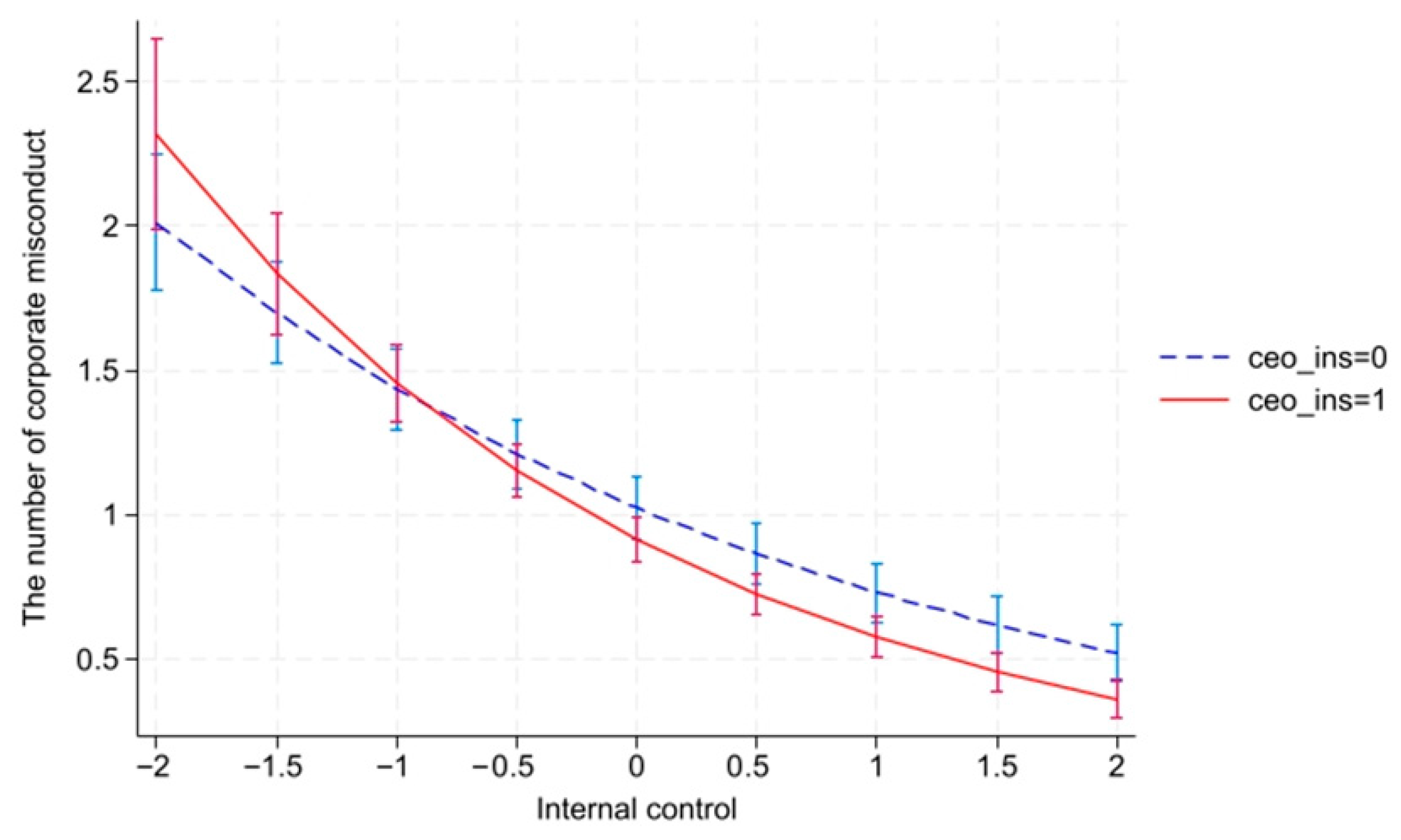
4.3.1. Internal Control
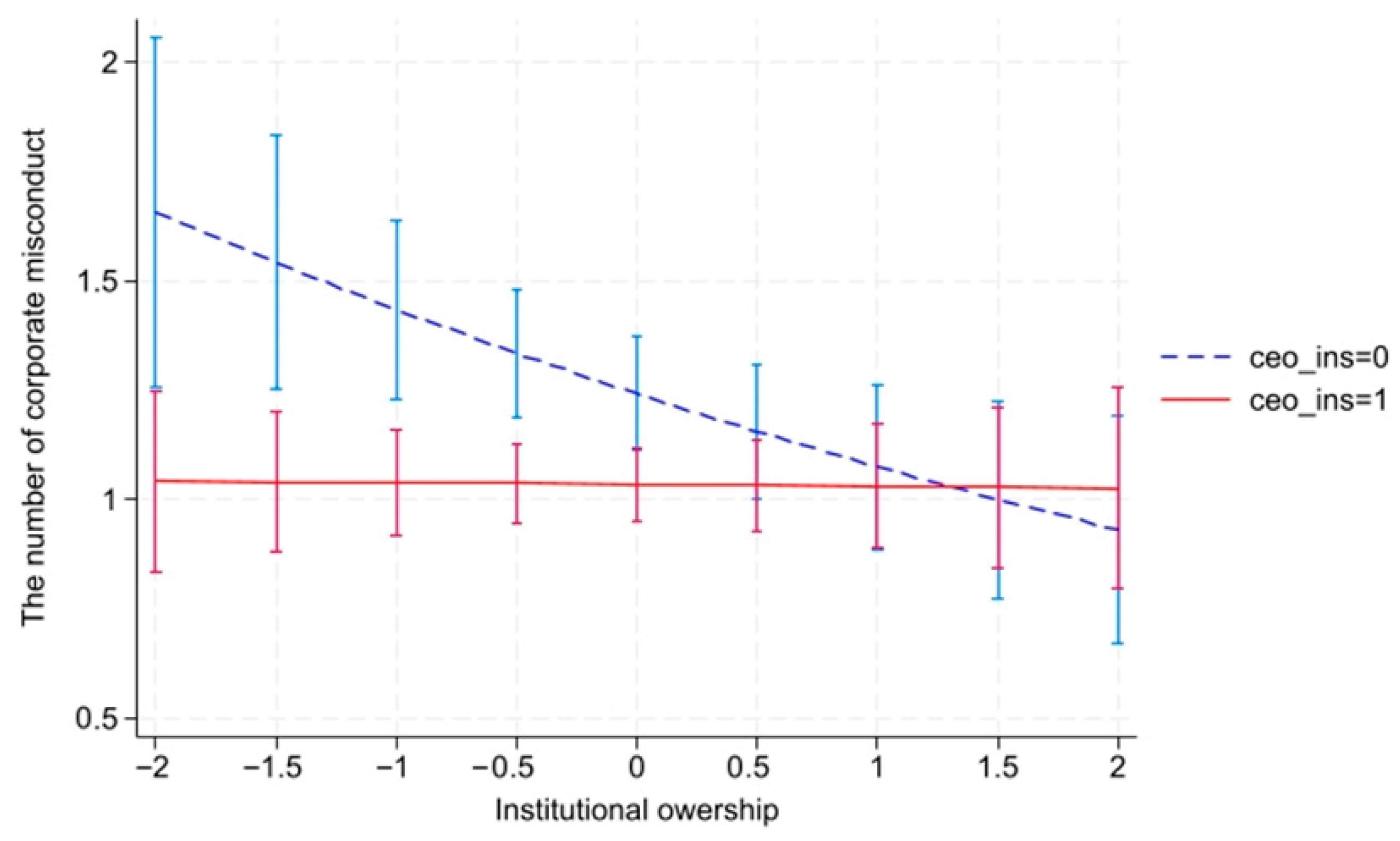
4.3.2. Institutional Ownership
5. Additional Analyses
6. Discussion
7. Conclusions
7.1. Theoretical Implications
7.2. Implications for Practice
7.3. Limitations and Future Research Directions
Author Contributions
Funding
Data Availability Statement
Conflicts of Interest
References
- Albert, Stuart, and David Allre Whetten. 1985. Organizational identity. Research in Organizational Behavior 7: 263–95. [Google Scholar]
- Ashforth, Blake Edward, and Fred Mael. 1989. Social identity theory and the organization. Academy of Management Review 14: 20–39. [Google Scholar] [CrossRef]
- Bamber, E. Michael, and Venkataraman M. Iyer. 2002. Big 5 auditors’ professional and organizational identification: Consistency or conflict? Auditing: A Journal of Practice & Theory 21: 21–38. [Google Scholar] [CrossRef]
- Bhat, Subrahmanya. 2023. The effectiveness of internal controls in preventing fraud and financial misconduct. Journal of Law and Sustainable Development 11: e1178. [Google Scholar] [CrossRef]
- Boivie, Steven, Donald Lange, Michael L. McDonald, and James D. Westphal. 2011. Me or we: The effects of CEO organizational identification on agency costs. Academy of Management Journal 54: 551–76. [Google Scholar] [CrossRef]
- Braun, Max C., and Simone Mueller. 2025. External corporate governance and corporate misconduct: A meta-analysis. Corporate Governance: An International Review 33: 832–49. [Google Scholar] [CrossRef]
- Brockman, Paul, Gopal Krishnan, Hye Seung Lee, and Jesus Manuel Salas. 2022. Implications of CEO succession origin and in-house experience for audit pricing. Journal of Accounting, Auditing & Finance 37: 173–204. [Google Scholar] [CrossRef]
- Brockman, Paul, Hye Seung Grace Lee, and Jesus Manuel Salas. 2016. Determinants of CEO compensation: Generalist–specialist versus insider–outsider attributes. Journal of Corporate Finance 39: 53–77. [Google Scholar] [CrossRef]
- Cao, Fei, Shuang Li, Hua Jian, and Yong Lu. 2024. Do local CEOs commit less fraud? Evidence from chinese listed firms. Applied Economics Letters 31: 849–53. [Google Scholar] [CrossRef]
- Chen, Jing, Junjie Hong, Weifeng Zhong, Chengqi Wang, and Xinghe Liu. 2024a. Doing right at home: Do hometown CEOs curb corporate misconduct? Technological Forecasting and Social Change 205: 123461. [Google Scholar] [CrossRef]
- Chen, Jing, Peiwen Hu, Shan Liu, and Xinghe Liu. 2024b. Too scared to make mistakes at home: CEO hometown identity and corporate risk-taking. Research in International Business and Finance 70: 102387. [Google Scholar] [CrossRef]
- Choi, Heeick, Khondkar Karim, and Anqi Tao. 2022. CEO origin and stock price crash risk: Insider versus outsider CEOs. Corporate Governance: An International Review 31: 105–26. [Google Scholar] [CrossRef]
- Connelly, Brian L., Wei Shi, H. Jack Walker, and Matt C. Hersel. 2022. Searching for a sign: CEO successor selection in the wake of corporate misconduct. Journal of Management 48: 1035–66. [Google Scholar] [CrossRef]
- Dadanlara, Hazel H., and Michael A. Abebeb. 2020. Female CEO leadership and the likelihood of corporate diversity misconduct: Evidence from S&P 500 firms. Journal of Business Research 118: 398–405. [Google Scholar] [CrossRef]
- Dong, Jinting, and Lianchao Yu. 2024. Impact of CEO foreign experience on corporate environmental violations: The role of enhanced environmental ethics and general competency. Economic Modelling 141: 106923. [Google Scholar] [CrossRef]
- Donker, Han, John Nofsinger, and Corey A. Shank. 2023. CEO narcissism and corporate misconduct. Economics Letters 228: 111178. [Google Scholar] [CrossRef]
- Efendia, Jap, Anup Srivastavab, and Edward P. Swansonb. 2007. Why do corporate managers misstate financial statements? The role of option compensation and other factors. Journal of Financial Economics 85: 667–708. [Google Scholar] [CrossRef]
- Eugster, Nicolas, Oskar Kowalewski, and Piotr Śpiewanowski. 2024. Internal governance mechanisms and corporate misconduct. International Review of Financial Analysis 92: 103109. [Google Scholar] [CrossRef]
- Fewer, Thomas, and Murat Tarakci. 2024. CEO political partisanship and corporate misconduct. Academy of Management Journal 68: amj.2022.909. [Google Scholar] [CrossRef]
- Gioia, Dennis A., Majken Schultz, and Kevin G. Corley. 2000. Organizational identity, image, and adaptive instability. Academy of Management Review 25: 63–81. [Google Scholar] [CrossRef]
- González, Tanja Artiga, Markus Schmid, and David Yermack. 2019. Does price fixing benefit corporate managers? Management Science 65: 4813–40. [Google Scholar] [CrossRef]
- Gu, Junjian. 2022. Do at home as romans do? CEO overseas experience and financial misconduct risk of emerging market firms. Research in International Business and Finance 60: 101624. [Google Scholar] [CrossRef]
- Guo, Lihong, and Zhibang Wang. 2021. CEOs Succession Source, Diversified Career Experience and Zombie Firms Governance. Business and Management Journal 43: 86–104. (In Chinese). [Google Scholar] [CrossRef]
- Haque, Md Reiazul Haque, Bobae Choi, Doowon Lee, and Sue Wright. 2022. Insider vs. outsider CEO and firm performance: Evidence from the COVID-19 pandemic. Finance Research Letters 47: 102609. [Google Scholar] [CrossRef] [PubMed]
- Harris, Jared, and Philip Bromiley. 2007. Incentives to cheat: The influence of executive compensation and firm performance on financial misrepresentation. Organization Science 18: 350–67. [Google Scholar] [CrossRef]
- Hogg, Michael A., Deborah J. Terry, and Katherine M. White. 1995. A tale of two theories: A critical comparison of identity theory with social identity theory. Social Psychology Quarterly 58: 255–69. [Google Scholar] [CrossRef]
- Huang, Guowei, Heiner Evanschitzky, and Hai-Anh Tran. 2025. The impact of influence tactics on brand message sharing. Journal of Business Research 199: 115497. [Google Scholar] [CrossRef]
- Islam, Md Ariful, Shahadat Hossain, Harjinder Singh, and Nigar Sultana. 2021. Outsider CEOs and corporate debt. International Review of Financial Analysis 74: 101660. [Google Scholar] [CrossRef]
- Jensen, Michael Cole, and William Henry Meckling. 2019. Theory of the firm: Managerial behavior, agency costs and ownership structure. In Corporate Governance. London: Gower, pp. 77–132. [Google Scholar]
- Jin, Yuxi. 2024. Management risk appetite, internal control and corporate financialization. Finance Research Letters 63: 105393. [Google Scholar] [CrossRef]
- Jongjaroenkamol, Prasart, and Volker Laux. 2017. Insider versus outsider CEOs, executive compensation, and accounting manipulation. Journal of Accounting and Economics 63: 253–61. [Google Scholar] [CrossRef]
- Kuang, Yu Flora, Bo Qin, and Jacco L. Wielhouwer. 2014. CEO origin and accrual-based earnings management. Accounting Horizons 28: 605–26. [Google Scholar] [CrossRef]
- Lai, Shufang, Zengquan Li, and Yong George Yang. 2020. East, West, Home’s Best: Do Local CEOs Behave Less Myopically? The Accounting Review 95: 227–55. [Google Scholar] [CrossRef]
- Lei, Zicheng, Dimitris Petmezas, P. Raghavendra Rau, and Chen Yang. 2025. Born to behave: Home CEOs and financial misconduct. Review of Accounting Studies 30: 1309–54. [Google Scholar] [CrossRef]
- Li, Yu, Tianpeng Bai, Ya Sha, and Zitong Xu. 2025. Concentration of supply chain, internal control, and corporate risk-taking. International Review of Financial Analysis 103: 104261. [Google Scholar] [CrossRef]
- Liu, Yang, Han Zhang, and Fukang Zhang. 2023. CEO’s poverty imprints and corporate financial fraud: Evidence from China. Pacific-Basin Finance Journal 81: 102128. [Google Scholar] [CrossRef]
- Mei, Mao, Xianyue Gao, and Wang Min. 2023. The power of belief: CEO political belief and corporate violations. International Journal of Frontiers in Sociology 5: 44–60. [Google Scholar] [CrossRef]
- Okeke, Stella Ehis, Stephanie Ifunanya Offor, and Onyekachi David Chukwunwike. 2021. Internal control: Its role in the reduction of fraud and professional misconduct among SMEs. Asian Journal of Economics, Business and Accounting 21: 57–66. [Google Scholar] [CrossRef]
- Oradi, Javad. 2021. CEO succession origin, audit report lag, and audit fees: Evidence from Iran. Journal of International Accounting, Auditing and Taxation 45: 100414. [Google Scholar] [CrossRef]
- Oradi, Javad, Reza Hesarzadeh, Sahar E-Vahdati, and Muhammad Nadeem. 2024. CEO succession origin and annual reports readability. The British Accounting Review 56: 101384. [Google Scholar] [CrossRef]
- Ren, Liuyang, Xi Zhong, and Liangyong Wan. 2022. Missing analyst forecasts and corporate fraud: Evidence from China. Journal of Business Ethics 181: 171–94. [Google Scholar] [CrossRef]
- Shi, Wei, Brian L. Connelly, and Robert E. Hoskisson. 2017. External corporate governance and financial fraud: Cognitive evaluation theory insights on agency theory prescriptions. Strategic Management Journal 38: 1268–86. [Google Scholar] [CrossRef]
- Sluss, David M., and Blake E. Ashforth. 2007. Relational identity and identification: Defining ourselves through work relationships. Academy of Management Review 32: 9–32. [Google Scholar] [CrossRef]
- Sun, Weizhang, Xue Zhizhong, Wang Yaping, Guo Shanshan, and Han Lanlan. 2023. CEO Succession Source, Survival Environment Heterogeneity and Corporate Innovation Input. Science and Technology Management Research 43: 136–45. (In Chinese). [Google Scholar] [CrossRef]
- Tajfel, Henri. 1978. Differentiation Between Social Groups: Studies in the Social Psychology of Intergroup Relations. Cambridge: Academic Press. [Google Scholar]
- Thosuwanchot, Nongnapat, and Min Suk Lee. 2025. Corporate misconduct and corporate social responsibility: The roles of CEO incentives and institutional ownership. Society and Business Review 20: 176–200. [Google Scholar] [CrossRef]
- Tian, Junmin, and Hui Sun. 2023. Corporate financialization, internal control and financial fraud. Finance Research Letters 56: 104046. [Google Scholar] [CrossRef]
- Van Dick, Rolf, Oliver Christ, Jost Stellmacher, Ulrich Wagner, Oliver Ahlswede, Cornelia Grubba, Martin Hauptmeier, Corinna Höhfeld, Kai Moltzen, and Patrick A. Tissington. 2004. Should I stay or should I go? Explaining turnover intentions with organizational identification and job satisfaction. British Journal of Management 15: 351–60. [Google Scholar] [CrossRef]
- Wang, Tao, Yongqing Ye, Jun Xia, and Xiaoyang Deng. 2023. Nonlocal CEOS and corporate financial fraud: Evidence from chinese listed firms. Available at SSRN 4474025. Available online: https://ssrn.com/abstract=4474025 (accessed on 10 September 2025).
- Wu, Yaqian, Jiyuan Li, and Chengfang Wang. 2024. Subdue One’ s Self and Return to Propriety: Local Chairman and Firm Violation. Accounting Research 4: 63–79. (In Chinese). [Google Scholar]
- Yang, Mei-Ling. 2010. The impact of controlling families and family CEOs on earnings management. Family Business Review 23: 266–79. [Google Scholar] [CrossRef]
- Yang, Shoufu, Dongmin Kong, and Jiaqiong He. 2025. Social identity or social capital: Local CEOs and corporate ESG performance. International Review of Economics & Finance 98: 103926. [Google Scholar] [CrossRef]
- Yang, Yang, and Mingyang Zou. 2025. The impact of CEO contract duration on corporate misconduct. Journal of Business Research 188: 115110. [Google Scholar] [CrossRef]
- Zaman, Rashid, Nader Atawnah, Ghasan A. Baghdadi, and Jia Liu. 2021. Fiduciary duty or loyalty? Evidence from co-opted boards and corporate misconduct. Journal of Corporate Finance 70: 102066. [Google Scholar] [CrossRef]
- Zhang, Ning, Lan Bo, and Xuanqiao Wang. 2024. Confucian culture and corporate default risk: Assessing the governance influence of traditional culture. International Review of Economics & Finance 94: 103378. [Google Scholar] [CrossRef]
- Zhao, Qifeng, Dongmin Kong, and Qianfeng Luo. 2024. Scientific disclosure and corporate misconduct. Pacific-Basin Finance Journal 88: 102547. [Google Scholar] [CrossRef]

| No. of Observation | |
|---|---|
| Starting Sample | 30,682 |
| Removed: | |
| Firms classified as ST, *ST or PT | 544 |
| Financial firms | 2187 |
| Firms with incomplete company or executive data | 4351 |
| Firms with missing insider CEO information | 12,163 |
| Final Sample | 10,437 |
| Variable | Definition | Symbol | Reference | Source |
|---|---|---|---|---|
| MIS_Num | Defined as the count of corporate misconduct incidents reported by a specific company within a calendar year. | - | Chen et al. (2024a); Wu et al. (2024) | CSMAR |
| MIS_Dumy | The company engages in misconduct during the current year: 1 for yes, 0 for no. | - | Yang and Zou (2025) | CSMAR |
| Insider CEO | CEO was hired internally: 1 for yes, 0 for no. | Oradi (2021); Sun et al. (2023) | CSMAR | |
| Internal control | internal control index/100 | - | Jin (2024) | DIB |
| Institutional ownership | The percentage of company stocks held by institutional investors (%). | - | Chen et al. (2024a) | CSMAR |
| Firm size | Natural log of the total assets at the end of the fiscal year. | - | Eugster et al. (2024) | |
| Firm age | Natural log of years since listing. | + | Harris and Bromiley (2007) | |
| Return on assets | The ratio of net profit to total assets at the end fiscal year end. | - | Chen et al. (2024a); Wang et al. (2023) | |
| Firm leverage | The ratio of total debts to total assets at the end fiscal year end. | + | Li et al. (2025) | |
| Ownership Concentration | The sum of the shareholding ratios of the top ten shareholders of a listed company. | - | Chen et al. (2024a); Yang and Zou (2025) | |
| Board size | The number of board members disclosed in the annual report. | - | Zhao et al. (2024); Yang and Zou (2025) | |
| Supervisory Board Size | Total number of supervisors on the supervisory board. | - | Zhao et al. (2024) | |
| CEO duality | The CEO also holds the position of chairman in the firm: 1 for yes, 0 for no. | + | Eugster et al. (2024) | |
| Share balance | The ratio of the combined ownership of the second- to fifth-largest shareholders to that of the largest shareholder. | + | Chen et al. (2024a) | |
| Auditor quality | The company is reviewed by a Big-4 international auditing firm: 1 for yes, 0 for no. | - | Eugster et al. (2024) | |
| CEO gender | The firm’s CEO is male: 1 for yes, 0 for no. | + | Eugster et al. (2024) | |
| CEO age | Natural log of the CEO’s age. | - | Chen et al. (2024a); Yang et al. (2025) | |
| CEO education Level | Education level: 5 = Doctorate, 4 = Master’s degree, 3 = Bachelor’s degree, 2 = Associate’s degree, 1 = Technical school or below. | - | Chen et al. (2024a) | |
| CEO overseas | CEO overseas experience is defined as follows: 1 = Foreign work or education experience; 0 = No overseas background. | - | Gu (2022); Guo and Wang (2021) | |
| CEO academic | The firm’s CEO possesses academic work experience: 1 for yes, 0 for no. | - | Chen et al. (2024b) |
| Number of Changes | Frequency | Percent | Cumulative Percent |
|---|---|---|---|
| 1 | 6850 | 65.63% | 65.63% |
| 2 | 2707 | 25.94% | 91.57% |
| 3 | 677 | 6.49% | 98.05% |
| 4 | 167 | 1.60% | 99.66% |
| 5 | 36 | 0.34% | 100.00% |
| Total | 10,437 | 100% |
| Variable | Obs | Mean | Std. Dev. | Min | Max |
|---|---|---|---|---|---|
| mis_num | 10,437 | 1.1 | 2.54 | 0 | 13 |
| mis_dumy | 10,437 | 0.26 | 0.44 | 0 | 1 |
| Insider CEO | 10,437 | 0.7 | 0.46 | 0 | 1 |
| Internal control | 10,437 | 6.29 | 1.43 | 0 | 9.41 |
| Institutional ownership | 10,437 | 41.02 | 25.33 | 0.08 | 90.33 |
| Firm size | 10,437 | 22.37 | 1.32 | 15.98 | 28.54 |
| Firm age | 10,437 | 2 | 0.9 | 0 | 3.47 |
| Return on assets | 10,437 | 0.04 | 0.06 | −0.19 | 0.22 |
| Firm leverage | 10,437 | 0.42 | 0.19 | 0.07 | 0.86 |
| Ownership Concentration | 10,437 | 0.59 | 0.15 | 0.24 | 0.91 |
| Board size | 10,437 | 8.33 | 1.61 | 4 | 18 |
| Supervisory Board Size | 10,437 | 3.41 | 0.91 | 3 | 7 |
| CEO duality | 10,437 | 0.4 | 0.49 | 0 | 1 |
| Share balance | 10,437 | 0.76 | 0.6 | 0.04 | 2.89 |
| Auditor quality | 10,437 | 0.06 | 0.23 | 0 | 1 |
| CEO gender | 10,437 | 0.92 | 0.27 | 0 | 1 |
| CEO age | 10,437 | 3.92 | 0.15 | 3.26 | 4.38 |
| CEO education Level | 10,437 | 3.37 | 0.95 | 1 | 5 |
| CEO overseas | 10,437 | 0.08 | 0.27 | 0 | 1 |
| CEO academic | 10,437 | 0.06 | 0.23 | 0 | 1 |
| Code | Industry Name (CSRC 2012) | Industry Code | Frequency | Frequency Percent |
|---|---|---|---|---|
| 1 | Agriculture, Forestry, Animal Husbandry and Fishery (A) | A01–A04 | 138 | 1.32% |
| 2 | Mining (B) | B06–B11 | 211 | 2.02% |
| 3 | Manufacturing (C1: Raw materials & primary processing) | C13–C19 | 900 | 8.62% |
| 4 | Manufacturing (C2: Machinery, equipment & transport) | C20–C29 | 2072 | 19.85% |
| 5 | Manufacturing (C3: Light industry, food, textiles, chemicals, others) | C30–C39 | 4342 | 41.60% |
| 6 | Manufacturing (C4: Specialized manufacturing & others) | C40–C42 | 151 | 1.45% |
| 7 | Electricity, Heat, Gas and Water Production & Supply (D) | D44–D46 | 271 | 2.60% |
| 8 | Construction (E) | E47–E50 | 235 | 2.25% |
| 9 | Wholesale & Retail (F) | F51–F52 | 430 | 4.12% |
| 10 | Transportation, Storage and Postal Services (G) | G54–G60 | 199 | 1.91% |
| 11 | Accommodation & Catering (H) | H61–H62 | 29 | 0.28% |
| 12 | Information Transmission, Software & IT Services (I) | I63–I65 | 539 | 5.16% |
| 13 | Finance (J) | J66–J69 | - | - |
| 14 | Real Estate (K) | K70 | 326 | 3.12% |
| 15 | Leasing & Business Services (L) | L71–L72 | 176 | 1.69% |
| 16 | Scientific Research & Technical Services (M) | M73–M74 | 106 | 1.02% |
| 17 | Water Conservancy, Environment & Public Facilities Management (N) | N77–N78 | 102 | 0.98% |
| 18 | Education (P) | P82 | 18 | 0.17% |
| 19 | Health & Social Work (Q) | Q83 | 27 | 0.26% |
| 20 | Culture, Sports & Entertainment (R) | R85–R88 | 116 | 1.11% |
| 21 | Comprehensive (S) | S90 | 49 | 0.47% |
| Title 1 | (1) | (2) | (3) | (4) | (5) | (6) | (7) | (8) | (9) | (10) |
|---|---|---|---|---|---|---|---|---|---|---|
| mis_num | 1 | |||||||||
| Insider CEO | −0.085 *** | 1 | ||||||||
| Internal control | −0.356 *** | 0.095 *** | 1 | |||||||
| Institutional ownership | −0.073 *** | −0.086 *** | 0.071 *** | 1 | ||||||
| Firm size | −0.061 *** | −0.062 *** | 0.160 *** | 0.425 *** | 1 | |||||
| Firm age | 0.086 *** | −0.217 *** | −0.118 *** | 0.234 *** | 0.404 *** | 1 | ||||
| Return on assets | −0.250 *** | 0.083 *** | 0.323 *** | 0.090 *** | 0.037 *** | −0.181 *** | 1 | |||
| Firm leverage | 0.087 *** | −0.072 *** | −0.056 *** | 0.200 *** | 0.479 *** | 0.292 *** | −0.356 *** | 1 | ||
| Ownership Concentration | −0.125 *** | 0.039 *** | 0.135 *** | 0.431 *** | 0.119 *** | −0.378 *** | 0.231 *** | −0.078 *** | 1 | |
| Board size | −0.051 *** | −0.061 *** | 0.033 *** | 0.203 *** | 0.254 *** | 0.155 *** | 0.007 *** | 0.119 *** | −0.002 *** | 1 |
| Supervisory Board Size | −0.050 *** | −0.100 *** | 0.006 | 0.247 *** | 0.291 *** | 0.280 *** | −0.041 *** | 0.174 *** | −0.006 | 0.314 *** |
| CEO duality | −0.022 ** | 0.068 *** | 0.050 *** | −0.160 *** | −0.137 *** | −0.225 *** | 0.057 *** | −0.111 *** | 0.032 *** | −0.207 *** |
| Share balance | 0.074 *** | 0.039 ** | −0.033 ** | −0.230 *** | −0.046 *** | −0.115 *** | −0.011 | −0.047 *** | −0.026 ** | 0.016 |
| Auditor quality | −0.064 *** | −0.010 | 0.087 *** | 0.232 *** | 0.357 *** | 0.108 *** | 0.048 *** | 0.116 *** | 0.159 *** | 0.099 *** |
| CEO gender | 0.012 | 0.019 * | 0.001 | 0.073 *** | 0.026 ** | 0.014 | −0.018 * | 0.043 *** | −0.022 ** | 0.071 *** |
| CEO age | −0.085 *** | 0.066 *** | 0.052 *** | 0.057 *** | 0.135 *** | 0.086 *** | 0.015 | 0.039 *** | −0.030 ** | 0.035 *** |
| CEO education Level | −0.007 | −0.043 *** | 0.027 ** | 0.115 *** | 0.176 *** | 0.164 *** | 0.022 ** | 0.037 *** | −0.065 *** | 0.078 *** |
| CEO overseas | 0.000 | 0.004 | 0.015 | 0.047 *** | 0.002 | 0.008 | 0.015 | −0.019 * | −0.007 | −0.021 ** |
| CEO academic | 0.004 | 0.014 | −0.001 | 0.016 | −0.010 | 0.002 | −0.005 | −0.023 ** | −0.014 | 0.019 ** |
| (11) | (12) | (13) | (14) | (15) | (16) | (17) | (18) | (19) | ||
| Supervisory Board Size | 1.000 | |||||||||
| CEO duality | −0.200 *** | 1.000 | ||||||||
| Share balance | −0.078 *** | 0.053 *** | 1.000 | |||||||
| Auditor quality | 0.071 *** | −0.046 *** | 0.003 | 1.000 | ||||||
| CEO gender | 0.052 *** | 0.042 *** | 0.015 | 0.006 | 1.000 | |||||
| CEO age | 0.019 * | 0.172 *** | −0.016 | 0.068 *** | 0.026 ** | 1.000 | ||||
| CEO education Level | 0.119 *** | −0.060 *** | 0.051 *** | 0.104 *** | 0.006 | −0.043 *** | 1.000 | |||
| CEO overseas | −0.069 *** | −0.015 | 0.052 *** | 0.082 *** | −0.037 *** | −0.106 *** | 0.171 *** | 1.000 | ||
| CEO academic | −0.031 ** | 0.058 *** | 0.025 * | 0.007 | 0.007 | 0.085 *** | 0.111 *** | 0.031 *** | 1.000 |
| Variable | VIF | 1/VIF | VIF | 1/VIF |
|---|---|---|---|---|
| Insider CEO | 1.07 | 0.9332 | 1.08 | 0.9252 |
| Internal control | 1.18 | 0.8486 | 2.36 | 0.4241 |
| Institutional ownership | 1.88 | 0.5315 | 4.79 | 0.2088 |
| Insider CEO × Internal control | 2.20 | 0.4537 | ||
| Insider CEO × Institutional ownership | 3.60 | 0.2777 | ||
| Firm size | 2.11 | 0.4749 | 2.11 | 0.4744 |
| Firm age | 1.93 | 0.5189 | 1.93 | 0.5178 |
| Return on assets | 1.38 | 0.7231 | 1.39 | 0.7217 |
| Firm leverage | 1.62 | 0.6189 | 1.62 | 0.6179 |
| Ownership Concentration | 1.88 | 0.5320 | 1.90 | 0.5270 |
| Board size | 1.19 | 0.8372 | 1.19 | 0.8369 |
| Supervisory Board Size | 1.25 | 0.7972 | 1.25 | 0.7970 |
| CEO duality | 1.16 | 0.8587 | 1.17 | 0.8578 |
| Share balance | 1.09 | 0.9140 | 1.10 | 0.9130 |
| Auditor quality | 1.19 | 0.8438 | 1.19 | 0.8424 |
| CEO gender | 1.02 | 0.9768 | 1.02 | 0.9765 |
| CEO age | 1.10 | 0.9066 | 1.10 | 0.9059 |
| CEO education Level | 1.12 | 0.8935 | 1.12 | 0.8931 |
| CEO overseas | 1.07 | 0.9386 | 1.07 | 0.9376 |
| CEO academic | 1.03 | 0.9719 | 1.03 | 0.9708 |
| Mean VIF | 1.35 | 1.71 | ||
| Variable | (1) Mis_Num | (2) Mis_Num | (3) Mis_Num |
|---|---|---|---|
| Insider CEO | −0.399 *** | −0.218 *** | −0.182 *** |
| (0.064) | (0.065) | (0.066) | |
| Firm size | −0.122 *** | −0.127 *** | |
| (0.033) | (0.033) | ||
| Firm age | 0.233 *** | 0.240 *** | |
| (0.048) | (0.048) | ||
| Return on assets | −5.309 *** | −5.624 *** | |
| (0.458) | (0.460) | ||
| Firm leverage | 0.680 *** | 0.709 *** | |
| (0.188) | (0.193) | ||
| Ownership Concentration | −0.568 ** | −0.743 *** | |
| (0.242) | (0.235) | ||
| Board size | −0.042 ** | −0.034 | |
| (0.021) | (0.021) | ||
| Supervisory Board Size | −0.154 *** | −0.152 *** | |
| (0.044) | (0.043) | ||
| CEO duality | −0.022 | 0.013 | |
| (0.066) | (0.064) | ||
| Share balance | 0.271 *** | 0.241 *** | |
| (0.052) | (0.053) | ||
| Auditor quality | −0.649 *** | −0.630 *** | |
| (0.185) | (0.180) | ||
| CEO gender | 0.068 | 0.029 | |
| (0.129) | (0.124) | ||
| CEO age | −0.992 *** | −0.871 *** | |
| (0.217) | (0.214) | ||
| CEO education Level | −0.013 | −0.004 | |
| (0.036) | (0.036) | ||
| CEO overseas | −0.121 | −0.072 | |
| (0.105) | (0.105) | ||
| CEO academic | −0.014 | −0.073 | |
| (0.128) | (0.121) | ||
| Constant | 0.362 *** | 7.166 *** | 6.733 *** |
| (0.054) | (0.985) | (0.987) | |
| Year and industry fixed effect | No | No | Yes |
| Observations | 10,437 | 10,437 | 10,437 |
| Log likelihood | −12,456.64 | −12,188.03 | −12,077.37 |
| Chi-square (χ2) | 38.97 *** | 451.35 *** | 740.44 *** |
| Pseudo R2 | 0.0019 | 0.0234 | 0.0323 |
| lnalpha | 1.904 *** | 1.736 *** | 1.668 *** |
| (0.035) | (0.037) | (0.038) |
| Panel A: Alternative Measures of Corporate Misconduct | ||
| Variable | (1) Mis_dumy | |
| Insider CEO | −0.202 *** | |
| Constant | 4.122 *** | |
| (1.104) | ||
| Control variables | Yes | |
| Year and industry fixed effect | Yes | |
| Observations | 10,437 | |
| Log likelihood | −5601.6876 | |
| Chi-square (χ2) | 516.92 *** | |
| Pseudo R2 | 0.0717 | |
| Panel B: excluding Leader-Related Misconduct from the Dependent Variable | ||
| Variable | (1) Mis_Num | |
| Insider CEO | −0.178 ** | |
| (0.080) | ||
| Constant | 7.112 *** | |
| (1.182) | ||
| Control variables | Yes | |
| Year and industry fixed effect | Yes | |
| Observations | 9621 | |
| Log likelihood | −9142.7605 | |
| Chi-square (χ2) | 566.26 *** | |
| Pseudo R2 | 0.0335 | |
| lnalpha | 2.004 *** | |
| (0.045) | ||
| Panel C: Tobit Estimation | ||
| Variable | (1) Mis_Num | |
| CEO_INS | −0.803 *** | |
| (0.247) | ||
| Constant | 19.160 *** | |
| (3.870) | ||
| Control variables | Yes | |
| Year and industry fixed effect | Yes | |
| Observations | 10,437 | |
| Log likelihood | −12,101.848 | |
| F-statistic | 14.74 *** | |
| Pseudo R2 | 0.0455 | |
| Panel D: Negative Binomial Regression (NBR) with Firm-Level Fixed Effects | ||
| Variable | (1) Mis_Num | |
| CEO_INS | −0.143 ** | |
| (0.059) | ||
| Constant | −0.725 ** | |
| (0.330) | ||
| Control variables | NO | |
| Year and industry fixed effect | Yes | |
| Firm FE | Yes | |
| Observations | 6854 | |
| Number of groups | 1052 | |
| Wald chi2 | 192.22 *** | |
| Log likelihood | −6397.2367 | |
| Panel E: Heckman Two-Stage Model | ||
| Variable | Heckman First-Stage Probit Results | Heckman Second-Stage NBR Results |
| (1) CEO_INS | (2) Mis_Num | |
| CEO_INS | −0.192 *** | |
| (0.068) | ||
| IMR | −0.103 | |
| (0.137) | ||
| Industry_insider_rate | 3.042 *** | |
| (0.303) | ||
| Region_insider_rate | 3.087 *** | |
| (0.253) | ||
| Constant | −3.869 *** | 6.882 *** |
| (1.014) | (1.010) | |
| Control variables | Yes | Yes |
| Year and industry fixed effect | Yes | Yes |
| Region FE | Yes | NO |
| Observations | 10,437 | 10,437 |
| Log likelihood | −5243.994 | −12,077.077 |
| Chi-square (χ2) | 842.85 *** | 740.20 *** |
| Pseudo R2 | 0.1727 | 0.0323 |
| lnalpha | 1.668 *** | |
| (0.038) | ||
| Panel F: Instrumental Variable Estimation (Control Function Approach) | ||
| Variable | (1) | (2) |
| CEO_INS | Mis_Num | |
| Confucian culture | 0.024 *** | |
| (0.006) | ||
| CEO_INS | −5.506 *** | |
| (2.018) | ||
| Residuals | 5.324 *** | |
| (2.020) | ||
| Constant | 0.206 | 8.017 *** |
| (0.144) | (1.085) | |
| Control variables | Yes | Yes |
| Year and industry fixed effect | Yes | Yes |
| Observations | 10,437 | 10,437 |
| Log likelihood | −12,070.945 | |
| F/Chi-square (χ2) | 38.24 *** | 753.80 *** |
| Adj R-squared/Pseudo R2 | 0.1384 | 0.0328 |
| lnalpha | 1.665 *** | |
| (0.038) | ||
| Panel G: Propensity Score Matching (PSM) | ||
| Variable | (1) Mis_Num | |
| Insider CEO | −0.143 ** | |
| (0.070) | ||
| Constant | 6.423 *** | |
| (1.033) | ||
| Control variables | Yes | |
| Year and industry fixed effect | Yes | |
| Observations | 9349 | |
| Log likelihood | −10,515.97 | |
| Chi-square (χ2) | 646.33 *** | |
| Pseudo R2 | 0.0311 | |
| lnalpha | 1.710 *** | |
| (0.040) | ||
| Variable | Sample | Treated | Controls | Difference | S.E. | T-Stat |
|---|---|---|---|---|---|---|
| mis_num | Unmatched | 0.9638 | 1.437 | −0.473 | 0.054 | −8.7 |
| mis_num | ATT | 0.9638 | 1.389 | −0.426 | 0.151 | −2.82 |
| Variable | (1) Mis_Num | (2) Mis_Num | (3) Mis_Num |
|---|---|---|---|
| Insider CEO | −0.112 * | −0.183 *** | −0.114 * |
| (0.067) | (0.066) | (0.067) | |
| Internal control | −0.339 *** | −0.333 *** | |
| (0.028) | (0.029) | ||
| Insider CEO × Internal control | −0.127 *** | −0.136 *** | |
| (0.043) | (0.043) | ||
| Institutional ownership | −0.143 ** | −0.135 ** | |
| (0.061) | (0.061) | ||
| Insider CEO × Institutional ownership | 0.139 ** | 0.140 ** | |
| (0.066) | (0.065) | ||
| Firm size | −0.050 | −0.123 *** | −0.048 |
| (0.034) | (0.034) | (0.034) | |
| Firm age | 0.175 *** | 0.257 *** | 0.189 *** |
| (0.049) | (0.049) | (0.050) | |
| Return on assets | −4.028 *** | −5.597 *** | −4.006 *** |
| (0.486) | (0.460) | (0.487) | |
| Firm leverage | 0.536 *** | 0.726 *** | 0.552 *** |
| (0.196) | (0.194) | (0.197) | |
| Ownership Concentration | −0.716 *** | −0.554 ** | −0.553 ** |
| (0.235) | (0.279) | (0.274) | |
| Board size | −0.039 * | −0.034 | −0.039 * |
| (0.022) | (0.021) | (0.022) | |
| Supervisory Board Size | −0.151 *** | −0.147 *** | −0.146 *** |
| (0.043) | (0.043) | (0.043) | |
| CEO duality | 0.035 | 0.008 | 0.030 |
| (0.063) | (0.064) | (0.063) | |
| Shares balance | 0.223 *** | 0.236 *** | 0.219 *** |
| (0.052) | (0.053) | (0.053) | |
| Auditor quality | −0.673 *** | −0.619 *** | −0.663 *** |
| (0.164) | (0.183) | (0.164) | |
| CEO gender | 0.092 | 0.037 | 0.098 |
| (0.121) | (0.123) | (0.121) | |
| CEO age | −0.826 *** | −0.872 *** | −0.822 *** |
| (0.224) | (0.216) | (0.224) | |
| CEO education Level | 0.012 | 0.003 | 0.018 |
| (0.036) | (0.036) | (0.036) | |
| CEO overseas | −0.045 | −0.075 | −0.049 |
| (0.101) | (0.106) | (0.102) | |
| CEO academic | −0.117 | −0.073 | −0.115 |
| (0.124) | (0.123) | (0.125) | |
| Constant | 4.891 *** | 6.453 *** | 4.661 *** |
| (1.029) | (1.045) | (1.078) | |
| Year and industry fixed effect | Yes | Yes | Yes |
| Observations | 10,437 | 10,437 | 10,437 |
| Log likelihood | −11,943.71 | −12,074.11 | −11,940.44 |
| Chi-square (χ2) | 1114.57 *** | 752.24 *** | 1118.41 *** |
| Pseudo R2 | 0.043 | 0.0326 | 0.0433 |
| lnalpha | 1.584 *** | 1.667 *** | 1.582 *** |
| (0.038) | (0.038) | (0.038) |
| Variable | (1) | (2) | (3) |
|---|---|---|---|
| Vio_Dis_Num | Vio_Oper_Num | Vio_Lead_Num | |
| Insider CEO | −0.238 *** | −0.137 * | −0.187 * |
| (0.074) | (0.073) | (0.097) | |
| Firm size | −0.165 *** | −0.105 *** | −0.029 |
| (0.036) | (0.039) | (0.046) | |
| Firm age | 0.283 *** | 0.272 *** | −0.083 |
| (0.055) | (0.054) | (0.065) | |
| Return on assets | −6.456 *** | −6.193 *** | −1.958 *** |
| (0.536) | (0.545) | (0.664) | |
| Firm leverage | 0.901 *** | 0.617 *** | 0.197 |
| (0.221) | (0.219) | (0.300) | |
| Ownership Concentration | −0.563 ** | −0.622 ** | −1.572 *** |
| (0.267) | (0.265) | (0.334) | |
| Board size | −0.044 * | −0.035 | −0.027 |
| (0.023) | (0.027) | (0.033) | |
| Supervisory Board Size | −0.172 *** | −0.158 *** | −0.105 |
| (0.052) | (0.045) | (0.065) | |
| CEO duality | −0.035 | 0.003 | 0.147 * |
| (0.072) | (0.072) | (0.090) | |
| Share balance | 0.219 *** | 0.219 *** | 0.402 *** |
| (0.057) | (0.057) | (0.067) | |
| Auditor quality | −0.721 *** | −0.605 *** | −0.336 |
| (0.218) | (0.226) | (0.218) | |
| CEO gender | −0.002 | 0.109 | −0.070 |
| (0.143) | (0.129) | (0.158) | |
| CEO age | −0.891 *** | −1.094 *** | −0.179 |
| (0.229) | (0.247) | (0.284) | |
| CEO education Level | −0.025 | 0.014 | 0.026 |
| (0.039) | (0.042) | (0.048) | |
| CEO overseas | −0.091 | −0.042 | 0.107 |
| (0.117) | (0.123) | (0.164) | |
| CEO academic | −0.101 | 0.021 | −0.269 |
| (0.142) | (0.138) | (0.198) | |
| Constant | 7.068 *** | 5.869 *** | 0.388 |
| (1.100) | (1.120) | (1.436) | |
| Year and industry fixed effects | Yes | Yes | Yes |
| Observations | 10,437 | 10,437 | 10,437 |
| Log likelihood | −8523.2032 | −7803.4681 | −3550.2069 |
| Chi-square (χ2) | 662.25 *** | 661.27 *** | 1699.54 *** |
| Pseudo R2 | 0.0474 | 0.0477 | 0.0242 |
| lnalpha | 1.620 *** | 1.433 *** | 1.897 *** |
| (0.050) | (0.056) | (0.084) |
Disclaimer/Publisher’s Note: The statements, opinions and data contained in all publications are solely those of the individual author(s) and contributor(s) and not of MDPI and/or the editor(s). MDPI and/or the editor(s) disclaim responsibility for any injury to people or property resulting from any ideas, methods, instructions or products referred to in the content. |
© 2025 by the authors. Licensee MDPI, Basel, Switzerland. This article is an open access article distributed under the terms and conditions of the Creative Commons Attribution (CC BY) license (https://creativecommons.org/licenses/by/4.0/).
Share and Cite
Zhang, Y.; bin Ghani, R.; binti Salleh, D. Insider CEOs and Corporate Misconduct: Evidence from China. Risks 2025, 13, 179. https://doi.org/10.3390/risks13090179
Zhang Y, bin Ghani R, binti Salleh D. Insider CEOs and Corporate Misconduct: Evidence from China. Risks. 2025; 13(9):179. https://doi.org/10.3390/risks13090179
Chicago/Turabian StyleZhang, Ying, Rusman bin Ghani, and Danilah binti Salleh. 2025. "Insider CEOs and Corporate Misconduct: Evidence from China" Risks 13, no. 9: 179. https://doi.org/10.3390/risks13090179
APA StyleZhang, Y., bin Ghani, R., & binti Salleh, D. (2025). Insider CEOs and Corporate Misconduct: Evidence from China. Risks, 13(9), 179. https://doi.org/10.3390/risks13090179

