


Abstract
The problem studied in this paper consists in the fact that the social and financial risks of investments in innovations are managed in isolation, which leads to limited results (reduces certain risks but raises other risks). This paper is devoted to the search for a new strategy of managing the risks of investments in innovations, which would allow balancing the financial interests of business and the interests of employees and is aimed at developing a framework strategy of the systemic management of all risks based on corporate social responsibility. The methodology of this research is based on regression analysis. The research sample comprises data from 80 countries of the world in 2021. The social and financial risks of investments in innovations are identified, systematized, and quantitatively measured and reconsidered from the positions of the UN SDGs. The paper’s contribution consists in substantiating a systemic interconnection between the social and financial risks of investments in innovations and the possibility of complex management of all these risks based on corporate social responsibility. The theoretical value of this paper consists in overcoming the gap in studying the social and financial risks of investments in innovations. The practical value of the authors’ conclusions and recommendations consists in the developed framework strategy being a practical guide for the systemic management of the risks of investments based on corporate social responsibility.
Keywords:
strategy of corporate management; risk management; social risks; financial risks; investments in innovation; corporate social responsibility JEL Codes:
D81; D92; G32; M14; O32; O35
1. Introduction
Risk is the key guide of any investment strategy. The prospect of return and profitability of investments, which is assessed from the positions of risk, forms the basis for making investment decisions. Investments in innovation are very important for the growth and development of the economy and entrepreneurship, especially in crisis conditions, which economic systems and individuals have faced due to the COVID-19 pandemic. Investments in innovation also carry increased risks and thus need risk management.
The problem is that the risks of investments in innovations have a different nature and are managed in isolation, which reduces the effectiveness of risk management—the reduction of some risks leads to the growth of other risks, and the risk component of investments in innovations is preserved at a high level. (Maglio and Lim 2016). The existing literature distinguishes, first, social risks.
The UN’s Sustainable Development Goals (SDGs) are growing in prominence around the world, so companies pay serious attention to them when investing in innovation (Huang et al. 2021a; Inshakova et al. 2021; Ragulina et al. 2021; Xi et al. 2020). The management of the social risks of investments in innovation is based on corporate social responsibility and has to reduce the social consequences and prevent the opposition of company employees to change.
The number of responsible companies that explicitly support and successfully implement the SDGs in their activity is growing constantly. It should be noted that the level of corporate social responsibility in business amid the pandemic and crisis has not reduced but grown, which is mentioned in the works of Purnomo et al. (2021) and Tian and Tian (2021).
Second, financial risks are the unrealized entrepreneurial potential and unachieved targeted results of investments in innovations, which are dictated by the market. Li et al. (2021a), Liu et al. (2021), Roszkowska-Menkes (2018), and Ruggiero and Cupertino (2018) describe corporate social responsibility as a boundary of social risks.
This is caused by the fact that to reduce social risks, responsible companies refuse innovations that will bring the most serious changes (and, accordingly, risks). Therefore, innovations that are implemented imply insufficient changes for the strengthening of a business’s competitiveness and the development of its potential. That is, the reduction of social risks leads to an increase in the financial risks of investments in innovation.
The financial interests of business and the economy (economic growth and high-tech export) contradict the interests of employees (stability, refusal of any changes), and the resolution of this contradiction with the help of corporate social responsibility checks innovations and violates the action of the market mechanism, which is critically important for ensuring the effectiveness of the economy and entrepreneurship.
In this case, it is expedient to search for a new strategy of managing the risks of investments in innovation, which would allow balancing the financial interests of business and employees and will ensure the systemic management of all risks. The risks of investments in innovation are studied in detail in the existing literature, but in isolation: social risks are studied in the works of Brewster et al. (2020), Chi (2021), and Suto and Takehara (2021); financial risks are studied in the works of Li and Vermeulen (2021), Lou et al. (2022), and Wang and Dong (2022). The absence of a comprehensive view of the whole totality of the risks (social and financial) of investments in innovation and the unknowns related to complex management of all these risks are a research gap.
This logically leads to the research question of this paper, which is as follows: How can we ensure the systemic management of the social and financial risks of investments in innovation?
As an answer to the research question, this article proposes the following hypothesis: corporate social responsibility is a prospective mechanism that enables the systemic management of the social and financial risks of investments in innovation. The purpose of this paper is to develop a framework strategy of the systemic risk management of investments in innovation based on corporate social responsibility. Achievement of this purpose predetermines the tasks of the research, which are as follows:
- –
- Discovering and quantitatively measuring the social risks of investments in innovation, which are the priorities of risk management;
- –
- Identifying the financial risks of investments in innovation and comparing them to social risks by their scale;
- –
- Substantiating the advantages of management of the social and financial risks of investments in innovation based on corporate social responsibility.
The methodology of this research is based on regression analysis, a high-precision method of economic statistics analysis. The empirical base for the research is the materials of the interactive database of the World Bank (2021), with the statistics of WIPO’s “Global Innovation Index 2021”. The research sample contains 80 countries for which there are no gaps or almost no gaps in the data for the studied indicators. This paper’s novelty lies in the identification, systematization, precise quantitative measuring, and reconsideration of the social and financial risks of investments in innovation from the positions of the SDGs.
The paper’s originality lies in the substantiation of the systemic interconnection between the social and financial risks of investments in innovation and the possibility of the complex management of all these risks based on corporate social responsibility. This paper adds new knowledge to the existing complex of knowledge in the sphere of managing the risks of investments in innovations through discovering a universal tool that allows for the simultaneous reduction of the social and financial risks (while the existing literature suggests isolated management of these risks). This tool is corporate social responsibility, which is manifested through the providing company’s employees with the opportunity to participate in the creation of innovations.
The paper’s contribution to the literature consists in overcoming the gap in studying the social and financial risks of investments in innovation. The practical value of the authors’ conclusions and recommendations consists in the developed framework strategy being a practical guide to the systemic management of risks of investments in innovation based on corporate social responsibility. It allows for the fullest development of entrepreneurial potential and achievement of target results of investments in innovation that are dictated by the market.
The social implications of the research consist in the systemic implementation of the whole complex of the SDGs during investing in innovations due to corporate social responsibility, which covers all SDGs. The economic implications of the research consist in stimulating the growth of innovative business activity and increasing its effectiveness due to the reduction of the whole spectrum of this activity’s risks.
The literature review elaborates on the essence of the social and financial risks of investments in innovation and demonstrates the seriousness of the research gap: inadmissibility of research in isolation and the contradiction of the existing approaches to risk management of investments in innovation. The literature review is followed by the research methodology, with a description of the research strategy, the theoretical basis of the research, and an explanation of the logic and methodology of testing the hypothesis H. Results include the following:
- –
- Determination of the social risks of investments in innovation;
- –
- Determination of the financial risks of investments in innovation and their comparison to social risks by their scale;
- –
- Substantiation of the advantages of risk management of investments in innovation based on corporate social responsibility for social and financial risks.
In the Discussion, the results obtained are compared to the literature. The value of scholarly knowledge obtained in this paper is described. The Conclusion sums up the research and describes the limitations and perspectives of further studies.
2. Literature Review
This article is based on the fundamental provisions of the theory of managing the risks of investments in innovation.
The central category of this theory and this paper is the notion of the risk of investments in innovation, which is treated as possible (probabilistic) negative consequences (aggravation of any indicators of a company’s activity) of investments in innovation for (internal and external) interested parties.
Social risks of investments in innovation are probabilistic negative consequences for the company’s employees or society. According to the existing theory, they are reflected in Table 1 (they are also compared to the SDGs).
Table 1.
Social risks of managing the investments in innovation and the approach to this management.
As shown in Table 1, the social risks of investments in innovation include the following:
- –
- According to SDG 8: first, the risk of reduction of the knowledge intensity of jobs during automatization: employees might be forced to move from creative jobs to technical maintenance of machines. Social risk management based on corporate social responsibility allows successful management of this risk, ensuring the increase in the knowledge intensity of employment for the human control of machines (Carlini and Grace 2021; Nicolopoulou 2011);
- –
- Second, the risk of reduction of labor efficiency due to the growth of workload on employees. Social risk management based on corporate social responsibility allows successful management of this risk, ensuring the improvement of labor conditions for the development of human potential and growth of labor efficiency (Li et al. 2021b; Tambosi et al. 2021);
- –
- According to SDG 4: the risk of reduction of the number of jobs during automatization. Social risk management based on corporate social responsibility allows successful management of this risk, ensuring retraining/advanced training of personnel based on formal training, to prevent personnel cuts (Papa et al. 2021; Sareen and Pandey 2021);
- –
- According to SDG 9: the risk of reducing the possibilities for employees to participate in the creation of innovations during companies’ purchase of ready innovations. Social risk management based on corporate social responsibility allows successful management of this risk, ensuring the creation of own innovations with the maximum involvement of the company’s employees in this process (Hu et al. 2021);
- –
- According to SDG 5: the risk of reduction of gender neutrality of jobs due to the aggravation of competition among employees. Social risk management based on corporate social responsibility allows successful management of this risk, ensuring the support of females as creative personnel to preserve the healthy working climate in a company (Owalla et al. 2021; Restrepo et al. 2021).
Financial risks of investments in innovation are probabilistic negative consequences for the company (including owners, stockholders, investors, and management), government, and economy. According to the existing theory, they are reflected in Table 2. Like social risks, they are compared to the SDGs.
Table 2.
Financial risks of managing the investments in innovation and the approach to this management.
As shown in Table 2, the financial risks of investments in innovation include the following:
- –
- Risk of the complexity of selling high-tech innovations due to their high cost;
- –
- Risk of reduction of competitiveness of business due to unclaimed innovations.
Financial risk management of investments in innovation is implemented based on automatization. It implies the implementation of the following measures:
- –
- Increase in the norms of creative labor for the growth of intellectual property receipts (Prowse 2009; Yu and Fu 2021);
- –
- Purchase of ready innovations for the growth of high-tech manufacturing and high-tech exports (Busch and Richards 2006; Oswal et al. 2014);
- –
- Creation of smart companies for the creation and strengthening of global brand value (Lee and Trimi 2018; Zheng et al. 2018).
The systemic view of social and financial risks of managing the investments in innovation and the consequences of risk management is presented in Table 3.
Table 3.
The systemic view of social and financial risks of managing the investments in innovations and the consequences of risk management.
As shown in Table 3, the approaches to the risk management of investments in innovation are essentially different during the management of social and financial risks. Social risk management implies the implementation of human-oriented innovations based on corporate social responsibility (Ghiasi et al. 2021; Pīlēna et al. 2021; Szemere et al. 2021). Financial risk management is connected to the reduction of the influence of the “human factor” through automatization.
The contradiction of the approaches to risk management of investments in innovation consists in social risk management increasing the effect of the “human factor” on innovations and thus raising their financial risks (Ali et al. 2021; Divella and Sterlacchini 2021; Weinberger et al. 2021). In contrast, financial risk management implies automatization, which increases the social risks of investments in innovation. Thus, the financial and social risks of investments in innovation are managed in isolation (forcedly), since their common solution (a universal managerial mechanism) is absent—this reduces the effectiveness of risk management and restrains the investments in innovation.
The conducted literature review demonstrated the following research gaps:
- –
- Absence of a clear and complex idea of the quantitative expression of the social and financial risks of investments in innovation and their proportion;
- –
- There is no scientific view of the connection (neither its presence nor absence is confirmed) between corporate social responsibility and the financial risks of investments in innovation. The ideas offered in the works (Boasson and Boasson 2015; Huang et al. 2021b; Lubberink et al. 2017; van de Poel et al. 2017; Zhao and Wang 2019) that corporate social responsibility (aimed at the reduction of the social risks) increases the financial risks of investments in innovation remain at the level of theoretical suppositions—untested hypotheses. The existing publications (Hadj 2020; Kharlanov et al. 2022; Paredes-Frigolett 2016; Polukhin and Panarina 2022; Wu 2017) also suggest alternative hypotheses and provide theoretical arguments in favor of corporate social responsibility reducing the financial risks of business; however, the evidential base is not formed, and these hypotheses also remain untested.
The discovered research gaps predetermine the uncertainty of the risks of investments in innovation. Their fragmentary research (in isolation—social and financial risks) does not allow forming a comprehensive idea of the whole totality of risks. Taking into account the fact that the social and financial risks are equally important (as shown in this paper, they contribute equally to the achievement of the SDGs), it is important to search for a common (universal, the one that could be applied to the social and financial risks, and non-contradictory) solution for managing all these risks.
This paper attempts to find this solution through collecting factual data on the impact of corporate social responsibility on the financial risks of investments in innovation. The discovered research gaps are filled in through the development of a framework strategy of the systemic risk management of investments in innovation based on corporate social responsibility.
3. Methodology
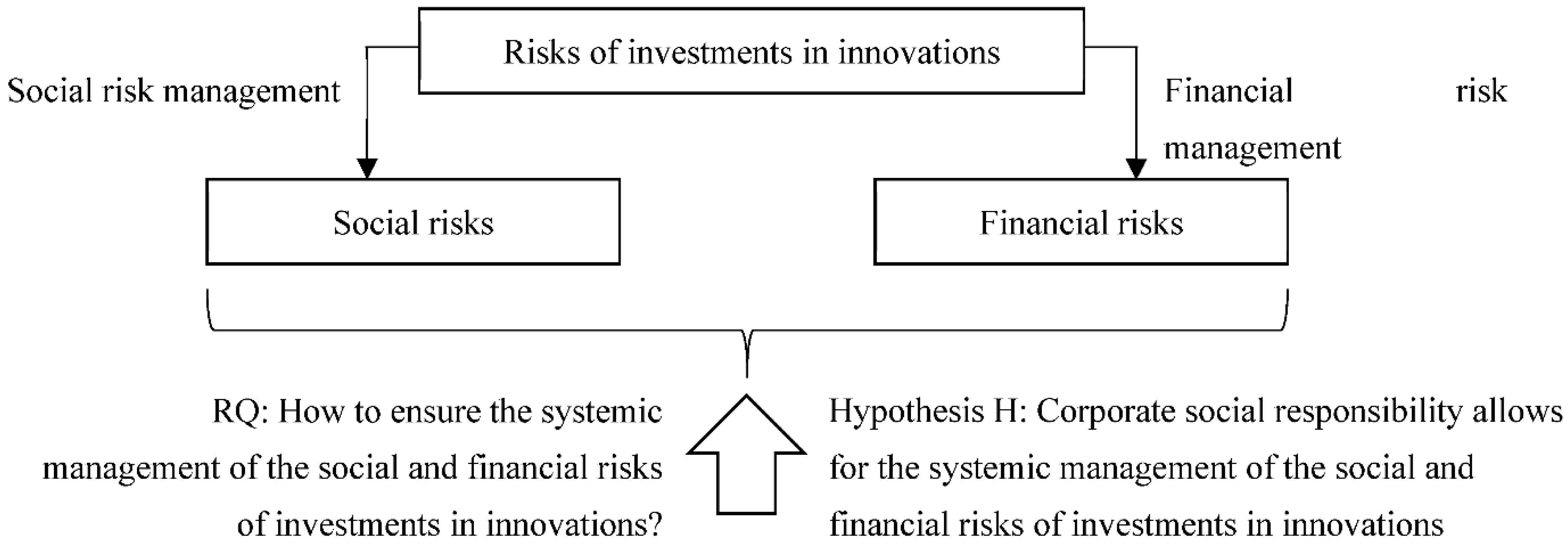
The research question (RQ) and the hypothesis of this study are shown in Figure 1.
Figure 1.
Research question (RQ) and hypothesis of the study. Source: authors.
The formulated goal and tasks predetermined the strategy (logic and order) of this research (Table 4).
Table 4.
Strategy of the research.
The methodology of this research is based on regression analysis, a high-precision method of economic statistics analysis. Its reliability during the study of innovations is confirmed in the works of Chen and Lei (2018), Coad and Rao (2008), and Ebersberger and Herstad (2013).
The empirical basis of the research includes the materials of the interactive map of the World Bank (2021), which contains the statistics of WIPO’s “Global Innovation Index 2021”. The research sample consists of 80 countries for which gaps in the data are absent or almost absent (for the considered indicators). The sample is given in the Supplement. Data were collected with the help of systematization—the statistics from different sources were standardized and brought down to a common list of countries (array of data). The research uses the data for 2021.
According to the research strategy (Table 4), at the first stage (within the first research task), the authors discover the social risks of investments in innovation—from the positions of employees of innovation-active companies. The dependence of the social consequences (Srisk) on investments in innovation (InvestInnov) is found. It takes the following form:
Srisk = σSrisk + μSrisk × InvestInnov
The indicators of the social risks of investments in innovation are as follows:
- –
- Knowledge-intensive employment, % (Srisk1);
- –
- Firms offering formal training, % (Srisk2);
- –
- Labor productivity growth, % (Srisk3);
- –
- Research talent, % in businesses (Srisk4);
- –
- Females employed w/advanced degrees, % (Srisk5).
The indicators of investments in innovation are as follows:
- –
- Venture capital investors, score 0–100 (InvestInnov1);
- –
- GERD financed by business, % (InvestInnov2).
The social risks of investments in innovation are the negative social consequences (for which μSrisk < 0).
At the second stage (within the second research task), the dependence of the financial risks (Frisk) on investments in innovation (InvestInnov) is found. It has the following form:
Frisk = σFrisk1 + μFrisk1 × InvestInnov
The financial risks of investments in innovation are the negative social consequences (for which μFrisk1 < 0).
At the third stage (within the third research task), the dependence of the financial risks (Frisk) on the social consequences of investments in innovation (Srisk)—manifestations of corporate social responsibility—is found. It takes the following form:
Frisk = σFrisk2 + μFrisk2 × Srisk
The target financial results of investments in innovation are as follows:
- –
- High-tech manufacturing, % (Frisk1);
- –
- High-tech exports, % total trade (Frisk2);
- –
- Global brand value, top 5000, % of GDP (Frisk3);
- –
- Intellectual property receipts, % of total trade (Frisk4).
The proposed hypothesis (H) is deemed proved if in such manifestations of corporate social responsibility (Srisk) μresult2 > 0 is found. Based on Equation (3), a framework strategy of systemic management (social and financial) of risks of investments in innovation based on corporate social responsibility is developed.
Then, the evaluation and comparison (using the method of comparative analysis) of the systemic results of managing the social and financial risks (I) are performed:
- –
- During financial risk management—the reduction of the influence of the “human factor” through automatization (Ifin): arithmetic mean of the percentage growth of the indicators of social consequences (Srisk) according to Equation (1) and financial consequences (Frisk) according to Equation (2) with the maximum (100%) values of the indicators of investments in innovation (InvestInov): Ifin = [(∆Sriskfin/5) + (∆Friskfin/4)]/2;
- –
- During the management of social risks—implementation of human-oriented innovations based on corporate social responsibility (Icsr): as the arithmetic mean of the percentage growth of the indicators of social consequences (Srisk) and financial consequences (Frisk) according to Equation (3) with maximum (100%) values of the indicators of social consequences, achieved through corporate social responsibility: Icsr = [(∆Sriskcsr/5) + (∆Friskcsr/4)]/2.
The approach to managing the risks of investments in innovation based on corporate social responsibility is deemed preferable from the positions of systemic risk management if Icsr > Ifin and (∆Sriskcsr/5) > 0 and (∆Friskcsr/4) > 0.
4. Results
4.1. The Social and Financial Risks of Investments in Innovations
For the maximum accuracy of the final results and exclusion of their false treatments, let us perform a multicollinearity test, which allows discovering and excluding the duplicate variables. For this, a matrix of correlation of all variables is compiled (Table 5).
Table 5.
The matrix of cross correlation of the variables.
The results of the correlation analysis from Table 5 do not show the duplicate variables (cross-correlation of which exceeds 0.9 in absolute value). Therefore, multicollinearity is absent, and each variable is unique. The significance level in the correlation matrix equals 0.08 (which is more than 0.05).
Within the solution of the first research task, to identify the social risks of investments in innovation—from the positions of employees of innovation-active companies—according to the presented logic and orders of the research (Figure 1), the dependence of the social consequences (Srisk) on investments in innovation (InvestInnov) is found. It is expressed in Equation (1) (Table 6).
Table 6.
Dependence of the social consequences (Srisk) on investments in innovation (InvestInnov).
The results of the regression analysis (Table 2) demonstrate the presence of two social risks of investments in innovation (the proof is the negative values of μrisk). First, the risk of reduction of the number of jobs and the absence of opportunities for retraining/advanced training. An increase in venture capital investors of 1 score causes a decrease in the share of firms offering formal training of 0.22%. An increase in the share of GERD financed by business of 1% causes a decrease in firms offering formal training of 0.06%. Second, the risk of reduction of opportunities for the development of human potential, expressed in labor productivity. An increase in venture capital investors of 1 score causes a decrease in labor productivity growth of 0.07%.
Consequently, of the five potential social risks (objects of possible social changes under the influence of innovations) from Table 1, only two risks are confirmed—which is a sign of the general moderate level of social risks of investments in innovation. More detailed results of the regression, including the level of significance, R and R-square, F-criterion, and other regression statistics, are given in Table A1, Table A2, Table A3, Table A4 and Table A5 (in Appendix A).
Within the solution of the second research task, to find the financial risks of investments in innovation and compare them to the social risks by their scale, the dependence of the financial results (Frisk) on investments in innovation (InvestInnov) is calculated. It is expressed in Equation (2) (Table 7).
Table 7.
Dependence of the financial consequences (Frisk) on investments in innovation (InvestInnov).
As shown in Table 7, almost all discovered dependencies are positive (μFrisk1 > 0), which is a sign of the low financial risks of investments in innovation. The only revealed negative change of the financial indicators of companies’ activity during investing in innovations is a slight decrease in high-tech export (by 0.02%, which is neglectfully small).
The comparative analysis of the results from Table 6 and Table 7 shows that the financial risks of investments in innovation (0.02) are much lower than the social risks (0.22 + 0.06 + 0.07 = 0.35). That is why the management of social risks is of higher priority, which strengthens the scientific arguments in favor of the expedience of using corporate social responsibility during the systemic management of risks of investments in innovation. More detailed results of the regression, including the level of significance, R and R-square, F-criterion, and other regressions statistics, are given in Table A6, Table A7, Table A8 and Table A9.
4.2. Advantages of the Management of Social and Financial Risks of Investments in Innovations Based on Corporate Social Responsibility
Within the solution of the third research task, to substantiate the advantages of management of the social and financial risks of investments in innovation based on corporate social responsibility, the dependence of the financial results (Frisk) on social consequences of investments in innovation (Srisk)—manifestations of corporate social responsibility—is found. It is expressed in Equation (3) (Table 8).
Table 8.
Dependence of the financial consequences (Frisk) on social consequences of investments in innovation (Srisk).
As shown in Table 8, corporate social responsibility, which is manifested through allowing a company’s employees to participate in the creation of innovations, is a universal factor that makes a significant positive contribution to the decrease in social and financial risks of investments in innovation. More detailed results of the regression, including the level of significance, R and R-square, F-criterion, and other regressions statistics, are given in Table A10, Table A11, Table A12 and Table A13.
An increase in the share of business structures that support research talent of 1% causes an increase in high-tech manufacturing of 0.51%; an increase in high-tech exports of 0.53%; an increase in total trade, global brand value of the top 500 of 0.45% of GDP; and an increase in intellectual property receipts of 0.42% of total trade. Therefore, there is a systemic interconnection between the social and financial risks of investments in innovation, as well as the potential possibility of complex management of all these risks (hypothesis H was proved).
It is also established that such a targeted financial result of investments in innovation as an increase in the share of high-tech manufacturing has positive dependence on all manifestations of corporate social responsibility. Since there are many such manifestations of corporate social responsibility (Srisk) for which μFrisk2 > 0 (they are all considered manifestations of corporate social responsibility), the offered hypothesis (in Figure 1—Hypothesis H) is deemed proved. However, the manifestations of the aggravation of the financial risks of investments in innovation during companies’ manifestation of corporate social responsibility are discovered (“*” in Table 4).
Therefore, corporate social responsibility really (as is supposed in the existing literature) raises, to a certain extent, some financial risks of investments in innovation (which supplements and develops the scientific provisions of the works of Boasson and Boasson 2015; Huang et al. 2021a; Lubberink et al. 2017; van de Poel et al. 2017; Zhao and Wang 2019). However, corporate social responsibility significantly contributes to the reduction of other financial risks, increasing the effect of investments in innovation (which supplements and develops the scientific provisions of the works of Hadj 2020; Kharlanov et al. 2022; Paredes-Frigolett 2016; Polukhin and Panarina 2022; Wu 2017). This allows for the simultaneous management of the financial and social risks of investments in innovation based on the universal mechanism of risk management of investments in innovation—corporate social responsibility.
4.3. The Systemic Approach to Managing the Risks of Investments Based on Corporate Social Responsibility
Using the results of the regression analysis from Table 4, a framework strategy of the systemic risk management of investments in innovation based on corporate social responsibility was developed. According to it, the recommendations are as follows:
- –
- Reduce the social risks of investments in innovation through (1) creation of additional jobs and providing employees with the opportunities for retraining/advanced training based on formal training in innovation-active companies and (2) expansion of opportunities for the development of human potential, which is expressed in labor productivity during investments in innovation;
- –
- Strive toward the fullest development of the potential of increase in the share of high-tech manufacturing through the complex maximization of the social advantages of corporate social responsibility while investing in innovation;
- –
- Support financial risk management of investments in innovation, with the help of corporate social responsibility, to obtain a synergetic effect in the form of an even larger increase in the targeted financial results through (1) increase in knowledge-intensive jobs, (2) expansion of opportunities of employees’ participation in the creation of innovations and (3) increase in gender neutrality of jobs.
The proved presence of the possibility does not mean the expedience of the simultaneous management of the financial and social risks of investments in innovation, which has yet to be proved. For this, the systemic results of managing the social and financial risks are evaluated (I).
During financial risk management—reduction of the influence of the “human factor” through automatization (Ifin)—the systemic results of managing the social and financial risks are determined based on the data from Table 2 and Table 3. At the maximum (100%/100 score) values of the indicators of investments in innovation (InvestInov), the consequences are as follows (Table 9).
Table 9.
Consequences of managing the financial risks—reduction of the influence of the “human factor” through automatization.
As shown in Table 9, the arithmetic mean of the percentage growth of the indicators of social consequences (Srisk) is as follows: ∆Sriskfin/5 = (83.03 − 81.30 − 6.40 + 151.64 + 93.29)/5 = 48.05. The arithmetic mean of the financial results (Frisk) is as follows: ∆Friskfin/4 = (94.70 + 99.36 + 234.85 + 296.74)/4 = 181.41. During the management of financial risks—reduction of the influence of the “human factor” through automatization—the results of managing the social and financial risks are as follows: Ifin = [(∆Sriskfin/5) + (∆Friskfin/4)]/2 = (48.05 + 181.41)/2 = 107.32.
During the management of the social risks—implementation of human-oriented innovations based on corporate social responsibility (Icsr)—the systemic results of managing the social and financial risks are determined based on the data from Table 4. At the maximum (100%) social consequences, which are achieved due to corporate social responsibility, the consequences are as follows (Table 10).
Table 10.
Consequences of the full-scale implementation of a new (socially-oriented) strategy of managing the risks of investments in innovation that is based on corporate social responsibility.
As shown in Table 10, the arithmetic mean of the percentage growth of the indicators of the social consequences (Srisk) is as follows: ∆Sriskcsr/5 = (112.82 + 295.53 + 71.38 + 176.65 + 129.78)/5 = 157.23. The arithmetic mean of the financial results (Frisk) is as follows: ∆Friskcsr/4 = (97.25 + 161.11 + 59.01 + 169.00)/4 = 121.59. In the new (socially-oriented) strategy of managing the risks of investments in innovation, which is based on corporate social responsibility, the systemic results of managing the social and financial risks are as follows: Icsr = [(∆Sriskcsr/5) + (∆Friskcsr/4)]/2 = (157.23 + 121.59)/2 = 141.39.
Since Icsr > Ifin (141.39 > 107.32) and (∆Sriskcsr/5) > 0 (157.23 > 0) and (∆Friskcsr/4) > 0 (121.59 > 0), the approach to managing the risks of investments in innovation based on corporate social responsibility is considered preferable.
This is confirmed not only at the level of generalized results but also at the level of the specific results, for in case of the approach to managing the financial risks—reduction of the influence of the “human factor” through automatization—the social risks aggravate: firms offering formal training (∆Srisk2 < 0) and labor productivity growth (∆Srisk3 < 0) reduce. In contrast, the approach to managing the risks of investments in innovation based on corporate social responsibility does not lead to growth; on the contrary, it reduced each social and financial risk of investments in innovation.
The advantages of the systemic risk management of investments in innovation based on corporate social responsibility through the lens of the SDGs are systematized in Table 11.
Table 11.
Advantages of the systemic risk management of investments in innovation based on corporate social responsibility.
The information presented in Table 11 specifies the systemic view of social and financial risks of managing the investments in innovations and the consequences of risk management (Table 3). It was proved that the implementation of human-oriented innovations based on the mechanism of corporate social responsibility allows for the simultaneous (systemic) and highly effective management of all—social and financial—risks of investments in innovation.
The developed framework strategy of the systemic risk management of investments in innovation—which is based on corporate social responsibility—ensures the following advantages (from the positions of sustainable development):
- –
- Contribution to the achievement of SDG 4: retraining/advanced training of personnel based on formal training to prevent personnel cuts—an increase in the number of jobs by 71.38%;
- –
- Contribution to the achievement of SDG 5: provision of gender-neutral jobs—an increase in the number of supported females as creative personnel to preserve the “healthy” working climate in the company by 129.78;
- –
- Contribution to the achievement of SDG 8 (decent work): first, an increase in knowledge intensity of employment for the human control of machines by 112.82%. Second, improvement of labor conditions for the development of human potential and growth of labor efficiency by 295.53%;
- –
- Contribution to the achievement of SDG 8 (economic growth) and SDG 9: first, creation of own innovations with the maximum involvement of company employees in this process. Second, simplification/support of selling high-tech innovations. Third, the growth of competitiveness of business due to needed innovations—the growth of high-tech manufacturing by 97.25%; growth of high-tech exports by 161.11%; growth of global brand value (top 500) by 59.01%; growth of intellectual property receipts by 169%.
5. Discussion
This paper contributes to the development of the theory of managing the risks of investments in innovation, through the quantitative measuring of the social and financial risks of investments in innovation and proposing a mechanism of the complex management of these risks that are based on corporate social responsibility. The revealed universal mechanism—providing the company’s employees with an opportunity to participate in the creation of innovations—answered the set research question, demonstrating that corporate social responsibility allows for the systemic management of the social and financial risks of investments in innovations.
Contrary to the existing literature sources, the results that were obtained in this article show the following:
- –
- Corporate social responsibility raises the economic effectiveness of investments in innovation (facilitates the achievement of companies’ targeted financial results), which is different from the assumptions proposed in various studies (Ali et al. 2021; Divella and Sterlacchini 2021; Weinberger et al. 2021);
- –
- Financial and social risks of investments in innovation could and should (useful for companies) be managed systemically. Contrary to various studies (Ghiasi et al. 2021; Pīlēna et al. 2021; Szemere et al. 2021), a common solution (universal management mechanism) was found—corporate social responsibility.
The obtained conclusions form the scientific arguments for the choice of the developed strategy of the systemic management of investments in innovations, which is based on corporate social responsibility. Due to the results obtained, this paper has filled in the research gaps and contributed to the literature in the following way:
- –
- Forming a clear and complex view of the social and financial risks of investments in innovation: most of the risks are not implemented in practice, i.e., have a low probability of emergence;
- –
- Quantitatively measuring these risks and proving that the level of financial risks (risk of reduction of high-tech export: μFrisk1 = −0.02%) is below the level of social risks (risk of reduction of jobs and absence of the possibilities for retraining/advanced training: μSrisk1 = 0.22%; μSrisk2 = 0.06%; risk of reduction of possibilities for the development of human potential, which is expressed in labor efficiency: μSrisk = 0.07%) of investments in innovation;
- –
- Proving the contribution of corporate social responsibility to the reduction of all financial risks of investments in innovation: intellectual property receipts +0.61% (∑μFrisk2 = 0.06 + 0.01 + 0 + 0.51 + 0.03); high-tech manufacturing +0.67% (∑μFrisk2 = −0.08 + 0.12 + 0.14 + 0.53 − 0.04); high-tech exports +0.17% (∑μFrisk2 = 0 − 0.17 − 0.08 + 0.45 − 0.03); global brand value +0.565% of GDP (∑μFrisk2 = 0.14 − 0.12 − 0.15 + 0.42 + 0.27).
The practical significance of the authors’ conclusions and recommendations is as follows: the developed framework strategy of the systemic risk management of investments in innovation based on corporate social responsibility allows optimizing the consequences of investments in innovation: reducing the social risks by 157.23% and financial risks by 121.59%.
6. Conclusions
The complex resolution of the set tasks allowed achieving the goal of this research: developing a framework strategy of the systemic management of the risks of investments in innovations based on corporate social responsibility.
Within the framework of the first task, the authors revealed and quantitatively measured the social risks of investments in innovation. The authors revealed two social risks of investments in innovation. The first risk: reduction of the number of jobs and absence of opportunities for retraining/advanced training (0.22%). The second risk: reduction of opportunities for the development of human potential, which is expressed in labor productivity (0.06%).
Within the framework of the second task, the authors identified the only financial risk of investments in innovation: a negative change of the financial indicators of company activity during investing in innovations is an insignificant decrease in high-tech export (by 0.02%, which is neglectfully small). The authors compared the risks by their scale and revealed that the social risks are much higher than the financial risks (0.28 > 0.02). This is a reason why social risks are the priorities of risk management.
Within the framework of the third task, the authors substantiated the advantages of management of social and financial risks of investments in innovation based on corporate social responsibility. Corporate social responsibility ensures the improvement of all considered financial indicators of investments in innovation: intellectual property receipts +0.61%, high-tech manufacturing +0.67%, high-tech exports +0.17%, and global brand value +0.565% of GDP.
As a result, the sought framework strategy of the systemic risk management of investments in innovation based on corporate social responsibility was developed. The main provisions of the authors’ framework strategy are as follows: (1) prioritized reduction of the social risks of investments in innovation, (2) striving toward the fullest development of the potential of growth of the share of high-tech manufacturing, (3) support of other targeted positive financial consequences, which are achieved through investments in innovation, with the help of corporate social responsibility, to gain a synergetic effect. These provisions are supplemented with practical (specifying) recommendations. The strategy allows reducing the social risks by 157.23% on average and financial risks by 121.59% on average.
The theoretical significance of the conclusions obtained consists in proving that the systemic risk management of social and financial risks of investments in innovation is possible based on the managerial mechanism of corporate social responsibility. The proposed hypothesis was proved. Corporate social responsibility is universal, for it ensures the systemic reduction of the social and financial risks of investments in innovation. The above results determine the paper’s contribution to the literature (to the development of the theory of managing the risks of investments in innovation).
The practical value of the authors’ conclusions consists in providing the objective proof of the necessity for a deep change in the existing practice of managing the risks of investments in innovations. Corporate social responsibility should move to the foreground of managing these risks. The authors’ developed strategy opens a possibility for the systemic management of the risks of investments in innovations based on providing employees with an opportunity to participate in the creation of innovation and demonstrates the vivid advantages of this strategy in the form of reduction of the social and financial risks.
The proposed strategy would be especially useful for companies that are leaders in the spheres of the economy—large and transnational businesses, which pay a lot of attention to corporate social responsibility and sustainable development. The contradiction in the system of risk management is dealt with in the new strategy, which allows increasing the scale of the programs of corporate social responsibility without any limitations. From the practical point of view, the proprietary strategy is also to support investments in innovations among small and medium entrepreneurship, which is the least sustainable and urgently needs systemic risk management under the conditions of economic restoration after the COVID-19 crisis.
Management implications consist in substantiating the necessity for the correction of the practice of managing the risks of investments in innovation, during which much more attention should be paid to corporate social responsibility than was considered previously. Social implications are due to the proposed strategy ensuring the maximization and systemic character of the contribution of investments in innovation to the practical implementation of SDG 4, SDG 5, SDG 8, and SDG 9.
Despite the generally positive impact on the financial consequences of investments in innovation, corporate social responsibility is more effective (by its nature) in the reduction of the social risks of investments in innovation. This is shown by the fact that though the general level of the financial risks reduces during the use of the mechanism of corporate social responsibility, there is still a certain decrease in the financial consequences of investments in innovation. Thus, a decrease during certain manifestations of corporate social responsibility is observed in high-tech exports, global brand value, and intellectual property receipts.
A limitation of the performed research is that corporate social responsibility is proposed as an alternative to automatization. Under the conditions of the Fourth Industrial Revolution, further automatization is inevitable and necessary for the accelerated restoration of the world economy and entrepreneurship after the COVID-19 crisis. Though the obtained results are valuable because they allow overcoming the contradiction between the social and financial risks and ensuring their systemic management, this seems to be only an intermediary result on the path of the optimization of risk management of investments in innovation. The revealed Pareto optimality (proposed framework strategy) is effective, but further scientific search aimed at the harmonization of automatization and corporate social responsibility is expedient. This should be done in the next scientific studies.
Most likely, the discovered universal mechanism of the systemic management of the risks of investments in innovations—providing company’s employees with the opportunity to participate in the creation of innovations—is the first of the range of such mechanisms that allow for the simultaneous (and without contradiction) reduction of the social and financial risks of the business. This opens a wide field for further scientific search for other mechanisms, which should be done in the next scientific works.
Author Contributions
Conceptualization, L.S.K.; Formal analysis, N.A.F.; Methodology, V.V.L.; Project administration, N.A.D.; Resources, L.S.K., V.V.L.; Writing—review & editing, N.A.D. and N.A.F. All authors have read and agreed to the published version of the manuscript.
Funding
This research received no external funding.
Data Availability Statement
Not applicable.
Conflicts of Interest
The authors declare no conflict of interest.
Appendix A
Table A1.
Regression statistics of the dependence Srisk1 on investments in innovation (InvestInnov).
Table A2.
Regression statistics of the dependence Srisk2 on investments in innovation (InvestInnov).
Table A3.
Regression statistics of the dependence Srisk3 on investments in innovation (InvestInnov).
Table A4.
Regression statistics of the dependence Srisk4 on investments in innovation (InvestInnov).
Table A5.
Regression statistics of the dependence Srisk5 on investments in innovation (InvestInnov).
Table A6.
Regression statistics of the dependence of Frisk1 on investments in innovation (InvestInnov).
Table A7.
Regression statistics of the dependence of Frisk2 on investments in innovation (InvestInnov).
Table A8.
Regression statistics of the dependence of Frisk3 on investments in innovation (InvestInnov).
Table A9.
Regression statistics of the dependence of Frisk4 on investments in innovation (InvestInnov).
Table A10.
Regression statistics of the dependence of Frisk1 on social consequences of investments in innovation (Srisk).
Table A11.
Regression statistics of the dependence of Frisk2 on social consequences of investments in innovation (Srisk).
Table A12.
Regression statistics of the dependence of Frisk3 on social consequences of investments in innovation (Srisk).
Table A13.
Regression statistics of the dependence of Frisk4 on social consequences of investments in innovation (Srisk).
References
- Ali, Mosataf, Nazimad Hussin, Hossam Haddad, Reem Al-Araj, and Ibtihal Abed. 2021. Intellectual capital and innovation performance: Systematic literature review. Risks 9: 170. [Google Scholar] [CrossRef] [Scilit]
- Boasson, Vagdis, and Emil Boasson. 2015. Firm value, spatial knowledge flow, and innovation: Evidence from patent citations. China Finance Review International 5: 132–60. [Google Scholar] [CrossRef] [Scilit]
- Brewster, Amanda, Teressa Fraze, Laura Gottlieb, Gottlieb Murray, Jennifer Frehn, Genevra Murray, and Valerie Lewis. 2020. The Role of Value-Based Payment in Promoting Innovation to Address Social Risks: A Cross-Sectional Study of Social Risk Screening by US Physicians. Milbank Quarterly 98: 1114–33. [Google Scholar] [CrossRef] [Scilit] [PubMed]
- Busch, Peter, and Debbie Richards. 2006. Acquiring innovation knowledge. Lecture Notes in Computer Science 4303 LNAI: 252–57. [Google Scholar] [CrossRef] [Scilit]
- Carlini, Joan, and Debra Grace. 2021. The corporate social responsibility (CSR) internal branding model: Aligning employees’ CSR awareness, knowledge, and experience to deliver positive employee performance outcomes. Journal of Marketing Management 37: 732–60. [Google Scholar] [CrossRef] [Scilit]
- Chen, Wenhui, and Yalin Lei. 2018. The impacts of renewable energy and technological innovation on environment-energy-growth nexus: New evidence from a panel quantile regression. Renewable Energy 123: 1–14. [Google Scholar] [CrossRef] [Scilit]
- Chi, NguyenThiKhanh. 2021. Innovation capability: The impact of e-CRM and COVID-19 risk perception. Technology in Society 67: 101725. [Google Scholar] [CrossRef] [Scilit]
- Coad, Alex, and Rekha Rao. 2008. Innovation and firm growth in high-tech sectors: A quantile regression approach. Research Policy 37: 633–48. [Google Scholar] [CrossRef] [Scilit]
- Divella, Marialuisa, and Alessandro Sterlacchini. 2021. Determinants of sustainable & responsible innovation: A firm-level analysis for Italy. Structural Change and Economic Dynamics 59: 360–74. [Google Scholar] [CrossRef] [Scilit]
- Ebersberger, Bernd, and Sverre Herstad. 2013. The relationship between international innovation collaboration, intramural R&D and SMEs’ innovation performance: A quantile regression approach. Applied Economics Letters 20: 626–30. [Google Scholar] [CrossRef] [Scilit]
- Ghiasi, Gita, Catherine Beaudry, Vincent Larivière, Carl St-Pierre, Andrea Schiffauerova, and Matthew Harsh. 2021. Who profits from the Canadian nanotechnology reward system? Implications for gender-responsible innovation. Scientometrics 126: 7937–91. [Google Scholar] [CrossRef] [Scilit]
- Hadj, Tarek Bel. 2020. Effects of corporate social responsibility towards stakeholders and environmental management on responsible innovation and competitiveness. Journal of Cleaner Production 250: 119490. [Google Scholar] [CrossRef] [Scilit]
- Hu, Hong, Liying Chen, Yuxuan Zhou, Yuan Liu, and Qunzhen Qu. 2021. Unpacking the effects of organizational slack on exploitative and exploratory innovation: A study of knowledge-intensive firms. Innovation: Organization and Management. [Google Scholar] [CrossRef] [Scilit]
- Huang, Hongbin, Yani Sun, and Qingling Chu. 2021a. Can we-media information disclosure drive listed companies’ innovation?—From the perspective of financing constraints. China Finance Review International. [Google Scholar] [CrossRef] [Scilit]
- Huang, Hsini, Brian Pin-Hsuan Chang, Calvin Zhou-Peng Liao, and Don-Yun Chen. 2021b. A matter of risk management: The effects of the innovation sandboxes on citizens’ risk perceptions. ACM International Conference Proceeding Series 3463738: 281–85. [Google Scholar] [CrossRef] [Scilit]
- Inshakova, Agnessa, Anastasia Sozinova, and Tatiana Litvinova. 2021. Corporate Fight against the COVID-19 Risks Based on Technologies of Industry 4.0 as a New Direction of Social Responsibility. Risks 9: 212. [Google Scholar] [CrossRef] [Scilit]
- Kharlanov, Alexey, Yuliya Bazhdanova, Teimuraz Kemkhashvili, and Natalia Sapozhnikova. 2022. The Case Experience of Integrating the SDGs into Corporate Strategies for Financial Risk Management Based on Social Responsibility (with the Example of Russian TNCs). Risks 10: 12. [Google Scholar] [CrossRef] [Scilit]
- Lee, Sang, and Silvana Trimi. 2018. Innovation for creating a smart future. Journal of Innovation and Knowledge 3: 1–8. [Google Scholar] [CrossRef] [Scilit]
- Li, Guo, Na Li, and Suresh Sethi. 2021a. Does CSR Reduce Idiosyncratic Risk? Roles of Operational Efficiency and AI Innovation. Production and Operations Management 30: 2027–45. [Google Scholar] [CrossRef] [Scilit]
- Li, Xing, Yue Guo, Jiani Hou, and Jun Liu. 2021b. Human Capital Allocation and Enterprise Innovation Performance: An Example of China’s Knowledge-Intensive Service Industry. Research in International Business and Finance 58: 101429. [Google Scholar] [CrossRef] [Scilit]
- Li, Xu, and Freek Vermeulen. 2021. High risk, low return (and vice versa): The effect of product innovation on firm performance in a transition economy. Academy of Management Journal 64: 1383–418. [Google Scholar] [CrossRef] [Scilit]
- Liu, Bai, Tao Ju, and Simon Gao. 2021. The combined effects of innovation and corporate social responsibility on firm financial risk. Journal of International Financial Management and Accounting 32: 283–310. [Google Scholar] [CrossRef] [Scilit]
- Lou, Zhukun, Siyu Chen, Wenwei Yin, Chuan Zhang, and Xiaoyu Yu. 2022. Economic policy uncertainty and firm innovation: Evidence from a risk-taking perspective. International Review of Economics and Finance 77: 78–96. [Google Scholar] [CrossRef] [Scilit]
- Lubberink, Rob, Vincent Blok, Johan Van Ophem, and Onno Omta. 2017. Lessons for responsible innovation in the business context: A systematic literature review of responsible, social and sustainable innovation practices. Sustainability 9: 721. [Google Scholar] [CrossRef] [Scilit]
- Maglio, Paul, and Chie-Hyeon Lim. 2016. Innovation and big data in smart service systems. Journal of Innovation Management 4: 1–11. [Google Scholar] [CrossRef] [Scilit]
- Nicolopoulou, Katerina. 2011. Towards a theoretical framework for knowledge transfer in the field of CSR and sustainability. Equality, Diversity and Inclusion 30: 524–38. [Google Scholar] [CrossRef] [Scilit]
- Oswal, Prasad, Winfried Ruigrok, and Narendra Agrawal. 2014. Acquiring firm-specific advantages: Organizational innovation and internationalization at Indian multinational corporations. International Finance Review 15: 3–33. [Google Scholar] [CrossRef] [Scilit]
- Owalla, Beldina, Elvis Nyanzu, and Tim Vorley. 2021. Intersections of gender, ethnicity, place and innovation: Mapping the diversity of women-led SMEs in the United Kingdom. International Small Business Journal: Researching Entrepreneurship 39: 681–706. [Google Scholar] [CrossRef] [Scilit]
- Papa, Armando, Alice Mazzucchelli, Luca Vincenzo Ballestra, and Antonio Usai. 2021. The open innovation journey along heterogeneous modes of knowledge-intensive marketing collaborations: A cross-sectional study of innovative firms in Europe. International Marketing Review. [Google Scholar] [CrossRef] [Scilit]
- Paredes-Frigolett, Harold. 2016. Modeling the effect of responsible research and innovation in quadruple helix innovation systems. Technological Forecasting and Social Change 110: 126–33. [Google Scholar] [CrossRef] [Scilit]
- Pīlēna, Arta, Iveta Mežinska, and Inga Lapiņa. 2021. Standardization as a catalyst for open and responsible innovation. Journal of Open Innovation: Technology, Market, and Complexity 7: 187. [Google Scholar] [CrossRef] [Scilit]
- Polukhin, Andrey, and Veronika Panarina. 2022. Financial Risk Management for Sustainable Agricultural Development Based on Corporate Social Responsibility in the Interests of Food Security. Risks 10: 17. [Google Scholar] [CrossRef] [Scilit]
- Prowse, Victoria. 2009. Estimating labor supply elasticities under rationing: A structural model of time allocation behaviour. Canadian Journal of Economics 42: 90–112. [Google Scholar] [CrossRef] [Scilit]
- Purnomo, Hadi, WakhidSlamet Ciptono, and Hargo Utomo. 2021. The emerging of dynamic capabilities for socially responsible operations and innovation development in the covid-19 pandemic situation. Paper presented at International Conference on Industrial Engineering and Operations Management, Singapore, March 7–11; pp. 7046–54. [Google Scholar]
- Ragulina, Julia, Vladimir Ukolov, and Oleg Shabunevich. 2021. Adaptation to the Risks of Digitalization: New Survival Trends for States in a Multipolar World. Risks 9: 218. [Google Scholar] [CrossRef] [Scilit]
- Restrepo, Natalia, Alfonso Unceta, and Xabier Barandiaran. 2021. Gender diversity in research and innovation projects: The proportion of women in the context of higher education. Sustainability 13: 5111. [Google Scholar] [CrossRef] [Scilit]
- Roszkowska-Menkes, Maria Teresa. 2018. Integrating strategic CSR and open innovation. Towards a conceptual framework. Social Responsibility Journal 14: 950–66. [Google Scholar] [CrossRef] [Scilit]
- Ruggiero, Pasquale, and Sebastiano Cupertino. 2018. CSR strategic approach, financial resources and corporate social performance: The mediating effect of innovation. Sustainability 10: 3611. [Google Scholar] [CrossRef] [Scilit]
- Sareen, Amit, and Sharadindu Pandey. 2021. Organizational Innovation in Knowledge Intensive Business Services: The role of Networks, Culture and Resources for Innovation. FIIB Business Review. [Google Scholar] [CrossRef] [Scilit]
- Suto, Megumi, and Hitoshi Takehara. 2021. Impact of corporate social responsibility intensity on firm-specific risk and innovation: Evidence from Japan. Social Responsibility Journal. [Google Scholar] [CrossRef] [Scilit]
- Szemere, Tibor Pal, Monoka Garai-Fodor, and Agnes Csiszárik-Kocsir. 2021. Risk approach—Risk hierarchy or construction investment risks in the light of interim empiric primary research conclusions. Risks 9: 84. [Google Scholar] [CrossRef] [Scilit]
- Tambosi, Jandir, Giancarlo Gomes, Linda Jessica De Montreuil Carmona, and Silvana Silva Viera Tambosi. 2021. Organizational culture and work-life balance as facilitators of service innovation: Study in a technology knowledge-intensive business services firm. International Journal of Innovation Management 25: 2130002. [Google Scholar] [CrossRef] [Scilit]
- Tian, Hong, and Jiahui Tian. 2021. The mediating role of responsible innovation in the relationship between stakeholder pressure and corporate sustainability performance in times of crisis: Evidence from selected regions in China. International Journal of Environmental Research and Public Health 18: 7277. [Google Scholar] [CrossRef] [Scilit]
- van de Poel, Ibo, Lotte Asveld, Steven Flipse, Pim Klaassen, Victor Scholten, and Emad Yaghmaei. 2017. Company strategies for responsible research and innovation (RRI): A conceptual model. Sustainability 9: 2045. [Google Scholar] [CrossRef] [Scilit]
- Wang, Qiang, and Zegun Dong. 2022. Technological innovation and renewable energy consumption: A middle path for trading off financial risk and carbon emissions. Environmental Science and Pollution Research. [Google Scholar] [CrossRef] [Scilit] [PubMed]
- Weinberger, Nora, Silvia Woll, Christofer Conrad Maximillian Kyba, and Nona Schulte-Römer. 2021. The value of citizen participation in technology assessment, responsible research and innovation, and sustainable development. Sustainability 13: 11613. [Google Scholar] [CrossRef] [Scilit]
- World Bank. 2021. Explore the Interactive Database of the WIPO Global Innovation Index 2021 Indicators. Available online: https://www.globalinnovationindex.org/analysis-indicator (accessed on 14 February 2022).
- Wu, Guo-Ciang. 2017. Effects of Socially Responsible Supplier Development and Sustainability-Oriented Innovation on Sustainable Development: Empirical Evidence from SMEs. Corporate Social Responsibility and Environmental Management 24: 661–75. [Google Scholar] [CrossRef] [Scilit]
- Xi, Xun, Tianyu Hu, Yueyue Zhang, Xiaoping Wang, Dengfeng Huang, Feng Hu, and Haiyan Zhou. 2020. The Knowledge Spillover Risks Management Framework for Collaborative Innovation. IOP Conference Series: Materials Science and Engineering 768: 052015. [Google Scholar] [CrossRef] [Scilit]
- Yu, Jian, and Jiasha Fu. 2021. Credit rationing, innovation, and productivity: Evidence from small- and medium-sized enterprises in China. Economic Modelling 97: 220–30. [Google Scholar] [CrossRef] [Scilit]
- Zhao, Qifeng, and Yongzhong Wang. 2019. Pay gap, inventor promotion and corporate technology innovation. China Finance Review International 9: 154–82. [Google Scholar] [CrossRef] [Scilit]
- Zheng, Pai, Tzu-Jui Lin, Chun-Hsien Chen, and Xun Xu. 2018. A systematic design approach for service innovation of smart product-service systems. Journal of Cleaner Production 201: 657–67. [Google Scholar] [CrossRef] [Scilit]

Publisher’s Note: MDPI stays neutral with regard to jurisdictional claims in published maps and institutional affiliations. |
© 2022 by the authors. Licensee MDPI, Basel, Switzerland. This article is an open access article distributed under the terms and conditions of the Creative Commons Attribution (CC BY) license (https://creativecommons.org/licenses/by/4.0/).