


Abstract
Mind-body interventions (MBIs) are one of the top ten complementary approaches utilized in pediatrics, but there is limited knowledge on associated adverse events (AE). The objective of this review was to systematically review AEs reported in association with MBIs in children. In this systematic review the electronic databases MEDLINE, Embase, CINAHL, CDSR, and CCRCT were searched from inception to August 2018. We included primary studies on participants ≤ 21 years of age that used an MBI. Experimental studies were assessed for whether AEs were reported on or not, and all other study designs were included only if they reported an AE. A total of 441 were included as primary pediatric MBI studies. Of these, 377 (85.5%) did not explicitly report the presence/absence of AEs or a safety assessment. There were 64 included studies: 43 experimental studies reported that no AE occurred, and 21 studies reported AEs. There were 37 AEs found, of which the most serious were grade 3. Most of the studies reporting AEs did not report on severity (81.0%) or duration of AEs (52.4%). MBIs are popularly used in children; however associated harms are often not reported and lack important information for meaningful assessment.
1. Introduction
Mind-body (MB) interventions are types of complementary therapies designed “with the intent to use the mind to affect physical functioning and promote health” [1]. They are a diverse group of modalities including biofeedback, hypnosis, and meditation, and have been utilized at least once by 5.3% of children in the United States aged 4–17 [2]. The popularity of MB interventions in pediatrics is increasing [3,4,5], as evidenced by a repeated survey (2007 and 2012) that demonstrated that their use had increased from 2.5% to 3.2% amongst children 4–17 years old [6]. Hypnosis and biofeedback are amongst the most commonly utilized MB therapies and are used to treat a variety of conditions including chronic pain, headache, enuresis and IBS [2,3]. Advantages of these therapies include their non-invasive nature, cost-effectiveness, and promotion of self-efficacy in pediatric patients that can contribute to improved coping skills and resiliency [7].
Safety of any health intervention is of great importance for patients and clinicians [8]. Safety can be assessed through monitoring for adverse events (AE), which are defined as “any unfavorable and unintended sign, symptom, or disease temporally associated with the use of a medical treatment or procedure” [9].
There is a recognized need for improvement in the assessment and reporting of harms [10,11]. Clinical trials are designed to collect, evaluate, and report harms associated with interventions [12]. However, randomized controlled trials (RCT) cannot be relied on to capture many AEs associated with an intervention due to inadequate sample sizes and trial duration to assess long-term harms, homogeneous populations that do not represent intervention use in real-world practice, and lack of harm assessments as primary objectives [8,13,14,15]. Unpublished supplemental data from RCTs and published data from controlled observational studies including case-control and cohort studies should additionally be scrutinized for AEs [8]. Uncontrolled studies including case reports and case series can also identify AEs, but are limited by a high probability of selection bias and lack of direct causal association between AEs and the intervention [8].
Systematic reviews of the literature seek to provide a high quality, unbiased, and comprehensive summary of evidence [16], yet less than 10% report harms as a primary objective [17]. Reviews of this kind synthesize valuable data regarding AEs, which allows health care practitioners and patients to make informed decisions with consideration to an intervention’s harms and benefits [17].
While the interest in and use of MB approaches is increasing, there are limited formal data synthesized about their potential harms. The primary objective of this review was to systematically identify and synthesize available data on the adverse events associated with MB therapies in pediatric patients.
2. Materials and Methods
The PRISMA guidelines were followed to develop and conduct this systematic review [18].
2.1. Data Sources
A comprehensive search strategy was developed in conjunction with a health research librarian and run in five electronic databases. The following databases were searched from inception to August 2018: MEDLINE (1946–2018), EMBASE (1974–2018), CINAHL (1937–2018), the Cochrane Database of Systematic Reviews (2005–2018), and the Cochrane Central Registry of Controlled Trials (CENTRAL) (1991–2018). Additional references were obtained by hand-searching the Google Scholar web search engine. A copy of the Medline search strategy can be found in Appendix A.
2.2. Study Selection
After removing duplicates, two review authors (ML and KKG/MF) screened the titles and abstracts of identified citations. Full text articles deemed to be potentially relevant were retrieved for full review and assessed by two independent review authors (ML, KKG/MF) using a predetermined set of inclusion criteria: (i) primary investigation/report (i.e., not a review, commentary); (ii) pediatric participants (0 to 21 years of age); and (iii) studied a MB intervention (see Appendix B). Interventional and observational studies including RCTs, CCTs, single-arm experimental, prospective cohort, case-control, and controlled before and after studies were included and evaluated for any assessment of safety/AE. These studies were categorized if they (i) assessed safety and reported AE, (ii) assessed safety and reported no AE, or (iii) did not report on safety or AEs of the intervention. Case reports, case series and any remaining observational studies were only included if they reported an AE. Non-English articles were excluded. Disagreement was resolved by discussion and if required, consultation with a senior review author, until consensus was reached.
2.3. Data Extraction
Data was extracted by a review author (ML) using a structured data-extraction form and verified by second reviewers (CB, MF). General (study methods, settings, age, sex, etc.) and specific (AEs, timing, etc.) information was extracted from the included studies. If further information was required, the corresponding author of the study was contacted. Disagreement was resolved by consensus.
2.4. Data Synthesis
The severity of the AEs was assessed by two reviewers (ML and MF) using the Common Terminology Criteria for Adverse Events (CTCAE) [9]; discrepancies were resolved by a third review author. The following categories were used: grade 1 (asymptomatic/mild symptoms, intervention not indicated), grade 2 (moderate, limit age-appropriate activities or local/noninvasive intervention required), grade 3 (severe, hospitalization indicated, but not immediately life-threatening), grade 4 (life-threatening) and grade 5 (resulted in death). Since this study did not investigate the effectiveness of interventions, neither risk of bias was evaluated nor was a meta-analysis performed.
3. Results
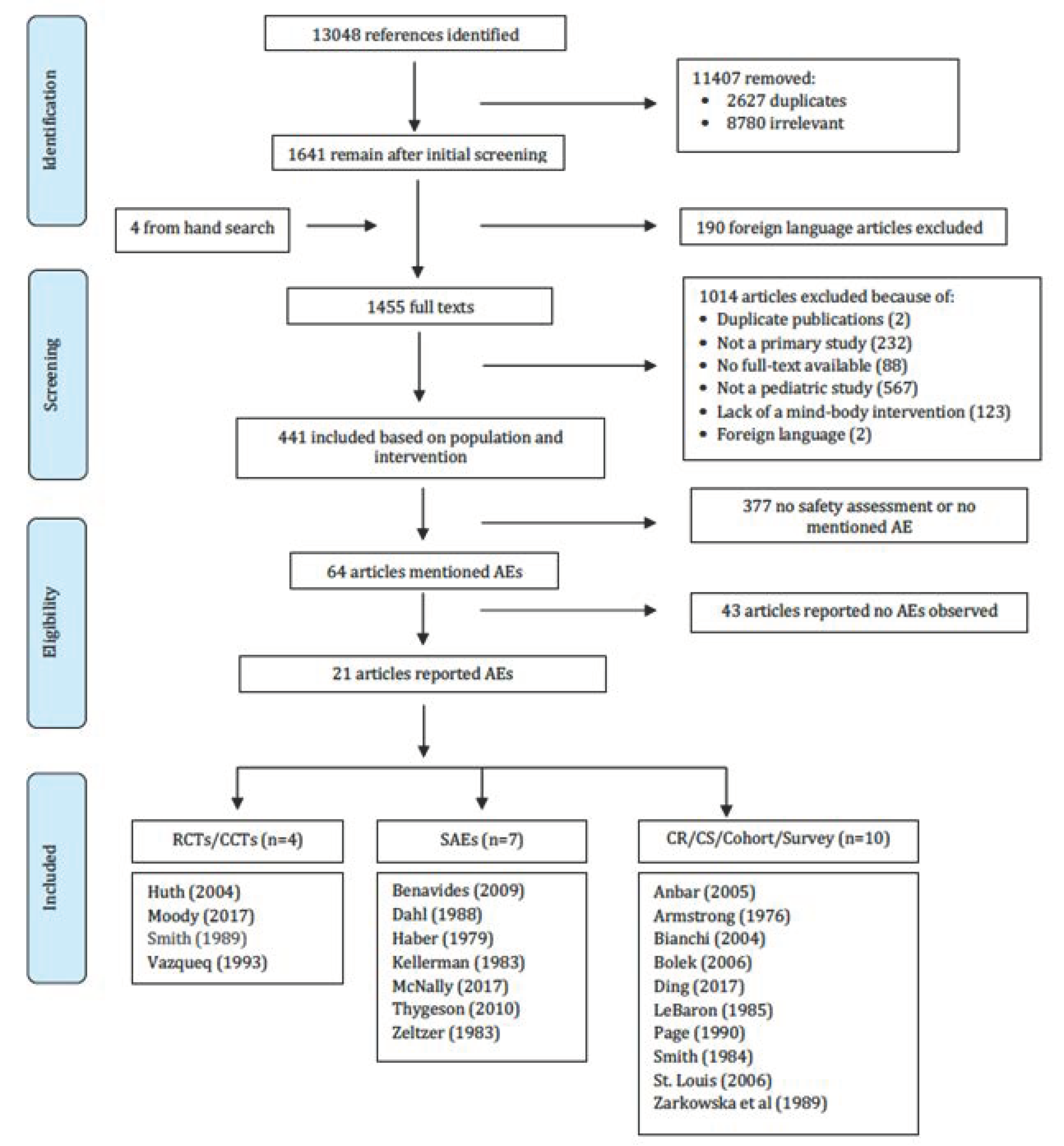
After screening the titles and abstracts of 13,048 citations, 1455 full text articles were retrieved, of which 1014 were excluded and 441 were included as primary pediatric MB intervention studies (Figure 1).

Figure 1.
PRISMA diagram of study selection for pediatric mind-body adverse events. AE: adverse event; CCT: controlled clinical trial; CR: case report; CS: case series; RCT: randomized controlled trial; SAE: single-arm experimental study.
Of these 441 studies identified, 254 (58%) were experimental and 187 (42%) were observational studies.
Within the 441 studies, only 64 (14.5%) explicitly reported presence/absence of AEs or assessed safety, of which 43 (67.2%) reported that no AE occurred, and 21 (32.8%) reported AE(s) (see Figure 1, PRISMA flow chart for details). The most common types of MB intervention studied were biofeedback and hypnosis, with 180 and 82 studies respectively (Appendix B and Appendix C).
Of the 254 experimental studies (n = 7213), 200 (n = 5647) did not report on AEs (if occurred/did not occur or if they were assessed). Of the 54 (n = 1566) studies that reported on AE, 43 (n = 1405) reported that no AEs were found and 11 reported AEs following MB interventions. Most of the studies reporting adverse events did not report on severity (81.0%) or duration of adverse events (52.4%).
3.1. Adverse Events
Of 21 studies reporting an AE, 11 (n = 208) were experimental and 10 (n = 406) were observational (Table 1). These studies reported one to four AEs each, for a total of 37 AEs (Table 2).

Table 1.
Characteristics of the studies reporting mind-body adverse events in pediatrics.
Table 2.
Summary of adverse events following mind-body practices in pediatrics by severity grad.
3.2. Adverse Events of Pediatric Mind-Body Interventions by Severity
Using CTCAE criteria for rating severity of AEs [9], three were rated as Grade 3, three as Grade 2, and 20 as Grade 1 (Table 2). There were no Grade 4 or 5 AE amongst reported MB AEs. We were unable to evaluate the severity of the remaining 11 AEs due to insufficient information provided in the article.
3.2.1. Grade 3
The most serious AEs identified were Grade 3, reported in three patients. One event was a case of unresponsiveness to verbal communication in a 13-year-old female with acute lymphoblastic leukemia who had initially been hospitalized with probable toxicity to her chemotherapy. She had utilized self-hypnosis in hospital for symptom control and could not come out of her hypnotic state independently. This necessitated transfer to an acute care unit for closer observation as her hypnotic state was misinterpreted as a possible neurological deterioration. The therapist who had taught her self-hypnosis facilitated her return to an alert state [26]. The second Grade 3 AE was an intra-abdominal bleed in a hemophiliac 18-year-old male who was utilizing hypnosis as a means of reducing bleeding and pain. Several hours prior to the development of the bleed, he had recalled two prior bleeds at the same site during a session of hypnosis. Treatment was provided by his hematologist; no specific surgical intervention was required. The study authors postulated the bleed may have been related to an ability of hypnosis to affect vasculature and blood flow (Table 2) [24]. The last grade 3 AE was a tibial fracture sustained by a 14-year-old female while assuming a yoga position in a school physical education class. The fracture was reduced and required a cast but did not result in a hospital admission [33].
3.2.2. Grade 2
There were three AEs rated as Grade 2. One of these AEs was the onset of mesial temporal lobe epilepsy in an 18-year-old female with no known risk factors after lifelong transcendental meditation practice. She had neurological assessment (MR and EEG) but hospitalization was not reported. The authors cautioned that there is insufficient evidence to definitively establish or disprove that meditation may precipitate seizures [29]. Another Grade 2 AE involved an 18-year-old female who had an apparent epileptic seizure while practicing hypnosis. A subsequent EEG was normal, and it was thought to likely be a spontaneous event given the absence of a personal or family history of seizures [25]. The last Grade 2 AE identified was a 17-year-old male who had increased symptoms of depression and reduced therapeutic engagement after biofeedback and progressive muscle relaxation for tension headaches (Table 2) [36].
3.2.3. Grade 1
There were 20 AEs rated as Grade 1 (mild) (Table 2). Seven adverse events were associated with the practice of hypnosis, including blue-tinted vision with a concurrent penile erection [21], increased anxiety, dissociated states, depersonalization phenomena [22], physical discomfort [23,27], and retroactive amnesia [25]. Relaxation had five adverse events associated with it, including four instances of increased betamimetic medication use [38] and an increase in tic frequency [31]. There were also four adverse events related to biofeedback: three cases of intervention-induced anxiety [19,20], and one case of foot pain [19]. The remaining four events associated with yoga, imagery, and a multi-modal MB intervention, were: dizziness [35], emotional distress and physical shaking [28], and chest pain [37], respectively.
3.3. Unclear Severity
4. Discussion
To the best of our knowledge, this is the first systematic review examining the safety of all pediatric MB interventions. Of potential concern, the vast majority of primary pediatric MB studies (85.5%) did not report if/how safety was measured. It is important to distinguish the absence of occurrence of AEs from the lack of their reporting. These are not equivalent, and lack of reporting can create bias during the assessment of an intervention if only its efficacy, or benefits, are evaluated and reported [10,11].
While there are systematic reviews that have extracted AE information on individual MB therapies [40,41,42,43,44,45,46,47,48,49,50,51], few of these have addressed AE as a primary objective [52,53,54,55]. Within the reviews with AE as a primary outcome, only three adverse events related to MB therapies were captured [34], in comparison to our review which was able to identify 37 adverse events. This synthesis helps to fill the existing gap in pediatric MB therapy research.
The majority of AEs identified were minor in nature; however, many of the studies did not provide pertinent details such as event duration or patient outcome. Incomplete reporting is significant as it hampers the ability to assess causation between an intervention and AE [56]. Additionally, poor reporting at the primary study level impairs the ability of systematic reviews to provide a balanced assessment of an intervention’s efficacy and harms. Regulatory frameworks to monitor the practice of complementary therapies would be beneficial [57], as at present there are no established standardized methods for assessing harms associated with MB interventions [58].
The absence of more serious events (Grade 4 and 5) is encouraging, but our ability to accurately estimate adverse events associated with these interventions is limited. While RCTs are regarded as the gold standard of research to assess efficacy, they report harms poorly [10,11,17], and are often statistically underpowered to detect rare, serious events [59]. This review is a first step in synthesizing best available information, to better plan future prospective research to identify and report AEs associated with pediatric MB therapy use.
While the majority of adverse events were reported in teenagers, there are insufficient data to make conclusions about AE profiles for different ages of children. Future studies should consider exploring age differences in adverse events associated with MB interventions.
MB interventions are popular and there is growing evidence for clinicians to support their use in children and youth to reduce stress, anxiety, and depression [60,61,62,63]. We recognize all health interventions have the potential for benefit and for harm. If patients experience an adverse event, there is value in reporting this. Our goal is to promote an evidence-based approach when considering health interventions, including weighing potential benefits and harms of various treatment approaches to determine which is preferred for an individual.
Assessing causality was limited as many of the identified studies were uncontrolled studies. While these are useful for evaluating adverse events related to an intervention, they are limited by a high probability of selection bias and therefore cannot confirm causation between an intervention and associated AEs [8]. Controlled trials, while the best design to examine causation, are hampered by an inability to detect rare, serious events [64]. Incomplete adverse event reporting further hampers the ability to assess causation between an intervention and AEs [56].
An important limitation of this review is the lack of adverse event reporting in the included studies, which limits the full understanding of the safety of pediatric MB interventions. Lack of adverse event reporting is not equivalent to lack of occurrence—lack of reporting could mean that: (i) no adverse events occurred; (ii) adverse events were not sought/assessed; or (iii) adverse events were identified, but not reported. Systematic reviews are only as reliable as the data presented in the included studies.
One potential limitation of this study is focusing on only English-language articles. Reviewing studies written in additional languages may provide more information and decrease the chance of selection bias [65] but was not feasible. Additionally, we were unable to obtain an estimate of adverse event rates for MB interventions, due to the lack of denominator data.
This study has multiple strengths, including that to our knowledge this is the first systematic review to summarize reported AEs associated with MB interventions.
Additionally, all study types from case reports to RCTs were included. Data regarding the reported AEs was further enriched by rating their severity with standard criteria. Selection and information bias were further reduced by having two reviewers independently apply inclusion criteria to the retrieved full text articles and perform data extraction/verification. Adverse events data can also be affected by publication bias, as less attention has been given to adverse events in comparison to efficacy of interventions [8,16,17,66,67,68,69].
Mind-body therapies are popular and would benefit from improved reporting of associated adverse events. Like other fields [70,71], MB would benefit from the development and validation of tools to measure associated AEs. Active surveillance is another means of improving the identification and reporting of adverse events [72,73]. Only if AEs are known, can risks be mitigated and safety enhanced.
This review identified adverse events associated with MB interventions, the majority of which were mild. The lack of adverse event reporting in the majority of included studies warrants caution in interpreting these results, as lack of reporting does not necessarily mean lack of events. Observational research is the foundation for advancing patient safety and several scales exist to help assess the likelihood that an AE is attributable to an intervention [72,74].
As uncontrolled retrospective studies are vulnerable to bias [75], an emphasis should be placed on prospectively assessing MB AEs in controlled research, such that associations between interventions and AEs can be better understood.
5. Conclusions
MB interventions are commonly used by children, and while some mild (Grade 1) to moderate (Grade 2–3) adverse events have been reported, serious (Grade 4–5) AEs were not identified. One cannot assume lack of AE reporting is equivalent to lack of harm. There is a need for researchers and health care providers to assess and report adverse effects associated with pediatric mind-body therapies. Better quality information will help promote informed decision-making by patients and health care providers.
Author Contributions
Conceptualization, S.V.; methodology, S.V.; data curation, M.L., M.K., K.K.G., L.Z. and M.F.; data analysis and interpretation, M.L., M.K., K.K.G., L.Z. and M.F.; writing—original draft preparation, M.L.; writing—review and editing: M.L., M.K., L.Z. and S.V. All authors have read and agreed to the published version of the manuscript.
Funding
There was no external funding for this manuscript.
Institutional Review Board Statement
Not applicable.
Informed Consent Statement
Not applicable.
Data Availability Statement
All data was obtained from existing published material, which has been referenced.
Acknowledgments
We thank Denise Adams for assisting with early stages of this systematic review, Susanne King-Jones for developing the search strategy, and Cecilia Bukutu for assisting in data verification.
Conflicts of Interest
The authors declare no conflict of interest.
Appendix A
Table A1.
Search Strategy for Systematic Review of Adverse Events of Pediatric Mind-Body Interventions. Medline Search.
Table A1.
Search Strategy for Systematic Review of Adverse Events of Pediatric Mind-Body Interventions. Medline Search.
| 1. Safety/or patient safety/ |
| 2. Drug Toxicity/ |
| 3. Adverse Effects.mp. |
| 4. Adverse Event.mp. |
| 5. Medication Side Effects.mp. |
| 6. Risk benefit analysis.mp. |
| 7. Risk/ |
| 8. Causality/ |
| 9. Safe$.mp. |
| 10. Adverse.m_titl. |
| 11. (Advers* effect or advers* affect).mp. |
| 12. ((Side or Advers$) adj3 (effect$ or affect$ or reaction$ or events$)).tw. |
| 13. $etiolog$.mp. |
| 14. Harm$.m_titl. |
| 15. Risks$.m_titl. |
| 16. Significant event.tw. |
| 17. Toxicity.ti. |
| 18. Consequence$.tw. |
| 19. Complication$.tw. |
| 20. Injury.tw. |
| 21. Incident$.tw. |
| 22. Therapeutic safet$.tw. |
| 23. Symptom$.tw. |
| 24. (ae or to or co).fs |
| 25. Or/1-24 |
| 26. Meditation/ |
| 27. Relaxation Therapy/ |
| 28. Biofeedback, Psychology/ |
| 29. Yoga/ |
| 30. Breathing Exercises/ |
| 31. “Imagery (Psychotherapy)”/ |
| 32. Hypnosis/ |
| 33. Tai Ji/ |
| 34. Qi gong.mp. |
| 35. Biofeedback.ti,ab. |
| 36. Creative arts therapies.mp. |
| 37. Deep breathing exercises.mp. |
| 38. Guided imagery.mp. |
| 39. Hypnotherapy.mp. |
| 40. Mantra meditation.mp. |
| 41. MBSR.mp. |
| 42. Mindfullness-based stress reduction.mp. |
| 43. Mediation.ti,ab. |
| 44. Relaxation techniques.mp. |
| 45. Tai Chi.mp. |
| 46. Tai Ji.mp. |
| 47. Yoga.ti,ab. |
| 48. Or/26-47 |
| 49. 25 and 48 |
Appendix B
Table A2.
Frequency Distribution of Primary Pediatric Studies by Intervention.
Table A2.
Frequency Distribution of Primary Pediatric Studies by Intervention.
| Intervention | Number of Studies |
|---|---|
| Biofeedback | 180 |
| Breathing Exercise | 10 |
| Healing Touch | 2 |
| Hypnosis | 82 |
| Imagery | 13 |
| Massage | 1 |
| Meditation | 11 |
| Mindfulness/MBSR | 14 |
| Music Therapy | 2 |
| Relaxation | 36 |
| Qi Gong | 2 |
| Tai Chi | 2 |
| Yoga | 27 |
| Multiple Interventions | 59 |
| Total | 441 |
Appendix C
Table A3.
Selected Definitions of the Most Commonly Identified Mind-Body Interventions [6].
Table A3.
Selected Definitions of the Most Commonly Identified Mind-Body Interventions [6].
| Biofeedback | A technique that uses simple electronic devices to teach clients how to consciously regulate bodily functions such as breathing, heart rate, and blood pressure, to improve overall health. |
| Breathing Exercises | An active process that involves conscious control over breathing in and out. This may involve controlling the way in which air is drawn in, the rate, the depth, and the control of other body parts. |
| Hypnosis | An altered state of consciousness characterized by increased responsiveness to suggestion. This hypnotic state is attained by first relaxing the body, then shifting attention toward a narrow range of suggested objects or ideas. |
| Imagery | Used for healing or health maintenance and involves a series of relaxation techniques followed by the visualization of detailed images, usually calm and peaceful in nature. |
| Massage | Therapists manipulate muscle and connective tissue to enhance function of those tissues and promote relaxation and wellbeing. |
| Meditation | A group of techniques, most of which started in Eastern religious or spiritual traditions. In meditation, individuals learn to focus their attention and suspend the stream of thoughts that normally occupy the mind. |
| Relaxation | A technique used to relieve tension and stress by systematically tensing and relaxing successive muscle groups. |
| Qi Gong | An ancient Chinese discipline combining the use of gentle physical movements, mental focus, and deep breathing directed toward specific parts of the body. |
| Tai Chi | A mind-body practice that originated in China as a martial art. Individuals doing tai chi move their bodies slowly and gently, while breathing deeply and meditating |
| Yoga | A combination of breathing exercises, physical postures, and meditation to calm the nervous system and balance the body, mind, and spirit. |
References
- National Institutes of Health. The Science of Mind and Body Therapies. 2016. Available online: https://nccih.nih.gov/video/series/mindbody (accessed on 28 December 2016).
- Data Resource Center for Child & Adolescents Health. Prevalence of Complementary Alternative Medicine Use. 2016. Available online: http://childhealthdata.org/browse./survey/results?q=2856&r=1# (accessed on 14 October 2016).
- Section on Integrative Medicine: Mind-Body Therapies in Children and Youth. Pediatrics 2016, 138, e20161896. [CrossRef]
- Feeney, K.; Moser, C.S. Yoga in Pediatrics. J. Occup. Ther. Sch. Early Interv. 2014, 7, 161–171. [Google Scholar] [CrossRef]
- Kanitz, J.L.; Camus, M.E.; Seifert, G. Keeping the balance—an overview of mind-body therapies in pediatric oncolo-gy. Complem. Ther. Med. 2013, 21, 20. [Google Scholar] [CrossRef] [PubMed]
- Black, L.I.; Clarke, T.C.; Barnes, P.M.; Stussman, B.J.; Nahin, R.L. Use of complementary health approaches among children aged 4–17 years in the United States: National Health Interview Survey, 2007. Natl. Health Stat. Rep. 2015, 78, 1–19. [Google Scholar]
- McClafferty, H. Mind-Body Medicine in Pediatrics. Children 2017, 4, 76. [Google Scholar] [CrossRef] [PubMed]
- Chou, R.; Aronson, N.; Atkins, D.; Ismaila, A.S.; Santaguida, P.; Smith, D.H.; Whitlock, E.; Wilt, T.J.; Moher, D. AHRQ Series Paper 4: Assessing harms when comparing medical interventions: AHRQ and the Effective Health-Care Program. J. Clin. Epidemiol. 2010, 63, 502–512. [Google Scholar] [CrossRef]
- CTCAE. Common Terminology Criteria for Adverse Events; Version 4. 2010. Available online: https://ctep.cancer.gov/protocoldevelopment/electronic_applications/ctc.htm#ctc_ (accessed on 14 October 2016).
- Singh, S.; Loke, Y.K. Drug safety assessment in clinical trials: Methodological challenges and opportunities. Trials 2012, 13, 138. [Google Scholar] [CrossRef]
- Ioannidis, J.P. Adverse events in randomized trials: Neglected, restricted, distorted, and silenced. Arch. Intern. Med. 2009, 169, 1737–1739. [Google Scholar] [CrossRef]
- Moher, D.; Hopewell, S.; Schulz, K.F.; Montori, V.; Gøtzsche, P.C.; Devereaux, P.; Elbourne, D.; Egger, M.; Altman, D.G. CONSORT 2010 explanation and elaboration: Updated guidelines for reporting parallel group randomised trials. Int. J. Surg. 2012, 10, 28–55. [Google Scholar] [CrossRef]
- Rothwell, P.M. External validity of randomised controlled trials: “to whom do the results of this trial apply? Lancet 2005, 365, 82–93. [Google Scholar] [CrossRef]
- Ioannidis, J.P.; Evans, S.J.; Gøtzsche, P.C.; O’Neill, R.T.; Altman, D.G.; Schulz, K.; Moher, D. Better Reporting of Harms in Randomized Trials: An Extension of the CONSORT Statement. Ann. Intern. Med. 2004, 141, 781–788. [Google Scholar] [CrossRef] [PubMed]
- Vandenbroucke, J.P. Benefits and harms of drug treatments. BMJ 2004, 329, 2–3. [Google Scholar] [CrossRef] [PubMed]
- Higgins, J.P.; Thomas, J.; Chandler, J.; Cumpston, M.; Li, T.; Page, M.J.; Welch, V.A. Updated Guidance for Trusted Systematic Reviews: A New Edition of the Cochrane Handbook for Systematic Reviews of Interventions; The Cochrane Database of Systematic Reviews; John Wiley & Sons: Oxford, UK, 2019; Volume 10, p. ED000142. [Google Scholar]
- Zorzela, L.; Golder, S.; Liu, Y.; Pilkington, K.; Hartling, L.; Joffe, A.; Loke, Y.; Vohra, S. Quality of reporting in systematic reviews of adverse events: Systematic review. BMJ 2013, 348, f7668. [Google Scholar] [CrossRef] [PubMed]
- Moher, D.; Liberati, A.; Tetzlaff, J.; Altman, D.G.; The PRISMA Group. Preferred reporting items for systematic reviews and meta-analyses: The PRISMA statement. PLoS Med. 2009, 6, e1000097. [Google Scholar] [CrossRef]
- Bolek, J.E. Use of Multiple-Site Performance-Contingent SEMG Reward Programming in Pediatric Rehabilitation: A Retrospective Review. Appl. Psychophysiol. Biofeedback 2006, 31, 263–272. [Google Scholar] [CrossRef] [PubMed]
- Dahl, J.; Melin, L.; Leissner, P. Effects of a Behavioral Intervention on Epileptic Seizure Behavior and Paroxysmal Activity: A Systematic Replication of Three Cases of Children with Intractable Epilepsy. Epilepsia 1988, 29, 172–183. [Google Scholar] [CrossRef] [PubMed]
- Anbar, R.D.; Savedoff, A.D. Hypnosis-associated blue-tinted vision: A case report. BMC Ophthalmol. 2005, 5, 28. [Google Scholar] [CrossRef] [PubMed]
- Haber, C.H.; Nitkin, R.; Shenker, I.R. Adverse reactions to hypnotherapy in obese adolescents: A developmental viewpoint. Psychiatr. Q. 1979, 51, 55–63. [Google Scholar] [CrossRef] [PubMed]
- Kellerman, J.; Zeltzer, L.; Ellenberg, L.; Dash, J. Adolescents with cancer. J. Adolesc. Health Care 1983, 4, 85–90. [Google Scholar] [CrossRef]
- LeBaron, S.; Zeltzer, L. Hypnosis for hemophiliacs: Methodologic problems and risks. Am. J. Pediatr. Hematol. Oncol. 1985, 7, 316–319. [Google Scholar]
- Page, R.A.; Handley, G.W. Psychogenic and Physiological Sequelae to Hypnosis: Two Case Reports. Am. J. Clin. Hypn. 1990, 32, 250–256. [Google Scholar] [CrossRef] [PubMed]
- Smith, M.S.; Kamitsuka, M. Self-Hypnosis Misinterpreted as CNS Deterioration in an Adolescent with Leukemia and Vincristine Toxicity. Am. J. Clin. Hypn. 1984, 26, 280–282. [Google Scholar] [CrossRef] [PubMed]
- Zeltzer, L.; Kellerman, J.; Ellenberg, L.; Dash, J. Hypnosis for reduction of vomiting associated with chemotherapy and disease in adolescents with cancer. J. Adolesc. Health Care 1983, 4, 77–84. [Google Scholar] [CrossRef]
- Huth, M.M.; Broome, M.E.; Good, M. Imagery reduces children’s post-operative pain. Pain 2004, 110, 439–448. [Google Scholar] [CrossRef] [PubMed]
- St Louis, E.K.; Lansky, E.P. Meditation and epilepsy: A still hung jury. Med. Hypothes. 2006, 67, 247–250. [Google Scholar] [CrossRef]
- McNally, K.A.; Patrick, K.E.; LaFleur, J.E.; Dykstra, J.B.; Monahan, K.; Hoskinson, K.R. Brief cognitive behavioral intervention for children and adolescents with persistent post-concussive symptoms: A pilot study. Child. Neuropsychol. 2017, 24, 396–412. [Google Scholar] [CrossRef]
- Zarkowska, E.; Crawley, B.; Locke, J. A behavioural intervention for Gilles de la Tourette syndrome in a severely mentally handicapped girl. J. Intellect. Disabil. Res. 2008, 33, 245–253. [Google Scholar] [CrossRef]
- Benavides, S.; Caballero, J. Ashtanga yoga for children and adolescents for weight management and psychological well being: An uncontrolled open pilot study. Complement. Ther. Clin. Pr. 2009, 15, 110–114. [Google Scholar] [CrossRef]
- Bianchi, G.; Cavenago, C.; Marchese, M. Can the practice of yoga be dangerous? Considerations over a case of epiphyseal separation of the distal tibia in a teenager. J. Orthop. Traumatol. 2004, 5, 188–190. [Google Scholar] [CrossRef]
- Moody, K.; Abrahams, B.; Baker, R.; Santizo, R.; Manwani, D.; Carullo, V.; Eugenio, D.; Carroll, A. A Randomized Trial of Yoga for Children Hospitalized with Sickle Cell Vaso-Occlusive Crisis. J. Pain Symptom Manag. 2017, 53, 1026–1034. [Google Scholar] [CrossRef]
- Thygeson, M.V.; Hooke, M.C.; Clapsaddle, J.; Robbins, A.; Moquist, K. Peaceful Play Yoga: Serenity and Balance for Children With Cancer and Their Parents. J. Pediatr. Oncol. Nurs. 2010, 27, 276–284. [Google Scholar] [CrossRef] [PubMed]
- Armstrong, S.H.; Hendrix, M.; Hendrix, E. Character Defenses and Biofeedback. Psychother. Psychosom. 1976, 27, 205–209. [Google Scholar] [CrossRef] [PubMed]
- Smith, M.S.; Doroshow, C.; Womack, W.M.; Tenckhoff, L.; Stamm, S.; Pertik, M. Symptomatic mitral valve prolapse in children and adolescents: Catecholamines, anxiety, and biofeedback. Pediatrics 1989, 84, 290. [Google Scholar] [PubMed]
- Vazquez, M.I.; Buceta, J.M. Effectiveness of self-management programmes and relaxation training in the treat-ment of bronchial asthma: Relationships with trait anxiety and emotional attack triggers. J. Psychosom. Res. 1993, 37, 71–81. [Google Scholar] [CrossRef]
- Ding, J.-L.; Taylor, D.M.; Lee, M.; Johnson, O.G.; Ashok, A.; Griffiths, M.; Simma, L.; Craig, S.S.; Cheek, J.A.; Babl, F.E. Observational study of alternative therapies among paediatric emergency department patients. Emerg. Med. Australas. 2017, 29, 136–142. [Google Scholar] [CrossRef] [PubMed]
- Evans, S.; Ling, M.; Hill, B.; Rinehart, N.; Austin, D.; Sciberras, E. Systematic review of meditation-based interventions for children with ADHD. Eur. Child. Adolesc. Psychiatry 2017, 27, 9–27. [Google Scholar] [CrossRef]
- Novak, I.; McIntyre, S.; Morgan, C.; Campbell, L.; Dark, L.; Morton, N.; Stumbles, E.; Wilson, S.-A.; Goldsmith, S. A systematic review of interventions for children with cerebral palsy: State of the evidence. Dev. Med. Child. Neurol. 2013, 55, 885–910. [Google Scholar] [CrossRef] [PubMed]
- Chang, C.-W.; Mu, P.-F.; Jou, S.-T.; Wong, T.-T.; Chen, Y.-C. Systematic Review and Meta-Analysis of Nonpharmacological Interventions for Fatigue in Children and Adolescents with Cancer. Worldviews Evid. Based Nurs. 2013, 10, 208–217. [Google Scholar] [CrossRef]
- Posadzki, P.; Lewandowski, W.; Terry, R.; Ernst, E.; Stearns, A. Guided Imagery for Non-Musculoskeletal Pain: A Systematic Review of Randomized Clinical Trials. J. Pain Symptom Manag. 2012, 44, 95–104. [Google Scholar] [CrossRef]
- Birdee, G.S.; Yeh, G.Y.; Wayne, P.M.; Phillips, R.S.; Davis, R.B.; Gardiner, P. Clinical Applications of Yoga for the Pediatric Population: A Systematic Review. Acad. Pediatr. 2009, 9, 212–220.e9. [Google Scholar] [CrossRef]
- Chambers, C.T.; Taddio, A.; Uman, L.S.; McMurtry, C. Psychological interventions for reducing pain and distress during routine childhood immunizations: A systematic review. Clin. Ther. 2009, 31, S77–S103. [Google Scholar] [CrossRef] [PubMed]
- Galantino, M.L.; Galbavy, R.; Quinn, L. Therapeutic Effects of Yoga for Children: A Systematic Review of the Literature. Pediatr. Phys. Ther. 2008, 20, 66–80. [Google Scholar] [CrossRef] [PubMed]
- Richardson, J.; Smith, J.E.; McCall, G.; Pilkington, K. Hypnosis for Procedure-Related Pain and Distress in Pediatric Cancer Patients: A Systematic Review of Effectiveness and Methodology Related to Hypnosis Interventions. J. Pain Symptom Manag. 2006, 31, 70–84. [Google Scholar] [CrossRef] [PubMed]
- Brazzelli, M.; Griffiths, P.V.; Cody, J.D.; Tappin, D. Behavioural and cognitive interventions with or without other treatments for the management of faecal incontinence in children. Cochrane Database Syst. Rev. 2011, 2011, CD002240. [Google Scholar] [CrossRef]
- Fisher, E.; Law, E.; Dudeney, J.; Palermo, T.M.; Stewart, G.; Eccleston, C. Psychological therapies for the management of chronic and recurrent pain in children and adolescents. Cochrane Database Syst. Rev. 2018, 9, CD003968. [Google Scholar] [CrossRef] [PubMed]
- Goldenberg, J.Z.; Brignall, M.; Hamilton, M.; Beardsley, J.; Batson, R.D.; Hawrelak, J.; Lichtenstein, B.; Johnston, B.C. Biofeedback for treatment of irritable bowel syndrome. Cochrane Database Syst. Rev. 2019, 2019, 012530. [Google Scholar] [CrossRef] [PubMed]
- Buckley, B.S.; Sanders, C.D.; Spineli, L.; Deng, Q.; Kwong, J.S. Conservative interventions for treating functional daytime urinary incontinence in children. Cochrane Database Syst. Rev. 2019, 2019, CD012367. [Google Scholar] [CrossRef]
- Sureshkumar, P.; Bower, W.; Craig, J.C.; Knight, J.F. Treatment of daytime urinary incontinence in children: A sys-tematic review of randomized controlled trials. J. Urol. 2003, 170, 196–200. [Google Scholar] [CrossRef]
- Ernst, E. Serious adverse effects of unconventional therapies for children and adolescents: A systematic review of recent evidence. Eur. J. Nucl. Med. Mol. Imaging 2003, 162, 72–80. [Google Scholar] [CrossRef]
- Rutten, J.M.T.M.; Korterink, J.J.; Venmans, L.M.A.J.; Benninga, M.A.; Tabbers, M.M. Nonpharmacologic Treatment of Functional Abdominal Pain Disorders: A Systematic Review. Pediatrics 2015, 135, 522–535. [Google Scholar] [CrossRef]
- Fisher, B.E.; Heathcote, B.L.; Palermo, T.M.; de Williams, A.C.C.; Lau, B.J.; Eccleston, B.C. Systematic Review and Meta-Analysis of Psychological Therapies for Children with Chronic Pain. J. Pediatr. Psychol. 2014, 39, 763–782. [Google Scholar] [CrossRef]
- Vohra, S.; Johnston, B.C.; Cramer, K.; Humphreys, K. Adverse Events Associated with Pediatric Spinal Manipulation: A Systematic Review. Pediatrics 2007, 119, e275–e283. [Google Scholar] [CrossRef] [PubMed]
- Lim, A.; Cranswick, N.; South, M. Adverse events associated with the use of complementary and alternative medicine in children. Arch. Dis. Child. 2010, 96, 297–300. [Google Scholar] [CrossRef] [PubMed]
- Astin, J.A.; Shapiro, S.L.; Eisenberg, D.M.; Forys, K.L. Mind-Body Medicine: State of the Science, Implications for Practice. J. Am. Board Fam. Med. 2003, 16, 131–147. [Google Scholar] [CrossRef]
- Tsang, R.; Colley, L.; Lynd, L.D. Inadequate statistical power to detect clinically significant differences in adverse event rates in randomized controlled trials. J. Clin. Epidemiol. 2009, 62, 609–616. [Google Scholar] [CrossRef] [PubMed]
- Biegel, G.M.; Brown, K.W.; Shapiro, S.L.; Schubert, C.M. Mindfulness-based stress reduction for the treatment of adolescent psychiatric outpatients: A randomized clinical trial. J. Consult. Clin. Psychol. 2009, 77, 855–866. [Google Scholar] [CrossRef]
- Joyce, A.; Etty-Leal, J.; Zazryn, T.; Hamilton, A. Exploring a Mindfulness Meditation Program on the Mental Health of Upper Primary Children: A Pilot Study. Adv. Sch. Ment. Health Promot. 2010, 3, 17–25. [Google Scholar] [CrossRef]
- Napoli, M.; Krech, P.R.; Holley, L.C. Mindfulness Training for Elementary School Students. J. Appl. Sch. Psychol. 2005, 21, 99–125. [Google Scholar] [CrossRef]
- Zenner, C.; Herrnleben-Kurz, S.; Walach, H. Mindfulness-based interventions in schools—a systematic review and meta-analysis. Front. Psychol. 2014, 5, 603. [Google Scholar] [CrossRef]
- Shekelle, P.G.; Morton, S.C.; Suttorp, M.J.; Buscemi, N.; Friesen, C. Challenges in Systematic Reviews of Complementary and Alternative Medicine Topics. Ann. Intern. Med. 2005, 142, 1042–1047. [Google Scholar] [CrossRef]
- Busse, J.W.; Bruno, P.; Malik, K.; Connell, G.; Torrance, D.; Ngo, T.; Kirmayr, K.; Avrahami, D.; Riva, J.J.; Ebrahim, S.; et al. An efficient strategy allowed English-speaking reviewers to identify foreign-language articles eligible for a systematic review. J. Clin. Epidemiol. 2014, 67, 547–553. [Google Scholar] [CrossRef] [PubMed]
- Zorzela, L.; Loke, Y.K.; Ioannidis, J.P.; Golder, S.; Santaguida, P.; Altman, D.G.; Moher, D.; Vohra, S.; PRISMA Harms Group. PRISMA harms checklist: Improving harms reporting in systematic reviews. BMJ 2016, 352, i157. [Google Scholar] [CrossRef] [PubMed]
- Ioannidis, J.P.A.; Lau, J. Completeness of Safety Reporting in Randomized Trials. JAMA 2001, 285, 437–443. [Google Scholar] [CrossRef] [PubMed]
- Loke, Y.K.; Derry, S. Reporting of adverse drug reactions in randomised controlled trials—a systematic survey. BMC Clin. Pharmacol. 2001, 1, 3. [Google Scholar] [CrossRef] [PubMed]
- Loke, Y.K.; Price, D.; Herxheimer, A. Cochrane Adverse Effects Methods Group. Systematic reviews of adverse ef-fects: Framework for a structured approach. BMC Med. Res. Methodol. 2007, 7, 32. [Google Scholar] [CrossRef]
- Basch, E.; Reeve, B.B.; Mitchell, S.A.; Clauser, S.B.; Minasian, L.M.; Dueck, A.C.; Mendoza, T.R.; Hay, J.; Atkinson, T.M.; Abernethy, A.P.; et al. Development of the National Cancer Institute’s Patient-Reported Outcomes Version of the Common Terminology Criteria for Adverse Events (PRO-CTCAE). J. Natl. Cancer Inst. 2014, 106, dju244. [Google Scholar] [CrossRef]
- Mason, K.P.; Green, S.M.; Piacevoli, Q. Adverse event reporting tool to standardize the reporting and tracking of adverse events during procedural sedation: A consensus document from the World SIVA International Sedation Task Force. Br. J. Anaesth. 2012, 108, 13–20. [Google Scholar] [CrossRef]
- Sparks, E.; Zorzela, L.; Necyk, C.; Khamba, B.; Urichuk, L.; Barnes, J.; Vohra, S. Study of Natural products Adverse Reactions (SONAR) in children seen in mental health clinics: A cross-sectional study. BMJ Paediatr. Open 2020, 4, e000674. [Google Scholar] [CrossRef]
- Zorzela, L.; Boon, H.; Mior, S.; Yager, J.; Gross, A.; Vohra, S. Serious adverse events associated with pediatric complementary and alternative medicine. Eur. J. Integr. Med. 2014, 6, 467–472. [Google Scholar] [CrossRef]
- Zorzela, L.; Mior, S.; Boon, H.; Gross, A.; Yager, J.; Carter, R.; Vohra, S. Tool to assess causality of direct and indirect adverse events associated with therapeutic interventions. Curr. Med. Res. Opin. 2017, 34, 407–414. [Google Scholar] [CrossRef] [PubMed]
- Gluud, L.L. Bias in Clinical Intervention Research. Am. J. Epidemiol. 2006, 163, 493–501. [Google Scholar] [CrossRef] [PubMed]
Publisher’s Note: MDPI stays neutral with regard to jurisdictional claims in published maps and institutional affiliations. |
© 2021 by the authors. Licensee MDPI, Basel, Switzerland. This article is an open access article distributed under the terms and conditions of the Creative Commons Attribution (CC BY) license (https://creativecommons.org/licenses/by/4.0/).