


What Are the Psycho-Social and Information Needs of Adolescents and Young Adults Cancer Care Consumers with Intellectual Disability? A Systematic Review of Evidence with Recommendations for Future Research and Practice
 , ,
, ,
Abstract
:1. Introduction
2. Purpose and Question
2.1. Study Purpose
2.2. Study Question
3. Methods
3.1. Search Strategy
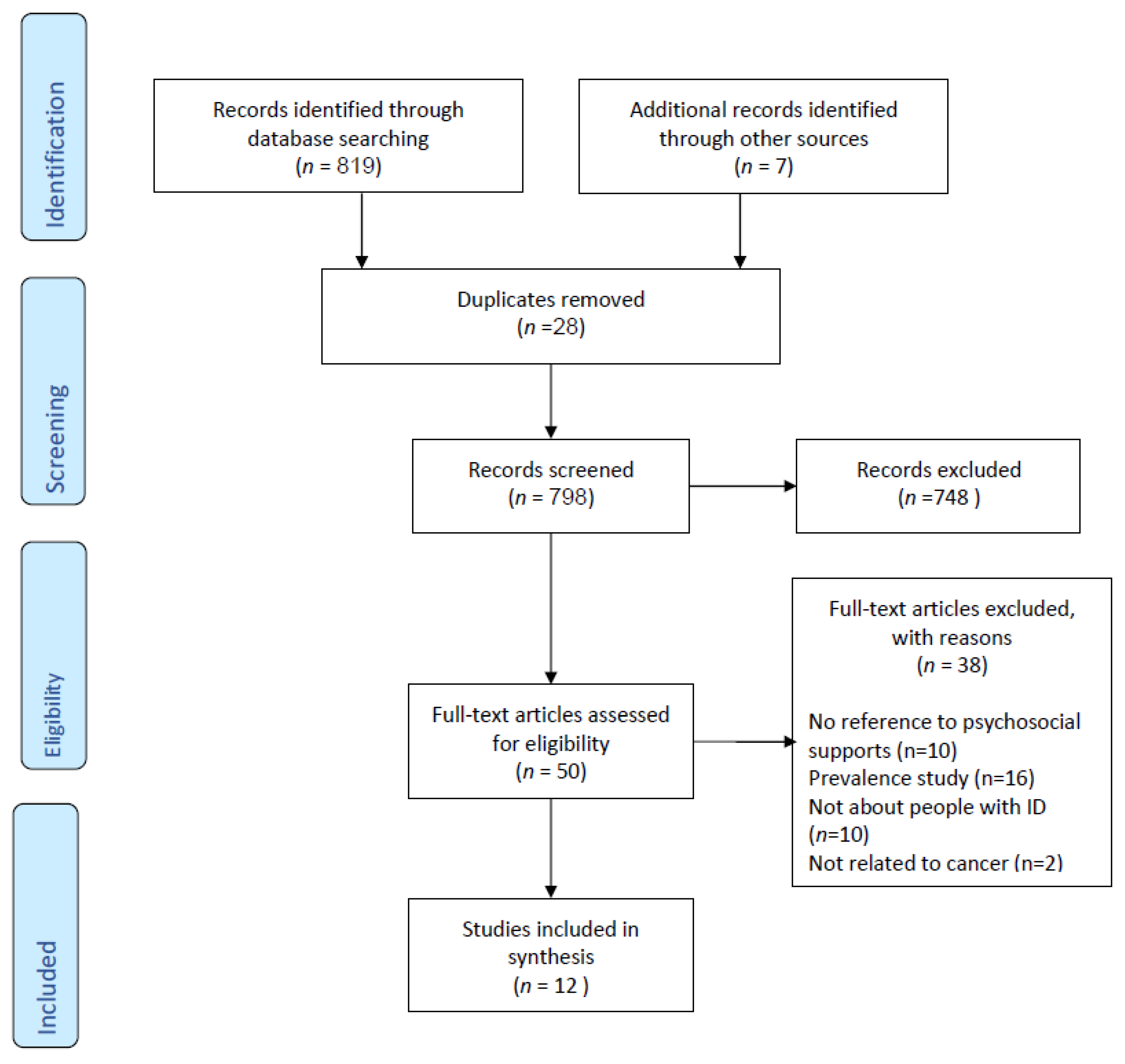
3.2. Search and Selection Process
3.3. Eligibility Criteria
3.3.1. Inclusion Criteria
- Published from 1 January 2000 [28] until 31 January 2021.
- English language.
- Studies involving AYAs aged 15–25 years with intellectual disability diagnosed in individuals less than 18 years who demonstrate permanent impairments to learning, thinking and reasoning, and social functioning [18].
- Current or past cancer care consumer, including as a patient, as a sibling, or other family member of someone accessing cancer care services in any cancer care setting and in any country.
- Parent/carers, siblings or health professionals acted as proxies for AYA with intellectual disability.
3.3.2. Exclusion Criteria
- Studies that do not report specific data related to AYAs aged 15–25 years of age.
- Studies involving AYA without intellectual disability only.
- Studies of AYA with chronic and/or complex conditions but do not have intellectual disability. For example, dyslexia, hearing loss/speech delay, reading difficulty, physical disability, Autism/Autistic Spectrum Disorder without intellectual disability [29], and mental health disorder.
- Prevalence studies.
3.3.3. Outcomes
3.4. Data Extraction
3.5. Quality Appraisal
4. Results
4.1. Study Selection
4.2. Study Characteristics
- Communication and Accessible Information
- Supports and System Navigation
- Cancer Service Provider Training and Reasonable Adjustments
4.3. Communication and Accessible Information
4.4. Supports and System Navigation
4.5. Cancer Service Provider Training and Reasonable Adjustments
5. Discussion
5.1. Study Limitations
5.2. Implications for Practice
6. Conclusions
Supplementary Materials
Author Contributions
Funding
Institutional Review Board Statement
Informed Consent Statement
Acknowledgments
Conflicts of Interest
Abbreviations
| AYA | Adolescents and young adults |
| QuADS | Quality Assessment Tool for Diverse Studies |
References
- Zeltzer, L. Cancer in adolescents and young adults psychosocial aspects. Long-term survivors. Cancer 1993, 71, 3463–3468. [Google Scholar] [CrossRef]
- Bleyer, A.; Ferrari, A.; Whelan, J.; Barr, R.D. Global assessment of cancer incidence and survival in adolescents and young adults. Pediatr. Blood Cancer 2017, 64, e26497. [Google Scholar] [CrossRef]
- Holland, L.; Walker, R.; Henney, R.; Cashion, C.E.; Bradford, N.K. Adolescents and Young Adults with Cancer: Barriers in Access to Psychosocial Support. J. Adolesc. Young-Adult Oncol. 2021, 10, 46–55. [Google Scholar] [CrossRef]
- Langeveld, N.E.; Ubbink, M.C.; Last, B.F.; Grootenhuis, M.A.; Voûte, P.A.; De Haan, R.J. Educational achievement, employment and living situation in long-term young adult survivors of childhood cancer in the Netherlands. Psycho-Oncology 2002, 12, 213–225. [Google Scholar] [CrossRef]
- Bradford, N.K.; Henney, R.; Walker, R.; Walpole, E.; Kennedy, G.; Nicholls, W.; Pinkerton, R. Queensland Youth Cancer Service: A Partner-ship Model to Facilitate Access to Quality Care for Young People Diagnosed with Cancer. J. Adolesc. Young Adult Oncol. 2018, 7, 339–348. [Google Scholar] [CrossRef]
- Robison, L.L.; Hudson, M.M. Survivors of childhood and adolescent cancer: Life-long risks and responsibilities. Nat. Rev. Cancer 2014, 14, 61–70. [Google Scholar] [CrossRef] [PubMed]
- McDonald, F.E.J.; Patterson, P.; White, K.J.; Butow, P.; Bell, M.L. Predictors of unmet needs and psychological distress in adolescent and young adult siblings of people diagnosed with cancer. Psycho-Oncology 2015, 24, 333–340. [Google Scholar] [CrossRef]
- Long, K.A.; Lehmann, V.; Gerhardt, C.A.; Carpenter, A.L.; Marsland, A.L.; Alderfer, M.A. Psychosocial functioning and risk factors among siblings of children with cancer: An updated systematic review. Psycho-Oncology 2018, 27, 1467–1479. [Google Scholar] [CrossRef]
- Patterson, P.; McDonald, F.; White, K.; Walczak, A.; Butow, P. Levels of unmet needs and distress amongst adolescents and young adults (AYAs) impacted by familial cancer. Psycho-Oncology 2017, 26, 1285–1292. [Google Scholar] [CrossRef] [Green Version]
- Patterson, P.; D’Agostino, N.M.; McDonald, F.E.; Church, T.D.; Costa, D.S.; Rae, C.S.; Siegel, S.E.; Hu, J.; Bibby, H.; Stark, D.P.; et al. Screening for distress and needs: Findings from a multinational validation of the Adolescent and Young Adult Psycho-Oncology Screening Tool with newly diagnosed patients. Psycho-Oncology 2021, 30, 1849–1858. [Google Scholar] [CrossRef] [PubMed]
- Osborn, T. The psychosocial impact of parental cancer on children and adolescents: A systematic review. Psycho-Oncology 2007, 16, 101–126. [Google Scholar] [CrossRef]
- Epelman, C.L. The Adolescent and Young Adult with Cancer: State of the Art-Psychosocial Aspects. Curr. Oncol. Rep. 2013, 15, 325–331. [Google Scholar] [CrossRef]
- Palmer Kelly, E.; McGee, J.; Obeng-Gyasi, S.; Herbert, C.; Azap, R.; Abbas, A.; Pawlik, T.M. Marginalized Patient Identities and the Patient-Physician Relationship in the Cancer Care Context: A Systematic Scoping Review. Support Care Cancer. 1 July 2021. Available online: https://doi.org/10.1007/s00520-021-06382-8 (accessed on 18 September 2021).
- Ashley, L.; Lawrie, I. Tackling inequalities in cancer care and outcomes: Psychosocial mechanisms and targets for change. Psycho-Oncology 2016, 25, 1122–1126. [Google Scholar] [CrossRef] [Green Version]
- Murphy, C.C.; Lupo, P.J.; Roth, M.E.; Winick, N.J.; Pruitt, S.L. Disparities in Cancer Survival Among Adolescents and Young Adults: A Population-Based Study of 88 000 Patients. J. Natl. Cancer Inst. 2021, 113, 1074–1083. [Google Scholar] [CrossRef] [PubMed]
- Darlington, W.S.; Green, A.L. The role of geographic distance from a cancer center in survival and stage of AYA cancer diagno-ses. Cancer 2021, 127, 3508–3510. [Google Scholar] [CrossRef]
- Maulik, P.K.; Mascarenhas, M.N.; Mathers, C.D.; Dua, T.; Saxena, S. Prevalence of intellectual disability: A meta-analysis of popula-tion-based studies. Res. Dev. Disabil. 2011, 32, 419–436. [Google Scholar] [CrossRef] [PubMed]
- Robertson, J.M.; Hatton, C.; Baines, S.; Emerson, E. Systematic Reviews of the Health or Health care of People with Intellectual Disabilities: A Systematic Review to Identify Gaps in the Evidence Base. J. Appl. Res. Intellect. Disabil. 2015, 28, 455–523. [Google Scholar] [CrossRef] [Green Version]
- From “Learning Disability to Intellectual Disability”—Perceptions of the Increasing Use of the Term “Intellectual Disability” in Learning Disability Policy, Research and Practice-Cluley-2018-British Journal of Learning Disabilities-Wiley Online Library. Available online: https://onlinelibrary.wiley.com/doi/abs/10.1111/bld.12209 (accessed on 17 November 2021).
- Mimmo, L.; Harrison, R.; Travaglia, J.; Hu, N.; Woolfenden, S. Inequities in quality and safety outcomes for hospitalized children with intellectual disability. Dev. Med. Child Neurol. 2021. [Google Scholar] [CrossRef]
- Hanna, L.M.; Taggart, L.; Cousins, W. Cancer prevention and health promotion for people with intellectual disabilities: An ex-ploratory study of staff knowledge. J. Intellect. Disabil. Res. 2011, 55, 281–291. [Google Scholar] [CrossRef]
- Tuffrey-Wijne, I.; Hogg, J.; Curfs, L. End-of-Life and Palliative Care for People with Intellectual Disabilities Who have Cancer or Other Life-Limiting Illness: A Review of the Literature and Available Resources. J. Appl. Res. Intellect. Disabil. 2007, 20, 331–344. [Google Scholar] [CrossRef]
- Flynn, S.; Hulbert-Williams, N.; Hulbert-Williams, L.; Bramwell, R. Psychosocial experiences of chronic illness in individuals with an intellectual disability: A systematic review of the literature. J. Intellect. Disabil. 2015, 19, 178–194. [Google Scholar] [CrossRef] [Green Version]
- Flynn, S.; Hulbert-Williams, N.J.; Hulbert-Williams, L.; Bramwell, R. “You don’t know what’s wrong with you”: An exploration of cancer-related experiences in people with an intellectual disability. Psycho-Oncology 2016, 25, 1198–1205. [Google Scholar] [CrossRef] [PubMed]
- Ali, A.; Hassiotis, A.; Strydom, A.; King, M. Self-stigma in people with intellectual disabilities and courtesy stigma in family carers: A systematic review. Res. Dev. Disabil. 2012, 33, 2122–2140. [Google Scholar] [CrossRef]
- Mimmo, L.; Harrison, R.; Mears, S. Systematic Review of the Psychosocial Support Needs of Adolescents and Young Adults Cancer Care Consumers with Intellectual Disability. PROSPERO 2021 CRD42021224101. Available online: https://www.crd.york.ac.uk/prospero/display_record.php?RecordID=224101 (accessed on 3 August 2021).
- Green, B.N.; Johnson, C.; Adams, A. Writing narrative literature reviews for peer-reviewed journals: Secrets of the trade. J. Chiropr. Med. 2006, 5, 101–117. [Google Scholar] [CrossRef] [Green Version]
- Institute of Medicine (US) Committee on Quality of Health Care in America. Crossing the Quality Chasm: A New Health System for the 21st Century; National Academies Press (US): Washington, DC, USA, 2001. Available online: http://www.ncbi.nlm.nih.gov/books/NBK222274/ (accessed on 17 November 2021).
- Matson, J.L.; Shoemaker, M. Intellectual disability and its relationship to autism spectrum disorders. Res. Dev. Disabil. 2009, 30, 1107–1114. [Google Scholar] [CrossRef] [PubMed]
- Snilstveit, B.; Oliver, S.; Vojtkova, M. Narrative approaches to systematic review and synthesis of evidence for international development policy and practice. J. Dev. Eff. 2012, 4, 409–429. [Google Scholar] [CrossRef]
- Popay, J.; Rogers, A.; Williams, G. Rationale and Standards for the Systematic Review of Qualitative Literature in Health Ser-vices Research. Qual. Health Res. 1998, 8, 341–351. [Google Scholar] [CrossRef]
- Ní Shé, É.; O’Donnell, D.; Donnelly, S.; Davies, C.; Fattori, F.; Kroll, T. “What Bothers Me Most Is the Disparity between the Choic-es that People Have or Don’t Have”: A Qualitative Study on the Health Systems Responsiveness to Implementing the As-sisted Decision-Making (Capacity) Act in Ireland. Int. J. Environ. Res. Public Health 2020, 17, 3294. [Google Scholar] [CrossRef] [PubMed]
- Harrison, R.; Jones, B.; Gardener, P.; Lawton, R. Quality assessment with diverse studies (QuADS): An appraisal tool for methodo-logical and reporting quality in systematic reviews of mixed- or multi-method studies. BMC Health Serv. Res. 2021, 21, 144. [Google Scholar] [CrossRef] [PubMed]
- Byrnes, K.; Hamilton, S.; McGeechan, G.J.; O’Malley, C.; Mankelow, J.; Giles, E.L. Attitudes and perceptions of people with a learn-ing disability, family carers, and paid care workers towards cancer screening programmes in the United Kingdom: A quali-tative systematic review and meta-aggregation. Psycho-Oncology 2020, 29, 475–484. [Google Scholar] [CrossRef]
- Forbat, L.; McCann, L. Adults with intellectual disabilities affected by cancer: Critical challenges for the involvement agenda. Eur. J. Cancer Care 2010, 19, 91–97. [Google Scholar] [CrossRef]
- Gilbert, T.; Wilkinson, T.; Crudgington, S. Supporting people with intellectual disability in the cancer journey: The ‘Living with cancer’ communication pack. Eur. J. Oncol. Nurs. 2007, 11, 357–361. [Google Scholar] [CrossRef]
- Willis, D.; Kilbride, L.; Horsburgh, D.; Kennedy, C. Paid- and family-carers’ views on supporting women with intellectual disability through breast screening. Eur. J. Cancer Care 2014, 24, 473–482. [Google Scholar] [CrossRef]
- Collins, K.; McClimens, A.; MeKeonnen, S.; Wyld, L. Breast Cancer Information and Support Needs for Women with Intellectual Disabilities: A Scoping Study—Psycho-Oncology. Psycho-Oncology 2014. Available online: https://onlinelibrary.wiley.com/doi/full/10.1002/pon.3500 (accessed on 9 April 2021).
- Cobigo, V.; Ouellette-Kuntz, H.; Balogh, R.; Leung, F.; Lin, E.; Lunsky, Y. Are cervical and breast cancer screening programmes equitable? The case of women with intellectual and developmental disabilities. J. Intellect. Disabil. Res. 2013, 57, 478–488. [Google Scholar] [CrossRef] [PubMed]
- Abells, D.; Kirkham, Y.A.; Ornstein, M.P. Review of gynecologic and reproductive care for women with developmental disabil-ities. Curr. Opin. Obstet. Gynecol. 2016, 28, 350–358. [Google Scholar] [CrossRef]
- Duc, J.K.; Herbert, A.R.; Heussler, H.S. Paediatric palliative care and intellectual disability—A unique context. J. Appl. Res. Intellect. Disabil. 2017, 30, 1111–1124. [Google Scholar] [CrossRef]
- Flynn, S.; Hulbert-Williams, L.; Bramwell, R.; Stevens-Gill, D.; Hulbert-Williams, N. Caring for cancer patients with an intellec-tual disability: Attitudes and care perceptions of UK oncology nurses. Eur. J. Oncol. Nurs. 2015, 19, 568–574. [Google Scholar] [CrossRef]
- Walczak, A.; Patterson, P.; Thomas, D. Trials and tribulations: Improving outcomes for adolescents and young adults with rare and low survival cancers. Med. J. Aust. 2018, 209. Available online: https://www.mja.com.au/journal/2018/209/8/trials-and-tribulations-improving-outcomes-adolescents-and-young-adults-rare-and (accessed on 20 September 2021). [CrossRef] [PubMed]
- Weise, J.C.; Srasuebkul, P.; Trollor, J.N. Potentially preventable hospitalisations of people with intellectual disability in New South Wales. Med. J. Aust. 2021, 215, 31–36. [Google Scholar] [CrossRef]
- O’Donovan, M.-A.; McCallion, P.; McCarron, M.; Lynch, L.; Mannan, H.; Byrne, E. A narrative synthesis scoping review of life course domains within health service utilisation frameworks. HRB Open Res. 2019, 2. Available online: https://www.ncbi.nlm.nih.gov/pmc/articles/PMC7140772/ (accessed on 6 May 2021). [CrossRef] [PubMed]
- Bailie, J.; Laycock, A.; Matthews, V.; Bailie, R.S. Increasing health assessments for people living with an intellectual disability: Lessons from experience of Indigenous-specific health assessments. Med. J. Aust. 2021, 215. Available online: https://www.mja.com.au/journal/2021/215/1/increasing-health-assessments-people-living-intellectual-disability-lessons (accessed on 5 July 2021). [CrossRef]
- Walsh, S.; O’Mahony, M.; Hegarty, J.; Farrell, D.; Taggart, L.; Kelly, L.; Sahm, L.; Corrigan, M.; Caples, M.; Martin, A.M.; et al. Defining breast cancer awareness and identifying bar-riers to breast cancer awareness for women with an intellectual disability: A review of the literature. J. Intellect. Disabil. 2021, 1744629521999548. [Google Scholar]
- Samtani, G.; Bassford, T.L.; Williamson, H.J.; Armin, J.S. Are Researchers Addressing Cancer Treatment and Survivorship Among People With Intellectual and Developmental Disabilities in the U.S.? A Scoping Review. Intellect. Dev. Disabil. 2021, 59, 141–154. [Google Scholar] [CrossRef] [PubMed]
- Iacono, T.; Bigby, C.; Unsworth, C.; Douglas, J.; Fitzpatrick, P. A systematic review of hospital experiences of people with intel-lectual disability. BMC Health Serv. Res. 2014, 14, 505. [Google Scholar] [CrossRef] [PubMed] [Green Version]
- Mimmo, L.; Woolfenden, S.; Travaglia, J.; Harrison, R. Partnerships for safe care: A meta-narrative of the experience for the par-ent of a child with Intellectual Disability in hospital. Health Expect. 2019, 22, 1199–1212. [Google Scholar] [CrossRef]
- Mimmo, L.; Harrison, R.; Hinchcliff, R. Patient safety vulnerabilities for children with intellectual disability in hospital: A sys-tematic review and narrative synthesis. BMJ Paediatr. Open. 2018, 2, e000201. [Google Scholar] [CrossRef]
- Patterson, P.; McDonald, F.E.; Zebrack, B.; Medlow, S. Emerging Issues Among Adolescent and Young Adult Cancer Survivors. Semin. Oncol. Nurs. 2015, 31, 53–59. [Google Scholar] [CrossRef]
- Sansom-Daly, U.M.; Wakefield, C.E.; Patterson, P.; Cohn, R.J.; Rosenberg, A.R.; Wiener, L.; Fardell, J.E. End-of-Life Communication Needs for Adolescents and Young Adults with Cancer: Recommendations for Research and Practice. J. Adolesc. Young Adult Oncol. 2020, 9, 157–165. [Google Scholar] [CrossRef]
- Zebrack, B.; Bleyer, A.; Albritton, K.; Medearis, S.; Tang, J. Assessing the health care needs of adolescent and young adult cancer patients and survivors. Cancer 2006, 107, 2915–2923. [Google Scholar] [CrossRef]
- Patterson, P.; Millar, B.; Desille, N.; McDonald, F. The Unmet Needs of Emerging Adults with a Cancer Diagnosis: A Qualitative Study. Cancer Nurs. 2012, 35, E32–E40. [Google Scholar] [CrossRef]
- Wiener, L.; Kazak, A.E.; Noll, R.B.; Patenaude, A.F.; Kupst, M.J. Standards for the Psychosocial Care of Children with Cancer and Their Families: An Introduction to the Special Issue. Pediatr. Blood Cancer 2015, 62, S419–S424. [Google Scholar] [CrossRef] [PubMed] [Green Version]
- Deatrick, J.A.; Kazak, A.E.; Madden, R.E.; McDonnell, G.A.; Okonak, K.; Scialla, M.A.; Barakat, L.P. Using qualitative and participatory meth-ods to refine implementation strategies: Universal family psychosocial screening in pediatric cancer. Implement. Sci. Commun. 2021, 2, 62. [Google Scholar] [CrossRef] [PubMed]
- Fardell, J.E.; Patterson, P.; Wakefield, C.E.; Signorelli, C.; Cohn, R.; Anazodo, A.; Zebrack, B.; Sansom-Daly, U. A Narrative Review of Models of Care for Adolescents and Young Adults with Cancer: Barriers and Recommendations. J. Adolesc. Young Adult Oncol. 2018, 7, 148–152. [Google Scholar] [CrossRef] [PubMed]
- Models of Care for Adolescent and Young Adult Cancer Programs-Osborn-2019-Pediatric Blood & Cancer-Wiley Online Library. Available online: https://onlinelibrary.wiley.com/doi/abs/10.1002/pbc.27991 (accessed on 18 September 2021).
- Shé, É.N.; Gordan, A.; Hughes, B.; Hope, T.; McNally, T.; Whelan, R.; Staunton, M.; Grayson, M.; Hazell, L.; Wilson, I.; et al. “Could you give us an idea on what we are all doing here?” The Patient Voice in Cancer Research (PVCR) starting the journey of involvement in Ireland. Res. Involv. Engag. 2021, 7, 1–15. [Google Scholar] [CrossRef]

| Author & Country | Year | Study Objective | Methods | Cancer Diagnosis | Description of ID | AYA Mentioned Specifically [12,13,14,15,16,17,18,19,20,21,22,23,24,25] | Psychosocial Support Needs Identified | Quality Appraisal [33] |
|---|---|---|---|---|---|---|---|---|
| Flynn et al. [24] UK | 2016 | Present an account of cancer related experiences of people with ID & to generate a grounded theory with relevance to both research and practice. | Qualitative -Interviews 6 people with ID and Cancer and 12 from their support network | Plasma, Cytoma, Bowel Testicular, Stomach Breast Ovarian and Lung | No specifics -those included had to have a mild ID (IQ = 55–70) | No-Youngest person with ID was 34 | People with ID were often overlooked within cancer consultations and excluded from conversations about their care and treatment related decisions. Caregivers (family and paid) were relied upon to facilitate communication and understanding and supplement health care professional knowledge. Need to support increased empowerment and involvement of people with ID. Enhanced patient centred skills for healthcare staff. | 29/39 |
| Collins et al. [38] UK | 2014 | Capture relevant research and identify gaps in evidence about breast cancer & ID | Scoping study that included consultation with stakeholders (n = 26) from one city Sheffield in the UK | Breast Cancer/Breast Screening | A local advocacy group for people with ID were included-three women with ID were interviewed together | Not specified | Paper highlighted a dearth of research and practice guidelines on the information and support needs of women with ID across the breast cancer pathway. Recommend further research needed to develop appropriate protocols, strategies and interventions in order to address these gaps. | 30/39 |
| Byrnes et al. [34] UK | 2020 | Reporting the attitudes and opinions of People with a Learning Disability, family carers, and paid care workers towards national cancer screening programmes amongst UK populations | Systematic review of 11 papers related to cervical and breast screening. No papers were related to colorectal cancer screening. | Cervical and breast screening | Not specified | Not specified | Synthesis highlights four areas of significance: [1] supporting women with a learning disability (WwLD) to attend screening, [2] WwLD’s awareness of screening and their psychophysical experiences, [3] professional practice barriers including the need for multidisciplinary working and an understanding of the needs of WwLD, and [4] approaches to improve the uptake of cervical and breast cancer screening. The synthesis highlights the significance of WwLD having support to understand the importance of screening to be able to make an informed choice about attending. | 34/39 |
| Flynn et al. [42] UK | 2015 | Investigate the previously unexplored perceptions of oncology nurses regarding the provision of cancer care for patients with and without an ID | Survey with 83 oncology nurses using 4 vignettes on perceptions of caring for patients with and without an ID were measured, alongside potentially confounding information about participant demographic characteristics and perceived stress | Oncology-details not specified | Not specified | Not specified | Perception that providing cancer care to person with intellectual disability will be more difficult than that for a person without intellectual disability. ‘however previous experience and increased knowledge working with this specific patient group acts as a protective factor against negative effects.’ Authors recommend interventions that will increase staff awareness and knowledge of care needs of people with intellectual disability to ‘ reduce anxiety and improve the perceptions and attitudes of oncology nurses when caring for this group of patients | 22/39 |
| Forbat et al. [35] UK | 2010 | To describe ‘the process of developing an advisory forum’ of people with intellectual disabilities affected by cancer. | Individuals who consented to their involvement were engaged in qualitative conversations about their experiences of cancer.’ Using an accessible book describing cancer treatment for people with intellectual disability with breast cancer/lymphoma. | Breast Cancer and Lymphoma | 4 participants with ID- One participant had cancer. All participants were the child and/or close relative of someone who had and/or died from cancer. | 22–53 years. 1 female was 22 years old the other 3 participants were over 40 years of age. | Gatekeepers’ treatment of cancer Seen as a taboo topic. The need to approach people via gatekeepers highlighted paternalistic attitudes that prevented people from becoming involved. Gatekeepers reported that they felt discussing experiences of cancer would be too upsetting for the service users Challenging the enduring paternalism of services, and opening dialogue about how best to support people with intellectual disabilities to engage in their care, must be a first step. Research topics should focus on communication between healthcare professionals and people with intellectual disabilities; effective supports for family members, staff and people with intellectual disabilities when someone gets cancer; and incidence and prevalence profiles. | 32/39 |
| Gilbert et al. [36] UK | 2007 | Evaluate the ‘Living with cancer pack’. for people with intellectual disabilities to help them understand cancer and communicate their needs- | The evaluation strategy involved obtaining data from four different sources to evaluate the effectiveness of the ‘Living with cancer pack’. 1. Mapping dissemination of materials 2. Focus groups with people with intellectual disabilities 3. Postal questionnaire to organisations that received a pack 4. Follow up telephone interviews with the respondent to the postal questionnaire | Not specified | Not specified | Not specified | Evaluation suggests that the ‘Living with cancer’ pack provides an important tool to supporting people with intellectual disabilities in both ‘health promotion’ activities and ‘the cancer journey’. Focus groups with people with intellectual disability highlighted another key feature, that of communication and exercising choice. These materials can play a positive role in facilitating people with intellectual disability to develop a language about their bodies enabling them to express feelings or concerns about their health. In addition, these materials could prove invaluable in helping people with intellectual disability explore health choices and issues related to end-of life care. | 29/39 |
| Tuffrey-Wijne et al. [22] UK | 2007 | To review the evidence around the current need of people with intellectual disabilities for palliative care, the issues that affect the delivery of palliative care to this group, availability of resources, and research activity in this area | Literature review 1995–2005. 45 documents included | Not specified | Not specified | 18 years or older was included in the review. | The most significant gap in research evidence is the almost total lack of insight into the needs and experiences of terminal illness from the perspective of people with intellectual disabilities themselves. If we are to provide end of life support that is appropriate and relevant to their needs, it is crucial to understand what they value in end of life care, what interventions and service provision are helpful, and where they would like to be cared for. The impact of terminal illness on the person’s social network gets minimal attention, with only a few papers making reference to this. Further studies into the palliative care needs of people with intellectual disabilities are only beneficial if steps are undertaken to act on the results. | 33/39 |
| Hanna et al. [21] Northern Ireland/UK | 2011 | Examine how care staff engaged in cancer prevention and health promotion activities with people with ID | An exploratory descriptive study using a postal survey design employing an anonymised questionnaire with 40 staff completed the survey on behalf of 90 adults with ID | Reports varied with how staff engaged with people with ID regarding stomach, breast, cervical and testicular cancer health promotion activities and cancer screening opportunities | Not Specified | 40 staff were caring for 90 adults with ID | Health promotion and cancer prevention activities for people with ID may be less than optimal. The importance of staff training in order to raise knowledge and awareness is highlighted. Educating both staff and people with ID about the early signs and symptoms of cancer and the importance of a healthy lifestyle as a protective factor may help lead to more informed healthier lifestyle choices and lower cancer risk and morbidity. | 32/39 |
| Willis et al. [37] Scotland/UK | 2015 | Explores the views and experiences of paid- and family-carers when supporting women with intellectual disabilities through breast screening. | Ethnographic approach- observation and interviews- One-to-one semi-structured interviews with 13 carers (10 paid-carers, three family-carers) were undertaken and supported by periods of focused observation on behaviour related to breast awareness and breast screening. | Breast Screening | Not specified | Not Specified | Findings indicated that most women with intellectual disabilities needed some support but the quality and quantity of support depended upon both the woman’s level of intellectual disability and who was supporting them. In terms of breast screening, the findings suggested that the women were potentially being let down at all the different stages of the breast screening process, from the arrival of the invitation letter to the experience of having a mammogram. The conclusion drawn was that there was evidence of equality of service provision but inequality of service delivery and uptake. For the woman to have a good experience during the procedure there needs to be joint working by the mammographers and carers. As observed in the post- observation discussions, there were clearly mixed feelings about the roles carers and mammographers play during the procedure. | 29/39 |
| Cobigo et al., [39] Canada | 2013 | Review and compare cancer screening utilisation by women with intellectual and developmental disabilities (IDD) in Ontario Canada compared to other women in Ontario | The study was conducted using health administrate- databases and registries in Ontario, Canada administrative datasets (n = 17,777). Two cohorts were created: a cohort of all women identified as having an IDD and a cohort consisting of a random sample of 20 % of the women without (n = 1440,962). | Cervical and breast cancer screening | Not specified | To examine cervical cancer screening, women in the IDD and non-IDD cohorts who were 20–69 years of age on 1 April 2009 were included. | Interventions tailored to the communication skills of women with IDD are required in order to increase their knowledge of the procedure and its benefits, decrease their anxiety, and thus allow them to give informed consent. The role of family caregivers and paid staff is crucial in providing information on cervical and breast cancer screening, supporting the person during the procedure and reporting any potential symptoms of cancer to health professionals. Information and training are required to support caregivers and staff in this role. Cancer screening initiatives need to specifically consider vulnerable populations such as women with IDD when planning their strategies such as one-to-one counselling. Training and information must be provided to healthcare professionals on the importance of health screening in persons with IDD and on how to support their patients in understanding and consenting to the procedure study. | 34/39 |
| Abells et al. [40] Canada | 2016 | Review of the literature and provide expert opinion relating to gynaecological issues for women with developmental disabilities to support healthcare providers better understand and care for this population. | Literature review and expert opinion from the authors | Cancer screening and prevention | No details on age-inclusionWomen with developmental disabilities | Not specified | Barriers to cancer screening include lack of understanding about developmental disabilities by providers performing screening or inability to complete screening due to perceived lack of cooperation, physical barriers, patient geographical or social isolation, or lack of patient knowledge. Education and resources are needed to support patients, their caregivers, and healthcare providers to improve the overall quality of life for women with developmental disabilities and their caregivers. | 33/39 |
| Duc et al. [41] Australia | 2017 | This study describes the complex care of children with life-limiting conditions and intellectual disability by means of a literature synthesis and commentary with “best-practice” guide. | As so few articles were identified by formal systematic review (to be summarized in a separate study), the present authors used an expert consensus group to reference seminal paediatric palliative care papers to highlight some of the unique challenges encountered in the care of children with a life-limiting condition in the context of intellectual disability, and the urgent need for further research in this important field. | All cancers related to children with ID | Defined as “individuals with intellectual disability may have significant difficulties in both adaptive and intellectual functioning impacting communication, learning, reasoning and problem solving”. | Focus is on children, but ages not stated specifically. | Psychosocial support for the child, siblings and parents/key caregivers is of vital importance. Key priorities in caring for these children include pain and symptom management, clear communication and support for families, as they balance hope and grief with uncertainty. This is best done by providing consistent and longitudinal child-and family-centred care to children and their families—including after the death of the child or young person. Research is needed in the areas of symptom management and care coordination, communication and decision making, psychosocial and bereavement support and education/training. Children’s understanding of death and dying is another suggested focus of further research. An individualized, child-and family-centred approach is imperative—acknowledging the cultural, spiritual and emotional needs of the family and child in their home and community context, and the experiences and expertise of the child’s parents/primary caregivers. | 36/39 |
Publisher’s Note: MDPI stays neutral with regard to jurisdictional claims in published maps and institutional affiliations. |
© 2021 by the authors. Licensee MDPI, Basel, Switzerland. This article is an open access article distributed under the terms and conditions of the Creative Commons Attribution (CC BY) license (https://creativecommons.org/licenses/by/4.0/).
Share and Cite
Ní Shé, É.; McDonald, F.E.J.; Mimmo, L.; Ross, X.S.; Newman, B.; Patterson, P.; Harrison, R. What Are the Psycho-Social and Information Needs of Adolescents and Young Adults Cancer Care Consumers with Intellectual Disability? A Systematic Review of Evidence with Recommendations for Future Research and Practice. Children 2021, 8, 1118. https://doi.org/10.3390/children8121118
Ní Shé É, McDonald FEJ, Mimmo L, Ross XS, Newman B, Patterson P, Harrison R. What Are the Psycho-Social and Information Needs of Adolescents and Young Adults Cancer Care Consumers with Intellectual Disability? A Systematic Review of Evidence with Recommendations for Future Research and Practice. Children. 2021; 8(12):1118. https://doi.org/10.3390/children8121118
Chicago/Turabian StyleNí Shé, Éidín, Fiona E. J. McDonald, Laurel Mimmo, Xiomara Skrabal Ross, Bronwyn Newman, Pandora Patterson, and Reema Harrison. 2021. "What Are the Psycho-Social and Information Needs of Adolescents and Young Adults Cancer Care Consumers with Intellectual Disability? A Systematic Review of Evidence with Recommendations for Future Research and Practice" Children 8, no. 12: 1118. https://doi.org/10.3390/children8121118
APA StyleNí Shé, É., McDonald, F. E. J., Mimmo, L., Ross, X. S., Newman, B., Patterson, P., & Harrison, R. (2021). What Are the Psycho-Social and Information Needs of Adolescents and Young Adults Cancer Care Consumers with Intellectual Disability? A Systematic Review of Evidence with Recommendations for Future Research and Practice. Children, 8(12), 1118. https://doi.org/10.3390/children8121118

