A Boy with a Novel Variant in TCF20: An Expanded Phenotype and a Brief Review of the Literature
 , , , , , , , ,
Highlights
- Chiari I Malformation.
- Oculomotor dyspraxia.
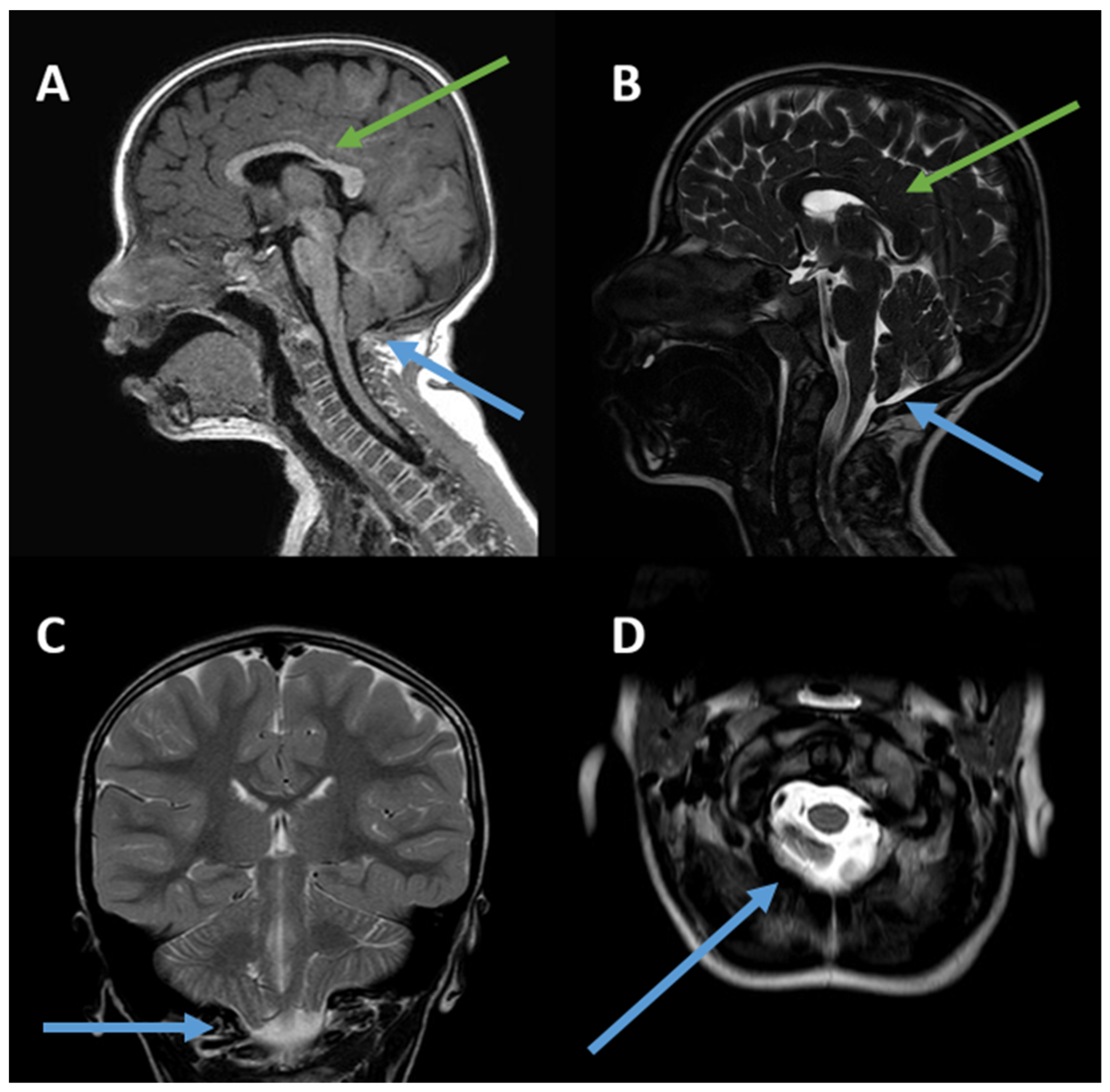
- Expanding neuroradiological findings in TCF20-NDD.
- Exome sequencing is extremely important when the clinical picture is unclear.
Abstract
1. Introduction
2. Case Report
3. Discussion
4. Take-Home Messages
- -
- Further studies are essential to delineate potential associations between TCF20 gene variants and MRI-detectable alterations. At present, based on the available data, it is not possible to identify neuroradiological features that are specific to this condition.
- -
- Motor impairment is a feature commonly associated with TCF20 gene alterations; in our case, however, the Chiari I malformation does not appear to be severe enough to contribute significantly to the patient’s symptoms.
- -
- When the etiology of a child’s motor impairment is unclear, particularly in the presence of ataxia-like features such as upper-limb tremors, it is advisable to perform comprehensive genetic testing to avoid overlooking potential diagnoses.
Supplementary Materials
Author Contributions
Funding
Institutional Review Board Statement
Informed Consent Statement
Data Availability Statement
Acknowledgments
Conflicts of Interest
References
- Torti, E.; Keren, B.; Palmer, E.E.; Zhu, Z.; Afenjar, A.; Anderson, I.J.; Andrews, M.V.; Atkinson, C.; Au, M.; Berry, S.A.; et al. Variants in TCF20 in neurodevelopmental disability: Description of 27 new patients and review of literature. Anesth. Analg. 2019, 21, 2036–2042. [Google Scholar] [CrossRef]
- Online Mendelian Inheritance in Man, OMIM®. Johns Hopkins University, Baltimore, MD, USA. Available online: https://omim.org/ (accessed on 16 October 2019).
- Gray, P.A.; Fu, H.; Luo, P.; Zhao, Q.; Yu, J.; Ferrari, A.; Tenzen, T.; Yuk, D.-I.; Tsung, E.F.; Cai, Z.; et al. Mouse brain organization revealed through direct genome-scale TF expression analysis. Science 2004, 306, 2255–2257. [Google Scholar] [CrossRef]
- Lein, E.S.; Hawrylycz, M.J.; Ao, N.; Ayres, M.; Bensinger, A.; Bernard, A.; Boe, A.F.; Boguski, M.S.; Brockway, K.S.; Byrnes, E.J.; et al. Genome-wide atlas of gene expression in the adult mouse brain. Nature 2007, 445, 168–176. [Google Scholar] [CrossRef]
- Huang, S.; Xu, J.; Li, Y.; Mo, W.; Lin, X.; Wang, Y.; Liang, F.; Bai, Y.; Huang, G.; Chen, J.; et al. A syndrome featuring developmental disorder of the nervous system induced by a novel mutation in the TCF20 gene, rarely concurrent immune disorders: A case report. Front. Genet. 2023, 14, 1192668. [Google Scholar] [CrossRef]
- Dominguez, G.; Wu, Y.; Zhou, J. Epigenetic Regulation and Neurodevelopmental Disorders: From MeCP2 to the TCF20/PHF14 Complex. Genes 2024, 15, 1653. [Google Scholar] [CrossRef] [PubMed]
- Zhou, J.; Hamdan, H.; Yalamanchili, H.K.; Pang, K.; Pohodich, A.E.; Lopez, J.; Shao, Y.; Oses-Prieto, J.A.; Li, L.; Kim, W.; et al. Disruption of MeCP2–TCF20 complex underlies distinct neurodevelopmental disorders. Proc. Natl. Acad. Sci. USA 2022, 119, e2119078119. [Google Scholar] [CrossRef] [PubMed]
- Landrum, M.J.; Lee, J.M.; Riley, G.R.; Jang, W.; Rubinstein, W.S.; Church, D.M.; Maglott, D.R. ClinVar: Public archive of relationships among sequence variation and human phenotype. Nucleic Acids Res. 2014, 42, D980–D985. [Google Scholar] [CrossRef]
- Vetrini, F.; McKee, S.; Rosenfeld, J.A.; Suri, M.; Lewis, A.M.; Nugent, K.M.; Roeder, E.; Littlejohn, R.O.; Holder, S.; Zhu, W.; et al. De novo and inherited TCF20 pathogenic variants are associated with intellectual disability, dysmorphic features, hypotonia, and neurological impairments with similarities to Smith–Magenis syndrome. Genome Med. 2019, 11, 12. [Google Scholar] [CrossRef] [PubMed]
- Babbs, C.; Lloyd, D.; Pagnamenta, A.T.; Twigg, S.R.F.; Green, J.; McGowan, S.J.; Mirza, G.; Naples, R.; Sharma, V.P.; Volpi, E.V.; et al. De novo and rare inherited mutations implicate the transcriptional coregulator TCF20/SPBP in autism spectrum disorder. J. Med. Genet. 2014, 51, 737–747. [Google Scholar] [CrossRef]
- Schäfgen, J.; Cremer, K.; Becker, J.; Wieland, T.; Zink, A.M.; Kim, S.; Windheuser, I.C.; Kreiß, M.; Aretz, S.; Strom, T.M.; et al. De novo nonsense and frameshift variants of TCF20 in individuals with intellectual disability and postnatal overgrowth. Eur. J. Hum. Genet. 2016, 24, 1739–1745. [Google Scholar] [CrossRef]
- Testa, B.; Conteduca, G.; Grasso, M.; Cecconi, M.; Lantieri, F.; Baldo, C.; Arado, A.; Andraghetti, L.; Malacarne, M.; Milani, D.; et al. Molecular Analysis and Reclassification of NSD1 Gene Variants in a Cohort of Patients with Clinical Suspicion of Sotos Syndrome. Genes 2023, 14, 295. [Google Scholar] [CrossRef]
- Svorenova, T.; Romito, L.M.; Colangelo, I.; Han, V.; Jech, R.; Prokisch, H.; Winkelmann, J.; Skorvanek, M.; Garavaglia, B.; Zech, M. Dystonia as a prominent feature of TCF20-associated neurodevelopmental disorder: Expanding the phenotype. Park. Relat. Disord. 2022, 102, 89–91. [Google Scholar] [CrossRef]
- Prasun, P.; Vermeire, K.; Ferimer, S. Dystonic Cerebral Palsy-Like Presentation Caused by a Novel TCF20 Variant. J. Mov. Disord. 2024, 17, 348–350. [Google Scholar] [CrossRef]
- Magistrelli, L.; Contaldi, E.; D’ALfonso, S.; Corrado, L. Myoclonus-Dystonia plus Syndrome in a Patient Carrying a Novel TCF20 Variant. Mov. Disord. Clin. Pract. 2024, 12, 105–107. [Google Scholar] [CrossRef]
- Tsoi, H.; Yu, A.C.S.; Chen, Z.S.; Ng, N.K.N.; Chan, A.Y.Y.; Yuen, L.Y.P.; Abrigo, J.M.; Tsang, S.Y.; Tsui, S.K.W.; Tong, T.M.F.; et al. A novel missense mutation in CCDC88C activates the JNK pathway and causes a dominant form of spinocerebellar ataxia. J. Med. Genet. 2014, 51, 590–595. [Google Scholar] [CrossRef] [PubMed]
- Yahia, A.; Chen, Z.S.; Ahmed, A.E.; Emad, S.; Adil, R.; Abubaker, R.; Taha, S.O.M.A.; Salih, M.A.; Elsayed, L.; Chan, H.Y.E.; et al. A heterozygous mutation in the CCDC88C gene likely causes early-onset pure hereditary spastic paraplegia: A case report. BMC Neurol. 2021, 21, 78. [Google Scholar] [CrossRef]
- Richards, S.; Aziz, N.; Bale, S.; Bick, D.; Das, S.; Gastier-Foster, J.; Grody, W.W.; Hegde, M.; Lyon, E.; Spector, E.; et al. Standards and guidelines for the interpretation of sequence variants: A joint consensus recommendation of the American College of Medical Genetics and Genomics and the Association for Molecular Pathology. Genet. Med. 2015, 17, 405–424. [Google Scholar] [CrossRef] [PubMed]
- Lévy, J.; Cogan, G.; Maruani, A.; Maillard, A.; Dupont, C.; Drunat, S.; Rachid, M.; Atzori, P.; Delorme, R.; Jeyarajah, S.; et al. Rare and de novo duplications containing TCF20 are associated with a neurodevelopmental disorder. Clin. Genet. 2022, 101, 364–370. [Google Scholar] [CrossRef] [PubMed]
- Aboulezz, A.O.; Sartor, K.; Geyer, C.A.; Gado, M.H. Position of cerebellar tonsils in the normal population and in patients with Chiari malformation: A quantitative approach with MR imaging. J. Comput. Assist. Tomogr. 1985, 9, 1033–1036. [Google Scholar] [CrossRef]
- Barkovich, A.J.; Wippold, F.J.; Sherman, J.L.; Citrin, C.M. Significance of cerebellar tonsillar position on MR. Am. J. Neuroradiol. 1986, 7, 795–799. [Google Scholar]
- Maya, I.; Vinkler, C.; Konen, O.; Kornreich, L.; Steinberg, T.; Yeshaya, J.; Latarowski, V.; Shohat, M.; Lev, D.; Baris, H.N. Abnormal brain magnetic resonance imaging in two patients with Smith–Magenis syndrome. Am. J. Med. Genet. A 2014, 164, 1940–1946. [Google Scholar] [CrossRef]
- Schneeweiss, M.R.; Dale, B.; Ejaz, R. Diagnosis and clinical presentation of two individuals with a rare TCF20 pathogenic variant. BMJ Case Rep. 2022, 15, e248995. [Google Scholar] [CrossRef]
- Allemang-Grand, R.; Ellegood, J.; Noakes, L.S.; Ruston, J.; Justice, M.; Nieman, B.J.; Lerch, J.P. Neuroanatomy in mouse models of Rett syndrome is related to the severity of Mecp2 mutation and behavioral phenotypes. Mol. Autism 2017, 8, 32. [Google Scholar] [CrossRef]
- Li, D.; Mei, L.; Li, H.; Hu, C.; Zhou, B.; Zhang, K.; Qiao, Z.; Xu, X.; Xu, Q. Brain structural alterations in young girls with Rett syndrome: A voxel-based morphometry and tract-based spatial statistics study. Front. Neuroinform. 2022, 16, 962197. [Google Scholar] [CrossRef]
- Lelieveld, S.H.; Reijnders, M.R.F.; Pfundt, R.; Yntema, H.G.; Kamsteeg, E.-J.; de Vries, P.; de Vries, B.B.A.; Willemsen, M.H.; Kleefstra, T.; Löhner, K.; et al. Meta-analysis of 2104 trios provides support for 10 new genes for intellectual disability. Nat. Neurosci. 2016, 19, 1194–1196. [Google Scholar] [CrossRef]
- Deciphering Developmental Disorders Study. Prevalence and architecture of de novo mutations in developmental disorders. Nature 2017, 542, 433–438. [Google Scholar] [CrossRef]
- Meadows, J.; Kraut, M.; Guarnieri, M.; Haroun, R.I.; Carson, B.S. Asymptomatic Chiari Type I malformations identified on magnetic resonance imaging. J. Neurosurg. 2000, 92, 920–926. [Google Scholar] [CrossRef] [PubMed]
- Elster, A.D.; Chen, M.Y. Chiari I malformations: Clinical and radiologic reappraisal. Radiology 1992, 183, 347–353. [Google Scholar] [CrossRef] [PubMed]
- Tubbs, R.S.; Lyerly, M.J.; Loukas, M.; Shoja, M.M.; Oakes, W.J. The pediatric Chiari I malformation: A review. Child’s Nerv. Syst. 2007, 23, 1239–1250. [Google Scholar] [CrossRef] [PubMed]
- Kuhn, J.; Weisbrod, L.J.; Emmady, P.D. Chiari Malformation Type 2. In StatPearls; StatPearls Publishing: Treasure Island, FL, USA, 2025. Available online: https://www.ncbi.nlm.nih.gov/books/NBK557498/ (accessed on 6 November 2025).
- American Psychiatric Association. Diagnostic and Statistical Manual of Mental Disorders, 5th ed.; Text Revision; American Psychiatric Association Publishing: Washington, DC, USA, 2022. [Google Scholar]
- Nash, J.; Cheng, J.S.; Meyer, G.A.; Remler, B.F. Chiari type I malformation: Overview of diagnosis and treatment. WMJ 2002, 101, 35–40. [Google Scholar]
- McClugage, S.G.; Oakes, W.J. The Chiari I malformation. J. Neurosurg. Pediatr. 2019, 24, 217–226. [Google Scholar] [CrossRef] [PubMed]
- Kular, S.; Cascella, M. Chiari Malformation Type 1; StatPearls Publishing: Treasure Island, FL, USA, 2025. [Google Scholar]


| Reference/(Case #) | TCF20 Variant (NM_001378418.1) | Pathologic Neuroimaging Findings |
|---|---|---|
| [23] (B) | c.1261A>T, p.(Thr421Ser) | Corpus callosum had an abnormal appearance with overall thickening and slightly lobulated contour, likely reflecting underlying abnormalities in the organization of the white matter. |
| [5] | c.1839_1872del, p.(Met613Ilefs*159) | Symmetric patchy abnormal signals in the bilateral parietal white matter and adjacent to the bilateral lateral ventricles, and insufficient cerebral white matter myelination were observed. The nuclei in the bilateral basal ganglia showed symmetric, slightly short T1 and slightly short T2 signals; the bilateral lateral paraventricular region and bilateral parietal white matter revealed symmetric patchy, slightly long T1 and slightly long T2 signals, isointense signals on fluid attenuated inversion recovery (FLAIR) image, and slightly low-intense signals with indistinct edges on diffusion weighted imaging (DWI). |
| [9] (#6) | c.2327_2328del, p.(Gln776Argfs*5) | Mild cerebellar atrophy. |
| [9] (#16) | c.4894del, p.(Tyr1632Thrfs*6) | Not specified. |
| [9] (#23) | c.5652_56553del, p.(Glu1884Aspfs*31) | Not specified. |
| [9] (#26) | c.5719C>T, p.(Arg1907*) | Delayed CNS myelination and lack of cerebral white matter. |
| [10,11,26,27] | NA | Abnormality of the cerebrum n = 2/12 (not better specified). |
Disclaimer/Publisher’s Note: The statements, opinions and data contained in all publications are solely those of the individual author(s) and contributor(s) and not of MDPI and/or the editor(s). MDPI and/or the editor(s) disclaim responsibility for any injury to people or property resulting from any ideas, methods, instructions or products referred to in the content. |
© 2025 by the authors. Licensee MDPI, Basel, Switzerland. This article is an open access article distributed under the terms and conditions of the Creative Commons Attribution (CC BY) license (https://creativecommons.org/licenses/by/4.0/).
Share and Cite
Ziveri, D.; Cesaroni, C.A.; Contrò, G.; Caraffi, S.G.; Ormitti, F.; Giannini, L.; Pantani, A.; Cavalli, A.; Rizzi, S.; Pollazzon, M.; et al. A Boy with a Novel Variant in TCF20: An Expanded Phenotype and a Brief Review of the Literature. Children 2025, 12, 1543. https://doi.org/10.3390/children12111543
Ziveri D, Cesaroni CA, Contrò G, Caraffi SG, Ormitti F, Giannini L, Pantani A, Cavalli A, Rizzi S, Pollazzon M, et al. A Boy with a Novel Variant in TCF20: An Expanded Phenotype and a Brief Review of the Literature. Children. 2025; 12(11):1543. https://doi.org/10.3390/children12111543
Chicago/Turabian StyleZiveri, Diletta, Carlo Alberto Cesaroni, Gianluca Contrò, Stefano Giuseppe Caraffi, Francesca Ormitti, Lucrezia Giannini, Agnese Pantani, Anna Cavalli, Susanna Rizzi, Marzia Pollazzon, and et al. 2025. "A Boy with a Novel Variant in TCF20: An Expanded Phenotype and a Brief Review of the Literature" Children 12, no. 11: 1543. https://doi.org/10.3390/children12111543
APA StyleZiveri, D., Cesaroni, C. A., Contrò, G., Caraffi, S. G., Ormitti, F., Giannini, L., Pantani, A., Cavalli, A., Rizzi, S., Pollazzon, M., Frattini, D., & Fusco, C. (2025). A Boy with a Novel Variant in TCF20: An Expanded Phenotype and a Brief Review of the Literature. Children, 12(11), 1543. https://doi.org/10.3390/children12111543