


The Impact of Prenatal Environmental Tobacco Smoking (ETS) and Exposure on Chinese Children: A Systematic Review



Abstract
1. Background
2. Materials and Methods
2.1. Eligibility Criteria
- Publication type: peer-reviewed journal article/report
- Article type: systematic reviews, meta-analyses, scoping reviews, cohort studies, cross-sectional studies, case-control studies, non-RCTs, case series, individual case reports
- Text availability: full text
- Publication date: since 2011
- Language: English
- Location: Mainland China, Hong Kong, Macau, and Taiwan
- Study population: pregnant women, children ages 0–18 years, and fetus
2.2. Type of Resources
2.3. Search Strategy
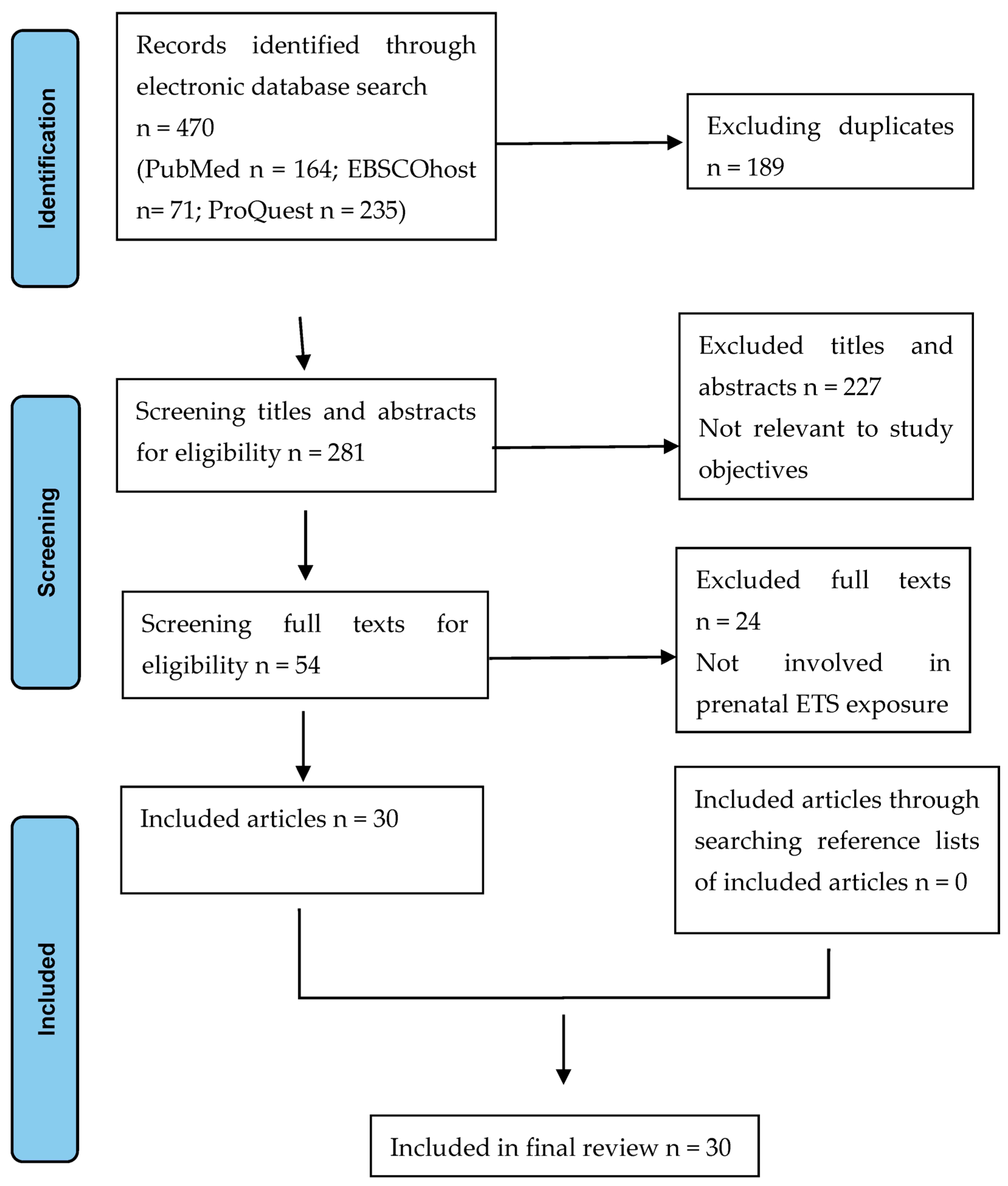
2.4. Selection of Eligible Studies
2.5. Data Charting
2.6. Critical Appraisal
2.7. Synthesis of Results
- A descriptive analysis, mapping the data and showing the distribution of studies by year of publication, origin, study method, aims, and quality.
- A thematic summary, narratively describing how the identified research relates to the systematic-scoping review research question and objectives, as well as the main findings from these organized by theme.
2.8. Characteristics and Quality of the Included Studies
2.9. Health Outcomes
2.10. Hypertension
2.11. Foetal and Children’s Development
2.12. Birth Outcomes
2.13. Orofacial Clefts (OFCs)
2.14. Neural Tube Defects (NTDs)
2.15. Congenital Heart Disease (CHD)
2.16. Developmental Coordination Disorder (DCD)
2.17. Developmental Delay
2.18. Behavioural Disorders
2.19. ADHD
2.20. Autism Behaviour
2.21. Other Disorders
2.22. Respiratory Outcomes
3. Others
3.1. Astigmatism
3.2. Sleep Disorders
4. Discussion
5. Limitations
6. Conclusions
Author Contributions
Funding
Institutional Review Board Statement
Informed Consent Statement
Data Availability Statement
Conflicts of Interest
References
- World Health Organization. Air Quality Guidelines for Europe, 2nd ed.; World Health Organization. Regional Office for Europe: Geneva, Switzerland, 2000. [Google Scholar]
- Greenhalgh, E.M.; Scollo, M.M.; Winstanley, M.H. Tobacco in Australia: Facts and Issues; Cancer Council Victoria: Melbourne, Australia, 2022; Available online: www.TobaccoInAustralia.org.au (accessed on 23 May 2023).
- DiGiacomo, S.I.; Jazayeri, M.-A.; Barua, R.S.; Ambrose, J.A. Environmental Tobacco Smoke and Cardiovascular Disease. Int. J. Environ. Res. Public Health 2018, 16, 96. [Google Scholar] [CrossRef]
- He, Y.; Luo, R.; Wang, T.; Gao, J.; Liu, C. Prenatal Exposure to Environmental Tobacco Smoke and Early Development of Children in Rural Guizhou Province, China. Int. J. Environ. Res. Public Health 2018, 15, 2866. [Google Scholar] [CrossRef]
- Vanker, A.; Gie, R.P.; Zar, H.J. The association between environmental tobacco smoke exposure and childhood respiratory disease: A review. Expert Rev. Respir. Med. 2017, 11, 661–673. [Google Scholar] [CrossRef]
- Öberg, M.; Jaakkola, M.S.; Woodward, A.; Peruga, A.; Prüss-Ustün, A. Worldwide burden of disease from exposure to second-hand smoke: A retrospective analysis of data from 192 countries. Lancet 2011, 377, 139–146. [Google Scholar] [CrossRef]
- Chao, M.-R.; Cooke, M.S.; Kuo, C.-Y.; Pan, C.-H.; Liu, H.-H.; Yang, H.-J.; Chen, S.-C.; Chiang, Y.-C.; Hu, C.-W. Children are particularly vulnerable to environmental tobacco smoke exposure: Evidence from biomarkers of tobacco-specific nitrosamines and oxidative stress. Environ. Int. 2018, 120, 238–245. [Google Scholar] [CrossRef]
- U.S. Department of Health and Human Services. The Health Consequences of Smoking—50 Years of Progress: A Report of the Surgeon General; U.S. Department of Health and Human Services: Washington, DC, USA, 2014. Available online: https://www.ncbi.nlm.nih.gov/books/NBK179276/pdf/Bookshelf_NBK179276.pdf (accessed on 23 May 2023).
- Snodgrass, A.M.; Tan, P.T.; E Soh, S.; Goh, A.; Shek, L.P.; van Bever, H.P.; Gluckman, P.D.; Godfrey, K.M.; Chong, Y.S.; Saw, S.M.; et al. Tobacco smoke exposure and respiratory morbidity in young children. Tob. Control 2016, 25, e75–e82. [Google Scholar] [CrossRef]
- Zhou, S.; Rosenthal, D.G.; Sherman, S.; Zelikoff, J.; Gordon, T.; Weitzman, M. Physical, behavioral, and cognitive effects of prenatal tobacco and postnatal secondhand smoke exposure. Curr. Probl. Pediatr. Adolesc. Health Care 2014, 44, 219–241. [Google Scholar] [CrossRef]
- Sabbagh, H.J.; Hassan, M.H.A.; Innes, N.P.T.; Elkodary, H.M.; Little, J.; Mossey, P.A. Passive smoking in the etiology of non-syndromic orofacial clefts: A systematic review and meta-analysis. PLoS ONE 2015, 10, e0116963. [Google Scholar] [CrossRef]
- Wang, Y.; Hu, D.; Chen, W.; Xue, H.; Du, Y. Prenatal Tobacco Exposure Modulated the Association of Genetic variants with Diagnosed ADHD and its symptom domain in children: A Community Based Case-Control Study. Sci. Rep. 2019, 9, 4274. [Google Scholar] [CrossRef]
- Chen, J.; Li, X.; Fang, P. Influence of family resources on secondhand smoking in pregnant women: A cross-sectional study in the border and minority urban areas of Northwest China. BMC Pregnancy Childbirth 2020, 20, 642. [Google Scholar] [CrossRef]
- Li, Q.; Hsia, J.; Yang, G. Prevalence of Smoking in China in 2010. N. Engl. J. Med. 2011, 364, 2469–2470. [Google Scholar] [CrossRef]
- World Health Organization. Global Adult Tobacco Survey (GATS)—China Fact Sheet 2010; World Health Organization: Geneva, Switzerland, 2010; Available online: https://www.tobaccofreekids.org/assets/global/pdfs/en/GATS_china_2010.pdf (accessed on 3 May 2023).
- Dai, S.; Chan, K.C.C. Household environmental tobacco smoke exposure in healthy young children in Hong Kong: Prevalence and risk factors. PLoS ONE 2020, 15, e0227733. [Google Scholar] [CrossRef]
- Peters, M.D.J.; Godfrey, C.M.; Khalil, H.; McInerney, P.; Parker, D.; Soares, C.B. Guidance for conducting systematic scoping reviews. JBI Evid. Implement. 2015, 13, 141–146. [Google Scholar] [CrossRef]
- The Joanna Briggs Institute. The Joanna Briggs Institute Reviewers’ Manual 2015, Methodology for JBI Scoping Reviews. 2015. Available online: https://nursing.lsuhsc.edu/JBI/docs/ReviewersManuals/Scoping-.pdf (accessed on 16 December 2022).
- Rethlefsen, M.L.; Page, M.J. PRISMA 2020 and PRISMA-S: Common questions on tracking records and the flow diagram. J. Med. Libr. Assoc. JMLA 2022, 110, 253. [Google Scholar] [CrossRef]
- The Joanna Briggs Institute. Template for Scoping Review Protocols; The Joanna Briggs Institute: Adelaide, Australia, 2020; Available online: https://jbi.global/scoping-review-network/resources (accessed on 17 December 2022).
- Zhang, H.; Yu, L.; Wang, Q.; Tao, Y.; Li, J.; Sun, T.; Zhang, Y.; Zhang, H. In utero and postnatal exposure to environmental tobacco smoke, blood pressure, and hypertension in children: The Seven Northeastern Cities study. Int. J. Environ. Health Res. 2020, 30, 618–629. [Google Scholar] [CrossRef]
- Wang, R.; Sun, T.; Yang, Q.; Yang, Q.; Wang, J.; Li, H.; Tang, Y.; Yang, L.; Sun, J. Low birthweight of children is positively associated with mother’s prenatal tobacco smoke exposure in Shanghai: A cross-sectional study. BMC Pregnancy Childbirth 2020, 20, 603. [Google Scholar] [CrossRef]
- Liu, J.; Leung, P.W.; McCauley, L.; Ai, Y.; Pinto-Martin, J. Mother’s environmental tobacco smoke exposure during pregnancy and externalizing behavior problems in children. Neurotoxicology 2013, 34, 167–174. [Google Scholar] [CrossRef]
- Lin, Q.; Hou, X.-Y.; Yin, X.-N.; Wen, G.-M.; Sun, D.; Xian, D.-X.; Fan, L.; Jiang, H.; Jing, J.; Jin, Y.; et al. Prenatal Exposure to Environmental Tobacco Smoke and Hyperactivity Behavior in Chinese Young Children. Int. J. Environ. Res. Public Health 2017, 14, 1132. [Google Scholar] [CrossRef]
- Lee, S.L.; Lam, T.H.; Leung, T.H.; Wong, W.H.S.; Schooling, M.; Leung, G.M.; Lau, Y.L. Foetal exposure to maternal passive smoking is associated with childhood asthma, allergic rhinitis, and eczema. Sci. World J. 2012, 2012, 542983. [Google Scholar] [CrossRef]
- Pi, X.; Li, Z.; Jin, L.; Liu, J.; Zhang, Y.; Zhang, L.; Wang, L.; Ren, A. Secondhand smoke during the periconceptional period increases the risk for orofacial clefts in offspring. Paediatr. Perinat. Epidemiol. 2018, 32, 423–427. [Google Scholar] [CrossRef]
- Ren, S.; Xie, S.; Li, X.; Li, G.; Wang, Y.; Liu, W.; Wang, L. The association between maternal exposure to secondhand smoke during pregnancy and their children’s cerebral palsy, Shandong, China. Tob. Induc. Dis. 2020, 18, 87. [Google Scholar] [CrossRef]
- Chen, X.; Huang, L.; Zhong, C.; Li, Q.; Chen, R.; Sun, G.; Jin, Z.; Yang, X.; Hao, L.; Yang, H.; et al. Association between environmental tobacco smoke before and during pregnancy and the risk of adverse birth outcomes: A birth cohort study in Wuhan, China. Environ. Sci. Pollut. Res. 2021, 28, 27230–27237. [Google Scholar] [CrossRef]
- Dong, G.-H.; Wang, D.; Yang, Z.-H.; Zhang, P.-F.; Ren, W.-H.; Zhao, Y.-D.; He, Q.-C. Gender-specific differences in effects of prenatal and postnatal environmental tobacco smoke exposure on respiratory symptoms in 23,474 children with and without allergic predisposition: Results from 25 districts of northeast China. Int. J. Environ. Health Res. 2011, 21, 173–188. [Google Scholar] [CrossRef]
- Hu, L.-W.; Yang, M.; Chen, S.; Shah, K.; Hailegiorgis, Y.; Burgens, R.; Vaughn, M.; Huang, J.; Xaverius, P.; Paul, G.; et al. Effects of in utero and Postnatal Exposure to Secondhand Smoke on Lung Function by Gender and Asthma Status: The Seven Northeastern Cities (SNEC) Study. Respiration 2017, 93, 189–197. [Google Scholar] [CrossRef]
- Lin, L.-Z.; Xu, S.-L.; Wu, Q.-Z.; Zhou, Y.; Ma, H.-M.; Chen, D.-H.; Chen, G.-B.; Yu, H.-Y.; Yang, B.-Y.; Zeng, X.-W.; et al. Association of Prenatal, Early Postnatal, or Current Exposure to Secondhand Smoke With Attention-Deficit/Hyperactivity Disorder Symptoms in Children. JAMA Netw. Open 2021, 4, e2110931. [Google Scholar] [CrossRef]
- Liu, W.; Huang, C.; Cai, J.; Wang, X.; Zou, Z.; Sun, C. Household environmental exposures during gestation and birth outcomes: A cross-sectional study in Shanghai, China. Sci. Total Environ. 2018, 615, 1110–1118. [Google Scholar] [CrossRef]
- Huang, L.; Tian, F.-Y.; Fan, L.; He, Y.-H.; Peng, D.; Xie, C.; Tao, L.; Yuan, S.-X.; Jia, D.-Q.; Chen, W.-Q. Appetite during the second and third trimesters mediates the impact of prenatal environmental tobacco smoke exposure on symmetric full-term low birth weight. J. Matern. Fetal Neonatal Med. 2020, 33, 1544–1553. [Google Scholar] [CrossRef]
- Leung, C.Y.; Leung, G.M.; Schooling, C.M. Early second-hand smoke exposure and child and adolescent mental health: Evidence from Hong Kong’s ‘Children of 1997’ birth cohort. Addiction 2015, 110, 1811–1824. [Google Scholar] [CrossRef]
- Li, C.-G.; Yang, G.-Y.; Schmid, K.L.; Huang, L.-H.; He, G.-H.; Liu, L.; Ruan, Z.-L.; Chen, W.-Q. Associations between Environmental Tobacco Smoke Exposure in Early Life and Astigmatism among Chinese Preschool Children. Int. J. Environ. Res. Public Health 2019, 16, 3725. [Google Scholar] [CrossRef]
- Lin, L.-Z.; Xu, S.-L.; Wu, Q.-Z.; Zhou, Y.; Ma, H.-M.; Chen, D.-H.; Dong, P.-X.; Xiong, S.-M.; Shen, X.-B.; Zhou, P.-E.; et al. Exposure to second-hand smoke during early life and subsequent sleep problems in children: A population-based cross-sectional study. Environ. Health 2021, 20, 127. [Google Scholar] [CrossRef]
- Yang, J.-H.; Strodl, E.; Wu, C.-A.; Yin, X.-N.; Wen, G.-M.; Sun, D.-L.; Xian, D.-X.; Chen, J.-Y.; Chen, Y.-J.; Chen, W.-Q. Association between environmental tobacco smoke exposure in early life and autistic-like behaviors in Chinese preschoolers. J. Psychosom. Res. 2021, 152, 110680. [Google Scholar] [CrossRef]
- Zhuge, Y.; Qian, H.; Zheng, X.; Huang, C.; Zhang, Y.; Li, B.; Zhao, Z.; Deng, Q.; Yang, X.; Sun, Y.; et al. Effects of parental smoking and indoor tobacco smoke exposure on respiratory outcomes in children. Sci. Rep. 2020, 10, 4311. [Google Scholar] [CrossRef] [PubMed]
- Liu, X.-C.; Strodl, E.; Huang, L.-H.; Hu, B.-J.; Chen, W.-Q. Effect of prenatal exposure to household air pollution from multiple sources on risk of preterm birth. Atmosphere 2022, 13, 2022. [Google Scholar] [CrossRef]
- Chen, H.; Zhang, Y.; Zhang, L.; Liu, J.; Jin, L.; Ren, A.; Li, Z. Indoor air pollution from coal combustion and tobacco smoke during the periconceptional period and risk for neural tube defects in offspring in five rural counties of Shanxi province, China, 2010–2016. Environ. Int. 2023, 171, 107728. [Google Scholar] [CrossRef] [PubMed]
- Wang, L.; Deng, Y.; Yang, Y.; Liu, F.; Xu, Q.; Peng, Z.; He, Y.; Wang, Y.; Xu, J.; Zhang, H.; et al. Paternal smoking and preterm birth: A population-based retrospective cohort study among non-smoking women aged 20–49 years in rural China. Reprod. Health 2022, 19, 72. [Google Scholar] [CrossRef] [PubMed]
- Song, X.; Li, Q.; Diao, J.; Li, J.; Li, Y.; Zhang, S.; Zhao, L.; Chen, L.; Wei, J.; Shu, J.; et al. Association of mthfd1 gene polymorphisms and maternal smoking with risk of congenital heart disease: A hospital-based case-control study. BMC Pregnancy Childbirth 2022, 22, 88. [Google Scholar] [CrossRef]
- Wu, M.; Williams, G.J.; Chen, G.; Zhang, L.; Hu, C.; Dai, X.; Du, W.; Hua, J. Prenatal second-hand smoke exposure and the risk of suspected developmental coordination disorder in preschoolers: A nationwide retrospective cohort study in China. Front. Public Health 2022, 10, 993471. [Google Scholar] [CrossRef]
- Sakran, K.A.; Abotaleb, B.M.; Al-Rokhami, R.K.; Hsieh, T.-Y.; Al-Wesabi, M.A.; Mohammed, A.A.; Al-Sharani, H.M.; Shi, P.; He, D. Analysis of environmental exposures for nonsyndromic cleft lip and/or palate: A case-control study. Iran. J. Public Health 2022, 51, 578. [Google Scholar] [CrossRef]
- Deng, C.; Pu, J.; Deng, Y.; Xie, L.; Yu, L.; Liu, L.; Guo, X.; Sandin, S.; Liu, H.; Dai, L. Association between maternal smoke exposure and congenital heart defects from a case–control study in China. Sci. Rep. 2022, 12, 14973. [Google Scholar] [CrossRef]
- Wang, T.; Chen, L.; Ni, B.; Sheng, X.; Huang, P.; Zhang, S.; Qin, J. Maternal pre-pregnancy/early-pregnancy smoking and risk of congenital heart diseases in offspring: A prospective cohort study in central china. J. Glob. Health 2022, 12, 11009. [Google Scholar] [CrossRef]
- Lee, N.L.; Samet, J.M.; Yang, G.; Zhou, M.; Yang, J.; Correa, A.; Lees, P.S.J. Prenatal Secondhand Smoke Exposure and Infant Birth Weight in China. Int. J. Environ. Res. Public Health 2012, 9, 3398–3420. [Google Scholar] [CrossRef] [PubMed]
- Chen, M.M.; Chiu, C.-H.; Yuan, C.-P.; Liao, Y.-C.; Guo, S.-E. Influence of Environmental Tobacco Smoke and Air Pollution on Fetal Growth: A Prospective Study. Int. J. Environ. Res. Public Health 2020, 17, 5319. [Google Scholar] [CrossRef] [PubMed]
- Leonardi-Bee, J.; Britton, J.; Venn, A. Secondhand smoke and adverse fetal outcomes in nonsmoking pregnant women: A meta-analysis. Pediatrics 2011, 127, 734–741. [Google Scholar] [CrossRef] [PubMed]
- Pereira, P.P.D.S.; Da Mata, F.A.; Figueiredo, A.C.G.; de Andrade, K.R.C.; Pereira, M.G. Maternal Active Smoking During Pregnancy and Low Birth Weight in the Americas: A Systematic Review and Meta-analysis. Nicotine Tob. Res. Off. J. Soc. Res. Nicotine Tob. 2017, 19, 497–505. [Google Scholar] [CrossRef] [PubMed]
- Xiao, L.; Jiang, Y.; Zhang, J.; Parascandola, M. Secondhand Smoke Exposure among Nonsmokers in China. Asian Pac. J. Cancer Prev. APJCP 2020, 21, 17–22. [Google Scholar] [CrossRef] [PubMed]

| Authors | Publication Year | Location | Aims/Purpose | Methodology | Sample Size | Study Population | Data Collection and Measurement | Study Quality |
|---|---|---|---|---|---|---|---|---|
| Zhang et al. [21] | 2020 | Liaoning Province | Evaluate the association of ETS exposure with hypertension and blood pressure (BP) in children. | Cross-sectional study | 9354 | School-aged children (5–17 years) | Questionnaire | Moderate |
| Chen et al. [13] | 2020 | Taiwan (Chaiyi) | Evaluated the influences of air quality, including ETS and particulate matter (PM), on fetal development. | Longitudinal correlation study | 74 | Non-smoking pregnant women | Questionnaire and laboratory result | High |
| Wang et al. [22] | 2020 | Shanghai | Explored whether the LBW in children is positively associated with mothers’ prenatal cigarette smoke exposure. | Cross-sectional study | 8586 | Kindergarten children | Interview and questionnaire | Moderate |
| Liu et al. [23] | 2013 | Jiangsu Province (Changzhou) | Examined the association between maternal ETS exposure during pregnancy and child behaviour problems. | Cross-sectional study | 646 | Mother-child pairs | Questionnaire and evaluation tool | Moderate |
| He et al. [4] | 2018 | Guizhou Province | Examined the association between prenatal exposure to ETS and the development of children in their first two years of life. | Cross-sectional study | 446 | Children | Questionnaire | Moderate |
| Lin et al. [24] | 2017 | Shenzhen City | Examined the association between prenatal ETS exposure and hyperactivity behaviours in young children. | Cross-sectional study | 21,243 | Preschool children | Questionnaire and evaluation tool | Moderate |
| Lee et al. [25] | 2012 | Beijing and Changchun Province | Examined the magnitude of association between maternal SHS exposure during pregnancy and reduction in infant birth weight in China. | Cross-sectional study | 2770 | Non-smoking postpartum women | Interview and questionnaire | Moderate |
| Wang et al. [12] | 2019 | Liuzhou City | Tested the hypothesis that prenatal tobacco smoking exposure (PSE) could modulate the association of genetic variants with ADHD. | Case-control study | 401 (168 cases and 233 controls) | Children aged 6–12 years | Interview and questionnaire | High |
| Pi et al. [26] | 2018 | Shanxi Province | Examined whether exposure to SHS during the periconceptional period among nonsmoking women is associated with an increased risk for orofacial clefts (OFCs) in offspring. | Case-control study | 1660 (240 cases and 1420 controls) | Newborns | Interview and questionnaire | Moderate |
| Ren et al. [27] | 2020 | Shandong Province | Assessed the association between maternal exposure to SHS during pregnancy and children’s cerebral palsy (CP). | Cross-sectional study | 5067 | Mother-child pairs | Questionnaire | Moderate |
| Chen et al. [28] | 2021 | Wuhan City | Clarified the association between ETS before and during pregnancy and the risk of adverse birth outcomes. | Cohort study | 7147 | Mothers-infant pairs | Questionnaire and delivery records | High |
| Dong et al. [29] | 2011 | Liaoning Province | Assessed the interaction between ETS exposure and allergic predisposition regarding respiratory health. | Cross-sectional study | 23,474 | Children from elementary schools | Questionnaire | Moderate |
| Hu et al. [30] | 2017 | Liaoning Province | Investigated whether gender or asthma status modifies the association between SHS exposure and lung function. | Cross-sectional study | 6740 | School-aged children | Questionnaire and electronic spirometers | Moderate |
| Lee at al. [25] | 2012 | Hong Kong | Examined the association between fetal exposure to maternal passive smoking and childhood asthma, allergic rhinitis, and eczema. | Cross-sectional study | 7393 | Children ≤ 14 Y | Questionnaire, interview, and evaluation tool | Moderate |
| Lin et al. [31] | 2021 | Liaoning Province | Evaluated the associations between prenatal, early postnatal, or current SHS exposure and ADHD symptoms and subtypes. | Cross-sectional study | 45,562 | School-aged children | Questionnaire and evaluation tool | Moderate |
| Liu et al. [32] | 2017 | Shanghai | Investigated the associations between household environmental factors during gestation and preterm birth, low birth weight, term low birth weight, and fetuses too small for their gestational age. | Cross-sectional study | 13,335 | Children ages 4–6 years | Questionnaire | Moderate |
| Huang et al. [33] | 2020 | Guangdong Province (Foshan and Shenzhen) | Examined the relationship between prenatal environmental tobacco smoke (ETS) exposure and full-term low birth weight (FT-LBW). | Case-control study | 1632 (243 cases and 1389 controls) | Mothers–infant pairs | Interview and medical records | High |
| Leung et al. [34] | 2015 | Hong Kong | Estimated the associations between early SHS exposure during the prenatal and postnatal periods and several aspects of adolescent mental health. | Cohort study | 7914 | “Children of 1997” birth cohort | Questionnaire and evaluation tool | High |
| Li et al. [35] | 2019 | Shenzhen City (Longhua) | Investigated the association between ETS during early life and early-onset astigmatism. | Cross-sectional study | 27,890 | Preschool children | Questionnaire and medical diagnosis | Moderate |
| Lin et al. [36] | 2021 | Liaoning Province | Evaluated the associations between early-life SHS exposure and sleep problems in children. | Cross-sectional study | 45,562 | School-aged children | Questionnaire and evaluation tool | Moderate |
| Yang et al. [37] | 2021 | Shenzhen City (Longhua) | Explored the association between children’s exposure to ETS in early life and autistic-like behaviours. | Cross-sectional study | 65,243 | Preschool children | Questionnaire and evaluation tool | Moderate |
| Zhuge et al. [38] | 2020 | Urumqi, Taiyuan, Beijing, Nanjing, Shanghai, Wuhan, Chongqing, and Changsha | Analyzed the associations between ETS and dry night cough, croup, pneumonia, and the frequent common colds. | Cross-sectional study | 41,176 | Children ages 3–8 years | Questionnaires | Moderate |
| Liu et al. [39] | 2022 | Shenzhen City (Longhua) | Explored the independent and joint effects of prenatal exposure from multiple household air pollution (HAP) sources on PTB. | Cross-sectional study | 63,038 | Mother–child pairs | Questionnaire | Moderate |
| Chen et al. [40] | 2023 | Shanxi Province (Pingding, Xiyang, Shouyang, Taigu, and Zezhou). | Investigated the impact of maternal exposure to indoor air pollution from coal combustion and tobacco smoke on the risk for neural tube defects (NTDs). | Case-control study | 739 (222 cases and 517 controls) | Women (during the periconceptional period) | Questionnaire and evaluation tool | High |
| Wang et al. [41] | 2022 | Rural China | Evaluated the association between paternal smoking and preterm birth (PTB). | Cohort study | 5,298,043 | Reproductive-aged couples | Questionnaire and medical diagnosis | High |
| Song et al. [42] | 2022 | Changsha, Hunan Province | Examined the role of the MTHFD1 gene and maternal smoking on infant CHD risk and investigated their interaction effects in Chinese populations. | Case-control study | 968 (464 cases and 504 controls) | Mother–child pairs | Questionnaire and laboratory result | Moderate |
| Wu et al. [43] | 2022 | Mainland China (nationwide) | Investigated the association between prenatal SHS exposure and suspected DCD in preschoolers. | Cross-sectional study | 149,005 | Preschoolers | Questionnaire and evaluation tool | Moderate |
| Sakran et al. [44] | 2022 | Gansu Province | Identified the relationship between environmental factors and nonsyndromic cleft lip and/or palate (NSCL/P) in Northwest China. | Case-control study | 1260 (600 cases and 660 controls) | Children and their parents | Interview | High |
| Deng et al. [45] | 2022 | West China Second University Hospital | Examined the association between maternal ETS and fetal CHDs and the potentially moderating effect of maternal hazardous and noxious substances (HNS), periconceptional folate intake, and paternal smoking. | Case-control study | 1629 (749 cases and 880 controls) | Pregnant women | Questionnaire, interview, and medical diagnosis | High |
| Wang et al. [46] | 2022 | Central China | Estimated the associations between maternal active and passive smoking during the pre-pregnancy/early-pregnancy period and CHDs as well as its common phenotypes in offspring. | Cohort study | 49,158 | Pregnant women between the 8th and 14th weeks of gestation | Interview and medical diagnosis | High |
| Criterion | Total Score | Percentage (%) | |||||||||||
|---|---|---|---|---|---|---|---|---|---|---|---|---|---|
| Author (Year) | 1 | 2 | 3 | 4 | 5 | 6 | 7 | 8 | 9 | 10 | 11 | ||
| Cross-sectional studies | |||||||||||||
| Zhang et al., (2020) [21] | 1 | 1 | 0 | 1 | 1 | 0 | 1 | 1 | n/a | n/a | n/a | 6 | 55% |
| Wang et al., (2020) [22] | 1 | 1 | 0 | 1 | 1 | 1 | 1 | 1 | n/a | n/a | n/a | 7 | 64% |
| Liu et al., (2013) [23] | 1 | 1 | 0 | 1 | 1 | 1 | 1 | 1 | n/a | n/a | n/a | 7 | 64% |
| He et al., (2018) [4] | 1 | 1 | 0 | 1 | 1 | 1 | 1 | 1 | n/a | n/a | n/a | 7 | 64% |
| Lin et al., (2017) [24] | 1 | 1 | 0 | 1 | 1 | 1 | 1 | 1 | n/a | n/a | n/a | 7 | 64% |
| Lee et al., (2012) [47] | 1 | 1 | 0 | 1 | 1 | 1 | 1 | 1 | n/a | n/a | n/a | 7 | 64% |
| Ren et al., (2020) [27] | 1 | 1 | 0 | 1 | 1 | 0 | 1 | 1 | n/a | n/a | n/a | 6 | 55% |
| Dong et al., (2011) [29] | 1 | 1 | 0 | 1 | 1 | 1 | 0 | 1 | n/a | n/a | n/a | 6 | 55% |
| Hu et al., (2017) [30] | 1 | 1 | 0 | 1 | 1 | 1 | 1 | 1 | n/a | n/a | n/a | 7 | 64% |
| Lee et al., (2012) [25] | 1 | 1 | 0 | 1 | 1 | 1 | 0 | 1 | n/a | n/a | n/a | 6 | 55% |
| Lin et al., (2021) [31] | 1 | 1 | 0 | 1 | 1 | 1 | 1 | 1 | n/a | n/a | n/a | 7 | 64% |
| Liu et al., (2018) [32] | 1 | 1 | 0 | 1 | 1 | 1 | 1 | 1 | n/a | n/a | n/a | 7 | 64% |
| Li et al., (2019) [35] | 1 | 1 | 0 | 1 | 1 | 1 | 0 | 1 | n/a | n/a | n/a | 6 | 55% |
| Lin et al., (2021) [36] | 1 | 1 | 0 | 1 | 1 | 1 | 1 | 1 | n/a | n/a | n/a | 7 | 64% |
| Yang et al., (2021) [37] | 1 | 1 | 0 | 1 | 1 | 1 | 1 | 1 | n/a | n/a | n/a | 7 | 64% |
| Zhuge et al., (2020) [38] | 1 | 1 | 0 | 1 | 1 | 1 | 0 | 1 | n/a | n/a | n/a | 6 | 55% |
| Liu et al., (2022) [39] | 1 | 1 | 0 | 1 | 1 | 1 | 0 | 1 | n/a | n/a | n/a | 6 | 55% |
| Wu et al., (2022) [43] | 1 | 1 | 0 | 1 | 1 | 1 | 1 | 1 | n/a | n/a | n/a | 7 | 64% |
| Case-control studies | |||||||||||||
| Wang et al., (2019) [12] | 1 | 1 | 1 | 0 | 1 | 1 | 1 | 1 | 1 | 1 | n/a | 9 | 82% |
| Pi et al., (2018) [26] | 1 | 0 | 1 | 0 | 1 | 1 | 1 | 1 | 1 | 1 | n/a | 8 | 73% |
| Huang et al., (2020) [33] | 1 | 1 | 1 | 0 | 1 | 1 | 1 | 1 | 1 | 1 | n/a | 9 | 82% |
| Chen et al., (2023) [40] | 1 | 1 | 1 | 0 | 1 | 1 | 1 | 1 | 1 | 1 | n/a | 9 | 82% |
| Song et al., (2022) [42] | 1 | 1 | 1 | 0 | 1 | 1 | 1 | 1 | 1 | 1 | n/a | 9 | 82% |
| Sakran et al., (2022) [44] | 1 | 1 | 1 | 0 | 1 | 1 | 1 | 1 | 1 | 1 | n/a | 9 | 82% |
| Deng et al., (2022) [45] | 1 | 1 | 1 | 0 | 1 | 1 | 1 | 1 | 1 | 1 | n/a | 9 | 82% |
| Cohort studies | |||||||||||||
| Chen et al., (2020) [48] | 1 | 1 | 1 | 1 | 1 | 1 | 1 | 0 | 1 | n/a | 1 | 9 | 82% |
| Chen et al., (2021) [28] | 1 | 1 | 0 | 1 | 1 | 1 | 1 | 1 | 1 | 0 | 1 | 9 | 82% |
| Leung et al., (2015) [34] | 1 | 1 | 0 | 1 | 1 | 1 | 0 | 1 | 1 | 1 | 1 | 9 | 82% |
| Wang et al., (2022) [41] | 1 | 1 | 0 | 1 | 1 | 1 | 1 | 1 | 1 | 0 | 1 | 9 | 82% |
| Wang et al., (2022) [46] | 1 | 1 | 0 | 1 | 1 | 1 | 1 | 1 | 1 | n/a | 1 | 9 | 82% |
| Authors (Publication Year) | Main Results | Exposure Sources | Exposure Timepoint |
|---|---|---|---|
| 1. Hypertension | |||
| Zhang et al., (2020) [21] | Significant associations were observed between hypertension and ETS exposure in utero, with current major ETS exposure from fathers or anyone, and with intensity of ETS exposure greater than 1 cigarette per day. For SBP, significant associations were only observed in children with major ETS exposure from fathers and with cigarettes smoking >10/day. | Household (SHS from father or anyone) | In utero and within children’s first 2 years of life |
| 2. Fetal and children’s development | |||
| 2.1. Birth outcomes | |||
| Wang et al., (2020) [22] | The mean birthweight was 167.7 g and 66.1 g lower in children born to mothers with prenatal FHS and SHS exposure compared with those children whose mothers were not exposed, respectively. | Maternal passive and active smoking | Prenatal exposure |
| Huang et al., (2020) [33] | Significant association between prenatal ETS exposure and FT-LBW. | Maternal SHS exposure at home, workplaces, and public places | During pregnancy |
| Chen et al., (2020) [48] | ETS exposure decreased birth length by ≥1 cm, and is potentially an independent risk factor for fetal growth restriction. | Maternal SHS exposure at home, workplaces, and public places | During pregnancy |
| Chen et al., (2021) [28] | Significant association between exposure to ETS during pregnancy and PTB, but not LBW or SGA births. | Maternal ETS exposure (indoor and outdoor) | Before and/or during pregnancy. |
| Liu et al., (2018) [32] | Positive relation between paternal smoking during gestation and PB, LBW, and SGA, but not significant associations. | Household (paternal and maternal smoking) | During pregnancy |
| Lee et al., (2012) [47] | No deficit in mean birth weight was observed with exposure from all sources of SHS combined. | Maternal ETS exposure at home, workplaces, and public places | During pregnancy |
| Liu et al., (2022) [39] | Prenatal exposure to ETS increased the risk of PTB, and the PTB risk increased with the average level of daily ETS exposure | Household (Maternal exposure) | Prenatal exposure |
| Wang et al., (2022) [41] | Paternal smoking and preconception paternal smoking was independently positively associated with PTB risk. The HRs of PTB also increased with the increment of paternal smoking and preconception paternal smoking categories | Paternal and maternal smoking | Preconception exposure |
| 2.2. Orofacial clefts | |||
| Pi et al., (2018) [26] | Maternal SHS exposure during the periconceptional period increased the risk of OFCs in offspring among nonsmoking mothers, and there was a dose–response relationship. | Maternal SHS exposure at home and indoor public places | Prenatal exposure |
| Sakran et al., (2022) [44] | Maternal passive smoking was found to be a significant risk factor for NSCLP incidence. | Paternal and maternal smoking | The 1st trimester of gestation |
| 2.3. Neural tube defects (NTDs) | |||
| Chen et al., (2023) [40] | Significant association between passive smoking and neural tube defects (NTDs) including a dose–response gradient. | Household | During the periconceptional period (1 month before to 2 months after conception) |
| 2.4. Congenital heart disease (CHD) | |||
| Song et al., (2022) [42] | Increased risk of CHD in offspring whose mothers were exposed to secondhand smoke during the 3 months before pregnancy and in the first trimester of pregnancy | At home and/or at work/school | During the 3 months before pregnancy and in the first trimester of pregnancy |
| Deng et al., (2022) [45] | Maternal exposure to ETS in the first trimester was associated with increased risk of CHDs in a dose–response gradient. | Maternal exposure | In the first trimester of pregnancy |
| Wang et al., (2022) [46] | Significantly higher risks of CHDs were detected in offspring exposed to maternal cigarette smoking in the 3 months before pregnancy. Maternal cigarette smoking in early pregnancy was also independently associated with risk of CHDs in offspring. | Maternal exposure | During the 3 months before pregnancy and in early pregnancy |
| 2.5. Developmental coordination disorder (DCD) | |||
| Wu et al., (2022) [43] | Prenatal SHS exposure had a strong negative association with the total score of LDCDQ and increased the risk of suspected DCD | At home and/or at work | Prenatal and postnatal exposure |
| 2.6. Developmental delay | |||
| Ren et al., (2020) [27] | Children born to mothers exposed to SHS during pregnancy had a higher risk of CP, and the risk increased with exposure time. | Maternal SHS exposure | Prenatal exposure |
| He et al., (2018) [4] | Prenatal ETS exposure was associated with lower cognition scores and language scores, and the frequency of prenatal ETS exposure was negatively associated with language development before children reached two years old. | Maternal ETS exposure | Prenatal exposure |
| 3. Behavioral disorders | |||
| 3.1. ADHD | |||
| Wang et al., (2019) [12] | Prenatal tobacco smoke exposure was a significant risk factor for ADHD, even after adjusting for other potential confounders. The risk of the genetic variants in ADHD was increased significantly if the child had prenatal tobacco exposure. | Household and workplace | Prenatal and postnatal exposure |
| Lin et al., (2021) [31] | Significant association between SHS exposure from pregnancy to childhood and ADHD symptoms and subtypes. | SHS exposure | Prenatal, postnatal (i.e., first 2 years of life), and current periods |
| Lin et al., (2017) [24] | Prenatal ETS exposure was significantly associated with an increased risk of hyperactivity behaviours in young children, and there was a dose–response relationship. | Household (Maternal exposure) | Prenatal exposure |
| 3.2. Autism Behaviour | |||
| Yang et al., (2021) [37] | Significant association between being exposed to ETS during gestation and autistic-like behaviours, including a dose–response relationship. | Household | During pregnancy, from birth to one year, and from one to three years |
| 3.3. Other disorders | |||
| Liu et al., (2013) [23] | ETS exposure was associated with a higher risk of externalizing behaviour problems in the offspring of exposed mothers. However, it was not associated with internalizing or total behaviour problems. No dose-response relationship was found. | Maternal ETS exposure at home, the workplace, and other places | Prenatal exposure |
| Leung et al., (2015) [34] | Significant association between prenatal SHS exposure from non-parental sources and behavioural problems, and association between paternal smoking, maternal smoking, and mental health problems. | Non-parental and parental exposure | Prenatal and postnatal |
| 4. Respiratory diseases | |||
| Zhuge et al., (2020) [38] | Associations between most respiratory health outcomes and parental smoking, except for the frequent common colds. Stronger association for father smoking and insignificant effect for maternal smoking. Most association were insignificant after adjustment. | Parental smoking (mother only, father only, both) | During pregnancy, during the first year of life, and current periods |
| Dong et al., (2011) [29] | Significant association between ETS exposure in utero and the prevalence of respiratory morbidities, including a dose–response relationship. | Household (current and maternal) | Prenatal, postnatal (i.e., first 2 years of life), and current periods |
| Lee et al., (2012) [25] | Significant association between fetal exposure to ETS, having ever experienced wheezing, currently experiencing wheezing, and having ever experienced allergic rhinitis or eczema, including a dose–response relationship. | Household (maternal passive and active smoking) | During pregnancy |
| Hu et al., (2017) [30] | Significant association between in utero exposure to SHS and decreased lung function. Childhood asthma mediated the effects. | Household SHS exposure and maternal passive and active smoking | In utero and during early childhood |
| 5. Others | |||
| Li et al., (2019) [35] | No significant association between being exposed to ETS only during pregnancy and astigmatism. Significant associations were found between exposure to ETS during pregnancy and from one to three years, or during pregnancy, from birth to one year, and from one to three years old. | Household | During pregnancy, from birth to one year and from one to three years |
| Lin et al., (2021) [36] | Significant association between being exposed to ETS during pregnancy and sleep problems. | Household | Pregnancy and the first two years of life |
Disclaimer/Publisher’s Note: The statements, opinions and data contained in all publications are solely those of the individual author(s) and contributor(s) and not of MDPI and/or the editor(s). MDPI and/or the editor(s) disclaim responsibility for any injury to people or property resulting from any ideas, methods, instructions or products referred to in the content. |
© 2023 by the authors. Licensee MDPI, Basel, Switzerland. This article is an open access article distributed under the terms and conditions of the Creative Commons Attribution (CC BY) license (https://creativecommons.org/licenses/by/4.0/).
Share and Cite
Ye, H.; Yang, X.; Hanna, F. The Impact of Prenatal Environmental Tobacco Smoking (ETS) and Exposure on Chinese Children: A Systematic Review. Children 2023, 10, 1354. https://doi.org/10.3390/children10081354
Ye H, Yang X, Hanna F. The Impact of Prenatal Environmental Tobacco Smoking (ETS) and Exposure on Chinese Children: A Systematic Review. Children. 2023; 10(8):1354. https://doi.org/10.3390/children10081354
Chicago/Turabian StyleYe, Huazhen, Xiaoyu Yang, and Fahad Hanna. 2023. "The Impact of Prenatal Environmental Tobacco Smoking (ETS) and Exposure on Chinese Children: A Systematic Review" Children 10, no. 8: 1354. https://doi.org/10.3390/children10081354
APA StyleYe, H., Yang, X., & Hanna, F. (2023). The Impact of Prenatal Environmental Tobacco Smoking (ETS) and Exposure on Chinese Children: A Systematic Review. Children, 10(8), 1354. https://doi.org/10.3390/children10081354

