
What Is Helpful and What Is Challenging for the Caregivers of Young People Receiving Interventions to Prevent Suicide? Caregivers’ Perspectives—A Rapid Scoping Review
 ,
,
Abstract
:
1. Introduction
1.1. Suicide in Young People
1.2. Interventions to Prevent Suicide
1.3. The Role of Caregivers
1.4. Caregivers’ Perspectives of Interventions to Prevent Suicide
2. Materials and Methods
2.1. Rapid Scoping Review
2.2. Eligibility Criteria
2.3. Information Sources
2.4. Selection
2.5. Data Extraction
2.6. Quality Assessment
2.7. Data Synthesis
3. Results
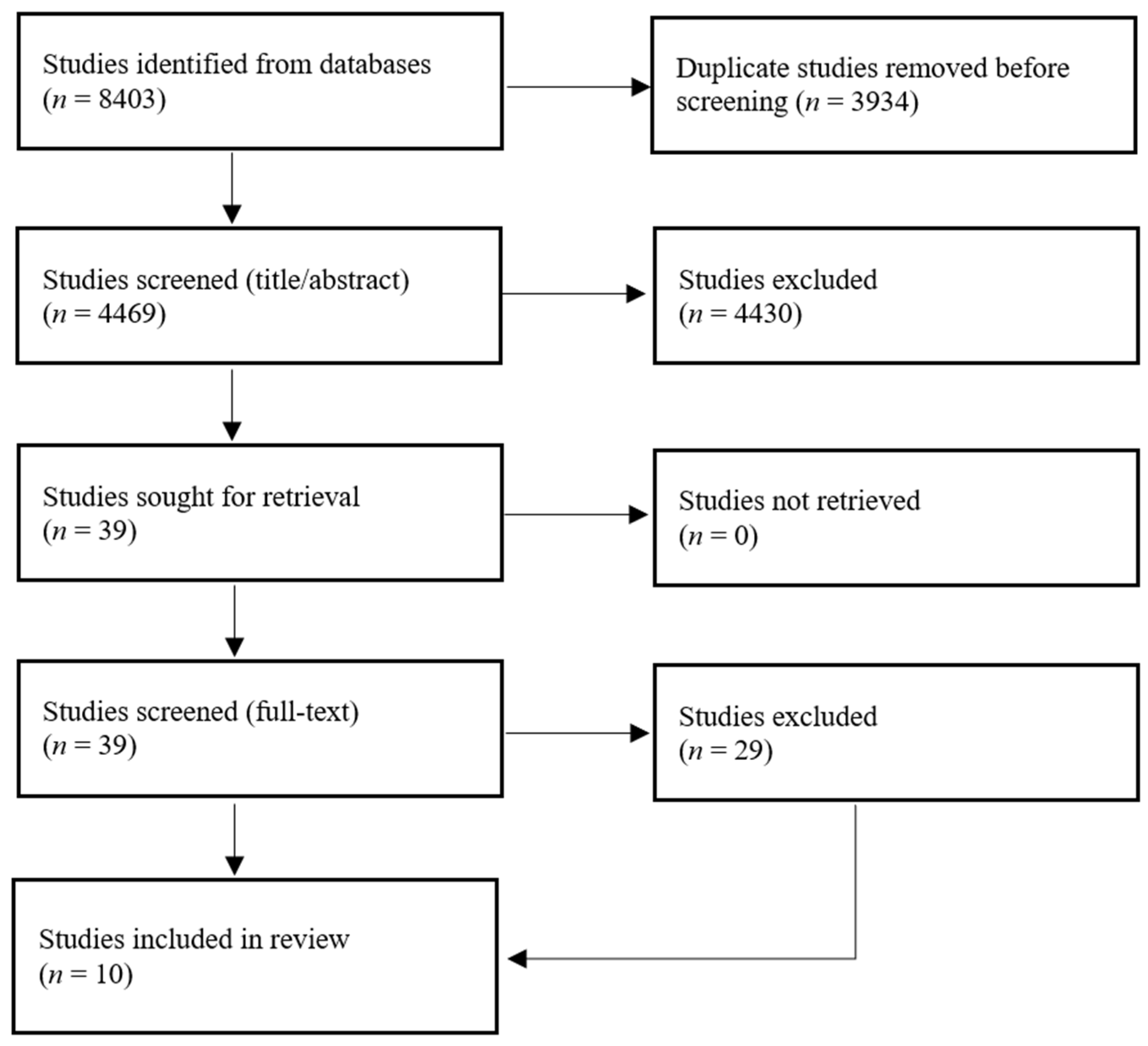
3.1. Searches
3.2. Study and Participant Characteristics
3.3. Intervention Characteristics
3.4. Caregivers’ Experiences and Perspectives
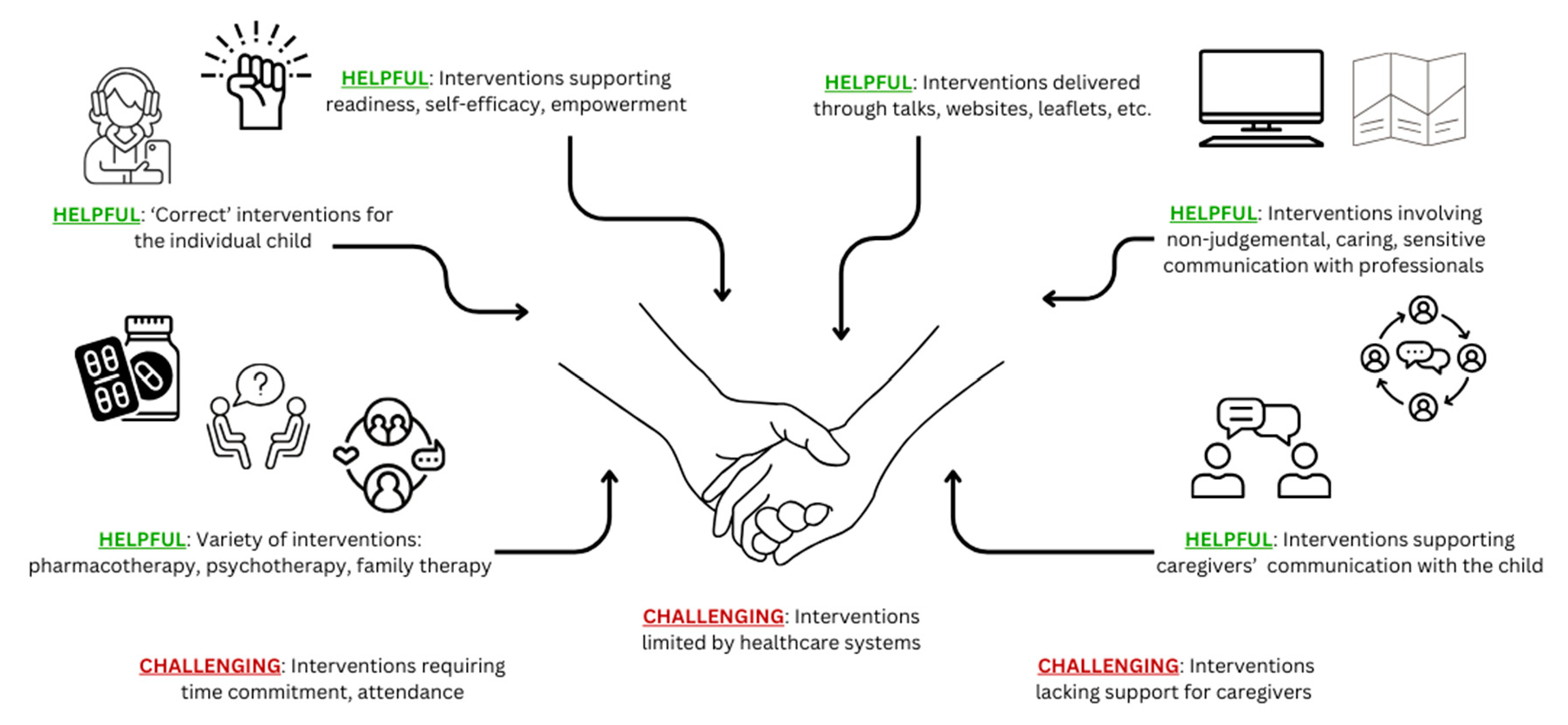
- Theme 1: What caregivers find helpful.
- Theme 2: What caregivers find challenging.
3.5. Quality Assessment
4. Discussion
4.1. Interventions That Are Delivered in the Right Context
4.2. Interventions That Include Psychological Support for Caregivers
4.3. Interventions That Are Flexible
4.4. Interventions That Increase Caregivers’ Confidence and Self-Efficacy
4.5. Interventions That Facilitate Caregivers’ Communication
4.6. Limitations
5. Conclusions
Author Contributions
Funding
Institutional Review Board Statement
Informed Consent Statement
Data Availability Statement
Conflicts of Interest
References
- World Health Organization. Suicide. 2021. Available online: https://www.who.int/news-room/fact-sheets/detail/suicide (accessed on 29 June 2022).
- Glenn, C.; Kleiman, E.; Kellerman, J.; Pollak, O.; Cha, C.; Esposito, E.; Porter, A.; Wyman, P.; Boatman, A. Annual research review: A meta-analytic review of worldwide suicide rates in adolescents. J. Child Psychol. Psychiatry 2019, 61, 294–308. [Google Scholar] [CrossRef] [PubMed]
- Kolves, K.; De Leo, D. Suicide rates in children aged 10–14 years worldwide: Changes in the past two decades. Br. J. Psychiatry 2018, 205, 283–285. [Google Scholar] [CrossRef]
- Centers for Disease Control and Prevention. Disparities in Suicide. 2023. Available online: https://www.cdc.gov/suicide/facts/disparities-in-suicide.html (accessed on 2 October 2023).
- Van Meter, A.; Knowled, E.; Mintz, E. Systematic review and meta-analysis: International prevalence of suicidal ideation and attempt in youth. J. Am. Acad. Child Adolesc. Psychiatry 2023, 62, 973–986. [Google Scholar] [CrossRef] [PubMed]
- Goto, R.; Okubo, Y.; Skokauskas, N. Reasons and trends in youth’s suicide rates during the COVID-19 pandemic. Lancet Reg. Health 2022, 27, 100567. [Google Scholar] [CrossRef] [PubMed]
- Gili, M.; Castellvi, P.; Vives, M.; de la Torre-Luque, A.; Almenara, J.; Blaso, M.; Cebria, A.; Gabilondo, A.; Perez-Ara, M.; Miranda-Mendizabal, A.; et al. Mental disorders as risk factors for suicidal behavior in young people: A meta-analysis and systematic review of longitudinal studies. J. Affect. Disord. 2019, 245, 152–162. [Google Scholar] [CrossRef] [PubMed]
- Campisi, S.; Carducci, B.; Askseer, N.; Zasowski, C.; Szatmari, P.; Bhutta, Z. Suicidal behaviours among adolescents from 90 countries: A pooled analysis of the global school-based student health survey. BMC Public Health 2010, 20, 1102. [Google Scholar] [CrossRef]
- Fonseca-Pedrero, E.; Al-Halabi, S.; Perez-Albeniz, A.; Debbane, M. Risk and protective factors in adolescent suicidal behaviour: A network analysis. Int. J. Environ. Res. Public Health 2022, 19, 1784. [Google Scholar] [CrossRef]
- Lipschitz, J.; Yen, S.; Weinstock, L.; Spirito, A. Adolescent and caregiver perception of family functioning: Relation to suicide ideation and attempts. Psychiatry Res. 2012, 200, 400–403. [Google Scholar] [CrossRef]
- del Carpio, L.; Paul, S.; Paterson, A.; Rasmussen, S. A systematic review of controlled studies of suicidal and self-harming behaviours in adolescents following bereavement by suicide. PLoS ONE 2021, 16, e0254203. [Google Scholar] [CrossRef]
- Nielassoff, E.; Le Floch, M.; Avril, C.; Gohier, B.; Duverger, P.; Riquin, E. Protective factors of suicidal behaviors in children and adolescents/young adults: A literature review. Arch. Pediatr. 2023; in press. [Google Scholar] [CrossRef]
- Robinson, J.; Bailey, E.; Witt, K.; Stefanac, N.; Milner, A.; Currier, D.; Pirkis, J.; Condron, P.; Hetrick, S. What works in youth suicide prevention? A systematic review and meta-analysis. EClinical Med. 2018, 4, 52–91. [Google Scholar] [CrossRef] [PubMed]
- Gaynor, K.; O’Reilly, M.; Redmond, D.; Nealon, C.; Twomey, C.; Hennessy, E. A meta-analysis of targeted interventions for reducing suicide-related behaviour and ideation in adolescents: Implications for trial design. Compr. Psychiatry 2023, 122, 152374. [Google Scholar] [CrossRef] [PubMed]
- Robinson, J.; Hetrick, S.; Cox, G.; Bendall, S.; Yuen, H.; Yung, A.; Pirkis, J. Can an Internet-based intervention reduce suicidal ideation, depression and hopelessness among secondary school students: Results from a pilot study. Early Interv. Psychiatry 2016, 10, 28–35. [Google Scholar] [CrossRef]
- Wasserman, D.; Carli, V.; Iosue, M.; Javed, A.; Herrman, H. Suicide prevention in childhood and adolescence: A narrative review of current knowledge on risk and protective factors and effectiveness of interventions. Asia-Pac. Psychiatry 2020, 13, e12452. [Google Scholar] [CrossRef] [PubMed]
- Abbott-Smith, S.; Ring, N.; Dougall, N.; Davey, J. Suicide prevention: What does the evidence show for the effectiveness of safety planning for children and young people?-A systematic scoping review. J. Psychiatr. Ment. Health Nurs. 2023, 30, 899–910. [Google Scholar] [CrossRef] [PubMed]
- Calear, A.; Christensen, H.; Freeman, A.; Fenton, K.; Grant, J.; van Spijker, B.; Donker, T. A systematic review of psychosocial suicide prevention interventions for youth. Eur. Child Adolesc. Psychiatry 2015, 25, 467–482. [Google Scholar] [CrossRef]
- Mann, J.; Michel, C.; Auerbach, R. Improving suicide prevention through evidence-based strategies: A systematic review. Am. J. Psychiatry 2021, 178, 611–624. [Google Scholar] [CrossRef]
- Asarnow, J.; Mehlum, L. Practitioner review: Treatment for suicidal and self-harming adolescents–Advances in suicide prevention care. J. Child Psychol. Psychiatry 2019, 61, 1046–1054. [Google Scholar] [CrossRef]
- Maple, M.; Wayland, S.; Sanford, R.; Bhullar, N. Predictors of caregiver burden among carers of suicide attempt survivors. Crisis 2023, 44, 41–48. [Google Scholar] [CrossRef]
- Lavers, G.; Andriessen, K.; Krysinska, K. A systematic review of the experiences and support needs of informal caregivers for people who have attempted suicide or experienced suicidal ideation. Int. J. Environ. Res. Public Health 2022, 19, 5181. [Google Scholar] [CrossRef]
- Demuthova, S.; Vaclavikova, I.; Selecka, L.; Blatny, M. The problem of self-disclosure of harming behavioru in adolescence. Postmod. Open 2020, 11, 1–19. [Google Scholar] [CrossRef]
- Rissanen, L.; Kylma, J.; Laukkanen, E. Helping adolescents who self-mutilate: Parental descriptions. J. Clin. Nurs. 2008, 18, 1711–1721. [Google Scholar] [CrossRef] [PubMed]
- He, A.; Fulginiti, A.; Finno-Velasquez, M. Connectedness and suicidal ideation among adolescents involved with child welfare: A national survey. Child Abus. Negl. 2015, 42, 54–62. [Google Scholar] [CrossRef] [PubMed]
- DeVille, D.; Whalen, D.; Breslin, F.; Morris, A.; Khalsa, S.; Paulus, M.; Barch, D. Prevalence and family-related factors associated with suicidal ideation, suicide attempts, and self-injury in children aged 9 to 10 years. JAMA Netw. Open 2020, 3, e1920956. [Google Scholar] [CrossRef]
- Chang, C.; Ohannessian, C.; Ewing, E.; Kobak, R.; Diamond, G.; Herres, J. Attachment and parent-adolescent discrepancies in reports of family functioning among suicidal adolescents. J. Child Fam. Stud. 2020, 29, 227–236. [Google Scholar] [CrossRef]
- Mughal, F.; Troya, M.; Dikomitis, L.; Tierney, S.; Corp, N.; Evans, N.; Townsend, E.; Chew-Grahan, C. The experiences and needs of supporting individuals of young people who self-harm: A systematic review and thematic synthesis. EClinical Med. 2022, 48, 101437. [Google Scholar] [CrossRef]
- Curtis, S.; Thorn, P.; McRoberts, A.; Hetrick, S.; Rice, S.; Robinson, J. Caring for young people who self-harm: A review of perspectives from families and yougn people. Int. J. Environ. Res. Public Health 2018, 15, 950. [Google Scholar] [CrossRef]
- Simes, D.; Shochet, I.; Murray, K.; Sands, I. A systematic review of qualitative research of the experiences of young people and their caregivers affected by suicidality and self-harm: Implications for family-based treatment. Adolesc. Res. Rev. 2022, 7, 211–233. [Google Scholar] [CrossRef]
- Tricco, A.; Antony, J.; Zarin, W.; Strifler, L.; Ghassemi, M.; Ivory, J.; Perrier, L.; Hutton, B.; Moher, D.; Straus, S. A scoping review of rapid review methods. BMC Med. 2015, 13, 224. [Google Scholar] [CrossRef]
- Sirriyeh, R.; Lawton, R.; Gardner, P.; Armitage, G. Reviewing studies with diverse designs: The development and evaluation of a new tool. J. Eval. Clin. Pract. 2012, 18, 746–752. [Google Scholar] [CrossRef]
- Harrison, R.; Jones, B.; Gardner, P.; Lawton, R. Quality assessment with diverse studies (QuADS): An appraisal tool for methodological and reporting quality in systematic reviews of mixed- or multi-method studies. BMC Health Serv. Res. 2021, 21, 144. [Google Scholar] [CrossRef]
- Lisy, K.; Porritt, K. Narrative synthesis: Considerations and challenges. Int. J. Evid. Based Healthc. 2016, 14, 201. [Google Scholar] [CrossRef]
- Burns, C.; Cortell, R.; Wagner, B. Treatment compliance in adolescents after attempted suicide: A 2-year follow-up study. J. Am. Acad. Child Adolesc. Psychiatry 2008, 47, 948–957. [Google Scholar] [CrossRef]
- Cottrell, D.; Wright-Hughes, A.; Collinson, M.; Boston, P.; Eisler, I.; Fortune, S.; Graham, E.; Green, J.; House, A.; Kerfoot, M.; et al. A pragmatic randomised controlled trial and economic evaluation of family therapy versus treatment as usual for young people seen after second or subsequent episodes of self-harm: The Self-Harm Intervention-Family Therapy (SHIFT) trial. Health Technol. Assess. 2018, 22, 1–222. [Google Scholar] [CrossRef]
- Czyz, E.; King, C.; Biermann, B. Motivational Interviewing-Enhanced Safety Planning for adolescents at high suicide risk: A pilot randomized controlled trial. J. Clin. Child Adolesc. Psychol. 2019, 48, 250–262. [Google Scholar] [CrossRef] [PubMed]
- Ewell Foster, C.; Magness, C.; Czyz, E.; Kahsay, E.; Martindale, J.; Hong, V.; Baker, E.; Cavataio, I.; Colombini, G.; Kettley, J.; et al. Predictors of parent behavioral engagement in youth suicide discharge recommendations: Implications for family-centered crisis interventions. Child Psychiatry Hum. Dev. 2022, 53, 1240–1251. [Google Scholar] [CrossRef]
- King, C.; Hovey, J.; Brand, E.; Wilson, R.; Ghaziuddin, N. Suicidal adolescents after hospitalization: Parent and family impacts on treatment follow-through. J. Am. Acad. Child Adolesc. Psychiatry 1997, 36, 85–93. [Google Scholar] [CrossRef]
- Rotheram-Borus, M.; Piacentini, J.; Van Rossem, R.; Graae, F.; Cantwell, C.; Castro-Blanco, D.; Miller, S.; Feldman, J. Enhancing treatment adherence with a specialized emergency room program for adolescent suicide attempters. J. Am. Acad. Child Adolesc. Psychiatry 1996, 35, 654–663. [Google Scholar] [CrossRef]
- Wharff, E.; Ginnis, K.; Ross, A.; White, E.; White, M.; Forbes, P. Family-based crisis intervention with suicidal adolescents: A randomized clinical trial. Pediatr Emerg. Care 2019, 35, 170–175. [Google Scholar] [CrossRef]
- Wijana, M.; Enebrink, P.; Liljedahl, S.; Ghaderi, A. Preliminary evaluation of an intensive integrated individual and family therapy model for self-harming adolescents. BMC Psychiatry 2018, 18, 371–386. [Google Scholar] [CrossRef]
- Yen, S.; Spirito, A.; Weinstock, L.; Tezanos, K.; Kolobaric, A.; Miller, I. Coping long term with active suicide in adolescents: Results from a pilot randomized controlled trial. Clin. Child Psychol. Psychiatry 2019, 24, 847–859. [Google Scholar] [CrossRef]
- Stewart, A.; Hughes, N.; Simkin, S.; Locock, L.; Ferrey, A.; Kapur, N.; Gunnell, D.; Hawton, K. Navigating an unfamiliar world: How parents of young people who self-harm experience support and treatment. Child Adolesc. Ment. Health 2018, 23, 78–84. [Google Scholar] [CrossRef] [PubMed]
- Inscoe, A.; Donisch, K.; Cheek, S.; Stokes, C.; Goldston, G.; Asarnow, J. Trauma-informed care for youth suicide prevention: A qualitative analysis of caregivers’ perspectives. Psychol. Trauma Theory Res. Pract. Policy 2021, 14, 653–660. [Google Scholar] [CrossRef] [PubMed]
- Ferrey, A.; Hawton, K.; Simkin, S.; Hughes, N.; Stewart, A.; Locock, L. “As a parent, there is no rulebook”: A new resource for parents and carers of young people who self-harm. Lancet Psychiatry 2015, 2, 577–579. [Google Scholar] [CrossRef] [PubMed]
- Krysinska, K.; Curtis, S.; Lamblin, M.; Stefanac, N.; Gibson, K.; Burne, S.; Thorn, P.; Rise, S.; McRoberts, A.; Ferrey, A.; et al. Parents’ experience and psychoeducation needs when supporting a young person who self-harms. Int. J. Environ. Res. Public Health 2020, 17, 3662. [Google Scholar] [CrossRef] [PubMed]
- McDonald, G.; O’Brien, L.; Jackson, D. Guilt and shame: Experiences of parents of self-harming adolescents. J. Child Health Care 2007, 11, 298–310. [Google Scholar] [CrossRef] [PubMed]
- Oldershaw, A.; Richards, C.; Simic, M.; Schmidt, U. Parents’ perspectives on adolescent self-harm: Qualitative study. Br. J. Psychiatry 2018, 193, 140–144. [Google Scholar] [CrossRef]
- Dempsey, S.; Halperin, S.; Smith, K.; Davey, C.; McKechnie, B.; Edwards, J.; Rice, S. “Some guidance and somewhere safe”: Caregiver and clinician perspectives on service provision for families of young people experiencing serious suicide ideation and attempt. Clin. Psychol. 2019, 23, 103–111. [Google Scholar] [CrossRef]
- Hughes, N.; Locock, L.; Simkin, S.; Stewart, A.; Ferrey, A.; Gunnell, D.; Kapur, N.; Hawton, K. Making sense of an unknown terrain: How parents understand self-harm in young people. Qual. Health Res. 2016, 27, 215–225. [Google Scholar] [CrossRef]
- Ferrey, A.; Hughes, N.; Simkin, S.; Locock, L.; Stewart, A.; Kapur, N.; Gunnell, D.; Hawton, K. The impact of self-harm by young people on parents and families: A qualitative study. BMJ Open 2016, 6, e009631. [Google Scholar] [CrossRef]
- Buus, N.; Caspersen, J.; Hansen, R.; Stenager, E.; Fleischer, E. Experiences of parents whose sons or daughters have (had) attempted suicide. J. Adv. Nurs. 2013, 70, 823–832. [Google Scholar] [CrossRef] [PubMed]
- Kawabe, K.; Horiuchi, F.; Ochi, M.; Oka, Y.; Ueno, S. Suicidal ideation in adolescents and their caregivers: A cross sectional survey in Japan. BMC Psychiatry 2016, 16, 231. [Google Scholar] [CrossRef] [PubMed]
- Kjellin, L.; Ostman, M. Relatives of psychiatric inpatients–Do physical violence and suicide attempts of patients influence family burden and participation in care? Nord. J. Psychiatry 2005, 59, 7–11. [Google Scholar] [CrossRef] [PubMed]
- Wayland, S.; Coker, S.; Maple, M. The human approach to supportive interventions: The lived experience of people who care for others who suicide attempt. Int. J. Ment. Health Nurs. 2021, 30, 667–682. [Google Scholar] [CrossRef] [PubMed]
- McLaughlin, C.; McGowan, I.; Kernohan, G.; O’Neill, S. The unmet support needs of family members caring for a suicidal person. J. Ment. Health 2016, 25, 212–216. [Google Scholar] [CrossRef]
- Hayes, C.; Simmons, M.; Palmer, V.; Hamilton, B.; Simons, C.; Hopwood, M. Experiences of an adolescent inpatient model of care: Adolescent and caregiver perspectives. J. Child Adolesc. Psychiatr. Nurs. 2020, 33, 109–124. [Google Scholar] [CrossRef]
- Kelada, L.; Whitlock, J.; Hasking, P.; Melvin, G. Parents’ experiences of nonsuicidal self-injury among adolescents and young adults. J. Child Fam. Stud. 2016, 25, 3403–3416. [Google Scholar] [CrossRef]
- Jansen, R.; Reid, M. Communication technology use by caregivers of adolescents with mental health issues: Systematic review. JMIR Mhealth Uhealth 2020, 8, 1–16. [Google Scholar] [CrossRef]
- Rheinberger, D.; Shand, F.; McGillivray, L.; McCallum, S.; Boydell, K. Parents of adolescents who experience suicidal phenomena-A scoping review of their experience. Int. J. Environ. Res. Public Health 2023, 20, 6227. [Google Scholar] [CrossRef]
- Taylor, L.; Oldershaw, A.; Richards, C.; Davidson, K.; Schmidt, U.; Simic, M. Development and pilot evaluation of a manualized cognitive-behavioural treatment package for adolescent self-harm. Behav. Cogn. Psychother. 2011, 39, 619–625. [Google Scholar] [CrossRef]
- Mehlum, L.; Tormoen, A.; Ramberg, M.; Haga, E.; Diep, L.; Laberg, S.; Larsson, B.; Stanley, B.; Miller, A.; Sund, A.; et al. Dialectical behavior therapy for adolescents with repeated suicidal and self-harming beahviour: A randomized controlled trial. J. Am. Acad. Child Adolesc. Psychiatry 2014, 53, 1082–1981. [Google Scholar] [CrossRef] [PubMed]
- Zisk, A.; Abbott, C.; Bounoua, N.; Diamond, G.; Kobak, R. Parent-teen communication predicts treatment benefit for depressed and suicidal adolescents. J. Consult. Clin. Psychol. 2019, 87, 1137–1148. [Google Scholar] [CrossRef] [PubMed]
- Spiers, S.; Grandclerc, S.; Guenole, F.; Moro, M.; Lachal, J. Adolescents-parents relationships around deliberate self-harm behaviours: A qualitative exploration. Neuropsychiatr. L’enfance L’adolesc. 2020, 68, 46–54. [Google Scholar] [CrossRef]
- Tulloch, A.; Blizzard, L.; Pinkus, Z. Adolescent-parent communication in self-harm. J. Adolesc. Health 1997, 21, 267–275. [Google Scholar] [CrossRef]


| Search Strategy | |
|---|---|
| ((Suicide prevention) OR (Suicide intervention)) AND ((Child*) OR (Youth) OR (Adolescen*) OR (“Young people”) OR (Teenager*) OR (Paediatric) OR (Pediatric)) AND ((Carer) OR (caregiver) OR (parent*) OR (Foster carer) OR (Mother) OR (Father)) | |
| Subject Category | Search Terms |
| Suicide prevention | suicide screen* suicide prevention suicide intervention suicide risk screening suicide assessment suicide risk assessment self-harm suicidal attempt |
| Youth and adolescents | child* youth adolescen* “young people” teenager* paediatric paediatric |
| Caregivers | carer caregiver parent* foster carer mother father |
| Citation | Country | Caregiver Examined | Child Age (Years) | Child Gender | Carer Sample Size | Setting | |||||||
|---|---|---|---|---|---|---|---|---|---|---|---|---|---|
| Mother/Step | Father/Step | Adoptive/Foster | Other Relatives | Not Reported | Male | Female | Emergency Department | Inpatient Hospital | Outpatient/ Community | ||||
| Quantitative Studies | |||||||||||||
| Burns et al., 2008 [35] | United States | X | X | X | 13–18 | X | X | 132 | X | X | |||
| Cottrell et al., 2018 [36] | United Kingdom | X | X | X | X | 11–18 | X | X | 832 | X | |||
| Czyz et al., 2019 [37] | United States | X (“parents”) | 13–17 | X | X | 32 | X | ||||||
| Ewell Foster et al., 2022 [38] | United States | X | X | X | 10–17 | X | X | 118 | X | ||||
| King et al., 1997 [39] | United States | X | X | 13–17 | X | X | 61 | X | |||||
| Rotheram-Borus et al., 1996 [40] | United States | X | 12–18 | X | 140 | X | X | ||||||
| Wharff et al., 2019 [41] | United States | X (“parents”, “caregivers”, “guardians”) | 13–18 | X | X | 112 families | X | ||||||
| Wijana et al., 2018 [42] | Sweden | X | X | 13–19 | X | X | Not specified | X | |||||
| Yen et al., 2019 [43] | United States | X (“parents”) | 12–18 | X | X | 17 families | X | ||||||
| Qualitative Studies | |||||||||||||
| Stewart et al., 2018 [44] | United Kingdom | X | X | X | 9–21 | X | X | 37 | X | X | X | ||
| Citation | Aim(s) | Intervention Characteristics | Caregivers’ Perspectives |
|---|---|---|---|
| Quantitative studies | |||
| Burns et al., 2008 [35] | To identify what adolescents who have attempted suicide, and their caregivers, consider ‘helpful’ in relation to mental health treatment, and to identify factors correlated with treatment compliance and suicidality outcomes | Participants might have received one or more treatments. The most common treatments were individual psychotherapy, family therapy, pharmacotherapy, and inpatient hospital treatment |
|
| Cottrell et al., 2018 [36] | To assess the clinical and cost-effectiveness of family therapy compared with treatment as usual for young people who have engaged in self-harm +/− suicidal ideation/attempt | Family therapy sessions with trained therapists: 8× sessions delivered over 6 months at approx. monthly intervals (with more frequent initial appointments), 1.25 h duration per session |
|
| Czyz et al., 2019 [37] | To determine the feasibility and acceptability of a motivational interview-enhanced safety planning intervention (MI-SafeCope) for teenagers hospitalized due to suicide risk | The MI-SafeCope intervention includes these components: (a) Establishing a personalized safety plan for the adolescent, (b) employing motivational interviewing strategies to strengthen the adolescent’s motivation and self-efficacy in relation to the plan (through individual meetings, family meetings, and follow-up calls), (c) enlisting the parents’ support to encourage safety plan use |
|
| Ewell Foster et al., 2022 [38] | To determine caregiver-level factors, and their correlation with behavioural engagement, in caregivers of youth presenting to an emergency department with suicidal ideation/attempt | Standard emergency department care (risk assessment, safety planning, lethal means counselling, treatment linkage) |
|
| King et al., 1997 [39] | To identify parent and family predictors of compliance with treatment after hospitalization in adolescents with suicidal ideation/attempt | Participants might have received pharmacotherapy, individual psychotherapy, and/or parent guidance/family therapy sessions |
|
| Rotheram-Borus et al., 1996 [40] | To evaluate outpatient treatment adherence in adolescents who have attempted suicide, and who participate in either standard care or a specialized emergency department program | The specialized emergency department program included staff with training in adolescent suicide, a videotape clarifying families’ treatment expectations, and an on-call family therapist |
|
| Wharff et al., 2019 [41] | To examine the efficacy of a Family-Based Crisis Intervention (FBCI), versus treatment as usual, in a hospital emergency department for adolescents with suicidal ideation/attempt | The FBCI involves a single 60- to 90-min session delivered during the emergency department visit. A clinician teaches psycho-education, cognitive behavioural skill building, therapeutic readiness, safety planning, and unified crisis narrative development |
|
| Wijana et al., 2018 [42] | To determine the effectiveness of an integrated individual and family therapy intervention (Intensive Contextual Treatment for Self-Harm [ICT]) in for adolescents with self-harm and/or suicidal ideation/attempts | The ICT intervention involves twice-weekly meetings for 3 months, delivered at the family home (wherever possible). A therapist teaches adolescents and caregivers effective emotional regulation, functional communication within the family, strategies for attendance of school/other scheduled activities, and maintenance and action planning in case of relapse |
|
| Yen et al., 2019 [43] | To test the feasibility and acceptability of the Coping Long Term with Active Suicide Program—adolescents (CLASP-A), versus treatment as usual, in adolescents with suicidal ideation/attempts | The CLASP-A program involves a therapist conducting two in-person sessions with the adolescent, one in-person session with the adolescent and their parent, then one telephone session each with the adolescent and their parent. The sessions focus on psycho-education life/safety planning, communication, problem-solving |
|
| Qualitative studies | |||
| Stewart et al., 2018 [44] | To explore the experiences of parents of young people who self-harmed, in terms of seeking support and navigating the healthcare system | Participants might have received one or more treatments. The most common treatments were cognitive and dialectical behaviour therapies |
|
| Citation | 1. Theoretical or Conceptual Underpinning to the Research | 2. Statement of Research Aim/s | 3. Clear Description of Research Setting and Target Population | 4. The Study Design Is Appropriate to Address the Stated Research Aim/s | 5. Appropriate Sampling to Address the Research Aim/s | 6. Rationale for Choice of Data Collection Tool/s | 7. The Format and Content of Data Collection Tool Is Appropriate to Address the Stated Research Aim/s | 8. Description of Data Collection Procedure | 9. Recruitment Data Provided | 10. Justification for Analytic Method Selected | 11. The Method of Analysis Was Appropriate to Answer the Research Aim/s | 12. Evidence That the Research Stakeholders have Been Considered in Research Design or Conduct | 13. Strengths and Limitations Critically Discussed | Total Score |
|---|---|---|---|---|---|---|---|---|---|---|---|---|---|---|
| Burns et al., 2008 [35] | 1 | 3 | 2 | 3 | 2 | 3 | 3 | 3 | 3 | 0 | 3 | 0 | 2 | 28 |
| Cottrell et al., 2018 [36] | 3 | 2 | 3 | 3 | 3 | 3 | 3 | 3 | 3 | 3 | 3 | 0 | 3 | 38 |
| Czyz et al., 2019 [37] | 3 | 2 | 1 | 3 | 2 | 1 | 2 | 3 | 3 | 2 | 2 | 2 | 2 | 28 |
| Ewell Foster et al., 2022 [38] | 3 | 3 | 3 | 3 | 3 | 3 | 3 | 2 | 3 | 3 | 3 | 3 | 3 | 38 |
| King et al., 1997 [39] | 3 | 3 | 1 | 3 | 2 | 3 | 3 | 3 | 1 | 0 | 1 | 0 | 1 | 24 |
| Rotheram-Borus et al., 1996 [40] | 2 | 3 | 3 | 3 | 3 | 3 | 3 | 3 | 3 | 3 | 3 | 3 | 3 | 38 |
| Stewart et al., 2018 [44] | 1 | 3 | 3 | 2 | 3 | 3 | 3 | 3 | 3 | 3 | 3 | 1 | 3 | 34 |
| Wharff et al., 2019 [41] | 2 | 3 | 3 | 3 | 3 | 3 | 3 | 3 | 3 | 2 | 2 | 2 | 1 | 33 |
| Wijana et al., 2018 [42] | 3 | 3 | 2 | 1 | 2 | 3 | 3 | 3 | 1 | 2 | 3 | 0 | 3 | 29 |
| Yen et al., 2019 [43] | 3 | 3 | 2 | 3 | 3 | 3 | 3 | 3 | 1 | 3 | 3 | 0 | 3 | 33 |
Disclaimer/Publisher’s Note: The statements, opinions and data contained in all publications are solely those of the individual author(s) and contributor(s) and not of MDPI and/or the editor(s). MDPI and/or the editor(s) disclaim responsibility for any injury to people or property resulting from any ideas, methods, instructions or products referred to in the content. |
© 2023 by the authors. Licensee MDPI, Basel, Switzerland. This article is an open access article distributed under the terms and conditions of the Creative Commons Attribution (CC BY) license (https://creativecommons.org/licenses/by/4.0/).
Share and Cite
Branjerdporn, G.; Erlich, F.; Ponraj, K.; McCosker, L.K.; Woerwag-Mehta, S. What Is Helpful and What Is Challenging for the Caregivers of Young People Receiving Interventions to Prevent Suicide? Caregivers’ Perspectives—A Rapid Scoping Review. Children 2023, 10, 1801. https://doi.org/10.3390/children10111801
Branjerdporn G, Erlich F, Ponraj K, McCosker LK, Woerwag-Mehta S. What Is Helpful and What Is Challenging for the Caregivers of Young People Receiving Interventions to Prevent Suicide? Caregivers’ Perspectives—A Rapid Scoping Review. Children. 2023; 10(11):1801. https://doi.org/10.3390/children10111801
Chicago/Turabian StyleBranjerdporn, Grace, Ferrell Erlich, Karthikeyan Ponraj, Laura K. McCosker, and Sabine Woerwag-Mehta. 2023. "What Is Helpful and What Is Challenging for the Caregivers of Young People Receiving Interventions to Prevent Suicide? Caregivers’ Perspectives—A Rapid Scoping Review" Children 10, no. 11: 1801. https://doi.org/10.3390/children10111801
APA StyleBranjerdporn, G., Erlich, F., Ponraj, K., McCosker, L. K., & Woerwag-Mehta, S. (2023). What Is Helpful and What Is Challenging for the Caregivers of Young People Receiving Interventions to Prevent Suicide? Caregivers’ Perspectives—A Rapid Scoping Review. Children, 10(11), 1801. https://doi.org/10.3390/children10111801