Pyroptosis in Alopecia Areata: Synthesizing Emerging Hypotheses and Charting a Path to New Therapies
 ,
,  and
and
Abstract
1. Introduction
2. Pyroptosis—A Lytic and Inflammatory Type of Programmed Cell Death
3. Signaling Pathways in Pyroptosis
3.1. Canonical and Non-Canonical Inflammasome Pathway
3.2. Pyroptosis Triggered by Granzymes
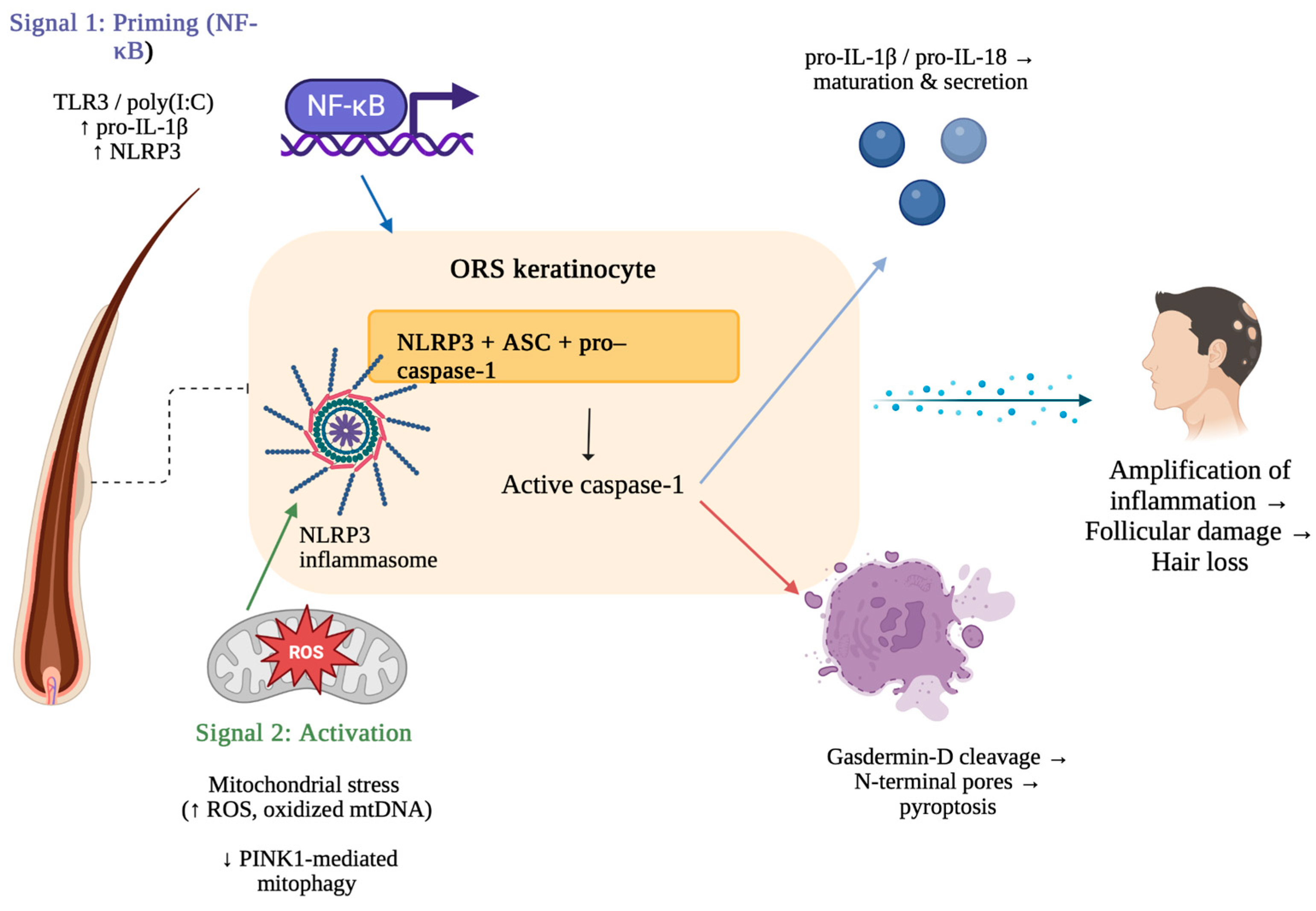
4. The Role of Pyroptosis in Alopecia Areata
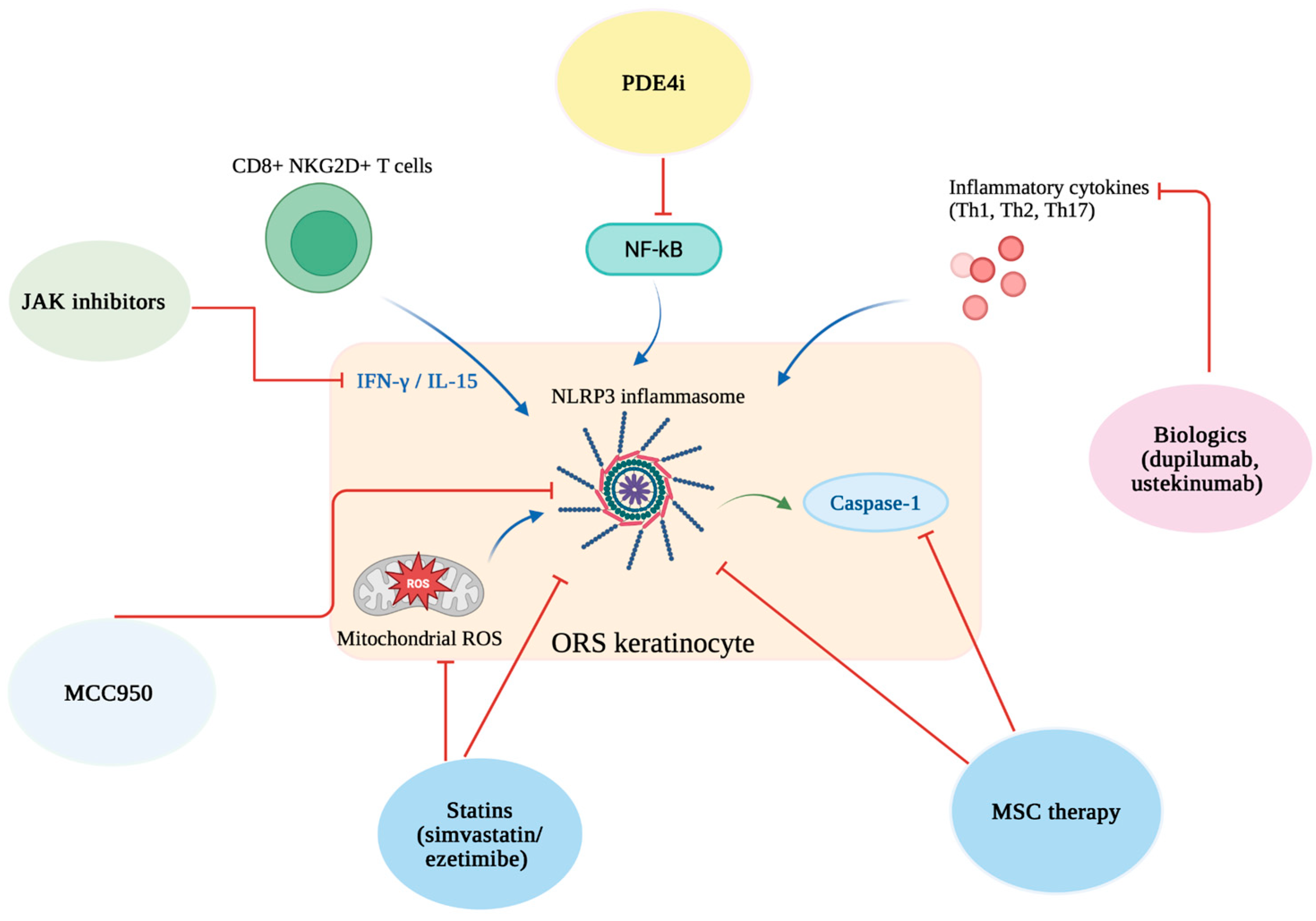
5. New Therapies of AA Based on Pyroptosis and Future Directions
- -
- LoE-H2: Interventional clinical data in humans, including randomized and non-randomized clinical trials. The study phase (e.g., phase II or III) is specified where applicable.
- -
- LoE-H1: Observational human data, such as analyses of patient biopsies, single-cell RNA sequencing (scRNA-seq), proteomics/serology, or immunohistochemistry (IHC).
- -
- LoE-A2: In vivo animal studies using AA-specific models (e.g., C3H/HeJ mice with spontaneous or graft-induced AA, humanized or xenograft AA models).
- -
- LoE-A1: In vivo animal studies using non-AA-specific hair growth or hair cycle models (e.g., C57BL/6 telogen-to-anagen induction), which assess follicular biology without autoimmune context.
- -
- LoE-X: Ex vivo human models, including organotypic skin cultures, isolated hair follicles, or other patient-derived tissue explants.
- -
- LoE-C: In vitro cellular studies, including cultured human outer root sheath (ORS) keratinocytes, keratinocyte lines, or co-culture systems.
- -
- Model-AA-C3H, murine alopecia areata model (C3H/HeJ, spontaneous or graft-induced AA)
- -
- Model-HG-C57, murine hair growth model (C57BL/6, telogen-to-anagen induction, non-autoimmune)
- -
- Model-ORS-polyIC, cultured human outer root sheath keratinocytes stimulated with poly(I:C) ± IFN-γ/TNF
- -
- Model-Skin-ExVivo, human scalp skin organotypic cultures or biopsies maintained ex vivo
- -
- Model-Human-Biopsy, in vivo human scalp biopsy material
- -
- Model-Trial-AA, interventional clinical trial in patients with alopecia areata.
5.1. AA-Specific Interventions
5.1.1. JAK Inhibitors (LoE-H2; Model-Trial-AA/LoE-A2; Model-AA-C3H)
5.1.2. Biologics (LoE-H2/H1; Model-Trial-AA/Model-Human-Biopsy)
5.1.3. Phosphodiesterase 4 Inhibitors (LoE-H2; Model-Trial-AA)
5.1.4. Other AA-Linked Modulators (LoE-H2/H1)
5.1.5. Mesenchymal Stem Cell Therapy (LoE-X; Model-Skin-ExVivo/LoE-A2; Model-AA-C3H)
5.1.6. Natural Compounds in AA (LoE-A2; Model-AA-C3H)
5.2. Non-AA-Specific/General Hair-Growth Interventions (LoE-A1; Model-HG-C57/LoE-C; Model-ORS-polyIC)
6. Conclusions
Author Contributions
Funding
Institutional Review Board Statement
Informed Consent Statement
Data Availability Statement
Conflicts of Interest
Abbreviations
| AA | Alopecia Areata |
| IL | Interleukin (np. IL-1β, IL-10, IL-12 itd.) |
| PCD | Programmed cell death |
| GSDMD | Gasdermin D |
| ASM | Acid sphingomyelinase |
| PRR | Pattern recognition receptor |
| PAMP | Pathogen-associated molecular pattern |
| DAMP | Damage-associated molecular pattern |
| NLRP | NOD-like receptor family pyrin domain containing protein |
| ASC | Apoptosis-associated speck-like protein containing a CARD |
| LPS | Lipopolysaccharide |
| AIM2 | Absent in melanoma 2 |
| ATP | Adenosine triphosphate |
| DNA | Deoxyribonucleic acid |
| NF-κB | Nuclear Factor kappa-light-chain enhancer of activated B cells |
| TLR | Toll-like receptor |
| MyD88 | Myeloid differentiation primary response 88 |
| TRIF | TIR-domain-containing adapter-inducing interferon-β |
| IRAK | Interleukin-1 receptor–associated kinase |
| IFN | Interferon |
| NK | Natural Killer cell |
| GZMA/GZMB | Granzyme A/Granzyme B |
| HF | Hair follicle |
| MHC | Major histocompatibility complex |
| TGF-β1 | Transforming growth factor beta 1 |
| α-MSH | Alpha-melanocyte-stimulating hormone |
| IDO | Indoleamine 2,3-dioxygenase |
| VIP | Vasoactive intestinal peptide |
| NKG2D | Natural Killer Group 2 Member D |
| Th | T helper (Th1, Th2, Th17) |
| TNF | Tumor necrosis factor |
| CXCL | Chemokine (C-X-C motif) ligand (CXCL9, CXCL10, CXCL11) |
| CXCR3 | C-X-C chemokine receptor type 3 |
| JAK | Janus kinase |
| STAT | Signal transducer and activator of transcription |
| ORS | Outer root sheath |
| C3H/HeJ | C3H substrain of inbred mice carrying the Lps^d mutation (defective Toll-like receptor 4, TLR4) |
| RNA | Ribonucleic acid |
| PTEN | Phosphatase and tensin homolog |
| PINK1 | PTEN-induced kinase 1 |
| ROS | Reactive oxygen species |
| PDE4 | Phosphodiesterase 4 |
| cAMP | Cyclic adenosine monophosphate |
| PRP | Platelet-rich plasma |
| hORSCs | Human outer root sheath cells |
| MSCT/MSC | Mesenchymal stem cell therapy/Mesenchymal stem cells |
| FGF | Fibroblast growth factor (FGF2, FGF7) |
| TGP | Total glucosides of paeony |
| WGBP | Water-soluble Ginkgo biloba leaf polysaccharides |
| VEGF | Vascular endothelial growth factor |
| HGF | Hepatocyte growth factor |
| XZD | Xuefu Zhuyu decoction |
| 4-MI | 4-methyl itaconate |
References
- Simakou, T.; Butcher, J.P.; Reid, S.; Henriquez, F.L. Alopecia areata: A multifactorial autoimmune condition. J. Autoimmun. 2019, 98, 74–85. [Google Scholar] [CrossRef]
- Fukuyama, M.; Ito, T.; Ohyama, M. Alopecia areata: Current understanding of the pathophysiology and update on therapeutic approaches, featuring the Japanese Dermatological Association guidelines. J. Dermatol. 2022, 49, 19–36. [Google Scholar] [CrossRef]
- Anzai, A.; Wang, E.H.C.; Lee, E.Y.; Aoki, V.; Christiano, A.M. Pathomechanisms of immune-mediated alopecia. Int. Immunol. 2019, 31, 439–447. [Google Scholar] [CrossRef]
- Zhou, C.; Li, X.; Wang, C.; Zhang, J. Alopecia Areata: An Update on Etiopathogenesis, Diagnosis, and Management. Clin. Rev. Allergy Immunol. 2021, 61, 403–423. [Google Scholar] [CrossRef]
- Holmes, S.; Harries, M.; Macbeth, A.E.; Chiu, W.S.; de Lusignan, S.; Messenger, A.G.; Tziotzios, C. Alopecia areata and risk of atopic and autoimmune conditions: Population-based cohort study. Clin. Exp. Dermatol. 2023, 48, 325–331. [Google Scholar] [CrossRef]
- Huang, Y.; Xu, W.; Zhou, R. NLRP3 inflammasome activation and cell death. Cell. Mol. Immunol. 2021, 18, 2114–2127. [Google Scholar] [CrossRef] [PubMed]
- Krajewski, P.K.; Jastrząb, B.; Szepietowski, J.C.; Jankowska-Konsur, A.; Saceda Corralo, D. Immune-Mediated Disorders in Patients with Alopecia Areata: Systematic Review and Meta-Analysis. Int. J. Dermatol. 2025, 64, 2029–2037. [Google Scholar] [CrossRef]
- Brajac, I.; Tkalcic, M.; Dragojević, D.M.; Gruber, F. Roles of stress, stress perception and trait-anxiety in the onset and course of alopecia areata. J. Dermatol. 2003, 30, 871–878. [Google Scholar] [CrossRef] [PubMed]
- Crowder, J.A.; Frieden, I.J.; Price, V.H. Alopecia areata in infants and newborns. Pediatr. Dermatol. 2002, 19, 155–158. [Google Scholar] [CrossRef]
- Minokawa, Y.; Sawada, Y.; Nakamura, M. Lifestyle Factors Involved in the Pathogenesis of Alopecia Areata. Int. J. Mol. Sci. 2022, 23, 1038. [Google Scholar] [CrossRef] [PubMed]
- Vasudevan, S.O.; Behl, B.; Rathinam, V.A. Pyroptosis-induced inflammation and tissue damage. Semin. Immunol. 2023, 69, 101781. [Google Scholar] [CrossRef] [PubMed]
- Rao, Z.; Zhu, Y.; Yang, P.; Chen, Z.; Xia, Y.; Qiao, C.; Liu, W.; Deng, H.; Li, J.; Ning, P.; et al. Pyroptosis in inflammatory diseases and cancer. Theranostics 2022, 12, 4310–4329. [Google Scholar] [CrossRef] [PubMed]
- Zhang, J.; Li, Z.; Liu, K.; Du, X.; Yao, T.; Ye, J. Total glucosides of paeony inhibit NLRP3/caspase-1/GSDMD-mediated inflammation and pyroptosis in C3H/HeJ mice with alopecia areata. Biomol. Biomed. 2025, 25, 954–964. [Google Scholar] [CrossRef]
- Hersh, D.; Monack, D.M.; Smith, M.R.; Ghori, N.; Falkow, S.; Zychlinsky, A. The Salmonella invasin SipB induces macrophage apoptosis by binding to caspase-1. Proc. Natl. Acad. Sci. USA 1999, 96, 2396–2401. [Google Scholar] [CrossRef] [PubMed]
- Hilbi, H.; Chen, Y.; Thirumalai, K.; Zychlinsky, A. The interleukin 1beta-converting enzyme, caspase 1, is activated during Shigella flexneri-induced apoptosis in human monocyte-derived macrophages. Infect. Immun. 1997, 65, 5165–5170. [Google Scholar] [CrossRef]
- Boise, L.H.; Collins, C.M. Salmonella-induced cell death: Apoptosis, necrosis or programmed cell death? Trends Microbiol. 2001, 9, 64–67. [Google Scholar] [CrossRef]
- Cookson, B.T.; Brennan, M.A. Pro-inflammatory programmed cell death. Trends Microbiol. 2001, 9, 113–114. [Google Scholar] [CrossRef]
- Fink, S.L.; Cookson, B.T. Caspase-1-dependent pore formation during pyroptosis leads to osmotic lysis of infected host macrophages. Cell. Microbiol. 2006, 8, 1812–1825. [Google Scholar] [CrossRef]
- Fink, S.L.; Cookson, B.T. Pyroptosis and host cell death responses during Salmonella infection. Cell. Microbiol. 2007, 9, 2562–2570. [Google Scholar] [CrossRef]
- Shi, J.; Zhao, Y.; Wang, K.; Shi, X.; Wang, Y.; Huang, H.; Zhuang, Y.; Cai, T.; Wang, F.; Shao, F. Cleavage of GSDMD by inflammatory caspases determines pyroptotic cell death. Nature 2015, 526, 660–665. [Google Scholar] [CrossRef]
- Ding, J.; Wang, K.; Liu, W.; She, Y.; Sun, Q.; Shi, J.; Sun, H.; Wang, D.C.; Shao, F. Pore-forming activity and structural autoinhibition of the gasdermin family. Nature 2016, 535, 111–116, Erratum in Nature 2016, 540, 150. [Google Scholar] [CrossRef] [PubMed]
- Aglietti, R.A.; Dueber, E.C. Recent Insights into the Molecular Mechanisms Underlying Pyroptosis and Gasdermin Family Functions. Trends Immunol. 2017, 38, 261–271. [Google Scholar] [CrossRef]
- Jin, P.; Wei, L.; Zhang, Q.; Gao, T.; Bai, J.; Dong, L.; Zhi, L. Dupilumab for alopecia areata treatment: A double-edged sword? J. Cosmet. Dermatol. 2022, 21, 5546–5548. [Google Scholar] [CrossRef]
- Zheng, D.; Liwinski, T.; Elinav, E. Inflammasome activation and regulation: Toward a better understanding of complex mechanisms. Cell Discov. 2020, 6, 36. [Google Scholar] [CrossRef]
- Kesavardhana, S.; Malireddi, R.K.S.; Kanneganti, T.D. Caspases in Cell Death, Inflammation, and Pyroptosis. Annu. Rev. Immunol. 2020, 38, 567–595. [Google Scholar] [CrossRef]
- Jiménez Fernández, D.; Lamkanfi, M. Inflammatory caspases: Key regulators of inflammation and cell death. Biol. Chem. 2015, 396, 193–203. [Google Scholar] [CrossRef]
- Rogers, C.; Fernandes-Alnemri, T.; Mayes, L.; Alnemri, D.; Cingolani, G.; Alnemri, E.S. Cleavage of DFNA5 by caspase-3 during apoptosis mediates progression to secondary necrotic/pyroptotic cell death. Nat. Commun. 2017, 8, 14128. [Google Scholar] [CrossRef]
- Xu, H.; Yang, J.; Gao, W.; Li, L.; Li, P.; Zhang, L.; Gong, Y.N.; Peng, X.; Xi, J.J.; Chen, S.; et al. Innate immune sensing of bacterial modifications of Rho GTPases by the Pyrin inflammasome. Nature 2014, 513, 237–241. [Google Scholar] [CrossRef]
- Zhao, Y.; Yang, J.; Shi, J.; Gong, Y.N.; Lu, Q.; Xu, H.; Liu, L.; Shao, F. The NLRC4 inflammasome receptors for bacterial flagellin and type III secretion apparatus. Nature 2011, 477, 596–600. [Google Scholar] [CrossRef] [PubMed]
- Elliott, E.I.; Sutterwala, F.S. Initiation and perpetuation of NLRP3 inflammasome activation and assembly. Immunol. Rev. 2015, 265, 35–52. [Google Scholar] [CrossRef] [PubMed]
- Miao, E.A.; Leaf, I.A.; Treuting, P.M.; Mao, D.P.; Dors, M.; Sarkar, A.; Warren, S.E.; Wewers, M.D.; Aderem, A. Caspase-1-induced pyroptosis is an innate immune effector mechanism against intracellular bacteria. Nat. Immunol. 2010, 11, 1136–1142. [Google Scholar] [CrossRef]
- Sharma, A.K.; Ismail, N. Non-Canonical Inflammasome Pathway: The Role of Cell Death and Inflammation in Ehrlichiosis. Cells 2023, 12, 2597. [Google Scholar] [CrossRef]
- Kelley, N.; Jeltema, D.; Duan, Y.; He, Y. The NLRP3 Inflammasome: An Overview of Mechanisms of Activation and Regulation. Int. J. Mol. Sci. 2019, 20, 3328. [Google Scholar] [CrossRef]
- Kayagaki, N.; Warming, S.; Lamkanfi, M.; Vande Walle, L.; Louie, S.; Dong, J.; Newton, K.; Qu, Y.; Liu, J.; Heldens, S.; et al. Non-canonical inflammasome activation targets caspase-11. Nature 2011, 479, 117–121. [Google Scholar] [CrossRef]
- Man, S.M.; Kanneganti, T.D. Regulation of inflammasome activation. Immunol. Rev. 2015, 265, 6–21. [Google Scholar] [CrossRef] [PubMed]
- Kayagaki, N.; Stowe, I.B.; Lee, B.L.; O’Rourke, K.; Anderson, K.; Warming, S.; Cuellar, T.; Haley, B.; Roose-Girma, M.; Phung, Q.T.; et al. Caspase-11 cleaves gasdermin D for non-canonical inflammasome signalling. Nature 2015, 526, 666–671. [Google Scholar] [CrossRef] [PubMed]
- Shi, J.; Zhao, Y.; Wang, Y.; Gao, W.; Ding, J.; Li, P.; Hu, L.; Shao, F. Inflammatory caspases are innate immune receptors for intracellular LPS. Nature 2014, 514, 187–192. [Google Scholar] [CrossRef]
- Rühl, S.; Broz, P. Caspase-11 activates a canonical NLRP3 inflammasome by promoting K(+) efflux. Eur. J. Immunol. 2015, 45, 2927–2936. [Google Scholar] [CrossRef] [PubMed]
- Sarhan, J.; Liu, B.C.; Muendlein, H.I.; Li, P.; Nilson, R.; Tang, A.Y.; Rongvaux, A.; Bunnell, S.C.; Shao, F.; Green, D.R.; et al. Caspase-8 induces cleavage of gasdermin D to elicit pyroptosis during Yersinia infection. Proc. Natl. Acad. Sci. USA 2018, 115, E10888–E10897. [Google Scholar] [CrossRef] [PubMed]
- Orning, P.; Weng, D.; Starheim, K.; Ratner, D.; Best, Z.; Lee, B.; Brooks, A.; Xia, S.; Wu, H.; Kelliher, M.A.; et al. Pathogen blockade of TAK1 triggers caspase-8-dependent cleavage of gasdermin D and cell death. Science 2018, 362, 1064–1069. [Google Scholar] [CrossRef]
- Hou, J.; Zhao, R.; Xia, W.; Chang, C.W.; You, Y.; Hsu, J.M.; Nie, L.; Chen, Y.; Wang, Y.C.; Liu, C.; et al. PD-L1-mediated gasdermin C expression switches apoptosis to pyroptosis in cancer cells and facilitates tumour necrosis. Nat. Cell Biol. 2020, 22, 1264–1275, Erratum in Nat Cell Biol. 2020, 22, 1396. [Google Scholar] [CrossRef]
- Chao, K.L.; Kulakova, L.; Herzberg, O. Gene polymorphism linked to increased asthma and IBD risk alters gasdermin-B structure, a sulfatide and phosphoinositide binding protein. Proc. Natl. Acad. Sci. USA 2017, 114, E1128–E1137. [Google Scholar] [CrossRef]
- Zhou, Z.; He, H.; Wang, K.; Shi, X.; Wang, Y.; Su, Y.; Wang, Y.; Li, D.; Liu, W.; Zhang, Y.; et al. Granzyme A from cytotoxic lymphocytes cleaves GSDMB to trigger pyroptosis in target cells. Science 2020, 368, eaaz7548. [Google Scholar] [CrossRef]
- van Daalen, K.R.; Reijneveld, J.F.; Bovenschen, N. Modulation of Inflammation by Extracellular Granzyme A. Front. Immunol. 2020, 11, 931. [Google Scholar] [CrossRef] [PubMed]
- Zhang, Z.; Zhang, Y.; Xia, S.; Kong, Q.; Li, S.; Liu, X.; Junqueira, C.; Meza-Sosa, K.F.; Mok, T.M.Y.; Ansara, J.; et al. Gasdermin E suppresses tumour growth by activating anti-tumour immunity. Nature 2020, 579, 415–420. [Google Scholar] [CrossRef] [PubMed]
- Rajabi, F.; Drake, L.A.; Senna, M.M.; Rezaei, N. Alopecia areata: A review of disease pathogenesis. Br. J. Dermatol. 2018, 179, 1033–1048. [Google Scholar] [CrossRef] [PubMed]
- Fetter, T.; de Graaf, D.M.; Claus, I.; Wenzel, J. Aberrant inflammasome activation as a driving force of human autoimmune skin disease. Front. Immunol. 2023, 14, 1190388. [Google Scholar] [CrossRef]
- Waśkiel-Burnat, A.; Osińska, M.; Salińska, A.; Blicharz, L.; Goldust, M.; Olszewska, M.; Rudnicka, L. The Role of Serum Th1, Th2, and Th17 Cytokines in Patients with Alopecia Areata: Clinical Implications. Cells 2021, 10, 3397. [Google Scholar] [CrossRef]
- Divito, S.J.; Kupper, T.S. Inhibiting Janus kinases to treat alopecia areata. Nat. Med. 2014, 20, 989–990. [Google Scholar] [CrossRef]
- Strazzulla, L.C.; Wang, E.H.C.; Avila, L.; Lo Sicco, K.; Brinster, N.; Christiano, A.M.; Shapiro, J. Alopecia areata: Disease characteristics, clinical evaluation, and new perspectives on pathogenesis. J. Am. Acad. Dermatol. 2018, 78, 1–12. [Google Scholar] [CrossRef]
- Seok, J.; Cho, S.D.; Lee, J.; Choi, Y.; Kim, S.Y.; Lee, S.M.; Kim, S.H.; Jeong, S.; Jeon, M.; Lee, H.; et al. A virtual memory CD8(+) T cell-originated subset causes alopecia areata through innate-like cytotoxicity. Nat. Immunol. 2023, 24, 1308–1317. [Google Scholar] [CrossRef] [PubMed]
- El Aziz Ragab, M.A.; Hassan, E.M.; El Niely, D.; Mohamed, M.M. Serum level of interleukin-15 in active alopecia areata patients and its relation to age, sex, and disease severity. Postep. Dermatol. Alergol. 2020, 37, 904–908. [Google Scholar] [CrossRef] [PubMed]
- Suzuki, T.; Chéret, J.; Scala, F.D.; Rajabi-Estarabadi, A.; Akhundlu, A.; Demetrius, D.L.; Gherardini, J.; Keren, A.; Harries, M.; Rodriguez-Feliz, J.; et al. Interleukin-15 is a hair follicle immune privilege guardian. J. Autoimmun. 2024, 145, 103217. [Google Scholar] [CrossRef]
- Bain, K.A.; McDonald, E.; Moffat, F.; Tutino, M.; Castelino, M.; Barton, A.; Cavanagh, J.; Ijaz, U.Z.; Siebert, S.; McInnes, I.B.; et al. Alopecia areata is characterized by dysregulation in systemic type 17 and type 2 cytokines, which may contribute to disease-associated psychological morbidity. Br. J. Dermatol. 2020, 182, 130–137. [Google Scholar] [CrossRef]
- Tomaszewska, K.; Kozłowska, M.; Kaszuba, A.; Lesiak, A.; Narbutt, J.; Zalewska-Janowska, A. Increased Serum Levels of IFN-γ, IL-1β, and IL-6 in Patients with Alopecia Areata and Nonsegmental Vitiligo. Oxid. Med. Cell. Longev. 2020, 2020, 5693572. [Google Scholar] [CrossRef]
- Shin, J.M.; Choi, D.K.; Sohn, K.C.; Kim, S.Y.; Min Ha, J.; Ho Lee, Y.; Im, M.; Seo, Y.J.; Deok Kim, C.; Lee, J.H.; et al. Double-stranded RNA induces inflammation via the NF-κB pathway and inflammasome activation in the outer root sheath cells of hair follicles. Sci. Rep. 2017, 7, 44127. [Google Scholar] [CrossRef]
- Shin, J.M.; Choi, D.K.; Sohn, K.C.; Koh, J.W.; Lee, Y.H.; Seo, Y.J.; Kim, C.D.; Lee, J.H.; Lee, Y. Induction of alopecia areata in C3H/HeJ mice using polyinosinic-polycytidylic acid (poly[I:C]) and interferon-gamma. Sci. Rep. 2018, 8, 12518. [Google Scholar] [CrossRef]
- Shin, J.M.; Kim, K.M.; Choi, M.S.; Park, S.; Hong, D.; Jung, K.E.; Seo, Y.J.; Kim, C.D.; Yang, H.; Lee, Y. The crosstalk between PTEN-induced kinase 1-mediated mitophagy and the inflammasome in the pathogenesis of alopecia areata. Exp. Dermatol. 2024, 33, e14844. [Google Scholar] [CrossRef]
- Jin, Y.; Guo, Z.; Pan, W.; Wang, X.; Tong, Q. Advances in the mechanism and new therapies of alopecia areata. Int. J. Rheum. Dis. 2023, 26, 1893–1896. [Google Scholar] [CrossRef] [PubMed]
- Howell, M.D.; Kuo, F.I.; Smith, P.A. Targeting the Janus Kinase Family in Autoimmune Skin Diseases. Front. Immunol. 2019, 10, 2342. [Google Scholar] [CrossRef]
- Schwartz, D.M.; Bonelli, M.; Gadina, M.; O’Shea, J.J. Type I/II cytokines, JAKs, and new strategies for treating autoimmune diseases. Nat. Rev. Rheumatol. 2016, 12, 25–36. [Google Scholar] [CrossRef]
- Betz, R.C.; Petukhova, L.; Ripke, S.; Huang, H.; Menelaou, A.; Redler, S.; Becker, T.; Heilmann, S.; Yamany, T.; Duvic, M.; et al. Genome-wide meta-analysis in alopecia areata resolves HLA associations and reveals two new susceptibility loci. Nat. Commun. 2015, 6, 5966. [Google Scholar] [CrossRef]
- Gilhar, A.; Schrum, A.G.; Etzioni, A.; Waldmann, H.; Paus, R. Alopecia areata: Animal models illuminate autoimmune pathogenesis and novel immunotherapeutic strategies. Autoimmun. Rev. 2016, 15, 726–735. [Google Scholar] [CrossRef]
- Xing, L.; Dai, Z.; Jabbari, A.; Cerise, J.E.; Higgins, C.A.; Gong, W.; de Jong, A.; Harel, S.; DeStefano, G.M.; Rothman, L.; et al. Alopecia areata is driven by cytotoxic T lymphocytes and is reversed by JAK inhibition. Nat. Med. 2014, 20, 1043–1049. [Google Scholar] [CrossRef]
- Kim, J.E.; Lee, Y.J.; Park, H.R.; Lee, D.G.; Jeong, K.H.; Kang, H. The Effect of JAK Inhibitor on the Survival, Anagen Re-Entry, and Hair Follicle Immune Privilege Restoration in Human Dermal Papilla Cells. Int. J. Mol. Sci. 2020, 21, 5137. [Google Scholar] [CrossRef]
- Ismail, F.F.; Sinclair, R. JAK inhibition in the treatment of alopecia areata—A promising new dawn? Expert Rev. Clin. Pharmacol. 2020, 13, 43–51. [Google Scholar] [CrossRef] [PubMed]
- Phan, K.; Sebaratnam, D.F. JAK inhibitors for alopecia areata: A systematic review and meta-analysis. J. Eur. Acad. Dermatol. Venereol. 2019, 33, 850–856. [Google Scholar] [CrossRef] [PubMed]
- Solimani, F.; Meier, K.; Ghoreschi, K. Emerging Topical and Systemic JAK Inhibitors in Dermatology. Front. Immunol. 2019, 10, 2847. [Google Scholar] [CrossRef] [PubMed]
- McSweeney, S.M.; Rayinda, T.; McGrath, J.A.; Tziotzios, C. Two phase III trials of baricitinib for alopecia areata: A critically appraised research paper. Br. J. Dermatol. 2023, 188, 195–197. [Google Scholar] [CrossRef]
- Senna, M.; Mostaghimi, A.; Ohyama, M.; Sinclair, R.; Dutronc, Y.; Wu, W.S.; Yu, G.; Chiasserini, C.; Somani, N.; Holzwarth, K.; et al. Long-term efficacy and safety of baricitinib in patients with severe alopecia areata: 104-week results from BRAVE-AA1 and BRAVE-AA2. J. Eur. Acad. Dermatol. Venereol. 2024, 38, 583–593. [Google Scholar] [CrossRef]
- King, B.; Senna, M.M.; Mesinkovska, N.A.; Lynde, C.; Zirwas, M.; Maari, C.; Prajapati, V.H.; Sapra, S.; Brzewski, P.; Osman, L.; et al. Efficacy and safety of deuruxolitinib, an oral selective Janus kinase inhibitor, in adults with alopecia areata: Results from the Phase 3 randomized, controlled trial (THRIVE-AA1). J. Am. Acad. Dermatol. 2024, 91, 880–888. [Google Scholar] [CrossRef]
- Tziotzios, C.; Sinclair, R.; Lesiak, A.; Mehlis, S.; Kinoshita-Ise, M.; Tsianakas, A.; Luo, X.; Law, E.H.; Ishowo-Adejumo, R.; Wolk, R.; et al. Long-term safety and efficacy of ritlecitinib in adults and adolescents with alopecia areata and at least 25% scalp hair loss: Results from the ALLEGRO-LT phase 3, open-label study. J. Eur. Acad. Dermatol. Venereol. 2025, 39, 1152–1162, Erratum in J. Eur. Acad. Dermatol. Venereol. 2025, 39, 1687–1689. [Google Scholar] [CrossRef]
- Winnette, R.; Banerjee, A.; Sikirica, V.; Peeva, E.; Wyrwich, K. Characterizing the relationships between patient-reported outcomes and clinician assessments of alopecia areata in a phase 2a randomized trial of ritlecitinib and brepocitinib. J. Eur. Acad. Dermatol. Venereol. 2022, 36, 602–609. [Google Scholar] [CrossRef]
- Guttman-Yassky, E.; Nia, J.K.; Hashim, P.W.; Mansouri, Y.; Alia, E.; Taliercio, M.; Desai, P.N.; Lebwohl, M.G. Efficacy and safety of secukinumab treatment in adults with extensive alopecia areata. Arch. Dermatol. Res. 2018, 310, 607–614. [Google Scholar] [CrossRef]
- Suárez-Fariñas, M.; Ungar, B.; Noda, S.; Shroff, A.; Mansouri, Y.; Fuentes-Duculan, J.; Czernik, A.; Zheng, X.; Estrada, Y.D.; Xu, H.; et al. Alopecia areata profiling shows TH1, TH2, and IL-23 cytokine activation without parallel TH17/TH22 skewing. J. Allergy Clin. Immunol. 2015, 136, 1277–1287. [Google Scholar] [CrossRef] [PubMed]
- Guttman-Yassky, E.; Renert-Yuval, Y.; Bares, J.; Chima, M.; Hawkes, J.E.; Gilleaudeau, P.; Sullivan-Whalen, M.; Singer, G.K.; Garcet, S.; Pavel, A.B.; et al. Phase 2a randomized clinical trial of dupilumab (anti-IL-4Rα) for alopecia areata patients. Allergy 2022, 77, 897–906. [Google Scholar] [CrossRef] [PubMed]
- Aleisa, A.; Lim, Y.; Gordon, S.; Her, M.J.; Zancanaro, P.; Abudu, M.; Deverapalli, S.C.; Madani, A.; Rosmarin, D. Response to ustekinumab in three pediatric patients with alopecia areata. Pediatr. Dermatol. 2019, 36, e44–e45. [Google Scholar] [CrossRef] [PubMed]
- Guttman-Yassky, E.; Ungar, B.; Noda, S.; Suprun, M.; Shroff, A.; Dutt, R.; Khattri, S.; Min, M.; Mansouri, Y.; Zheng, X.; et al. Extensive alopecia areata is reversed by IL-12/IL-23p40 cytokine antagonism. J. Allergy Clin. Immunol. 2016, 137, 301–304. [Google Scholar] [CrossRef]
- Pagnanelli, G.; Cavani, A.; Canzona, F.; Mazzanti, C. Mild therapeutic response of alopecia areata during treatment of psoriasis with secukinumab. Eur. J. Dermatol. 2020, 30, 602–603. [Google Scholar] [CrossRef]
- Taneja, N.; Gupta, S. Apremilast is efficacious in refractory alopecia areata. J. Dermatol. Treat. 2020, 31, 727–729. [Google Scholar] [CrossRef]
- Awasthi, S.; Nijhawan, M.; Mishra, A.; Gupta, A. Comparing the efficacy of oral apremilast, intralesional corticosteroids, and their combination in patients with patchy alopecia areata: A randomized clinical controlled trial. Arch. Dermatol. Res. 2024, 317, 129. [Google Scholar] [CrossRef]
- Mikhaylov, D.; Pavel, A.; Yao, C.; Kimmel, G.; Nia, J.; Hashim, P.; Vekaria, A.S.; Taliercio, M.; Singer, G.; Karalekas, R.; et al. A randomized placebo-controlled single-center pilot study of the safety and efficacy of apremilast in subjects with moderate-to-severe alopecia areata. Arch. Dermatol. Res. 2019, 311, 29–36. [Google Scholar] [CrossRef]
- Sakakibara, M.; Shimoyama, H.; Nomura, M.; Nakashima, C.; Hirabayashi, M.; Sei, Y.; Kuwano, Y. Efficacy of the phosphodiesterase-4 inhibitor, apremilast, in a patient with severe alopecia areata. Eur. J. Dermatol. 2019, 29, 436–437. [Google Scholar] [CrossRef] [PubMed]
- Mackay-Wiggan, J.; Sallee, B.N.; Wang, E.H.C.; Sansaricq, F.; Nguyen, N.; Kim, C.; Chen, J.C.; Christiano, A.M.; Clynes, R. An open-label study evaluating the efficacy of abatacept in alopecia areata. J. Am. Acad. Dermatol. 2021, 84, 841–844. [Google Scholar] [CrossRef]
- Almohanna, H.M.; Ahmed, A.A.; Griggs, J.W.; Tosti, A. Platelet-Rich Plasma in the Treatment of Alopecia Areata: A Review. J. Investig. Dermatol. Symp. Proc. 2020, 20, S45–S49. [Google Scholar] [CrossRef]
- Trink, A.; Sorbellini, E.; Bezzola, P.; Rodella, L.; Rezzani, R.; Ramot, Y.; Rinaldi, F. A randomized, double-blind, placebo- and active-controlled, half-head study to evaluate the effects of platelet-rich plasma on alopecia areata. Br. J. Dermatol. 2013, 169, 690–694. [Google Scholar] [CrossRef]
- Choi, J.W.; Suh, D.W.; Lew, B.L.; Sim, W.Y. Simvastatin/Ezetimibe Therapy for Recalcitrant Alopecia Areata: An Open Prospective Study of 14 Patients. Ann. Dermatol. 2017, 29, 755–760. [Google Scholar] [CrossRef]
- Lattouf, C.; Jimenez, J.J.; Tosti, A.; Miteva, M.; Wikramanayake, T.C.; Kittles, C.; Herskovitz, I.; Handler, M.Z.; Fabbrocini, G.; Schachner, L.A. Treatment of alopecia areata with simvastatin/ezetimibe. J. Am. Acad. Dermatol. 2015, 72, 359–361. [Google Scholar] [CrossRef]
- Shin, J.M.; Jung, K.E.; Yim, S.H.; Rao, B.; Hong, D.; Seo, Y.J.; Kim, C.D.; Lee, Y. Putative therapeutic mechanisms of simvastatin in the treatment of alopecia areata. J. Am. Acad. Dermatol. 2021, 84, 782–784. [Google Scholar] [CrossRef] [PubMed]
- Inui, S.; Nakajima, T.; Toda, N.; Itami, S. Fexofenadine hydrochloride enhances the efficacy of contact immunotherapy for extensive alopecia areata: Retrospective analysis of 121 cases. J. Dermatol. 2009, 36, 323–327. [Google Scholar] [CrossRef] [PubMed]
- Benezeder, T.; Gehad, A.; Patra, V.; Clark, R.; Wolf, P. Induction of IL-1β and antimicrobial peptides as a potential mechanism for topical dithranol. Exp. Dermatol. 2021, 30, 841–846. [Google Scholar] [CrossRef]
- Schmoeckel, C.; Weissmann, I.; Plewig, G.; Braun-Falco, O. Treatment of alopecia areata by anthralin-induced dermatitis. Arch. Dermatol. 1979, 115, 1254–1255. [Google Scholar] [CrossRef]
- Lee, Y.J.; Park, S.H.; Park, H.R.; Lee, Y.; Kang, H.; Kim, J.E. Mesenchymal Stem Cells Antagonize IFN-Induced Proinflammatory Changes and Growth Inhibition Effects via Wnt/β-Catenin and JAK/STAT Pathway in Human Outer Root Sheath Cells and Hair Follicles. Int. J. Mol. Sci. 2021, 22, 4581. [Google Scholar] [CrossRef]
- Kim, J.E.; Lee, Y.J.; Lee, K.J.; Park, S.H.; Kang, H. Ex Vivo Treatment with Allogenic Mesenchymal Stem Cells of a Healthy Donor on Peripheral Blood Mononuclear Cells of Patients with Severe Alopecia Areata: Targeting Dysregulated T Cells and the Acquisition of Immunotolerance. Int. J. Mol. Sci. 2022, 23, 13228. [Google Scholar] [CrossRef] [PubMed]
- Park, S.H.; Song, S.W.; Lee, Y.J.; Kang, H.; Kim, J.E. Mesenchymal Stem Cell Therapy in Alopecia Areata: Visual and Molecular Evidence from a Mouse Model. Int. J. Mol. Sci. 2024, 25, 9236. [Google Scholar] [CrossRef] [PubMed]
- Hashimoto, K.; Yamada, Y.; Sekiguchi, K.; Mori, S.; Matsumoto, T. NLRP3 inflammasome activation contributes to development of alopecia areata in C3H/HeJ mice. Exp. Dermatol. 2022, 31, 133–142. [Google Scholar] [CrossRef] [PubMed]
- Li, Y.; Sheng, Y.; Liu, J.; Xu, G.; Yu, W.; Cui, Q.; Lu, X.; Du, P.; An, L. Hair-growth promoting effect and anti-inflammatory mechanism of Ginkgo biloba polysaccharides. Carbohydr. Polym. 2022, 278, 118811. [Google Scholar] [CrossRef]
- He, X.; Duan, X.; Liu, J.; Sha, X.; Gong, Y.; Lu, W.; Li, Z.; Chen, X.; Li, Y.; Shen, Z. The antiinflammatory effects of Xuefu Zhuyu decoction on C3H/HeJ mice with alopecia areata. Phytomedicine 2021, 81, 153423, Erratum in Phytomedicine 2021, 83, 153510. [Google Scholar] [CrossRef]
- Tsai, J.; Gori, S.; Alt, J.; Tiwari, S.; Iyer, J.; Talwar, R.; Hinsu, D.; Ahirwar, K.; Mohanty, S.; Khunt, C.; et al. Topical SCD-153, a 4-methyl itaconate prodrug, for the treatment of alopecia areata. PNAS Nexus 2023, 2, pgac297. [Google Scholar] [CrossRef]


| Aspect | Classical AA Mechanism | Pyroptosis-Driven Mechanism |
|---|---|---|
| Main mechanism | Loss of the hair follicle’s immune privilege results in autoimmune attack by lymphocytes | Pyroptosis in follicular cells releases danger signals and cytokines that strengthen inflammation |
| Main triggers | Collapse of hair follicle immune privilege (loss of MHC I downregulation, decrease in local immunosuppressants: TGF-β, IL-10, α-MSH, IDO, VIP) | Cellular stress, mitochondrial dysfunction, PAMPs/DAMPs activating PRRs and inflammasomes (e.g., NLRP3) |
| Key cells | CD8+ NKG2D+ T cells; helper T cells (Th1/Th2/Th17) | ORS keratinocytes, infiltrating immune cells; innate sensors drive caspase-1 activity within follicles |
| Key signaling pathways | Positive feedback between IFN-γ and IL-15 which sustain T cell activation and follicular attack | Inflammasome activation (NLRP3/ASC/caspase-1) → pyroptotic pore formation (GSDMD) → cytokine release → amplification of inflammation |
| Effector molecules | Cytokines/chemokines (IFN-γ, IL-15, CXCL9/10/11) recruit and activate cytotoxic T cells around the hair bulb | Gasdermins (mainly GSDMD) form membrane pores after cleavage by caspase-1 → cell swelling and lysis |
| Most important cytokines | IFN-γ, IL-15, TNF-α, IL-2, IL-12, IL-17 | IL-1β, IL-18 |
| Type of cell death | Apoptosis/immune-mediated cytotoxicity (CD8+ T cell killing of follicular epithelium) | Programmed lytic death (pyroptosis): pore formation, swelling, rupture, release of intracellular contents |
| Hair follicle outcome | Premature end of anagen, peribulbar infiltrate, hair loss | Direct damage to ORS and surrounding tissue via pyroptotic pores and IL-1 family cytokines |
| Therapeutic implications | JAK inhibitors, biologics targeting Th1/Th2/Th17 cytokines, immunosuppressants | Inflammasome inhibitors (e.g., MCC950), antioxidants, mitophagy inducers (PINK1/PTEN), MSC therapy, novel small molecules |
| Cytokine/Pathway | Role in AA | Relation to Pyroptosis | Notes |
|---|---|---|---|
| IL-1β | Central proinflammatory cytokine; disrupts hair cycle, promotes follicular degeneration | Direct product of caspase-1 cleavage in NLRP3 inflammasome; major mediator of pyroptosis | Human biopsies and ORS studies showed upregulation |
| IL-18 | Activates CD8+ and “virtual memory” T cells; strengthens IFN-γ production; promotes chronic inflammation | Produced by caspase-1 during pyroptosis | Elevated in serum and lesional skin of AA patients |
| Th1 axis (IL-2, IFN-γ, IL-12, TNF) | Correlates with severity; promotes cytotoxic T-cell activity around follicles | Strengthens priming for IL-1β/IL-18 production | – |
| Th2 axis (IL-4, IL-5, IL-6, IL-17E, IL-31, IL-33) | Part of mixed cytokine pattern in AA | Can indirectly affect inflammasome via NF-κB/JAK-STAT | Mixed clinical signals with Th2-targeting biologics |
| Th17/IL-23 axis (IL-17, IL-17F, IL-21, IL-22, IL-23) | Associated with disease activity | Supports the priming of inflammasome genes | – |
| IFN–γ/IL-15 → JAK-STAT | Forms a positive feedback loop between follicular epithelium and CD8+ NKG2D+ T cells; stimulates inflammation | IFN-γ activates inflammasome genes; JAK inhibitors reduce this effect | JAK inhibitors clinically effective in AA |
| TNF-α | Potent proinflammatory cytokine; contributes to follicular inflammation | Stimulates NF-κB signaling → activates NLRP3 inflammasome | Elevated in AA, but anti-TNF biologics showed limited efficacy |
| NF-κB pathway | Major regulator of inflammatory gene expression | Drives transcription of NLRP3, pro-IL-1β, pro-IL-18 (“signal 1” priming step) | – |
| NLRP3 inflammasome | Canonical inflammasome sensor → activates caspase-1 | Central driver of pyroptosis in ORS cells and infiltrating immune cells | Upregulated in AA lesions and in mouse models |
| Mitophagy (PINK1/PTEN axis) | Mitochondrial quality control | Negative regulator of NLRP3 activation and pyroptosis | Loss of PINK1 increases inflammasome activity in ORS |
| Therapy/Agent | Main Target in the Pyroptosis Pathway | Evidence in AA (Model/LoE) | Notes |
|---|---|---|---|
| JAK inhibitors | Lower IFN-γ and IL-15 → reduced NF-κB activation and limited inflammasome formation; indirectly lower IL-1β/IL-18 production and caspase-1 activation | Human trials (LoE-H2); animal AA-specific models (C3H/HeJ mice) (LoE-A2) | Effective AA therapies; data on topical formulations are mixed |
| Biologics | Blocking Th2/IL-12/23/IL-17 pathways → can change the cytokine environment that activates inflammasomes | Human data heterogeneous (LoE-H2/H1) | Responses inconsistent; rare reports of AA induction with dupilumab; need controlled studies and biomarker stratification (e.g., IgE). |
| PDE4 inhibitors | Increase cAMP → suppress NF-κB → reduce priming of NLRP3 and pro-IL-1β | Human pilot studies/case reports (LoE-H2) | Mixed efficacy in humans |
| Other AA-linked modulators (Abatacept, PRP, Statins, Antihistamines, Dithranol) | ↓ IFN-γ/TNF or NF-κB/JAK-STAT; ↓ ROS; potential reduction of IL-1β | Human open-label/RCT/small series (LoE-H2/H1) | Mostly indirect effects on pyroptosis |
| Mesenchymal stem cell therapy | Anti-inflammasome action in ORS cells (↓ NLRP3/caspase-1); reduces IL-1β/IL-18 | Ex vivo human models (LoE-X); animal AA-specific models (C3H/HeJ mice) (LoE-A2) | Promising but preliminary |
| MCC950 | Direct NLRP3 inhibitor—blocks NLRP3→caspase-1 activation → prevents GSDMD cleavage | Animal AA-specific models (C3H/HeJ mice) (LoE-A2) | No human AA trials yet |
| Natural anti-inflammatory compounds affecting NLRP3 axis (TGP, WGBP, XZD) | ↓ caspase-1 activity and IL-1β/IL-18 | Animal AA-specific models (C3H/HeJ mice) (LoE-A2); clinical observation s for XZD | Encouraging preclinical data; human validation needed |
| SCD-153 | Itaconate derivative → suppresses inflammatory gene expression (IL-1β, IL-6, TLR3, IFNβ) → limits inflammasome signaling | In vitro keratinocyte studies and a non-AA (C57BL/6) hair growth model (LoE-C/A1) | No AA-specific animal or human trials yet. |
Disclaimer/Publisher’s Note: The statements, opinions and data contained in all publications are solely those of the individual author(s) and contributor(s) and not of MDPI and/or the editor(s). MDPI and/or the editor(s) disclaim responsibility for any injury to people or property resulting from any ideas, methods, instructions or products referred to in the content. |
© 2025 by the authors. Licensee MDPI, Basel, Switzerland. This article is an open access article distributed under the terms and conditions of the Creative Commons Attribution (CC BY) license (https://creativecommons.org/licenses/by/4.0/).
Share and Cite
Łysek, M.; Putek, J.; Jastrząb-Miśkiewicz, B.; Szepietowski, J.C.; Krajewski, P.K. Pyroptosis in Alopecia Areata: Synthesizing Emerging Hypotheses and Charting a Path to New Therapies. Biomedicines 2025, 13, 2940. https://doi.org/10.3390/biomedicines13122940
Łysek M, Putek J, Jastrząb-Miśkiewicz B, Szepietowski JC, Krajewski PK. Pyroptosis in Alopecia Areata: Synthesizing Emerging Hypotheses and Charting a Path to New Therapies. Biomedicines. 2025; 13(12):2940. https://doi.org/10.3390/biomedicines13122940
Chicago/Turabian StyleŁysek, Mateusz, Justyna Putek, Beata Jastrząb-Miśkiewicz, Jacek C. Szepietowski, and Piotr K. Krajewski. 2025. "Pyroptosis in Alopecia Areata: Synthesizing Emerging Hypotheses and Charting a Path to New Therapies" Biomedicines 13, no. 12: 2940. https://doi.org/10.3390/biomedicines13122940
APA StyleŁysek, M., Putek, J., Jastrząb-Miśkiewicz, B., Szepietowski, J. C., & Krajewski, P. K. (2025). Pyroptosis in Alopecia Areata: Synthesizing Emerging Hypotheses and Charting a Path to New Therapies. Biomedicines, 13(12), 2940. https://doi.org/10.3390/biomedicines13122940