
Abstract
In this work, the feasibility of solid-surface three-dimensional fluorescence (SSTF) in combination with chemometrics to rapidly and directly determine three PAHs in drill cuttings recycling products was studied for the first time. Due to the nondestructive characteristics of SSTF and the “mathematical separation” of chemometric three-way calibration, neither time-consuming sample pretreatments nor toxic organic reagents were involved in the determination. By using the smart “mathematical separation” function of the parallel factor analysis (PARAFAC) algorithm, clear spectral profiles together with reasonable quantitative results for the three target PAHs were successfully extracted from the total SSTF signals of drill cuttings recycling products without the need for chromatographic separation. The linearity of the calibration models was good (R2 > 0.96) and the average spiked recoveries of three target PAHs were between 88.1–102.7% with a relative standard deviation less than 20%. Nevertheless, given the green, fast, low-cost, and nondestructive advantages of the proposed strategy, it has the potential to be used as a fast screening approach and allow for a quick survey of PAHs in drill cuttings recycling products.
1. Introduction
With the development of the economy, the demand for petroleum is increasing significantly. In order to meet this demand, more and more petroleum should be exploited. However, during the exploration of petroleum, a large amount of waste is produced every year, such as waste drilling fluids and drilling cuttings, oil sludge, and landing crude oil [1,2,3]. Oil-based drill cuttings are the hazardous waste generated from oil and gas development, which accounts for 50–70% of the total amount of the abovementioned wastes [4,5]. For example, the annual amount of waste drilling cuttings generated in China alone is more than 3 million tons [6,7]. In order to dispose of these solid wastes, many of them are treated by some chemical or biological techniques and recycled into paving stones or construction bricks [8,9]. As is well known, the drilling solid wastes usually contain high levels of polycyclic aromatic hydrocarbons (PAHs) and have potential risks to the environment and living bodies [10]. Therefore, it is urgent to develop an inexpensive, effective, and user-friendly analytical method to monitor and assess the content of PAHs in drilling solid wastes recycling products.
Up until now, a lot of analytical strategies (mainly chromatographic methods, such as HPLC-UV [11,12], GC-MS [13,14], and GC×GC-TOFMS [15,16]) have been developed for determining the contents of PAHs in various environmental matrices. Generally, the chromatography-based methods provide good separation and low limits of detection. However, they tend to be expensive, a waste of time, and usually require tedious sample pretreatments [17]. Owing to the existence of aromatic rings in molecules, PAHs are intrinsically fluorescent, which makes fluorescence spectroscopy possible for their analysis [18]. Fluorescence spectroscopy has superior performance from the perspective of accuracy, cost, analytical speed, and the operator’s safety and health. For example, Gu et al. [17] proposed a green chemometrics-assisted fluorimetric detection method for the direct and simultaneous determination of six PAHs in oil-field wastewaters, which was proven to be comparable with the classical GC-MS method. More recently, they proposed three- dimensional fluorescence spectroscopy coupled with chemical pattern recognition methods for tracing the sources of oilfield wastewater [19]. However, as for solid samples [20], traditional fluorescence spectrometry still faces complex sample extraction steps and may consume plenty of toxic organic reagents, which would lead to secondary pollution.
In considering the above, solid-surface three-dimensional fluorescence (SSTF) could be an attractive alternative method to analyze solid samples directly [21]. SSTF spectrometry offers a simple, fast, non-destructive form of measurement, without any sample preparation or extraction steps, which has been investigated extensively in food preparation [22] and pharmaceutical domains [23]. Structurally, SSTF data acquired from multiple solid samples consist of three dimensions: the excitation dimension, emission dimension, and sample dimension. This form of data structure enables SSTF spectrometry to achieve the accurate quantitative analysis of multiple components of interest in complex solid samples with unknown interferences when combined with chemometric three-way calibration algorithms, which is known as the “second-order advantage” [24,25].
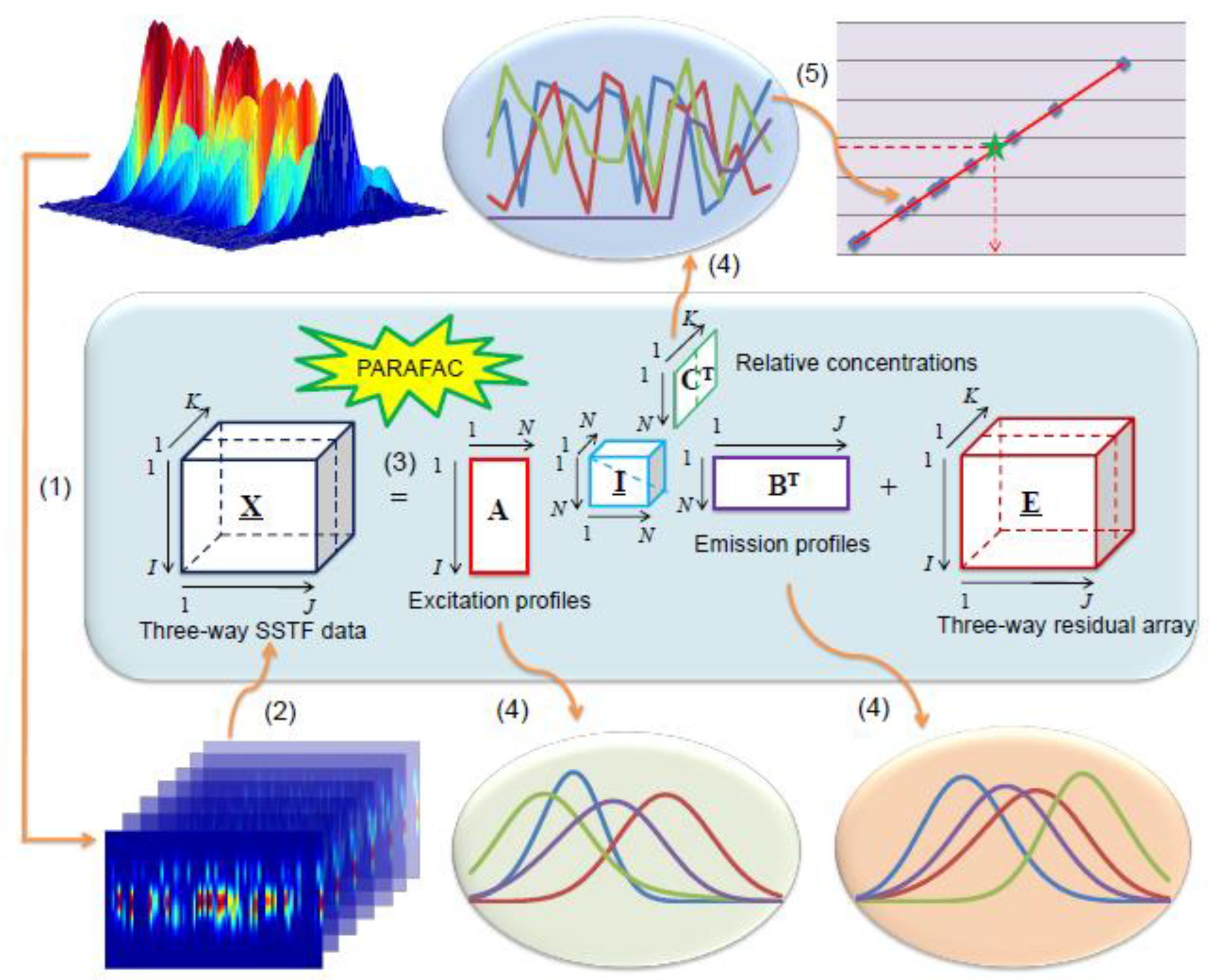
The purpose of this work was to evaluate the feasibility of SSTF spectrometry coupled with chemometric three-way calibration for the rapid and direct determination of three common PAHs in drill cuttings recycling products. To achieve this goal, SSTF spectra of two kinds of drill cuttings recycling products, including pretreated waste drilling cuttings and their recycling product bricks, were acquired and analyzed using the chemometric three-way calibration algorithm: parallel factor analysis (PARAFAC). The analytical process of this strategy is illustrated in Figure 1, as reported by our previous work [17]. It was demonstrated that the combination of SSTF spectrometry with chemometric three-way calibration has the potential to offer a quick survey of PAHs in drill cuttings recycling products owing to its green, fast, low-cost, and nondestructive characteristics.
Figure 1.
Schematic representation of SSTF spectrometry coupled with the PARAFAC algorithm for the rapid and direct determination of three common PAHs in drill cuttings recycling products.
2. Experimental
2.1. Chemicals and Reagents
The standard substances of three common PAHs, including anthracene (ANT), fluoranthene (FLA), and pyrene (PYR), were provided by Shanghai Aladdin Biochemical Technology Co., Ltd. (Shanghai, China); their mass purity was >99%. Two kinds of drill cuttings recycling products, including the pretreated waste drilling cuttings and their recycling product bricks, were sampled from an oil field in the southwest of China. Blank soils without any PAHs pollution were collected from local farmland in Jingzhou, China, and were confirmed by GC-MS method. Prior to analysis, the drill cuttings recycling products and blank soils were naturally dried, crushed by blender, and passed through a 120-mesh sieve.
2.2. Sample Preparation
To quantify the ANT, FLA, and PYR in drill cuttings recycling products, nine calibration samples (Cal01–Cal09) were prepared by diluting corresponding solid PAHs standards with blank soils using the grinding method. The calibration ranges of ANT and FLA were 0.5 to 4.5 mg g−1, while the calibration range of PYR ranged from 2 to 10 mg g−1. In addition, three prediction samples for each kind of drill cuttings recycling products were made by using their corresponding solid powders directly. Each kind of drill cuttings recycling product was prepared in triplicate, and the concentration of every target PAH was the mean value. Furthermore, to prove the accuracy of the proposed analytical method, three spiked samples (Sp01–Sp03) for each drill cuttings recycling product were constructed by adding low, middle, and high levels of solid PAHs standards to the prediction samples mentioned above. The concentrations of the three PAHs in the nine calibration samples and the three spiked drill cuttings recycling product samples are summarized in Table 1.
Table 1.
Concentrations (mg g−1) of three PAHs in nine calibration samples and three spiked drill cuttings recycling product samples.
2.3. Solid-Surface 3D Fluorescence Measurement
Solid-surface 3D fluorescence was measured by an F-7000 spectrofluorometer configured with a 5J0-0152 solid sample holder accessory (Hitachi, Tokyo, Japan). In order to obtain the SSTF spectra, the apparatus was run in 3-D scan mode with excitation range of 250 to 430 nm (3 nm interval) and emission range of 400 nm to 511 nm (3 nm interval). The scan speed was 30,000 nm min−1, and PMT voltage was 500 V. Slit widths of excitation and emission were both set to 5 nm. In such a way, a three-way SSTF data array with a size of 62 (excitation) × 39 (emission) × 21 (sample) was obtained.
2.4. Chemometric Analysis
The SSTF spectra were recorded by FL solution software (Hitachi, version 4.0). In all situations, the raw SSTF spectra were transferred from FD3 format into MATLAB readable .txt files for further data analysis. PARAFAC decomposition, regression, and prediction of three PAHs in drill cuttings recycling products were implemented using the in-house code.
3. Results and Discussion
3.1. SSTF Characteristics of Individual PAHs
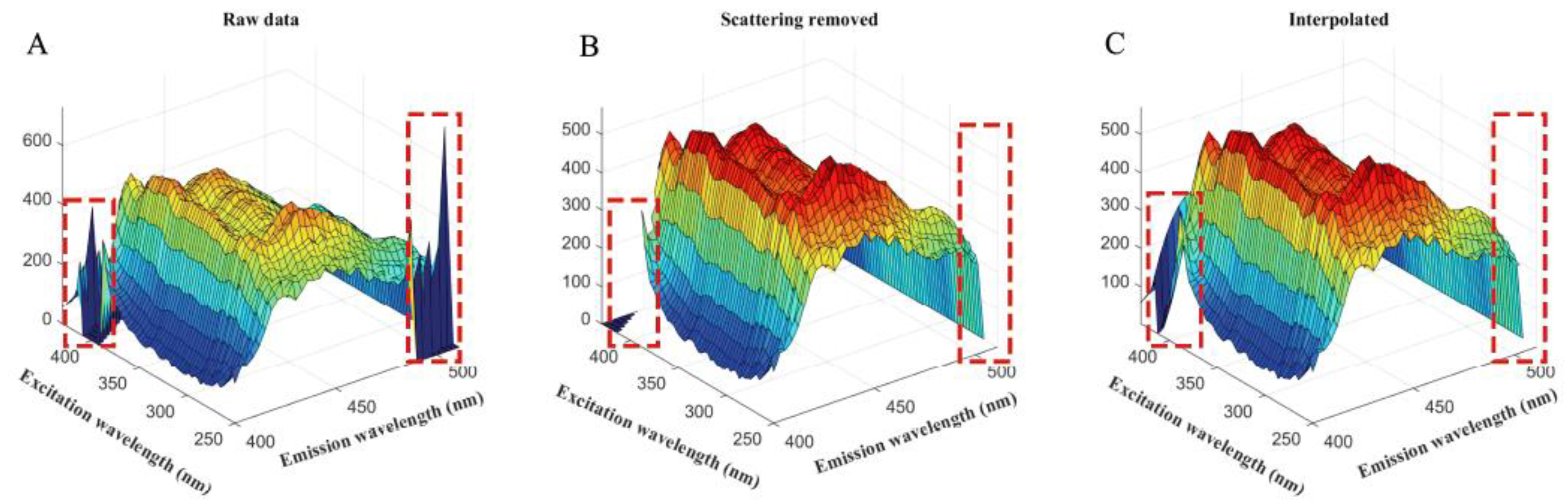
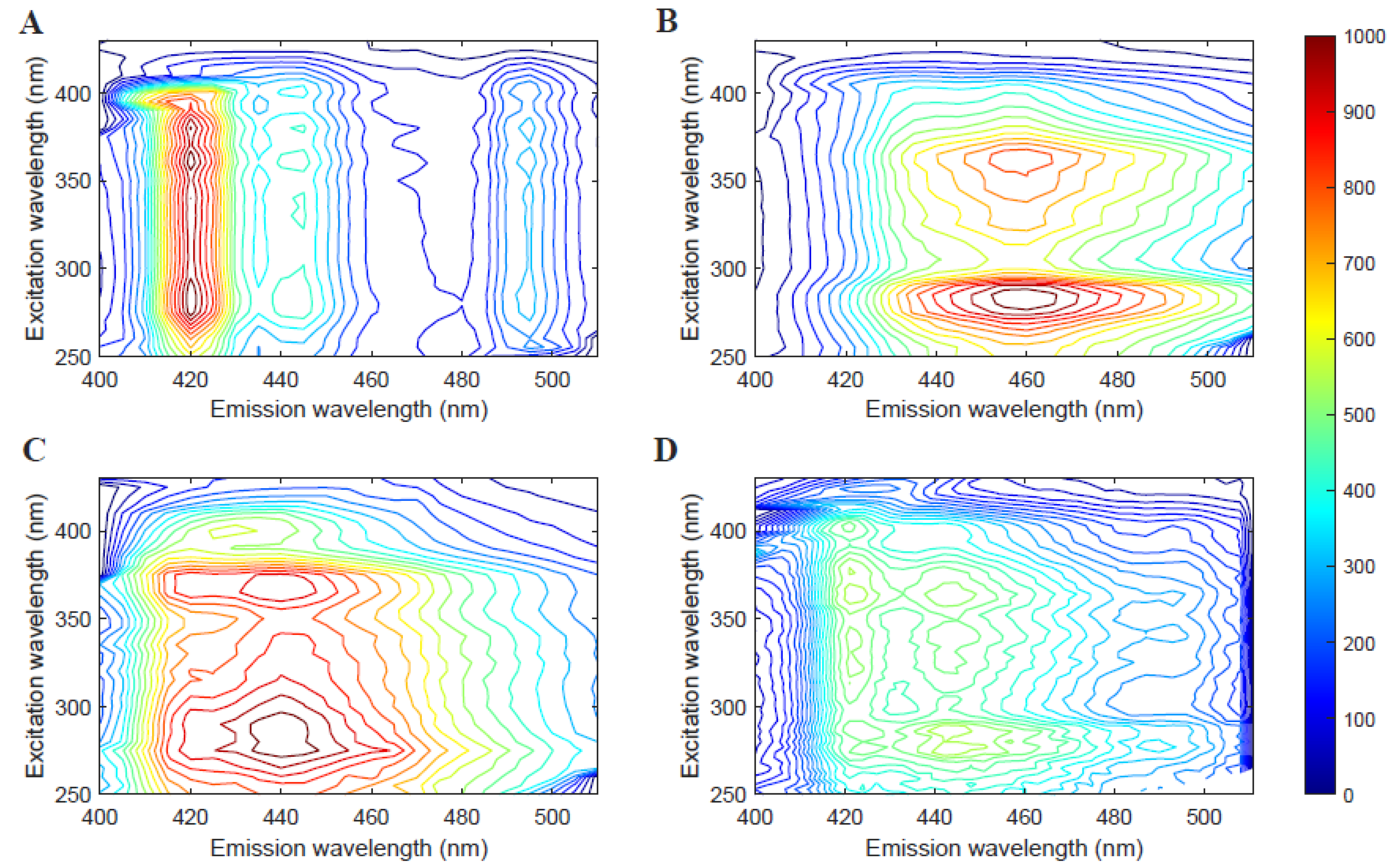
Considering the adverse effects of Rayleigh and Raman scattering in the SSTF spectra, they must be eliminated before data analysis. In this study, the Raman scattering was firstly minimized by deducting the basal blank (i.e., blank soil) from all SSTF spectra. Then, the Rayleigh scattering was removed and modeled by the interpolation method. Figure 2 shows the STTF spectra of the third calibration sample before and after removing the Rayleigh scattering. As can be seen, it was successfully eliminated from the raw STTF spectra. Figure 3 shows the contour plots of the SSTF spectra of the solid standard ANT, FLA, PYR, and a mixture of them after removing the scattering. It can be clearly seen that ANT, FLA, and PYR have a wide excitation peak range of 250–400 nm and an emission peak at around 420, 460, and 440 nm. Moreover, the peak regions of the three PAHs are significantly overlapped (Figure 3A–C). Due to the high spectral overlap, it is very difficult to distinguish the presence of one specific PAH in the mixture (Figure 3D) without the assistance of deconvolution. Moreover, the PAHs usually co-existed with plenty of other unknown fluorescent interferences in drill cuttings recycling products, making the situation more complex.
Figure 2.
Removal of Rayleigh scattering (red dotted box) in STTF spectra of the third calibration sample. (A) Raw spectra with Rayleigh scattering; (B) gapped spectra with scattering removed; (C) repaired spectra modeled by the interpolation method.
Figure 3.
The contour plots of STTF spectra after removing the scattering. (A) ANT (10 mg g−1); (B) FLA (10 mg g−1); (C) PYR (10 mg g−1); (D) a mixture of ANT, FLA, and PYR.
In this case, a traditional solution is to apply the strategy named “separation followed by analysis”; that is, to first completely separate target PAHs by some necessary sample pretreatment procedures, and then to analyze them one by one [26]. In the current work, we will turn to the chemometric modeling for help; namely, use smart “mathematical separation” instead of the traditional “physical and/or chemical separation” to extract the pure spectra of each PAH from the complex mixed SSTF spectra, and then achieve the rapid and direct analysis of multiple PAHs even in the presence of overlapping peaks and unknown fluorescent interferences.
3.2. Method Development
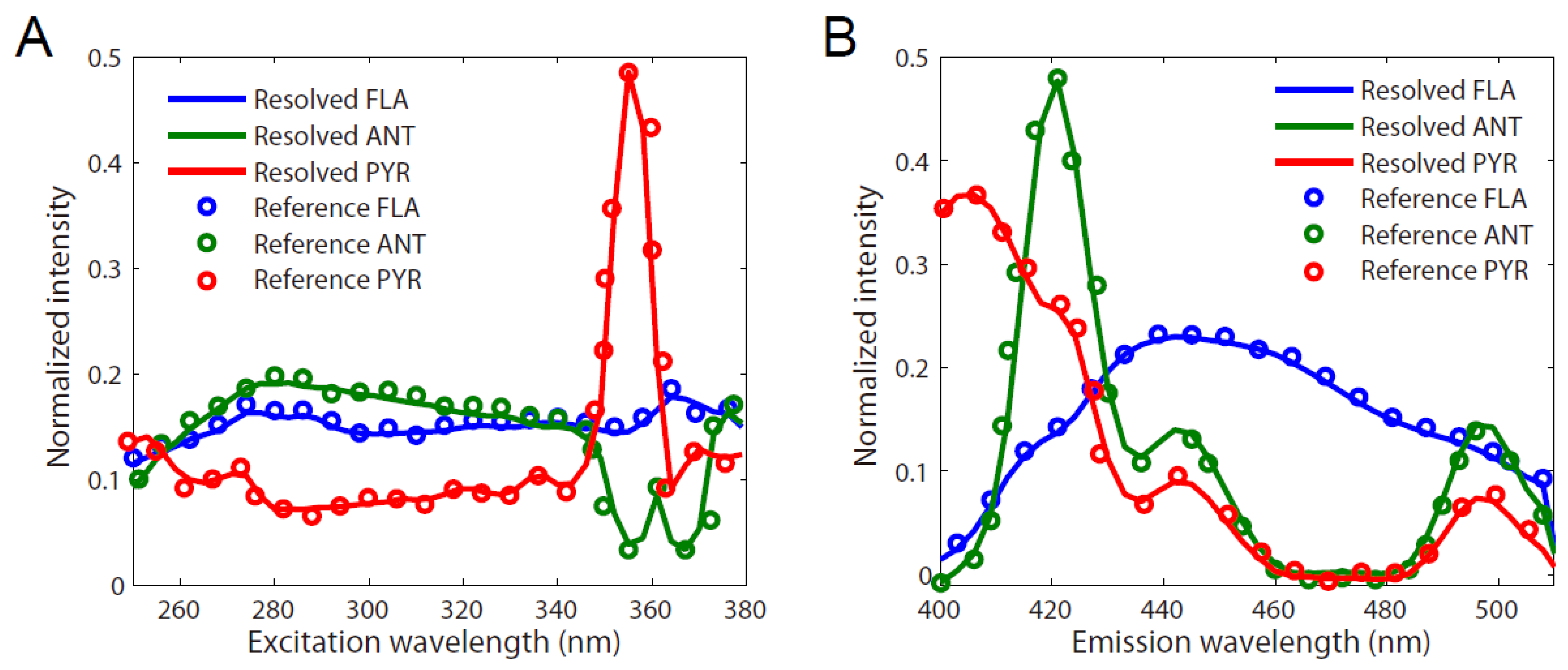
In this section, we will use the well-known PARAFAC algorithm [27] to resolve the overlapping SSTF spectra of ANT, FLA, and PYR. Figure 4 shows the resolved pure excitation spectra and emission spectra as well as their reference spectra for the three PAHs in the nine calibration samples. As illustrated in Figure 4, although there are serious spectral overlaps of the three PAHs in the excitation and emission modes, the proposed strategy can still extract clear pure excitation and emission spectra for each target PAH from the mixed SSTF spectra. This means that the proposed strategy can indeed use the “mathematical separation” of the PARAFAC algorithm to replace the traditional “physical and/or chemical separation” and achieve the signal separation of each PAH.
Figure 4.
PARAFAC resolved excitation spectra (A) and emission spectra (B) as well as their reference spectra for the three PAHs in the nine calibration samples.
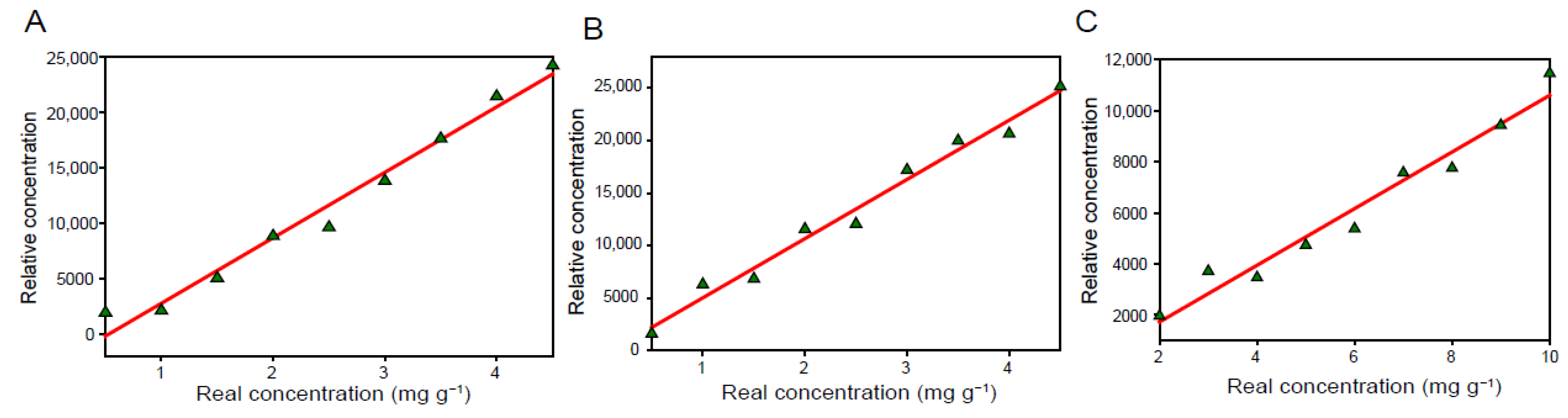
The calibration models of the three PAHs based on the relative concentrations against the real concentrations in the nine calibration samples are shown in Figure 5 and Table 2. As can be seen, the linearity between the relative concentrations resolved by PARAFAC and the real concentrations are acceptable (R2 > 0.96); these results demonstrate the feasibility of using the SSTF spectroscopy coupled with the PARAFAC algorithm for resolving and quantifying overlapped PAHs. In the following section, the performances of the proposed method on real complex samples (i.e., drill cuttings recycling products) will be further investigated.
Figure 5.
The calibration models of ANT (A), FLA (B), and PYR (C) based on the relative concentrations against the real concentrations in nine calibration samples by least squares regression.
Table 2.
The calibration equations and their correlation coefficients for the three PAHs.
3.3. Method Application
As a practical method, we utilized the proposed strategy to quantify the contents of the three PAHs in two kinds of drill cuttings recycling products. The results are summarized in Table 3. As can be seen, some the three PAHs were detected in drill cuttings recycling products. For example, ANT and FLA were detected in pretreated drill cuttings, while only FLA was detected in bricks. As for the remaining target PAHs, they may not be present or may not be detected because of the low sensitivity of the SSTF spectroscopy. In order to prove the accuracy and reliability of the proposed method, the spiked recovery experiments were carried out; the recoveries are listed in Table 3. We can see that the average recoveries for the spiked concentration at low levels are a bit worse, while the average recoveries for the spiked concentration at high levels are good. The reason for this phenomenon is that the sensitivity of the SSTF spectroscopy is not high enough. Nevertheless, it has distinct advantages of being simple, fast, green, low-cost, and nondestructive. Given the complexity of the drill cuttings recycling products, the average recoveries of (88.1 ± 19.6)% to (102.7 ± 16.4)% can be considered to be reasonable. Therefore, the SSTF spectroscopy technique has the potential to be used as a preliminary screening approach and allow for a quick survey of PAHs in complex solid samples, thereby giving priority to prompt analysis.
Table 3.
Predicted concentration, RMSEP, and spiked recovery of three PHAs in drill cuttings recycling products based on SSTF spectroscopy coupled with the PARAFAC algorithm.
4. Conclusions
This study has established the capability of SSTF spectroscopy for the rapid and direct determination of three PAHs in drill cuttings recycling products for the first time. The acquired SSTF spectral data were firstly stacked along the sample dimension to construct a three-way data array and then decomposed by the well-known PARAFAC algorithm to extract the pure excitation and emission spectra of each individual PAH, even in the presence of overlapping peaks and unknown interferences. The calibration models based on the relative concentrations resolved by the PARAFAC algorithm against the real concentrations in the calibration samples are good. By applying the proposed strategy to real drill cuttings recycling products, some target PAHs could be detected, and reasonable average spiked recoveries were obtained. In conclusion, the proposed SSTF spectroscopy coupled with chemometrics has the potential to be used as a preliminary screening method for PAHs in drill cuttings recycling products.
Author Contributions
Conceptualization, T.G. and W.C.; methodology, T.G. and W.C.; software, T.G.; validation, Z.L. and X.G.; formal analysis, Z.L. and X.G.; investigation, T.G.; resources, Z.W. and X.L.; data curation, T.G.; writing—original draft preparation, T.G.; writing—review and editing, W.C.; visualization, T.G.; supervision, Z.W., X.L. and W.C.; project administration, Z.W. and X.L.; funding acquisition, W.C. All authors have read and agreed to the published version of the manuscript.
Funding
This study was supported by the Open Project Program of State Key Laboratory of Petroleum Pollution Control (Grant No. PPC2020012), CNPC Research Institute of Safety and Environmental Technology.
Institutional Review Board Statement
Not applicable.
Informed Consent Statement
Not applicable.
Data Availability Statement
The data presented in this study are available on request from the corresponding author.
Conflicts of Interest
The authors declare no conflict of interest.
References
- Kazamias, G.; Zorpas, A.A. Drill cuttings waste management from oil & gas exploitation industries through end-of-waste criteria in the framework of circular economy strategy. J. Clean. Prod. 2021, 322, 129098. [Google Scholar] [CrossRef]
- Pereira, L.B.; Sad, C.M.S.; da Silva, M.; Corona, R.R.B.; dos Santos, F.D.; Gonçalves, G.R.; Castro, E.V.R.; Filgueiras, P.R.; Lacerda, V. Oil recovery from water-based drilling fluid waste. Fuel 2019, 237, 335–343. [Google Scholar] [CrossRef]
- Al-Doury, M.M.I. Treatment of oily sludge using solvent extraction. Pet. Sci. Technol. 2019, 37, 190–196. [Google Scholar] [CrossRef]
- Kachel-Jakubowska, M.; Matwijczuk, A.; Gagoś, M. Analysis of the physicochemical properties of post-manufacturing waste derived from production of methyl esters from rapeseed oil. Int. Agrophysics 2017, 31, 175–182. [Google Scholar] [CrossRef]
- Matwijczuk, A.; Zając, G.; Kowalski, R.; Kachel-Jakubowska, M.; Gagoś, M. Spectroscopic Studies of the Quality of Fatty Acid Methyl Esters Derived from Waste Cooking Oil. Pol. J. Environ. Stud. 2017, 26, 2643–2650. [Google Scholar] [CrossRef] [PubMed]
- Lv, Q.; Wang, L.a.; Ma, S.; Jiang, J.; Liu, L.; Zhou, Z.; Liu, L.; Wang, X.; Bai, J. Pyrolysis of oil-based drill cuttings from shale gas field: Kinetic, thermodynamic, and product properties. Fuel 2022, 323, 124332. [Google Scholar] [CrossRef]
- Xia, Z.; Yang, H.; Sun, J.; Zhou, Z.; Wang, J.; Zhang, Y. Co-pyrolysis of waste polyvinyl chloride and oil-based drilling cuttings: Pyrolysis process and product characteristics analysis. J. Clean. Prod. 2021, 318, 128521. [Google Scholar] [CrossRef]
- Zhang, A.P.; Li, M.; Lv, P.; Zhu, X.F.; Zhao, L.P.; Zhang, X. Disposal and Reuse of Drilling Solid Waste from a Massive Gas Field. Procedia Environ. Sci. 2016, 31, 577–581. [Google Scholar] [CrossRef]
- Wang, C.Q.; Jin, J.Z.; Lin, X.Y.; Xiong, D.M.; Mei, X.D. A study on the oil-based drilling cutting pyrolysis residue resource utilization by the exploration and development of shale gas. Environ. Sci. Pollut. Res. 2017, 24, 17816–17828. [Google Scholar] [CrossRef]
- Xie, B.X.; Qin, J.H.; Sun, H.; Wang, S.; Li, X. Release characteristics of polycyclic aromatic hydrocarbons (PAHs) leaching from oil-based drilling cuttings. Chemosphere 2022, 291, 132711. [Google Scholar] [CrossRef]
- Khan, A.M.; Imran, M.; Hashmi, A.S.; Shehzad, W.; Abbas, M. Quantification of Selected Polycyclic Aromatic Hydrocarbons (PAHs) in Soil, Water and Blood by an Optimized and Validated HPLC –UV–DAD Method. Pol. J. Environ. Stud. 2022, 31, 3633–3644. [Google Scholar] [CrossRef] [PubMed]
- Erawaty Silalahi, E.T.M.; Anita, S.; Teruna, H.Y. Comparison of Extraction Techniques for the Determination of Polycyclic Aromatic Hydrocarbons (PAHs) in Soil. J. Phys. Conf. Ser. 2021, 1819, 012061. [Google Scholar] [CrossRef]
- Mueller, A.; Ulrich, N.; Hollmann, J.; Zapata Sanchez, C.E.; Rolle-Kampczyk, U.E.; von Bergen, M. Characterization of a multianalyte GC-MS/MS procedure for detecting and quantifying polycyclic aromatic hydrocarbons (PAHs) and PAH derivatives from air particulate matter for an improved risk assessment. Environ. Pollut. 2019, 255, 112967. [Google Scholar] [CrossRef]
- Chen, C.-F.; Ju, Y.-R.; Lim, Y.C.; Hsieh, S.-L.; Tsai, M.-L.; Sun, P.-P.; Katiyar, R.; Chen, C.-W.; Dong, C.-D. Determination of Polycyclic Aromatic Hydrocarbons in Sludge from Water and Wastewater Treatment Plants by GC-MS. Int. J. Environ. Res. Public Health 2019, 16, 2604. [Google Scholar] [CrossRef] [PubMed]
- Kumar, S.; Dutta, S. Utility of comprehensive GC×GC-TOFMS in elucidation of aromatic hydrocarbon biomarkers. Fuel 2021, 283, 118890. [Google Scholar] [CrossRef]
- Liang, M.; Liang, H.D.; Gao, P.; Rao, Z.; Liang, Y.C. Characterization and risk assessment of polycyclic aromatic hydrocarbon emissions by coal fire in northern China. Environ. Geochem. Health 2022, 44, 933–942. [Google Scholar] [CrossRef]
- Gu, H.W.; Zhang, S.H.; Wu, B.C.; Chen, W.; Wang, J.B.; Liu, Y. A green chemometrics-assisted fluorimetric detection method for the direct and simultaneous determination of six polycyclic aromatic hydrocarbons in oil-field wastewaters. Spectrochim. Acta A Mol. Biomol. Spectrosc. 2018, 200, 93–101. [Google Scholar] [CrossRef] [PubMed]
- Catena, S.; Sanllorente, S.; Sarabia, L.A.; Boggia, R.; Turrini, F.; Ortiz, M.C. Unequivocal identification and quantification of PAHs content in ternary synthetic mixtures and in smoked tuna by means of excitation-emission fluorescence spectroscopy coupled with PARAFAC. Microchem. J. 2020, 154, 104561. [Google Scholar] [CrossRef]
- Liu, Z.Z.; Gu, H.W.; Guo, X.Z.; Geng, T.; Li, C.L.; Liu, G.X.; Wang, Z.S.; Li, X.C.; Chen, W. Tracing sources of oilfield wastewater based on excitation-emission matrix fluorescence spectroscopy coupled with chemical pattern recognition techniques. Spectrochim. Acta A Mol. Biomol. Spectrosc. 2022, 281, 121596. [Google Scholar] [CrossRef]
- Qin, X.-Q.; Yao, B.; Jin, L.; Zheng, X.-Z.; Ma, J.; Benedetti, M.F.; Li, Y.; Ren, Z.-L. Characterizing Soil Dissolved Organic Matter in Typical Soils from China Using Fluorescence EEM–PARAFAC and UV–Visible Absorption. Aquat. Geochem. 2020, 26, 71–88. [Google Scholar] [CrossRef]
- Fernández-Sánchez, J.F.; Segura Carretero, A.; Cruces-Blanco, C.; Fernández-Gutiérrez, A. The development of solid-surface fluorescence characterization of polycyclic aromatic hydrocarbons for potential screening tests in environmental samples. Talanta 2003, 60, 287–293. [Google Scholar] [CrossRef]
- Hougaard, A.B.; Lawaetz, A.J.; Ipsen, R.H. Front face fluorescence spectroscopy and multi-way data analysis for characterization of milk pasteurized using instant infusion. LWT Food Sci. Technol. 2013, 53, 331–337. [Google Scholar] [CrossRef]
- Alves, J.C.L.; Poppi, R.J. Pharmaceutical analysis in solids using front face fluorescence spectroscopy and multivariate calibration with matrix correction by piecewise direct standardization. Spectrochim. Acta A Mol. Biomol. Spectrosc. 2013, 103, 311–318. [Google Scholar] [CrossRef] [PubMed]
- Wu, H.L.; Li, Y.; Yu, R.Q. Recent developments of chemical multiway calibration methodologies with second-order or higher-order advantages. J. Chemom. 2014, 28, 476–489. [Google Scholar] [CrossRef]
- Yin, X.L.; Gu, H.W.; Liu, X.L.; Zhang, S.H.; Wu, H.L. Comparison of three-way and four-way calibration for the real-time quantitative analysis of drug hydrolysis in complex dynamic samples by excitation-emission matrix fluorescence. Spectrochim. Acta A Mol. Biomol. Spectrosc. 2018, 192, 437–445. [Google Scholar] [CrossRef]
- Gu, H.W.; Yin, X.L.; Zhou, X.C.; Chen, Y.; Meng, X.Z.; Peng, T.Q. Impact of diverse background interferences on the alternating trilinear decomposition modeling of excitation-emission matrix fluorescence data acquired from different sample sources. Spectrochim. Acta A Mol. Biomol. Spectrosc. 2020, 232, 118173. [Google Scholar] [CrossRef]
- Bro, R. PARAFAC. Tutorial and applications. Chemometr. Intell. Lab. Syst. 1997, 38, 149–171. [Google Scholar] [CrossRef]
Disclaimer/Publisher’s Note: The statements, opinions and data contained in all publications are solely those of the individual author(s) and contributor(s) and not of MDPI and/or the editor(s). MDPI and/or the editor(s) disclaim responsibility for any injury to people or property resulting from any ideas, methods, instructions or products referred to in the content. |
© 2023 by the authors. Licensee MDPI, Basel, Switzerland. This article is an open access article distributed under the terms and conditions of the Creative Commons Attribution (CC BY) license (https://creativecommons.org/licenses/by/4.0/).