Riverine Women’s Perceptions of the Pap Smear Test in Light of Health Literacy

 , , , , , , and
Abstract
1. Introduction
2. Materials and Methods
2.1. Study Design
2.2. Study Setting and Recruitment
2.3. Participants, Inclusion and Exclusion Criteria
2.4. Data Collection
2.5. Data Analysis
2.6. Ethical Considerations
3. Results
3.1. Participant Characteristics
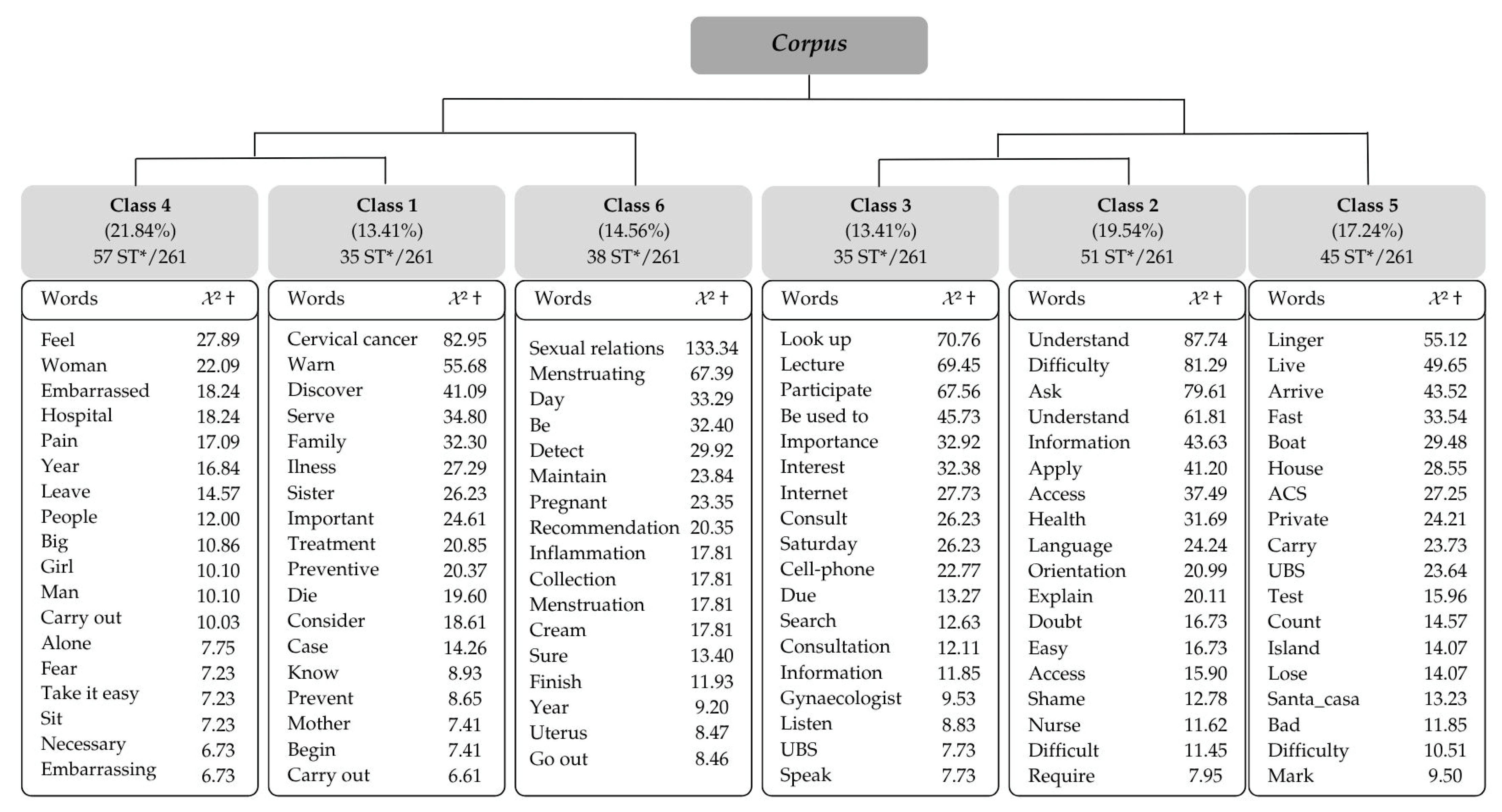
3.2. Characterization of the Textual Data
3.2.1. Thematic Axis 1—Knowledge, Feelings, and Perceptions About the Pap Smear Test (Classes 6, 1, and 4)
“[…] To have it done I know you must not have had sexual intercourse, not be menstruating and not be using those vaginal creams”(E10)
“I know that before the Pap smear you should refrain from sexual intercourse for three days and not be menstruating”(E29)
“[…] Once I didn’t do it because it was a man; when it’s a woman we feel more at ease”(E16)
“[…] One time I was waiting and I left to wash my hands and overheard something I shouldn’t have—the nurse talking to the woman who had the test, saying she was going to vomit because the woman hadn’t bathed; that’s unethical. I said so and I didn’t go in, I went home”(E27)
“[…] It’s been two years since I had it done; I’m scared and I don’t like it, you feel discomfort at the time”(E35)
“[…] Many women are afraid of the result”(E5)
“I know you have to have the Pap smear every three months”(E12)
“I do it annually, but I have heard it is every six months”(E30)
“I don’t know what the Pap smear is or what it’s for. I did it because my mother always said we should go to the health unit to take care of our bodies”(E30)
“To be honest I don’t know what this preventive exam is because I’ve never had it, but I know it’s to prevent several diseases”(E26)
“[…] How is cervical cancer caused, where does it come from? That’s my question”(E17)
“Cervical cancer is a strong bacterium that spreads and, if not detected early, has no cure or treatment. A woman may have bleeding and pain”(E29)
“[…] Women who have an active sexual life, many partners, are more at risk for this disease; that’s why it’s very important to have this preventive test”(E02)
“[…] Besides genetics, HPV, syphilis, small discharges are a major warning sign”(E27)
“I consider it very important to do the Pap smear because I had a friend who died of cervical cancer. She was diagnosed very late, so I prefer to come and have it done; I never skipped it”(E18)
“I talked to my mother about the Pap smear; my aunt had cervical cancer and she never used to do the Pap smear; when she finally did she was already in pain and very ill, she started treatment”(E03)
“Twenty years ago my mother had the Pap smear and they found cervical cancer; she completed all the treatment and today she is fine, so it’s important to do it; that’s why my sisters and I do it every year”(E37)
“[…] I consider the Pap smear important because if my grandmother had done it maybe the cancer would have been discovered earlier and she wouldn’t have died”(E41)
3.2.2. Thematic Axis 2—How Health Literacy and Access to Information Affect Self-Care (Classes 3, 2, and 5)
“I don’t have difficulty understanding information; I become aware when information is detailed, but it would be important to hold talks about the Pap smear and its importance for our health; this would help increase the number of women coming to do the test”(E10)
“I’ve never had the Pap smear, so I don’t know what needs to be done beforehand. I never sought information about it”(E1)
“[…] The difficulty is getting to the health unit; like I said, it depends on the boat—if there is a boat you can come”(E02)
“I used to have trouble accessing information because we didn’t have a cellphone or access to information; now that they installed Wi-Fi it’s better, but I still have trouble understanding and applying it”(E22)
“I don’t have difficulty accessing, understanding and applying information because when they explain properly we understand. When I have time I research more deeply. Some health professionals use accessible language; when they speak in a difficult way I complain because otherwise I leave without knowing anything”(E27)
“I don’t have difficulty understanding the Pap smear information; when I realize I don’t understand, I ask so I don’t do it wrong”(E07)
“I think it would be important to explain why the Pap smear is necessary and what it means. They just give a paper and don’t explain anything”(E14)
“I have all the difficulty accessing information because I’m ashamed to ask about it. I can’t understand either; I think health professionals’ language is a bit difficult and I’m ashamed to ask, so I can’t do anything”(E32)
3.2.3. Thematic Axis 3—Access to Health Services (Class 5)
“Many women from where I live don’t come because it’s very difficult to get to the health unit. You have to take a boat, you need a small boat to come; sometimes the weather is bad, lots of spray and storms. To get here today, we left the island at eight and arrived at nine thirty”(E38)
“When I had mine done I did it at the hospital, but I haven’t done it here at the Cotijuba health unit because it’s difficult for me to get here; I live far away so transportation is very difficult; you have to pay ten reais to go and come back and sometimes we don’t have it, so all that makes the situation difficult”(E12)
“Because I live far away, it takes me a long time to get to the health unit; I arrive in about an hour to an hour and a half because of the road”(E22)
“[…] I live far from the health unit; it takes me half an hour to an hour to get here”(E26)
“I usually have the Pap smear quite frequently; the last time I had it was in November 2023. I don’t do it at the Cotijuba health unit because sometimes the result takes too long, so I prefer to see a private physician—it’s faster”(E11)
“I always had the Pap smear privately because I wanted everything faster and because I work and don’t have time to be here, so I preferred private care”(E29)
4. Discussion
5. Conclusions
Author Contributions
Funding
Institutional Review Board Statement
Informed Consent Statement
Data Availability Statement
Acknowledgments
Conflicts of Interest
Abbreviations
| ACS | Community Health Worker |
| CC | Cervical Cancer |
| CEP | Research Ethics Committee |
| COREQ | Consolidated Criteria for Reporting Qualitative Research |
| DHC | Descending Hierarchical Classification |
| HL | Health Literacy |
| HPV | Human Papillomavirus |
| IRaMuTeQ | Interface de R pour les Analyses Multidimensionnelles de Textes et de Questionnaires |
| PCCU | Cervical Cancer Preventive |
| SISCAN | Cancer Information System |
| SUS | Unified Health System |
| UBS | Basic Health Unit |
References
- da Silva, D.C.B.; Garnelo, L.; Herkrath, F.J. Barriers to Access the Pap Smear Test for Cervical Cancer Screening in Rural Riverside Populations Covered by a Fluvial Primary Healthcare Team in the Amazon. Int. J. Environ. Res. Public Health 2022, 19, 4193. [Google Scholar] [CrossRef]
- Brasil. [Ministério da Saúde]. Instituto Nacional de Câncer José Alencar Gomes da Silva (INCA). Dados e Números Sobre o Câncer do Colo do Útero: Relatório Anual 2023. Available online: www.inca.gov.br/utero (accessed on 20 May 2024).
- Instituto Nacional de Câncer José Alencar Gomes da Silva (INCA). Atlas da Mortalidade; INCA: Rio de Janeiro, Brazil, 2022. Available online: https://www.inca.gov.br/sites/ufu.sti.inca.local/files/media/document/dados_e_numeros_colo_22setembro2022.pdf (accessed on 21 May 2024).
- Cerqueira, R.S.; Dos Santos, H.L.P.C.; Prado, N.D.B.; Bittencourt, R.G.; Biscarde, D.G.D.S.; dos Santos, A.M. Control of cervical cancer in the primary care setting in South American countries: Systematic review. Rev. Panam. Salud Pública 2022, 46, e107. [Google Scholar] [CrossRef] [PubMed]
- Brasil, Ministério da Saúde. Departamento de Informática do SUS (DATASUS). SISCAN—Cito do Colo—Atendimentos Brasil; Ministério da Saúde: Brasília, Brazil, 2025. Available online: https://tabnet.datasus.gov.br/cgi/webtabx.exe?SISCAN/cito_colo_atendbr.def (accessed on 29 July 2025).
- Da Silva, E.G.; Silva, R.K.; Oliveira, L.A.; Leal, B.M.; Carvalho, M.L.; Silva, B.G.; Gomes, M.L.; Moura, N.S. Health literacy and cervical cancer prevention. Braz. J. Dev. 2020, 6, 43439–43448. [Google Scholar] [CrossRef]
- Nutbeam, D. Health literacy as a public health goal: A challenge for contemporary health education and communication strategies into the 21st century. Health Promot. Int. 2000, 15, 259–267. [Google Scholar] [CrossRef]
- Menezes, A.F.; Tier, C.G.; Santos, A.O.; Oliveira, J.L.; Moura, C.B.; Sauceda, M.F.; Lana, D.L.; Abreu, D.P.G.; Cassola, T.P. Nursing in the face of health literacy, food and non-communicable chronic diseases in the elderly: Integrative literature review. Res. Soc. Dev. 2022, 11, e48211528368. [Google Scholar] [CrossRef]
- Blacher, P.H.; Mendonça, I.R.; Vieira, C.S.; Corrêa, L.K.; Nunes, F.L.; Martins, L.P.; Pereira, P.M.G.; da Costa, L.F.; Iser, B.P.M. Relação entre o letramento em saúde e a adesão terapêutica de pacientes com diabetes mellitus tipo 2. Arq. Catarin. Med. 2022, 51, 126–136. [Google Scholar] [CrossRef]
- Yang, Q.; Yu, S.; Wang, C.; Gu, G.; Yang, Z.; Liu, H.; Qiao, Y.; Yu, L.; Feng, Q.; Niu, G. Health literacy and its socio-demographic risk factores in Hebei: A cross-sectional survey. Medicene 2021, 100, e25975. [Google Scholar] [CrossRef]
- da Silva, D.S.M.; de Assumpção, D.; Francisco, P.M.S.B.; Yassuda, M.S.; Neri, A.L.; Borim, F.S.A. Doenças crônicas não transmissíveis considerando determinantes sociodemográficos em coorte de idosos. Rev. Bras. Geriatr. Gerontol. 2022, 25, e210204. [Google Scholar] [CrossRef]
- Bagata, L.D.C.B. Cuidado em saúde de Mulheres Ribeirinhas: Relações de Saber-Poder No Interior da Amazônia. Programa de Pós-Graduação em Ciências da Sociedade. 2018. Available online: https://repositorio.ufopa.edu.br/items/19e3261d-039e-445d-9c6d-bfa0b03afed8/full (accessed on 14 May 2024).
- Viana, J.N.; Moysés, R.P.C.; Espir, T.T.; Sousa GAde Barcellos, J.F.M.; da Graça Pereira Alves, M. Determinantes sociais da saúde e prevenção secundária do câncer do colo do útero no Estado do Amazonas, Brasil. Medicina 2019, 52, 110–112. [Google Scholar] [CrossRef]
- Souza, V.R.; Marziale, M.H.P.; Silva, G.T.R.; Nascimento, P.L. Translation and validation into Brazilian Portuguese and assessment of the COREQ checklist. Acta Paul. Enferm. 2021, 34, eAPE02631. [Google Scholar] [CrossRef]
- Silva, E.K.; de Almeida, A.; Gama, L.H. Ilhas ameaçadas com o desflorestamento: Análise da fragmentação florestal da ilha de Cotijuba, Belém, Pará, Brasil. Bol. Do Mus. Para. Emílio Goeldi-Ciências Nat. 2021, 16, 203–213. [Google Scholar] [CrossRef]
- Gil, A.C. Como Elaborar Projetos de Pesquisa, 7th ed.; Atlas: São Paulo, Brazil, 2023; p. 208. [Google Scholar]
- Camargo, B.V.; Justo, A.M. IRaMuTeQ: Um software gratuito para análise de dados textuais. Temas Psicol. 2013, 21, 513–518. [Google Scholar] [CrossRef]
- Demissie, B.W.; Azeze, G.A.; Asseffa, N.A.; Lake, E.A.; Besha, B.B.; Gelaw, K.A.; Mokonnon, T.M.; Gebeyehu, N.A.; Obsa, M.S. Communities’ perceptions towards cervical cancer and its screening in Wolaita zone, southern Ethiopia: A qualitative study. PLoS ONE 2022, 17, e0262142. [Google Scholar] [CrossRef]
- Mendes, L.D.D.A. O Exame de Papanicolaou: Conhecimento e Atitudes das Mulheres a Respeito da Prevenção do Câncer do Colo de Útero; Universidade Federal de Uberlândia: Uberlândia, 2020; 49p, Available online: https://repositorio.ufu.br/bitstream/123456789/28857/1/ExamePapanicolaouConhecimento.pdf (accessed on 19 September 2025).
- Silva, L.A.; Freitas, A.S.; Müller, B.C.T.; de Jesus Sousa Magalhães, M. Knowledge and practice of women attended in primary health care about Papanicolau test/Conhecimento e prática de mulheres atendidas na atenção primária à saúde sobre o exame Papanicolau. Ver. Pesqui. 2021, 13, 1013–1019. [Google Scholar] [CrossRef]
- Dsouza, J.P.; Van Den Broucke, S.; Pattanshetty, S.; Dhoore, W. Exploring the Barriers to Cervical Cancer Screening through the Lens of Implementers and Beneficiaries of the National Screening Program: A Multi-Contextual Study. Asian Pac. J. Cancer Prev. 2020, 21, 2209–2215. [Google Scholar] [CrossRef] [PubMed]
- Jibat, N.; Ali, R.; Adissu, W.; Buruh, G.; Abdissa, A.; Goba, G.K.; Garland, S.M.; Mulholland, N.; Mulholland, K.; Amenu, D. Less known but greatly feared: Cervical cancer in Ethiopia community awareness. Heliyon 2024, 10, e28328. [Google Scholar] [CrossRef] [PubMed]
- Brasil, Agência Nacional de Telecomunicações. Estudo Conjunto Apresenta Diagnóstico Sobre o Acesso a Internet em Municípios Com até 20 Mil Habitantes; Agência Nacional de Telecomunicações: Brasília, Brazil, 2022. Available online: https://www.gov.br/anatel/pt-br/assuntos/noticias/estudo-conjunto-apresenta-diagnostico-sobre-o-acesso-a-internet-em-municipios-com-ate-20-mil-habitantes (accessed on 25 July 2024).
- Zhang, M.; Sit, J.W.H.; Choi, K.C.; Chan, C.W.H. A theory-driven, culture-tailored educational intervention for cervical cancer screening among rural Chinese females: A feasibility and pilot study. Asia Pac. J. Oncol. Nurs. 2023, 10, 100218. [Google Scholar] [CrossRef]
- Ferreira, E.S.; Paranhos, S.B.; Margotti, E.; Da Silva, S.M.; Barbosa, S.C. Os motivos de não-adesão ao exame preventivo de câncer de colo uterino e ações educativas em uma região marajoara. Enferm. Bras. 2020, 19, 130–137. [Google Scholar] [CrossRef]
- Lee, H.; Mtengezo, J.T.; Kim, D.; Makin, M.S.; Kang, Y.; Malata, A.; Fitzpatrick, J. Exploring Complicity of Cervical Cancer Screening in Malawi: The Interplay of Behavioral, Cultural, and Societal Influences. Asia Pac. J. Oncol. Nurs. 2019, 7, 18–27. [Google Scholar] [CrossRef]
- Borrull-Guardeño, J.; Sebastiá-Laguarda, C.; Donat-Colomer, F.; Sánchez-Martínez, V. Women’s knowledge and attitudes towards cervical cancer prevention: A qualitative study in the Spanish context. J. Clin. Nurs. 2021, 30, 1383–1393. [Google Scholar] [CrossRef] [PubMed]
- Kiracılar, E.; Koçak, D.Y. The Effects of Health Literacy on Early Diagnosis Behaviors of Breast and Cervical Cancer in Women Aged 18–65. J. Contemp. Med. 2023, 13, 410–417. [Google Scholar] [CrossRef]

Disclaimer/Publisher’s Note: The statements, opinions and data contained in all publications are solely those of the individual author(s) and contributor(s) and not of MDPI and/or the editor(s). MDPI and/or the editor(s) disclaim responsibility for any injury to people or property resulting from any ideas, methods, instructions or products referred to in the content. |
© 2026 by the authors. Licensee MDPI, Basel, Switzerland. This article is an open access article distributed under the terms and conditions of the Creative Commons Attribution (CC BY) license.
Share and Cite
Mendes, T.C.; Chagas, L.C.; Santos, M.Y.S.d.; Lima, I.B.; Duarte, B.A.S.; Rodrigues, I.L.A.; do Espírito Santo, E.L.S.; Silva, P.G.C.; Nogueira, L.M.V. Riverine Women’s Perceptions of the Pap Smear Test in Light of Health Literacy. Healthcare 2026, 14, 175. https://doi.org/10.3390/healthcare14020175
Mendes TC, Chagas LC, Santos MYSd, Lima IB, Duarte BAS, Rodrigues ILA, do Espírito Santo ELS, Silva PGC, Nogueira LMV. Riverine Women’s Perceptions of the Pap Smear Test in Light of Health Literacy. Healthcare. 2026; 14(2):175. https://doi.org/10.3390/healthcare14020175
Chicago/Turabian StyleMendes, Thaynara Cordeiro, Letícia Calandrine Chagas, Marcio Yrochy Saldanha dos Santos, Ingrid Bentes Lima, Breno Augusto Silva Duarte, Ivaneide Leal Ataíde Rodrigues, Evelin Lorena Sousa do Espírito Santo, Paula Gisely Costa Silva, and Laura Maria Vidal Nogueira. 2026. "Riverine Women’s Perceptions of the Pap Smear Test in Light of Health Literacy" Healthcare 14, no. 2: 175. https://doi.org/10.3390/healthcare14020175
APA StyleMendes, T. C., Chagas, L. C., Santos, M. Y. S. d., Lima, I. B., Duarte, B. A. S., Rodrigues, I. L. A., do Espírito Santo, E. L. S., Silva, P. G. C., & Nogueira, L. M. V. (2026). Riverine Women’s Perceptions of the Pap Smear Test in Light of Health Literacy. Healthcare, 14(2), 175. https://doi.org/10.3390/healthcare14020175