


Enhancing Episiotomy Skills Through Interactive Online Simulation


Abstract
1. Introduction
2. Materials and Methods
- In alignment with these objectives, the following research questions in terms of the benefits of training are posed under the predefined subgroups: the differences across all parameters of the pre- and post-training questionnaires and the manual skills improved through online education, considering the period before and after the training (Table 1).
2.1. Participants
Power Analysis
2.2. Procedure
2.2.1. Creating an Interactive Online Education Environment
2.2.2. Preparation of Training Materials
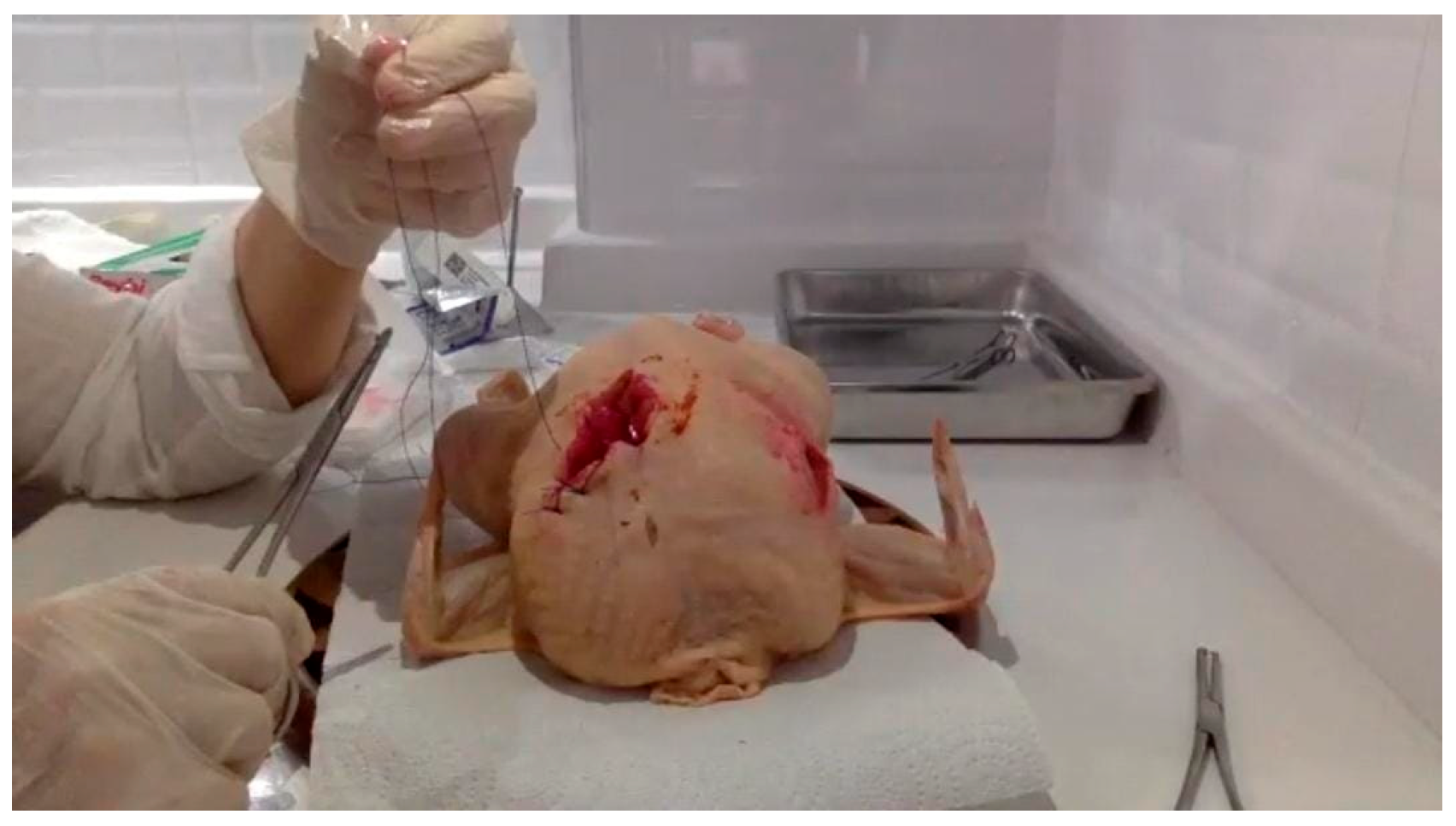
2.2.3. Episiotomy Simulation Instructional Process
2.2.4. Suture Repair Protocol
2.3. Collecting Data
2.3.1. Personal Information Form
2.3.2. Pre- and Post-Education Questionnaire
2.3.3. Online Learning Readiness Scale (OLRS)
2.3.4. Student Satisfaction and Self-Confidence in Learning Scale (SCLS)
2.4. Episiotomy Simulation Skills Rubric
2.5. Evaluation of Data Obtained Through Observation
2.6. Statistical Method
3. Results
3.1. The Differences in All Parameters of the Pre- and Post-Training Questionnaire
3.2. Determination of the Students’ Benefit from the Training
3.3. Relationship Between the Performance During the Episiotomy Simulation and Marks
4. Discussion
Limitations
5. Conclusions
Author Contributions
Funding
Institutional Review Board Statement
Informed Consent Statement
Data Availability Statement
Conflicts of Interest
Appendix A

| 1. Pre—Can an episiotomy study with an online simulation on living animal tissue increase your dexterity? |
| 1. Post—Did the episiotomy study with this online simulation on living animal tissue help to increase your dexterity? |
| 2. Pre—Does a simulated episiotomy study in living animal tissue help you to imagine a real episiotomy study? |
| 2. Post—Did the simulated episiotomy study in living animal tissue help you to imagine a real episiotomy study? |
| 3. Pre—Should a simulated episiotomy study on living animal tissue be performed before a real episiotomy study? |
| 3. Post—Should a simulated episiotomy study on living animal tissue be performed before a real episiotomy study? |
| 4. Pre—Do you find yourself incapable of suturing? |
| 4. Post—Did you find yourself incapable of suturing? |
| 5. Pre—Do you feel confident about performing an episiotomy? |
| 5. Post—Did you trust yourself to perform an episiotomy? |
| 6. Pre—Are you confident in episiotomy repair? |
| 6. Post—Were you confident in episiotomy repair? |
| 7. Pre—Is it difficult to learn episiotomy before online education? |
| 7. Post—Was it difficult to learn episiotomy after online education? |
Appendix B. Questions Asked Students to Evaluate After the Training
- Did you find the interactive online simulation training method useful?
- Do you think that the episiotomy trainer gave training by the instructions in the interactive online simulation?
- Does having an objective expert observer in interactive online simulation training increase the objectivity of the training?
- I found this training for my hand skills encouraging, even in online education.
- I would like to participate in such interactive online simulation training in crises.
References
- Stoodley, C.; McKellar, L.; Steen, M.; Fleet, J. Simulation in midwifery education: A descriptive explorative study exploring students’ knowledge, confidence and skills in the care of the preterm neonate. Nurse Educ. Pract. 2020, 42, 102635. [Google Scholar] [CrossRef]
- World Health Organization. Global Strategic Directions for Nursing and Midwifery 2021–2025; Licence: CC BY-NC-SA 3.0 IGO; World Health Organization: Geneva, Switzerland, 2021. Available online: https://iris.who.int/bitstream/handle/10665/344562/9789240033863-eng.pdf?sequence=1 (accessed on 10 June 2025).
- Baayd, J.; Heins, Z.; Walker, D.; Afulani, P.; Sterling, M.; Sanders, J.N.; Cohen, S. Context Matters: Factors affecting implementation of simulation training in nursing and midwifery schools in North America, Africa and Asia. Clin. Simul. Nurs. 2023, 75, 1–10. [Google Scholar] [CrossRef]
- Roh, Y.S.; Jang, K.I.; Issenberg, S.B. Nursing students’ perceptions of simulation design features and learning outcomes: The mediating effect of psychological safety. Collegian 2021, 28, 184–189. [Google Scholar] [CrossRef]
- Clark, K.R. Learning theories: Constructivism. Radiol. Technol. 2018, 90, 180–182. [Google Scholar]
- Alinier, G.; Hunt, B.; Gordon, R.; Harwood, C. Effectiveness of intermediate-fidelity simulation training technology in undergraduate nursing education. J. Adv. Nurs. 2006, 54, 359–369. [Google Scholar] [CrossRef]
- Ciesielski, P.; Kołodziejczak, M.; Dutkiewicz, P. New porcine model of perineal tear and its utility in physicians’ training on the reconstruction of 3rd and 4th degree perineal tear during vaginal delivery. Ginekol. Pol. 2018, 89, 558–562. [Google Scholar] [CrossRef]
- Eston, M.; Stephenson-Famy, A.; McKenna, H.; Fialkow, M. Perineal laceration and episiotomy repair using a beef tongue model. MedEdPORTAL 2020, 16, 10881. [Google Scholar] [CrossRef]
- Illston, J.D.; Ballard, A.C.; Ellington, D.R.; Richter, H.E. Modified beef tongue model for fourth-degree laceration repair simulation. Obstet. Gynecol. 2017, 129, 491–496. [Google Scholar] [CrossRef]
- Dobrowolska, B.; Chiapinotto, S.; Cabrera, E.; Chloubová, I.; Kane, R.; Kennedy, S.; Lovrić, R.; Stanisavljević, S.; Riklikiene, O.; Palese, A. Changes and continuities in undergraduate nursing education during and after COVID-19: A European comparative study from the perspective of health science. BMC Med. Educ. 2025, 25, 799. [Google Scholar] [CrossRef] [PubMed]
- Bono, R.; Núñez-Peña, M.I.; Campos-Rodríguez, C.; González-Gómez, B.; Quera, V. Sudden transition to online learning: Exploring the relationships among measures of student experience. Int. J. Educ. Res. Open 2024, 6, 100332. [Google Scholar] [CrossRef]
- Haanes, G.G.; Nilsen, E.; Mofossbakke, R.; Wighus, M.; ve Ravik, M. Digital learning in nursing education: Lessons from the COVID-19 lockdown. BMC Nurs. 2024, 23, 646. [Google Scholar] [CrossRef] [PubMed]
- Yılmaz Topuz, Ş.; Sezer, N.Y.; Aker, M.N.; Gönenç, İ.M.; Cengiz, H.Ö.; Korucu, A.E. A SWOT analysis of the opinions of midwifery students about distance education during the Covid-19 pandemic a qualitative study. Midwifery 2021, 103, 103161. [Google Scholar] [CrossRef]
- Keskin, M.; Derya, Ö. Evaluation of students’ feedbacks on web-based distance education in the COVID-19 process. İzmir Katip Çelebi Univ. Health Sci. Fac. J. 2020, 5, 59–67. [Google Scholar]
- Prasad, N.; Fernando, S.; Willey, S.; Davey, K.; Kent, F.; Malhotra, A.; Kumar, A. Online interprofessional simulation for undergraduate health professional students during the COVID-19 pandemic. J. Interprof. Care 2020, 35, 706–710. [Google Scholar] [CrossRef]
- Morris, T.H. Experiential learning–a systematic review and revision of Kolb’s model. Interact. Learn. Environ. 2020, 28, 1064–1077. [Google Scholar] [CrossRef]
- Bandura, A. Social cognitive theory: An agentic perspective. Annu. Rev. Psychol. 2001, 52, 1–26. [Google Scholar] [CrossRef]
- Karimian, Z.; Farrokhi, M.R.; Moghadami, M.; Zarifsanaiey, N.; Mehrabi, M.; Khojasteh, L.; Salehi, N. Medical education and COVID-19 pandemic: A crisis management model towards an evolutionary pathway. Educ. Inf. Technol. 2022, 27, 3299–3320. [Google Scholar] [CrossRef]
- Dhaussy, J.; Kemken, L.; Pugliese, M.T.; Forestier, A.; Boloré, S. Using simulation to adapt nursing education to times of crisis: A scoping review during Covid-19 pandemic. Teach. Learn. Nurs. 2024, 19, e511–e517. [Google Scholar] [CrossRef]
- Liu, X.S. Statistical Power Analysis for the Social and Behavioral Sciences: Basic and Advanced Techniques, 1st ed.; Routledge: London, UK, 2013. [Google Scholar] [CrossRef]
- Instagram. Available online: https://www.instagram.com/ksbuogrenciebeler/reel/CKgUfIBFGu9/ (accessed on 25 March 2025).
- Guler, H.; Cetin, P.; Yurtsal, Z.B.; Cesur, B.; Bekar, M.; Uçar, T.; Evcili, F.; Cetin, A. Effect of episiotomy training with beef tongue and sponge simulators on the self-confidence building of midwifery students. Nurse Educ. Pract. 2018, 30, 1–6. [Google Scholar] [CrossRef] [PubMed]
- Atakoğlu, R.; Asiye, G.Ü.L.; Türen, S.; Kivanç, M.M.; Özçalik, C.K. Importance of using simulation in nursing training. Turk. J. Health Sci. Res. 2020, 3, 52–60. [Google Scholar]
- Demirel, G.; Evcili, F.; Kaya, N.; Doganer, A. The effect of episiotomy repair simulation on the anxiety and self-efficacy levels of midwifery students. J. Midwifery Reprod. Health 2020, 8, 2050–2057. [Google Scholar] [CrossRef]
- Hung, M.L.; Chou, C.; Chen, C.H.; Own, Z.Y. Learner readiness for online learning: Scale development and student perceptions. Comput. Educ. 2010, 55, 1080–1090. [Google Scholar] [CrossRef]
- İlhan, M.; Çetin, B. The validity and reliability study of the Turkish version of an online learning readiness scale. Educ. Technol. Theory Pract. 2013, 3, 72–101. [Google Scholar]
- Franklin, A.E.; Burns, P.; Lee, C.S. Psychometric testing on the NLN student satisfaction and self-confidence in learning, simulation design scale, and educational practices questionnaire using a sample of pre-licensure novice nurses. Nurse Educ. Today 2014, 34, 1298–1304. [Google Scholar] [CrossRef]
- Karaçay, P.; Kullanılan, K.H.S.E. The Turkish adaptation of the students satisfaction and self-confidence in learning scale used in smulation education. Florence Nightingale J. Nurs. 2017, 25, 95–103. [Google Scholar] [CrossRef]
- Cokluk, O. Logistic regression: Concept and application. Educ. Sci. Theory Pract. 2010, 10, 1397–1407. [Google Scholar]
- Cain, M.K.; Zhang, Z.; Yuan, K.H. Univariate and multivariate skewness and kurtosis for measuring nonnormality: Prevalence, influence and estimation. Behav. Res. Methods 2017, 49, 1716–1735. [Google Scholar] [CrossRef]
- Li, M.; Gao, Q.; Yu, T. Kappa statistic considerations in evaluating inter-rater reliability between two raters: Which, when and context matters. BMC Cancer 2023, 25, 23. [Google Scholar] [CrossRef]
- Mehrpouyan, A. Enhancing online English language and literature classrooms: Effective and practical teaching strategies. Educ. Inf. Technol. 2023, 28, 4127–4141. [Google Scholar] [CrossRef] [PubMed]
- Oducado, R.M. New normal in nursing education: Sophomore students’ expectations of and readiness for online learning in the era of COVID-19 pandemic. Int. J. Caring Sci. 2021, 14, 1170–1177. [Google Scholar] [CrossRef]
- Zaragoza-García, I.; Ortuño-Soriano, I.; Posada-Moreno, P.; Sánchez-Gómez, R.; Raurell-Torredà, M. Virtual simulation for last-year nursing graduate students in times of COVID-19: A quasi-experimental study. Clin. Simul. Nurs. 2021, 60, 32–41. [Google Scholar] [CrossRef]
- Wang, C. Comprehensively summarizing what distracts students from online learning: A literature review. Hum. Behav. Emerg. Technol. 2022, 1, 1483531. [Google Scholar] [CrossRef]
- Karahan, E.; Çelik, S.; Tank, D.Y.; Göğüş, F. Yüksek gerçeklikli hasta simülatöründe eğitim: Hemşirelik öğrencilerinin memnuniyeti ve öğrenmede kendine güvenlerinin değerlendirilmesi. Celal Bayar Univ. J. Institu Health Sci. 2019, 6, 106–110. [Google Scholar] [CrossRef]
- Kiraz, E.D.E.; Gülengün, T.Ü.R.K.; Denat, Y.; Bulut, S.; Şahbaz, M.; Tuğrul, E.; Gerçek, E. The effect of use of simulation during task training on students’ anxiety, learning attitudes and skill levels. J. Nurs. Sci. 2019, 2, 17–22. [Google Scholar]
- Savage, E.C.; Tenn, C.; Vartanian, O.; Blackler, K.; Sullivan-Kwantes, W.; Garrett, M.; Blais, A.-R.; Jarmasz, J.; Peng, H.; Pannell, D.; et al. A comparison of live tissue training and high-fidelity patient simulator: A pilot study in battlefield trauma training. J. Trauma Acute Care Surg. 2015, 79, 157–163. [Google Scholar] [CrossRef]
- Silva, A.P.; Rodriguez, J.E.; Oliveira, M.C.; Negreiros, R.M.; Cavalcante, L.P. The alternative model of silicone for experimental simulation of suture of living tissue in the teaching of surgical technique. Acta Cir. Bras. 2019, 34, e201900410. [Google Scholar] [CrossRef]
- MacArthur, S.L.; Johnson, M.D.; Colee, J.C. Effect of a spay simulator on student competence and anxiety. J. Vet. Med. Educ. 2021, 48, 115–128. [Google Scholar] [CrossRef]
- Co, M.; Chung, P.H.Y.; Chu, K.M. Online teaching of basic surgical skills to medical students during the COVID-19 pandemic: A case–control study. Surg. Today 2021, 51, 1404–1409. [Google Scholar] [CrossRef]
- Rogers, B.A.; Baker, K.A.; Sapp, A. Learning outcomes of the observer role in nursing simulation: A scoping review protocol. JBI Evid. Synth. 2020, 18, 5. [Google Scholar] [CrossRef]
- Wei, H.C.; Chou, C. Online learning performance and satisfaction: Do perceptions and readiness matter? Distance Educ. 2020, 41, 48–69. [Google Scholar] [CrossRef]
- Brereton, S.; Curtin, M.; Greene, E.; Hardie, P.; Szafranska, M.; Kirwan, C. A blended learning perineal suturing programme for midwifery students: An evaluative descriptive study. Nurse Educ. Pract. 2022, 64, 103453. [Google Scholar] [CrossRef] [PubMed]
- Yukselturk, E.; Bulut, S. Predictors for student success in an online course. Educ. Technol. Soc. 2007, 10, 71–83. [Google Scholar]
- El-Gazar, H.E.; Zoromba, M.A.; Fayed, S.M.; Loutfy, A.; Elzieny, A.A.; Elzeiny, A.; Alkubati, S.A.; Shahin, M.A.H.; Altheeb, M.; El-Monshed, A.H. Nurturing Success: E-Learning readiness and academic self-efficacy in nursing students. BMC Nurs. 2024, 23, 495. [Google Scholar] [CrossRef] [PubMed]
| Question | Assessment/Outcome Points |
|---|---|
| (a) Which students benefited the most from the online episiotomy training? | Beneficiary Identification |
| (b) Do students who are more confident and satisfied with their learning perform better? | Performance and Confidence Relationship |
| (c) Are students with online readiness more successful? | Online Learning Readiness |
| (d) Do students who feel more capable of performing and repairing an episiotomy differ in self-confidence, learning satisfaction, and online readiness? | Skill–Confidence Connection |
| The questions about the outcomes of the training: | |
| Key Question | Assessment/Outcome Points |
| (a) Do students who performed better during the episiotomy simulation achieve higher scores in the module afterward? | Effect of Simulation on Academic Achievement |
| (b) Did the training enhance overall learning in clinical practice and contribute to academic achievement in class? | Overall Learning Impact |
| Stage | Description | Details/ Duration | Responsible Parties |
|---|---|---|---|
| 1. Group Allocation | Students were divided into four online groups. | 3 groups of 15, 1 group of 16 | Two academic instructors |
| 2. Pre-Test Evaluation | Students’ knowledge and skills pre-test. | Before the session, 20 min | Two academic instructors |
| 2. Simulation Session | An interactive online simulation was conducted using basic materials (half-frozen animal tissue). | 60 min per group | Two academic instructors, Two external experts (university and hospital) |
| 3. Observation and Rubric Filling | Each student’s performance was observed in real time. | During the session | Two external experts and Two academic instructors |
| 4. Video Recording | Sessions were recorded for objectivity and feedback. | Continuous during practice | University Knowledge Management System (Sisteme Giriş - Kütahya Sağlık Bilimleri Üniversitesi) |
| 5. Feedback and Guidance | Students received formative feedback during practice. | Real time | Two external experts |
| 6. Evaluating | Students practices evaluated | After training | Two academic instructors |
| 7. Posttest Evaluation | Students completed a knowledge and skills posttest. | After the session, 20 min | Two academic instructors |
| Criteria | Exemplary (4 Points) | Proficient (3 Points) | Basic (2 Points) | Needs Improvement (1 Point) |
|---|---|---|---|---|
| 1. Preparation of Materials | All materials, including the episode set and auxiliary items, are prepared efficiently and organized systematically. | Materials are prepared adequately with some organization but could be improved. | Materials are prepared but lack organization, leading to inefficiencies. | Materials are incomplete or poorly organized, causing delays or confusion. |
| 2. Tissue Fixation | The tissue is securely fixed to the surface (e.g., tire, clamp, etc.) with no movement during the procedure. | The tissue is fixed securely with minimal movement during the procedure. | The tissue is fixed but has some movement that slightly impacts the procedure. | The tissue is poorly fixed, leading to significant movement and hindering the procedure. |
| 3. Creation of Vaginal Opening | A precise and deep 4–5 cm vaginal opening is created, showing excellent scalpel control. | A 4–5 cm vaginal opening is created with good depth and control. | A vaginal opening is created but lacks depth or precision. | The vaginal opening is shallow or poorly executed, lacking proper scalpel control. |
| 4. Mediolateral Incision | A deep and precise 3 cm mediolateral incision is made 2 cm above where the vagina ends. | A 3 cm mediolateral incision is made with good depth but could be more precise. | The incision is made but lacks depth or precision. | The incision is shallow or not accurately placed, lacking proper depth. |
| 5. Wound Staining | The wound is effectively stained to simulate blood using the appropriate material. | The wound is stained, but the effect could be more realistic. | The wound is stained, but the application is uneven or unrealistic. | The wound is poorly stained or not stained at all, lacking realism. |
| 6. Explanation of Anatomical Structures | Clearly explains and identifies the bulbocavernosus muscle, transverse perineal muscles, and perineal membrane with full understanding. | Explains the anatomical structures with minor errors or omissions. | Identifies the structures but lacks a clear understanding. | Fails to correctly identify or explain the anatomical structures. |
| 7. Reapproximation of Vaginal Wall | Demonstrates excellent technique in reapproximating the vaginal wall and perineal trunk to their original positions. | Reapproximates the vaginal wall and perineal trunk with minor errors. | Reapproximation is attempted but lacks precision or proper alignment. | Fails to properly reapproximate the vaginal wall and perineal trunk. |
| 8. Suture Selection | Selects the appropriate 3-0 or 2-0 absorbable suture confidently and correctly. | Selects the correct suture but lacks confidence in the choice. | Selects the correct suture but with hesitation or uncertainty. | Fails to select the correct suture, affecting the procedure. |
| 9. Suture Technique | Executes continuous or interrupted sutures with precision, ensuring the torn ends are perfectly reapproximated. | Performs sutures effectively with minor gaps or interruptions. | Sutures are completed but with noticeable gaps or improper technique. | Sutures are poorly executed, with significant gaps or incorrect techniques. |
| 10. Suture Application | Applies the suture as described, ensuring secure and accurate closure of the wound. | Applies the suture with minor deviations from the described method. | Suture application is inconsistent or deviates significantly from the described method. | The suture application is incorrect, leading to an insecure or incomplete closure. |
| 11. Technique Application | Demonstrates full mastery of the episiotomy technique, following all steps accurately and confidently. | Applies the technique competently with minor errors or hesitation. | Applies the technique with noticeable errors or a lack of confidence. | Fails to apply the technique correctly, with significant errors or omissions. |
| 12. Use of Materials | Uses all materials appropriately and efficiently, with no waste or misuse. | Uses materials appropriately with minimal waste or misuse. | Uses materials but with noticeable waste or minor misuse. | Fails to use materials appropriately, leading to waste or improper application. |
| Age | n | % |
|---|---|---|
| 21 22 | 43 18 | 70.4 29.5 |
| Living place | ||
| City | 31 | 50.8 |
| District | 20 | 32.8 |
| Village | 10 | 16.4 |
| Economic situation | ||
| My income is more than my expenses | 12 | 20 |
| My income is equal to my expenses | 25 | 42 |
| My income is less than my expenses | 24 | 38 |
| Access to the Internet | ||
| I frequently have problems | 6 | 9.8 |
| Sometimes I have problems | 20 | 32.8 |
| Good | 29 | 47.5 |
| Pretty good | 6 | 9.8 |
| I have sutured a living tissue before | ||
| Yes | 14 | 23.0 |
| No | 46 | 75.4 |
| I am indecisive | 1 | 1.6 |
| I have seen episiotomy suturization in the delivery room before | ||
| Yes | 23 | 37.7 |
| No | 38 | 62.3 |
| I have performed episiotomy repair in the delivery room before | ||
| Yes | 3 | 4.9 |
| No | 58 | 95.1 |
| Interest in clinical practice simulations | ||
| Good | 20 | 32.8 |
| Very Good | 41 | 67.2 |
| Average | Standard Dev. | |
| Monthly Internet payment for courses | 96.80 | 34.79 |
| Latest Clinical Practice academic score | 95.56 | 6.23 |
| Mean | Std Dev. | Min. | Max. | |
|---|---|---|---|---|
| OLRS | 74.96 | 8.12 | 51 | 90 |
| SCLS | 47.10 | 10.8 | 12 | 60 |
| Student satisfaction with learning | 20.24 | 4.67 | 5 | 25 |
| Confidence in learning | 26.86 | 6.46 | 7 | 35 |
| Online Learning Readiness | ||
|---|---|---|
| Student Satisfaction | r | 0.204 |
| p | 0.159 | |
| n | 61 | |
| Confidence in Learning | r | 0.326 |
| p | 0.022 * | |
| n | 61 |
| Yes | No | p | Effect Size (%95 C.I.) | ||||
|---|---|---|---|---|---|---|---|
| N | % | N | % | ||||
| Can an episiotomy study with a simulation made in living animal tissue increase your dexterity? | Before | 54 | 88.5 | 7 | 11.5 | 0.125 | 1.145 (0.844–1.553) |
| After | 59 | 96.7 | 2 | 3.3 | |||
| Should an episiotomy study with simulation on living animal tissue be performed before a real episiotomy study? | Before | 41 | 67.2 | 20 | 32.8 | 0.003 | 1.090 (0.890–1.336) |
| After | 55 | 90.2 | 6 | 9.8 | |||
| Does an episiotomy study with simulation on living animal tissue help you to imagine a real episiotomy study? | Before | 52 | 85.2 | 9 | 14.8 | 1.000 | 1.662 (0.921–2.996) |
| After | 53 | 86.9 | 8 | 13.1 | |||
| I believe that this training improved my hand skills, even though it was an online education. | Before | 30 | 49.2 | 31 | 50.8 | 0.000 | 0.999 (0.911–1.096) |
| After | 59 | 96.7 | 2 | 3.3 | |||
| I find myself incapable of suturing. | Before | 28 | 45.9 | 33 | 54.1 | 0.004 | 8.250 (2.048–33.235) |
| After | 16 | 26.2 | 45 | 73.8 | |||
| I trust myself to open an episiotomy. | Before | 27 | 44.3 | 34 | 55.7 | 0.815 | 2.393 (1.346–4.254) |
| After | 29 | 47.5 | 32 | 52.5 | |||
| I trust myself to repair an episiotomy. | Before | 28 | 45.9 | 33 | 54.1 | 0.210 | 2.464 (1.476–4.114) |
| After | 34 | 55.7 | 27 | 44.3 | |||
| Learning episiotomy with online education is difficult. | Before | 33 | 54.1 | 28 | 45.9 | 0.332 | 3.111 (1.471–6.581) |
| After | 28 | 45.9 | 33 | 54.1 | |||
| Observed Performance During Training | Online Readiness Scale | Student Learning Satisfaction | Student Self- Confidence | Mark in Clinical Practice After Training | |||
|---|---|---|---|---|---|---|---|
| Spearman’s rho | Observed performance during training | rho | 1.000 | −0.172 | −0.116 | −0.067 | 0.327 * |
| p | 0.322 | 0.508 | 0.703 | 0.011 | |||
| N | 35 | 35 | 35 | 60 | |||
| Online readiness scale | rho | 1.000 | 0.393 ** | 0.496 ** | 0.053 | ||
| p | 0.008 | 0.001 | 0.764 | ||||
| N | 45 | 45 | 35 | ||||
| Student learning satisfaction | rho | 1.000 | 0.844 ** | 0.178 | |||
| p | 0.000 | 0.306 | |||||
| N | 45 | 35 | |||||
| Student self-confidence | rho | 1.000 | 0.052 | ||||
| p | 0.768 | ||||||
| N | 35 | ||||||
| Mark in Clinical Practice after training | rho | 1.000 | |||||
| p | |||||||
| N | |||||||
Disclaimer/Publisher’s Note: The statements, opinions and data contained in all publications are solely those of the individual author(s) and contributor(s) and not of MDPI and/or the editor(s). MDPI and/or the editor(s) disclaim responsibility for any injury to people or property resulting from any ideas, methods, instructions or products referred to in the content. |
© 2025 by the authors. Licensee MDPI, Basel, Switzerland. This article is an open access article distributed under the terms and conditions of the Creative Commons Attribution (CC BY) license (https://creativecommons.org/licenses/by/4.0/).
Share and Cite
Tosun, H.; Özkan, H. Enhancing Episiotomy Skills Through Interactive Online Simulation. Healthcare 2025, 13, 1472. https://doi.org/10.3390/healthcare13121472
Tosun H, Özkan H. Enhancing Episiotomy Skills Through Interactive Online Simulation. Healthcare. 2025; 13(12):1472. https://doi.org/10.3390/healthcare13121472
Chicago/Turabian StyleTosun, Hülya, and Hava Özkan. 2025. "Enhancing Episiotomy Skills Through Interactive Online Simulation" Healthcare 13, no. 12: 1472. https://doi.org/10.3390/healthcare13121472
APA StyleTosun, H., & Özkan, H. (2025). Enhancing Episiotomy Skills Through Interactive Online Simulation. Healthcare, 13(12), 1472. https://doi.org/10.3390/healthcare13121472

