Supporting Infants’ Motor Development through Water Activities: A Preliminary Case–Control Study


Abstract
1. Introduction
2. Materials and Methods
2.1. Study Population
2.2. Assessments
2.3. Intervention Protocol
2.4. Statistical Analysis
3. Results
4. Discussion
Limitations
5. Conclusions
Author Contributions
Funding
Institutional Review Board Statement
Informed Consent Statement
Data Availability Statement
Acknowledgments
Conflicts of Interest
References
- World Health Organization. Caring for Children with Developmental Delay—Reaching the Vulnerable; WHO: Geneva, Switzerland, 2023. [Google Scholar]
- Niu, F.; Romauli, S. Effect of baby spa (solus per aqua) on the development of gross motor abilities of baby umur 3–6 months. Int. J. Nurs. Midwifery Sci. 2023, 6, 264–270. [Google Scholar] [CrossRef]
- Iverson, J.M. Developmental variability and developmental cascades: Lessons from motor and language development in infancy. Curr. Dir. Psychol. Sci. 2021, 30, 228–235. [Google Scholar] [CrossRef] [PubMed]
- Lipkin, P.H.; Macias, M.M. Council on children with disabilities, section on developmental and behavioral pediatrics. Promoting Optimal Development: Identifying Infants and Young Children with Developmental Disorders Through Developmental Surveillance and Screening. Pediatrics 2020, 145, 20193449. [Google Scholar] [CrossRef]
- Ruffin, N.J. Understanding Growth and Development Patterns of Infants; Virginia Cooperative Extension: Petersburg, VA, USA, 2019; p. 350-055. [Google Scholar]
- Moffatt, F. The individual physical health benefits of swimming: A literature review. In The Health & Wellbeing Benefits of Swimming; Commissioned by Swim England’s Swimming and Health Commission: Loughborough, UK, 2017; pp. 8–26. [Google Scholar]
- Santos, C.; Burnay, C.; Button, C.; Cordovil, R. Effects of Exposure to Formal Aquatic Activities on Babies Younger than 36 Months: A Systematic Review. Int. J. Environ. Res. Public Health 2023, 20, 5610. [Google Scholar] [CrossRef] [PubMed]
- Yuniati, E. Enterprise Innovation in Service Independent Practice of Midwives in Indonesia: Literature Review. Turk. J. Comput. Math. Educ. 2021, 12, 1834–1840. [Google Scholar]
- Lawson, L.M.; Kivlin, N. Exploring the Effects of Swimming on Sleep Behaviors of Children with Autism Spectrum Disorder 312 Using Single-Subject Design. Ther. Recreat. J. 2022, 56, 487. [Google Scholar]
- Becker, B.E. Aquatic therapy: Scientific foundations and cliniacal rehabilitation applications. PMR 2009, 1, 859–872. [Google Scholar] [CrossRef] [PubMed]
- Costa, M.J.; Barbosa, T.M.; Ramos, A.; Marinho, D.A. Effects of a swimming program on infants’ heart rate response. J. Sports Med. Phys. Fit. 2016, 56, 352–358. [Google Scholar]
- Karpov, V.Y.; Medvedev, I.N.; Komarov, M.N.; Dorontsev, A.V.; Kumantsova, E.S.; Mikhailova, O.D. Possibilities of Students’ Health Improvement through Physical Training in the Aquatic Environment. J. Biochem. Technol. 2021, 12, 67–71. [Google Scholar] [CrossRef]
- Martins, M.; Costa, A.; Costa, M.J.; Marinho Barbosa, D.A. Interactional Response During Infants’ Aquatic Sessions. Sports Med. Int. Open 2020, 4, E67–E72. [Google Scholar]
- Rihatno, T.; Nuraini, S.; Yufiarti, Y.; Sitorus, A.S. Activities Swimming and Motor Ability Children Ages Early. In Proceedings of the Sriwijaya University Learning and Education International Conference, Palembang, Indonesia, 24–26 October 2018; Volume 3, pp. 291–295. [Google Scholar]
- Muñoz-Blanco, E.; Merino-Andrés, J.; Aguilar-Soto, B.; García, Y.C.; Puente-Villalba, M.; Pérez-Corrales, J.; Güeita-Rodríguez, J. Influence of Aquatic Therapy in Children and Youth with Cerebral Palsy: A Qualitative Case Study in a Special Education School. Int. J. Environ. Res. Public Health 2020, 17, 3690. [Google Scholar] [CrossRef] [PubMed]
- Ogonowska-Slodownik, A.; de Lima, A.A.R.; Cordeiro, L.; Morgulec-Adamowicz, N.; Alonso-Fraile, M.; Güeita-Rodríguez, J. Aquatic Therapy for Persons with Neuromuscular Diseases—A Scoping Review. J. Neuromuscul. Dis. 2022, 9, 237–256. [Google Scholar] [CrossRef] [PubMed]
- Reed, I.; Menz, S.; Smith, B.A. The Otteroo: A Case Series Exploring Its Potential to Support Physical Therapy Intervention in Infants with or at Risk for Developmental Delay. Healthcare 2021, 9, 109. [Google Scholar] [CrossRef] [PubMed]
- Leo, I.; Leone, S.; Dicataldo, R.; Vivenzio, C.; Cavallin, N.; Taglioni, C.; Roch, M.A. Non-Randomized Pilot Study on the Benefits of Baby Swimming on Motor Development. Int. J. Environ. Res. Public Health 2022, 19, 9262. [Google Scholar] [CrossRef] [PubMed]
- Nissim, M.; Ram-Tsur, R.; Zion, M.; Mevarech, Z.; Ben-Soussan, T.D. Effects of aquatic motor activities on early childhood cognitive and motor development. Open J. Soc. Sci. 2004, 2, 24–39. [Google Scholar] [CrossRef]
- Pratt, N.A.; Duncan, M.J. The Effects of a 6-Week Swimming Intervention on Gross Motor Development in Primary School Children. Children 2024, 11, 1. [Google Scholar] [CrossRef] [PubMed]
- Sigmundsson, H.; Hopkins, B. Baby swimming: Exploring the effects of early intervention on subsequent motor abilities. Child Care Health Dev. 2009, 36, 428–430. [Google Scholar] [CrossRef] [PubMed]
- García, J.L.; Sánchez-López, A.M.; Baena García, L.; Noack Segowia, J.P.; Aguilar-Cordero, M.J. Influencia de la actividad física acuática sobre el neurodesarrollo de los bebés: Revisión sistemática. Nutr. Hosp. 2016, 33, 10–17. [Google Scholar]
- Eliks, M.; Sowińska, A.; Steinborn, B.; Gajewska, E. The standardization of the Polish version of the Alberta Infant Motor Scale. BMC Pedriatrics 2023, 23, 236. [Google Scholar] [CrossRef]
- Dias, J.A.; Manoel Ede, J.; Dias, R.B.; Okazaki, V.H. A pilot study on infant swimming activities and early motor development. Perceptual and motor skills. Percept. Mot. Ski. 2013, 117, 950–955. [Google Scholar] [CrossRef]
- Bartlett, D.M.S.; Piper, P.T.; Martha, P.D. Mothers’ difficulty in assessing the motor development of their infants born preterm: Implications for intervention. Pediatric Phys. Ther. 1994, 6, 55–60. [Google Scholar] [CrossRef]
- Libertus, K.; Landa, R.J. The Early Motor Questionnaire (EMQ): A parental report measure of early motor development. Infant Behav. Dev. 2013, 36, 833–842. [Google Scholar] [CrossRef] [PubMed]
- Laudańska, Z.; Szmytke, M.; Radkowska, A.; Malinowska-Korczak, A.; Babis, K.; Pérez, D.L.; Tomalski, P. Improving access to assessments of early motor development in local languages: Polish adaptation of the Early Motor Questionnaire. Eur. J. Pediatr. 2023, 182, 299–2313. [Google Scholar] [CrossRef] [PubMed]
- Smith, D.K.; Libertus, K. The early motor questionnaire revisited: Starting points, standardized scores, and stability. J. Exp. Child Psychol. 2022, 223, 105492. [Google Scholar] [CrossRef] [PubMed]
- Borioni, F.; Biino, V.; Tinagli, V.; Pesce, C. Effects of baby swimming on motor and cognitive development: A pilot trial. Percept. Mot. Skills. Sage J. 2022, 129, 977–1000. [Google Scholar]
- Duda, H.; Płatek, Ł.; Stachura, A.; Różycki, P.; Stanek, L.; Kubieniec, P. Physical activity of infants and young children in the water. Health Wellness 2015, 1, 90–99. [Google Scholar]
- Araujo, L.B.D.; Mélo, T.R.; Israel, V.L. Improvements in babies’ neuropsychomotor development after family-centered Kids Intervention Therapy-Aquatic Environment (KITE): Biopsychosocial approach. Early Child Dev. Care 2023, 193, 33–45. [Google Scholar] [CrossRef]
- Blystad, J.B.; van der Meer, A.L.H. Longitudinal study of infants receiving extra motor stimulation, full-term control infants, and infants born preterm: High-density EEG analyses of cortical activity in response to visual motion. Dev. Psychobiol. 2022, 64, e22276. [Google Scholar] [CrossRef]
- Harasimowicz, J. Pro-health action environmental water infants and young children. J. Edu. Health Sport 2018, 8, 59–68. [Google Scholar]
- Pereira, K.R.G.; Valentini, N.C.; Saccani, R.; de Azevedo, H.A. Influence of aquatic activities on the motor development of babies. J. Phys. Edu. 2011, 22, 159–168. [Google Scholar]
- Ellis-Davies, K.; Sakkalou, E.; Fowler, N.C. The continuous unified electronic diary method. Behav. Res. 2012, 44, 1063–1078. [Google Scholar] [CrossRef] [PubMed][Green Version]
- Kennedy, J.; Brown, T.; Chien, C.W. Motor skill assessment of children: Is there an association between performance-based, child-report, and parent-report measures of children’s motor skills? Phys. Occup. Ther. Pediatr. 2012, 32, 196–209. [Google Scholar] [CrossRef] [PubMed]



| Variable | Group | Mean (SD) | p |
|---|---|---|---|
| Age (days) | Water | 208.95 (51.81) | 0.799 |
| Control | 196.86 (75.23) | ||
| Birth weight (g) | Water | 3338.10 (509.39) | 0.545 |
| Control | 3375.00 (403.77) | ||
| Birth body height (cm) | Water | 52.86 (3.89) | 0.690 |
| Control | 53.30 (3.10) | ||
| Girls/boys (number) | Water | 9/12 | |
| Control | 11/11 | ||
| Age 3–6 months (number) | Water | 11 | |
| Control | 12 | ||
| Age 7–12 months (number) | Water | 10 | |
| Control | 10 | ||
| Exercise | Organizational Notes | Number of Repetitions/Exercise Time |
|---|---|---|
| Introductory part | ||
| Song of greeting | Infant is held under the arms vertically to the surface of the water. Parents with infants face the center of the circle. Everybody sings a greeting song. | 1′ |
| Greeting children | Infant is held under the arms, horizontal to the surface of the water. Parents with infants face the center of the circle. At the word “greeting”, parents come to the center, greet their babies, and return to their places. | 1′ |
| Swimming on the belly | Infant is held under the arms horizontally to the surface of the water. Parents with infants move around the perimeter of the circle. At the instructor’s signal, they change direction. | 1′ |
| Rotations on the belly | Infant is held under the arms horizontally to the surface of the water. Parents with infants move around the perimeter of the circle performing body tilts in the frontal plane. | 1′ |
| Jumps | Infant is held under the arms. Parent and infant face each other. Parents with infants move around the perimeter of the circle. At the signal of the instructor, the parents lift the baby up. *We observed sensitivity to vestibular stimulation. | 1′ |
| Main part | ||
| Flying balls | Infant is held under the arms horizontally to the surface of the water. The instructor counts down 1, 2, 3 and throws colored balls into the pool. The infants grab the ball. | 1′ |
| Treasure | Infant is held under the arms horizontally to the surface of the water facing the direction of the swim. The infants grab the ball with both hands and then throw it into the box. | 1′ |
| Back swimming | Infant is held under thighs and lies on their back, with head resting on the parent’s shoulder. The parent walks backwards in the direction of the swim and shows the child a book. | 1 length of the pool |
| Rotation and toss | Infant is held under the arms vertically to the surface of the water. The parent performs a 360° turn, then lifts the child upward. *It is important that the parent performs the rotation in both directions. | 1 length of the pool |
| Bubbles | Infant is supported under chest horizontally to the surface of the water. Parent and infant face each other. The parent moves backwards in the direction of the swim and shows the infant the water bubbles. | 1 length of the pool |
| Motorboats on the back | Infant is supported at shoulder height. The parent walks backward in the direction of the swim and performs a frontal plane tilt with the infant. | 1 length of the pool |
| Snaking | Infant is held under the arms. Parent and infant face each other in the direction of the swim, performing frontal plane body tilts and gliding through the water. | 1 length of the pool |
| Catch and throw | Infant is held under the arms, horizontally to the surface of the water. The parent throws the ball forward, they move together towards it so that the baby can catch it. | 1 length of the pool |
| Throw and jump | Infant is held under the arms, horizontally to the surface of the water. Parent throws the ball forward, counts down 1, 2, 3, and jumps on the ball. | 1 length of the pool |
| Shot at the goal | Infant is held under thighs, lying on back, head resting on the parent’s shoulder. Parent kicks the ball with the child’s legs to make the ball move forward. At the end of the length, they must hit the inflatable goal. | 1 length of the pool |
| Ball massage | Infant is held on forearm, horizontally to the surface of the water. Parent massages the baby’s back with a ball with spikes. | 1 length of the pool |
| Floating mat on the belly | Infant lies forward on the mat. The child assumes proper forearm support or enters a quadruped position. Parent pours water from a cup over the child’s back and head. | 1 length of the pool |
| Rotation | Infant lies on the mat on the back and learns the correct rotation from the back to belly. | 1 length of the pool |
| Floating mat on the back | Infant lies on the mat on the back. Parent holds the mat with one hand, moves backward with the other hand, holding a mirror over the child’s face, showing the child’s reflection. | 1 length of the pool |
| Jump off the mat | Infant lies forward on the mat. The child assumes proper forearm support or enters a quadruped position. Parent sings a song and rocks the mat, then finally performs a jump into the water. | 1 length of the pool |
| Pouring | Infant sits or lies on the shore. The parent pours water over the baby’s feet back and head with a watering can. | 5 repetitions |
| Introduction to diving | Infant is held on forearm, vertically to the surface of the water. Parent clearly says the child’s name at the phrase “we dive”. The parent pours a whole bucket of water over the infant’s head. | 3 repetitions |
| Diver | Infant is held under the arms. Parent and child face each other. Parent sings a song that ends with the baby being submerged underwater for 2 s. | 1 repetition |
| Cool down | ||
| Goodbye song | Infant held under the arms, vertically to the surface of the water. Parents and their infants face the center of the circle. Everybody sing a goodbye song. | 1′ |
| Silence | Infant held under the arms, as parent and infant face each other. Parent rocks and hugs the infant. | 1′ |
| Pre | Post | t (df) | p | 95% CI | ||
|---|---|---|---|---|---|---|
| AIMS raw test score a | ||||||
| Water group | Mean | 31.00 | 43.43 | −9.98 (20) | 0.001 | −15.02 to −9.83 |
| SD | 11.45 | 9.13 | ||||
| Control group | Mean | 30.00 | 39.14 | −11.00 (21) | 0.001 | −10.86 to −7.40 |
| SD | 13.71 | 12.04 | ||||
| EMQ raw test score b | ||||||
| Water group | Mean | −74.19 | −32.95 | NA | 0.001 | NA |
| SD | 67.33 | 68.18 | ||||
| Control group | Mean | −99.86 | −53.09 | NA | 0.001 | NA |
| SD | 67.74 | 71.30 | ||||
| Variable | Water Group (n = 21) | Control Group (n = 22) | ||||||
|---|---|---|---|---|---|---|---|---|
| Pre | Post | Z | p | Pre | Post | Z | p | |
| AIMS percentile | ||||||||
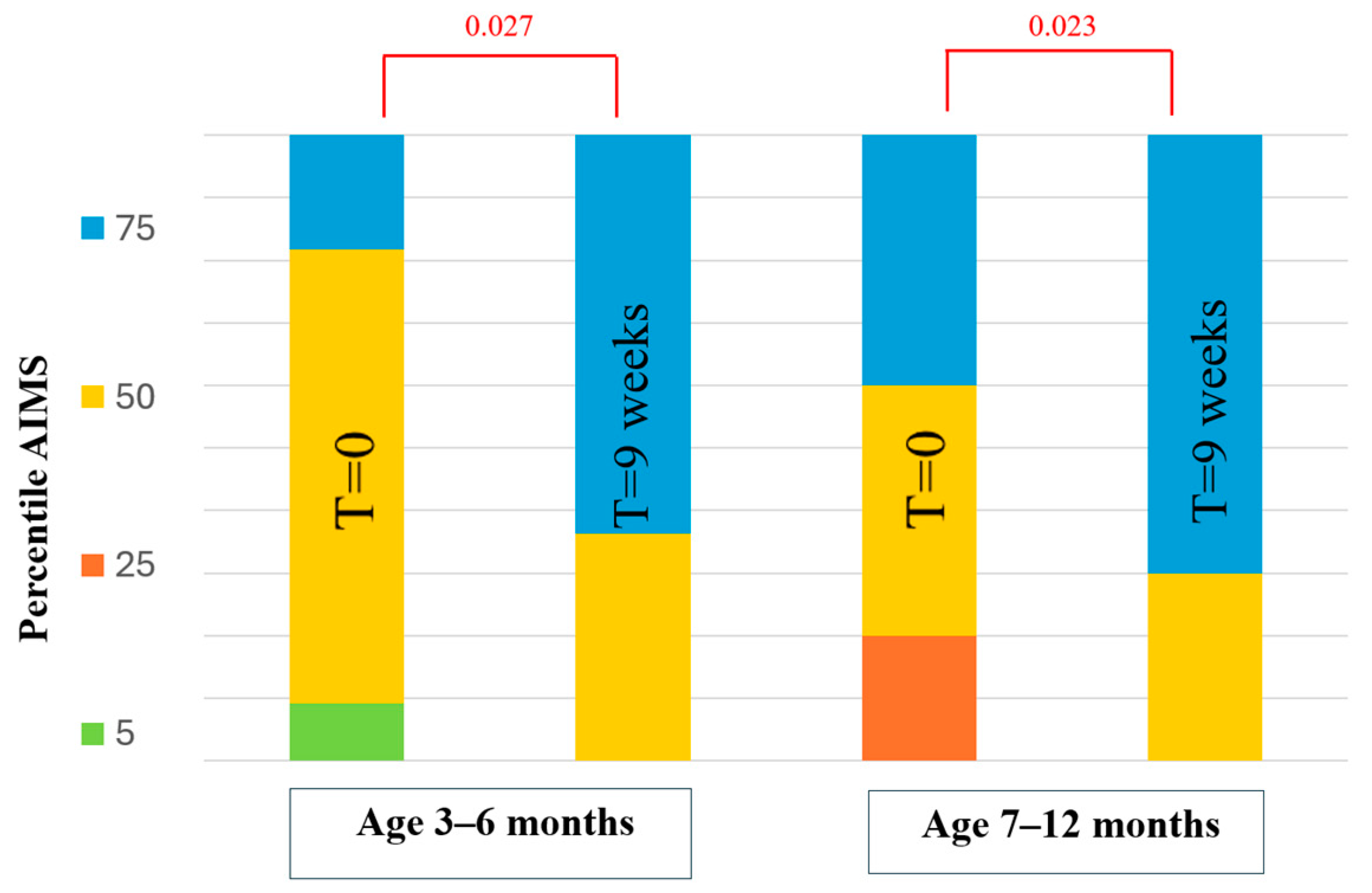
| Mean | 51.43 | 66.67 | 3.059 | 0.002 | 65.45 | 65.45 | 0.001 | 1.000 |
| SD | 17.83 | 12.08 | 13.53 | 13.53 | ||||
| Min | 5 | 50 | 50 | 50 | ||||
| Max | 75 | 75 | 90 | 90 | ||||
| AIMS percentile for Polish children | ||||||||
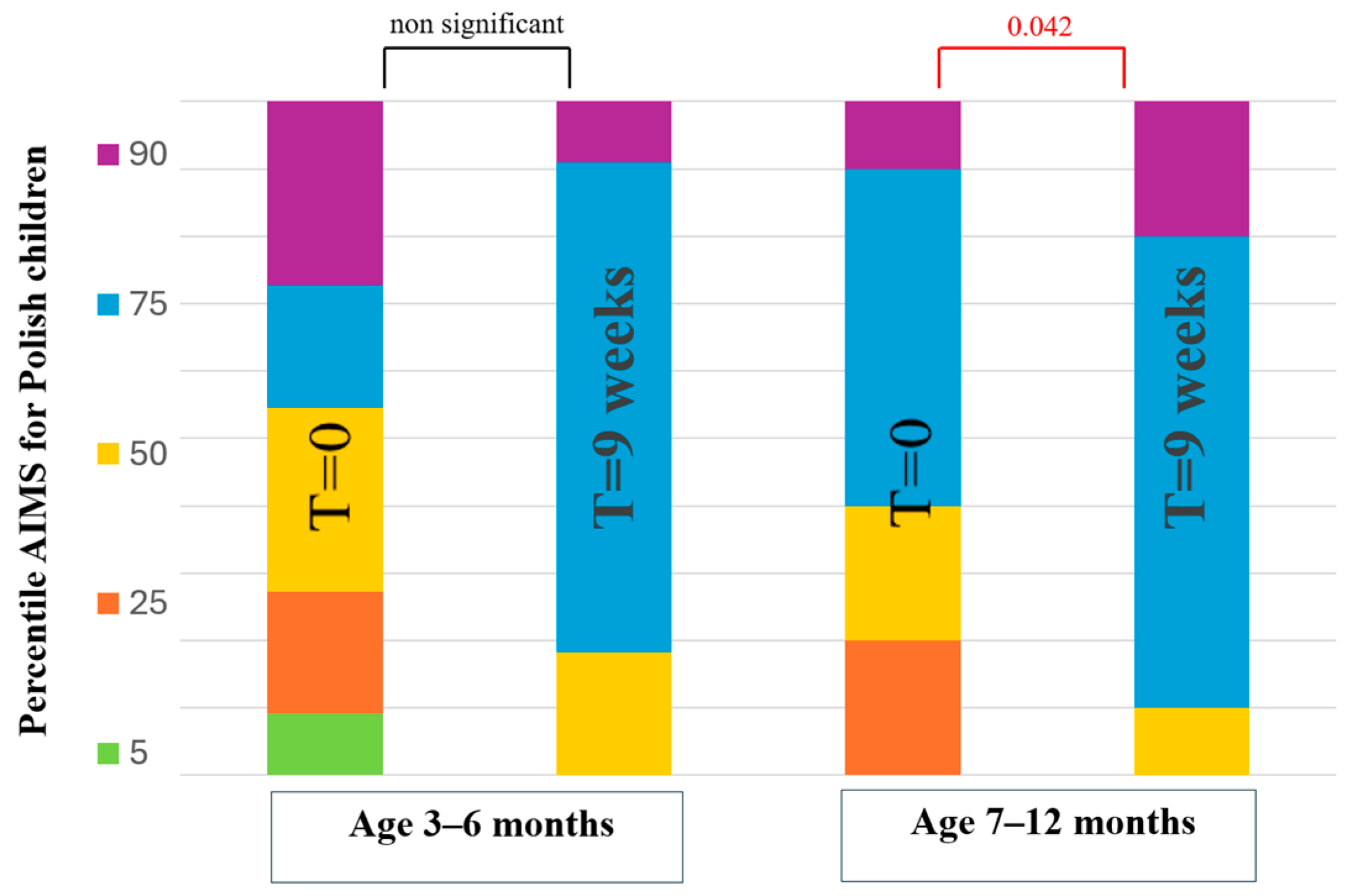
| Mean | 56.67 | 73.1 | 2.158 | 0.031 | 73.18 | 71.59 | 0.625 | 0.532 |
| SD | 26.8 | 12.89 | 14.76 | 14.83 | ||||
| Min | 5 | 50 | 25 | 50 | ||||
| Max | 90 | 90 | 90 | 90 | ||||
| GL age-independent score | ||||||||
| Mean | 49.47 | 49.53 | 1.442 | 0.149 | 48.22 | 48.66 | 0.730 | 0.465 |
| SD | 4.89 | 3.69 | 2.67 | 2.4 | ||||
| Min | 44.87 | 45.16 | 43.56 | 44.21 | ||||
| Max | 65.44 | 64.07 | 52.60 | 54.59 | ||||
| Age and AIMS Difference | Mean (SD) | r(X,Y) | r2 | t | p |
| 202.76 (64.38) | −0.349 | 0.121 | −2.384 | 0.021 | |
| 10.74 (5.08) |
Disclaimer/Publisher’s Note: The statements, opinions and data contained in all publications are solely those of the individual author(s) and contributor(s) and not of MDPI and/or the editor(s). MDPI and/or the editor(s) disclaim responsibility for any injury to people or property resulting from any ideas, methods, instructions or products referred to in the content. |
© 2024 by the authors. Licensee MDPI, Basel, Switzerland. This article is an open access article distributed under the terms and conditions of the Creative Commons Attribution (CC BY) license (https://creativecommons.org/licenses/by/4.0/).
Share and Cite
Jakobowicz, O.; Ogonowska-Slodownik, A. Supporting Infants’ Motor Development through Water Activities: A Preliminary Case–Control Study. Healthcare 2024, 12, 1556. https://doi.org/10.3390/healthcare12161556
Jakobowicz O, Ogonowska-Slodownik A. Supporting Infants’ Motor Development through Water Activities: A Preliminary Case–Control Study. Healthcare. 2024; 12(16):1556. https://doi.org/10.3390/healthcare12161556
Chicago/Turabian StyleJakobowicz, Oliwia, and Anna Ogonowska-Slodownik. 2024. "Supporting Infants’ Motor Development through Water Activities: A Preliminary Case–Control Study" Healthcare 12, no. 16: 1556. https://doi.org/10.3390/healthcare12161556
APA StyleJakobowicz, O., & Ogonowska-Slodownik, A. (2024). Supporting Infants’ Motor Development through Water Activities: A Preliminary Case–Control Study. Healthcare, 12(16), 1556. https://doi.org/10.3390/healthcare12161556