


Physical Restraint Use in Nursing Homes—Regional Variances and Ethical Considerations: A Scoping Review of Empirical Studies


Abstract
1. Introduction
1.1. Objectives
1.2. Research Questions
- What are the prevalence rates and methods of physical restraint use among the elderly in nursing homes?
- What are the reasons for using physical restraint on the elderly in nursing homes?
- What are the critical gaps in the literature regarding interventions to obviate physical restraint use among the elderly in nursing homes?
2. Method
2.1. Design
- Identify the research question;
- Identify relevant studies;
- Select studies;
- Extract the data;
- Collate, summarize, and report the results.
2.2. Search Methods
2.3. Inclusion and Exclusion Criteria
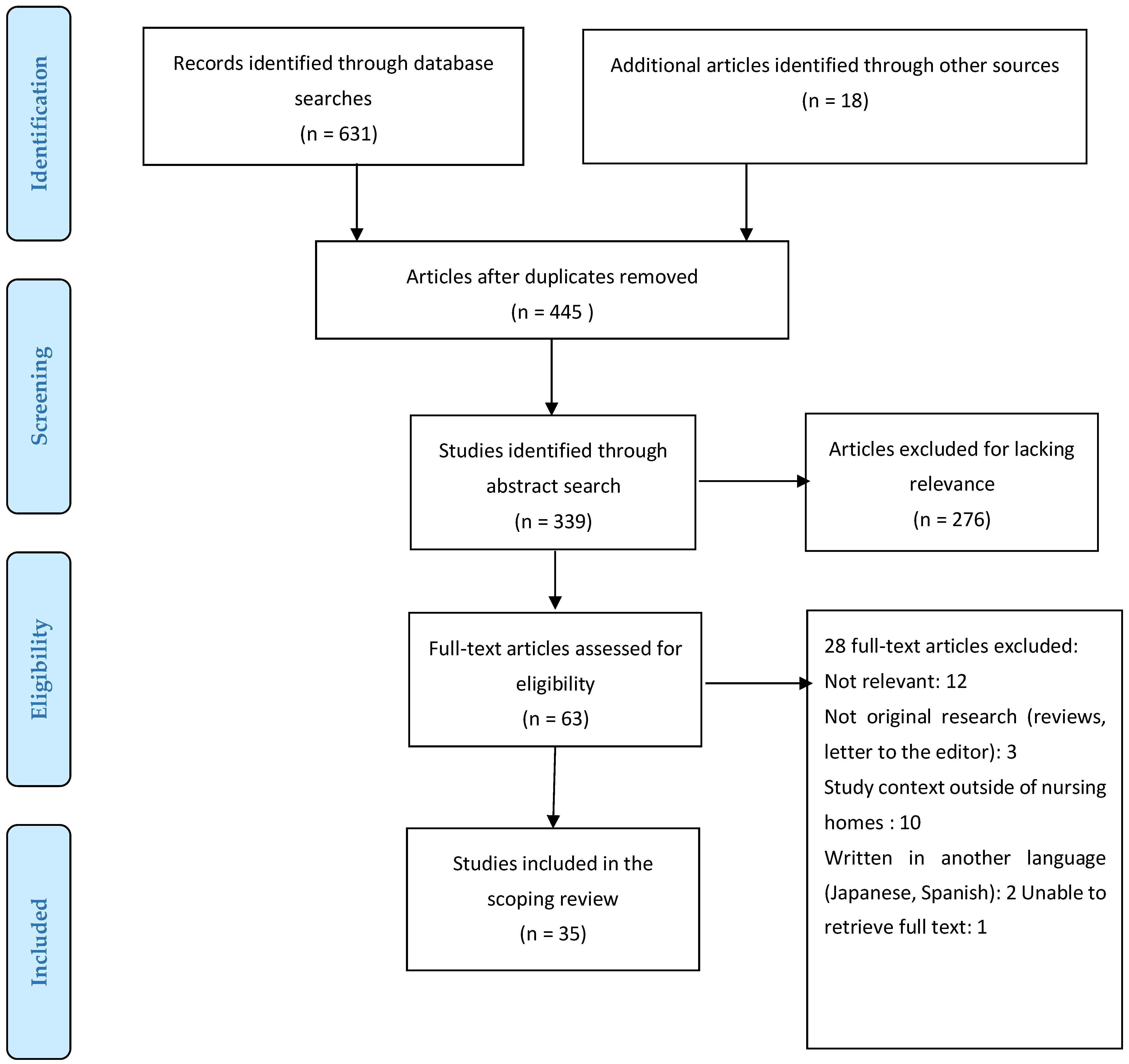
2.4. Study Selection
2.5. Charting the Data
3. Results
3.1. Characteristics of the Included Studies
3.2. Prevalence and Types of Physical Restraint Use
3.3. Reasons for Physical Restraint Use
3.4. Interventions to Reduce Physical Restraint Use
3.5. The PAGER Analysis
4. Discussion
5. Conclusions
Author Contributions
Funding
Institutional Review Board Statement
Informed Consent Statement
Data Availability Statement
Conflicts of Interest
References
- GBD. Global, regional, and national burden of diseases and injuries for adults 70 years and older: Systematic analysis for the Global Burden of Disease 2019 Study. BMJ 2022, 376, e068208. [Google Scholar]
- WHO. Ageing and Health. 2022. Available online: https://www.who.int/news-room/fact-sheets/detail/ageing-and-health (accessed on 5 April 2022).
- Friedland, R.B. Selected Long-Term Care Statistics. 2005. Available online: https://www.caregiver.org/resource/selected-long-term-care-statistics/ (accessed on 5 April 2022).
- STATCAN. A Portrait of Canada’s Growing Population Aged 85 and Older from the 2021 Census. 2022. Available online: https://www12.statcan.gc.ca/census-recensement/2021/as-sa/98-200-X/2021004/98-200-x2021004-eng.cfm (accessed on 5 April 2022).
- Brookmeyer, R.; Johnson, E.; Ziegler-Graham, K.; Arrighi, H.M. Forecasting the global burden of Alzheimer’s disease. Alzheimer’s Dement. 2007, 3, 186–191. [Google Scholar] [CrossRef]
- Scanlon, W.J. A perspective on long-term care for the elderly. Health Care Financ. Rev. 1988, 1988, 7–15. [Google Scholar]
- Breen, J.; Wimmer, B.C.; Smit, C.C.; Courtney-Pratt, H.; Lawler, K.; Salmon, K.; Price, A.; Goldberg, L.R. Interdisciplinary Perspectives on Restraint Use in Aged Care. Int. J. Environ. Res. Public Health 2021, 18, 11022. [Google Scholar] [CrossRef] [PubMed]
- Bekkema, N.; Niemeijer, A.; Frederiks, B.; Schipper, C. Exploring restrictive measures using action research: A participative observational study by nursing staff in nursing homes. J. Adv. Nurs. 2021, 77, 2785–2795. [Google Scholar] [CrossRef] [PubMed]
- Berzlanovich, A.M.; Schöpfer, J.; Keil, W. Deaths due to physical restraint. Dtsch. Arzteblatt Int. 2012, 109, 27–32. [Google Scholar] [CrossRef]
- Langhammer, B.; Bergland, A.; Rydwik, E. The Importance of Physical Activity Exercise among Older People. BioMed Res. Int. 2018, 2018, 7856823. [Google Scholar] [CrossRef]
- McPhee, J.S.; French, D.P.; Jackson, D.; Nazroo, J.; Pendleton, N.; Degens, H. Physical activity in older age: Perspectives for healthy ageing and frailty. Biogerontology 2016, 17, 567–580. [Google Scholar] [CrossRef]
- Heckman, G.A.; Crizzle, A.M.; Chen, J.; Pringsheim, T.; Jette, N.; Kergoat, M.J.; Eckel, L.; Hirdes, J.P. Clinical Complexity and Use of Antipsychotics and Restraints in Long-Term Care Residents with Parkinson’s Disease. J. Park. Dis. 2017, 7, 103–115. [Google Scholar] [CrossRef]
- Bleijlevens, M.H.C.; Wagner, L.M.; Capezuti, E.; Hamers, J.P.H. Physical Restraints: Consensus of a Research Definition Using a Modified Delphi Technique. J. Am. Geriatr. Soc. 2016, 64, 2307–2310. [Google Scholar] [CrossRef]
- Palese, A.; Longhini, J.; Businarolo, A.; Piccin, T.; Pitacco, G.; Bicego, L. Between Restrictive and Supportive Devices in the Context of Physical Restraints: Findings from a Large Mixed-Method Study Design. Int. J. Environ. Res. Public Health 2021, 18, 12764. [Google Scholar] [CrossRef]
- Australian Government. Department of Health and Aged Care (ADAHC), Restrictive Practices in Aged Care—A Last Resort. 2022. Available online: https://www.health.gov.au/topics/aged-care/providing-aged-care-services/working-in-aged-care/restrictive-practices-in-aged-care-a-last-resort (accessed on 6 June 2022).
- Bellenger, E.; Ibrahim, J.E.; Bugeja, L.; Kennedy, B. Physical restraint deaths in a 13-year national cohort of nursing home residents. Age Ageing 2017, 46, 688–693. [Google Scholar] [CrossRef]
- Feng, Z.; Hirdes, J.P.; Smith, T.F.; Finne-Soveri, H.; Chi, I.; Du Pasquier, J.-N.; Gilgen, R.; Ikegami, N.; Mor, V. Use of physical restraints and antipsychotic medications in nursing homes: A cross-national study. Int. J. Geriat. Psychiatry 2009, 24, 1110–1118. [Google Scholar] [CrossRef] [PubMed]
- Ambrosi, E.; Debiasi, M.; Longhini, J.; Giori, L.; Saiani, L.; Mezzalira, E.; Canzan, F. Variation of the Occurrence of Physical Restraint Use in the Long-Term Care: A Scoping Review. Int. J. Environ. Res. Public Health 2021, 18, 11918. [Google Scholar] [CrossRef] [PubMed]
- Gastmans, C.; Milisen, K. Use of physical restraint in nursing homes: Clinical-ethical considerations. J. Med. Ethics 2006, 32, 148–152. [Google Scholar] [CrossRef] [PubMed]
- Berzlanovich, A.M.; Kirsch, S.; Schöpfer, J.; Keil, W.; Kohls, N. Freedom-restraining measures as a result of misguided concern? Use of physical restraint in care situations. MMW Fortschr. Med. 2012, 154, 53–55. [Google Scholar] [CrossRef]
- Castle, N.G.; Engberg, J. The health consequences of using physical restraints in nursing homes. Med. Care 2009, 47, 1164–1173. [Google Scholar] [CrossRef]
- Hofmann, H.; Hahn, S. Characteristics of nursing home residents and physical restraint: A systematic literature review. J. Clin. Nurs. 2014, 23, 3012–3024. [Google Scholar] [CrossRef]
- Mamun, K.; Lim, J. Use of physical restraints in nursing homes: Current practice in Singapore. Ann. Acad. Med. Singap. 2005, 34, 158–162. [Google Scholar]
- Foebel, A.D.; Onder, G.; Finne-Soveri, H.; Lukas, A.; Denkinger, M.D.; Carfi, A.; Vetrano, D.L.; Brandi, V.; Bernabei, R.; Liperoti, R. Physical Restraint and Antipsychotic Medication Use Among Nursing Home Residents with Dementia. J. Am. Med. Dir. Assoc. 2016, 17, 184.e9–184.e14. [Google Scholar] [CrossRef]
- Freeman, S.; Spirgiene, L.; Martin-Khan, M.; Hirdes, J.P. Relationship between restraint use, engagement in social activity, and decline in cognitive status among residents newly admitted to long-term care facilities. Geriatr. Gerontol. Int. 2017, 17, 246–255. [Google Scholar] [CrossRef] [PubMed]
- Robins, L.M.; Lee, D.-C.A.; Bell, J.S.; Srikanth, V.; Möhler, R.; Hill, K.D.; Haines, T.P. Definition and Measurement of Physical and Chemical Restraint in Long-Term Care: A Systematic Review. Int. J. Environ. Res. Public Health 2021, 18, 3639. [Google Scholar] [CrossRef]
- Luo, H.; Lin, M.; Castle, N. Physical restraint use and falls in nursing homes: A comparison between residents with and without dementia. Am. J. Alzheimer’s Dis. Other Dement. 2011, 26, 44–50. [Google Scholar]
- De Veer, A.J.; Francke, A.L.; Buijse, R.; Friele, R.D. The use of physical restraints in home care in the Netherlands. J. Am. Geriatr. Soc. 2009, 57, 1881–1886. [Google Scholar] [CrossRef]
- Hamers, J.P.; Huizing, A.R. Why do we use physical restraints in the elderly? Z. Gerontol. Geriatr. 2005, 38, 19–25. [Google Scholar] [CrossRef] [PubMed]
- Kor, P.P.K.; Kwan, R.Y.C.; Liu, J.Y.W.; Lai, C. Knowledge, Practice, and Attitude of Nursing Home Staff toward the Use of Physical Restraint: Have They Changed over Time? J. Nurs. Scholarsh. 2018, 50, 502–512. [Google Scholar] [CrossRef] [PubMed]
- American Nurses Association (ANA). The Ethical Use of Restraints: Balancing Dual Nursing Duties of Patient Safety and Personal Safety. 2020. Available online: https://www.nursingworld.org/48f80d/globalassets/practiceandpolicy/nursing-excellence/ana-position-statements/nursing-practice/restraints-position-statement.pdf (accessed on 6 June 2022).
- Øye, C.; Jacobsen, F.F. Informal use of restraint in nursing homes: A threat to human rights or necessary care to preserve residents’ dignity? Health 2020, 24, 187–202. [Google Scholar] [CrossRef]
- Li, Y.; Wang, Y.; Gu, Y.; Gong, D.; Jiang, S.; Li, J.; Xu, H. Knowledge, Attitude, and Practice of Nursing Home Staff Regarding Physical Restraint in China: A Cross-Sectional Multicenter Study. Front. Public Health 2022, 10, 815964. [Google Scholar] [CrossRef]
- Capezuti, E.; Maislin, G.; Strumpf, N.; Evans, L.K. Side rail use and bed-related fall outcomes among nursing home residents. J. Am. Geriatr. Soc. 2002, 50, 90–96. [Google Scholar] [CrossRef]
- Gulpers, M.J.M.; Bleijlevens, M.H.C.; Ambergen, T.; Capezuti, E.; van Rossum, E.; Hamers, J.P.H. Belt restraint reduction in nursing homes: Effects of a multicomponent intervention program. J. Am. Geriatr. Soc. 2011, 59, 2029–2036. [Google Scholar] [CrossRef]
- Gallinagh, R.; Slevin, E.; McCormack, B. Side rails as physical restraints in the care of older people: A management issue. J. Nurs. Manag. 2002, 10, 299–306. [Google Scholar] [CrossRef] [PubMed]
- Huizing, A.R.; Hamers, J.P.; de Jonge, J.; Candel, M.; Berger, M.P. Organisational determinants of the use of physical restraints: A multilevel approach. Soc. Sci. Med. 2007, 65, 924–933. [Google Scholar] [CrossRef] [PubMed]
- Heinze, C.; Dassen, T.; Grittner, U. Use of physical restraints in nursing homes and hospitals and related factors: A cross-sectional study. J. Clin. Nurs. 2012, 21, 1033–1040. [Google Scholar] [CrossRef] [PubMed]
- Unruh, L.; Joseph, L.; Strickland, M. Nurse absenteeism and workload: Negative effect on restraint use, incident reports and mortality. J. Adv. Nurs. 2007, 60, 673–681. [Google Scholar] [CrossRef]
- Muñiz, R.; Gómez, S.; Curto, D.; Hernández, R.; Marco, B.; García, P.; Tomás, J.F.; Olazarán, J. Reducing Physical Restraints in Nursing Homes: A Report from Maria Wolff and Sanitas. J. Am. Med. Dir. Assoc. 2016, 17, 633–639. [Google Scholar] [CrossRef] [PubMed]
- Hofmann, H.; Schorro, E.; Haastert, B.; Meyer, G. Use of physical restraints in nursing homes: A multicentre cross-sectional study. BMC Geriatr. 2015, 15, 129. [Google Scholar] [CrossRef]
- Kim, K.-I.; Jung, H.-K.; Kim, C.O.; Kim, S.-K.; Cho, H.-H.; Kim, D.Y.; Ha, Y.-C.; Hwang, S.-H.; Won, C.W.; Lim, J.-Y.; et al. Evidence-based guidelines for fall prevention in Korea. Korean J. Intern. Med. 2017, 32, 199–210. [Google Scholar] [CrossRef]
- Arksey, H.; O’Malley, L. Scoping studies: Towards a methodological framework. Int. J. Soc. Res. Methodol. 2005, 8, 19–32. [Google Scholar] [CrossRef]
- Peters, M.D.J.; Godfrey, C.M.; Khalil, H.; McInerney, P.; Parker, D.; Soares, C.B. Guidance for conducting systematic scoping reviews. Int. J. Evid.-Based Healthc. 2015, 13, 141–146. [Google Scholar] [CrossRef]
- Huynh, D.; Lee, O.N.; An, P.M.; Ens, T.A.; Mannion, C.A. Bedrails and Falls in Nursing Homes: A Systematic Review. Clin. Nurs. Res. 2021, 30, 5–11. [Google Scholar] [CrossRef]
- Bradbury-Jones, C.; Aveyard, H.; Herber, O.R.; Isham, L.; Taylor, J.; O’malley, L. Scoping reviews: The PAGER framework for improving the quality of reporting. Int. J. Soc. Res. Methodol. 2022, 25, 457–470. [Google Scholar] [CrossRef]
- Abraham, J.; Kupfer, R.; Behncke, A.; Berger-Höger, B.; Icks, A.; Haastert, B.; Meyer, G.; Köpke, S.; Möhler, R. Implementation of a multicomponent intervention to prevent physical restraints in nursing homes (IMPRINT): A pragmatic cluster randomized controlled trial. Int. J. Nurs. Stud. 2019, 96, 27–34. [Google Scholar] [CrossRef] [PubMed]
- Aranda-Gallardo, M.; Morales-Asencio, J.M.; de Luna-Rodriguez, M.E.; Vazquez-Blanco, M.J.; Morilla-Herrera, J.C.; Rivas-Ruiz, F.; Toribio-Montero, J.C.; Canca-Sanchez, J.C. Characteristics, consequences and prevention of falls institutionalised older adults in the province of Malaga (Spain): A prospective, cohort, multicentre study. BMJ Open 2018, 8, e020039. [Google Scholar] [CrossRef]
- Delvalle, R.; Santana, R.F.; Menezes, A.K.; Cassiano, K.M.; De Carvalho, A.C.S.; Barros, P.D.F.A. Mechanical Restraint in Nursing Homes in Brazil: A cross-sectional study. Rev. Bras. Enferm. 2020, 73 (Suppl. S3), e20190509. [Google Scholar] [CrossRef] [PubMed]
- Estévez-Guerra, G.J.; Fariña-López, E.; Núñez-González, E.; Gandoy-Crego, M.; Calvo-Francés, F.; Capezuti, E.A. The use of physical restraints in long-term care in Spain: A multi-center cross-sectional study. BMC Geriatr. 2017, 17, 29. [Google Scholar] [CrossRef]
- Heeren, P.; Van de Water, G.; De Paepe, L.; Boonen, S.; Vleugels, A.; Milisen, K. Staffing levels and the use of physical restraints in nursing homes: A multicenter study. J. Gerontol. Nurs. 2014, 40, 48–54. [Google Scholar] [CrossRef]
- Huizing, A.R.; Hamers, J.P.H.; Gulpers, M.J.M.; Berger, M.P.F. A cluster-randomized trial of an educational intervention to reduce the use of physical restraints with psychogeriatric nursing home residents. J. Am. Geriatr. Soc. 2009, 57, 1139–1148. [Google Scholar] [CrossRef]
- Kirkevold, Ø.; Engedal, K. Prevalence of patients subjected to constraint in Norwegian nursing homes. Scand. J. Caring Sci. 2004, 18, 281–286. [Google Scholar] [CrossRef]
- Koczy, P.; Becker, C.; Rapp, K.; Klie, T.; Beische, D.; Büchele, G.; Kleiner, A.; Guerra, V.; Rißmann, U.; Kurrle, S.; et al. Effectiveness of a Multifactorial Intervention to Reduce Physical Restraints in Nursing Home Residents. J. Am. Geriatr. Soc. 2011, 59, 333–339. [Google Scholar] [CrossRef]
- Köpke, S.; Mühlhauser, I.; Gerlach, A.; Haut, A.; Haastert, B.; Möhler, R.; Meyer, G. Effect of a guideline-based multicomponent intervention on use of physical restraints in nursing homes: A randomized controlled trial. JAMA 2012, 307, 2177–2184. [Google Scholar] [CrossRef]
- Lam, K.; Kwan, J.S.K.; Kwan, C.W.; Chong, A.M.L.; Lai, C.K.Y.; Lou, V.W.Q.; Leung, A.Y.M.; Liu, J.Y.W.; Bai, X.; Chi, I. Factors Associated With the Trend of Physical and Chemical Restraint Use Among Long-Term Care Facility Residents in Hong Kong: Data From an 11-Year Observational Study. J. Am. Med. Dir. Assoc. 2017, 18, 1043–1048. [Google Scholar] [CrossRef] [PubMed]
- Meyer, G.; Köpke, S.; Haastert, B.; Mühlhauser, I. Restraint use among nursing home residents: Cross-sectional study and prospective cohort study. J. Clin. Nurs. 2009, 18, 981–990. [Google Scholar] [CrossRef] [PubMed]
- Pellfolk, T.J.-E.; Gustafson, Y.; Bucht, G.; Karlsson, S. Effects of a restraint minimization program on staff knowledge, attitudes, and practice: A cluster randomized trial. J. Am. Geriatr. Soc. 2010, 58, 62–69. [Google Scholar] [CrossRef] [PubMed]
- Pivodic, L.; Smets, T.; Gambassi, G.; Kylänen, M.; Pasman, H.R.; Payne, S.; Szczerbińska, K.; Deliens, L.; Van den Block, L. Physical restraining of nursing home residents in the last week of life: An epidemiological study in six European countries. Int. J. Nurs. Stud. 2020, 104, 103511. [Google Scholar] [CrossRef] [PubMed]
- Testad, I.; Mekki, T.E.; Førland, O.; Øye, C.; Tveit, E.M.; Jacobsen, F.; Kirkevold, Ø. Modeling and evaluating evidence-based continuing education program in nursing home dementia care (MEDCED)-training of care home staff to reduce use of restraint in care home residents with dementia. A cluster randomized controlled trial. Int. J. Geriatr. Psychiatry 2016, 31, 24–32. [Google Scholar] [CrossRef]
- Wang, J.; Liu, W.; Li, X.; Li, L.; Tong, J.; Zhao, Q.; Xiao, M. Effects and implementation of a minimized physical restraint program for older adults in nursing homes: A pilot study. Front. Public Health 2022, 10, 959016. [Google Scholar] [CrossRef]
- Te Boekhorst, S.; Depla, M.F.I.A.; Francke, A.L.; Twisk, J.W.R.; Zwijsen, S.A.; Hertogh, C.M.P.M. Quality of life of nursing-home residents with dementia subject to surveillance technology versus physical restraints: An explorative study. Int. J. Geriatr. Psychiatry 2013, 28, 356–363. [Google Scholar] [CrossRef]
- Verbeek, H.; Zwakhalen, S.M.; van Rossum, E.; Ambergen, T.; Kempen, G.I.; Hamers, J.P. Effects of small-scale, home-like facilities in dementia care on residents’ behavior, and use of physical restraints and psychotropic drugs: A quasi-experimental study. Int. Psychogeriatr. 2014, 26, 657–668. [Google Scholar] [CrossRef]
- Ben Natan, M.; Akrish, O.; Zaltkina, B.; Noy, R.H. Physically restraining elder residents of long-term care facilities from a nurses’ perspective. Int. J. Nurs. Pract. 2010, 16, 499–507. [Google Scholar] [CrossRef]
- Saarnio, R.; Isola, A. Nursing staff perceptions of the use of physical restraint in institutional care of older people in Finland. J. Clin. Nurs. 2010, 19, 3197–3207. [Google Scholar] [CrossRef]
- Laurin, D.; Voyer, P.; Verreault, R.; Durand, P.J. Physical restraint use among nursing home residents: A comparison of two data collection methods. BMC Nurs. 2004, 3, 5. [Google Scholar] [CrossRef] [PubMed]
- Evans, D.; Wood, J.; Lambert, L. Patient injury and physical restraint devices: A systematic review. J. Adv. Nurs. 2003, 41, 274–282. [Google Scholar] [CrossRef] [PubMed]
- Favez, L.; Simon, M.; Bleijlevens, M.H.; Serdaly, C.; Zúñiga, F. Association of surveillance technology and staff opinions with physical restraint use in nursing homes: Cross-sectional study. J. Am. Geriatr. Soc. 2022, 70, 2298–2309. [Google Scholar] [CrossRef]
- O’Keeffe, S.T. Physical restraints and nursing home residents: Dying to be safe? Age Ageing 2017, 46, 536–537. [Google Scholar] [CrossRef] [PubMed]
- Flaherty, J.H. Zero Tolerance for Physical Restraints: Difficult but Not Impossible. J. Gerontol. Ser. A 2004, 59, M919–M920. [Google Scholar] [CrossRef] [PubMed]
- Marques, P.; Queirós, C.; Apóstolo, J.; Cardoso, D. Effectiveness of bedrails in preventing falls among hospitalized older adults: A systematic review. JBI Database Syst. Rev. Implement. Rep. 2017, 15, 2527–2554. [Google Scholar] [CrossRef] [PubMed]
- Gallinagh, R.; Nevin, R.; Mc Ilroy, D.; Mitchell, F.; Campbell, L.; Ludwick, R.; McKenna, H. The use of physical restraints as a safety measure in the care of older people in four rehabilitation wards: Findings from an exploratory study. Int. J. Nurs. Stud. 2002, 39, 147–156. [Google Scholar] [CrossRef]
- Fonad, E.; Wahlin, T.-B.R.; Winblad, B.; Emami, A.; Sandmark, H. Falls and fall risk among nursing home residents. J. Clin. Nurs. 2008, 17, 126–134. [Google Scholar] [CrossRef]
- Evans, L.K.; Cotter, V.T. Avoiding restraints in patients with dementia: Understanding, prevention, and management are the keys. Am. J. Nurs. 2008, 108, 40–49. [Google Scholar] [CrossRef]
- Sullivan-Marx, E.M.; Strumpf, N.E.; Evans, L.K.; Baumgarten, M.; Maislin, G. Predictors of continued physical restraint use in nursing home residents following restraint reduction efforts. J. Am. Geriatr. Soc. 1999, 47, 342–348. [Google Scholar] [CrossRef]
- Rubenstein, L.Z. Falls in older people: Epidemiology, risk factors and strategies for prevention. Age Ageing 2006, 35 (Suppl. S2), ii37–ii41. [Google Scholar] [CrossRef]
- Schoberer, D.; Breimaier, H.E.; Zuschnegg, J.; Findling, T.; Schaffer, S.; Archan, T. Fall prevention in hospitals and nursing homes: Clinical practice guideline. Worldviews Evid. Based Nurs. 2022, 19, 86–93. [Google Scholar] [CrossRef] [PubMed]
- Sze, T.W.; Leng, C.Y.; Lin, S.K.S. The effectiveness of physical restraints in reducing falls among adults in acute care hospitals and nursing homes: A systematic review. JBI Libr. Syst. Rev. 2012, 10, 307–351. [Google Scholar] [CrossRef] [PubMed]
- Fernández Ibáñez, J.M.; Morales Ballesteros, M.D.C.; Montiel Moreno, M.; Mora Sánchez, E.; Arias Arias, Á.; Redondo González, O. Physical restraint use in relation to falls risk in a nursing home. Rev. Esp. Geriatr. Gerontol. 2020, 55, 3–10. [Google Scholar] [CrossRef]
- Sherrington, C.; Michaleff, Z.A.; Fairhall, N.; Paul, S.S.; Tiedemann, A.; Whitney, J.; Cumming, R.G.; Herbert, R.D.; Close, J.C.T.; Lord, S.R. Exercise to prevent falls in older adults: An updated systematic review and meta-analysis. Br. J. Sports Med. 2017, 51, 1750–1758. [Google Scholar] [CrossRef]
- Kato, M.; Izumi, K.; Shirai, S.; Kondo, K.; Kanda, M.; Watanabe, I.; Ishii, K.; Saito, R. Development of a fall prevention program for elderly Japanese people. Nurs. Health Sci. 2008, 10, 281–290. [Google Scholar] [CrossRef]
- Voyer, P.; Verreault, R.; Azizah, G.M.; Desrosiers, J.; Champoux, N.; Bédard, A. Prevalence of physical and verbal aggressive behaviours and associated factors among older adults in long-term care facilities. BMC Geriatr. 2005, 5, 13. [Google Scholar] [CrossRef] [PubMed]
- Ryden, M.B.; Feldt, K.S.; Oh, H.L.; Brand, K.; Warne, M.; Weber, E.; Nelson, J.; Gross, C. Relationships between aggressive behavior in cognitively impaired nursing home residents and use of restraints, psychoactive drugs, and secured units. Arch. Psychiatr. Nurs. 1999, 13, 170–178. [Google Scholar] [CrossRef] [PubMed]
- Evans, L.K.; Strumpf, N.E.; Allen-Taylor, S.L.; Capezuti, E.; Maislin, G.; Jacobsen, B. A clinical trial to reduce restraints in nursing homes. J. Am. Geriatr. Soc. 1997, 45, 675–681. [Google Scholar] [CrossRef]
- Abraham, J.; Hirt, J.; Richter, C.; Köpke, S.; Meyer, G.; Möhler, R. Interventions for preventing and reducing the use of physical restraints of older people in general hospital settings. Cochrane Database Syst. Rev. 2022, 8, CD012476. [Google Scholar]
- Woltsche, R.; Mullan, L.; Wynter, K.; Rasmussen, B. Preventing Patient Falls Overnight Using Video Monitoring: A Clinical Evaluation. Int. J. Environ. Res. Public Health 2022, 19, 13735. [Google Scholar] [CrossRef] [PubMed]

| Author, Year Country | Aim/Purpose of Study | Design and Study Population | PR Use and Methods |
|---|---|---|---|
| Abraham et al., 2019 [47], Germany | To evaluate the effectiveness of two versions of a guideline and theory-based multicomponent intervention to reduce physical restraints in nursing homes. | RCT-120 nursing home residents The mean age: 82.5 years | PR: (Baseline) 18.6% Bed rails: 16.1% Any belt: 0.8% Belt in chair: 0.8% Fixed table: 1.1% Belt in bed: 0.1% Other: 3.0% |
| Aranda-Gallardo et al., 2018 [48], Spain | To determine the characteristics of a typical institutionalized elderly patient who suffers a fall and to describe the physical harms resulting from this event. | Prospective cohort, multi-center study—647 nursing home residents The mean age: 81.81 years | PR: 16.79% Bed rails: 53.53% |
| Bellenger et al., 2017 [16], Australia | To investigate the nature and extent of physical restraint deaths reported to Coroners in Australia over a 13-year period. | Retrospective cohort study— 58 nursing home residents placed under physical restraint. The median age: 83 years | PR: NI Chair restraint Bed rails Fixed table Cot sides with webbing |
| Delvalle et al., 2020 [49], Brazil | To estimate the prevalence of mechanical restraint in nursing homes and the factors associated with its performance. | Cross-sectional study— 443 elderly in 14 nursing homes The mean age: 83.8 years | PR: 7.45% Wheelchair: 27.3% Plastic chair: 18.2% Bandage: 3.0% Bed rail: 45.5% Adapted wooden rail: 3.0% Sheeting: 48.5% |
| Castle and Engberg, 2009 [21], USA | To examine whether physical restraint use contributes to subsequent physical or psychological health decline. | Longitudinal study—264,068 nursing home residents | PR: 1.9% |
| Estévez-Guerra et. al., 2017 [50], Spain | To examine the prevalence of PR use in long-term care residents with the ability to move voluntarily. | Cross-sectional observational and correlational multi-center study— 920 long-term care residents The mean age: 81 years | PR: 84.9% Side rails: 84.5% Belts in chair: 26.9% Belts in bed: 9.9% Chair with attached table: 6.2% Vest: 6.1% Wrist/ankle belt: 1.2% Sleep suits: 1.2% |
| Feng et al., 2009 [17], Canada, Finland, Hong Kong, Switzerland, and USA | To compare inter- and intra-country differences in the prevalence of PR and antipsychotic medications in nursing homes. | Population-based, cross-sectional study—14,504 residents of nursing homes The average age: 82–84 years | Switzerland: 6% The USA: 9% Hong Kong: 20% Finland: 28% Canada: 31% |
| Foebel et al., 2016 [24], Czech Republic, England, Finland, France, Germany, Israel, Italy, and the Netherlands | To explore antipsychotic medications and PR use and their effects on physical function and cognition in older nursing home residents. | Retrospective cohort study— 532 residents with dementia in 57 nursing homes The mean age: 85.2 years | PR: 19.6% Trunk: 45% Chair: 55% |
| Freeman et al., 2017 [25], Canada | To examine the role of physical restraint use, use of antipsychotic medications, and engagement in social activities in affecting change in cognitive status and driving cognitive decline among residents newly admitted to a Long term care facilities (LTCF). | Longitudinal Secondary data analysis— 111,052 residents in 635 LTCFs The mean age: 82.9 | PR: 13.2% Trunk restraint: 8.5% Limb restraint: 0.3% Chair that prevents rising: 6.9% |
| Gulpers et al., 2011 [35], the Netherlands | To test the effectiveness of EXBELT on reducing belt restraint usage in psychogeriatric nursing home care. | A quasi-experimental longitudinal study—405 nursing home residents The mean age: 83.3 years | PR (Baseline): 61% Belts: 18% Wheelchair: 15% Bed: 6% Wheelchair with a locked table: 12% Special sheet: 9% Full-enclosure bedrails: 55.5% Chair on a board:1.5% Deep or overturned wheelchair: 8.5% Sleep suits: 7.5% |
| Hamers et al., 2004 [29], the Netherlands | To examine the prevalence of PR use in cognitively impaired nursing home residents, the manner in which restraints are used, the reasons for using them, and the relationships between residents’ characteristics and the use of PR. | A point prevalence study— 260 nursing home residents The mean age: 81 years | PR: 49% Bed and chair-26% Bed: 23% Bed rails: 98% Belts: 27% Belt with chairs: 57% Chairs with a table: 36% |
| Heckman et al., 2017 [12], Canada | To describe the clinical complexity of older institutionalized persons with Parkinson’s disease (PD); and examine patterns and predictors of restraint use and the prescription of antipsychotics in this population. | Cross-sectional cohort study— 7851 Complex Continuing Care (CCC) residents with a recorded diagnosis of PD The mean age: 82.6 years | PR: 18.9% Trunk: 11.3% Limb: 0.4% Chair: 11.6% |
| Heeren et al., 2014 [51], USA | To examine the relationship between staffing levels and the use of physical restraints in nursing homes. | Multi-center study—570 Residents in 23 wards in nursing homes (NHs) The median age: 86 years | PR: 47.5% |
| Heinze et al., 2012 [38], Germany | To investigate factors related to the use of restraints and to explore whether the number of nurses was an influencing factor regarding the use of restraints in German NHs and hospitals. | A secondary analysis of a cross-sectional study—5521 residents The mean age: 84.9 years | PR: 26.3% Bed rails: 25.77% Belts for fixation: 4.8% |
| Hofmann et al., 2015 [41], Switzerland | To investigate the prevalence and types of physical restraints used in nursing homes in two Swiss cantons and to explore whether resident-related and organizational factors are associated with the use of physical restraints. | A multi-center cross-sectional study—1362 residents The mean age: 85.1 years | PR: 26.8% Centre prevalence: 2.6% to 61.2% Bilateral bedrails: 20.3% Unilateral bedrails at one side of the bed with the other positioned at the wall: 5.7% Wheelchair with a locked tray table: 1.8% Belt in chair: 1.1% Sleep suits: 1.1% Chair preventing rising: 0.5% Chair with a locked tray table: 0.3% |
| Huizing et al., 2007 [37], the Netherlands | To investigate the relationship between the use of physical restraints on psycho-geriatric nursing home residents and the characteristics of organizations and residents. | Cross-sectional study— 371 residents The mean age: 83 years | PR: 56% |
| Huizing et al., 2009 [52], the Netherlands | To investigate the effects of an educational intervention on the use of physical restraints on psychogeriatric nursing home residents. | A cluster-randomized trial—371 residents in a psychogeriatric nursing home The mean age: 83 years | PR (Baseline): 51.5% Belt in chair: 10% Belt in bed: 9% Bilateral bedrails: 45% Deep or tipped chair: 18% Special sheet: 4% Sleep suits: 8% Sensor mat: 4% Infrared system: 4% |
| Kirkevold and Engedal, 2004 [53], Norway | To describe the prevalence of various types of constraint in Norwegian nursing homes. | Descriptive study—1501 residents in 222 nursing home special care units The mean age: 84.4 years | PR: 36.1% Bedrails without patients consent; 32.2% Belts or other fixing to bed: 2.3% Belts or other fixing to chair: 8.5% Other physical restraint: 3% |
| Koczy et al., 2011 [54], Germany | To evaluate the effectiveness of a multifactorial intervention to reduce the use of physical restraints in residents of nursing homes. | Cluster-randomized controlled trial—333 residents in 45 nursing homes | PR (Baseline): 6.1% |
| Köpke et al., 2012 [55], Germany | To reduce PR prevalence in nursing homes using a guideline- and theory-based multicomponent intervention. | Parallel group cluster RCT—2283 residents (IG), 2166 residents (CG) in 36 nursing homes | PR (Baseline): 31.1% Restrictive bed rails: 29.1% Any waist belt: 2.9% Waist belt in bed: 0.8% Waist belt in chair: 2.4% Fixed table: 1.9% Other physical restraint: 3.8% |
| Lam et al., 2017 [56], China | To review the change in the prevalence of physical and chemical restraint use in LTCFs over a period of 11 years in Hong Kong and to identify the major factors associated with their use. | Longitudinal Study—2896 Residents in 10 residential LTCFs Mean age: 83.3 years | PR: 70.2% |
| Luo et al., 2011 [27], USA | To estimate the use of different types of physical restraint and assess their association with falls and injuries among residents with and without AD or dementia in US nursing homes. | Cross-sectional study—5057 nursing home residents with Alzheimer Disease (AD) or dementia and 4224 residents without | PR: 6.99% Bed rails: 36.79% Limp: 0.40% Trunk: 3.87% Chair restraints: 3.35% |
| Mamun and Lim, 2005 [23], Singapore | To assess the use and complications related to physical restraints in Singapore nursing homes. | Mixed-method study—390 nursing homes residents The mean age: 80.1 years | PR: 23.3% |
| Meyer et al., 2009 [57], Germany | To investigate the prevalence of physical restraints, the frequency with which the devices being applied and the frequency with which psychoactive medication is available on demand during 12-month follow-up, and characteristics associated with restraint use in nursing homes. | Cross-sectional study—2367 nursing homes residents The mean age: 86 years | PR: 26.2% Bed rails: 24.5% Waist belt used in a chair or bed: 2.7% Chair with a table: 2.1% Other devices: 2.3% |
| Muniz et al., 2016 [40], Spain | To implement a dementia-friendly culture as well as specific organizational skills relevant to person-centered care and environmental improvement. | Longitudinal study 4361, 2410 residents with dementia—41 Spanish nursing homes Mean age: 84.6 | PR: 18.1% and 29.1% with dementia Bed rails: 43.5% and 56.8% Chair abdominal belt: 9.4% and 15.1% Upper body vest and perineal belt: 3.4% and 5.7% Belt in bed: 5.9% and 9.8% Wrist restraint: 0.8–1.4% |
| Pellfolk et al., 2010 [58], Sweden | To evaluate the effects of a restraint minimization education program on staff knowledge, attitudes and use of PRs. | Cluster RCT—184 staff and 191 residents (IG), and 162 staff and 162 residents (CG) in dwelling units for people with dementia The mean age: 43.5 years | PR (Baseline): 25.2% |
| Pivodic et al., 2020 [59], Belgium, England, Finland, Italy, the Netherlands and Poland | To determine the frequency of physical limb and/or trunk restraint use in the last week of nursing home residents’ lives in six European countries and its association with country, resident and nursing home characteristics. | Epidemiological cross-sectional survey study—1384 deceased residents from 322 nursing homes The mean age: 83–89 years | Belgium: 8% England: 1% Finland: 4% Italy:12% Poland: 0.4% |
| Testad et al., 2016 [60], Norway | To evaluate the effect of a tailored 7-month training intervention, entitled “Trust Before Restraint”, on reducing the use of restraint, agitation, and antipsychotic medications in care home residents with dementia. | RCT—274 residents with dementia in 24 care homes. The mean age: 88.2 years | PR: 12.4% Bedrails without the patient’s consent: 4.7% Belts or other fixing to bed: 0.4% Belts or other fixing to chair: 0.4% Physical retention: 2.9% |
| Wang et al., 2022 [61], China | To identify the relationship between the Theory of Planned Behavior constructs and nursing staffs’ use of PR in LTCFs. | Cross-sectional survey—316 nursing staff in six Chinese LTCFs The mean age: 43.52 years | PR: 25.83% |
| te Boekhorst et al., 2013 [62], the Netherlands | To explore the social, mood and behavioral dimensions of the quality of life of residents under surveillance technology compared with those of residents under PR. | An explanatory study—150 nursing home residents | PR: 5.4% Fixation: 52% Restrictive chair: 48% |
| Verbeek et al., 2014 [63], the Netherlands | To examine the effects of small-scale living facilities on the behavior of residents with dementia and the use of physical restraints and psychotropic drugs. | A quasi-experimental study—259 nursing home residents with AD or dementia The mean age: 82.4 years | PR: 44% Belt: 11% (Wheel) chair with a locked table/chair on a board: 10% Deep or overturned chair: 8% Bilateral full enclosed bed rails: 40% Sleepsuits: 16% |
| Author, Year, Country | Aim and Purpose of Study | Design and Study Population | Reasons |
|---|---|---|---|
| Bellenger et al., 2017 [16], Australia | To investigate the nature and extent of physical restraint deaths reported to coroners in Australia over a 13-year period. | Retrospective cohort study: 58 nursing home residents experiencing physical restraint | Impaired mobility, dementia, risk of fall, history of repeated falls, mobility |
| Ben Natan et al., 2010 [64], Israel | To identify and analyze major variables affecting the decision of nursing staff to physically restrain elder residents of long-term care facilities. | Descriptive correlational study: 10 4 nurses in a geriatric care institution | Dementia, physical state, stress of elder residents, cognitive impairment: 10% Risk of fall: 53.8% Risk of self-injury: 80.8% Threatening the lives of others: 66.3% |
| Delvalle et al., 2020 [49], Brazil | To estimate the prevalence of mechanical restraints in nursing homes and factors associated with their performance. | Cross-sectional study: 443 elderly in 14 nursing homes | Risk of falls: 66.7% Agitation, aggressiveness, wandering: 21.2% Lack of institutional protocol or medical request: 9.1% Alzheimer’s Disease: 3.0% |
| Estévez-Guerra et al., 2017 [50], Spain | To examine the prevalence of physical restraint on long-term care residents with the ability to move voluntarily. | Cross-sectional observational and correlational multi-center study: 920 long-term care residents | Prevent falls, impaired cognitive status |
| Feng et al., 2009 [17], Canada, Finland, Hong Kong, Switzerland, and USA | To compare inter- and intra-country differences in the prevalence of physical restraint and antipsychotic medications in nursing homes. | Population-based, cross-sectional study: 14,504 residents of nursing homes | Longer resident stays were associated with higher physical restraint use rate in Switzerland Larger facilities had a lower rate of physical restraint use in Canada and Finland Older age was associated with reduced physical restraint use only in the USA. |
| Foebel et al., 2016 [24], Czech Republic, England, Finland, France, Germany, Israel, Italy, and the Netherlands | To explore antipsychotic medications and physical restraint use and their effects on physical function and cognition in older nursing home residents. | Retrospective cohort study: 532 residents with dementia in 57 nursing homes | Dependent: 55.8% Incontinence: 97.1% Severe CI: 59.6% Hallucinations: 14.4% Delusions: 14.4% Wandering: 24.0% Disrobing in public: 34.6% Verbally abusive: 27.9% Physically abusive: 16.4% Socially inappropriate: 30.8% Resist care: 4.8% History of falls: 12.5% |
| Hamers et al., 2004 [29], the Netherlands | To examine the prevalence of physical restraint use in cognitively impaired nursing home residents, the manner in which restraints are used, reasons for using them, and relationships between residents’ characteristics and the use of physical restraint. | A point prevalence study: 260 nursing home residents | Prevent falls: 80% Restlessness: 24% Safe use of medical devices: 1% Poor mobility Care dependency Risk of falling in the opinion of nursing staff |
| Heckman et al., 2017 [12], Canada | To describe the clinical complexity of older institutionalized persons with PD, and examine patterns and predictors of restraint use and prescription of antipsychotics in this population. | Cross-sectional cohort study: 7851 Complex Continuing Care (CCC) residents with a recorded diagnosis of PD | History of falls Cognitive impairment Aggressive behavior Delusions or hallucinations Behavioral symptoms Functional impairment Urinary incontinence Shortage of physicians |
| Heeren et al., 2014 [51], USA | To examine the relationship between staffing levels and the use of physical restraints in nursing homes. | Multi-center study: 570 residents, 23 wards in 7 nursing homes | Bathing dependency Transfer difficulties Risk for falls Frequent restlessness/agitation |
| Heinze et al., 2012 [38], Germany | To investigate factors related to the use of restraints and to explore whether the number of nurses is an influencing factor regarding the use of restraints in German nursing homes and hospitals. | A secondary analysis of a cross-sectional study: 5521 residents | Care dependency Impaired mobility Bedfast Urinary incontinence History of falls Polypharmacy High risk of falls Disorientation/confusion |
| Hofmann et al., 2015 [41], Switzerland | To investigate the prevalence and types of physical restraint used in nursing homes in two Swiss cantons and to explore whether resident-related and organizational factors are associated with the use of physical restraints. | A multi-center cross-sectional study: 1362 residents | Age Degree of care dependency Mobility limitation Verbal agitation Physical agitation Risk/history of fall and/or fracture |
| Huizing et al., 2007 [37], the Netherlands | To investigate the relationship between the use of physical restraints with psycho-geriatric nursing home residents and the characteristics of organizations and residents. | Cross-sectional study: 371 residents | Age: 84.0% Female: 78.6% Cognitive status: 4.5% ADL: 4.6% Nursing staff workload: 3.1% Higher job autonomy (nursing staff): 3.0% Immobility: 3.0% |
| Koczy et al., 2011 [54], Germany | To evaluate the effectiveness of a multifactorial intervention to reduce the use of physical restraints on residents of nursing homes. | Cluster-randomized controlled trial: 333 residents in 45 nursing homes | Limited physical mobility Female High need for care |
| Köpke et al., 2012 [55], Germany | To reduce physical restraint prevalence in nursing homes using a guideline- and theory-based multicomponent intervention. | Parallel group cluster RCT: 2283 residents (IG), 2166 residents (CG) in 36 nursing homes | Negative experiences of nurses Concerns and uncertainties of relatives and legal guardians Organizational problems (e.g., staff fluctuation) |
| Lam et al., 2017 [56], China | To review the change in the prevalence of physical and chemical restraint use in LTCFs over a period of 11 years in Hong Kong and to identify the major factors associated with their use. | Longitudinal study: 2896 residents in 10 residential LTCFs | Impaired activities of daily living Impaired cognitive function Negative mood Bowel and bladder incontinence Dementia |
| Mamun and Lim, 2005 [23], Singapore | To assess the use and complications related to the use of physical restraints in Singapore nursing homes. | Mixed method study: 390 nursing home residents | Dementia Prevent falls: 18.7% Prevent dislodgement of feeding tubes: 22% Injury to self: 31.2% Injury to others: 8.6% Wandering: 23.7% Shouting: 36.6% Agitation: 8.8% |
| Meyer et al., 2009 [57], Germany | To investigate the prevalence of physical restraints, the frequency with which the devices areapplied, and the frequency with which psychoactive medication is available on demand during 12-month follow-up, and characteristics associated with restraint use in nursing homes. | Cross-sectional study: 2367 nursing homes residents | Degree of disablement Cognitive impairment Fracture Repeated verbal agitation |
| Øye et al., 2017 [32], Norway | To investigate what kind of restraint is used in three nursing homes and to investigate how staff use restraint under different nursing home contexts by comparing three nursing home settings. | Mixed-method study: 38 nursing home staff | Resident mix Staff culture Location Human resources Agitation Aggressiveness Wandering |
| Saarnio and Isola, 2010 [65], Finland | To describe the perceptions of nursing staff regarding the use of physical restraint in the institutional care of older people. | Qualitative study: 21 nursing home nurses | Requests by the patient’s family Aggressive Untidy Exposes him/herself Wandering Lack of legislation |
| Wang et al., 2022 [61], China | To identify the relationship between the theory of planned behavior (TPB) constructs and the nursing staff’s use of physical restraint in LTCFs. | Cross-sectional survey: 316 nursing staff in 6 Chinese LTCFs | Prevent falls Residents with feeding tubes |
| Author, Year, Country | Aims and Objectives | Design and Study Population | Intervention | Effectiveness | Challenges and Suggestions |
|---|---|---|---|---|---|
| Abraham et al., 2019 [47], Germany | To evaluate the effectiveness of two versions of a guideline and theory-based multicomponent intervention to reduce physical restraints in nursing homes. The authors conducted a pragmatic cluster randomized controlled trial with a twelve-month follow-up including 120 nursing homes. | A pragmatic cluster RCT with 12,245 residents (4126 and 3547 in IG 1 and 2 and 4572 in CG) | Guideline-based multicomponent intervention. IG 1 received an updated version of a successfully tested guideline-based multicomponent intervention (comprising brief education for the nursing staff, intensive training of nominated key nurses in each cluster, introduction of a least-restraint policy and supportive material); IG 2 received a concise version of the original program, and the control group received optimized usual care (I.e., supportive materials only). | Neither intervention showed a clear advantage compared to the control. | Increased heterogeneity data, risk of bias in randomization. Other approaches, like legal or governmental policies, seem to be necessary to sustainably change physical restraint practice and reduce center variations in nursing homes. |
| Gulpers et al., 2011 [35], the Netherlands | To test the effectiveness of EXBELT on reducing belt restraint usage in psychogeriatric nursing home care. | A quasi-experimental longitudinal design with 714 residents in a nursing home | The intervention program included four major components: promotion of institutional policy change that discourages use of belt restraint, nursing home staff education, consultation by a nurse specialist aimed at nursing home staff, and availability of alternative interventions. | The intervention led to a substantial reduction in use of belts, full-enclosure bed rails, and sleep suits without increasing the use of other physical restraints, psychoactive drugs, or falls and fall related injuries. | Further research is recommended. |
| Huizing et al., 2009 [52], the Netherlands | To investigate the effects of an educational intervention on the use of physical restraints with psychogeriatric nursing home residents. | A cluster randomized trial of 371 residents in a psychogeriatric nursing home | The intervention consisted of five 2-h educational sessions for selected staff delivered over a 2-month period, one 90-min plenary session for all staff, and consultation with a nurse specialist (RN level). The educational program was designed to encourage nursing staff to adopt a restraint-free care philosophy and familiarize themselves with individualized care techniques. | No effect was had on the restraint status, restraint intensity, or multiple restraint usage in any of the three post-intervention measurements. | No information about factors potentially influencing the intervention’s lack of effectiveness due to contamination bias, insufficient consultation (one nurse specialist performed consultation). Future studies should include an effect evaluation and a process evaluation. |
| Koczy et al., 2011 [54], Germany | To evaluate the effectiveness of a multifactorial intervention to reduce the use of physical restraints in residents of nursing homes. | Cluster-randomized controlled trial with 333 residents | Persons responsible for the intervention in the nursing homes attended a 6-h training course that included education about the reasons for restraint use, its adverse effects, and alternatives to its use. The following components were selected: increasing awareness, improving knowledge, clarifying legal arguments, demonstrating alternatives, providing related equipment and supplies, and empowering staff members to participate in the decision-making process. Technical aids, such as hip protectors and sensor mats, were provided. The training was designed to give the change agents tools for problem-solving to prevent behavioral symptoms and injuries from falls without using physical restraints. | The intervention reduced restraint use (belts tied to a chair or to bed and chairs with fixed tables) without a significant increase in falling, behavioral symptoms, or medication. | Unblinded documentation of physical restraints and falls by the staff members of the nursing homes. An interdisciplinary approach based on medical and nursing science including ethical and legal aspects is likely to yield the greatest benefits. |
| Köpke et al., 2012 [55], Germany | To reduce physical restraint prevalence in nursing homes using a guideline- and theory-based multicomponent intervention. | Parallel group cluster RCT with 2283 (IG), 2166 (CG) residents of nursing homes | A guideline- and theory-based multicomponent intervention. Components were group sessions for all nursing staff; additional training for nominated key nurses; and supportive material for nurses, residents, relatives, and legal guardians. Control group clusters received standard information. As opposed to other guideline-based interventions, the central recommendation is not to perform a certain action, i.e., not to apply physical restraints, aiming to implement a “practice culture” without physical restraints. | A guideline- and theory-based multicomponent intervention compared with standard information reduced physical restraint use (bilateral bed rails, belts, fixed tables, and other measures limiting free body movement) without significant differences in falls, fall-related fractures, or psychotropic medication prescriptions. | Information leakage between head nurses and staff nurses who performed the assessment of the use of physical restraint. |
| Muniz et al., 2016 [40], Spain | To implement a dementia-friendly culture, as well as specific organizational skills relevant to person-centered care and environmental improvement. | A two-wave longitudinal study with 4361 residents with dementia | The intervention was initiated in April 2010 and combined training, consultation, and consultancy at various levels of the organization. “Dementia champions” (1 per nursing home) received in-depth training about a wide array of dementia topics (e.g., biological basis of dementia, genesis and management of behavioral and psychological symptoms of dementia, person-centered care) needed to coordinate the implementation of several dementia care approaches. | Physical restraints can almost be eliminated along with psychotropic medication. | Recliner chairs used as physical restraints were not tracked in the database. Future research is recommended to address ways to avoid injurious falls in restraint-free nursing homes for people with severe dementia. |
| Pellfolk et al., 2010 [58], Sweden | To evaluate the effects of a restraint minimization education program on staff knowledge, attitudes and use of physical restraints. | Cluster RCT with 156 staff and 185 residents (IG) and 133 staff and 165 residents (CG) | The intervention consisted of a six-month education program comprised of six different themes, one for each month, for nursing staff. The education included 30 min of videotaped lectures. Three of the lectures also included a clinical vignette presented in writing, which could be used for group discussions. | Staff education in small group dwellings can increase knowledge, change attitudes, and reduce the use of physical restraints in the care of elderly people suffering from dementia, without increasing the incidence of falls or the use of psychoactive drugs. | The effects In this study were measured immediately after the completion of the intervention. Thus, the long-term effects of the intervention cannot be evaluated based on this study; more studies are recommended. |
| te Boekhorst et al., 2013 [62], the Netherlands | To explore the social, mood, and behavioral dimensions of the quality of life of residents under surveillance technology compared with those of residents under physical restraints. | An explorative study with 150 residents | The use of surveillance technology versus physical restraints. Surveillance cameras, acoustic monitoring systems, chips worn in clothing or shoes that close doors or sound an alarm when off-limits doors are opened, tracking chips with GPS, inactivity sensors, movement sensors in beds or chairs, door sensors, and bed pressure sensors were defined as surveillance technology. | Not effective. Surveillance technology may only benefit those who can already move without the help of others. | There was no measurement made before residents were put under surveillance technology or physical restraint so as to establish potential baseline differences between these two groups. More robust design research is needed with surveillance technology. |
| Testad et al., 2016 [60], Norway | To evaluate the effect of a tailored 7-month training intervention, entitled “Trust Before Restraint”, on reducing the use of restraints, agitation, and antipsychotic medications in care home residents with dementia. | RCT with 197 residents with dementia and 35 staff | The intervention included the seven-step guidance group, where the care staff chose a situation includingthe use of restraint and the DMP model (to emphasize and understand the relationship between resident and care staff, and to support the identification and effective management of unmet needs in order to reduce the use of restraint and improve care). | Training intervention reduced the use of restraints in both the intervention and control groups, with a greater reduction in the control group. | Possible bias between the two groups that may have influenced the main findings of the study. |
| Verbeek et al., 2014 [63], the Netherlands | To examine the effects of small-scale living facilities on the behavior of residents with dementia and the use of physical restraints and psychotropic drugs. | A quasi-experimental study of 124 (IG) and 135 (CG) nursing home residents with AD or dementia | Comparing residents in two types of long-term institutional nursing care: small-scale living facilities versus traditional psychogeriatric wards on three time points—at baseline and at follow-ups after six and 12 months. | Positive effects of small-scale living facilities on the use of physical restraints and psychotropic drugs | Sample bias (residents were not randomized in a dementia care facility), risk of underreporting physical restraints (measurement of physical restraints was based on nurses’ self-reports instead of independent observers). Studies need to determine which elements of small-scale living facilities are essential for improving outcome measures and how they work together. |
| Patterns | Advances | Gaps | Evidence for Practice | Research Recommendations |
|---|---|---|---|---|
| Prevalence of Physical Restraint | Strong evidence supports the substantial use of PR in nursing homes, particularly from studies in countries with large elderly populations. Discussion of the possibility of creating physical restraint-free nursing homes. | Lack of extensive observational studies on the prevalence of physical restraints in long-term care facilities. Lack of understanding of the variation in physical restraint use rates among countries. | Physical restraint use indicates poor clinical practice and should be avoided. | Research is needed to explore the reasons for using physical restraint for performing daily activities. Future research should address interventions to avoid falls to reduce physical restraint use, especially for people with cognitive impairment/dementia. |
| Type of PRs | A variety of physical restraint devices are used in nursing homes among elderly populations. Studies about the everyday use of bed rails and chair restraints among the elderly. | Lack of research on the reasons for using different types of physical restraint and their effects on elderly residents’ behavior. | Evidence from future research is needed. | Further investigation is required to understand whether physical restraints are associated with various health outcomes. |
| Factors affecting PR use | The largest number of studies reported prevention and/or fall risk as the main reason for using physical restraints, followed by challenging behaviors. | Research has only focused on patient-related reasons for using PR among the elderly in nursing homes. | Improving the skills of nursing home staff, especially nurses, to care for the elderly with cognitive and functional impairment, aggressive behavior, and fall risk is warranted to eliminate physical restraint use in nursing homes. | Further research is needed to understand the variation in physical restraint use rates among countries; it is essential to determine the individual factors specific to each country. |
Disclaimer/Publisher’s Note: The statements, opinions and data contained in all publications are solely those of the individual author(s) and contributor(s) and not of MDPI and/or the editor(s). MDPI and/or the editor(s) disclaim responsibility for any injury to people or property resulting from any ideas, methods, instructions or products referred to in the content. |
© 2023 by the authors. Licensee MDPI, Basel, Switzerland. This article is an open access article distributed under the terms and conditions of the Creative Commons Attribution (CC BY) license (https://creativecommons.org/licenses/by/4.0/).
Share and Cite
Hakverdioğlu Yönt, G.; Kisa, S.; Princeton, D.M. Physical Restraint Use in Nursing Homes—Regional Variances and Ethical Considerations: A Scoping Review of Empirical Studies. Healthcare 2023, 11, 2204. https://doi.org/10.3390/healthcare11152204
Hakverdioğlu Yönt G, Kisa S, Princeton DM. Physical Restraint Use in Nursing Homes—Regional Variances and Ethical Considerations: A Scoping Review of Empirical Studies. Healthcare. 2023; 11(15):2204. https://doi.org/10.3390/healthcare11152204
Chicago/Turabian StyleHakverdioğlu Yönt, Gülendam, Sezer Kisa, and Daisy Michelle Princeton. 2023. "Physical Restraint Use in Nursing Homes—Regional Variances and Ethical Considerations: A Scoping Review of Empirical Studies" Healthcare 11, no. 15: 2204. https://doi.org/10.3390/healthcare11152204
APA StyleHakverdioğlu Yönt, G., Kisa, S., & Princeton, D. M. (2023). Physical Restraint Use in Nursing Homes—Regional Variances and Ethical Considerations: A Scoping Review of Empirical Studies. Healthcare, 11(15), 2204. https://doi.org/10.3390/healthcare11152204

