


Design and Content Validation using Expert Opinions of an Instrument Assessing the Lifestyle of Adults: The ‘PONTE A 100’ Questionnaire

 ,
,  , , , and
Abstract
1. Introduction
1.1. Lifestyle: Definition and Impact on Health
1.2. Lifestyle and Primary Healthcare
1.3. Lifestyle Questionnaires
1.4. Validation by Expert Opinion
2. Materials and Methods
2.1. Study Stages
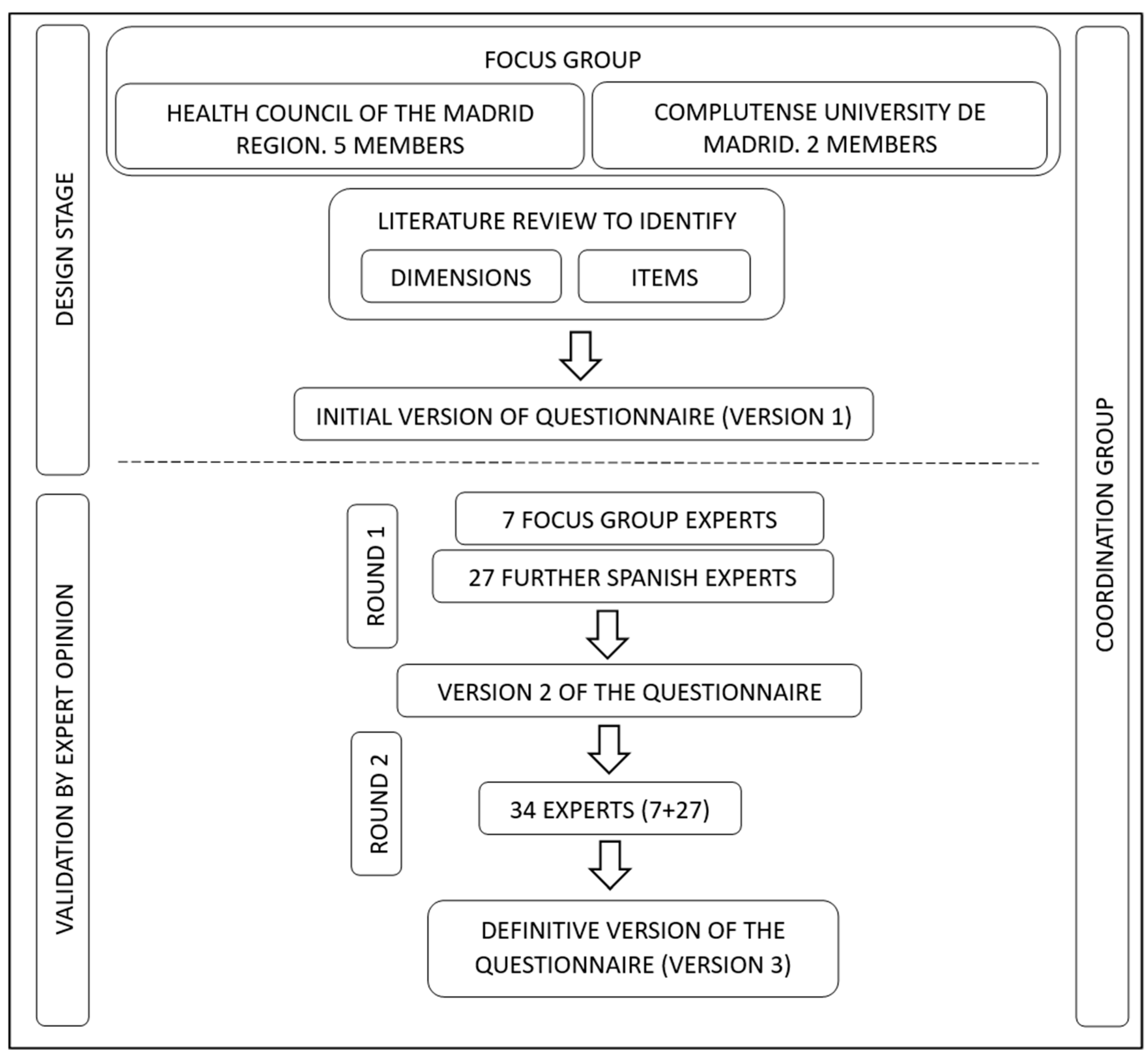
2.1.1. Stage 1: Questionnaire Design
- Literature review
- to examine existing questionnaires/tools for the assessment of lifestyle, noting their format, the dimensions covered, and the assessment system used;
- to collate evidence justifying the dimensions and items required and the assignment of LIV points to them, their sum providing an overall numerical value for lifestyle.
- 2.
- Definition of dimensions and items
- 3.
- Initial version of the questionnaire
2.1.2. Stage 2. Content Validation
- 1.
- Participants
- 2.
- Procedure
- 2.1.
- Round 1: Content validation of Version 1
- sufficiency, i.e., that the collection of items contained in a dimension are sufficient to assess the variable under scrutiny;
- coherence, i.e., that the items have a logical relationship with the dimension being assessed;
- clarity, i.e., that the items are easily understood (adequate syntax and semantics);
- relevance, i.e., that an item is important.
- at the end of each dimension: would you add any other item? (no/yes, specify);
- at the end of the questionnaire: would you add any other dimension (no/yes, specify).
- 2.2.
- Round 2: Reaching expert consensus
2.2. Statistical Analysis
3. Results
3.1. Questionnaire Design
3.2. Content Validation
3.2.1. Modifications Made to the Questionnaire after Round 1 of Expert Assessment
3.2.2. Modifications Made to the Questionnaire after Round 2 of Expert Assessment and Production of Version 3
4. Discussion
5. Conclusions
Supplementary Materials
Author Contributions
Funding
Institutional Review Board Statement
Informed Consent Statement
Data Availability Statement
Acknowledgments
Conflicts of Interest
References
- World Health Organization. Health Promotion. Glossary; WHO: Geneva, Switzerland, 1998. [Google Scholar]
- Lalonde, M. A New Perspective on the Health of Canadians; Office of the Canadian Minister of National Health and Welfare: Ottawa, ON, Canada, 1974.
- Li, Y.; Pan, A.; Wang, D.D.; Liu, X.; Dhana, K.; Franco, O.H.; Kaptoge, S.; Di Angelantonio, E.; Stampfer, M.; Willett, W.C.; et al. Impact of Healthy Lifestyle Factors on Life Expectancies in the US Population. Circulation 2018, 138, 345–355. [Google Scholar] [CrossRef]
- May, A.M.; Struijk, E.A.; Fransen, H.P.; Onland-Moret, N.C.; de Wit, G.A.; Boer, J.M.; van der Schouw, Y.T.; Hoekstra, J.; Bueno-de-Mesquita, H.B.; Peeters, P.H.; et al. The impact of a healthy lifestyle on Disability-Adjusted Life Years: A prospective cohort study. BMC Med. 2015, 13, 39. [Google Scholar] [CrossRef]
- Hackshaw, A.; Morris, J.K.; Boniface, S.; Tang, J.-L.; Milenković, D. Low cigarette consumption and risk of coronary heart disease and stroke: Meta-analysis of 141 cohort studies in 55 study reports. BMJ 2018, 360, j5855. [Google Scholar] [CrossRef] [PubMed]
- Carter, B.D.; Abnet, C.C.; Feskanich, D.; Freedman, N.D.; Hartge, P.; Lewis, C.E.; Ockene, J.K.; Prentice, R.L.; Speizer, F.E.; Thun, M.J.; et al. Smoking and Mortality—Beyond Established Causes. N. Engl. J. Med. 2015, 372, 631–640. [Google Scholar] [CrossRef] [PubMed]
- Griswold, M.G.; Fullman, N.; Hawley, C.; Arian, N.; Zimsen, S.R.M.; Tymeson, H.D.; Venkateswaran, V.; Tapp, A.D.; Forouzanfar, M.H.; Salama, J.S.; et al. Alcohol use and burden for 195 countries and territories, 1990–2016: A systematic analysis for the Global Burden of Disease Study 2016. Lancet 2018, 392, 1015–1035. [Google Scholar] [CrossRef] [PubMed]
- Zhao, J.; Stockwell, T.; Naimi, T.; Churchill, S.; Clay, J.; Sherk, A. Association Between Daily Alcohol Intake and Risk of All-Cause Mortality. JAMA Netw. Open 2023, 6, e236185. [Google Scholar] [CrossRef]
- Scott, A.L.; Hu, W.; Rangarajan, S.; Gasevic, D.; Leong, D.; Iqbal, R.; Casanova, A.; Swaminathan, S.; Anjana, R.M.; Kumar, R.; et al. The effect of physical activity on mortality and cardiovascular disease in 130 000 people from 17 high-income, middle-income, and low-income countries: The PURE study. Lancet 2017, 390, 2643–2654. [Google Scholar] [CrossRef]
- Garcia, L.; Pearce, M.; Abbas, A.; Mok, A.; Strain, T.; Ali, S.; Crippa, A.; Dempsey, P.C.; Golubic, R.; Kelly, P.; et al. Non-occupational physical activity and risk of cardiovascular disease, cancer and mortality outcomes: A dose–response meta-analysis of large prospective studies. Br. J. Sports Med. 2023; Published Online First. [Google Scholar] [CrossRef]
- Rico-Campà, A.; Martínez-González, M.A.; Alvarez-Alvarez, I.; de Deus Mendonça, R.; De La Fuente-Arrillaga, C.; Gómez-Donoso, C.; Bes-Rastrollo, M. Association between consumption of ultra-processed foods and all cause mortality: SUN prospective cohort study. BMJ 2019, 365, l1949. [Google Scholar] [CrossRef]
- GBD 2017 Diet Collaborators. Health effects of dietary risks in 195 countries, 1990–2017: A systematic analysis for the Global Burden of Disease Study 2017. Lancet 2019, 393, 1958–1972. [Google Scholar] [CrossRef]
- Dar, T.; Radfar, A.; Abohashem, S.; Pitman, R.K.; Tawakol, A.; Osborne, M.T. Psychosocial Stress and Cardiovascular Disease. Curr. Treat. Options Cardiovasc. Med. 2019, 21, 23. [Google Scholar] [CrossRef]
- Santosa, A.; Rosengren, A.; Ramasundarahettige, C.; Rangarajan, S.; Gulec, S.; Chifamba, J.; Lear, S.A.; Poirier, P.; Yeates, K.E.; Yusuf, R.; et al. Psychosocial Risk Factors and Cardiovascular Disease and Death in a Population-Based Cohort From 21 Low-, Middle-, and High-Income Countries. JAMA Netw. Open 2021, 4, e2138920. [Google Scholar] [CrossRef]
- Díaz-Gutiérrez, J.; Ruiz-Canela, M.; Gea, A.; Fernández-Montero, A.; Martínez-González, M. Relación entre un índice de estilo de vida saludable y el riesgo de enfermedad cardiovascular en la cohorte SUN. Rev. Esp. Cardiol. 2018, 71, 1001–1009. [Google Scholar] [CrossRef]
- Stenholm, S.; Head, J.; Kivimäki, M.; Kawachi, I.; Aalto, V.; Zins, M.; Goldberg, M.; Zaninotto, P.; Hanson, L.M.; Westerlund, H.; et al. Smoking, physical inactivity and obesity as predictors of healthy and disease-free life expectancy between ages 50 and 75: A multicohort study. Int. J. Epidemiol. 2016, 45, 1260–1270. [Google Scholar] [CrossRef]
- Kringos, D.S.; Boerma, W.G.W.; Hutchinson, A.; Saltman, R.B. (Eds.) Building Primary Care in a Changing Europe: Case Studies [Internet]; European Observatory on Health Systems and Policies: Copenhagen, Denmark, 2015. [Google Scholar]
- Córdoba García, R.; Camarelles Guillem, F.; Muñoz Seco, E.; Gómez Puente, J.M.; San José Arango, J.; Ramírez Manent, J.I.; Martín Cantera, C.; Del Campo Giménez, M.; Revenga Frauca, J.; Egea Ronda, A.; et al. Lifestyle recommendations. Aten. Primaria 2022, 54 (Suppl. S1), 102442. (In Spanish) [Google Scholar] [CrossRef]
- United Nations General Assembly. A/RES/71/313: Global Indicator Framework for the Sustainable Development Goals and Targets of the 2030 Agenda for Sustainable Development. New York; ONU; OpenElement. 2018. Available online: https://documents-dds-ny.un.org/doc/UNDOC/GEN/N17/207/63/PDF/N1720763.pdf? (accessed on 1 February 2023).
- European Union. The European Health Interview Survey (EHIS); Eurostat: Brussels, Belgium, 2019; Available online: https://ec.europa.eu/eurostat/web/microdata/european-health-interview-survey (accessed on 1 February 2023).
- Serrano-Fernández, M.J.; Boada-Grau, J.; Vigil-Colet, A.; Gil-Ripoll, C. Adaptación española de la escala HPLP-II con una muestra de empleados. Univ. Psychol. 2016, 15, 1–14. [Google Scholar] [CrossRef]
- Leyton, M.; Lobato, S.; Batista, M.; Aspano, M.I.; Jiménez, R. Validación del cuestionario de estilo de vida saludable (EVS) en una población española. Rev. Iberoam. Psicol. Ejerc. Deporte 2018, 13, 23–31. [Google Scholar]
- Ramírez-Vélez, R.; Agredo, R.A. Fiabilidad y validez del instrumento “Fantástico” para medir el estilo de vida en adultos colombianos. Rev. Salud Pública 2012, 14, 226–237. [Google Scholar] [CrossRef]
- Sotos-Prieto, M.; Moreno-Franco, B.; Ordovás, J.M.; León, M.; Casasnovas, J.A.; Peñalvo, J.L. Design and development of an instrument to measure overall lifestyle habits for epidemiological research: The Mediterranean Lifestyle (MEDLIFE) index. Public Health Nutr. 2014, 18, 959–967. [Google Scholar] [CrossRef]
- Ministerio de Sanidad, Servicios Sociales e Igualdad. Estrategia de Promoción de la Salud y Prevención en el SNS en el Marco del Abordaje de la Cronicidad en el SNS; Informes, Estudios e Investigación; Ministerio de Sanidad, Servicios Sociales e Igualdad: Madrid, Spain, 2014.
- World Health Organization. Development of an Implementation Roadmap 2023–2030 for the Global Action Plan for the Prevention and Control of NCDS 2013–2030; WHO: Geneva, Switzerland, 2021. [Google Scholar]
- Soriano, A.M. Diseño y validación de instrumentos de medición. Diálogos 2014, 14, 19–40. [Google Scholar]
- Argimon Pallás, J.M.; Jiménez Villa, J. Métodos de Investigación Clínica y Epidemiológica, 5th ed.; Elsevier: Barcelona, Spain, 2019; pp. 217–243. [Google Scholar]
- Escobar, J.; Cuervo, Á. Validez de contenido y juicio de expertos: Una aproximación a su utilización. Av. Medición 2008, 6, 27–36. [Google Scholar]
- Aiken, L.R. Three Coefficients for Analyzing the Reliability and Validity of Ratings. Educ. Psychol. Meas. 1985, 45, 131–142. [Google Scholar] [CrossRef]
- Penfield, R.D.; Giacobbi, J.P.R. Applying a Score Confidence Interval to Aiken’s Item Content-Relevance Index. Meas. Phys. Educ. Exerc. Sci. 2004, 8, 213–225. [Google Scholar] [CrossRef]
- Cicchetti, D.V. Guidelines, criteria, and rules of thumb for evaluating normed and standardized assessment instruments in psychology. Psychol. Assess. 1994, 6, 284–290. [Google Scholar] [CrossRef]
- GBD 2019 Risk Factors Collaborators. Global burden of 87 risk factors in 204 countries and territories, 1990–2019: A systematic analysis for the Global Burden of Disease Study 2019. Lancet 2020, 396, 1223–1249. [Google Scholar] [CrossRef]
- Collet, C.; Nascimento, J.V.; Folle, A.; Ibáñez, S.J. Construcción y validación de un instrumento para el análisis de la formación deportiva en voleibol. Cuad. Psicol. Deporte 2018, 19, 178–191. [Google Scholar] [CrossRef]
- Urrutia Egaña, M.; Barrios Araya, S.; Gutiérrez Núñez, M.; Mayorga Camus, M. Métodos óptimos para determinar validez de contenido. Educ. Med. Super. 2014, 28, 547–558. Available online: http://scielo.sld.cu/scielo.php?script=sci_arttext&pid=S0864-21412014000300014&lng=es (accessed on 1 February 2023).
- Villavicencio, A.Z.; Gómez, M.A.C.; Ruíz, J.G.S.; Cobián, J.F.A. Construcción y validación por juicio de expertos de un instrumento para medir atribuciones causales de las complicaciones crónicas de la diabetes mellitus. Rev. Salud Publica Nutr. 2017, 16, 35–44. [Google Scholar] [CrossRef]
- Bernal-García, M.I.; Salamanca Jiménez, D.R.; Perez Gutiérrez, N.; Quemba Mesa, M.P. Content validity by expert judgment of an instrument to measure physico-emotional perceptions in anatomical dissection practice. Educ. Med. 2020, 21, 349–356. [Google Scholar]
- Torres-Malca, J.R.; Vera-Ponce, V.J.; Zuzunaga-Montoya, F.E.; Talavera, J.E.; De La Cruz-Vargas, J.A. Content validity by expert judgment of an instrument to measure knowledge, attitudes and practices about salt consumption in the peruvian population. Rev. Fac. Med. Humana 2022, 22, 273–279. [Google Scholar] [CrossRef]
- Melgar-Bieberach, R.E. Methodological proposal for the development and validation of a scale of pain assessment in the critically burned patient. Cir. Cir. 2022, 90, 365–371. [Google Scholar] [CrossRef] [PubMed]
- Mamani-Vilca, E.M.; Pelayo-Luis, I.P.; Guevara, A.T.; Sosa, J.V.C.; Carranza-Esteban, R.F.; Huancahuire-Vega, S. Validación de un cuestionario que mide las percepciones del rol del profesional de enfermería comunitaria en Perú. Aten. Primaria 2022, 54, 102194. [Google Scholar] [CrossRef]
- Alarcón, L.A.G.; Trápaga, J.A.B.; Navarro, R.E. Content validity by experts judgment: Proposal for a virtual tool. Apertura 2017, 9, 42–53. [Google Scholar] [CrossRef]
- Robles Garrote, P.; Rojas, M.C. La validación por juicio de expertos: Dos investigaciones cualitativas en Lingüística aplicada. Rev. Nebrija Lingüística Apl. 2015, 18, 124–139. [Google Scholar]
- Escurra, L.M. Cuantificación de la validez de contenido por criterio de jueces. Rev. Psicol. 1988, 6, 103–111. [Google Scholar] [CrossRef]
- Narayan, P.; Guhabiswas, R.; Chowdhury, S.R. Validated tool for quality assessment of anesthesia services by cardiac surgeons. Ann. Card. Anaesth. 2021, 24, 190–196. [Google Scholar] [CrossRef] [PubMed]
- Navarro-Prado, S.; Sánchez-Ojeda, M.A.; Martín-Salvador, A.; Luque-Vara, T.; Fernández-Gómez, E.; Caro-Morán, E. Development and Validation of a Rating Scale of Pain Expression during Childbirth (ESVADOPA). Int. J. Environ. Res. Public Health 2020, 17, 5826. [Google Scholar] [CrossRef]
- Caballero-Apaza, L.M.; Vidal-Espinoza, R.; Padilla-Cáceres, T.; Gómez-Campos, R.; Cossio Bolaños, M. Validación de una escala de creencias sobre la adherencia al tratamiento con suplementos de hierro en madres de niños con anemia. Nutr. Hosp. 2022, 39, 888–895. [Google Scholar] [CrossRef]
- Curcio, F.; Vaquero-Abellán, M.; Zicchi, M.; Zinabi, O.E.; Romero-Saldaña, M. Translation and cross-cultural adaptation of the Neonatal Skin Risk Assessment Scale (NSRAS) to Italian. J. Tissue Viability 2022, 31, 693–698. [Google Scholar] [CrossRef] [PubMed]
- Farhat, H.; Alinier, G.; Gangaram, P.; El Aifa, K.; Khenissi, M.C.; Bounouh, S.; Khadhraoui, M.; Gargouri, I.; Laughton, J. Exploring pre-hospital healthcare workers’ readiness for chemical, biological, radiological, and nuclear threats in the State of Qatar: A cross-sectional study. Health Sci. Rep. 2022, 5, e803. [Google Scholar] [CrossRef]
- Feligreras-Alcalá, D.; Cazalilla-López, M.d.P.; Del-Pino-Casado, R.; Frías-Osuna, A. Validity and Reliability of the Caregiver Strain Index Scale in Women during the Puerperium in Spain. Int. J. Environ. Res. Public Health 2021, 18, 3602. [Google Scholar] [CrossRef]

| Expert | Academic Training | Academic Degree | Work Position | Years of Professional Experience |
|---|---|---|---|---|
| 1 | Nurse | Doctorate | University lecturer | 31 |
| 2 | Physiologist | Bachelor | Public health technician (PHT) | 28 |
| 3 | Nurse | Bachelor (FCN) | Front line health worker | 31 |
| 4 | Psychologist | Bachelor | Public health technician (PHT) | 16 |
| 5 | Nurse | Master | Primary care manager | 23 |
| 6 | Physician | Doctorate | Research manager | 38 |
| 7 | Pharmacist | Doctorate | Public health manager | 34 |
| 8 | Nurse. | Doctorate | University lecturer | 32 |
| 9 | Nurse | Bachelor (FCN) | Front line health worker | 32 |
| 10 | Physician | Doctorate | Front line health worker | 50 |
| 11 | Nurse | Master/PhD student | Primary care manager | 20 |
| 12 | Physician | Doctorate | Researcher and University lecturer | 40 |
| 13 | Nurse | FCN | Front line health worker | 30 |
| 14 | Physician | Doctorate | University lecturer | 25 |
| 15 | Nurse | FCN | Front line health worker | 31 |
| 16 | Physician | Doctorate | Front line health worker University lecturer | 25 |
| 17 | Physician | Doctorate | University lecturer | 40 |
| 18 | Nurse | Doctorate | Researcher | 14 |
| 19 | Pharmacist | Doctorate | University lecturer | 30 |
| 20 | Nurse | FCN | Front line health worker | 34 |
| 21 | Psychologist | Doctorate | Researcher | 19 |
| 22 | Pharmacist | Doctorate | University lecturer | 25 |
| 23 | Nurse | Doctorate | Front line health worker and university lecturer | 36 |
| 24 | Nurse | Master/PhD student | Primary care manager | 10 |
| 25 | Psychologist | Doctorate | Primary care manager | 28 |
| 26 | Physician | Bachelor (FCM) | Public health technician (PHT) | 16 |
| 27 | Nurse | Bachelor (FCN) | Front line health worker | 28 |
| 28 | Nurse | Doctorate | Primary care manager | 29 |
| 29 | Physician | Doctorate | Front line health worker and university lecturer | 38 |
| 30 | Nurse | Doctorate | Primary care manager | 19 |
| 31 | Physician | Bachelor (FCM) | Public health manager | 19 |
| 32 | Physician | Bachelor (PMPH) | Public health technician (PHT) | 15 |
| 33 | Pharmacist | Doctorate | University lecturer | 10 |
| 34 | Nurse | Doctorate | University lecturer | 36 |
| Dimension | Items (No) | LIV Points |
|---|---|---|
| Food habits | 10 | 0–20 points |
| Physical activity | 3 | 0–20 points |
| Alcohol consumption | 1 | 0–20 points |
| Smoking | 1 | 0–20 points |
| Emotional wellbeing | 7 | 0–20 points |
| Total | 22 | 100 points |
| Dimension | Dimension Sufficiency Mean (Sd) | Item | Item Coherence Mean (Sd) | Item Relevance Mean (Sd) | Item Clarity Mean (Sd) | Total Por Dimension |
|---|---|---|---|---|---|---|
| Food habits | 3.44 (0.82) | Vegetables | 3.96 (0.20) | 3.96 (0.20) | 3.73 (0.45) | 3.84 (0.33) |
| Fruits | 4.00 (0.00) | 4.00 (0.00) | 3.81 (0.40) | |||
| Wholegrain cereals | 3.85 (0.37) | 3.85 (0.37) | 3.62 (0.50) | |||
| Processed meats | 3.92 (0.27) | 3.88 (0.43) | 3.58 (0.64) | |||
| Red meats | 3.88 (0.43) | 3.96 (0.20) | 3.42 (0.81) | |||
| Fizzy drinks | 3.92 (0.27) | 3.96 (0.20) | 3.58 (0.58) | |||
| Pulses | 4.00 (0.00) | 3.92 (0.27) | 3.88 (0.43) | |||
| Fish | 3.92 (0.27) | 4.00 (0.00) | 3.81 (0.40) | |||
| Nuts | 4.00 (0.00) | 3.96 (0.20) | 3.85 (0.37) | |||
| Oil | 3.92 (0.27) | 3.88 (0.43) | 3.65 (0.56) | |||
| Physical activity | 3.67 (0.48) | Intense physical activity | 3.96 (0.20) | 4.00 (0.00) | 3.73 (0.45) | 3.85 (0.32) |
| Moderate physical activity | 3.96 (0.20) | 4.00 (0.00) | 3.77 (0.43) | |||
| Sedentary behaviour | 3.85 (0.37) | 3.85 (0.37) | 3.73 (0.53) | |||
| Alcohol consumption | 3.81 (0.40) | Alcohol consumption | 4.00 (0.00) | 4.00 (0.00) | 3.73 (0.53) | 3.85 (0.27) |
| Smoking | 3.54 (0.58) | Smoking | 4.00 (0.00) | 4.00 (0.00) | 3.69 (0.58) | |
| Emotional wellbeing | 3.68 (0.48) | Self-concept | 3.92 (0.27) | 3.83 (0.48) | 3.83 (0.64) | 3.88(0.36) |
| Satisfaction | 4.00 (0.00) | 3.92 (0.27) | 3.88 (0.34) | |||
| Happiness | 4.00 (0.00) | 3.83 (0.56) | 3.96 (0.20) | |||
| Emotional wellbeing | 4.00 (0.00) | 3.88 (0.43) | 3.92 (0.27) | |||
| Motivation | 3.88 (0.43) | 3.75 (0.61) | 3.75 (0.68) | |||
| Capacity to face problems | 3.87 (0.46) | 3.83 (0.49) | 3.57 (0.79) | |||
| Interpersonal relationships | 3.96 (0.20) | 3.96 (0.21) | 3.96 (0.20) | |||
| Affective needs | 4.00 (0.00) | 3.83 (0.48) | 4.00 (0.00) | |||
| Sleep/rest | 3.92 (0.27) | 3.88 (0.43) | 3.83 (0.38) | |||
| Leisure/Entertainment | 3.81 (0.40) | 3.90 (0.30) | 3.82 (0.39) | |||
| Round 2 Safety And non-intentional injuries | 3.67 (0.56) | Road safety: seatbelt use | 4.00 (0.00) | 4.00 (0.00) | 3.93 (0.25) | 3.87 (0.36) |
| Road safety: driving and drinking | 3.97 (0.18) | 3.97 (0.18) | 3.87 (0.43) | |||
| Road safety: adherence to traffic regulations | 3.90 (0.31) | 3.97 (0.18) | 3.83 (0.46) | |||
| Compliance with water-use regulations | 3.90 (0.40) | 3.73 (0.64) | 3.77 (0.57) | |||
| Safety at home | 3.93 (0.37) | 3.83 (0.46) | 3.60 (0.81) | |||
| TOTAL | 3.63 (0.12) | 3.94 (0.05) | 3.91 (0.08) | 3.77 (0.13) | 3.86 (0.34) |
| Food Habits |
| The items were modified to appear in terms of frequency of recommended consumption (daily/several times per week/occasionally) |
| LIV points were adjusted for the items wholegrain cereals, red and processed meat, processed/ultra-processed foods given their weight in the Global Burden of Disease document [33] |
| Household measurements were added to complement ‘grams per serving’ |
| Extra examples were added for some dimensions to make the text clearer |
| The consumption of wholegrain cereals was specified as servings/day instead of servings/week |
| Inclusion of toasted nuts (3 times/seek) with an LIV point value lower than that for the consumption of raw nuts |
| Red and processed meats were grouped into a single item |
| It was clarified that refined/sugar-added breakfast cereals are processed foods |
| A final clarification was made to highlight that processed foods include pre-cooked/ready cooked foods with excess salt, sugar refined oils, or additives/preservatives, but not little-processed foods such as tinned fruit, pickled fruits/vegetables, or jars of pulses |
| The term ‘sugary/fizzy drink’ was substituted with ‘sugary/sweetened drink’ and assigned an LIV point value depending on rate of consumption |
| An item on water consumption was included |
| Physical Activity |
| More inclusive language was used |
| A new item covering muscular strength training (maximum 4 LIV points) was added with corresponding clarifications |
| A maximum of 12 LIV points was assigned to aerobic exercise (instead of the original 16) |
| The example of walking 7000/8000 steps per day was included as an example of moderate activity |
| The wording of the question on sedentary behaviour was modified |
| A clarification was made regarding the meeting of physical activity recommendations by adding short periods of activity (of at least 10 min duration) together |
| Smoking And Use of Alcohol And Other Drugs |
| Smoking was clarified as tobacco use via the consumption of cigarettes, cigars, pipes, e-cigarettes, vaping devices, and hookahs |
| Smokers were asked about their consumption rate |
| LIV points ranging from −15 to +15 were contemplated for the degree of consumption |
| The LIV points for alcohol consumption were set from −10 to +10. |
| A new item was included to assess the use of ‘other drugs’; their consumption could remove up to 10 points for this dimension |
| Emotional Wellbeing |
| Motivation was clarified as referring to the will to undertake activities |
| The item relating to sleep/rest was written from a positive perspective |
| Safety And Non-Intentional Injuries |
| This dimension, with its 5 items (three relating to road safety and traffic accidents, one to drowning and other water accidents, and one relating to accidents in the home), was added |
| Dimension | Item | Was the Modification Adequate | Was This New Item Relevant | ||
|---|---|---|---|---|---|
| Yes | No | Yes | No | ||
| Food habits | Vegetables | 91.42% | 2.8% | ||
| Fruits | 88.57% | 5.7% | |||
| Wholegrain cereals | 88.57% | 5.7% | |||
| Nuts | 77.14% | 17% | |||
| Oil | 85.71% | 5.7% | |||
| Pulses | 91.42% | - | |||
| Fish/seafood | 91.42% | 2.8% | |||
| Red meats | 85.71% | 8.5% | |||
| Ultra-processed foods | 85.71% | 5.7% | |||
| Sugary/sweetened drinks | 85.71% | 5.7% | |||
| Water | 82.85% | 5.7% | |||
| Physical activity | Intense | 85.71% | 2.8% | ||
| Moderate | 91.42% | 2.8% | |||
| Muscle strengthening exercise | 85.71% | 5.7% | |||
| Sedentary behaviour | 85.71% | 8.5% | |||
| Smoking and use of alcohol and other drugs | Use of tobacco | 82.85% | 11.42% | ||
| Alcohol consumption | 82.85% | 8.5% | |||
| Use of other drugs | 94.28% | 5.7% | |||
| Emotional wellbeing | Self-acceptance/self-concept | 91.42% | 2.8% | ||
| Satisfaction/personal development | |||||
| Happiness | |||||
| Emotional balance/stress | |||||
| Motivation/attitude | 85.71% | 8.5% | |||
| Capacity to face problems | |||||
| Interpersonal relationships | 94.28% | - | |||
| Affective needs | |||||
| Sleep/rest | 88.57% | 5.7% | |||
| Leisure/entertainment | |||||
| Dimension | Dimension Sufficiency Aiken V (95%Ci) | Item | Item Coherence Aiken V (95% Ci) | Item Relevance Aiken V (95% Ci) | Item Clarity Aiken V (95% Ci) | Total for Each Dimension Aiken V (95% Ci) |
|---|---|---|---|---|---|---|
| Food habits | 0.81 (0.73–0.90) | Vegetables | 0.99 (0.95–1.00) | 0.99 (0.95–1.00) | 0.91 (0.85–0.98) | 0.95 (0.89–1.00) |
| Fruits | 1 (0.98–1.00) | 1 (0.98–1.00) | 0.94 (0.88–1.00) | |||
| Wholegrain cereals | 0.95 (0.90–1.00) | 0.95 (0.90–1.00) | 0.87 (0.80–0.95) | |||
| Processed meats | 0.97 (0.93–1.00) | 0.96 (0.91–1.00) | 0.86 (0.78–0.94) | |||
| Red meats | 0.96 (0.91–1.00) | 0.99 (0.95–1.00) | 0.81 (0.72–0.90) | |||
| Fizzy drinks | 0.97 (0.93–1.00) | 0.99 (0.95–1.00) | 0.86 (0.78–0.94) | |||
| Pulses | 1 (0.98–1.00) | 0.97 (0.93–1.00) | 0.96 (0.91–1.00) | |||
| Fish | 0.97 (0.93–1.00) | 1 (0.98–1.00) | 0.94 (0.88–1.00) | |||
| Nuts | 1 (0.98–1.00) | 0.99 (0.95–1.00) | 0.95 (0.90–1.00) | |||
| Oil | 0.97 (0.93–1.00) | 0.96 (0.91–1.00) | 0.88 (0.81–0.96) | |||
| Physical activity | 0.89 (0.82–0.96) | Intense physical activity | 0.99 (0.95–1.00) | 1 (0.98–1.00) | 0.91 (0.85–0.98) | 0.95 (0.90–1.00) |
| Moderate physical activity | 0.99 (0.95–1.00) | 1 (0.98–1.00) | 0.92 (0.86–0.99) | |||
| Sedentary behaviour | 0.95 (0.90–1.00) | 0.95 (0.90–1.00) | 0.91 (0.85–0.98) | |||
| Alcohol consumption | 0.94 (0.88–1.00) | Alcohol consumption | 1 (0.98–1.00) | 1 (0.98–1.00) | 0.91 (0.85–0.98) | 0.95 (0.90–1.00) |
| Smoking | 0.85 (0.77–0.93) | Smoking | 1 (0.98–1.00) | 1 (0.98–1.00) | 0.90 (0.83–0.97) | |
| Emotional wellbeing | 0.89 (0.83–0.97) | Self-concept | 0.97 (0.93–1.00) | 0.94 (0.88–1.00) | 0.94 (0.88–1.00) | 0.96 (0.91–1.00) |
| Satisfaction | 1 (0.98–1.00) | 0.97 (0.93–1.00) | 0.96 (0.91–1.00) | |||
| Happiness | 1 (0.98–1.00) | 0.94 (0.88–1.00) | 0.99 (0.95–1.00) | |||
| Emotional wellbeing | 1 (0.98–1.00) | 0.96 (0.91–1.00) | 0.97 (0.93–1.00) | |||
| Motivation | 0.96 (0.91–1.00) | 0.92 (0.86–0.99) | 0.92 (0.86–0.99) | |||
| Capacity to face problems | 0.96 (0.91–1.00) | 0.94 (0.88–1.00) | 0.86 (0.78–0.94) | |||
| Interpersonal relationships | 0.99 (0.95–1.00) | 0.99 (0.95–1.00) | 0.99 (0.95–1.00) | |||
| Affective needs | 1 (0.98–1.00) | 0.94 (0.88–1.00) | 1 (0.98–1.00) | |||
| Sleep/rest | 0.97 (0.93–1.00) | 0.96 (0.91–1.00) | 0.94 (0.88–1.00) | |||
| Leisure/entertainment | 0.94 (0.88–1.00) | 0.97 (0.93–1.00) | 0.94 (0.88–1.00) | |||
| Round 2 Safety and non-Intentional injuries | 0.89 (0.83–0.95) | Road safety: seatbelt use | 1 (0.98–1.00) | 1 (0.98–1.00) | 0.98 (0.95–1.00) | 0.87 (0.80–0.94) |
| Road safety: driving and drinking | 0.99 (0.95–1.00) | 0.99 (0.95–1.00) | 0.96 (0.91–1.00) | |||
| Road safety: adherence to traffic regulations | 0.97 (0.93–1.00) | 0.99 (0.95–1.00) | 0.94 (0.88–1.00) | |||
| Compliance with water-use regulations | 0.97 (0.93–1.00) | 0.91 (0.85–0.98) | 0.92 (0.86–0.99) | |||
| Safety at home | 0.98 (0.95–1.00) | 0.94 (0.88–1.00) | 0.87 (0.80–0.94) | |||
| Total | 0.88 (0.81–0.96) | 0.98 (0.94–1.00) | 0.97 (0.93–1.00) | 0.92 (0.86–0.99) | 0.95 (0.90–1.00) |
| Dimension | Items (No) | LIV Points |
|---|---|---|
| Food habits | 11 | 0–25 points |
| Physical activity | 4 | 0–20 points |
| Smoking and use of alcohol and other drugs | 3 | (−35)–25 points |
| Emotional wellbeing | 10 | 0–20 points |
| Safety and non-intentional injuries | 5 | 0–20 points |
| Total | 33 | 100 points |
Disclaimer/Publisher’s Note: The statements, opinions and data contained in all publications are solely those of the individual author(s) and contributor(s) and not of MDPI and/or the editor(s). MDPI and/or the editor(s) disclaim responsibility for any injury to people or property resulting from any ideas, methods, instructions or products referred to in the content. |
© 2023 by the authors. Licensee MDPI, Basel, Switzerland. This article is an open access article distributed under the terms and conditions of the Creative Commons Attribution (CC BY) license (https://creativecommons.org/licenses/by/4.0/).
Share and Cite
Pérez-Rivas, F.J.; Jiménez-González, J.; Bayón Cabeza, M.; Belmonte Cortés, S.; de Diego Díaz-Plaza, M.; Domínguez-Bidagor, J.; García-García, D.; Gómez Puente, J.; Gómez-Gascón, T. Design and Content Validation using Expert Opinions of an Instrument Assessing the Lifestyle of Adults: The ‘PONTE A 100’ Questionnaire. Healthcare 2023, 11, 2038. https://doi.org/10.3390/healthcare11142038
Pérez-Rivas FJ, Jiménez-González J, Bayón Cabeza M, Belmonte Cortés S, de Diego Díaz-Plaza M, Domínguez-Bidagor J, García-García D, Gómez Puente J, Gómez-Gascón T. Design and Content Validation using Expert Opinions of an Instrument Assessing the Lifestyle of Adults: The ‘PONTE A 100’ Questionnaire. Healthcare. 2023; 11(14):2038. https://doi.org/10.3390/healthcare11142038
Chicago/Turabian StylePérez-Rivas, Francisco Javier, Jennifer Jiménez-González, Marianela Bayón Cabeza, Susana Belmonte Cortés, Marta de Diego Díaz-Plaza, Julia Domínguez-Bidagor, David García-García, Juana Gómez Puente, and Tomás Gómez-Gascón. 2023. "Design and Content Validation using Expert Opinions of an Instrument Assessing the Lifestyle of Adults: The ‘PONTE A 100’ Questionnaire" Healthcare 11, no. 14: 2038. https://doi.org/10.3390/healthcare11142038
APA StylePérez-Rivas, F. J., Jiménez-González, J., Bayón Cabeza, M., Belmonte Cortés, S., de Diego Díaz-Plaza, M., Domínguez-Bidagor, J., García-García, D., Gómez Puente, J., & Gómez-Gascón, T. (2023). Design and Content Validation using Expert Opinions of an Instrument Assessing the Lifestyle of Adults: The ‘PONTE A 100’ Questionnaire. Healthcare, 11(14), 2038. https://doi.org/10.3390/healthcare11142038

