1. Introduction
In discrete geometry, finding an efficient covering of a given domain using unit discs is a well known problem, with various applications such as facility location and cellular network design. The covering problem is strongly related to the well-studied packing problem [
1,
2,
3,
4].
It has been known for a long time that the optimal covering of the entire two dimensional plane is obtained using the honeycomb (regular hexagonal) lattice, where the plane is tiled by regular hexagons, and the center of each hexagon is used as the center of the inscribing disc. The fact that this is indeed the best obtainable covering was proven about a century ago by Thue and Toth [
5,
6].
In [
7], an upper bound for covering any convex domain with area
A and perimeter
L has been given. It has been shown that by the properties of the hexagonal regular lattice, the number of unit discs needed to cover a convex domain is at most
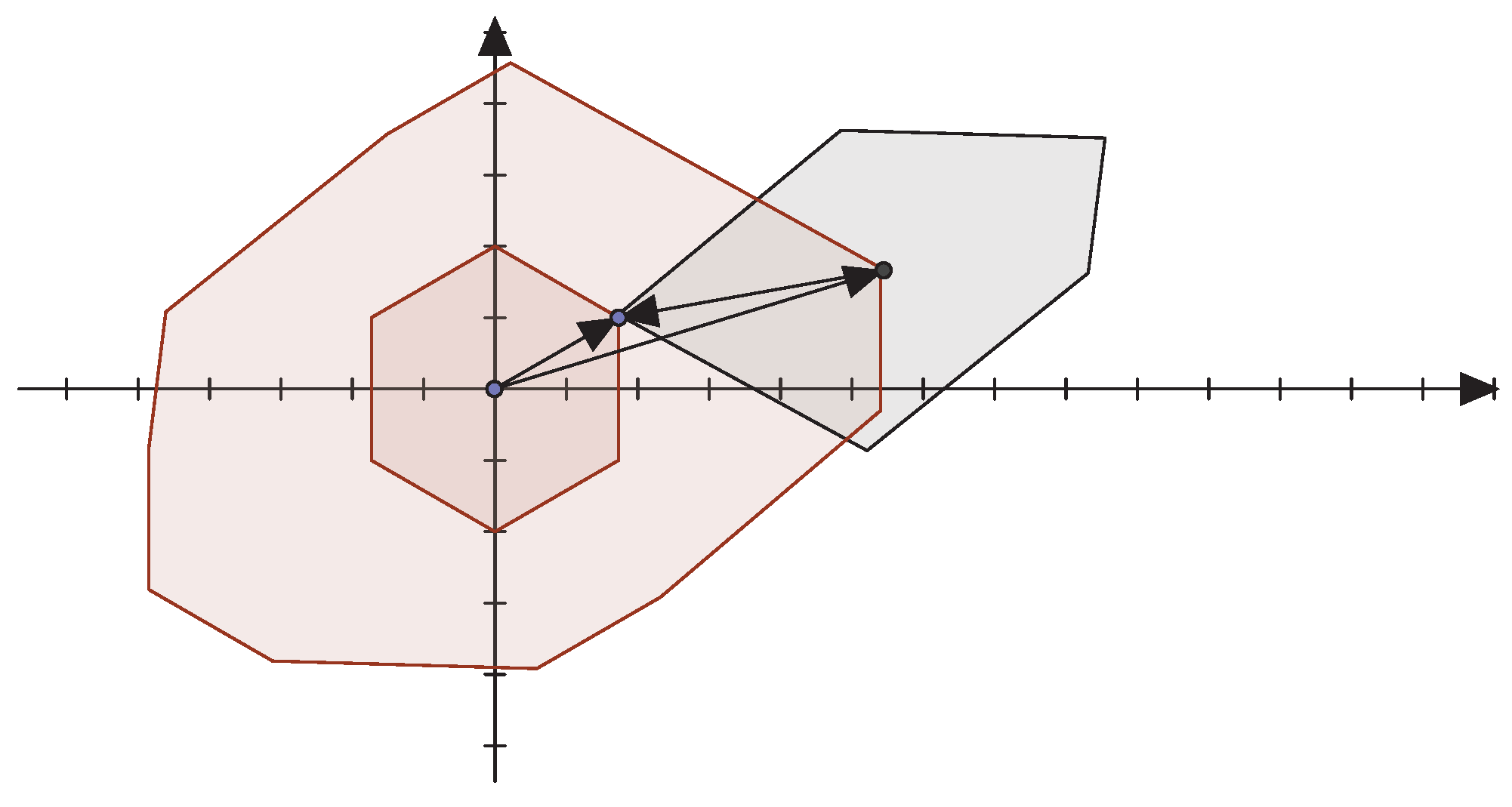
This result is obtained using a probabilistic method by a random (location and orientation-wise) placement of the convex domain on the hexagonal lattice. It has been shown that the expectation of the number of unit hexagons in the hexagonal regular lattice that hit the domain is given by the area of the Minkowski sum of the regular hexagon and the convex domain. The expectation value of this area can be calculated using mixed area formulas, and this expectation leads to this upper bound on the number of required discs in the most efficient covering. In [
8], another estimation using geometric probability has been presented, in this case, for pairs of hyperplanes intersecting a convex body.
In [
9], an algorithm for finding the exact location and orientation of the given convex domain relative to the lattice is presented, such that the number of unit discs in the cover is minimized (for a given lattice). In particular, the cardinality of the cover given by the algorithm is bounded from above by the bound given in Equation (
1).
Also in [
9], a lower bound for the number of unit discs necessary to cover a convex domain has been given. If
is the optimal number of unit discs that cover a convex domain, then
, for some absolute constant
.
For fat domains, it follows that the honeycomb-based covering is asymptotically optimal. However, for thin domains, there are known cases in which the honeycomb covering is far from optimal. In this manuscript, we present some case studies in which the honeycomb covering is suboptimal and present improved coverings that are based on deformations of the hexagonal lattice.
In [
10], a thinnest covering has been described for a rectangle and a unit square using up to 7 congruent discs.
In [
11], an algorithm for finding the minimal covering of convex polygons by two minimum diameter congruent discs is presented.
In [
12], an efficient algorithm for covering for line segments in the plane by unit discs is presented.
In this paper, we present some results on covering several families of domains efficiently. The first part will consider covering a general convex thin domain, which can be either a polygon or a domain with curved boundary. The second part considers rectangles. However, many of the results presented in the second part apply also to general polygons, as well as non-polygonal domains. Most of the presented results also apply to thin non-convex domains. For a general discussion of covering convex and non-convex domains see [
9].
2. Preliminaries
Definition 1. The Minkowski sum of any two sets is defined to be . For , the Minkowski dilation by factor s is defined to be .
Definition 2. For every , the support function of a domain Ω, denoted , is a function that maps every θ to the supremum over all p such that , where is the line . The width of Ω is .
We state some standard theorems from integral geometry. We refer the reader to [
7] or other standard textbooks in the field for full proofs.
Theorem 1 (Cauchy’s Formula [
7]).
Let Ω
be a bounded convex domain, then the circumference of Ω
is given bywhere h is the support function of Ω
and w is Ω
’s width. Theorem 2 ([
7]).
Suppose Ω
is a compact, convex domain with a continuous boundary. Then, the area of Ω
iswhere the support’s derivative may be a distribution. 3. Row Covering
Consider a long and narrow domain. The expression in Equation (
1) is given an upper bound on the number of discs needed to cover it. However, this expression is determined by two variables
A (area) and
L (perimeter). If the domain is narrow enough, it is expected that a covering can be obtained that depends almost solely on
L since the main restriction on the covering is that it must cover all the length of the perimeter. Thus, it desired to give an improved upper bound as well as a proper definition of “narrow enough”.
Notation 1. Consider a convex domain Ω with area A and perimeter L. Let d denote the diameter of Ω and h its height, which will be calculated as the width in a direction perpendicular to the diameter (in case the diameter is determined by several chords, we choose one arbitrarily).
Our assumption that such an improvement indeed exists is based on the following simple observation. Take a very narrow (
) convex domain
. Then, the number of unit discs that are needed to cover
tends to
Comparing (
3) to (
1) gives us the justification that, indeed, such an improvement exists.
Proposition 1. For a convex domain Ω having diameter d and height h, Ω is bounded by a rectangle with sides d and h.
Proof. The diameter is the longest chord in the domain. Taking the endpoints of the diameter, no point in the domain is at a distance more than d from those points. Thus, the domain is inscribed in the intersection of two circles of radius d centered at the diametrically opposing points, and therefore also between the tangents to those circles at the diametrically opposing point. Since the height is determined by the maximum distance of two parallel lines to d, which intersect , this result follows. □
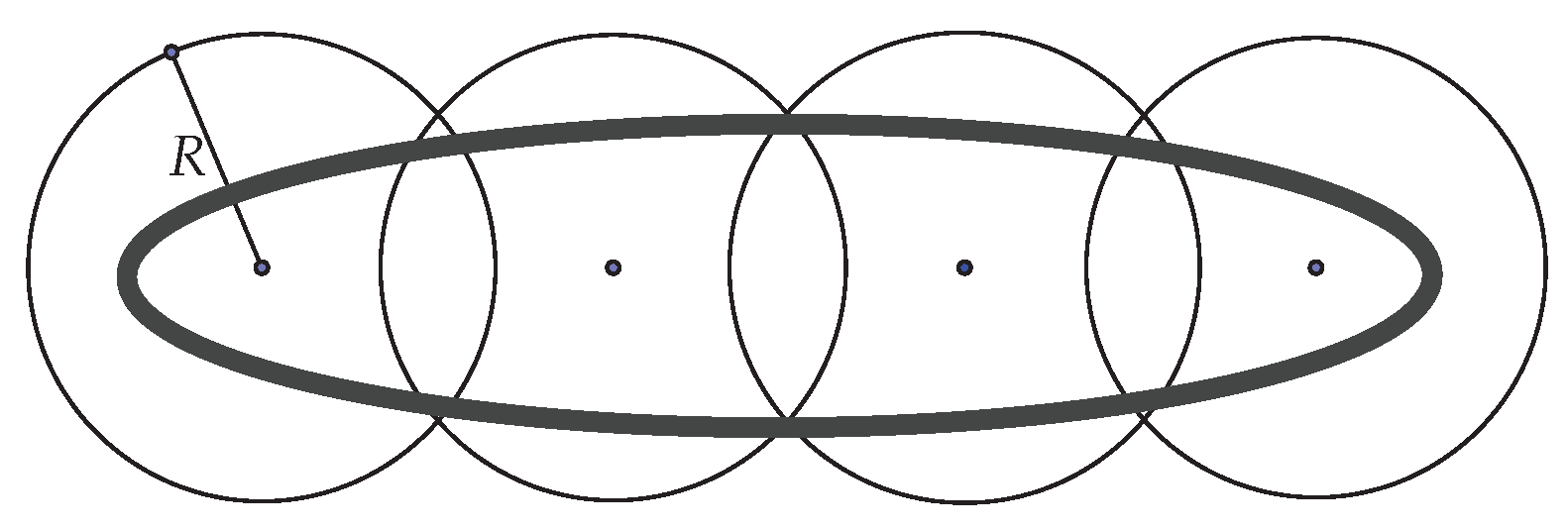
Definition 3. A parallel row covering of a convex domain Ω
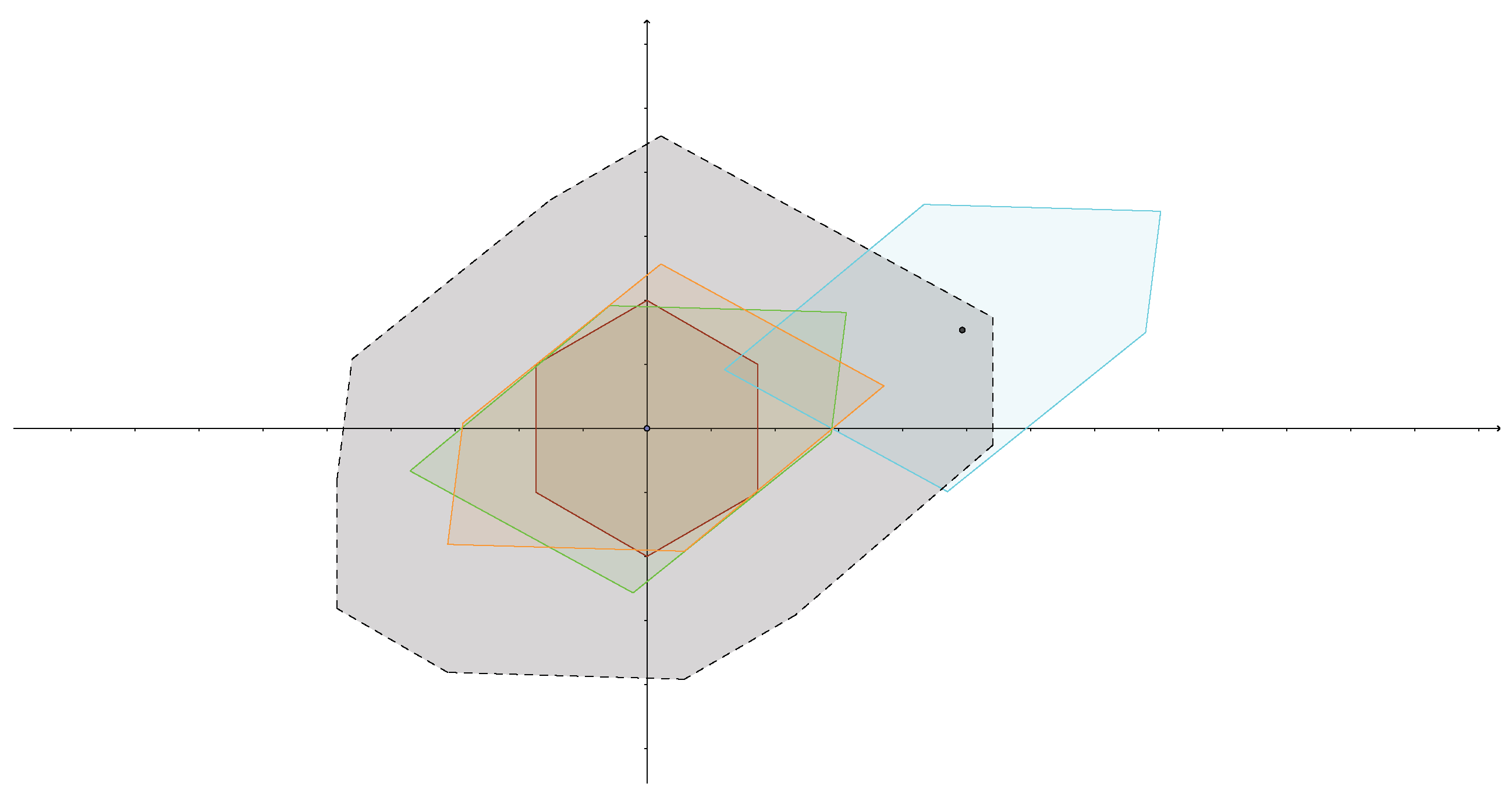
is a cover composed of n unit discs in a row, which is parallel to the diameter (or any one of the diameters, if more than one exists), as in Figure 1. It should be noted that there are row coverings that are not parallel row coverings. For instance, row covering a rectangle can be done naturally along its longer side, and not its diameter (which is any one of the two diagonals).
Lemma 1. Given a convex domain Ω
and having diameter d and a height h. If , , then there exists a parallel row covering to Ω
with at mostunit discs. Proof. Since every convex domain is bounded by a rectangle with length d and height h, it is sufficient to cover the rectangle. W.l.o.g, we will locate the rectangle with the diameter parallel to the x-axis with the leftmost point touching the y-axis and with h cut in half by the x-axis (i.e., the uppermost point and the lowermost point will be at the same distance of from the x-axis).
Let
. Define the family of unit circles, parametrized by
, whose centers lie on the
x-axis to be the set of solutions of the equations
and the appropriate unit discs bounded by these circle as
Every two nearby circles intersect at two points if and only if the equation consists of two points. If the distance between these two intersection points is greater than h, then the set of unit discs for some appropriate set constitutes a covering of the domain.
Denote the distance between the centers of two nearby circles by
. The distance from the
x-axis to the intersection point between two nearby circles is
(since the covering by circles is symmetric respective to the
x-axis). This leads to
. Since
, the number of unit circles is
We note that the center of the first unit circle will be located at a distance from the leftmost edge of the rectangle, which determines the locations of the unit discs that complete the covering. □
Theorem 3. Given a convex domain Ω
- 1.
If there exists a parallel row covering for Ω, then .
- 2.
If , then Ω admits a parallel row covering.
Proof. The following bounds hold for every convex domain
with area
A and perimeter
L:
The lower bound in Equation (
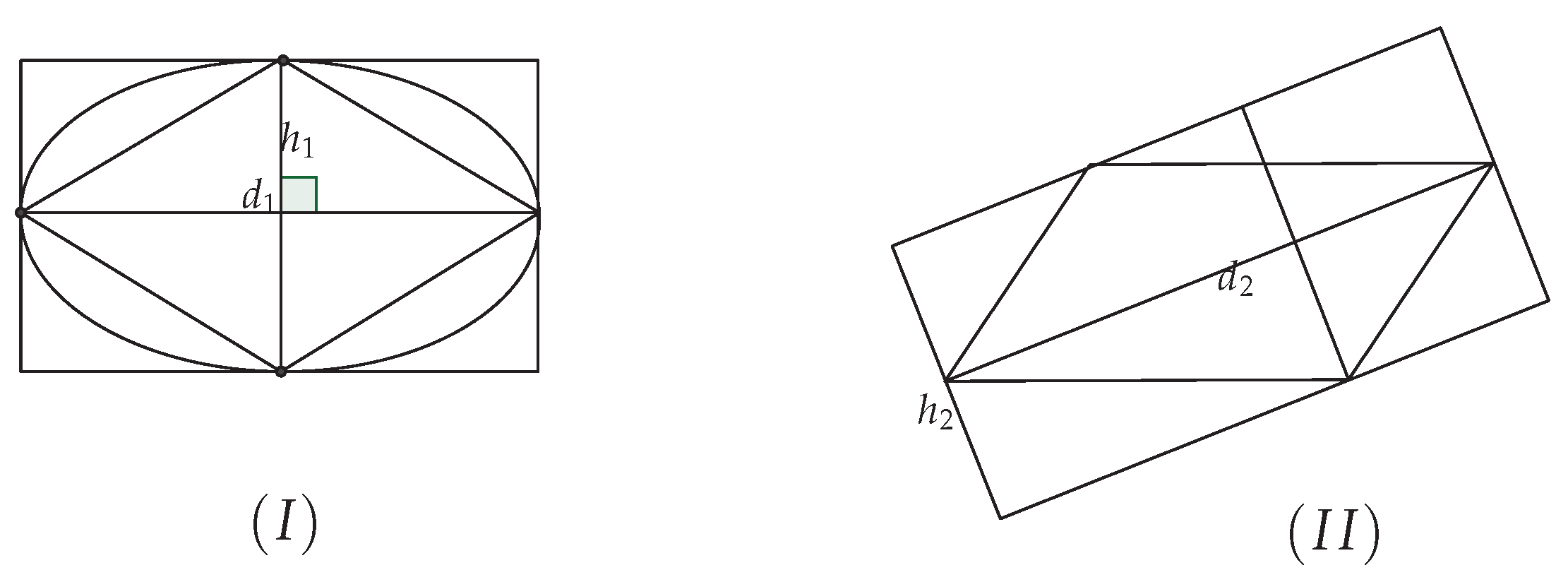
4) results by constructing two triangles with bases on the diameter and the uppermost and lowermost points (respectively) as a third vertex, as in
Figure 2. By convexity, the perimeter
is at least the perimeter of these triangles, which obtains its maximum of
when both triangles are isosceles and congruent. The upper bound in Equation (
4) is obtained by replacing the width function in Theorem 1 by the diameter
d.
In a similar way, a bound to the area is
The lower bound in Equation (
5) is the area of the desired quadrilateral consisting of the two triangles with the diameter of
as a shared base. The upper bound in Equation (
5) is the area of the rectangle that contains
.
□
Theorem 4. Given a convex domain Ω
with area A and perimeter L satisfying , then Ω
admits a parallel row covering using at mostunit discs. Proof. We will start by bounding
d,
h. From (
4) and (
5), we can obtain
and
By substituting (
6) in (
7), we conclude that
Denote the distance between the centers of every two neighboring circles in the parallel row covering by , with the requirement . We also define (). The desired number of unit circles that cover is (d is the diameter).
Solving the equation,
leads to
, by inequality (
8)
Taking the maximal height leads to
Therefore, the desired number of unit circles is
, which is
□
4. Covering a General Rectangle
One may consider the following method of obtaining a covering of a domain,
: Impose
onto a hexagonal tiling of the plane, in which each hexagon can be inscribed by a unit circle. Then, place a unit disc at the center of each hexagon which intersects
. This method guarantees a covering. If the lattice is as sparse as possible, the covering is expected to be efficient, although it is not guaranteed to be optimal. Finding the optimal placement of
onto the tiling can be done optimally using an algorithm such as the one suggested in [
9]. However, to bound the cardinality of the covering from above, one may consider a random placement of
where the orientation is chosen to optimize the result, and the location is random and uniform.
It should be noted that the calculations presented here are for thin rectangles. However, the same method can be applied to any thin domain, and the optimal location of these domains relative to the lattice can also be deduced using the same algorithm.
We will make use of the following Theorem, which is proven in
Appendix A.
Theorem 5. Given domains and , where is of the form (translation in the plane to ), and is chosen uniformly in a ball with radius r (where r is larger than the sum of diameters of and ), then (where is the reflection of ).
The number of unit discs that cover the rectangle is determined by the number of fundamental domains in the lattice, which intersect the rectangle. Thus, we would like to explore whether there exists a lattice, such that the number of fundamental regions intersecting the rectangle is smaller than the hexagonal regular lattice.
We will show in the case of a rectangle how to improve the hexagonal regular lattice in the sense of intersections between the lattice and the given rectangle.
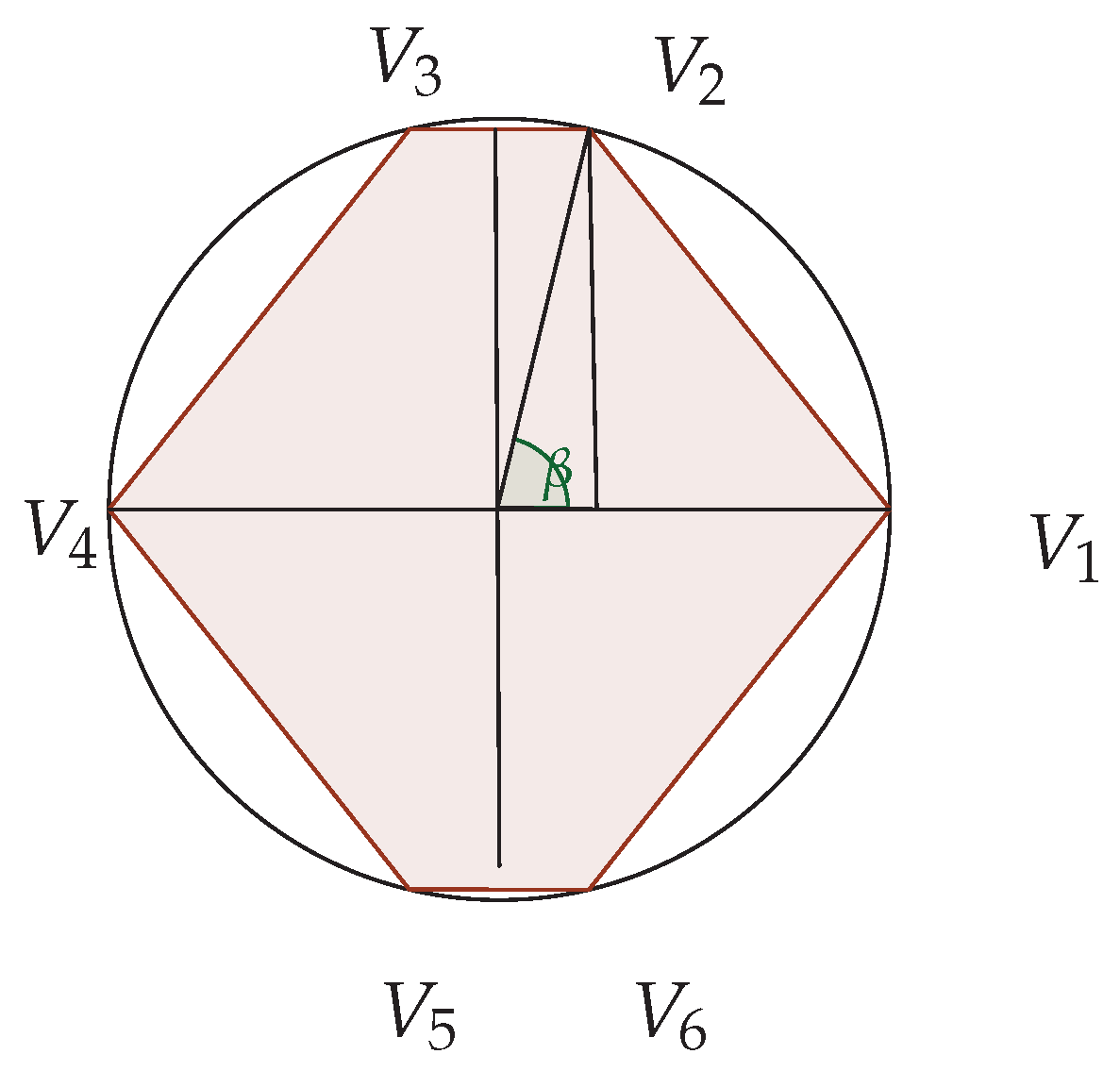
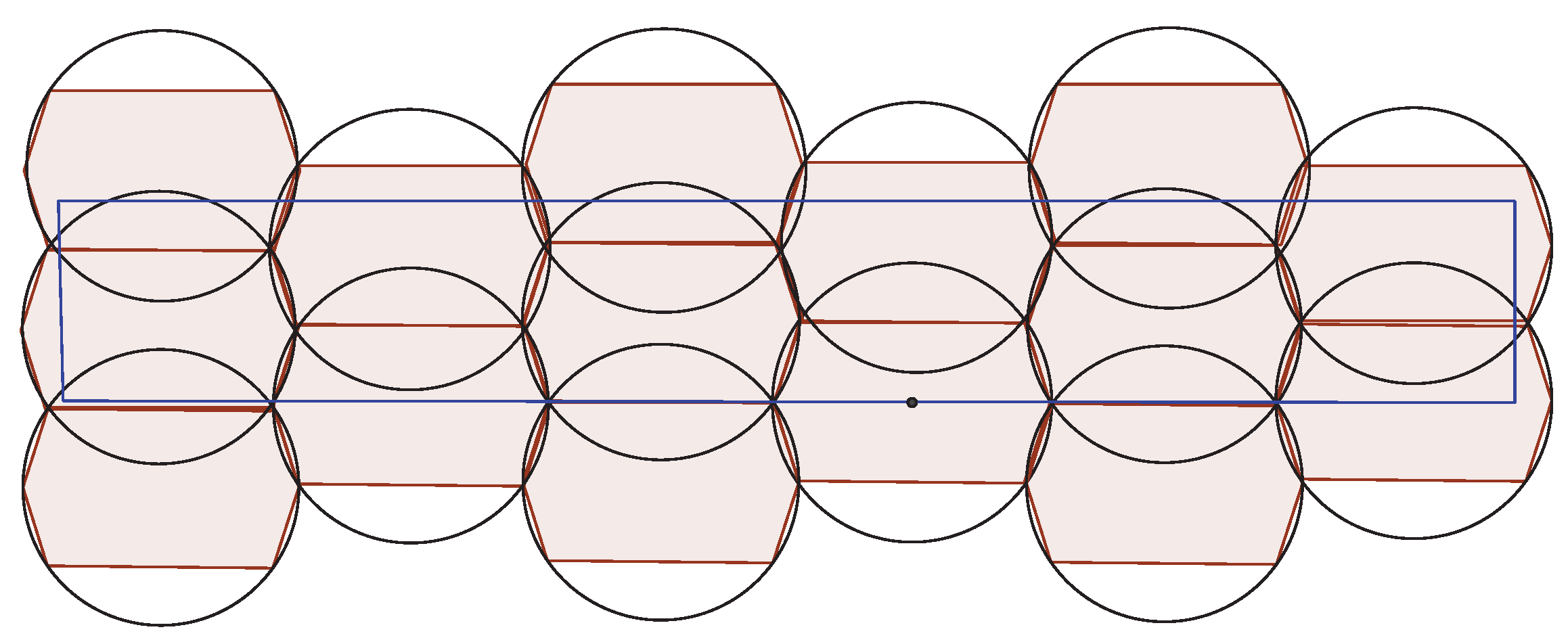
Consider as the fundamental region in the desired tiling the hexagon having vertices
and
, ±
(See
Figure 3). We denote this hexagon by
.
The following theorem gives us the desired tiling, which covers the rectangle.
Theorem 6. Given a rectangle with sides and . There exists a tiling by hexagons as defined above with β being the solution ofsuch that the expected number of hexagons intersecting the rectangle is smaller than the bound given by Equation (1). Proof. Denote the rectangle with sides
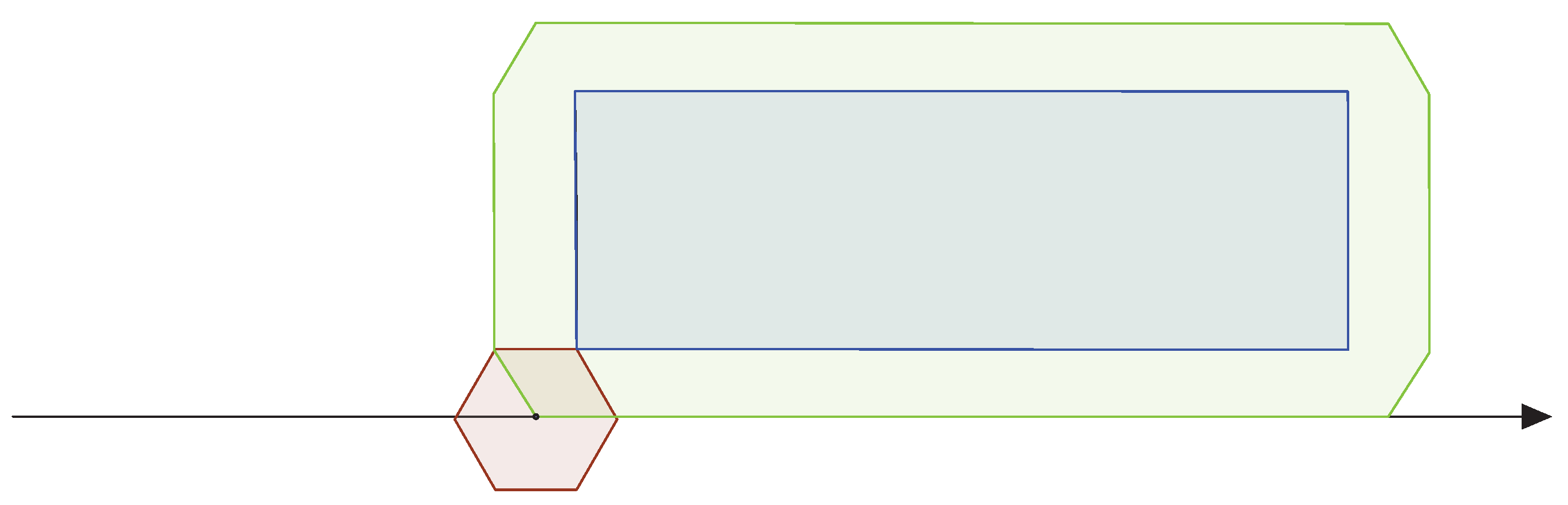
a and
b (
) by
and its respective area by
(see
Figure 4). By Theorem 5, for a random placement the expected number of intersections between a given domain
and a lattice is determined by the relation between the area of the Minkowski sum of the given domain and the fundamental region, in our case
, so the relation is
which needs to be minimized.
The Minkowsi sum
is bounded by a rectangle with length
and width
. So,
By Theorem 5, the number of unit discs is determined by the fundamental region. Hence,
So, the desired number of unit circles is at most
Minimizing
f by the derivative leads to
where
. Then,
Since
, then
. Therefore, it is sufficient to solve the following equation:
which is a quadric equation and
can be expressed explicitly as a function of
a. □
The described optimization is for a single angle. A similar calculation can be done for general hexagonal tilings, which can be parametrized by two angels [
9]. However, we conjecture that it will not improve the result, since a maximal area of the hexagon is obtained when its vertices lie on the unit circle.
Example 1. Consider a rectangle with sides .
- 1.
Take and . There is a single feasible solution with , see Figure 5. In this case, the number of unit discs is , whereas the honeycomb bound given in Equation (4) gives . That is, the irregular lattice give an improvement of the bound by a factor of . - 2.
Take , then . Notice that since this rectangle is wide, the solution is close to the regular hexagonal lattice.