


Abstract
In this paper, the interior elastic direct and inverse scattering problem of time-harmonic waves for a non-penetrable partially coated obstacle placed in a homogeneous and isotropic medium is studied. The scattering problem is formulated via the Navier equation, considering incident circular waves due to point-source fields, where the corresponding scattered data are measured on a closed curve inside the obstacle. Our model, from the mathematical point of view, is described by a mixed boundary value problem in which the scattered field satisfies mixed Dirichlet-Robin boundary conditions on the Lipschitz boundary of the obstacle. Using a variational equation method in an appropriate Sobolev space setting, uniqueness and existence results as well as stability ones are established. The corresponding inverse problem is also studied, and using some specific auxiliary integral operators an appropriate modified factorisation method is given. In addition, an inversion algorithm for shape recovering of the partially coated obstacle is presented and proved. Last but not least, useful remarks and conclusions concerning the direct scattering problem and its linchpin with the corresponding inverse one are given.
1. Introduction
Mathematical and modelling techniques for wave scattering theory have played an essential role in recent decades and are widely used in real-world problems. Broadly speaking, classic scattering theory is concerned with the effect a bounded obstacle has on a time-harmonic incident wave, which is known as a scattering problem. A lot of scientific work has been done for direct scattering problems as well as for the inverse ones [1,2,3,4,5,6]. The first problems have the following interpretation: If the total field is the superposition of an incident field and the scattered field , then the direct scattering problem is to determine the scattered field from the knowledge of the incident wave field and the governing differential equation of the wave motion. On the other hand, we have the inverse scattering problems, where the determination of physical or/and geometrical properties of the inhomogeneity from the knowledge of the incident and scattered field is considered.
At this point we mention that some scientific research works deal with inverse problems for elasticity using methods for hyperbolic equations and not methods applicable to elliptic ones, e.g., [7,8]. Hence, these problems in elastodynamics are time-dependent, and they constitute a scientific extension for the reader in time-dependent inverse problems.
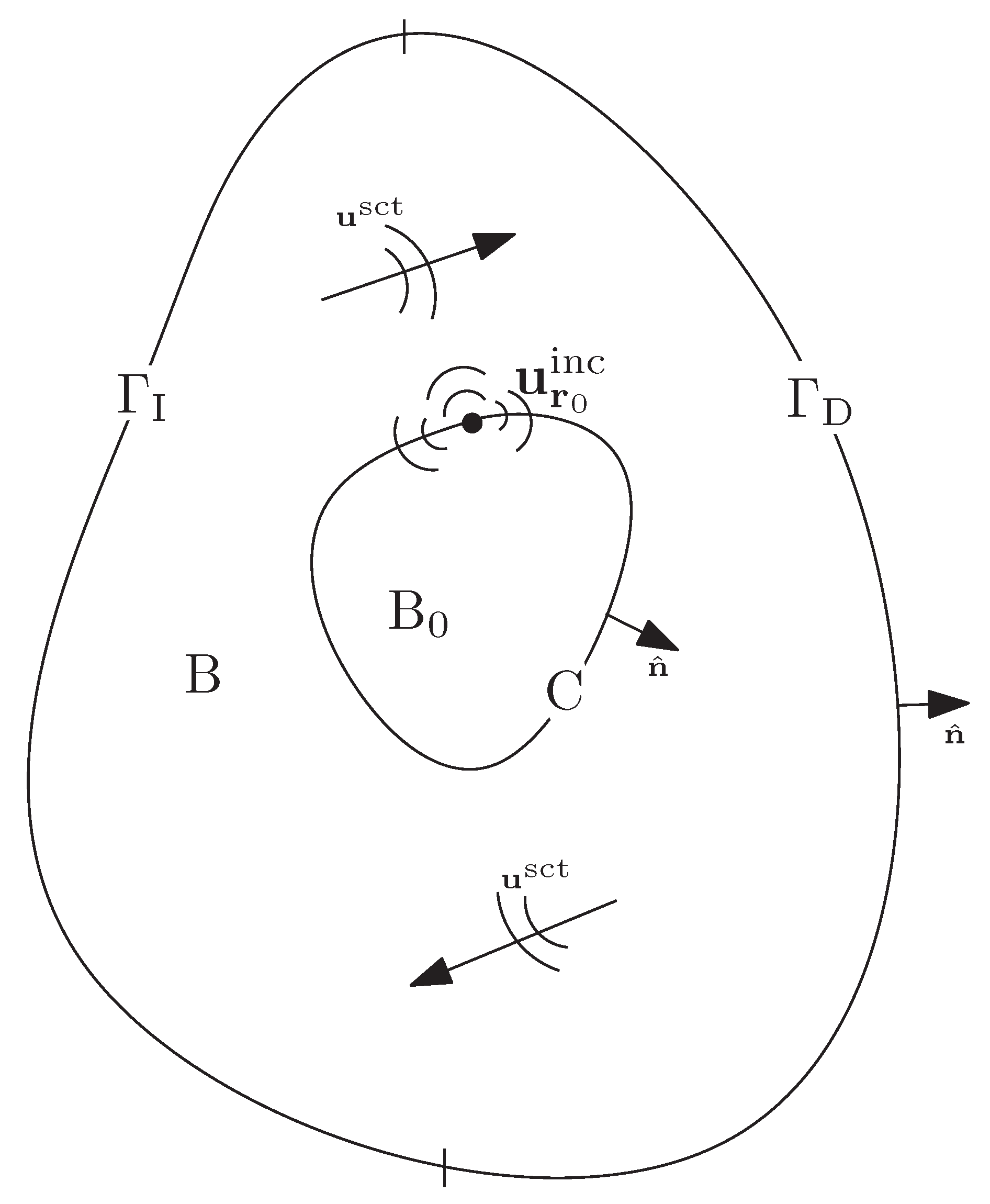
In this work, the elastic direct scattering problem of time-harmonic waves by a bounded non-penetrable partially coated obstacle will be studied. In particular, our partially coated obstacle will be referred to as the scatterer, which consists of an inhomogeneity to the propagation of a given time-harmonic elastic wave field; our incident wave is a point-source field located at a point inside the scatterer (see later p. 2, Figure 1). Hence, knowing the governing Navier differential equation of the total wave field, the geometrical and physical properties of the scatterer, and the incident field, the scattered field will be determined. Further, the corresponding inverse problem and shape identification of the obstacle will be considered and studied. In contrast to traditional approaches applied in inverse scattering theory, which deal with iterative techniques such as regularised Newton methods [9,10,11] or conjugate gradient methods, our study focuses on a non-iterative method. The latter is known as factorization method (FM); here we exploit a modified factorization method (MFD) which avoids the need of solving the corresponding direct scattering problem. The MFD belongs to a wide class of methods, known as qualitative methods, and is a different technique for solving inverse scattering problems compared to an iterative one. These methods require less a priori information, and for an excellent source we refer the reader to [4].
Figure 1.
The mixed scattering configuration.
Our scattering problem will be mathematically modelled by a mixed boundary value problem, and emphasis on its well-posedness using a variational method will be given. We will extend the results from the acoustic case proposed in [12] to the more complicated elastic one. We consider as incident elastic wave , a source located at a point with position vector [13], i.e.,
where is the identity dyadic, is the Hankel function of first kind and zero order, denotes the mass density, is the angular frequency and and are the wave numbers of longitudinal and shear waves respectively. This is actually similar to the fundamental solution in two dimensional elasticity with a singularity at the point which satisfies the following Navier equation
where stands for the Kupradze’s differential operator, are the Lamé constants of the elastic medium and represents the Dirac measure concentrated at the point . For the Lamé constants, strong ellipticity conditions and hold, in order for the medium to sustain longitudinal as well as transverse waves.
The paper at hand deals with an interior scattering problem where both incident point-sources and scattered wave fields inside our obstacle are considered. For our problem, Dirichlet-Robin type boundary conditions will be considered, a Sobolev space setting will be presented and the appropriate mixed boundary value problem will be studied. In elasticity, the Dirichlet boundary condition has the meaning of a rigid body where the displacement vector is given, whereas the Robin type or impedance boundary condition is applied on the coated part of the elastic obstacle. The latter partially coating part of our boundary is due to a constant surface impedance c (see Equation (5)), and the mathematical relation upon this part is a combination of the displacement and surface-stress vector, simultaneously [14].
Applications regarding elastic materials and environments, especially for the coated obstacle case, are very extensive and there a lot of examples from real-world problems in the following areas: engineering mechanics, medical imaging, non-destructive testing and evaluation, geophysics material science, etc. (for details see [15] and references therein). The present results concerning elastic direct scattering problems are used in the study of corresponding inverse problems for partially coated obstacles buried-or-non in elastic layered background media. The latter research direction is also investigated in this paper and useful results are given.
Our paper is organised as follows. In Section 2, the direct scattering problem for a partially coated obstacle irradiated by an elastic incident point-source field is considered. We formulate our problem in a suitable functional space setting, which is described by a specific mixed boundary value problem for the Navier equation. We consider the case where our point-source field is located on some curve C inside the scatterer. The latter is crucial, since our future goal is the shape reconstruction of the obstacle via the scattering data measured on the above curve. In Section 3, uniqueness and existence of the direct mixed scattering problem via the variational method is established, and using Riesz-Fredholm theory, stability of solutions is also proved. In Section 4, we study the corresponding inverse scattering problem and using the factorization method due to some specific auxiliary operators, determination of the shape of the partially coated obstacle from the knowledge of near-field data is achieved. Finally, in Section 5 we end up with fruitful conclusions and remarks for partially coated obstacles in elastic media.
2. Setting up the Scattering Problem
Let denote a closed bounded and simply connected domain with Lipschitz boundary , where ( stands for the Dirichlet boundary condition) and (I: stands for the Robin boundary condition) are disjoint, relatively open subsets of having as their common boundary in . Moreover, the Dirichlet and impedance type of boundary conditions are specified on and , respectively.
We state the direct scattering problem which is described by the following mixed boundary value problem: For a given elastic incident point-source , find the total elastic wave field , such that
where is Kupradze’s differential operator (see p. 2), and T is the physical stress vector, given by
where stands for the outward unit normal vector define almost everywhere on at the point . The superscript (which will be omitted from now on) denotes the action of the differential operator on the indicated variable. Throughout this paper is the surface impedance being a constant, , are the Lamé coefficients as before and denotes the mass density, given by
In what follows in this paper, we assume C to be a Lipschitz closed curve inside B and to be the interior domain enclosed by C. We also assume as incident wave a point-source given by and where is the fundamental solution of the Navier Equation (2), given by (1); the mixed scattering configuration is shown in Figure 1.
We need the following Sobolev space setting. Let be a partial boundary of , then we define
where and are the usual Sobolev spaces, is the trace space and is equipped with the norm induced from , i.e.,
We now define the following interior mixed boundary value problem (IMBVP):
3. Variational Formulation and Its Linchpin with Well-Posedness
In this section a variational formulation of the problem will be presented, and an equivalent integral form of the scattering problem (9)–(11) will be established.
Let be a vector test function; we multiply each one of the Equations (9)–(11) with function (where overline denotes the conjugate), and applying the first generalised Betti’s formula [16] for functions and we get
where
with and is a specific energy functional in 2D-linear elasticity and expresses the energy disseminated through the point of the material being shifted. Using now Equation (9) and the notation , from (12) we take
The latter with the aid of (11) yields to
and having in mind that , we easily take
In the variational sense, the problem (9)–(11) is equivalent by finding a function which satisfies:
where . For the latter, we consider that for any and a test function, we can get
It easily follows that for we can arrive at and hence .
Further, we easily get , as well as ; therefore, is an inner product.
In what follows, we prove continuous dependence of the solution of our IMBVP due to the boundary data, and therefore the following uniqueness-existence theorem holds.
Theorem 1.
The interior mixed boundary value problem (IMBVP) (9)–(11), has a unique weak solution satisfying (17), and furthermore
for some positive constant C.
Proof.
Let us first deal with the uniqueness by showing that the homogeneous problem of (9)–(11) , has only the trivial solution, i.e., in B. We consider the variational Equation (17), by letting , and therefore
Since , we get
By taking the imaginary part in the latter relation, we have
and using (13) and the fact , we get
Having in mind that are positive real numbers, we take . We can also get by the boundary condition (11) that , on . By Holmgren’s uniqueness theorem [17] we conclude that in B, and hence uniqueness is secured.
We continue our well-posedness analysis with the existence of solutions of the problem (9)–(11). Let a vector function being a solution of the static Navier equation in B with on , where
i.e., is the continuous by zero extension of on . Using the property we can obtain , where , are positive constants. If we now denote by the difference we take,
and with the aid of and (9) we arrive at
After some manipulations, we also have the following boundary condition
as well as the boundary condition
We mention here that relations (26)–(28) will be used for proving the stability of solution of our IMBVP (see later, p. 10).
In the sequel, our proof moves on with stability-existence results. Having in mind that , we will prove the following alternative form of the Equation (17)
Indeed, we make use of the following first generalised Betti’s formula:
where is the generalised stress vector on the boundary defined, by [18]
with the differential operator given as [18]
We point out that if we set and , our surface stress vector will be transformed to the physical stress vector . Hence relation (30), via , can be written as
Taking into account that , the latter yields to
The variational Equation (17), via (34) gives
where relation has been taken into account. Hence,
If we now define the following auxiliary operators:
and
then, it can easily be seen that (36) arrives at:
Via (37) and (38), it is obvious that
with being a linear bounded conjugate function, and therefore
We also mention that although we have to deal with the complicated nature of (given in (13)), we can easily prove that is a sesquilinear form.
Following now similar steps as those in [19], we deal with the integral operator given by (39), which for arrives at
After some calculations, for we can rewrite as
From the latter, is non-negative and using (44) we arrive at
where
After some manipulations in (46), we also have the following
We denote as a constant (which is a positive constant) and hence,
From the latter inequality we get
and therefore, the functional is strictly coercive.
Next we deal with the boundedness of the functional . Using (38) we have
If we now consider in (51) the Cauchy–Schwartz inequality and some calculations, we arrive at
Hence, from the fact that T is bounded, i.e., there exists a positive constant such that , we can get
and finally,
Therefore, there exist positive constants such that
After some calculations, we arrive at
for some positive constant and therefore ℓ is bounded. Having in mind that (see (42)), we have that
and applying the Riesz representation theorem, we get
Since now , we take
and the latter via (58), gives
for some positive constant . Using now the trace theorem [20], there exists a positive constant C such that
Finally, combining the previous results with the above inequality and using the Lax–Milgram theorem [4] our proof is completed. □
4. The Inverse Problem
In this section we address the inverse scattering problem concerning partially coated obstacles which are bounded and simply connected domains in . Our aim is to recover the shape of the partially coated scatterer B from the knowledge of the near field data due to the point source (see (1)).
The latter is mathematically modelled by the following interior mixed boundary value problem:
where , is the mass density in B and the surface impedance. The problem (62)–(64) is actually the problem (9)–(11)written this time in terms of the total displacement field . The mixed partially coated obstacle B and its boundary can be uniquely determined; the proof is omitted for brevity since it can be exploited if we consider minor modifications as those used in [15].
The Modified Factorization Method
In the sequel, we will follow the basic ideas arising from the factorization method, in order to recover the boundary of the non-penetrable partially coated obstacle B. These ideas have been used widely, mostly in various inverse-acoustic and electromagnetic scattering problems [4,21]. For inverse elastic scattering problems, factorization method has also been employed [15,22], and in this work we will exploit a modification of the factorization method concerning the shape recovering of the scatterer B.
Initially, we introduce the near−field operator defined as:
The factorization method requires the following decomposition
where the operator is given by
is a single-layer potential of the form
( the density function), and is the adjoint operator of (operator will be given shortly (see p. 13)). For the decomposition of , we also need to define a boundary data-to-near filed data operator:
such that
Taking into account operator , we now get
Using the single layer potential and the relation
we take
and therefore
We now consider the continuous by zero expansion of and , respectively, upon , i.e.,
and by (74) we have
hence,
Combining (65) and (77) the following factorization for near-field operator holds:
or, in equivalent form
In the sequel, we will calculate and find the adjoint operator of . Let and . Then
After some calculations we end up with adjoint operator , given by
In addition, we define a combination of single and double layer potential , written as:
where . We now want to find the jump relation of when approaches the boundary from the inside of the domain B. Using the jump relation of the single and double layer potential [18], we arrive at
In a similar way, we can get the jump relation for in the form
For our decomposition analysis, it is necessary to define the following boundary integral operators and as (their properties and details can be found in [23]):
where denotes the polarization vector of an elastic point source at any (see (1)), and in particular we consider In this way we avoid the dyadic nature of the fundamental solution, and in relations (85)–(88) the vector plays the role of an argument rather than a variable.
We can now consider (83) and (84) restricted on and respectively, due to the following matrix integral form (recall that )
In (89), and after some computational effort, the integral operator is found to be
The latter in combination with (70) and (81) lead to
In the sequel, we prove the following.
Theorem 2.
Assume that is not an eigenvalue of in , then
- (i)
- For the integral operator we havefor any and .
- (ii)
- The bilinear matrix operator is invertible.
Proof.
- (i)
- Using the integral operator and its linchpin with matrix Equation (89) we have:Taking into account (93) we haveHence, we getWe now consider , with being a circle with large enough radius R. From the latter and after some calculations, we havewhere is the analogous functional as it is given in (13) if we substitute and . Using now Betti’s formula in (101), we getUsing the radiation conditions [16]andhold uniformly for all directions , relation (102) arrives atwhere . We now let and since , we takewith . If we now assume for (105) that equality holds, then both terms and are vanishing. Using Rellich’s Lemma and unique continuation principle [5,20], we getand since satisfies the Navier Equation (62) in B, by Holmgren’s theorem [24] we take in B. From (94)–(97) we can now conclude thatTaking into account the above arguments, we can see that indeed the imaginary part of the integral operator is strictly negative, i.e., relation (92) holds.
- (ii)
- We now want to show that is invertible. Concerning the injectivity of , let us assume that . Hence is vanishing too, and using previous argument (see (107)) we have , and now injectivity of is secured.In what follows, we consider the matrix−integral operatorand therefore the following decomposition for holdsThe latter implies that invertibility of and is an equivalent argument and since injectivity of is proved, the injectivity of is secured as well. In addition and due to Fredholm theory, if we combine the above injectivity showing that is a Fredholm operator with index zero, then operators and are bounded and invertible.
□
We state the following lemma; its proof follows analogous arguments and minor modifications as those in [12,25], and here it is omitted for brevity.
Lemma 1.
Let be operators corresponding to the operators (85)–(88), with kernel
where , and corresponds to the elasto-static case i.e., (). If we assume the differences and , then:
- (i)
- The operators and are compact.
- (ii)
- The operators and are adjoint operators.
- (iii)
- The operator is self-adjoint operator.
- (iv)
- The operators and are coercive.
We also give and prove the following result.
Theorem 3.
The near field operator
given by (65) can be written as:
with operator being compact and has dense range in .
Proof.
Let us recall that
The latter in combination with (91), the fact that is invertible and is bounded, gives:
Compactness of now is secured, by the fact that ( is the interior domain enclosed by C) and ; therefore, the operator is compact.
Last but not least, we will prove that has dense range. Assume that . From the definition of (see (67)), we have
Hence solves the following exterior mixed boundary value problem:
with . The problem (115)–(119) has a unique solution [26], and we can easily get in . From the analytic continuation argument we take in , and therefore . Using the fact that is not an eigenvalue of in , we arrive at in . We also have on C, and finally . The above argument yields to injectivity of and therefore has dense range. □
In the sequel, we make use of an essential theorem (see [25], p. 57) which is very helpful in the suggested modified factorization method due to the introduction of some proposed key auxiliary operators. For the convenience of the reader, we state it here.
Theorem 4.
Let be a Gelfand triple with a Hilbert space U and a reflexive Banach space X such that the embedding is dense. Furthermore, let Y be a second Hilbert space and let and be linear bounded operators such that
If we assume that:
- (i)
- G is a compact operator,
- (ii)
- There exists such that with some compact operator K and some self-adjoint and coercive operator , i.e., there is constant with , for all ,
- (iii)
- is non−negative or non−positive on , i.e., or , for all and , and
- (iv)
- is one−to−one or is strictly positive or strictly negative, for all and ,
then the operator is positive, and the range of G coincides with the range of .
Remark 1.
The above analysis deals with the matrix−integral operator , for which the essential theorem introduced by Kirsh and Grinberg [25] cannot be applied. In particular, the decomposition of the real part of the matrix operator into a compact operator and a coercive one is not valid, and hence we have to modify our functional analysis technique by considering some suitable auxiliary operators.
In what follows, we define new operators related with as follows:
where with and is given as
In (121) is the smooth boundary of a known domain D which is open, bounded with , and . The following theorem holds.
Theorem 5.
We assume that is not an interior Dirichlet eigenvalue of in both D and . Then the following decompositions hold:
and
with
and
In addition, the operators are coercive and are compact.
Proof.
then is a coercive operator and a compact one. Here we have taken into account the compactness of and as well as that .
Let us consider the following exterior boundary value problem:
for and . We also define the operator
given by
with being a solution of (126)–(129). The exterior boundary value problem (126)–(129) has a solution with boundary data [15,26] and its regularity properties yield to compactness of the operator . Using relation (68) it is easy to prove that solves problem (126)–(129), with , and via (121)
In addition, from definitions of and (see (67) and (131)), we get
and using a similar consideration, the following relation
also holds. From (120) and the factorization relation (113) we have
If we use the notation
then (122) is secured. In what follows and since is bounded, we can write
where
Then (137) via (136) is written as
and if we set
and
Following a similar analysis as before for , we can also prove relation (123). We now use the notation
and
If we assume that we conclude that is coercive and since the operators and are compact, is also compact. □
We also state the following theorem.
Theorem 6.
Assume that is neither a Dirichlet eigenvalue of in D, nor in , then
- (i)
- The operators and are strictly negative.
- (ii)
- The operators and are compact and have dense ranges in .
Proof.
- (i)
- Let us consider an arbitrary and assume . We have the following analysis:whereTaking into account that , from (145) we end up withConcerning now the vanishing of (146), if we assume , then via (145) we can arrive at and therefore by (145), we get:Hence , and operator is strictly negative. Following similar arguments as above, and considering , the operator is also strictly negative.
- (ii)
- From relation (121) we can see thathence, compactness of is secured since the integral operator has a weakly singular kernel. We assume now that , which is written asThe single layer potential in the left hand side of (149) satisfies the Navier equation for , withand since is not a Dirichlet eigenvalue of in D we arrive at for , which also vanishes in ; therefore, . The injectivity now of is proved.
□
In view of Theorems 5 and 6 it is obvious that operator satisfies all the conditions of Theorem 4, and hence
where
For , we have that
The operator also satisfies the conditions of Theorem 3, hence
where
Again, for every , we have
Proposition 1.
Assume that is neither a Dirichlet eigenvalue of in both D and . If we take any given nonitersecting arc L, which is smooth piecewise and without cups, defined by
for any with for all , we have that:
Proof.
Let us first consider that . Then from , and taking into account (153), we easily get
On the contrary and using the abduction method, let us assume that L is not a subset of and
simultaneously. Therefore, there exists for which the following relation holds:
If we now take a fixed point , such that , but , then a singularity for at occurs, whereas the right hand side of (161) has not. The assertion easily follows by contradiction. □
Taking into account Theorems 4–6 and Proposition 1, we are ready now to state the following essential theorem of this paper.
Theorem 7.
Assume that is neither a Dirichlet eigenvalue of in D nor a Dirichlet eigenvalue of in . Then
and
Here is an eigenvalue system of , where is given in (152).
Using the same steps as before, the shape reconstruction of can be treated in a similar way. Indeed, if we again assume that is neither a Dirichlet eigenvalue of in D nor a Dirichlet eigenvalue in as well, then the following relations
and
hold, where
with and for all , and here as before is an eigenvalue system of , recall .
5. Conclusions
In this paper an elastic mixed scattering problem in two dimensional linear elasticity for a non-penetrable obstacle was studied. The direct scattering problem as well as the corresponding inverse one were addressed. We mention that our problem is not a typical one, since it concerns a point-source field placed inside the scatterer, i.e., inside a Lipschitz closed curve into the partially coated obstacle (see Figure 1). We make the following remarks:
- (i)
- On the boundary of the scatterer, a Dirichlet and an impedance type of boundary condition is imposed, specified by and , respectively. Our method can be expanded and is still valid, for the case where our boundary is divided into more than two disjoint, relatively open subsets of .
- (ii)
- Solvability of the direct problem is an essential one, since the measurements (data) of the scattered waves inside the partially coated scatterer are used for the corresponding inverse problem.
- (iii)
- Concerning the corresponding inverse scattering problem, a modified factorisation method in order to retrieve the shape reconstruction of a partially coated obstacle was presented.
- (iv)
- Basic auxiliary operators were introduced, since from the mathematical point of view the basic Theorem 4 (page 17) could not be applied. The key idea was to factorise these new auxiliary operators and prove some essential properties, in order to apply the above theorem and recover the shape reconstruction of the obstacle.
- (v)
- An inversion algorithm via Proposition 1 and Theorem 7 were established. Concerning numerical examples, and to the best of our knowledge, in elasticity there are no numerical results for partially coated obstacles which deal with a Dirichlet boundary condition and an impedance one. However, this is beyond the aim of this paper; our analytical method contributes to the understanding of the physical background, and its usefulness lies in checking the credibility of the corresponding numerical technique. We hope to provide examples in the future, and numerical results showing the applicability of the method are also welcomed.
Author Contributions
Both authors A.K. and V.S. have contributed equally to the conceptualization, design and investigation of this research work. All authors have read and agreed to the published version of the manuscript.
Funding
This research received no external funding.
Institutional Review Board Statement
Not applicable.
Informed Consent Statement
Not applicable.
Data Availability Statement
Not applicable.
Conflicts of Interest
The authors declare no conflict of interest.
References
- Athanasiadis, E.C.; Pelekanos, G.; Sevroglou, V.; Stratis, G.I. On the scattering of two dimensional elastic point source and related near-field inverse problems for small discs. R. Soc. Endinburg 2009, 139A, 719–741. [Google Scholar] [CrossRef]
- Athanasiadis, E.C.; Sevroglou, V.; Skourogiannis, I.K. The direct electromagnetic scattering problem by a mixed impedance screen in chiral media. Appl. Anal. 2012, 91, 1–11. [Google Scholar] [CrossRef]
- Cakoni, F.; Colton, D. The direct and inverse scattering problems for partially coated obstacles. Inverse Probl. 2001, 17, 1997–2015. [Google Scholar] [CrossRef]
- Cakoni, F.; Colton, D. Qualitative Methods in Inverse Electromagnetic Scattering Theory; Springer: New York, NY, USA, 2005. [Google Scholar]
- Colton, D.; Kress, R. Inverse Acoustic and Electromagnetic Scattering Theory, 2nd ed.; Springer: Berlin/Heidelberg, Germany, 1998. [Google Scholar]
- Liu, D.X. The factorization method for cavities. Inverse Probl. 2014, 30, 15–033. [Google Scholar] [CrossRef]
- Hansen, S.; Uhlmann, G. Propagation of polarization in elastodynamics with residual stress and travel times. Math. Ann. 2003, 326, 563–587. [Google Scholar] [CrossRef]
- Rachele, L. Uniqueness of the density in an inverse problem for isotropic elastodynamics. Trans. Am. Math. Soc. 2003, 355, 4781–4806. [Google Scholar] [CrossRef][Green Version]
- Hohage, T. Iterative Methods in Inverse Obstacle Scattering: Regularization Theory of Linear and Nonlinear Exponentially Ill-Posed Problems. Ph.D. Thesis, University of Linz, Linz, Austria, 1999. [Google Scholar]
- Kress, R.; Rundell, W. Inverse scattering for shape and impedance. Inverse Probl. 2001, 17, 1075–1085. [Google Scholar] [CrossRef]
- Potthast, R. On the convergence of a new Newton-type method in inverse scattering. Inverse Probl. 2001, 17, 1419–1434. [Google Scholar] [CrossRef]
- Wu, Q.; Yan, G. The factorization method for a partially coated cavity in inverse scattering. Inverse Probl. 2016, 10, 263–279. [Google Scholar] [CrossRef]
- Athanasiadis, E.C.; Sevroglou, V.; Stratis, G.I. Scattering relations for point generations dyadic fields in two dimentional linear elasticity. Q. Appl. Math. 2006, 64, 695–710. [Google Scholar] [CrossRef]
- Dasios, G.; Kleinman, R. Low Frequency Scattering; Clarendon Press: Oxford, UK, 2000. [Google Scholar]
- Athanasiadis, E.C.; Natrosvilli, D.; Sevroglou, V.; Stratis, G.I. An application of the reciprocity gap functional to inverse mixed impedance problems in elasticity. Inverse Probl. 2010, 26, 085011. [Google Scholar] [CrossRef]
- Kupradze, D.V. Potential Methods in the Theory of Elasticity; Israel Programm for Scientific Translations: Jerusalem, Israel, 1965. [Google Scholar]
- Holmgren, E. Über systeme von linearen partiellen differentialgleichungen. Översigt Vetensk. Akad. Handl. 1901, 58, 91–105. [Google Scholar]
- Arens, T. The Scattering of Elastic Waves by Rouph Surfaces. Ph.D. Thesis, Department of Mathematical Science, Brunel University, Brunel, UK, 2000. [Google Scholar]
- Monk, P. Finite Element Methods for Maxwell’s Equations; Oxford University Press: New York, NY, USA, 2003. [Google Scholar]
- Brezis, H. Functional Analysis, Sobolev Spaces and Partial Differential Equations; Springer: New York, NY, USA, 2010. [Google Scholar]
- Colton, D.; Kress, R. Integral Equation Methods in Scattering Theory; John Wiley & Sons, Inc.: New York, NY, USA, 1983. [Google Scholar]
- Bondarenko, O.; Liu, X. The factorization method for inverse obstacle scattering with conductive boundary condition. Inverse Probl. 2013, 29, 95-021. [Google Scholar] [CrossRef]
- Kiriaki, K.; Sevroglou, V. Integral equation methods in obstacle elastic scattering. Bull. Greek. Math. Soc. 2001, 45, 57–69. [Google Scholar]
- McLean, W. Strongly Elliptic Systems and Boundary Integral Equations; Cambridge University Press: Cambridge, UK, 2000. [Google Scholar]
- Kirsch, A.; Grinberg, N. The Factorization Method for Inverse Problems; Oxford University Press: Oxford, UK, 2008. [Google Scholar]
- Athanasiadis, E.C.; Natrosvilli, D.; Sevroglou, V.; Stratis, G.I. A boundary integral equations approach for direct mixed impedance problems in elasticity. J. Integral Equ. Appl. 2011, 23, 183–222. [Google Scholar] [CrossRef]
Publisher’s Note: MDPI stays neutral with regard to jurisdictional claims in published maps and institutional affiliations. |
© 2021 by the authors. Licensee MDPI, Basel, Switzerland. This article is an open access article distributed under the terms and conditions of the Creative Commons Attribution (CC BY) license (https://creativecommons.org/licenses/by/4.0/).
