


Abstract
A dozen papers have considered the concept of negation of probability distributions (pd) introduced by Yager. Usually, such negations are generated point-by-point by functions defined on a set of probability values and called here negators. Recently the class of pd-independent linear negators has been introduced and characterized using Yager’s negator. The open problem was how to introduce involutive negators generating involutive negations of pd. To solve this problem, we extend the concepts of contracting and involutive negations studied in fuzzy logic on probability distributions. First, we prove that the sequence of multiple negations of pd generated by a linear negator converges to the uniform distribution with maximal entropy. Then, we show that any pd-independent negator is non-involutive, and any non-trivial linear negator is strictly contracting. Finally, we introduce an involutive negator in the class of pd-dependent negators. It generates an involutive negation of probability distributions.
1. Introduction
The concept of negation of a probability distribution (pd) was introduced by Yager [1]. He is concerned with the representation of the knowledge contained in the negation of a probability distribution. He considered an example of a rule-based system consisting of rules of the form: If V is Tall, then U is b, and If V is Not Tall, then U is d. If Tall is represented as a fuzzy set, then the process of obtaining Not Tall is well known. If Tall is represented by a probability distribution, then to determine Not Tall, we need to define the negation of a probability distribution.
Yager [1] defined the negation of a finite probability distribution by: , where is defined by: . He noted that other negations of probability distributions (pd) could exist. Further, negations of probability distributions were considered in many works [2,3,4,5,6,7,8,9,10,11,12]. The properties of Yager’s negation of a probability distribution are studied in [2]. The authors of [3] studied uncertainty related to Yager’s negation. The authors of [4,5] studied the convergence of the sequence of multiple Yager’s negations of pd to the uniform distribution. Yager’s negation is used in a multi-criteria decision-making procedure in [6]. The authors of [7] introduced another negation of probability distributions based on Tsallis entropy. A negation of basic probability assignment in Dempster-Shafer theory is considered in [8]. The properties of the negation of basic probability assignment based on a total uncertainty measure are studied in [9]. A definition of negation in basic belief assignment in the Dempster–Shafer theory using matrix operators is given in [10]. This matrix negation was also considered in [11].
The authors of [12] studied functions called negators defined on the set of probability values and point-by-point transforming pd into its negation. Two types of negators are considered: pd-independent and pd-dependent. In the class of pd-independent negators it was introduced the class of linear negators [12]. It was shown that a negator is linear if and only if it is a convex combination of Yagers’s and uniform negators. Hence the Yager’s negator plays a crucial role in the definition of pd-independent linear negators. The current paper studies new properties of negators introduced in the paper [12].
The non-solved problem was how to introduce involutive negators generating involutive negations of pd. Involutive and non-involutive negations are studied in detail in fuzzy logic and for lexicographic valuations of plausibility [13,14,15,16,17,18,19]. It was shown that any fuzzy negation at any point of [0,1] is contracting, expanding, or involutive. This paper aims to extend the concepts of contracting, expanding, and involutive negations from fuzzy logic on the set of probability values in probability distributions and to introduce involutive negators and negations of pd.
The principal contributions of the paper are the following: we prove that the sequence of multiple negations of pd generated by a linear negator converges to the uniform distribution with maximal entropy. We show that any pd-independent negator is non-involutive, and any non-trivial linear negator is strictly contracting. Finally, we introduce an involutive negator in the class of pd-dependent negators that generates an involutive negation of probability distributions.
The paper has the following structure. Section 2 considers basic definitions of negators and negations of pd generated by negators and describes pd-independent and linear negators’ properties from [12] used in the following sections. Section 3 presents the results of the paper. Section 3.1 introduces a general form of multiple linear negators and finds the limit of the sequence of such multiple negators. Section 3.2 shows non-involutivity of pd-independent negators, and shows that non-trivial linear negators are strictly contracting. In Section 3.3, we introduce an involutive pd-dependent negator that defines the involutive negation of probability distribution. Section 4 contains a discussion.
2. Materials and Methods
2.1. Negations of Discrete Probability Distributions
A set , of n real values , where , is referred to as a (finite discrete) probability distribution (pd) of the length n, if it satisfies for all , the following properties:
One can consider as a probability of an outcome in some experiment with outcomes , . Let be the set of all possible probability distributions of the length n defined on X. For simplicity of the interpretation; we will fix the ordering of outcomes and the ordering of corresponding probability values according to their indexing , and represent the probability distribution as n-tuple
The probability distribution satisfying the property: for some in {, and for all , will be referred to as a degenerate or point distribution [20]. For example, for and we have the following point distributions: , and .
The simplest example of pd is the uniform distribution: .
A transformation of probability distributions from into probability distributions in is called a negation of probability distributions if, for all , the following properties are satisfied [12]:
From (3) it follows for all :
A negator is a function of probability values point-by-point transforming probability distributions into probability distributions: , hence, for all , the following properties are satisfied:
We will say that a negator generates (point-by-point) a negation of probability dictribution P.
A negator is called pd-independent [12] if for any pd in the negator depends only on the value but not on other values in P. A negator that is not pd-independent will be referred to as pd-dependent. A negation of a probability distribution will be called a pd-independent negation of pd if it is generated by pd-independent negator N.
Yager’s negator [1]:
is a pd-independent negator. For any pd in it defines negation of :
The uniform negator [12]:
is another example of pd-independent negator. For any pd in negator defines its negation: , where is the uniform distribution.
The following negator, introduced by Zhang et al. [7]:
is an example of pd-dependent negator.
In the following sections, we will show that all pd-independent negators are non-involutive. We will introduce an involutive negator in the class of pd-dependent negators. This involutive negator generates an involutive negation of probability distributions satisfying the property: .
2.2. Properties of Pd-Independent and Linear Negators
The authors of [12] showed that Yager’s negator plays a crucial role in the construction of pd-independent linear negators: any linear negator is a convex combination of Yager’s and uniform negators; hence it is a function of Yager’s negator. Let us consider some properties of pd-independent and linear negators that will be used further in this paper.
An element in [0,1] is called a fixed point of a negator if . A probability distribution is called a fixed point of a negation if .
Proposition 1
([12]). Any negator N has a fixed point , i.e., , and the negation of probability distribution generated by N have the fixed point:
Theorem 1
([12]). Any pd-independent negator has the unique fixed point and any pd-independent negation of probability distributions has a unique fixed point .
Corollary 1.
Any pd-independent negatorsatisfies the following property:
Proposition 2
([12]). Any pd-independent negator N satisfies the property:
From (11), we obtain the following:
Proposition 3
([12]). Any pd-independent negator N satisfies the following properties:
Theorem 2
([12]). Any pd-independent negator N satisfies the following properties:
A pd-independent negator N is referred to as a linear negator [12] if is a linear function of . The negation of a probability distribution is called a linear negation of pd if is a linear negator.
Theorem 3
([12]). A function is a linear negator if and only if it is a convex combination of negators and , i.e., for some for all p in [0,1] the following property is satisfied:
where is a parameter of the convex combination.
From (13), we have , hence in (17), we can use and represent (17) as a function of Yager’s negator [12]:
where is a parameter, , defining the value of for .
The authors of [12] formulate an Open Problem: Prove or disprove a hypothesis that any pd-independent negator is linear. We suppose that any pd-independent negator is linear. In such a case, the properties established in [12] and in this paper for pd-independent negators will be fulfilled for linear negators and vise versa.
Section 3 presents the new property of linear negations: the sequence of multiple linear negations of a pd converges to the uniform distribution with the maximal entropy.
3. Results
3.1. Multiple Linear Negators and Negations
Let N be a pd-independent negator. For all , denote , where and We have: .
For any p in [0,1] denote , then .
Applying (12): , in linear negator (18): , after equivalent transformations, we obtain another representation of linear negator:
Substituting in (19): and we obtain the following:
Proposition 4.
For linear negator N, the following formula holds for any p in [0,1] and for all:
Proof.
The formula (21) holds for : , and (21) holds also for in (20). Suppose that (21) holds for . Using (19) and (20) show that (21) holds for : . □
Theorem 4.
For linear negator N for any p in [0,1], it holds:
Proof.
From (14), we have ; hence for we obtain: , i.e.,
For and we have: . Taking into account these possible values of and d, we obtain from (21): . □
The definition of linear negation says that the negation of a probability distribution is a linear negation of pd, if is a linear negator. Define: . From the construction of it is clear that is a probability distribution, i.e., satisfy the properties (5). Let us check, for example, that . Indeed, from (21), we have: .
From Theorem 4, we have the following.
Theorem 5.
If N is a linear negator, then for the corresponding linear negation of pdfor any pd P init holds:
Proof.
. □
As it follows from Theorem 5, the multiple negations of probability distributions have as the limit the uniform distribution with the maximal entropy value [1]:
Results obtained for linear negators also fulfilled for Yager’s negator, because it is a linear negator. Hence, for Yager’s negator we have from (21): , and for all it is fulfilled:
3.2. Contracting Negators
The concepts of contracting and expanding negations have been introduced and studied in [14,15,16,17] on the sets of lexicographic valuations, multisets, and membership values [18,19]. Here we extend these concepts on pd-independent negators.
Definition 1.
Let p be a probability value from [0,1]. A negatoris called contracting in p if
expanding in p if
and involutive in p if
A negatoris called contracting, expanding, or involutive (on [0,1]) if it satisfies the corresponding property for all p in [0,1]. A negatoris called non-involutive if it is not involutive.
A negatoris called strictly contracting if for anyall inequalities in (25) are strict:
A negationof probability distributionswill be called contracting if it is generated by contracting negator N.
Theorem 6.
Any negator N for any p in [0,1] satisfies (25) or (26), hence it is contracting or expanding in p. N satisfies both properties (25) and (26) if and only if N is involutive in p.
Proof.
Suppose , then from (6), we obtain: , that gives or , and hence (25) or (26), respectively, fulfilled.
Dually, if , then from (6) we obtain , that gives or , and hence (26) or (25), respectively, fulfilled.
If N is involutive in p, then (25) coincides with (26), and both hold. Suppose both (25) and (26) hold together. If then from (6) we obtain , and from (25) and (26) we obtain and hence (27) is fulfilled. Similarly, we obtain (27) from , (6), (25), and (26). □
Theorem 7.
Any pd-independent negator N is non-involutive.
Proof.
From (13) and (16) we have: , and , hence , and is non-involutive. □
From this theorem, it follows that involutive negators we need to look for between pd-dependent negators. Such negator we introduce in the following section.
A linear negator N such that will be referred to as a non-trivial linear negator.
Theorem 8.
Any non-trivial linear negator is strictly contracting.
Proof.
From , Corollary 1 and (14) it follows for all , hence , and , and in (21) for we have: , i.e., A is negative, and . Using representation (21): , and , we need to prove that (28) is satisfied for all in [0,1], i.e., the following inequalities are fulfilled:
If we have: , i.e., (29) and hence (28) are satisfied.
If we have: , i.e., (29) and hence (28) are satisfied.
Hence linear negator is strictly contracting. □
Strictly contracting linear negator can be represented by a contracting spiral in Figure 1, which depicts a sequence of linear negator values , for in the form of a spiral, contracting around the fixed point . Figure 2 depicts the sequence from Theorem 4 with the limit . Similar figures can be depicted for .
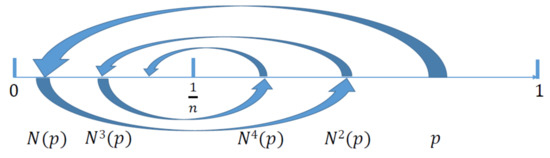
Figure 1.
Contracting negator as a spiral contracting around the fixed point .
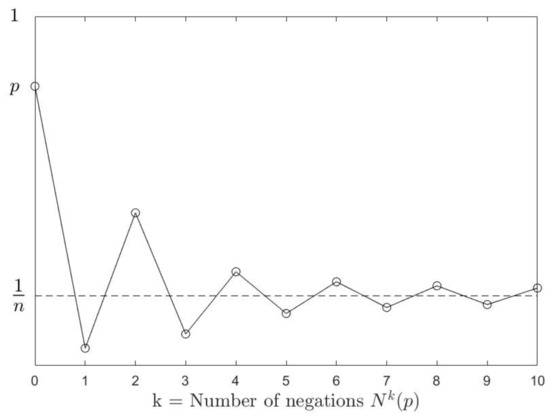
Figure 2.
Contracting negator as a sequence of with the limit .
3.3. Involutive Negators and Involutive Negations
Let be a probability distribution from , and be a negation of pd P. It will be called an involutive negation if the following property is satisfied:
As in the previous sections, consider negations acting element-by-element on pd P using some negator N:
but in this case, to obtain an involutive negation satisfying (30) a negator should be involutive, such that for any pd it is fulfilled:
As it follows from Theorem 7, an involutive negator cannot be pd-independent. It means that depends not only on the value of but possibly on other values of probability distribution . Hence can be considered as an operator acting on pd P and transforming it element-by-element into a new pd :
where is a pd-dependent negator depending on P. In such notation, the involutivity (30) of a negation will have the form:
which, instead of (32), gives , for all . The indexes and in can be used for not forgetting that is pd-dependent and to what pd negation was applied; hence it can be for some in [0,1]. But when it is clear to what pd negation neg is applied, instead of and we will write simply . In the previous sections, we considered pd-independent negators defined on as functions generating element-by-element a negation of probability distributions P. Now we say that negation applies element-by-element transformation of the components of pd that considered as a pd-dependent negator .
Let be a probability distribution. Denote , and .
Theorem 9.
Letbe a probability distribution. Then the function:
is an involutive negator, i.e., the function (31) is an involutive negation, satisfying (30).
Proof.
Let us check the fulfillment for (33) the properties (5), (6), and (32).
From (33) and (1) we obtain: . From (33) we obtain: , and from it follows for all , hence (5) is fulfilled.
defined by (33), is a decreasing function of ; hence (6) is fulfilled.
Let us prove (32). Denote , where for all . From (33), we have: , and .
Dually obtain: , and:
From (33) and (34) we obtain the following:
hence (32) is fulfilled, is involutive negator, and the negation (31) is involutive. □
We show that the probability value is a fixed point of negator (33) if, for any probability distribution P, it is fulfilled:
Proposition 6.
The involutive negatordefined by (33) has the unique fixed point, and the uniform distributionis the unique fixed point of the involutive negationwith the negator (33).
Proof.
We have , i.e., is a fixed point of . If is a fixed point of the negator (33), that is: , then we obtain sequentially: ; ; ; and finally: . Hence, is the unique fixed point of negator defined by (33), and:
From (35), it follows that the negation of probability distributions has a fixed point :
Suppose is a fixed point of negation with negator defined by (33). Then , hence , for all , i.e., are fixed points of , hence , and . □
Since the involutive negator (33) is strictly decreasing function, from it follows for any probability distribution and any :
If , i.e., not all equal to , then from it follows that , and from (36) and strict monotonicity of it follows that: , and for all , , from (33) it is fulfilled: .
To summarize the last considerations, we can say that for any probability distribution the values of negations , , are located on the decreasing line connecting two points in 2-dimensional space with coordinates: and , and passing through the fixed point .
When , the involutive negator (33) coincides with Yager’s negator. This situation appears when or for a point distribution satisfying the property: for some , and for all . For example, for , we have: .
Example 1.
Consider probability distribution . We have , fixed point: , and , , , , , . . After similar calculations, we obtain: .
4. Discussion
The paper studied negators generating element-by-element negations of probability distributions (pd). We showed that the sequence of multiple negations of pd generated by a pd-independent linear negator converges to the uniform distribution with maximal entropy. We showed that all pd-independent negators are non-involutive, and non-trivial linear negators are strictly contracting; hence, we need to look for an involutive negator in the class of pd-dependent negators. Finally, we introduced an involutive negator in the class of pd-dependent negators. It generates involutive negation of probability distributions. Such involutive negation can formalize a probability distribution NOT(P), where P is some linguistic concept like HIGH defined on a set of probability distributions. The involutivity of negation, like NOT(NOT(P)) = P, is a common property for many logical systems and can be used in reasoning systems operating with terms represented by probability distributions. We plan to apply the proposed involutive negation in Dempster-Shaffer theory, as it was proposed in the original work of Yager [1], and also in data analysis.
Funding
This research and the APC were funded by Instituto Politecnico Nacional (IPN), project SIP 20211874, and COFAA grant of IPN.
Conflicts of Interest
The author declares no conflict of interest. The funders had no role in the design of the study, in the collection, analyses, or interpretation of data, in the writing of the manuscript, or in the decision to publish the results.
References
- Yager, R.R. On the maximum entropy negation of a probability distribution. IEEE Transact. Fuzzy Syst. 2015, 23, 1899–1902. [Google Scholar] [CrossRef]
- Srivastava, A.; Maheshwari, S. Some new properties of negation of a probability distribution. Int. J. Intell. Syst. 2018, 33, 1133–1145. [Google Scholar] [CrossRef]
- Srivastava, A.; Kaur, L. Uncertainty and negation—Information theoretic applications. Int. J. Intell. Syst. 2019, 34, 1248–1260. [Google Scholar] [CrossRef]
- Yin, L.; Deng, X.; Deng, Y. The negation of a basic probability assignment. IEEE Transact. Fuzzy Syst. 2018, 27, 135–143. [Google Scholar] [CrossRef]
- Xie, D.; Xiao, F. Negation of basic probability assignment: Trends of dissimilarity and dispersion. IEEE Access 2019, 7, 111315–111323. [Google Scholar] [CrossRef]
- Sun, C.; Li, S.; Deng, Y. Determining weights in multi-criteria decision making based on negation of probability distribution under uncertain environment. Mathematics 2020, 8, 191. [Google Scholar] [CrossRef] [Green Version]
- Zhang, J.; Liu, R.; Zhang, J.; Kang, B. Extension of Yager’s negation of a probability distribution based on Tsallis entropy. Int. J. Intell. Syst. 2020, 35, 72–84. [Google Scholar] [CrossRef]
- Gao, X.; Deng, Y. The negation of basic probability assignment. IEEE Access 2019, 7, 107006–107014. [Google Scholar] [CrossRef]
- Xie, K.; Xiao, F. Negation of belief function based on the total uncertainty measure. Entropy 2019, 21, 73. [Google Scholar] [CrossRef] [PubMed] [Green Version]
- Luo, Z.; Deng, Y. A matrix method of basic belief assignment’s negation in Dempster-Shafer theory. IEEE Transact. Fuzzy Syst. 2019, 28, 2270–2276. [Google Scholar] [CrossRef]
- Li, S.; Xiao, F.; Abawajy, J.H. Conflict management of evidence theory based on belief entropy and negation. IEEE Access 2020, 8, 37766–37774. [Google Scholar] [CrossRef]
- Batyrshin, I.; Villa-Vargas, L.A.; Ramírez-Salinas, M.A.; Salinas-Rosales, M.; Kubysheva, N. Generating Negations of Probability Distributions. Soft Comput. 2021. Available online: https://arxiv.org/abs/2103.14986 (accessed on 27 March 2021). [CrossRef]
- Trillas, E. Sobre funciones de negacion en la teoria de conjuntos difusos. Stochastica 1979, 3, 47–59. [Google Scholar]
- Batyrshin, I.Z. Lexicographic valuations of plausibility with universal bounds. II. Negation operations. Izv. Ross. Akad. Nauk. Teor. Sist. Upr. 1995, 5, 133–151. (In Russian) [Google Scholar]
- Batyrshin, I.; Wagenknecht, M. Contracting and expanding negations on [0,1]. J. Fuzzy Math. 1998, 6, 133–140. [Google Scholar]
- Batyrshin, I.Z. Basic Operations of Fuzzy Logic and Their Generalizations; Otechestvo Publisher: Kazan, Russia, 2001. [Google Scholar]
- Batyrshin, I. On the structure of involute, contracting and expanding negations. Fuzzy Sets Syst. 2003, 139, 661–672. [Google Scholar] [CrossRef]
- Sheremetov, L.; Batyrshin, I.; Filatov, D.; Martinez, J.; Rodriguez, H. Fuzzy expert system for solving lost circulation problem. Appl. Soft Comput. 2008, 8, 14–29. [Google Scholar] [CrossRef]
- Batyrshin, I. Uncertainties with memory in construction of strict monotonic t-norms and t-conorms for finite ordinal scales: Basic definitions and applications. Appl. Comput. Math. 2011, 10, 498–513. [Google Scholar]
- Evans, M.J.; Rosenthal, J.S. Probability and Statistics: The Science of Uncertainty, 2nd ed.; W. H. Freeman and Company: New York, NY, USA, 2010. [Google Scholar]
Publisher’s Note: MDPI stays neutral with regard to jurisdictional claims in published maps and institutional affiliations. |
© 2021 by the author. Licensee MDPI, Basel, Switzerland. This article is an open access article distributed under the terms and conditions of the Creative Commons Attribution (CC BY) license (https://creativecommons.org/licenses/by/4.0/).