


Abstract
In this study, a new oscillation criterion for the fourth-order neutral delay differential equation is established. By introducing a Riccati substitution, we obtain a new criterion for oscillation without requiring the existence of the unknown function. Furthermore, the new criterion improves and complements the previous results in the literature. The results obtained are illustrated by an example.
1. Introduction
The behavior of solutions of functional differential/difference equations is a very fertile area for study and investigation, as it has great importance in various applied sciences; see [1,2,3,4,5]. Delay differential equations (DDEs) of neutral type arise in various phenomena; see Hale’s monograph [3]. Oscillation theory, as one of the branches of qualitative theory, has gained much attention in recent times. Agarwal et al. [6,7], Baculikova and Dzurina [8], Bohner et al. [9,10], Chatzarakis et al. [11], and Moaaz et al [12,13] extended and improved several techniques for studying the oscillation of second-order DDEs. On the other hand, odd-order DDEs have received interest in studies [14,15,16,17]. The development of the study of equations of the second order is reflected in the equations of the even order, and this can be observed in the works [18,19,20,21,22,23,24].
In this study, we establish a new criterion for oscillation of the fourth-order neutral DDE
where and . Throughout this study, we suppose and are ratios of odd positive integers and , and
Via a solution of (1), we obtain the function xwhich has the property and satisfies (1) on . We consider only those solutions x of (1) that satisfy for all . A solution of (1) is called oscillatory if it has arbitrarily large zeros on for some ; otherwise, it is called non-oscillatory.
Many works have dealt with sufficient conditions for oscillation of solutions of the DDE
and special cases thereof; see [18,20,21,23]. The advantage of these works over others is that they took into account all of the positive values of . Agarwal et al. [18] studied oscillation of an even-order equation, Equation (2). They concluded a new relationship between the solution x and the corresponding function w as
and used a Riccati substitution to obtain the following results:
Theorem 1.
Suppose that
If there exist two functions such that, for some
and
then (2) is oscillatory.
By using a different technique (comparison with the first-order delay equation), Baculikova et al. [20] and Xing et al. [23] studied the sufficient conditions for oscillation of (2).
Theorem 2.
(Corollary 2.8, Corollary 2.14 [20,23]). If ϕ is invertible, and
then (2) is oscillatory, where .
Moreover, Baculikova et al. [20] introduced a new Riccati substitution to obtain one condition that guarantees oscillation for (2).
Theorem 3.
Assume that . If there exists a function such that
holds for some and for all , then (2) is oscillatory.
It can be clearly observed that the previous theorem is not sufficient for application to a high number of examples due to the necessity to fulfill Condition (3) for all positive values of M.
In 2016, Li and Rogovchenko [21] improved the results in [18,20,23]. They used an approach similar to that used in [18] but based on a comparison with the first-order delay equation.
Theorem 4.
Assume that there exist functions and satisfying
and
If
and
then (2) is oscillatory, where
Since there is no general rule as to how to choose functions and satisfying the imposed conditions, an interesting problem is how an improved result can be established without requiring the existence of the unknown function and .
In this paper, we are interested in studying the oscillatory behavior of solutions to a class of DDEs of neutral type. The technique used is based on introducing two Riccati substitutes, such as that used in Theorem 3. However, in the case where , we present conditions that do not need to be satisfied for all positive values of M. Moreover, the technique used (Riccati substitution) is distinguished from that used in [21,23] in that it does not require the assumption of unknown functions. Using the example most often mentioned in the literature, we compare our results with previous results.
In order to discuss our main results, we need the following lemmas:
Lemma 1
([8]). Let . Then
and
Lemma 2
([24]). Let α bea ratios of two odd positive integers. Then
Lemma 3
([25]). Let Suppose that is of fixed sign on and for all . If then there exists such that
for all and .
Lemma 4
([26]). Assume that z satisfies and then
for all values of in eventually.
2. Main Results
In the sequel, we adopt the following notation:
and
Lemma 5.
Let be a positive solution of (1). Then, and there are two possible cases eventually:
Proof.
Theorem 5.
Let ,
Assume that there exist functions such that
and
for all and some , where
and . Thus, (1) is oscillatory.
Proof.
Assume that x is a positive solution of (1). It follows from Lemma 5 that there exist two possible cases: and Let hold. Since , we obtain
integrating the above inequality from to we have
integrating (6) from to we obtain
Next, defining the function as
then Differentiating (9) with respect to u, we have
from (6) and we obtain
and, thus, (10) can be written as
Similarly, defining another function by
then Differentiating (14) with respect to u, we have
from (6) and we obtain
and, thus, (15) can be written as
From (8), we obtain
From Lemma 2, (20), becomes
Since , there exist a and a constant such that
by using (21) and integrating (20) from to u, we obtain
which contradicts (4).
From Lemma 4 and (25), we have
that is,
since and , we have
that is,
or
since , then From the above inequality, we have
Example 1.
Consider the fourth-order neutral differential equation
where and . We note that and . It can be easily verified that
and
By choosing and we obtain
and
and
respectively. Therefore, we see that (29) is oscillatory if
Remark 1.
From Theorem 2, we see that (29) is oscillatory if
Using Theorem 4, if we choose then (29) is oscillatory if
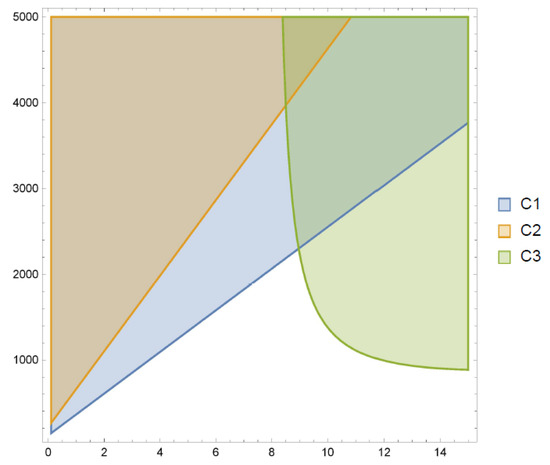
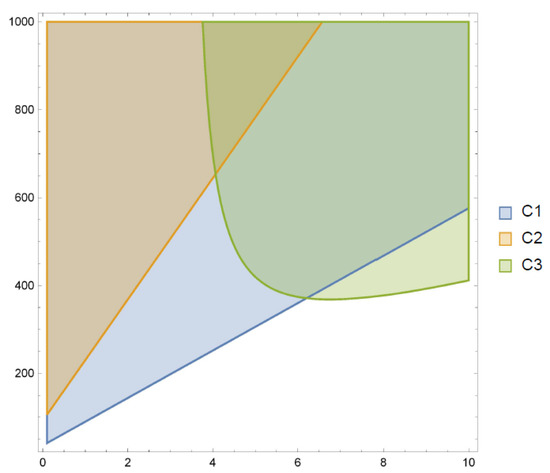
Figure 1 and Figure 2 illustrate the efficiency of the Conditions (32)–(34) in studying the oscillation of the solutions of (29). It can be easily observed that Condition (31) supports the most efficient condition for values of , and Condition (34) supports the most efficient condition for values of . Therefore, our results improve the results in [20,23] and complement the results in [21].
Figure 1.
Regions for which Conditions (32)–(34) are satisfied when and .
Figure 2.
Regions for which Conditions (32)–(34) are satisfied when and .
3. Conclusions
In this study, we established new criteria for oscillation of solutions of neutral delay differential equation of fourth order (1). By imposing two Riccati substitutions in each case of the derivatives of the corresponding function, we obtained criteria that ensure that all solutions oscillate. To the best of our knowledge, the sharp results that addressed the oscillation of (1) are presented in the works [18,20,21,23]. Li and Rogovchenko [21] improved the results in [18,20,23], but they used Lemma 4 with ( this is inaccurate); see Remark 12 in [14]. Thus, the results in [21] may be somewhat inaccurate. By applying our results to an example, it was shown that our results improve the previous results in the literature.
Author Contributions
All authors contributed equally to this article. All authors have read and agreed to the published version of the manuscript.
Funding
The authors extend their appreciation to the Deanship of Scientific Research at King Khalid University and Mansoura University for funding this work.
Acknowledgments
The authors extend their appreciation to the Deanship of Scientific Research at King Khalid University for funding this work through the Research Group Program under Grant No. RGP. 2/51/42.
Conflicts of Interest
There are no competing interests.
References
- Ahmed, E.; Hegazi, A.S.; Elgazzar, A.S. On difference equations motivated by modelling the heart. Nonlinear Dyn. 2006, 46, 49–60. [Google Scholar] [CrossRef][Green Version]
- Awrejcewicz, J.; Krysko, V. Nonclassic Thermoelastic Problems in Nonlinear Dynamics of Shells; Springer: Berlin/Heidelberg, Germany, 2003. [Google Scholar]
- Hale, J.K. Functional Differential Equations; Springer: New York, NY, USA, 1977. [Google Scholar]
- MacDonald, N. Biological Delay Systems: Linear Stability Theory; Cambridge University Press: Cambridge, UK, 1989. [Google Scholar]
- Moaaz, O.; Chalishajar, D.; Bazighifan, O. Some qualitative behavior of solutions of general class of difference equations. Mathematics 2019, 7, 585. [Google Scholar] [CrossRef]
- Agarwal, R.P.; Bohner, M.; Li, T.; Zhang, C. Oscillation of second-order Emden–Fowler neutral delay differential equations. Ann. Mat. Pura Appl. 2014, 4, 1861–1875. [Google Scholar] [CrossRef]
- Agarwal, R.P.; Zhang, C.; Li, T. Some remarks on oscillation of second order neutral differential equations. Appl. Math. Comput. 2016, 274, 178–181. [Google Scholar] [CrossRef]
- Baculikova, B.; Dzurina, J. Oscillation theorems for second-order nonlinear neutral differential equations. Comput. Math.Appl. 2011, 62, 4472–4478. [Google Scholar] [CrossRef]
- Bohner, M.; Grace, S.R.; Jadlovska, I. Oscillation criteria for second-order neutral delay differential equations. Electron. J.Qual. Theory Differ. Equ. 2017, 60, 1–12. [Google Scholar] [CrossRef]
- Bohner, M.; Grace, S.R.; Jadlovska, I. Sharp oscillation criteria for second-order neutral delay differential equations. Math. Methods Appl. Sci. 2020, 43, 1–13. [Google Scholar] [CrossRef]
- Chatzarakis, G.E.; Moaaz, O.; Li, T.; Qaraad, B. Some oscillation theorems for nonlinear second-order differential equations with an advanced argument. Adv. Differ. Equ. 2020, 2020, 160. [Google Scholar] [CrossRef]
- Moaaz, O.; Anis, M.; Baleanu, D.; Muhib, A. More effective criteria for oscillation of second-order differential equations with neutral arguments. Mathematics 2020, 8, 986. [Google Scholar] [CrossRef]
- Moaaz, O.; Elabbasy, E.M.; Qaraad, B. An improved approach for studying oscillation of generalized Emden–Fowler neutral differential equation. J. Ineq. Appl. 2020, 2020, 69. [Google Scholar] [CrossRef]
- Chatzarakis, G.E.; Grace, S.R.; Jadlovská, I.; Li, T.; Tunç, E. Oscillation criteria for third-order Emden–Fowler differential equations with unbounded neutral coefficients. Complexity 2019, 2019, 7p. [Google Scholar] [CrossRef]
- Jadlovská, I.; Chatzarakis, G.E.; Džurina, J.; Grace, S.R. On Sharp Oscillation Criteria for General Third-Order Delay Differential Equations. Mathematics 2021, 9, 1675. [Google Scholar] [CrossRef]
- Moaaz, O.; Elabbasy, E.M.; Shaaban, E. Oscillation criteria for a class of third order damped differential equations. Arab J. Math. Sci. 2018, 24, 16–30. [Google Scholar] [CrossRef]
- Moaaz, O.; Baleanu, D.; Muhib, A. New aspects for non-existence of kneser solutions of neutral differential equations with odd-order. Mathematics 2020, 8, 494. [Google Scholar] [CrossRef]
- Agarwal, R.P.; Bohner, M.; Li, T.; Zhang, C. A new approach in the study of oscillatory behavior of even-order neutral delay differential equations. Appl. Math. Comput. 2013, 225, 787–794. [Google Scholar] [CrossRef]
- Alsharari, F.; Bazighifan, O.; Nofal, T.A.; Khedher, K.M.; Raffoul, Y.N. Oscillatory Solutions to Neutral Delay Differential Equations. Mathematics 2021, 9, 714. [Google Scholar] [CrossRef]
- Baculikova, B.; Dzurina, J.; Li, T. Oscillation results for even-order quasilinear neutral functional differential equations. Electronic J. Diff. Equ. 2011, 2011, 1–9. [Google Scholar]
- Li, T.; Rogovchenko, Y.V. Oscillation criteria for even-order neutral differential equations. Appl. Math. Lett. 2016, 61, 35–41. [Google Scholar] [CrossRef]
- Moaaz, O.; El-Nabulsi, R.A.; Bazighifan, O. Oscillatory behavior of fourth-order differential equations with neutral delay. Symmetry 2020, 12, 371. [Google Scholar] [CrossRef]
- Xing, G.; Li, T.; Zhang, C. Oscillation of higher-order quasi-linear neutral differential equations. Adv. Difference Equ. 2011, 2011, 1–10. [Google Scholar] [CrossRef]
- Zhang, C.; Agarwal, R.P.; Bohner, M.; Li, T. New results for oscillatory behavior of even-order half-linear delay differential equations. Appl. Math. Lett. 2013, 26, 179–183. [Google Scholar] [CrossRef]
- Agarwal, R.P.; Grace, R.S.; O’Regan, D. Oscillation Theory for Difference and Functional Differential Equations; Kluwer Acad. Publ.: Dordrecht, The Netherlands, 2000. [Google Scholar]
- Kiguradze, I.T.; Chanturiya, T.A. Asymptotic Properties of Solutions of Nonautonomous Ordinary Differential Equations; Kluwer Acad. Publ.: Dordrecht, The Netherlands, 1993. [Google Scholar]
Publisher’s Note: MDPI stays neutral with regard to jurisdictional claims in published maps and institutional affiliations. |
© 2021 by the authors. Licensee MDPI, Basel, Switzerland. This article is an open access article distributed under the terms and conditions of the Creative Commons Attribution (CC BY) license (https://creativecommons.org/licenses/by/4.0/).