

Abstract
Let be the sequence of Fibonacci numbers. The order of appearance of an integer is defined as . Let be the set of all limit points of . By some theoretical results on the growth of the sequence , we gain a better understanding of the topological structure of the derived set . For instance, and does not have any interior points. A recent result of Trojovská implies the existence of a positive real number such that is the empty set. In this paper, we improve this result by proving that is the largest subinterval of which does not intersect . In addition, we show a connection between the sequence , for which tends to (as ), and the number of preimages of r under the map .
1. Introduction
Let be the Fibonacci sequence. For any positive integer n, the order of apparition (or the rank of appearance) of n in the Fibonacci sequence, denoted by , as the minimum element of the set . This function is well-defined by a result of Lucas [1] (p. 300) (in 1878) and, in 1975, Sallé [2] proved the sharpest upper bound , for all . Moreover, he also found the explicit form of all integers n for which the equality is attained. Indeed, it holds that
In particular, . Set and denote by its derived set (i.e., the set of all limit points of ). In 2013, Marques [3] proved the . Recently, Trojovský [4] generalized this result by showing that the natural density of is 1, for all . Recall that the natural density of is the following limit (if it exists)
where, for (see, e.g., recent paper [5] on natural density of sets related to generalized Fibonacci numbers of order r).
Summarizing, we have some important properties of , namely:
- and (Sallé [2]);
- (Marques [3]) and (Marques [6], see also [7]);
- does not contain any (non-degenerated) interval (Trojovský [4]).
In 2020, Trojovská [8] solved completely the Diophantine equation , with . She proved that all solutions are related to the cases or 2 (and there are two infinite families of solutions for each of these cases). In particular, and since tends to 2 as , then (by her result) there exists some real number such that does not contain any limit point of (i.e., ). This seems to be more apparent by Figure 1 (indeed, seemingly should work).
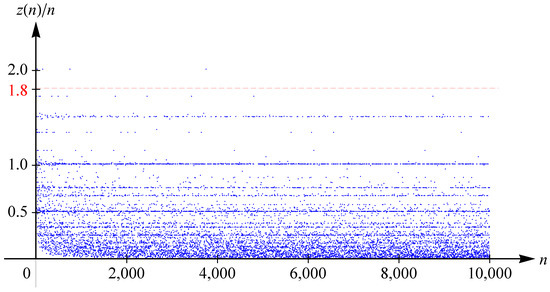
Figure 1.
The scatterplot of the function for values of n from 1 to .
Our first goal is to find the largest subinterval of which does not intersect . More precisely, we proved that
Theorem 1.
It holds that is the largest subinterval of which does not intersect .
Now, we turn our attention to the arithmetic properties of the sequences which “realize” the elements of . For that, let us make some definitions. First, for any , we denote as
i.e., is the set of all sequences (of positive integers) for which tends to r as . For example, (see [3]). Also, it is conjectured that holds for infinitely many prime numbers (the first few of them are , see sequence A000057 in OEIS [9]). If this conjecture is true, then also belongs to . However, if denotes the set of preimages of r under the function (i.e., ), then , while .
The next result provides a characterization for to be finite (for ) depending on the prime factors of the terms of . As usual, denotes the greatest prime factor of n and, for we define .
Theorem 2.
For any and , we have that is an infinite set if and only if is finite.
Remark 1.
Observe that the case is not considered in the previous theorem. The reason is that is the empty set, since , for all .
The proof of the theorems combines the growth properties of with some Diophantine aspects of its prime factors.
2. Auxiliary Results
In this section, we shall present some results which will be very important tools in the proof. The first ingredients are about the growth of related to the number of its distinct primes factors of n (denoted, as usual, by ):
Lemma 1.
We have
- (i)
- (Theorem 1.1 of [3]) (for ), (for ), and (for ).
- (ii)
- (Theorem 2.4 of [10]) If p is an odd prime, thenwhere . In particular, since , it holds thatwhere, as usual, denotes the p-adic valuation of m and denotes the Legendre symbol of an integer a with respect to an odd prime q.
Lemma 2
(Theorem 1.2 of [3]). Let n be an odd integer with , then
where
Lemma 3
(Theorem 1.3 of [3]). Let n be an even integer with and let as in the previous lemma, we have that
- (i)
- If , then
- (ii)
- If , then
- (iii)
- If , then
The next tool is a kind of “formula" for depending on for all primes p dividing n. The proof of this fact can be found in [11].
Lemma 4
(Theorem 3.3 of [11]). Let be an integer with prime factorization . Then
In general, it holds that
Our last auxiliary result is the following
Lemma 5.
Let be an integer and let be a prime number. If , then .
Proof .
Set be the factorization of a, where are prime numbers, with and . By Lemma 1 (ii), we have
for some . Striving for a contradiction, suppose that q divides (i.e., ), then q divides which divides . Since , then q divides , for some . This implies that
and so (where we used that , for all prime numbers p, also by Lemma 1 (ii)). Therefore, and (the only consecutive primes) leading to a contradiction (since ), which completes the proof. □
Now, we are ready to deal with the proof of the theorems.
3. The Proof of Theorem 1
Since if and only if , then, in order to prove that , it suffices to show that whenever n is not of the form and that for infinitely many positive integers n. This proof will be divided into four cases according to and the parity of n.
Case 1.. In this case, n is a power of a prime number, say . By Lemma 1 (ii), we have
Case 2.n odd and . By Lemma 2, we obtain
since and the minimum of is 1.
Case 3.n even, and . For this case, we must split the proof into 2 sub-cases:
- If , then Lemma 3 (i) yields
- If , then Lemma 3 (iii) implies that
Case 4.n even, and . This is the most delicate case, since it contains the extremal values (for ). Thus, Lemma 3 (in its item (ii)) only settles the case in which and . Indeed, in this situation, one has
In order to deal with the other cases, we need to improve the inequalities in Lemma 3 (ii).
- Suppose that and , then , for some prime number . If , we have by Lemmas 1 (i) and 4 thatand soLet us assume that . Thuswhere we used that and that , from Lemma 1 (ii). Therefore,Also, since , Lemma 1 (ii), yields that (here we used that ). We then getfor all and so .
- The remaining case is . Note that by Lemma 3 (ii), we infer thatIf , then . However, the minimum value of is 2 which is attained only if and n is a multiple of 5, i.e., , for some prime number p with . When , we deduce thatfor all (as before, one has that , for all , with ).Now, we must deal with the case that . Indeed, one hasaccording to or , respectively. In conclusion, we arrive at
Summarizing, we proved that if and only if or (for which ) as well as (for which ). Hence is the empty set.
To finish the proof, we must show that is the largest subinterval of without limit points of (observe that the length of is ). For proving this, it is enough to exhibit a partition of the interval by subintervals of length smaller than and whose endpoints belong to . Indeed, consider the following partition (and see Figure 2)

Figure 2.
Partition of into subintervals intersecting and with the length smaller than .
Graphically, the endpoints are positioned as below:
The largest among the intervals of partition has length (which is smaller than ). Hence, we only need to prove that all endpoints belong to (since , we may consider only nonzero endpoints). This is a consequence of Lemmas 1 and 4 and a straightforward calculation (we shall leave the details to the reader):
The proof is then complete. □
4. The Proof of Theorem 2
4.1. Proof of “If” Part
Let with . So, tends to r () and is a bounded sequence. Thus, there exist distinct prime numbers and an infinite set such that
for all , where . By Lemma 4, we have that
By Lemma 1 (ii), one has
where . We infer that divides (where we denote ) and so
for all n belonging to an infinite set , where and t is a divisor of . Thus
where (it is important to notice that , because , since ).
Since does not tend to 0 as , then is bounded. Therefore, by the pigeonhole principle, there exists a k-tuple such that
for all n belonging to an infinite set . In conclusion,
for all . Thus is an infinite set (since it contains ). □
4.2. Proof of the “Only If” Part
Let with . Then, we can write , where , and tends to infinity as . Passing through a subsequence, if necessary, we may assume that is an increasing sequence with , for all . By Lemmas 1 (ii) and 4, we have
where . Since , we have, by Lemma 5, that and then
where we used that if . Thus
Note that, in any case, if , then
where we used Sallé’s bound , for any m. However, tends to and tends to infinity (as ) which forces to be 1, for all n sufficiently large, say . Therefore
for all .
Suppose that , for all n belonging to an infinite set . Then , for positive coprime integers a and b and, by (2), we obtain
for all . However, (since ) and thus the relation (3) implies that divides b for all which is an absurd since is unbounded and . Thus must be a finite set. This completes the proof. □
5. Conclusions
In this paper, we study some properties of the set of limit points, say , of the sequence , where is the order of appearance in the Fibonacci sequence. For instance, some results in the literature imply that and 2 belongs to . Thus, in this work, we improve some growth results of in order to prove that is the largest subinterval of which does not contain any element of . Moreover, we show a connection between some arithmetic properties of the sequence , for which tends to (as ), and the number of preimages of r under the map .
Author Contributions
Formal analysis, K.V.; Funding acquisition, E.T.; Investigation, E.T.; Methodology, K.V.; Writing—original draft, E.T. All authors have read and agreed to the published version of the manuscript.
Funding
The research was supported by the Excellence Project PřF UHK No. 2213/2021–2022, University of Hradec Králové, Czech Republic.
Institutional Review Board Statement
Not applicable.
Informed Consent Statement
Not applicable.
Data Availability Statement
Not applicable.
Acknowledgments
The author thanks University of Hradec Králové for support.
Conflicts of Interest
The author declares no conflict of interest.
References
- Lucas, E. Théorie des fonctions numériques simplement périodiques. Am. J. Math. 1878, 1, 289–321. [Google Scholar] [CrossRef]
- Sallé, H.J.A. Maximum value for the rank of apparition of integers in recursive sequences. Fibonacci Quart. 1975, 13, 159–161. [Google Scholar]
- Marques, D. Sharper upper bounds for the order of appearance in the Fibonacci sequence. Fibonacci Quart. 2013, 51, 233–238. [Google Scholar]
- Trojovský, P. Some problems related to the growth of z(n). Adv. Difference Equ. 2020, 2020, 270. [Google Scholar] [CrossRef]
- Trojovský, P. On the Natural Density of Sets Related to Generalized Fibonacci Numbers of Order r. Axioms 2021, 10, 144. [Google Scholar] [CrossRef]
- Marques, D. Fixed points of the order of appearance in the Fibonacci sequence. Fibonacci Quart. 2012, 50, 346–352. [Google Scholar]
- Somer, L.; Křížek, M. Fixed points and upper bounds for the rank of appearance in Lucas sequences. Fibonacci Quart. 2013, 51, 291–306. [Google Scholar]
- Trojovská, E. On the Diophantine Equation z(n) = (2 − 1/k)n Involving the Order of Appearance in the Fibonacci Sequence. Mathematics 2020, 8, 124. [Google Scholar] [CrossRef]
- Sloane, N.J.A. The On-Line Encyclopedia of Integer Sequences. Available online: http://www.research.att.com/~njas/sequences/ (accessed on 5 August 2021).
- Fulton, J.D.; Morris, W.L. On arithmetical functions related to the Fibonacci numbers. Acta Arith. 1969, 16, 105–110. [Google Scholar] [CrossRef][Green Version]
- Renault, M. Properties of the Fibonacci Sequence Under Various Moduli. Master’s Thesis, Wake Forest University, Winston-Salem, NC, USA, 1996. Available online: http://webspace.ship.edu/msrenault/fibonacci/FibThesis.pdf (accessed on 5 August 2021).
Publisher’s Note: MDPI stays neutral with regard to jurisdictional claims in published maps and institutional affiliations. |
© 2021 by the authors. Licensee MDPI, Basel, Switzerland. This article is an open access article distributed under the terms and conditions of the Creative Commons Attribution (CC BY) license (https://creativecommons.org/licenses/by/4.0/).