1. Introduction
This work deals with multi-point iterative methods for approximating all the zeros of a polynomial simultaneously. Let us recall that an iterative method for solving a nonlinear equation is called a multi-point method if it can be defined by an iteration of the form
where
N is a fixed natural number, and
are
initial approximations. In the literature, there are multi-point iterative methods for finding a single zero of a nonlinear equation (see, e.g., [
1,
2,
3,
4,
5,
6,
7]). This study is devoted to the multi-point iterative methods for approximating all the zeros of a polynomial simultaneously (see, e.g., [
8,
9,
10,
11]).
Let us recall the two most popular iterative methods for simultaneous computation of all the zeros of a polynomial
f of degree
. These are Weierstrass’ method [
12] and Ehrlich’s method [
13].
Weierstrass’ method is defined by the following iteration:
where the function
is defined by
with
where
is the leading coefficient of
f and
denotes the set of all vectors in
with pairwise distinct components. Weierstrass’ method (
1) has second order of convergence (provided that
f has only simple zeros).
Ehrlich’s method is defined by the following fixed point iteration:
where the iteration function
is defined by
with
Ehrlich’s method has third order convergence. In 1973, this method was rediscovered by Aberth [
14]. In 1970, Börsch-Supan [
15] constructed another third-order method for simultaneous computing all the zeros of a polynomial. However in 1982, Werner [
16] proved that both Ehrlich’s and Börsch-Supan’s methods are identical.
In 1999, Trićković and Petković [
9] constructed and studied a two-point version of Ehrlich’s method. They proved that the two-point Ehrlich-type method has the order of convergence
.
In the present paper, we introduce an infinite sequence of multi-point Ehrlich-type iterative methods. We note that the first member of this family of iterative methods is the two-point Ehrlich-type method constructed in [
9]. The main purpose of this paper is to provide a local and semilocal convergence analysis of the multi-point Ehrlich-type methods.
Our local convergence result (Theorem 2) contains the following information: convergence domain; a priori and a posteriori error estimates; convergence order of every method of the family. For instance, we prove that for a given natural number
N, the order of convergence of the
Nth multi-point Ehrlich-type method is
, where
r is the unique positive solution of the equation
It follows from this result that the first iterative method has the order of convergence which coincides with the above mentioned result of Trićković and Petković. We note that each method of the new family has super-quadratic convergence of order . The semilocal convergence result (Theorem 4) states a computer-verifiable initial condition that guarantees fast convergence of the corresponding method of the family.
The paper is structured as follows: In
Section 2, we introduce the new family of multi-point iterative methods.
Section 3 contains some auxiliary results that underlie the proofs of the main results. In
Section 3, we present a local convergence result (Theorem 2) for the iterative methods of the new family. This result contains initial conditions as well as a priori and a posteriori error estimates. In
Section 5, we provide a semilocal convergence result (Theorem 4) with computer verifiable initial conditions.
Section 6 provides two numerical examples to show the applicability of our semilocal convergence theorem and the convergence behavior of the proposed multi-point iterative methods. The paper ends with a conclusion section.
2. A New Family of Multi-Point Ehrlich-Type Iterative Methods
Throughout the paper stands for a valued field with a nontrivial absolute value and denotes the ring of uni-variate polynomials over . The vector space is equipped with the product topology.
For a given vector
,
always denotes the
ith component of
u. For example, if
F is a map with values in
, then
denotes the
ith component of the vector
. Let us define a binary relation
on
as follows [
17]
Here and throughout the paper,
is defined by
Suppose
is a polynomial of degree
. A vector
is called a
root vector of the polynomial
f if
where
. It is obvious that
f possesses a root vector in
if and only if it splits over
.
In the following definition, we introduce a real-value function of two vector variables that plays an essential role in the present study.
Definition 1. Suppose is a polynomial of degree . We define an iteration function of two vector variables as follows: where is defined by Now the two-point Ehrlich-type root-finding method introduced by Trićković and Petković [
9] can be defined by the following iteration
with initial approximations
.
Theorem 1 (Petković and Trićkovic [
9]).
The convergence order of the two-point Ehrlich-type method (8) is . Based on the function , we define a sequence of vector-valued functions such that the Nth function is a function of vector variables.
Definition 2. We define a sequence of iteration functions recursively by setting and The sequence of domains is defined also recursively by setting and Clearly, the iteration function coincides with the function .
Definition 3. Let N be a given natural number, and be initial approximations. We define the Nth iterative method of an infinite sequence of multi-point Ehrlich-type methods by the following iteration Note that in the case
, the iterative method (
11) coincides with the two-point Ehrlich-type method (
8).
In
Section 4, we present a local convergence theorem (Theorem 2) for the methods (
11) with initial conditions that guarantee the convergence to a root vector of
f. In the case
, this result extends Theorem 1 in several directions.
In
Section 5, we present a semilocal convergence theorem (Theorem 4) for the family (
11), which is of practical importance.
3. Preliminaries
In this section, we present two basic properties of the iteration function
defined in Definition 1, which play an important role in obtaining the main result in
Section 4.
In what follows, we assume that
is endowed with the norm
defined by
and with the cone norm
defined by
assuming that
is endowed with the component-wise ordering ⪯ defined by
Furthermore, for two vectors
and
, we denote by
the vector
We define a function
by
with
Lemma 1 ([
11]).
Suppose and ξ is a vector with pairwise distinct components. where the function is defined by Lemma 2. Suppose is a polynomial of degree , which splits over , and is a root vector of f. Let be two vectors such that . If for some , then where is defined by Proof. Since
is a root vector of
f, we obtain
which proves (
14). □
Define the function
by
with domain
where
is defined by (
13).
Lemma 3. Let be a polynomial of degree with n simple zeros in , and let be a root vector of f. Suppose are two vectors such that . Then:
- (i)
;
- (ii)
;
- (iii)
,
where the functions Φ, E and σ are defined by (6), (13) and (16), respectively. Proof. (i) According to (
17), we have
. Then it follows from Lemma 1 that
for every
. This yields
. In view of (
7), it remains to prove that
for
. Let
be fixed. We shall consider only the non-trivial case
. In this case, (
19) is equivalent to
On the other hand, it follows from Lemma 2 that (
20) is equivalent to
, where
is defined by (
15). By Lemma 1 with
, we obtain
for every
. From (
15), (
18) and (
21), we obtain
This implies that which proves the first claim.
(ii) The second claim is equivalent to
for all
. If
, then (
23) holds trivially. Let
. Then, it follows from (
21) that
. It follows from (
6), (
20) and (
14) that
By (
24) and the estimate (
22), we obtain
Therefore, (
23) holds, which proves the second claim.
(iii) By dividing both sides of the last inequality by and taking the max-norm, we obtain the third claim. □
Lemma 4. Let be a polynomial of degree with n simple zeros in , and let be a root vector of f. Suppose are two vectors satisfying
where the function is defined by (13). Then: - (i)
;
- (ii)
;
- (iii)
.
Proof. It follows from (
25) that
and
Hence, it follows from (
17) that
which proves the claim (i). It is easy to show that
R is the unique positive zero of the function
, defined by
Then, from (
16) and (
26), we obtain
which proves (ii). The claim (iii) follows from Lemma 3 (iii) and claim (ii). □
4. Local Convergence Analysis
In this section, we present a local convergence theorem for the multi-point iterative methods (
11). More precisely, we study the local convergence of the multi-point Ehrlich-type methods (
11) with respect to the function of the initial conditions
defined by (
13), where
is a root vector of a polynomial
.
Definition 4. We define a sequence of functions by where σ is defined by (16). The domain is defined by and is defined by (10). Lemma 5. Let be a polynomial of degree with n simple zeros in and be a root vector of f. Assume and . Then:
- (i)
;
- (ii)
;
- (iii)
,
where and are defined by (9) and (29), respectively. Proof. Applying Lemma 1 with
, we obtain (i). It follows from Definition 2, Lemma 3 (ii) and Definition 4 that
which proves (ii). From Definition 2, Lemma 3 (iii) and Definition 4, we obtain
which proves (iii). □
Lemma 6. Let be a polynomial of degree with n simple zeros in , and let be a root vector of f. Assume and are vectors in such that
where the function is defined by (13). Then: - (i)
;
- (ii)
;
- (iii)
.
Proof. The proof goes by induction on
N. In the case
, Lemma 6 coincides with Lemma 4. Suppose that for some
the three claims of the lemma hold for every
vectors
satisfying (
30). Let
be
vectors satisfying
We must prove the following three claims:
By induction assumption, we obtain
. By induction assumption (ii) and (
30), we obtain
By induction assumption, we also have
The inequalities (
34) and (
35) yield
, which proves (
31). From Definition 4, Lemma 4 (ii) and induction assumption (ii), we obtain
which proves (
32). Claim (
33) follows from Lemma 5 (ii) and claim (
32). □
Now we are ready to state the first main result in this paper.
Theorem 2. Suppose is a polynomial of degree which has n simple zeros in , is a root vector of f, and . Let be initial approximations such that where the function is defined by (13). Then the multi-point Ehrlich-type iteration (11) is well defined and converges to ξ with order r and error estimates where is the unique positive root of the Equation (5), and λ is defined by Proof. First, we will show that the iterative sequence
generated by (
11) is well defined and the inequality
holds for every integer
. The proof is by induction. It follows from (
39) that (
40) holds for
. Suppose that for some
the iterates
are well defined and
We shall prove that the iterate
is well defined and that it satisfies the inequality (
40) with
. It follows from (
39) that
. Hence, from (
41) we obtain
Then by (
11), Lemma 6 (iii), (
41) and the definition of
r, we obtain
which completes the induction. By Lemma 6 (ii), (
40) and the definition of
r, we obtain the following estimate
From (
11), Lemma 5 (ii) and the last estimate, we obtain
which proved the a posteriori estimate (
37). The a priori estimate (
38) can be easily proved by induction using the estimate (
37). Finally, the convergence of the sequence
to a root vector
follows from the estimate (
38). □
Remark 1. It can be proved that the sequence , , of orders of the multi-point Ehrlich-type methods (11) is an increasing sequence which converges to 3 as . In Table 1, one can see the order of convergence for . 5. Semilocal Convergence Analysis
In this section, we present a semilocal convergence result for the multi-point Ehrlich type methods (
11) with respect to the function of initial conditions
defined by
where the function
is defined by (
2). We note that in the last decade, this is the most frequently used function to set the initial approximations of semilocal results for simultaneous methods for polynomial zeros. (see, e.g., [
10,
11,
17,
18,
19,
20,
21,
22]).
The new result is obtained as a consequence from the local convergence Theorem 2 by using the following transformation theorem:
Theorem 3 (Proinov [
19]).
Let be an algebraically closed field, be a polynomial of degree , and let be a vector with pairwise distinct components such that where . Then f has only simple zeros in and there exists a root vector of f such that Each iterative method for finding simultaneously all roots of a polynomial
of degree
is an iterative method in
. It searches the roots
of the polynomial
f as a vector
. We have noticed in
Section 2 that such a vector
is called a root vector of
f. Clearly, a polynomial can have more than one vector of the roots. On the other hand, we can assume that the vector root is unique up to permutation.
A natural question arises regarding how to measure the distance of an approximation
to the zeros of a polynomial. The first step is to identify all vectors whose components are the same up to permutation. Namely, we define a relation of equivalence ≡ on
by
if the components of
x and
y are the same up to permutation. Then following [
11,
20], we define a distance between two vectors
as follows
Note that is a metric on the set of classes of equivalence. For simplicity, we shall identify equivalence classes with their representatives.
In what follows, we consider the convergence in
with respect to the metric
. Clearly, if a sequence
in
is convergent to a vector
with respect to the norm
, then it converges to
x with respect to the metric
. The opposite statement is not true (see [
11]).
Before formulating the main result, we recall a technical lemma.
Lemma 7 ([
11]).
Let be such that . Then there exists a vector such that and Now we can formulate and prove the second main result of this paper.
Theorem 4. Suppose is an algebraically closed field, is a polynomial of degree and . Let be initial approximations satisfying the following condition: where the function is defined by (42). Then the polynomial f has only simple zeros and the multi-point Ehrlich-type iteration (11) is well defined and converges (with respect to the metric ρ) to a root vector ξ of f with order of convergence , where r is the unique positive solution of the Equation (5). Proof. The condition (
47) can be represented in the form
where
R is defined in (
36). From Theorem 3 and the inequality (
48), we conclude that
f has
n simple zeros in
and that there exist root vectors
such that
Let us put
. Since
are root vectors of
f, then
for all
. It follows from Lemma 7 that there exist vectors
such that
and (
49) can be represented in the form
It follows from Theorem 2 and inequality (
50) that the multi-point iterative method (
11) with initial approximations
is well defined and converges to
. Hence, the iteration (
11) with initial approximations
converges with respect to the metric
to the root vector of
f. □
The following criterion guarantees the convergence of the methods (
11). It is an immediate consequence of Theorem 4.
Corollary 1 (Convergence criterion).
If there exists an integer such that then f has only simple zeros and the multi-point Ehrlich-type iteration (11) converges to a root vector ξ of f. The next result is an immediate consequence of Theorem 5.1 of [
19]. It can be used as a stopping criterion of a large class of iterative methods for approximating all zeros of a polynomial simultaneously.
Theorem 5 (Proinov [
19]).
Suppose is an algebraically closed field, is a polynomial of degree with simple zeros, and is a sequence in consisting of vectors with pairwise distinct components. If is such that then the following a posteriori error estimate holds: where the metric ρ is defined by (45), the function is defined by (42), and the function α is defined by 6. Numerical Examples
In this section, we present two numerical examples in order to show the applicability of Theorem 4. Using the convergence criterion (
51), we show that at the beginning of the iterative process it can be proven numerically that the method is convergent under the given initial approximations.
We apply the first four methods of the family (
11) for calculating simultaneously all the zeros of the selected polynomials. In each example, we calculate the smallest
that satisfies the convergence criterion (
51). In accordance with Theorem 5, we use the following stop criterion
where
and
are defined by (
52) and (
53), respectively. To see the convergence behavior of the methods, we show in the tables
in addition to
.
In both examples, we take the same polynomials and initial approximations as in [
11], where the initial approximations are chosen quite randomly. This choice gives the opportunity to compare numerically the convergence behavior of the multi-point Ehrlich-type methods with those of the multi-point Weierstrass-type methods which are studied in [
11].
To present the calculated approximations of high accuracy, we implemented the corresponding algorithms using the programming package Wolfram Mathematica 10.0 with multiple precision arithmetic.
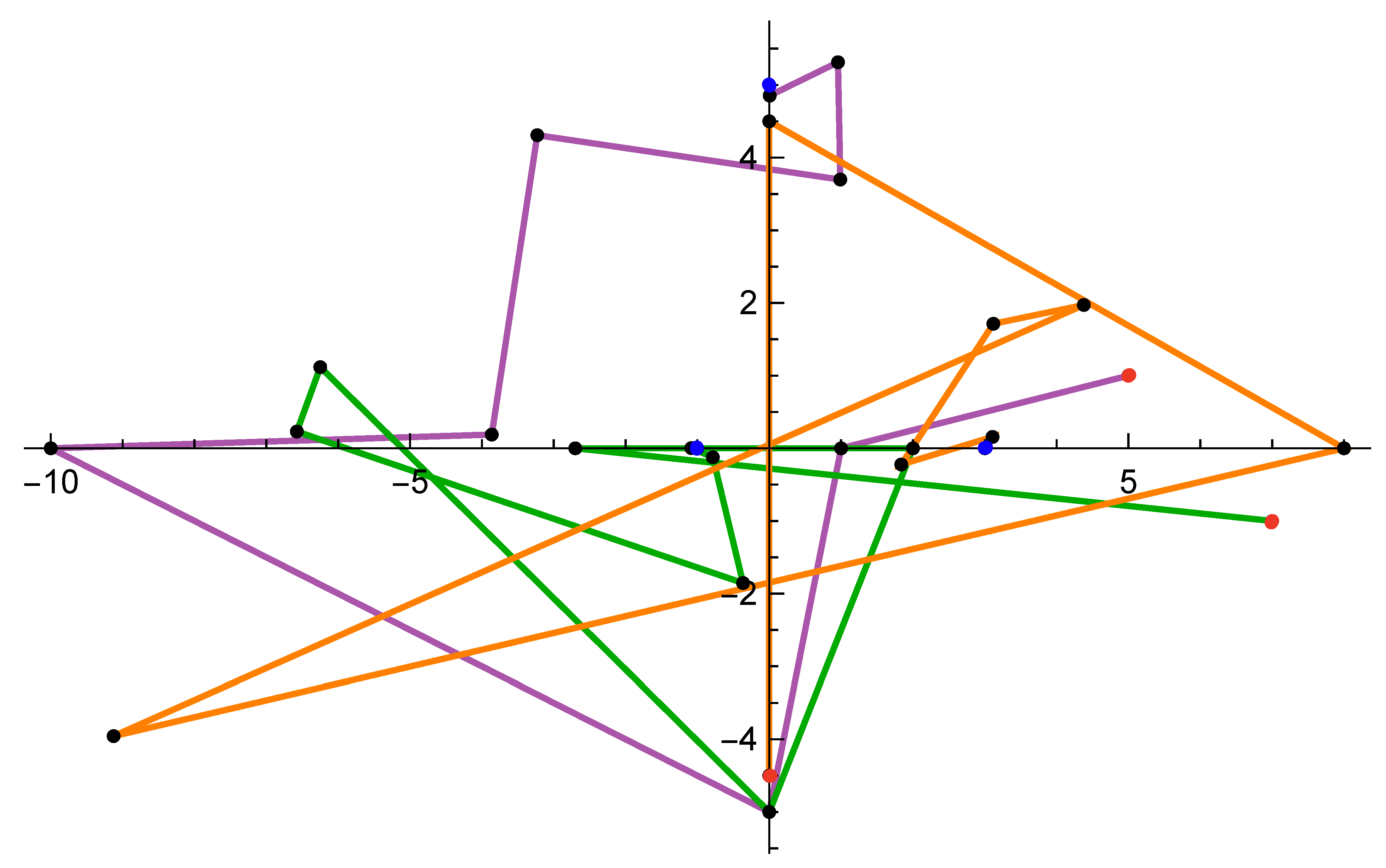
Example 1. The first polynomial is with zeros , 3 and (marked in blue in Figure 1). For , the initial approximations in are given in Table 2, where In the case , the initial approximations are marked in red in Figure 1. The numerical results for Example 1 are presented in
Table 3. For instance, for the multi-point Ehrlich-type method (
11) with
, one can see that the convergence condition (
51) is satisfied for
which guarantees that the considered method is convergent with order of convergence
. The stopping criterion (
55) is satisfied for
and at the sixth iteration the guaranteed accuracy is
. At the next seventh iteration, the zeros of the polynomial
f are calculated with accuracy
.
In
Figure 1, we present the trajectories of the approximations generated by the first six iterations of the method (
11) for
. We observe how each initial approximation, moving along a bizarre trajectory, finds a zero of the polynomial.
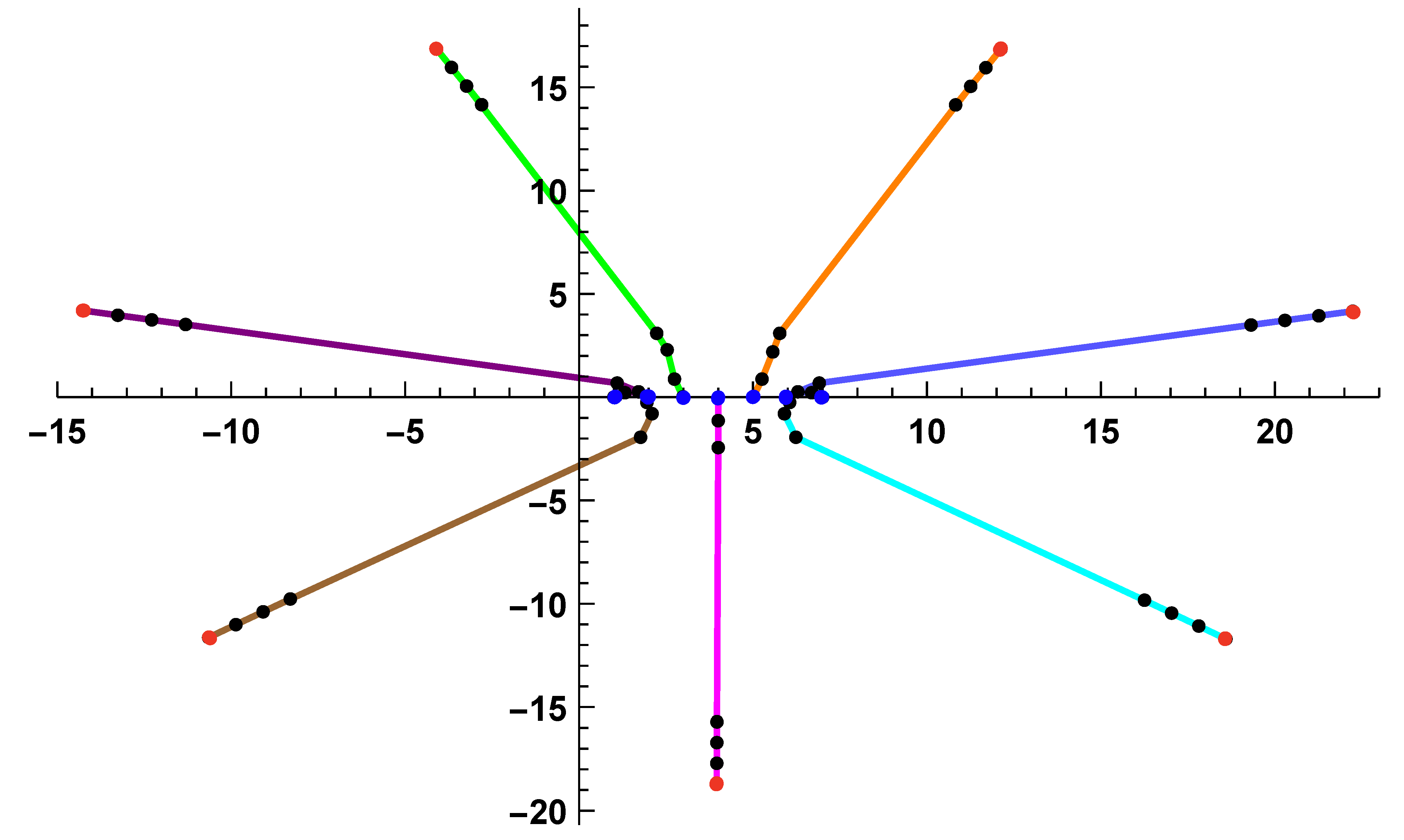
Example 2. The second polynomial is with zeros (marked in blue in Figure 2). For given , the initial approximations are chosen with Aberth initial approximations as follows: where , , and . In the case , the initial approximations are marked in red in Figure 2. The numerical results for Example 2 are presented in
Table 4. For example, for the multi-point Ehrlich-type method (
11) with
, the convergence condition (
51) is satisfied for
and the stopping criterion (
55) is satisfied for
which guarantees an accuracy
. At the next ninth iteration, the zeros of the polynomial
f are calculated with accuracy
. In
Figure 1, we present the trajectories of the approximations generated by the first seven iterations of the method (
11) for
. One can see that the trajectories are quite regular in the case of Aberth’s initial approximations.
7. Conclusions
In this paper, we introduced a new family of multi-points iterative methods for approximating all the zeros of a polynomial simultaneously. Let us note that the first member of this family is the two-point Ehrlich-type method introduced in 1999 by Trićković and Petković [
9]. Its convergence order is
.
We provide a local and semilocal convergence analysis of the new iterative methods. Our local convergence result (Theorem 2) contains the following information for each method: convergence order; initial conditions that guarantee the convergence; a priori and a posteriori error estimates. In particular, each method of the family has super-quadratic convergence of order . Our semilocal convergence result (Theorem 4) can be used to numerically prove the convergence of each method for a given polynomial and initial approximation.
Finally, we would like to note that the local convergence theorem was obtained by a new approach developed in our previous article [
11]. We believe that this approach can be applied to obtain convergence results for other multi-point iterative methods.