Abstract
In this paper, we introduce a new construction method of a fuzzy implication from n increasing functions () and fuzzy negations (). Imagine that there are plenty of combinations between increasing functions and fuzzy negations in order to produce new fuzzy implications. This method allows us to use at least two fuzzy negations and one increasing function in order to generate a new fuzzy implication. Choosing the appropriate negations, we can prove that some basic properties such as the exchange principle (EP), the ordering property (OP), and the law of contraposition with respect to are satisfied. The worth of generating new implications is valuable in the sciences such as artificial intelligence and robotics. In this paper, we have found a novel method of generating families of implications. Therefore, we would like to believe that we have added to the literature one more source from which we could choose the most appropriate implication concerning a specific application. It should be emphasized that this production is based on a generalization of an important form of Yager’s implications.
1. Introduction
Fuzzy implications are the generalization of the classical (Boolean) implication in the interval of [0,1]. They play an important role in the area of fuzzy logic, decision theory, and fuzzy control. We can generate fuzzy implications from aggregation functions and fuzzy negations [1,2,3,4,5]. Other ways of generating fuzzy implications can be achieved by additive generating functions or by some initials implications [6,7,8,9,10,11]. Fuzzy implications are used for the application of the ‘if-then’ rule in fuzzy systems and inference processes, through Modus Ponens and Modus Tollens [12].
This paper is inspired by Yager’s f-generated implications where is a strictly decreasing and continuous function and . In addition, a fuzzy implication is defined by: with the understanding 0·∞ = 0 (see [1] Definition 3.1.1). In this paper, we use functions , which are increasing and continuous, and also . We present a new production machine of fuzzy implications. Such a type of generating fuzzy implications can be found in the literature [1,2,5,6,7,8], for example, . The production of new fuzzy implications is accomplished with the help of any fuzzy negations and increasing functions. These generated fuzzy implications fulfill the necessary properties required to be fuzzy implications (see [1] Definition 1.1.1.). Moreover, if the negations are selected with certain properties, then the generated implications may also fulfill additional properties like the neutrality property (NP), exchange principle (EP), identity principle (IP), and some others. The worth of this production of implications could be estimated at artificial intelligence, robotics science, etc. [13,14,15]. This method of producing implications gives us the possibility, in a fuzzy environment, to find a large number of implications, which could help any researcher choose the most appropriate one.
The paper is organized as follows. In Section 2, we recall the basic concepts and definitions used in the paper. In Section 3, we study the new constructed method of fuzzy implications. Firstly, we present a constructed method using one increasing function and two negations , then a second method using two increasing functions and three negations . Finally, we generalize our constructed method using functions and negations
2. Preliminaries
In order to help the reader get familiar with the theory, we recall here some of the concepts and results employed in the rest of the paper.
Definition 1.
(see [1] Definition 1.1.1).A functionis called a fuzzy implication if it satisfies, for allthe following conditions:
The set of all fuzzy implications will be denoted by.
A fuzzy negation N is a generalization of the classical complement or negation ¬, whose truth table consists of the two conditions: ¬0 = 1 and ¬1 = 0.
Definition 2.
(see [1] Definition 1.4.1).A functionis called a fuzzy negation if it satisfies the following conditions:
Definition 3.
(see [1] Definition 1.4.2 (i)).A fuzzy negationis called strict if, in addition,
Definition 4.
(see [1] Definition 1.4.2 (ii)).A fuzzy negationis called strong if it is an involution, i.e.,
Definition 5.
(see [1] Definition 1.4.2 (ii)).A fuzzy negationis said to be non-vanishing if
N(x) = 0 ⟺ x = 1
Definition 6.
(see [1] Definition 1.4.2 (ii)).A fuzzy negation is said to be non-filling if
N(x) = 1 ⟺ x = 0
Definition 7.
(see [1] Definition 1.4.15 (ii)).Let I ∈ FI. The functiondefined by
is called the natural negation of I.
Example 1.
(see [1] example 1.4.4, [2] Section 2.1 Example 1).Important negations that will be used throughout this paper are the standard negationthe least or Godel, and the greatest or dual Godel fuzzy negations given respectively by
Definition 8.
(see [1] Definitions 1.3.1, 1.5.1).A Fuzzy Implicationis said to satisfy
- i.
- The left neutrality property if:
- ii.
- The exchange principle if:
- iii.
- The identity principle if:
- iv.
- The ordering property if:
- v.
- The law of contraposition with respect toif:
- vi.
- The law of left contraposition with respect toif:
- vii.
- The law of right contraposition with respect to N if:
Definition 9.
(see [1] Notations and Some Preliminaries).We say that functionsare Φ-conjugate if there exists a φ ∈ Φ such that , where
Definition 10.
(see [1] Definition 2.2.1).A functionis called a triangular conorm (t-conorm) if it satisfies, for allthe following conditions:
Definition 11.
(see [1] Definition 2.1.1).A functionis called a triangular norm (t-norm) if it satisfies, for allthe following conditions:
Remark 1.
(see [1] Propositions 1.1.8, 1.4.8 and Remarks 2.1.4 (vii), 2.2.5 (vii)).It is proved that, if φ ∈ Φ, T is a continuous t-norm,is a continuous t-conorm,is a fuzzy (strict, strong) negation, andis a fuzzy implication, thenis a t-norm,is a t-conorm,is a fuzzy (strict, strong) negation, andis a fuzzy implication.
Definition 12.
(see [1] Definition 2.4.1).The equation p → q ≡ ¬p ∨ q creates a new class of fuzzy implications.
A functionis called an (S, N)-Implication if there exist a t-conorm S and a fuzzy negationsuch that:
Definition 13.
(see [1] Subsection 7.3).The equation (p ∧ q) → r ≡ (p → (q → r)) is known as the law of importation and is a tautology in classical logic. The general form of the above equivalence is given by
Definition 14.
(see [1] Definition 7.4.1).An implication I and a t-norm T satisfy the T-conditionality property if and only if
Proposition 1.
(see [1] Definition 7.4.2).If I ∈ FI is such that there exist x, y ∈ (0, 1) such that x > y and I(x, y) = 1, then I does not satisfy (32) with any t-norm T.
Proposition 2.
(see [1] Definition 7.4.3).Let I ∈ FI, a t-norm T satisfy (32),is the natural negation of I andis the natural negation of T, then , the natural negation of T.
Definition 15.
(see [1] Definition 1.6.1).Let N be a fuzzy negation and I be a fuzzy implication. A functiondefined by
is called the N-reciprocal of I.
When N is the classical negation, thenis called the reciprocal of I and is denoted by.
3. The Main Results
In this section, we give definitions of new generated implications and prove some useful properties of them.
3.1. Fuzzy Implications Generated by One Increasing Function and Two fuzzy negations
Theorem 1.
Ifare two fuzzy negations andis an increasing and continuous function with g(0) = 0, then the functiondefined by
is a fuzzy implication.
Proof.
Let be an increasing and continuous function with g(0) = 0 and
- If then
- is decreasing, i.e., I satisfies (1)
- Let . If , then
- is increasing, i.e., I satisfies (2)
- , i.e., I satisfies (3)
- , i.e., I satisfies (4)
- , i.e., I satisfies (5)
- Therefore, I ∈ FI. □
Proposition 3.
Let I be the fuzzy implication of Theorem 1, then the fuzzy implication N-reciprocal of I is
Proposition 4.
Ifare strong negations, then the fuzzy implication of Theorem 1 satisfies additionally the left neutrality property (14) and the exchange principle (15).
Proof.
, y ∈ [0, 1], i.e., I satisfies (14)
Thus, we have i.e., I satisfies (15). □
Theorem 2.
If φ ∈ Φ and I is the fuzzy implication of Theorem 1, then Iφ is a fuzzy implication.
Proof.
According to Remark 1, is a fuzzy implication. □
Proposition 5.
If = (the least fuzzy negation), then the fuzzy implication of Theorem 1 satisfies the Identity Principle (16).
Proof.
i.e., I satisfies (16). □
Proposition 6.
If the fuzzy implication of Theorem 1 satisfies the Identity Principle (16), then it satisfies the Ordering Property (17).
Proof.
Let x,y ∈ [0,1] and x ≤ y, then I(x,y) ≥ I(y, y) = 1. Thus, I(x, y) = 1.
- If ⇔
- ⇔
- ⇔
- ⇔
- x = 0 ≤ y or y = 1≥ x.
- Thus, we have x ≤ y. □
Proposition 7.
The natural negationof the fuzzy implication of Theorem 1 is
Proof.
□
Proposition 8.
Whenare strong negations, then the fuzzy implication of Theorem 1 is an (S, N)–implication.
Proof.
When are strong negations, according to Theorem 1 and Proposition 4, the fuzzy implication satisfies (I1) and (EP). Moreover, if are continuous negations, then is also a continuous fuzzy negation. We deduce that I is an (S, N) – implication (see [1] Theorem 2.4.10). □
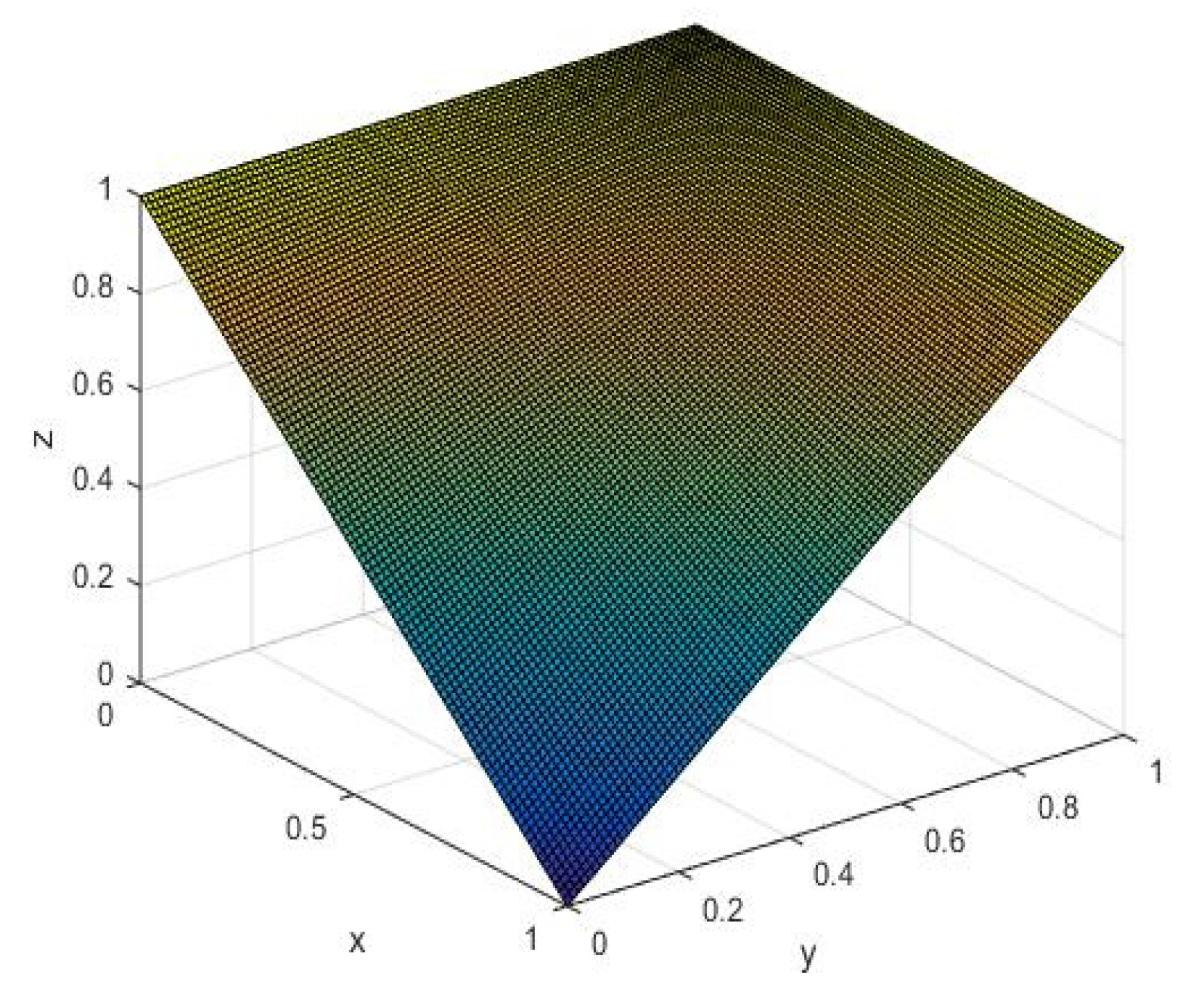
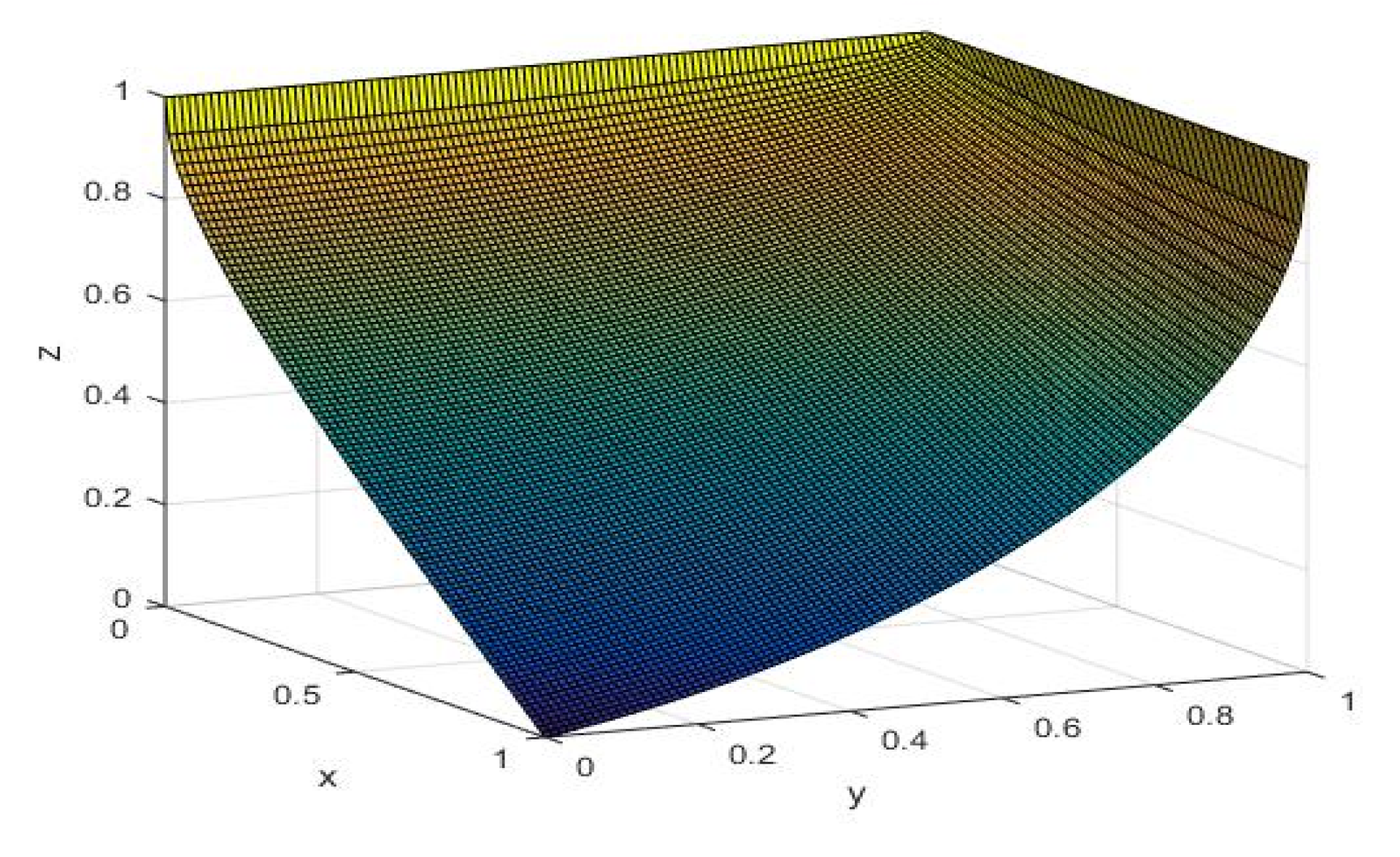
Example 2.
Let .
- Then,
- The graph of the above surface is plotted in Figure 1.
Figure 1. I implication of example 2.
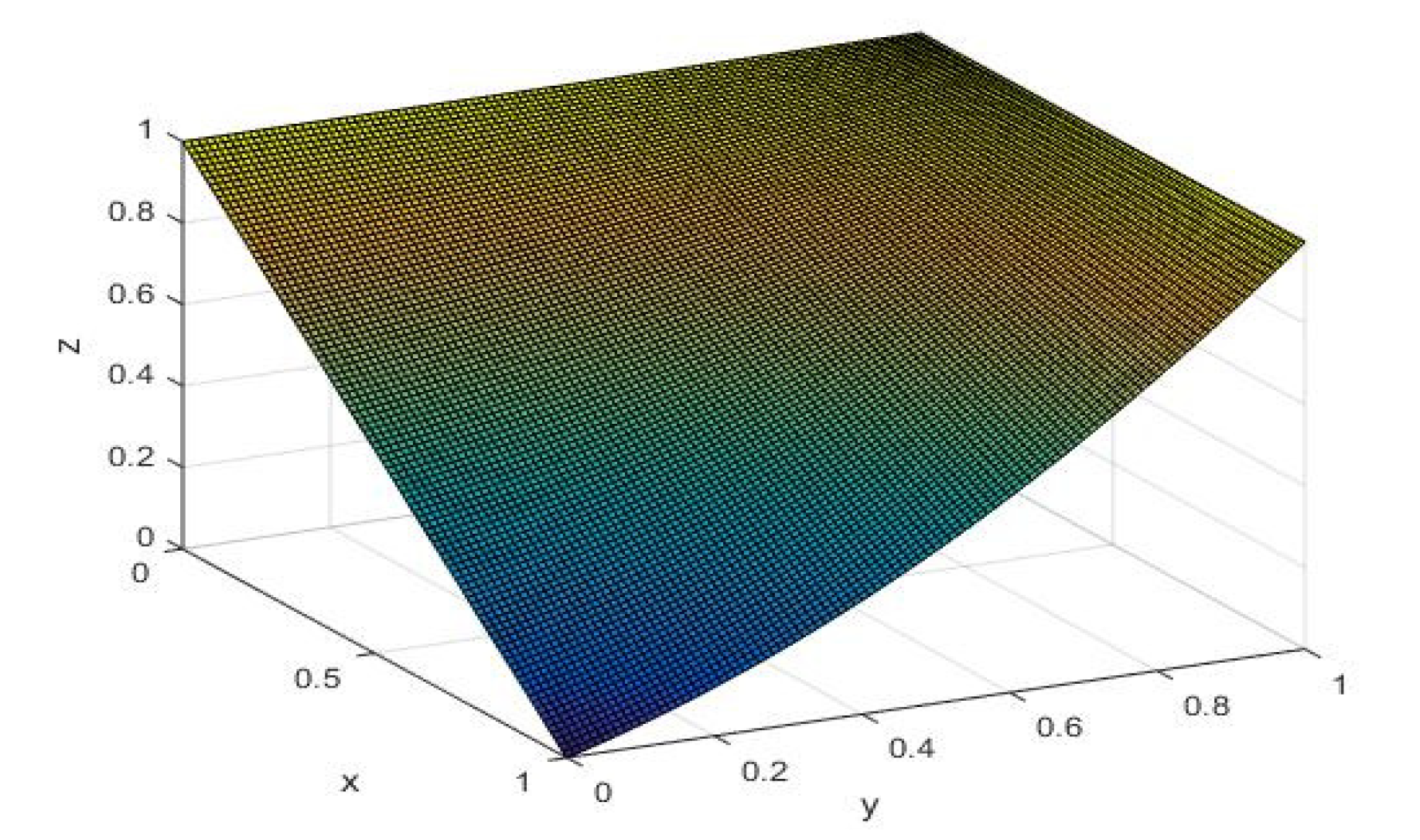
Example 3.
LetThus,Then, it is the Reinchenbach Implication.
The graph of the above surface is plotted in Figure 2.
Figure 2.
I implication of example 3.
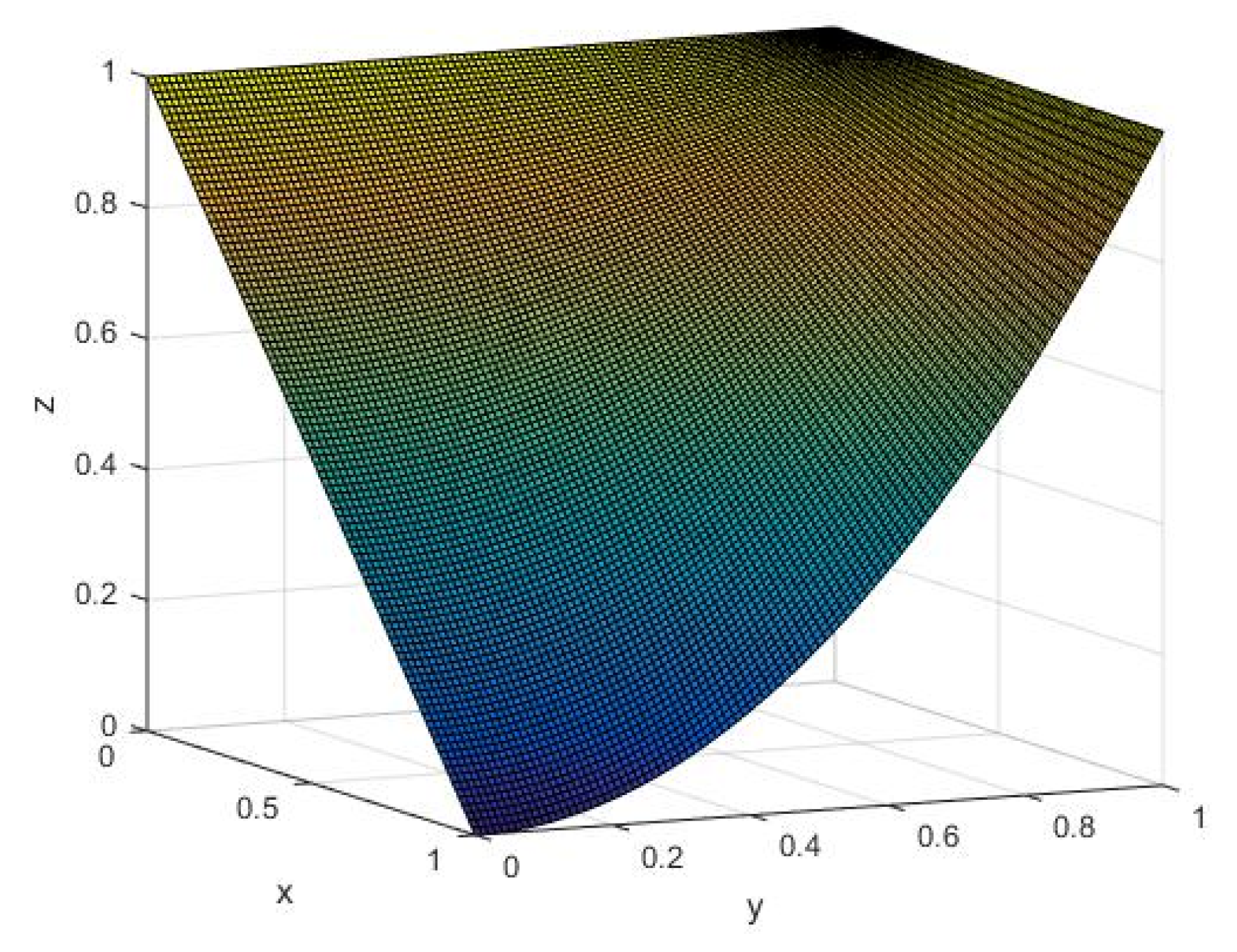
Example 4.
. Then,
The graph of the above surface is plotted in Figure 3.
Figure 3.
I implication of example 4.
Proposition 9.
Letbe three fuzzy negations. Let us suppose also thatis a strong fuzzy negation. If g: [0,1] → [0,∞) is an increasing and continuous function with g(0) = 0 and, then the fuzzy implicationdefined in Theorem 1 satisfies the law of contraposition (18) with respect to.
Proof.
g: [0,1] → [0,∞) is an increasing and continuous function
□
Lemma 1.
(see [1] Proposition 1.5.3).Letbe three fuzzy negations with the propertiesbeing strict ones andadditionally being a strong negation. If g: [0,1] → [0,∞) is an increasing and continuous function with g(0) = 0 and, then the fuzzy implicationdefined by Theorem 1 satisfies the left (L-CP) and the right (R-CP) law of the contraposition.
Proof.
According to Proposition 1.5.3 [1], I satisfies the left (19) and the right (20) law of the contraposition. □
Using Definition 14 and Proposition 2 of Section 2, we prove the following:
Proposition 10.
Let I be the fuzzy implication defined by Theorem 1, . Let us suppose that T is a t-norm and T satisfies (32), then:
- i.
- .
- ii.
- , if is a strong negation.
Proof.
As I and T satisfy (TC), then for all .
- i.
- Let ⇒ .
- ii.
- From Proposition 2, we have ⇒
□
3.2. Fuzzy Implications Generated by Two Increasing Functions and Three Fuzzy Negations
Theorem 3.
If are increasing and continuous functions withandare fuzzy negations, then the functiondefined by
is a fuzzy implication.
Proof.
- Let ∈ [0,1].
- If
- , i.e., I(∙,y) is decreasing, i.e., I satisfies (1).
- Let ∈ [0, 1]
- If , then ⇒
- i.e., is increasing, i.e., I satisfies (2).□
Proposition 11.
Letbe the fuzzy implication of Theorem 3. Ifare strong negations, then the neutrality property (14) and the exchange principle (15) are satisfied.
Proof.
, i.e., I satisfies (14)
We conclude that (15) is satisfied. □
Proposition 12.
Letbe the fuzzy implication of Theorem 3andbe fuzzy negations. If(the least fuzzy negation), then the identity principle (16) is satisfied.
Proof.
Thus, I satisfies (16). □
Proposition 13.
If the fuzzy implication of Theorem 3 satisfies the identity principle (16), then it satisfies the ordering property (17).
Proof.
Let x,y ∈ [0,1] and x ≤ y, then I(x,y) ≥ I(y, y) = 1. Thus, I(x, y) = 1.
If ⇔
- and (
- and or
- x = 0 ≤ y or y = 1 ≥ x.
- Thus, we have x ≤ y. □
Proposition 14.
Letbe four fuzzy negations. Let us suppose also thatis a strong fuzzy negation. If: [0,1] → [0,∞) are increasing and continuous functions withand, and, then the fuzzy implication defined in Theorem 3 satisfies the law of contraposition (16) with respect to.
Proof.
Thus, I satisfies (16). □
Proposition 15.
The natural negationof the fuzzy implication of Theorem 3 is
Proof.
□
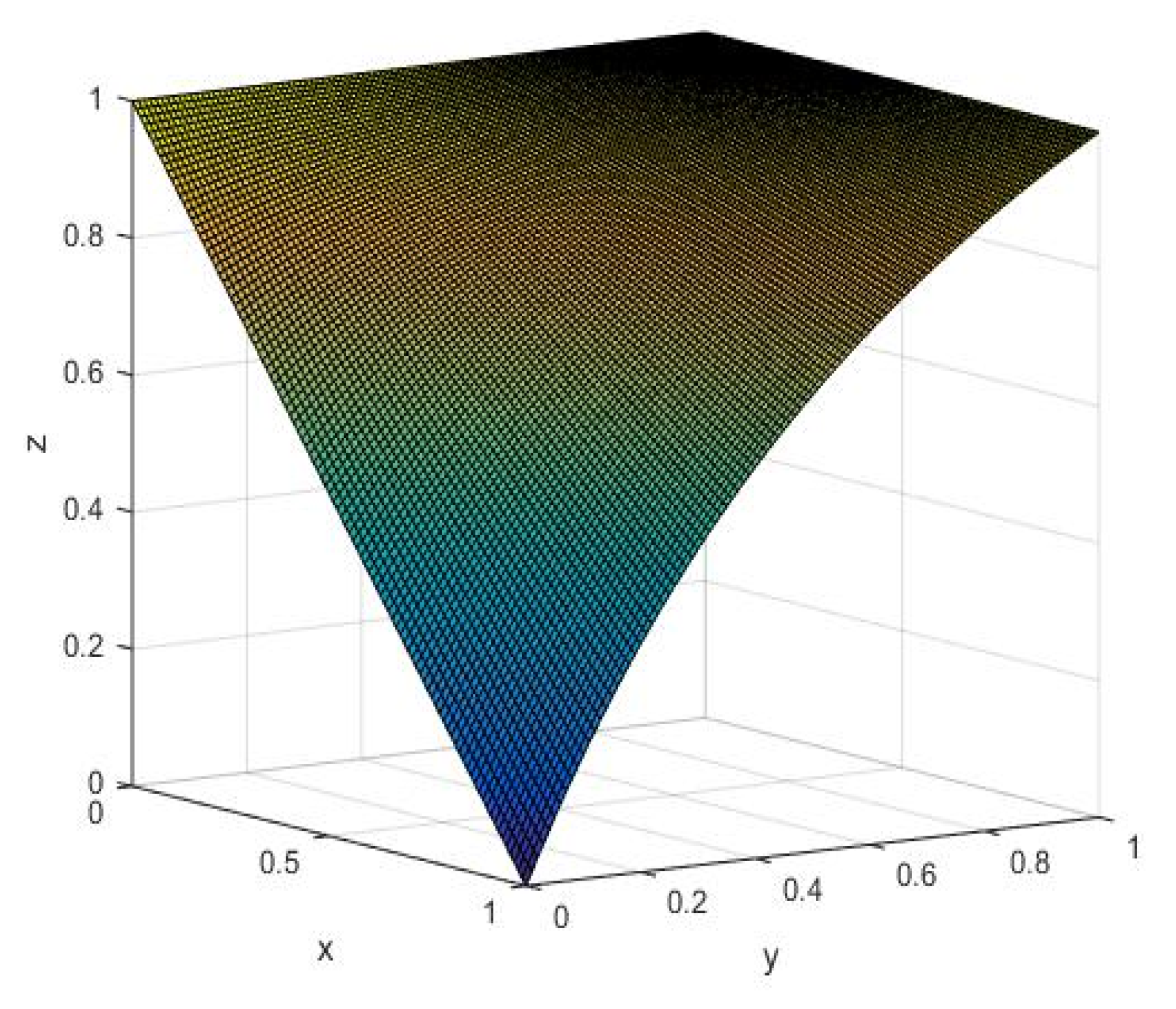
Example 5.
Let
- Then,
- The graph of the above surface is plotted in Figure 4.
Figure 4. I implication of example 5.
Example 6.
Let .
Then, .
The graph of the above surface is plotted in Figure 5.
Figure 5.
I implication of example 6.
3.3. Fuzzy Implications Generated by n Increasing Function and n + 1 Fuzzy Negations
Theorem 4.
If : [0,1] → [0,∞) are increasing and continuous functions, where (i = 1, 2, …n, n ∈ ℕ) and are fuzzy negations (i = 1,2,…n + 1 , n ∈ ℕ), then the function defined by
is a fuzzy implication.
Proof.
Let ∈ [0, 1].
If ⇒ , then
- ⇒ , i.e., I(,y) is decreasing, i.e., I satisfies (1)
- Let x ∈ [0, 1]. If , then
- , i.e., I(x,ˑ) is increasing, i.e., I satisfies (2)
- , i.e., I satisfies (3), i.e., I satisfies (4)
- , i.e., I satisfies (5). □
Proposition 16.
Letbe the fuzzy implication of Theorem 4. Ifare strong negations, then the left neutrality property (14) and the exchange principle (15) are satisfied.
Proof.
y ∈ [0, 1], i.e., I satisfies (14)
We conclude that (15) is satisfied, □
Proposition 17.
Letthe fuzzy implication defined by Theorem 4. Then, if(the least fuzzy negation), the identity principle (16) is satisfied.
Proof.
Thus, I satisfies (16). □
Proposition 18.
Letn + 2 be fuzzy negations. Let us suppose also thatis a strong fuzzy negation. If: [0,1] → [0,∞) (i = 1, …, n , n ∈ ℕ) are increasing and continuous functions withand, then the functiondefined by Theorem 4,satisfies the law of contraposition (18) with respect to.
Proof.
Thus, I satisfies (16). □
Proposition 19.
The natural negationof the fuzzy negation of Theorem 4 is

Proof.
□
4. Conclusions
In this paper, a new production machine of fuzzy implications from n continuous increasing functions and n + 1 negation are introduced. We studied certain properties of these new fuzzy implications, as the left neutrality property (14), exchange principle (15), identity principle (16), ordering property (17), law of contraposition (18), and T-Conditionality (32), where some results are obtained if the fuzzy negations are strong or the least fuzzy negations. The advance of this method relies on the fact that we can combine a lot of fuzzy negations and increasing functions in order to generate fuzzy implications.
Finally, we believe that this production machine needs to be investigated further. It has been observed that in order to be satisfied, certain desirable properties by the implications generated by this method must use strong fuzzy negations or the least fuzzy negation. A question that arises is the following one:
Are there non-strong fuzzy negations that satisfy the left neutrality property (14) or the exchange principle (15)? In addition, in a future paper, we will study the behavior of non-continuous functions in terms of the validity of certain basic properties.
Author Contributions
Supervision, B.K.P.; Investigation, M.N.R. All authors have read and agreed to the published version of the manuscript.
Funding
This research received no external funding.
Conflicts of Interest
The authors declare no conflict of interest.
References
- Baczynski, M.; Jayaram, B. Fuzzy Implications; Springer: Berlin/Heidelberg, Germany, 2008. [Google Scholar] [CrossRef]
- Baczynski, M.; Jayaram, B. (S, N)-and R-implications; a state-of-the-art survey. Fuzzy Sets Syst. 2008, 159, 1836–1859. [Google Scholar] [CrossRef]
- Baczynski, M.; Jayaram, B. QL-implications: Some properties and intersections. Fuzzy Sets Syst. 2010, 161, 158–188. [Google Scholar] [CrossRef]
- Baczynski, M.; Jayaram, B. (U, N)-implications and their characterizations. Fuzzy Sets Syst. 2009, 160, 2049–2062. [Google Scholar] [CrossRef]
- Durante, F.; Klement, E.P.; Meriar, R.; Sempi, C. Conjunctors and their residual implicators: Characterizations and construction methods. Mediterr. J. Math. 2007, 4, 343–356. [Google Scholar] [CrossRef]
- Massanet, S.; Torrens, J. An overview of construction methods of fuzzy implications. In Advances in Fuzzy Implication Functions. Studies in Fuzziness and Soft Computing; Springer: Berlin/Heidelberg, 2013; Volume 300, pp. 1–30. [Google Scholar] [CrossRef]
- Baczynski, M.; Jayaram, B.; Massanet, S.; Torrens, J. Fuzzy implications: Past, present, and future. In Springer Handbook of Computational Intelligence. Springer Handbooks; Springer: Berlin/Heidelberg, Germany, 2015; pp. 183–202. [Google Scholar] [CrossRef]
- Sainio, E.; Turunen, E.; Mesiar, R. A characterization of fuzzy implications generated by generalized quantifiers. Fuzzy Sets Syst. 2008, 159, 491–499. [Google Scholar] [CrossRef]
- Baczynski, M.; Jayaram, B. On the characterization of (S, N)-implications. Fuzzy Sets Syst. 2007, 158, 1713–1727. [Google Scholar] [CrossRef]
- Massanet, S.; Torrens, J. Threshold generation method of construction of a new implication from two given ones. Fuzzy Sets Syst. 2012, 205, 50–75. [Google Scholar] [CrossRef]
- Balasubramanian, J. Yager’s new class of implications Jf and some classical tautologies. Inf. Sci. 2007, 177, 930–946. [Google Scholar] [CrossRef]
- Zadeh, L.A. Outline of a new approach to the analysis of complex systems and decision processes. IEEE Trans. Syst. Man Cybern. 1973, SMC-3, 28–44. [Google Scholar] [CrossRef]
- Bogiatzis, A.C.; Papadopoulos, B.K. Producing fuzzy inclusion and entropy measures and their application on277 global image thresholding. Evol. Syst. 2018, 9, 331–353. [Google Scholar] [CrossRef]
- Bogiatzis, A.C.; Papadopoulos, B.K. Local Thresholding of degraded or unevenly illuminated documents using fuzzy inclusion and entropy measures. Evol. Syst. 2019, 10, 593–619. [Google Scholar] [CrossRef]
- Bogiatzis, A.C.; Papadopoulos, B. Global Image Thresholding Adaptive Neuro- Fuzzy Inference System Trained with Fuzzy Inclusion and Entropy Measures. Symmetry 2019, 11, 286. [Google Scholar] [CrossRef]
© 2020 by the authors. Licensee MDPI, Basel, Switzerland. This article is an open access article distributed under the terms and conditions of the Creative Commons Attribution (CC BY) license (http://creativecommons.org/licenses/by/4.0/).