Abstract
Quantum inequalities (QI) are local restraints on the magnitude and range of formulas. Quantum inequalities have been established to have a different range of applications. In this paper, we aim to introduce a study of QI in a complex domain. The idea basically, comes from employing the notion of subordination. We shall formulate a new q-differential operator (generalized of Dunkl operator of the first type) and employ it to define the classes of QI. Moreover, we employ the q-Dunkl operator to extend the class of Briot–Bouquet differential equations. We investigate the upper solution and exam the oscillation solution under some analytic functions.
Keywords:
differential operator; unit disk; univalent function; analytic function; subordination; q-calculus; fractional calculus; fractional differential equation; q-differential equation MSC:
30C45
1. Introduction
Quantum calculus exchanges the traditional derivative by a difference operator, which permits dealing with sets of non-differentiable curves and admits several formulas. The most common formula of quantum calculus is constructed by the q-operator (q-indicates for the quantum), which is created by the Jackson q-difference operator [1] as follows: let be the q-calculus which is formulated by
then the derivatives of functions are presented as fractions by the q-derivative
For example, the q-derivative of the function (for some positive integer n) is
Recently, quantum inequalities (differential and integral) have extensive applications not only in mathematical physics but also in other sciences. In variation problems, Cruz et al. [2] presented a new variational calculus created by the general quantum difference operator of . Rouze and Datta used the quantum functional inequalities to describe the transportation cost functional inequality [3]. Giacomo and Trevisan proved the conditional Entropy Power Inequality for Gaussian quantum systems [4]. Bharti et al. provided a novel algorithm to self-test local quantum systems employing non-contextuality quantum inequalities [5]. The class of quantum energy inequalities is studied by Fewster and Kontou [6]. In the control system, Ibrahim et al. established different classes of quantum differential inequalities [7]. In quantum information processing, Mao et al formulated a new quantum key distribution based on quantum inequalities [8].
In this investigation, we formulate a novel q-differential operator of complex coefficients and discuss its behavior in view of the theory of geometric functions. The suggested q-differential operator indicates a generalization of well-known differential operators in the open unit disk, such as the Dunkl operator and the Sàlàgean operator. It will be considered in some subclasses of starlike functions. Quantum inequalities involve the q-differential operator and some special functions are studied. Sharpness of QI is studied in the sequel. As an application, we employ the q-differential operator to define the q-Briot–Bouquet differential equations (q-BBE). Special cases are discussed and compared with recent works. Moreover, we illustrate a set of examples of q-BBE (for q = 1/2) and exam its oscillated solutions.
2. Related Works
The quantum calculus receives the attention of many investigators. This calculus, for the first time appeared in complex analysis by Ismail et al. [9]. They defined a class of complex analytic functions dealing with the inequality condition on the open unit disk. Grinshpan [10] presented some interesting outcomes filled with geometric observations are of very significant in the univalent function theory. Newly, q-calculus becomes very attractive in the field of special functions. Srivastava and Bansal [11] presented a generalization of the well-known Mittag–Leffler functions and they studied the sufficient conditions under which it is close-to-convex in the open unit disk. Srivastava et al. [12] established a new subclass of normalized smooth and starlike functions in . Mahmood et al. [13] introduced a family of q-starlike functions which are based on the Ruscheweyh-type q-derivative operator. Shi et al. [14] examined some recent problems concerning the concept of q-starlike functions. Ibrahim and Darus [15] employed the notion of quantum calculus and the Hadamard product to amend an extended Sàlàgean q-differential operator. Srivastava [16] developed many functions and classes of smooth functions based on the q-calculus. The q-Subordination inequality presented by Ul-Haq et al. [17]. Govindaraj and Sivasubramanian [18] as well as Ibrahim et al. [7] used the quantum calculus and the Hadamard product to deliver some subclasses of analytic functions involving the modified Sàlàgean q-differential operator and the generalized symmetric Sàlàgean q-differential operator respectively.
3. q-Differential Operator
Assume that ⋀ is the set of the smooth functions formulating by the followed power series
For a function the Sàlàgean operator expansion is formulated by the expansion
For we get
Now, let , the Sàlàgean q-differential operator [18] is formulated by
where m is a positive integer. A calculation associated by the formula of , yields , where ∗ is the convolution product,
and
Next, we present the q-differential operator as follows:
where For the operator subjects to the Sàlàgean operator [19]. In addition, the operator represents to the q-Dunkl operator of first rank [20], such that the value of is the Dunkl parameter. The term indicates a major law in oscillation study (see [21]). Furthermore, the term is denoting the quantum number q when . That is there is a connection between the definition of the and its coefficients.
Two functions ⋎ and ⋏ in ⋀ are subordinated ( ), if there occurs a Schwarz function with and whenever for all (see [22]). Literally, the subordination inequality is indicated the equality at the origin and inclusion regarding
Definition 1.
Assume that and Then it is in the set if and only if
where ς is univalent function of a positive real part in ∪ realizing .
The set of functions is an extension of types related to the Ma and Minda classes (see [23,24,25,26,27]). Next result indicates the upper and lower bound of a convex formula involving special functions, which will be useful in the next section.
Theorem 1.
Assume that . Then for as follows:
- 1.
- 2.
- 3.
- 4.
satisfying
and
Proof.
For , the first and second formula can be found in [25]. In the same manner, we show the third formal. When this implies that (see [24]). Obviously,
thus, this yields
Now, let this leads to
Consequently, we indicate that
thus, this yields
Extend the above outcome, for we obtain
and
Similarly, for the last assertion, where for we have a result in [27]. □
The next result can be found in [22].
Lemma 1.
Suppose that and . Then for two constants and with are achieving
Lemma 2.
Consider is a convex function in ∪ and for and n is a positive integer. If and
then and this outcome is sharp.
4. q-Subordination Relations
In this section, we deal with the set for some
Theorem 2.
Assume that fulfills the next relation:
where γ is non-negative real number (depending on β) and ς is one of the form in Theorem 1 and
Proof.
Suppose that and This implies the inequality
According to Theorem 1, one can find
which indicates
Hence, we have
which leads to the requested result. Assume that then we conclude the next minimization and maximization inequality
which implies
that is
Now, suppose that which implies that
A calculation yields
this yields
□
Remark 1.
In Theorem 2,
- When for non-negative γ (see [24]);
- When for all ς in Theorem 2 and non-negative real number γ (see [25]);
- When for all non-negative γ (see [28]);
- When for all non-negative γ (see [28]).
Next outcome shows the inclusion relation between the class and other geometric class.
Theorem 3.
The set satisfies the inclusion:
where ς is given in Theorem 1.
The class is an extension of the Uralegaddi set (see [29])
Proof.
Suppose that where is termed in Theorem 1. Then we obtain
and
Thus, □
Remark 2.
We have the following special cases from Theorem 3,
- for (see [24]);
- for (see [25], Theorem 2.5);
- for (see [25], Theorem 2.6).
- where (see [25], Corollary 2.7).
The following theorem confirms the belonging of a normalized function in the class where indicates the Janowski formula of order .
Theorem 4.
If satisfies the subordination
then where for
Proof.
In virtue of Lemma 1, a computation yields
Now, according to Lemma 1, we attain
which indicates that . □
The next result shows the iteration inequality including the q-differential operator and .
Theorem 5.
Suppose that φ is convex with and g is defined as follows:
If fulfills the inequality
then
Proof.
For all we define
Please note that the term
therefore, A differentiation implies that
Consequently, we indicate that
In virtue of Lemma 2, we conclude that which leads to
□
5. Q-Differential Equations
This section deals with a class of differential equations type complex Briot–Bouquet (see [30,31] for recent works) and its analytic solutions. The main formula of BBE is The operator (1) can be used to extend q-BBE as follows:
where (the set of univalent and convex in ∪). The aim is to discuss the maximum outcome of (2) by using -inequalities.
Theorem 6.
Suppose that and satisfy
Then the maximum solution of (3) is
where is smooth in such that and it is the upper limit in the above integral. Also, for , achieves the inequality
Proof.
By the definition of the subordination, inequality (3) achieves that there exists a Schwarz function satisfying and
This implies
Integrating both sides yields
A calculation indicates
Then, we have
for some Schwarz function. In addition, by the behavior of the function on the disk we have
and
Thus, we conclude that
which implies
and
We conclude that
□
Next result presents the condition on the coefficients of the normalized function ⋎ to satisfy the upper bound in Theorem 6.
Theorem 7.
Suppose that has non-negative coefficients. If in Equation (2) and then there is a solution satisfying the maximum bound inequality
where is smooth with and .
Proof.
By the condition of the theorem, we get the following assertions:
Moreover, we have , which leads to
Hence the proof. □
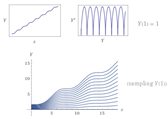
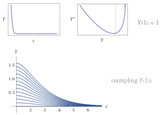
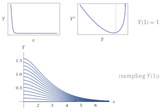
We illustrate an example to find the upper and oscillation solution of q-BBE when , see Table 1 and Table 2.
Table 1.
The upper bound solution of q-BBE for different
Table 2.
The oscillation solution for different .
Where is the cos integral function and is the sin integral function. The first example of -BBE of (2) is which has an oscillation solution with one branch point at the origin and has a local maximum at and local minimum at While, for the oscillation solution has no branch point in the disk. Moreover, for the oscillation solution has no branch point. Finally, when the oscillation solution has a global maximum equal to at
6. Conclusions
From above, we conclude that in view of the quantum calculus, some generalized differential operators in the open unit disk can have connections (coefficients) convergence of quantum numbers. These numbers might change the behavior of the operator and its classes of analytic functions. We investigated the oscillation solution and asymptotic solutions of different differential equations of the Briot–Bouquet type. For future work, one can employ the q-operator (1) in different classes of analytic functions such as the meromorphic and multivalent functions (see [32,33,34]).
Author Contributions
Investigation, R.M.E.; Methodology, R.W.I.; Writing original draft, R.W.I.; Writing review and editing, R.M.E. and S.J.O. All authors have read and agreed to the published version of the manuscript.
Funding
This work is financially supported by the Prince Sultan University.
Acknowledgments
The authors would like to thank both anonymous reviewers and editor for their helpful advice.
Conflicts of Interest
The authors declare no conflict of interest.
References
- Kac, V. Ch. Pokman; Quantum Calculus; Springer: New York, NY, USA, 2002. [Google Scholar]
- Da Cruz, A.M.C.B.; Natalia, M. General quantum variational calculus. Stat. Optim. Inf. Comput. 2018, 6, 22–41. [Google Scholar] [CrossRef]
- Cambyse, R.; Datta, N. Concentration of quantum states from quantum functional and transportation cost inequalities. J. Math. Phys. 2019, 60, 012202. [Google Scholar]
- Giacomo, D.P.; Trevisan, D. The conditional entropy power inequality for bosonic quantum systems. Commun. Math. Phys. 2018, 360, 639–662. [Google Scholar]
- Bharti, K.; Ray, M.; Varvitsiotis, A.; Warsi, N.A.; Cabello, A.; Kwek, L.C. Robust self-testing of quantum systems via noncontextuality inequalities. Phys. Rev. Lett. 2019, 122, 250403. [Google Scholar] [CrossRef]
- Fewster, C.J.; Eleni-Alexandra, K. Quantum strong energy inequalities. Phys. Rev. D 2019, 99, 045001. [Google Scholar] [CrossRef]
- Ibrahim, R.W.; Hadid, S.B.; Momani, S. Generalized Briot-Bouquet differential equation by a quantum difference operator in a complex domain. Int. J. Dyn. Control 2020, 1–10. [Google Scholar] [CrossRef]
- Mao, Q.P.; Wang, L.; Zhao, S.M. Decoy-state round-robin differential-phase-shift quantum key distribution with source errors. Quantum Inf. Process. 2020, 19, 56. [Google Scholar] [CrossRef]
- Ismail, M.E.H.; Merkes, E.; Styer, D. A generalization of starlike functions. Complex Var. Theory Appl. 1990, 14, 77–84. [Google Scholar] [CrossRef]
- Grinshpan, A.Z. Logarithmic geometry, exponentiation, and coefficient bounds in the theory of univalent functions and nonoverlapping domains. In Handbook of Complex Analysis: Geometric Function Theory; Kühnau, R., Ed.; Elsevier: Amsterdam, The Netherlands, 2002; pp. 273–332. [Google Scholar]
- Srivastava, H.M.; Bansal, D.E. Close-to-convexity of a certain family of q-Mittag-Leffler functions. J. Nonlinear Var. Anal. 2017, 1, 61–69. [Google Scholar]
- Srivastava, H.M.; Ahmad, Q.Z.; Khan, N.; Khan, N.; Khan, B. Hankel and Toeplitz determinants for a subclass of q-starlike functions associated with a general conic domain. Mathematics 2019, 7, 181. [Google Scholar] [CrossRef]
- Mahmood, S.; Srivastava, H.M.; Khan, N.; Ahmad, Q.Z.; Khan, B.; Ali, I. Upper bound of the third Hankel determinant for a subclass of q-starlike functions. Symmetry 2019, 11, 347. [Google Scholar] [CrossRef]
- Shi, L.; Khan, Q.; Srivastava, G.; Liu, J.L.; Arif, M. A study of multivalent q-starlike functions connected with circular domain. Mathematics 2019, 7, 670. [Google Scholar] [CrossRef]
- Ibrahim, R.W.; Darus, M. On a class of analytic functions associated to a complex domain concerning q-differential-difference operator. Adv. Differ. Equ. 2019, 2019, 515. [Google Scholar] [CrossRef]
- Srivastava, H.M. Operators of basic (or q-) calculus and fractional q-calculus and their applications in geometric function theory of complex analysis. Iran. J. Sci. Technol. Trans. A Sci. 2020, 44, 327–344. [Google Scholar] [CrossRef]
- Ul-Haq, M.; Raza, M.; Arif, M.; Khan, Q.; Tang, H. q-Analogue of Differential Subordinations. Mathematics 2019, 7, 724. [Google Scholar] [CrossRef]
- Govindaraj, M.; Sivasubramanian, S. On a class of analytic functions related to conic domains involving q-calculus. Anal. Math. 2017, 43, 475–487. [Google Scholar] [CrossRef]
- Sàlàgean, G.S. Subclasses of univalent functions. In Complex Analysis-Fifth Romanian-Finnish Seminar; Springer: Berlin/Heidelberg, Germany, 1983; pp. 362–372. [Google Scholar]
- Dunkl, C.F. Differential-difference operators associated to reflection groups. Trans. Am. Math. Soc. 1989, 311, 167–183. [Google Scholar] [CrossRef]
- Genest, V.X.; Lapointe, A.; Vinet, L. The Dunkl-Coulomb problem in the plane. Phys. Lett. A 2015, 379, 923–927. [Google Scholar] [CrossRef]
- Miller, S.S.; Mocanu, P.T. Differential Subordinations: Theory and Applications; CRC Press: Boca Raton, FL, USA, 2000. [Google Scholar]
- Ma, W.C.; Minda, D. A unified treatment of some special classes of univalent functions. In Proceedings of the Conference on Complex Analysis, Tianjin, China, 19–23 June 1992. [Google Scholar]
- Cho, N.E.; Kumar, V.; Kumar, S.S.; Ravichandran, V. Radius problems for starlike functions associated with the sine function. Bull. Iran. Math. Soc. 2019, 45, 213–232. [Google Scholar] [CrossRef]
- Khatter, K.; Ravichandran, V.; Kumar, S.S. Starlike functions associated with exponential function and the lemniscate of Bernoulli. Revista de la Real Academia de Ciencias Exactas, Fisicas y Naturales. Serie A. Matematicas 2019, 113, 233–253. [Google Scholar]
- Mendiratta, R.; Nagpal, S.; Ravichandran, V. On a subclass of strongly starlike functions associated with exponential function. Bull. Malays. Math. Sci. Soc. 2015, 38, 365–386. [Google Scholar] [CrossRef]
- Kumar, V.; Cho, N.E.; Ravichandran, V.; Srivastava, H.M. Sharp coefficient bounds for starlike functions associated with the Bell numbers. Math. Slovaca 2019, 69, 1053–1064. [Google Scholar] [CrossRef]
- Kanas, S.; Wisniowska, A. Conic domains and starlike functions. Revue Roumaine de Mathematiques Pures et Appliquees 2000, 45, 647–658. [Google Scholar]
- Uralegaddi, B.A.; Ganigi, M.D.; Sarangi, S.M. Univalent functions with positive coefficients. Tamkang J. Math 1994, 25, 225–230. [Google Scholar]
- Ibrahim, R.W.; Jahangiri, J.M. Conformable differential operator generalizes the Briot-Bouquet differential equation in a complex domain. AIMS Math. 2019, 4, 1582–1595. [Google Scholar] [CrossRef]
- Ibrahim, R.W.; Elobaid, R.M.; Obaiys, S.J. Symmetric Conformable Fractional Derivative of Complex Variables. Mathematics 2020, 8, 363. [Google Scholar] [CrossRef]
- Noor, K.I.; Badar, R.S. On a class of quantum alpha-convex functions. J. Appl. Math. Inform. 2018, 36, 541–548. [Google Scholar]
- Ahuja, O.; Anand, S.; Jain, N.K. Bohr Radius Problems for Some Classes of Analytic Functions Using Quantum Calculus Approach. Mathematics 2020, 8, 623. [Google Scholar] [CrossRef]
- Arif, M.; Barkub, O.; Srivastava, H.M.; Abdullah, S.; Khan, S.A. Some Janowski Type Harmonic q-Starlike Functions Associated with Symmetrical Points. Mathematics 2020, 8, 629. [Google Scholar] [CrossRef]

© 2020 by the authors. Licensee MDPI, Basel, Switzerland. This article is an open access article distributed under the terms and conditions of the Creative Commons Attribution (CC BY) license (http://creativecommons.org/licenses/by/4.0/).