

Abstract
Max–min algebra (called also fuzzy algebra) is an extremal algebra with operations maximum and minimum. In this paper, we study the robustness of Monge matrices with inexact data over max–min algebra. A matrix with inexact data (also called interval matrix) is a set of matrices given by a lower bound matrix and an upper bound matrix. An interval Monge matrix is the set of all Monge matrices from an interval matrix with Monge lower and upper bound matrices. There are two possibilities to define the robustness of an interval matrix. First, the possible robustness, if there is at least one robust matrix. Second, universal robustness, if all matrices are robust in the considered set of matrices. We found necessary and sufficient conditions for universal robustness in cases when the lower bound matrix is trivial. Moreover, we proved necessary conditions for possible robustness and equivalent conditions for universal robustness in cases where the lower bound matrix is non-trivial.
1. Introduction
In many optimization problems maximum and minimum operations are involved. Both of these operations have the property that they create no new elements. An extremal algebra is defined as an algebra in which at least one of the operations possesses the above-mentioned property. The notion extremal algebra was introduced in [1]. Most frequented are the max–min algebra (called also fuzzy algebra) with operations maximum and minimum and max-plus algebra (called also max algebra) with operations maximum and addition. The role of max-plus algebra in the field of discrete event systems and wide variety of topics in this algebra were presented in [2]. How the concept of max-plus algebra can be used in modeling discrete event systems was described in [3]. Theory regarding fuzzy sets and their applications was published in [4,5]. A generalized approach to max–min algebra was introduced in [6].
Matrices in fuzzy algebra are helpful for expressing applications in graph theory, knowledge engineering, cluster analysis, and also for modeling discrete dynamic systems, for describing diagnosis of technical devices [7], fuzzy logic programs [8] or medical diagnosis [9].
If the considered matrices possess special properties, e.g., Monge matrices, the algorithms for matrix computations can be more efficient. We have studied Monge matrices, their structural properties and algorithms solving many problems related to Monge matrices in [10,11,12,13,14,15]. Robustness of matrices is a special case of matrix periodicity. Periodicity in max–min algebra was studied in [16]. The formula for computing matrix period in max–min algebra was proved in [16], namely the period is equal to least common multiple of the periods of all non-trivial strongly connected components from all threshold digraphs of the matrix. The steady state of a discrete dynamic system is important for the stability of the system. It is connected with the eigenvectors of the system matrix [17,18]. Exactly a robust matrix has the property that an eigenvector is reached by arbitrary initial vector. Robustness of matrices in max-plus algebra was studied in [19,20,21] and in max–min algebra in [22]. Robustness of Monge matrices was presented in [23], where the sufficient and necessary condition for a Monge matrix to be robust was proved using similarly to [16] the method of investigating relevant properties of the threshold digraphs corresponding to given matrix. The proof of the equivalent condition is based on the fact that a threshold digraph of a fuzzy Monge matrix cannot contain loops in two different strongly connected components.
Matrix inputs are in practice rather inexact values, i.e., contained in an interval, than exact values. Hence it is useful to investigate interval matrices, i.e., matrices with interval coefficients [9,24,25,26,27]. The question of matrix robustness turns to questions of possible robustness (there exists at least one robust matrix in an interval matrix) and universal robustness (all matrices are robust in an interval matrix) in case of interval matrices. Robustness of interval matrices in max-plus algebra was studied in [28]. Necessary and sufficient conditions together with polynomial algorithms for verifying the robustness of interval circulant matrices and matrices in binary max-plus algebra were presented in [29]. Equivalent conditions for an interval matrix to be possibly robust in max–min algebra were proved in [30]. However, the resulting robust matrix of the described algorithm needs not to possess the Monge property. In addition, there is no polynomial algorithm to check the universal robustness in max–min algebra. The computational complexity of the algorithm presented in [30] can be exponentially large. In contrast to general case of an interval fuzzy matrix equivalent conditions for possible robustness and equivalent conditions for universal robustness of circulant matrices with corresponding polynomial algorithms to verify the robustness were found in [30]. Results dealing with another types of robustness of matrices in fuzzy algebra were presented in [31]. These results encouraged us to turn our attention to another class of special matrices, namely to matrices with Monge property in max–min algebra. Equivalent conditions for possible robustness as well as universal robustness of special classes of interval Monge matrices were presented in [32], i.e., interval Monge matrices with additional restrictions were considered.
The aim of this paper is to prove equivalent conditions for universal robustness and necessary condition for possible robustness of interval Monge matrices in binary case of max–min algebra.
We briefly outline the content and main results of the paper. Section 2 provides the necessary preliminaries on max–min algebra, periodicity and robustness in max–min algebra. In Section 3, the notion of a Monge matrix is introduced. Important properties in regard of digraph structure of Monge matrices are proved and results concerning robustness of Monge matrices with exact data are summarized. In Section 4, the notions of an interval matrix, interval Monge matrix and universal robustness are introduced. Results concerning possible and universal robustness are presented. The key results of this section are Theorem 10, which formulates a necessary condition for an interval Monge matrix to be possibly robust, and the Theorem 11, which formulates a necessary and sufficient condition for an interval Monge matrix to be universally robust.
2. Background
The fuzzy algebra is a triple , where is a bounded linearly ordered set with binary operations maximum and minimum, denoted by ⊕, ⊗. The least element in B is denoted by O, the greatest one by I. For a given natural , we use the notation N for the set of all smaller or equal positive natural numbers, i.e.,
A digraph is an ordered pair of sets , where V is a finite set of vertices, and E, the set of edges, is a subset of . A path in the digraph is a sequence of vertices such that for The number k is the length of the path p and is denoted by . If , then p is called a cycle. For any , denotes the set of all matrices of type and the set of all n–dimensional column vectors over For a given matrix the symbol stands for the complete, edge-weighted digraph associated with A. The vertex set of is N, and the capacity of any edge is . In addition, for given the threshold digraph is the digraph with the vertex set N and the edge set We define the period of a strongly connected component as with length If is trivial, then .
Let and . The sequence is the orbit of generated by A, where for each . For a given matrix , the number and the n–tuple are the so-called eigenvalue of A and eigenvector of A, respectively, if they satisfy the equation . We define the corresponding eigenspace as the set Let , . Let . A is called λ–robust if . A –robust matrix with is called a robust matrix.
According to [16] we define
The following theorems are crucial investigating robustness of matrices.
Theorem 1
([16]). Let . Then .
Theorem 2
([22]). Let . Then A is robust if and only if .
In this paper, we consider binary max–min algebra , i.e., is an ordered set , where
3. Robustness of Monge Matrices
In this section, we introduce the notion of a convex Monge matrix. We prove important properties in regard of digraph structure of Monge matrices which will be useful to investigate robustness of Monge matrices with inexact data. Moreover, we recall results concerning robustness of Monge matrices with exact data.
Definition 1.
A matrixis a convex Monge matrix if and only if
According to robustness we consider square matrices, only, in this paper, i.e., .
Definition 2.
A matrix A is a non-trivial matrix, if the threshold digraphcontains a cycle of positive length. Otherwise the matrix is trivial.
Theorem 3.
Let A be a trivial matrix. Then A is robust.
Proof.
By Definition 2 the digraph contains only trivial strongly connected components. The period of a trivial strongly connected component is 1. Hence, by Theorem 1 . By Theorem 2, if the period of a matrix is 1, then this matrix is robust. □
Lemma 1.
Let A be a Monge matrix. Let there exist cyclesandforandin the digraph. If one of the statements holds:
- (i)
- ,
- (ii)
- ,
then the cyclesandlie in a common non-trivial strongly connected component.
Proof.
- (i)
- Let there exist cycles and in the digraph and let . We prove that the cycles and lie in a common non-trivial strongly connected component of . The following cases may occur:
- (a.)
- Let . Then . It means that the cycle is a loop lying on the cycle in , or if , and are identical loops, respectively. Thus, nodes lie in a common non-trivial strongly connected component.
- (b.)
- Let . Then . It means that there exists a cycle in . Thus, nodes lie in a common non-trivial strongly connected component.
- (c.)
- Let . Based on Definition 1 for , holds:Since , and must equal to 1. Thus, there exist edges and in , i.e., there is a cycle in . Hence, the nodes lie in a common non-trivial strongly connected component.
- (ii)
- Let there exist cycles and in the digraph and let . We prove that the cycles and lie in a common non-trivial strongly connected component of . The following cases may occur:
- (a.)
- Let . Then . It means that the cycle is a loop lying on cycle in , or if , and are identical loops, respectively. Thus, the nodes lie in a common non-trivial strongly connected component.
- (b.)
- Let . This means that , thus there exists a cycle in . Hence, the nodes lie in a common non-trivial strongly connected component.
- (c.)
- Let . This means that , thus there exists a cycle in . Hence, the nodes lie in a common non-trivial strongly connected component.
- (d.)
- Let . Based on Definition 1 for , holds:Since , and must equal to 1. Then there exist edges and in , i.e., there is a cycle in . Hence, the nodes lie in a common non-trivial strongly connected component. In case, if the nodes lie in a common non-trivial strongly connected component trivially.
□
Lemma 2.
Let A be a Monge matrix. Letcontain a non-trivial strongly connected component. Then there is a cyclefor,in the digraph.
Proof.
Let contains a non-trivial strongly connected component with a loop, for which holds , . If , then the statement holds trivially. Hence, in the following text we consider .
- ▹
- Let be the maximal index for which holds and let , i.e., . The node u lies in . This implies that there exists with . By the Monge property of A we get:Since , then also (and as well). This is a contradiction with the assumption .
- ▹
- Let be the minimal index for which holds and let , i.e., . The node t lies in . This implies that there exists with . By the Monge property of A we get:Since , then also (and as well). This is a contradiction with the assumption .
□
Lemma 3.
Let A be a Monge matrix. Letcontain a non-trivial strongly connected componentwith a loop. Let,. If there is a cycleforin the digraph, then.
Proof.
Let contain strongly connected component with a loop, for which holds , . If , then the statement holds trivially. Hence, we consider in the following text.
- (i)
- Let . contains a loop, i.e., by Lemma 4 it follows that
- (ii)
- Let . Since contains a loop, there exists , for which .The following cases may occur:
- ▹
- Let . Thus, . According to Definition 1 the following statement holds:Since , as well. This implies that there exist edges and in . Thus, the nodes lie in a common non-trivial strongly connected component .
- ▹
- We prove the cases and by analogy with the above case.
- ▹
- Let . Since , there exists a path , which connects the node t with the node m in the strongly connected component while or , respectively, and at the same time. The same applies that there exists a path , which connects the node u with the node m in the strongly connected component while the same inequalities as above hold for the given indices.
- ▶
- Let . According to Definition 1 the following statement holds:Since , as well. This implies that there exist edges and in . Thus, the nodes lie in a common non-trivial strongly connected component .
- ▶
- We prove the case by analogy with the above case, when .
- ▹
- We prove the case by analogy with the case, when .
□
It is enough to consider while investigating robustness of matrices using threshold digraphs. Since is a complete digraph, a crucial role plays the digraph in binary case.
Lemma 4
([23]). Let be a Monge matrix. Let . Let for be the loops and in the digraph . Then the nodes i and k are in the same non-trivial strongly connected component of .
Lemma 5.
Let A be a Monge matrix. Let the digraphcontain a cyclefor. Then the following statements hold:
- (i)
- If:such that whetherorthencontains a loop on the node c.
- (ii)
- If:such that whetherorthencontains a loop on the node d.
Proof.
- (i)
- Let there exist : . The following cases may occur:
- (a.)
- Let .According to Definition 1 the following statements hold:Since and the first inequality holds, then as well. Moreover, and the second inequality holds, i.e., also . Thus, contains a loop on the node c along with the cycle .If , the claim follows from the first inequality.
- (b.)
- We prove the case by analogy with the above case.
- (ii)
- Let there exist : . We prove the cases and by analogy with the case .
□
In case of the existence of two cycles with loops, Lemma 4 guaranties that the cycles lie in a common non-trivial strongly connected component.
Remark 1
([26]). In our considerations we use an important property of a threshold digraph corresponding to a Monge matrix. Specifically, each cycle can be spread into cycles of length 1 and 2.
The equivalent condition for a Monge matrix with exact data to be robust was proved in [23]. It will be helpful investigating robustness of interval Monge matrices in the following section.
Theorem 4
([23]). Let be a Monge matrix. Then A is robust if and only if for each the digraph contains at most one non-trivial strongly connected component and this has a loop.
For the binary case the above theorem has the following form.
Theorem 5.
Let A be a Monge matrix. Then A is robust if and only if the digraphcontains at most one non-trivial strongly connected component and this has a loop.
4. Robustness of Binary Interval Monge Matrices
In this section, we deal with robustness of matrices with inexact data, which are represented as matrices with interval coefficients. We prove some necessary or sufficient conditions for possible or universal robustness, respectively and equivalent conditions for universal robustness in cases where the lower bound matrix is non-trivial using results from the previous section.
As with [24,25], we define an interval matrix.
Definition 3.
Let. An interval matrixwith boundsandis defined as follows:
Definition 4.
An interval matrixforis called interval Monge, ifare Monge matrices and.
Definition 5.
An interval matrixis called:
- possibly robust if there exists a matrixsuch that A is robust,
- universally robust if each matrixis robust.
Definition 6.
An interval Monge matrixis called:
- possibly robust if there exists a matrixsuch that A is robust,
- universally robust if each matrixis robust.
In this paper, we use the following property in our considerations:
Theorem 6.
Let. Let the matrixbe trivial. Let. Letcontain the cycle. Thenis not universally robust.
Proof.
Based on Definition 3 there exists a matrix , which is constructed as follows:
We show that A is a Monge matrix.
is a Monge matrix, thus by setting we do not break the Monge property defined in Definition 1, since for all and holds (Without loss of generality we assume that ):
Consequently, the matrix A is a Monge matrix and the corresponding threshold digraph contains exactly one cycle, namely . Hence, by Theorem 5 the matrix A is not robust, thus according to Definition 6 is not universally robust. □
Theorem 7.
Let. Let the matrixbe trivial. Thenis universally robust.
Proof.
Since is trivial then by Definition 5 each matrix is trivial. Thus, the digraph for does not contain any non-trivial strongly connected component. Moreover, by Theorem 3 each matrix is robust, thus the matrix is universally and possibly robust. □
Corollary 1.
Let. Let the matrixbe trivial. Thenis possibly robust.
Proof.
The assertion follows by Definition 6. □
Theorem 8.
Let. Let the matrixbe trivial. Thenis possibly robust.
Proof.
By Theorem 3 the matrix is robust. Using Definition 6, if at least one matrix from the interval is robust then the interval Monge matrix is possibly robust. □
Theorem 9.
Let. Let the matrixbe trivial and the matrixbe non-trivial. Then,is universally robust if the following statements hold:
- (i)
- contains exactly one non-trivial strongly connected componentand this has a loop,
- (ii)
- does not contain the cycle,
- (iii)
- for each cycleinat least one of the statements hold:
- such that eitheror
Proof.
Assume , and hold. (, because is trivial.) We prove that is universally robust. The following three cases may occur:
- (1)
- If the only non-trivial strongly connected component of is generated by one node, then for all matrices holds that the digraph contains either a cycle of length 1, or does not contain any cycle (trivial matrix). Using Theorem 3 and Theorem 5 each matrix is robust, thus is universally robust.
- (2)
- Let the non-trivial strongly connected component of the digraph be generated by two nodes, thus the strongly connected component contains cycle for .Since the statement holds, by Lemma 5 there exists a loop on the node c or d, thus the digraph of each matrix which contains a cycle of length 2, also contains a loop on one of the nodes. This implies that the digraph of each non-trivial matrix contains a non-trivial strongly connected component with a loop. Moreover, since each cycle of length 2 is connected to a loop, by Lemma 4 all such cycles are in a common non-trivial strongly connected component. Using Theorem 5 each matrix is robust, thus is universally robust.
- (3)
- Let the non-trivial strongly connected component of be generated by more than two nodes. According to Remark 1, for each non-trivial matrix holds that each cycle of length in consists of cycles of length 1 and 2. Since each cycle of length based on contains a loop as well (see the previous case) and by Lemma 4 all loops in lie in the same non-trivial strongly connected component , the digraph of each non-trivial matrix contains exactly one non-trivial strongly connected component, which has a loop. By Theorem 5 follows that the interval matrix is universally robust.
□
Theorem 10.
Let. Let the matrixbe non-trivial. Ifis possibly robust, then the following statements hold:
- (i)
- contains exactly one non-trivial strongly connected componentwith a loop,
- (ii)
- contains only such non-trivial strongly connected components, which are generated by nodes fromexclusively.
Proof.
Let be possibly robust. We show that the statements and hold.
- According to Lemma 4 contains at most one non-trivial strongly connected component with a loop.Let do not contain any non-trivial strongly connected component with a loop, i.e., every component is without any loop. Hence for each matrix the digraph does not contain any non-trivial strongly connected component with a loop. Moreover, since is non-trivial, contains at least one non-trivial component. According to Theorem 5 there is no robust matrix , what is contrary to the assumption that is possibly robust.
- Let contain a non-trivial strongly connected component such that .We want to reach a dispute with the possible robustness; thus we show that there is no matrix , which is robust.The period of the component is , because it does not contain any loop, since . For every matrix A, the digraph must contain the component , thus for every matrix the digraph must contain a non-trivial strongly connected component without any loop. By Theorem 5 none of the matrices is robust, i.e., is not possibly robust.
□
Theorem 11.
Let. Let the matrixbe non-trivial. Thenis universally robust if and only if the following statements hold:
- (i)
- contains exactly one non-trivial strongly connected componentand this has a loop,
- (ii)□
- contains exactly one non-trivial strongly connected componentand this has a loop,
- (iii)
- Let,. For each cyclein,,there exists at least one of the indicesand at least one of the indicesfor;such that both conditions hold:
Proof.
We prove the sufficient condition.
Assume , , hold. and also contains exactly one non-trivial strongly connected component, and this has a loop, thus matrices and are robust. We prove that each matrix , is robust, i.e., contains exactly one non-trivial strongly connected component and this has a loop. According to 1, 4 and assumption it is enough to show that every cycle of length two in lies in the same non-trivial strongly connected component with a loop and hence this component is unique. The following cases may occur:
. Let the non-trivial strongly connected component of the digraph with a loop be generated by 1 node. Then also the digraph contains this component with a loop, thus . In this case the digraph of each matrix contains exactly one non-trivial strongly connected component, which has a loop and this component is generated by one node. Thus, for the non-trivial strongly connected component of the digraph of each matrix holds . According to Theorem 5 and the Definition 6 the matrix is universally robust.
. Let the non-trivial strongly connected component of the digraph with a loop be generated by two nodes. The digraph of the matrix contains exactly one non-trivial strongly connected component with a loop. Since, for a Monge matrix according to Lemma 4 all loops lie in the same non-trivial strongly connected component, the digraph of each matrix , contains exactly one non-trivial strongly connected component which has a loop and is generated by one or two nodes. Based on Theorem 5 is each matrix robust, thus is universally robust.
Let , . Let the non-trivial strongly connected component of the digraph be generated by more than two nodes. Let there exist a cycle in for , for which there exists at least one of the indices and at least one of the indices ; ; such that the conditions (1) and (2) hold.
Let . Let there exist a non-trivial strongly connected component such that . We show that if there exists a cycle in for , , then , i.e., the cycle lies in the non-trivial strongly connected component .
We shall consider all possibilities satisfying conditions (1) and (2) in , i.e.,
- •
- ,
- •
- ,
- •
- ,
- •
- .
Hereinafter we investigate all the possible cases that can occur.
In cases, if in or , equality occurs for at least one index from each pair or respectively, or if the pairs or respectively, are equal to each other, then the cycle is part of the component . Thus, it does not satisfy the assumptions , . These cases are irrelevant for our calculations.
Let us suppose , i.e., there exist edges and in . Based on our considerations that ; , while the above-mentioned cases are irrelevant for our calculations, the following three cases with respect to cycle position may occur:
- (1.)
- Let and at the same time.According to Definition 1, for the digraph of each matrix , which contains the cycle the statementholds only in case, if . Thus, the digraph of each matrix which contains the non-trivial strongly connected component and the cycle , contains also the edge . Moreover, since , there exists an edge (based on the assumption ) in the digraph of each matrix . This implies that the digraph of each matrix which contains the non-trivial strongly connected component and the cycle , contains also the edges and . These edges connect the cycle with to a common non-trivial strongly connected component .
- (2.)
- The case and at the same time can be proved by analogy with the above case.
- (3.)
- Let and at the same time.According to Definition 1, for the digraph of each matrix , which contains the cycle the statementshold only in case, if and . Thus, the digraph of each matrix which contains the non-trivial strongly connected component and the cycle , contains also the edges and . These edges connect the cycle with to a common non-trivial strongly connected component .
Since , the non-trivial strongly connected component contains a loop as well, then according to Theorem 5 each matrix is robust, i.e., is universally robust.
All the remaining cases can be proved by analogy with the above case.
We prove the necessary condition.
We assume that the matrix is universally robust, i.e., every matrix is robust, in other words contains exactly one non-trivial strongly connected component and this has a loop. We prove that the conditions , , hold.
- –
- Since the matrix is non-trivial, according to Theorem 5 the digraph contains exactly one non-trivial strongly connected component , which has a loop and the digraph also contains exactly one non-trivial strongly connected component , which has a loop.
- is universally robust, thus the digraph of each matrix contains exactly one non-trivial strongly connected component, which has a loop.Let . Then the digraph of each matrix contains exactly one non-trivial strongly connected component which has a loop. Thus, and the condition holds trivially (does not exist any cycle for which holds ).Let and let contains a cycle for , .Let , . According to Lemma 2 there is a cycle in . Let , and let the condition does not hold. We show that there exists a matrix , which is not robust.Since , , it holds that . Thus, there is a matrix , whose digraph contains at least two non-trivial strongly connected components. According to Theorem 5 this matrix is not robust. We find which is not robust.Based on the contradiction of the consideration , either (1) is false, (2) is false, or both conditions (1) and (2) are false.Let us suppose (1) in is false, i.e., none of the indices exists, for which or , i.e. for all , . Let us define the matrix A as follows:We prove that A is a Monge matrix. Based on the Monge property of matrix and the assumption for all , it follows that the values used in the matrix A are equal to 0.The matrix A consists of three blocks. Block contains values for , , block contains values for , and block includes the remaining cases.To verify the Monge property of the matrix A we must consider all the possibilities of the selection of the indices for , , and verify the following condition:Let be in the block . Hence, and it holds that . Let be in the block . Hence, and it holds that . Let , , , be in the block . Based on the definition of the matrix A these values are the same as in the matrix (see (3)), which is a Monge matrix.It follows that A is a Monge matrix, and since it is not robust, is not universally robust and this is a contrary to the assumption.Let us suppose (2) in is false, i.e., none of the indices exists, for which or , i.e. for all , . We define the matrix A as follows:We prove the Monge property by analogy with the above case.Let us suppose (1) and (2) in are false, i.e., none of the indices exists, for which or , i.e. for all , and at the same time, does not exist any of the indices such that it holds that or , i.e., for all , . We define the matrix A as follows:We prove that A is a Monge matrix. Based on the Monge property of matrix and the assumption for all , it follows that the values used in the matrix A are equal to 0.The matrix A consists of three blocks. Block contains values for , or , , block contains values for , or , and block includes the remaining cases.To verify the Monge property of the matrix A we must consider all the possibilities of the selection of indices for , , and verify the following condition:The verification is analogical to the previous two cases. It follows that A is a Monge matrix, and since it is not robust, is not universally robust and this is a contrary to the assumption.
□
We demonstrate the necessary and sufficient condition for universal robustness in following examples.
Example 1.
Letis given by matricesand:
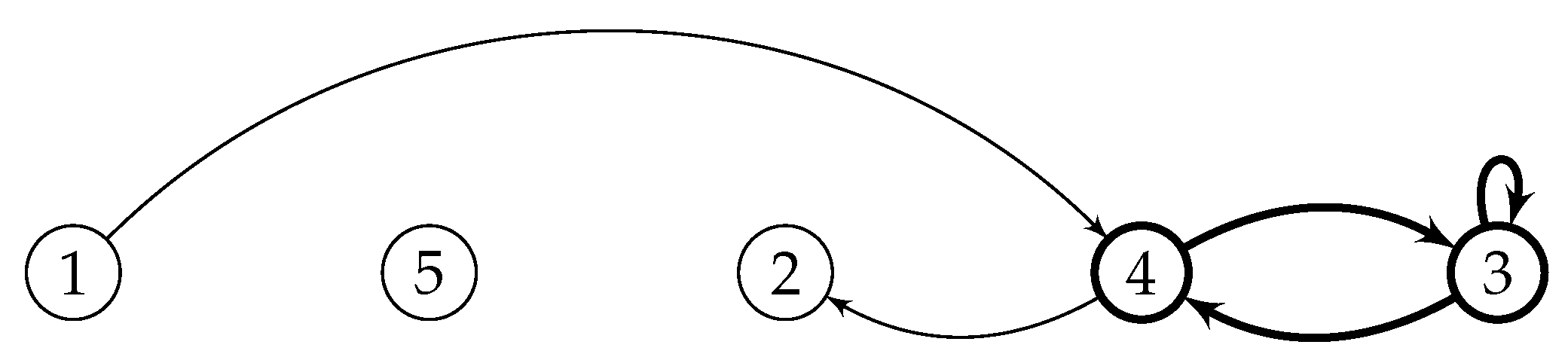
Sinceandare Monge matrices, they define an interval Monge matrix. It is easy to verify thatis a non-trivial matrix (seeFigure 1).
Figure 1.
The threshold digraph .
We verify, the universal robustness ofusing Theorem 11:
Figure 2. The threshold digraph .- For,there exists exactly one cyclein, for which,and. There existandsuch that the conditions (1), (2) hold:
- •
- ✓
- •
- ✓
Let. We show that ifcontains the cycle, then it is included in the unique non-trivial strongly connected componentfor which. Based on the Monge property of the matrix A:
Hence,. In addition,holds, thus. Hence, the corresponding edgesandconnect the cycle s to the component.
Consequently, the digraphcontains exactly one non-trivial strongly connected component and this has a loop. Hence, by Theorem 5 the matrix A is robust, i.e.,is universally robust.
(✓ means that the condition is met.)
A slight modification of the previous example gives a negative answer.
Example 2.
Letis given by matricesand:
In contrast to the previous example,andwhile the rest of the entries inis the same. Since the matrixis without any changes,is the same as in the Example 1, seeFigure 2.
We verify, whether the matrixis universally robust:
Figure 3. The threshold digraph .- For,there exists exactly one cyclein, for which holds,and.
Since for all indicesandholds, the conditionof the Theorem 11 does not hold. Thus, there exists, whose digraphcontains along with the non-trivial strongly connected componentalso the cycle, i.e.,contains two non-trivial strongly connected components. We construct the matrix A according to proof of the Theorem 11 (see (3)):
As shown on theFigure 4there exists the edge, which connects the cyclewith the non-trivial strongly connected component; however there is no edge, which could connectwith the cycle. According to Theorem 5 the matrix A is not robust, thus by Definition 6 the matrixis not universally robust. (✓ means that the condition is met, ✗ means that the condition is not met.)
Figure 4.
The threshold digraph —contains two strongly connected components.
5. Conclusions
The aim of this paper is to investigate the possible and universal robustness of Monge matrices with inexact data in binary case of max–min algebra. We proved necessary condition for universal robustness, sufficient condition for possible robustness and sufficient condition for universal robustness under assumption that is trivial. Moreover, we found necessary conditions for possible robustness and equivalent conditions for universal robustness under assumption that is non-trivial. A future work will focus on finding equivalent conditions for possible and universal robustness of interval Monge matrices in case, if the lower bound matrix is trivial and the upper bound matrix is non-trivial. Another possible extension is to find sufficient conditions for possible robustness in case, if both matrices and are non-trivial. It will be necessary to find further properties of the structure of threshold digraphs corresponding to a Monge matrix to be able to solve the problems connected especially with possible robustness. To find a Monge matrix in an interval Monge matrix which is robust is namely the crucial point to find necessary and sufficient condition for such a matrix with inexact data to be possibly robust. Afterwards, equivalent conditions for universal robustness and equivalent conditions for possible robustness of an interval Monge matrix could be generalized in max–min algebra without restriction to binary case.
Author Contributions
Conceptualization, M.M.; Investigation, M.H.; Methodology, M.H.; Supervision, P.D., M.M.; Writing—original draft, M.H.; Writing—review & editing, M.M. and P.D.; funding acquisition, P.D. All authors have read and agreed to the published version of the manuscript.
Funding
This work was supported by the Slovak Research and Development Agency under contract No. APVV-16-0211 and APVV-18-0214 and by the Scientific Grant Agency of the Ministry of Education, Science, Research and Sport of the Slovak Republic and the Slovak Academy of Sciences under contract VEGA 1/0327/20.
Acknowledgments
The authors would like to thank the referees for valuable remarks and suggestions that helped to increase the clarity of arguments and to improve the structure of the paper.
Conflicts of Interest
The authors declare no conflict of interest.
Abbreviations
The following symbols and abbreviations are used in this manuscript:
| gcd | greatest common divisor |
| lcm | least common multiple |
| ⊕ | operation of maximum |
| ⊗ | operation of minimum |
| set of all finite real numbers | |
| set of all n-dimensional column vectors | |
| set of all matrices of type | |
| per | period |
| digraph associated with matrix A | |
| threshold digraph associated with matrix A | |
| set of all non-trivial strongly connected components of |
References
- Vorobyov, N.N. Extremal Algebra of Positive Matrices. In Informationsverarbeitung und Kybernetik; Elektron: Gothenburg, Sweden, 1967; pp. 39–71. (In Russian) [Google Scholar]
- Komenda, J.; Lahaye, S.; Boimond, J.-L.; van den Boom, T. Max-plus algebra and discrete event systems. IFAC-PapersOnLine 2017, 50, 1784–1790. [Google Scholar] [CrossRef]
- De Schutter, B.; van den Boom, T.; Xu, J.; Farahani, S.S. Analysis and control of max-plus linear discrete-event systems: An introduction. Discrete Event Dyn. Syst. 2020, 30, 25–54. [Google Scholar] [CrossRef]
- Mordeson, J.N.; Premchand, S.N. Fuzzy Mathematics; Physica-Verlag: Heidelberg, Germany, 2001. [Google Scholar]
- Zimmermann, H.J. Fuzzy Set Theory—And Its Applications; Springer Science & Business Media: Berlin, Germany, 2011. [Google Scholar]
- Nitica, V.; Sergeev, S. Tropical convexity over max-min semiring. Trop. Idempotent Math. Appl. 2014, 616, 241–260. [Google Scholar]
- Zadeh, L.A. Toward a theory of fuzzy systems. In Aspects of Network and Systems Theory; Kalman, R.E., De Claris, N., Eds.; Hold, Rinehart and Winston: New York, NY, USA, 1971; pp. 209–245. [Google Scholar]
- Horvath, T.; Vojtáš, P. Induction of fuzzy and annotated logic programs. Inductive Log. Program. 2007, 4455, 260–274. [Google Scholar]
- Rohn, J. Systems of linear interval equations. Linear Algebra Appl. 1989, 126, 39–78. [Google Scholar] [CrossRef]
- Burkard, R.E.; Klinz, B.; Rudolf, R. Perspectives of Monge properties in optimization. Discret. Appl. Math. 1996, 33, 153–161. [Google Scholar] [CrossRef]
- Burkard, R.E. Monge properties, discrete convexity and applications. Eur. J. Oper. Res. 2007, 176, 1–14. [Google Scholar] [CrossRef]
- Estes, A.; Ball, M.O. Monge Properties, Optimal Greedy Policies, and Policy Improvement for the Dynamic Stochastic Transportation Problem. SSRN Electron. J. 2019. [Google Scholar] [CrossRef]
- Hutter, J.C.; Mao, C.; Rigollet, P.; Robeva, E. Estimation of Monge Matrices. arXiv 2019, arXiv:1904.03136. [Google Scholar]
- Kaplan, H.; Mozes, S.; Nussbaum, Y.; Sharir, M. Submatrix maximum queries in Monge matrices and Monge partial matrices, and their applications. In Proceedings of the Twenty-Third Annual ACM-SIAM Symposium on Discrete Algorithms, San Francisco, CA, USA, 23–25 January 2011; Society for Industrial and Applied Mathematics: Philadelphia, PA, USA, 2012; pp. 338–355. [Google Scholar]
- Tiskin, A. Fast distance multiplication of unit-Monge matrices. Algorithmica 2015, 71, 859–888. [Google Scholar] [CrossRef]
- Gavalec, M. Computing matrix period in max–min algebra. Discret. Appl. Math. 1997, 75, 63–70. [Google Scholar] [CrossRef]
- Cuninghame-Green, R.A. Minimax algebra. In Lecture Notes in Economics and Mathematical Systems; Springer: Berlin, Germany, 1979; Volume 166. [Google Scholar]
- Subiono, J.W.; Mufid, M.S.; Adzkiya, D. Eigenproblems of latin squares in bipartite (min, max,+)-systems. Discrete Event Dyn. Syst. 2016, 26, 657–668. [Google Scholar] [CrossRef]
- Butkovič, P.; Cuninghame-Green, R.A. On matrix powers in max-algebra. Linear Algebra Appl. 2007, 421, 370–381. [Google Scholar] [CrossRef]
- Butkovič, P.; Cuninghame-Green, R.A.; Gaubert, S. Reducible spectral theory with applications to the robustness of matrices in max-algebra. SIAM J. Matrix Anal. Appl. 2009, 21, 1412–1431. [Google Scholar] [CrossRef]
- Butkovič, P. Max-linear Systems: Theory and Algorithms; Springer: Berlin/Heidelberg, Germany, 2010. [Google Scholar]
- Plavka, J.; Szabó, J. On the λ-robustness of matrices over fuzzy algebra. Discret. Appl. Math. 2011, 159, 381–388. [Google Scholar]
- Molnárová, M. Robustness of Monge matrices in fuzzy algebra. In Proceedings of the 32nd International Conference Mathematical Methods in Economics, Olomouc, Czech Republic, 10–12 September 2014; pp. 679–684. [Google Scholar]
- Fiedler, M.; Nedoma, J.; Ramík, J.; Rohn, J.; Zimmermann, K. Linear Optimization Problems with Inexact Data; Spriner: Berlin/Heidelberg, Germany, 2006. [Google Scholar]
- Gavalec, M.; Zimmermann, K. Classification of solutions to systems of two-sided equations with interval coefficients. Int. J. Pure Appl. Math. 2008, 39, 187–220. [Google Scholar]
- Gavalec, M.; Plavka, J. Monotone interval eigenproblem in max–min algebra. Kybernetika 2010, 46, 387–396. [Google Scholar]
- Wang, C.; Tao, Y. Interval strong solutions of interval systems of max-plus linear equations. Linear Algebra Appl. 2018, 537, 148–159. [Google Scholar] [CrossRef]
- Siswanto, V.Y.; Pangadi, S.B.; Wiyono, S.B. Robust matrices in the interval max-plus algebra. In Journal of Physics: Conference Series; IOP Publishing: Bristol, UK, 2019; p. 012029. [Google Scholar]
- Myšková, H.; Plavka, J. The robustness of interval matrices in max-plus algebra. Linear Algebra Its Appl. 2014, 445, 85–102. [Google Scholar] [CrossRef]
- Molnárová, M.; Myšková, H.; Plavka, J. The robustness of interval fuzzy matrices. Linear Algebra Appl. 2013, 438, 3350–3364. [Google Scholar] [CrossRef]
- Myšková, H.; Plavka, J. AE and EA robustness of interval circulant matrices in max-min algebra. Fuzzy Sets Syst. 2020, 384, 91–104. [Google Scholar] [CrossRef]
- Molnárová, M. Possible and universal robustness of Monge fuzzy matrices. In Proceedings of the 34th International Conference Mathematical Methods in Economics, Liberec, Czech Republic, 6–9 September 2016; pp. 582–587. [Google Scholar]
© 2020 by the authors. Licensee MDPI, Basel, Switzerland. This article is an open access article distributed under the terms and conditions of the Creative Commons Attribution (CC BY) license (http://creativecommons.org/licenses/by/4.0/).




