Abstract
In this paper, we combine the periodogram method for perturbed block Toeplitz matrices with the Cholesky decomposition to give a parameter estimation method for any perturbed vector autoregressive (VAR) or vector moving average (VMA) process, when we only know a perturbed version of the sequence of correlation matrices of the process. In order to combine the periodogram method for perturbed block Toeplitz matrices with the Cholesky decomposition, we first need to generalize a known result on the Cholesky decomposition of Toeplitz matrices to perturbed block Toeplitz matrices.
1. Introduction
The Cholesky decomposition has been widely used in statistical signal processing. For instance, it has been used for parameter estimation of vector autoregressive (VAR) processes and for parameter estimation of vector moving average (VMA) processes. Specifically, the parameters of a VAR process can be directly obtained from the Cholesky decomposition of the inverses of its correlation matrices, and the parameters of a VMA process can be directly obtained from the Cholesky decomposition of its correlation matrices. However, when real-world problems are considered, what we usually know is a perturbed version of the sequence of correlation matrices of the process involved.
In this paper, we use the Cholesky decomposition to give a parameter estimation method for any perturbed VAR or VMA process, whenever the sequence of correlation matrices of the perturbed process is asymptotically equivalent to the sequence of correlation matrices of the original process in the Gray sense [1]. Specifically, our parameter estimation method combines the Cholesky decomposition with the periodogram method for perturbed block Toeplitz matrices presented in [2]. In order to combine them, we first need to generalize a result given in [3] on the Cholesky decomposition of Toeplitz matrices to perturbed block Toeplitz matrices.
The paper is organized as follows. In Section 2, we set up notation and we review the periodogram method for perturbed block Toeplitz matrices presented in [2]. In Section 3, we generalize a result given in [3] on the Cholesky decomposition of Toeplitz matrices to perturbed block Toeplitz matrices. In Section 4, we give a parameter estimation method for perturbed VAR and VMA processes. Our parameter estimation method for perturbed VMA processes is there also applied in another statistical signal processing problem, namely, in multiple-input multiple-output (MIMO) channel identification.
2. Preliminaries
In this section, we set up notation and we review the periodogram method for perturbed block Toeplitz matrices presented in [2].
2.1. Notation
In this paper, , , , and denote the set of natural numbers (that is, the set of positive integers), the set of integer numbers, the set of real numbers, and the set of complex numbers, respectively. is the set of all complex matrices, stands for the identity matrix, denotes the zero matrix, and is the Fourier unitary matrix, i.e.,
with being the imaginary unit. We denote by the eigenvalues of an Hermitian matrix A arranged in decreasing order, * denotes conjugate transpose, ⊗ is the Kronecker product, E stands for expectation, and denotes the characteristic (or indicator) function of , that is,
If for all , then is the -dimensional vector given by
If is a (complex) random N-dimensional vector for all , denotes the corresponding (complex) random N-dimensional vector process.
Let and be matrices for all . We write if the sequences and are asymptotically equivalent (i.e., and are bounded and with and being the spectral norm and the Frobenius norm, respectively). We recall that the concept of asymptotically equivalent sequences of matrices was introduced by Gray in [1] for the case in which .
If is a continuous -periodic function, we denote by the block Toeplitz matrix generated by F whose blocks are given by
where is the sequence of Fourier coefficients of F, that is,
2.2. The Periodogram Method for Perturbed Block Toeplitz Matrices
The following theorem, which was given in ([2], Theorem 4), provides a method to estimate the generating function F when we only know a perturbed version of the sequence of block Toeplitz matrices , namely, we only know a sequence of matrices which is asymptotically equivalent to .
Theorem 1.
Letbe anmatrix for all. Suppose that there exists a continuous-periodic functionsuch that. Then
whereis the-periodic step function given by
Moreover, if F is a trigonometric polynomial there existssuch that
The estimation method of the generating function F provided in Theorem 1 consists of the sequence of functions . Observe that from Equation (1) the squared error made, when F is estimated (approximated) by , tends to zero as n grows.
The correlation matrix of a random vector is a positive semidefinite matrix. Furthermore, if A is a positive semidefinite matrix, then there exists a zero-mean random vector whose correlation matrix is A. Therefore, is a sequence of positive semidefinite matrices if and only if is the sequence of correlation matrices of certain wide sense stationary (WSS) N-dimensional vector process (we recall that a random vector process is said to be WSS if its correlation matrices are block Toeplitz and its random vectors have the same mean). If is the sequence of correlation matrices of a WSS vector process, the generating function F is called the power spectral density (PSD) of the process. Therefore, Theorem 1 provides a method to estimate the PSD (a spectral estimation method) of any WSS vector process, when we only know a perturbed version of its sequence of correlation matrices. This spectral estimation method is a modified version of the (averaged) periodogram method, because if then
where is the conventional spectral estimator, which is also known as the method of (averaged) periodogram or as the Bartlett method (see, e.g., [4]), defined as
3. A Note on the Cholesky Decomposition of Perturbed Block Toeplitz Matrices
We recall that if A is an positive definite matrix, then there exists a unique lower triangular matrix L with for all satisfying that . This decomposition of A () is called the Cholesky decomposition of A. In ([3], Section 6.3) Gray gave a result on the Cholesky decomposition of Toeplitz matrices. The following theorem generalizes this result to perturbed block Toeplitz matrices. Furthermore, unlike in ([3], Section 6.3) we also give the convergence speed of our result.
Theorem 2.
Consider a continuous-periodic functionwhose sequence of Fourier coefficientssatisfies thatis lower triangular withfor allandfor all. Suppose thatis anpositive definite matrix for allwith(or equivalently,, where,). Letbe the Cholesky decomposition offor all. Ifandare stable (that is,andare bounded) then
Moreover, there existssuch that
Proof.
Applying ([5], Lemma 4.2) and ([5], Theorem 6.2) yields (we recall that ([5], Theorem 6.2) was previously given for Hermitian generating functions (see, e.g., [6,7], or ([8], Theorem 2))). Hence, since the relation ∼ is symmetric and transitive (see ([5], Lemma 3.1)), if and only if .
The sequence is bounded (see, e.g., ([5], Theorem 4.3) or ([9], Corollary 4.2)). As is bounded and
is also bounded. Consequently, to finish the proof we only need to show Equation (3), or equivalently, we only need to show that there exists such that
We have
where denotes the diagonal matrix satisfying that for all and . Since is lower triangular for all , is lower triangular for all (see, e.g., ([10], p. 44)), and therefore,
for all and . Thus,
for all and , and hence,
As and are lower triangular for all , and are lower triangular for all (see, e.g., ([11], p. 240)). Consequently, is upper triangular for all , and therefore,
Combining Equations (6), (7), and (8) yields
with for all . To prove Equation (4) we only need to show that is bounded, or equivalently, we only need to show that is bounded. For every there exists such that
where is the -dimensional (column) vector whose entries are given by , , with being the Kronecker delta. Thus, is bounded. □
Observe that Equation (3) shows that the sequence converges to zero at least as fast as the sequence does.
Equation (2) generalizes ([3], Section 6.3). Specifically, in ([3], Section 6.3) Gray proved Equation (2), but only for the special case in which , F is in the Wiener class, and (or equivalently, ). It should be mentioned that unlike here, the convergence speed of was not given in ([3], Section 6.3) for the special case there studied.
4. Applications of the Periodogram Method in Parameter Estimation
Using Theorems 1 and 2 we give in this section a parameter estimation method for perturbed VAR processes and another for perturbed VMA processes. These methods can be applied in any real-world problem where the random process involved is modeled as a VAR process or as a VMA process, e.g., in damage detection for aeronautical structures or in MIMO channel identification.
4.1. Parameter Estimation Method for Perturbed VAR Processes
We begin by reviewing the concept of VAR process.
Definition 1.
A zero-mean random N-dimensional vector processis said to be a VAR process if
wherefor all, andis a zero-mean random N-dimensional vector process whose sequence of correlation matrices is given bywith Λ being an positive definite matrix. If there exists such that for all , then is called a VAR process of (finite) order p or a VAR process.
Let be as in Definition 1. Assume that , with and for all , is the sequence of Fourier coefficients of a continuous -periodic function . From Equation (8) we can obtain (see, e.g., ([12], Equation (20)))
If is the Cholesky decomposition of the positive definite matrix , then
is the Cholesky decomposition of the positive definite matrix for all , since
Observe that if we know the correlation matrix for certain , then the Cholesky decomposition of provides and the parameters of the VAR process, because
However, in practice what we usually know is a perturbed version of the sequence of correlation matrices of the process. The following theorem allows us to estimate and the parameters of the VAR process from the Cholesky decomposition of the matrices of the sequence , when .
Theorem 3.
Letbe as in Definition 1. Assume that, withandfor all, is the sequence of Fourier coefficients of a continuous-periodic function. Suppose thatis anpositive definite matrix for allsatisfying thatis stable and. Letbe the Cholesky decomposition offor all. Then
and
for alland, whereis the Cholesky decomposition of. Moreover, ifis of finite order there existsuch that
Proof.
Since is positive definite matrix for all , is positive definite matrix for all . From ([12], Equation (20)) and ([5], Lemma 4.2) we have
Hence, as is bounded (see, e.g., ([5], Theorem 4.3) or ([9], Corollary 4.2)), is also bounded. Consequently, applying ([13], Lemma A1) and Equation (9) yields
As and are bounded, the sequences
and
are also bounded. Thus, from Theorem 2 we have that and that there exists such that
for all . Hence, applying Theorem 1 we conclude that Equation (11) holds.
Applying the Schwarz inequality (see, e.g., ([14], p. 139) yields
for all and .
Moreover, if is of finite order from Theorem 1 there exists such that
□
If we know for certain , Theorem 3 provides an estimation of the block entry of the matrix in Equation (10) given by
Therefore, if we know for certain , Theorem 3 allows us to estimate and the parameters of the VAR process as follows
and
Example 1.
We consider the zero-mean 2-dimensional VARprocessin ([15], Example 2.3), where
and
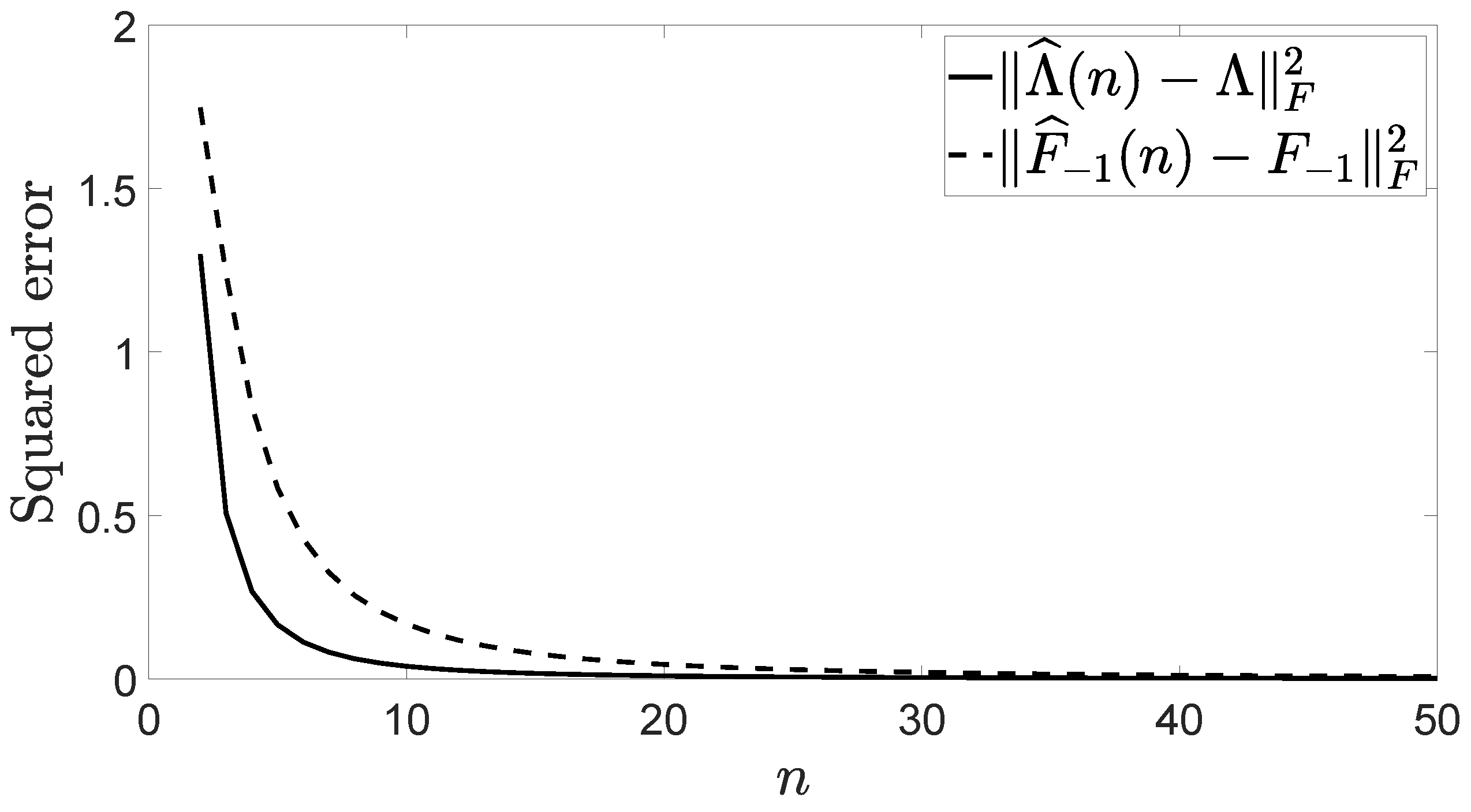
Figure 1 shows the squared error made when Λ and are estimated from the perturbed VAR process whose sequence of correlation matrices is
Observe that this perturbed process has been generated by corrupting the VAR process in ([15], Example 2.3) by an impulse at .
Figure 1.
Squared error made when and are estimated by and , respectively.
4.2. Parameter Estimation Method for Perturbed VMA Processes
We begin by reviewing the concept of VMA process.
Definition 2.
A zero-mean random N-dimensional vector processis said to be a VMA process if
wherefor all, andis a zero-mean random N-dimensional vector process whose sequence of correlation matrices is given bywith Λ being an positive definite matrix and
If there exists such that for all , then is called a VMA process of (finite) order q or a VMA process.
Let be as in Definition 2. Assume that , with and for all , is the sequence of Fourier coefficients of a continuous -periodic function . Since Equation (12) can be rewritten as
we have
and consequently,
If is the Cholesky decomposition of , then
is the Cholesky decomposition of the positive definite matrix for all , because
Observe that if we know the correlation matrix for certain , then its Cholesky decomposition provides and the parameters of the VMA process, since
However, in practice what we usually know is a perturbed version of the sequence of correlation matrices of the process. The following theorem allows us to estimate and the parameters of the VMA process from the Cholesky decomposition of the matrices of the sequence , when .
Theorem 4.
Letbe as in Definition 2. Assume that, withandfor all, is the sequence of Fourier coefficients of a continuous-periodic function. Suppose thatis anpositive definite matrix for allsatisfying thatis stable and. Letbe the Cholesky decomposition offor all. Ifis stable then
and
for alland, whereis the Cholesky decomposition of Λ. Moreover, ifis of finite order there existsuch that
Proof.
From Equation (14) we have . As and are bounded, the sequences
and
are also bounded. Consequently, from Theorem 2 we have that and that there exists such that
Therefore, applying Theorem 1 we conclude that Equation (16) holds.
Applying the Schwarz inequality (see, e.g., ([14], p. 139)) yields
for all and .
Moreover, if is of finite order from Theorem 1 there exists such that
□
If we know for certain , Theorem 4 provides an estimation of the block entry of the matrix in Equation (15) given by
Therefore, if we know for certain , Theorem 4 allows us to estimate and the parameters of the VMA process as follows
and
Example 2.
We consider the zero-mean 2-dimensional VMAprocessin ([15], Example 2.1), where
and
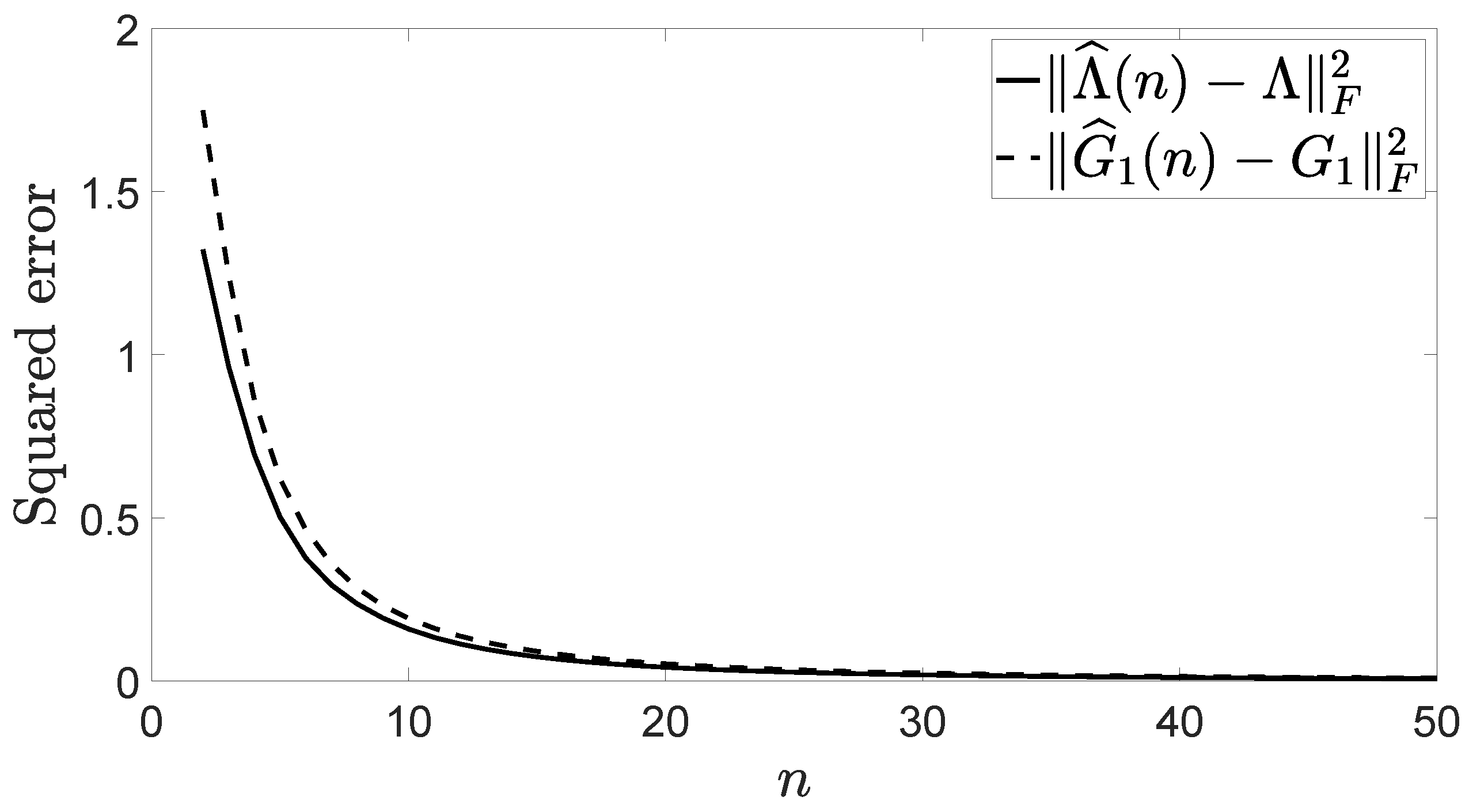
Figure 2 shows the squared error made when Λ and are estimated from the perturbed VMA process whose sequence of correlation matrices is
Observe that this perturbed process has been generated by corrupting the VMA process in ([15], Example 2.1) by an impulse at .
Figure 2.
Squared error made when and are estimated by and , respectively.
In [2], the periodogram method for perturbed block Toeplitz matrices was applied in spectral estimation. In Theorems 3 and 4, it has been also applied in parameter estimation for perturbed VAR processes and in parameter estimation for perturbed VMA processes, respectively. We finish the paper by showing that the periodogram method for perturbed block Toeplitz matrices can be applied in a fourth statistical signal processing problem, namely, in MIMO channel identification with perturbed additive WSS noise.
In [16], an asymptotic result on block Toeplitz matrices was applied in single-input multiple-output (SIMO) channel identification. We finish the paper by showing that Theorem 4 can be applied in MIMO channel identification when the number of channel inputs and the number of channel outputs are equal.
We consider a MIMO channel with a discrete-time causal infinite impulse response (IIR) filter and additive noise. Thus, the channel output process is of the form
We assume that the filter tap for all and . We also assume that , with for all , is the sequence of Fourier coefficients of a continuous -periodic function . We consider that the input process is a zero-mean WSS N-dimensional vector process with , where is an positive definite matrix. We assume that the noise process is a zero-mean random N-dimensional vector process satisfying that there exists a continuous -periodic function such that . We also assume that the noise process is uncorrelated with the input process.
Suppose that is stable and is a stable sequence of positive definite matrices. To show that Theorem 4 can be here applied, we only need to prove that .
From Equation (13) we obtain
for all . Hence, as is bounded (see, e.g., ([5], Theorem 4.3) or ([9], Corollary 4.2)), is also bounded and . Since is bounded, , and consequently, applying ([5], Lemma 3.1) yields . Therefore, from ([5], Lemma 3.1) we conclude that
Thus, Theorem 4 can be applied in the considered MIMO channel identification problem, that is, it can be used to identify and the filter taps .

5. Conclusions
In ([2], Theorem 4) the (averaged) periodogram method for positive semidefinite Toeplitz matrices was generalized to perturbed block Toeplitz matrices. Moreover, ([2], Theorem 4) was there applied to perturbed positive semidefinite block Toeplitz matrices to solve a statistical signal processing problem: spectral estimation for perturbed WSS vector processes.
In the present paper, ([2], Theorem 4) (Theorem 1) has been applied to perturbed lower triangular block Toeplitz matrices to solve three statistical signal processing problems: parameter estimation for perturbed VAR processes, parameter estimation for perturbed VMA processes, and MIMO channel identification with perturbed additive WSS noise. To solve those problems we have first generalized a result given in [3] on the Cholesky decomposition of Toeplitz matrices to perturbed block Toeplitz matrices.
Author Contributions
Authors are listed in order of their degree of involvement in the work, with the most active contributors listed first. J.G.-G. conceived the research question. All authors were involved in the research and wrote the paper. They have also read and approved the published version of the manuscript. All authors have read and agreed to the published version of the manuscript.
Funding
This work was supported in part by the Basque Government through the research project “Advanced distributed control for safety and energy efficiency of air transport (CODISAVA)” (KK-2018/00082).
Conflicts of Interest
The authors declare no conflict of interest.
References
- Gray, R.M. On the asymptotic eigenvalue distribution of Toeplitz matrices. IEEE Trans. Inf. Theory 1972, IT-18, 725–730. [Google Scholar] [CrossRef]
- Gutiérrez-Gutiérrez, J. A modified version of the Pisarenko method to estimate the power spectral density of any asymptotically wide sense stationary vector process. Appl. Math. Comput. 2019, 362, 124526. [Google Scholar] [CrossRef]
- Gray, R.M. Toeplitz and circulant matrices: A review. Found. Trends Commun. Inf. Theory 2006, 2, 155–239. [Google Scholar] [CrossRef]
- Pisarenko, V.F. On the estimation of spectra by means of non-linear functions of the covariance matrix. Geophys. J. R. Astron. Soc. 1972, 28, 511–531. [Google Scholar] [CrossRef]
- Gutiérrez-Gutiérrez, J.; Crespo, P.M. Block Toeplitz matrices: Asymptotic results and applications. Found. Trends Commun. Inf. Theory 2011, 8, 179–257. [Google Scholar] [CrossRef]
- Serra, S. Asymptotic results on the spectra of block Toeplitz preconditioned matrices. SIAM J. Matrix Anal. Appl. 1998, 20, 31–44. [Google Scholar] [CrossRef]
- Miranda, M.; Tilli, P. Asymptotic spectra of Hermitian block Toeplitz matrices and preconditioning results. SIAM J. Matrix Anal. Appl. 2000, 21, 867–881. [Google Scholar] [CrossRef]
- Gutiérrez-Gutiérrez, J.; Crespo, P.M. Asymptotically equivalent sequences of matrices and Hermitian block Toeplitz matrices with continuous symbols: Applications to MIMO systems. IEEE Trans. Inf. Theory 2008, 54, 5671–5680. [Google Scholar] [CrossRef]
- Tilli, P. Singular values and eigenvalues of non-Hermitian block Toeplitz matrices. Linear Algebra Appl. 1998, 272, 59–89. [Google Scholar] [CrossRef]
- Lancaster, P.; Tismenetsky, M. The Theory of Matrices; Academic Press: Cambridge, MA, USA, 1985. [Google Scholar]
- Bernstein, D.S. Matrix Mathematics: Theory, Facts, and Formulas; Princeton University Press: Princeton, NJ, USA, 2009. [Google Scholar]
- Gutiérrez-Gutiérrez, J.; Crespo, P.M. Asymptotically equivalent sequences of matrices and multivariate ARMA processes. IEEE Trans. Inf. Theory 2011, 57, 5444–5454. [Google Scholar] [CrossRef]
- Gutiérrez-Gutiérrez, J.; Zárraga-Rodríguez, M.; Crespo, P.M.; Insausti, X. Rate distortion function of Gaussian asymptotically WSS vector processes. Entropy 2018, 20, 719. [Google Scholar] [CrossRef]
- Rudin, W. Principles of Mathematical Analysis; McGraw-Hill: New York, NY, USA, 1976. [Google Scholar]
- Reinsel, G.C. Elements of Multivariate Time Series Analysis; Springer: Berlin, Germany, 1993. [Google Scholar]
- Gazzah, H.; Regalia, P.A.; Delmas, J.P. Asymptotic eigenvalue distribution of block Toeplitz matrices and application to blind SIMO channel identification. IEEE Trans. Inf. Theory 2001, 47, 1243–1251. [Google Scholar] [CrossRef]
© 2020 by the authors. Licensee MDPI, Basel, Switzerland. This article is an open access article distributed under the terms and conditions of the Creative Commons Attribution (CC BY) license (http://creativecommons.org/licenses/by/4.0/).