

Abstract
This paper extends two fuzzy ranking data envelopment analysis (DEA) approaches to the case of general networks of processes. The first approach provides an efficiency score for each possibility level which requires solving one linear program for each possibility level. The second approach is even simpler and provides an overall efficiency score solving just one linear program. The proposed approaches are tested on two datasets from the literature and compared with other fuzzy network DEA approaches. The results show that the two methods provide very highly correlated efficiency estimates which are also consistent with those of other fuzzy network DEA approaches.
1. Introduction
Data envelopment analysis (DEA) is a well-known non-parametric technique, generally used to assess the relative efficiency of a group decision making units (DMUs). Conventional DEA considers that each DMU consists of just a single process. This process consumes certain amounts of inputs and produces certain amount of outputs. The aim of DEA is to detect inefficiencies, i.e., to check if the same outputs can be obtained with less inputs the so-called input orientation) or the same inputs can produce more outputs (output orientation). Detecting all kinds of inefficiencies is important for both competitiveness and sustainability.
There are different DEA models, depending on the orientation, the metric, and the returns to scale (RTS) assumptions considered. Considering certain axioms (like convexity or scalability, for example) and applying the minimum extrapolation principle, DEA can infer from the observed data a so-called production possibility set (PPS), which corresponds to the set of operation points that are considered feasible. The PPS is formed using all linear combinations of the observed DMUs. When variable returns to scale (VRS) are assumed then only convex linear combinations are used. The non-dominated subset of the PPS defines the efficient frontier. The DMUs that fall on the Efficient Frontier (EF) are labelled efficient while those that do not are termed inefficient and are projected onto the EF. The distance of a DMU to the EF is used to compute an efficiency score so that the further from the EF a DMU is (i.e., the larger the input and output improvements that can be achieved) the lower its efficiency score. Accordingly, efficient DMUs have an efficiency score of one since for them no input or output improvements are possible.
Different to conventional DEA, network DEA looks at the internal structure of the DMUs, considering the DMU as a network of interrelated processes which consume inputs and produce outputs but also produce and consume intermediate products. As with conventional DEA, many different network DEA approaches have also been proposed (e.g., Kao [1]; Tone and Tsutsui [2,3]; Cook et al. [4]; Lozano [5]). The range of applications of network DEA has also grown accordingly, spanning banking (Lozano [6]), transportation (e.g., Lozano et al. [7]), sports (Moreno and Lozano [8]), supply chain (e.g., Lozano and Adenso-Díaz [9]), etc.
All the above references have dealt with crisp data, i.e., they assume that there is no uncertainty in the data. This does not mean that DEA cannot work when the data are fuzzy. On the contrary, there are many different fuzzy DEA approaches (e.g., Kao and Liu [10], Arana-Jimenez et al. [11], Saati et al. [12], León et al. [13], Lertworasirikul et al. [14], Wang et al. [15], Soleimani-damaneh et al. [16], Arana-Jimenez et al. [17], etc.). The reader is referred to Hatami-Marbini et al. [18] and Emrouznejad et al. [19] for a taxonomy and review of fuzzy DEA approaches.
Of special relevance are those fuzzy DEA approaches that consider networks of processes. Thus, Kao and Liu [20] extend Kao and Liu [10] approach to two-stage systems with fuzzy data. Liu [21] proposes a methodology to rank fuzzy two-stage efficiencies, while Liu [22] adds weight restrictions to Kao and Liu [20] fuzzy two-stage model. Tavana and Khalili-Damghani [23] also work with Kao and Liu [20] approach but implementing a leader-follower game theory approach to decompose the two-stage efficiency into single-stage efficiencies. Another variant is presented in Hemmati et al. [24]. Wang et al. [25] adopt a bootstrapped truncated-regression model to study the relationship between fuzzy two-stage efficiencies and an exogenous variable.
Concerning non-radial network DEA approaches, Shermeh et al. [26] adapt the Network Slack-Based Measure (SBM) model by Tone and Tsutsui [2] to be able to deal with fuzzy numbers. Olfat et al. [27] propose a fuzzy extension of the dynamic Network SBM approach by Tone and Tsutsui [3].
Khalili-Damghani and Taghavi-Fard [28] also study fuzzy two-stage DEA systems. Kao and Lin [29] consider parallel processes and fuzzy data. Lozano [30,31] compute process efficiencies in parallel and two-stage process DEA systems, respectively. Kao [32] proposes two approaches, namely the membership grade and the α-cut, for network DEA with fuzzy data. Lozano and Moreno [33] extend the approaches in Saati et al. [12], Wang et al. [15], and Kao and Liu [20] to general networks of processes. Finally, Mirhedayatian et al. [34] present a fuzzy network DEA approach with dual-role factors and undesirable outputs to evaluate green supply chains.
However, to the best of our knowledge, ranking methods needs further development for network DEA when dealing with fuzzy data and general network of processes. In fact, our work allows any configuration of the stages that form the internal structure of the DMU, which implies an improvement over other models. It could also be argued that previous models seem to be complex enough to prevent some researchers from working with fuzzy data. Therefore, our aim is to develop a general fuzzy network DEA approach without adding unnecessary complexity.
The structure of the paper is the following. In Section 2 the network DEA is introduced, and a crisp model is formulated. In Section 3, the proposed methods are presented. In Section 4 the results of the application of the proposed methods to two datasets from the literature are presented. Finally, Section 5 summarizes and concludes.
2. Preliminaries
In order to facilitate a better understanding of the proposed fuzzy ranking network DEA approaches, this section presents a brief overview of network DEA models and fuzzy numbers.
2.1. Crisp Network DEA Model
It is convenient to formulate first the crisp network DEA model, i.e., the network DEA model without fuzzy data. We will use the same notation that Lozano [5] and Lozano and Moreno [33]. This notation helps to formulate the models in a very compact form.
Assume the DMUs to assess are all structurally homogeneous, i.e., all of them have the same number and type of processes. Each process may consume a different subset of inputs and may produce a different subset of outputs. Let be the set of exogenous inputs consumed by process p and, for each , let denote the observed amount of exogenous input i used by process p of DMU j. Similarly, let the set of outputs produced by process p and, for each , let denote the amount of output k produced by process p of DMU j. Let be the set of processes that consume the input i and the total amount of input i consumed by DMU j. Let be the set of processes that produce the output k and the total amount of output k produced by DMU j.
A key feature of network DEA is that, in addition to exogenous inputs and outputs, there generally exist intermediate products that are produced by some processes and consumed by others. Let be the set of processes that produce the intermediate product r and, for each , let the amount of intermediate product r produced by process p of DMU j. Analogously, let be the set of processes that consume the intermediate product r and, for each , let the amount of intermediate product r used by process p of DMU j. Finally, let us define the sets and that correspond to the intermediate products produced and consumed, respectively, by process p.
Once the notation for required data has been introduced let us consider the variables. For the radial, input-oriented model the variables needed are
- Uniform reduction factor of the input consumption of DMU J
- Intensity variable of process p of DMU j
This crisp network DEA model (see Lozano [5], Lozano and Moreno [33]) computes the maximum radial reduction of the inputs consumed by a given DMU J. Note that this model has to be solved as many times as DMUs are in the dataset. The idea is to compute a feasible operating point (i.e., within the inferred PPS) that maintains the output level of DMU J but reduces all its inputs as much as possible. The optimal value of the variable corresponds to the efficiency score of DMU J. The multipliers, note that there is a specific set of them for each process p, determine the inputs, outputs and intermediate products of each process. Thus, the linear combinations of the observed data define a target feasible operating point that produces at least the same amount of output, as required by Constraint (3), while consuming a fraction of the observed inputs, as indicated by Constraints (2). Constraints (4) impose that enough intermediate products are generated internally within the system to satisfy the internal demand of those intermediate products. Therefore, the constraints guarantee that the total amount of outputs produced by DMU J is not reduced and that the intermediate products produced are enough to supply those processes that consume them.
Note that although, in the above model, it has been assumed that all processes exhibit variable returns to scale (VRS), other RTS assumptions can be considered in which case Constraints (5) should be modified accordingly (see Lozano [5]). Moreover, the above formulation corresponds to the input orientation. The corresponding model for the output orientation is shown in Appendix A.
2.2. Fuzzy Numbers
For the sake of clarity, an introduction to fuzzy numbers is provided in this section. More detailed information can be found at Dubois and Prade [35]. A fuzzy number is a subset of the real line with membership function satisfying the following properties:
- (i)
- There exists such that ;
- (ii)
- is fuzzy convex. In other words, , for any and ;
- (iii)
- is upper semicontinuous on , which means that is closed for all ;
- (iv)
- The support of is bounded, i.e., the closure of is bounded.
In this paper, we deal with LR fuzzy numbers (LRFN) as in León et al. [13]. A fuzzy number is a LRFN if its membership function has the following structure:
where are non-increasing, continuous shape functions with and . Furthermore, consists of the real numbers with the highest chance of realization, while and are the left and right spread, respectively.
Note that LRFN includes as special cases the commonly used trapezoidal fuzzy numbers (TrFN) and triangular fuzzy numbers (TFN). Thus, TrFN use linear left and right shape functions . TFN use linear shape functions and, in addition, the left and right values coincide, i.e., .
Finally, the α-cuts of a LRFN are the intervals:
where the inverse shape functions are defined as and . In the case of TrFN and TFN these inverse shape functions are simply .
3. Proposed Fuzzy Ranking Network DEA Approaches
In this section, two different fuzzy ranking methods are presented. Both consider that the input, output and intermediate products are LRFN:
According to Definition (8), the α-cuts of these LRFN , and are the intervals:
Note also that it has been assumed that for a given input, output or intermediate product the left shape function is the same for all DMUs and processes and the same occurs with the right shape function. This assumption is commonly made (e.g., León et al. [13] or Soleimani-damaneh et al. [16]) and it is not too restrictive since it only assumes that the data for a certain factor (input, output or intermediate product) are described through LRFN of the same type. This assumption is important because it means that the linear combination of these LRFN, using scalar multipliers, is also a LRFN with the same left and right shape functions. Mathematically,
The α-cuts of these LRFN , and are thus the intervals:
3.1. Fuzzy Ranking Method 1 (FRM1)
FRM1 uses the ranking method in Tanaka et al. [36]. This method was proposed in León et al. [13] for conventional (i.e., single-process DEA). The starting point is the formulation of the problem using the fuzzy data. The objective is to reduce all inputs as much as possible with respect to the observed values. This corresponds to Equations (15) and (16). Note that the right-hand side of (16) corresponds to the observed input consumption of DMU J (summed for all the processes that consume that input) while the left-hand side is the input consumption of the target operating point (computed as a linear combination of the input consumption of all the DMUs). Similarly, in Constraints (17), the right-hand side represents the observed outputs of DMU J and the left-hand side is the corresponding amounts produced by the target operating computed using a convex linear combination of all the DMUs. Thus, Constraints (17) impose that the observed outputs are not reduced. Finally, Constraints (18) impose that the target operating point must satisfy the intermediate products constraints that guarantee that the internal production of intermediate products is enough to satisfy its internal demand.
The Constraints (16)–(18) compare two fuzzy quantities. The key idea in this method is how to interpret the inequality, i.e., when to consider that one fuzzy quantity is larger than or equal to another. Based on Tanaka et al. [36], León et al. [13] proposed the use of the following ranking criterion for two fuzzy numbers and at possibility level :
Following this criterion, for each possibility level an input-oriented efficiency score can be computed for each DMU J using the following model:
This fuzzy ranking approach has the drawback, as Soleimani-damaneh et al. [16] indicates for conventional fuzzy DEA, of having many constraints, more so in the case of fuzzy network DEA (due to the existence of intermediate products). However, the number of constraints can be reduced to almost half (because of many constraints being redundant) in the case of symmetric TFN, in which case the appropriate model to use is the following:
Same as in León et al. [13], the following holds for the efficiency scores computed by FRM1:
Thus, the efficiency scores represent a monotonous non-increasing function of the possibility level α. In order to rank the efficiency of the different DMUs the following area criterion is proposed. A DMU J ranks above another DMU J’ in terms of efficiency if the area below is greater than that the area below . The area below is which in the common case that is computed for several discrete possibility levels reduces to
Finally, let us mention that, same as in León et al. [13], the efficiency of DMU J can also be expressed as a fuzzy set whose membership function is .
3.2. Fuzzy Ranking Method 2 (FRM2)
FRM2 uses the ranking method in Yao and Wu [37]. This method was proposed in Soleimani-damaneh et al. [16] for conventional (i.e., single-process DEA). As before, the key is how to interpret the Inequalities (16)–(18), i.e., when to consider that one fuzzy quantity is larger than or equal to another. Yao and Wu [37] defined the signed distance between two fuzzy numbers and as
and proposed the following ranking criterion:
Moreover, Soleimani-damaneh et al. [16] showed the signed distance between two LRFN and can be expressed as
and that the resulting model is equivalent to the corresponding crisp DEA model using appropriately defuzzified factor values.
Thus, from the LRFN of each input, output and intermediate product a defuzzified value is computed as
where , , and , , are all inverse shape functions. In the case of TrFN and TFN which means that:
and therefore
Moreover, in the case of symmetric TrFN and TFN, the above expressions reduce to
In any case, once the defuzzified values of the input, output and intermediate products have been computed, the following LP is solved:
yielding, for each DMU J, a single efficiency score .
Note that the, in the end, above model is just Models (1)–(6) applied to the defuzzified values of the inputs, outputs and intermediate products. Its interpretation is similar, i.e., the model aims at minimizing the amount of inputs consumed by a target feasible operating point that is computed as linear convex combination of all the DMUs. The target operating point must maintain the output level of DMU J and it is also required that the intermediate products produced must be greater than the amount consumed. As mentioned above, the difference between this model and Models (1)–(6) is that in the latter the observed data were crisp while in the above model the crisp input, output, and intermediate product values used for all DMUs (including DMU J) are obtained from the observed fuzzy data through a defuzzification process. As with the previous approach the corresponding output-oriented model is formulated in Appendix A.
4. Illustration of Proposed Approaches
In order to illustrate the proposed approach two datasets from the literature will be used. The first one corresponds to a simple two-stage system and was used in Kao and Liu [20]. This dataset involves 24 DMUs (which represent Taiwanese non-life insurance companies) and considers two inputs (Operating expenses and Insurance expenses), two intermediate products (Direct written premiums and Reinsurance premiums) and two outputs (Underwriting profit and Investment profit). The upper and lower efficiency limits computed by Kao and Liu [20], which correspond to the upper and lower efficiency estimates for α = 0, respectively, are shown in Table 1. In addition, Table 1 shows the estimates for α = 1. Because in this dataset we are dealing with TFN, the upper and lower efficiencies for α = 1 coincide.
Table 1.
Efficiency estimates of proposed approaches for dataset 1.
The efficiency estimates and the corresponding ranking index computed by the proposed FRM1 approach are also shown in Table 1. To compare with the results in Kao and Liu [20], constant returns to scale (CRS) in all processes and input orientation are considered. Although for FRM1 only three possibility levels are shown in Table 1, calculations were made for eleven levels, i.e., α ranges from 0 to 1 with 0.1 increments. Note that for FRM1 the estimated efficiency score for each possibility level is within the lower and upper limits computed by Kao and Liu [20]. Moreover, for the α = 1 value they are very similar.
Note also that the efficiency score of FRM2 is also rather similar to the Kao and Liu [20] α = 1 efficiency score and the α = 1 FRM1 efficiency estimate. In this dataset the differences cannot be large because the defuzzified values for the inputs, intermediate products and outputs are close to the corresponding α = 1 values (i.e., the vertex) of the TFN of the inputs, outputs and intermediate products. Note, finally, that none of the DMUs is found efficient. This is normally the case in network DEA, as opposed to conventional DEA, since for a DMU to be efficient in network DEA all its processes must be efficient, which seldom occurs.
Table 2 shows the ranking of the DMUs derived from the results of the different approaches. For the proposed methods, the ranking is computed as indicated in Section 3. For ranking the results of the Kao and Liu [20] approach the area measurement ranking index proposed in Chen and Klein [38] has been used, as suggested by Cadenas et al. [39] for that approach. Note that the proposed methods give the same ranking, which is very similar to that of Kao and Liu [20]. The Spearman rank order correlation coefficient is 0.997 (p-level 0.01).
Table 2.
Ranking of Kao and Liu [20] and proposed methods for dataset 1.
The second dataset used to illustrate the proposed approach is the one in Khalili-Damghani and Tavana [40]. It is a much more complex network configuration, with 40 DMUs, each one consisting of seven interconnected processes. In this case, TrFN are for the inputs, outputs and intermediate products. To compare with the results in Khalili-Damghani and Tavana [40], constant returns to scale (CRS) in all processes and input orientation are considered. Table 3 shows the lower and upper system efficiency estimates computed by Khalili-Damghani and Tavana [40] as well as the efficiency score computed by FRM2. The derived rankings are also shown.
Table 3.
Results of Khalili-Damghani and Tavana [40] and Fuzzy Ranking Method 2 (FRM2) for dataset 2.
Although most of the times the efficiency score computed by FRM2 lies within the lower and upper efficiency estimates of Khalili-Damghani and Tavana [40] that is not always the case. For ten DMUs, namely 3, 7, 11, 17, 20, 22, 28, 37, and 38, it is above the upper efficiency estimate and in one case, namely DMU 35, it is below the lower efficiency estimate. Since both approaches are rather different, their results need not be very similar. We believe though that, in general, the results of both methods are relatively consistent. Their rankings, however, do not seem to be correlated (p-value 0.397). Note that, for Khalili-Damghani and Tavana [40], the ranking has been derived using the midpoint of the interval of efficiency estimates.
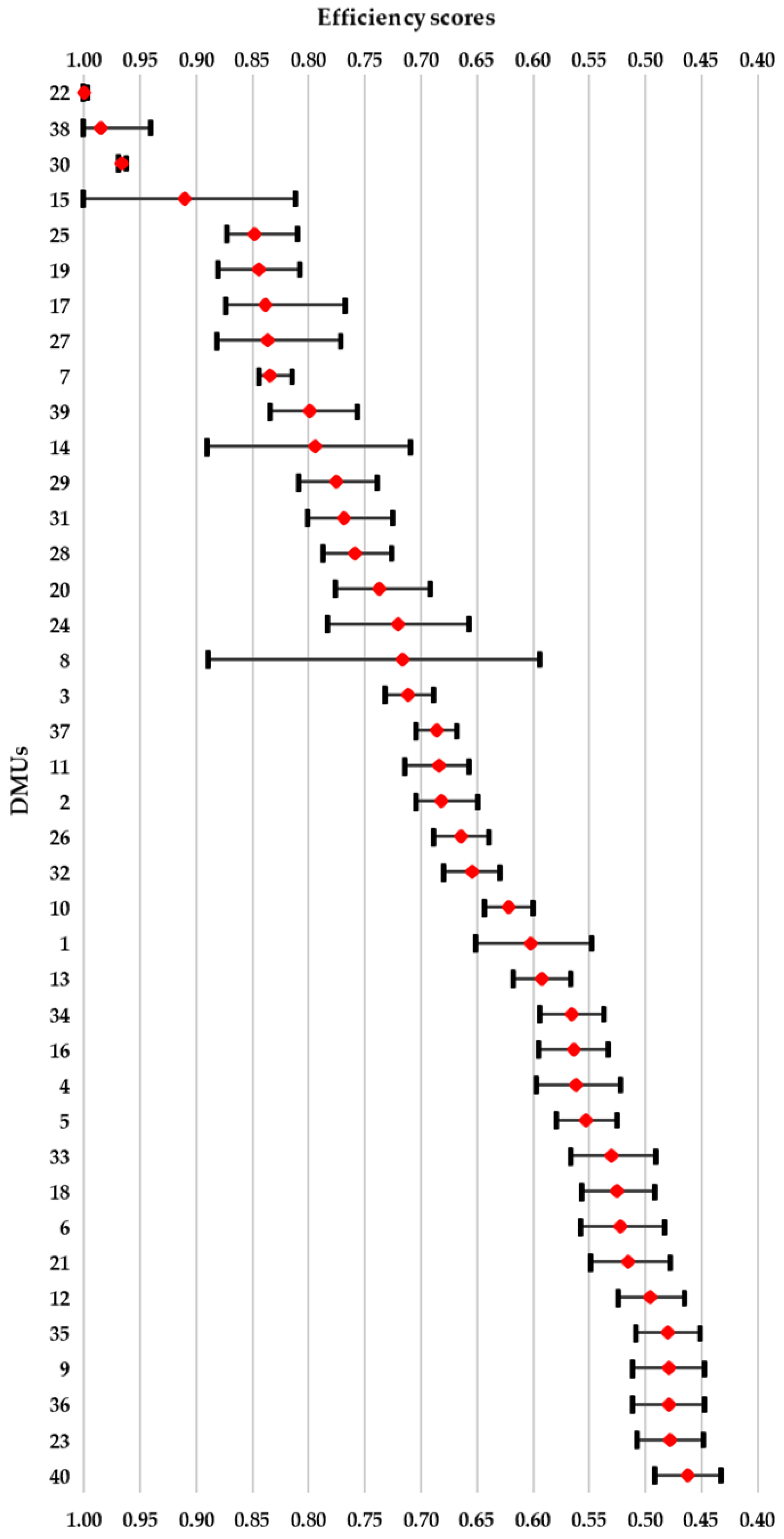
Figure 1 displays the range of efficiency estimates computed by FRM1. Thus, the highest value of each interval corresponds to , whereas the lowest value corresponds to . For each DMU, the red point corresponds to the FRM1 ranking index, i.e., . As it can be seen in the figure, the DMUs have been arranged in decreasing order of that index.
Figure 1.
Results of FRM1 for dataset 2. DMUs vs. efficiency scores.
As occurred with FRM2, the efficiency scores computed by FRM1 are generally, but not always, within the lower and upper efficiency estimates of Khalili-Damghani and Tavana [40]. Comparing the FRM2 efficiency scores with those of FRM1 for α = 1, it can be proven that the latter are always slightly larger. As for their rankings, although the rankings of FRM1 and FRM2 are not identical, they are rather similar, with a Spearman correlation coefficient of 0.976 (p-value 0.01).
For the sake of completeness, Table 4 and Table 5 show the results of the extension of the Kao and Liu [20] approach (see Lozano and Moreno [33]) applied to this dataset. Table 5 only shows DMUs whose upper efficiency estimates are different from one. In addition, the α-cuts of those DMUs from α = 0 to α = 0.7 have also been omitted for the same reason. Therefore, in this case, the width of the α-cuts of the estimated efficiency is very large, with most DMUs having an upper efficiency score equal to or slightly less than unity. This makes these estimations less useful.
Table 4.
Lower efficiency estimates and ranking of Kao and Liu [20] for dataset 2.
Table 5.
Upper efficiency estimates of Kao and Liu [20] for dataset 2 (The value is 1.000 for all DMUs and all α values not shown in the table).
The increase in the uncertainty in the efficiency estimations computed by the extension of the Kao and Liu [20] approach in this dataset with respect to the first may be due to two reasons. One is that dataset 2 uses TrFN, which may increase the uncertainty in the data with respect to the TFN used in dataset 1. The other reason is that the dataset 2 corresponds to a more complex network structure and it may happen that the increase in the number of processes may to contribute to an increase in the uncertainty of the estimations.
Finally, note that although the efficiency estimations of Kao and Liu [20] for this problem have a large uncertainty, the ranking that it provides, using as before the ranking index of Chen and Klein [38], is similar to those computed by the proposed methods. Thus, the Spearman correlation coefficients are 0.895 and 0.916 with FRM1 and FRM2, respectively (p-value = 0.01 in both cases). No correlation seems to exist, however, between the ranking of [20] and that of Khalili-Damghani and Tavana [40] (p-value = 0.309).
5. Conclusions
In this paper, two fuzzy ranking network DEA methods have been proposed. FRM1 is an extension of León et al. [13] and leads to an efficiency estimate, computed solving a linear program, for each possibility level. FRM2 is an extension of the Soleimani-damaneh et al. [16] and computes a single efficiency score for each DMU, thus requiring just solving a single linear program with the same structure as the corresponding crisp network DEA model. Although a radial metric has been used, the proposed approaches can be used with other additive and non-radial metrics.
Since network DEA takes into account the internal structure of the DMUs, it usually entails a more detailed level of analysis and discloses further sources of inefficiency. Therefore, the proposed approaches will lead to more valid rankings when dealing with fuzzy data. Both methods also support any kind of configuration when modelling the DMUs, which broadens the range of applications and provides an advantage over previous fuzzy ranking methodologies. Moreover, the complexity of the proposed approaches is similar to that of a conventional (i.e., crisp) network DEA model, which means that incorporating the uncertainty of the data should no longer be an issue in network DEA.
The proposed methods have been tested on two different datasets from the literature and compared with existing approaches. The results show that FRM1 provides, for each possibility level, an efficiency estimate that is within the lower and upper efficiency scores provided by Kao and Liu [20]. They also provide very similar rankings of the DMUs. The FRM1 efficiency scores do not always lie within the lower and upper efficiency estimates of Khalili-Damghani and Tavana [40] giving higher efficiency scores than Khalili-Damghani and Tavana [40] for some DMUs.
As regards FRM2, it tends to give similar results to the α = 1 efficiency score of Kao and Liu [20] if the data LRFN are not very asymmetrical. Its efficiency score and ranking are also very highly correlated with those of FRM1. However, same as it occurs with FRM1, FRM2 efficiency scores do not always lie within the lower and upper efficiency estimates computed by Khalili-Damghani and Tavana [40].
Finally, during the computational experiments, it has been found that applying the extension of Kao and Liu [20] to more complex network DEA structures seems to lead to a loss on discriminate power and an increase in the uncertainty in the efficiency estimations. These drawbacks should have to be confirmed with additional experiments involving more datasets.
Author Contributions
Conceptualization, P.M. and S.L.; methodology, P.M. and S.L.; software, P.M. and S.L.; validation, S.L.; writing—original draft preparation, S.L.; writing—review and editing, P.M. All authors have read and agreed to the published version of the manuscript.
Funding
This research was carried out with the financial support of the Spanish Ministry of Economy, Industry and Competitiveness and the European Regional Development Fund, Grant DPI2017-85343-P.
Conflicts of Interest
The authors declare no conflict of interest.
Appendix A
In this appendix the output-oriented formulation of the models that have been presented above are shown. The only new variable is the usual radial output expansion factor . The idea in this case is to compute a target feasible operating point (i.e., within the PPS) so that, without increasing the amount of inputs, as required by constraints (A2), the increase in all outputs is maximized, as indicated by (A3) and (A1). Same as in the input-oriented case, the amounts of intermediate products produced internally (by the process that produce them) must be larger than the amount demanded (by the processes that consume them). The values of all the variables of the target operating point are computed as linear combinations of the observed data. The convexity constraint (5) implies that VRS are assumed. Note, finally, that, in the output-oriented case, the efficiency score is the inverse of the optimal value of the variable.
- Crisp network DEA model (output orientation)
- FRM1 (output orientation)
- FRM2 (output orientation)
References
- Kao, C. Efficiency decomposition in network data envelopment analysis: A relational model. Eur. J. Oper. Res. 2009, 192, 949–962. [Google Scholar] [CrossRef]
- Tone, K.; Tsutsui, M. Network DEA: A slacks-based measure approach. Eur. J. Oper. Res. 2009, 197, 243–252. [Google Scholar] [CrossRef]
- Tone, K.; Tsutsui, M. Dynamic DEA with network structure: A slacks-based measure approach. Omega 2014, 42, 124–131. [Google Scholar] [CrossRef]
- Cook, W.D.; Zhu, J.; Bi, G.; Yang, F. Network DEA: Additive efficiency decomposition. Eur. J. Oper. Res. 2010, 207, 1122–1129. [Google Scholar] [CrossRef]
- Lozano, S. Scale and cost efficiency analysis of networks of processes. Expert Syst. Appl. 2011, 38, 6612–6617. [Google Scholar] [CrossRef]
- Lozano, S. Slacks-based inefficiency approach for general networks with bad outputs: An application to the banking sector. Omega 2016, 60, 73–84. [Google Scholar] [CrossRef]
- Lozano, S.; Gutiérrez, E.; Moreno, P. Network DEA approach to airports performance assessment considering undesirable outputs. Appl. Math. Model. 2013, 37, 1665–1676. [Google Scholar] [CrossRef]
- Moreno, P.; Lozano, S. A network DEA assessment of team efficiency in the NBA. Ann. Oper. Res. 2014, 214, 99–124. [Google Scholar] [CrossRef]
- Lozano, S.; Adenso-Díaz, B. Network DEA-based biobjective optimization of product flows in a supply chain. Ann. Oper. Res. 2018, 264, 307–323. [Google Scholar] [CrossRef]
- Kao, C.; Liu, S.T. Fuzzy efficiency measures in data envelopment analysis. Fuzzy Sets Syst. 2000, 113, 427–437. [Google Scholar] [CrossRef]
- Arana-Jiménez, M.; Sánchez-Gil, M.C.; Lozano, S. Efficiency Assessment and Target Setting Using a Fully Fuzzy DEA Approach. Int. J. Fuzzy Syst. 2020, 224, 1056–1072. [Google Scholar] [CrossRef]
- Saati, S.; Memariani, A.; Jahanshahloo, G.R. Efficiency Analysis and Ranking of DMUs with Fuzzy Data. Fuzzy Optim. Decis. Mak. 2002, 1, 255–267. [Google Scholar] [CrossRef]
- León, T.; Liern, V.; Ruiz, J.L.; Sirvent, I. A fuzzy mathematical programming approach to the assessment of efficiency with DEA models. Fuzzy Sets Syst. 2003, 139, 407–419. [Google Scholar] [CrossRef]
- Lertworasirikul, S.; Fang, S.C.; Nuttle, H.L.; Joines, J.A. Fuzzy BCC Model for Data Envelopment Analysis. Fuzzy Optim. Decis. Mak. 2003, 2, 337–358. [Google Scholar] [CrossRef]
- Wang, Y.M.; Greatbanks, R.; Yang, J.B. Interval efficiency assessment using data envelopment analysis. Fuzzy Sets Syst. 2005, 153, 347–370. [Google Scholar] [CrossRef]
- Soleimani-damaneh, M.; Jahanshahloo, G.R.; Abbasbandy, S. Computational and theoretical pitfall in some current performance measurement techniques; and a new approach. Appl. Math. Comput. 2006, 181, 1199–1207. [Google Scholar] [CrossRef]
- Arana-Jiménez, M.; Sánchez-Gil, M.C.; Lozano, S. A fuzzy DEA slacks-based approach. J. Comput. Appl. Math. 2020. [Google Scholar] [CrossRef]
- Hatami-Marbini, A.; Emrouznejad, A.; Tavana, M. A taxonomy and review of the fuzzy data envelopment analysis literature: Two decades in the making. Eur. J. Oper. Res. 2011, 214, 457–472. [Google Scholar] [CrossRef]
- Emrouznejad, A.; Tavana, M.; Hatami-Marbini, A. The state of the art in fuzzy data envelopment analysis. In Performance Measurement with Fuzzy Data Envelopment Analysis. Studies in Fuzziness and Soft Computing; Emrouznejad, A., Tavana, M., Eds.; Springer: Berlin, Germany, 2014; Volume 309, pp. 1–45. [Google Scholar]
- Kao, C.; Liu, S.-T. Efficiencies of two-stage systems with fuzzy data. Fuzzy Sets Syst. 2011, 176, 20–35. [Google Scholar] [CrossRef]
- Liu, S.-T. Fuzzy efficiency ranking in fuzzy two-stage data envelopment analysis. Optim. Lett. 2014, 8, 633–652. [Google Scholar] [CrossRef]
- Liu, S.-T. Restricting weight flexibility in fuzzy two-stage DEA. Comput. Ind. Eng. 2014, 74, 149–160. [Google Scholar] [CrossRef]
- Tavana, M.; Khalili-Damghani, K. A new two-stage Stackelberg fuzzy data envelopment analysis model. Measurement 2014, 53, 109–118. [Google Scholar] [CrossRef]
- Hemmati, M.; Feiz, D.; Jalilvand, M.R.; Kholghi, I. Development of fuzzy two-stage DEA model for competitive advantage based on RBV and strategic agility as a dynamic capability. J. Model. Manag. 2016, 11, 288–308. [Google Scholar] [CrossRef]
- Wang, W.-K.; Lu, W.-M.; Liu, P.-Y. A fuzzy multi-objective two-stage DEA model for evaluating the performance of US bank holding companies. Expert Syst. Appl. 2014, 41, 4290–4297. [Google Scholar] [CrossRef]
- Shermeh, H.E.; Najafi, S.E.; Alavidoost, M.H. A novel fuzzy network SBM model for data envelopment analysis: A case study in Iran regional power companies. Energy 2016, 112, 686–697. [Google Scholar] [CrossRef]
- Olfat, L.; Amiri, M.; Bamdad Soufi, J.; Pishdar, M. A dynamic network efficiency measurement of airports performance considering sustainable development concept: A fuzzy dynamic network-DEA approach. J. Air Transp. Manag. 2016, 57, 272–290. [Google Scholar] [CrossRef]
- Khalili-Damghani, K.; Taghavi-Fard, B. Sensitivity and stability analysis in two-stage DEA models with fuzzy data. Int. J. Oper. Res. 2013, 17, 1–37. [Google Scholar] [CrossRef]
- Kao, C.; Lin, P.H. Efficiency of parallel production systems with fuzzy data. Fuzzy Sets. Syst. 2012, 198, 83–98. [Google Scholar] [CrossRef]
- Lozano, S. Computing fuzzy process efficiency in parallel systems. Fuzzy Optim. Decis. Mak. 2014, 13, 73–89. [Google Scholar] [CrossRef]
- Lozano, S. Process efficiency of two-stage systems with fuzzy data. Fuzzy Sets Syst. 2014, 243, 36–49. [Google Scholar] [CrossRef]
- Kao, C. Network Data Envelopment Analysis with Fuzzy Data. In Performance Measurement with Fuzzy Data Envelopment Analysis. Studies in Fuzziness and Soft Computing; Emrouznejad, A., Tavana, M., Eds.; Springer: Berlin, Germany, 2014; Volume 309, pp. 191–206. [Google Scholar]
- Lozano, S.; Moreno, P. Network Fuzzy Data Envelopment Analysis. In Performance Measurement with Fuzzy Data Envelopment Analysis. Studies in Fuzziness and Soft Computing; Emrouznejad, A., Tavana, M., Eds.; Springer: Berlin, Germany, 2014; Volume 309, pp. 207–230. [Google Scholar]
- Mirhedayatian, S.M.; Azadi, M.; Farzipoor Saen, R. A novel network data envelopment analysis model for evaluating green supply chain management. Int. J. Prod. Econ. 2014, 147, 544–554. [Google Scholar] [CrossRef]
- Dubois, D.; Prade, H. Operations on fuzzy numbers. Int. J. Syst. Sci. 1978, 9, 613–626. [Google Scholar] [CrossRef]
- Tanaka, H.; Ichihasi, H.; Asai, K. A formulation of fuzzy linear programming problem based on comparison of fuzzy numbers. Control Cybern. 1984, 13, 185–194. [Google Scholar]
- Yao, J.-S.; Wu, K. Ranking fuzzy numbers based on decomposition principle and signed distance. Fuzzy Sets Syst. 2000, 116, 275–288. [Google Scholar] [CrossRef]
- Chen, C.B.; Klein, C.M. A simple approach to ranking a group of aggregated fuzzy utilities. IEEE Trans. Syst. Man Cybern. Part B Cybern. 1997, 27, 26–35. [Google Scholar] [CrossRef]
- Cadenas, J.M.; Liern, V.; Sala, R.; Verdegay, J.L. Fuzzy Linear Programming in Practice: An Application to the Spanish Football League. In Fuzzy Optimization. Recent Advances and Applications. Studies in Fuzziness and Soft Computing; Lodwick, W.A., Kacprzyk, J., Eds.; Springer: Berlin, Germany, 2010; Volume 254, pp. 503–528. [Google Scholar]
- Khalili-Damghani, K.; Tavana, M. A new fuzzy network data envelopment analysis model for measuring the performance of agility in supply chains. Int. J. Adv. Manuf. Tech. 2013, 69, 291–318. [Google Scholar] [CrossRef]
Publisher’s Note: MDPI stays neutral with regard to jurisdictional claims in published maps and institutional affiliations. |
© 2020 by the authors. Licensee MDPI, Basel, Switzerland. This article is an open access article distributed under the terms and conditions of the Creative Commons Attribution (CC BY) license (http://creativecommons.org/licenses/by/4.0/).



