Figure 1.
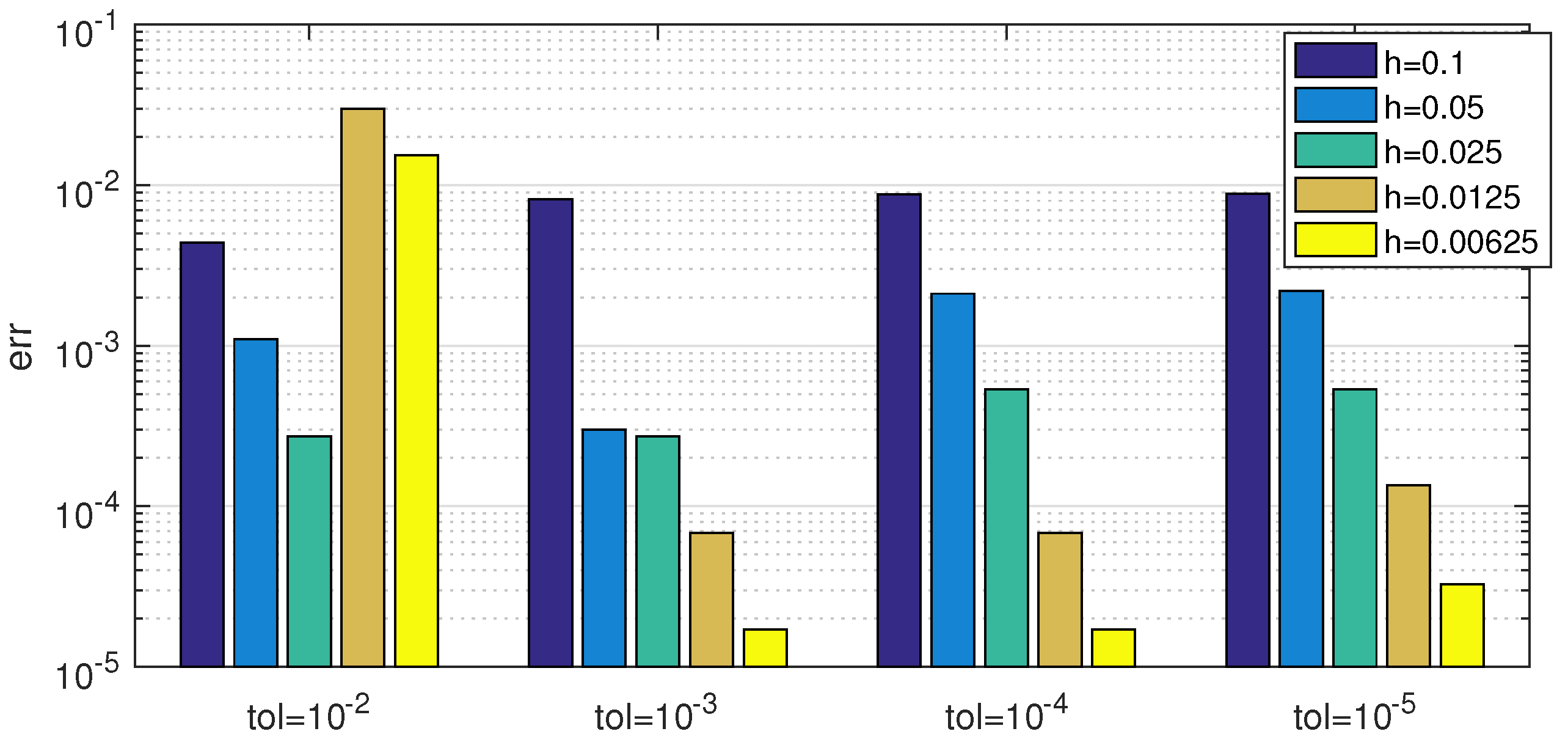
Matrix problem. Precision of the modern version of the multi-splitting iterative approach in terms of the time step h and the tolerance.
Figure 1.
Matrix problem. Precision of the modern version of the multi-splitting iterative approach in terms of the time step h and the tolerance.
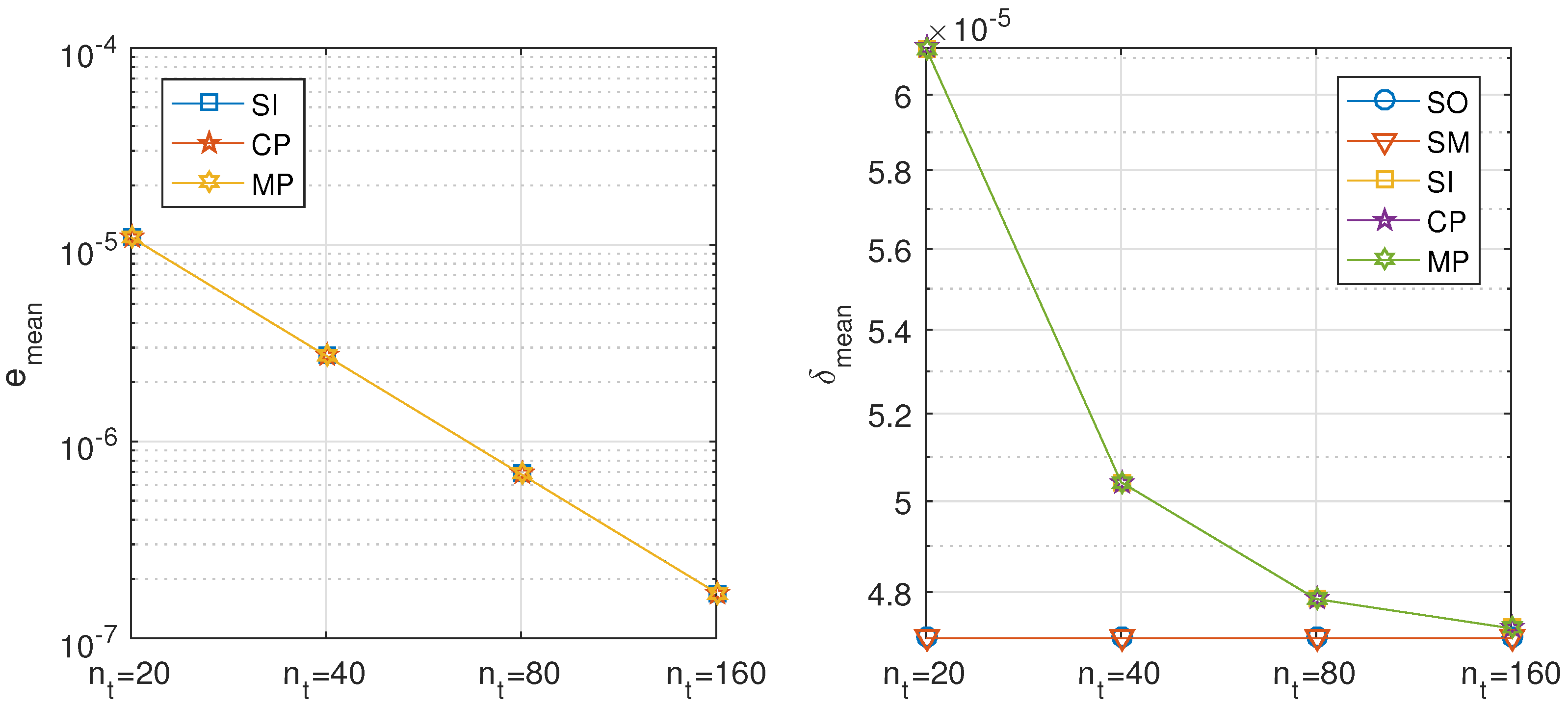
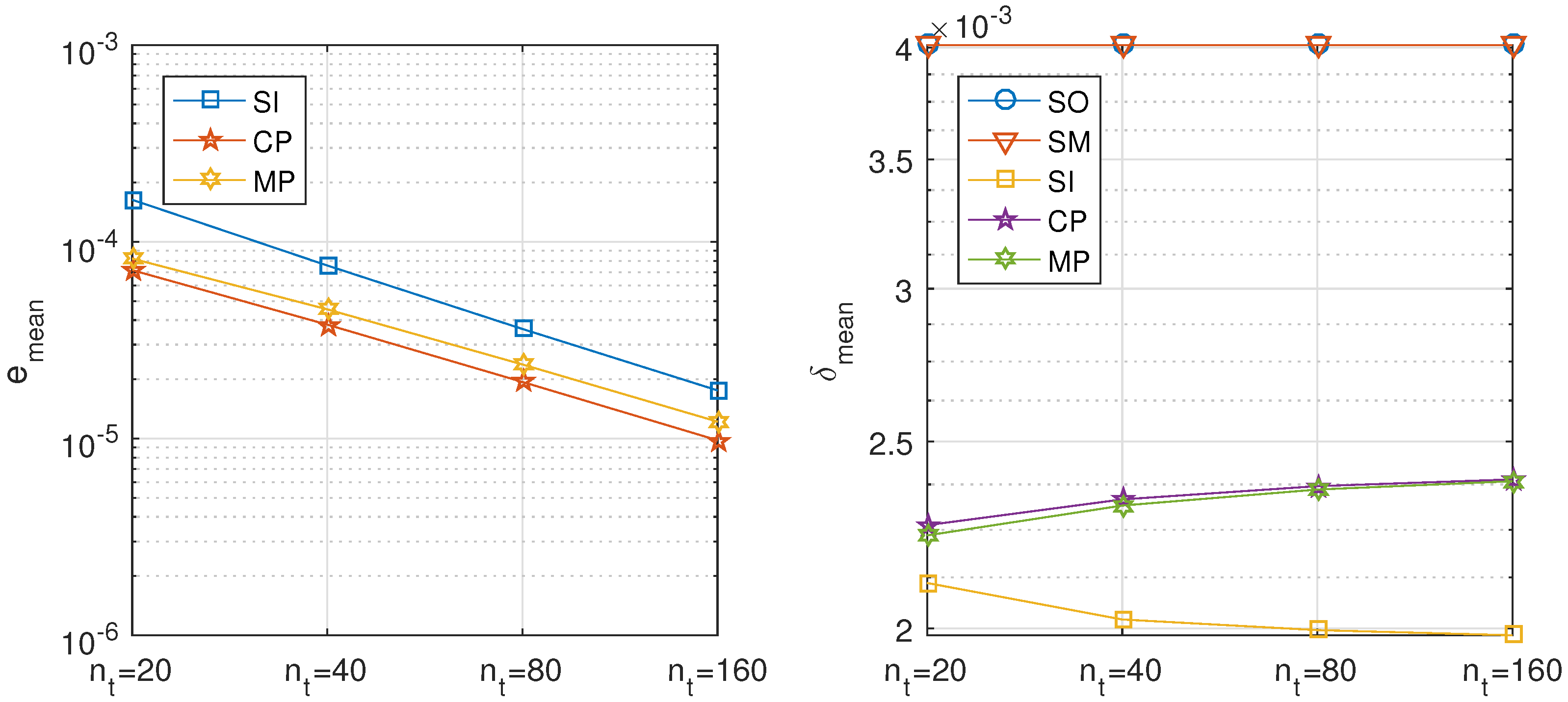
Figure 2.
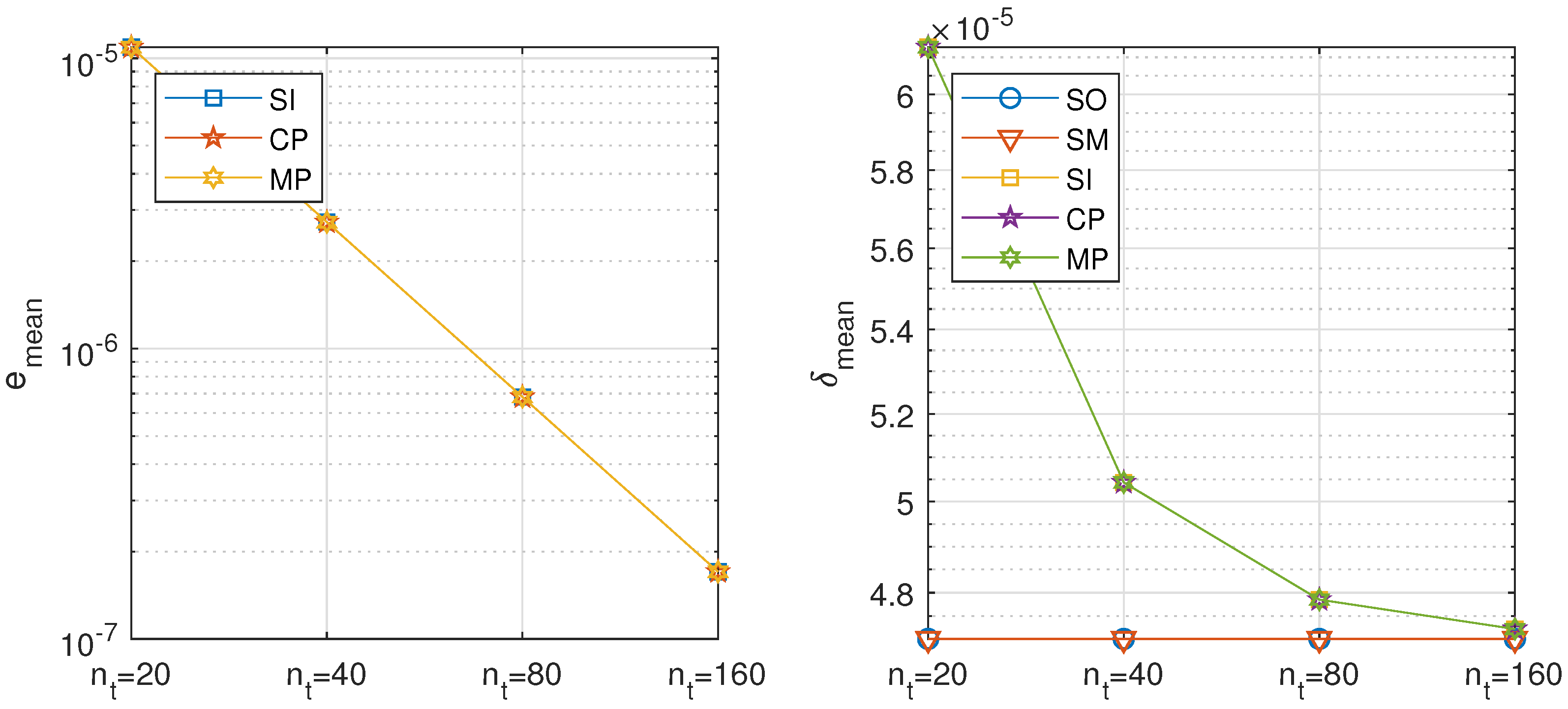
Diffusion problem, directional decomposition. Precision of the proposed methods: sequential iterative SI, classical parallel CP, and modern parallel MP, as compared with the classical ones: sequential operator SO and Strang–Marchuk SM, with second order approximations for the spatial derivatives for different number of time steps.
Figure 2.
Diffusion problem, directional decomposition. Precision of the proposed methods: sequential iterative SI, classical parallel CP, and modern parallel MP, as compared with the classical ones: sequential operator SO and Strang–Marchuk SM, with second order approximations for the spatial derivatives for different number of time steps.
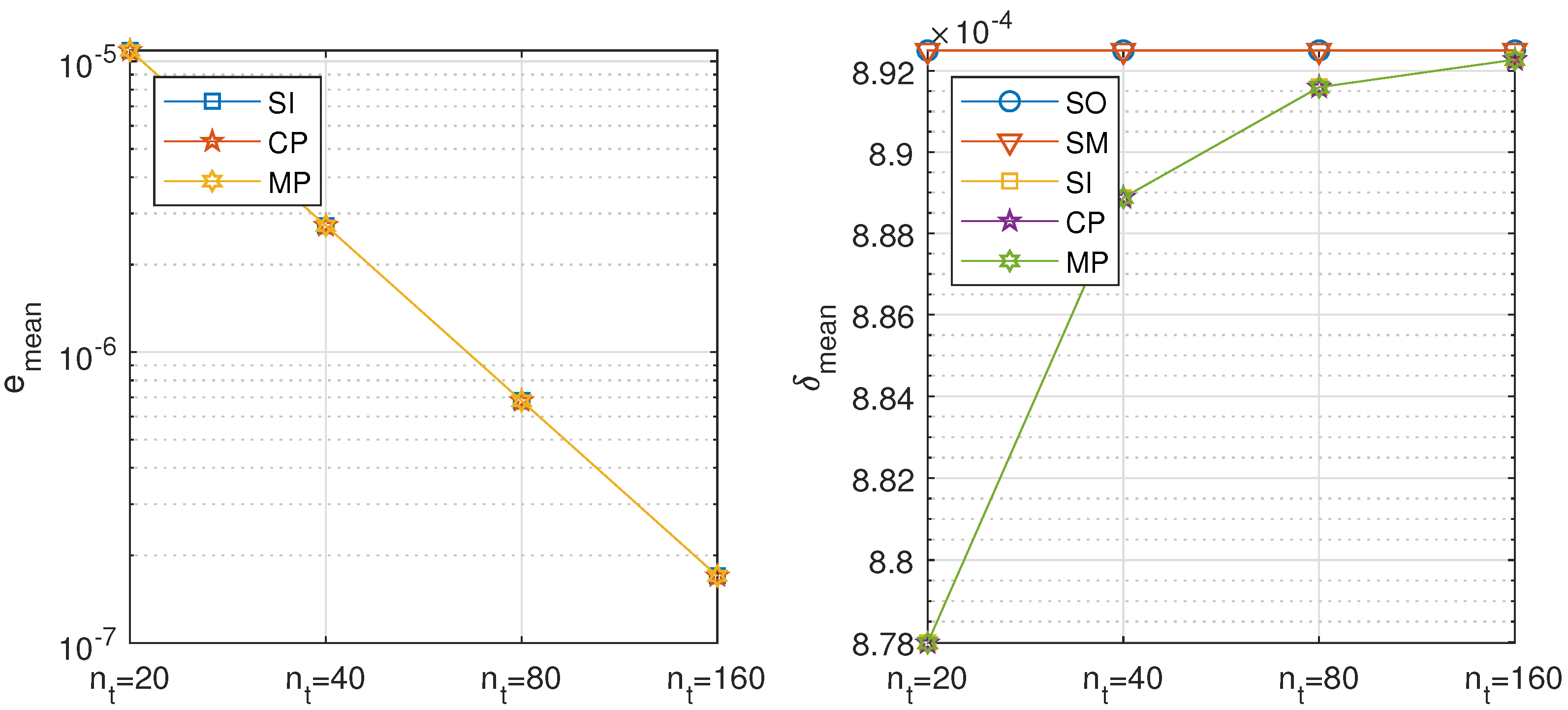
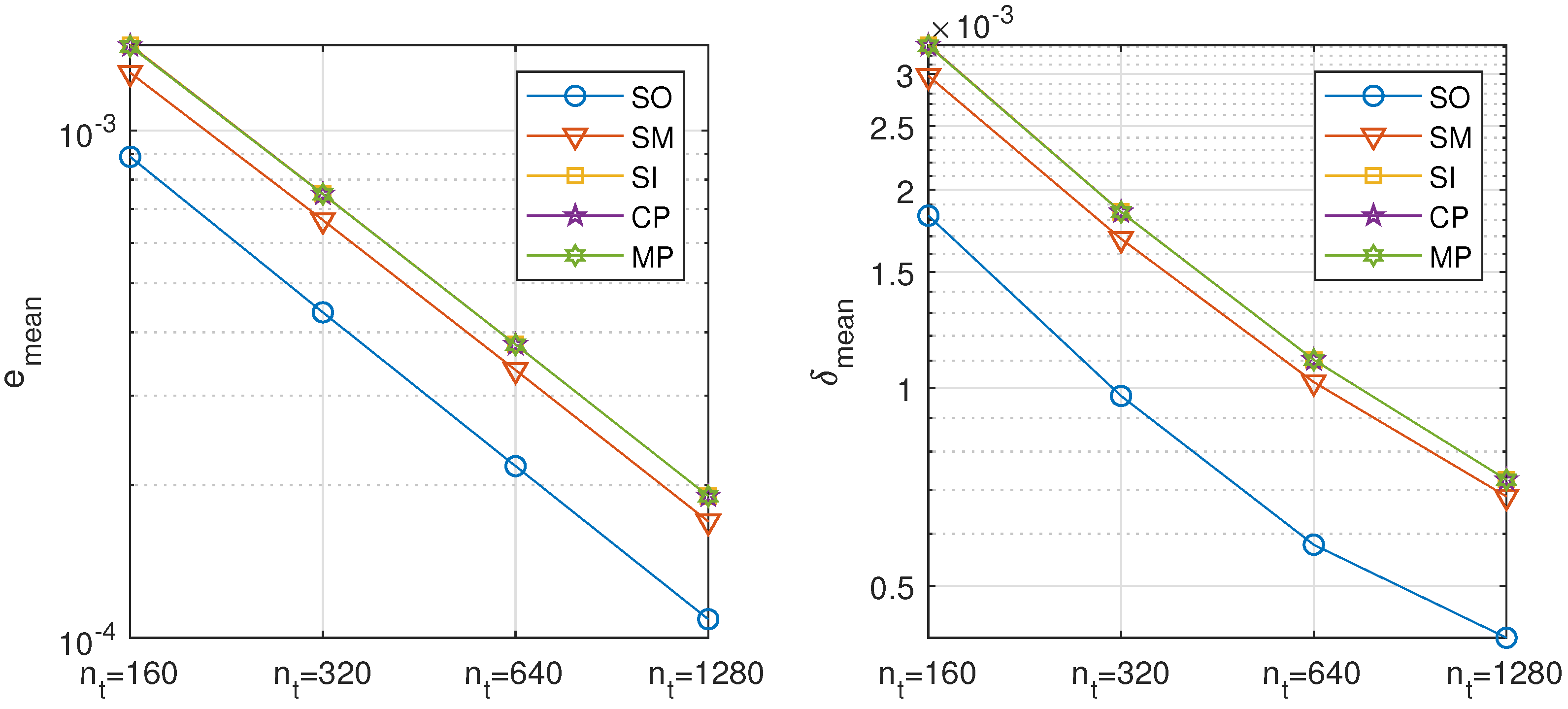
Figure 3.
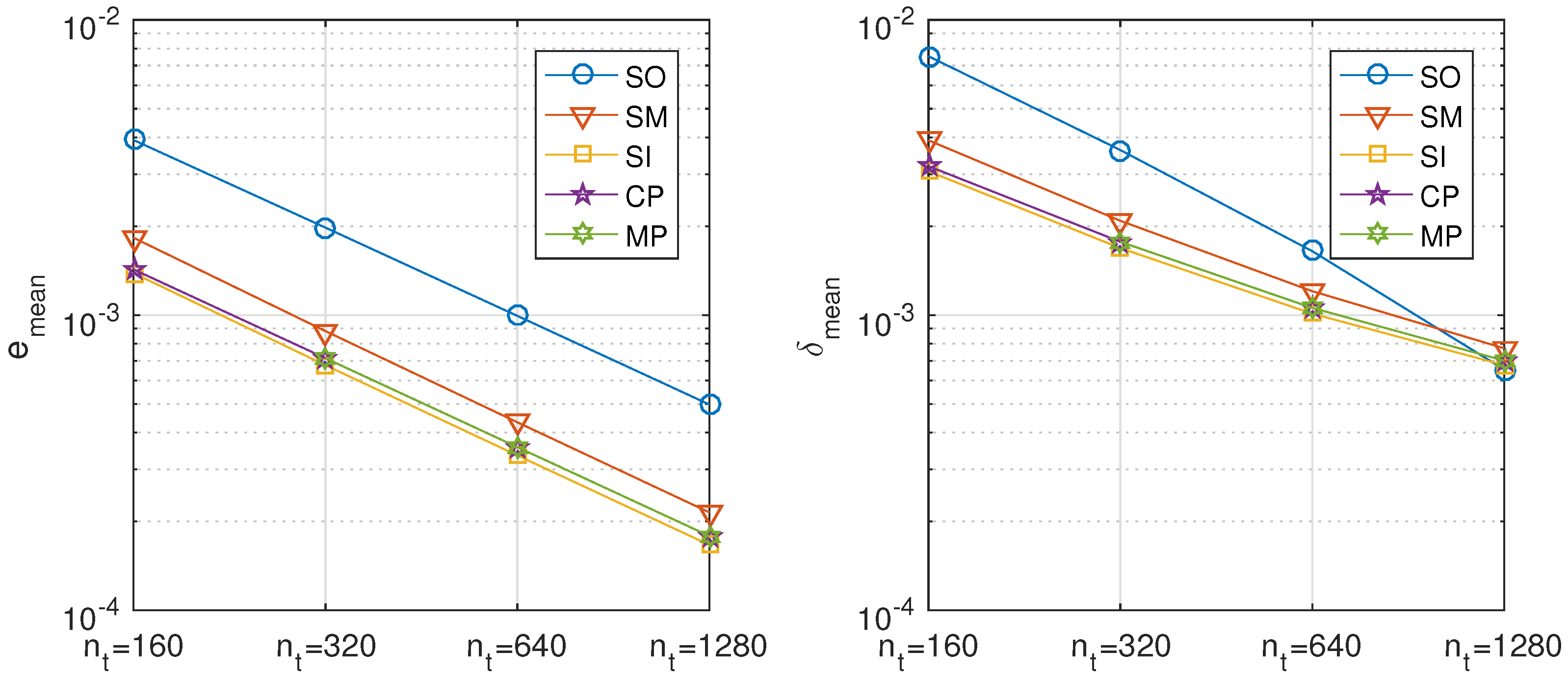
Diffusion problem, directional decomposition. Precision of the proposed methods: sequential iterative SI, classical parallel CP, and modern parallel MP, compared with the classical ones: sequential operator SO and Strang–Marchuk SM, with fourth order approximations for the spatial derivatives for different number of time steps.
Figure 3.
Diffusion problem, directional decomposition. Precision of the proposed methods: sequential iterative SI, classical parallel CP, and modern parallel MP, compared with the classical ones: sequential operator SO and Strang–Marchuk SM, with fourth order approximations for the spatial derivatives for different number of time steps.
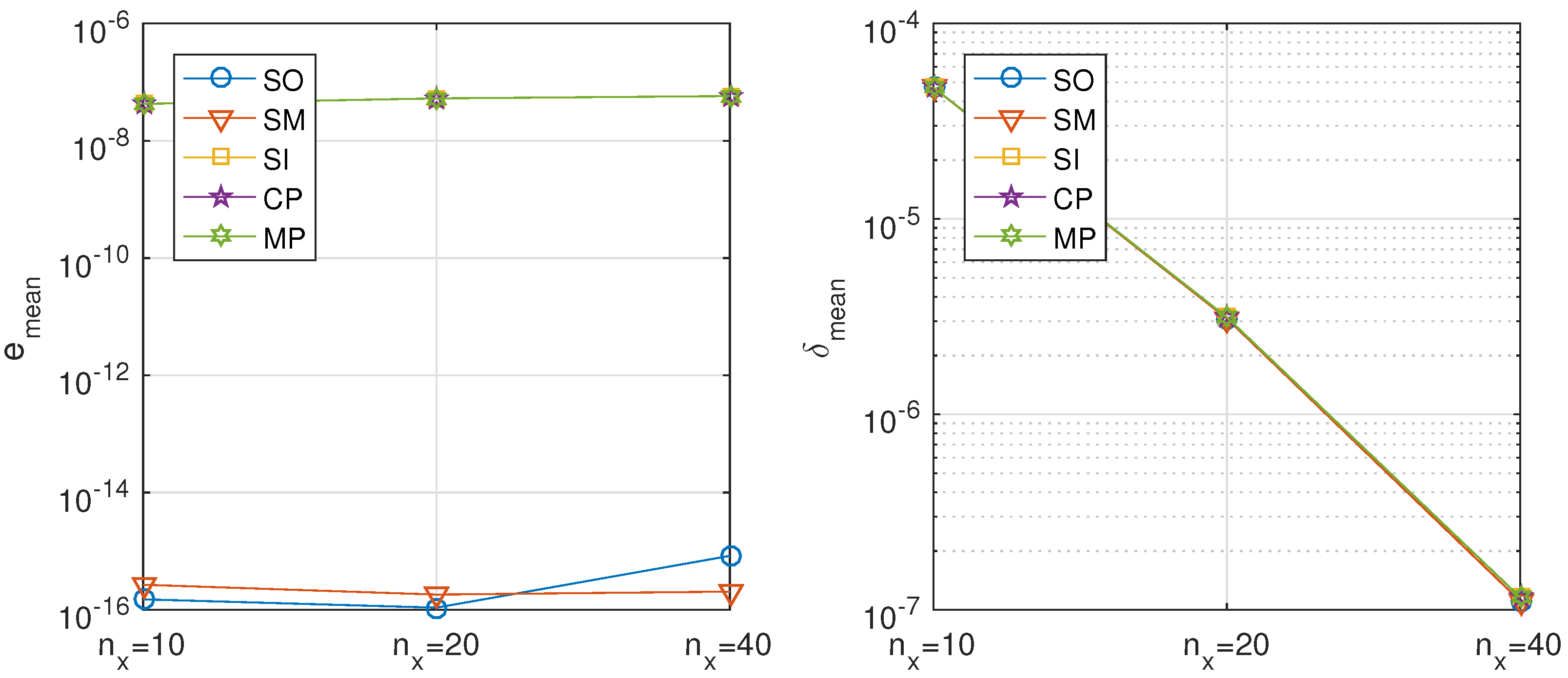
Figure 4.
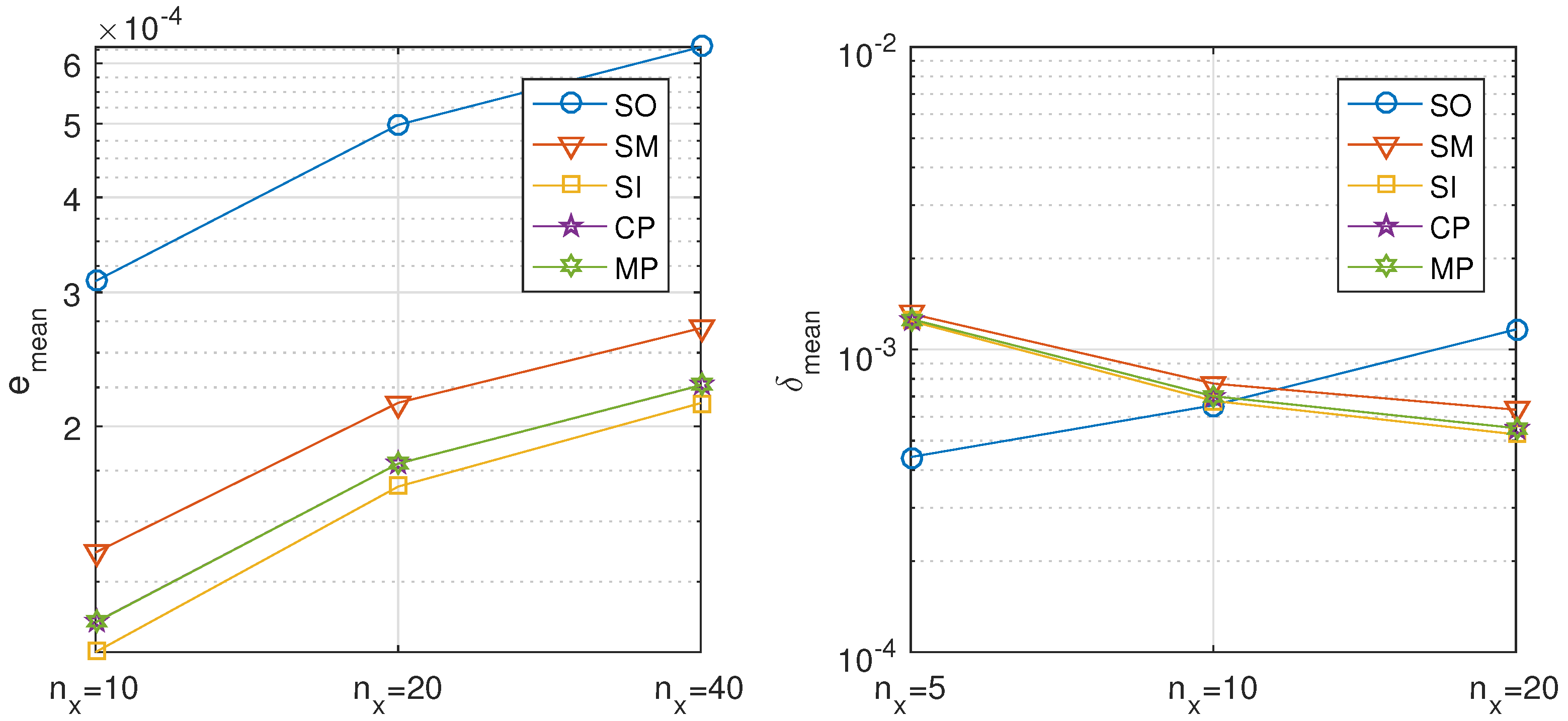
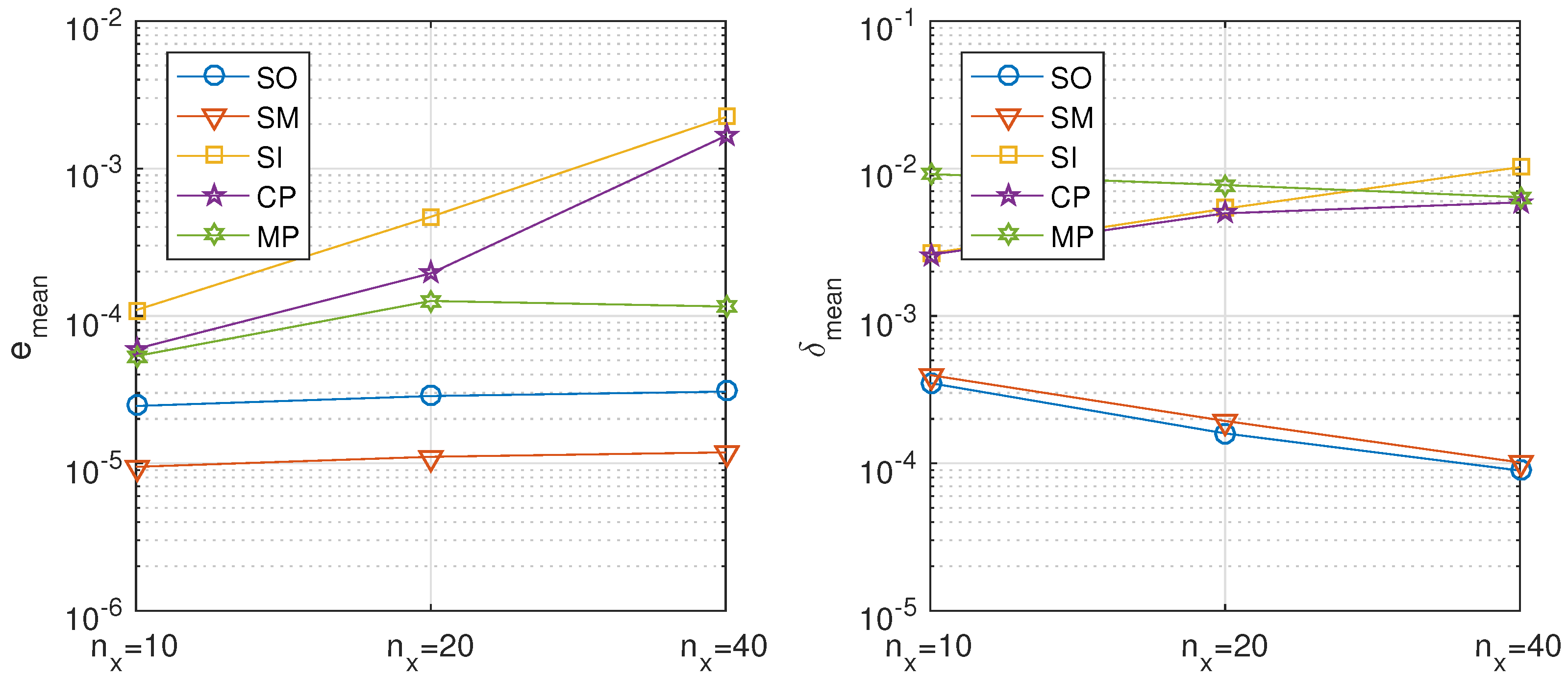
Diffusion problem, directional decomposition. Precision of the proposed methods: sequential iterative SI, classical parallel CP, and modern parallel MP, compared with the classical ones: sequential operator SO and Strang–Marchuk SM, with second order approximations for the spatial derivatives with 320 time steps and different number of spatial steps.
Figure 4.
Diffusion problem, directional decomposition. Precision of the proposed methods: sequential iterative SI, classical parallel CP, and modern parallel MP, compared with the classical ones: sequential operator SO and Strang–Marchuk SM, with second order approximations for the spatial derivatives with 320 time steps and different number of spatial steps.
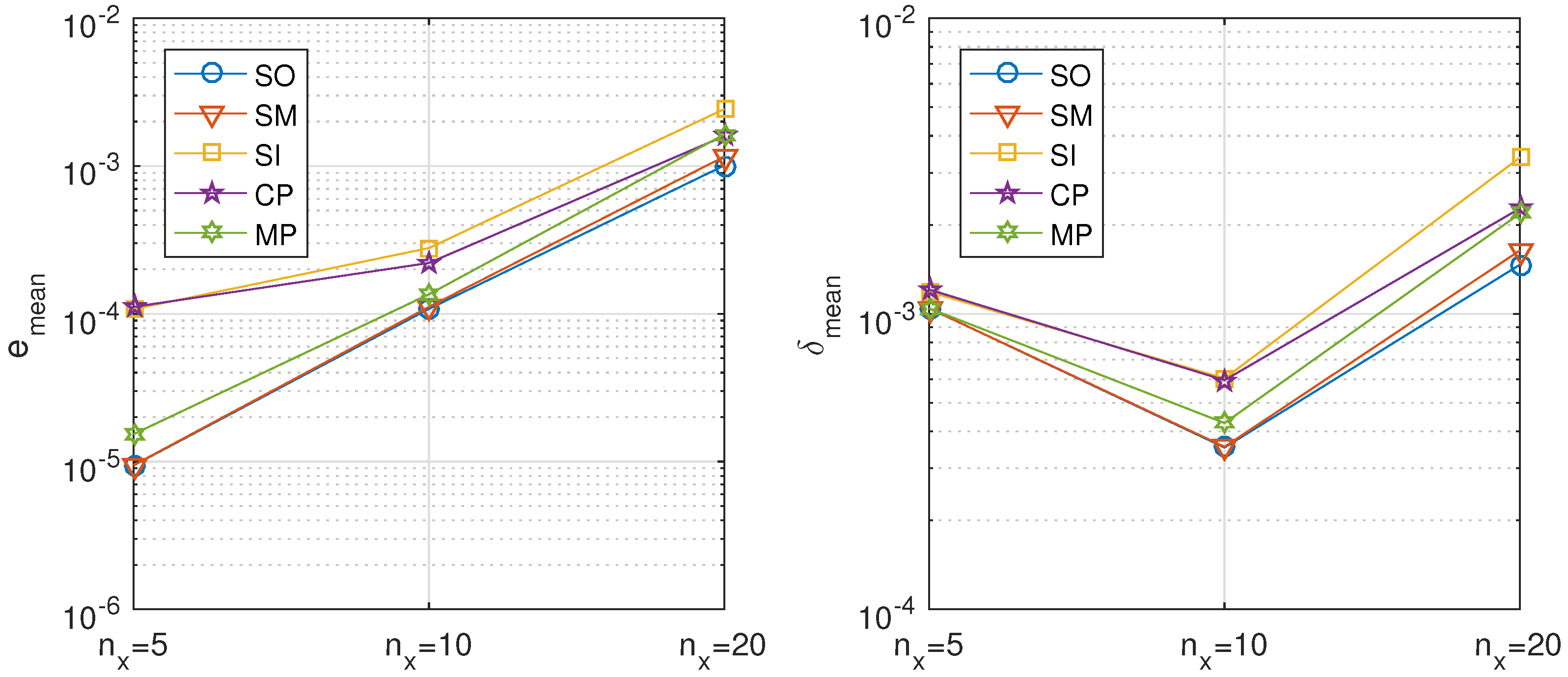
Figure 5.
Diffusion problem, directional decomposition. Precision of the proposed methods: sequential iterative SI, classical parallel CP, and modern parallel MP, compared with the classical ones: sequential operator SO and Strang–Marchuk SM, with fourth order approximations for the spatial derivatives for different number of spatial steps.
Figure 5.
Diffusion problem, directional decomposition. Precision of the proposed methods: sequential iterative SI, classical parallel CP, and modern parallel MP, compared with the classical ones: sequential operator SO and Strang–Marchuk SM, with fourth order approximations for the spatial derivatives for different number of spatial steps.
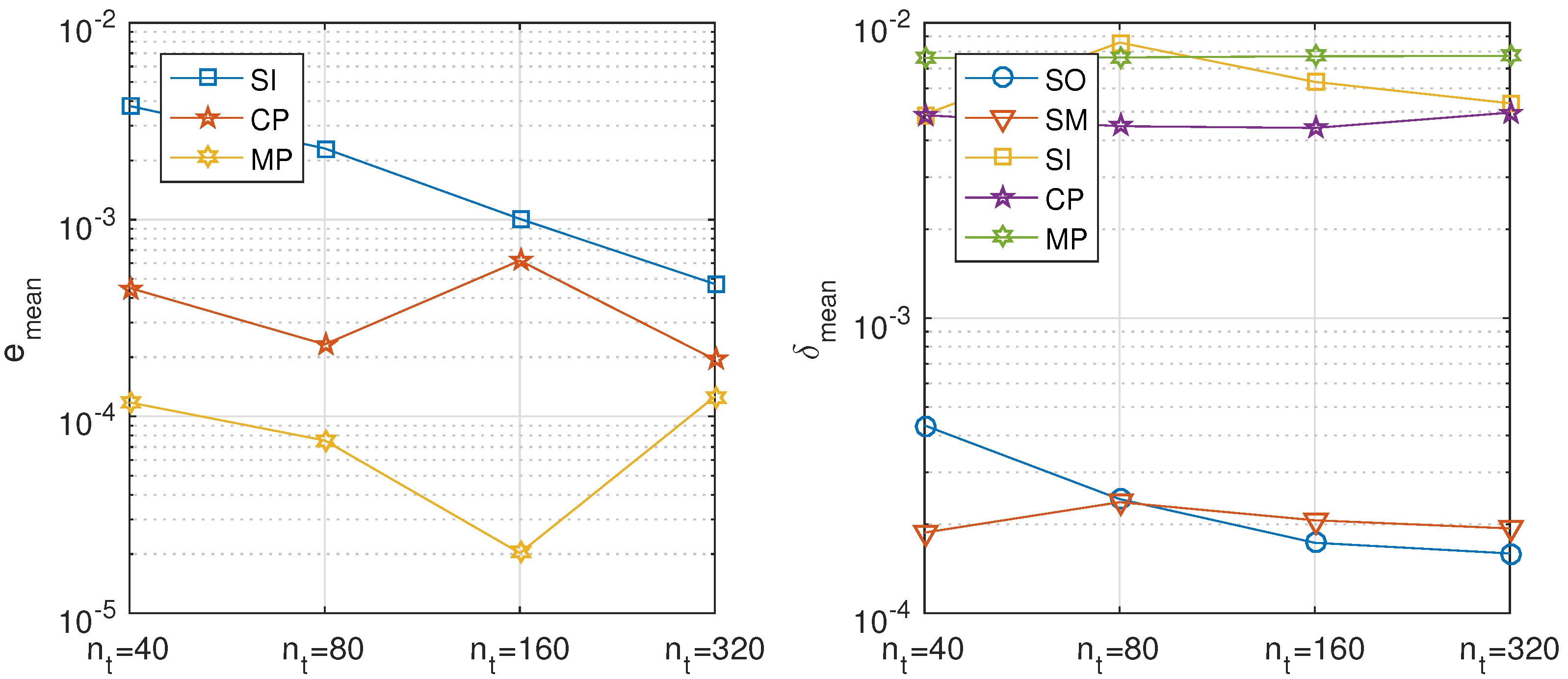
Figure 6.
Diffusion problem, balanced decomposition. Precision of the proposed methods: sequential iterative SI, classical parallel CP, and modern parallel MP, compared with the classical ones: sequential operator SO and Strang–Marchuk SM, with second order approximations for the spatial derivatives for different number of time steps.
Figure 6.
Diffusion problem, balanced decomposition. Precision of the proposed methods: sequential iterative SI, classical parallel CP, and modern parallel MP, compared with the classical ones: sequential operator SO and Strang–Marchuk SM, with second order approximations for the spatial derivatives for different number of time steps.
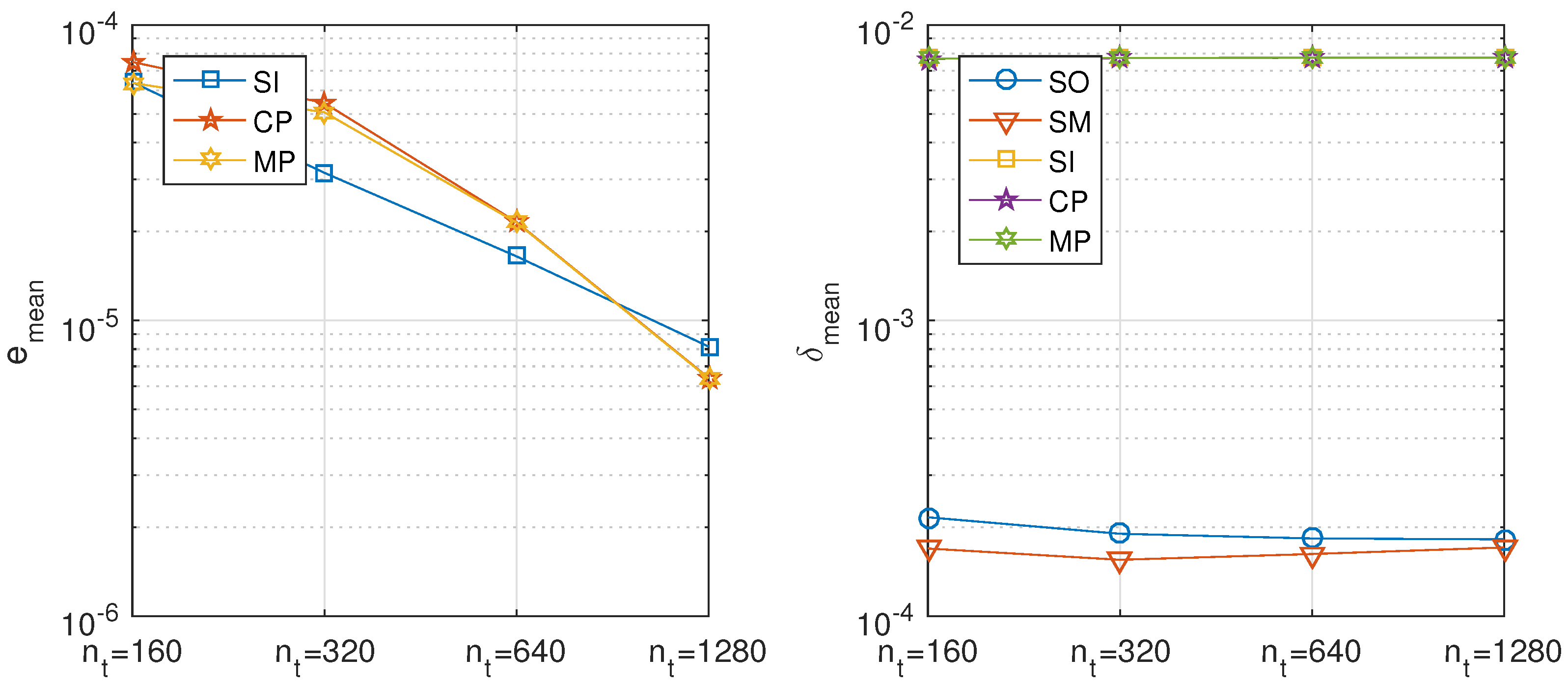
Figure 7.
Diffusion problem, balanced decomposition. Precision of the proposed methods: sequential iterative SI, classical parallel CP, and modern parallel MP, compared with the classical ones: sequential operator SO and Strang–Marchuk SM, with fourth order approximations for the spatial derivatives for different number of time steps.
Figure 7.
Diffusion problem, balanced decomposition. Precision of the proposed methods: sequential iterative SI, classical parallel CP, and modern parallel MP, compared with the classical ones: sequential operator SO and Strang–Marchuk SM, with fourth order approximations for the spatial derivatives for different number of time steps.
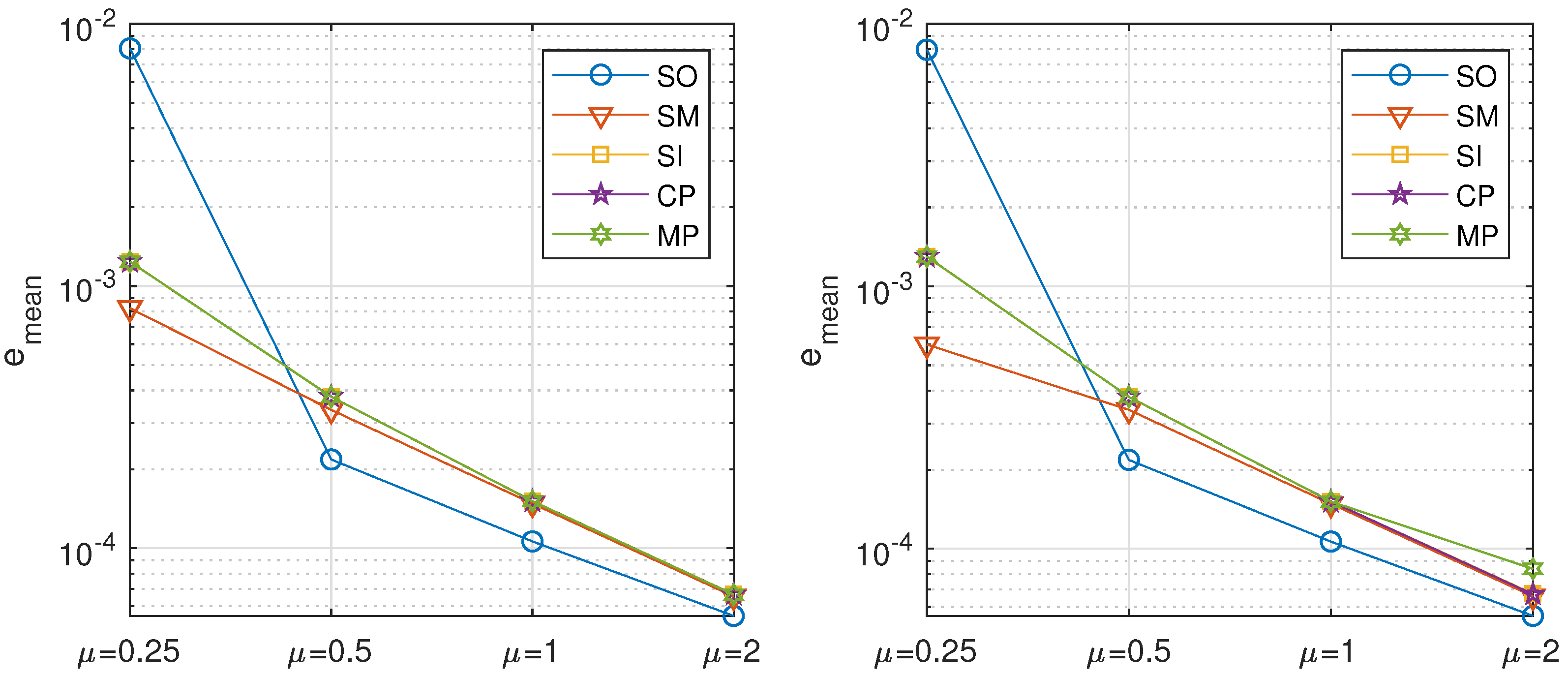
Figure 8.
Mixed convection-diffusion and Burgers’ equation, directional decomposition. Precision of the proposed methods: sequential iterative SI, classical parallel CP, and modern parallel MP, compared with the classical ones: sequential operator SO and Strang–Marchuk SM, for different viscosities . Left: order 2 approximation and right: order 4 approximation for the discretization of the spatial derivatives.
Figure 8.
Mixed convection-diffusion and Burgers’ equation, directional decomposition. Precision of the proposed methods: sequential iterative SI, classical parallel CP, and modern parallel MP, compared with the classical ones: sequential operator SO and Strang–Marchuk SM, for different viscosities . Left: order 2 approximation and right: order 4 approximation for the discretization of the spatial derivatives.
Figure 9.
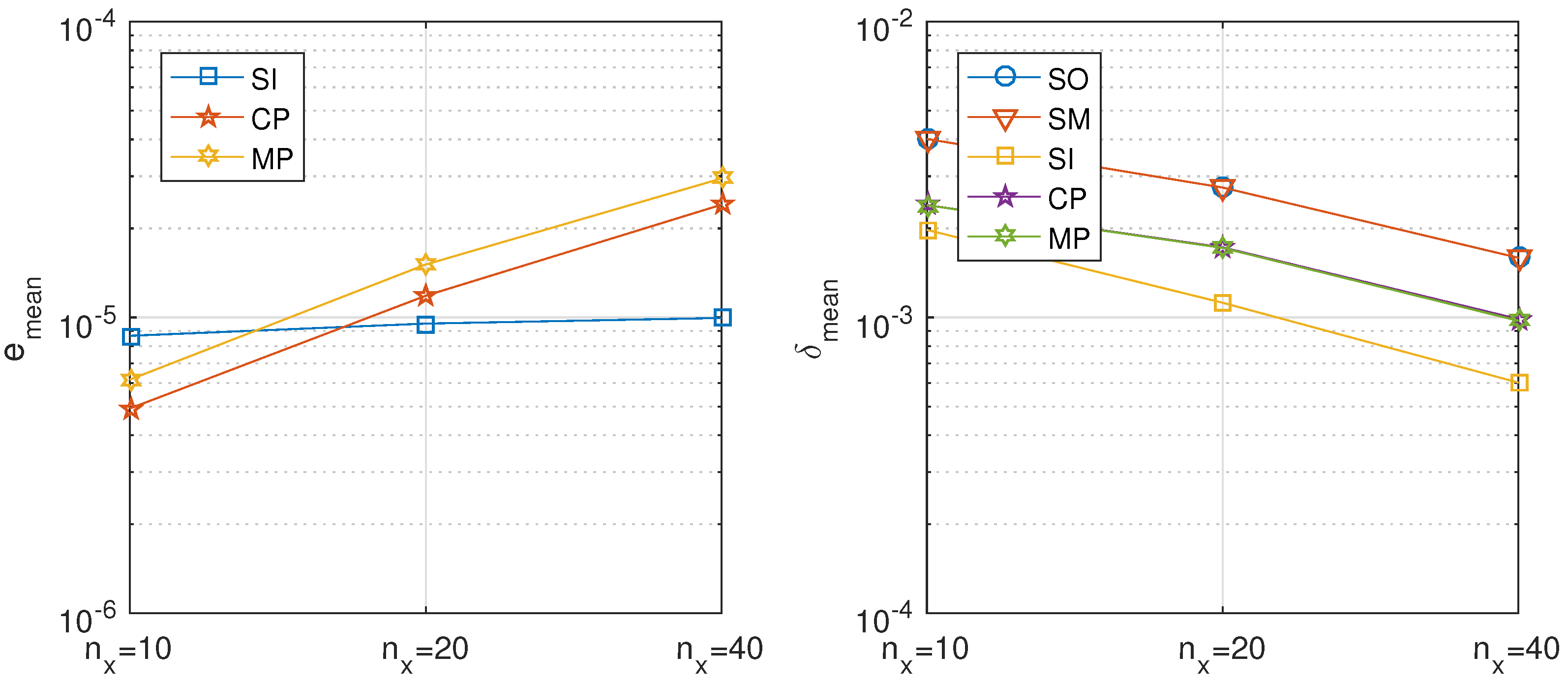
Mixed convection-diffusion and Burgers’ equation, directional decomposition. Precision of the proposed methods: sequential iterative SI, classical parallel CP, and modern parallel MP, compared with the classical ones: sequential operator SO and Strang–Marchuk SM, for different number of time steps.
Figure 9.
Mixed convection-diffusion and Burgers’ equation, directional decomposition. Precision of the proposed methods: sequential iterative SI, classical parallel CP, and modern parallel MP, compared with the classical ones: sequential operator SO and Strang–Marchuk SM, for different number of time steps.
Figure 10.
Mixed convection-diffusion and Burgers’ equation, directional decomposition. Precision of the proposed methods: sequential iterative SI, classical parallel CP, and modern parallel MP, compared with the classical ones: sequential operator SO and Strang–Marchuk SM, for different number of spatial steps in the directional decomposition.
Figure 10.
Mixed convection-diffusion and Burgers’ equation, directional decomposition. Precision of the proposed methods: sequential iterative SI, classical parallel CP, and modern parallel MP, compared with the classical ones: sequential operator SO and Strang–Marchuk SM, for different number of spatial steps in the directional decomposition.
Figure 11.
Mixed convection-diffusion and Burgers’ equation, convection-diffusion decomposition. Precision of the proposed methods: sequential iterative SI, classical parallel CP, and modern parallel MP, compared with the classical ones: sequential operator SO and Strang–Marchuk SM, for different number of time steps.
Figure 11.
Mixed convection-diffusion and Burgers’ equation, convection-diffusion decomposition. Precision of the proposed methods: sequential iterative SI, classical parallel CP, and modern parallel MP, compared with the classical ones: sequential operator SO and Strang–Marchuk SM, for different number of time steps.
Figure 12.
Mixed convection-diffusion and Burgers’ equation, convection-diffusion decomposition. Precision of the proposed methods: sequential iterative SI, classical parallel CP, and modern parallel MP, compared with the classical ones: sequential operator SO and Strang–Marchuk SM, for different number of spatial steps.
Figure 12.
Mixed convection-diffusion and Burgers’ equation, convection-diffusion decomposition. Precision of the proposed methods: sequential iterative SI, classical parallel CP, and modern parallel MP, compared with the classical ones: sequential operator SO and Strang–Marchuk SM, for different number of spatial steps.
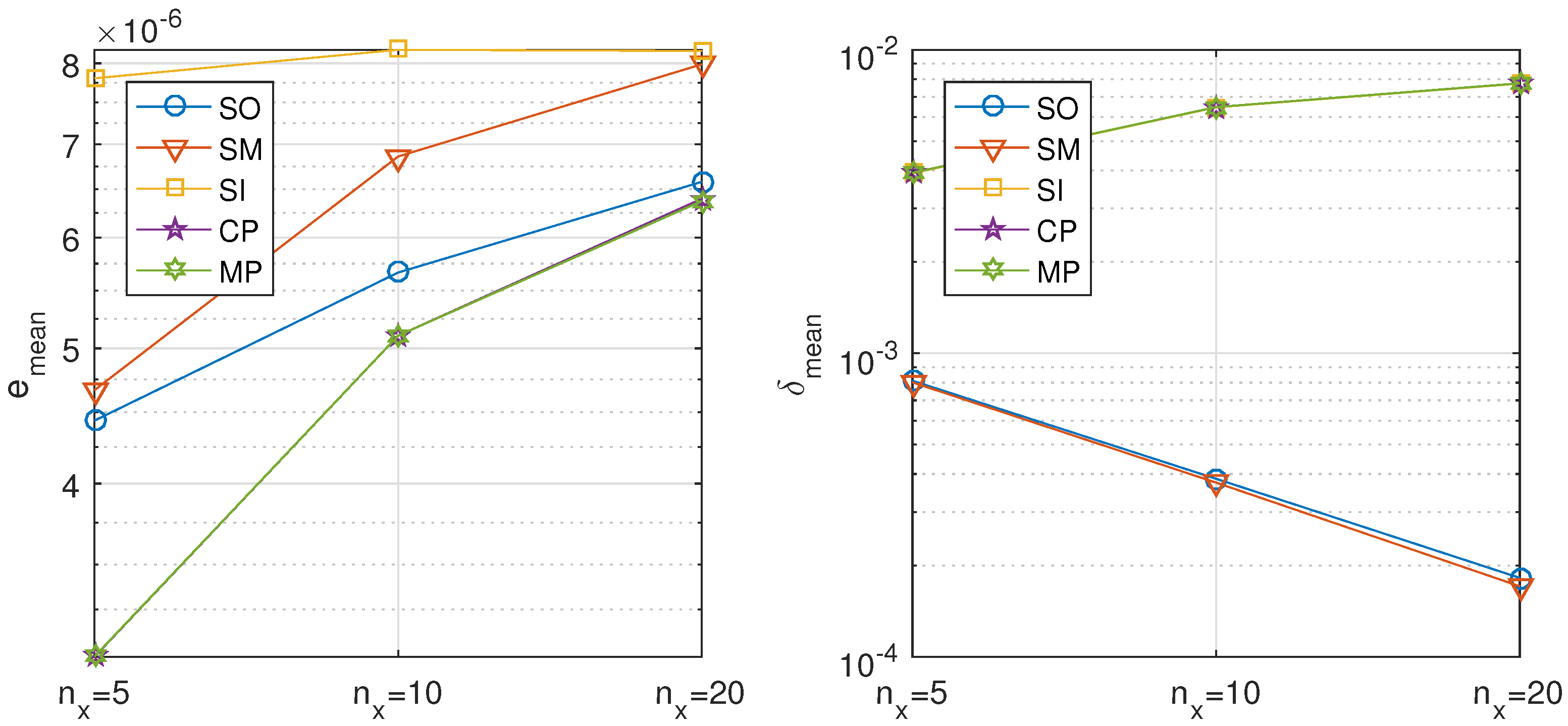
Figure 13.
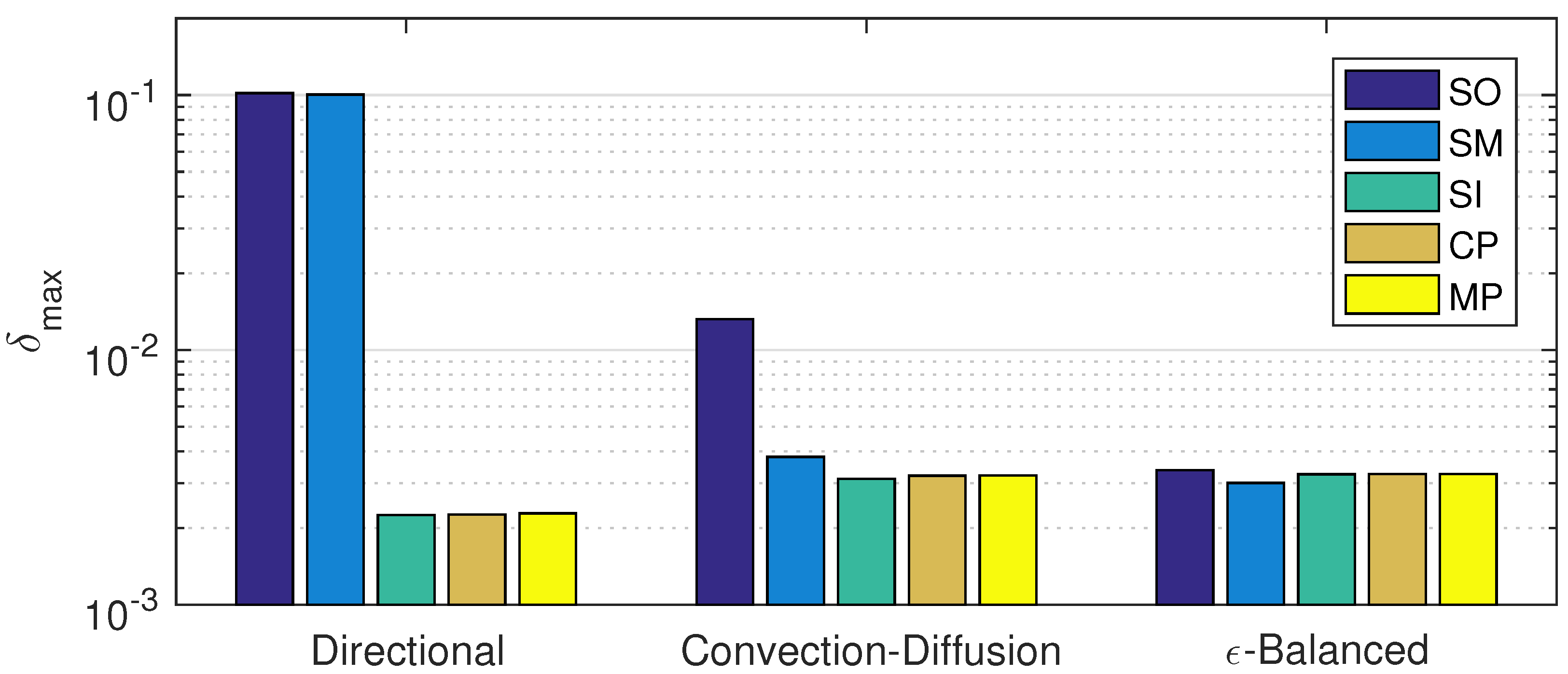
Mixed convection-diffusion and Burgers’ equation with 10 spatial intervals and 1280 temporal steps. Precision of the proposed methods: sequential iterative SI, classical parallel CP, and modern parallel MP, compared with the classical ones: sequential operator SO and Strang–Marchuk SM, for different decomposition methods.
Figure 13.
Mixed convection-diffusion and Burgers’ equation with 10 spatial intervals and 1280 temporal steps. Precision of the proposed methods: sequential iterative SI, classical parallel CP, and modern parallel MP, compared with the classical ones: sequential operator SO and Strang–Marchuk SM, for different decomposition methods.
Figure 14.
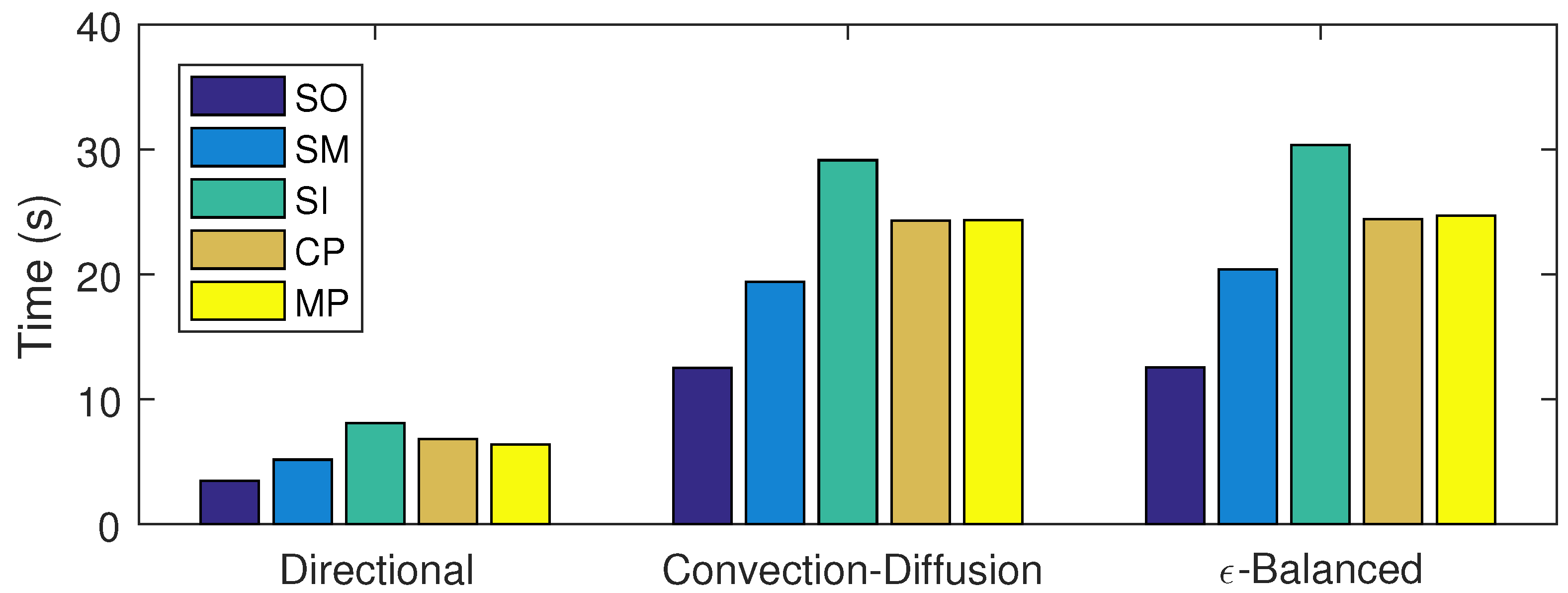
Mixed convection-diffusion and Burgers’ equation with 10 spatial intervals and 640 time steps. Temporal cost in seconds of the proposed methods: sequential iterative SI, classical parallel CP, and modern parallel MP, compared with the classical ones: sequential operator SO and Strang–Marchuk SM, for different decomposition methods.
Figure 14.
Mixed convection-diffusion and Burgers’ equation with 10 spatial intervals and 640 time steps. Temporal cost in seconds of the proposed methods: sequential iterative SI, classical parallel CP, and modern parallel MP, compared with the classical ones: sequential operator SO and Strang–Marchuk SM, for different decomposition methods.
Figure 15.
Fractional diffusion equation, directional decomposition. Precision of the proposed methods: sequential iterative SI, classical parallel CP, and modern parallel MP, compared with the classical ones: sequential operator SO and Strang–Marchuk SM, for different number of time steps.
Figure 15.
Fractional diffusion equation, directional decomposition. Precision of the proposed methods: sequential iterative SI, classical parallel CP, and modern parallel MP, compared with the classical ones: sequential operator SO and Strang–Marchuk SM, for different number of time steps.
Figure 16.
Fractional diffusion equation, directional decomposition. Precision of the proposed methods: sequential iterative SI, classical parallel CP, and modern parallel MP, compared with the classical ones: sequential operator SO and Strang–Marchuk SM, for 320 temporal steps and different number of spatial subintervals.
Figure 16.
Fractional diffusion equation, directional decomposition. Precision of the proposed methods: sequential iterative SI, classical parallel CP, and modern parallel MP, compared with the classical ones: sequential operator SO and Strang–Marchuk SM, for 320 temporal steps and different number of spatial subintervals.
Figure 17.
Fractional diffusion equation, balanced decomposition. Precision of the proposed methods: sequential iterative SI, classical parallel CP, and modern parallel MP, compared with the classical ones: sequential operator SO and Strang–Marchuk SM, for different number of time steps.
Figure 17.
Fractional diffusion equation, balanced decomposition. Precision of the proposed methods: sequential iterative SI, classical parallel CP, and modern parallel MP, compared with the classical ones: sequential operator SO and Strang–Marchuk SM, for different number of time steps.
Figure 18.
Fractional diffusion equation, balanced decomposition. Precision of the proposed methods: sequential iterative SI, classical parallel CP, and modern parallel MP, compared with the classical ones: sequential operator SO and Strang–Marchuk SM, for 320 temporal steps and different number of spatial subintervals.
Figure 18.
Fractional diffusion equation, balanced decomposition. Precision of the proposed methods: sequential iterative SI, classical parallel CP, and modern parallel MP, compared with the classical ones: sequential operator SO and Strang–Marchuk SM, for 320 temporal steps and different number of spatial subintervals.
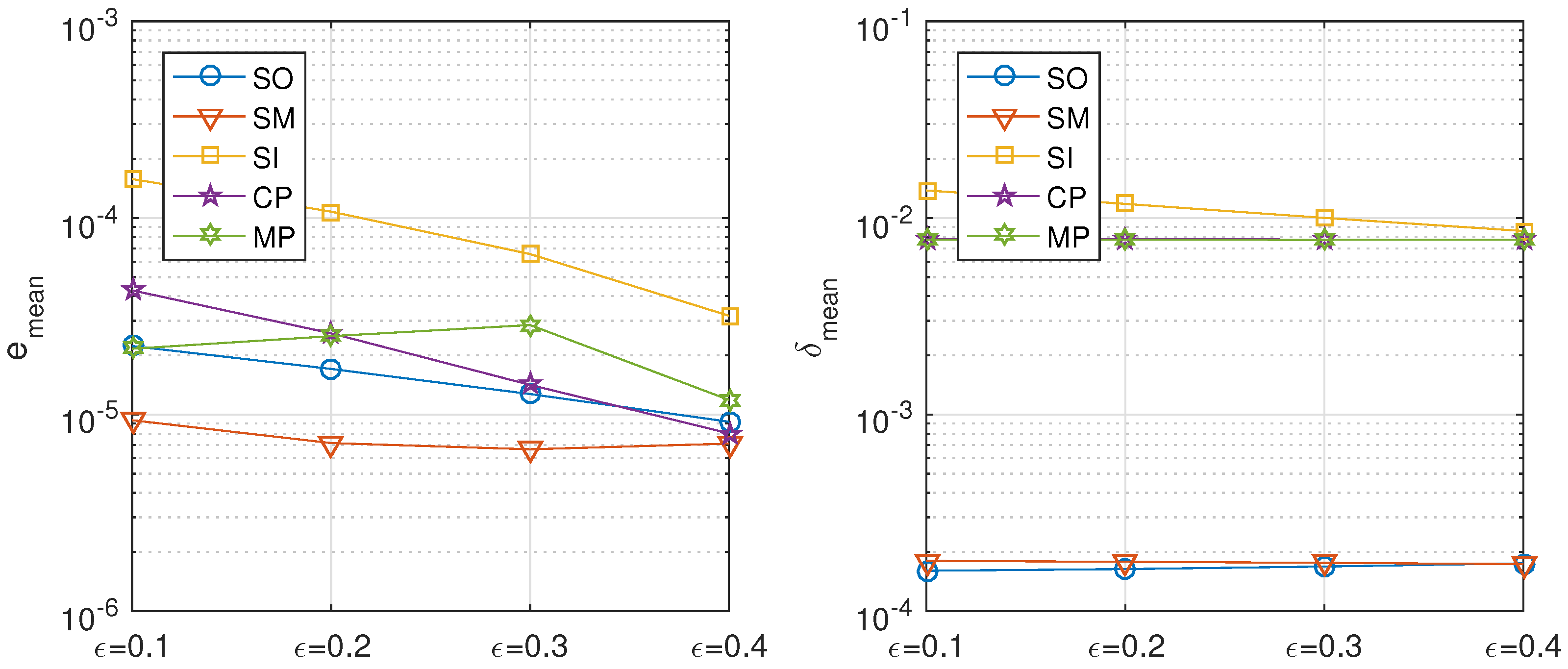
Figure 19.
Fractional diffusion equation, mixed decomposition. Precision of the proposed methods: sequential iterative SI, classical parallel CP, and modern parallel MP, compared with the classical ones: sequential operator SO and Strang–Marchuk SM, for 20 temporal steps, 320 temporal steps, and different values of .
Figure 19.
Fractional diffusion equation, mixed decomposition. Precision of the proposed methods: sequential iterative SI, classical parallel CP, and modern parallel MP, compared with the classical ones: sequential operator SO and Strang–Marchuk SM, for 20 temporal steps, 320 temporal steps, and different values of .
Table 1.
Multisplitting classic version.
Table 1.
Multisplitting classic version.
| h | max | max | rel | rel | it 1 | it 2 |
|---|
| 0.1 | 0.008308 | 0.00040332 | 0.0010188 | 0.00014837 | 4 | 4 |
| 0.05 | 0.00043184 | | | | 3 | 3 |
| 0.025 | 0.00010623 | | | | 3 | 3 |
| 0.0125 | | | | | 3 | 3 |
| 0.00625 | | | | | 3 | 3 |
Table 2.
Multisplitting Modern version.
Table 2.
Multisplitting Modern version.
| h | max | max | rel | rel | it 1 | it 2 |
|---|
| 0.1 | 0.0081586 | 0.0003996 | 0.0010005 | 0.000147 | 4 | 4 |
| 0.05 | 0.00030027 | | 0.00012447 | | 3.35 | 3 |
| 0.025 | 0.00027348 | | | | 3 | 3 |
| 0.0125 | | | | | 3 | 3 |
| 0.00625 | | | | | 3 | 3 |
Table 3.
Diffusion problem. Results of the directional decomposition using the second order scheme for the spatial discretization, with 10 spatial subintervals and different number of temporal steps.
Table 3.
Diffusion problem. Results of the directional decomposition using the second order scheme for the spatial discretization, with 10 spatial subintervals and different number of temporal steps.
| Splitting Algorithm | Time Steps | | | | | Average Iterations |
|---|
| Sequential Operator | 20 | | | | | 1.0000 |
| 40 | | | | | 1.0000 |
| 80 | | | | | 1.0000 |
| 160 | | | | | 1.0000 |
| Strang-Marchuk | 20 | | | | | 1.6667 |
| 40 | | | | | 1.6667 |
| 80 | | | | | 1.6667 |
| 160 | | | | | 1.6667 |
| Serial Iterative | 20 | | | | | 3.0000 |
| 40 | | | | | 3.0000 |
| 80 | | | | | 2.0688 |
| 160 | | | | | 2.0031 |
| Classical Parallel | 20 | | | | | 7.0000 |
| 40 | | | | | 5.0750 |
| 80 | | | | | 4.8688 |
| 160 | | | | | 4.0031 |
| Modern Parallel | 20 | | | | | 7.9750 |
| 40 | | | | | 6.0000 |
| 80 | | | | | 4.9938 |
| 160 | | | | | 4.0031 |
Table 4.
Diffusion problem. Results of the directional decomposition using the fourth order scheme for the spatial discretization, with 10 subintervals in each dimension and different number of temporal steps.
Table 4.
Diffusion problem. Results of the directional decomposition using the fourth order scheme for the spatial discretization, with 10 subintervals in each dimension and different number of temporal steps.
| Splitting Algorithm | Time Steps | | | | | Average Iterations |
|---|
| Sequential Operator | 20 | | | | | 1.0000 |
| 40 | | | | | 1.0000 |
| 80 | | | | | 1.0000 |
| 160 | | | | | 1.0000 |
| Strang-Marchuk | 20 | | | | | 1.6667 |
| 40 | | | | | 1.6667 |
| 80 | | | | | 1.6667 |
| 160 | | | | | 1.6667 |
| Serial Iterative | 20 | | | | | 3.0000 |
| 40 | | | | | 3.0000 |
| 80 | | | | | 2.0063 |
| 160 | | | | | 2.0031 |
| Classical Parallel | 20 | | | | | 6.0250 |
| 40 | | | | | 5.0125 |
| 80 | | | | | 4.0062 |
| 160 | | | | | 4.0031 |
| Modern Parallel | 20 | | | | | 6.0250 |
| 40 | | | | | 5.0125 |
| 80 | | | | | 4.0062 |
| 160 | | | | | 4.0031 |
Table 5.
Diffusion problem. Results of the directional decomposition using the second order scheme for the spatial discretization, with 320 temporal steps and different number of spatial subintervals.
Table 5.
Diffusion problem. Results of the directional decomposition using the second order scheme for the spatial discretization, with 320 temporal steps and different number of spatial subintervals.
| Splitting Algorithm | Space Intervals | | | | | Average Iterations |
|---|
| Sequential Operator | 10 | | | | | 1.0000 |
| 20 | | | | | 1.0000 |
| 40 | | | | | 1.0000 |
| Strang-Marchuk | 10 | | | | | 1.6667 |
| 20 | | | | | 1.6667 |
| 40 | | | | | 1.6667 |
| Serial Iterative | 10 | | | | | 2.0000 |
| 20 | | | | | 2.0000 |
| 40 | | | | | 2.0078 |
| Classical Parallel | 10 | | | | | 4.0000 |
| 20 | | | | | 4.0016 |
| 40 | | | | | 4.4063 |
| Modern Parallel | 10 | | | | | 4.0000 |
| 20 | | | | | 4.9828 |
| 40 | | | | | 6.9922 |
Table 6.
Diffusion problem, directional decomposition. Results using the fourth order scheme for the spatial discretization, with 320 temporal steps and different number of subintervals in each dimension.
Table 6.
Diffusion problem, directional decomposition. Results using the fourth order scheme for the spatial discretization, with 320 temporal steps and different number of subintervals in each dimension.
| Splitting Algorithm | Space Intervals | | | | | Average Iterations |
|---|
| Sequential Operator | 10 | | | | | 1.0000 |
| 20 | | | | | 1.0000 |
| 40 | | | | | 1.0000 |
| Strang-Marchuk | 10 | | | | | 1.6667 |
| 20 | | | | | 1.6667 |
| 40 | | | | | 1.6667 |
| Serial Iterative | 10 | | | | | 2.0000 |
| 20 | | | | | 2.0000 |
| 40 | | | | | 2.0000 |
| Classical Parallel | 10 | | | | | 4.0000 |
| 20 | | | | | 4.0000 |
| 40 | | | | | 4.0000 |
| Modern Parallel | 10 | | | | | 4.0000 |
| 20 | | | | | 4.0000 |
| 40 | | | | | 4.0000 |
Table 7.
Diffusion problem. Results of the balanced decomposition using the second order scheme for the spatial discretization, with 10 spatial subintervals and different number of temporal steps.
Table 7.
Diffusion problem. Results of the balanced decomposition using the second order scheme for the spatial discretization, with 10 spatial subintervals and different number of temporal steps.
| Splitting Algorithm | Time Steps | | | | | Average Iterations |
|---|
| Sequential Operator | 20 | | | | | 1.0000 |
| 40 | | | | | 1.0000 |
| 80 | | | | | 1.0000 |
| 160 | | | | | 1.0000 |
| Strang-Marchuk | 20 | | | | | 1.6667 |
| 40 | | | | | 1.6667 |
| 80 | | | | | 1.6667 |
| 160 | | | | | 1.6667 |
| Serial Iterative | 20 | | | | | 3.0000 |
| 40 | | | | | 3.0000 |
| 80 | | | | | 2.0063 |
| 160 | | | | | 2.0031 |
| Classical Parallel | 20 | | | | | 6.0000 |
| 40 | | | | | 5.0125 |
| 80 | | | | | 4.0062 |
| 160 | | | | | 4.0031 |
| Modern Parallel | 20 | | | | | 6.0000 |
| 40 | | | | | 5.0125 |
| 80 | | | | | 4.0062 |
| 160 | | | | | 4.0031 |
Table 8.
Diffusion problem. Results of the balanced decomposition using the fourth order scheme for the spatial discretization, with 10 spatial subintervals and different number of temporal steps.
Table 8.
Diffusion problem. Results of the balanced decomposition using the fourth order scheme for the spatial discretization, with 10 spatial subintervals and different number of temporal steps.
| Splitting Algorithm | Time Steps | | | | | Average Iterations |
|---|
| Sequential Operator | 20 | | | | | 1.0000 |
| 40 | | | | | 1.0000 |
| 80 | | | | | 1.0000 |
| 160 | | | | | 1.0000 |
| Strang-Marchuk | 20 | | | | | 1.6667 |
| 40 | | | | | 1.6667 |
| 80 | | | | | 1.6667 |
| 160 | | | | | 1.6667 |
| Serial Iterative | 20 | | | | | 3.0000 |
| 40 | | | | | 3.0000 |
| 80 | | | | | 2.0063 |
| 160 | | | | | 2.0031 |
| Classical Parallel | 20 | | | | | 6.0250 |
| 40 | | | | | 5.0125 |
| 80 | | | | | 4.0062 |
| 160 | | | | | 4.0031 |
| Modern Parallel | 20 | | | | | 6.0250 |
| 40 | | | | | 5.0125 |
| 80 | | | | | 4.0062 |
| 160 | | | | | 4.0031 |
Table 9.
Mixed convection-diffusion and Burgers’ equation. Results of the directional decomposition using the second order scheme for the spatial discretization, with 10 spatial subintervals, 640 temporal intervals and different values of .
Table 9.
Mixed convection-diffusion and Burgers’ equation. Results of the directional decomposition using the second order scheme for the spatial discretization, with 10 spatial subintervals, 640 temporal intervals and different values of .
| Splitting Algorithm | | | | | | Average Iterations | Time |
|---|
| Sequential Operator | 0.25 | | | | | 1.0000 | 10.9421 |
| 0.5 | | | | | 1.0000 | 11.8920 |
| 1 | | | | | 1.0000 | 11.2869 |
| 2 | | | | | 1.0000 | 11.8224 |
| Strang-Marchuk | 0.25 | | | | | 1.5000 | 16.2900 |
| 0.5 | | | | | 1.5000 | 16.4826 |
| 1 | | | | | 1.5000 | 17.5409 |
| 2 | | | | | 1.5000 | 16.8117 |
| Serial Iterative | 0.25 | | | | | 2.1500 | 22.3302 |
| 0.5 | | | | | 2.0031 | 21.5187 |
| 1 | | | | | 2.5313 | 27.0622 |
| 2 | | | | | 3.0141 | 34.6163 |
| Classical Parallel | 0.25 | | | | | 3.2531 | 17.8904 |
| 0.5 | | | | | 3.9859 | 22.5435 |
| 1 | | | | | 4.0078 | 24.1887 |
| 2 | | | | | 5.0328 | 32.4515 |
| Modern Parallel | 0.25 | | | | | 3.7172 | 25.2081 |
| 0.5 | | | | | 4.0062 | 24.5462 |
| 1 | | | | | 5.0109 | 30.8930 |
| 2 | | | | | 10.0828 | 63.1537 |
Table 10.
Mixed convection-diffusion and Burgers’ equation. Results of the directional decomposition using the fourth order scheme for the spatial discretization, with 10 spatial subintervals, 640 temporal intervals and different values of .
Table 10.
Mixed convection-diffusion and Burgers’ equation. Results of the directional decomposition using the fourth order scheme for the spatial discretization, with 10 spatial subintervals, 640 temporal intervals and different values of .
| Splitting Algorithm | | | | | | Average Iterations | Time(s) |
|---|
| Sequential Operator | 0.25 | | | 1.1575 | | 1.0000 | 9.7930 |
| 0.5 | | | | | 1.0000 | 9.7708 |
| 1 | | | | | 1.0000 | 10.0130 |
| 2 | | | | | 1.0000 | 10.7038 |
| Strang-Marchuk | 0.25 | | | | | 1.5000 | 14.9624 |
| 0.5 | | | | | 1.5000 | 14.9328 |
| 1 | | | | | 1.5000 | 15.6433 |
| 2 | | | | | 1.5000 | 15.4479 |
| Serial Iterative | 0.25 | | | | | 2.1922 | 18.4870 |
| 0.5 | | | | | 2.0031 | 17.0251 |
| 1 | | | | | 2.1734 | 18.9489 |
| 2 | | | | | 3.0781 | 28.1390 |
| Classical Parallel | 0.25 | | | | | 3.2641 | 15.7949 |
| 0.5 | | | | | 4.0000 | 18.9540 |
| 1 | | | | | 4.0094 | 20.2018 |
| 2 | | | | | 5.8922 | 30.5905 |
| Modern Parallel | 0.25 | | | | | 4.0906 | 20.3866 |
| 0.5 | | | | | 4.0062 | 20.6630 |
| 1 | | | | | 5.0813 | 26.9929 |
| 2 | | | | | 40.0000 | 221.3149 |
Table 11.
Mixed convection-diffusion and Burgers’ equation. Results of the directional decomposition with 10 spatial subintervals and different number of temporal steps.
Table 11.
Mixed convection-diffusion and Burgers’ equation. Results of the directional decomposition with 10 spatial subintervals and different number of temporal steps.
| Splitting Algorithm | Time Steps | | | | | Average Iterations | Time |
|---|
| Sequential Operator | 160 | | | | | 1.0000 | 1.8802 |
| 320 | | | | | 1.0000 | 3.7410 |
| 640 | | | | | 1.0000 | 7.5102 |
| 1280 | | | | | 1.0000 | 14.3002 |
| Strang-Marchuk | 160 | | | | | 1.5000 | 2.7755 |
| 320 | | | | | 1.5000 | 5.5802 |
| 640 | | | | | 1.5000 | 11.0716 |
| 1280 | | | | | 1.5000 | 22.0197 |
| Serial Iterative | 160 | | | | | 5.0375 | 9.8504 |
| 320 | | | | | 3.0062 | 11.2158 |
| 640 | | | | | 2.0031 | 14.7620 |
| 1280 | | | | | 2.0008 | 28.9387 |
| Classical Parallel | 160 | | | | | 10.0938 | 10.1398 |
| 320 | | | | | 5.0125 | 9.7186 |
| 640 | | | | | 3.9859 | 15.7576 |
| 1280 | | | | | 3.0016 | 22.4570 |
| Modern Parallel | 160 | | | | | 20.0562 | 21.0610 |
| 320 | | | | | 6.0188 | 12.0327 |
| 640 | | | | | 4.0062 | 16.4724 |
| 1280 | | | | | 3.0023 | 23.0908 |
Table 12.
Mixed convection-diffusion and Burgers’ equation. Results of the directional decomposition using the second order scheme for the spatial discretization, with 1280 time subintervals and different number of spatial steps.
Table 12.
Mixed convection-diffusion and Burgers’ equation. Results of the directional decomposition using the second order scheme for the spatial discretization, with 1280 time subintervals and different number of spatial steps.
| Splitting Algorithm | Space Steps | | | | | Average Iterations | Time(s) |
|---|
| Sequential operator | 5 | | | | | 1.0000 | 2.5386 |
| 10 | | | | | 1.0000 | 7.0674 |
| 20 | | | | | 1.0000 | 19.1647 |
| Strang-Marchuk | 5 | | | | | 1.5000 | 3.7953 |
| 10 | | | | | 1.5000 | 9.3821 |
| 20 | | | | | 1.5000 | 24.3018 |
| Serial Iterative | 5 | | | | | 2.0008 | 6.7669 |
| 10 | | | | | 2.0008 | 8.3770 |
| 20 | | | | | 2.4992 | 27.8058 |
| Classical Parallel | 5 | | | | | 3.0008 | 4.2199 |
| 10 | | | | | 3.0016 | 10.2357 |
| 20 | | | | | 4.0047 | 34.6686 |
| Modern Parallel | 5 | | | | | 3.0008 | 4.8821 |
| 10 | | | | | 3.0023 | 8.1929 |
| 20 | | | | | 7.0039 | 51.4063 |
Table 13.
Mixed convection-diffusion and Burgers’ equation. Results for the convection diffusion decomposition using the second order scheme for the spatial discretization with 10 spatial subintervals and different number of temporal steps.
Table 13.
Mixed convection-diffusion and Burgers’ equation. Results for the convection diffusion decomposition using the second order scheme for the spatial discretization with 10 spatial subintervals and different number of temporal steps.
| Splitting Algorithm | Time Steps | | | | | Average Iterations | Time(s) |
|---|
| Sequential Operator | 160 | | | | | 1.0000 | 2.2217 |
| 320 | | | | | 1.0000 | 4.1601 |
| 640 | | | | | 1.0000 | 8.1867 |
| 1280 | | | | | 1.0000 | 16.1663 |
| Strang-Marchuk | 160 | | | | | 1.5000 | 3.2557 |
| 320 | | | | | 1.5000 | 6.1221 |
| 640 | | | | | 1.5000 | 12.2784 |
| 1280 | | | | | 1.5000 | 23.9329 |
| Serial Iterative | 160 | | | | | 3.7250 | 7.0300 |
| 320 | | | | | 3.0062 | 10.7644 |
| 640 | | | | | 2.0031 | 14.1231 |
| 1280 | | | | | 2.0008 | 29.3916 |
| Classical Parallel | 160 | | | | | 10.1000 | 11.5662 |
| 320 | | | | | 5.0125 | 10.6269 |
| 640 | | | | | 4.0031 | 17.3560 |
| 1280 | | | | | 3.0016 | 25.8503 |
| Modern Parallel | 320 | | | | | 9.6687 | 20.3683 |
| 640 | | | | | 4.8344 | 20.8872 |
| 1280 | | | | | 3.0047 | 26.5525 |
Table 14.
Mixed convection-diffusion and Burgers’ equation. Results for the convection diffusion decomposition using the second order scheme for the spatial discretization with 10 temporal steps and different number of spatial subintervals.
Table 14.
Mixed convection-diffusion and Burgers’ equation. Results for the convection diffusion decomposition using the second order scheme for the spatial discretization with 10 temporal steps and different number of spatial subintervals.
| Splitting Algorithm | Spatial Intervals | | | | | Average Iterations | Time(s) |
|---|
| Sequential operator | 5 | | | | | 1.0000 | 4.9225 |
| 10 | | | | | 1.0000 | 13.9807 |
| 20 | | | | | 1.0000 | 246.2290 |
| Strang-Marchuk | 5 | | | | | 1.5000 | 8.8805 |
| 10 | | | | | 1.5000 | 25.2552 |
| 20 | | | | | 1.5000 | 379.1765 |
| Serial Iterative | 5 | | | | | 2.0008 | 21.1443 |
| 10 | | | | | 2.0008 | 49.0657 |
| 20 | | | | | 2.0016 | 707.5677 |
| Classical Parallel | 5 | | | | | 3.0008 | 18.2641 |
| 10 | | | | | 3.0016 | 43.1654 |
| 20 | | | | | 4.0039 | 792.4449 |
| Modern Parallel | 5 | | | | | 3.0016 | 8.3758 |
| 10 | | | | | 3.0047 | 21.2526 |
| 20 | | | | | 6.0141 | 687.0917 |
Table 15.
Mixed convection-diffusion and Burgers’ equation, balanced decomposition. Results for the balanced decomposition using the second order scheme for the spatial discretization with 640 temporal subintervals and different values of parameter .
Table 15.
Mixed convection-diffusion and Burgers’ equation, balanced decomposition. Results for the balanced decomposition using the second order scheme for the spatial discretization with 640 temporal subintervals and different values of parameter .
| Splitting Algorithm | | | | | | Average Iterations | Time(s) |
|---|
| Sequential operator | 0.5 | | | | | 1.0000 | 6.6720 |
| 1 | | | | | 1.0000 | 7.5672 |
| 2 | | | | | 1.0000 | 7.8492 |
| Strang-Marchuk | 0.5 | | | | | 1.0000 | 9.7979 |
| 1 | | | | | 1.0000 | 12.8640 |
| 2 | | | | | 1.0000 | 13.6113 |
| Serial Iterative | 0.5 | | | | | 2.8812 | 20.1360 |
| 1 | | | | | 2.0031 | 20.5409 |
| 2 | | NaN | Inf | NaN | 1.3125 | 10.5239 |
| Classical Parallel | 0.5 | | | | | 3.9859 | 15.0469 |
| 1 | | | | | 3.9859 | 21.0260 |
| 2 | | | | | 3.9875 | 19.8748 |
| Modern Parallel | 0.5 | | | | | 3.9859 | 15.9368 |
| 1 | | | | | 4.0062 | 19.0337 |
| 2 | | NaN | | NaN | 2.7375 | 12.0642 |
Table 16.
Mixed convection-diffusion and Burgers’ equation with 10 spatial intervals and 640 temporal steps. Results of the different splitting methods with directional decomposition, D, convection-diffusion decomposition, CD, and -balanced decomposition, B.
Table 16.
Mixed convection-diffusion and Burgers’ equation with 10 spatial intervals and 640 temporal steps. Results of the different splitting methods with directional decomposition, D, convection-diffusion decomposition, CD, and -balanced decomposition, B.
| Splitting Algorithm | Decomposition | | | | | Average Iterations | Time |
|---|
| Sequential operator | D | | | | | 1.0000 | 3.4686 |
| CD | | | | | 1.0000 | 12.5035 |
| | | | | 1.0000 | 12.5689 |
| Strang-Marchuk | D | | | | | 1.0000 | 5.1649 |
| CD | | | | | 1.0000 | 19.4012 |
| B | | | | | 1.0000 | 20.3991 |
| Serial Iterative | D | | | | | 2.0008 | 8.1039 |
| CD | | | | | 2.0008 | 29.1385 |
| B | | | | | 2.0008 | 30.3495 |
| Classical Parallel | D | | | | | 3.0016 | 6.8251 |
| CD | | | | | 3.0016 | 24.2979 |
| B | | | | | 3.0016 | 24.4019 |
| Modern Parallel | D | | | | | 3.0023 | 6.3850 |
| CD | | | | | 3.0047 | 24.3399 |
| B | | | | | 3.0016 | 24.6888 |
Table 17.
Fractional diffusion equation. Results for the directional decomposition with 20 spatial subintervals and different number of temporal steps.
Table 17.
Fractional diffusion equation. Results for the directional decomposition with 20 spatial subintervals and different number of temporal steps.
| Splitting Algorithm | Time Steps | | | | | Average Iterations | Time(s) |
|---|
| Sequential Operator | 40 | | | | | 1.0000 | 0.0595 |
| 80 | | | | | 1.0000 | 0.1169 |
| 160 | | | | | 1.0000 | 0.2488 |
| 320 | | | | | 1.0000 | 0.4207 |
| Strang-Marchuk | 40 | | | | | 1.5000 | 1.1779 |
| 80 | | | | | 1.5000 | 0.1476 |
| 160 | | | | | 1.5000 | 0.3029 |
| 320 | | | | | 1.5000 | 0.6012 |
| Serial Iterative | 40 | | | | | 1.1625 | 1.1494 |
| 80 | | | | | 3.0000 | 0.3391 |
| 160 | | | | | 2.9625 | 0.6819 |
| 320 | | | | | 1.9625 | 0.9298 |
| Classical Parallel | 40 | | | | | 1.7414 | 1.6636 |
| 80 | | | | | 3.0000 | 0.3520 |
| 160 | | | | | 2.9750 | 0.6967 |
| 320 | | | | | 2.5344 | 1.2122 |
| Modern Parallel | 40 | | | | | 1.5680 | 1.5756 |
| 80 | | | | | 3.0000 | 0.3567 |
| 160 | | | | | 2.9937 | 0.7005 |
| 320 | | | | | 2.5500 | 1.2045 |
Table 18.
Fractional diffusion equation. Results for the directional decomposition with 320 time steps and different number of spatial subintervals.
Table 18.
Fractional diffusion equation. Results for the directional decomposition with 320 time steps and different number of spatial subintervals.
| Splitting Algorithm | Spatial Intervals | | | | | Average Iterations | Time(s) |
|---|
| Sequential Operator | 10 | | | | | 1.0000 | 0.2665 |
| 20 | | | | | 1.0000 | 0.4556 |
| 40 | | | | | 1.0000 | 2.0992 |
| Strang-Marchuk | 10 | | | | | 1.5000 | 0.1661 |
| 20 | | | | | 1.5000 | 0.5920 |
| 40 | | | | | 1.5000 | 3.1666 |
| Serial Iterative | 10 | | | | | 1.7750 | 0.2555 |
| 20 | | | | | 1.9625 | 0.9364 |
| 40 | | | | | 1.9937 | 4.5270 |
| Classical Parallel | 10 | | | | | 1.8281 | 0.2669 |
| 20 | | | | | 2.5344 | 1.1800 |
| 40 | | | | | 2.9406 | 6.5080 |
| Modern Parallel | 10 | | | | | 2.0875 | 0.2990 |
| 20 | | | | | 2.5500 | 1.2041 |
| 40 | | | | | 2.9000 | 6.6945 |
Table 19.
Fractional diffusion equation. Results for the balanced decomposition with 20 spatial subintervals and different number of temporal steps.
Table 19.
Fractional diffusion equation. Results for the balanced decomposition with 20 spatial subintervals and different number of temporal steps.
| Splitting Algorithm | Time Steps | | | | | Average Iterations | Time(s) |
|---|
| Sequential Operator | 40 | | | | | 1.0000 | 0.9777 |
| 80 | | | | | 1.0000 | 1.8580 |
| 160 | | | | | 1.0000 | 3.6733 |
| 320 | | | | | 1.0000 | 7.4484 |
| Strang Marchuk | 40 | | | | | 1.5000 | 1.4172 |
| 80 | | | | | 1.5000 | 2.8931 |
| 160 | | | | | 1.5000 | 5.6685 |
| 320 | | | | | 1.5000 | 11.1808 |
| Serial Iterative | 40 | | | | | 3.0000 | 0.9013 |
| 80 | | | | | 3.0000 | 1.5581 |
| 160 | | | | | 2.5875 | 2.6810 |
| 320 | | | | | 1.6688 | 3.5020 |
| Classical Parallel | 40 | | | | | 2.0000 | 1.8878 |
| 80 | | | | | 2.0000 | 2.1625 |
| 160 | | | | | 1.8062 | 3.8818 |
| 320 | | | | | 1.3406 | 6.4414 |
| Modern Parallel | 40 | | | | | 3.0000 | 0.8175 |
| 80 | | | | | 3.0000 | 1.7332 |
| 160 | | | | | 2.6000 | 2.6822 |
| 320 | | | | | 1.6719 | 3.4380 |
Table 20.
Fractional diffusion equation. Results for the balanced decomposition with 320 time steps and different number of spatial subintervals.
Table 20.
Fractional diffusion equation. Results for the balanced decomposition with 320 time steps and different number of spatial subintervals.
| Splitting Algorithm | Spatial Intervals | | | | | Average Iterations | Time(s) |
|---|
| Sequential Operator | 5 | | | | | 1.0000 | 0.1604 |
| 10 | | | | | 1.0000 | 0.6763 |
| 20 | | | | | 1.0000 | 14.9386 |
| Strang Marchuk | 5 | | | | | 1.5000 | 0.1949 |
| 10 | | | | | 1.5000 | 0.8352 |
| 20 | | | | | 1.5000 | 21.1158 |
| Serial Iterative | 5 | | | | | 1.2875 | 0.1144 |
| 10 | | | | | 1.6063 | 0.4583 |
| 20 | | | | | 1.6688 | 7.4995 |
| Classical Parallel | 5 | | | | | 1.1469 | 0.1123 |
| 10 | | | | | 1.3062 | 0.4936 |
| 20 | | | | | 1.3406 | 5.5945 |
| Modern Parallel | 5 | | | | | 1.2906 | 0.1332 |
| 10 | | | | | 1.6094 | 0.4803 |
| 20 | | | | | 1.6719 | 6.4903 |
Table 21.
Fractional diffusion equation. Results for the mixed decomposition with 20 subintervals in each spatial direction, 320 time steps, and different values of .
Table 21.
Fractional diffusion equation. Results for the mixed decomposition with 20 subintervals in each spatial direction, 320 time steps, and different values of .
| Splitting Algorithm | | | | | | Average Iterations | Time(s) |
|---|
| Sequential Operator | 0.1 | | | | | 1.0000 | 11.7929 |
| 0.2 | | | | | 1.0000 | 11.6719 |
| 0.3 | | | | | 1.0000 | 11.4894 |
| 0.4 | | | | | 1.0000 | 12.7896 |
| Strang Marchuk | 0.1 | | | | | 1.5000 | 22.0758 |
| 0.2 | | | | | 1.5000 | 18.4355 |
| 0.3 | | | | | 1.5000 | 18.5075 |
| 0.4 | | | | | 1.5000 | 21.7024 |
| Serial Iterative | 0.1 | | | | | 1.8375 | 6.1359 |
| 0.2 | | | | | 1.8062 | 6.9199 |
| 0.3 | | | | | 1.7688 | 6.2609 |
| 0.4 | | | | | 1.7188 | 5.8413 |
| Classical Parallel | 0.1 | | | | | 1.3375 | 4.7969 |
| 0.2 | | | | | 1.3375 | 5.5666 |
| 0.3 | | | | | 1.3375 | 5.7738 |
| 0.4 | | | | | 1.3406 | 4.7526 |
| Modern Parallel | 0.1 | | | | | 3.0000 | 10.3976 |
| 0.2 | | | | | 3.0000 | 10.1307 |
| 0.3 | | | | | 2.9297 | 11.0316 |
| 0.4 | | | | | 2.3078 | 7.8798 |