1. Introduction
Mathematical models can take many forms, including dynamical systems, statistical models, differential equations and game theoretic models and real world problems. In various branches of mathematics, The existence of solution for these matters has been checked, for example, differential equations, integral equations, functional analysis, etc. Fixed point technique is one of these methods to find the solution of these problems. So this technique has many applications not only is limited to mathematics but also occurs in various sciences, such that, economics, biology, chemistry, computer science, physics, etc. More clearly, for example, In economics, this technique is applied to find the solution of the equilibrium problem in game theory.
Problems in the nonlinear analysis are solved by a popular tool called Banach contraction principle. This principle appeared in Banach’s thesis [
1], where it was used in proving the existence and uniqueness of solution of integral equations, it stated as: A nonlinear self mapping
on a metric space
is called a Banach contraction if there exists
such that
Notice that the contractive condition (
1) is satisfied for all
which forces the mapping
to be continuous, while it is not applicable in case of discontinuity. In view of the applicability of contraction principle this is the major draw-back of this principle. Many authors attempted to overcome this drawback (see, for example [
2,
3,
4]).
In 1989, one of the interesting generalizations of this basic principle was given by Bakhtin [
5] (and also Czerwik [
6], 1993) by introducing the concept of
metric spaces. For fixed point results in
metric spaces. See [
7,
8,
9,
10,
11,
12,
13,
14].
In 2010, the concept of a
metric-like initiated by Alghamdi et al. [
9] as an extension of a
metric. They studied some related fixed point consequences concerning with this space. Recently, many contributions on fixed points results via certain contractive conditions in mentioned spaces are made (for example, see [
15,
16,
17,
18,
19,
20]).
In 2012, a new contraction called
contraction-type is presented by Wardowski [
21], where
. By this style, recent fixed point results and strong examples to obtain a different type of contractions are discussed.
Definition 1 ([
21]).
A mapping defined on a metric space , is called an contraction if there is and such thatwhere Σ
is the set of functions satisfying the following assumptions: F is strictly increasing, i.e., for all such that
For every sequence of positive numbers, iff
There exists such that
The following functions
for
are the elements of
. Furthermore, substituting these functions in (
2), Wardowski obtained the following contractions:
for all
with
and
Remark 1. It follows from (2) thatthis means that Γ
is contractive with . Hence, if the mapping is contraction, then it continuous. Remark 2 ([
22]).
For and the function belong to In a different way to generalize the Banach contraction principle, Wardowski [
21] established the following theorem:
Theorem 1 ([
21]).
Suppose that is a complete metric space and Γ
is a self-mapping on it satisfying the condition (2). Then there exists a unique fixed point of As well as, the sequence is convergent to , for any The Wardowski-contraction is extended by many authors such as Abbas et al. [
23] to give certain fixed point results, Batra et al. [
24,
25], to generalize it on graphs and alter distances, and Cosentino and Vetro [
26] to introduce some fixed point consequences for Hardy-Rogers-type self-mappings in ordered and complete metric spaces.
In 2014, some fixed point consequences proved via the notion of an
Suzuki contraction by Piri and Kumam [
27]. This concept is stated as follows:
Definition 2 ([
27]).
Let be a complete metric space and a mapping is called Suzuki contraction if there exists , and such thatwith In 1975, Jaggi [
28] defined the concept of a generalized Banach contraction principle as follows:
Definition 3. Let be a complete metric space. A continuous self-mapping Γ
on a set Ω
is called Jaggi contraction-type iffor all and for some with Recently, the same author [
29], extended his above result on
metric-like spaces as follows:
Definition 4. Let be a metric-like space with parameter . A nonlinear self-mapping Γ
on a set Ω
is called Jaggi contraction type if it satisfies the following conditionfor all whenever where with and for some In addition, Berinde [
30] introduced the notion of almost contraction by generalized the Zamfirescu fixed point theorem, his result incorporated as follows:
Definition 5. Let Γ
be a nonlinear self-mapping on a complete metric space Then it called Ciric almost contraction, if there exists and such thatfor all After that, the same author [
31] extended the contraction (
3) and obtained some related fixed point results on complete metric spaces as follows:
Theorem 2. Let be a complete metric space and a self-mapping Γ
on the set Ω
be a Ciric almost contraction, if there exist and such thatwhere Then, - i.
there is a non-empty fixed point of the mapping i.e.,
- ii.
for any , the Picard iteration converges to
- iii.
The following estimate holdsfor all
Inspired by Definitions 1, 4 and 5, we introduce a new generalized Jaggi contraction-type on the context of metric-like spaces as the following:
Definition 6. Let Γ
be a self-mapping on a metric-like space with parameter Then the mapping Γ
is said to be generalized Jaggi F contraction-type if there is and such thatfor all and with and for some To support our definition, we state the following example:
Example 1. Let and It’s obvious that ϖ is a metric like on with coefficient . Define a nonlinear self-mapping by , for all and the function Consider the constants , and So Since for each for all , we have Therefore the mapping Γ is a generalized almost Jaggi contraction-type.
In this article, we present some related fixed point results for a generalized almost Jaggi F-contraction-type and generalized almost Jaggi Suzuki contraction-type on metric-like spaces. Also, we give some examples to illustrate these main results. Moreover, applications to find solutions of electric circuit equations and second-order differential equations are discussed and we justify the first application with an example.
2. Preliminaries and Known Results
In the context of this paper, we will use the following notations: and denotes the set of positive integers, real numbers, nonnegative real numbers and rational numbers, respectively. We begin this part with backgrounds about metric-like and metric-like spaces.
Definition 7 ([
9]).
Let Ω
be a nonempty set. A mapping is said to be dislocated (metric-like) if the following three conditions hold for all
In this case, the pair is called a dislocated (metric-like) space.
Definition 8 ([
32]).
A dislocated on a nonempty set Ω
is a function such that for all and a constant the following three conditions are satisfied:
In this case, the pair is called a dislocated (metric-like) space (with constant s).
It should be noted that the class of metric-like spaces is larger than the class of metric-like spaces, since a metric-like is a metric-like with
For new examples in metric-like and
metric-like spaces (see [
33,
34]).
A
metric-like on
satisfies all of the conditions of a metric except that
may be positive for
, so each
metric-like
on
generates a topology
on
whose base is the family of open
balls
for all
,
and
.
According to a topology we can present the following results:
Definition 9. Let be a metric-like space and χ be a subset of We say that χ is a open subset of if for all there exists such that Also is a closed subset of Ω if is a open subset in
Lemma 1. Let be a metric-like space and σ be a closed subset of Let be a sequence in σ such that Then
Proof. Let
by Definition 9,
is a
open set. Then there exists
such that
On the other hand, we have
since
Hence, there exists
such that
for all
. So, we conclude that
for all
This is a contradiction since
for all
□
In a metric-like space , if and , then , but the converse is not true in general.
Example 2. Let and let Then is a metric-like space with the constant
Definition 10. Let be a sequence on a metric-like space with a coefficient Then
If then the sequence is said to be convergent to is said to be a Cauchy sequence if exists and is finite. The pair is said to be a complete metric-like space if for every Cauchy sequence in there exists a such that in Ω is called a Cauchy sequence if . The space is said to be complete if every Cauchy sequence in Ω converges with respect to to a point such that
A nonlinear mapping Γ
is continuous on the set Ω,
if the following limits Existing and equal.
The following example elucidates every complete metric-like space is complete but the converse is not true.
Example 3. Let and be a function defined by Then is a metric like spaces with a coefficient Also, if we take a Cauchy sequence then So is a Cauchy sequence converges to a point Therefore the pair is a complete metric-like space, while, if we consider then exists and is finite but converges to a point so, the pair is not a complete metric-like space. Remark 3. In a metric-like space the limit of a sequence need not be unique and a convergent sequence need not be a Cauchy sequence.
To show this remark, we gave the following example:
Example 4. Let Define a function by . Then is a metric-like space with a coefficient Suppose that For Therefore, it is a convergent sequence and Now if we take therefore,
if n is an odd number, we have ,
if n is an even number, we get .
That is, the sequence has not limit although it has two subsequences (for odd n and for even n) both having a limit with both limits being distinct.
3. New Fixed Point Results
This section is devoted to present some new fixed point results for a generalized almost Jaggi contraction-type and almost Jaggi Suzuki-type contraction on the context of metric-like spaces.
We begin with the first main result.
Theorem 3. Let be a complete metric-like space with a coefficient and Γ
be a self mapping satisfying a generalized almost Jaggi contraction-type (4). Then, Γ
has a unique fixed point whenever F or Γ
is continuous. Proof. Let
be an arbitrary point of
Define a sequence
by
If
then the proof is finished. Again, if there exists
the right hand side of (
4) is 0 for
and
so the proof is stopped. So, without loss of generality we may assume that
for all
and
Then
On the other hand,
is a generalized almost
Jaggi
contraction-type, hence we get
By condition
, we have
Applying (
6) in (
5), one can write
Since
F is strictly increasing, then
this leads to
Since
we deduce that
and thus
By the same method, we can prove that
Passing the limit as
in (
7), we can get
So, by
, we obtain
Apply
, there exists
such that
By (
7), for all
yields
Considering (
8), (
9) and passing
in (
10), we get
By (
11), there exists
such that
for all
or
Now, we shall prove that
is
Cauchy sequence, let
such that
By (
12) and the assumption
we have
Since the series
is converges, as
and since multiply a scalar number in a convergent series gives a convergent series, so,
Therefore
is
Cauchy sequence in
. Since
is
complete
metric-like space, there exists
such that
or equivalently,
If
is
continuous, it follows from (
12) that
this implies that
Furthermore, suppose that
F is continuous, we prove that
is a fixed point of
by contrary, suppose
so there exist an
and a subsequence
of
such that
for all
(otherwise, there exists
such that
which implies that
. That is a contradiction, with
Since
then by (
4), we have
Letting
in (
14) and since
F is continuous, we can get
the above inequality say that
for some
This a contradiction. Hence
For uniqueness. Suppose that
and
are two distinct fixed points of a mapping
hence
which implies by (
4) that
a contradiction again. Hence, the fixed point is unique. The proof is finished. □
Remark 4. In the real, we can obtain some classical results of our new contraction (4) if we take the following considerations on a complete metric space . Put and , we have Wardowski contraction [21]. Take , with , we get Banach contraction [1]. Consider and with we have Jaggi-contraction [29]. Let with , we have Jaggi-contraction [28]. Set with , we get Ciric almost contraction [30].
Now, we present the following example to discuss the validity results of Theorem 3.
Example 5. Let and be a function defined by for all Suppose that If then for all By the condition we can write Passing limit as in (15), we obtain Thus is complete metric-like space with a coefficient Note, here is not a complete metric like space. Indeed, consider the sequence for in then Let for all If then So
If then So
Therefore, is a complete metric-like space, which is not a complete metric-like space. Define a nonlinear mapping Γ
by . Take and We shall prove that Γ
satisfy the condition (4) with and So . Then for by simple calculations, we can getandHence By the same manner, for , one gets that So, all required hypotheses of Theorem 3 are verified and the point is a unique fixed point of
The second result of this section is to introduce the notion of a generalized almost Jaggi Suzuki contraction-type in the context of metric-like spaces and study some related fixed point results in this direction.
Definition 11. Let Γ
be a self-mapping on a metric-like space with parameter Then the mapping Γ
is said to be a generalized almost Jaggi Suzuki contraction-type if there exists and such thatfor all and with for some and satisfying Theorem 4. Let be a complete metric-like space with a coefficient and Γ
be a self mapping satisfying a generalized almost Jaggi-type Suzuki contraction (16).Then, Γ
has a unique fixed point whenever F or Γ
is continuous. Proof. Let
and
defined by
If there exists
such that
thus the proof is completed. So, suppose that
therefore for all
yields
Since
F is strictly increasing, then
Since
and
then we can write
By the same method, we can deduce that
By the same manner of Theorem 3, we deduce that
is
Cauchy sequence in
. Since
is
complete
metric-like space, there exists
such that
or equivalently,
Assuming the opposite, that there is
such that
From (
21) and (
22), we have
Since
and using (
16), we can get
Replace
n with
m in the inequalities (
17) and (
18) and apply the same above steps, we can write
It follows from (
21) and (
22), that
A contradiction, so (
20) holds for all
this leads to
a gain, since
,
and
F is strictly increasing, this yields,
or,
Passing the limit as
in (
23), using
and (
19) we can get
Therefore,
Similarly, by (
20) for all
one can write
since
,
and
F is strictly increasing, this leads to
or,
Taking the limit as
in (
24), using
and (
19) we can get
Therefore, Hence,
The uniqueness follows immediately from the proof of Theorem 3, and this completes the proof. □
Example 6. By taking all assumptions of Example 5, if we havealso, if we deduce that Therefore all required hypotheses of Theorem 4 are satisfied and a mapping Γ has a unique fixed point □
4. Solution of Electric Circuit Equation
Fixed point theory is involved in physical applications especially the solution of the the electric circuit equation, which was presented in [
35,
36]. The authors applied their theorems obtained to solve this equation under
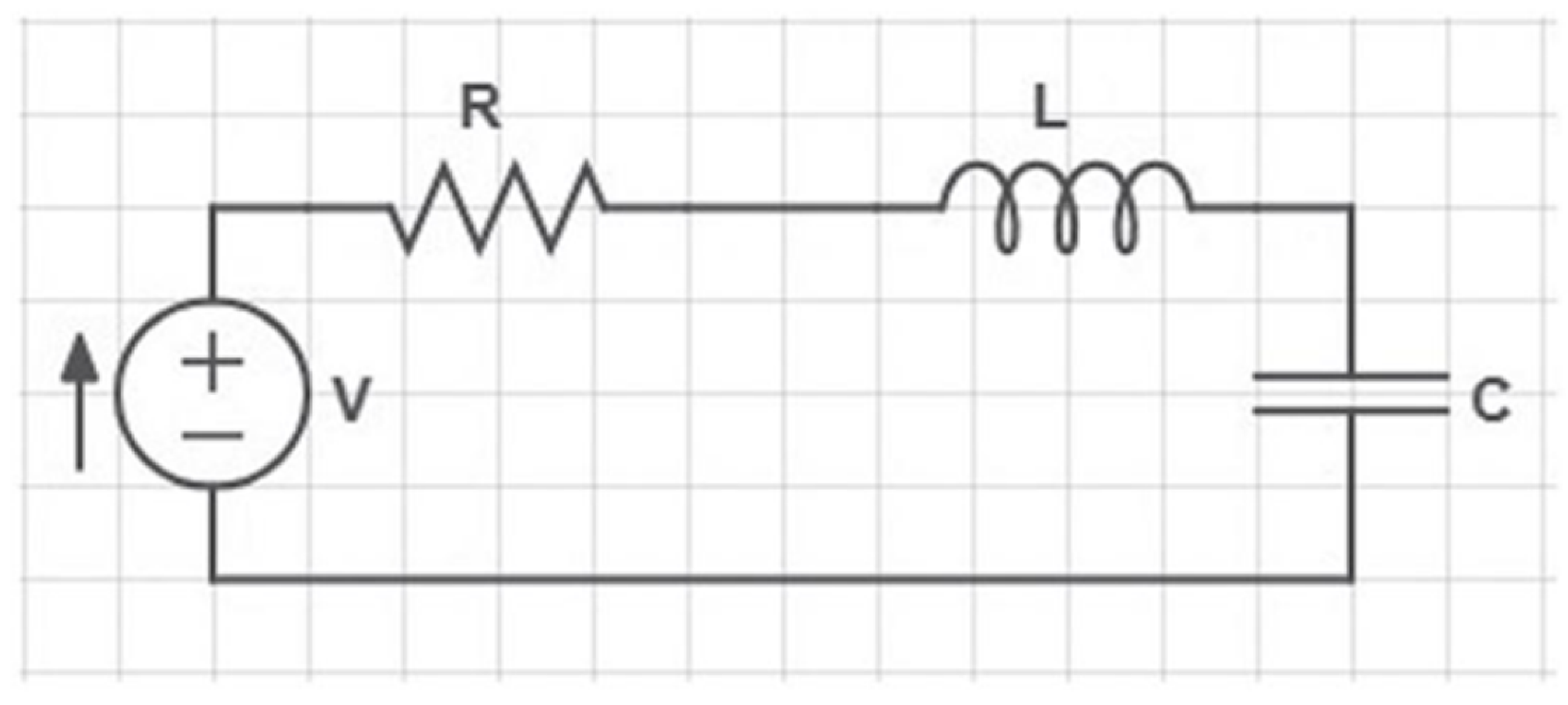
contraction mapping. In this part, we present the solution of electric circuit equation, which is in the form of second-order differential equation. It contains a resistor
R, an electromotive force
E, a capacitor
an inductor
L and a voltage
V in series as
Figure 1.
If the rate of change of charge q with respect to time t denoted by the current i.e., . We get the following relations:
The sum of these voltage drops is equal to the supplied voltage (law of Kirchhoff voltage), i.e.,
or
where
and
, this case is said to be the resonance solution in a Physics context. Then, the Green function associated with (
25) is given by
Using Green function, problem (
25) is equivalent to the following nonlinear integral equation
where
.
Let
be the set of all continuous functions defined on
, endowed with
where
and
. It is clear that
is a complete
metric-like space with parameter
Now, we state and prove the main theorem of this section.
Theorem 5. Let Γ be a nonlinear self mapping on Ω of a metric-like space such that the following conditions hold
- (i)
is a continuous function;
- (ii)
, where is monotone nondecreasing mapping for all ;
- (iii)
there exists a constant such that for all and ,wherefor all, and such that Then the Equation (25) has a unique solution.
Proof. Define a nonlinear self-mapping
by
It is clear that if
is a fixed point of the mapping
then it a solution of the problem (
26). Suppose that
we can get
so we have
which leads to,
since
we obtain that
Taking
for all
which is
, we obtain
or
By Theorem 3 and taking the coefficient we deduce that has a fixed point, which is a solution of the differential equation arising in the electric circuit equation. This finished the proof. □
The following example satisfy all required hypotheses of Theorem 5.
Example 7. Consider the following nonlinear integral equation Then it has a solution in Ω.
Proof. Let be defined by By specifying in Theorem 5, it follows that:
- (i)
the function is continuous on
- (ii)
is monotone increasing on for all
- (iii)
By taking
and
hence
so, for all
and
we obtain that
Therefore, all conditions of Theorem 5 are satisfied, therefore a mapping
has a fixed point in
, which is a solution to the problem (
27). □