


Abstract
In this article, we make a detailed study of some mathematical aspects associated with a generalized Lévy process using fractional diffusion equation with Mittag–Leffler kernel in the context of Atangana–Baleanu operator. The Lévy process has several applications in science, with a particular emphasis on statistical physics and biological systems. Using the continuous time random walk, we constructed a fractional diffusion equation that includes two fractional operators, the Riesz operator to Laplacian term and the Atangana–Baleanu in time derivative, i.e., . We present the exact solution to model and discuss how the Mittag–Leffler kernel brings a new point of view to Lévy process. Moreover, we discuss a series of scenarios where the present model can be useful in the description of real systems.
1. Introduction
The generalization of mathematical diffusion models have a crucial role in the production of non-Gaussian distributions. Recently, a series of generalized Gaussian distributions were reported in a huge quantity of contexts. Among them, in super-statistical [1,2,3], diffusion with memory kernels [4,5,6], stochastic resetting process [7,8], controlled-diffusion [9,10,11], complex fluids [12], etc. In this scenario, a huge quantity of systems present a relation between a non-Gaussian distribution and anomalous diffusion process by nonlinear growth of the mean square displacement (MSD) in time [13,14], i.e., , in which is a general diffusion coefficient with fractional dimension. The MSD relation is associated with different diffusive behaviors, classified as follows: , the system is sub-diffusive; usual diffusion; and occurs the super-diffusion. In particular cases, when the diffusion is ballistic and for occurs the hyper diffusive process. Moreover, there are fractional dynamics that imply an infinity MSD behavior, i.e.,
in which is a probability function and . In math, the relation (1) is justified in Lévy statistic [15,16]. In physics, the relation (1) occurs due to instantaneous propagation velocity, that is the central idea of Lévy flights.
The Lévy statistic is a powerful tool to approach some complex systems in physics [17,18]. A central point of the Lévy statistic is the Lévy-distribution that has the following structure:
which have a long-tailed and is characterized by a power-law function [19,20]. The Lévy distribution, which retrieves the Gaussian distribution from to , obtains the Cauchy distribution. In addition, the Lévy distribution is a consequences of a generalized version of the central limit theorem [21], in which the sum of random variables (identically distributed) with distributions having power-law tails converge to one of the Lévy distributions. In works [22,23], the authors showed that the Lévy-stable distribution emerges as a natural consequence of fractional collisions models (Rayleigh, driven Maxwell gas). Another option is the fractional Fokker Planck (FFP) equation that has a broad field of investigation. A typical example of an application of the FFP equation occurs to the free particle in the context of diffusion equations, which was reported by Metzler, Barkai, and Klafter [24]. In this scenario, there is a different class of generalized random walks, that may include nonlocality and memory, among other effects [25]. A way to build the fractional random walks is by use of the Scher–Montroll equation (continuous time random walk or CTRW theory) [26,27,28]. In this sense, the Riesz–Feller fractional derivative appears in diffusion equations as a natural consequence of big jumps that sometimes occur to random walks [16]. Thereby, using the CTRW formalism, it is possible to write the following equation:
in which and are the Riesz–Feller and Caputo fractional derivative, respectively [29]. The solution of Equation (3) is well-known and can be written as follows:
in which is the Mittag–Leffler function. The solution of Equation (3) was found by Mainardi et al. in [30] and expressed in term of the Fox function in [31]. Considering and , we have
Moreover, for and , we retrieve the Gaussian distribution; for and , we have another particular case that corresponds to the Cauchy distribution. In this decade, the Lévy process was reported in several contexts: Optics [32], chaos [33], cold atoms [34], turbulence [35], glass [36], quantum dots [37], bio-physics [38], single-molecule spectroscopy [39], etc. Motivated by huge amount of applications in science, in this work, we constructed a generalization of Lévy process in the context of temporal memory. To do this, we consider the most investigated kernel in actuality, the Mittag–Leffler (ML) memory kernels.
The ML function, represented by symbol, is a generalization of the exponential function in the context of fractional calculus [40,41]. The -function for two parameters is given by
in which .
Some complexities present in the actual scenario of the diffusion process are deeply linked with memory process [42]. Examples, there are several biological systems in which the collective movement of particles (or organisms) needs some type of special dynamical approach, which can include analytical models and simulations [43]. In recent works [44,45] Hristov shows a series of diffusive models which include memory effects due to generalized kernels. In works [46,47,48] the authors suggest that the new fractional the operator can capture a more substantial memory effect in a series of particular cases. Hence, investigate the mechanisms which lead to anomalous process and non-Gaussian distributions are central themes in mathematical of diffusion. In particular, the Lévy process (in Riesz–Feller sense [13]) can be determined through analytical calculus of probability distribution in CTRW approach, and applications for it is present in many fields of physics [17]. In this direction, the present work investigates how memory kernel modifies the Lévy process.
The paper is outlined as follows: In Section 2, we present the preliminary concepts about fractional calculus. In Section 3 we introduce our model that consists of a construction of the fractional diffusion equation with Riesz derivative and Mittag–Leffler kernels. We present the exact solution for the model. In the following, we present a series of behavior to exemplify the different behaviors to the generalized Lévy process in the context of Mittag–Leffler kernel. Finally, in Section 4, we present the conclusions and discuss possible scenarios where results can be applied.
2. Preliminaries Concepts: Fractional Derivatives
In this section, we review some notions and concepts used throughout the paper.
Nowadays, there are several definitions and references that bring in detail mathematical and applicable aspects of fractional derivatives [40]. The best-known definitions for the fractional derivative are associated with formulations made by Riemann, Liouville, and Caputo.
Definition 1.
Considering a continuous function . The fractional derivative of Caputo, to arbitrary order is defined by
in which is the Gamma function and . Considering , the Laplace transform () implies
To , Equation (7) retrieves the usual n-order derivative. For more details, see [40]. In the same way that the fractional derivative was defined, a corresponding fractional integral can be defined [40].
To exemplify the applicability of definition (7), we can consider a fractional order and a power-law function to . Thereby, we obtain
To we obtain
Therefore, the fractional derivative for power-law function has a similar mathematical structure of the integer-order derivative (Leibniz–Newton), for example, Equation (10) followed limit to
There are several other definitions of fractional derivatives, and these satisfy several mathematical properties that are detailed in references [40,49,50]. The fractional derivatives applied in differential equations generate a series of special functions [51,52], for example, the application of fractional derivatives on the diffusion equation implies solutions that are written by uses of Mittag–Leffler and Fox functions. In fact, the versatility of the fractional index introduces the memory concept if we consider a fractional derivative applied in a temporal variable. The fractional derivative can be applied into the spatial variable which can imply a nonlocality effect, an example of this occurs in fractional Schrödinger equation [53].
Another definition that we use in this work is the Riesz–Feller fractional derivative, which is defined as follows:
in which and skewness (, ). The fractional derivatives such as Riemann–Liouville, Letnikov, Riesz, and others, are constituted by convolution integrals with power-law kernels. In this scenario, a huge quantity of kernels were investigated in more different contexts [41,44,54]. Particularly, the diffusion with fractional derivatives generalize the Gaussian solution (Einstein sense) to a rich class of non-Gaussian distributions [4,8].
Recently, the presence of temporal memory kernels on descriptions of physical systems has been an interesting mathematical tool to investigate complexity in nature [55,56,57,58,59]. In this sense, a series of news kernels was proposed to approach mathematical models that have become limited. A successful proposal in the description of many systems was the proposal of Atangana and Baleanu, which introduces a particular Mittag–Leffler function as a kernel [46,60,61]. The Atangana–Baleanu operator obtained complete success and was used to describe chaotic systems [62], memory effects [44], non-Gaussian processes [4], epidemic systems [63], and others. In this sense, new approaches to fractional dynamics have come to light [4,8,64]. They opened up new discussions and introduced new memory effects on physical systems. In this way, the study of memory kernels attracted more and more scientists. Here, we defined a general Mittag–Leffler operator to exemplify the mathematical structure of discussed theme, so
in which is the Mittag–Leffler function [40] with . To , we obtain the integer derivative of first order. The kernel is not singular (i.e., ). Here, one question may be considered, how can the nonsingular Mittag–Leffler kernel in Lévy-diffusion equation be linked with continuous time random walk (CTRW)? In the next section, we applied the CTRW formalism to build the fractional diffusion equation that implies the Lévy process in the context of Mittag–Leffler memory kernel.
3. From CTRW to Generalized Lévy Process
In fact, the CTRW [16] brings the fractional derivative in the diffusion process as a consequence of disorder, traps, memory, or other mechanisms [65]. In the case of the CTRW [16], the walker run in a medium that can admit some irregularities, and is thereby conventional, takes a step as a random variable in an arbitrary direction in x. Moreover, we assume a given time interval between each step of the walker. All steps are statistically independent, occurring at random time intervals. We can then write the length of the jump as a probability density function,
as well as the waiting time
in which corresponds to the density probability of a long jump L in a given range , and the density probability of (waiting time), , will be chosen from between two steps. Thus, the walker can be described by a probability density function , where L and are random variables. The function can be decoupled, i.e., . In this sense, the waiting time and the length of the jumps may present divergences depending on the nature of the functions and . These quantities may bring elementary pieces of information about the system. For example, if the mean of waiting time distribution is finite and jump length variance is divergent, we obtain Lévy distributions, or else in the case that the average waiting time distribution diverges, keeping the jump length variance constant implies the random walker with a fractal nature on time [16].
Thus, considering time as a discrete variable, we can establish a parallel between random walkers with discrete and continuous time. Therefore, we have successive jumps occurring between uniform time intervals, but, in case that time continuously evolves, the duration between jumps constitutes a random variable. In this way, the prediction of the walker in the next position may not only want local knowledge of walker but also of positions in earlier times. Thereby, the system has a dependence of past history, and reveals that the non-Markovian process can be described by use of CTRW theory [13,16].
Now, using the CTRW theory, we want to build a fractional diffusion equation that is associated with generalized Lévy process. The average waiting time is considered,
as well as the jump length variance
By means of such averages, and considering the finite or divergent nature of these quantities, we can characterize different types of CTRW. In a more general case, any of these different CTRWs can be described by the integral equation:
where is the probability per unit of displacement and time of a random hiker who has left the x in the time t, to the position in time , and the last term () is the initial condition of the walker.
Therefore, the probability density function of the walker to be found in position x in the time t is given by
in which
is the probability of the walker not jumping during the time interval , that is, to remain in the initial position. Applying the Laplace transform in Equations (19) and (20) and using the convolution theorem, we have
To determine , we must return to (18) and apply the Laplace transform on the temporal variable and Fourier transform on the spatial variable. Making use of integral transformations, we have
Using the previous result (Equation (21)) and considering an initial condition as , we obtain the following equation
which is known as the Scher–Montroll equation. This equation can be applied to systems that have the jump length coupled to the waiting time. In 1987, Klafter, Blumen, and Shlesinger [16] demonstrated how the continuous random walk can be used to approach anomalous diffusive behaviors.
Here, we consider that the waiting time distribution in Laplace space assumes the following form:
with to . Equation (24) has a structure present in the following works [4,66]. If we consider that is infinite, the -distribution in Fourier space has the following asymptotic limit:
as presented by Metzler et al. in [16], we can rewrite the Scher–Montroll equation as follows:
in which . Using the relation
and performing the inverse Laplace–Fourier transforms, we obtain the following equation:
that corresponds to the Atangana–Baleanu diffusion in the context of Lévy flights. The particular case in which was investigated was in [4], in this work, the author found exact solutions and performing applications in the stochastic resetting problem. The solution corresponds to Fourier–Laplace the inverse function of the following expression:
performing the Laplacian–Fourier inverse transforms we obtain
in which
to we have
The solution (32) implies a rich class of Lévy-like distribution. The solution (32) is composed by integration of the product of two positive functions, thereby to all with , a detailed analysis about non-negativity of solution (32) was made by Sandev et al. in [67], considering a class of function with the same mathematical structure as Equation (26) (in Laplace-space). In Figure 1, we show Lévy distributions under Atangana–Baleanu operator and fractional Caputo operator. In Figure 2, we fixed in Atangana–Baleanu operator and fractional Caputo operator, we choose different values of -index of the Riesz–Feller fractional derivative.
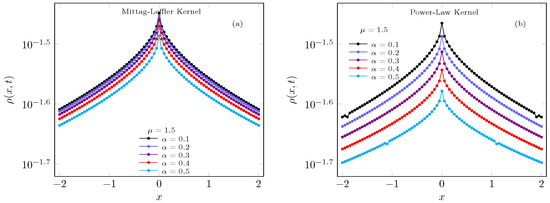
Figure 1.
These figures show a series of distributions that represent the differences among Mittag–Leffler kernel (a) and power-law kernel (b) in Lévy process. The Mittag–Leffler Lévy flights are represented by Equation (32); and the fractional Caputo derivative in the Lévy process is represented by Equation (4). In both figures, we consider the follow values: (Lévy process), , , and different -index. Moreover, in both figures, we use the same scale to make the differences clear.
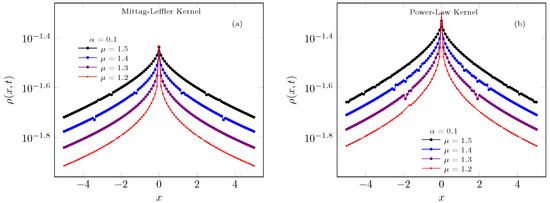
Figure 2.
These figures show a series of distributions that represent the differences among Mittag–Leffler kernel (a) and power-law kernel (b) in Lévy process. The Mittag–Leffler Lévy flights are represented by Equation (32); and the fractional Caputo derivative in the Lévy process is represented by Equation (4). In both figures, we consider the follow values: (fractional dynamic in the time), , , and different -index (to we have Lévy process). Moreover, in both figures, we use the same scale to make the differences clear.
As mentioned in Equation (1), the second moment of this type of distribution is infinity. However, in [68], Sokolov, Chechkin, and Klafter proposed a way to analyze the evolution of Lévy distributions in diffusion context, they consider in that is the position in initial time, where —the quantity allows us to understand how the function sinks into the relaxation process, applications of this technique can be founded in [69]. To obtain an analytic expression of , consider , we obtain
In this sense, we perform the numerical integration present in that is represented in Figure 3. To , in Equation (33) we obtain
as the asymptotic limit, this limit was represented in Figure 3 to five situations for two points of view the Mittag–Leffler kernel and the well-known power-law kernel. The particular case in both figures occurs to , a well-known case presented in [68]. Another interesting observation in Mittag–Leffler case in Figure 3 is that, for times less than , there a transient that Lévy flight with power-law (Figure 3b) does not present. It occurs due to the relation that ML function has with exponential function to short times. Moreover, Figure 3a shows that the asymptotic effect of Lévy flights (34) appears only for a short time and to there is a crossover behavior from the non-Lévy process to a Lévy process.
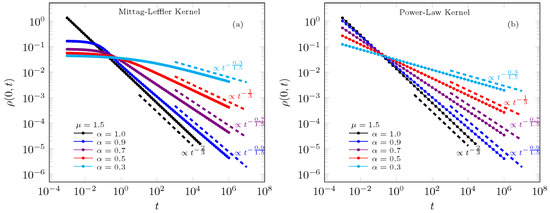
Figure 3.
These figures show a series of curves (Sokolov analysis [68]) that represent the differences among Mittag–Leffler kernel (a) and power-law kernel (b) in Lévy process. The Mittag–Leffler cases are represented by Equation (33) and power-law cases are represented by Equation (4) to . In both figures, we consider the following values: (Lévy process), , and different -index. Moreover, in both figures, we use the same scale to make the differences clear.
The model proposed in this work has connections with other models, as presented in Figure 4.
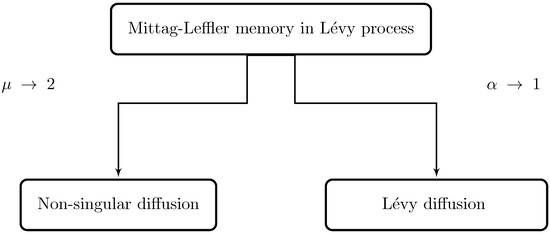
Figure 4.
The diagram represents how our model recovers well-known models [4,17].
4. Discussion and Conclusions
In this work, we have investigated the Lévy flight to Atangana–Baleanu fractional derivative. Using the continuous time random walks, we build a generalized diffusion equation with two fractional operators, with the fractional Riesz–Feller Laplacian operator and Atangana–Baleanu fractional-time operator. The physical means of the obtained model is a new approach to Lévy flight in the context of a nonsingular fractional time operator. We presented the exact analytic solution to the problem. The results and techniques employed in this work are important tools for studying memory effects in Lévy process, thus opening new possibilities in future research and applications of fractional Atangana–Baleanu-Lévy process.
- Biological systems present a complexity that the usual models (with usual calculus) not are suitable on the description of some experimental results. In this sense, the Lévy flights have been a powerful approach in Biology. Some examples make mention of following problems:
- Animals search for food [70,71,72]. This is one of directions where the fractional models obtain success, maybe the main reason for this is the presence of a single big jump that probability distribution admits. However, the usual Lévy-diffusion is subordinated to Brownian motion, thereby, locally (excluding the big jumps) the Lévy process presents local-Brownian motion. Our model showed that Ml kernel generalizes the behaviors of distribution to small time regimes, making possible a new characterization of the animals search process.
- Organism movement patterns [73,74,75,76]. This is one of the most important recent application of random walks that sometimes requires Lévy flights or Lévy walks for a deeper approach. A typical application occurs in the run-and-tumble problem of bacteria, bacteria is a small organism that presents a complex motion which depends on the sense that the flagellum rotates, Reynolds number, swimming type, etc. In this context, the "run" is when bacteria (or cell) swims following an almost straight path; and the "tumble" the bacteria (or cell) rotates almost on the same spot. Recently, the Lévy process has been on description of run-time distribution [77].
- Transport in complex systems has been a research line of many scientists in diverse fields of investigation. In this scenario, the Lévy process is present in most different contexts. Below, we present some examples of relevant problems:
- Reaction–diffusion process [9,78,79]. The reaction-diffusion process in fractional context implies a new class of reaction process that is suitable to approaches of reaction–diffusion with long-range. This way we can employ to approach complexity in reactions process. When we think in the reaction process, we think in reaction order. The linear reaction term is the most ordinary approach, due to the existence of analytical solutions. In this scenario, the fractional dynamics can be employed to experimentally adjust experimental data, associated with the fluorescence process [80].
- Intermittent process [38,81,82,83,84]. This investigation line has a particular mechanism in which the movement state alternates between “motion” and “pauses” (or Brownian motion alternating between the state with force or free). The intermittent process can describe the motion of particles immersed in a turbulent fluid, biological environments, and other complex systems.
Finally, a study of consequences obtained in applications is expected in future works (for instance, in the intermittent process, reaction–diffusion, search process, etc. [13]) in order to establish with more details the role of the generalized Lévy process on statistical physics. Regarding this, it is important to point out that, in this work, the continuous time random walks was analyzed in a complex context which emerges the general Lévy process. New studies relaxing this distribution could extend the present contribution, thus allowing new directions to be studied.
Funding
This research received no external funding.
Acknowledgments
This work was supported by Brazilian agency INCT-CAPES. We thank the referees for their comments and recommendations.
Conflicts of Interest
The authors declare no conflict of interest.
References
- Sposini, V.; Chechkin, A.V.; Seno, F.; Pagnini, G.; Metzler, R. Random diffusivity from stochastic equations: Comparison of two models for Brownian yet non-Gaussian diffusion. New J. Phys. 2018, 20, 043044. [Google Scholar] [CrossRef]
- Chechkin, A.V.; Seno, F.; Metzler, R.; Sokolov, I.M. Brownian yet non-Gaussian diffusion: From superstatistics to subordination of diffusing diffusivities. Phys. Rev. X 2017, 7, 021002. [Google Scholar] [CrossRef]
- Ślęzak, J.; Metzler, R.; Magdziarz, M. Superstatistical generalised Langevin equation: Non-Gaussian viscoelastic anomalous diffusion. New J. Phys. 2018, 20, 023026. [Google Scholar] [CrossRef]
- Dos Santos, M. Non-Gaussian distributions to random walk in the context of memory kernels. Fractal Fract. 2018, 2, 20. [Google Scholar] [CrossRef]
- Hristov, J. Response functions in linear viscoelastic constitutive equations and related fractional operators. Math. Model. Nat. Phenom. 2019, 14, 305. [Google Scholar] [CrossRef]
- Sene, N.; Abdelmalek, K. Analysis of the fractional diffusion equations described by Atangana-Baleanu-Caputo fractional derivative. Chaos Solitons Fractals 2019, 127, 158–164. [Google Scholar] [CrossRef]
- Bodrova, A.S.; Chechkin, A.V.; Sokolov, I.M. Nonrenewal resetting of scaled Brownian motion. Phys. Rev. E 2019, 100, 012119. [Google Scholar] [CrossRef]
- Dos Santos, M.A.F. Fractional Prabhakar Derivative in Diffusion Equation with Non-Static Stochastic Resetting. Physics 2019, 1, 40–58. [Google Scholar] [CrossRef]
- Dos Santos, M.A.F. From continuous-time random walks to controlled-diffusion reaction. J. Stat. Mech. Theory Exp. 2019, 2019, 033214. [Google Scholar] [CrossRef]
- Reid, B.A.; Täuber, U.C.; Brunson, J.C. Reaction-controlled diffusion: Monte Carlo simulations. Phys. Rev. E 2003, 68, 046121. [Google Scholar] [CrossRef]
- Dos Santos, M. A fractional diffusion equation with sink term. Indian J. Phys. 2019. [Google Scholar] [CrossRef]
- Song, S.; Park, S.J.; Kim, M.; Kim, J.S.; Sung, B.J.; Lee, S.; Kim, J.H.; Sung, J. Transport dynamics of complex fluids. Proc. Natl. Acad. Sci. USA 2019, 201900239. [Google Scholar] [CrossRef] [PubMed]
- Dos Santos, M.A.F. Analytic approaches of the anomalous diffusion: A review. Chaos Solitons Fractals 2019, 124, 86–96. [Google Scholar] [CrossRef]
- Oliveira, F.A.; Ferreira, R.M.D.S.; Lapas, L.C.; Vainstein, M.H. Anomalous diffusion: A basic mechanism for the evolution of inhomogeneous systems. Front. Phys. 2019, 7, 18. [Google Scholar] [CrossRef]
- Lévy, P.; Borel, M.É. Théorie de L’addition des Variables Aléatoires; Gauthier-Villars: Paris, France, 1954; Volume 1. [Google Scholar]
- Metzler, R.; Klafter, J. The random walk’s guide to anomalous diffusion: A fractional dynamics approach. Phys. Rep. 2000, 339, 1–77. [Google Scholar] [CrossRef]
- Zaburdaev, V.; Denisov, S.; Klafter, J. Lévy walks. Rev. Mod. Phys. 2015, 87, 483. [Google Scholar] [CrossRef]
- Bertoin, J. Lévy Processes; Cambridge University Press: Cambridge, UK, 1996; Volume 121. [Google Scholar]
- Nolan, J. Stable Distributions: Models for Heavy-Tailed Data; Birkhauser: New York, NY, USA, 2003. [Google Scholar]
- Tsallis, C. Lévy distributions. Phys. World 1997, 10, 42. [Google Scholar] [CrossRef]
- Gnedenko, B.V.; Kolmogorov, A.N. Limit Distributions for Sums of Independent Random Variables; Addison Wesley: Reading, MA, USA, 1954. [Google Scholar]
- Barkai, E. Stable equilibrium based on Lévy statistics: Stochastic collision models approach. Phys. Rev. E 2003, 68, 055104. [Google Scholar] [CrossRef]
- Barkai, E. Stable equilibrium based on Lévy statistics: A linear Boltzmann equation approach. J. Stat. Phys. 2004, 115, 1537–1565. [Google Scholar] [CrossRef]
- Metzler, R.; Barkai, E.; Klafter, J. Anomalous diffusion and relaxation close to thermal equilibrium: A fractional Fokker-Planck equation approach. Phys. Rev. Lett. 1999, 82, 3563. [Google Scholar] [CrossRef]
- Brockmann, D.; Sokolov, I. Lévy flights in external force fields: From models to equations. Chem. Phys. 2002, 284, 409–421. [Google Scholar] [CrossRef]
- Montroll, E.W.; Weiss, G.H. Random walks on lattices. II. J. Math. Phys. 1965, 6, 167–181. [Google Scholar] [CrossRef]
- Scher, H.; Montroll, E.W. Anomalous transit-time dispersion in amorphous solids. Phys. Rev. B 1975, 12, 2455. [Google Scholar] [CrossRef]
- Montroll, E.W.; Scher, H. Random walks on lattices. IV. Continuous-time walks and influence of absorbing boundaries. J. Stat. Phys. 1973, 9, 101–135. [Google Scholar] [CrossRef]
- Tomovski, Ž.; Sandev, T.; Metzler, R.; Dubbeldam, J. Generalized space–time fractional diffusion equation with composite fractional time derivative. Phys. A Stat. Mech. Its Appl. 2012, 391, 2527–2542. [Google Scholar] [CrossRef]
- Mainardi, F.; Luchko, Y.; Pagnini, G. The fundamental solution of the space-time fractional diffusion equation. Fract. Calc. Appl. Anal. 2001, 4, 153–192. [Google Scholar]
- Mainardi, F.; Pagnini, G.; Saxena, R. Fox H functions in fractional diffusion. J. Comput. Appl. Math. 2005, 178, 321–331. [Google Scholar] [CrossRef]
- Bardou, F.; Bouchaud, J.; Emile, O.; Aspect, A.; Cohen-Tannoudji, C. Subrecoil laser cooling and Lévy flights. Phys. Rev. Lett. 1994, 72, 203. [Google Scholar] [CrossRef]
- Solé, J.L.; Utzet, F.; Vives, J. Chaos expansions and Malliavin calculus for Lévy processes. In Stochastic Analysis and Applications; Springer: Berlin, Germany, 2007; pp. 595–612. [Google Scholar]
- Kessler, D.A.; Barkai, E. Theory of fractional Lévy kinetics for cold atoms diffusing in optical lattices. Phys. Rev. Lett. 2012, 108, 230602. [Google Scholar] [CrossRef] [PubMed]
- Shlesinger, M.; West, B.; Klafter, J. Lévy dynamics of enhanced diffusion: Application to turbulence. Phys. Rev. Lett. 1987, 58, 1100. [Google Scholar] [CrossRef] [PubMed]
- Barkai, E.; Silbey, R.; Zumofen, G. Lévy distribution of single molecule line shape cumulants in glasses. Phys. Rev. Lett. 2000, 84, 5339. [Google Scholar] [CrossRef]
- Jung, Y.; Barkai, E.; Silbey, R.J. Lineshape theory and photon counting statistics for blinking quantum dots: A Lévy walk process. Chem. Phys. 2002, 284, 181–194. [Google Scholar] [CrossRef]
- Lomholt, M.A.; Tal, K.; Metzler, R.; Joseph, K. Lévy strategies in intermittent search processes are advantageous. Proc. Natl. Acad. Sci. USA 2008, 105, 11055–11059. [Google Scholar] [CrossRef]
- Barkai, E.; Jung, Y.; Silbey, R. Theory of single-molecule spectroscopy. Annu. Rev. Phys. Chem 2004, 55, 457–507. [Google Scholar] [CrossRef]
- Podlubny, I. Fractional Differential Equations: An Introduction to Fractional Derivatives, Fractional Differential Equations, to Methods of Their Solution and Some of Their Applications; Elsevier: Amsterdam, The Netherlands, 1998; Volume 198. [Google Scholar]
- Sene, N. Mittag-Leffler input stability of fractional differential equations and its applications. Discret. Contin. Dyn. Syst. Ser. S 2019. [Google Scholar] [CrossRef]
- Sokolov, I.M.; Klafter, J. From diffusion to anomalous diffusion: A century after Einstein’s Brownian motion. Chaos Interdiscip. J. Nonlinear Sci. 2005, 15, 026103. [Google Scholar] [CrossRef] [PubMed]
- Höfling, F.; Franosch, T. Anomalous transport in the crowded world of biological cells. Rep. Prog. Phys. 2013, 76, 046602. [Google Scholar] [CrossRef] [PubMed]
- Hristov, J. On the Atangana–Baleanu Derivative and Its Relation to the Fading Memory Concept: The Diffusion Equation Formulation. In Fractional Derivatives with Mittag-Leffler Kernel; Springer: Berlin, Germany, 2019; pp. 175–193. [Google Scholar]
- Hristov, J. Linear viscoelastic responses and constitutive equations in terms of fractional operators with non-singular kernels. Eur. Phys. J. Plus 2019, 134, 283. [Google Scholar] [CrossRef]
- Atangana, A.; Baleanu, D. New fractional derivatives with nonlocal and non-singular kernel: Theory and application to heat transfer model. arXiv 2016, arXiv:1602.03408. [Google Scholar] [CrossRef]
- Atangana, A.; Alqahtani, R.T. Tumour model with intrusive morphology, progressive phenotypical heterogeneity and memory. Eur. Phys. J. Plus 2018, 133, 85. [Google Scholar] [CrossRef]
- Atangana, A.; Mekkaoui, T. Capturing complexities with composite operator and differential operators with non-singular kernel. Chaos Interdiscip. J. Nonlinear Sci. 2019, 29, 023103. [Google Scholar] [CrossRef] [PubMed]
- Samko, S.G.; Kilbas, A.A.; Marichev, O.I. Fractional Integrals and Derivatives; Gordon and Breach Science Publishers: Yverdon, Switzerland, 1993; Volume 1993. [Google Scholar]
- Cattani, C.; Srivastava, H.M.; Yang, X.J. (Eds.) Fractional Dynamics. In Lecture Notes of the Unione Matematica Italiana (Book 20); De Gruyter Open: Berlin, Germany, 2016. [Google Scholar]
- Tomovski, Ž.; Hilfer, R.; Srivastava, H. Fractional and operational calculus with generalized fractional derivative operators and Mittag–Leffler type functions. Integral Transform. Spec. Funct. 2010, 21, 797–814. [Google Scholar] [CrossRef]
- Dalir, M.; Bashour, M. Applications of fractional calculus. Appl. Math. Sci. 2010, 4, 1021–1032. [Google Scholar]
- Laskin, N. Fractional schrödinger equation. Phys. Rev. E 2002, 66, 056108. [Google Scholar] [CrossRef] [PubMed]
- De Oliveira, E.C.; Jarosz, S.; Vaz, J., Jr. Fractional calculus via Laplace transform and its application in relaxation processes. Commun. Nonlinear Sci. Numer. Simul. 2019, 69, 58–72. [Google Scholar] [CrossRef]
- Yang, S.; Zhou, H.; Zhang, S.; Ren, W. A fractional derivative perspective on transient pulse test for determining the permeability of rocks. Int. J. Rock Mech. Min. Sci. 2019, 113, 92–98. [Google Scholar] [CrossRef]
- Chang, A.; Sun, H. Time-space fractional derivative models for CO2 transport in heterogeneous media. Fract. Calc. Appl. Anal. 2018, 21, 151–173. [Google Scholar] [CrossRef]
- Liu, L.; Zheng, L.; Liu, F. Temporal anomalous diffusion and drift of particles in a comb backbone with fractional Cattaneo- Christov flux. J. Stat. Mech. Theory Exp. 2017, 2017, 043208. [Google Scholar] [CrossRef]
- Dos Santos, M.A.F.; Gomez, I.S. A fractional Fokker–Planck equation for non-singular kernel operators. J. Stat. Mech. Theory Exp. 2018, 2018, 123205. [Google Scholar] [CrossRef]
- Jena, R.M.; Chakraverty, S.; Baleanu, D. On New Solutions of Time-Fractional Wave Equations Arising in Shallow Water Wave Propagation. Mathematics 2019, 7, 722. [Google Scholar] [CrossRef]
- Fernandez, A.; Özarslan, M.A.; Baleanu, D. On fractional calculus with general analytic kernels. Appl. Math. Comput. 2019, 354, 248–265. [Google Scholar] [CrossRef]
- Gómez-Aguilar, J.F.; Atangana, A. Power and exponentials laws: Theory and application. J. Comput. Appl. Math. 2019, 354, 52–65. [Google Scholar] [CrossRef]
- Owolabi, K.M.; Atangana, A. Chaotic behaviour in system of noninteger-order ordinary differential equations. Chaos Solitons Fractals 2018, 115, 362–370. [Google Scholar] [CrossRef]
- Owolabi, K.M.; Atangana, A. Mathematical analysis and computational experiments for an epidemic system with nonlocal and nonsingular derivative. Chaos Solitons Fractals 2019, 126, 41–49. [Google Scholar] [CrossRef]
- Koca, I. Efficient numerical approach for solving fractional partial differential equations with non-singular kernel derivatives. Chaos Solitons Fractals 2018, 116, 278–286. [Google Scholar] [CrossRef]
- Bouchaud, J.P.; Georges, A. Anomalous diffusion in disordered media: Statistical mechanisms, models and physical applications. Phys. Rep. 1990, 195, 127–293. [Google Scholar] [CrossRef]
- Sandev, T.; Metzler, R.; Chechkin, A. From continuous time random walks to the generalized diffusion equation. Fract. Calc. Appl. Anal. 2018, 21, 10–28. [Google Scholar] [CrossRef]
- Sandev, T.; Deng, W.; Xu, P. Models for characterizing the transition among anomalous diffusions with different diffusion exponents. J. Phys. A Math. Theor. 2018, 51, 405002. [Google Scholar] [CrossRef]
- Sokolov, I.; Chechkin, A.; Klafter, J. Fractional diffusion equation for a power-law-truncated Lévy process. Phys. A Stat. Mech. Its Appl. 2004, 336, 245–251. [Google Scholar] [CrossRef]
- Chechkin, A.V.; Gonchar, V.Y.; Gorenflo, R.; Korabel, N.; Sokolov, I.M. Generalized fractional diffusion equations for accelerating subdiffusion and truncated Lévy flights. Phys. Rev. E 2008, 78, 021111. [Google Scholar] [CrossRef]
- Viswanathan, G.M.; Buldyrev, S.V.; Havlin, S.; Da Luz, M.; Raposo, E.; Stanley, H.E. Optimizing the success of random searches. Nature 1999, 401, 911. [Google Scholar] [CrossRef] [PubMed]
- Humphries, N.E.; Weimerskirch, H.; Queiroz, N.; Southall, E.J.; Sims, D.W. Foraging success of biological Lévy flights recorded in situ. Proc. Natl. Acad. Sci. USA 2012, 109, 7169–7174. [Google Scholar] [CrossRef] [PubMed]
- Palyulin, V.V.; Chechkin, A.V.; Metzler, R. Lévy flights do not always optimize random blind search for sparse targets. Proc. Natl. Acad. Sci. USA 2014, 111, 2931–2936. [Google Scholar] [CrossRef]
- Pyke, G.H. Understanding movements of organisms: It’s time to abandon the Lévy foraging hypothesis. Methods Ecol. Evol. 2015, 6, 1–16. [Google Scholar] [CrossRef]
- Reynolds, A.M. Passive particles Lévy walk through turbulence mirroring the diving patterns of marine predators. J. Phys. Commun. 2018, 2, 085003. [Google Scholar] [CrossRef]
- Nagaya, N.; Mizumoto, N.; Abe, M.S.; Dobata, S.; Sato, R.; Fujisawa, R. Anomalous diffusion on the servosphere: A potential tool for detecting inherent organismal movement patterns. PLoS ONE 2017, 12, e0177480. [Google Scholar] [CrossRef] [PubMed]
- Weber, S.C.; Spakowitz, A.J.; Theriot, J.A. Bacterial chromosomal loci move subdiffusively through a viscoelastic cytoplasm. Phys. Rev. Lett. 2010, 104, 238102. [Google Scholar] [CrossRef] [PubMed]
- Ariel, G.; Rabani, A.; Benisty, S.; Partridge, J.D.; Harshey, R.M.; Be’Er, A. Swarming bacteria migrate by Lévy Walk. Nat. Commun. 2015, 6, 8396. [Google Scholar] [CrossRef]
- Lenzi, E.K.; dos Santos, M.A.F.; Lenzi, M.K.; Neto, R.M. Solutions for a mass transfer process governed by fractional diffusion equations with reaction terms. Commun. Nonlinear Sci. Numer. Simul. 2017, 48, 307–317. [Google Scholar] [CrossRef]
- Stamova, I.M.; Simeonov, S. Delayed Reaction–Diffusion Cellular Neural Networks of Fractional Order: Mittag–Leffler Stability and Synchronization. J. Comput. Nonlinear Dyn. 2018, 13, 011015. [Google Scholar] [CrossRef]
- Weiss, M. Crowding, diffusion, and biochemical reactions. In International Review of Cell and Molecular Biology; Elsevier: Amsterdam, The Netherlands, 2014; Volume 307, pp. 383–417. [Google Scholar]
- Bénichou, O.; Loverdo, C.; Moreau, M.; Voituriez, R. Intermittent search strategies. Rev. Mod. Phys. 2011, 83, 81. [Google Scholar] [CrossRef]
- Gherardi, M.; Calabrese, L.; Tamm, M.; Cosentino Lagomarsino, M. Model of chromosomal loci dynamics in bacteria as fractional diffusion with intermittent transport. Phys. Rev. E 2017, 96, 042402. [Google Scholar] [CrossRef] [PubMed]
- Bénichou, O.; Coppey, M.; Moreau, M.; Suet, P.; Voituriez, R. Optimal search strategies for hidden targets. Phys. Rev. Lett. 2005, 94, 198101. [Google Scholar] [CrossRef] [PubMed]
- Bénichou, O.; Loverdo, C.; Moreau, M.; Voituriez, R. Two-dimensional intermittent search processes: An alternative to Lévy flight strategies. Phys. Rev. E 2006, 74, 020102. [Google Scholar] [CrossRef] [PubMed]
© 2019 by the authors. Licensee MDPI, Basel, Switzerland. This article is an open access article distributed under the terms and conditions of the Creative Commons Attribution (CC BY) license (http://creativecommons.org/licenses/by/4.0/).