1. Introduction
The intuitionistic fuzzy set (IFS) [
1] has discussed only two categories of responses “yes” and “no”, but many real life problems have more then two types of responses, such that, in case of selection, we face three types of responses “yes”, “no” and “refusal”. Thus, to overcome this issue, Cuong [
2,
3] introduced a novel concept of picture fuzzy set (PFS), which is dignified in three different functions presenting the positive, neutral and negative membership degrees. Cuong [
4] studied some characteristic of PFSs and also approved their distance measures. Cuong and Hai [
5] defined firstly the fuzzy logic operators and implications functions for PFS. Cuong et al. [
6] examined the characteristic of picture fuzzy t-norm and t-conorm. Phong et al. [
7] examined certain configurations of PF relations. Wei et al. [
8,
9,
10] defined many procedures to compute the closeness between PFSs. Presently, many researchers have developed more models in the PFS condition: a correlation coefficient of PFS is proposed by Sing [
11] and applies it to clustering analysis. Son et al. [
12,
13] provided time arrangement calculation and temperature estimation on the basis of PFS domain. Son [
14,
15] defined picture fuzzy separation measures, generalized picture fuzzy distance measures and picture fuzzy association measures, and combined it to tackle grouping examination under PFS condition. A novel fuzzy derivation structure on PFS is defined by Son et al. [
16] to improve the performance of the classical fuzzy inference system. To handle decision making problems, Ashraf et al. [
17] introduced two decision techniques; firstly, they proposed a series of geometric aggregation operators and, secondly, introduced the TOPSIS method to deal with uncertainty in the form of PF sets. In addition, Ashraf et al. [
18] proposed the PF linguistic set to deal with linguistic information in (decision-making) DM problems. Zeng et al. [
19] proposed the exponential jensen PF divergence measure to deal with DM problems using PF information. Khan et al. [
20] examined the application of a generalized PF soft set in DM problems. Khan et al. [
21] introduced the Einstein aggregation operators for PF information. Thong et al. [
22,
23] proposed the DM approach using PF clustering to deal with uncertainty in the form of PF sets. Khan et al. [
24] described the application of logarithmic aggregation operators of PF numbers in DM problems. Wei [
25] proposed the series of aggregation operator to handle the decision problem using PF information. Peng et al. [
26] proposed an PFS algorithm and tested it in decision-making. Bo and Zhang [
27] studied some new operations of picture fuzzy relations such as type-2 inclusion relation, type-2 union, type-2 intersection and type-2 complement operations and also defined the anti-reflexive kernel, symmetric kernel, reflexive closure and symmetric closure of a picture fuzzy relation. For more detailed study, we refer to [
28,
29,
30].
Dombi introduced [
31] a new type of operations called the Dombi triangular norm and Dombi triangular conorm, demonstrating the preference of variability with the operation of parameters. For the first time in [
32], Dombi operations were used for IFS to handle decision-making problems by introducing a Dombi Bonferroni mean operator. Dombi aggregation operation was further extended to a single neutrosophic set [
33]. Travel decision-making problems were solved by using Dombi operations [
34] by inspecting neutrosophic cubic sets. Dombi aggregation operations were further extended to linguistic cubic variables [
35], Dombi hesitant fuzzy information [
36] by utilizing the multi attribute decision-making methods to solve different real-life problems. Furthermore, Dombi picture fuzzy sets and aggregation operation are proposed in [
37] for evaluating different significances of selections among others in the decision-making process. Bipolar fuzzy Dombi aggregation operators are introduced [
38] based on arithmetic and geometric Dombi operations. Pythagorean fuzzy Dombi aggregation operators are proposed [
39] for evaluating the uncertainty in decision-making problems. Application of spherical fuzzy Dombi aggregation operators is introduced [
40] for evaluating the best alternative using spherical fuzzy information.
Motivated by the above discussion, we proposed the naval aggregation operators for linguistic picture fuzzy numbers using Dombi t-norm and Dombi t-conorm. The proposed operators play a vital role of aggregating the linguistic picture fuzzy information. For revelation and numerical application of the proposed operators, a numerical example is constructed. The rest of this study is designed as follows.
Section 2 provides a brief overview of the basic knowledge of the extension of a linguistic fuzzy set. The novel Dombi aggregation operators are introduced in
Section 3.
Section 4 consists of some discussion on the application of a defined approach. In
Section 5, we discussed the comparison and advantages of the proposed work and, finally, conclusions are drawn in
Section 6.
2. Preliminaries
Definition 1. ([2]) Let be a fixed set; then, a PFS p in is defined aswhere satisfies the condition: Furthermore, and indicate the positive, neutral and negative grads of the element to the set respectively. For each PFS, is said to be the refusal degree of to
Definition 2. ([2,25]) Let and be two PFNs on the universe Then, the operation laws between p and are stated as: (1) if and
(2) iff and
(3)
(4)
(5)
(6)
(7)
(8)
(9)
Definition 3. ([41,42]) Let be the finite and absolutely order distinct term set. Then, is the linguistic term set, where t is the odd value, e.g., when then can be written as ( poor, slightly poor, fair, slightly good, good) The following characteristics of the linguistic set must be satisfied:
(1) Ordered
(2) Negation: neg
(3) Max: iff
(4) Min: iff
The extended form of the discrete term set is called a continuous linguistic term set and defined as and, if then is called the original term otherwise, virtual term.
Definition 4. ([18]) Let and be a continuous linguistic set. Then, an LPFS is defined aswhere stands for the linguistic positive, linguistic neutral and linguistic negative degrees of the element to We shall denote the triple of as and referred to as linguistic picture fuzzy value (LPFV). For any the condition is always satisfied, and is the linguistic refusal degree of to Obviously, if then LPFS has the minimum linguistic indeterminacy degree, that is, which means the membership degree of to p can be precisely expressed with a single linguistic term and LPFS p is reduced to a linguistic variable. On the contrary, if then LPFS has the maximum linguistic indeterminacy degree; that is,
Definition 5. ([43]) If is an LPFN, then the score index and accuracy index is defined as Definition 6. ([17]) Let and be the picture fuzzy numbers. Then, iff; (1) If Ē Ē, then is superior to , denoted by
(2) Ē Ē, then
(a) , implies that is superior to , denoted by
(b), implies that is equivalent to , denoted by
Definition 7. ([31]) Let A and B be any two real numbers. If then Dombi traingular-norm and triangular-conorm are defined aswhere and 3. Linguistic Picture Fuzzy Arithmetic Aggregation Operators
Definition 8. Let and be two LPFNs, and Then, Dombi triangular-conorm and Dombi triangular-conorm operation of LPFNs are expressed as
(1)
(2)
(3)
(4)
Example 1. Let and be two LPFNs, then utilizing the Dombi operation defined in Definition 8 for and we get
(1)
(2)
(3)
(4)
Theorem 1. Let and be two LPFNs, then we have
(1)
(2)
(3)
(4)
(5)
(6)
Proof. (1) By Definition 8, we can write
(2) It is obvious.
(3) Let
Now,
(4)
(5)
(6)
□
Definition 9. Let be a collection of LPFNs. Then, the linguistic picture fuzzy Dombi weighted averaging (LPFDWA) operator can be defined aswhere the weighting vector of is , with and Theorem 2. Let be a collection of LPFNs. Then, structure of linguistic picture fuzzy Dombi weighted averaging (LPFDWA) operator is defined using Dombi operation with where is the weighting vector of with and Proof. (i) If then using Dombi operations of LPFNs, we write
Hence, Equation (
8) is valid for
(ii) Assume that Equation (
8) is valid for
then, by Equation (
3), we get
Now, for then
Thus, Equation (
8) holds for
which is required. □
Theorem 3. (Idempotency). If is a collection of LPFNs, then, then
Proof. Since
then, by Equation (
8), we have
Theorem 4. (Boundedness). Let be a collection of LPFNs. Assume that and where Then, we have
Theorem 5. (Monotonicity). Let and be the two sets of LPFNs, if thenwhere is the permutation of Definition 10. Let be a collection of LPFNs. Then, the linguistic picture fuzzy Dombi order weighted averaging (LPFDOWA) operator can be defined aswhere is the permutation of for which and the weighting vector of are , with and Theorem 6. Let be a collection of LPFNs. Then, the structure of a linguistic picture fuzzy Dombi weighted averaging (LPFDWA) operator is defined using Dombi operation with where are the permutation of for which with the corresponding weighting vector of are , such that and Theorem 7. (Idempotency). If is a collection of LPFNs that are all identical, i.e., then
Theorem 8. (Boundedness). Let be a collection of LPFNs. Assume that and Then, Theorem 9. (Monotonicity). Let and be the two sets of LPFNs, thenwhere is any permutation of Definition 11. A linguistic picture fuzzy Dombi hybrid weighted averaging (LPFDHWA) operator of dimension n is a function with corresponding weight , such that and Therefore, LPFDHWA operator as defined aswhere is the kth largest weighted linguistic fuzzy values and , with and where n is the balancing coefficient. When then LPFDWG and LPFDOWG operator is a specific type of LPFDHG operator. Thus, the generalized form of LPFDWG and LPFDOWG is the LPFDHWG operator. 3.1. Linguistic Picture Fuzzy Dombi Geometric Operators
Definition 12. Let be a collection of LPFNs. Then, the linguistic picture fuzzy Dombi weighted geometric (LPFDWG) operator can be defined asthe weighting vector of are , where and Theorem 10. Let be a collection of LPFNs. Then, the structure of linguistic picture fuzzy Dombi weighted geometric (LPFDWG) operator is defined using Dombi operation with where the weighting vector of is , with and Proof. (i) If then using Dombi operations of LPFNs, we write
Hence, Equation (
13) is valid for
(ii) Assume that Equation (
13) is valid for
then, by Equation (
4), we get
Now, for then
Thus, Equation (
13) holds for
which is required. □
Theorem 11. (Idempotency). If is a collection of LPFNs that are all identical, i.e., then
Theorem 12. (Boundedness). Let be a collection of LPFNs. Assume that and Then, Theorem 13. (Monotonicity). Let and be the two sets of LPFNs, thenwhere is any permutation of Definition 13. Let be a collection of LPFNs. Then, the linguistic picture fuzzy Dombi order weighted average (LPFDOWG) operator can be defined aswhere is the permutation of for which , and the weighting vectors of are , with and Theorem 14. Let be a collection of LPFNs. Then, the structure of linguistic picture fuzzy Dombi ordered weighted geometric (LPFDWG) operator is defined using Dombi operation with where is the permutation of for which with the corresponding weight vector of are , such that and Theorem 15. (Idempotency). If is a collection of LPFNs that are all identical, i.e., then
Theorem 16. (Boundedness). Let be a collection of LPFNs. Assume that and Then, Theorem 17. (Monotonicity). Let and be the two sets of LPFNs, thenwhere is any permutation of Definition 14. A linguistic picture fuzzy Dombi hybrid weighted averaging (LPFDHWG) operator of dimension n is a function with corresponding weight , such that and Therefore, LPFDHWG operator as defined aswhere is the kth largest weighted linguistic fuzzy values and , with and where n is the balancing coefficient. When then LPFDWG and LPFDOWG operator is a specific type of LPFDHWG operator. Thus, the generalized form of LPFDWG and LPFDOWG is an LPFDHWG operator. 4. Approach for Madm Using Linguistic Picture Fuzzy Information
Suppose that the set of alternatives is and the set of attributes is Let the attributes weight vector be with and Suppose that is the linguistic picture fuzzy decision matrix, and is the positive membership degree of the alternative under the attribute , is the neutral membership degree of the alternative under the attribute , and is the negative membership degree of the alternative under the attribute which was given by the decision makers, where and
Step 1. According to Equations (8) and (13), calculate the total preference values
of the alternative
:
and
Step 2. Find the score values of using the Definition 5.
Step 3. Give the ranking to the alternative and choose the best one’s on the basis of score index.
4.1. Example
Assume that there is a committee which selects five applicable emerging technology enterprises
. To assess the possible rising technology enterprises, one chooses four attributes, which are
(advancement),
(market risk),
(financial investments) and
(progress of science and technology). To avoid the conflict between them, the decision makers take the attribute weights as
The decision matrix is given in
Table 1, where all the information is in the format of LPFNs.
Step 1. Assume that the perimeter
and utilize the LPFDWAoperator to compute the total preference values of
of emerging technology enterprises
Step 2. Compute the score values using Definition 5, Ē of the all LPFNs as
Ē Ē Ē
Ē Ē
Step 3. According to score values, rank all the emerging technology systems Ē
of the LPFNs as
Step 4. Thus, Form the
Table 2 the most preferable developing technology enterprise is
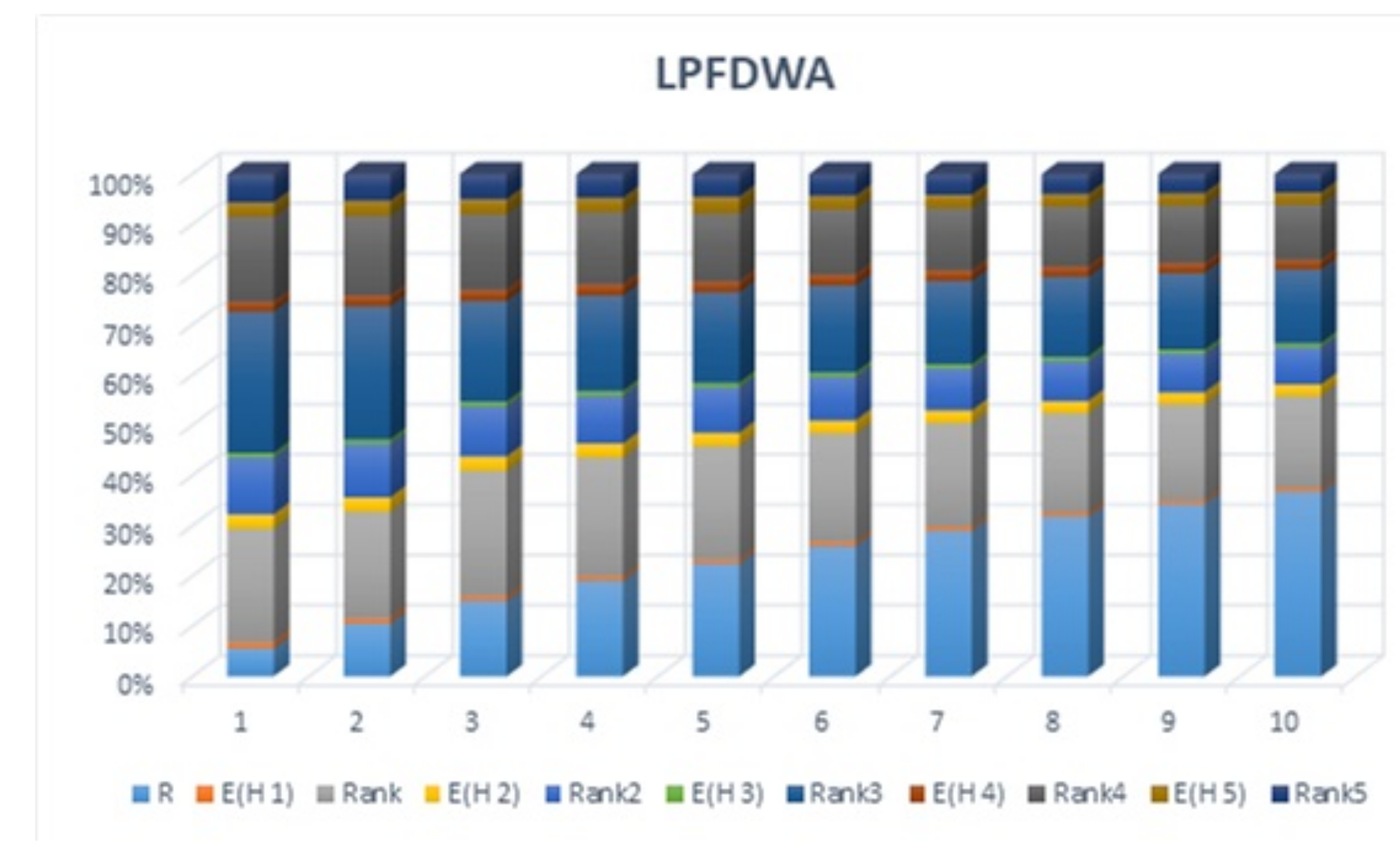
Ranking results of LPFDWA with average weights are shown in
Figure 1.
Now, if we use the PFDWG operator, then the problem gives us the following results:
Step 1. Assume the parameter
, and utilize the LPFDWG operator to compute the total preference values of
of emerging technology enterprises
Step 2. Compute the score values using Definition 5, Ē of the all LPFNs as
Ē Ē Ē
Ē Ē
Step 3. According to score values, the emerging technology systems Ē
of the LPFNs ranking are:
Step 4. Thus, Form the
Table 3 the most preferable developing technology enterprise is
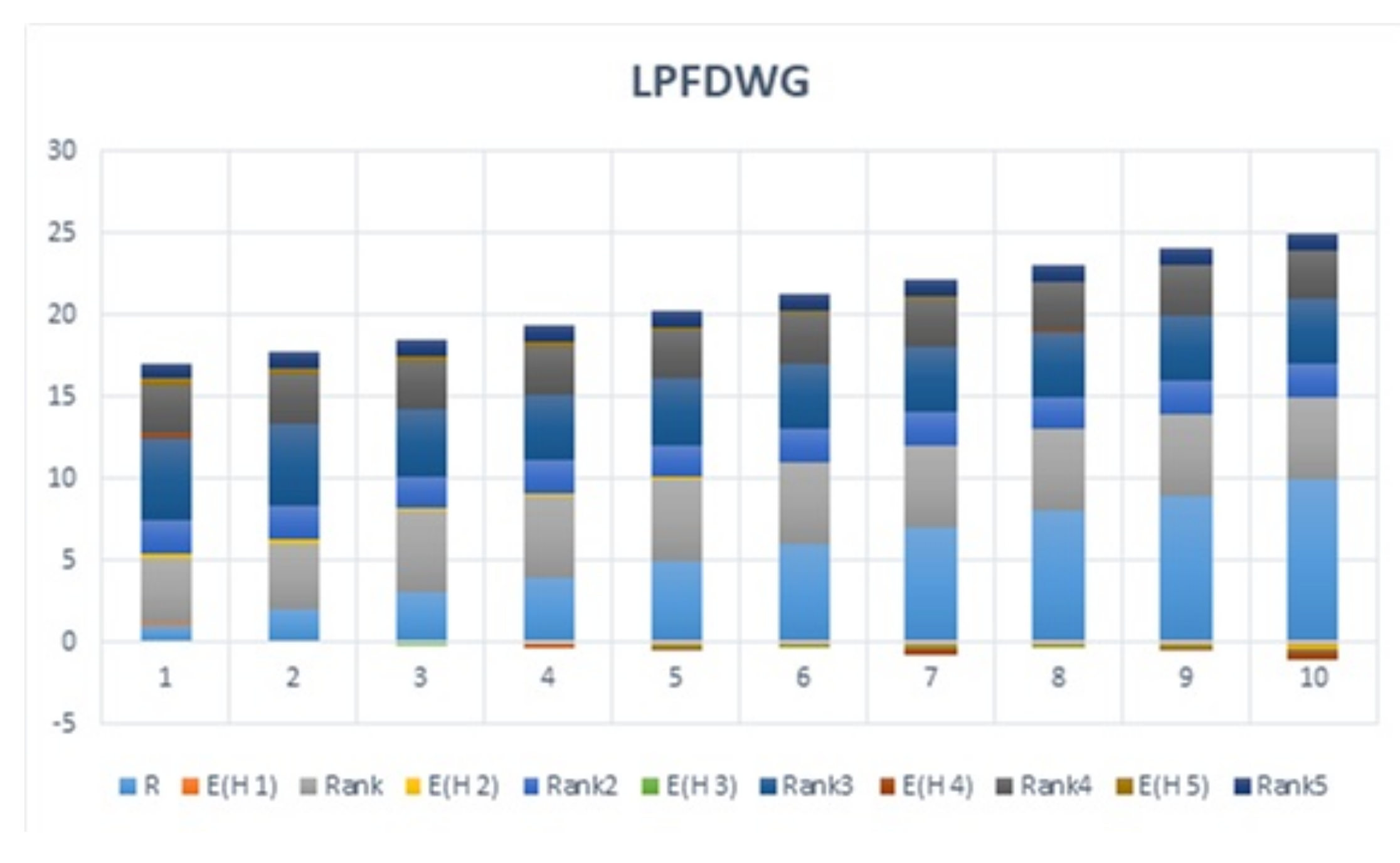
Ranking results of LPFDWG with average weights are shown in
Figure 2.