Abstract
In this paper, neutral-type competitive neural networks with mixed time-varying delays and leakage delays on time scales are proposed. Based on the contraction fixed-point theorem, some sufficient conditions that are independent of the backwards graininess function of the time scale are obtained for the existence and global exponential stability of almost periodic solutions of neural networks under consideration. The results obtained are brand new, indicating that the continuous time and discrete-time conditions of the network share the same dynamic behavior. Finally, two examples are given to illustrate the validity of the results obtained.
1. Introduction
Competitive neural networks (CNNs), which are used to characterize the dynamics of cortical maps, have two types of state variables—the short-term memory variables (STM) that characterize the fast neural activity and the long-term memory (LTM) variables that characterize the slow unsupervised synaptic modifications. Consequently, there are two time scales in CNNs, one corresponding to a rapid change in the state of the neural networks and the other corresponding to a slow change in the external stimulus to the synapse. As they are widely used in image processing, pattern recognition, signal processing and so on [1,2,3,4], many achievements have been made in the research of dynamics of CNNs in recent years [2,3,4,5,6,7,8,9,10,11,12,13,14,15,16,17,18,19]. For example, the exponential stability of CNNs with multi-proportional delays was studied in [13]; the multiplicity of CNNs were studied in [14,15]; the multiperiodicity of higher-order CNNs was investigated in [16]; the anti-periodic dynamics of CNNs was discussed in [17]; the adaptive synchronization of stochastic CNNs was investigated in [18]; the finite-time synchronization of delayed CNNs with non-identical perturbations was dealt with in [19]. It is well known that the phenomenon of approximate periodicity in nature is very common, such as the motion of the sun, the moon, and stars, including repetitions in large alphabets [20]. However, the real periodicity is really rare. What is ubiquitous is the almost periodic phenomenon. However, to the best of our knowledge, so far, there have been few papers on the existence of almost periodic solutions for CNNs, especially for discrete-time CNNs. Nonetheless, because time scale theory can unify continuous and discrete systems [21], we do not have to study discrete-time neural networks alone.
On the one hand, since Bohr [22,23] introduced almost periodic functions into the field of mathematics, the concept of almost periodic functions has attracted the attention of mathematicians, and proposed various extensions of this concept, such as pseudo almost periodic functions, weighted pseudo almost periodic functions and almost automorphic functions and so on. However, to the best of our knowledge, there has been no paper published on the existence and global exponential stability of almost periodic solutions of neutral-type CNNs with mixed time-varying delays and leakage delays on time scales. Therefore, it is a challenging and important issue in theory and application.
On the other hand, to study almost periodic functions on time scales, it is necessary that time scales have some translation invariance. In [24], a concept of time scales with some global translation invariance is proposed, which is called almost periodic time scales. On such almost periodic time scales, the definitions of almost periodicity [24], pseudo almost periodicity [25], almost automorphicity [26], weighted pseudo almost automorphicity [27], set-valued functions’ almost periodicity [28], almost periodicity in the sense of Stepanov [29] and so forth are given one after another. At the same time, some research results have been obtained on this type of almost periodic time scales (see [30,31,32,33,34,35,36,37,38,39]). Since the almost periodic time scale proposed in [24] has some global translation invariance, it can effectively unify the continuous and discrete cases, while eliminating many interesting time scales. Therefore, it is a challenging and significant problem in theory and application to study almost periodic problems on time scales without such a global invariance.
Besides, it is well known that time lag is inevitable in real systems. For neural network systems, there are usually three types of time delays to consider, namely, delays in transmission, delays in leakage terms, and neutral-type delays.
Motivated by the above, in this paper, we propose the following CNNs with mixed time-varying delays and leakage delays on time scales:
where , is an almost periodic time scale, and denote the nabla derivatives of and at time t, respectively, is the neuron current activity level, are the time variable of the neuron, is the output of neurons, is the synaptic efficiency, is the constant external stimulus, and , and are the connection weights and the synaptic weights of delayed feedback between the ith neuron and the jth neuron, respectively, corresponds to the strength of the external stimulus, represents disposable scale, , are the external inputs on the ith neuron at time t, and correspond to leakage delays and satisfy , for , , and are transmission delays and satisfy , , for .
Setting , where and, without loss of generality, the input stimulus is assumed to be normalized with unit magnitude , summing up the LTM over j, then the above networks are simplified as the networks:
For convenience, for almost periodic functions on time scales, we introduce the following notations:
We denote . The initial condition associated with system (1) is
where , , , , , , , , , are real-valued bounded ∇-differentiable functions defined on .
Our main purpose of this paper is to study the existence and stability of almost periodic solutions of on a new almost periodic time scale which will be defined in the next section.
This paper is organized as follows. In Section 2, we make some preparations for later sections. In Section 3, we study the existence of almost periodic solutions of . In Section 4, we investigate the stability of the almost periodic solution of . In Section 5, we present an example to illustrate the feasibility of the obtained results. Finally, we give a brief discussion in Section 6.
2. Preliminaries
A time scale is a nonempty closed subset of the real set with the topology from . The forward jump and the backwards jump operators are defined by and , respectively, and the backwards graininess function is defined by . For more terminology and symbols of time scale theory, see [21].
Definition 1.
Let be a function and [21]. Then we define to be the number (provided it exists) with the property that given any , there is a neighborhood U of t (i.e., for some ) such that
for all , we call the nabla derivative of f at t.
For every ld-continuous function , if , then we define .
A function is said to be -regressive if for . We denote by , the set of all -regressive and ld-continuous functions, and define .
For , we define the nabla exponential function as follow:
where
For , we define a circle plus addition by , for all . For , define a circle minus p by .
Lemma 1.
Let , and [21]. Then
- (i)
- ;
- (ii)
- ;
- (iii)
- ;
- (iv)
- .
Lemma 2.
Assume and . If for , then for all [21].
Definition 2.
A time scale is called an almost periodic time scale [24] if
Definition 3.
A time scale is called an almost periodic time scale [40] if the set
where , and there exists a set Λ satisfying
- (a)
- ,
- (b)
- ,
- (c)
- ,
where .
Obviously, if , then If , then for .
Lemma 3.
Let be almost periodic in the sense of Definition 3 [40]. Then is also almost periodic in the sense of Definition 2.
In the following, we restrict our discussion on an almost periodic time scale that is defined by Definition 3.
Lemma 4.
Let t be a right-dense point in time scale [40]. Then it is also a right-dense point in time scale .
Lemma 5.
Let t be a left-dense point in time scale [40]. Then t is a left-dense point in time scale .
Let , we denote by the restriction of f on . It follows from Lemmas 4 and 5 that . Hence,
is an antiderivative of f on , where denotes the ∇-derivative on .
For each , we define by for . From Lemmas 4 and 5, we can get that . Therefore, F defined by
is an antiderivative of f on , where denotes the ∇-derivative on .
Let denote the collection of all bounded uniformly continuous functions from to , where is any compact set. We introduce the following definition of almost periodic functions on time scales as follows.
Definition 4.
In the sense of Definition 3, let be almost periodic [40]. Function is said to be almost periodic in uniformly for if for every and each compact subset S of D, there exists a constant such that in each interval of length in , one can find a such that
The set of all such functions will be denoted by .
Definition 5.
Let be an matrix-valued function on [41]. Then the linear system
is said to admit an exponential dichotomy on if there exist positive constants , projection P, and the fundamental solution matrix of (4), satisfying
where is a matrix norm on .
Consider the linear non-homogeneous system
where is a matrix function, is a vector function.
Lemma 6.
Lemma 7.
Let [41], where and , then the linear system
admits an exponential dichotomy on .
By Lemma 2.7 in [41], we have
Lemma 8.
From Definition 4 and Lemmas 6 and 8, one can easily get the following lemma.
3. The Existence of Almost Periodic Solution
In this section, we will state and prove the sufficient conditions for the existence of almost periodic solutions of (1).
Let with the norm , where , then is a Banach space.
In the sequel, we make the following assumptions:
- For , with and .
- The function and there exists positive constant such that
Theorem 1.
Assume that Let , and the following condition hold:
- there exists a constant K such thatwhere
Then (1) has a unique almost periodic solution in .
Proof.
According to and Lemma 7, we see that the corresponding homogeneous linear system of (7) admits an exponential dichotomy on . Therefore, in view of Lemma 9, we obtain that system (7) has a unique almost periodic solution
where
Define a mapping by setting
We will prove that is a self-mapping and a contraction mapping.
First, we shall prove that for all . In fact, for ,
and
In addition, for , we have
and
In view of , we have
which means that , so the mapping is a self-mapping.
Next, we shall show that is a contraction mapping. To this end, for any , we make the following estimations:
and
In a similar way, we have
and
From , we obtain
Since , is a contraction mapping. Therefore, (1) has a unique almost periodic solution in . The proof is completed.
4. Global Exponential Stability of Almost Periodic Solutions
This section addresses the exponential stability of the almost periodic solution of (1).
Definition 6.
Theorem 2.
Assume that and – hold, then (1) has a unique almost periodic solution which is globally exponentially stable.
Proof.
By Theorem 1 it follows that system (1) has an almost periodic solution . Assume that its initial value is . Suppose that is an arbitrary solution of (1) with the initial value . By system (1), we obtain
where , , and .
The initial value of (9) is
Multiplying both sides of the first and the second equations of (9) by and , respectively, and integrating over the interval , we have
where .
For , we introduce the following notation:
and
From , for , we obtain
and
From the continuity of functions and , and the fact that and , as it follows that there exist such that and for , for , for , for . Take , then . Therefore, we can select a positive number such that
which imply that for
and
Denote
From , .
Obviously,
where and satisfies (11). Below we will prove that the following inequality is established.
To this end, for every , we prove
Remark 1.
Since conditions – are independent of the backwards graininess function of the time scale, according to Theorems 1 and 2, both the continuous time and the discrete-time cases of system (1) share the same dynamical behavior.
5. Numerical Examples
In this section, we present an example to show the feasibility of our results of this paper.
Example 1.
By a calculation, we obtain
Take , and , we have
Obviously, conditions and hold. Since
that is,
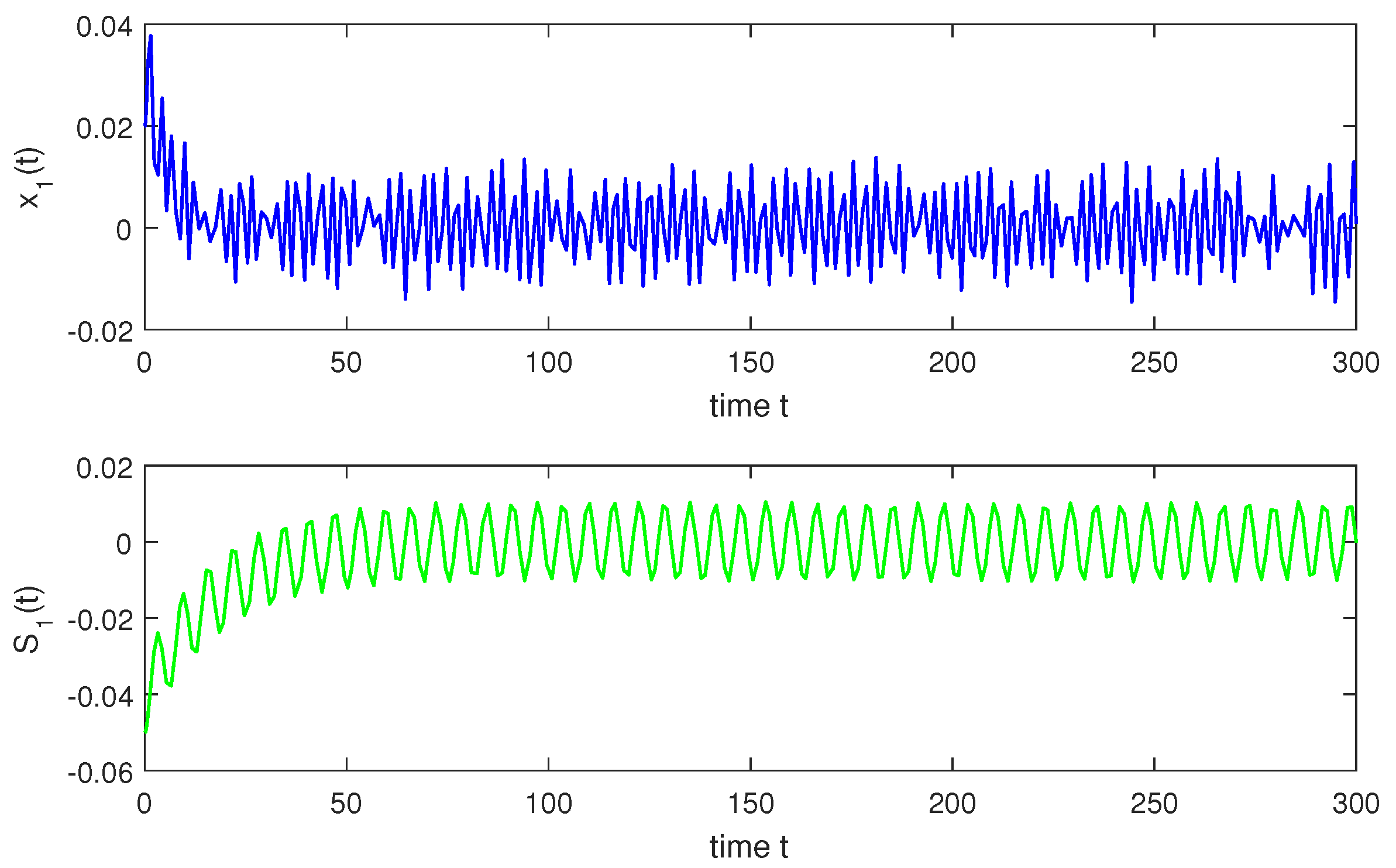
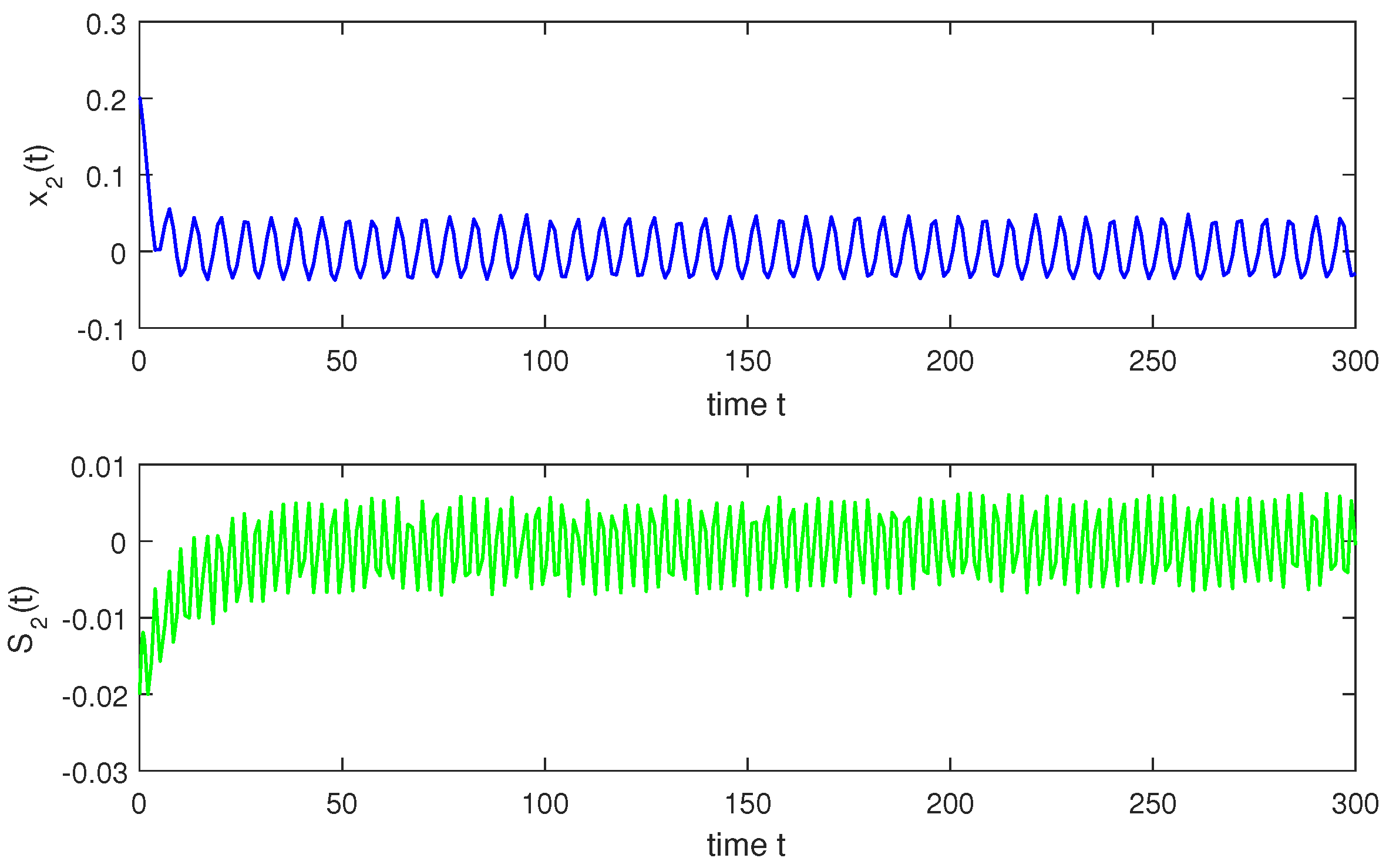
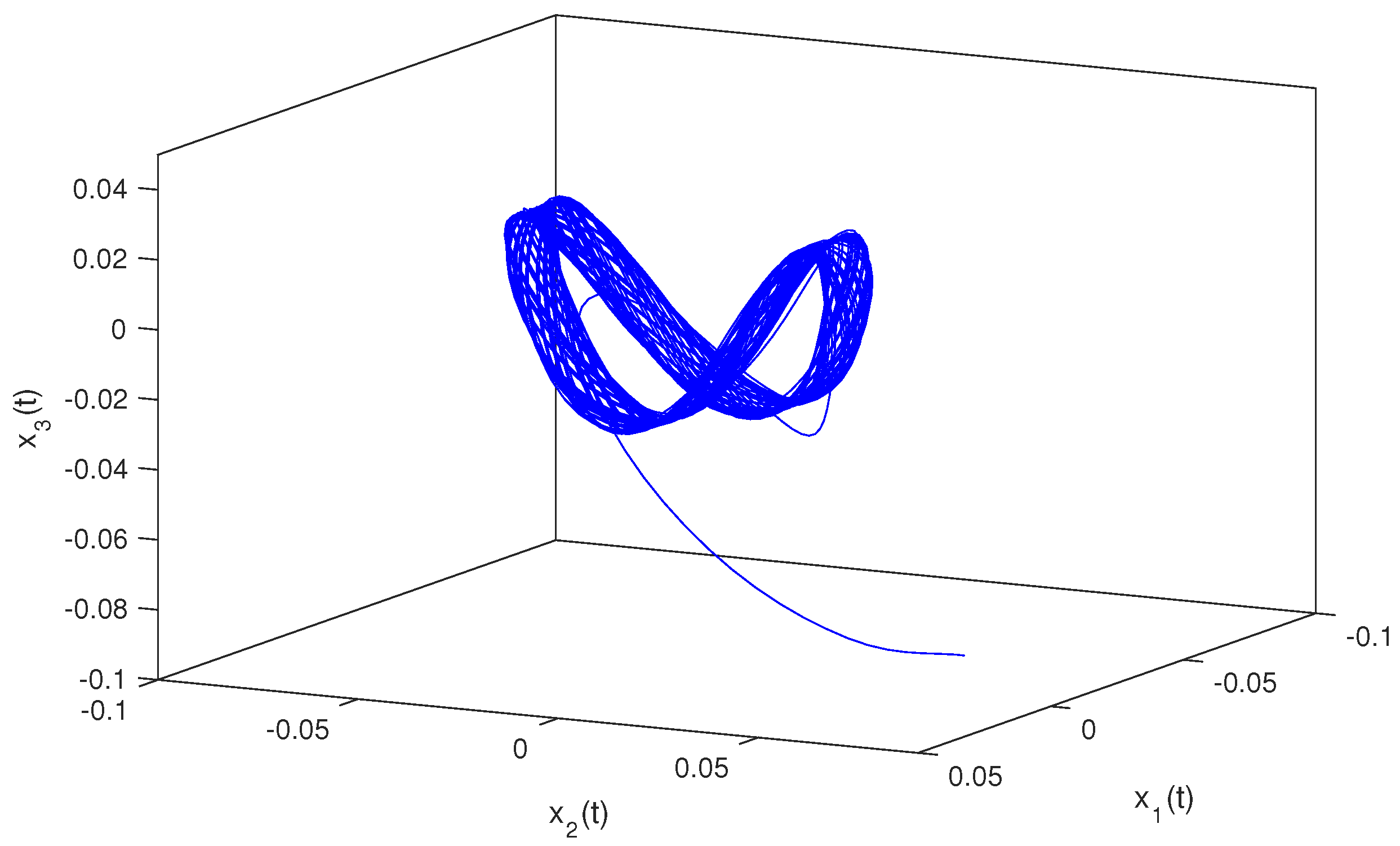
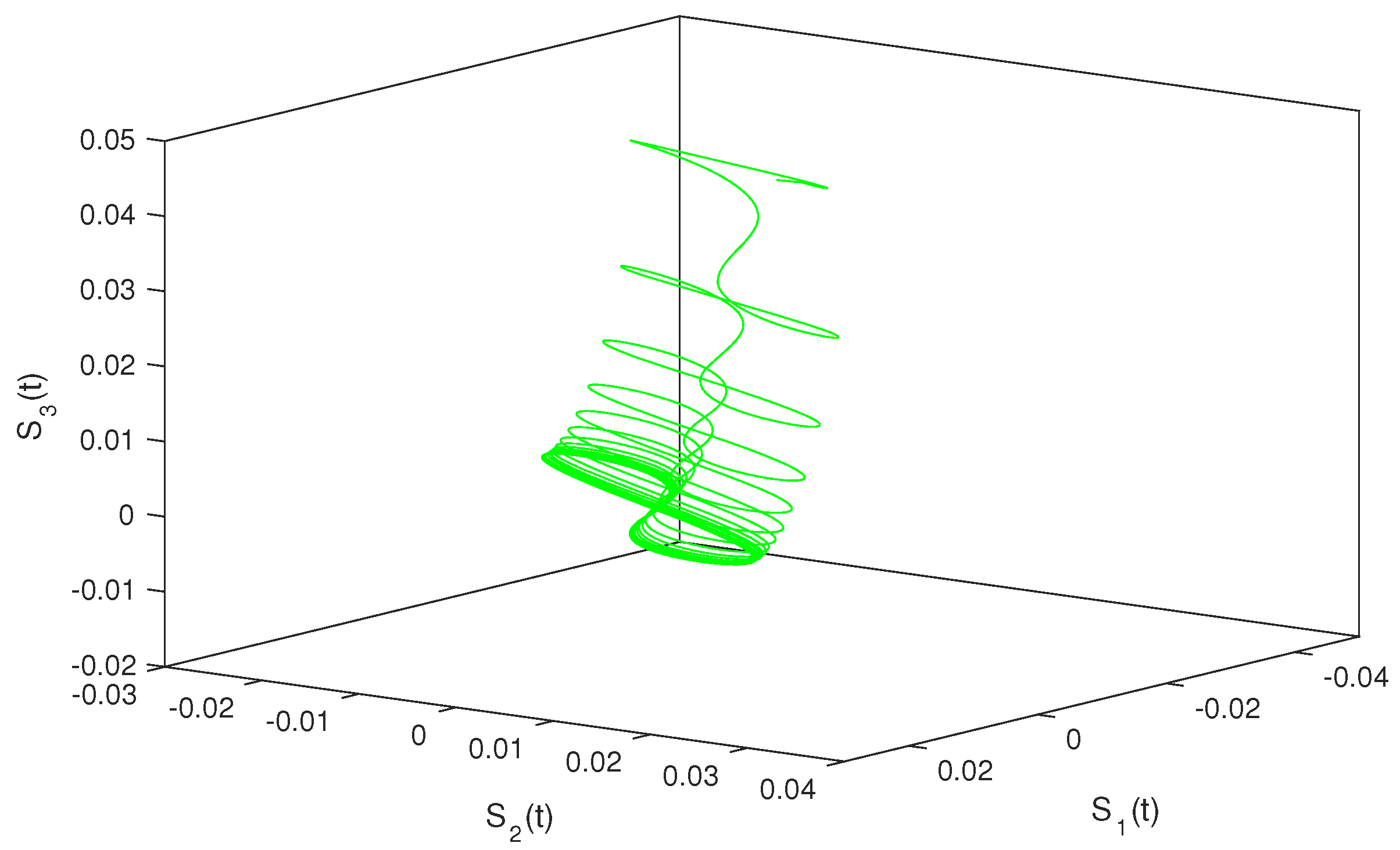
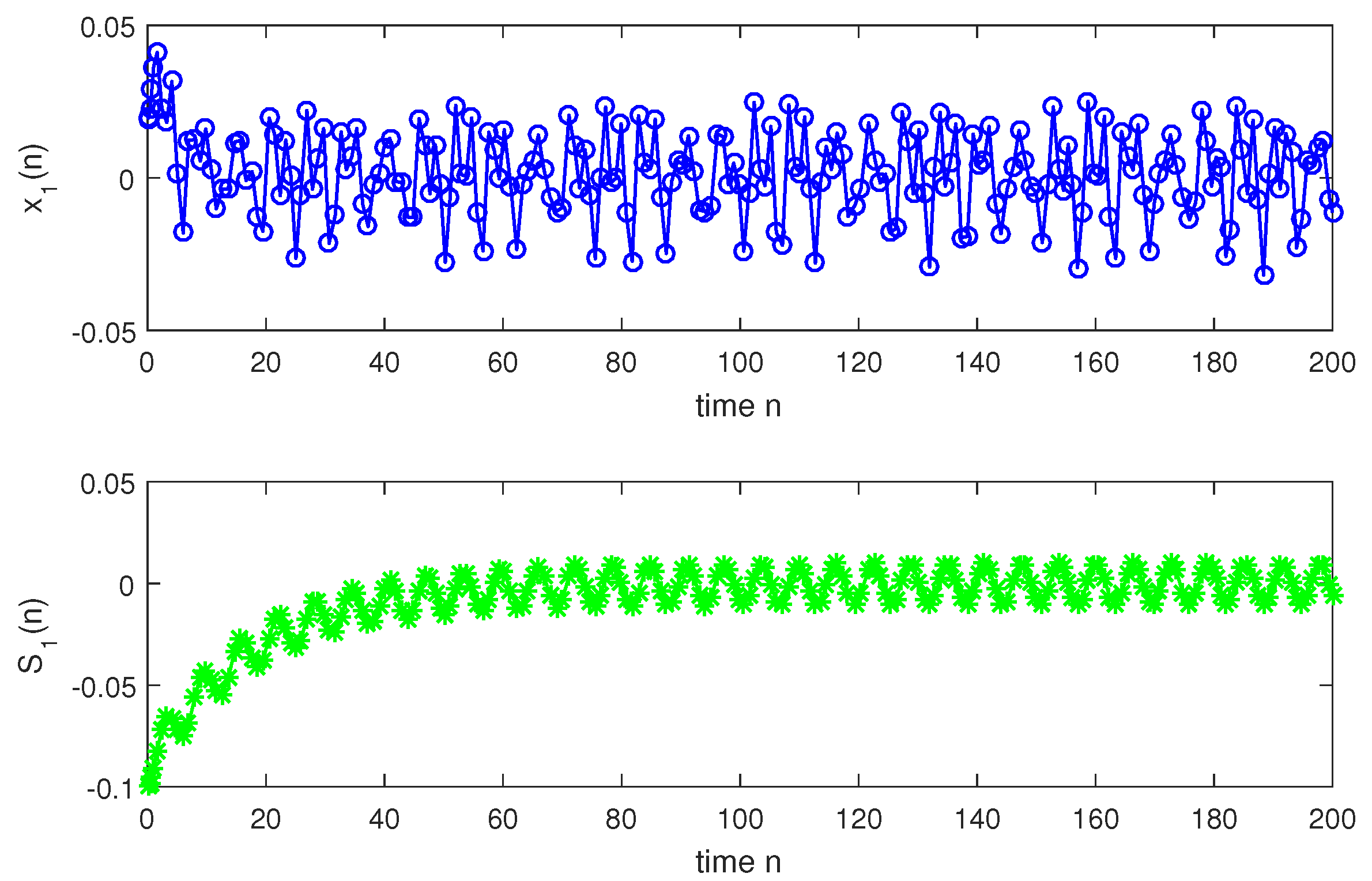
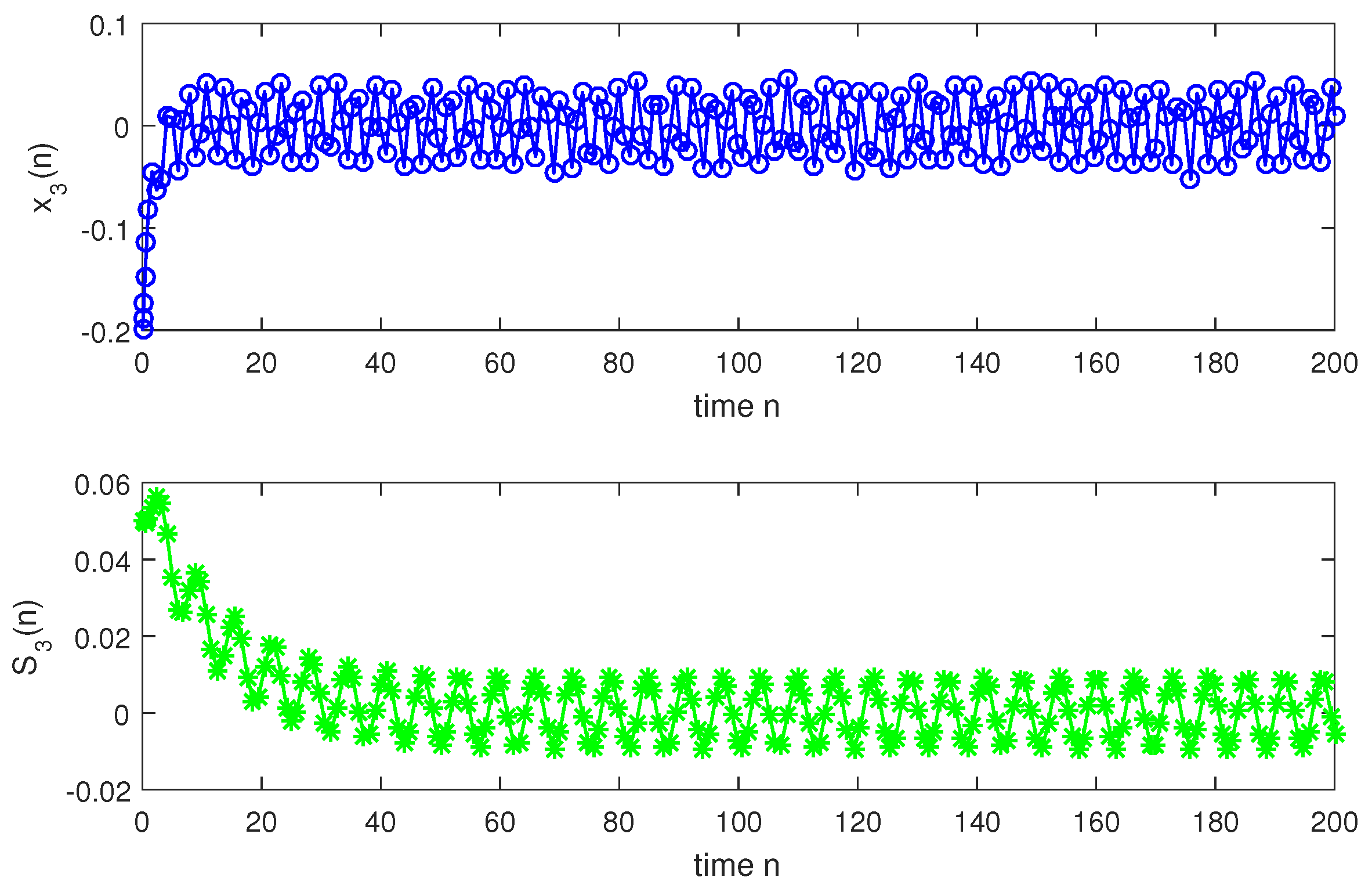
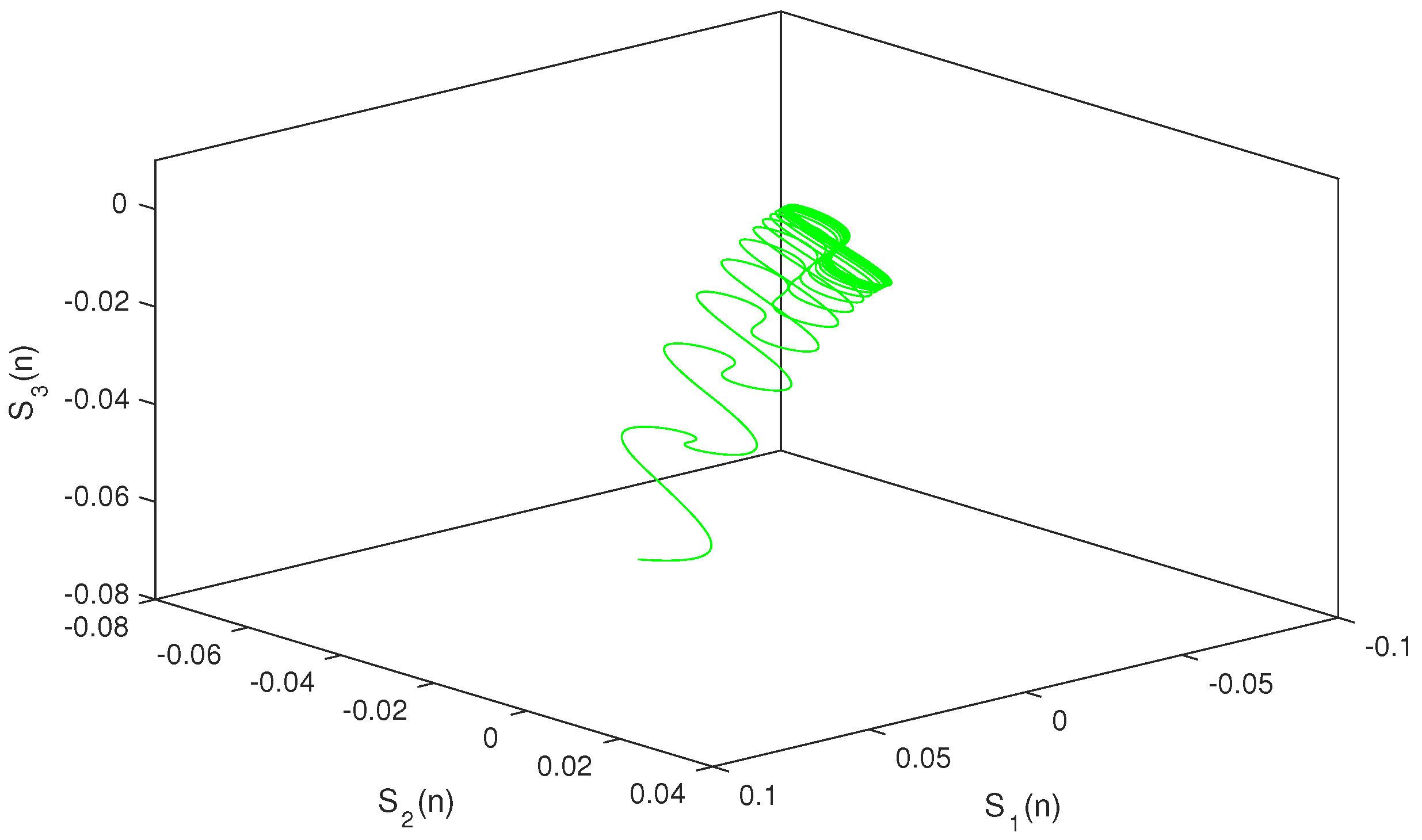
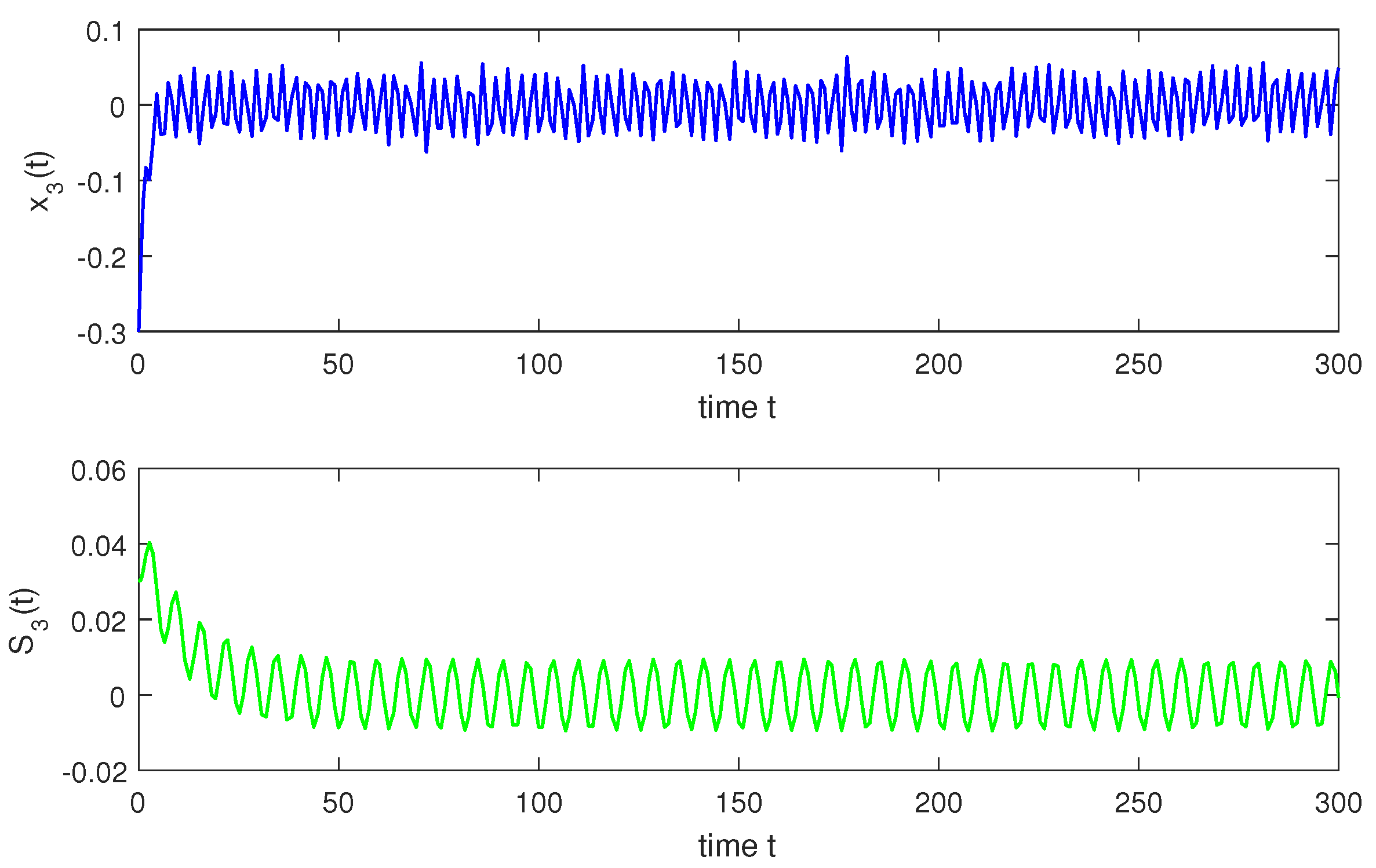
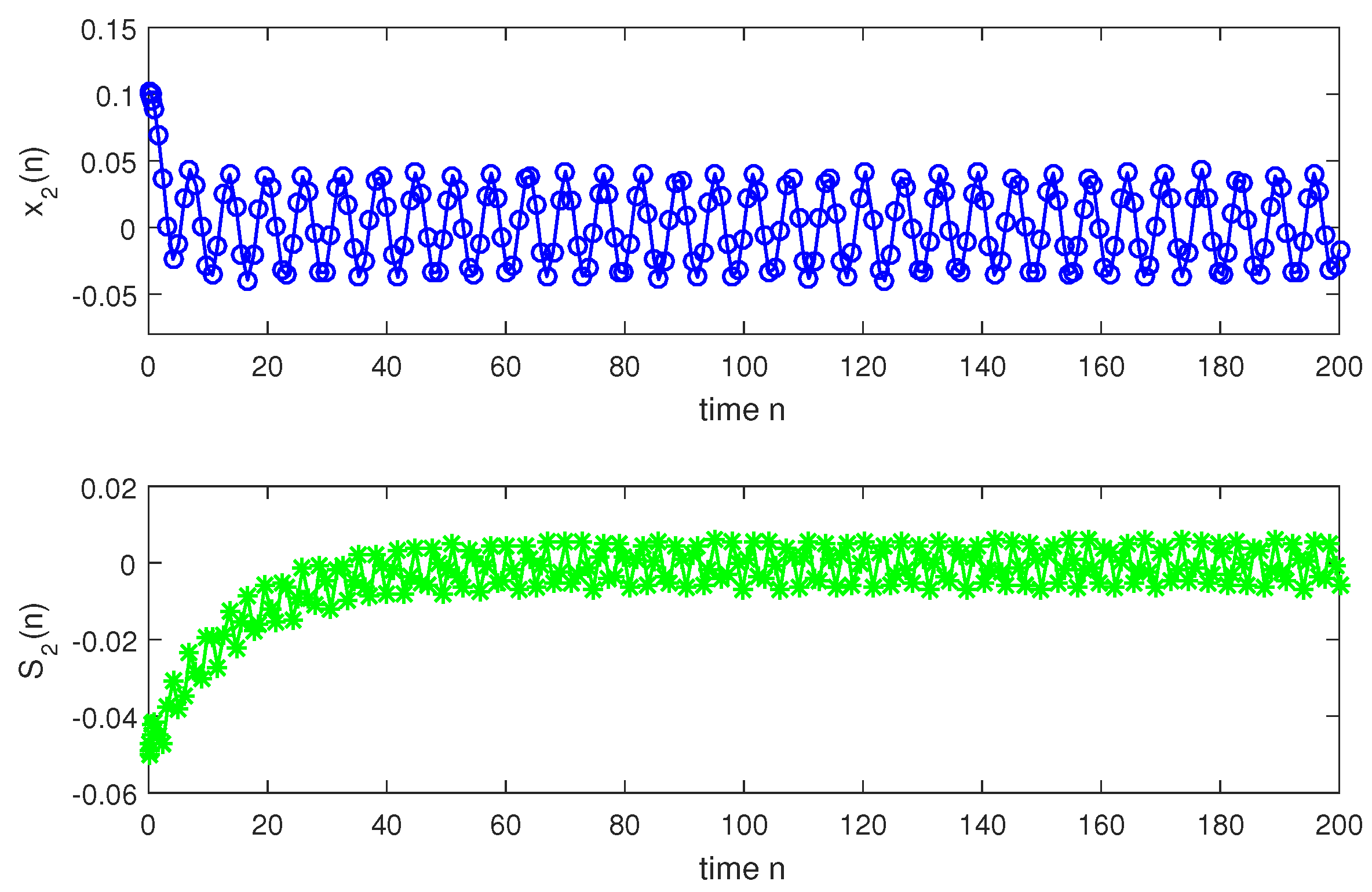
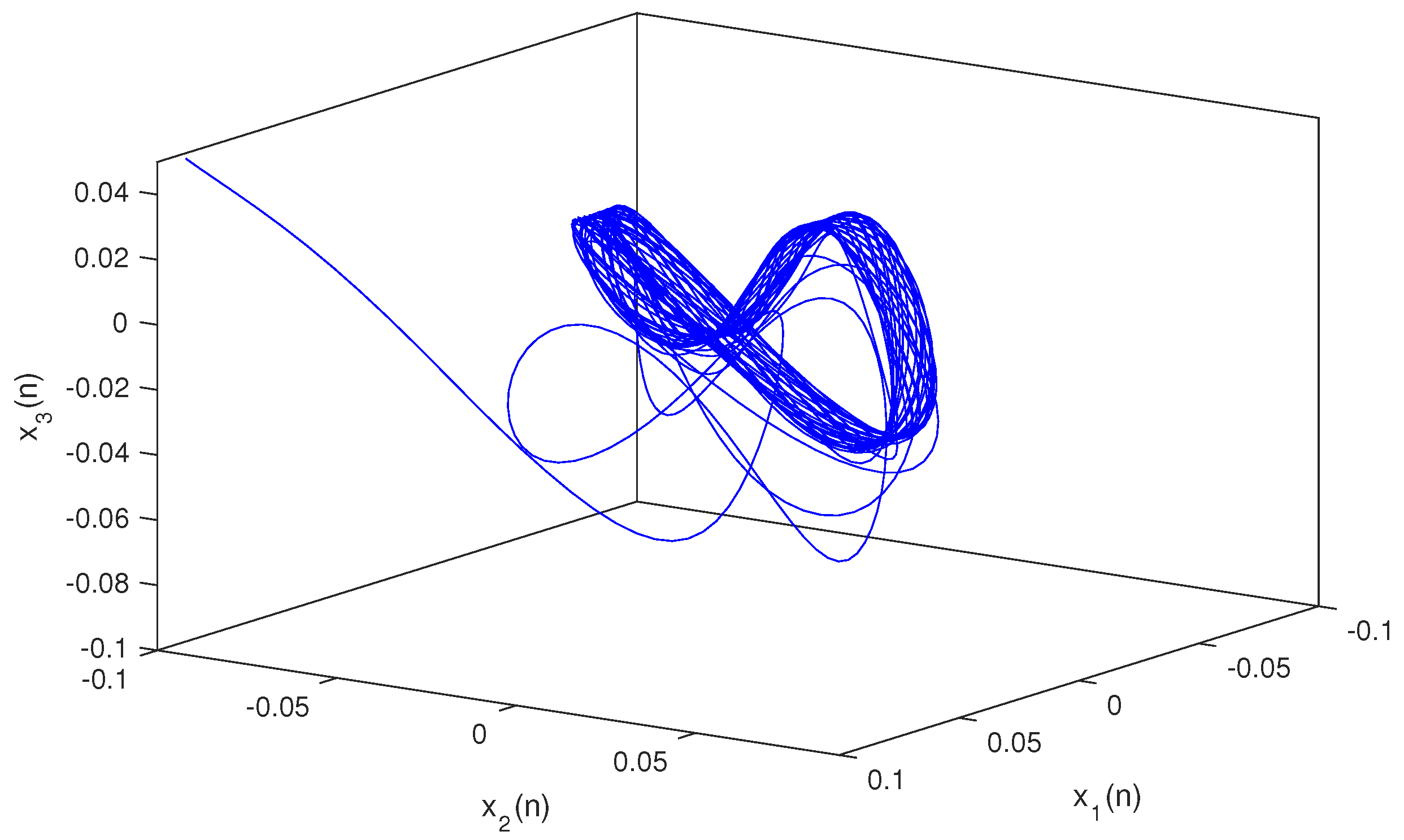
so, condition holds. Hence, conditions – are verified. Therefore, according to Theorem 2, system (1) has a unique almost periodic solution which is globally exponentially stable. In particular, for both the discrete-time and continuous-time cases, system (1) has a unique almost periodic solution which is globally exponentially stable (see Figure 1, Figure 2, Figure 3, Figure 4, Figure 5, Figure 6, Figure 7, Figure 8, Figure 9 and Figure 10).
Figure 1.
Continuous situation with t.
Figure 2.
Continuous situation with t.
Figure 3.
Continuous situation with t.
Figure 4.
Continuous situation .
Figure 5.
Continuous situation .
Figure 6.
Discrete situation with n.
Figure 7.
Discrete situation with n.
Figure 8.
Discrete situation with n.
Figure 9.
Discrete situation .
Figure 10.
Discrete situation .
6. Conclusions
In this paper, we proposed a class of neutral-type CNNs on a new type of almost periodic time scales. We established the existence and uniqueness of almost periodic solutions for this class of neural networks without assuming the boundedness of the activation functions by the contraction fixed-point theorem. Besides, under the same assumptions, we also obtained the global exponential stability of the almost periodic solutions. Our approaches of this paper maybe further be used for other dynamical systems. However, if we modify Definition 3 to be the following form:
Definition 7.
Let be time scale, it is said to be almost periodic if
where , and there exists a set Λ satisfying
- ,
- ,
- ,
where .
Then, how to study the problem of almost periodic and almost automorphic solutions for dynamic equations on the almost periodic time scale defined by Definition 7 with or without condition is a more challenge task. This is our future goals.
Author Contributions
The authors made equal contributions to this paper.
Funding
This work was supported by the National Natural Science Foundation of China under Grants No. 11861072 and No. 11361072, and the Scientific Research Fund Project of the Yunnan Provincial Education Department of People’s Republic of China under Grant No. 2018JS307.
Conflicts of Interest
The authors declare that they have no conflict of interest.
References
- Cohen, M.A.; Grossberg, S. Absolute Stability of Global Pattern Formation and Parallel Memory Storage by Competitive Neural Networks. IEEE Trans. Syst. Man Cybern. 1983, 13, 815–826. [Google Scholar] [CrossRef]
- Engel, P.M.; Molz, R.F. A New Proposal for Implementation of Competitive Neural Networks in Analog Hardware. In Proceedings of the 5th Brazilian Symposium on Neural Networks, Belo Horizonte, Brazil, 9–11 December 1998; pp. 186–191. [Google Scholar]
- Sowmya, B.; Rani, B.S. Colour image segmentation using fuzzy clustering techniques and competitive neural network. Appl. Soft Comput. 2011, 11, 3170–3178. [Google Scholar] [CrossRef]
- Amari, S. Competitive and Cooperative Aspects in Dynamics of Neural Excitation and Self-Organization. In Lecture Notes in Biomathematics; Springer: Berlin/Heidelberg, Germany, 1982; pp. 1–28. [Google Scholar]
- Nie, X.; Cao, J.; Fei, S. Multistability and instability of competitive neural networks with non-monotonic piecewise linear activation functions. Nonlinear Anal. Real World Appl. 2019, 45, 799–821. [Google Scholar] [CrossRef]
- Gu, H.; Jiang, H.; Teng, Z. Existence and global exponential stability of equilibrium of competitive neural networks with different time scales and multiple delays. J. Frankl. Inst. 2010, 347, 719–731. [Google Scholar] [CrossRef]
- Nie, X.; Cao, J. Existence and global stability of equilibrium point for delayed competitive neural networks with discontinuous activation functions. Int. J. Syst. Sci. 2012, 43, 459–474. [Google Scholar] [CrossRef]
- Tan, Y.; Jing, K. Existence and global exponential stability of almost periodic solution for delayed competitive neural networks with discontinuous activations. Math. Meth. Appl. Sci. 2016, 39, 2821–2839. [Google Scholar] [CrossRef]
- Lu, H.; Amari, S.I. Global exponential stability of multitime scale competitive neural networks with nonsmooth functions. IEEE Trans. Neural Netw. 2006, 17, 1152–1164. [Google Scholar] [CrossRef]
- Duan, L.; Fang, X.; Yi, X.; Fu, Y. Finite-time synchronization of delayed competitive neural networks with discontinuous neuron activations. Int. J. Mach. Learn. Cyber. 2018, 9, 1649–1661. [Google Scholar] [CrossRef]
- Lu, H.; He, Z. Global exponential stability of delayed competitive neural networks with different time scales. Neural Netws. 2005, 18, 243–250. [Google Scholar] [CrossRef]
- Wang, Y.; Huang, L. Global stability analysis of competitive neural networks with mixed time-varying delays and discontinuous neuron activations. Neurocomputing 2015, 152, 85–96. [Google Scholar] [CrossRef]
- Qin, J.; Li, Y. New results on exponential stability of competitive neural networks with multi-proportional delays. Asian J. Control 2018. Available online: https://onlinelibrary.wiley.com/doi/abs/10.1002/asjc.1926 (accessed on 28 February 2019). [CrossRef]
- Xu, D.; Tan, M. Multistability of delayed complex-valued competitive neural networks with discontinuous non-monotonic piecewise nonlinear activation functions. Commun. Nonlinear Sci. Numer. Simulat. 2018, 62, 352–377. [Google Scholar] [CrossRef]
- Nie, X.; Cao, J. Multistability of competitive neural networks with time-varying and distributed delays. Nonlinear Anal. Real World Appl. 2009, 10, 928–942. [Google Scholar] [CrossRef]
- Nie, X.; Huang, Z. Multistability and multiperiodicity of high-order competitive neural networks with a general class of activation functions. Neurocomputing 2012, 82, 1–13. [Google Scholar] [CrossRef]
- Liu, Y.; Yang, Y.; Liang, T.; Li, L. Existence and global exponential stability of anti-periodic solutions for competitive neural networks with delays in the leakage terms on time scales. Neurocomputing 2014, 133, 471–482. [Google Scholar] [CrossRef]
- Gan, Q.; Hu, R.; Liang, Y. Adaptive synchronization for stochastic competitive neural networks with mixed time-varying delays. Commun. Nonlinear Sci. Numer. Simulat. 2012, 17, 3708–3718. [Google Scholar] [CrossRef]
- Li, Y.; Yang, X.; Shi, L. Finite-time synchronization for competitive neural networks with mixed delays and non-identical perturbations. Neurocomputing 2016, 185, 242–253. [Google Scholar] [CrossRef]
- Carpi, A. On the Repetition Threshold for Large Alphabets. In Lecture Notes in Computer Science; Springer: Berlin/Heidelberg, Germany, 2006; pp. 226–237. [Google Scholar]
- Bohner, M.; Peterson, A. Advances in Dynamic Equations on Time Scales; Birkhäuser: Boston, MA, USA, 2002. [Google Scholar]
- Bohr, H. Zur theorie der fast periodischen funktionen: I. Acta Math. 1925, 45, 29–127. [Google Scholar] [CrossRef]
- Bohr, H. Zur Theorie der Fastperiodischen Funktionen: II. Acta Math. 1925, 46, 101–214. [Google Scholar] [CrossRef]
- Li, Y.; Wang, C. Uniformly almost periodic functions and almost periodic solutions to dynamic equations on time scales. Abstr. Appl. Anal. 2011, 2011, 1–22. [Google Scholar] [CrossRef]
- Li, Y.; Wang, C. Pseudo almost periodic functions and pseudo almost periodic solutions to dynamic equations on time scales. Adv. Differ. Equ. 2012, 2012, 77. [Google Scholar] [CrossRef]
- Lizama, C.; Mesquita, J.G. Almost automorphic solutions of dynamic equations on time scales. J. Funct. Anal. 2013, 265, 2267–2311. [Google Scholar] [CrossRef]
- Wang, C.; Li, Y. Weighted pseudo almost automorphic functions with applications to abstract dynamic equations on time scales. Ann. Polon. Math. 2013, 3, 225–240. [Google Scholar] [CrossRef]
- Hong, S.; Peng, Y. Almost periodicity of set-valued functions and set dynamic equations on time scales. Inf. Sci. 2016, 330, 157–174. [Google Scholar] [CrossRef]
- Li, Y.; Wang, P. Almost periodic solution for neutral functional dynamic equations with Stepanov-almost periodic terms on time scales. Discret. Cont. Dyn. Syst. Ser. S 2017, 10, 463–473. [Google Scholar] [CrossRef]
- Lizama, C.; Mesquita, J.G. Asymptotically almost automorphic solutions of dynamic equations on time scales. J. Math. Anal. Appl. 2013, 407, 339–349. [Google Scholar] [CrossRef]
- Lizama, C.; Mesquita, J.G.; Ponce, R. A connection between almost periodic functions defined on timescales and ℝ. Applic. Anal. 2014, 93, 2547–2558. [Google Scholar] [CrossRef]
- Li, Y.; Yang, L. Almost automorphic solution for neutral type high-order Hopfield neural networks with delays in leakage terms on time scales. Appl. Math. Comput. 2014, 242, 679–693. [Google Scholar] [CrossRef]
- Liang, T.; Yang, Y.; Liu, Y.; Li, L. Existence and global exponential stability of almost periodic solutions to Cohen-Grossberg neural networks with distributed delays on time scales. Neurocomputing 2014, 123, 207–215. [Google Scholar] [CrossRef]
- Gao, J.; Wang, Q.R.; Zhang, L.W. Existence and stability of almost-periodic solutions for cellular neural networks with time-varying delays in leakage terms on time scales. Appl. Math. Comput. 2014, 237, 639–649. [Google Scholar] [CrossRef]
- Li, Y.; Meng, X. Existence and global exponential stability of pseudo almost periodic solutions for neutral type quaternion-valued neural networks with delays in the leakage term on time scales. Complexity 2017, 2017, 9878369. [Google Scholar] [CrossRef]
- Yao, Z. Existence and global exponential stability of an almost periodic solution for a host-macroparasite equation on time scales. Adv. Differ. Equ. 2015, 2015, 41. [Google Scholar] [CrossRef]
- Li, Y.; Meng, X.; Xiong, L. Pseudo almost periodic solutions for neutral type high-order Hopfield neural networks with mixed time-varying delays and leakage delays on time scales. Int. J. Mach. Learn. Cyber. 2017, 8, 1915–1927. [Google Scholar] [CrossRef]
- Mophou, G.; N’Guérékata, G.M.; Milce, A. Almost automorphic functions of order and applications to dynamic equations on time scales. Discret. Dyn. Nat. Soc. 2014, 2014, 1–13. [Google Scholar] [CrossRef]
- Zhou, H.; Zhou, Z.; Jiang, W. Almost periodic solutions for neutral type BAM neural networks with distributed leakage delays on time scales. Neurocomputing 2015, 157, 223–230. [Google Scholar] [CrossRef]
- Li, Y.; Li, B. Existence and exponential stability of positive almost periodic solution for Nicholson’s blowflies models on time scales. SpringerPlus 2016, 5, 1096. [Google Scholar] [CrossRef]
- Wang, P.; Li, Y.; Ye, Y. Almost periodic solutions for neutral-type neural networks with the delays in the leakage term on time scales. Math. Meth. Appl. Sci. 2016, 39, 4297–4310. [Google Scholar] [CrossRef]
© 2019 by the authors. Licensee MDPI, Basel, Switzerland. This article is an open access article distributed under the terms and conditions of the Creative Commons Attribution (CC BY) license (http://creativecommons.org/licenses/by/4.0/).