


Abstract
In recent years, a mathematical approach of blending different aspects is on the way, which as a result gives a more generalized approach. Following the above mathematical approach, we combine two very powerful techniques, namely complex intuitionistic fuzzy sets and graph theory, and introduce the notion of complex intuitionistic fuzzy graphs. Then, we introduce certain notions including union, join and composition of complex intuitionistic fuzzy graphs, through which one can easily manipulate the complex intuitionistic fuzzy graphs in decision making problems. We elucidate these operations with some examples. We also describe the homomorphisms of complex intuitionistic fuzzy graphs. Finally, we provide an application in cellular network provider companies for the testing of our approach.
1. Introduction
We divide the Introduction Section into four main paragraphs. In the first paragraph, we provide some details about the fuzzy sets. In the second paragraph, detail is given about the complex version of fuzzy sets, namely complex fuzzy sets, which is an extension of fuzzy sets. In the third paragraph, detail is given about graph theory in terms of different types of fuzzy sets. In the fourth paragraph, we give our presented approach by combining the two different approaches given in the second and third paragraphs.
Fuzzy set theory was conferred by Zadeh [1] to solve difficulties in dealing with uncertainties. Since then, the theory of fuzzy sets and fuzzy logic have been examined by many researchers to solve many real life problems involving ambiguous and uncertain environment. Atanassov [2] proposed the extended form of fuzzy set by adding a new component, called “intuitionistic fuzzy sets” (-sets). The idea of -sets is more meaningful as well as intensive due to the presence of degree of truth and falsity membership. Applications of these sets have been broadly studied in other aspects such as image processing [3], multi-criteria decision making [4], pattern recognition [5], etc.
Buckley [6] and Nguyen et al. [7] combined complex numbers with fuzzy sets. On the other hand, Ramot et al. [8,9] extended the range of membership to “unit circle in the complex plane”, unlike others who limited the range to . Zhang et al. [10] studied some operation properties and -equalities of complex fuzzy sets. Some applications of complex fuzzy sets have been considered in reasoning schemes [11], image restoration [12] and decision making [13]. Further, this concept has been studied in intuitionistic fuzzy sets [14]. Alkouri and Salleh studied some operations on complex Atanassov’s intuitionistic fuzzy sets in [15] and also studied complex Atanassov’s intuitionistic fuzzy relation in [16]. Ali et al. [17] introduced complex intuitionistic fuzzy classes.
Fuzzy graphs were narrated by Rosenfeld [18] and Mordeson [19]. After that, some opinion on “fuzzy graphs” were given by Bhattacharya [20]. He showed that none of the concepts of crisp graph theory have similarities in fuzzy graphs. Thirunavukarasu et al. [21] extended this concept for complex fuzzy graphs. Shannon and Atanassov [22] and Akram and Davvaz [23] defined intuitionistic fuzzy graphs. Later, several authors worked on intuitionistic fuzzy graphs and added many useful results to this area, for instance, Akram and Akmal [24], Alshehri and Akram [25], Karunambigai et al. [26], Myithili et al. [27], Nagoorgani et al. [28] and Parvathi et al. [29,30]. See also [31,32,33,34,35].
Inspired by the fact that complex intuitionistic fuzzy sets generalize intuitionistic fuzzy sets, in this paper, we provide the new idea of complex intuitionistic fuzzy graphs with some fundamental operations. We also describe homomorphisms of complex intuitionistic fuzzy graphs. Finally, we provide an application.
2. Preliminaries and Basic Definitions
Definition 1.
[8] A complex fuzzy set (CFS) , defined on a universe of discourse is an object of the form
where and
Definition 2.
[14] A complex intuitionistic fuzzy set (cif-set) , defined on a universe of discourse is an object of the form
where , and
Definition 3.
[14] Let and be two cif-sets in where
Then, is given as
where
Definition 4.
[16] Let and be two -sets in where
Then, for all
- (1)
- if and only if for amplitude terms and for phase terms.
- (2)
- if and only if for amplitude terms and for phase terms.
Definition 5.
A graph is an ordered pair , where V is the set of vertices of and E is the set of edges of
3. Complex Intuitionistic Fuzzy Graphs
In this section, we provide definition and operations of complex intuitionistic fuzzy graphs.
Definition 6.
A complex intuitionistic fuzzy graph (cif-graph) with an underlaying set V is defined to be a pair , where is a cif-set on V and is a cif-set on such that
for all
Definition 7.
Let be a cif-graph. The order of a cif-graph is defined by
The degree of a vertex x in is defined by
Example 1.
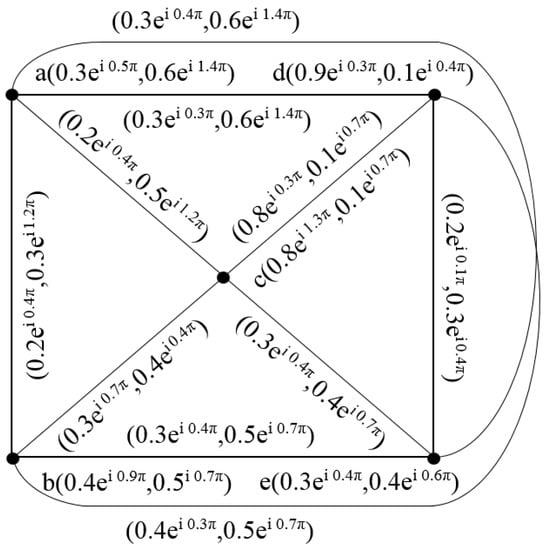
Consider a graph such that . Let be a cif-subset of V and let be a cif-subset of as given:
- (i)
- By routine calculations, it can be observed that the graph shown in Figure 1 is a cif-graph.
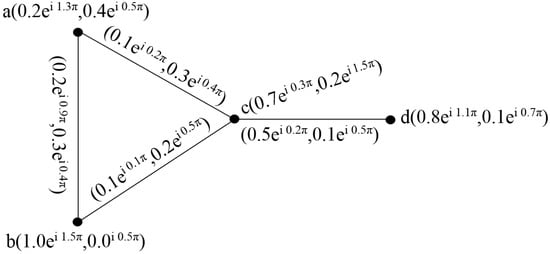 Figure 1. Complex intuitionistic fuzzy graph .
 - (ii)
- Order of cif-graph
- (iii)
- Degree of each vertex in is
Definition 8.
The Cartesian product of two cif-graphs is defined as a pair , such that:
- 1.
- for all
- 2.
- for all , and ,
- 3.
- for all , and .
Definition 9.
Let and be two cif-graphs. The degree of a vertex in can be defined as follows: for any ,
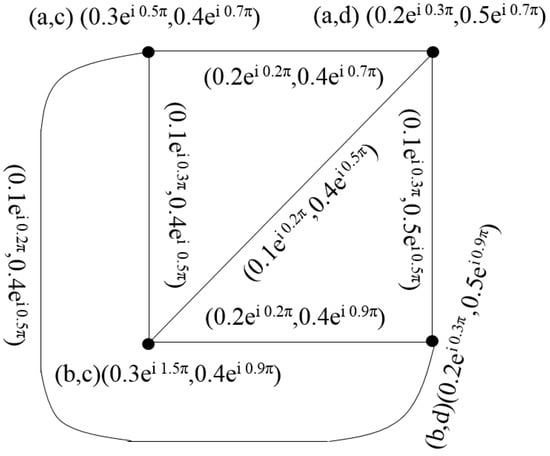
Example 2.

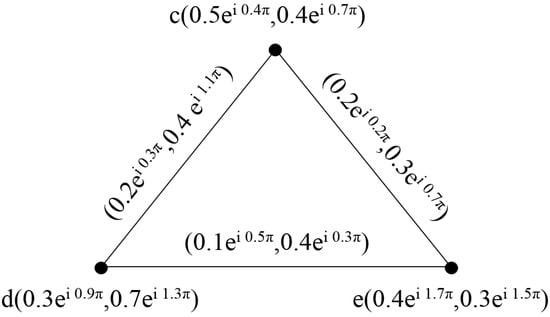
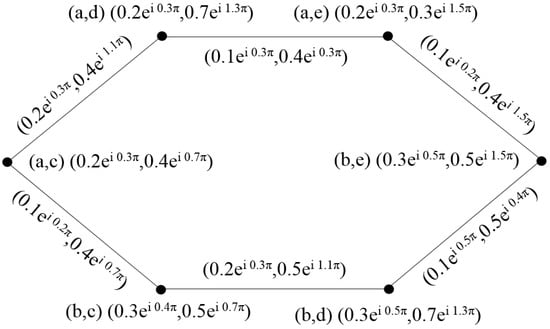
Figure 2.
Complex intuitionistic fuzzy graph .
Figure 3.
Complex intuitionistic fuzzy graph .
Then, their corresponding Cartesian product is shown in Figure 4.
Figure 4.
Complex intuitionistic fuzzy graph of .
Proposition 1.
The Cartesian product of two cif-graphs is a cif-graph.
Proof.
The conditions for are obvious, therefore, we verify only conditions for .
Let , and . Then,
Similarly, we can prove it for and □
Definition 10.
The composition of two -graphs is defined as a pair , , such that:
- 1.
- for all , ,
- 2.
- for all , and ,
- 3.
- for all , and .
- 4.
- for all , and .
Definition 11.
Let and be two cif-graphs. The degree of a vertex in can be defined as follows: for any ,
Example 3.
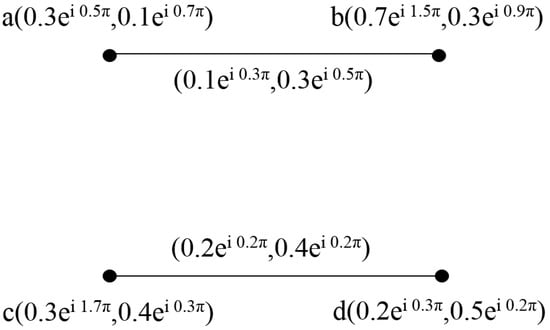
Consider the two cif-graphs, as shown in Figure 5.
Figure 5.
Complex intuitionistic fuzzy graphs of and .
Then, their composition is shown in Figure 6.
Figure 6.
Complex intuitionistic fuzzy graph of .
Proposition 2.
The composition of two cif-graphs is a cif-graph.
Definition 12.
The union of two -graphs is defined as follows:
- 1.
- for and .
- 2.
- for and .
- 3.
- for .
- 4.
- for and .
- 5.
- for and .
- 6.
- for .
Example 4.
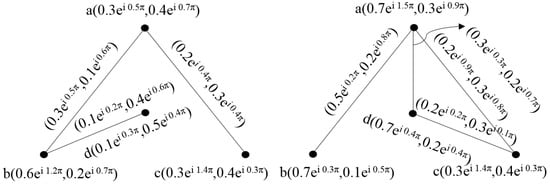
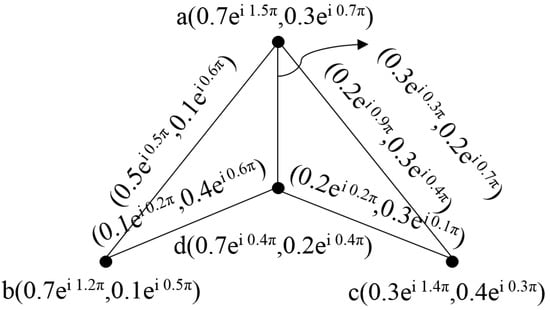
Consider the two cif-graphs, as shown in Figure 7.
Figure 7.
Complex intuitionistic fuzzy graphs of and .
Then, their corresponding union is shown in Figure 8.
Figure 8.
Complex intuitionistic fuzzy graph of .
Proposition 3.
The union of two cif-graphs is a cif-graph.
Definition 13.
The join of two cif-graphs, where , is defined as follows:
- 1.
- if
- 2.
- if
- 3.
- if where is the set of all edges joining the vertices of and .
Example 5.
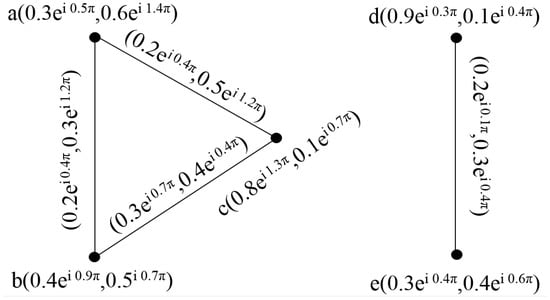
Consider the two cif-graphs, as shown in Figure 9.
Figure 9.
Complex intuitionistic fuzzy graphs of and .
Then, their corresponding join is shown in Figure 10.
Figure 10.
Complex intuitionistic fuzzy graph of .
Proposition 4.
The join of two cif-graphs is a cif-graph.
Proposition 5.
Let and be cif-graphs of the graphs and and let Then, union is a cif-graph of if and only if and are cif-graphs of the graphs and , respectively.
Proof.
Suppose that is a cif-graph. Let Then, and Thus,
This shows that is a cif-graph. Similarly, we can show that is a cif-graph. The converse part is obvious. □
Proposition 6.
Let and be cif-graphs of the graphs and and let Then, join is a cif-graph of if and only if and are cif-graphs of the graphs and , respectively.
Proof.
The proof is similar to the proof of Proposition 5. □
4. Isomorphisms of cif-Graphs
In this section, we discuss isomorphisms of cif-graphs.
Definition 14.
Let and be two cif-graphs. A homomorphism is a mapping such that:
- 1.
- for all
- 2.
- for all .A bijective homomorphism with the property
- 3.
- for all is called a weak isomorphism.A bijective homomorphism with the property
- 4.
- for all , is called a strong co-isomorphism. A bijective mapping satisfying 3 and 4 is called an isomorphism.
Example 6.
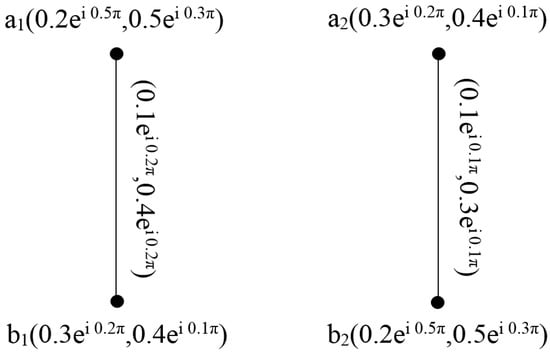
Consider two cif-graphs, as shown in Figure 11.
Figure 11.
Complex intuitionistic fuzzy graphs of and .
Then, it is easy to see that the mapping defined by and is a weak isomorphism.
Proposition 7.
An isomorphism between cif-graphs is an equivalence relation.
Proof.
The reflexivity and symmetry are obvious. To prove the transitivity, we let and be the isomorphisms of onto and onto , respectively. Then, is a bijective map from to , where for all . Since a map defined by for is an isomorphism. Now
Since a map defined by for is an isomorphism,
From and f , we have
From and f , we have
From and , we have
From and , we have
for all . Therefore, is an isomorphism between and . This completes the proof. □
Proposition 8.
A weak isomorphism (co-isomorphism) between cif-graphs is a partial ordering relation.
Proof.
The reflexivity and transitivity are obvious. To prove the anti-symmetry, we let be a strong isomorphism of onto . Then, f is a bijective map defined by f for all satisfying
Let be a strong isomorphism of onto . Then, g is a bijective map defined by for all satisfying
The inequalities , and , hold on the finite sets and only when and have the same number of edges and the corresponding edges have same weight. Hence, and are identical. Therefore, is a strong isomorphism between and . This completes the proof. □
5. Complement of cif-Graphs
In this section, we discuss complements of cif-graphs.
Definition 15.
The complement of a weak cif-graph of is a weak cif-graph on , is defined by
- (i)
- (ii)
- for all ,
- (iii)
Example 7.
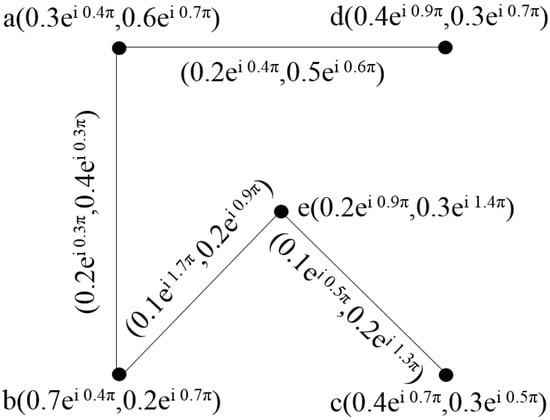
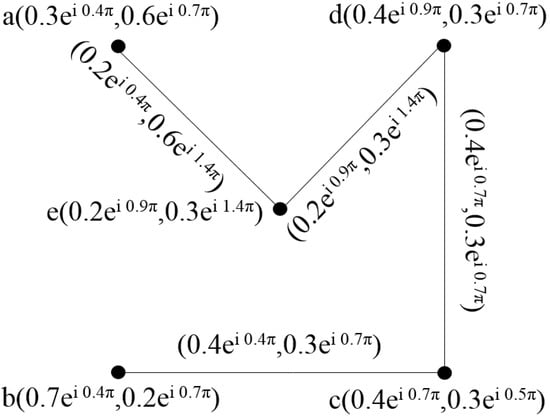
Consider a cif-graph , as shown in Figure 12.
Figure 12.
Complex intuitionistic fuzzy graph of .
Then, the complement of is shown in Figure 13.
Figure 13.
Complex intuitionistic fuzzy graph of .
Definition 16.
A cif-graph G is called self complementary if .
The following propositions are obvious.
Proposition 9.
Let be a self complementary cif-graph. Then,
Proposition 10.
Let be a cif-graph. If
then G is self complementary.
Proposition 11.
Let and be cif-graphs. If there is a strong isomorphism between and , then there is a strong isomorphism between and .
Proof.
Let f be a strong isomorphism between and . Then, is a bijective map that satisfies
Since is a bijective map, f is also bijective map such that f for all Thus
By definition of complement, we have
Thus, f is a bijective map which is a strong isomorphism between and . This ends the proof. □
The following Proposition is obvious.
Proposition 12.
Let and be cif-graphs. Then, if and only if
Proposition 13.
Let and be cif-graphs. If there is a co-strong isomorphism between and , then there is a homomorphism between and .
6. Application
Intuitionistic fuzzy sets are the valuable generalization of fuzzy sets. We combine complex intuitionistic fuzzy sets with the graph theory. Complex intuitionistic fuzzy graphs have many applications in database theory, expert systems, neural networks, decision making problems, GIS-based road networks, facility location problems and so on. In the following, we propose an assumption based application that can be utilized in a physical way.
Consider a cellular company that has a plan to fix the minimum number of towers in a city, such that the maximum numbers of the users can be attracted. For this purpose, the following are some of the parameters that can be taken in account:
- Suitable place to fix a tower
- Transportation means
- Users
- Connectivity with the main server
- Urban area or hilly area
- Any other existing cellular network
- Available recourses
- Expenditures and outcomes
Suppose a team selected five places where they are interested in placing a tower, so that they can facilitate maximum numbers of the users. They observe the following two situations:
- Fixing a tower exactly at the chosen place from the selected five places
- Fixing a tower between any two of the selected five places.
For Situation we proceed as follows:
Let be the set of places where the team is interested in fixing a tower as a vertex set. Suppose that of the experts on the team believe that should have a tower and of the experts believe that there is no need to fix tower at the place after carefully observing the different parameters. Thus, in this way, we can find the amplitude term for both membership and non-membership functions. Now, the phase term that represents the period needs to be found. Let of the experts believe that in a particular time can attract the maximum number of users (Profit) and of the experts have the opposite opinion. We model this information as
Thus, the team finalizes its opinion about the place Now, they visit the place . After careful observation, they model the information as . It means that of the experts are in the favor of , even though it will produce only of profit, while are opposed to , even though it will produce profit. Similarly, they model all the other places as and We denote this model as
The complex membership of the vertices denotes the positive characteristics and complex non-membership of the vertices denotes the negative characteristics of a certain parameter for a certain place. Now, finding the absolute values, we have
To find the optimal choice, we find the score function of the absolute values of Thus, we have
Since the scores for and are equal, we find the accuracies of and and thus , which is the most suitable choice to fix a tower. This is the application of complex intuitionistic fuzzy graph, where it has no edge, as shown in Figure 14.
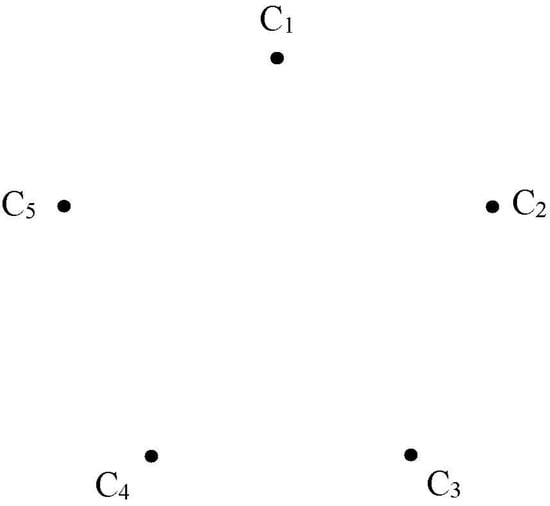
Figure 14.
Complex intuitionistic fuzzy graph with no edge.
Now, for Situation we proceed as follows:
If a tower is fixed between places and , it will represent the edge of the vertex To find the model of , we use Definition 6 and find that Similarly, we find the other edges and we denote this model as
If we consider the edge . In this case, the amplitude term shows that of the experts believe that there should be a tower between these two places and of the experts believe the opposite. The phase terms show that of the experts believe that in a certain time if a tower is fixed between these two places it will produce maximum profit, while of the experts believe the opposite. Absolute values of the edges are:
To find the optimal choice, we find the score function of the absolute values of the edges. Thus, we have
is the greatest, and hence most suitable choice to fix the tower. This is the case where complex intuitionistic fuzzy graph has edges, as shown in Figure 15.
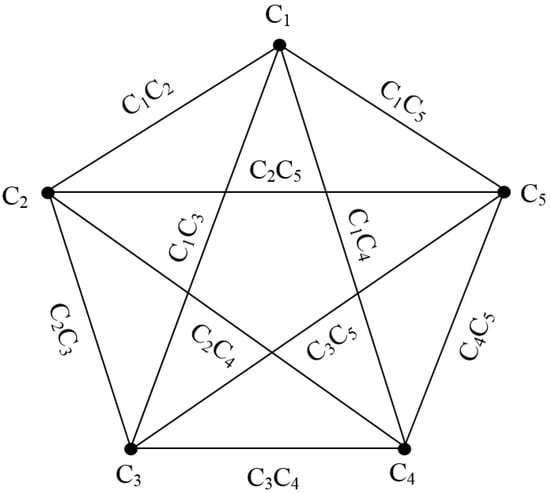
Figure 15.
Complex intuitionistic fuzzy graph with edges.
7. Conclusions
We defined cif-graphs and accomplished the notion of union of cif-graphs, Cartesian product of cif-graphs, join of cif-graphs and composition of cif-graphs. Our presented approach is the generalization of fuzzy graphs. We aim to extend our work in the following directions: One can see in the Section 6, that handling different parameters is one of the most difficult tasks, and since soft sets are very useful tools where one can handle more parameters in a practical way, we will define the complex fuzzy soft graphs that will generalize the idea of fuzzy graphs, soft graphs and fuzzy soft graphs. On the other side, since intuitionistic fuzzy sets generalize the concept of fuzzy sets, we will try to produce a model related with complex intuitionistic fuzzy soft graph, which is the generalization of complex fuzzy graphs and complex fuzzy soft graphs.
Author Contributions
All authors contributed equally.
Funding
This research received no external funding.
Conflicts of Interest
The authors declare no conflict of interest.
References
- Zadeh, L.A. Fuzzy sets. Inform. Control 1965, 8, 338–353. [Google Scholar] [CrossRef]
- Atanassov, K. Intuitionistic fuzzy sets. Fuzzy Sets Syst. 1986, 20, 87–96. [Google Scholar] [CrossRef]
- Palaniappan, N.; Srinivasan, R. Applications of intuitionistic fuzzy sets of root type in image processing. In Proceedings of the Annual Meeting of the North American Fuzzy Information Processing Society, Cincinnati, OH, USA, 14–17 June 2009; pp. 1–5. [Google Scholar]
- Szmidt, E.; Kacprzyk, J. An application of intuitionistic fuzzy set similarity measures to a multi-criteria decision making problem. In Proceedings of the Artificial Intelligence and Soft Computing—ICAISC, Zakopane, Poland, 25–29 June 2006; pp. 314–323. [Google Scholar]
- Vlachos, I.K.; Sergiadis, G.D. Intuitionistic fuzzy information: Applications to pattern recognition. Pattern Recognit. Lett. 2007, 28, 197–206. [Google Scholar] [CrossRef]
- Buckley, J.J. Fuzzy complex numbers. Fuzzy Sets Syst. 1989, 33, 333–345. [Google Scholar] [CrossRef]
- Nguyen, H.T.; Kandel, A.; Kreinovich, V. Complex fuzzy sets: Towards new foundations. In Proceedings of the Ninth IEEE International Conference on Fuzzy Systems, San Antonio, TX, USA, 7–10 May 2000; pp. 1045–1048. [Google Scholar]
- Ramot, D.; Milo, R.; Friedman, M.; Kandel, A. Complex fuzzy sets. IEEE Trans. Fuzzy Syst. 2002, 10, 171–186. [Google Scholar] [CrossRef]
- Ramot, D.; Friedman, M.; Langholz, G.; Kandel, A. Complex fuzzy logic. IEEE Trans. Fuzzy Syst. 2003, 11, 450–461. [Google Scholar] [CrossRef]
- Zhang, G.; Dillon, T.S.; Cai, K.Y.; Ma, J.; Lu, J. Operation properties and δ-equalities of complex fuzzy sets. Int. J. Approx. Reason. 2009, 50, 1227–1249. [Google Scholar] [CrossRef]
- Cheng, G.; Yang, J. Complex fuzzy reasoning schemes. In Proceedings of the IEEE International Conference on Information and Computing, Wuxi, China, 4–6 June 2010; pp. 29–32. [Google Scholar]
- Li, C.; Chan, F. Complex-fuzzy adaptive image restoration an artificial-bee-colony-based learning approach. In Proceedings of the Asian Conference on Intelligent Information and Database Systems, Daegu, Korea, 20–22 April 2011; pp. 90–99. [Google Scholar]
- Yager, R.R.; Abbasov, A.M. Pythagorean membership grades, complex numbers, and decision making. Int. J. Intell. Syst. 2013, 28, 436–452. [Google Scholar] [CrossRef]
- Alkouri, A.M.; Salleh, A.R. Complex intuitionistic fuzzy sets. AIP Conf. Proc. 2012, 1482, 464–470. [Google Scholar]
- Alkouri, A.M.; Salleh, A.R. Some operations on complex Atanassov’s intuitionistic fuzzy sets. AIP Conf. Proc. 2013, 1571, 987–993. [Google Scholar]
- Alkouri, A.M.; Salleh, A.R. Complex Atanassov’s intuitionistic fuzzy relation. Abstr. Appl. Anal. 2013, 2013, 287382. [Google Scholar] [CrossRef]
- Ali, M.; Tamir, D.E.; Rishe, N.D.; Kandel, A. Complex intuitionistic fuzzy classes. In Proceedings of the IEEE International Conference on Fuzzy Systems, Vancouver, BC, Canada, 24–29 July 2016; pp. 2027–2034. [Google Scholar]
- Rosenfeld, A. Fuzzy Graphs, Fuzzy Sets and Their Applications; Academic Press: New York, NY, USA, 1975; pp. 77–95. [Google Scholar]
- Mordeson, J.N.; Nair, P.S. Fuzzy Graphs and Fuzzy Hypergraphs, 2nd ed.; Physica Verlag: Heidelberg, Germany, 2001. [Google Scholar]
- Bhattacharya, P. Some remarks on fuzzy graphs. Pattern Recognit. Lett. 1987, 6, 297–302. [Google Scholar] [CrossRef]
- Thirunavukarasu, P.; Suresh, R.; Viswanathan, K.K. Energy of a complex fuzzy graph. Int. J. Math. Sci. Eng. Appl. 2016, 10, 243–248. [Google Scholar]
- Shannon, A.; Atanassov, A. A first step to a theory of the intuitionistic fuzzy graphs. In Proceedings of the First Workshop on Fuzzy Based Expert Systems, Sofia, Bulgaria, 28–30 September 1994; pp. 59–61. [Google Scholar]
- Akram, M.; Davvaz, B. Strong intuitionistic fuzzy graphs. Filomat 2012, 26, 177–196. [Google Scholar] [CrossRef]
- Akram, M.; Akmal, R. Operations on intuitionistic fuzzy graph structures. Fuzzy Inf. Eng. 2016, 8, 389–410. [Google Scholar] [CrossRef]
- Alshehri, N.; Akram, M. Intuitionistic fuzzy planar graphs. Discret. Dyn. Nat. Soc. 2014, 2014, 397823. [Google Scholar] [CrossRef]
- Karunambigai, M.G.; Akram, M.; Buvaneswari, R. Strong and superstrong vertices in intuitionistic fuzzy graphs. J. Intell. Fuzzy Syst. 2016, 30, 671–678. [Google Scholar] [CrossRef]
- Myithili, K.K.; Parvathi, R.; Akram, M. Certain types of intuitionistic fuzzy directed hypergraphs. Int. J. Mach. Learn. Cybern. 2016, 7, 287–295. [Google Scholar] [CrossRef]
- Nagoorgani, A.; Akram, M.; Anupriya, S. Double domination on intuitionistic fuzzy graphs. J. Appl. Math. Comput. 2016, 52, 515–528. [Google Scholar] [CrossRef]
- Parvathi, R.; Karunambigai, M.G.; Atanassov, K. Operations on intuitionistic fuzzy graphs. In Proceedings of the IEEE International Conference on Fuzzy Systems, Jeju Island, Korea, 20–24 August 2009; pp. 1396–1401. [Google Scholar]
- Parvathi, R.; Thamizhendhi, G. Domination in intuitionistic fuzzy graphs. Notes Intuit. Fuzzy Sets 2010, 12, 39–49. [Google Scholar]
- Dymova, L.; Sevastjanov, P.; Tikhonenko, A. A new approach to comparing intuitionistic fuzzy values. Sci. Res. Inst. Math. Comput. Sci. 2011, 10, 57–64. [Google Scholar]
- Liu, X.; Kim, H.S.; Feng, F.; Alcantud, J.C.R. Centroid Transformations of Intuitionistic Fuzzy Values Based on Aggregation Operators. Mathematics 2018, 6, 215. [Google Scholar] [CrossRef]
- Rashid, S.; Yaqoob, N.; Akram, M.; Gulistan, M. Cubic graphs with application. Int. J. Anal. Appl. 2018, 16, 733–750. [Google Scholar]
- Gulistan, M.; Khan, A.; Abdullah, A.; Yaqoob, N. Complex neutrosophic subsemigroups and ideals. Int. J. Anal. Appl. 2018, 16, 97–116. [Google Scholar]
- Gulistan, M.; Yaqoob, N.; Rashid, Z.; Smarandache, F.; Wahab, H.A. A study on neutrosophic cubic graphs with real life applications in industries. Symmetry 2018, 10, 203. [Google Scholar] [CrossRef]
© 2019 by the authors. Licensee MDPI, Basel, Switzerland. This article is an open access article distributed under the terms and conditions of the Creative Commons Attribution (CC BY) license (http://creativecommons.org/licenses/by/4.0/).