


Abstract
The polynomial bounds of Jordan’s inequality, especially the cubic and quartic polynomial bounds, have been studied and improved in a lot of the literature; however, the linear and quadratic polynomial bounds can not be improved very much. In this paper, new refinements and improvements of Jordan’s inequality are given. We present new lower bounds and upper bounds for strengthened Jordan’s inequality using polynomials of degrees 1 and 2. Our bounds are tighter than the previous results of polynomials of degrees 1 and 2. More importantly, we give new improvements of Jordan’s inequality using polynomials of degree 5, which can achieve much tighter bounds than those previous methods.
1. Introduction
The following inequality
with equality holds if and only if , is the famous Jordan’s inequality [1]. is also called the “sampling function” that arises frequently in signal processing and the theory of Fourier transforms. The Jordan’s inequality plays an important role in many areas of pure and applied mathematics. Many improvements and refinements of Jordan’s inequality were presented in the recent period [2,3,4,5,6,7]. There are some sharp lower and upper bounds for the function by using polynomial degrees from 1 to 4.
Zhang et al. [8] gave that
Qi et al. [9] proved that
Deng [10] presented
and Jiang et al. [11], similarly, gave the result
Equalities in Labels (2)–(5) are valid if and only if . As , the equalities on the right-hand sides of (3)–(5) are valid, but strict inequalities on the left-hand sides of (3)–(5) and two sides of (2) persist. Debnath et al. [12] gave the improvements of (3) and (5)
and
where
As , equalities on two sides of (6) and (7) are valid; however, as , the lower and upper limits of (6) and (7) are different from that of . The problem of strict inequalities of (6) and (7) still exists.
In order to ensure that the equality of Jorand’s inequality is valid near zero and , Agarwal et al. [13] and Chen et al. [14] gave new lower and upper bounds by using polynomials of degree of 3 and 4,
where
Zeng and Wu [15] gave the polynomial bounds of degree for sinc(x)
The cubic and quartic polynomial lower and upper bounds of have been improved in a lot of literature; however, the linear and quadratic polynomial lower and upper bounds can not be improved very well. To give new tighter linear and quadratic polynomial bounds is the first aim of the paper. The second aim is to further refine and generalize the Jordan’s inequality.
The paper gives improvements of the polynomial bounds of degrees 1 and 2. More importantly, we present new improvements of Jordan’s inequality using polynomials of degree 5, which can achieve much tighter bounds than those previous methods.
2. Results
In this section, we will give some results about the n-th-order derivative and two-sides bounds of . Firstly, we present a Lemma that is very useful for our proof [16].
Lemma 1.
Let be distinct points in , and be integers ≥ 0. Let Suppose that is a polynomial of degree N such that
Then, there exists such that
Next, we give Theorems of n-th-order derivative and two sides bounds of using polynomials of degrees 1 and 2.
Theorem 1.
For , we have
where , , , and denotes the n-th-order derivative of .
Proof.
For the definition of , we have
then, , .
Let , ; then, as ,
The proof of Theorem 1 is completed. □
Theorem 2.
For ,
Proof.
Let and for , we have
By Lemma 1 and Theorem 1, and there exists such that
The proof is finished. □
Theorem 3.
For ,
where
Proof.
Let ,
By Lemma 1 and Theorem 1, and there exists such that
The proof is finished. □
Theorems 2 and 3 give new bounds of using polynomials of degrees 1 and 2. Figure 1 and Figure 2 give the error between sinc(x) and the polynomial bounds from degree 1 to 2. Both figures show that our bounds are tighter than the previous results. The same conclusion can also be shown in Table 1. and denote the maximum errors between and the lower and upper bounds, respectively. It is obvious that the maximum errors are less than or equal to those of previous methods using polynomials of degrees 1 and 2.
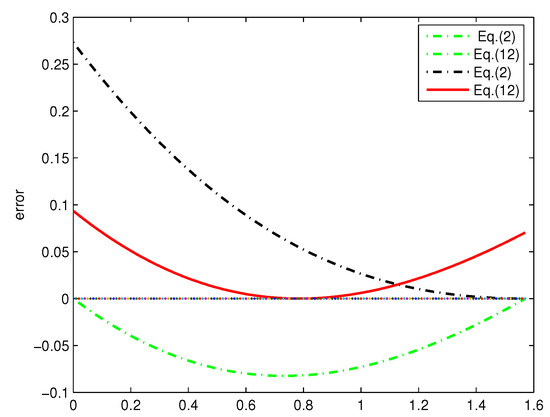
Figure 1.
Error plots between sinc(x) and the bounds of Equations (2) and (12).
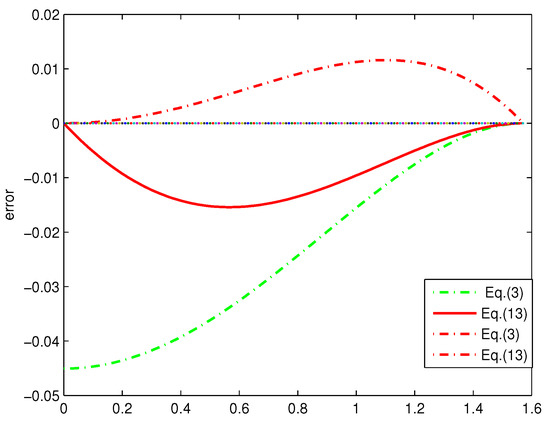
Figure 2.
Error plots between sinc(x) and the bounds of Equations (3) and (13).

Table 1.
Maximum errors from different methods.
Theorem 4.
For ,
where ,
Proof.
Let , It is obvious that for , . □
By Theorem 1 and Lemma 1, we have and there exists such that
which means that . The theorem is proved.
Theorem 4 gives new two-sided bounds of using polynomials of degree 5. The conclusion that Equation (14) achieves much tighter bounds than those of previous methods is easy to be verified. Figure 3 gives the errors between and polynomial bounds of degree 3 and 5. However, the results of Equations (8), (9) and (14) are close in Figure 3; in particular, we give the errors between sinc(x) and the polynomial bounds of Equations (8), (9) and (14) in Figure 4. Figure 4 shows that Equations (8) and (9) have similar errors and the error of Equation (14) is obviously smaller than that of Equations (8) and (9).
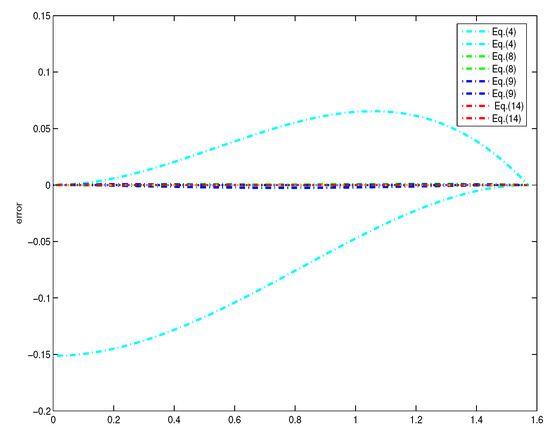
Figure 3.
Error plots between sinc(x) and the polynomial bounds of degrees 3 and 5.
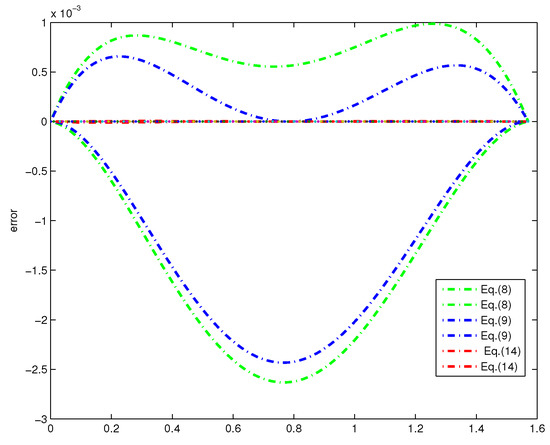
Figure 4.
Error plots between sinc(x) and the polynomial bounds of Equations (8), (9) and (14).
Figure 5 gives the errors between and the polynomial bounds of degrees 4 and 5. For the same reason, we also give the errors between sinc(x) and the polynomial bounds of Equations (10) and (14) in Figure 6.
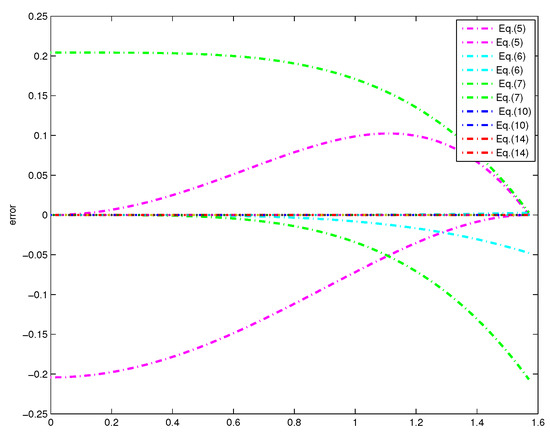
Figure 5.
Error plots between sinc(x) and the polynomial bounds of degrees 4 and 5.
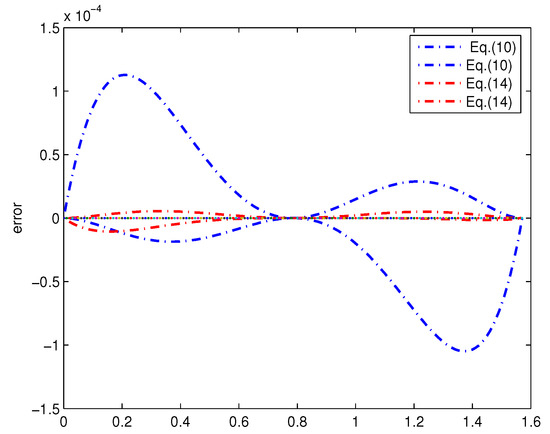
Figure 6.
Error plots between sinc(x) and the polynomial bounds of Equations (10) and (14).
Figure 7 gives a comparison between Equations (14) and (11); here, we set in Equation (11), where m is the degree of the polynomial. Our results are obviously better than that of Zeng [15]; meanwhile, we find that the error is even greater with the increase of m’s value of Equation (11). Maximum errors of different methods are presented in Table 1. Although Equation (11) gives the polynomial bounds of degree m for sinc(x), the error of Equation (11) is relatively large. The maximum errors of Equation (10) is close to the results of Equation (14); however, it is still very obvious that the maximum error of Equation (14) is the smallest.
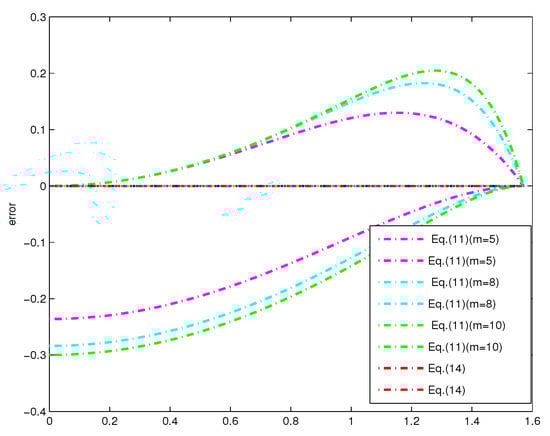
Figure 7.
Error plots between sinc(x) and the polynomial bounds of Equations (11) and (14).
3. Conclusions
In this paper, we gave new refinements and improvements of Jordan’s inequality. Firstly, the new polynomial bounds of degrees 1 and 2 were given. The results show that our bounds are tighter than the previous results of polynomials of degrees 1 and 2. Meanwhile, we presented new improvements of Jordan’s inequality using polynomials of degree 5, which can achieve much tighter bounds than those previous methods.
Much work still remains. The polynomial bounds of degree 5 were given in this paper, and the polynomial bounds of higher degree are needed for tighter bounds. However, it will require more complicated calculations. Furthermore, it is still an important problem to find tighter polynomial bounds of lower degrees.
Author Contributions
All authors contributed equally in writing this article. All authors read and approved the final manuscript.
Funding
The work is partially supported by the National Natural Science Foundation of China (No. 11701152, 11161038).
Acknowledgments
We thank the editor and referees for their careful reading and valuable suggestions to make the article reader-friendly.
Conflicts of Interest
The authors declare no conflicts of interest.
References
- Mitrinović, D.S. Analytic Inequalities; Springer: New York, NY, USA, 1970. [Google Scholar]
- Wu, S.; Debnath, L. A new generalized and sharp version of Jordan’S inequality and its applications to the improvement of the Yang Le inequality. Appl. Math. Lett. 2006, 19, 1378–1384. [Google Scholar] [CrossRef]
- Zhu, L. Sharpening of Jordan’s inequalities and its applications. Math. Inequal. Appl. 2006, 9, 103. [Google Scholar] [CrossRef]
- Kuo, M.K. Refinements of Jordan’s inequality. J. Inequal. Appl. 2011, 2011, 1–6. [Google Scholar] [CrossRef]
- Chen, C.P.; Debnath, L. Sharpness and generalization of Jordan’s inequality and its application. Appl. Math. Lett. 2012, 12, 594–599. [Google Scholar] [CrossRef]
- Nishizawa, Y. Sharpening of Jordan’s type and Shafer-Fink’s type inequalities with exponential approximations. Appl. Math. Comput. 2015, 269, 146–154. [Google Scholar] [CrossRef]
- Alzer, H.; Kwong, M.K. Sharp upper and lower bounds for a sine polynomial. Appl. Math. Comput. 2016, 275, 81–85. [Google Scholar] [CrossRef]
- Zhang, X.; Wang, G.; Chu, Y. Extensions and sharpenings of Jordan’s and Kober’s inequalities. J. Inequal. Pure Appl. Math. 2006, 7, 98–101. [Google Scholar]
- Qi, F.; Niu, D.W.; Guo, B.N. Refinements, Generalizations, and Applications of Jordan’s Inequality and Related Problems. J. Inequal. Appl. 2009, 2009, 1–52. [Google Scholar] [CrossRef]
- Deng, K. The noted Jordan’s inequality and its extensions. J. Xiangtan Mining Inst. 1995, 60–63. [Google Scholar]
- Jiang, W.D.; Yun, H. Sharpening of Jordan’s inequality and its applications. J. Inequal. Pure Appl. Math. 2006, 7, 1–8. [Google Scholar]
- Debnath, L.; Mortici, C.; Zhu, L. Refinements of Jordan–Stečkin and Becker–Stark Inequalities. Results Math. 2015, 67, 207–215. [Google Scholar] [CrossRef]
- Agarwal, R.P.; Kim, Y.H.; Sen, S.K. A new refined Jordan’s inequality and its application. Math. Inequal. Appl. 2009, 12, 255–264. [Google Scholar] [CrossRef]
- Chen, X.D.; Shi, J.; Wang, Y.; Xiang, P. A New Method for Sharpening the Bounds of Several Special Functions. Results Math. 2017, 72, 695–702. [Google Scholar] [CrossRef]
- Zeng, S.P.; Wu, Y.S. Some new inequalities of Joran type for sine. Sci. World J. 2013, 2013, 1–5. [Google Scholar]
- Davis, P. Interpolation and Approximation; Dover Publications: New York, NY, USA, 1975. [Google Scholar]
© 2018 by the authors. Licensee MDPI, Basel, Switzerland. This article is an open access article distributed under the terms and conditions of the Creative Commons Attribution (CC BY) license (http://creativecommons.org/licenses/by/4.0/).