1. Introduction
Throughout this paper, “
G is a graph” always means that “
G is a simple and undirected graph”. Moreover, we denote a graph
G by
, where
is the vertex set and
is the edge set of
G. Associated with a graph
G, some matrices characterize the structure of
G, such as the adjacency matrix
, which is an
matrix with entry
if
and
are adjacent in
G, and
otherwise, the diagonal matrix
with diagonal entries
and the Laplacian matrix
, which is
. Let
denote the unit matrix of order
n,
1n be the all-one column vector of dimension
n and
be the all-one
-matrix. For more detail, one can refer to [
1,
2] for the definitions and notions in the paper.
It is rather clear that, from some given graphs, a big graph arises by the help of graph operations, such as the Cartesian product, the Kronecker product, the corona graph, the neighborhood corona graph and subdivision-vertex join and subdivision-edge join of graphs (see [
3,
4,
5,
6,
7]). Furthermore, following [
8], from an arbitrary graph
H of order
k and graphs
, we obtain a new graph called
H-join of graphs
, which is denoted by
, for detail:
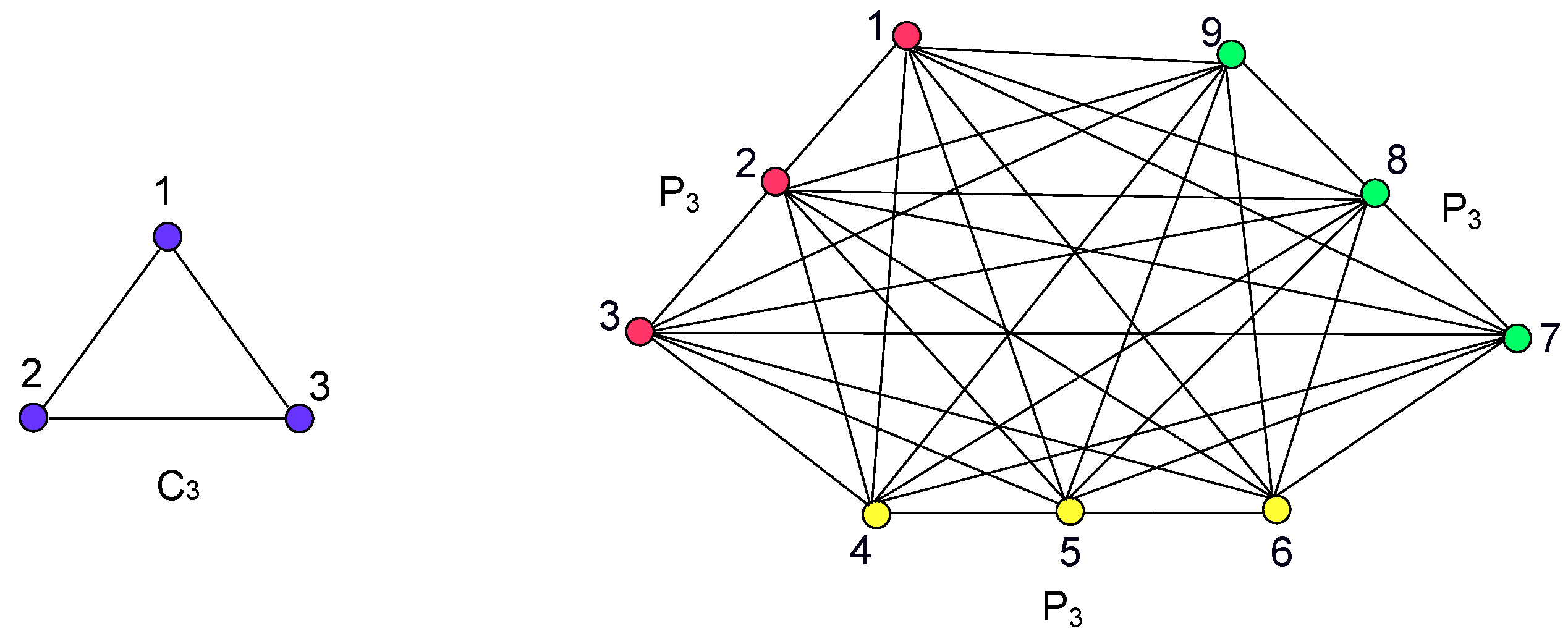
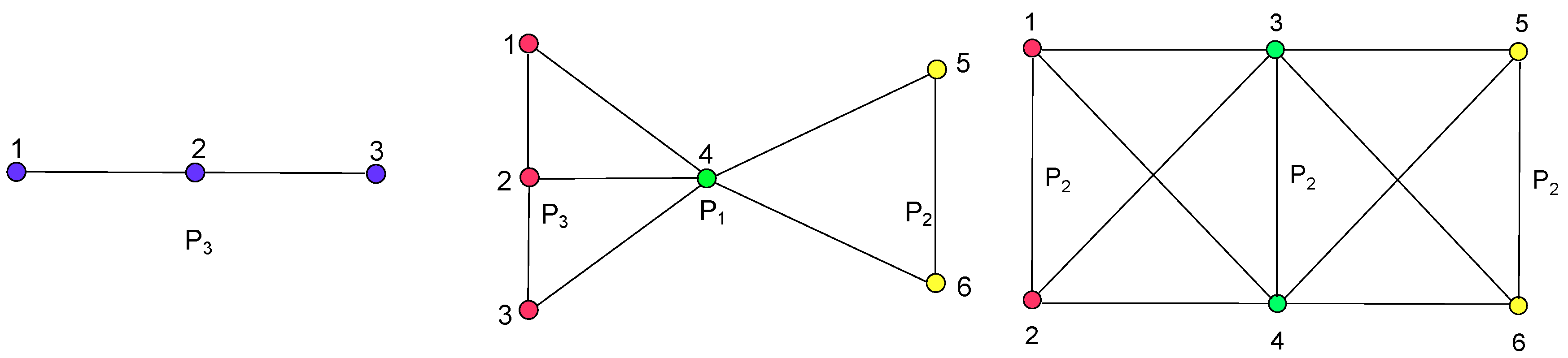
Definition 1. Let H be an arbitrary graph with , and be disjoint graphs of orders . The H-join of graphs , which is denoted by , is a graph formed by taking and joining every vertex of to every vertex of whenever i is adjacent to j in H. Particularly, is denoted by .
Example 1. Let and be a path and a cycle with n vertices. Then, , and are as follows (Figure 1 and Figure 2). As we know, the length of a shortest path between vertices
and
, which is denoted by
, is the conventional distance. However, it does not apply to some practical situations, such as electrical network. Thus, based on electrical network theory, Klein and Randić introduced a new distance called resistance distance ([
9]). The resistance distance between vertices
and
is denoted by
, and, in fact,
is the effective electrical resistance between
and
if every edge of
G is replaced by a unit resistor. In view of its practical application, resistance distance was widely explored by many authors. One of the main topics in the study of resistance distance is to determine it in various graphs. For example, from [
10], one would know that how
can be computed from the Laplacian matrix of the graph; in [
11], authors gave the resistance distance between any two vertices of a wheel and a fan; in [
3], authors obtained formulae for resistance distance in subdivision-vertex join and subdivision-edge join of graphs; recently, in [
12], authors gave the resistance distance in corona and the neighborhood corona graphs of two disjoint graphs. Except for the above, one can refer to [
13,
14,
15,
16,
17,
18,
19,
20] for more information.
Motivated by the study of resistance distance and graph operations, a natural question arises: what is the resistance distance in ? In fact, this paper focuses on this question, gives resistance distance in H-join of graphs and finally presents some applications.
2. Preliminaries
Recall that, for a matrix
M, a
-inverse of
M, which is always denoted by
, is a matrix
X such that
. For a square matrix
M, the group inverse of
M, which is denoted by
, is the unique matrix
X such that the following hold:
. It is well-known that
exists if and only if rank(
M)=rank(
). Therefore,
exists and it is a
-inverse of
A, whenever
A is a real symmetric. In fact, assume that
A is a real symmetric matrix and
U is an orthogonal matrix (i.e.,
), such that
, where
are eigenvalues of
A. Then,
, where
Note that the Laplacian matrix
of a graph
G is real symmetric. Thus,
exists. For more detail about the group inverse of the Laplacian matrix of a graph, see [
21].
Lemma 1 ([
3,
22])
. Let be the Laplacian matrix of a connected graph. Assume that is nonsingular. Denote . Then,- (1)
is a symmetric -inverse of L.
- (2)
If each column vector of is or a zero vector, then is a symmetric -inverse of L.
In order to compute the inverse of a matrix, the next lemma is useful.
Lemma 2 ([
3])
. Let be a nonsingular matrix. If A and D are nonsingular, thenwhere is the Schur complement of A in M. One of the important applications of group inverse or -inverse is based on the following fact, which gives the formulae for resistance distance.
Lemma 3 ([
3])
. Let G be a connected graph and be the -entry of the Laplacian matrix . Then, 3. Main Results
Now, we turn to compute resistance distance in H-join of graphs . Denote . Keeping Lemma 3 in mind, we only need to compute the group inverse or a -inverse .
First, we give the Laplacian matrix of G.
Theorem 1. Let H be an arbitrary graph with , and be the disjoint graph of order . Assume that the adjacency matrix of H is and Denote , and label the vertices of with Then, , and the Laplacian matrix of G is Proof. Clearly, all of the diagonal matrix , the adjacency matrix and the Laplacian matrix are partitioned -matrixes, whose -entry is a -matrix. We proceed via the following steps:
(1) The diagonal matrix of G.
Obviously, the degree increment of
depends on the i-th line
of
. For detail, if
, then every vertex of
is joined to every vertex of
, that is, the increment of each vertex in
is
. Otherwise, that is
, the increment is zero, which can also be written by
. In general, the degree increment of each vertex of
is
.
Consequently, the diagonal matrix of G is
(2) The adjacency matrix of G.
Similarly, the i-th line of the partitioned matrixes
also relies on
. Assume that
. Then, every vertex of
is joined to every vertex of
. Thus, the
-entry of
is
, which is
. If
, then there is no edge between
and
, that is, the
-entry of
is zero. However, in this case, we can also denote it by
. Note that the above holds for
. Therefore, the adjacency matrix of G is
(3) The Laplacian matrix of G.
With respect to the above results, the Laplacian matrix of G is the Theorem 1. ☐
According to Theorem 1 and Lemma 1, we finally obtain a symmetric -inverse of .
Theorem 2. Let H be an arbitrary connected graph with , and be disjoint connected graph of order . Assume that and . Denote . Then, the following matrixis a symmetric -inverse of , where Here, and .
Proof. Note that all of H and
are connected. Thus, it is easy to show that G is connected. By Theorem 1, we have the Laplacian matrix
of G. In order to give a
-inverse of
with the help of Lemma 1, we further divide
into blocks
, where
Note that
. Thus, we have
Since
, where
, we have
Assume that
B is a column vector of dimension
satisfying
Therefore,
has three forms:
By Lemma 1, we know that Theorem 2 holds. ☐
Recall that the Kronecker product
([
23]) of two matrices
and
is an
-matrix obtained from A by replacing every element
by
. As an application of Theorem 2, we easily obtain a symmetric
-inverse of
.
Corollary 1. Let H be an arbitrary connected graph with k vertices and G be a connected graph with n vertices. Assume that and . Then, the following matrixis a symmetric -inverse of , where Here, .
4. Some Applications
Now, we give a specific application of formation mentioned in the
Section 2. Let A be a real symmetric such that
are eigenvalues of A and 0 is a simple eigenvalue. Assume that A is a real symmetric and U is an orthogonal matrix such that
. Then,
.
Example 2. Compute resistance distance in (see Figure 1). Step 1. We label the vertices
. Then,
Note that
Thus, the Laplacian matrix of G is
where
,
and
Step 2. and so . By Theorem 2, and By the formula at the beginning of this section, Furthermore, and .
Step 3. By Lemma 1 or Theorem 2, is a -inverse of .
Step 4. In view of Lemma 3, the matrix whose
-entry is the resistance distance
between vertices
and
is
Example 3. Assume that (see Figure 1). Then, the Laplacian matrix of G is From Theorem 2, we have that the matrix is a -inverse of .
Thus, the matrix whose -entry is is Example 4. Assume that (see Figure 2). Then, the Laplacian matrix of G is Based on Theorem 2, the matrix is a -inverse of , where Thus, the matrix whose -entry is is