Deep Learning-Enhanced Hybrid Beamforming Design with Regularized SVD Under Imperfect Channel Information



Abstract
1. Introduction
1.1. Deep Learning-Based Hybrid Beamforming
1.2. Motivation and Contribution
- DL-Enhanced ADMM for Hybrid Beamforming: We enhance the ADMM [25] by embedding it within a DL-based architecture, termed DL-ADMM, enabling low-complexity joint optimization of transmitter and receiver baseband and RF chain components.
- RSVD-Based Robustness: We incorporate RSVD theory [20] into the hybrid beamforming framework to suppress noise amplification and strengthen singular values of the observed channel, thereby mitigating the impact of CSI estimation errors.
- Theoretical Foundation: We establish new theoretical results (Theorem 1 and Corollary 1) that prove RSVD achieves lower noise sensitivity compared to standard SVD, providing rigorous justification for its integration into hybrid beamforming.
- Complexity and Efficiency Analysis: We analyze the computational complexity of the proposed scheme and compare it against conventional methods such as OMP and APS, demonstrating that DL-ADMM achieves reduced per-iteration complexity without sacrificing performance.
- Extensive Simulations: Through comprehensive experiments under diverse antenna configurations, SNR ranges, and channel estimation error variances, we validate that the proposed DL-ADMM-Reg outperforms baseline approaches in terms of spectral efficiency, robustness, and stability.
2. System Model and Spectral Efficiency
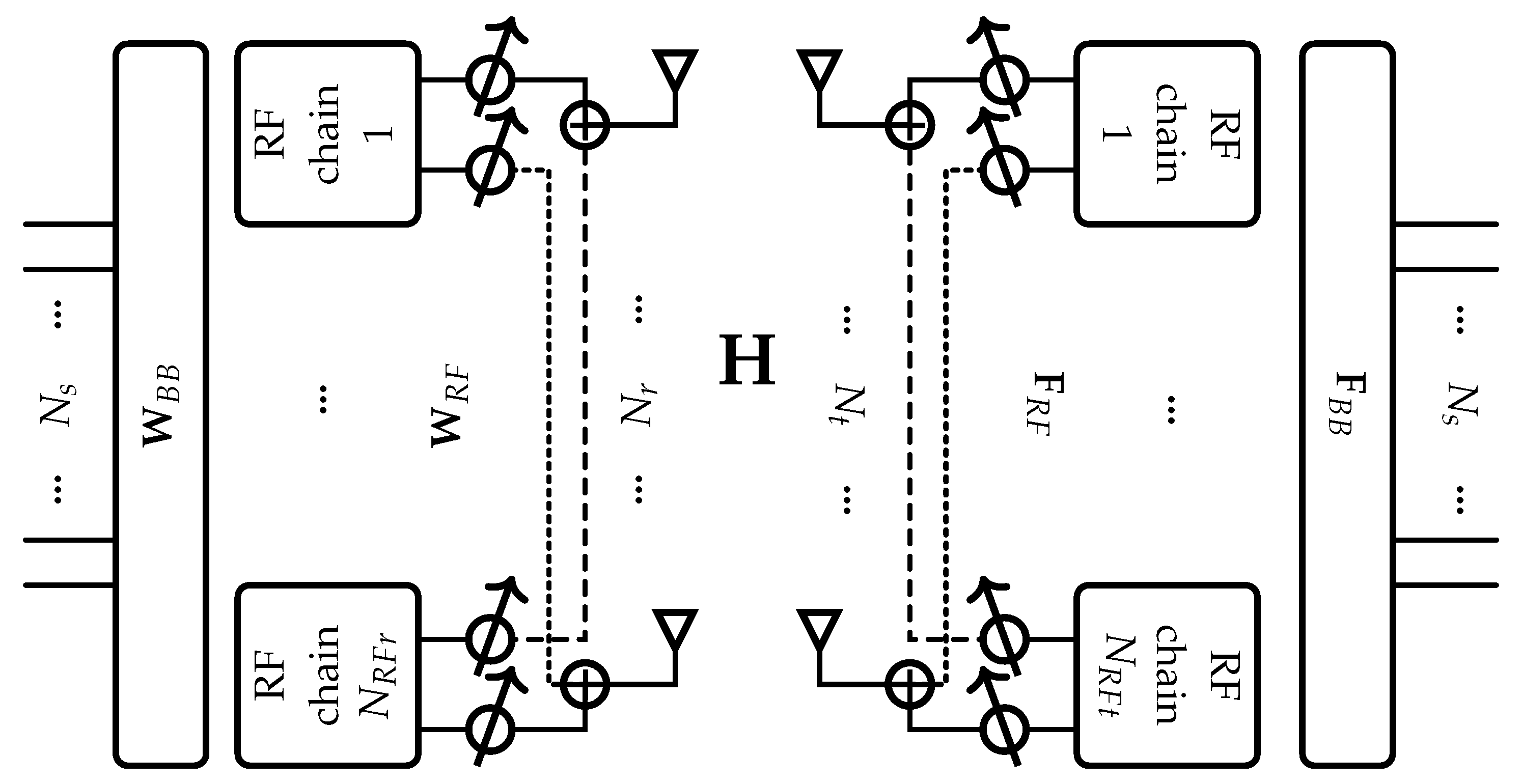
2.1. System Model
2.2. Achievable Spectral Efficiency
2.3. Conventional ADMM for Hybrid Beamforming
- Problem restatement
- Augmented Lagrangian
- Z-update (quadratic projection)
- B-update (least squares with power normalization)
- R-update (unit–modulus projection)
- Dual update (scaled multipliers)
- Stopping rule and feasibility
3. DL-ADMM Assistant Regularized Hybrid Beamforming
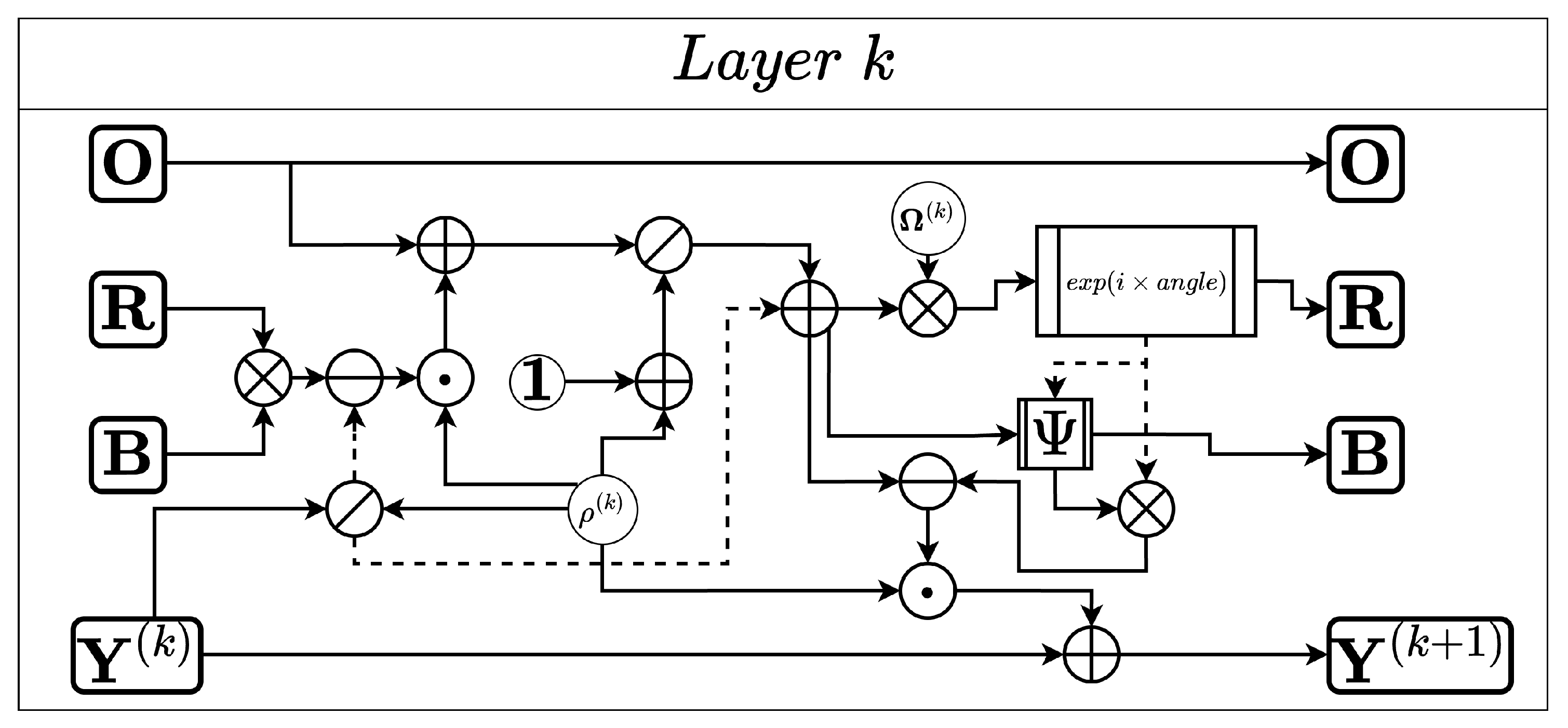
3.1. DL-ADMM Scheme
| Algorithm 1 DL-ADMM |
| Require: O, number of layers K, and dimensions (a, b, c) |
| Ensure: R, B |
| 1: Initialize and with random values. |
| 2: for do |
| 3: |
| 4: |
| 5: |
| 6: |
| 7: end for |
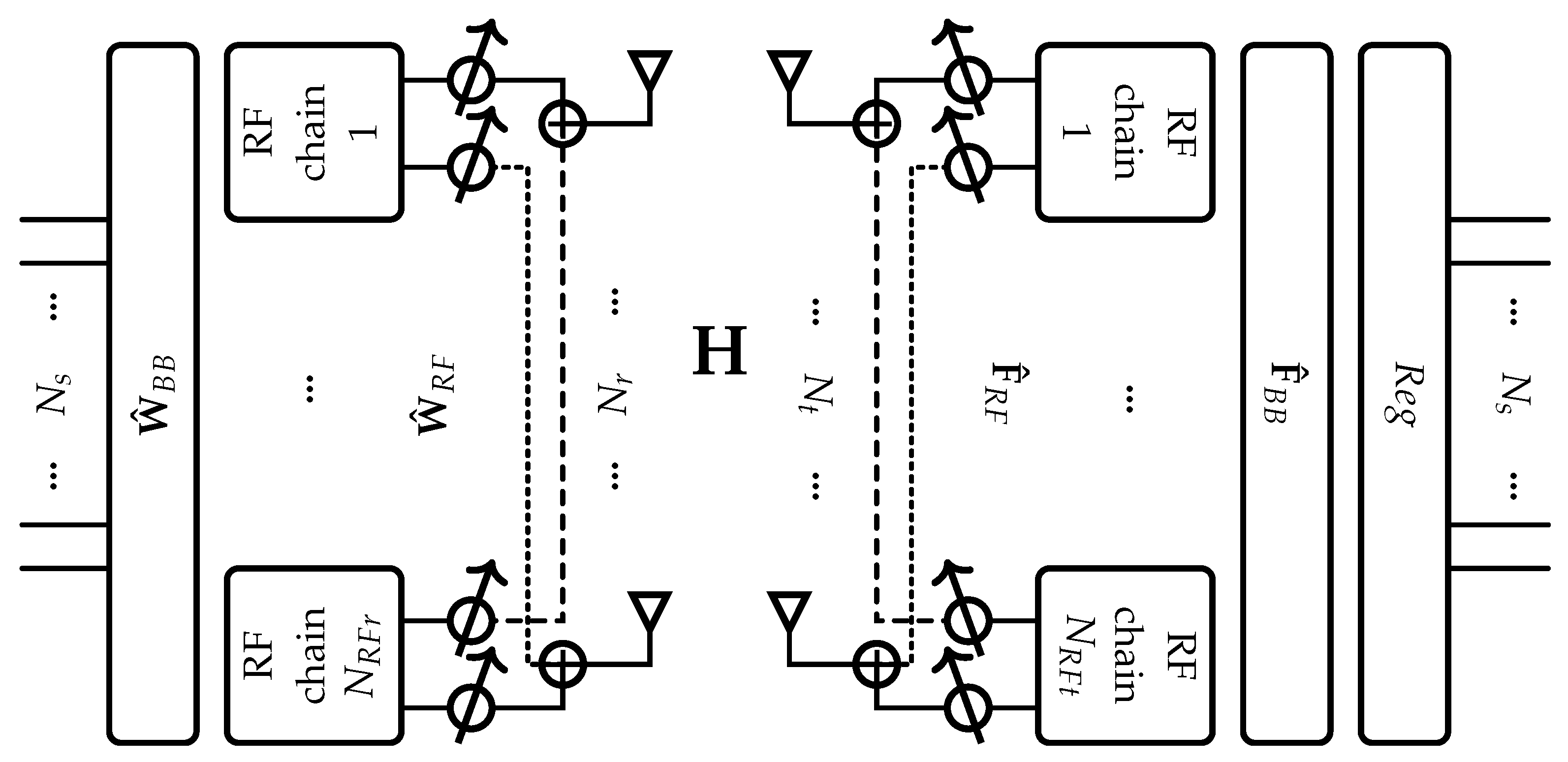
3.2. Regularized System
3.3. RSVD in Hybrid Beamforming
- Motivation
- Proposed mechanism
- Step 1: Initialization. Set as the initial filter. Compute the observed channel SVD, , and design , , , and using DL-ADMM under imperfect CSI. At this stage, the hybrid beamformers approximate the unconstrained SVD solution, but are still vulnerable to error-induced spectral efficiency loss.
- Step 2: Regularization parameter design. Following (10), Theorem 1, and Corollary 1, we enforce a robustness inequality that guarantees improved performance:where is the truncated singular value matrix, and capture the effective channel components, and is a penalty term that can be chosen as a function of . The use of the ∞-norm ensures that the dominant channel gains are reinforced, guaranteeing that the regularized design does not underperform compared to the unregularized case.
- Step 3: Construction of . Using the values and , define the diagonal regularization filter asThis filter amplifies strong singular values while preventing weak and error-prone ones from dominating the effective channel.
- Resulting spectral efficiency
4. Simulation Results
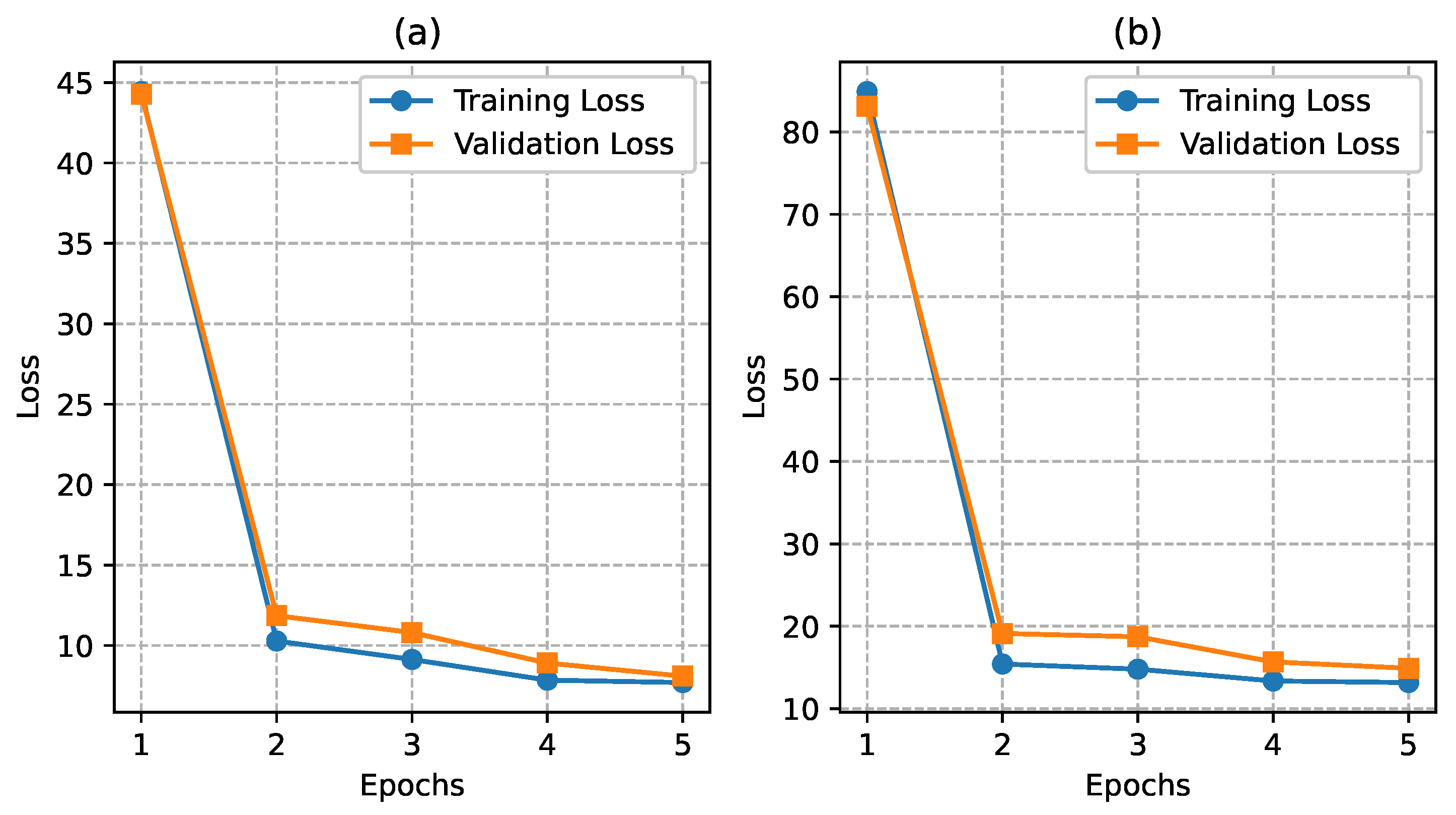
4.1. Convergence Analysis
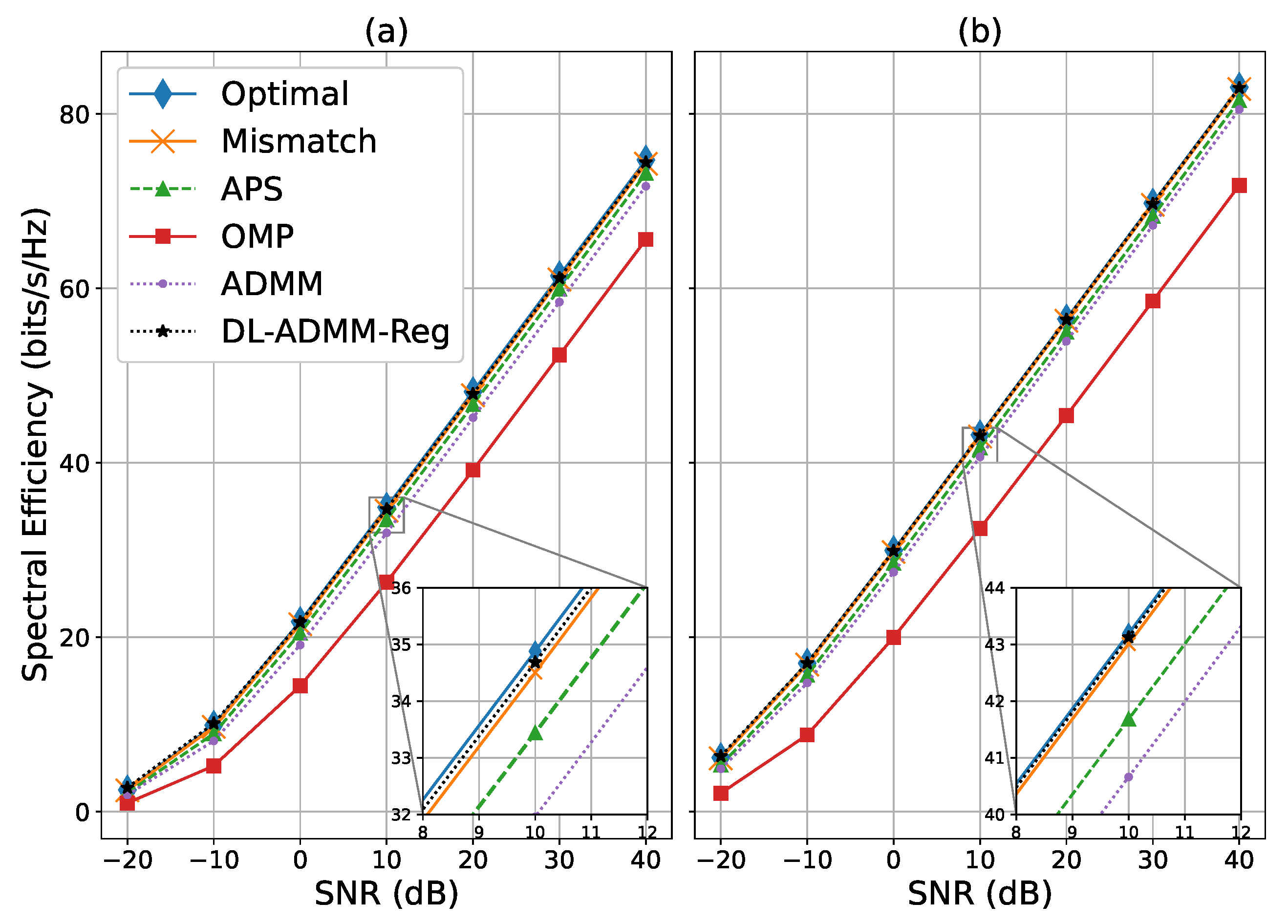
4.2. Spectral Efficiency vs. SNR
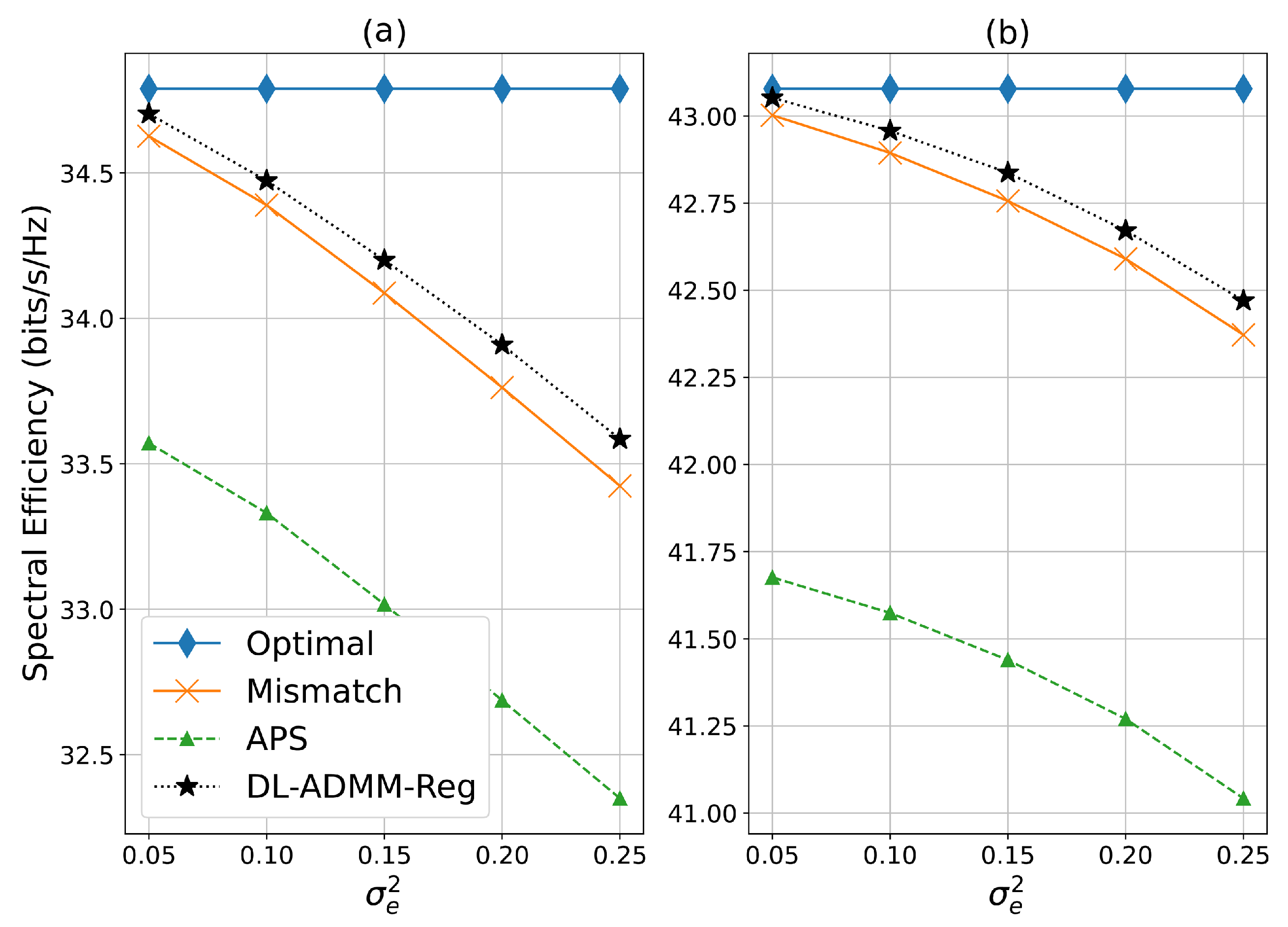
4.3. Spectral Efficiency vs. Channel Estimation Error
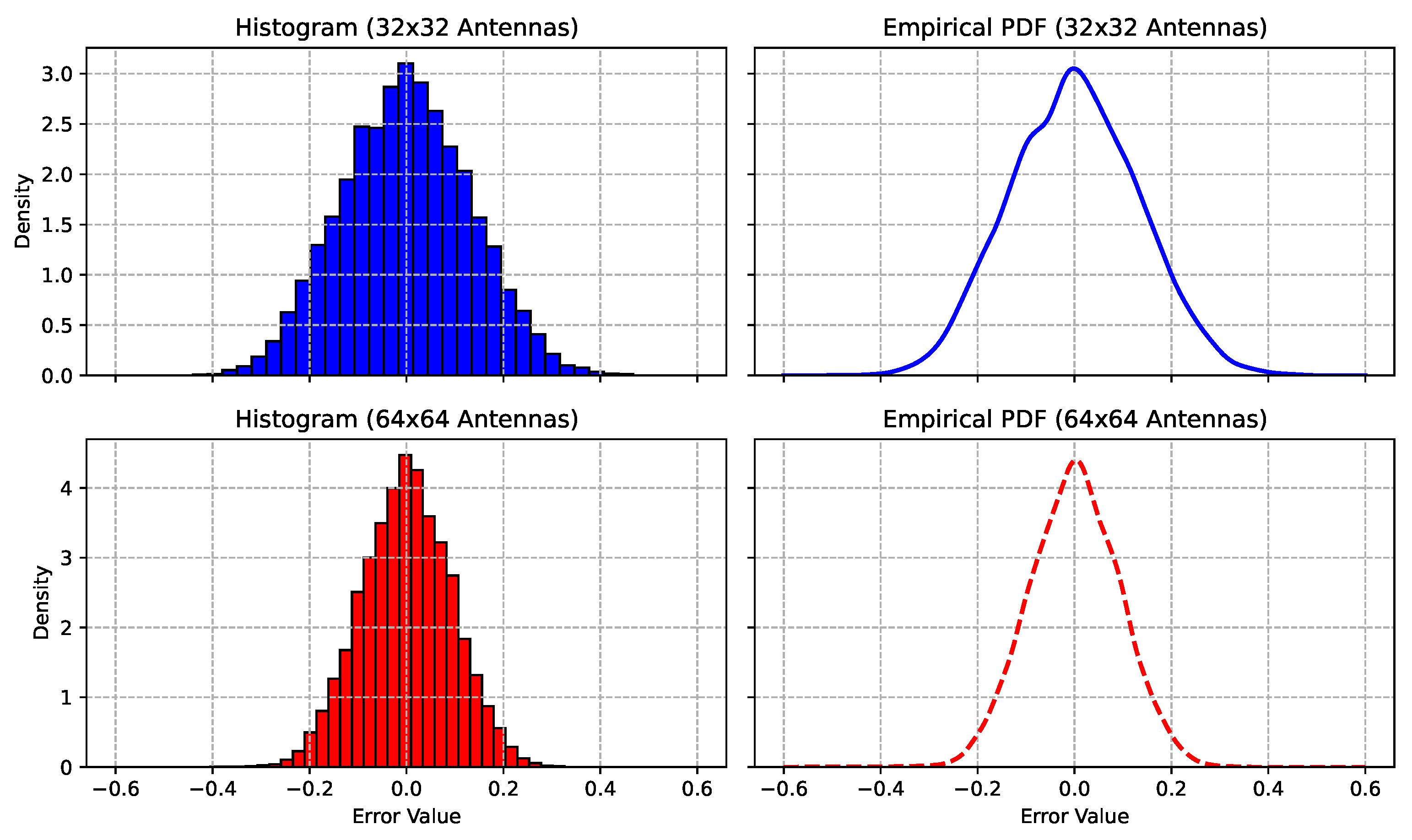
4.4. Error Analysis
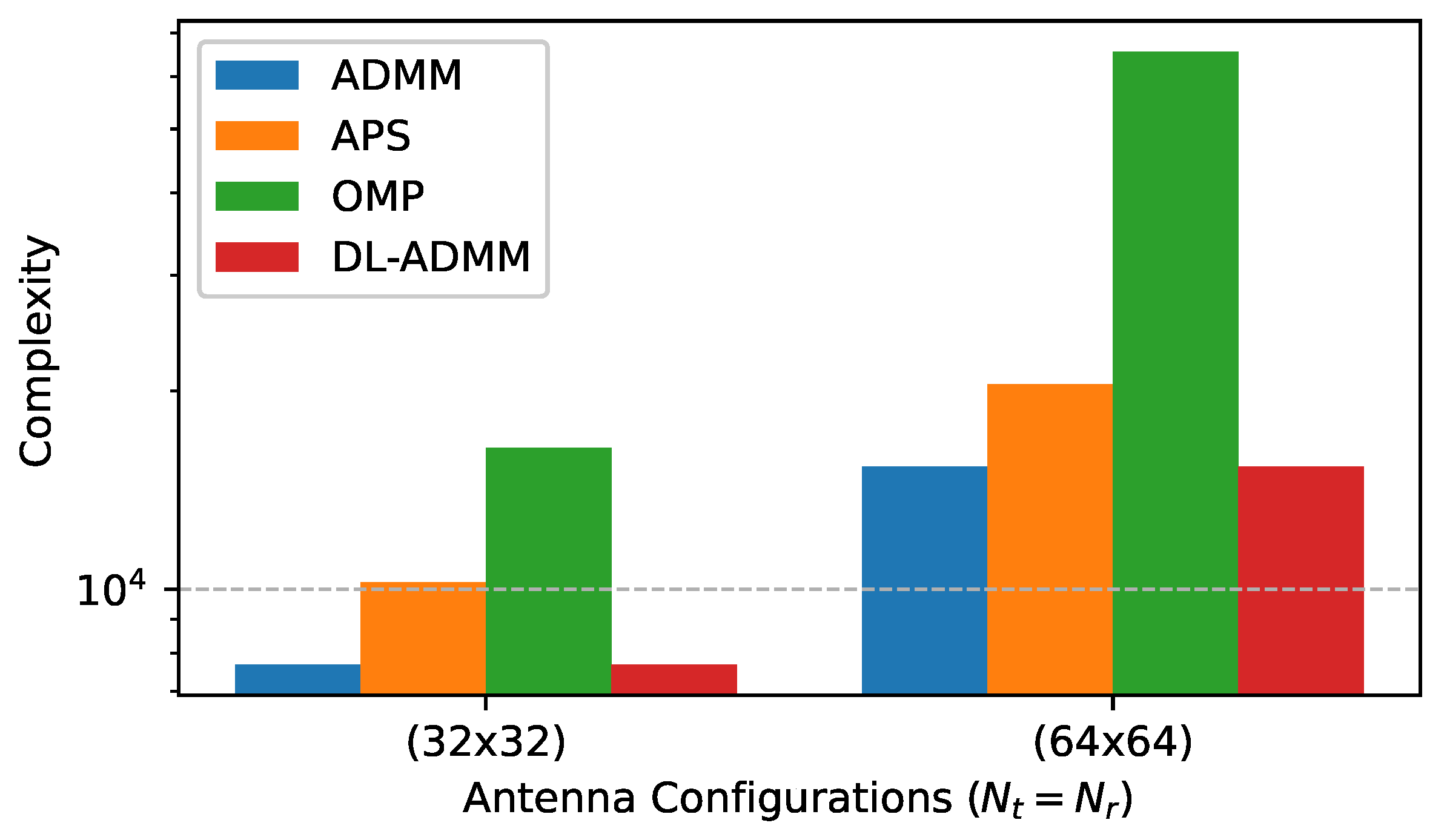
4.5. Analysis of Complexity
5. Conclusions
Author Contributions
Funding
Data Availability Statement
Conflicts of Interest
References
- Larsson, E.G.; Edfors, O.; Tufvesson, F.; Marzetta, T.L. Massive MIMO for next generation wireless systems. IEEE Commun. Mag. 2014, 52, 186–195. [Google Scholar] [CrossRef]
- Han, S.; Chih-Lin, I.; Xu, Z.; Rowell, C. Large-scale antenna systems with hybrid analog and digital beamforming for millimeter wave 5G. IEEE Commun. Mag. 2015, 53, 186–194. [Google Scholar] [CrossRef]
- Rappaport, T.S.; Xing, Y.; Kanhere, O.; Ju, S.; Madanayake, A.; Mandal, S.; Alkhateeb, A.; Trichopoulos, G.C. Wireless communications and applications above 100 GHz: Opportunities and challenges for 6G and beyond. IEEE Access 2019, 7, 78729–78757. [Google Scholar] [CrossRef]
- Wang, Y.; Chen, X.; Cai, Y.; Champagne, B.; Hanzo, L. Channel estimation for hybrid massive MIMO systems with adaptive-resolution ADCs. IEEE Trans. Commun. 2022, 70, 2131–2146. [Google Scholar] [CrossRef]
- Myers, N.J.; Pachai Kannu, A. Impact of Channel Estimation Errors on Single Stream MIMO Beamforming. IEEE Commun. Lett. 2017, 21, 1345–1348. [Google Scholar] [CrossRef]
- Chen, Y.; Wen, X.; Lu, Z. Achievable Spectral Efficiency of Hybrid Beamforming Massive MIMO Systems With Quantized Phase Shifters, Channel Non-Reciprocity and Estimation Errors. IEEE Access 2020, 8, 71304–71317. [Google Scholar] [CrossRef]
- Heath, R.W.; Gonzalez-Prelcic, N.; Rangan, S.; Roh, W.; Sayeed, A.M. An overview of signal processing techniques for millimeter wave MIMO systems. IEEE J. Sel. Top. Signal Process. 2016, 10, 436–453. [Google Scholar] [CrossRef]
- Mendez-Rial, R.; Rusu, C.; González-Prelcic, N.; Heath, R.W. Dictionary-free hybrid precoders and combiners for mmWave MIMO systems. In Proceedings of the 2015 IEEE 16th International Workshop on Signal Processing Advances in Wireless Communications (SPAWC), Stockholm, Sweden, 28 June–1 July 2015; IEEE: Piscataway, NJ, USA, 2015; pp. 151–155. [Google Scholar]
- Wang, Y.; Zou, W. Low complexity hybrid precoder design for millimeter wave MIMO systems. IEEE Commun. Lett. 2019, 23, 1259–1262. [Google Scholar] [CrossRef]
- El Ayach, O.; Rajagopal, S.; Abu-Surra, S.; Pi, Z.; Heath, R.W. Spatially sparse precoding in millimeter wave MIMO systems. IEEE Trans. Wirel. Commun. 2014, 13, 1499–1513. [Google Scholar] [CrossRef]
- Zhao, L.; Luo, Z.; Liu, H.; Pu, X.; Kuang, Q. MmWave relay systems with robust hybrid transceiver designs under correlated channel estimation errors. Digit. Signal Process. 2022, 127, 103541. [Google Scholar] [CrossRef]
- Sohrabi, F.; Yu, W. Hybrid digital and analog beamforming design for large-scale antenna arrays. IEEE J. Sel. Top. Signal Process. 2016, 10, 501–513. [Google Scholar] [CrossRef]
- Wang, Y.; Zou, W. Low complexity hybrid precoding algorithm in millimeter wave mimo systems. In Proceedings of the 2018 IEEE/CIC International Conference on Communications in China (ICCC Workshops), Beijing, China, 16–18 August 2018; IEEE: Piscataway, NJ, USA, 2018; pp. 16–20. [Google Scholar]
- Alouzi, M.; Yanikomeroglu, H.; Karabulut Kurt, G. Adaptive Phase Shifters for Hybrid Beamforming in mmWave Systems. IEEE Trans. Wirel. Commun. 2025, 24, 1104–1116. [Google Scholar] [CrossRef]
- Huang, H.; Yang, J.; Huang, H.; Song, Y.; Gui, G. Deep learning for super-resolution channel estimation and DOA estimation based massive MIMO system. IEEE Trans. Veh. Technol. 2018, 67, 8549–8560. [Google Scholar] [CrossRef]
- Lavdas, S.; Gkonis, P.K.; Zinonos, Z.; Trakadas, P.; Sarakis, L.; Papadopoulos, K. A machine learning adaptive beamforming framework for 5G millimeter wave massive MIMO multicellular networks. IEEE Access 2022, 10, 91597–91609. [Google Scholar] [CrossRef]
- Iliadis, L.A.; Zaharis, Z.D.; Sotiroudis, S.; Sarigiannidis, P.; Karagiannidis, G.K.; Goudos, S.K. The road to 6G: A comprehensive survey of deep learning applications in cell-free massive MIMO communications systems. EURASIP J. Wirel. Commun. Netw. 2022, 2022, 68. [Google Scholar] [CrossRef]
- Chen, J.; Tao, J.; Luo, S.; Li, S.; Zhang, C.; Xiang, W. A deep learning driven hybrid beamforming method for millimeter wave MIMO system. Digit. Commun. Netw. 2023, 9, 1291–1300. [Google Scholar] [CrossRef]
- Jeyakumar, P.; Ramesh, A.; Srinitha, S.; Nishant, V.; Gowri, P.; Muthuchidambaranathan, P. Two-stage deep learning-based hybrid precoder design for very large scale massive MIMO systems. Phys. Commun. 2022, 54, 101835. [Google Scholar]
- Zheng, S.; Ding, C.; Nie, F. Regularized singular value decomposition and application to recommender system. arXiv 2018, arXiv:1804.05090. [Google Scholar] [CrossRef]
- Nie, F.; Huang, H.; Cai, X.; Ding, C. Efficient and robust feature selection via joint ℓ2, 1-norms minimization. Adv. Neural Inf. Process. Syst. 2010, 23, 1813–1821. [Google Scholar]
- Peken, T.; Adiga, S.; Tandon, R.; Bose, T. Deep learning for SVD and hybrid beamforming. IEEE Trans. Wirel. Commun. 2020, 19, 6621–6642. [Google Scholar] [CrossRef]
- Elbir, A.M. A deep learning framework for hybrid beamforming without instantaneous CSI feedback. IEEE Trans. Veh. Technol. 2020, 69, 11743–11755. [Google Scholar] [CrossRef]
- Hojatian, H.; Nadal, J.; Frigon, J.F.; Leduc-Primeau, F. Unsupervised deep learning for massive MIMO hybrid beamforming. IEEE Trans. Wirel. Commun. 2021, 20, 7086–7099. [Google Scholar] [CrossRef]
- Boyd, S.; Parikh, N.; Chu, E.; Peleato, B.; Eckstein, J. Distributed optimization and statistical learning via the alternating direction method of multipliers. Found. Trends Mach. Learn. 2011, 3, 1–122. [Google Scholar] [CrossRef]
- Rajput, K.P.; Maity, P.; Srivastava, S.; Sharma, V.; Venkategowda, N.K.D.; Jagannatham, A.K.; Hanzo, L. Robust Linear Hybrid Beamforming Designs Relying on Imperfect CSI in mmWave MIMO IoT Networks. arXiv 2022, arXiv:2212.12917. [Google Scholar] [CrossRef]
- Chen, Z.; Li, Y.; Zhang, R.; Liu, R.; Niu, Z.; Li, Q. Robust Hybrid Beamforming Design for Multi-RIS Assisted Millimeter Wave Systems With Imperfect CSI. IEEE Trans. Wirel. Commun. 2023, 22, 2640–2654. [Google Scholar] [CrossRef]
- Shi, S.; Cai, Y.; Hu, Q.; Champagne, B.; Hanzo, L. Deep-unfolding neural-network aided hybrid beamforming based on symbol-error probability minimization. IEEE Trans. Veh. Technol. 2022, 72, 529–545. [Google Scholar] [CrossRef]



Disclaimer/Publisher’s Note: The statements, opinions and data contained in all publications are solely those of the individual author(s) and contributor(s) and not of MDPI and/or the editor(s). MDPI and/or the editor(s) disclaim responsibility for any injury to people or property resulting from any ideas, methods, instructions or products referred to in the content. |
© 2026 by the authors. Licensee MDPI, Basel, Switzerland. This article is an open access article distributed under the terms and conditions of the Creative Commons Attribution (CC BY) license.
Share and Cite
Azizi, S.P.; Nafei, A.; Chen, S.-C.; Lin, R.-H. Deep Learning-Enhanced Hybrid Beamforming Design with Regularized SVD Under Imperfect Channel Information. Mathematics 2026, 14, 509. https://doi.org/10.3390/math14030509
Azizi SP, Nafei A, Chen S-C, Lin R-H. Deep Learning-Enhanced Hybrid Beamforming Design with Regularized SVD Under Imperfect Channel Information. Mathematics. 2026; 14(3):509. https://doi.org/10.3390/math14030509
Chicago/Turabian StyleAzizi, S. Pourmohammad, Amirhossein Nafei, Shu-Chuan Chen, and Rong-Ho Lin. 2026. "Deep Learning-Enhanced Hybrid Beamforming Design with Regularized SVD Under Imperfect Channel Information" Mathematics 14, no. 3: 509. https://doi.org/10.3390/math14030509
APA StyleAzizi, S. P., Nafei, A., Chen, S.-C., & Lin, R.-H. (2026). Deep Learning-Enhanced Hybrid Beamforming Design with Regularized SVD Under Imperfect Channel Information. Mathematics, 14(3), 509. https://doi.org/10.3390/math14030509