A New Trigonometric-Inspired Probability Distribution: The Weighted Sine Generalized Kumaraswamy Model with Simulation and Applications in Epidemiology and Reliability Engineering

Abstract
1. Introduction
- 1.
- To define the WSG-Kumaraswamy distribution and derive its essential statistical properties.
- 2.
- To estimate the model parameters using the maximum likelihood method and evaluate the performance of the estimator via a comprehensive simulation study.
- 3.
- To demonstrate the practical utility of the distribution by applying it to two real-world datasets and comparing its fit against several competing distributions.
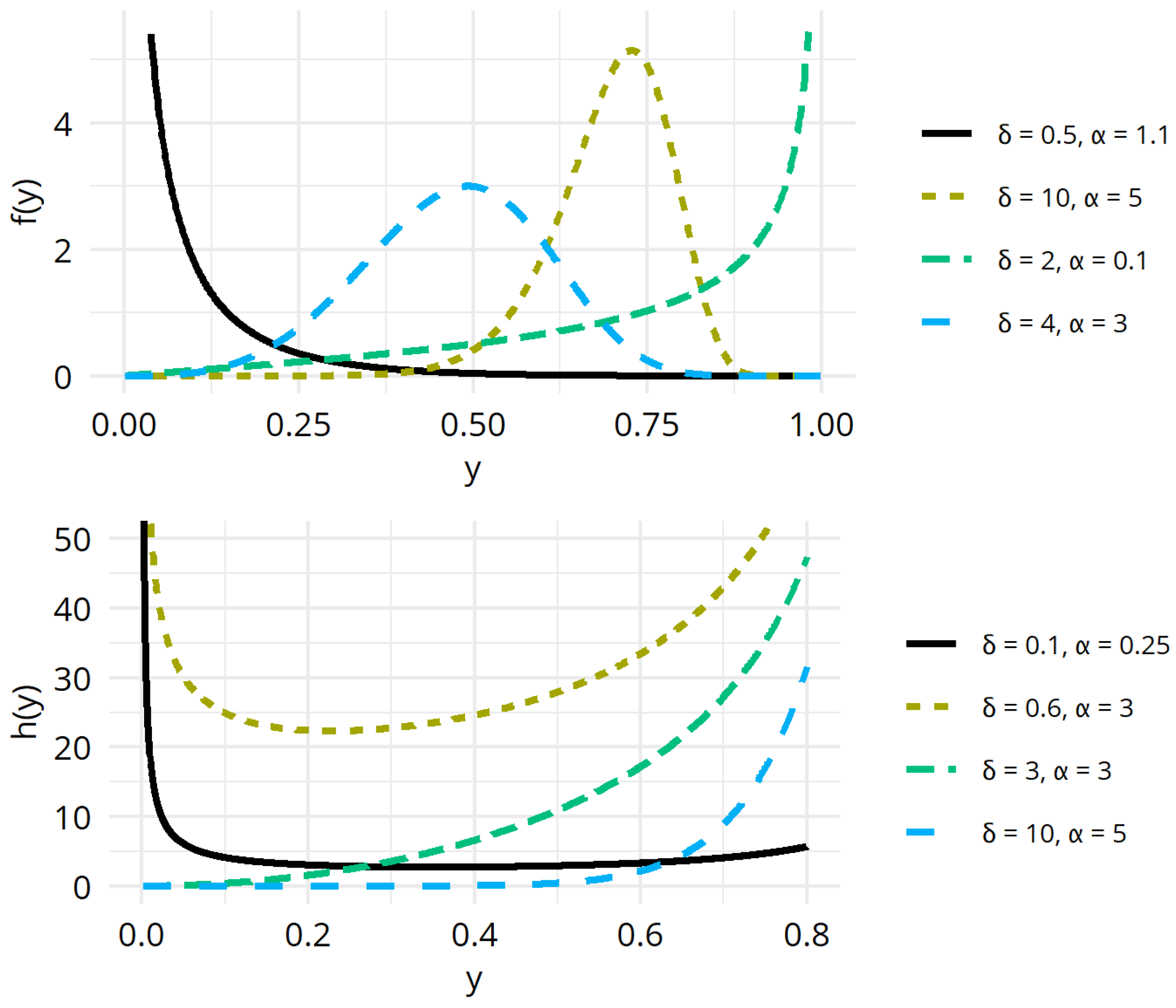
2. WSG-Kumaraswamy Distribution
3. Statistical Properties
3.1. The Quantile Function
3.2. Moments
3.3. Moment Generating Function
4. Maximum Likelihood Estimation
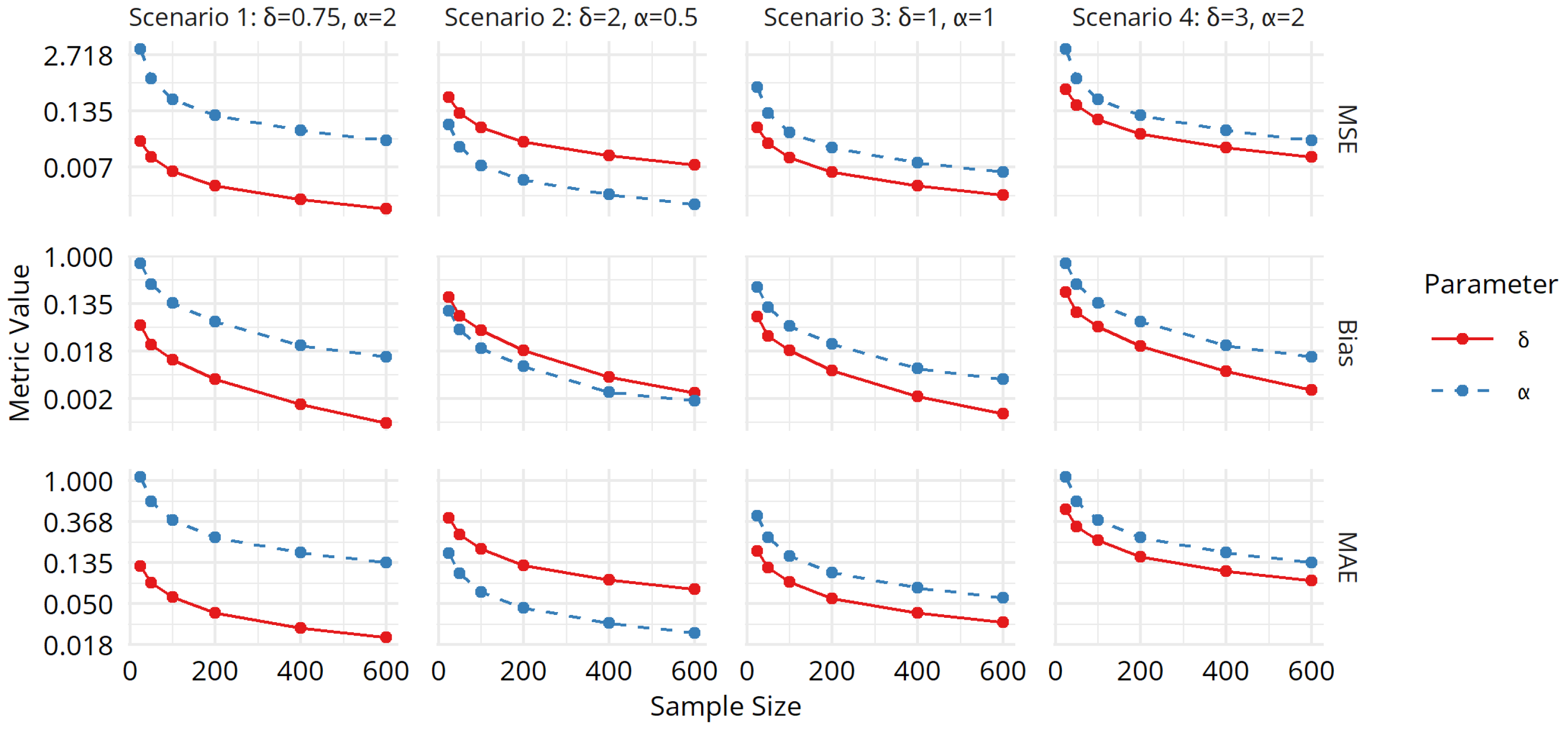
5. Simulation Study
- Scenario 1: , ,
- Scenario 2: , ,
- Scenario 3: , ,
- Scenario 4: , .
- Bias: ,
- Mean squared error: ,
- Mean absolute error: ,
6. Real Data Applications
- Beta distribution:
- Kumaraswamy distribution:
- : Kolmogorov-Smirnov (KS) statistic,
- : p-value corresponding to the KS statistic,
- : Anderson-Darling (AD) statistic,
- : p-value corresponding to the AD statistic,
- : Maximized log-likelihood (log-L),
- : Akaike Information Criterion (AIC),
- : Bayesian Information Criterion (BIC).
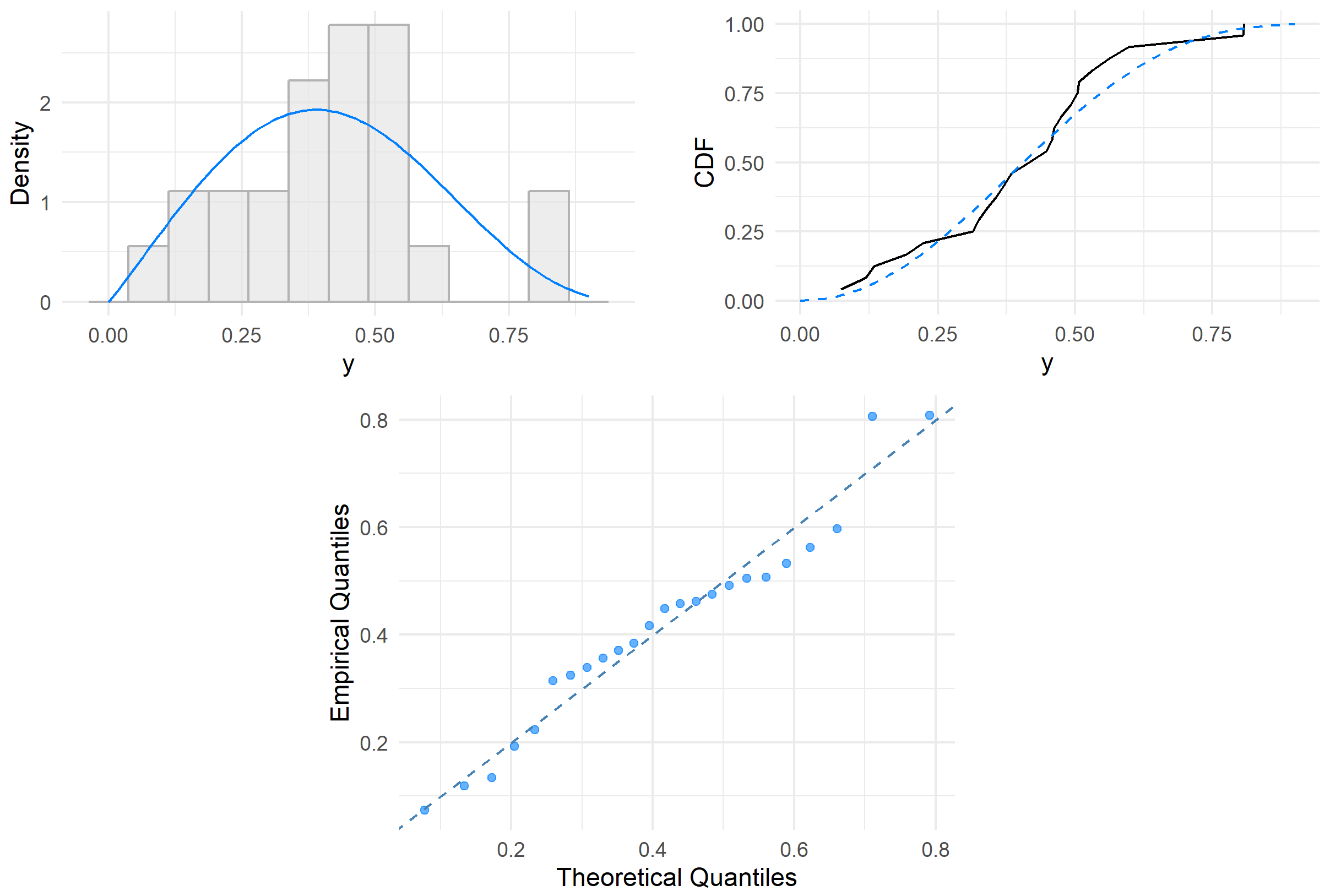
6.1. Application to COVID-19 Mortality Data
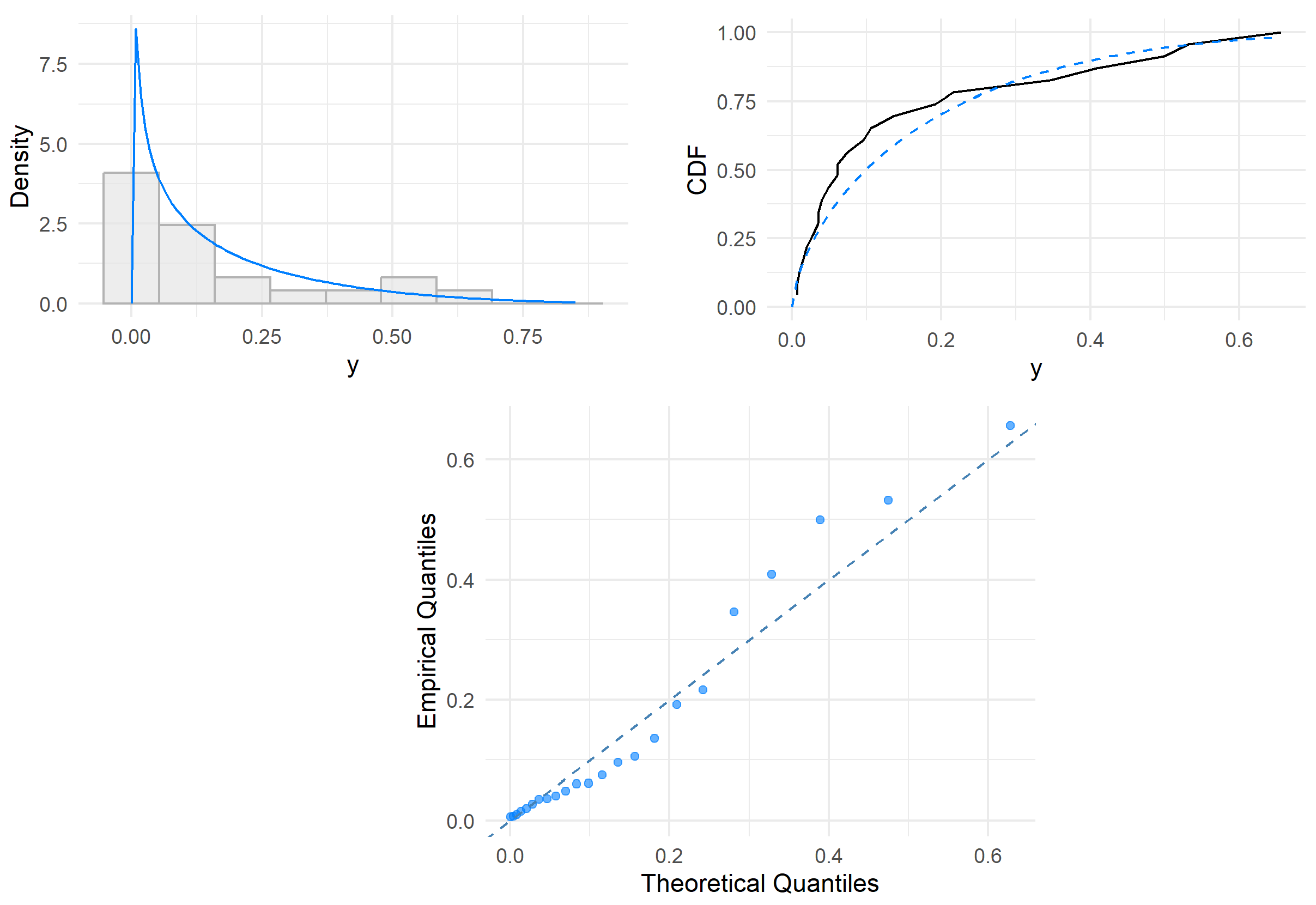
6.2. Application to Times Between Failures Data
6.3. Simulation-Based Model Comparison
7. Conclusions
Author Contributions
Funding
Data Availability Statement
Conflicts of Interest
References
- Dodson, B.; Schwab, H. Accelerated Testing: A Practitioner’s Guide to Accelerated and Reliability Testing; SAE International: Warrendale, PA, USA, 2021. [Google Scholar]
- Stødle, K.; Flage, R.; Guikema, S.D.; Aven, T. Data-driven predictive modeling in risk assessment: Challenges and directions for proper uncertainty representation. Risk Anal. 2023, 43, 2644–2658. [Google Scholar] [CrossRef]
- Tu, X.; Kong, J.; Fu, Q.; Chang, S.; Zhang, K.; Alballa, T.; Alqahtani, H.; Khalifa, H.A.E.-W. A new trigonometric-inspired probability distribution: A simulation study and applications in reliability and hydrology. Alex. Eng. J. 2025, 113, 181–194. [Google Scholar] [CrossRef]
- Wang, Y.; Xu, J.; Huang, Q.; Albalawi, O.; Alshanbari, M. A new optimal probability model: Its background and applications to sports and reliability. Alex. Eng. J. 2024, 107, 521–532. [Google Scholar] [CrossRef]
- Wang, M.; Albalawi, O.; Alshanbari, M. A new probabilistic model with properties: Its implementations to the reliability and musical instruments. Alex. Eng. J. 2024, 109, 1–11. [Google Scholar] [CrossRef]
- Lai, C.-D.; Xie, M. Stochastic Ageing and Dependence for Reliability; Springer: New York, NY, USA, 2006. [Google Scholar]
- McCool, J.I. Using the Weibull Distribution: Reliability, Modeling, and Inference; John Wiley & Sons: Hoboken, NJ, USA, 2012. [Google Scholar]
- Zhou, J.; Qian, H.; Yao, Y.; Tashkandy, Y.A.; Bakr, M.E.; Kumar, A.; Bahloul, M.M. On the empirical exploration of a new probability distribution in physical education and reliability. Alex. Eng. J. 2024, 106, 422–437. [Google Scholar] [CrossRef]
- Ulrich, W.; Nakadai, R.; Matthews, J.; Kubota, Y. The two-parameter weibull distribution as a universal tool to model the variation in species relative abundances. Ecol. Complex. 2018, 36, 110–116. [Google Scholar] [CrossRef]
- Almalki, S.J.; Nadarajah, S. Modifications of the weibull distribution: A review. Reliab. Eng. Syst. Saf. 2014, 124, 32–55. [Google Scholar] [CrossRef]
- Wang, Y.; Albalawi, O.; Alshanbari, H.M.; Alsubaie, H.H. A modified cosine-based probability distribution: Its mathematical features with statistical modeling in sports and reliability prospects. Alex. Eng. J. 2024, 109, 322–333. [Google Scholar] [CrossRef]
- Merovci, F. Transmuted generalized rayleigh distribution. J. Stat. Appl. Probab. 2014, 3, 9. [Google Scholar] [CrossRef]
- Cordeiro, G.M.; Ortega, E.M.M.; da Cunha, D.C.C. The exponentiated generalized class of distributions. J. Data Sci. 2013, 11, 1–27. [Google Scholar] [CrossRef]
- Heydari, T.; Zare, K.; Shokri, S.; Khodadadi, Z.; Almaspoor, Z. A new sine-based probabilistic approach: Theory and monte carlo simulation with reliability application. J. Math. 2024, 2024, 9593193. [Google Scholar] [CrossRef]
- Dell, F.; Guessab, A.; Milovanović, G.V.; Nudo, F. Truncated gegenbauer-hermite weighted approach for the enrichment of the crouzeix-raviart finite element. BIT Numer. Math. 2025, 65, 24. [Google Scholar]
- Kumaraswamy, P. A generalized probability density function for double-bounded random processes. J. Hydrol. 1980, 46, 79–88. [Google Scholar] [CrossRef]
- Jones, M.C. Kumaraswamy’s distribution: A beta-type distribution with some tractability advantages. Stat. Methodol. 2009, 6, 70–81. [Google Scholar] [CrossRef]
- Lemonte, A.J.; Barreto-Souza, W.; Cordeiro, G.M. The exponentiated kumaraswamy distribution and its log-transform. Braz. J. Probab. Stat. 2013, 27, 31–53. [Google Scholar] [CrossRef]
- Kızılaslan, F.; Nadar, M. Estimation of reliability in a multicomponent stress–strength model based on a bivariate kumaraswamy distribution. Stat. Pap. 2018, 59, 307–340. [Google Scholar] [CrossRef]
- Kohansal, A. On estimation of reliability in a multicomponent stress-strength model for a kumaraswamy distribution based on progressively censored sample. Stat. Pap. 2019, 60, 2185–2224. [Google Scholar] [CrossRef]
- Arshad, M.; Azhad, Q.J. Parametric and reliability estimation of the kumaraswamy generalized distribution based on record values. J. Mod. Appl. Stat. Methods 2022, 19, 28. [Google Scholar]
- Alanzi, A.R.A.; Rafique, M.Q.; Tahir, M.H.; Sami, W.; Jamal, F. A new modified kumaraswamy distribution: Actuarial measures and applications. J. Math. 2022, 2022, 4288286. [Google Scholar] [CrossRef]
- Elghaly, H.E.; Elgawad, M.A.A.; Tian, B. A novel alternative to the beta and kumaraswamy distributions for double bounded hydroclimatology data. IEEE Access 2025, 13, 111217–111236. [Google Scholar] [CrossRef]
- Comtet, L. Advanced Combinatorics: The Art of Finite and Infinite Expansions; Springer Science & Business Media: Berlin/Heidelberg, Germany, 2012. [Google Scholar]
- Charalambides, C.A. Enumerative Combinatorics; Chapman and Hall/CRC: Boca Raton, FL, USA, 2018. [Google Scholar]
- Alrumayh, A.; Weera, W.; Khogeer, H.A.; Almetwally, E.M. Optimal analysis of adaptive type-II progressive censored for new unit-lindley model. J. King Saud Univ.-Sci. 2023, 35, 102462. [Google Scholar] [CrossRef]
- Dutta, S.; Dey, S.; Kayal, S. Bayesian survival analysis of logistic exponential distribution for adaptive progressive type-II censored data. Comput. Stat. 2024, 39, 2109–2155. [Google Scholar] [CrossRef]
- Suprawhardana, M.S.; Prayoto, S. Total time on test plot analysis for mechanical components of the RSG-GAS reactor. At. Indones 1999, 25, 81–90. [Google Scholar]
- Maya, R.; Jodra, P.; Irshad, M.R.; Krishna, A. The unit muth distribution: Statistical properties and applications. Ric. Mat. 2024, 73, 1843–1866. [Google Scholar] [CrossRef]



| 0.5 | 0.5 | 0.000022 | 0.002312 | 0.015790 | 0.076092 | 0.226199 | 0.434715 | 0.788339 | 0.929324 |
| 1.0 | 0.5 | 0.004696 | 0.048084 | 0.125660 | 0.275847 | 0.475603 | 0.659329 | 0.887885 | 0.964014 |
| 2.0 | 0.5 | 0.068526 | 0.219281 | 0.354486 | 0.525212 | 0.689640 | 0.811991 | 0.942276 | 0.981842 |
| 5.0 | 0.5 | 0.342249 | 0.545005 | 0.660449 | 0.772919 | 0.861884 | 0.920069 | 0.976498 | 0.992697 |
| 10.0 | 0.5 | 0.585020 | 0.738245 | 0.812680 | 0.879158 | 0.928377 | 0.959202 | 0.988179 | 0.996342 |
| 0.5 | 1.0 | 0.000006 | 0.000592 | 0.004217 | 0.022209 | 0.076092 | 0.173330 | 0.442443 | 0.656588 |
| 1.0 | 1.0 | 0.002351 | 0.024338 | 0.064939 | 0.149028 | 0.275848 | 0.416330 | 0.665164 | 0.810301 |
| 2.0 | 1.0 | 0.048484 | 0.156007 | 0.254830 | 0.386042 | 0.525212 | 0.645236 | 0.815576 | 0.900167 |
| 5.0 | 1.0 | 0.298015 | 0.475618 | 0.578763 | 0.683367 | 0.772919 | 0.839242 | 0.921692 | 0.958803 |
| 10.0 | 1.0 | 0.545907 | 0.689651 | 0.760765 | 0.826660 | 0.879158 | 0.916102 | 0.960048 | 0.979185 |
| 0.5 | 2.0 | 0.000001 | 0.000150 | 0.001090 | 0.006009 | 0.022210 | 0.055704 | 0.177536 | 0.318610 |
| 1.0 | 2.0 | 0.001176 | 0.012244 | 0.033014 | 0.077519 | 0.149029 | 0.236017 | 0.421350 | 0.564456 |
| 2.0 | 2.0 | 0.034293 | 0.110653 | 0.181698 | 0.278422 | 0.386042 | 0.485816 | 0.649115 | 0.751303 |
| 5.0 | 2.0 | 0.259468 | 0.414558 | 0.505522 | 0.599627 | 0.683367 | 0.749184 | 0.841257 | 0.891920 |
| 10.0 | 2.0 | 0.509380 | 0.643862 | 0.711001 | 0.774356 | 0.826660 | 0.865554 | 0.917200 | 0.944415 |
| 0.5 | 5.0 | 0.000000 | 0.000024 | 0.000178 | 0.001009 | 0.003908 | 0.010422 | 0.038626 | 0.080001 |
| 1.0 | 5.0 | 0.000471 | 0.004916 | 0.013339 | 0.031760 | 0.062511 | 0.102088 | 0.196536 | 0.282845 |
| 2.0 | 5.0 | 0.021693 | 0.070112 | 0.115494 | 0.178213 | 0.250023 | 0.319513 | 0.443324 | 0.531832 |
| 5.0 | 5.0 | 0.216036 | 0.345397 | 0.421719 | 0.501621 | 0.574370 | 0.633571 | 0.722251 | 0.776801 |
| 10.0 | 5.0 | 0.464797 | 0.587705 | 0.649399 | 0.708252 | 0.757872 | 0.795972 | 0.849854 | 0.881363 |
| 0.5 | 10.0 | 0.000000 | 0.000006 | 0.000045 | 0.000256 | 0.001009 | 0.002748 | 0.010741 | 0.023455 |
| 1.0 | 10.0 | 0.000235 | 0.002461 | 0.006692 | 0.016008 | 0.031760 | 0.052418 | 0.103638 | 0.153150 |
| 2.0 | 10.0 | 0.015340 | 0.049608 | 0.081803 | 0.126523 | 0.178214 | 0.228950 | 0.321929 | 0.391344 |
| 5.0 | 10.0 | 0.188075 | 0.300759 | 0.367374 | 0.437389 | 0.501622 | 0.554493 | 0.635483 | 0.687105 |
| 10.0 | 10.0 | 0.433676 | 0.548415 | 0.606114 | 0.661354 | 0.708253 | 0.744643 | 0.797172 | 0.828918 |
| n | Parameter | Bias | MSE | MAE |
|---|---|---|---|---|
| 25 | 0.05380 | 0.02715 | 0.12488 | |
| 0.73824 | 3.72122 | 1.09238 | ||
| 50 | 0.02374 | 0.01160 | 0.08236 | |
| 0.30144 | 0.77908 | 0.60620 | ||
| 100 | 0.01282 | 0.00542 | 0.05861 | |
| 0.13742 | 0.25680 | 0.38189 | ||
| 200 | 0.00567 | 0.00250 | 0.03933 | |
| 0.06294 | 0.10836 | 0.25067 | ||
| 400 | 0.00196 | 0.00121 | 0.02761 | |
| 0.02360 | 0.04938 | 0.17372 | ||
| 600 | 0.00090 | 0.00073 | 0.02198 | |
| 0.01438 | 0.02878 | 0.13482 |
| n | Parameter | Bias | MSE | MAE |
|---|---|---|---|---|
| 25 | 0.17643 | 0.28882 | 0.40472 | |
| 0.10074 | 0.06708 | 0.17150 | ||
| 50 | 0.07948 | 0.12906 | 0.28275 | |
| 0.04628 | 0.02307 | 0.11285 | ||
| 100 | 0.04023 | 0.05870 | 0.19107 | |
| 0.02265 | 0.00959 | 0.07460 | ||
| 200 | 0.02008 | 0.02749 | 0.13174 | |
| 0.01096 | 0.00420 | 0.05036 | ||
| 400 | 0.00952 | 0.01279 | 0.09049 | |
| 0.00525 | 0.00194 | 0.03457 | ||
| 600 | 0.00601 | 0.00826 | 0.07197 | |
| 0.00341 | 0.00124 | 0.02738 |
| n | Parameter | Bias | MSE | MAE |
|---|---|---|---|---|
| 25 | 0.07159 | 0.04170 | 0.16188 | |
| 0.29581 | 0.74363 | 0.45305 | ||
| 50 | 0.03165 | 0.01757 | 0.10562 | |
| 0.12079 | 0.18547 | 0.29436 | ||
| 100 | 0.01580 | 0.00800 | 0.07120 | |
| 0.05509 | 0.06063 | 0.19335 | ||
| 200 | 0.00754 | 0.00371 | 0.04842 | |
| 0.02628 | 0.02526 | 0.13150 | ||
| 400 | 0.00275 | 0.00251 | 0.03986 | |
| 0.00880 | 0.00876 | 0.07343 | ||
| 600 | 0.00132 | 0.00153 | 0.03172 | |
| 0.00567 | 0.00516 | 0.05709 |
| n | Parameter | Bias | MSE | MAE |
|---|---|---|---|---|
| 25 | 0.21519 | 0.43432 | 0.49953 | |
| 0.73823 | 3.72116 | 1.09237 | ||
| 50 | 0.09496 | 0.18567 | 0.32943 | |
| 0.30143 | 0.77907 | 0.60620 | ||
| 100 | 0.05126 | 0.08665 | 0.23442 | |
| 0.13741 | 0.25680 | 0.38190 | ||
| 200 | 0.02269 | 0.04006 | 0.15731 | |
| 0.06293 | 0.10836 | 0.25068 | ||
| 400 | 0.00782 | 0.01930 | 0.11042 | |
| 0.02359 | 0.04938 | 0.17372 | ||
| 600 | 0.00359 | 0.01174 | 0.08791 | |
| 0.01438 | 0.02879 | 0.13483 |
| Statistic | n | Mean | Median | Std. Dev. | Skewness | Kurtosis | Sk/Ku |
|---|---|---|---|---|---|---|---|
| Value | 24 | 0.4125 | 0.4323 | 0.1872 | 0.1985 | −0.2601 | −0.7633 |
| Distribution | ||
|---|---|---|
| Beta | 2.4495 | 3.4956 |
| Kumaraswamy | 2.0487 | 4.0201 |
| WSG-Kumaraswamy | 2.0632 | 0.9531 |
| Distribution | |||||||
|---|---|---|---|---|---|---|---|
| Beta | 0.1244 | 0.8083 | 0.4696 | 0.7763 | 6.93913 | −9.87826 | −7.52215 |
| Kumaraswamy | 0.1168 | 0.8616 | 0.4567 | 0.7896 | 6.95118 | −9.90236 | −7.54625 |
| WSG-Kumaraswamy | 0.1165 | 0.8634 | 0.4483 | 0.7982 | 6.98818 | −9.97636 | −7.62025 |
| Statistic | n | Mean | Median | Std. Dev. | Skewness | Kurtosis | Sk/Ku |
|---|---|---|---|---|---|---|---|
| Value | 23 | 0.1578 | 0.0614 | 0.1931 | 1.2763 | 0.2430 | 5.2521 |
| Distribution | ||
|---|---|---|
| Beta | 0.6307 | 3.2318 |
| Kumaraswamy | 0.6766 | 2.9360 |
| WSG-Kumaraswamy | 0.6787 | 0.6926 |
| Distribution | |||||||
|---|---|---|---|---|---|---|---|
| Beta | 0.1541 | 0.5918 | 0.6886 | 0.5667 | 20.02854 | −36.05708 | −33.78609 |
| Kumaraswamy | 0.1393 | 0.7123 | 0.5755 | 0.6696 | 20.32962 | −36.65924 | −34.38825 |
| WSG-Kumaraswamy | 0.1376 | 0.7263 | 0.5634 | 0.6814 | 20.33736 | −36.67473 | −34.40374 |
| True Distribution | Criterion | Beta | Kumaraswamy | WSG-Kumaraswamy |
|---|---|---|---|---|
| Beta | 0.06238 | 0.06319 | 0.06260 | |
| Kumaraswamy | 0.06390 | 0.06288 | 0.06265 | |
| WSG-Kumaraswamy | 0.06652 | 0.06199 | 0.06149 | |
| Beta | 0.37143 | 0.38286 | 0.37621 | |
| Kumaraswamy | 0.39111 | 0.37599 | 0.37266 | |
| WSG-Kumaraswamy | 0.44401 | 0.38695 | 0.38136 | |
| Beta | −44.29420 | −44.07363 | −44.08824 | |
| Kumaraswamy | −38.71087 | −38.82817 | −38.80964 | |
| WSG-Kumaraswamy | −145.61167 | −146.34561 | −146.36645 | |
| Beta | −39.08386 | −38.86329 | −38.87790 | |
| Kumaraswamy | −33.50053 | −33.61783 | −33.59930 | |
| WSG-Kumaraswamy | −140.40133 | −141.13527 | −141.15610 |
| True Distribution | Criterion | Beta | Kumaraswamy | WSG-Kumaraswamy |
|---|---|---|---|---|
| Beta | 0.79957 | 0.78447 | 0.79229 | |
| Kumaraswamy | 0.77418 | 0.79037 | 0.79379 | |
| WSG-Kumaraswamy | 0.74697 | 0.80350 | 0.80941 | |
| Beta | 0.86370 | 0.85141 | 0.85726 | |
| Kumaraswamy | 0.83766 | 0.85322 | 0.85579 | |
| WSG-Kumaraswamy | 0.80277 | 0.84676 | 0.85153 | |
| Beta | 24.14710 | 24.03682 | 24.04412 | |
| Kumaraswamy | 21.35543 | 21.41408 | 21.40482 | |
| WSG-Kumaraswamy | 74.80584 | 75.17281 | 75.18322 |
Disclaimer/Publisher’s Note: The statements, opinions and data contained in all publications are solely those of the individual author(s) and contributor(s) and not of MDPI and/or the editor(s). MDPI and/or the editor(s) disclaim responsibility for any injury to people or property resulting from any ideas, methods, instructions or products referred to in the content. |
© 2026 by the authors. Licensee MDPI, Basel, Switzerland. This article is an open access article distributed under the terms and conditions of the Creative Commons Attribution (CC BY) license.
Share and Cite
Genç, M.; Özbilen, Ö. A New Trigonometric-Inspired Probability Distribution: The Weighted Sine Generalized Kumaraswamy Model with Simulation and Applications in Epidemiology and Reliability Engineering. Mathematics 2026, 14, 510. https://doi.org/10.3390/math14030510
Genç M, Özbilen Ö. A New Trigonometric-Inspired Probability Distribution: The Weighted Sine Generalized Kumaraswamy Model with Simulation and Applications in Epidemiology and Reliability Engineering. Mathematics. 2026; 14(3):510. https://doi.org/10.3390/math14030510
Chicago/Turabian StyleGenç, Murat, and Ömer Özbilen. 2026. "A New Trigonometric-Inspired Probability Distribution: The Weighted Sine Generalized Kumaraswamy Model with Simulation and Applications in Epidemiology and Reliability Engineering" Mathematics 14, no. 3: 510. https://doi.org/10.3390/math14030510
APA StyleGenç, M., & Özbilen, Ö. (2026). A New Trigonometric-Inspired Probability Distribution: The Weighted Sine Generalized Kumaraswamy Model with Simulation and Applications in Epidemiology and Reliability Engineering. Mathematics, 14(3), 510. https://doi.org/10.3390/math14030510