1. Introduction
Functionally graded piezoelectric materials (FGPMs) achieve a gradient distribution of key parameters such as piezoelectric coefficients, elastic modulus, and dielectric constants by continuously regulating their compositions, microstructures, or porosities along spatial dimensions [
1,
2]. This unique gradual variation in properties effectively mitigates the interfacial stress concentration problem in traditional homogeneous piezoelectric materials under complex loading conditions, thereby significantly enhancing the structural integrity and service stability of devices [
3,
4,
5,
6]. At present, FGPMs have been widely applied in high-end equipment, such as precision sensors, piezoelectric actuators, and intelligent vibration-damping structures. Such devices often operate under steady-state sliding frictional contact conditions during service—for instance, contact-based signal acquisition in piezoelectric rotary sensors, reciprocating friction-driven motion of precision actuators [
7]. The pressure distribution, frictional force transmission, and potential response at the contact interface directly determine the output accuracy and service life of the devices.
In recent years, research on frictional contact in FGPMs has garnered increasing attention. Early foundation work by Ke et al. integrated piezoelectric material properties and functionally graded design into contact mechanics investigations, developing an exponential gradient model to systematically explore the influencing mechanisms of material gradient parameters and punch geometry on the frictionless/frictional contact performance of FGPM coating structures [
8,
9,
10]. Building upon this exponential gradient framework, Su et al. proposed an efficient iterative algorithm to solve the overdetermined equations arising from the theoretical model for sliding frictional contact involving conductive cylindrical punches and conducted in-depth analyses of frictionless/frictional contact problems under the action of conductive cylindrical punches [
11,
12,
13]. Liu et al. examined axisymmetric frictionless contact problems in FGPMs with exponentially varying material parameters under insulating and conductive punches, elucidating that the maximum contact stress under conductive punches is lower than that under insulating punches [
14,
15]. Furthermore, Liu et al. extended their research on surface slip contact behaviors of exponential FGPMs-substrate structures under insulating spherical punches, delineating the effects of gradient index, friction coefficient, and substrate stiffness on contact mechanical responses [
16]. Subsequently, EI-Borgi et al. investigated the receding contact problem in structures consisting of exponential functionally graded piezoelectric coatings and homogeneous piezoelectric substrates, illustrating that non-homogeneity parameters exert a significant influence on contact pressure and charge distribution [
17]. Separately, Çömez explored the sliding frictional contact problem in functionally graded piezoelectric coatings under rigid conductive cylindrical punches, revealing that exponential gradient variations in coating materials remarkably affect surface contact stress and electric displacement distributions [
18]. Furthermore, Çömez et al. ignored thermal convection effects, adopted exponential functions to characterize continuous variation in graded piezoelectric parameters, and investigated the thermos–electro–elastic frictional contact problem between these graded surfaces and conductive punches. They found that adjusting the gradient index enables the optimization of thermodynamic responses in the contact region, thereby enhancing the material’s resistance to thermal contact damage [
19]. Additionally, Han et al. established a contact analysis model for the coupled friction–adhesion contact problem on the surface of exponential functionally graded piezoelectric coatings with insulating punches. Their findings indicated that regulating the gradient index can optimize coating mechanical properties of coating, while the friction coefficient and adhesion parameters significantly affect stress concentration and charge distribution in the contact zone [
20].
Nevertheless, current research on the electromechanical contact behaviors of FGPMs has predominantly centered on simplified theoretical models featuring exponential gradient distributions along the thickness direction. In practical engineering applications, however, material parameters of FGPMs (e.g., elastic modulus, piezoelectric constants, and dielectric constants) often exhibit diverse distribution characteristics, which necessitate accommodating gradient variations described by diverse functional forms, such as linear, power-law, and logarithmic functions. Against this backdrop, the existing literature that can accurately characterize gradient distributions of various functional forms is still relatively limited, posing challenges for addressing the analytical requirements of electromechanical coupling behaviors of FGPMs in complex engineering scenarios. Regarding the relevant research progress, Vasiliev et al. derived fundamental solutions for point-load-induced responses when elastic modulus, piezoelectric constants, and dielectric constants of functionally graded piezoelectric coatings vary arbitrarily along the depth direction [
21]. Ma et al. investigated the torsional fretting of FGPM coatings by employing a laminated model to simulate the through-thickness property variations, analyzing how gradient indices affect the stick–slip regimes and electromechanical fields [
22]. Meanwhile, Chen et al. established an adhesive model for piezoelectric actuators on non-uniform substrates composed of homogeneous half-planes and arbitrarily varying gradient coatings, demonstrating that exponential gradient coatings exhibit more stable performance compared to linear gradient coatings [
7]. Zang and Liu approximated the FGPM interfacial layer using a multi-layer model to solve the axisymmetric contact problem in a piezoelectric coating–substrate system under a rigid spherical punch. They utilized the transfer matrix method to discuss how gradient parameters affect the electromechanical response [
23]. Liu and Xing investigated the contact behavior of a coating–substrate structure under a rigid spherical punch by modeling the functionally graded interfacial layer with a linear multi-layer model, revealing that the stiffness ratio and gradient index significantly influence the stress distribution [
24].
Notably, existing research has not yet addressed in depth the frictional contact behavior of FGPM coatings with material parameters varying arbitrarily along the thickness direction under the high-speed dynamic sliding conditions of the punch. To the best of the authors’ knowledge, no systematic research on this topic has been reported to date. Specifically, constructing a theoretical model for material parameters following arbitrary functional gradient distributions requires overcoming the limitations of traditional exponential or linear gradient assumptions, posing higher requirements for the mathematical rigor and applicability of the model. Innovative theoretical derivations are thus needed to accurately describe the diverse distribution characteristics of material parameters. Furthermore, the introduction of inertial effects during high-speed sliding complicates the dynamic characteristics of the contact system, which necessitates the consideration of coupled multi-physics field responses. This significantly increases the complexity and solution difficulty of the governing equations, further constraining in-depth research in this field.
To address the aforementioned research gaps, this paper focuses on investigating the two-dimensional steady-state frictional contact problem in FGPM coating structures with arbitrarily varying material parameters under the high-speed action of a rigid cylindrical punch. Based on piezoelectric elasticity theory, a laminated plate model is employed to simulate the electro–elastic material parameters of coatings with arbitrary variations. Steady-state governing equations for electro–elastic coupling are established by incorporating inertial terms. By means of Galilean transformation, transfer matrix method, and Fourier integral transform, the problem is converted into a system of coupled Cauchy singular integral equations of the first and second kinds. Numerical solutions are obtained via the least squares method and iterative techniques. Moreover, a detailed discussion is present on the effect of key parameters, including the gradient index, relative sliding velocity, friction coefficient, and coating gradient type of FGPM coatings, on the contact damage to the piezoelectric material’s frictional surface.
2. The Statement and Formulation of the Problem
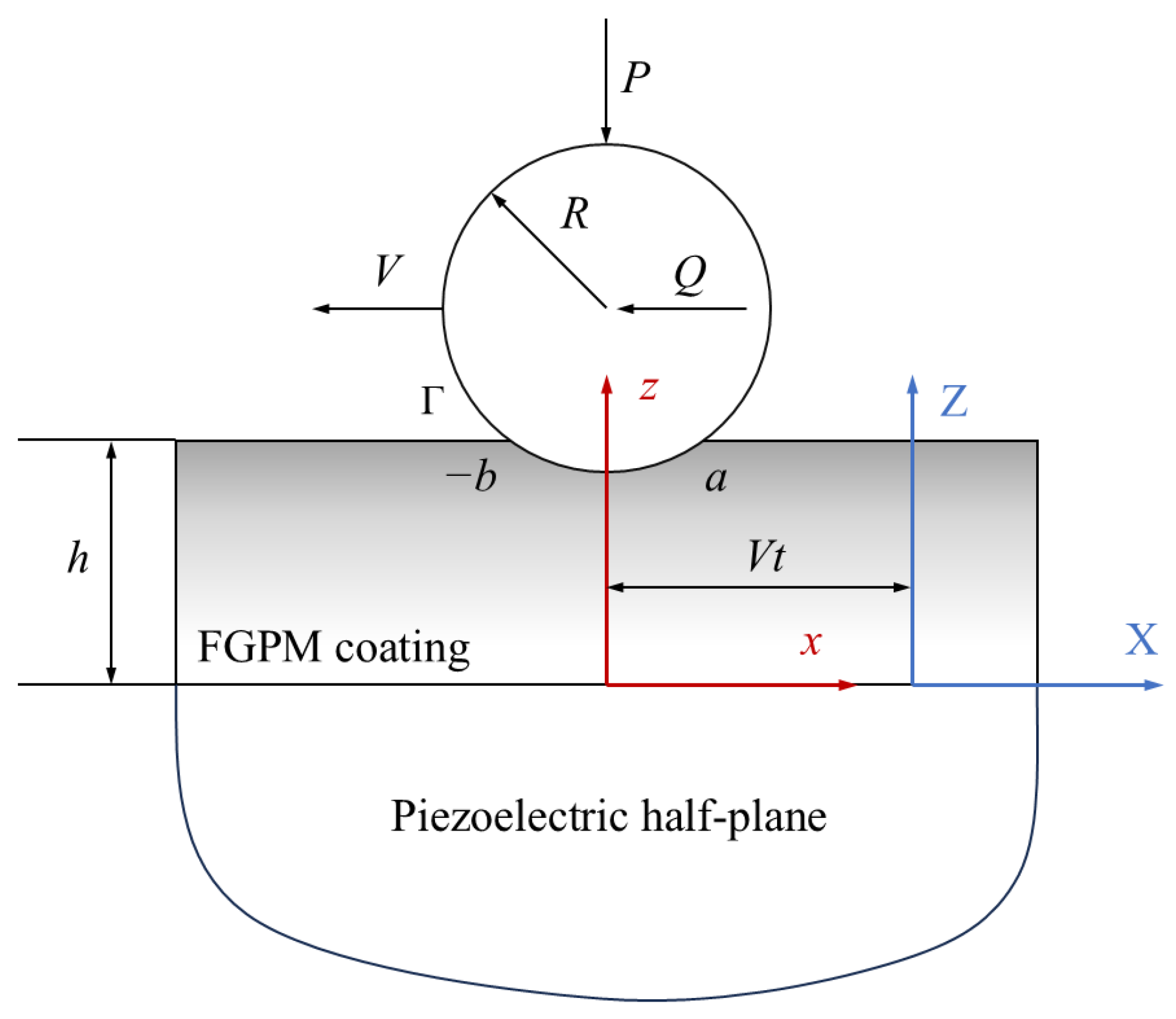
Consider the sliding frictional contact problem in a functionally graded piezoelectric coating with thickness
h under the action of a conductive cylindrical punch (see
Figure 1), where the material parameters of the graded coating vary arbitrarily along the thickness direction. The punch slides over the surface of the graded coating at a constant velocity
V, subjected to normal and tangential concentrated line loads
P and
Q, as well as a concentrated line charge Γ. A Cartesian coordinate system (
X,
Z) is established on the bonding interface between the coating and the homogeneous piezoelectric half-plane. Within the contact region defined by −
b ≤
x ≤ −
a, the normal contact pressure, tangential contact pressure, and surface charge are denoted as
p(
x),
q(
x), and
g(
x), respectively, where the tangential contact pressure satisfies the Coulomb friction criterion.
The elastic constants, piezoelectric constants, dielectric constants, and density of the functionally graded piezoelectric coating vary as arbitrary functions, denoted as
cil(
z),
eil(
z),
εil(
z), and
ρ(
z), with their respective values at the contact surface being
,
,
, and
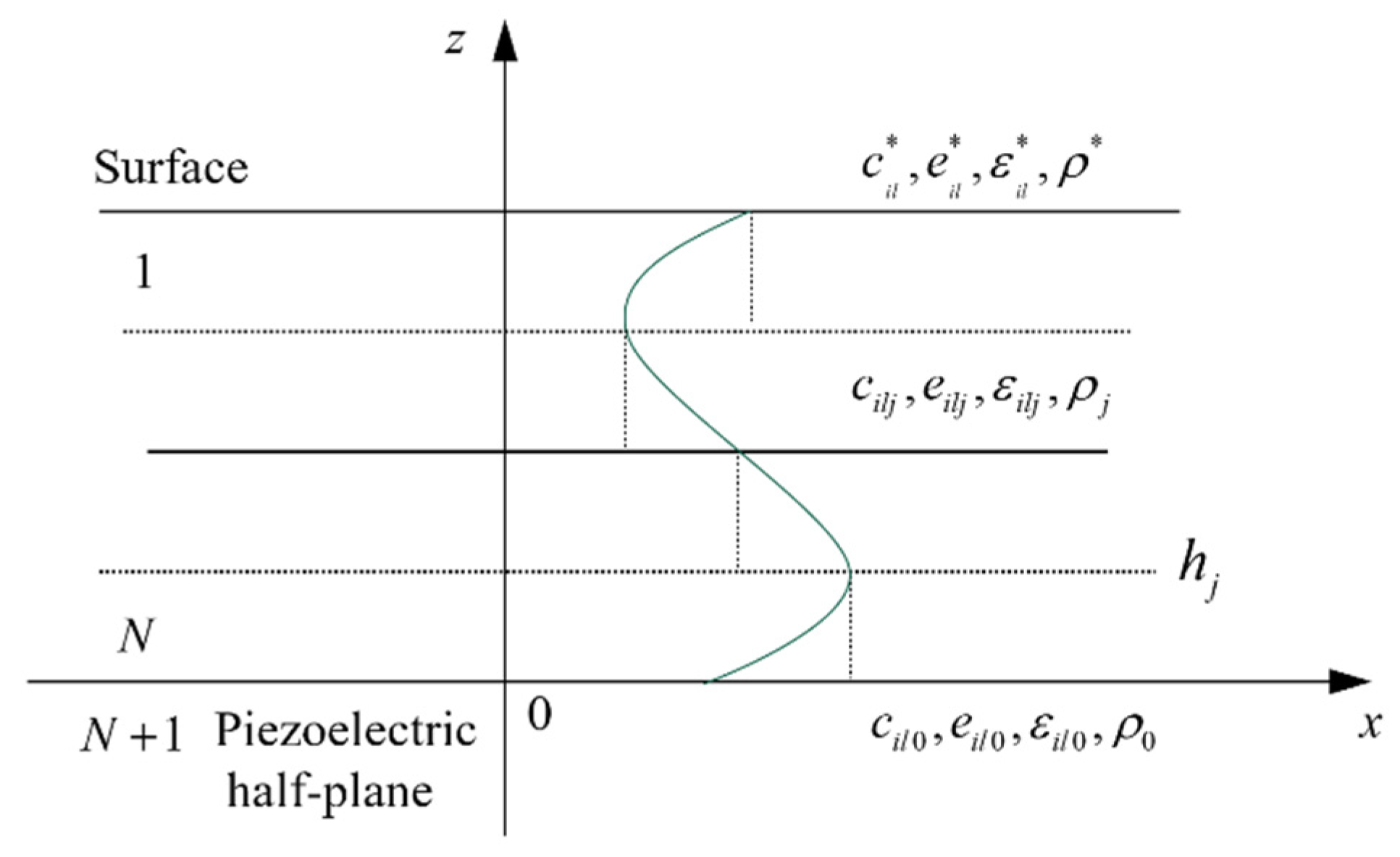
. To simulate the arbitrary variation in the electro–elastic material parameters of the graded coating, a laminated plate model (see
Figure 2) is employed. The coating is uniformly divided along the thickness direction into
N sublayers of equal thickness, with the material parameters in each sublayer taken as constants, denoted as
cilj,
eilj,
εilj, and
ρj. These parameters of each sublayer correspond to the true values at
z =
hj, where
. The material parameters of the homogeneous piezoelectric half-plane are denoted as
cil0,
eil0,
εil0, and
ρ0, respectively.
Under the plane strain state, the linear constitutive equations of transversely isotropic piezoelectric materials are given by [
8,
9,
10]:
where
σXX,
σZZ,
σXZ,
DX, and
DZ are the stress components and electric displacement components, respectively, and
uX,
uZ, and
φ are the displacement components and electric potential, respectively. When inertial terms are included, and in the absence of body forces and body charges, the equilibrium equations and Maxwell’s equations for each sublayer of the graded coating and the homogeneous piezoelectric half-plane can be expressed as follows:
where
j (
j = 1, 2, …,
N) represents the
j-th layer of the stratified model. It is important to note that for
j =
N + 1, the aforementioned equations reduce to the equilibrium equations for a piezoelectric half-plane. Subsequently, the Galilean transformation is introduced as follows:
where
x and
z are the moving coordinates attached to the punch. Substituting it into the system of Equations (1)–(5) yields the equation of motion in the moving coordinate system, as follows:
Performing the Fourier integral transform with respect to
x on the systems of Equations (10)–(12) yields:
where the tilde “~” denotes the Fourier integral transform, “i” denotes the imaginary unit, and “
s” denotes the integral transform parameter.
Given the distinctive characteristic of the homogeneous piezoelectric half-plane extending infinitely along the coordinate directions, the displacement components and electric potential on its surface must vanish, as
X and
Z tend to infinity, as shown in
Figure 2, under the action of the punch. This implies that as
,
, the general solution to the system of Equations (13)–(15) in the transform domain takes the form:
where, the expressions for
,
,
,
,
, and
are provided in
Appendix A.
and
are undetermined coefficients. The displacement components and electric potential of the graded coating in the transform domain can be expressed in matrix form as:
Herein, the superscript “T” denotes the transpose of a matrix. Additionally,
,
,
, and
are denoted, respectively, as:
where
Substituting Equations (18) and (19) into Equations (1)–(5) yields the matrix form of the stress components and electric displacements in the transform domain for each sublayer of the laminated model and the homogeneous piezoelectric half-plane, as follows:
where
4. Numerical Results
Based on the above analysis, this section presents an analysis of the frictional sliding contact characteristics of a FGPMs coating structure under a cylindrical punch. Specifically, it provides the numerical results of the stress components and electric displacement on the surface of the FGPM coating and examines the effects of the material gradient variation type of the coating, gradient index
β, friction coefficient
μ, and relative sliding velocity
V* of the punch on the sliding frictional contact behavior of the FGPM coating structure. It is assumed that the gradient piezoelectric coating is composed of cadmium selenide (CdSe), and its electromechanical material parameters are listed in
Table 1 [
31]. In the following numerical analysis, the following parameters are assumed: normal concentrated load P = 1 × 10
4 N/m, normal concentrated charge Γ = 1 × 10
−7 C/m, cylindrical punch radius
R = 0.1 m, coating thickness
h = 0.01 m, and relative sliding velocity
V* =
V2ρ0/
c440. To prevent the generation of shock waves and ensure the validity of the steady-state assumption, the ratio of the actual velocity
V to the shear wave velocity
is set to be less than 1.
4.1. Comparison Studies
To validate the effectiveness of the theoretical model proposed in this paper, a laminated plate model is first employed to simulate the sliding frictional contact behavior of an FGPM coating structure, wherein the coating material parameters vary along the thickness direction, according to the following exponential function:
where
,
. Select the ratio of material parameters of the upper and lower surfaces of the coating as
.
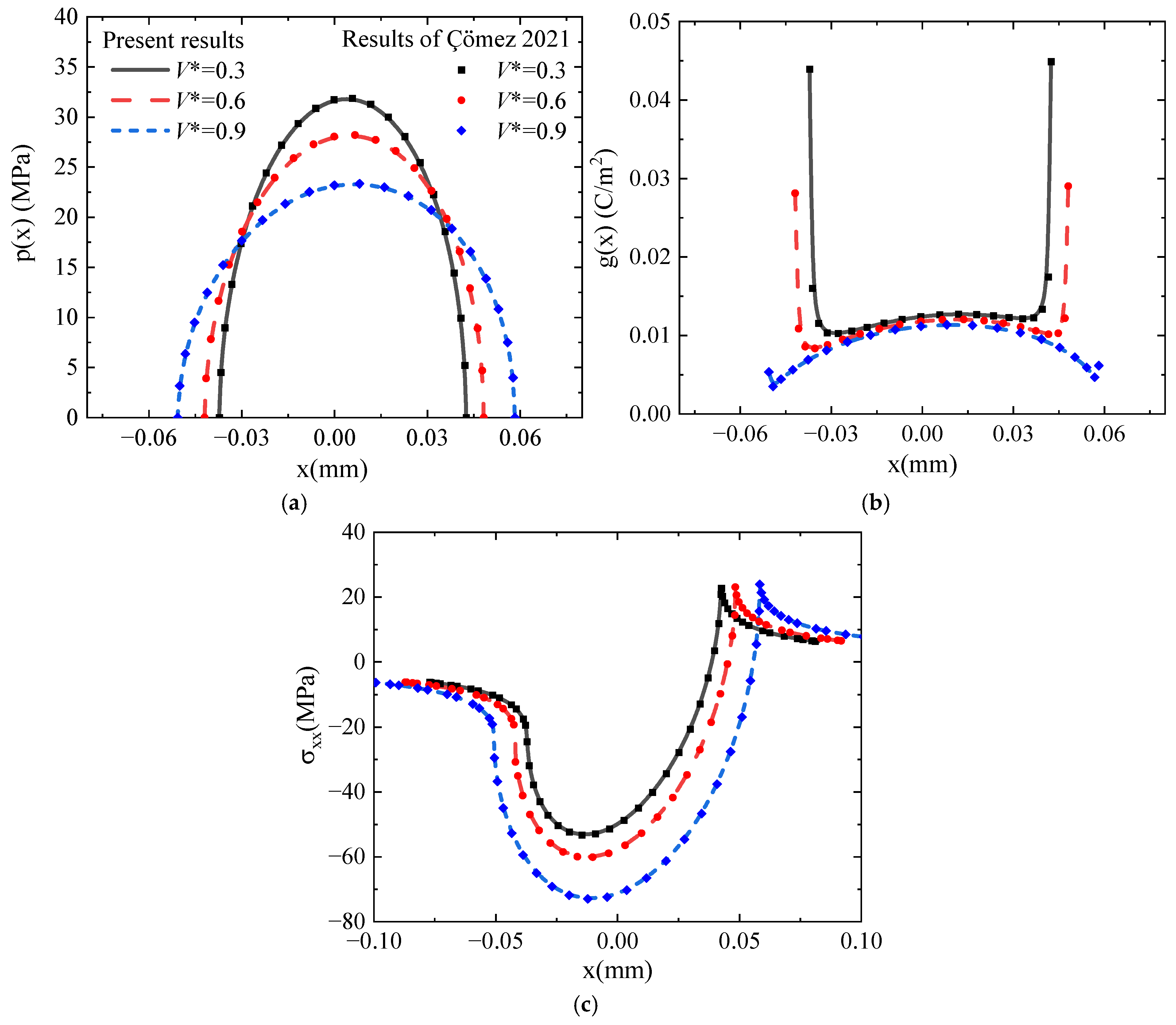
Figure 3 illustrates the effect of the punch’s relative sliding velocity on the sliding frictional contact characteristics of the functionally graded piezoelectric layered coating structure, specifically including the surface contact pressure
p(
x), surface charge
g(
x), and in-plane stress
σXX(
x). The curves in the figure denote the calculation results obtained in this chapter, while the discrete points correspond to the numerical results reported by Çömez [
18]. As illustrated in
Figure 3, the results of this study are in good agreement with those presented in Çömez’s work.
To more realistically simulate the arbitrary variations in piezoelectric material parameters, it is further assumed that the electro–elastic properties of the piezoelectric coating vary along the thickness direction following the form of the subsequent power function. Correspondingly, the surface electro–elastic contact behaviors of this functional model under various influencing factors are discussed, as follows:
To ensure the accuracy of calculation results, it is necessary to verify that variations in the layer number do not affect the surface electro–elastic contact behaviors of the coating. Taking the variation in the form of the previously mentioned power function as an example,
Table 2 presents the effect of different layer numbers
N on the contact mechanical behavior of the coating surface when
μ = 0.3. It can be seen from the table that as
N increases, the in-plane tensile stress gradually converges. When
N ≥ 6, the results stabilize, and this convergence behavior is consistently observed for other adopted functional variation forms. Therefore, to maintain accuracy while minimizing computational costs, a value of
N = 6 is adopted for all numerical calculations in this section.
4.2. The Effects of the Friction Coefficient on the Contact Behaviors
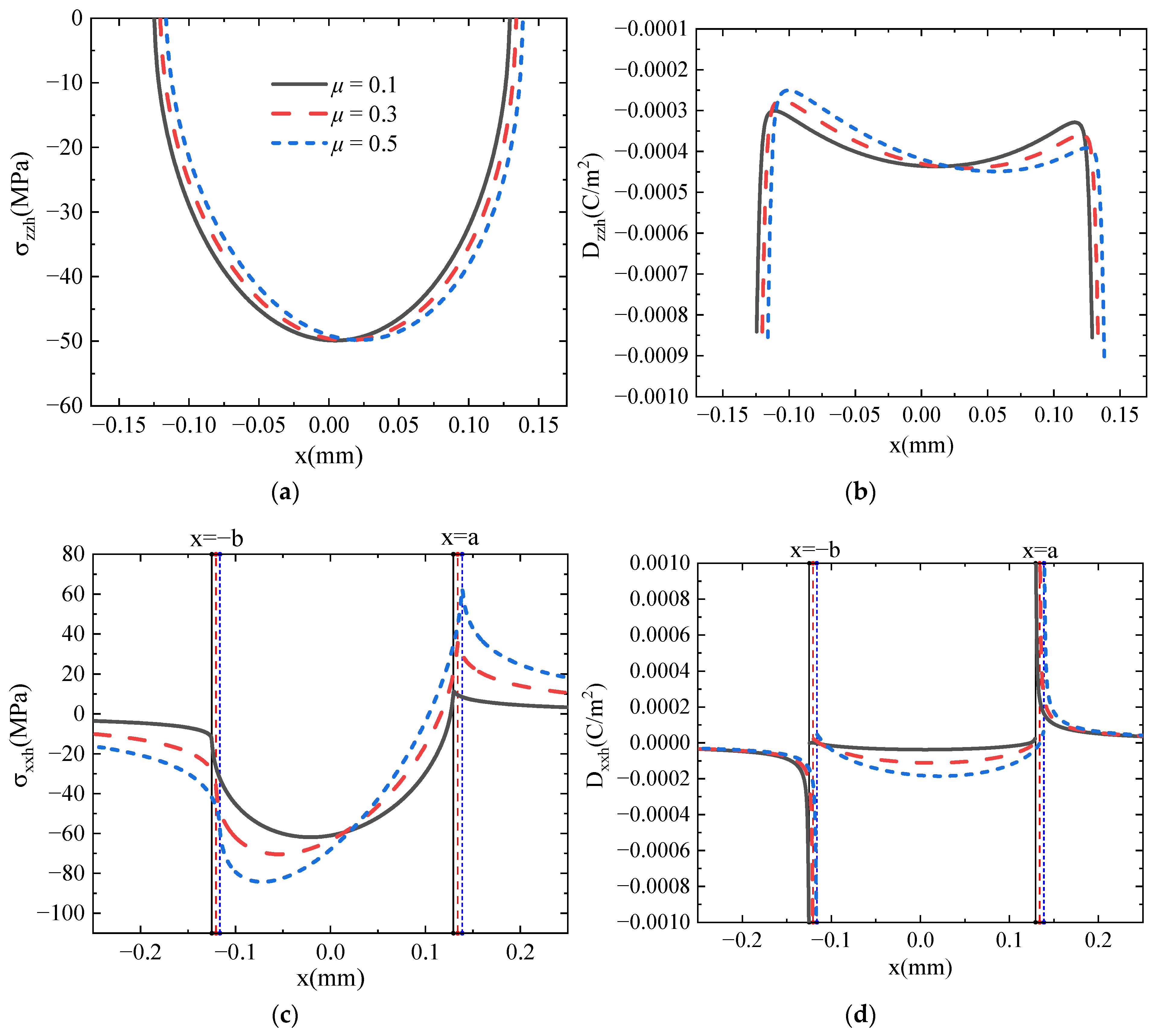
Figure 4 illustrates the influence of the friction coefficient
μ on the sliding frictional contact behaviors of the functionally graded piezoelectric coating structure. As observed from the figure, variations in
μ exert a slight influence on the distributions of the surface normal contact stress
σzzh (
Figure 4a) and surface electric displacement
Dzh (
Figure 4b), with their values shifting slightly rightward within the contact region. This asymmetry may be attributed to the superposition of the tangential traction caused by friction, which tends to distort the stress field relative to the contact center.
With an increase in
μ, the maximum tensile value of the in-plane transverse stress
σxxh (
Figure 4c) at the trailing edge of the contact zone also increases correspondingly. From a physical perspective, this trend is likely associated with the enhanced “dragging” effect of the frictional force, which presumably intensifies the tensile strain accumulation behind the sliding punch. Additionally, it can be seen from the figure that the in-plane electric displacement
Dxh (
Figure 4d) exhibits singularities at both ends of the contact zone, and its maximum values at the contact zone center and trailing edge increase with the increase in
μ.
4.3. The Effects of the Gradient Parameter on the Contact Behaviors
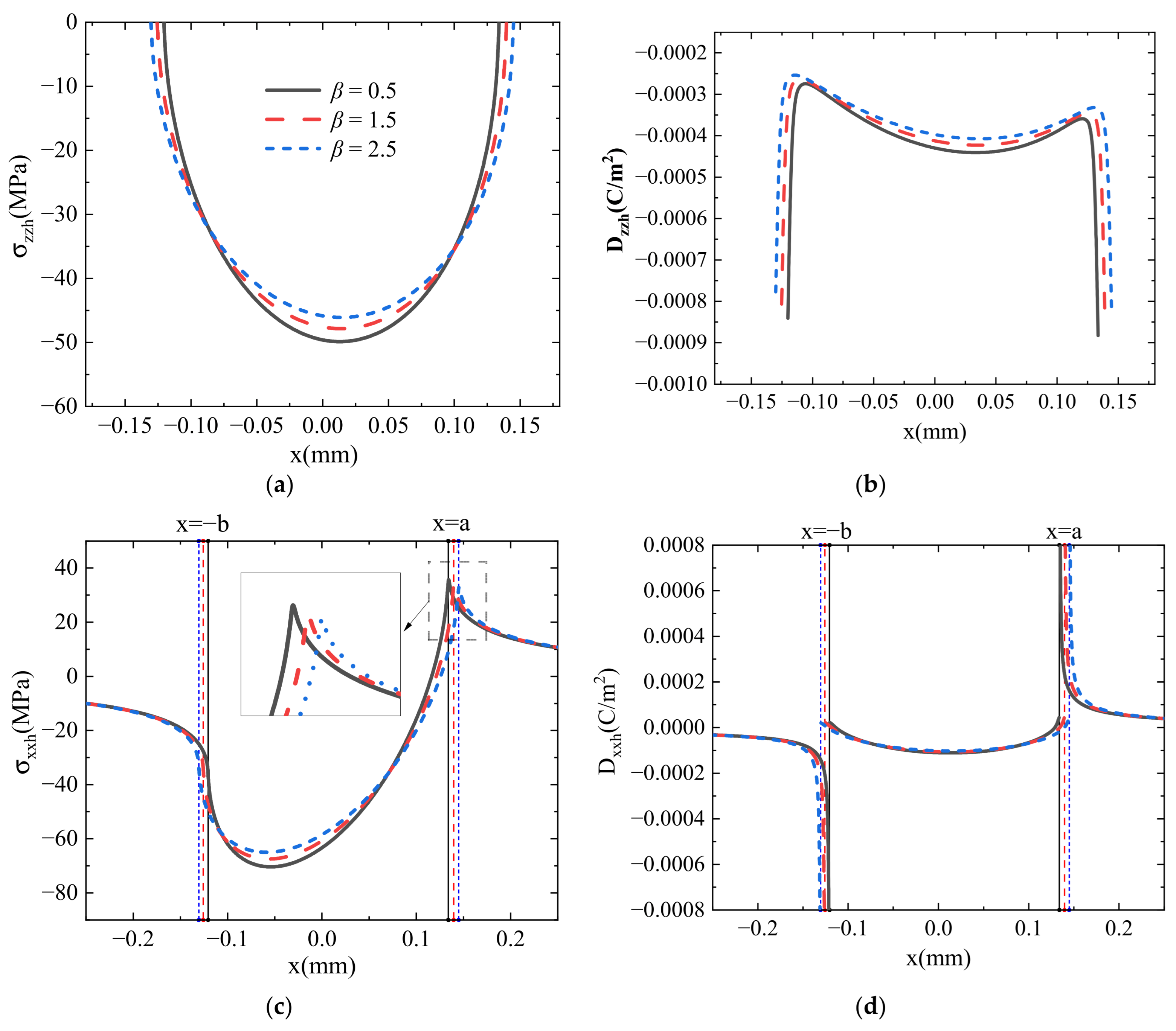
Figure 5 shows the effect of the gradient index
β (governing the variation in electro–elastic properties) on the sliding frictional contact behaviors of the functionally graded piezoelectric coating structure. As observed from the figure, with an increase in the gradient index
β, the maximum values of
σzzh (
Figure 5a) and
Dzh (
Figure 5b) exhibit a decreasing trend, while the size of the contact region gradually increases. From the perspective of contact mechanics, this expansion in contact area suggests that the specific gradient profile tends to facilitate a more uniform redistribution of the surface load, thereby reducing the localized peak magnitude of the normal contact stress.
Meanwhile, the maximum tensile values of
σxxh (
Figure 5c) at the trailing edge of the contact zone, and the maximum values of
Dxh (
Figure 5d) at two ends of the contact zone, both show a gradual decrease with the increase in
β. This indicates that the contact stress, electric displacement, and in-plane stress on the coating surface can be effectively regulated by adjusting the gradient index of the coating.
4.4. The Effects of the Sliding Speed on the Contact Behaviors
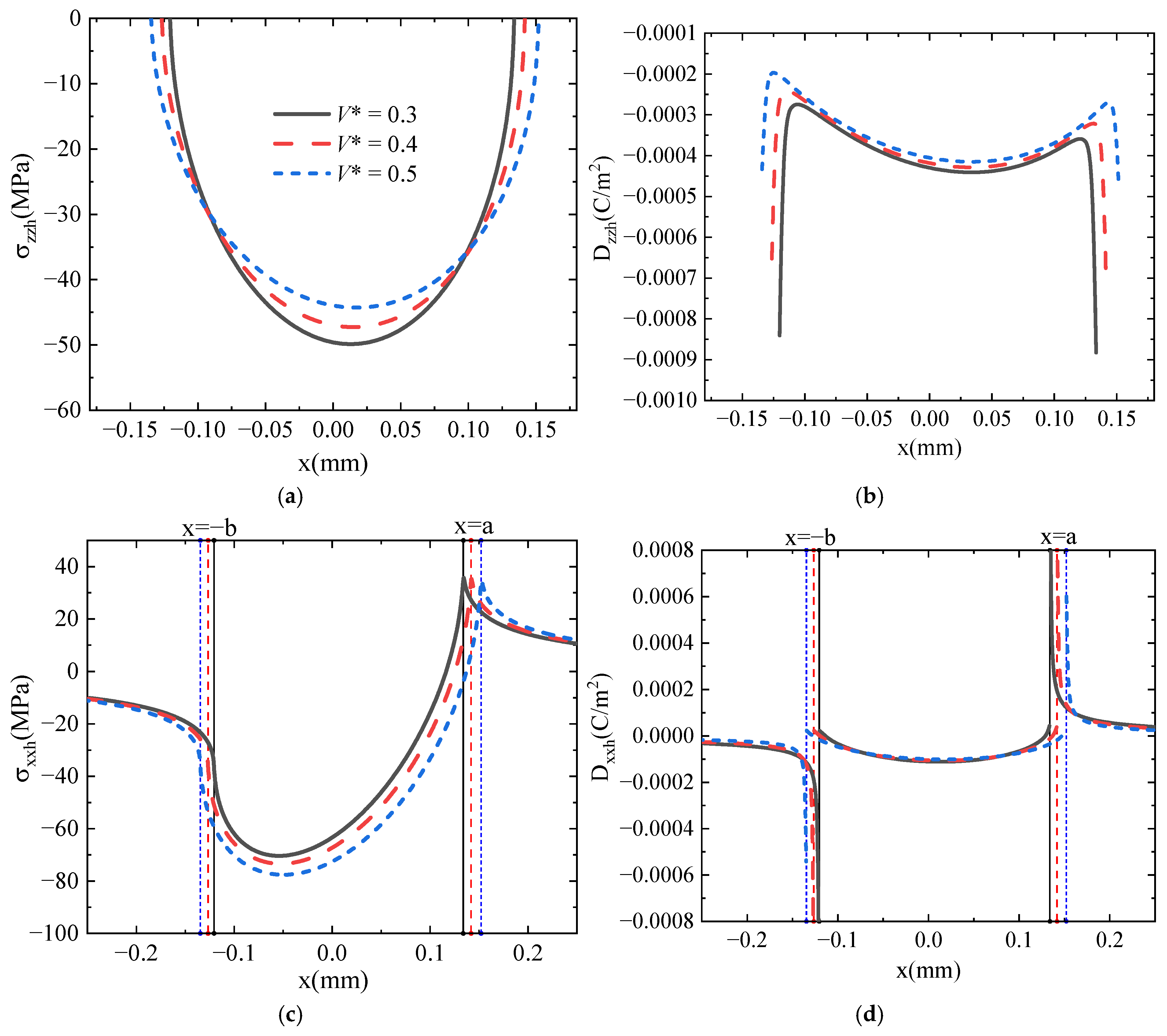
Figure 6 illustrates the influence of the relative sliding velocity
V* of the conductive cylindrical punch on the frictional contact behaviors of the functionally graded piezoelectric coating structure. As observed from the figure, the punch’s sliding velocity exerts a notable influence on the surface contact stress (
Figure 6a), surface electric displacement (
Figure 6b), and in-plane electric displacement (
Figure 6d). With an increase in the sliding velocity s, the contact width of
σzzh and
Dzh increases, while their maximum values both decrease. In contrast, the in-plane tensile stress
σxxh within the contact region increases with the increase in sliding velocity
V*, whereas the peak tensile stress at the contact zone’s trailing edge shows no substantial variation. Additionally, the in-plane electric displacement
Dxh exhibits singularities at both ends of the contact zone, and the maximum values at these two locations decrease as the sliding velocity increases. This indicates that variations in sliding velocity effectively modulate both the mechanical and electrical responses of the functionally graded piezoelectric coating structure.
The variation in the mechano-electrical field may originate from the inertia-induced redistribution of the contact area, as well as the singular behavior of different field components. On the one hand, an increase in sliding velocity expands the contact region, which reduces the maximum of the normal stress and electric displacement under the constraints of total pressure and total charge conservation. On the other hand, the in-plane electric displacement exhibits a stronger singularity at the contact edges than the in-plane stress, and is thus highly sensitive to perturbations at the contact boundary. Consequently, the expansion of the contact region significantly attenuates the amplitude of electric displacement, while exerting a negligible effect on the amplitude of in-plane stress—manifesting only as a shift in the peak position.
It is worth noting that the piezoelectric field distribution remains stable even at high sliding velocities (
V > 800 m/s), showing a trend consistent with Çömez [
18]. This confirms the validity of the proposed model for high-speed multi-physics contact problems. By introducing inertia terms, the model effectively captures the moving effects associated with high-speed sliding. Equations (10)–(12) reveal the mechanism of these effects analytically, while
Figure 6 indicates that their intensity scales significantly with sliding velocity. Conversely, in low-speed regimes, the moving effect is negligible, and the field distribution exhibits a velocity-independent characteristic [
11,
12].
4.5. The Effects of Gradient Variation Type on the Contact Behaviors
To further investigate the influence of the gradient variation type of the coating materials on the sliding frictional contact behaviors, it is further assumed that the electro–elastic parameters of the coating material vary along the thickness direction, according to the following sine functions:
Table 3 and
Table 4 present the effects of three coating gradient types—power function (Case 1), exponential function (Case 2), and sine function (Case 3)—on the maximum tensile stress at the surface of the graded layer, under varying friction coefficients and sliding velocities for a cylindrical punch. As shown in the tables, all three parameter variation types exhibit consistent variation trends in surface contact behaviors: an increase in the friction coefficient exacerbates stress concentration in the contact region, while an increase in sliding velocity moderately alleviates contact stress via inertial effects. This indicates that a higher friction coefficient induces a more pronounced mechanical response in the contact region. Meanwhile, among the three different material parameter variation types, the power function (
β = 1.5) yields the minimum surface maximum tensile stress, and the peak tensile stress for this type decreases with an increase in
β. This suggests that rational regulation of the coating’s gradient type can optimize its mechanical properties.