1. Introduction
The convergence of autonomous driving technologies, vehicular connectivity, and artificial intelligence is poised to reshape the future of intelligent transportation systems (ITS). Connected and autonomous vehicles (CAVs) have the potential to significantly enhance safety, efficiency, and sustainability, by enabling vehicles and infrastructure to sense, decide, and act in a coordinated manner [
1,
2,
3,
4]. This need is becoming increasingly urgent as extreme weather events grow more frequent and severe, heightening the likelihood of infrastructure failures and large-scale road incidents. For example, in the early morning of 1 May 2024, heavy rainfall led to the catastrophic collapse of a section of the Meilong Expressway, South China, causing 23 vehicles to plunge into the failed roadway (
https://edition.cnn.com/2024/05/01/china/china-highway-collapse-kills-intl/index.html, accessed on 20 November 2025). Shortly after this incident, on 19 July 2024, flash floods triggered a bridge collapse in Shaanxi Province, Northwest China, sending 25 vehicles into the river below (
https://english.news.cn/20250327/29e710a050fa408091055bd0edc13600/c.html, accessed on 20 November 2025). Such tragedies could have been prevented, or their consequences substantially mitigated, had adaptive CAV systems been widely deployed and functioning effectively [
5].
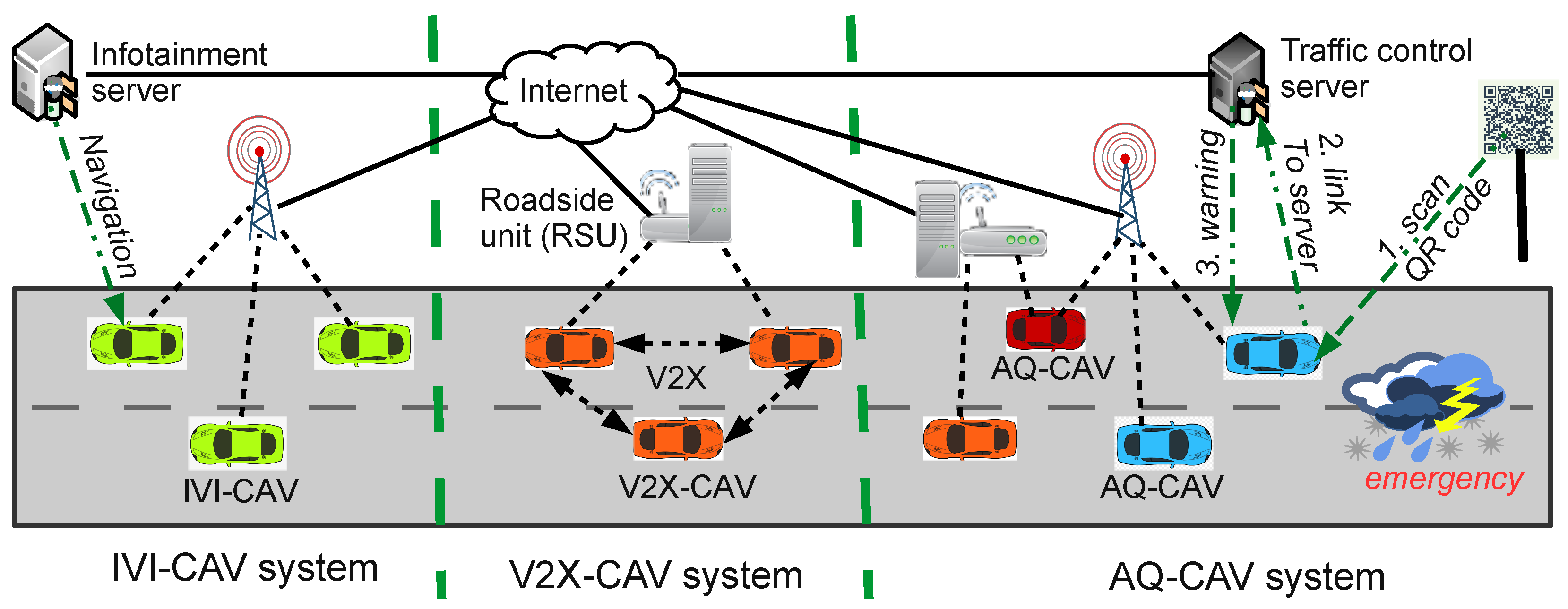
Despite rapid technological progress, existing CAV systems still face significant barriers that limit their ability to realize their full potential in safe and efficient ITS. As illustrated in
Figure 1, current deployments can be broadly categorized into two classes: (1) 4G/5G cellular-based in-vehicle infotainment systems (IVI-CAV systems): These systems focus on information, convenience, and entertainment to improve in-vehicle user experience. (2) Vehicle-to-everything (V2X) communication-based systems (V2X-CAV systems): These systems aim to enhance driving safety and traffic efficiency by enabling connected vehicles to perform tasks such as collision avoidance, hazard warning, and cooperative driving. V2X-CAV has been the primary focus of research and development efforts targeting CAV safety and ITS performance [
3].
IVI-CAV technologies are mature and widely deployed, supporting services such as media streaming, navigation, diagnostics, data collection, and AI model updates. However, they do not process driving environmental information or support communication and interaction with surrounding road users and therefore do not directly contribute to driving safety or traffic efficiency.
While the V2X-CAV system is dedicated to enhancing driving safety and efficiency, it has so far been limited to pilot tests and has not yet made a tangible impact. The widespread deployment of V2X-CAV systems is delayed by the following major barriers: (1) The business case and cost challenge: The initial cost of equipping V2X modules and deploying roadside units (RSUs) across a vast road network is enormous. There is no proven business model as the benefits are often public and long-term while the costs are immediate and private. (2) The ‘chicken and egg’ deployment dilemma: Without a critical mass of V2X-enabled vehicles and RSUs, the V2X applications will not function. Furthermore, V2X lacks a single must-have killer application that drives demand and justifies the infrastructure investment, which creates a stalemate. (3) Standardization and device interoperability: There is a long-standing competition between IEEE 802.11p-based DSRC and cellular network-based V2X standards [
3]. Even though cellular network-based V2X technology is now the dominant path forward, ensuring that devices from different manufacturers and in different regions can communicate seamlessly is a huge technical and regulatory challenge. (4) The interaction, cooperation, and trust problem: There are no proven and widely accepted mechanisms for interaction and cooperation between different CAV applications. Furthermore, AV development remains predominantly focused on standalone models lacking inherent capabilities to cooperate with other road users. Inaccurate data or a security breach will create significant trust and liability challenges.
Furthermore, both IVI-CAV and V2X-CAV systems remain largely constrained by modular, rule-based architectures organized around fixed pipelines of perception, decision, control, communication, and cooperation. While effective in structured or predictable environments, such architectures limit adaptability in unanticipated scenarios. Their centralized or semi-centralized coordination mechanisms struggle to scale with increasing traffic density and interaction complexity, and they often lack the capability to reason about the intentions and reactions of surrounding agents. As a result, these systems fail to generalize in the complex, uncertain, and mixed-traffic conditions that characterize real-world driving.
In view of the CAV potentials and the significant barriers, we are motivated to propose an innovative, forward-looking CAV system termed AQ-CAV, which leverages QR codes and agentic intelligence to complement and augment the existing CAV systems [
6,
7]. The pervasive QR codes and smartphones with cellular communications provide a great way to connect vehicles and other road users, enabling large-scale interaction and cooperation with very low cost compared to the V2X-based approach. They are ideal for helping tackle many of the aforementioned challenges faced by the V2X-CAV system.
Moreover, agent-based architectures, where individual vehicles and infrastructure components operate as intelligent agents capable of perception, reasoning, and interaction, represent a promising paradigm for boosting cooperation, adaptability, and intelligent decision-making for CAVs. Instead of viewing each vehicle as an isolated autonomous entity, the agent-based perspective conceptualizes vehicles, roadside units (RSUs), and traffic management components as intelligent, interactive agents within a distributed ecosystem. Each agent possesses the ability to perceive its surroundings, reason about both individual and collective objectives, and communicate and negotiate with others to achieve safe and efficient outcomes. The transition from conventional AI agents to agentic AI further extends this capability. Traditional AI agents perform task-specific actions based on fixed goals and local inputs. In contrast, agentic AI systems demonstrate higher degrees of autonomy, proactivity, and self-organization [
7,
8,
9]. They can formulate subgoals, reason about the broader system context, and pursue cooperative strategies that benefit both individual agents and the collective network. In the context of CAVs, this evolution enables vehicles not only to follow pre-defined rules but also to anticipate, negotiate, and learn in coordination with other vehicles, infrastructure, and management entities.
While low-cost accident reporting and warning solutions have been reported in the literature, including methods based on mobile short messages and mobile applications, they do not offer the flexibility, cooperation, and automation characteristics that can be provided by the proposed AQ-CAV system. Next, we review QR code technology and present a detailed technical architecture of the proposed AQ-CAV system with QR codes in
Section 2. We also propose a scheme for authentication of QR codes to ensure its secure use for the AQ-CAV system. Then, we describe the AQ-CAV system with agentic intelligence in
Section 2, presenting the components and functions of the vehicle and infrastructure agents, inter-agent communication, and coordination mechanisms. Building on this foundation, we explore key application domains, including cooperative driving, emergency response, self-configuration and adaptation of V2X networks, and digital twins of CAVs for intelligent and safe transport systems, in
Section 3. Preliminary experiments are conducted on an emergency response use case with AQ-CAV in
Section 4 which demonstrate its feasibility and effectiveness alongside significant safety improvement and low system cost. Finally, we discuss the open challenges of the AQ-CAV system and outline research directions that need to be explored to realize its full potential. A list of the main acronyms is shown in
Table 1.
2. AQ-CAV System with QR Codes
In this section, we give an overview of the QR code and the design of the AQ-CAV system with QR codes.
2.1. General Introduction of QR Codes
A QR code is a two-dimensional matrix barcode originally developed for industrial tracking applications [
6,
10]. It has since evolved into a ubiquitous tool for digital interaction and information exchange. Unlike traditional one-dimensional barcodes, QR codes can encode information both horizontally and vertically with much higher data density. Their ability to be scanned rapidly from any orientation, coupled with universal compatibility with smartphone cameras, has made them a versatile medium for applications in advertising, logistics, identity verification, and mobile payment systems.
QR code generation involves encoding input data, such as text, URLs, or binary content, into a grid of black and white modules. The encoding process includes data conversion, Reed–Solomon error correction, and the addition of functional patterns such as finder, alignment, and timing marks to ensure accurate detection and decoding [
6]. The embedded Reed–Solomon error correction mechanism allows recovery of up to 30% of lost or obscured data.
QR codes are available in 40 standardized versions. Higher versions allow more data to be stored but require greater print area and scanning resolution. Depending on the version, data type, and error correction level, a QR code can store up to approximately 7000 numeric characters or nearly 3 kilobytes of binary data, providing a scalable balance between capacity and physical size. QR codes are engineered for robust and reliable operation under diverse environmental conditions. These design principles ensure that QR codes maintain high readability and fault tolerance, making them applicable to ITS and CAV systems.
2.2. AQ-CAV System Design with QR Codes
The pervasive and low-cost QR codes provide a simple but effective solution to some of the problems faced by the V2X-CAV system. As the QR codes and AI agents are complementary to each other, they can be used separately or jointly in the AQ-CAV system. In this subsection, we present the design of the AQ-CAV system with integrated use of QR codes only (called the Q-CAV system for short). The design of the AQ-CAV system with AI agents (called the A-CAV system for short) is presented in the next section.
In a basic setting, the key components of the Q-CAV system include the CAVs (equipped with cellular communication and a device to process QR codes), transport QR codes, and transport control centers (TCCs) which are placed close to the roads or remotely. The transport QR codes can be displayed at roadsides or on the road surface. Information, including the URLs of an associated TCC and optional RSUs, is embedded in the QR codes. Additional information such as instructions for navigation and emergency response can also be encoded in the QR codes. The CAVs use their onboard cameras or smartphone camera to detect and decode the transport QR codes. Once the URL embedded in a transport QR code is decoded, the CAVs will be directed and connected to the associated TCC. The connectivity is primarily through cellular communication, which reduces strict reliance on the V2X communication. The CAVs may periodically update their locations and inform the TCCs when they leave the roads. If a considerable number of CAVs are equipped with V2X devices, they can also interact with each other via V2X communication. The TCCs will act as the central contacts and system manager. They can manage the mobility of the CAVs, provide them with information and warnings (regarding, e.g., road accidents and road works), and support their interaction and cooperation.
QR codes do not need to be deployed as densely as the V2X RSUs (e.g., about 500 m between two RSUs). The QR codes can be strategically placed such as at highway entrances and toll stations and along the roads. Once the CAVs are connected to a TCC via the QR codes, they can report their locations to the TCC periodically on their journeys and be assigned to the TCCs responsible for the roads where the CAVs are driving. If a CAV was connected to a transport control center before, it can report to that TCC in new journeys even without decoding new transport QR codes, and that TCC can direct the CAV to the corresponding TCCs. A TCC can manage multiple roads and/or multiple road sections. With the above design, the investment in the Q-CAV system can be significantly reduced while maintaining service coverage.
2.3. Qualitative Feature Analysis
In this subsection, we will first analysis the features of the Q-CAV system and explain how it can address the barriers faced by the V2X-CAV system. We then analyze the security concern of the Q-CAV system and enhance its security with QR code authentication. It is noted that the Q-CAV system is proposed to complement the V2X-CAV system instead of replace it. With ultra-reliable and low-latency V2X communication, V2X-CAV can support tactic safety (such as real-time forward collision avoidance and remote driving). Due to the larger delay through the cellular communication, the Q-CAV system is more suitable for supporting strategic safety (such as accident warning, emergency response, and cooperative driving). Even so, it can provide strong support to the V2X-CAV system and break the identified key barriers.
With regard to the business model and cost challenge barrier, the costs of deploying and processing QR codes with smartphones are negligible. The main investment in equipment and system operation costs are in the TCCs, which can be much smaller compared to those of RSUs and V2X devices. With the support and coordination of TCCs, there can be novel business models exploiting the interaction and cooperation among the CAVs and with the infrastructure. For the deployment barrier, the Q-CAV system is cost-effective and much more scalable. It can generate a significant safety impact even if only a small proportion of CAVs have QR code-processing capabilities, as demonstrated by the preliminary experiment results regarding emergency response in
Section 5. Therefore, this barrier could be broken by the Q-CAV system. For the standardization and interoperability barrier, the CAVs can use the existing 4G/5G technologies for communication and rely on the management of the central transport control centers. Furthermore, the RSUs can use QR codes or TCC assistance to share the V2X communication setting information with the CAVs, which can help break the interoperability barrier.
2.4. Security Enhancement with QR Code Authentication
Relating to the interaction, cooperation, and trust barrier, the TCCs and AI agents introduced in
Section 3 can provide a great solution to the interaction and cooperation problems. One security concern that could be brought by Q-CAV is that attackers could place QR codes embedding malicious URLs. If CAVs decode the QR codes and open the malicious URLs, it could lead to serious damages. To address the security and trust issue with the Q-CAV system, a security enhancement scheme is proposed with use of digital authentication for the key information embedded in the transport QR codes.
Suppose that the key information to be embedded in a QR code includes the name and URL of the TCC associated with the QR code. Next, we present an efficient and secure approach to authenticate the name and URL of the TCC. The TCC first generates a private key and public key pair with an eclipse curve cryptograph (ECC) scheme [
11]. The ECC is selected as it can achieve similar security performance to an RSA scheme with much shorter ciphertexts, which is desirable for QR code authentication. Then, the TCC can apply a hash algorithm (such as SHA-256) to its name and URL and generate a hash value. A digital signature is generated by encrypting the hash value using the TCC’s private key. The key information (the TCC’s name and URL) and the digital signature are embedded in the QR code. Anyone with the public key of the TCC can verify the authority of the URL and counter the malicious URL attacks. Therefore, a CAV can connect to the URLs of the TCCs which have been authenticated in the QR codes.
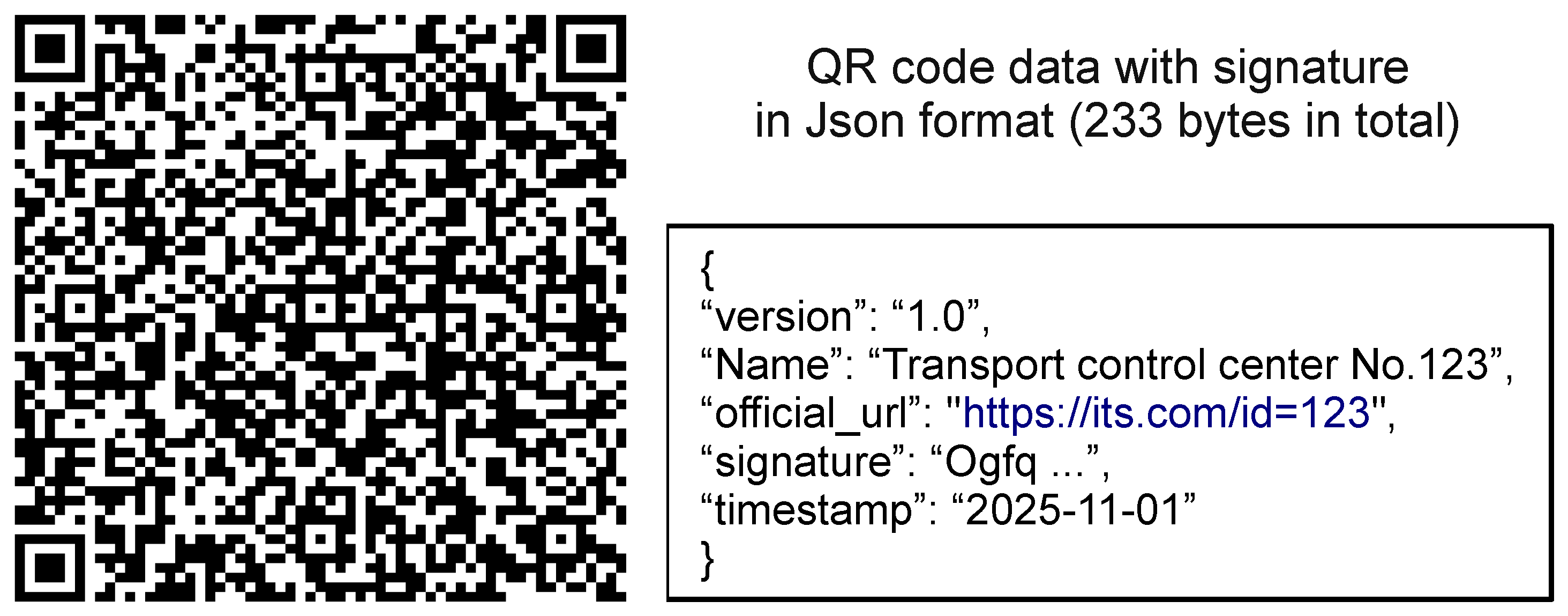
The QR code authentication has been tested successfully. An example QR code with signed data is shown in
Figure 2. The size of the TCC name and URL is 29 and 22 bytes, respectively. The data signature is generated with the ED25519 algorithm, which uses ECC encryption [
11]. The size of the data signature is 64 bytes. The encoded data are organized in JSON format with a total size of 233 bytes. It was found that version 10 QR codes can meet the data capacity and reliability requirements.
We considered a system-level adversary capable of eavesdropping on wireless communications and attempting to inject forged QR payloads but without the ability to break standard cryptographic primitives. The security of the proposed QR authentication mechanism relies on the assumed unforgeability of ECC-based digital signatures and the collision resistance of SHA-256, which are widely adopted in practice. Formal cryptographic proofs of these primitives are outside the scope of this work.
In practical deployment, the TCCs may supply a mobile app for the CAVs to process the decoded information from the QR codes, which can obtain their public keys securely. An alternative approach is for the TCC to request and obtain a certificate from an official certificate authority (CA). The certificate shows the TCC name and the generated public key and the CA’s public key. Anyone can use the CA’s public key to verify the authority of the TCC’s public key. The TCCs can encode the certificates and their digital signature to the key information in the QR codes. Using the certificates can improve the scalability at the cost of involving the CA.
3. A-CAV System Design with AI Agents
Early autonomous driving systems were predominantly modular, consisting of discrete functional blocks for perception, planning, and control which communicate through well-defined interfaces. While such architectures have enabled significant progress, they remain limited by their rigidity and inability to adapt effectively to dynamic, uncertain environments. To enhance adaptability, learning-based and integrated architectures have emerged. These systems demonstrate improved performance in structured tasks, such as lane keeping and adaptive cruising; however, they often lack interpretability, interaction, cooperation, and formal safety guarantees.
In parallel, advances in multi-agent systems (MAS) have provided a foundation for modeling and coordinating autonomous entities that operate in shared and partially observable environments [
9]. MAS research has developed core principles for agent autonomy, communication, negotiation, and cooperative planning. The MAS framework naturally aligns with the requirements of CAV ecosystems. By embedding learning, communication, and cooperation into every level of the vehicular ecosystem, agent-based CAVs promise to overcome the interaction, adaptability, and scalability limitations of current architectures. They offer a pathway toward self-organizing and resilient ITS capable of continuous evolution and optimization. In this section, we present a unified architecture for an AI agent-based CAV (A-CAV) system, which can be smoothly integrated with the Q-CAV system to form the AQ-CAV system.
3.1. Architecture of Agent-Based CAV
The A-CAV ecosystem is a vehicular network of agents consisting of multiple intelligent entities operating across vehicle, infrastructure, and management layers. Each entity functions as an autonomous or semi-autonomous agent equipped with sensing, reasoning, and communication capabilities, allowing the system to collectively achieve safe, efficient, and adaptive driving behavior.
The architecture supports both horizontal coordination among agents and vertical coordination within agents. It enables partial and fully agent-based systems with varying degrees of agentization where not all entities are fully agentic at the outset. Partial agent-based systems coexist with traditional modular or rule-based components. For example, traditional modular system-based vehicles may interact with agentic infrastructure or edge agents that assist decision-making through broadcasted guidance. Early implementations may feature agentic infrastructure coordinating conventional vehicles. Over time, as communication infrastructure and onboard intelligence mature, these systems can evolve into fully agent-based ecosystems in which all entities act as intelligent and communicative agents.
3.1.1. Vehicle Layer
We propose a two-tier agent-based architecture for the CAVs. At the top level, each CAV is conceptualized as a vehicle-level agent (VLA) that embodies the vehicle’s global decision-making, external interaction, and participation in cooperative driving. Internally, the VLA is realized through a collection of in-vehicle agents (IVAs), each responsible for a clearly defined functional domain such as perception, V2X communication, cooperation, or safety. This two-tier structure preserves the external simplicity of a single CAV agent while enabling an internally modular, verifiable, and scalable system organization.
Modern CAVs already employ highly modular software stacks for perception, prediction, planning, control, and communication, which are often distributed across heterogeneous hardware platforms and developed by multiple suppliers. Safety standards such as ISO 26262 and ISO 21448 further require functional separation, redundancy, safety monitoring, and explicitly defined supervisory logic. Within this context, an agent-oriented formulation provides a unified way to describe heterogeneous subsystems as a set of collaborating intelligent components. Each IVA encapsulates a distinct competency with well-defined behaviors and interfaces.
A multi-agent structure inside the CAV is particularly valuable for cooperative and human-centric driving, where the vehicle must reason about external agents and mixed-traffic interactions. Dedicated IVAs enable the system to scale its reasoning capabilities and maintain verifiability even as cooperative intelligence grows in complexity. This multi-agent approach therefore enhances safety, robustness, extensibility, continuous updatability, and interpretability, making it a practical and forward-looking architectural strategy for next-generation CAVs.
The VLA serves as the macro-level intelligence of the vehicle and is the sole entity authorized to communicate with external agents, including other vehicles, roadside infrastructure, cloud services, and human users. The VLA synthesizes and arbitrates the outputs provided by IVAs, resolves conflicts, enforces safety and ethics constraints, and maintains the vehicle’s intent, behavioral policies, and cooperative strategies. Functionally, the VLA operates as the executive and integrative layer of the CAV, ensuring coherent decision-making and consistent external communication.
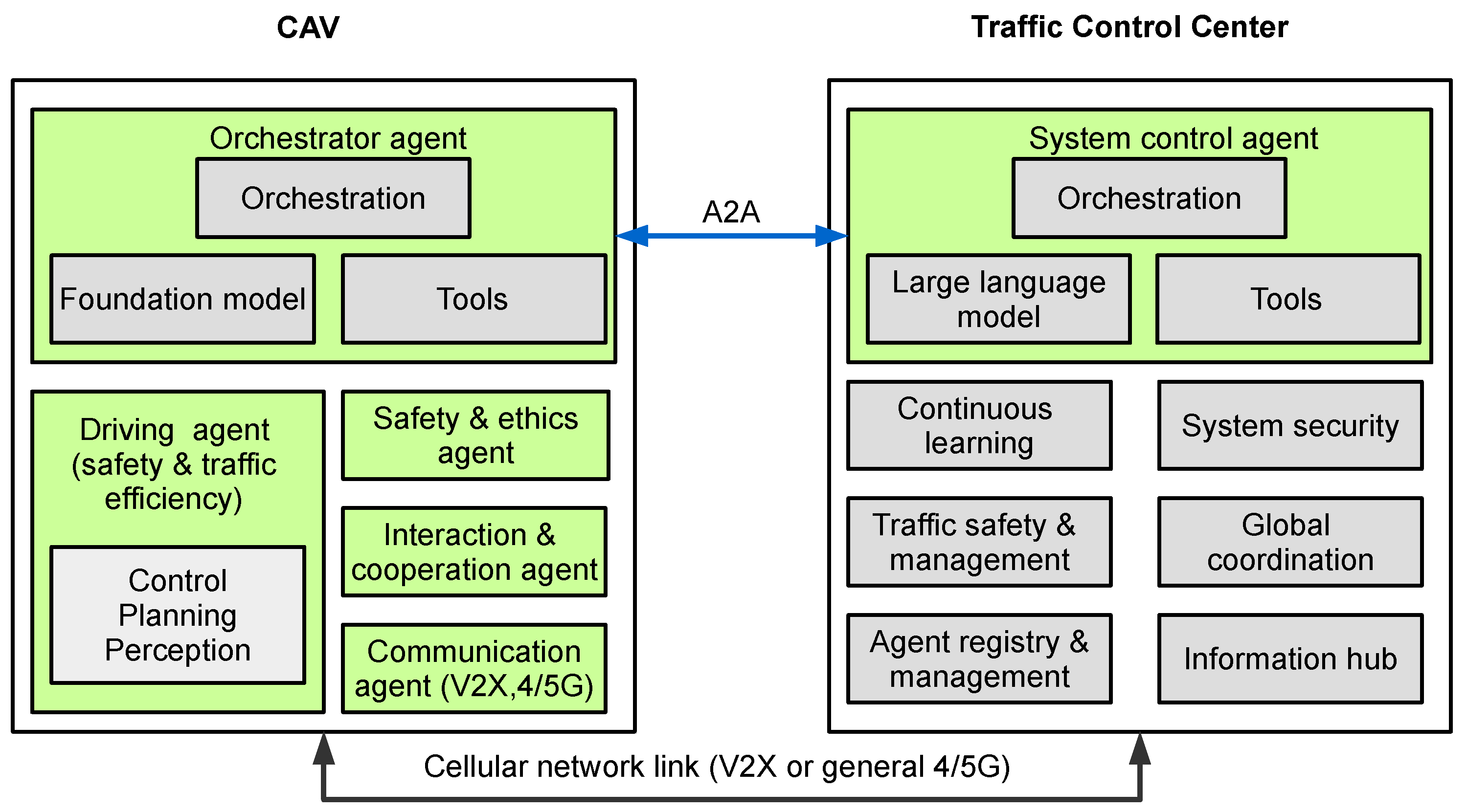
Each IVA functions as a specialized autonomous subagent with its own local objectives, domain-specific knowledge, and internal algorithms. Representative IVAs are illustrated in
Figure 3. The driving IVA is responsible for driving-related competencies including perception, prediction, route planning, and motion control. Its objective is to maximize driving safety, efficiency, and rule compliance. The communication IVA provides reliable, low-latency, and secure communication services using V2X and cellular technologies. It manages message scheduling, prioritization, and adaptation to network conditions. The interaction and cooperation IVA handles intent negotiation and coordination with external entities, including other vehicles, RSUs, pedestrians, remote operators, and traffic police. It enables socially compliant and cooperative behaviors. The safety and ethics IVA oversees runtime safety monitoring, fallback strategies, anomaly detection, and ethical constraint enforcement. It ensures safe operation under uncertainty and system degradation. The Orchestrator IVA manages IVA-to-IVA coordination, monitors the system, allocates computational resources, and manages tool invocation or shared models. It provides the VLA with structured meta-information about internal capabilities.
These IVAs operate concurrently and interact through an internal agent communication layer. They expose capability interfaces to the VLA and may incorporate foundation models where they are beneficial. IVAs remain individually modular, replaceable, and updatable. They may share a common foundation model, tools, or persistent memory to support enhanced reasoning and adaptability.
It is noted that the vehicle agent can adopt other organizational forms. For example, in a fully distributed configuration, all entities operate as peer agents that collaborate through consensus or negotiation without relying on central coordination. This approach maximizes resilience and scalability but requires robust distributed learning and fault-tolerant communication. The presented hierarchical system simplifies coordination and enables safety assurance but may introduce latency or limit local adaptability.
3.1.2. The Infrastructure Layer
The infrastructure layer comprises RSUs, connected intersections, intelligent traffic controllers, and edge-computing nodes, all functioning as infrastructural agents. These agents extend the perception, communication, and decision-making horizon beyond the capabilities of any individual vehicle. Infrastructure agents enhance collective situational awareness by detecting and broadcasting information about hazards, congestion, vulnerable road users, or adverse environmental conditions. They also facilitate coordinated behavior in complex environments such as intersections, roundabouts, merging zones, and work sites.
Edge-computing nodes embedded within this layer may host perception fusion, prediction, or coordination models, enabling low-latency multi-agent reasoning and reducing dependence on cloud-level computation. By providing timely and high-resolution environmental intelligence, the infrastructure layer acts as a critical intermediary between individual CAVs and the broader network.
3.1.3. Coordination and Management Layer
The coordination and management layer consists of regional traffic management centers, cloud-based services, and digital-twin platforms that operate as supervisory agents with strategic oversight responsibilities. These agents monitor large-scale traffic patterns, maintain an up-to-date digital twin of the transportation network, and optimize higher-level policies such as flow control, congestion mitigation, and cooperative behaviors among neighboring CAVs.
This layer also provides cloud-accessible registries and information hubs where VLAs can authenticate, access transportation information services, and exchange relevant operational data. While VLAs primarily interact with nearby VLAs and RSUs, they can also query or receive guidance from supervisory agents to support long-term planning, large-scale model updates, or policy refinement. Importantly, supervisory agents do not dictate individual vehicle maneuvers. Instead, they provide adaptive policy dissemination, safety verifications, global coordination cues, and learning signals that influence local decision-making while preserving the autonomy and real-time responsiveness of VLAs.
3.1.4. Interaction and Communication Across Layers
The proposed hierarchical organization balances local autonomy with network-level oversight and enables robust cooperation across mixed traffic environments. Interaction occurs both within a vehicle (between its internal agents) and across vehicles and infrastructure. Internal IVA–IVA exchanges support tight integration of perception, prediction, planning, and human–machine interaction, while the VLAs engage in peer-to-peer vehicle communication, negotiation, and coordination with infrastructure. These interactions can rely on lightweight agent communication protocols, such as the A2A protocol for agent-to-agent communication and MCP for agent-to-tools communication [
12].
Cross-layer communication also extends to human operators and external digital tools. Human-facing interfaces (e.g., teleoperation panels or traffic officer interaction modules) allow the VLA and IVAs to query, inform, or seek human intervention when required. Tool-facing interfaces enable agents to invoke specialized services such as mapping servers, intent prediction models, or safety validators. Together, these communication pathways ensure that coordination emerges seamlessly across scales, within the vehicle, between vehicles, and within the broader cooperative ecosystem.
3.2. Core Agent Components and Continuous Learning
Agents (including IVAs and higher-level coordination agents) follow a unified architectural pattern consisting of three primary elements: a model, a toolset, and an orchestration. The model serves as the cognitive core of the agent and may range from resource-efficient foundation models to more capable LLMs [
8,
9], depending on functional requirements and computational constraints. It is noted that computational cost is a critical consideration, particularly for safety-critical and real-time applications. In the proposed agent-based AI architecture, foundation models and LLMs are not assumed to directly control real-time driving functions. Instead, vehicles are expected to deploy appropriately selected models, such as lightweight foundation models or quantized LLMs, based on available onboard computational resources. While many LLMs remain too computationally intensive for real-time driving control, recent advances in vehicular computing platforms make it increasingly feasible to deploy selected models for auxiliary safety-related functions. In particular, such models can assist safety-critical tasks with less stringent real-time constraints, including emergency reporting, warning dissemination, and coordination with infrastructure or external agents.
The toolset provides the agent with memory (both short-term and long-term) and interfaces to external resources, services, and APIs, which enable perception, communication, and interaction beyond the model’s intrinsic capabilities. The orchestration governs planning, reasoning, and action execution. It synthesizes model outputs with contextual information to determine when to reason, when to act, and which tools to invoke. Frameworks such as ReAct offer an effective paradigm for integrating deliberation and tool-mediated behavior, ensuring that agents remain goal-directed, transparent, and adaptable.
Agent capabilities can evolve through continuous learning driven by both simulated and real-world interactions. A closed-loop data lifecycle aggregates operational experience (including task outcomes, communication traces, human–agent exchanges, and failure cases) to iteratively refine the underlying models and coordination policies. Over time, this facilitates more robust reasoning, improved negotiation behavior, and higher levels of cooperative intelligence across the agent ecosystem.
5. Emergency and Safety Response Use Case
As previously discussed, road emergencies (such as traffic accidents, blockages, and hazardous surface conditions) pose significant challenges to road safety and mobility [
15]. Effective emergency response requires low-cost accessibility as well as rapid and reliable coordination among heterogeneous traffic participants. In this section, we investigate a representative use case of the AQ-CAV system for emergency response and present preliminary simulation results demonstrating its impact on driving safety.
In the AQ-CAV system, when a vehicle detects an accident, its local agent not only initiates emergency braking and hazard signaling, but also communicates the event to nearby RSU and/or infrastructure agents via general-purpose cellular connectivity or vehicle-to-networks (V2N) communication. It can use the QR codes published by the TCCs to obtain the web link and contact information of the TCCs. The agents verify the event using sensor corroboration or cross-agent consensus mechanisms and, if confirmed, propagate structured alerts to surrounding vehicles. Agentic AI can enable these agents to reason about the severity, spatial extent, and temporal evolution of incidents, dynamically adjusting broadcast frequency, message priority, and routing strategies to prevent congestion and secondary accidents. Unlike conventional broadcast-based warnings, QR codes and agentic coordination allow for fast and differentiated responses. Vehicles in the immediate proximity may reroute or stop, while others further upstream pre-emptively adjust speed or select alternative routes. This distributed reasoning enhances the resilience and responsiveness of the entire traffic network.
5.1. Experiment Settings
A simulator is developed to evaluate the AQ-CAV-enabled emergency response mechanism over a 500 m highway segment. A sinkhole accident occurring at night is randomly placed within the interval [50, 400] m from the road entrance and within [1, 5] s of the start of each simulation. The number of vehicles (some connected to the TCC and some not) is configurable and denoted by
. Vehicles follow the Intelligent Driver Model (IDM) and operate at a nominal speed of 20 m/s, which is configurable [
16]. To maintain continuous traffic flow, vehicles that reach the end of the road segment are wrapped around to the beginning, enabling steady-state evaluation. Any vehicle that reaches the sinkhole without warning falls in and is considered completely damaged.
The CAVs in the AQ-CAV system are connected to the TCC via transport QR codes displayed along the highway. As the nighttime visibility can be very low, the CAVs are assumed to be unable to detect the sinkhole at a sufficient distance to brake safely. Once a CAV crosses the near edge of the sinkhole, it is assumed that the VLA will detect the hazard (through onboard sensing or warning from the human driver) and immediately transmit an emergency alert with an optional scene image to the TCC. The TCC processes such alerts with the highest priority and broadcasts warnings to all vehicles on the road (via audio alerts and/or wireless broadcasts). The delay from the report of the alert to the warning broadcast is uniformly distributed in [0.5, 1] s. Vehicles receiving the warning can brake and stop safely, enabling all following vehicles to decelerate and avoid the hazard as well.
The proposed AQ-CAV-based solution is compared to two baseline V2X-CAV systems in the same scenario. These baselines adopt parameterized communication and response settings to facilitate controlled comparison under varying system conditions. In the first baseline (denoted by the RSU-only system), two RSUs with configurable probability are deployed at the beginning and end of the road segment, respectively. Each RSU detects the sinkhole with probability , where d denotes its distance from the sinkhole location and is a constant. The likelihood of accident detection decreases monotonically with distance.
Upon successful detection, the RSU periodically broadcasts hazard warnings. The RSUs have a communication range of 300 m. Any CAV equipped with a V2X device can receive these warnings and perform a safe stop, allowing trailing vehicles to stop in turn and avoid the accident. RSUs will detect accidents and broadcast to the CAVs, but CAVs will not detect and report accidents to the RSUs. In the second baseline (the RSU-CAV system), in addition to the accident detection and warning by RSUs, the CAVs can also detect accidents in the same way as the AQ-CAVs and report accidents to the RSUs.
It is noted that the simplified accident detection model is adopted as an abstraction to capture the intuitive and widely used assumption that the likelihood of accident detection decreases monotonically with distance. The physical motivation for this model is that accident detection performance in practice depends on multiple factors, including the distance between the accident and the sensing infrastructure, sensor modality and quality, line-of-sight conditions, weather, lighting, and accident severity. Among these factors, distance is a primary and consistently influential variable across sensing technologies. The exponential decay form is commonly used in systems modeling to represent signal attenuation, sensing reliability degradation, or detection likelihood as a function of distance, and provides a smooth, analytically simple approximation suitable for comparative evaluation. The adopted detection model is not intended to precisely represent any specific sensing system, but rather to enable controlled and reproducible performance comparison across different system architectures. The proposed framework is general, and the detection probability function can be readily modified to incorporate additional factors or alternative functional forms as more detailed sensing models or empirical data become available. More realistic detection modeling will be investigated as an important direction for future work.
5.2. Experiment and Results
Let
and
denote the proportion of vehicles equipped with V2X and AQ capabilities for the V2X-CAV and AQ-CAV systems, respectively.
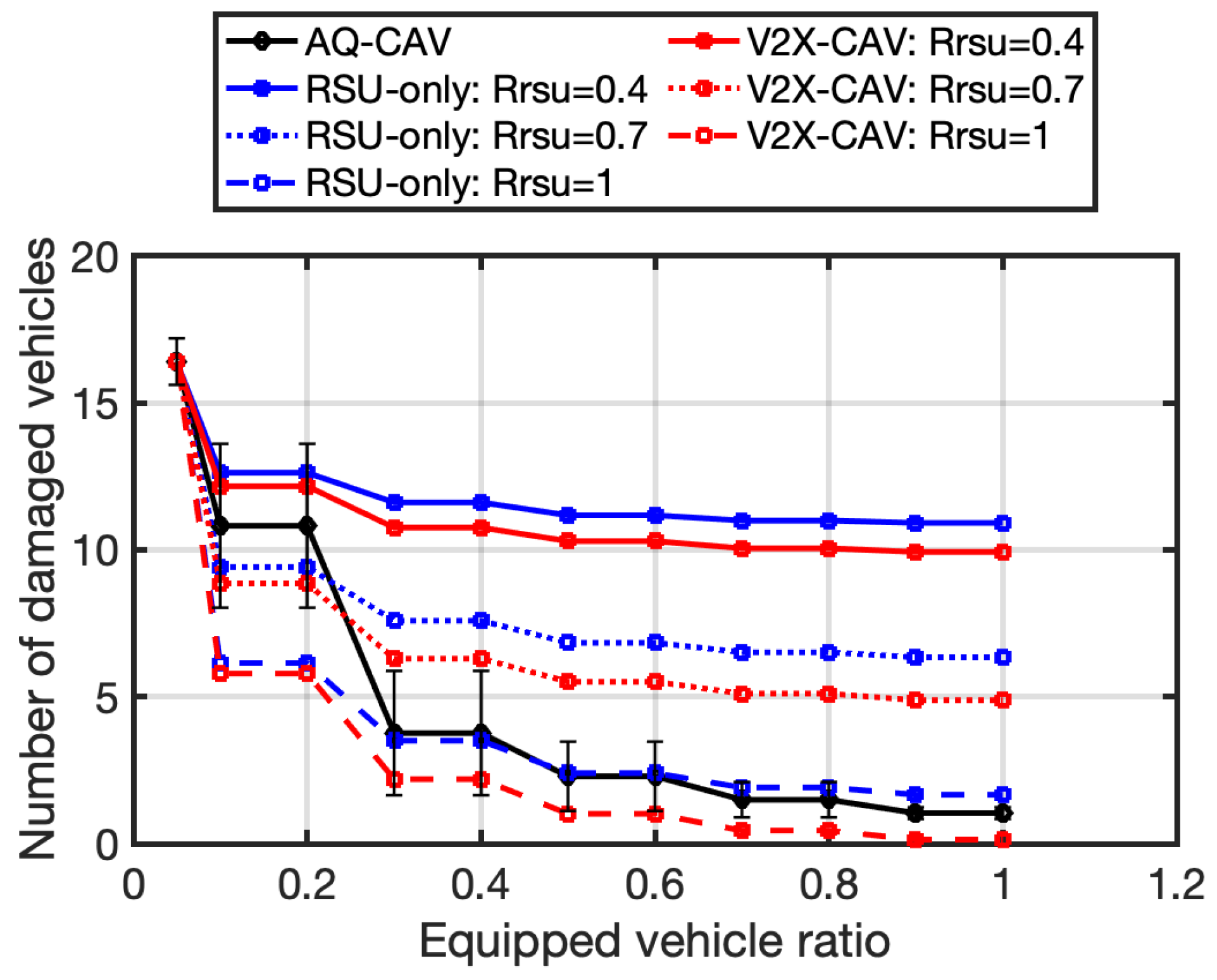
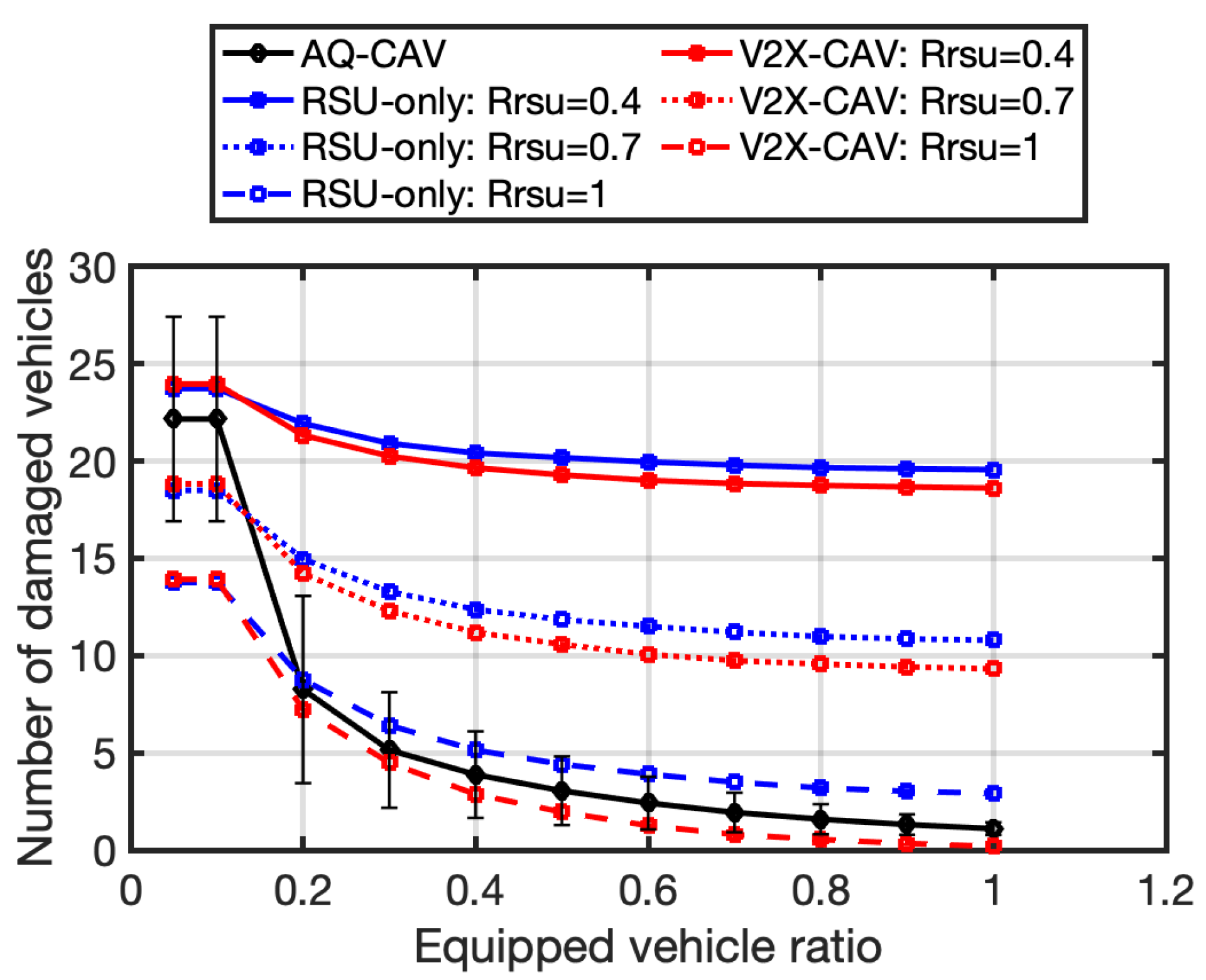
Figure 4 and
Figure 5 present the number of damaged vehicles as a function of
and
for the two systems, with the number of vehicles
being 5 and 10, respectively. The settings for the number of vehicles on the road correspond to average inter-vehicle distances of approximately 100 m and 50 m, respectively, which are reasonable for highway driving scenarios. Each result point in the figures represents the mean over 1000 independent simulation runs, each initialized with a distinct random seed. Error bars indicate 95% confidence intervals. For readability, confidence intervals are plotted only for the AQ-CAV system in the figures.
For the compared RSU-only and V2X-CAV baselines, three settings of 0.4, 0.7, and 1 for
are investigated. Sensing parameter
is set to 600 m. As the results for the scenarios with 5 and 10 vehicles show similar performance trends, we focus on the analysis of the results with 10 vehicles. For
= 0.05, which may approximate the current V2X market penetration, the results in
Figure 5 show that, even with a high RSU deployment level (
), about 18 vehicles on average are still damaged for both the RSU-only and V2X-CAV baselines.
As increases, the number of damaged vehicles remains high (around 11 for the RSU-only baseline and 10 for the V2X-CAV baseline at = 1). Even with = 1 and = 1, the number of damaged vehicles is still three for the RSU-only baseline. This outcome is partly attributable to the limited nighttime sensing capability of RSUs. These findings indicate that the existing V2X-CAV system is not effective in either safety or cost-effectiveness for emergency response.
In contrast, the simulation results indicate that the AQ-CAV system remains effective even when only a small fraction of vehicles are AQ-CAV-equipped. In particular, the AQ-CAV system exhibits a markedly steeper reduction in the number of damaged vehicles compared to baseline approaches. As shown in
Figure 5, the average number of damaged vehicles is approximately 22, 8, and 1 when the penetration rate of AQ-CAV vehicles is 5%, 20%, and 100%, respectively. These results demonstrate that even limited AQ-CAV deployment can lead to substantial safety benefits. Moreover, since existing vehicles can be upgraded to AQ-CAV capability at relatively low cost, the system can progressively scale with increasing penetration. Overall, these findings indicate that the proposed AQ-CAV system significantly outperforms conventional V2X-CAV systems in terms of safety effectiveness and cost efficiency, even under partial deployment.
5.3. Discussions and Future Work
5.3.1. Reliability of QR Code-Based Systems
In this paper, we run preliminary experiments to assess the feasibility and safety performance of the AQ-CAV systems without testing the QR codes in real scenarios. In real scenarios, factors such as weather (e.g., rain, snow, glare), viewing distance, and vehicle speed can affect QR code scanning and decoding performance. In the proposed AQ-CAV system, QR codes are intended to be deployed at controlled locations such as highway entrances or toll gates, where vehicles typically operate at low speeds and reliable scanning can be achieved. Once a vehicle successfully decodes a QR code and obtains the necessary information (e.g., access to TCC servers), continuous QR code scanning is no longer required. As a result, the impact of high-speed driving and adverse weather conditions on system operation can be substantially mitigated. We identify the empirical evaluation of QR code reliability under varying environmental conditions as an important direction for future work.
5.3.2. Security Attacks
In this work, our security discussion focuses primarily on defending against URL spoofing, which we consider a critical and distinctive threat in QR code-based systems. However, other types of attacks and security concerns at a system level are also relevant in practical deployments, such as denial-of-service (DoS) attacks and QR code tampering.
Potential denial-of-service (DoS) attacks on TCCs could make the service temporally unavailable. However, such attacks are not unique to the proposed system and can be mitigated using established approaches such as priority-based service, redundancy, and distributed TCC deployment. Another potential attack is location tracking. There is an inherent trade-off between safety and privacy. The CAVs can have the option of sharing their locations or not. In addition, the CAVs can connect to the TCC servers and subscribe to reports or updates on accidents within an area without sharing their locations, which allows vehicles to receive area-based accident notifications without continuously disclosing precise location data.
Regarding physical QR code tampering, as the proposed system does not rely on continuous QR code scanning and only requires occasional successful decoding at designated locations, the impact of localized QR code tampering can be limited. Moreover, such tampering can be detected through routine inspection and maintenance.
The above discussion provides a system-level security perspective rather than an exhaustive threat model, with the goal of identifying key risks and mitigation directions. A comprehensive security analysis and formal threat modeling across all attack surfaces constitute important directions for future work.
5.3.3. Impact of Communication Systems
Communication services play a key role for the emergency response systems, including the AQ-CAV system. The cellular networks may experience increased load during emergencies, which can affect end-to-end latency and reliability. In this work, rather than modeling the cellular communication system at the protocol or network level, we adopt a configurable and parametric abstraction of communication delay to capture its system-level impact on emergency reporting and warning dissemination. Specifically, the end-to-end delay from accident reporting to warning broadcast is modeled as a bounded random variable uniformly distributed in the range [0.5, 1] s, which reflects representative latency levels reported for contemporary cellular systems under moderate congestion. This abstraction allows us to evaluate the robustness and sensitivity of the proposed AQ-CAV system to communication delay without relying on detailed assumptions about emergency traffic patterns or cellular network internals. While a quantitative study of latency and reliability during large-scale emergency events may help the study of the impact of communication services, it would require detailed traffic models, protocol-level simulation, and empirical measurements, which are beyond the scope of the present study. Importantly, the proposed AQ-CAV framework is designed to be adaptable. The delay parameters can be readily adjusted to reflect different network conditions as new empirical data or models become available.
Another potential concern for communication systems is the scalability of TCC servers during large-scale emergency events. We need to consider simultaneous reporting by a large number of vehicles in realistic scenarios. In the proposed AQ-CAV system, this situation can be handled through a combination of system design and operational mechanisms. First, TCC servers can be provisioned with scalable computing and networking resources (e.g., elastic cloud-based infrastructure) to accommodate temporary surges in reporting traffic. Second, and more importantly, many reports received during such events are likely to correspond to the same underlying accident. Once the TCC server receives an initial report and verifies the event, it can promptly broadcast warning messages to affected vehicles and publish the information through its service interface. Upon receiving the warning notification, other vehicles that would otherwise report the same accident can suppress or abort redundant reports, thereby significantly reducing unnecessary reporting load. This feedback-based suppression mechanism helps prevent report flooding and improves the overall scalability of the system.
Furthermore, connectivity resilience has a high impact on the performance of the AQ-CAV systems. While cellular networks provide the primary communication channel in the proposed AQ-CAV system, alternative connectivity options are important in scenarios where cellular service is unavailable or degraded. In such cases, several complementary communication mechanisms may be leveraged, including satellite links, direct vehicle-to-vehicle (V2V) communication, dedicated public safety radio systems, and unmanned aerial vehicles (UAVs) acting as temporary relays. Within the proposed agent-based AQ-CAV architecture, AI agents are designed to flexibly explore and utilize available communication channels to maintain connectivity with other vehicles and TCCs when feasible.
5.3.4. QR Codes Deployment and Coverage–Cost Analysis
Coverage planning and optimization are important aspects when considering large-scale deployment of the AR-CAV systems. The placement and density of QR codes introduce a coverage–cost trade-off that depends on sensing conditions and decoding reliability. While a full-coverage optimization model is outside the scope of this work, practical deployment at controlled locations (e.g., highway entrances and toll gates) enables effective coverage with minimal infrastructure cost. Systematic coverage optimization based on empirical decoding performance is an important topic for future research.
5.3.5. Evaluation of Agent AI in the AQ-CAV System
Lightweight protocols such as A2A and MCP are referenced in this paper as representative tools that enable interaction between vehicle-side agents and external agents or services within the AQ-CAV framework, particularly in the emergency reporting and warning case study. In this work, however, the primary focus is on assessing the feasibility, system architecture, and safety performance of the proposed QR code-assisted AQ-CAV approach, rather than the implementation or protocol-level evaluation of specific agent communication standards. While open-source implementations of A2A and MCP exist, they are not directly implemented or evaluated in the current study. The implementation and evaluation of the A2A and MCP protocols are identified as important directions for future work.
6. Conclusions
This paper envisions a paradigm shift from isolated autonomy toward agentic and cooperative intelligence in CAV systems. It leveraged the QR codes and designed QR code authentication to tackle the challenges of deployment cost, scalability, and adaptivity in the existing CAV systems. In addition, it treats vehicles, infrastructure, and control entities as interactive agents with reasoning, communication, and learning capabilities. Agentic AI enables vehicles not merely to react, but to negotiate, anticipate, and self-organize. They foster resilient, scalable, and ethically aligned mobility ecosystems. Representative applications with the proposed AQ-CAV system are discussed. An emergency response use case with the AQ-CAV was investigated, which demonstrated effectiveness in safety and scalability. Realizing this vision requires addressing a series of deep technical, organizational, and ethical challenges. These challenges stem from the intrinsic complexity of multi-agent communication and coordination, the heterogeneity of real-world environments, safety assurance, and the need for accountable and verifiable intelligence at scale. Future research will therefore focus on foundational advances and practical testing that enable reliability, adaptability, and societal trust in QR code-based and agentic mobility ecosystems.