Abstract
An interconnection network is usually modeled by a graph, and fault tolerance of the interconnection network is often measured by connectivity of the graph. Given a connected subgraph L of a graph G and non-negative integer t, the t-extra connectivity , the L-structure connectivity and the t-extra L-structure connectivity of G can provide new metrics to measure the fault tolerance of a network represented by G. Fully connected cubic networks are a class of hierarchical networks which enjoy the strengths of a constant vertex degree and good expansibility. In this paper, we determine , and for and . We also establish the edge versions , and for and .
Keywords:
connectivity; extra connectivity; structure connectivity; fully connected cubic networks; fault tolerance MSC:
68M15; 05C40; 05C82
1. Introduction
To improve the flexibility and effectiveness of interconnection networks, a major measure is to mend its fault-tolerant performance. Fault tolerance refers to the ability of an interconnection network to run normally when some components fail. The fault-tolerance ability of interconnection networks increases the overall consistency of the parallel systems and improves its functionality. Therefore, the fault tolerance of an interconnection network is an important issue and has been studied extensively [1]. It is well known that when the underlying topology of an interconnection network is modeled by a graph G, the classical connectivity and edge connectivity of G are used as deterministic measures of fault tolerance of the interconnection network. The connectivity (resp., edge connectivity) of a graph G, denoted (resp., ), is the cardinality of a minimal set S of vertices (resp., edges) whose removal disconnects G or makes an isolated vertex. In general, the interconnection network becomes more reliable as the connectivity and edge connectivity rise.
However, these two measures are bounded by the minimum degree of the graph. Thus, they cannot accurately reflect the real fault-tolerant ability of networks under some particular cases. In order to overcome this shortcoming and reflect the reliability of interconnection networks more accurately, some generalizations of these two measures have been proposed. Esfahanian and Hakimi introduced the concept of restricted connectivity, which requires that each vertex has at least one good neighbor [2,3]. Over the past few years, the restricted connectivity has found applications in several interconnection networks; see, for example, the works in [4,5] and the references therein. Fábrega et al. introduced the t-extra connectivity by adding extra conditions on every component of a faulty network [6]. As an important measure, extra connectivity has been widely studied. Yang et al. determined the t-extra connectivity of the n-dimensional hypercube for and . More generally, Chang et al. studied the t-extra connectivity of hypercube-like networks for . Recently, An et al. investigated the t-extra connectivity of the data center network RRect for [7]. For further reviewing of t-extra connectivity, the readers can refer to [8,9,10,11,12].
It is worth noting that the above-mentioned research only deals with the faults of a single vertex and fails to take into account the possible impact that these faulty vertices may have on their neighboring vertices. In fact, in a real-world network environment, adjacent vertices usually have an influence on one another. Specifically, when a vertex is faulty, the vertices adjacent to the faulty one are often more prone to being affected, with an increased likelihood of suffering subsequent faults. By taking into account this case, Lin et al. introduced the L-structure connectivity and L-substructure connectivity of a graph G and determined and for a hypercube and [13]. Following this trend, the two measurements have been studied extensively for other interconnection networks like two-dimensional torus networks [14], alternating group networks [15], split-star networks [16] and divide-and-swap cube [17]. In addition, the further promotion of these concepts and studies also demonstrates the strong vitality of this topic. Recently, combining t-extra connectivity and L-structure connectivity, Zhu et al. proposed t-extra L-structure connectivity and investigated this property of hypercubes [18]. In 2021, Sabir et al., inspired by the impacts brought about by structure edge faults, proposed structure edge connectivity and used the measurement to evaluate the fault tolerance of some recursive interconnection networks [19]. Later, Wang et al. studied the structure edge connectivity and substructure edge connectivity of regular networks [20]. In this paper, combining t-extra connectivity and L-structure edge connectivity, we introduce t-extra L-structure edge connectivity.
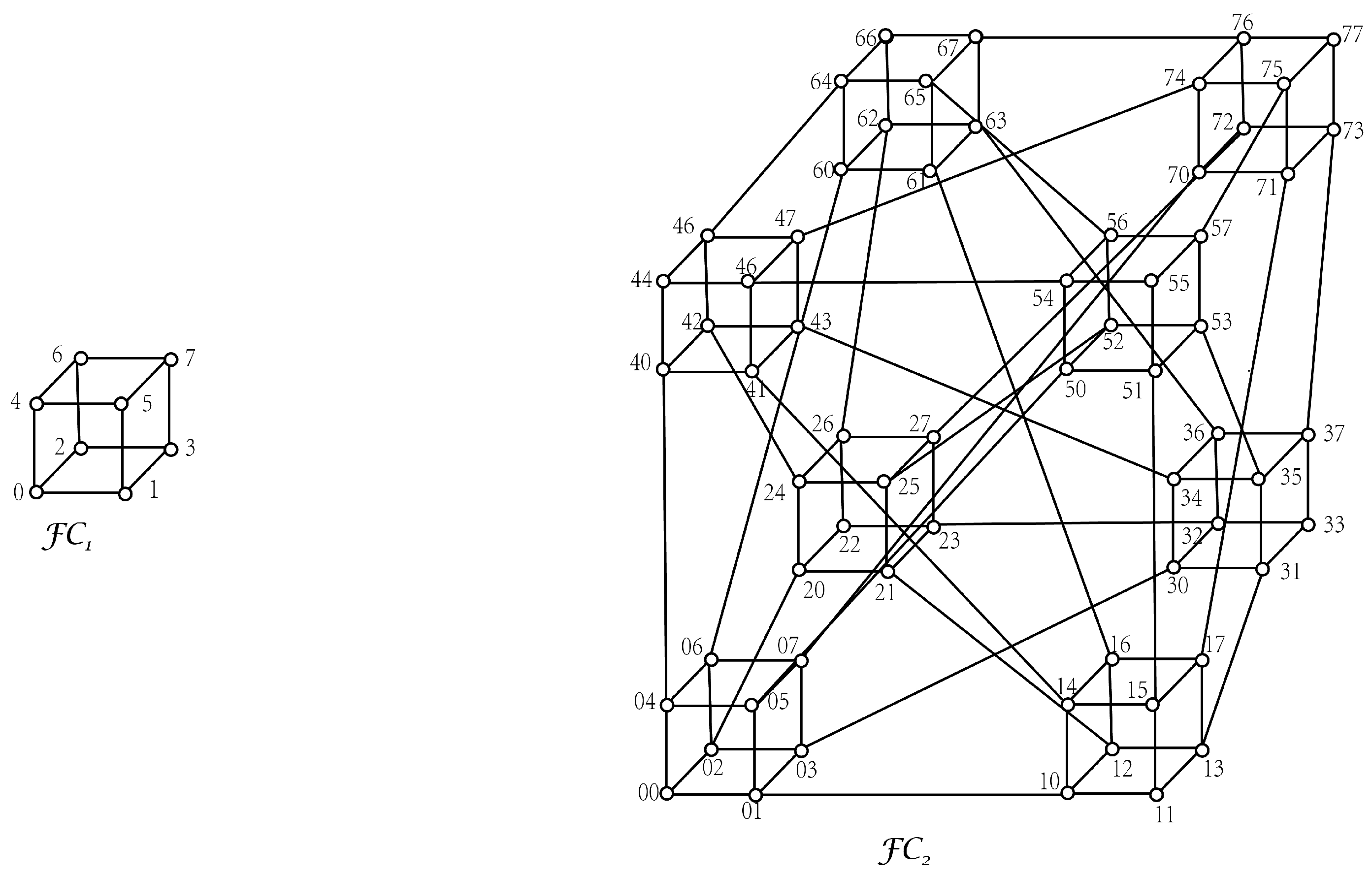
This paper focuses on fully connected cubic networks, represented as . They are recursively defined using the three-dimensional hypercube as the base graph. As a result, networks possess the advantages of a constant vertex degree and excellent expandability [21]. For simplicity, we represent as hereafter. Some basic properties including the connectivity, diameter and maximally fault-tolerant capability of were also discussed in [21]. Later, Yang et al. provided the shortest-path routing algorithm in [22]. Ho et al. studied the fault-tolerant Hamiltonian property of [23]. Chin et al. proved that was super-spanning-connected [24]. Anitha investigated the total domination problem in fully connected cubic networks [25]. Rao et al. explored some forcing parameters in fully connected cubic networks [26]. In this paper, we discuss the t-extra connectivity (resp., t-extra edge connectivity), L-structure connectivity (resp., L-structure edge connectivity) and t-extra L-structure connectivity (resp., t-extra L-structure edge connectivity) of the fully connected cubic networks for and .
The rest of this article is organized as follows: In Section 2, we introduce the definitions and notations of graphs applied in this paper. The principal contributions of this paper are presented in Section 3 and Section 4. The results of the paper are summarized in Section 5.
We list some symbols in Table 1.
Table 1.
Notations and descriptions.
2. Preliminaries
2.1. Graph Definitions and Notations
For a graph , denote by and the vertex set and edge set. The order of G is the cardinality of , and the size of G is the cardinality of . Let , and denotes the edge if u is adjacent to v. For a vertex subset , we denote as the set for some . This set includes all vertices outside S that are adjacent to at least one vertex in S. In particular, is a subgraph of graph G, which is obtained by removing vertex u and its adjacent edges from graph G. The degree of a vertex u is . If , we call it an isolated vertex. We denote by and the minimum degree and maximum degree of graph G. We use to denote a complete graph with n vertices, where every pair of vertices is connected by an edge. Additionally, we use to denote a star which consists of a central vertex connected to n leaf vertices.
Definition 1
([6]). Let and . Then, we call S a t-extra vertex cut if becomes disconnected and every component of contains at least vertices. Moreover, , the t-extra connectivity, is defined as the minimum size of all t-extra vertex cuts.
By the definition above, we infer .
In the following five lemmas, let L be a connected subgraph of a graph G.
Definition 2
([13]). Assume that a set of vertex-disjoint connected subgraphs in G is denoted by . When ’s every element is isomorphic to L and is not connected, we call an L-structure cut. The cardinality of a minimum L-structure cut of G is said to be the L-structure connectivity of G, written as . If is disconnected and every element of is isomorphic to a connected subgraph of L, then we call an L-substructure cut. A minimum L-substructure cut’s cardinality is said to be the L-substructure connectivity, denoted by , of G.
By definition, it is not difficult to see that . Moreover, and reduce to the classical connectivity , i.e., .
Definition 3
([18]). Let . For L and a set of vertex-disjoint subgraphs of G, we call a t-extra L-structure cut if ’s every element is isomorphic to L, is not connected, and ’s every remaining component contains more than t vertices. The cardinality of a minimum t-extra L-structure cut of G is said to be the t-extra L-structure connectivity of G, written as . Moreover, we call a t-extra L-substructure cut if ’s every element is isomorphic to a connected subgraph of L, is not connected, and ’s every component contains more than t vertices. The cardinality of a minimum t-extra L-substructure cut of G is said to be the t-extra L-substructure connectivity of G, written as .
By definition, we have that and .
Definition 4
([6]). For a non-negative integer t, we call an edge subset F of a graph G, a t-extra edge cut if is disconnected and every component of has at least vertices. Moreover, the minimum cardinality over all t-extra edge cuts of G is said to be the t-extra edge connectivity, denoted by .
By the definition above, we infer .
Definition 5
([19]). Let denote a set of edge-disjoint subgraphs of G. Then, we call an L-structure edge cut if is not connected and ’s every element is isomorphic to L. If is an L-structure edge cut of G, then the minimum cardinality of is said to be the L-structure edge connectivity of G, written as . Moreover, if is not connected and ’s every element is isomorphic to a connected subgraph of L, then is said to be an L-substructure edge cut. If is a substructure edge cut of G, then the L-substructure edge connectivity of G, denoted by is the minimum cardinality of .
By definition, . In addition, the -structure edge connectivity and -substructure edge connectivity reduce to the classic edge connectivity. Therefore, structure edge connectivity and substructure edge connectivity can both be regarded as general forms of the classic edge connectivity.
Definition 6.
Let and a set of edge-disjoint subgraphs of G be denoted by . Then, we call a t-extra L-structure edge cut if ’s every element is isomorphic to L, is not connected, and every remaining component of contains more than t vertices. The t-extra L-structure edge connectivity of G, denoted by is the minimum cardinality of such that is a t-extra L-structure edge cut of G. Moreover, is a t-extra L-substructure edge cut if every element in is isomorphic with a connected subgraph of L, is not connected, and ’s every component has more than t vertices. The t-extra L-substructure edge connectivity of G is the minimum cardinality of such that is a t-extra L-substructure edge cut of G.
By definition, we have . Moreover, .
2.2. Fully Connected Cubic Networks
The Hamming distance between two strings of the same length is the number of positions at which the corresponding characters differ. We set to be the set .
Definition 7.
The n-dimensional hypercube consists of the vertex set for each . Two vertices x and y are adjacent in if and only if they differ in exactly one position, meaning the Hamming distance between them is one.
Lemma 1
([27]). For , .
Lemma 2
([13]). When , , and , where .
Lemma 3
([18]). for .
Lemma 4
([28]). For , let with . If is not connected, then it contains exactly two components, and one of them contains vertices.
For any positive integer and for any , we set . For any positive integer , let denote the function that returns the binary representation of x with a fixed length n. For example, , and .
Definition 8
([21]). For , the n-level fully connected cubic networks, , is defined as follows:
- 1.
- has vertex set and edge set for .
- 2.
- For , the graph is constructed from eight vertex-disjoint copies of by adding 28 edges. For , let represent a copy of with each vertex being prefixed by m. Specifically, the vertex set of is and for each . Then, the graph is defined as and with .
Figure 1 shows and . It is worth mentioning that . Let . If a vertex in is of the form , then it is said to be a boundary vertex, and if it has the form with , then it is said to be an intercubic vertex. If an edge joins two intercubic vertices, then we call it an intercubic edge. Obviously, every has seven intercubic vertices and one boundary vertex for and . Let S be any subset of . For convenience, we set to be the subgraph induced by ).
Figure 1.
Illustrations of and .
Lemma 5
([29]). For , and .
Lemma 6
([24]). For and for any two elements with , there is exactly one intercubic edge between and , denoted by .
3. Extra Connectivity, Structure Connectivity and t-Extra L-Structure Connectivity
For any vertex subset F of , we set . Note that and if .
Lemma 7.
Let F be any vertex subset of with . Define m as , and let t be an element in such that . For , is connected if , and is connected if .
Proof.
We set such that and . Since and , and for . By Lemma 5, is connected for each . By Lemma 6, there is an edge between and for any two elements with . Thus, the subgraph is connected. We set and .
- Case 1: . We set for each . By Lemma 6, . Since and for each , there is an edge, say , in with . Since and are both connected, is connected. Similarly, one can deduce that is connected for each . Thus, we have if .
- Case 2: . By Case 1, we have that is connected. Since , we have that is connected. We set . By Lemma 6, . Since and , there exists an edge, say , in with . From the fact that and are both connected, one can infer that is also connected for . □
3.1. Extra Connectivity
Lemma 8.
Let with . If , then contains a component with at least vertices.
Proof.
We set such that . Suppose that . We prove this lemma by mathematical induction on n. By Lemma 7, is connected and it contains vertices. Thus, we consider that . Since , we have and for each . Let . By Lemma 7, the subgraph is connected. We have the following cases:
- Case 1: . Let R be the largest connected component of . If is connected, then R contains vertices. Otherwise, by Lemma 4, it contains four vertices. Consequently, R contains at least three intercubic vertices, and one of these intercubic vertices has a neighbor in . Hence, the subgraph induced by and is connected and contains at least vertices.
- Case 2: . Since , there are at least three vertices, say and , in such that those vertices are not boundary vertex of . By Lemma 6, each vertex of them has a neighbor in . Thus, the subgraph induced by contains vertices. However, . Therefore, this lemma is valid when .
Suppose that it is true for . Next, we consider the case for . By Lemma 7, is connected and it contains vertices. Thus, we focus on the case where .
Since , we have and for each . Let . By induction hypothesis, contains a component R which contains a least vertices. Since has seven intercubic vertices, R has at least two intercubic vertices. Since , there is at least one intercubic vertex in R such that its neighbor is in . Hence, the induced subgraph induced by and is connected and contains at least vertices. □
Theorem 1.
Proof.
Since is isomorphic to , by Lemma 1, we have . Next, we consider the case for .
Let F be any subset of vertices of with . By Lemma 8, is either connected or it contains exactly two components: one trivial component and one nontrivial component. This implies that F is not a one-extra vertex cut of . Hence, .
We set , , , , , and . It is straightforward to see that , and . We set R as . Since , R forms a vertex cut of . Let w be any vertex in . According to Definition 8, . Hence, w has a neighbor in . Consequently, R is a one-extra vertex cut of . Thus, .
In conclusion, . □
3.2. Structure Connectivity
Theorem 2.
For , .
Proof.
We set , , , , , and . Then, we set F as . Obviously, every element in F is an edge in . Combining the fact that is not a connected graph with the fact that F is a -structure cut of , and .
Let S be a -substructure cut of with . Since S is a vertex cut and , by Lemma 8, contains one trivial component and one nontrivial component . Moreover, and . Since each element in S represents either a single vertex or two adjacent vertices, and is -free, u can have at most one neighbor in each element of S. Since , we must have , which contradicts the fact that . Therefore, S cannot be a -substructure cut. Consequently, and for . □
Lemma 9.
For , .
Proof.
We set , , , , , , , and . It follows that for every and for every .
Let . Each element in is isomorphic to and . Since is disconnected where is one component of , we have that is a -structure cut of . Hence, .
Similarly, define . Each element in is isomorphic to and . From the fact that is not connected, we have that is a -structure cut of . Therefore, .
In conclusion, we have . □
Theorem 3.
For , .
Proof.
By Lemma 9, we have . Thus, we only need to show that .
We prove it by contradiction. Let S be a -substructure set of with . Suppose that is not connected. We assume that C is the smallest component of . Since and is triangle free, . However, by Theorem 1, for . This means that under the condition , if we want to disconnect , we have to delete at least five vertices. However, , which is a contradiction. Thus, and so for . □
Lemma 10.
For , we have .
Proof.
Since , the lemma is valid for . Thus, suppose that it is also valid for . Next, we consider the case for . We assume that and .
Suppose that . According to Definition 8, u has at most one neighbor in , and v has at most one neighbor in . Thus, .
Suppose that . By induction hypothesis, . Let . By Definition 8, the neighbor vertex of u in is not the same as the neighbor vertex of v in if both u and v are intercubic vertices. Thus, . □
Theorem 4.
For .
Proof.
By Lemma 9, we have . Thus, we only need to show that and . We prove this by contradiction. Consider a set F which is a subset of the collection of all -substructures of that satisfies . Assume that is not connected. We suppose that C is the smallest component of . Combining the fact that and is triangle free with Lemma 10, . However, by Theorem 1, for . This means that under the condition , if we want to disconnect , we have to delete at least five vertices. However, , which is a contradiction. Thus, , and so for . □
By Lemma 2, we have for every . The following theorem is derived from Theorems 2, 3 and 4.
Theorem 5.
3.3. t-Extra L-Structure Connectivity
Theorem 6.
Proof.
According to Lemma 3, one can deduce . Next, we consider .
First, we show that and as follows: Let , . Take . Set . Obviously, every element in F is isomorphic to and . Because is not connected and its every component has more than one vertex, we have that F is a one-extra -structure cut of . This means that and .
Below, we prove that and for . We prove this by contradiction. Let F be a one-extra -substructure cut of with . Then, is disconnected. We assume that C is the smallest component of . Clearly, . However, by Theorem 1, for . This means that under the condition , if we want to disconnect , we have to delete at least five vertices. However, , which is a contradiction. Thus, , and so for . □
4. Extra Edge Connectivity, Structure Edge Connectivity and g-Extra H-Structure Edge Connectivity
Let be any subset of edges of . We set for each , and . Note that is the set of faulty intercubic edges. Moreover, .
Lemma 11.
Let be a subset of edges of with . Define m as , and let t be an element in such that . For , is connected if , and is connected if .
Proof.
We set such that and . Since and , . We set , and . By Lemma 5, is connected for each .
- Case 1: . Let , and let R be the set . Since and , by Lemma 6, there is an index z in R such that the edge between and and the edge between and are not in . Since is connected, can connect to via . Consequently, for any two distinct indices and in S, there exists an index such that can connect to via . Thus, is connected if .
- Case 2: . By Case 1, we have that is connected. By Lemma 5, is connected. By Lemma 6, there are seven edges between and . Since , there is an edge between and such that it is not in . Thus, is connected if . □
4.1. Extra Edge Connectivity
Lemma 12.
If is a subset of edges of with , then contains a component with at least vertices.
Proof.
Without loss of generality, we may assume that for each . According to Lemma 11, this lemma is valid for . Hence, we consider the case . We have . Let be the set of all intercubic vertices in , and let be the boundary vertex in . Since , there is at least six intercubic vertices in such that their corresponding intercubic edges are not in . We may suppose that ’s corresponding intercubic edge is not in for each . Thus, can connect to via its corresponding intercubic edge. Let e be the ’s corresponding intercubic edge.
- Case 1: . We have that can connect to via its corresponding intercubic edge. Hence, the subgraph H induced by R and is connected and it contains vertices.
- Case 2: . We have .
- Case 2.1: . Let . Since and y can connect to via its corresponding intercubic edge, can connect to via y. Hence, the subgraph H induced by , and is connected and it contains vertices.
- Case 2.2: . Since , we have that there are at least two edges corresponding to that are in . Since , . Similarly to Case 2.1, the subgraph H induced by R and is connected and contains vertices. □
Lemma 13.
Let with . If , then contains a component with at least vertices.
Proof.
According to Lemma 12, the lemma is valid for . Below, we assume that the result is also valid for . Without loss of generality, we may assume that for each . According to Lemma 11, this lemma is valid for . Hence, we consider the case .
By Lemma 11, is connected for . By the induction hypothesis, there is a connected component R in that contains at least vertices. Consequently, R contains at least six intercubic vertices. Since , some of the intercubic vertices in R can connect to via its intercubic edge. Thus, the subgraph induced by and is connected and it contains at least vertices. □
From Lemma 13, we obtain the corollary below.
Corollary 1.
Let with . Then, one of the following is true:
1. is connected;
2. contains exactly two components, and one of them contains vertices.
Theorem 7.
Proof.
Combining the fact that with Lemma 1, we obtain . Hence, . Thus, we consider the case below. On one hand, we prove . Let , , . Clearly, . Because , and u,v have no common vertices, . Since , is connected. Thus, every component of has at least two vertices. This means that F is a one-extra edge cut of . Thus, . On the other hand, we prove . Suppose, to the contrary, that . Suppose that S is an arbitrary minimum one-extra edge cut of . This means . By Corollary 1, contains a component, say C, that satisfies . Clearly, this is a contradiction. Hence, . In summary, . □
4.2. Structure Edge Connectivity
Theorem 8.
When , .
Proof.
The result clearly holds for since . In the following we consider the case .
First, we show that for . Assume that S is a -substructure set of with . Since , is connected. Thus, .
Next, we prove that for . We set , , , and .
- Case 1: . Set . Obviously, S’s every element is isomorphic to and . Since is disconnected, we have that is clearly a -structure edge cut of . This means that and .
- Case 2: . Set . Obviously, F’S every element isomorphic to and . Since is disconnected, we have that is clearly a -structure edge cut of . This implies that and .
In conclusion, for , we have . □
4.3. g-Extra H-Structure Edge Connectivity
Theorem 9.
Proof.
By definition, we obtain . In the following, we prove first that and for . Let , . Take . Set . Obviously, S’s every element is isomorphic to and . Because is not connected and ’s every component has more than one vertices, we infer that is a one-extra -structure edge cut of and so and . Now, we prove that and when . Assume that S is an arbitrary set of edge disjoint -substructures of with . Then, . Thus, and so . □
5. Conclusions
Fault tolerance is significant to the reliability analysis of interconnection networks. Extra connectivity, structure connectivity and t-extra L-structure connectivity are important parameters to measure network fault tolerance. In this paper, we explored the t-extra connectivity, L-structure connectivity and t-extra L-structure connectivity of fully connected cubic networks . In detail, we determined that
We also established the corresponding edge versions of the results . On the basis of this research, one can continue to study the t-extra connectivity, L-structure connectivity and t-extra L-structure connectivity of for more general t and L.
Author Contributions
Methodology: E.S.; writing—review and editing: C.-K.L. All authors have read and agreed to the published version of the manuscript.
Funding
This research was funded by the National Natural Science Foundation of China (12261085).
Data Availability Statement
The manuscript has no associated data.
Conflicts of Interest
The authors declare no conflicts of interest.
References
- Nadeem, M.F.; Imran, M.; Afzal Siddiqui, H.M. Fault tolerance designs of interconnection. Peer-to-Peer Netw. Appl. 2023, 16, 1125–1134. [Google Scholar] [CrossRef]
- Esfahanian, A.-H.; Hakimi, S.L. On computing a conditional edge-connectivity of a graph. Inf. Process. Lett. 1988, 27, 195–199. [Google Scholar] [CrossRef]
- Esfahanian, A.-H. Generalized measures of fault tolerance with application to n-cube networks. IEEE Trans. Comput. 1989, 38, 1586–1591. [Google Scholar] [CrossRef]
- Li, X.; Zhou, S.; Guo, X.; Ma, T. The h-restricted connectivity of the generalized hypercubes. Theor. Comput. Sci. 2021, 850, 135–147. [Google Scholar] [CrossRef]
- Lin, L.; Huang, Y.; Wang, X.; Xu, L. Restricted connectivity and good-neighbor diagnosability of split-star networks. Theor. Comput. Sci. 2020, 824, 81–91. [Google Scholar] [CrossRef]
- Fàbrega, J.; Fiol, M.A. Extraconnectivity of graphs with large girth. Discrete Math. 1994, 127, 163–170. [Google Scholar] [CrossRef]
- An, N.; Lv, M.; Fan, W.; Han, L.; Xiao, F. Extra connectivity of the data center network-RRect. J. Supercomput. 2024, 80, 16452–16473. [Google Scholar] [CrossRef]
- Cheng, E.; Lipták, L.; Qiu, K.; Shen, Z.; Vangipuram, A. On the g-extra connectivity of augmented cubes. Theor. Comput. Sci. 2022, 33, 155–173. [Google Scholar] [CrossRef]
- Gu, M.-M.; Hao, R.-X.; Lei, J. Fault-tolerance and diagnosability of hierarchical star networks. Int. J. Comput. Math. 2018, 3, 106–121. [Google Scholar] [CrossRef]
- Sun, X.; Dong, Q.; Zhou, S.; Lv, M.; Lian, G.; Liu, J. Fault tolerance analysis of hierarchical folded cube. Theor. Comput. Sci. 2019, 790, 117–130. [Google Scholar] [CrossRef]
- Sun, X.; Fan, J.; Sabir, E.; Cheng, B.; Yu, J. Reliability of augmented k-ary n-cubes under the extra connectivity condition. J. Supercomput. 2023, 79, 13641–13669. [Google Scholar] [CrossRef]
- Yi, Y.; Fan, J.; Cheng, B.; Wang, Y.; Yu, J. The 3-extra connectivity of the data center network BCube. J. Parallel Distrib. Comput. 2022, 65, 3199–3208. [Google Scholar] [CrossRef]
- Lin, C.-K.; Zhang, L.; Fan, J.; Wang, D. Structure connectivity and substructure connectivity of hypercubes. Theor. Comput. Sci. 2016, 634, 97–107. [Google Scholar] [CrossRef]
- Cheng, D. Extra connectivity and structure connectivity of 2-dimensional torus networks. Int. J. Found. Comput. Sci. 2023, 970, 114059. [Google Scholar] [CrossRef]
- Ge, H.; Zhang, S.; Ye, C. The structure fault tolerance of alternating group networks. Int. J. Found. Comput. Sci. 2024, 35, 483–500. [Google Scholar] [CrossRef]
- Zhao, L.; Wang, S. Structure connectivity and substructure connectivity of split-star networks. Discret Appl. Math. 2023, 341, 359–371. [Google Scholar] [CrossRef]
- Zhou, Q.; Zhou, S.; Liu, J.; Liu, X. Structure connectivity and substructure connectivity of split-star networks. Theor. Comput. Sci. 2021, 880, 20–36. [Google Scholar] [CrossRef]
- Zhu, B.; Zhang, S.; Ge, H.; Ye, C. The g-extra H-structure connectivity and g-extra H-substructure connectivity of hypercubes. AIMS Math. 2023, 8, 24848–24861. [Google Scholar] [CrossRef]
- Sabir, E.; Meng, J. Structure fault tolerance of recursive interconnection networks. Comput. J. 2021, 64, 64–75. [Google Scholar] [CrossRef]
- Wang, N.; Meng, J.; Tian, Y. Reliability analyses of regular graphs based on edge-structure connectivity. Discret Appl. Math. 2024, 356, 329–342. [Google Scholar] [CrossRef]
- Wang, H.; Chang, E.K.C. Fully connected cubic network: A highly recursive interconnection network. In Proceedings of the 11th International Conference on Parallel and Distributed Systems (ICPADS’05), Fukuoka, Japan, 20–22 July 2005; pp. 250–255. [Google Scholar]
- Yang, X.; Megson, G.M.; Evans, D.J. An oblivious shortest-path routing algorithm for fully connected cubic networks. J. Parallel Distrib. Comput. 2006, 66, 1294–1303. [Google Scholar] [CrossRef]
- Ho, T.-Y.; Lin, C.-K. Fault-Tolerant hamiltonian connectivity and fault-tolerant hamiltonicity of the fully connected cubic networks. J. Inf. Sci. Eng. 2009, 25, 1855–1862. [Google Scholar] [CrossRef]
- Chin, C.; Chen, H.-C.; Hsu, L.-. H; Chiou, S.-C.; Lai, K.-T. Super spanning connectivity of the fully connected cubic networks. J. Interconnect. Netw. 2010, 11, 61–70. [Google Scholar] [CrossRef]
- Anitha, J. Total domination in fully connected cubic networks. Int. J. Pure Appl. Math. 2016, 109, 211–218. [Google Scholar]
- Rao, Y.; Kosari, S.; Anitha, J.; Rajasingh, I.; Rashmanlou, H. Forcing parameters in fully connected cubic networks. Mathematics 2022, 10, 1263. [Google Scholar] [CrossRef]
- Xu, J.M.; Zhu, Q.; Hou, X.M.; Zhou, T. On restricted connectivity and extra connectivity of hypercubes and folded hypercubes. J. Shanghai Jiaotong Univ. (Sci.) 2005, E-10, 203–207. [Google Scholar]
- Lai, P.-L.; Tan, J.J.M.; Chang, C.-P.; Hsu, L.-H. Conditional diagnosability measures for large multiprocessor systems. IEEE Trans. Comput. 2005, 54, 165–175. [Google Scholar] [CrossRef]
- Wang, H.; Gu, W.; Chang, E.K.C. Fully connected cubic network applied in parallel processing. In Proceedings of the 2002 IEEE Region 10 Conference on Computers, Communications, Control and Power Engineering, TENCOM ’02, Proceedings, Beijing, China, 28–31 October 2002; Volume 1, pp. 363–366. [Google Scholar]
Disclaimer/Publisher’s Note: The statements, opinions and data contained in all publications are solely those of the individual author(s) and contributor(s) and not of MDPI and/or the editor(s). MDPI and/or the editor(s) disclaim responsibility for any injury to people or property resulting from any ideas, methods, instructions or products referred to in the content. |
© 2025 by the authors. Licensee MDPI, Basel, Switzerland. This article is an open access article distributed under the terms and conditions of the Creative Commons Attribution (CC BY) license (https://creativecommons.org/licenses/by/4.0/).