


Abstract
In this paper, we establish new generalized Mitrinović-Adamović-type inequalities in a wider range by using the monotonicity of certain functions. These inequalities contain sharp and tractable bounds for the function All the main results are also true in due to the symmetry of the curves involved.
Keywords:
Mitrinović–Adamović inequality; Bernoulli numbers; Qi’s inequality; monotonicity of function; circular function MSC:
26D05; 26D15; 42A10
1. Introduction
An obvious relation was refined in [1,2] as
The inequality (1) is known in the literature as Mitrinović–Adamović inequality. In recent years, some mathematicians tried to refine and extend the inequality (1). For instance, the inequality
appeared in the references [3,4,5]. Mortici [6] and Chouikha [7] independently obtained, respectively, the following double inequalities:
and
We observe that it is not difficult to show the validity of (1) in an interval In this direction, Zhu [8] achieved the inequalities
and
On the other hand, W.-D. Jiang [9] very recently maintained the uniformity and sharpness of the bounds for in a wider range and established a better double inequality
along with
We also refer the reader to [10,11,12,13,14,15,16,17,18,19,20,21,22,23,24] and the references therein for more information on this topic.
2. Lemmas for Bernoulli Numbers
Recall that the Bernoulli numbers can be generated by
and all of the Bernoulli numbers for equal 0. For more details, we refer the interested readers to the research monograph [25].
To prove our main results, we need the following important lemmas.
Lemma 1
(see [8,9,25]). Let be the even indexed Bernoulli numbers. Then, for , the following identities hold:
and
Lemma 2
(see [26]). For we have
where are the even indexed Bernoulli numbers.
The following well-known Qi’s inequality for Bernoulli numbers is crucial in this paper.
Lemma 3
(see [27]). For the even indexed Bernoulli numbers satisfy
We now establish some new auxiliary results for even indexed Bernoulli numbers.
Lemma 4.
For we have
Proof.
Lemma 5.
For it is true that
Proof.
Lemma 6.
Let Then, it holds that
where
Proof.
In view of Lemma 3, it suffices to prove
for Equivalently,
A direct computation gives
which can be put as
Since
for we only need to prove that
where
Now, implies
□
3. Some New Generalized Mitrinović–Adamović-Type Inequalities
We are now in a position to state and prove our main results.
Theorem 1.
The function
is strictly decreasing on
Proof.
The differentiation of gives
and then deduces
where
Using power series expansions in Lemma 1, and known series expansions of and we have
where
We calculate and
Next, we claim that for First, we need to prove for that is,
for and then for that is,
for Now, by Lemma 4 and Lemma 5, we, respectively, have
and
Combining (10) with (11), we obtain
which implies (8). Also, the inequality (11) implies (9). Thus, for Therefore, we conclude that and consequently This shows that is strictly decreasing on The proof is completed. □
The following new generalized Mitrinović–Adamović-type inequality can be established by applying Theorem 1.
Theorem 2.
The following double inequalities are valid:
- (i)
- The double inequalityholds with the best possible constants and .
- (ii)
- The double inequalityholds with the best possible constants and .
Proof.
Applying Theorem 1, we have
and
From the limits
we can show the desired inequalities (12) and (13). □
Remark 1.
The left inequality of (13) can be written as
This inequality was first proved by Neuman and Sándor [4] and reappeared in [15]. However, it was shown to be true on only.
Remark 2.
It can be observed that the right inequality of (13) is in fact true for This fact can be verified graphically at https://www.desmos.com/calculator (accessed on 1 March 2025). Let us write
and
for Then, we compare graphically the bounds in (13) with those in (2).
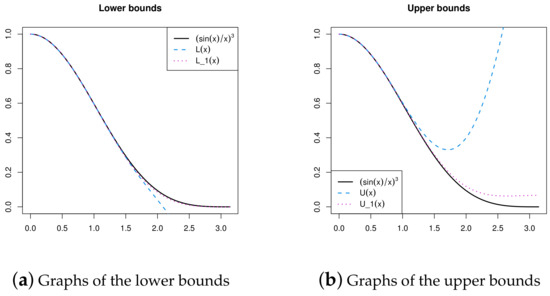
In what follows, we further refine the bounds of
Theorem 3.
The function
is strictly increasing on
Proof.
Differentiating with respect to x yields
This can be written as where
Utilizing Lemma 1, we obtain
where
By Lemma 6, This proves that and hence is positive, implying that is strictly increasing on The proof is completed. □
Theorem 4.
The following double inequalities are valid:
- (i)
- The double inequalityholds with the best possible constants and
- (ii)
- The double inequalityholds with the best possible constants and
Proof.
□
Remark 3.

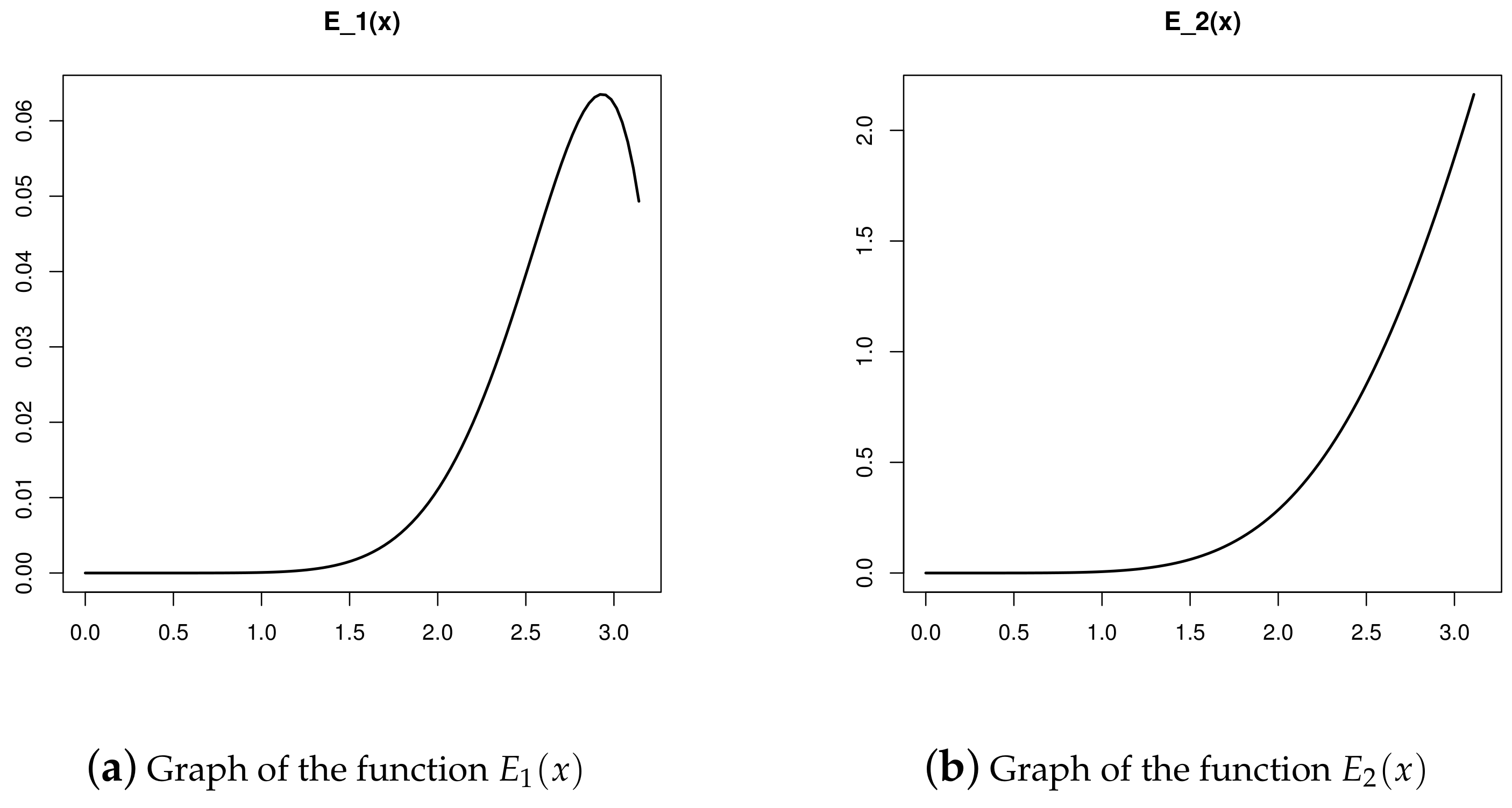
If we suppose
and
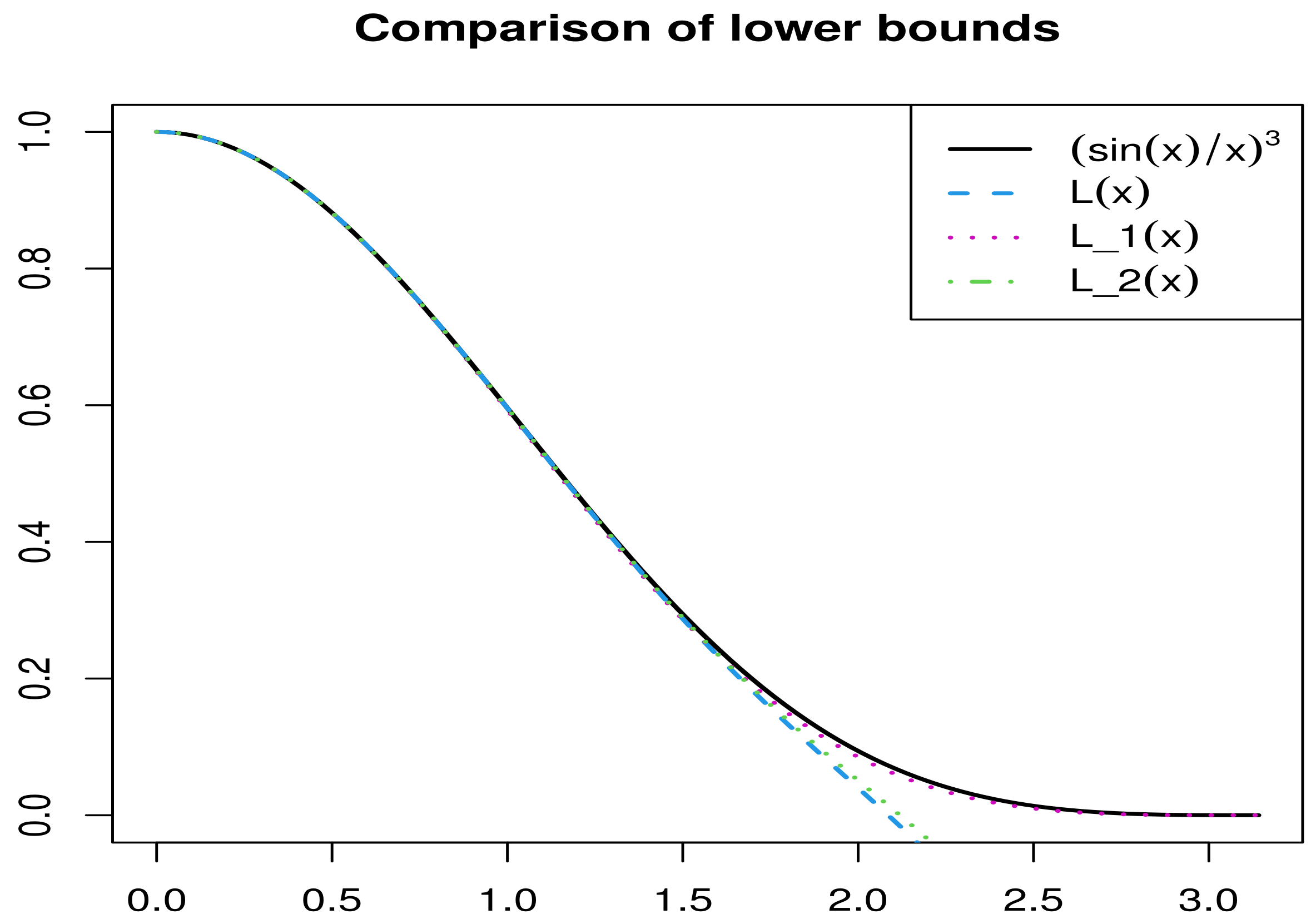
then it is obvious that for all Based on Figure 2 and some numerical calculations, it is found that for where

The curves and depicted in the following Figure 3 show that the double inequality (2) is completely refined to (15).
Figure 3.
Graphs of the functions and for .
Lemma 7.
Let
Then, for
Proof.
It is still possible to refine the inequalities of Theorem 3. We present the following more refined results.
Theorem 5.
The function
is strictly increasing on
Proof.
By the differentiation of we have
where
We plan to use the series expansions given in Lemma 1 to obtain
After simplifying, can be written as
Then, we have
which is equivalent to
that is,
Here,
We write conveniently as
From this, we obtain So,
where the function in the parentheses is strictly decreasing on Hence,
The values of ’s in the above expression for are calculated using the Bernoulli numbers ([25], Chapter 23). For proving on it suffices to prove for Now, we rewrite as follows:
Since
by using Qi’s inequality (5) and applying Lemma 7. we have
Thus, , implying that Therefore, is strictly increasing on The proof is completed. □
Theorem 6.
The following double inequalities are valid:
- (i)
- The double inequalityholds with the best possible constants and
- (ii)
- The double inequalityholds with the best possible constants and
Proof.
Applying Theorem 5, we obtain
and
Then, using the limits
we can prove our conclusion. □
Remark 4.
Remark 5.
In our new generalized Mitrinović–Adamović-type inequalities, we have compared our bounds of in a larger interval with the old ones, i.e., with the corresponding bounds of (2). A similar numerical and/or graphical comparison can be made to show that the double inequalities (14) and (20) are superior to (3). In conclusion, we obtained stronger and superior bounds for the function than those in (2)–(3). Moreover, all the main results of the paper hold in because of the the symmetry of curves involved. Thus, our bounds provide the better alternatives.
Remark 6.
Our results can be used to bound the so-called sinc function, i.e., which is extensively used in mathematics, physics and engineering. For instance, the double inequality (13) can be written as
Remark 7.
An interesting application of our new generalized Mitrinović–Adamović-type inequalities is to find the value of the integral It is known that there are some complex standard methods; however, it is difficult to evaluate for any In such a case, we need to rely on an approximate value of the integral. Here, we can better approximate the integral by using one of our main results. In particular, we approximate by selecting the inequality (21) as the best candidate whose bounds are tractable. Thus, integrating (21) from 0 to π, we have
where
and
After expanding using simple formulae of integration and integrating by parts, we obtain
Then,
which is very close to the exact value
4. Conclusions
In this paper, we established various new generalized Mitrinović–Adamović-type inequalities as follows:
- (See Theorem 2):
- (i)
- The double inequalityholds with the best possible constants and .
- (ii)
- The double inequalityholds with the best possible constants and .
- (See Theorem 4):
- (i)
- The double inequalityholds with the best possible constants and
- (ii)
- The double inequalityholds with the best possible constants and
- (See Theorem 6):
- (i)
- The double inequalityholds with the best possible constants and
- (ii)
- The double inequalityholds with the best possible constants and
In these new generalized Mitrinović–Adamović-type inequalities, we have compared our bounds of in a larger interval with the old ones. We believe that our results will assist us in obtaining novel expression results related to other generalized Mitrinović–Adamović-type inequalities in future studies.
Author Contributions
Writing—original draft, Y.J.B. and W.-S.D.; writing—review and editing, Y.J.B. and W.-S.D. All authors contributed equally to the manuscript and read and approved the final version of the manuscript.
Funding
Wei-Shih Du is partially supported by Grant No. NSTC 113-2115-M-017-004 of the National Science and Technology Council of the Republic of China.
Data Availability Statement
The original contributions presented in this study are included in the article. Further inquiries can be directed to the corresponding author.
Acknowledgments
The authors wish to express their sincere thanks to the anonymous referees for their valuable suggestions and comments.
Conflicts of Interest
The authors declare no conflicts of interest.
References
- Mitrinović, D.S.; Adamović, D.D. Sur une Inegalite Elementaire ou Interviennent des Fonctions Trigonometriques; Univerzitet u Beogradu: Belgrade, Serbia, 1965; pp. 23–34. [Google Scholar]
- Mitrinović, D.S.; Adamović, D.D. Complement a L’article “Sur une Inegalite Elementaire ou Interviennent des Fonctions Trigonometriques”; Univerzitet u Beogradu: Belgrade, Serbia, 1966; pp. 31–32. [Google Scholar]
- Lv, Y.-P.; Wang, G.-D.; Chu, Y.-M. A note on Jordan type inequalities for hyperbolic functions. Appl. Math. Lett. 2012, 25, 505–508. [Google Scholar] [CrossRef][Green Version]
- Neuman, E.; Sándor, J. On some inequalities involving trigonometric and hyperbolic functions with emphasis on the Cusa-Huygens, Wilker, and Huygens inequalities. Math. Inequal. Appl. 2010, 13, 715–723. [Google Scholar] [CrossRef]
- Yang, Z.-H.; Jiang, Y.-L.; Song, Y.-Q.; Chu, Y.-M. Sharp inequalities for trigonometric functions. Abstr. Appl. Anal. 2014, 2014, 601839. [Google Scholar] [CrossRef]
- Mortici, C. The natural approach of Wilker-Cusa-Huygens inequalities. Math. Inequal. Appl. 2011, 14, 535–541. [Google Scholar] [CrossRef]
- Chouikha, A.R. New sharp inequalities related to classical trigonometric inequalities. J. Inequal. Spec. Funct. 2020, 11, 27–35. [Google Scholar]
- Zhu, L. New Mitrinović-Adamović type inequalities. RACSAM 2020, 114, 119. [Google Scholar] [CrossRef]
- Jiang, W.-D. New sharp inequalities of Mitrinović-Adamović type. Appl. Anal. Discrete Math. 2023, 17, 76–91. [Google Scholar] [CrossRef]
- Chen, C.-P.; Sándor, J. Inequality chains for Wilker, Huygens and Lazarević type inequalities. J. Math. Inequal. 2014, 8, 55–67. [Google Scholar] [CrossRef]
- Chouikha, A.R. On natural approaches related to classical trigonometric inequalities. Open J. Math. Sci. 2023, 7, 299–320. [Google Scholar] [CrossRef]
- Malešević, B.; Malešević, B. A minimax approximant in the theory of analytic inequalities. Appl. Anal. Discrete Math. 2021, 154, 486–509. [Google Scholar] [CrossRef]
- Nenezić, M.; Malešević, B.; Mortici, C. New approximations of some expressions involving trigonometric functions. Appl. Math. Comput. 2016, 283, 299–315. [Google Scholar] [CrossRef]
- Qian, G.; Chen, X.-D. Improved bounds of Mitrinović-Adamović-type inequalities by using two-parameter functions. J. Inequal. Appl. 2023, 2023, 25. [Google Scholar] [CrossRef]
- Sándor, J. Sharp Cusa-Huygens and related inequalities. Notes Number Theory Discret. Math. 2013, 19, 50–54. [Google Scholar]
- Wu, S.-H.; Yue, H.-P.; Deng, Y.-P.; Chu, Y.-M. Several improvements of Mitrinović-Adamović and Lazarević inequalities with applications to the sharpening of Wilker-type inequalities. J. Nonlinear Sci. Appl. 2016, 9, 1755–1765. [Google Scholar] [CrossRef]
- Wu, S.-H.; Li, S.-G.; Bencze, M. Sharpened versions of Mitrinović-Adamović, Lazarević and Wilker’s inequalities for trigonometric and hyperbolic functions. J. Nonlinear Sci. Appl. 2016, 9, 2688–2696. [Google Scholar] [CrossRef]
- Yang, Z.-H.; Chu, Y.-M. A note on Jordan, Mitrinović-Adamović, and Cusa inequalities. Abstr. Appl. Anal. 2014, 2014, 364076. [Google Scholar] [CrossRef]
- Zhang, L.-N.; Ma, X.-S. Some new results of Mitrinović-Cusa’s and related inequalities based on the interpolation and approximation method. J. Math. 2021, 2021, 5595650. [Google Scholar] [CrossRef]
- Zhu, L. On Frame’s inequalities. J. Inequal. Appl. 2018, 2018, 94. [Google Scholar] [CrossRef]
- Zhu, L. Sharp inequalities of Mitrinović-Adamović type. RACSAM 2019, 113, 957–968. [Google Scholar] [CrossRef]
- Zhu, L. An unity of Mitrinović-Adamović and Cusa-Huygens inequalities and the analogue for hyperbolic functions. RACSAM 2019, 113, 3399–3412. [Google Scholar] [CrossRef]
- Zhu, L. New bounds for the ratio of two adjacent even-indexed Bernoulli numbers. RACSAM 2020, 114, 83. [Google Scholar] [CrossRef]
- Zhu, L.; Zhang, R.-J. New inequalities of Mitrinović-Adamović type. RACSAM 2022, 116, 34. [Google Scholar] [CrossRef]
- Abramowitz, M.; Stegun, I.A. (Eds.) Handbook of Mathematical Functions with Formulas, Graphs and Mathematical Tables. In Applied Mathematics Series, 10th Printing; National Bureau of Standards: Washington, DC, USA, 1972; Volume 55. [Google Scholar]
- D’Aniello, C. On some inequalities for the Bernoulli numbers. Rend. Circ. Mat. Palermo Ser. 2 1994, 43, 329–332. [Google Scholar] [CrossRef]
- Qi, F. A double inequality for the ratio of two non-zero neighbouring Bernoulli numbers. J. Comput. Appl. Math. 2019, 351, 1–5. [Google Scholar] [CrossRef]
- Bagul, Y.J.; Panchal, S.K. Certain inequalities of Kober and Lazarevi’c type. J. Indian Math. Soc. 2022, 89, 1–7. [Google Scholar] [CrossRef]
Disclaimer/Publisher’s Note: The statements, opinions and data contained in all publications are solely those of the individual author(s) and contributor(s) and not of MDPI and/or the editor(s). MDPI and/or the editor(s) disclaim responsibility for any injury to people or property resulting from any ideas, methods, instructions or products referred to in the content. |
© 2025 by the authors. Licensee MDPI, Basel, Switzerland. This article is an open access article distributed under the terms and conditions of the Creative Commons Attribution (CC BY) license (https://creativecommons.org/licenses/by/4.0/).