Skip to Content
MathematicsMathematics
  • Article
  • Open Access

2 March 2025

Differential Geometry and Matrix-Based Generalizations of the Pythagorean Theorem in Space Forms

,
and
1
Department of Mathematics, Bartın University, 74100 Bartın, Türkiye
2
Department of Mathematics and Statistics, Texas Tech University, Lubbock, TX 79409, USA
3
Department of Mathematics, Ankara University, 06100 Ankara, Türkiye
*
Author to whom correspondence should be addressed.

Abstract

In this work, we consider Pythagorean triples and quadruples using fundamental form matrices of hypersurfaces in three- and four-dimensional space forms and illustrate various figures. Moreover, we generalize that an immersed hypersphere M n with radius r in an ( n + 1 ) -dimensional Riemannian space form M n + 1 ( c ) , where the constant sectional curvature is c { 1 , 0 , 1 } , satisfies the ( n + 1 ) -tuple Pythagorean formula P n + 1 . Remarkably, as the dimension n and the fundamental form N , we reveal that the radius of the hypersphere converges to r 1 2 . Finally, we propose that the determinant of the P n + 1 formula characterizes an umbilical round hypersphere satisfying k 1 = k 2 = = k n , i.e., H n = K e in M n + 1 ( c ) .

1. Introduction

The Pythagorean theorem is one of the most fundamental and enduring results in mathematics. This article explores its geometric significance through differential geometry, extending its classical formulation to higher-dimensional space forms.
The Pythagorean (or Pythagoras’ of Samos (570–495 BC)) Theorem: Geometrically: The sum of (the areas of) the two small squares equals (the area of) the big one. Algebraically:  a 2 + b 2 = c 2 , where a and b are the legs of the triangle and c is the hypotenuse.
For centuries, people have been cited and used this theorem. Mordell [1] and Nagell [2] gave the Pythagorean triples and quadruples, algebraically, in their books.
Arnold and Eydelzon [3] studied matrix Pythagorean triples. Crasmareanu [4] introduced a new method to find Pythagorean triples with matrices. Aydın and Mihai [5] worked on surfaces with Pythagorean fundamental forms in 3-space forms. Palmer, Ahuja, and Tikoo [6] studied the Pythagorean triples preserving matrices. Some authors, such as [7,8,9], gave the Pythagorean theorem in their books, historically.
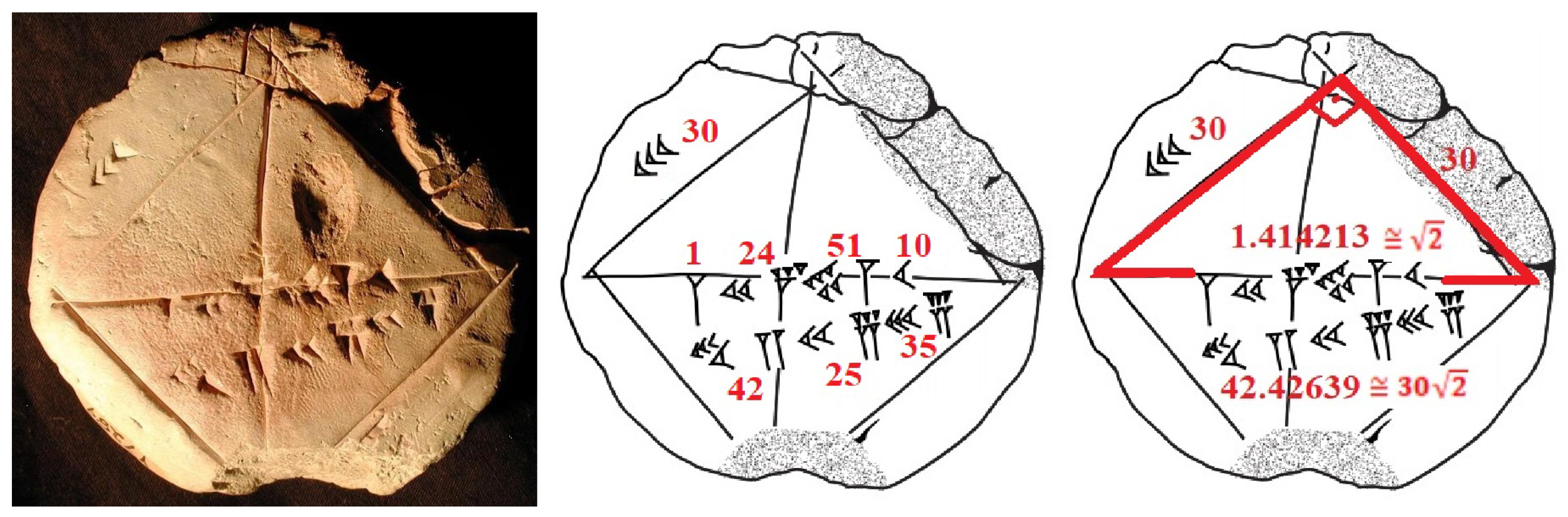
Remarkably, the Babylonians empirically knew the hypotenuse length of a square, i.e., 2 . See Figure 1 (Left and Middle: written in the original Babylonian sexagesimal system using base 60; Right: converted to our decimal system using base 10) for the best-known ancient Babylonian tablet, known as YBC 7289, which is approximately 4000 years old and related to the Pythagorean theorem [7,9].
Figure 1. The best known old Babylonian tablet from Mesopotamia: YBC 7289. (Left) Original tablet. (Middle) Babylonian numbers and their decoded values. (Right) Decimal number transformation.
See [10,11] for more details on the Babylonian clay tablet YBC 7289.
Next, we give the fundamental notions of the differential geometry of hypersurfaces. See [12] for details.
Let E m denote the Euclidean m-space, where ( x 1 , x 2 , , x m ) is a rectangular coordinate system, with the canonical Euclidean metric tensor defined by g ˜ = , = i = 1 m d x i 2 . We denote the Levi-Civita connections [13] of the manifold M ˜ , and its submanifold M of E m by ˜ , , respectively. We use the letters X , Y , Z , W (resp., ξ , η ) to denote the vectors fields tangent (resp., normal) to M. The Gauss and Weingarten formulas are given, respectively, by
˜ X Y = X Y + h ( X , Y ) ,
˜ X ξ = A ξ ( X ) + D X ξ ,
where h, D, and A are the second fundamental form, the metric connection, and the shape operator of M, respectively. The shape operator A ξ is a symmetric endomorphism of the tangent space T p M at p M for each ξ T p M . The shape operator and the second fundamental form are related by
h ( X , Y ) , ξ = A ξ X , Y .
The Gauss and Codazzi equations are, respectively, defined by
R ( X , Y , ) Z , W = h ( Y , Z ) , h ( X , W ) h ( X , Z ) , h ( Y , W ) ,
( ¯ X h ) ( Y , Z ) = ( ¯ Y h ) ( X , Z ) ,
where R , R D are the curvature tensors related with connections ∇ and D, respectively, and then ¯ h is given by the Levi-Civita connection
( ¯ X h ) ( Y , Z ) = D X h ( Y , Z ) h ( X Y , Z ) h ( Y , X Z ) .
Let M be an oriented hypersurface in E n + 1 , S its shape operator, and x its position vector. Considering a local orthonormal frame field { e 1 , e 2 , , e n } consisting of principal directions of M corresponding from the principal curvature k i for i = 1 , 2 , , n , we assume the dual basis of this frame field be { θ 1 , θ 2 , , θ n } . Hence, the first structural equation of Cartan is given by
d θ i = i = 1 n θ j ω i j , i , j = 1 , 2 , , n ,
where ω i j denotes the connection forms corresponding to the chosen frame field. Denoting the Levi-Civita connections of M in E n + 1 by ∇ and ˜ , respectively, from the Codazzi Equation (3), we obtain
e i ( k j ) = ω i j ( e j ) ( k i k j ) ,
ω i j ( e l ) ( k i k j ) = ω i l ( e j ) ( k i k l )
for distinct i , j , l = 1 , 2 , , n .
Taking s j = σ j ( k 1 , k 2 , , k n ) , where σ j is the j-th symmetric function defined by
σ j ( a 1 , a 2 , , a n ) = 1 i 1 < i 2 < < i j n a i 1 a i 2 a i j ,
we use the following notation:
r i j = σ j ( k 1 , k 2 , , k i 1 , k i + 1 , k i + 2 , , k n ) .
By the definition, we have r i 0 = 1 and s n + 1 = s n + 2 = = 0 . Calling the function s k as the k-th mean curvature of M, the functions H = 1 n s 1 and K = s n are named the mean curvature and the Gauss–Kronecker curvature of M, respectively. M is called the j-minimal if s j 0 on M.
In E n + 1 , finding the i-th curvature formulas C i , where i = 0 , , n , we use the following characteristic polynomial of S :
P S ( λ ) = 0 = det ( S λ I n ) = k = 0 n 1 k s k λ n k ,
and I n denotes the identity matrix of order n . Then, we obtain curvature formulas n i C i = s i . Here, n 0 C 0 = s 0 = 1 (by definition), n 1 C 1 = s 1 , , n n C n = s n = K .
k-th fundamental form of M is defined by
S k 1 X , Y = S k 1 X , Y .
Then, one obtains
i = 0 n 1 i n i C i I S n i X , Y = 0 .
Recently, Güler [14] introduced curvature formulas for hypersurfaces in four-dimensional space. For further details on the nature of hypersurfaces, see also [15,16,17,18].
In this work, we present several results related to the Pythagorean P n + 1 formula. In Section 2, we introduce the Pythagorean triples P 3 using fundamental form matrices of surfaces in three-dimensional space forms.
In Section 3, we examine Pythagorean quadruples P 4 using fundamental form matrices of hypersurfaces in four-dimensional space forms M 4 ( c ) , where c { 1 , 0 , 1 } .
In Section 4, we generalize the Pythagorean formula for hypersurfaces immersed in M n + 1 ( c ) using matrices corresponding to the fundamental forms I , I I , I I I , , N , N + 1 of the hypersurface. Additionally, we show that an immersed hypersphere M n with radius r in M n + 1 ( c ) satisfies the Pythagorean n + 1 -tuple equation P n + 1 . Remarkably, as n and N , we reveal that the radius converges to r 1 2 for the hypersphere M n . Finally, we show that the determinant of the P n + 1 formula characterizes an umbilical round hypersphere satisfying k 1 = k 2 = = k n , i.e., H n = K e in M n + 1 ( c ) .
We also provide a conclusion in Section 5.

2. The Pythagorean Triples P 3

Using the fundamental form matrices, we consider the Pythagorean triples Equation as follows
I 2 + I I 2 = I I I 2 .
For any surface, taking n = 2 in Equation (9), we have
C 0 I I I 2 C 1 I I + C 2 I = 0 ,
where C 0 = 1 (by definition), C 1 = H (mean curvature), C 2 = K = K e (extrinsic Gaussian curvature, where K = K e + c ) .
Next, we obtain the solutions of the Pythagorean triples formula P 3 with the fundamental form matrices, using two different ways, excluding the way of Aydın and Mihai [5].

2.1. First Solution of the Pythagorean Triples Formula P 3

Substituting I I I of Equation (11) into the right side of Equation (10), we obtain the Pythagorean triples formula P 3 , as follows
I 2 + I I 2 = 2 H I I K e I 2 ,
considering that A . B B . A for matrices in general, and taking I I = I . S , we have the following equation
1 4 H 2 S + 2 H K e I 2 I . S K e 2 1 I 2 2 H K e S I = 0 .
Substituting the following matrices: shape operator S = k 1 0 0 k 2 , the first fundamental form I = a 11 a 12 a 12 a 22 , and identity I 2 = 1 0 0 1 into the Equation (12), we obtain
a 11 X 11 a 12 X 12 a 12 X 12 a 22 X 22 = 0 0 0 0 ,
where
X 11 = 1 4 H 2 k 1 2 + 4 H K e k 1 + 1 K e 2 ,
X 22 = 1 4 H 2 k 2 2 + 4 H K e k 2 + 1 K e 2 ,
X 12 = 1 4 H 2 k 1 k 2 + 2 H K e k 1 + k 2 + 1 K e 2 .
Here, a 11 0 , a 12 0 , a 22 0 , since I 0 . Hence, we have X i j = 0 , as follows
1 4 H 2 k 1 2 + 4 H K e k 1 + 1 K e 2 = 0 ,
1 4 H 2 k 2 2 + 4 H K e k 2 + 1 K e 2 = 0 ,
1 4 H 2 k 1 k 2 + 2 H K e k 1 + k 2 + 1 K e 2 = 0 .
Adding Equations (17) and (18), and extending Equation (19) by 2, respectively, we obtain
1 4 H 2 k 1 2 + k 2 2 + 4 H K e k 1 + k 2 + 2 1 K e 2 = 0 ,
2 1 4 H 2 k 1 k 2 + 4 H K e k 1 + k 2 + 2 1 K e 2 = 0 .
Replacing k 1 + k 2 2 = k 1 2 + k 2 2 + 2 k 1 k 2 ,   k 1 + k 2 = 2 H ,   k 1 k 2 = K e ,   k 1 2 + k 2 2 = 4 H 2 2 K e , into Equation (20) and Equation (21), respectively, we obtain the following
K e 2 + K e 1 = 2 H 2 1 + 4 K e H 2 ,
K e 2 K e 1 = 0 .
K e solutions of Equation (23) are the golden ratio φ = 1 + 5 2 , and its conjugate φ * = 1 5 2 as in [5]. Together with complex solutions, all H , K e solutions of Equations (22) and (23) are the following
1 2 , φ * , 1 2 , φ , 1 2 , φ * , 1 2 , φ , i φ * , φ * , i φ * , φ * , φ , φ , φ , φ .
Corollary 1.
Whenever H 2 = K e in Equation (22), we obtain Equation (23). Therefore, H 2 = K e is the common solution, and then the real H , K e solutions of P 3 are φ , φ , φ , φ .
Definition 1.
The surface is called totally umbilical if all its points are umbilical, i.e., k 1 = k 2 or equivalently H 2 = K e .
For simplicity, we will use the term “umbilical surface” instead of “totally umbilical surface” for the rest of the paper.
The only totally umbilical surfaces are (pieces of) planes and spheres. See [19] for details.

2.2. Second Solution of the Pythagorean Triples Formula P 3

Taking the determinant of both sides of the following
X 11 X 12 X 12 X 22 = 0 0 0 0 ,
where X i j is given by Equations (14), (15), and (16), respectively, we obtain
4 H 2 K e 2 + 1 k 1 2 + k 2 2 + 2 4 H 2 + K e 2 1 k 1 k 2 = 0 .
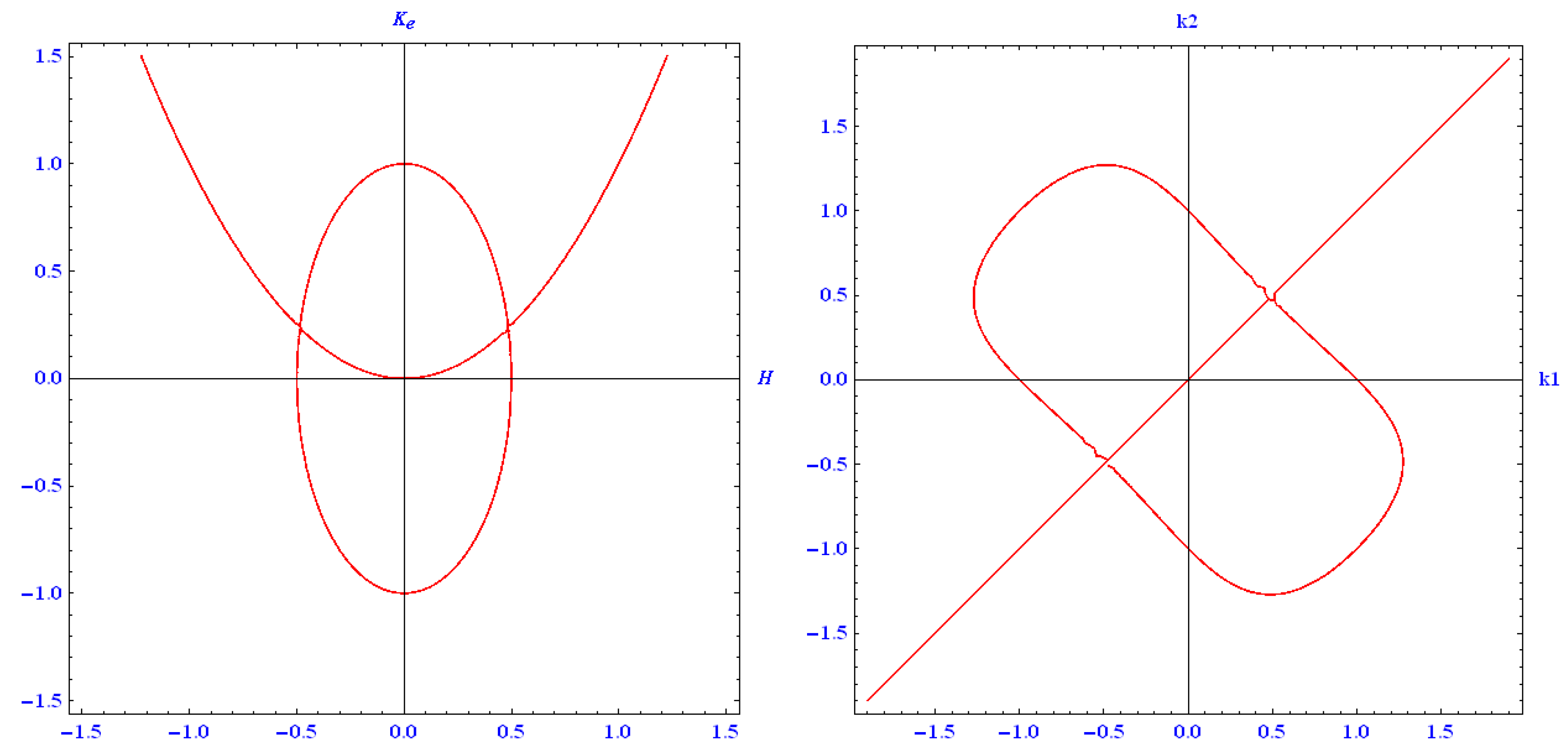
Substituting k 1 2 + k 2 2 = 4 H 2 2 K e , k 1 k 2 = K e , we obtain an implicit algebraic curve Φ 1 ( H , K e ) = 0 (See Figure 2, Left):
4 K e H 2 4 H 2 + K e 2 1 = 0 .
Figure 2. Algebraic curves. (Left) Φ 1 ( H , K e ) = 0 , (Right) Φ 2 ( k 1 , k 2 ) = 0 .
Corollary 2 (Geometric Conclusion 1).
The determinant described by Equation (25) of the P 3 matrix given by Equation (24) draws a parabola K e = H 2 or an ellipse 2 H 2 + K e 2 = 1 .
Taking H = k 1 + k 2 2 and K e = k 1 k 2 in Equation (25), we obtain the implicit algebraic curve Φ 2 ( k 1 , k 2 ) = 0 , which depends on the principal curvatures, curvature k 1 , and torsion k 2 , as follows (see Figure 2, right):
k 1 4 k 2 2 k 1 2 k 2 4 + 2 k 1 3 k 2 3 k 1 4 k 2 4 + 2 k 1 2 k 2 2 + k 1 2 + k 2 2 2 k 1 k 2 = 0 .
Corollary 3.
The determinant of the P 3 matrix defined in Equation (24) and given by Equation (25), corresponds to an umbilical round sphere where the principal curvatures satisfy k 1 = k 2 , i.e., H 2 = K e , in M 3 ( c ) with c { 1 , 0 , 1 } .

3. The Pythagorean Quadruples P 4

Let a , b , c , d N 0 , and let a , b , c , d be a quadruple with a 2 + b 2 + c 2 = d 2 , called a Pythagorean quadruple (we called it P 4 ).
In addition, if a , b , c , d is a P 4 , so is t a , t b , t c , t d for any t N 0 . If gcd ( a , b , c , d ) = 1 , the quadruple a , b , c , d is named a primitive Pythagorean quadruple. Here are some of the quadruples 1 , 2 , 2 , 3 , 2 , 10 , 11 , 15 , 3 , 4 , 12 , 13 , 7 , 24 , 312 , 313 , 17 , 144 , 408 , 433 , and 1089 , 4840 , 6480 , 8161 .
See [1,2,20,21] for the algebric cases, and for the geometric cases [3,4,5,6] of the Pythagorean theorem. Considering the algebraic findings of it, we continue our computations with the geometric ways. Nelsen [22] gave the proof of the Pythagorean quadruples, virtually.
The set of the primitive Pythagorean quadruples for which a is odd can be obtained by
m 2 + n 2 p 2 q 2 a , 2 m p + n q b , 2 n q m p c , m 2 + n 2 + p 2 + q 2 d ,
where m , n , p , q are the non-negative integers, gcd ( m , n , p , q ) = 1 , and m + n + p + q is odd. Here, a 2 + b 2 + c 2 = d 2 is also known as Lebesgue’s identity. See [2] for Lebesgue’s identity.
Better understanding the Pythagorean quadruples P 4 , we consider the Hopf fibration map defined by Hopf: C × C E 3 ,
Hopf z , w = | z | 2 | w | 2 , 2 R e z w ¯ , 2 I m z w ¯ ,
or briefly, it is defined by Hopf: S 3 S 2 . Adding on the last term d of Equation (27) on the image Hopf z , w , we can define P 4 : C × C E 4 , as follows:
z , w P 4 z , w = z 2 w 2 a , 2 R e z w ¯ b , 2 I m z w ¯ c , z 2 + w 2 d ,
where z = m + n i ,   w = p + q i ,   m , n , p , q are the non-negative integers; gcd ( m , n , p , q ) = 1 ; and m + n + p + q is odd. Then, we obtain that P 4 z , w transforms into a Pythagorean quadruple (27).
Let M 4 ( c ) be a 4-dimensional Riemannian space form, which has constant sectional curvature c { 1 , 0 , 1 } , with metric . , . M . While c { 1 , 0 , 1 } , M 4 ( c ) represents a hyperbolic space H 4 , Euclidean space E 4 , 4-sphere S 4 , respectively. The hypersphere with radius r in E 5 is defined by S 4 r = x E 5 x , x E = r 2 , and the hyperquadric in Lorentz–Minkowski space L 5 = E 1 5 is defined by H 4 r = x L 5 x , x L = r 2 . We remark that the open hemi-hypersphere, which has all points x = x 1 , , x 5 of S 4 , is S i , + 4 , where x i > 0 .
We assume M 3 to be an orientable hypersurface immersed into M 4 ( c ) . For any hypersurface of M 4 ( c ) , taking n = 3 in Equation (9), the fundamental forms and the curvatures are related by
C 0 I V 3 C 1 I I I + 3 C 2 I I C 3 I = 0 .
Here, C 0 = 1 , C 1 = H , C 3 = K e . See [14] for details.
Next, we consider a hypersurface M 3 immersed in a space form M 4 ( c ) , c { 1 , 0 , 1 } , satisfying Pythagorean quadruples Equation P 4 :
I 2 + I I 2 + I I I 2 = I V 2 ,
geometrically. In the next theorem, we only use the following 3-sphere S 3 ( r ) with spherical representing x :   E 3 S 3 ( r ) E 4 :
r cos θ 1 cos θ 2 cos θ 3 , r sin θ 1 cos θ 2 cos θ 3 , r sin θ 2 cos θ 3 , r sin θ 3 ,
where r > 0 and 0 θ i 2 π . It can be given for H 3 and E 4 , similarly.
Theorem 1.
The Pythagorean quadruple given Equation (29) of the hypersphere determined by Equation (30) can be denoted by
I 3 2 + S 2 + S 2 2 = S 3 2 .
S 3 ( r ) has the Pythagorean quadruple described by Equation (29) if and only if the following algebraic equation holds:
x 3 + x 2 + x 1 = 0 ,
where x = r 2 .
Proof. 
Let M 4 ( c ) with c = 0 be a Euclidean 4-space E 4 , and let S 3 ( r ) be a hypersphere with radius r given by Equation (30). Then, we compute the fundamental forms of the hypersphere as follows
I = diag r 2 cos 2 θ 2 cos 2 θ 3 , r 2 cos 2 θ 3 , r 2 , I I = diag r cos 2 θ 2 cos 2 θ 3 , r cos 2 θ 3 , r , I I I = diag cos 2 θ 2 cos 2 θ 3 , cos 2 θ 3 , 1 , I V = diag 1 r cos 2 θ 2 cos 2 θ 3 , 1 r cos 2 θ 3 , 1 r .
Using Equation (29), and with the help of the fundamantel form matrices of the S 3 ( r ) , we obtain r 6 + r 4 + r 2 1 = 0 , and r 0 . The shape operator matrix of the hypersphere described by Equation (30) is given by S = 1 r I 3 , where I 3 is the identitity matrix. See [14] for details.
Numerical solutions of the Equation (31) are x 1 ≈ 0.54369, x 2 , x 3 C . Since x = r 2 , we have r 1 0.73735 .
Next, we indicate the solutions of the Pythagorean quadruples formula P 4 , using two different ways with the fundamental form matrices.

3.1. First Solution of the Pythagorean Quadruples Formula P 4

Substituting I V of Equation (28) into the right side of Equation (29), we have the Pythagorean quadruple formula P 4 , as follows
I 2 + I I 2 + I I I 2 = 3 H I I I 3 C 2 I I + K e I 2 .
Taking into account A . B B . A for matrices in general, and S = I 1 . I I , S 1 = I I 1 . I , I I I = I I . S = I . S 2 , after some computations, we obtain the following equation
0 = K e M I 3 + M T S + 1 M 2 S 2 I . S 2 + T K e I 3 + 1 T 2 S + M T S 2 I . S + 1 K e 2 I 3 + T K e S M K e S 2 I .
To shorten the computations, we use
k 1 + k 2 + k 3 = 3 H = M , k 1 k 2 + k 1 k 3 + k 2 k 3 = 3 C 2 = T , k 1 k 2 k 3 = K e .
Substituting the shape operator S = k 1 0 0 0 k 2 0 0 0 k 3 , the first fundamental form I = a 1 a 2 a 3 a 2 a 4 a 5 a 3 a 5 a 6 , and the identity I 3 = 1 0 0 0 1 0 0 0 1 matrices into the Equation (33), we obtain
a 1 Y 11 a 2 Y 12 a 3 Y 13 a 2 Y 12 a 4 Y 22 a 5 Y 23 a 3 Y 13 a 5 Y 23 a 6 Y 33 = 0 0 0 0 0 0 0 0 0 ,
where
Y 11 = 1 M 2 k 1 4 + 2 T M k 1 3 + 1 T 2 2 M K e k 1 2 + 2 T K e k 1 + 1 K e 2 ,
Y 22 = 1 M 2 k 2 4 + 2 T M k 2 3 + 1 T 2 2 M K e k 2 2 + 2 T K e k 2 + 1 K e 2 ,
Y 33 = 1 M 2 k 3 4 + 2 T M k 3 3 + 1 T 2 2 M K e k 3 2 + 2 T K e k 3 + 1 K e 2 ,
Y 12 = M K e k 1 2 + k 2 2 + T K e k 1 + k 2 + 1 M 2 k 1 2 k 2 2 + T M k 1 2 k 2 + k 1 k 2 2 + 1 T 2 k 1 k 2 + 1 K e 2 ,
Y 13 = M K e k 1 2 + k 3 2 + T K e k 1 + k 3 + 1 M 2 k 1 2 k 3 2 + T M k 1 2 k 3 + k 1 k 3 2 + 1 T 2 k 1 k 3 + 1 K e 2 ,
Y 23 = M K e k 2 2 + k 3 2 + T K e k 2 + k 3 + 1 M 2 k 2 2 k 3 2 + T M k 2 2 k 3 + k 2 k 3 2 + 1 T 2 k 2 k 3 + 1 K e 2 .
Since I 0 ,   a i 0 , where i = 1 , 2 , . . . , 6 . Hence, Y 11 = 0 ,   Y 12 = 0 ,   Y 13 = 0 ,   Y 22 = 0 ,   Y 23 = 0 , and Y 33 = 0 . Adding diagonal elements Y i i and other elements Y j k j k , we find
3 K e 2 2 M 3 M 2 6 T 2 K e + M 2 T 6 M 2 9 T 4 M 6 + M 4 + M 2 + 1 + 2 T 3 + T 2 T + 1 = 0 ,
3 K e 2 + M 3 T 2 K e + 2 T 3 T 2 T 1 = 0 ,
respectively. We use
k 1 4 + k 2 4 + k 3 4 = M 2 2 T 2 2 T 2 2 M K e = 9 H 2 6 C 2 2 2 9 C 2 2 6 H K e , k 1 3 + k 2 3 + k 3 3 = M 3 3 M T + 3 K e = 27 H 3 27 H C 2 + 3 K e , k 1 2 + k 2 2 + k 3 2 = M 2 2 T = 9 H 2 6 C 2 , k 1 2 k 2 2 + k 1 2 k 3 2 + k 2 2 k 3 2 = T 2 2 M K e = 9 C 2 2 6 H K e ,
and
k 1 k 2 2 + k 1 2 k 2 + k 1 k 3 2 + k 1 2 k 3 + k 2 k 3 2 + k 2 2 k 3 = M T 3 K e = 9 H C 2 3 K e
to obtain Equations (40) and (41). Therefore, by replacing T , M with 3 C 2 , 3 H , respectively, Equations (40) and (41) reduce to Ω 1 H , C 2 , K e = 0 and Ω 2 H , C 2 , K e = 0 , as follows
Ω 1 H , C 2 , K e = 3 ( K e 2 2 H 18 C 2 27 H 2 + 2 K e + 9 C 2 H 2 27 C 2 54 H 2 + 4 + 243 H 6 27 H 4 3 H 2 18 C 2 3 6 C 2 2 + 2 C 2 1 ) ,
Ω 2 H , C 2 , K e = 3 K e 2 H 9 C 2 2 K e + 9 C 2 3 3 C 2 2 C 2 1 ,
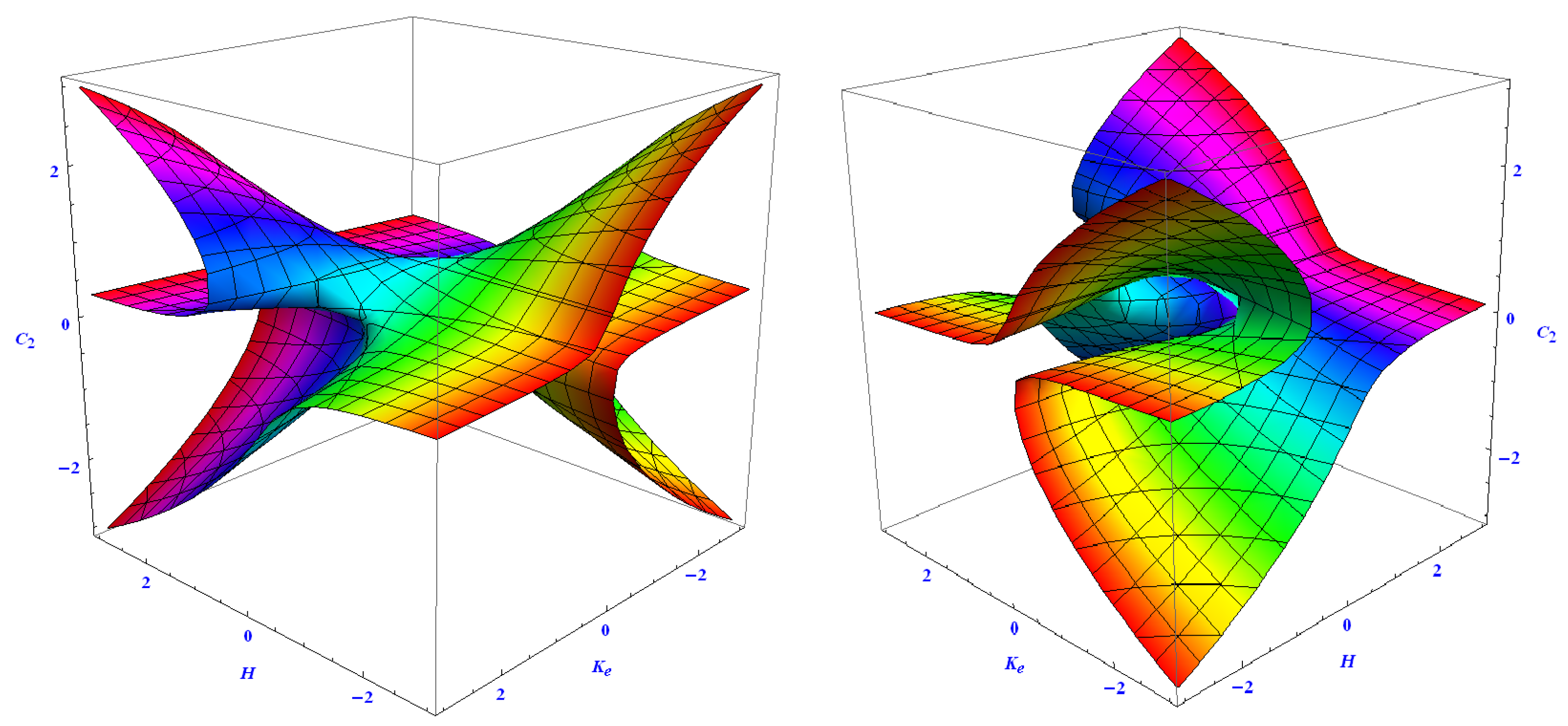
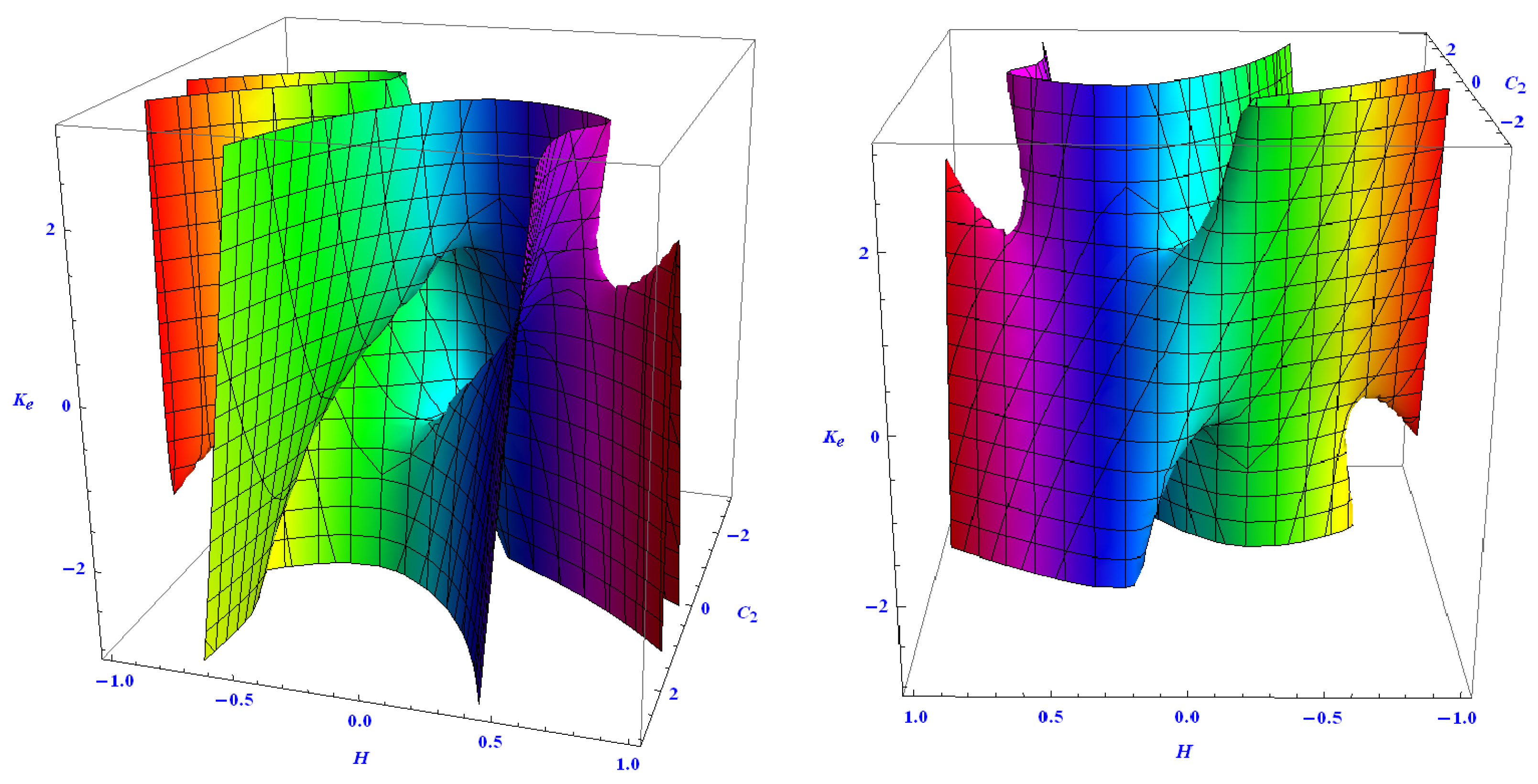
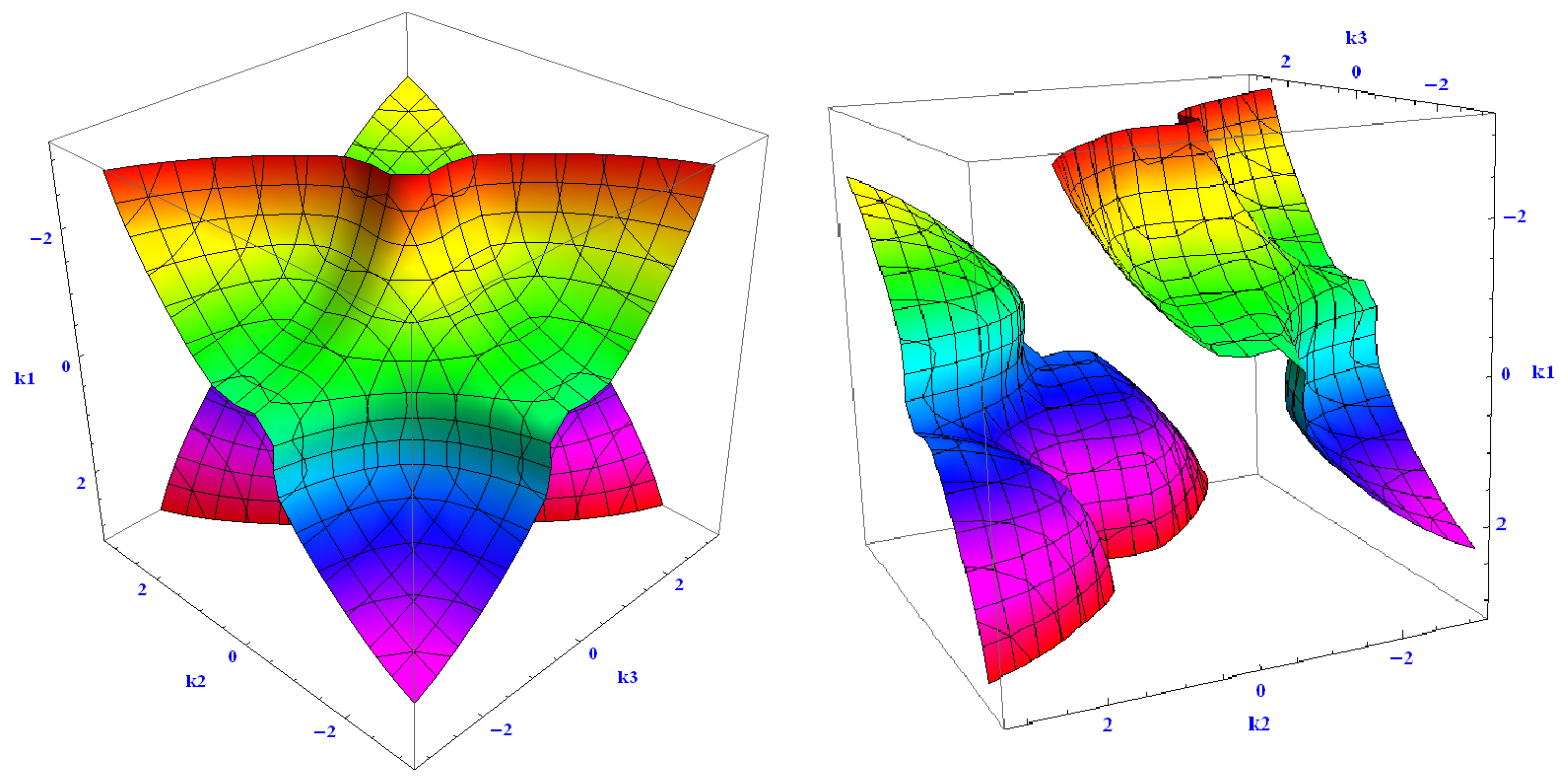
respectively. Equations (42) and (43) are the implicit algebraic surfaces. See Figure 3 and Figure 4, respectively.
Figure 3. Algebraic surface Ω 1 H , C 2 , K e = 0 . (Left) Front view, (Right) back view.
Figure 4. Algebraic surface Ω 2 H , C 2 , K e = 0 in. (Left) Front side view, (Right) back side view.
K e solutions of Equations (42) and (43) and are as follows
K e = 18 C 2 27 H 2 + 2 H ± ( 18 C 2 3 + 6 C 2 2 2 C 2 + 1 + 81 C 2 2 H 2 486 C 2 H 4 + 36 C 2 H 2 + 486 H 6 81 H 4 + 7 H 2 ) 1 / 2 , K e = 1 2 9 C 2 2 H ± 9 C 2 2 2 H 2 4 9 C 2 3 3 C 2 2 C 2 1 1 / 2 ,
respectively.
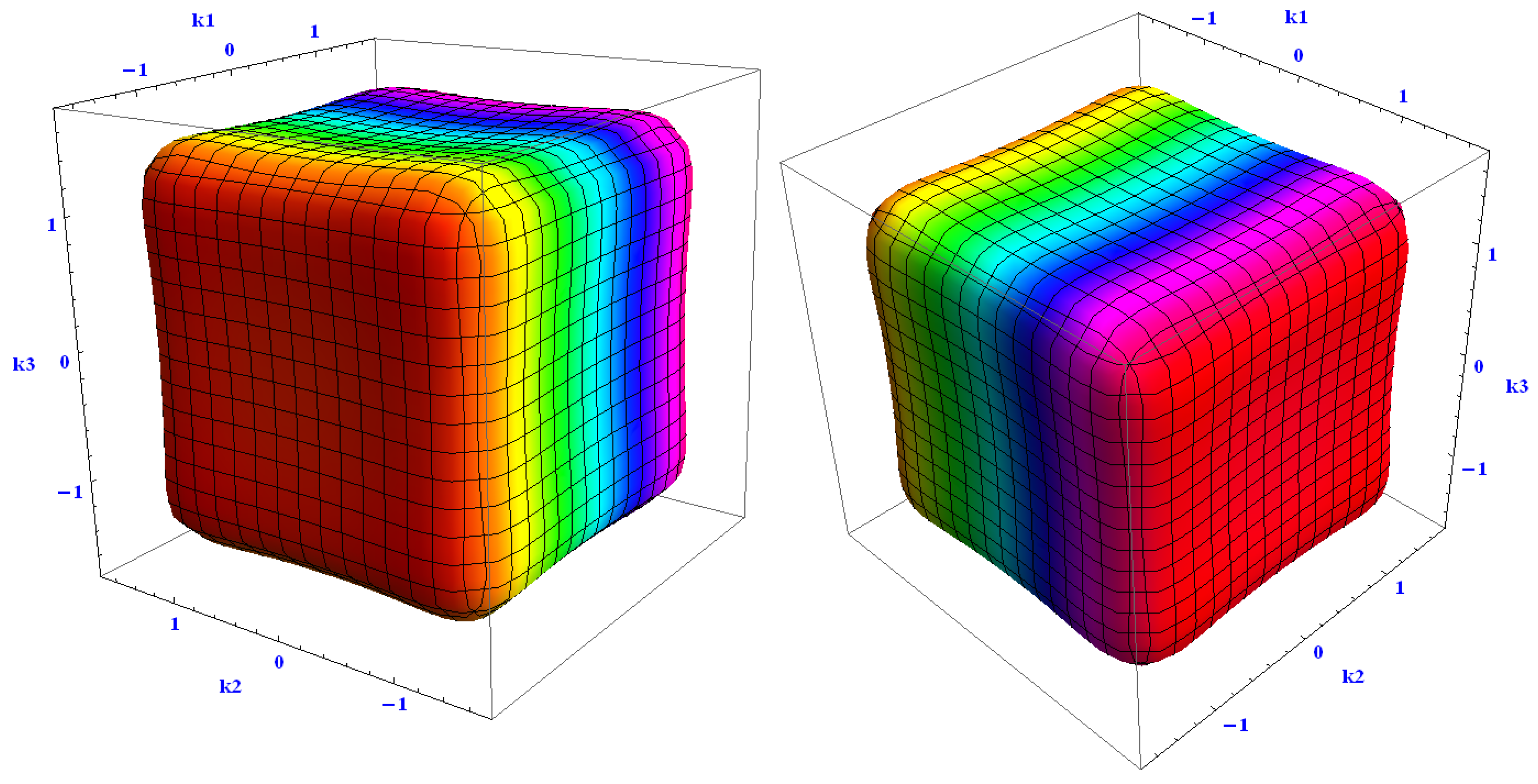
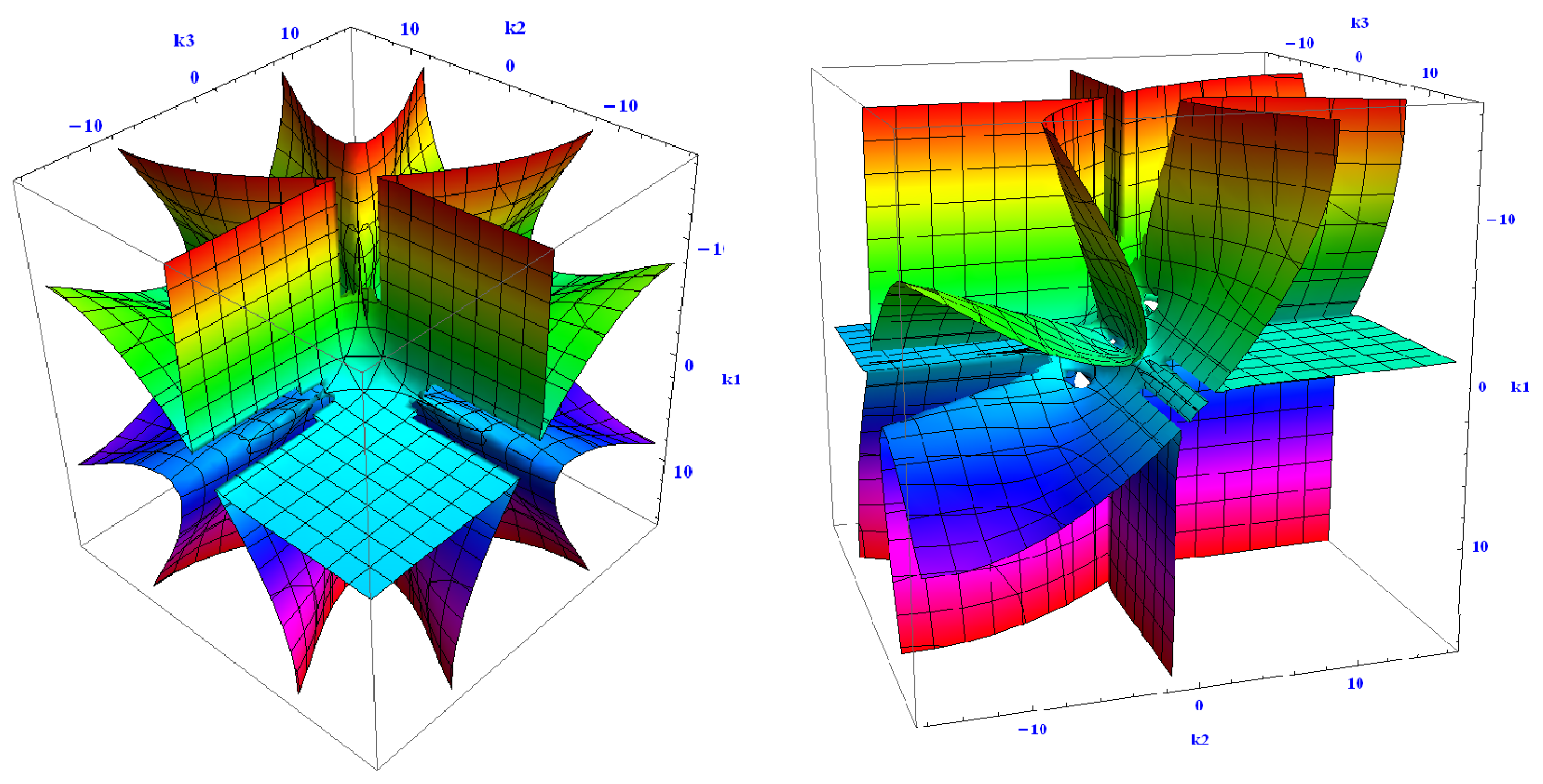
We also obtain that the implicit algebraic surfaces depend on the principal curvatures k 1 ,   k 2 ,   k 3 as Ω 1 k 1 , k 2 , k 3 = 0 and Ω 2 k 1 , k 2 , k 3 = 0 , replacing H , C 2 , K e with k 1 + k 2 + k 3 3 ,   k 1 k 2 + k 1 k 3 + k 2 k 3 3 ,   k 1 k 2 k 3 , respectively, in Equation (42) and Equation (43). See Figure 5 and Figure 6 for the algebraic surfaces Ω 1 ,   Ω 2 , respectively.
Figure 5. Algebraic surface Ω 1 k 1 , k 2 , k 3 = 0 . (Left) Front side view, (Right) back side view.
Figure 6. Algebraic surface Ω 2 k 1 , k 2 , k 3 = 0 . (Left) Front side view, (Right) back side view.
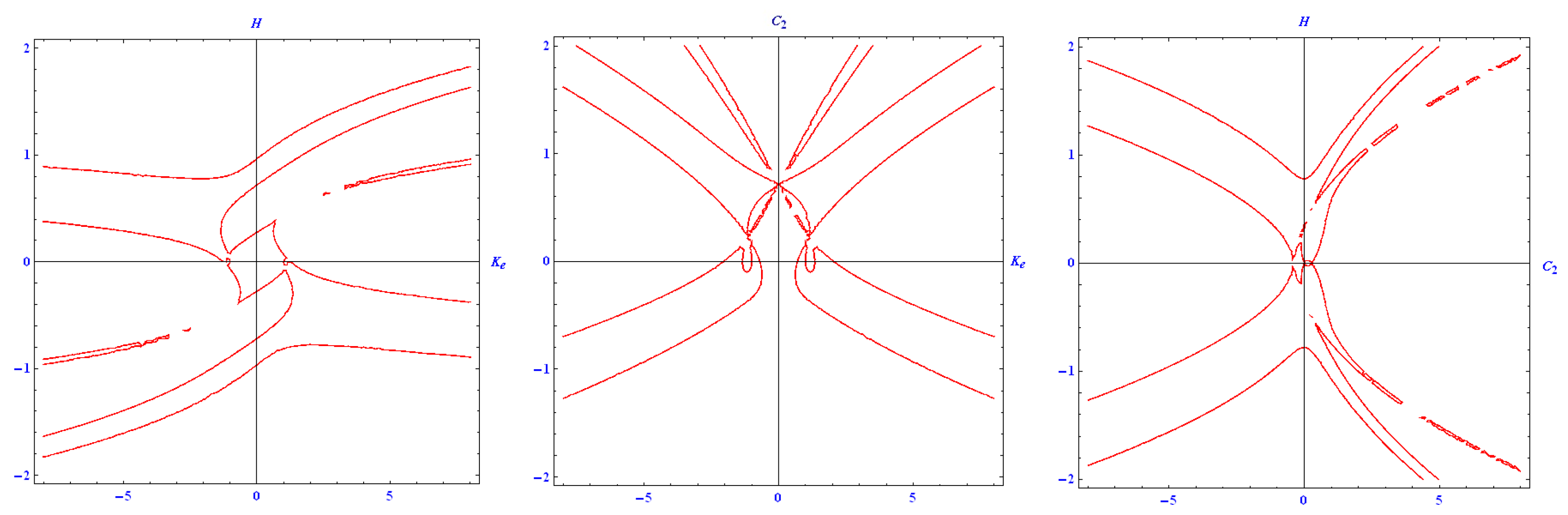
Eliminating C 2 , H , K e , respectively, in Equation (42) and Equation (43), we have the following implicit algebraic equations. Ω 3 H , K e = 0 (see Figure 7, Left), Ω 3 C 2 , K e = 0 (See Figure 7, Middle), and Ω 3 H , C 2 = 0 (see Figure 7, Right), respectively.
Ω 3 H , K e = 387420489 H 18 + 387420489 H 16 + 516560652 H 15 K e 33480783 H 14 420901272 H 13 K e 200884698 H 12 K e 2 + 60584274 H 12 + 74401740 H 11 K e + 136580337 H 10 K e 2 + 18068994 H 9 K e 3 49483062 H 10 49837356 H 9 K e 30114990 H 8 K e 2 12045996 H 7 K e 3 + 177147 H 6 K e 4 + 2827791 H 8 + 15348366 H 7 K e + 8815797 H 6 K e 2 + 2033910 H 5 K e 3 + 347733 H 4 K e 4 39366 H 3 K e 5 1081107 H 6 783918 H 5 K e 1579014 H 4 K e 2 265842 H 3 K e 3 23328 H 2 K e 4 7290 H K e 5 729 K e 6 43335 H 4 + 278208 H 3 K e + 41292 H 2 K e 2 + 17100 H K e 3 + 2871 K e 4 10332 H 2 9810 H K e 3699 K e 2 + 1557 ,
Ω 3 C 2 , K e = 387420489 C 2 18 + 774840978 C 2 17 + 516560652 C 2 15 K e 2 387420489 C 2 16 903981141 C 2 14 K e 2 200884698 C 2 12 K e 4 + 114791256 C 2 15 + 449599086 C 2 13 K e 2 + 306110016 C 2 11 K e 4 + 18068994 C 2 9 K e 6 286978140 C 2 14 157306536 C 2 12 K e 2 150929244 C 2 10 K e 4 24446286 C 2 8 K e 6 + 177147 C 2 6 K e 8 + 153055008 C 2 13 + 199113228 C 2 11 K e 2 + 39090438 C 2 9 K e 4 + 10628820 C 2 7 K e 6 39366 C 2 3 K e 10 + 2125764 C 2 12 99615663 C 2 10 K e 2 24229773 C 2 8 K e 4 + 2342277 C 2 6 K e 6 91854 C 2 4 K e 8 + 45927 C 2 2 K e 10 729 K e 12 + 46766808 C 2 11 + 17990262 C 2 9 K e 2 + 14464818 C 2 7 K e 4 4531464 C 2 5 K e 6 + 77274 C 2 3 K e 8 10206 C 2 K e 10 25863462 C 2 10 13161366 C 2 8 K e 2 2138886 C 2 6 K e 4 + 1972188 C 2 4 K e 6 125145 C 2 2 K e 8 + 5994 K e 10 5117580 C 2 9 + 7619508 C 2 7 K e 2 57834 C 2 5 K e 4 259686 C 2 3 K e 6 + 19818 C 2 K e 8 5078214 C 2 8 1570995 C 2 6 K e 2 141426 C 2 4 K e 4 + 106146 C 2 2 K e 6 16551 K e 8 + 2152008 C 2 7 303750 C 2 5 K e 2 2970 C 2 3 K e 4 + 18396 C 2 K e 6 + 819396 C 2 6 326268 C 2 4 K e 2 76158 C 2 2 K e 4 + 20700 K e 6 + 454896 C 2 5 + 97524 C 2 3 K e 2 49716 C 2 K e 4 43740 C 2 4 + 80919 C 2 2 K e 2 13383 K e 4 40824 C 2 3 + 26082 C 2 K e 2 24057 C 2 2 + 4698 K e 2 4374 C 2 729 ,
Ω 3 H , C 2 = 4782969 H 12 9565938 C 2 H 10 + 4782969 C 2 2 H 8 3188646 H 10 + 1062882 C 2 3 H 6 + 6731586 C 2 H 8 1062882 C 2 4 H 4 4901067 C 2 2 H 6 + 413343 H 8 + 1417176 C 2 3 H 4 944784 C 2 H 6 + 59049 C 2 6 157464 C 2 4 H 2 + 597051 C 2 2 H 4 223074 H 6 + 13122 C 2 5 83106 C 2 3 H 2 + 266814 C 2 H 4 12393 C 2 4 78003 C 2 2 H 2 + 50301 H 4 1458 C 2 3 27702 C 2 H 2 + 729 C 2 2 2916 H 2 .
Figure 7. Algebraic curves. (Left) Ω 3 H , K e = 0 , (Middle) Ω 3 C 2 , K e = 0 , and (Right) Ω 3 H , C 2 = 0 .
We obtain the implicit algebraic surface, which depends on principal curvatures k 1 ,   k 2 ,   k 3 as Ω 3 k 1 , k 2 , k 3 = 0 , replacing H , K e with k 1 + k 2 + k 3 3 ,   k 1 k 2 k 3 , respectively, in Ω 3 H , K e = 0 . See Figure 8 for the algebraic surface Ω 3 .
Figure 8. Algebraic surface Ω 3 k 1 , k 2 , k 3 = 0 . (Left) Front side view, (Right) back side view.

3.2. Second Solution of the Pythagorean Quadruple Formula P 4

Before defining the umbilical hypersurface in 4-space, we make some remarks.
Remark 1.
The following are equivalent
k 1 = k 2 = k 3 k 1 k 2 = 0 k 1 k 3 = 0 k 2 k 3 = 0 k 1 k 2 2 = 0 k 1 k 3 2 = 0 k 2 k 3 2 = 0 k 1 2 2 k 1 k 2 + k 2 2 = 0 k 1 2 2 k 1 k 3 + k 3 2 = 0 k 2 2 2 k 2 k 3 + k 3 2 = 0 k 1 2 + k 2 2 + k 3 2 = k 1 k 2 + k 1 k 3 + k 2 k 3 ( Adding above eqs . ) H 2 = C 2 .
Remark 2.
The following are equivalent
k 1 = k 2 = k 3 k 1 k 2 = 0 k 1 k 3 = 0 k 2 k 3 = 0 k 1 k 2 2 = 0 k 1 k 3 2 = 0 k 2 k 3 2 = 0 k 1 2 + 2 k 1 k 2 + k 2 2 = 4 k 1 k 2 k 1 2 + 2 k 1 k 3 + k 3 2 = 4 k 1 k 3 k 2 2 + 2 k 2 k 3 + k 3 2 = 4 k 2 k 3 k 1 + k 2 2 = 4 k 1 k 2 k 1 + k 3 2 = 4 k 1 k 3 k 2 + k 3 2 = 4 k 2 k 3 k 1 + k 2 k 1 + k 3 k 2 + k 3 = 8 k 1 k 2 k 3 H C 2 = K e .
Remark 3.
Using the results of the Remarks 1 and 2 together, we have
k 1 = k 2 = k 3 H 3 = K e .
Next, we describe the umbilical hypersurface of four dimensional space.
Definition 2.
The hypersurface M 3 immersed into a M 4 ( c ) , c { 1 , 0 , 1 } is called umbilical if all its points are umbilical, i.e., k 1 = k 2 = k 3 or, equivalently, H 3 K e = 0 , with H C 2 = K e , H 2 = C 2 .
The only umbilical hypersurfaces are (open to) hyperplanes and hyperspheres in M 4 ( c ) .
Next, taking determinants of both sides of
Y 11 Y 12 Y 13 Y 12 Y 22 Y 23 Y 13 Y 23 Y 33 = 0 0 0 0 0 0 0 0 0 ,
we obtain
0 = [ k 1 2 k 2 4 + k 1 4 k 2 2 + k 1 2 k 3 4 + k 1 4 k 3 2 + k 2 2 k 3 4 + k 2 4 k 3 2 + 6 k 1 2 k 2 2 k 3 2 + 2 k 1 3 k 2 3 + k 1 3 k 3 3 + k 2 3 k 3 3 + 2 k 1 k 2 k 3 k 1 3 + k 2 3 + k 3 3 2 k 1 k 2 k 3 k 1 k 2 2 + k 1 2 k 2 + k 1 k 3 2 + k 1 2 k 3 + k 2 k 3 2 + k 2 2 k 3 ] K e 2 + M 2 + T 2 1 .
Here, Y i j are given by Equations (34), (35), (36), (37), (38), and (39), respectively. Hence, the above Equation reduces to
k 1 k 2 2 k 1 k 3 2 k 2 k 3 2 K e 2 + M 2 + T 2 1 = 0 .
Then, k 1 k 2 2 k 1 k 3 2 k 2 k 3 2 transforms to the following
k 2 k 3 2 k 1 k 3 2 k 1 k 2 2 = 27 4 H 3 K e 3 C 2 2 H 2 + 4 C 2 3 + K e 2 6 C 2 H K e ,
by using
k 1 2 k 2 4 + k 1 4 k 2 2 + k 1 2 k 3 4 + k 1 4 k 3 2 + k 2 2 k 3 4 + k 2 4 k 3 2 = T 2 2 M K e M 2 2 T 3 K e 2 = 9 C 2 2 6 H K e 9 H 2 6 C 2 3 K e 2 .
Therefore, we obtain the following.
Corollary 4.
Since H 2 = C 2 ,   H C 2 = K e ,   H 3 = K e , the determinant of the P 4 matrix (44) satisfies
4 H 3 K e 3 C 2 2 H 2 + 4 C 2 3 + K e 2 6 C 2 H K e = 0 ,
by using
k 1 3 k 2 3 + k 1 3 k 3 3 + k 2 3 k 3 3 = T 3 3 T M K e + 3 K e 2 = 27 C 2 3 27 H C 2 K e + 3 K e 2 .
We also have the following.
Corollary 5 (Geometric Conclusion 2).
The determinant given by Equation (45) of the P 4 matrix described by Equation (44) draws the surface K e = H 3 with H 2 = C 2 ,   H C 2 = K e and the ellipsoid surface 3 H 2 + 3 C 2 2 + K e 2 = 1 .
The determinant of the P 4 is also given by as follows
27 4 H 3 K e 3 C 2 2 H 2 + 4 C 2 3 + K e 2 6 C 2 H K e 3 H 2 + 3 C 2 2 + K e 2 1 = 0 .
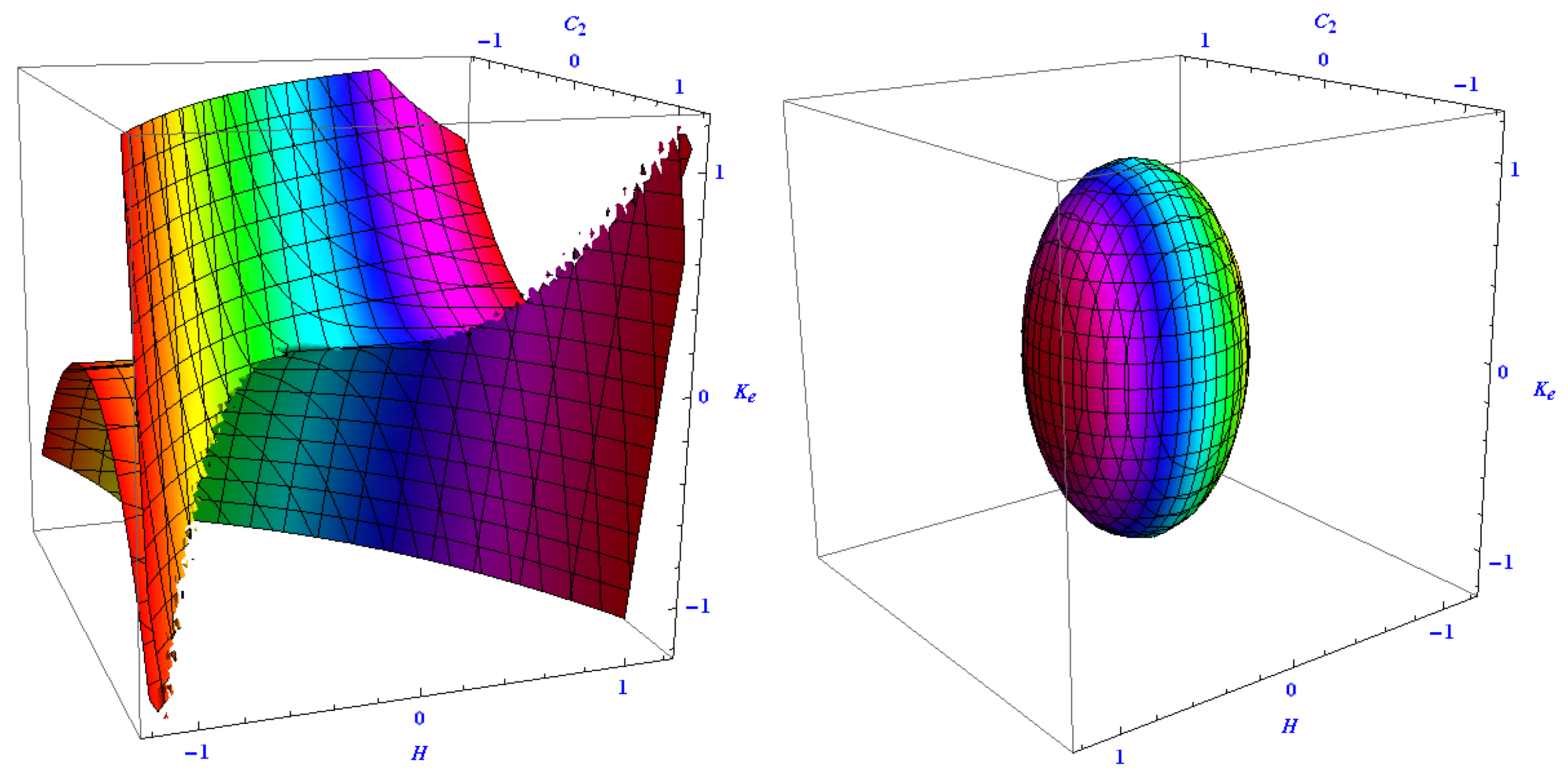
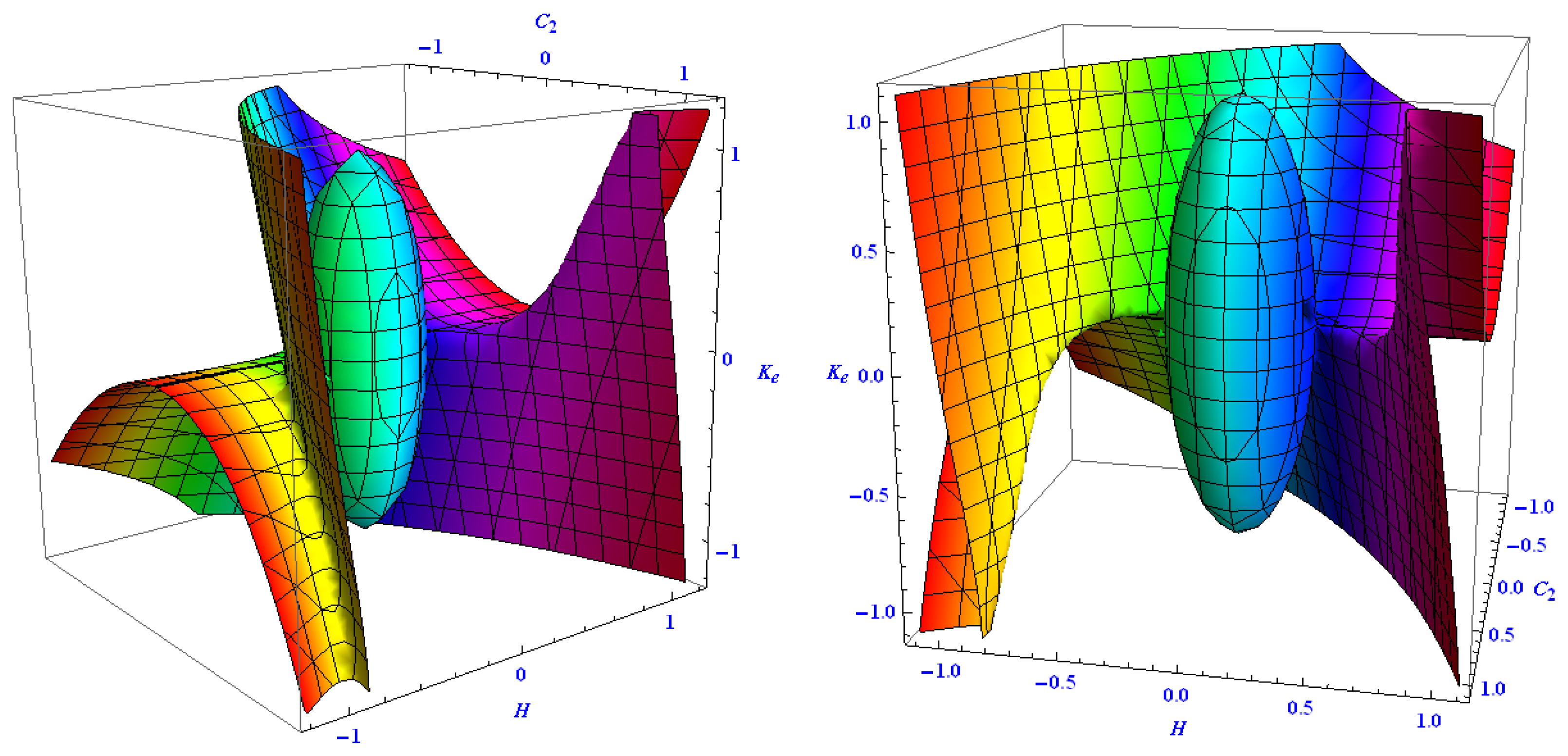
Here, 4 H 3 K e 3 C 2 2 H 2 + 4 C 2 3 + K e 2 6 C 2 H K e = 0 is the implicit surface as Θ 1 H , C 2 , K e = 0 (See Figure 9, Left), satisfying H 3 K e = 0 , with H C 2 = K e , H 2 = C 2 , and the implicit ellipsoid, or ellipsoidal surface 3 H 2 + 3 C 2 2 + K e 2 = 1 as Θ 2 H , C 2 , K e = 0 (See Figure 9, Right).
Figure 9. Algebraic surfaces. (Left) Θ 1 H , C 2 , K e = 0 , (Right) Θ 2 H , C 2 , K e = 0 .
Hence, extending the determinant of the P 4 , we obtain the implicit algebraic surface Ψ H , C 2 , K e = 0 , as follows (see Figure 10):
Ψ H , C 2 , K e = 108 H 3 K e + 972 H 5 K e + 81 C 2 2 H 2 + 972 C 2 3 H 2 729 C 2 2 H 4 729 C 2 4 H 2 + 243 C 2 2 K e 2 + 108 C 2 3 K e 2 + 243 H 2 K e 2 + 108 H 3 K e 3 108 C 2 3 + 972 C 2 5 27 K e 2 + 27 K e 4 81 C 2 2 H 2 K e 2 162 C 2 H K e 3 1458 C 2 H 3 K e 1458 C 2 3 H K e + 972 C 2 2 H 3 K e + 162 C 2 H K e .
Figure 10. Algebraic surface Ψ H , C 2 , K e = 0 . (Left) Front side view, (Right) back side view.
Corollary 6.
The determinant given by Equation (45) of the P 4 matrix described by Equation (44) corresponds to an umbilical round hypersphere where the principal curvatures satisfy k 1 = k 2 = k 3 . In other words, it satisfies H 3 = K e with H C 2 = K e and H 2 = C 2 in M 4 ( c ) , where c { 1 , 0 , 1 } .
We remark that this work relies on the Phythagorean formula but does not depend on the distance between points in the running space form.
On the other hand, we use the upper hypersphere S 3 ( r ) with the Cartesian map x :   E 3 S 3 ( r ) E 4 given by
u , v , w u , v , w , r 2 u 2 v 2 w 2 ,
where r > 0 . Next, we compute the fundamental forms of the upper hypersphere given by Equation (46). The first fundamental form matrix of it as follows
I = r 2 v 2 w 2 r 2 u 2 v 2 w 2 u v r 2 u 2 v 2 w 2 u w r 2 u 2 v 2 w 2 u v r 2 u 2 v 2 w 2 r 2 u 2 w 2 r 2 u 2 v 2 w 2 v w r 2 u 2 v 2 w 2 u w r 2 u 2 v 2 w 2 v w r 2 u 2 v 2 w 2 r 2 u 2 v 2 r 2 u 2 v 2 w 2 ,
Then, the shape operator matrix is given by S = 1 r I 3 . We obtain I I = I . S ,   I I I = I I . S , and I V = I I I . S , easily.
Taking into account the Pythagorean quadruple formula I 2 + I I 2 + I I I 2 Ω = I V 2 Φ , of the hypersphere described by Equation (46), and considering det Ω = det Φ , we have the following.
Corollary 7.
The hypersphere given by Equation (46) has the Pythagorean quadruple formula mentioned by (29) if and only if the following holds
r 6 r 12 + 3 r 10 + 6 r 8 + 7 r 6 + 6 r 4 + 3 r 2 + 1 1 = 0 .
The roots of above equation are r 1 = 0.73735 R ,   r 2 = 0.73735 R + ,   r 3 , 4 , , 18 C . Here, the positive and real r 2 solution is also given in the second row of the Table 1.
Table 1. x and r solutions of Pythagorean 3–26-tuples.
Let M 3 be an immersed hypersurface into H 4 , E 4 , or S 4 . M 3 is named totally geodesic while I I = 0 and totally umbilical while I I = μ I , where μ 0 is a constant. When I I = 0 , then I I I = 0 and I V = 0 . This is not possible for the Pythagorean P 4 formula. On the other hand, while I I is degenerate (i.e., det I I = 0 ), using Equations (28) and (29), and considering I I I = I I . S = I . S 2 ,   K e = det S , we obtain I = 0 , which contradicts det I I = 0 . So, det I I 0 .
When M 3 is minimal, and K e 0 , using Equations (28) and (29) again, we find the following:
K e 2 1 I 2 = 1 3 C 2 2 I I 2 .
Taking both sides of the determinant, we have
K e 6 3 K e 4 + 3 C 2 2 + 2 K e 2 1 = 0 .
Here, K e has 4 complex roots, 1 negative real root ( K e = 1.3936 , C 2 = 0.251538 ), and the following positive real root ( K e = 0.317103 , C 2 = 0.956641 )
K e = 0.381571 c 7.86222 C 2 2 c + 0.87358 c + 1 1 / 2 ,
where
c = 81 C 2 2 + 1.73205 2916 C 2 6 + 1215 C 2 4 378 C 2 2 + 23 1 / 2 + 9 1 / 3 .
Then, K e is a constant. When the space is H 4 or E 4 , then M 3 should be totally geodesic (see [23,24] for M 2 case.). Then, it gives a contradiction.
Therefore, the case of K e = 1 and M 3 is totally geodesic and does not take place. The case of K e = 0 , M 3 is an open piece of the Clifford torus. Then, K e = 1 , which is incompatible with Equation (47). So, the immersed hypersurface into H 4 , E 4 , or S + 4 supplying the P 4 formula mentioned by Equation (29) cannot be totally geodesic, may not be minimal, and does not have a degenerate second fundamental form.
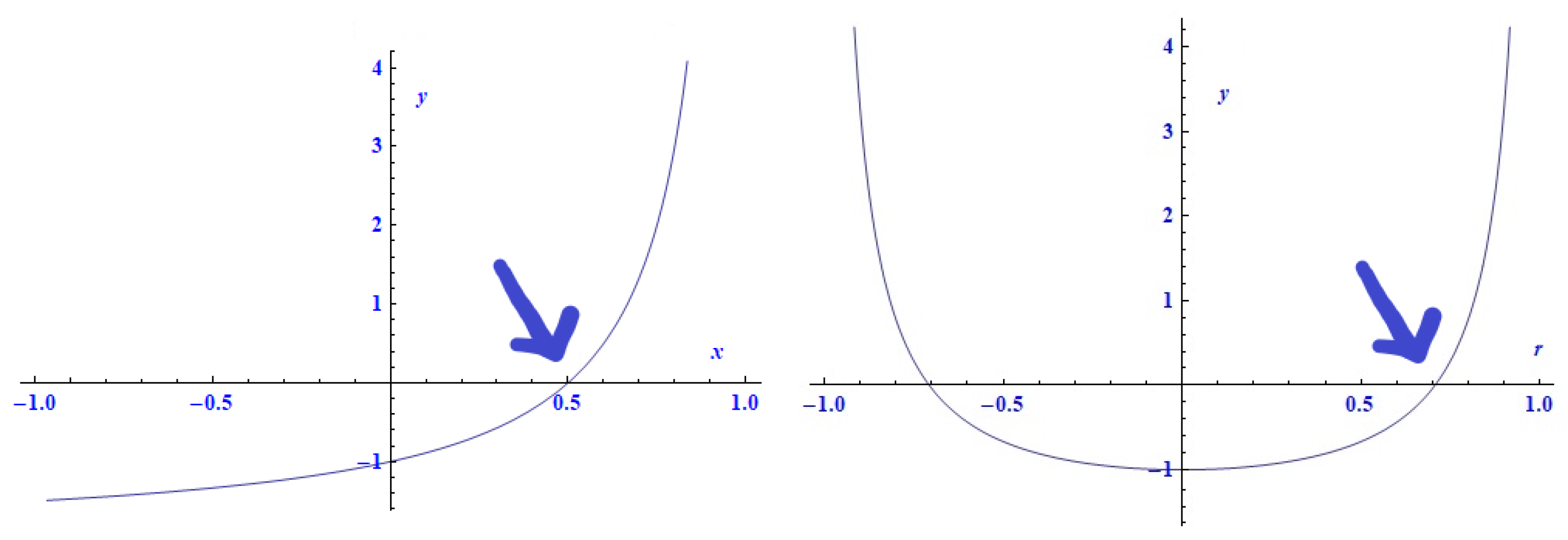
On the other side, we want to see the real solutions of k = 1 n x k 1 = 0 for some integers. See Table 1, Table 2, Table 3 and Table 4 for some solutions to it. To see the real solutions of k = 1 99999 x k 1 = 0 in E 100000 on graphics depending on x and r, respectively, see Figure 11.
Table 2. x and r solutions of Pythagorean 30 , 40 , 50 -tuples.
Table 3. x and r solutions of Pythagorean 75-tuples of S 74 ( r ) in E 75 .
Table 4. x and r solutions of Pythagorean 100-tuples of S 99 ( r ) in E 100 .
Figure 11. Real graphics of the Pythagorean 10 5 -tuples of S 99999 ( r ) . (Left) y = k = 1 99999 x k 1 , x 1 2 , ( Right ) y = k = 1 99999 r 2 k 1 , r 1 2 .
In dimension 200, i.e., in E 200 , x and r solutions of the Pythagorean 200-tuples of the S 199 ( r ) are as follows (with 321 digits):
x 0.5000000000000000000000000000000000000000000000000000000000003 11150763893057085357203202689006212029512608436058356655094556658 63343488449735236553010467476138303976881738641100895335924232023 34114463199807863070347568289193325695011780175081122039993867410 2867738110784051939243798551104507095592401999618923621906567756 ,
and
r 0.7071067811865475244008443621051279437325833055886006739067917 94344757197397837300988207418918995590004395380321440946772513382 49838886753552692449588190583402000578194741957214813556875759537 82813770690555701346636538769813156446384560892821446168091144026 0791134133607458928495481181021022394644625344379042586920744364 .
Interestingly, when the dimension n increasing regularly, we observe that x 1 2 , and r 1 2 from all of the above results. To understand the larger results of the Pythagorean 10 5 -tuples, virtually, see Figure 11.

4. Pythagorean n + 1 -Tuples P n + 1

In this section, considering all findings of the previous two sections, we obtain the generalized Pythagorean formula P n + 1 , using the fundamental form matrices for the hypersurfaces in higher dimension space forms.
Theorem 2.
Let a hypersurface M n immersed into a ( n + 1 ) -dimensional Riemannian space form M n + 1 ( c ) , c { 1 , 0 , 1 } satisfy the following Pythagorean n + 1 -tuples P n + 1 equation
I 2 + I I 2 + I I I 2 + + N 2 = ( N + 1 ) 2 ,
if and only if the following algebraic equation holds:
k = 1 n x k 1 = 0 ,
where x = r 2 . Here, I , I I , I I I , , N , N + 1 are the fundamental form matrices of the hypersurface M n .
Proof. 
Let M n be an immersed hypersurface into H n + 1 , E n + 1 , or S n + 1 . The shape operator matrix is given by S = 1 r I n , where I n is the identitity matrix. The P n + 1 given by Equation (48) of the hypersurface can be denoted by
I n 2 + S 2 + S 2 2 + + S n 1 2 = S n 2 .
Considering the P n + 1 determined by Equation (48) with the fundamantel form matrices of the hypersurface, we obtain r 2 n + r 2 n 2 + + r 2 1 = 0 , and r 0 . The hypersurface M n has the Pythagorean n + 1 -tuples P n + 1 described by Equation if and only if algebraic equation x n + x n 1 + + x 1 = 0 holds, where x = r 2 .
Additionally, the geometric series is defined by k = 0 x k = 1 1 x , where x < 1 . Therefore, we have the following
k = 1 x k 1 = 0 k = 0 x k 2 = 0 1 + 2 x 1 x = 0 , x 1 x = 1 2 r = 1 2 , x = r 2 , r > 0 .
Corollary 8.
Let M n be an immersed hypersphere into M n + 1 ( c ) , c { 1 , 0 , 1 } with radius r satisfying the Pythagorean n + 1 -tuples P n + 1 mentioned by Equation (48). When n , then N , and r 1 2 .
Next, we define the umbilic hypersurface, then give a generalization of the determinant of the Pythagorean n + 1 -tuples P n + 1 formula.
Definition 3.
The hypersurface M n immersed into a ( n + 1 ) -dimensional Riemannian space form M n + 1 ( c ) , c { 1 , 0 , 1 } is called umbilical if all its points are umbilical, i.e., k 1 = k 2 = = k n , or, equivalently, H n K e = 0 .
Proposition 1.
Let a hypersurface M n immersed into a M n + 1 ( c ) , c { 1 , 0 , 1 } satisfy the Pythagorean n + 1 -tuples P n + 1 formula
I 2 + I I 2 + I I I 2 + + N 2 = i = 1 n 1 i + 1 n i C i I S n i X , Y 2 .
Then, the determinant of Equation (50) is given by
n n C n C 1 n n C 1 2 + n C 2 2 + + n C n 1 2 + C n 2 1 = 0 ,
or equivalently by
1 i < j n n k i k j 2 = 1 n 1 n C 2 + C n 2 1 = 0 ,
where C 1 = H , C n = K e .
Finally, we have the following.
Conjecture 1.
The determinant of the  P n + 1  matrix, as defined in Equation (50), generates a hypersurface  H n = K e  and a hyperellipsoid  n H 2 + n C 2 2 + n C 3 2 + + n C n 1 2 + K e 2 = 1  in  M n + 1 ( c ) , where  c { 1 , 0 , 1 } .
Then, we present the following generalization for the determinant of P n + 1 .
Conjecture 2.
The determinant given by Equation (51) (or equivalently by Equation (52)) of the  P n + 1  formula mentioned by Equation corresponds to an umbilical round hypersphere satisfying  k 1 = k 2 = = k n , i.e.,  H n = K e , in  M n + 1 ( c ) , where  c { 1 , 0 , 1 } .

5. Conclusions

This article provides a thorough investigation of the Pythagorean theorem from the perspective of differential geometry, offering insightful generalizations in higher-dimensional space forms. It establishes a connection between classical geometric identities and the intrinsic properties of hypersurfaces, filling a notable gap in the field.
Specifically, the paper generalizes that an immersed hypersphere M n with radius r in M n + 1 ( c ) , where c { 1 , 0 , 1 } , satisfies the ( n + 1 ) -tuple Pythagorean formula. Furthermore, as the dimension n and the fundamental form N , it is shown that r 1 2 .
Finally, the paper proposes that the determinant of the Pythagorean formula characterizes an umbilical round hypersphere with equal principal curvatures, satisfying H n = K e in M n + 1 ( c ) . These findings contribute to a broader understanding of curvature relations and their role in the geometry of hypersurfaces.


Author Contributions

E.G. provided the idea of the differential geometry and matrix-based generalizations of the Pythagorean theorem in space forms. Conceptualization, E.G., Y.Y. and M.T.; methodology, E.G., Y.Y. and M.T.; software, E.G., Y.Y. and M.T.; validation, E.G., Y.Y. and M.T.; investigation, E.G., Y.Y. and M.T.; resources, E.G., Y.Y. and M.T.; data curation, E.G., Y.Y. and M.T.; writing—original draft preparation, E.G., Y.Y. and M.T.; writing—review and editing, E.G., Y.Y. and M.T.; visualization, E.G., Y.Y. and M.T.; supervision, E.G., Y.Y. and M.T.; and funding acquisition, E.G. All authors have read and agreed to the published version of the manuscript.

Funding

This research received no external funding.

Data Availability Statement

No data were created.

Acknowledgments

We gratefully acknowledge the constructive comments from the editor and the anonymous referees.

Conflicts of Interest

The authors declare no conflicts of interest.

References

  1. Mordell, L.J. Diophantine Equations; Academic Press: London, UK, 1969. [Google Scholar]
  2. Nagell, T. Introduction to Number Theory; Wiley: New York, NY, USA, 1951. [Google Scholar]
  3. Arnold, M.; Eydelzon, A. On matrix Pythagorean triples. Am. Math. Mon. 2019, 126, 158–160. [Google Scholar] [CrossRef]
  4. Crasmareanu, M. A new method to obtain Pythagorean triple preserving matrices. Mo. J. Math. Sci. 2002, 14, 149–158. [Google Scholar]
  5. Aydın, M.E.; Mihai, A. A note on surfaces in space forms with Pythagorean fundamental forms. Mathematics 2020, 8, 444. [Google Scholar] [CrossRef]
  6. Palmer, L.; Ahuja, M.; Tikoo, M. Finding Pythagorean triple preserving matrices. Mo. J. Math. Sci. 1998, 10, 99–105. [Google Scholar] [CrossRef]
  7. Hahn, R. The Metaphysics of the Pythagorean Theorem Thales, Pythagoras, Engineering, Diagrams, and the Construction of the Cosmos out of Right Triangles; Suny Press: New York, NY, USA, 2017. [Google Scholar]
  8. Kaplan, R.; Kaplan, E. Hidden Harmonies: The Lives and Times of the Pythagorean Theorem; Bloomsbury Press: New York, NY, USA, 2012. [Google Scholar]
  9. Maor, E. The Pythagorean Theorem: A 4,000-Year History; Princeton Un. Press: New Jersey, NJ, USA, 2007. [Google Scholar]
  10. Neugebauer, O.; Sachs, A. Mathematical Cuneiform Texts; American Oriental Society and the American Schools of Oriental Research: New Haven, CT, USA, 1945; p. 43. [Google Scholar]
  11. Yale Babylonian Collection. YBC 7289—Babylonian Clay Tablet. 2014. Available online: https://collections.peabody.yale.edu/search/Record/YPM-BC-021354 (accessed on 26 January 2025).
  12. Do Carmo, M.P. Riemannian Geometry; Birkhäuser: Boston, MA, USA, 1992. [Google Scholar]
  13. Levi-Civita, T. Famiglie di superficie isoparametriche nellordinario spacio euclideo. Rend. Acad. Lincei 1937, 26, 355–362. [Google Scholar]
  14. Güler, E. Fourth fundamental form and i-th curvature formulas in E 4. São Paulo J. Math. Sci. 2024, 18, 1779–1792. [Google Scholar] [CrossRef]
  15. Chen, B.Y.; Güler, E.; Yaylı, Y.; Hacısalihoğlu, H.H. Differential geometry of 1-type submanifolds and submanifolds with 1-type Gauss map. Int. Elec. J. Geom. 2023, 16, 4–47. [Google Scholar] [CrossRef]
  16. Güler, E.; Hacısalihoğlu, H.H.; Kim, Y.H. The Gauss map and the third Laplace–Beltrami operator of the rotational hypersurface in 4-space. Symmetry 2018, 10, 398. [Google Scholar] [CrossRef]
  17. Güler, E.; Magid, M.; Yaylı, Y. Laplace–Beltrami operator of a helicoidal hypersurface in four-space. J. Geom. Symm. Phys. 2016, 41, 77–95. [Google Scholar] [CrossRef]
  18. Güler, E.; Turgay, N.C. Cheng–Yau operator and Gauss map of rotational hypersurfaces in 4-space. Mediterr. J. Math. 2019, 16, 66. [Google Scholar] [CrossRef]
  19. Lopez, R. Surfaces with constant mean curvature in Euclidean space. Int. Elec. J. Geom. 2010, 3, 67–101. [Google Scholar]
  20. Carmichael, R.D. The Theory of Numbers and Diophantine Analysis; Dover Pub. Inc.: New York, NY, USA, 1959. [Google Scholar]
  21. Gauss, C.F. Disquisitiones Arithmeticae; Springer: New York, NY, USA, 1986; Translated and with a preface by Arthur A. Clarke, Revised byWilliam C.Waterhouse, Cornelius Greither and A.W. Grootendorstand with a preface by Waterhouse. [Google Scholar]
  22. Nelsen, R. Proof without words: Pythagorean quadruples. Coll. Math. J. 2014, 45, 179. [Google Scholar] [CrossRef]
  23. Chen, B.Y. Minimal surfaces with constant Gauss curvature. Proc. Am. Math. Soc. 1972, 34, 504–508. [Google Scholar] [CrossRef]
  24. Chen, B.Y. Geometry of Submanifolds; M. Dekker: New York, NY, USA, 1973. [Google Scholar]
Disclaimer/Publisher’s Note: The statements, opinions and data contained in all publications are solely those of the individual author(s) and contributor(s) and not of MDPI and/or the editor(s). MDPI and/or the editor(s) disclaim responsibility for any injury to people or property resulting from any ideas, methods, instructions or products referred to in the content.

Article Metrics

Citations

Article Access Statistics

Multiple requests from the same IP address are counted as one view.