Solution Methods for the Dynamic Generalized Quadratic Assignment Problem


Abstract
1. Introduction
- There are changes in either the amount of materials transported between facilities or the costs of transporting materials between facilities.
- There are changes in the location and location capacities, which may change the distances between the locations.
- There are changes in the facilities’ requirements.
2. Mathematical Models for the DGQAP
2.1. Mathematical Programming Models
- (1)
- The planning horizon is divided into multiple periods. Periods may be defined as weeks, months, quarters, or years.
- (2)
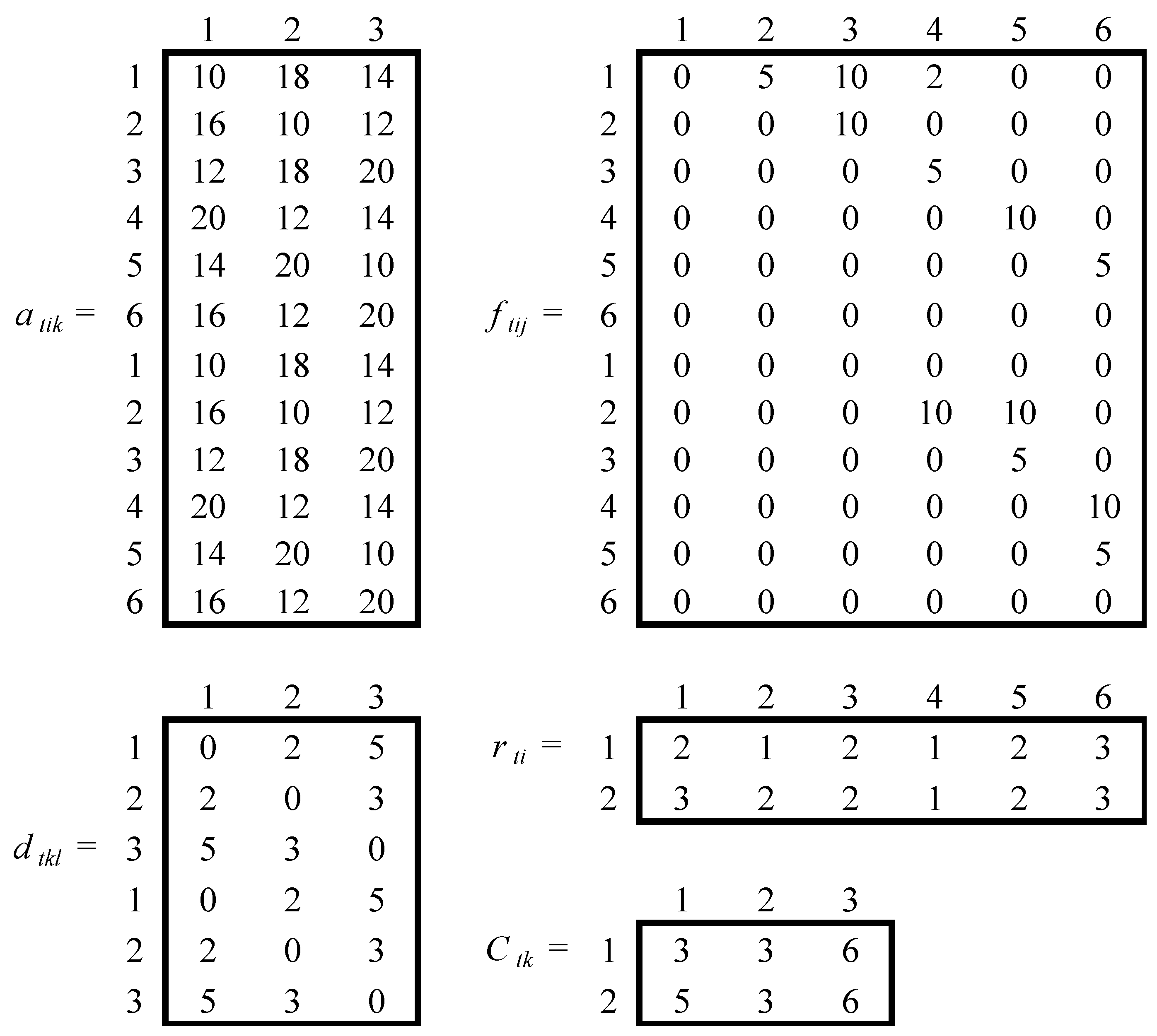
- The input data is deterministic and known. That is, for each period t, the number of units of materials transported between facilities i and j (ftij), the distances between locations k and l (dtkl), the space requirement of each facility i (rti), the capacity of each location k (Ctk), the costs of assigning and reassigning each facility i to each location k (atik), and the unit cost per distance unit of transporting materials between each pair of facility i at location k and facility j at location l (ctijkl) are deterministic and known.
- (3)
- One or more facilities may be assigned to each location during each period such that the capacity of the location is not exceeded.
- (4)
- The objective is to minimize the sum of the transportation, assignment, and reassignment costs. The assignment costs are the costs of initially assigning (or installing) facilities to locations during the first period. Reassignment costs are the costs of reassigning facilities to different locations (uninstalling and reinstalling facilities) after the first period. More specifically, reassignment cost of a facility i assigned to location l in period t (atil) consists of the costs of uninstalling facility i assigned to location k at end of period t − 1 plus the cost of reinstalling facility i at a new location l at the beginning of the next period t.
2.2. Combinatorial Optimization Problem (COP) Model
3. Heuristic Algorithms for the DGQAP
3.1. Construction Algorithms
3.1.1. Construction Algorithm I (CAI)
| Algorithm 1: CAI(Ctk, rti) | ||||
| 1: for t ← 1 to T do | ||||
| 2: | Initialize Ct and rt | |||
| 3: | Construct EFSt by sorting i in descending order based on rt(i) (break ties by lower i) | |||
| 4: | k ← 1 % k is the location index in array Ct | |||
| 5: | while k ≤ N and EFSt ≠ {} do % {} is the empty set | |||
| 6: | p ← 1 % p is the position index in array EFSt | |||
| 7: | repeat | |||
| 8: | i ← EFSt(p) % i is the facility number | |||
| 9: | if rt(i) ≤ Ct(k) then | |||
| 10: | st(i) ← k | |||
| 11: | Ct(k) ← Ct(k) − rt(i) | |||
| 12: | Remove(EFSt(p)) % Remove element EFSt(p) from set EFSt | |||
| 13: | else | |||
| 14: | p ← p + 1 | |||
| 15: | end if | |||
| 16: | until Ct(k) < rt(EFSt(Last)) do % EFSt(Last) is the last facility in array EFSt | |||
| 17: | k ← k + 1 | |||
| 18: | end while | |||
| 19: end for | ||||
| 20: return S | ||||
3.1.2. Construction Algorithm II (CAII)
| Algorithm 2: CAII(Ctk, rti) | |||
| 1: Initialize Ct and rt for 1 ≤ t ≤ T | |||
| 2: S1 ← CAI(C1, r1) | |||
| 3: Construct EFS2, …, EFST as discussed in CAI | |||
| 4: for t ← 2 to T do | |||
| 5: | p ← 1 % p is the position index in array EFSt | ||
| 6: | while p ≤ Last do % Last is the position of the last facility in array EFSt | ||
| 7: | i ← EFSt(p) % i is the facility number | ||
| 8: | if rt(i) ≤ Ct(st−1(i)) then | ||
| 9: | st(i) ← st−1(i) | ||
| 10: | Ct(st(i)) ← Ct(st(i)) − rt(i) | ||
| 11: | Remove(EFSt(p)) % Remove element EFSt(p) from set EFSt | ||
| 12: | else | ||
| 13: | p ← p + 1 | ||
| 14: | end if | ||
| 15: | end while | ||
| 16: | if EFSt ≠ {} then | ||
| 17: | Assign facilities in EFSt to location with enough capacity | ||
| 18: | if insufficient capacity then | ||
| 19: | St ← CAI(Ct, rt) | ||
| 20: | end if | ||
| 21: | end if | ||
| 22: end for | |||
| 23: return S | |||
3.2. Simulated Annealing (SA) Heuristic
3.2.1. Simulated Annealing I (SAI)
| Algorithm 3: SA(Temp0, min_Temp, NTemp, α, p) | |||||||||
| 1: Initialize Temp0, min_Temp, NTemp, α, and p | |||||||||
| 2: S0 ← CAI(Ctk, rti) in SAI and S0 ← CAII(Ctk, rti) in SAII | |||||||||
| 3: Compute TC(S0) using Equation (18) | |||||||||
| 4: best_sol ← S0, best_cost ← TC(S0) | |||||||||
| 5: n ← 0, Temp ← Temp0 % n is the iteration counter at current temperature Temp | |||||||||
| 6: while Temp > min_Temp do | |||||||||
| 7: | Randomly generate period t, move, and obtain neighboring solution S | ||||||||
| 8: | if S is feasible then % Use Equation (19) to check if S is feasible | ||||||||
| 9: | ∆TC ← TC(S0) − TC(S) | ||||||||
| 10: | if ∆TC > 0 or p = exp(-∆TC/Temp) > rand(0, 1) then | ||||||||
| 11: | S0 ← S | ||||||||
| 12: | Update(best_sol, best_cost) | ||||||||
| 13: | S0 ← Look-Ahead/Look-Back Strategy(S0, t, move) //use in SAII only | ||||||||
| 14: | end if | ||||||||
| 15: | n ← n + 1 | ||||||||
| 16: | if n = Ntemp then | ||||||||
| 17: | n ← 0, Temp ← α*Temp | ||||||||
| 18: | end if | ||||||||
| 19: | end if | ||||||||
| 20: end while | |||||||||
| 21: S* ← LocalSearch(best_sol, best_cost) | |||||||||
| 22: return S* | |||||||||
- Given best_sol and best_cost.
- Find all feasible neighboring solutions by considering all possible drop/add and pairwise exchange operations on best_sol.
- Pick the best feasible neighboring solution, S, with respect to total cost, TC(S). If TC(S) < best_cost, set best_sol = S, best_cost = TC(S), and go to step 2. Otherwise, terminate heuristic and return local optimum S* = best_sol.
3.2.2. Simulated Annealing II (SAII)
- (i)
- S is infeasible (steps 13–14),
- (ii)
- S is feasible, but ∆TC < 0 and p < rand(0, 1) (steps 10–11), or
- (iii)
- tp < 1 (step 16).
| Algorithm 4: Look-Ahead/Look-Back Strategy(S0, t, move) | ||||||||||
| 1: | tp ← t − 1, ts ← t + 1 | |||||||||
| 2: | repeat | |||||||||
| 3: | Perform move in period tp (or ts) and obtain solution S | |||||||||
| 4: | if S is feasible then % Use Equation (19) to check if S is feasible | |||||||||
| 5: | ∆TC ← TC(S0) − TC(S) | |||||||||
| 6: | if ∆TC > 0 or p = exp(−∆TC/Temp) > rand(0, 1) then | |||||||||
| 7: | S0 ← S | |||||||||
| 8: | Update(best_sol, best_cost) | |||||||||
| 9: | tp ← tp − 1 (ts ← ts + 1) | |||||||||
| 10: | else | |||||||||
| 11: | break | |||||||||
| 12: | end if | |||||||||
| 13: | else | |||||||||
| 14: | break | |||||||||
| 15: | end if | |||||||||
| 16: | until tp < 1 (ts > T) do | |||||||||
| 17: | return S0 | |||||||||
4. Computational Results
4.1. Set of Test Problems
4.2. Heuristic Parameter Settings
4.3. Computational Results for Data Set 1
4.4. Computational Results for Data Set 2
5. Conclusions
Author Contributions
Funding
Data Availability Statement
Conflicts of Interest
References
- Koopmans, T.C.; Beckmann, M.J. Assignment problems and the location of economic activities. Econometrica 1957, 25, 53–76. [Google Scholar] [CrossRef]
- Sahni, S.; Gonzales, T. P-complete Approximation Problems. J. ACM 1976, 23, 555–565. [Google Scholar] [CrossRef]
- Burkard, R.E.; Cela, E.; Pardalos, P.M.; Pitsoulis, L.S. The Quadratic Assignment Problem. In Handbook of Combinatorial Optimization; Du, D.-Z., Pardalos, P.M., Eds.; Kluwer: Boston, MA, USA, 1998; pp. 1713–1809. [Google Scholar] [CrossRef]
- Loiola, E.M.; de Abreu, N.M.M.; Boaventura-Netto, P.O.; Hahn, P.; Querido, T. A survey for the quadratic assignment problem. Eur. J. Oper. Res. 2007, 176, 657–690. [Google Scholar] [CrossRef]
- Silva, A.; Coelho, L.C.; Darvish, M. Quadratic assignment problem variants: A survey and an effective parallel memetic iterated tabu search. Eur. J. Oper. Res. 2021, 292, 1066–1084. [Google Scholar] [CrossRef]
- Lee, C.-G.; Ma, Z. The Generalized Quadratic Assignment Problem; Research Report; Department of Mechanical and Industrial Engineering, University of Toronto: Toronto, ON, Canada, 2004. [Google Scholar]
- Cordeau, J.-F.; Gaudioso, M.; Laporte, G.; Moccia, L. A memetic heuristic for the generalized quadratic assignment problem. INFORMS J. Comput. 2006, 18, 433–443. [Google Scholar] [CrossRef]
- Hahn, P.M.; Kim, B.-J.; Guignard, M.; MacGregor Smith, J.; Zhu, Y.-R. An algorithm for the generalized quadratic assignment problem. Comput. Optim. Appl. 2008, 40, 351–372. [Google Scholar] [CrossRef][Green Version]
- Pessoa, A.A.; Hahn, P.M.; Guignard, M.; Zhu, Y.-R. Algorithms for the generalized quadratic assignment problem combining lagrangean decomposition and the reformulation-linearization technique. Eur. J. Oper. Res. 2010, 206, 54–63. [Google Scholar] [CrossRef]
- Guignard, M. Strong RLT1 bounds from decomposable Lagrangean relaxation for some quadratic 0–1 optimization problems with linear constraints. Ann. Oper. Res. 2020, 286, 173–200. [Google Scholar] [CrossRef]
- Holland, J.H. Adaptation in Natural and Artificial Systems; University of Michigan Press: Ann Arbor, MI, USA, 1975. [Google Scholar]
- Glover, F. Future paths for integer programming and links to artificial intelligence. Comput. Oper. Res. 1986, 13, 533–549. [Google Scholar] [CrossRef]
- Mateus, G.R.; Resende, M.G.C.; Silva, R.M.A. GRASP with Path-relinking for the generalized quadratic assignment problem. J. Heuristics 2011, 17, 527–565. [Google Scholar] [CrossRef]
- McKendall, A.; Li, C. A tabu search heuristic for a generalized quadratic assignment problem. J. Ind. Prod. Eng. 2017, 34, 221–231. [Google Scholar] [CrossRef]
- Greistorfer, P.; Staněk, R.; Maniezzo, V. A tabu search matheuristic for the generalized quadratic assignment problem. In Metaheuristics; MIC 2022; Lecture Notes in Computer Science; Di Gaspero, L., Festa, P., Nakib, A., Pavone, M., Eds.; Springer: Cham, Switzerland, 2023; Volume 13838, pp. 544–553. [Google Scholar] [CrossRef]
- Fathollahi-Fard, A.M.; Wong, K.Y.; Aljuaid, M. An efficient adaptive large neighborhood search algorithm based on heuristics and reformulations for the generalized quadratic assignment problem. Eng. Appl. Artif. Intell. 2023, 126, 106802. [Google Scholar] [CrossRef]
- McKendall, A.; Dhungel, Y. A simulated annealing algorithm for the generalized quadratic assignment problem. Algorithms 2024, 17, 540. [Google Scholar] [CrossRef]
- Sohrabi, M.; Fathollahi-Fard, A.M.; Gromov, V.A.; Dulebenets, M.A. A genetic engineering algorithm for the generalized quadratic assignment problem. Neur. Comput. Appl. 2025, 37, 12253–12279. [Google Scholar] [CrossRef]
- Zou, D.; Gao, L.; Li, S.; Wu, J.; Wang, X. A novel global harmony search algorithm for task assignment problem. J. Syst. Soft. 2010, 83, 1678–1688. [Google Scholar] [CrossRef]
- Unal, Y.Z.; Uysal, O. A new mixed integer programming model for curriculum balancing: Application to a Turkish university. Eur. J. Oper. Res. 2014, 238, 339–347. [Google Scholar] [CrossRef]
- Elbeltagi, E.; Hegazy, T.; Eldosouky, A. Dynamic layout of construction temporary facilities considering safety. J. Constr. Eng. Manag. 2004, 130, 534–541. [Google Scholar] [CrossRef]
- Rosenblatt, M.J. The dynamics of plant layout. Manag. Sci. 1986, 32, 76–86. [Google Scholar] [CrossRef]
- McKendall, A.R.; Shang, J.; Kuppusamy, S. Simulated annealing heuristics for the dynamic facility layout problem. Comput. Oper. Res. 2006, 33, 2431–2444. [Google Scholar] [CrossRef]
- Khajemahalle, L.; Emami, S.; Keshteli, R.N. A hybrid nested partitions and simulated annealing algorithm for dynamic facility layout problem: A robust optimization approach. INFOR 2021, 59, 74–101. [Google Scholar] [CrossRef]
- Kogan, K.; Shtub, A.; Levit, V. DGAP-The dynamic generalized assignment problem. Ann. Oper. Res. 1997, 69, 227–239. [Google Scholar] [CrossRef]
- Mazzola, J.B.; Neebe, A.W. A generalized assignment model for dynamic supply chain capacity planning. Nav. Res. Logist. 2012, 59, 470–485. [Google Scholar] [CrossRef]
- Moccia, L.; Cordeau, J.-F.; Monaco, M.F.; Sammarra, M. A column generation heuristic for a dynamic generalized assignment problem. Comput. Oper. Res. 2009, 36, 2670–2681. [Google Scholar] [CrossRef]
- McKendall, A.R.; Noble, J.S.; Klein, C.M. Simulated annealing heuristics for managing resources during planned outages at electric power plants. Comput. Oper. Res. 2005, 32, 107–125. [Google Scholar] [CrossRef]
- Wang, S.; Sun, W.; Huang, M. An adaptive large neighborhood search for the multi-depot dynamic vehicle routing problem with time windows. Comput. Ind. Eng. 2024, 191, 110122. [Google Scholar] [CrossRef]
- Zhang, L.; Li, Q. Approximation algorithm for dynamic facility location problem. J. Comb. Optim. 2025, 49, 48. [Google Scholar] [CrossRef]
- Kirpatrick, S.; Gelatt, C.D.; Vecchi, M.P. Optimization by simulated annealing. Science 1983, 220, 671–680. [Google Scholar] [CrossRef]
- Huo, L.; Zhu, J.; Wu, G.; Li, Z. A novel simulated annealing based strategy for balanced UAV task assignment and path planning. Sensors 2020, 20, 4769. [Google Scholar] [CrossRef]
- Dai, Z.; Zhang, Z.; Chen, M. The home health care location-routing problem with a mixed fleet and battery swapping stations using a competitive simulated annealing algorithm. Expert Syst. Appl. 2023, 228, 120374. [Google Scholar] [CrossRef]
- Leelertkij, T.; Buddhakulsomsiri, J.; Huynh, V.-N. A multi-thread simulated annealing for multi-objective vehicle routing problem with time windows and demand priority. Comput. Ind. Eng. 2025, 207, 111253. [Google Scholar] [CrossRef]
- Tole, K.; Moqa, R.; Zheng, J.; He, K. A simulated annealing approach for the circle bin packing problem with rectangular items. Comput. Ind. Eng. 2023, 176, 109004. [Google Scholar] [CrossRef]
- Lin, S.-W.; Guo, S.; Wu, W.-J. Applying the simulated annealing algorithm to the set orienteering problem with mandatory visits. Mathematics 2024, 12, 3089. [Google Scholar] [CrossRef]
- Rosati, R.M.; Schaerf, A. Multi-neighborhood simulated annealing for the capacitated dispersion problem. Expert Syst. Appl. 2024, 255, 124484. [Google Scholar] [CrossRef]
- Ceschia, S.; Schaerf, A. Multi-neighborhood simulated annealing for the capacitated facility location problem with customer incompatibilities. Comput. Ind. Eng. 2024, 188, 109858. [Google Scholar] [CrossRef]
- Da Ros, F.; Di Gaspero, L.; Lackner, M.-L.; Musliu, N.; Winter, F. Multi-neighborhood simulated annealing for the oven scheduling problem. Comput. Oper. Res. 2025, 177, 106999. [Google Scholar] [CrossRef]
- Van Bulck, D.; Goossens, D.; Schaerf, A. Multi-neighbourhood simulated annealing for the ITC-2007 capacitated examination timetabling problem. J. Sched. 2025, 28, 217–232. [Google Scholar] [CrossRef]



| Number of Periods | Case 1 | Case 2 | Case 3 |
|---|---|---|---|
| 5 | 5-15-5-35 | 5-15-5-55 | 5-15-5-75 |
| 5-20-9-55 | 5-20-8-95 | 5-20-8-45 | |
| 5-30-10-65 | 5-30-20-75 | 5-30-20-80 | |
| 5-40-15-75 | 5-40-20-55 | 5-40-15-65 | |
| 10 | 10-15-5-55 | 10-15-5-35 | 10-15-5-75 |
| 10-20-8-95 | 10-20-10-75 | 10-20-9-55 | |
| 10-30-20-75 | 10-30-10-65 | 10-30-15-85 | |
| 10-40-15-65 | 10-40-20-75 | 10-40-15-65 |
| Proposed SA Heuristics | CPLEX | ||||||||
|---|---|---|---|---|---|---|---|---|---|
| Problem | SAI (20 runs) | SAII (10 runs) | |||||||
| Min | Avg | Avg Time (s) | Min | Avg | Avg Time (s) | Opt TC Min | Time (s) | % Dev | |
| 2-6-3-92 | 308 | 309 | 0.95 | 308 | 308 | 1.38 | 308 | 0.05 | 0 |
| 2-15-4-85 | 1,204,837 | 1,231,778.95 | 6.28 | 1,204,837 | 1,209,350 | 10.40 | 1,248,242 * | 19,644 | −3.5 |
| 3-10-5-75 | 710,036 | 747,393.55 | 6.02 | 710,036 | 739,104.8 | 10.63 | 710,036 | 10,494 | 0 |
| 3-15-4-85 | 1,652,317 | 1,702,007.75 | 9.41 | 1,652,317 | 1,679,416.7 | 16.10 | 1,872,699 * | 10,916 | −11.8 |
| 3-9-4-55 | 630,095 | 636,850.75 | 2.71 | 630,095 | 630,095 | 4.70 | 630,095 | 661 | 0 |
| 4-10-5-75 | 822,861 | 907,919.3 | 8.01 | 865,255 | 893,277 | 13.06 | 822,861 * | 19,674 | 0 |
| 4-12-5-35 | 266,907 | 340,770.7 | 5.63 | 266,907 | 316,014.9 | 10.96 | 266,907 | 24.84 | 0 |
| SAI (30 Runs) | SAII (10 Runs) | |||||||
|---|---|---|---|---|---|---|---|---|
| # | Problem | Min | Avg | Avg Time (s) | Min | Avg | Avg Time (s) | % Dev |
| 1 | 5-15-5-35 | 922,200 | 945,672 | 9.89 | 922,200 | 936,132.889 | 16.66 | 0 |
| 2 | 5-20-9-55 | 5,379,995 | 5,460,632.22 | 41.16 | 5,341,049 | 5,434,662.78 | 68.18 | −0.72 |
| 3 | 5-30-10-65 | 13,431,191 | 13,520,605.6 | 106.01 | 13,317,816 | 13,453,558.1 | 173.9 | −0.84 |
| 4 | 5-40-15-75 | 27,560,439 | 27,745,720 | 328.05 | 27,530,778 | 27,702,223.9 | 506.7 | −0.11 |
| 5 | 10-15-5-55 | 1,623,750 | 1,657,796.44 | 27.67 | 1,600,610 | 1,646,887.11 | 49.38 | −1.43 |
| 6 | 10-20-8-95 | 18,193,911 | 18,364,936.2 | 252 | 18,213,573 | 18,339,336.4 | 359.68 | 0.11 |
| 7 | 10-30-20-75 | 39,161,467 | 39,414,923.1 | 679.79 | 39,010,900 | 39,250,770 | 1098.28 | −0.38 |
| 8 | 10-40-15-65 | 50,169,966 | 50,506,268 | 551.35 | 50,262,851 | 50,644,072.67 | 1063.97 | 0.19 |
| 9 | 5-15-5-55 | 2,286,825 | 2,321,354.56 | 13.27 | 2,283,483 | 2,319,463.89 | 20.82 | −0.15 |
| 10 | 5-20-8-95 | 8,641,452 | 8,686,293.67 | 119.11 | 8,588,225 | 8,669,305.67 | 166.47 | −0.62 |
| 11 | 5-30-20-75 | 19,541,977 | 19,739,468 | 323.11 | 19,692,003 | 19,788,634.78 | 486.99 | 0.77 |
| 12 | 5-40-20-55 | 27,392,715 | 27,527,123 | 337.82 | 27,271,823 | 27,571,778.44 | 583.04 | −0.44 |
| 13 | 10-15-5-35 | 1,646,841 | 1,660,313.22 | 20.01 | 1,623,122 | 1,633,250.44 | 41.23 | −1.44 |
| 14 | 10-20-10-75 | 15,341,257 | 15,405,018.7 | 122.99 | 15,300,098 | 15,364,792.4 | 201.64 | −0.27 |
| 15 | 10-30-10-65 | 28,288,641 | 28,429,625.9 | 207.94 | 28,234,507 | 28,385,578.8 | 407.16 | −0.19 |
| 16 | 10-40-20-75 | 65,959,299 | 66,672,030 | 965.77 | 66,668,768 | 66,793,629.44 | 1630.85 | 1.08 |
| 17 | 5-15-5-75 | 2,904,174 | 2,944,380.56 | 18.16 | 2,907,949 | 2,941,021 | 27.36 | 0.13 |
| 18 | 5-20-8-45 | 4,095,000 | 4,123,576.33 | 30.99 | 4,063,326 | 4,115,795.22 | 53.1 | −0.77 |
| 19 | 5-30-20-80 | 20,518,420 | 20,649,265.9 | 374.43 | 20,461,707 | 20,624,964.8 | 549.39 | −0.28 |
| 20 | 5-40-15-65 | 28,921,669 | 29,019,295 | 280.66 | 28,865,557 | 28,958,645.3 | 469.37 | −0.19 |
| 21 | 10-15-5-75 | 5,763,799 | 5,790,489.56 | 36.99 | 5,697,149 | 5,781,182 | 59.05 | −1.16 |
| 22 | 10-20-9-55 | 11,120,614 | 11,226,135.4 | 86.38 | 11,114,752 | 11,207,295.2 | 168.23 | −0.05 |
| 23 | 10-30-15-85 | 38,612,373 | 38,841,027.4 | 560 | 38,394,484 | 38,751,672.9 | 873.47 | −0.56 |
| 24 | 10-40-15-65 | 57,216,830 | 57,423,855 | 554.89 | 57,150,774 | 57,365,444.9 | 1070.64 | −0.12 |
| # Best | 6 | 4 | 19 | 20 | ||||
Disclaimer/Publisher’s Note: The statements, opinions and data contained in all publications are solely those of the individual author(s) and contributor(s) and not of MDPI and/or the editor(s). MDPI and/or the editor(s) disclaim responsibility for any injury to people or property resulting from any ideas, methods, instructions or products referred to in the content. |
© 2025 by the authors. Licensee MDPI, Basel, Switzerland. This article is an open access article distributed under the terms and conditions of the Creative Commons Attribution (CC BY) license (https://creativecommons.org/licenses/by/4.0/).
Share and Cite
Dhungel, Y.; McKendall, A. Solution Methods for the Dynamic Generalized Quadratic Assignment Problem. Mathematics 2025, 13, 4021. https://doi.org/10.3390/math13244021
Dhungel Y, McKendall A. Solution Methods for the Dynamic Generalized Quadratic Assignment Problem. Mathematics. 2025; 13(24):4021. https://doi.org/10.3390/math13244021
Chicago/Turabian StyleDhungel, Yugesh, and Alan McKendall. 2025. "Solution Methods for the Dynamic Generalized Quadratic Assignment Problem" Mathematics 13, no. 24: 4021. https://doi.org/10.3390/math13244021
APA StyleDhungel, Y., & McKendall, A. (2025). Solution Methods for the Dynamic Generalized Quadratic Assignment Problem. Mathematics, 13(24), 4021. https://doi.org/10.3390/math13244021