


Abstract
Let G be a simple graph. A general total coloring f of G refers to a coloring of the vertices and edges of G. Let be the set of colors of vertex x and edges incident with x under f. For a general total coloring f of G in which k colors are available, if for any two different vertices u and v in , then f is called a k-general vertex-distinguishing total coloring of G, or a k-GVDTC of G for short. The minimum number of colors required for a GVDTC of G is denoted by and is called the general vertex-distinguishing total chromatic number, or the GVDT chromatic number of G for short. GVDTCs of complete bipartite graphs are studied in this paper.
Keywords:
graphs; complete bipartite graphs; general total coloring; general vertex-distinguishing total coloring; general vertex-distinguishing total chromatic number MSC:
05C15
1. Introduction and Terminologies
For an edge coloring (proper or not) of a graph G and a vertex x of G, denote by the set of colors used to color the edges incident with x.
A proper edge coloring of a graph G is said to be vertex-distinguishing if for , we have . In other words, whenever . A graph G has a vertex-distinguishing proper edge coloring if and only if it has no more than one isolated vertex and no isolated edges. Such a graph will be referred to as a -graph. The minimum number of colors required for a vertex-distinguishing proper edge coloring of a -graph G is denoted by . Vertex-distinguishing proper edge coloring has been considered in several papers [1,2,3,4,5,6,7].
A general edge coloring (not necessarily proper) of a graph G is said to be point-distinguishing if is required for any two distinct vertices . The point-distinguishing chromatic index of a -graph G, denoted by , refers to the minimum number of colors required for a point-distinguishing general edge coloring of G. This parameter was introduced by Harary and Plantholt in [8]. Although the structure of complete bipartite graphs is simple, it seems that the problem of determining is not easy, especially in the case , as documented by papers of M. Horňák and R. Soták [9,10], N. Zagaglia Salvi [11,12] and M. Horňák and N. Zagaglia Salvi [13].
A proper total coloring of a graph G is an assignment of several colors to the vertices and edges of G such that the following three conditions are satisfied:
Condition (V): No two adjacent vertices receive the same color;
Condition (E): No two adjacent edges receive the same color;
Condition (I): No edge receives the same color as any one of its incident vertices.
A general total coloring of a graph G is an assignment of several colors to the vertices and edges of G. Note that three conditions (V), (E) and (I) are not required; i.e., under a general total coloring of a graph G, two adjacent or incident elements of G may receive the same color.
For a total coloring (proper or general) f of G and a vertex x of G, denote by (or simply if no confusions arise) the set of colors used to color the vertex x or the edges incident with x. Note that is not a multiple set. And is called the color set of vertex x under f. Let be the complementary set of in the set of all available colors. Obviously , and the equality holds if the total coloring is proper.
For a proper total coloring, if for any two distinct vertices u and v, then the coloring is called vertex-distinguishing proper total coloring, and the minimum number of colors required for a vertex-distinguishing proper total coloring is denoted by . This concept was considered in [14,15]. In [15], the following conjecture was given.
Conjecture 1
([15]). Suppose G is a simple graph and is the number of vertices of degree d, . Let k be the minimum positive integer such that for all d such that ; then or .
From [15] we know that the above conjecture is valid for complete graphs, complete bipartite graphs, wheels, fans, regular double stars, paths, cycles, , , , and 2-order n-separate trees. An upper bound for is also given in [15].
General vertex-distinguishing total coloring of a graph is introduced in [16]. The relationship between this coloring and vertex-distinguishing proper total coloring is similar to the relationship between vertex-distinguishing general edge coloring and vertex-distinguishing proper edge coloring.
After vertex-distinguishing proper edge coloring was investigated by Burris and Schelp et al. in [4], Zhongfu Zhang et al. in [15] began by studying vertex-distinguishing proper total coloring, obtained several results and proposed the Vizing-like conjecture (Conjecture 1) of this coloring. Similarly, Chanjuan Liu and Enqiang Zhu in [16] researched general vertex-distinguishing total coloring and obtained many results, after vertex-distinguishing general edge coloring was studied by Harary et al. in [8]. General vertex-distinguishing total coloring (in [16]) is nothing but vertex-distinguishing general total coloring. In this paper we introduce an index of a graph G and propose a Vizing-like conjecture of the coloring. For reasons such as these, general vertex-distinguishing total coloring turns out to be rather important.
A general total coloring of graph G in which k colors are available is also called a k-general total coloring of graph G. If f is a general total coloring of graph G and for any two different vertices in , then f is called a vertex-distinguishing general total coloring of G or a general vertex-distinguishing total coloring of G and denoted by GVDTC in brief. A general vertex-distinguishing total coloring of G in which k colors are available is also called a k-general vertex-distinguishing total coloring of G and denoted by k-GVDTC in brief.
The positive integer is called the general vertex-distinguishing total chromatic number of graph G (or GVDT chromatic number of G) and is denoted by .
The following proposition is obviously true (since a vertex-distinguishing proper total coloring of a graph G is also a vertex-distinguishing general total coloring of G).
Proposition 1.
.
For a graph G, let denote the number of vertices of degree i, . Let
Obviously, we have the following proposition.
Proposition 2.
.
The GVDTCs of a path, cycle, star, double star, tristar, fan, wheel and complete graph are investigated and the GVDT chromatic numbers of these graphs are obtained in [16]. The conclusions on the GVDT chromatic numbers of star and complete graph are listed in the following. A conjecture (the following Conjecture 2) is proposed in [16].
Proposition 3
([16]). Suppose is a star of order ; i.e., . We have
Proposition 4
([16]). If is a complete graph of order n, then we have
Conjecture 2
([16]). If G is a graph, then
In this paper we will consider the GVDTC of complete bipartite graphs.
For a set S, let denote the collection of all subsets of S. Of course is also a set and has members.
An i-subset of S is a subset of S that has i elements.
For complete bipartite graph (), we suppose that the vertex set of is , where , and the edge set of is .
For a GVDTC of complete bipartite graph (), we use to denote the collection of the color sets of all vertices in X under given GVDTC; i.e., . We use to denote the collection of the color sets of all vertices in Y under given GVDTC and to denote the collection of the color sets of all vertices in under given GVDTC; i.e., =.
Generally, if we mention a k-GVDTC, then the available colors in this coloring are . If A is a subset of , then we denote by .
2. Preliminaries
For complete bipartite graphs , is the minimum positive integer l such that
The following Lemma 1 is obviously true.
Lemma 1.
(i) If a is a positive real number, then function is decreasing when and is increasing when .
(ii) If are positive integers, , , then when a is an even number and when a is an odd number.
Proof.
By simple calculation we have . So when and when . Thus (i) is true. But (ii) is the direct consequence of (i). □
Lemma 2.
Let , , where m is a positive integer. Then or .
Proof.
Suppose q is a non-negative integer such that . Then . If , then , . Thus we may assume that .
(i) When , we have . Thus and .
(ii) When , we have . Thus and . □
Lemma 3.
Let s be the minimum positive integer such that . If (i) , or (ii) , , then has an -GVDTC.
Proof.
We will give an -GVDTC of in which the available colors are in the following. There are four cases to be considered.
Case 1.
.
In this case, only condition (i) is satisfied. Let , , and . Let , ; ; ; ; ; ; and . Let , , …, be different subsets (of ) containing at least 2 and at most colors except for all (). This is well established since .
Construct a general total coloring as follows. Let receive color , . Let and receive color and receive color j (), . Let () and receive color j, . For each , let , , then . Note that depend on j. Let receive color ; let edge receive color (); and let edge () receive the color .
Obviously we have since . From the colors of the vertices in X and the edges incident with , , we know that , . From the coloring process we know that . Thus the resulting coloring is an -GVDTC of .
Case 2.
.
If , then condition (i) is satisfied and . If , then condition (ii) is satisfied and .
Let , , and . Let , ; ; ; ; and . Let , , …, be different subsets (of ) containing at least 2 and at most colors except for all (). This is well established since .
Note that ; we can give an -GVDTC of similar to the case such that , , .
Case 3.
and when condition (ii) is satisfied we suppose .
In this case if condition (i) is satisfied then ; if condition (ii) is satisfied then and .
Fact 1.
.
Proof of Fact 1.
If condit ion (i) is satisfied, we have If condition (ii) is satisfied, we will prove that by induction on s.
When , , we have . Since when , when and when , we have for . Let and be the maximum positive integer such that . Then the maximum positive integer is such that does not exceed (otherwise . So . This is a contradiction to the choice of ). Suppose (induction assumption) and . Then . The proof of Fact 1 is completed. □
Let , , and . Let , , …, be different subsets (of ) containing color such that (). Let , ; ; and . Let , , …, be different subsets (of ) containing at least 2 and at most colors except for all , () and (). This is well established since (obtained by Fact 1) and .
Construct a general total coloring as follows. Let receive color , . Let and receive color and receive color j (), . Let () and receive color . For each , let , then . Let receive color ; let edge receive the color (); and let edge () receive the color .
Obviously we have . From the color of and colors of the edges incident with , , we know that , . From the coloring process we know that . Thus the resulting coloring is an -GVDTC of .
Case 4.
, and condition (ii) is satisfied.
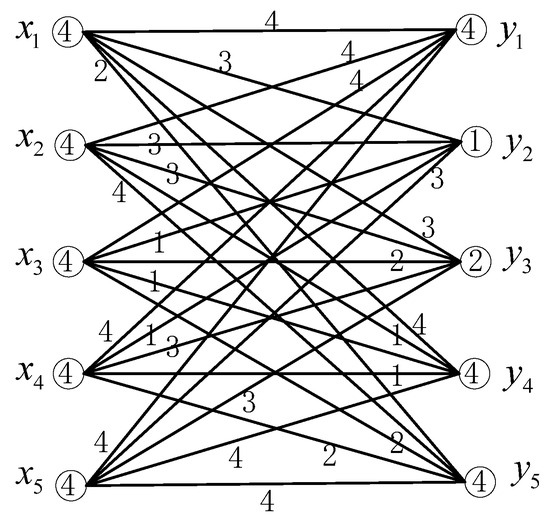
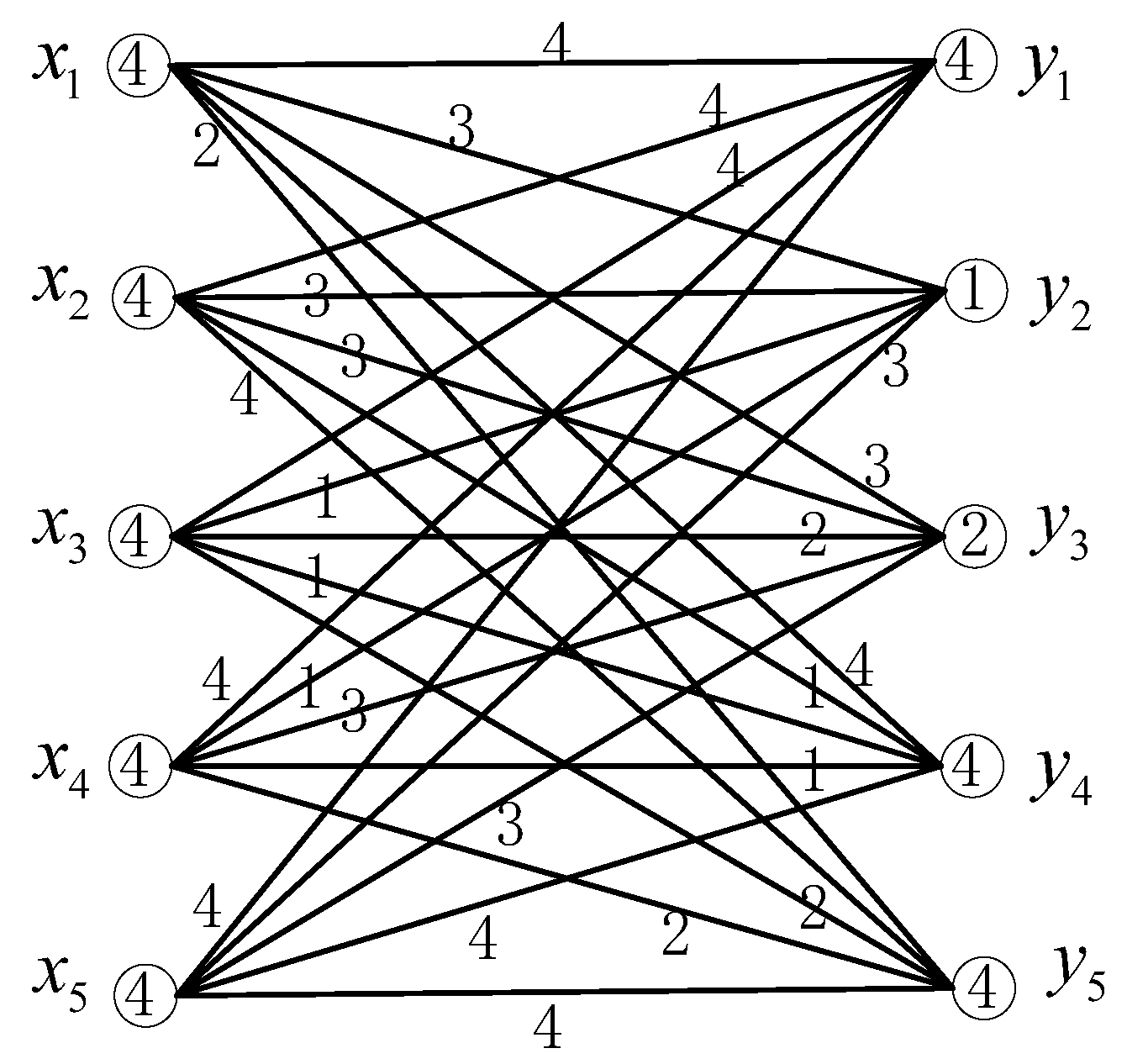
In this case we have that or . The coloring given in Table 1 is a 4-GVDTC of . The restriction of this 4-GVDTC of on the subgraph induced by is a 4-GVDTC of (see Figure 1).
Table 1.
A 4-GVDTC of .
Figure 1.
A 4-GVDTC of .
3. Main Results
Theorem 1.
Let , and . If , then .
Proof.
Firstly, we show that does not have a -GVDTC.
Otherwise, we assume that g is a -GVDTC of in which the available colors are .
When , from we know that ; i.e., . This is a contradiction. So we let . Suppose that is the collection of all 1-subsets, 2-subsets, …, -subsets of .
If , say , then , , …, are not in and , , …, . Thus . This is a contradiction.
If , then and , . Thus , , …, and . This is a contradiction.
Secondly, we will give a k-GVDTC of in which the available colors are .
Put
Now distribute other subsets of with cardinality between 2 and to vertices such that different vertices correspond different subsets. The subset that corresponds to is denoted by . This is well established since .
Construct a general total coloring as follows. Let receive color k, ; let and receive color k and receive color j (), ; and let () and receive color j, .
Let .
If contains at least two different colors, then let , where . Let receive color . Let edge receive color (). The number of colors in is not larger than the number of the uncolored edges incident with , so we can assign the colors in to the edges in such that each color in is used to color at least one edge incident with .
If contains just one color , then let receive color . The number of colors in is not larger than the number of the all (uncolored) edges incident with , so we can assign the colors in to the edges incident with such that each color in is used to color at least one edge incident with .
If is empty, then the number of colors in is not larger than , so we can assign the colors in to the vertex and the edges incident with such that each color in is used to color the vertex or one edge incident with .
By simple calculation we see that . From the color of each and the coloring of the incident edges of vertices , , we know that , . From the coloring process we know that . Thus the resulting coloring is a k-GVDTC of . □
Example 1.
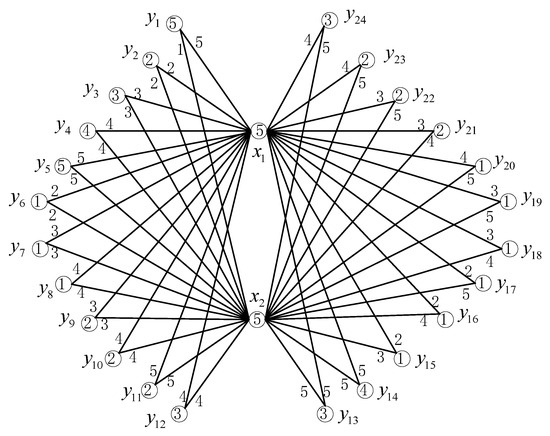
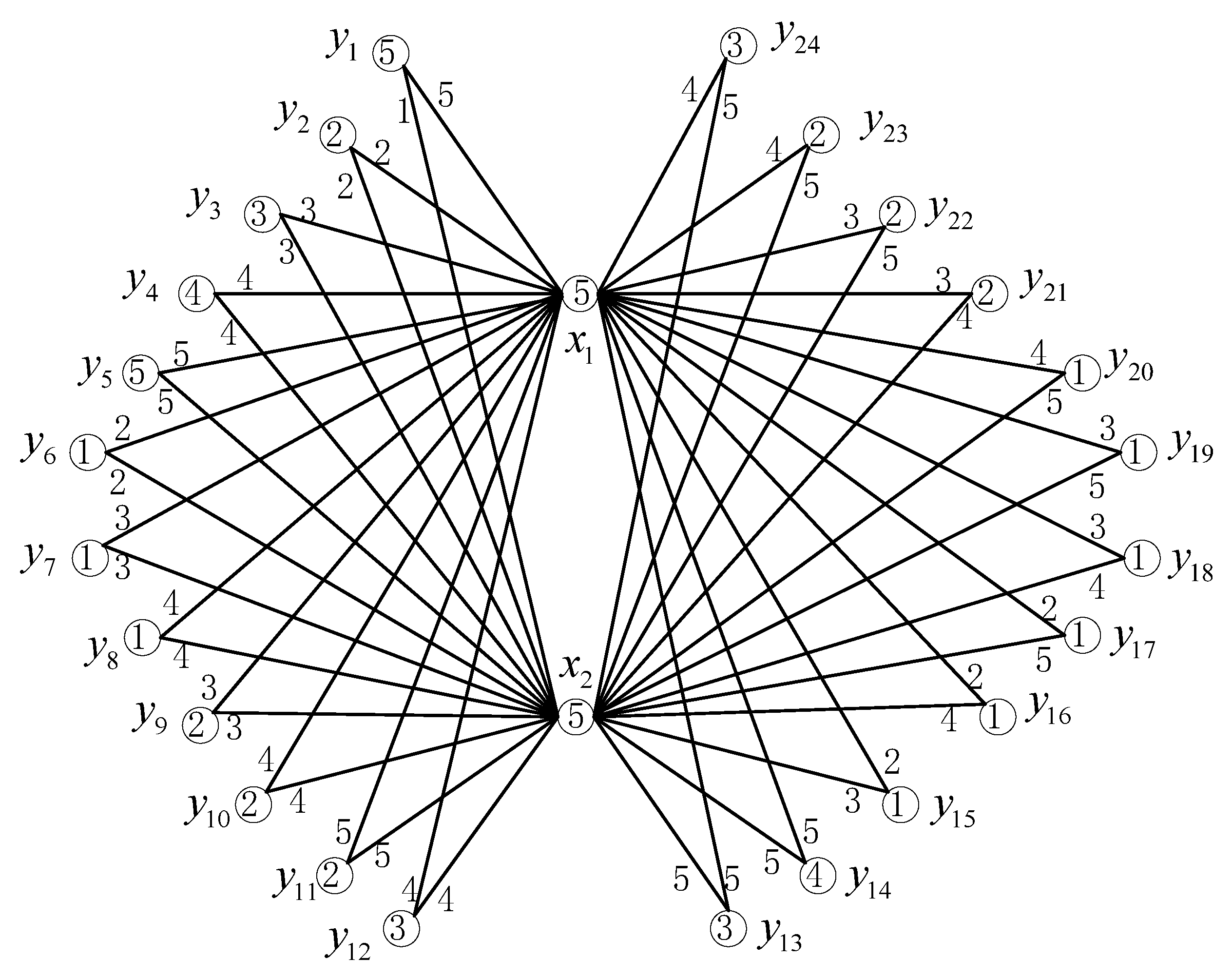
According to the proof of Theorem 1, a 5-GVDTC of is shown in Figure 2.
Figure 2.
A 5-GVDTC of .
Remark 1.
Note that when , . It is easy to see that . Let . So the restriction of the -GVDTC of obtained in the proof of Theorem 1 (take ) on the subgraph induced by is an -GVDTC of when .
Theorem 2.
Let ; i.e., . Then .
Proof.
By Remark 1, we have . So we need only to prove that does not have an GVDTC. Otherwise, suppose g is an GVDTC of in which the available colors are .
If there are two members and in such that (i.e., the two members are complementary), then each nonempty subset in is not in . Since , there exist at most nonempty subsets of , which are not the color set of any vertices in . Therefore at least members in are contained in . We have . By Lemma 1, we have ; i.e., . This is a contradiction.
If any subset in is not the complement of any subset in , then each is not the color set of any vertices. Thus and . This is a contradiction. □
Theorem 3.
Let and . If , then .
Proof.
By Lemma 3, we know that since . So we need only to prove that does not have an r-GVDTC under the given conditions.
Otherwise, let g be an r-GVDTC of in which the available colors are . We will give six claims as follows.
- Claim 1.
- , .
This is obvious because the color of edge is in both and .
- Claim 2.
- .
Otherwise, say . Then, by Claim 1, each is not the color set of any vertex and we have that . This is a contradiction.
- Claim 3.
- .
From Claim 2, we can deduce Claim 3 easily.
- Claim 4.
- .
Otherwise, say . Then, by Claim 1, each is not the color set of any vertex and we have that . This is a contradiction.
- Claim 5.
- .
This is deduced from Claim 4 directly.
- Claim 6.
- If D is a subset of with , then either D or is not the color set of any vertex in X, where .
Otherwise, D and are the color sets of vertices in X; then each nonempty subset in is not in . Since , there exist at most nonempty subsets of , which are not the color set of any vertices in . Therefore at least members in are contained in , where . We have .
If r is even, by Lemma 1, we have ; i.e., . In addition, by Lemma 2 from we know that . Thus ; i.e., and we have . This is a contradiction.
If r is odd, by Lemma 1, we have ; i.e., . In addition, by Lemma 2 from we know that . Thus ; i.e., . This is a contradiction, too.
We consider the following two cases.
- Case 1.
- , , …, , are in .
Of course . If , then is not the color set of any vertex in by Claim 1 and Claim 6. Thus, by Claim 3 and Claim 5, we have that , where is the collection of all 2-subsets, 3-subsets, …, -subsets, except for all and with . Therefore ; i.e., . This is a contradiction.
- Case 2.
- At least one subset among all -subsets and r-subsets is not the color set of any vertex in X.
If , then the complementary sets of the color sets of at least vertices in X (whose color set is not -subset or r-subset) are not the color set of any vertex in . Thus . This is a contradiction.
If , then , where is the collection of all 2-subsets, 3-subsets, …, r-subsets. Thus . This is a contradiction, too.
Thus does not have an r-GVDTC under the given conditions. The proof is completed. □
Theorem 4.
If (i) , , or (ii) , or (iii) , , , then .
Let and s be the minimum positive integer such that . Suppose
Proof.
By Lemma 3, we know that has an -GVDTC when one of three conditions (i), (ii) or (iii) holds. When conditions (i) and (ii) are valid, we have that , and the results are right since all the nonempty subsets of the set composed by r colors cannot distinguish n vertices. So we suppose that condition (iii) holds in the following. By use of Lemma 2 and the definitions of a and , we can deduce that from . By Lemma 3, we need only to prove that does not have an r-GVDTC.
Assume that has an r-GVDTC g in which the available colors are . Firstly, we will give six claims.
- Claim 1.
- , .
This is obvious because the color of edge is in both and .
- Claim 2.
- .
Otherwise, say . Then each is not the color set of any vertex and we have that . This is a contradiction.
- Claim 3.
- .
From Claim 2, we can deduce Claim 3 easily.
- Claim 4.
- .
Otherwise, say . Then each is not the color set of any vertex and we have that . This is a contradiction.
- Claim 5.
- .
This is deduced from Claim 4 directly.
- Claim 6.
- If D is a subset of with , then either D or is not the color set of vertex in X, where .
Otherwise, D and are the color sets of vertices in X; then each nonempty subset in is not in . Since , there exist at most nonempty subsets of , which are not the color set of any vertex in . Therefore at least members in are contained in , where . We have .
If r is even, by Lemma 1, we have ; i.e., . This is a contradiction.
If r is odd, by Lemma 1, we have ; i.e., . This is a contradiction, too.
The proof of Claim 6 is completed.
Finally we consider the following two cases.
- Case 1.
- , , …, , are in .
If , then is not the color set of any vertex in by Claim 6. Let , , …, , . Then, by Claim 3 and Claim 5, we have
Thus ; i.e., . This is a contradiction.
- Case 2.
- At least one subset among all -subsets and r-subsets is not the color set of vertices in X.
Let , , …, , with . Then we have
Thus ; i.e., . This is a contradiction.
Thus does not have an r-GVDTC under the given conditions. The proof is completed. □
4. An Application to the Case
By Theorems 1–4, we can determine the when , , and , , respectively. From Theorem 4 (when condition (iii) holds) we can know that when and 12. We will discuss other cases in the following.
Theorem 5.
.
Proof.
Obviously, we have . So we need only to give a 5-GVDTC of in which the available colors are . Let
We can give a 5-GVDTC of easily such that , , (see Table 2). □
Table 2.
A 5-GVDTC of .
Theorem 6.
If , then .
Proof.
This is a contradiction.
This is a contradiction. □
By Lemma 3, we know that has 6-GVDTC when . So we need only to show that does not have any 5-GVDTC when .
Assume that has a 5-GVDTC g when .
- Claim 1.
- , .
Otherwise, without loss of generality, we suppose that . Then each is not the color set of any vertex and . This is a contradiction.
- Claim 2.
- , .
Otherwise, without loss of generality, we suppose that . Then each is not the color set of any vertex and . This is a contradiction.
From Claim 1 and Claim 2, we have the following claim.
- Claim 3.
- and , where is the collection of all subsets (of ) that contains at least 2 elements.
All 2-subsets of except for at most two 2-subsets are in .
We consider two cases.
- Case 1.
- . We may suppose . Since the color set of each vertex in X is not disjoint with the color set of any vertex in Y, we have that , , , , , , , are the color sets of vertices in one part. Thus the color set of each vertex in another part is one of the following sets:
- Case 2.
- . We may suppose . Since the color set of each vertex in X is not disjoint with the color set of any vertex in Y, we have that , , , , , , , are the color sets of vertices in one part. Thus the color set of each vertex in another part is one of the following sets:
Theorem 7.
If , then .
Proof.
This is a contradiction.
This is a contradiction. □
By Lemma 3, we know that has a 7-GVDTC when . So we need only to show that does not have any 6-GVDTC when .
Assume that has a 6-GVDTC g when .
- Claim 1.
- , .
Otherwise, without loss of generality, we suppose that . Then each contains color 1. But has at most 31 subsets that contain 1 and have at least two elements. This is a contradiction.
- Claim 2.
- , .
Otherwise, without loss of generality, we suppose that . Then each is not the color set of any vertex and . This is a contradiction.
From Claim 1 and Claim 2, we have the following claim.
- Claim 3.
- and , where is the collection of all subsets ( of ) that contains at least two elements.
All 2-subsets of except for at most two 2-subsets are in .
We consider two cases.
- Case 1.
- . We may suppose . We can deduce that other 2-subsets are the color sets of vertices in one part. Thus the color set of each vertex in another part is one of the following sets:
- Case 2.
- . We may suppose . We can deduce that other 2-subsets are the color sets of vertices in one part. Thus the color set of each vertex in another part is one of the following sets:
5. A Conjecture
It is easy to know that Conjecture 2 is right for the bipartite graphs mentioned in Theorems 1–4 and .
By simple calculation we can obtain that or for the above graphs. For example, for the graph in Theorem 4, we have If conditions (i) and (ii) hold, then ; i.e., . When condition (iii) holds, we get ; i.e., .
So we propose the following Vizing-like conjecture.
Conjecture 3.
If G is a simple graph, then or .
6. Conclusions
In this paper we have investigated the general vertex-distinguishing total colorings of complete bipartite graphs and determined the general vertex-distinguishing total chromatic numbers for many complete bipartite graphs (Theorems 1–4). Furthermore, as an application, we have given the general vertex-distinguishing total chromatic number of complete bipartite graphs . What is more, our results show that Conjecture 2 holds for the complete bipartite graphs considered in this paper, and we have proposed a Vizing-like conjecture (Conjecture 3).
Author Contributions
Methodology, X.C.; formal analysis, T.L.; investigation, X.C. and T.L.; writing—original draft, X.C. and T.L.; writing—review and editing, X.C. and T.L.; funding acquisition, X.C. and T.L. All authors have read and agreed to the published version of the manuscript.
Funding
This research is supported by the National Natural Science Foundation of China under Grant No. 11761064, Launch Project of High-Level Talent Scientific Research of Shihezi University under Grant No. RCZK202416 and the Tianchi Talent of Xinjiang Uygur Autonomous Region under Grant No. CZ001313.
Data Availability Statement
The original contributions presented in this study are included in the article. Further inquiries can be directed to the corresponding author.
Conflicts of Interest
The authors declare no conflict of interest.
Notations
The following abbreviations are used in this manuscript:
| the set of colors used to color the edges incident with x | |
| -graph | a graph that has no more than one isolated vertex and no isolated edges |
| minimum number of colors required for a vertex-distinguishing proper edge coloring of a -graph | |
| point-distinguishing chromatic index of a -graph | |
| the set of colors used to color the vertex x as well as the edges incident with x | |
| the complementary set of in the set of available colors | |
| the minimum number of colors required for a vertex-distinguishing proper total coloring | |
| GVDTC | general vertex-distinguishing total coloring |
| the positive integer |
References
- Balister, P.N.; Bollobás, B.; Shelp, R.H. Vertex distinguishing colorings of graphs with Δ(G)=2. Discret. Math. 2002, 252, 17–29. [Google Scholar] [CrossRef] [Scilit]
- Balister, P.N.; Riordan, O.M.; Schelp, R.H. Vertex distinguishing Edge colorings of graphs. J. Graph Theory 2003, 42, 95–109. [Google Scholar] [CrossRef] [Scilit]
- Bazgan, C.; Harkat-Benhamdine, A.; Li, H.; Woźniak, M. On the vertex-distinguishing proper edge-colorings of graphs. J. Combin. Theory Ser. B 1999, 75, 288–301. [Google Scholar] [CrossRef] [Scilit]
- Burris, A.C.; Schelp, R.H. Vertex-distinguishing proper edge-colorings. J. Graph Theory 1997, 26, 73–82. [Google Scholar] [CrossRef] [Scilit]
- Černý, J.; Horňák, M.; Sotxaxk, R. Observability of a graph. Math. Slovaca 1996, 46, 21–31. [Google Scholar]
- Horňák, M.; Sotxaxk, R. Observability of complete multipartite graphs with equipotent parts. Ars Comb. 1995, 41, 289–301. [Google Scholar]
- Horňák, M.; Sotxaxk, R. Asymptotic behaviour of the observability of Qn. Discret. Math. 1997, 176, 139–148. [Google Scholar] [CrossRef] [Scilit]
- Harary, F.; Plantholt, M. The point-distinguishing chromatic index. In Graphs and Applications; Harary, F., Maybee, J.S., Eds.; Wiley Interscience: New York, NY, USA, 1985; pp. 147–162. [Google Scholar]
- Horňák, M.; Sotxaxk, R. The fifth jump of the point-distinguishing chromatic index of Kn,n. Ars Comb. 1996, 42, 233–242. [Google Scholar]
- Horňák, M.; Sotxaxk, R. Localization jumps of the point-distinguishing chromatic index of Kn,n. Discuss. Math. Graph Theory 1997, 17, 243–251. [Google Scholar] [CrossRef] [Scilit]
- Zagaglia Salvi, N. On the point-distinguishing chromatic index of Kn,n. Ars Comb. 1988, 25B, 93–104. [Google Scholar]
- Zagaglia Salvi, N. On the value of the point-distinguishing chromatic index of Kn,n. Ars Comb. 1990, 29B, 235–244. [Google Scholar]
- Horňák, M.; Zagaglia Salvi, N. On the point-distinguishing chromatic index of complete bipartite graphs. Ars Comb. 2006, 80, 75–85. [Google Scholar]
- Chen, X. Asymptotic behaviour of the vertex-distinguishing total chromatic numbers of n-cube. J. Northwest Norm. Univ. (Nat. Sci.) 2005, 41, 1–3. [Google Scholar]
- Zhang, Z.; Qiu, P.; Xu, B.; Li, J.; Chen, X.; Yao, B. Vertex-distinguishing total colorings of graphs. Ars Comb. 2008, 87, 33–45. [Google Scholar] [CrossRef] [Scilit]
- Liu, C.; Zhu, E. General vertex-distinguishing total colorings of graphs. J. Appl. Math. 2014, 2014, 849748. [Google Scholar] [CrossRef] [Scilit]

Disclaimer/Publisher’s Note: The statements, opinions and data contained in all publications are solely those of the individual author(s) and contributor(s) and not of MDPI and/or the editor(s). MDPI and/or the editor(s) disclaim responsibility for any injury to people or property resulting from any ideas, methods, instructions or products referred to in the content. |
© 2025 by the authors. Licensee MDPI, Basel, Switzerland. This article is an open access article distributed under the terms and conditions of the Creative Commons Attribution (CC BY) license (https://creativecommons.org/licenses/by/4.0/).