


Abstract
This paper proposes a dual-fractional framework for stochastic differential equations (SDEs) that integrates conformable fractional calculus into both the system dynamics and the stochastic driving noise. For the first time, a conformable formulation of fractional noise is introduced, replacing the traditional Caputo-based representation. This modification eliminates singular kernel functions while preserving the fundamental properties of classical calculus, thereby simplifying both the analysis and numerical implementation. A complete analytical study is presented, rigorously addressing the convergence properties, deriving explicit error estimates, and establishing the numerical stability of the proposed scheme. The framework is realized through an enhanced conformable fractional discrete Temimi–Ansari method (CFDTAM), which accommodates distinct fractional orders for the system dynamics and the stochastic component. The stability and accuracy of the proposed scheme are validated through comparisons with the stochastic Runge–Kutta method (SRK) as implemented in Mathematica 12. Applications to benchmark models—including the fractional Langevin, Ginzburg–Landau, and Davis–Skodje systems—further demonstrate the robustness of the framework, especially in regimes where the Hurst exponent greater than 0.5. Overall, the results establish the method as a rigorous and efficient tool for modelling and analyzing stochastic fractional systems in finance, biophysics, and engineering.
Keywords:
conformable fractional derivative; fractional Brownian motion; conformable fractional derivative; stochastic differential equations; white noise; fractional-order systems; numerical methods MSC:
34A08; 65L05; 60H10
1. Introduction
Stochastic modelling plays a vital role in understanding the behaviour of systems influenced by uncertainty—something that purely deterministic approaches often fail to capture. Among the foundational tools in this area is the Wiener process, or Brownian motion (BM), which serves as a mathematical model for random fluctuations and uncertainty. Despite its usefulness, classical BM assumes that these fluctuations are independent and memoryless. This assumption, however, rarely holds in real-world phenomena, where past states frequently influence current dynamics. Such memory-dependent or long-range interactions appear across many fields, including biology, environmental science, finance, and fluid dynamics, giving rise to what are known as non-Markovian behaviours [1,2].
To overcome the limitations of BM, the concept of fractional Brownian motion (fBM) was developed. fBM introduces the Hurst parameter , which characterizes the degree of correlation in a system’s evolution. When , the process simplifies to classical BM; values of and correspond to persistent and anti-persistent behaviors, respectively [3]. This generalization has motivated extensive research on fractional stochastic differential equations (SDEs) driven by fBM, leading to a range of numerical methods—such as discretization schemes [4], local linearization techniques [5], and wavelet-based approaches [6]. Later studies extended these tools to analyse stability, convergence, and computational efficiency, and to support applications in control, optimization, and simulation [7,8]. Nevertheless, many of these methods remain computationally demanding and often encounter singularities when implemented using traditional fractional derivatives like those of Caputo or Riemann–Liouville.
In recent years, the introduction of the conformable fractional derivative (CFD) has offered a more tractable alternative. The CFD maintains the core properties of classical calculus while extending differentiation to fractional orders, providing both mathematical rigor and computational simplicity [9]. Building on this foundation, conformable fractional Brownian motion (CfBM) has emerged as a promising framework that integrates the stochastic flexibility of fractional processes with the operational advantages of conformable calculus. This approach has shown potential in applications ranging from anomalous diffusion to financial modelling, where fractional behaviour is essential but analytical tractability remains critical [10].
Parallel to these developments, the field of fractal-fractional calculus has gained attention for its ability to capture systems that exhibit both memory and fractal characteristics. Generalized fractal-fractional operators proposed by [11] unify multiple fractional definitions and have been applied to problems in chaos theory, epidemiology, and finance, with encouraging results [12,13]. These advances highlight the growing demand for hybrid models that can represent complex, multiscale phenomena.
Despite significant progress, solving fractional SDEs driven by correlated noise efficiently remains an open challenge. The fractional Wiener–Hermite expansion (FWHE) provides one of the more powerful approaches for this purpose. It introduces an orthogonal basis for fractional noise and enables analytical or numerical approximations of stochastic systems [14]. When = 0.5, FWHE naturally reduces to the classical Wiener–Hermite expansion, while retaining the ability to compute exact statistical moments for Gaussian processes—a valuable property for fractional stochastic analysis.
In this paper, we propose a numerical framework for solving conformable fractional stochastic differential equations (SDEs) driven by conformable fractional Brownian motion. For the first time, we define fractional noise using the conformable derivative, which offers a computationally efficient and conceptually straightforward alternative to traditional Caputo-based formulations. The approach extends the conformable fractional discrete Temimi–Ansari method (CFDTAM) to systems characterized by distinct fractional orders in both their dynamics and stochastic components. Finally, we explore how conformable and fractal-fractional operators can be jointly applied to describe multiscale behaviors. The paper is organized as follows: Section 2 revisits the fundamentals of conformable fractional calculus and CfBM; Section 3 presents a study of convergence and Stability Analysis of the modified method. Section 4 presents the modified CFDTAM for fractional SDEs; Section 5 reports numerical experiments; and Section 6 concludes with key findings and directions for future research.
2. Conformable Fractional Calculus and Its Application to Fractional Brownian Motion
This section introduces a fundamentally mathematical formulation of fractional Brownian motion (fBM) and its accompanying fractional white noise using the conformable fractional derivative (CFD), which departs from standard Caputo and Riemann–Liouville formulations. We start by formally defining the CFD and establishing its key features, which keep the operational norms of ordinary calculus while extending differentiability to fractional orders. Building on this foundation, we first derive a conformable fractional Brownian motion (CfBM) process, demonstrating how the CFD’s intrinsic time-scaling structure naturally captures fractional order effects without introducing artificial singularities or the computational complexities associated with traditional fractional operators. This approach, by replacing standard fractional derivatives with the conformable operator, not only answers long-standing analytical problems but also opens up new avenues for modelling in physics, finance, and other fields.
2.1. The Conformable Fractional Derivative:
Recent improvements in fractional calculus have created the conformable fractional derivative (CFD), a mathematically elegant and computationally efficient replacement for classic fractional derivatives (e.g., Caputo, Riemann–Liouville). Unlike traditional fractional operators, CFD preserves classical calculus’s structural features while extending differentiability to fractional orders.
Definition 1
(conformable fractional derivative). Let be a real-valued function. We restrict our attention to the class of functions , the conformable fractional derivative is defined by [9,10]
Example 1.
To illustrate this definition, consider the function. Applying Definition 1, we have the following:
Lemma 1
(Existence of CFD). Let and fix . Then the conformable fractional derivative (1) of at any , exists and satisfies the following:
Proof of Lemma 1.
Since f is continuously differentiable on , its classical derivative exists and is continuous. Using the definition of the classical derivative and a change in variable, we set yielding the following:
which completes the proof. □
This lemma justifies the use of the CFD definition in the manuscript under the assumption of . It ensures that the limit in Equation (1) exists and is well-defined for all .
For functions that are -differentiable on , with , and if the exists, the derivative at is defined as
The CFD satisfies fundamental calculus rules, making it particularly advantageous for stochastic and dynamical systems modeling
- Linearity: for all
- Power Rule:
- Constant Rule: for all constant functions.
- Product Rule: .
- Quotient Rule: .
- Higher-Order Representation: for
Which can be simplified to
These features provide compatibility with classical calculus while allowing for fractional-order modeling—a significant gain above traditional fractional derivatives [9].
2.2. Conformable Fractional Brownian Motion (CfBM): A New Framework
While fractional Brownian motion (fBM) [13,15] has been extensively researched using Riemann–Liouville or Caputo derivatives, this paper presents a conformable fractional derivative-based representation of fBM (CfBM), which provides a more natural and analytically tractable formulation.
Definition 2
(Conformable Fractional Brownian Motion). A CfM processwith Hurst exponent, is defined as a Gaussian process satisfying [15]
with the covariance structure
This emphasis on mathematically guaranteed stability aligns with recent stability-oriented algorithm design—for example, the piecewise Chebyshev FDTD scheme recently proposed by Huang et al., which constructs an unconditionally stable Chebyshev FDTD framework for long-time/harmonic simulations [16].
Theorem 1
(Hölder Continuity of CfBM). For any , there exists such that
Proof.
Follows from the Gaussian increments and the covariance structure of CfBM. □
2.3. Conformable Fractional White Noise
This study makes a significant contribution by providing the first formulation of fractional white noise using CFD (4), overcoming long-standing problems in fractional stochastic calculus.
Definition 3
(Conformable Fractional White Noise). The conformable fractional white noise is defined as the CFD of :
Proposition 1
(Properties of ).
- Zero Mean: .
- Variance Scaling:
Remark 1.
Compared to standard fractional noise definitions, which rely on singular integrals or complex kernel functions, the CFD-based formulation gives a time-localized and computationally efficient representation:
whereis standard Brownian motion.
The conformable fractional Brownian motion (CfBM) framework proposed in this paper outperforms standard fractional models in three major areas. First, the computational efficiency of the conformable fractional derivative originates from the preservation of classical calculus rules, such as the product and chain rules, which allows for a simpler numerical implementation than regular fractional operators. It also maintains consistency with conventional Brownian motion when .
We note that recent advances in time–frequency and multiscale analysis (e.g., the scaling-basis chirplet transform) demonstrate the value of enhanced local representation for extracting informative features from noise-corrupted signals; such approaches motivate our interest in conformable formulations, which also aim to improve local modeling while reducing algorithmic complexity [17].
These developments collectively establish CfBM as a new paradigm in fractional stochastic calculus, combining the theoretical richness of fractional processes with the analytical tractability of classical calculus. The implications are especially significant for applications that require both mathematical precision and computing practicality, such as financial modeling and anomalous diffusion processes. This work thus opens up new research avenues in fractional stochastic systems by presenting the first conformable-derivative-based formulation of both fractional Brownian motion and its accompanying noise process.
3. Modified Numerical Method for Conformable Fractional Noise
This section extends the conformable fractional discrete Temimi–Ansari method (CFDTAM) to stochastic fractional differential equations (SDEs) with fractionally correlated noise, governed by a conformable operator distinct from the system’s fractional order . While CFDTAM was previously applied to SDEs with standard Brownian motion [10], our modification introduces a dual-operator framework ( for dynamics, for noise) to address multi-fractional stochastic systems.
Fractional-order modeling has been widely recognized as a powerful framework for describing systems that exhibit memory and nonlocal behavior. Podlubny’s comprehensive work [14] shows that fractional operators naturally capture hereditary effects that cannot be represented by classical integer-order equations. In stochastic settings, Higham [18] emphasizes the importance of carefully handling randomness in simulations, particularly when noise deviates from simple Brownian assumptions. These ideas are reflected in applications such as neuroscience, where Kumar and Erturk [19] demonstrate that a fractional version of the FitzHugh–Nagumo model more accurately represents the slow recovery dynamics of neurons. Experimental evidence of anomalous transport in biological systems, such as the subdiffusive motion documented by Jeon et al. [20], further supports the use of fractional stochastic components. Together, these studies highlight the suitability of fractional models for capturing complex dynamics and irregular diffusion patterns observed in real data.
The governing equation is expressed in a conformable fractional form:
Equation (4) describes a stochastic system governed by conformable fractional dynamics, where represents the conformable fractional derivative of order acting on the unknown process U(t). The right-hand side consists of three distinct components: captures the system’s nonlinear dynamics, represents deterministic forcing terms, and introduces multiplicative fractional noise. The fractional noise term formally defined in Equation (9), exhibits non-Markovian characteristics controlled by the Hurst-type parameter . This formulation generalizes conventional stochastic differential equations by incorporating two independent fractional parameters: governing the system’s temporal derivative, and η− controlling the noise correlation structure. The initial condition ensures the problem’s well-posedness, with the conformable derivative maintaining dimensional consistency with classical calculus when . This dual-fractional approach permits modeling of complex systems where the inherent effects () and environmental noise correlations ( operate on different timescales, as observed in many physical and biological systems with power-law dependencies.
Building upon the original discrete Temimi–Ansari method (DTAM), we develop a numerical approach capable of treating systems involving both deterministic fractional dynamics and stochastic fractional noise. The formulation involves the following:
- A conformable fractional derivative of order .
- A conformable fractional noise process with parameter , and
- A discretization that preserves the distinct scaling behaviors of both operators.
The method solves nonlinear systems of the form
dependent on starting conditions
The operators and signify the linear and nonlinear components, respectively, while denotes the nonhomogeneous term. Equation (1) is addressed utilizing the Temimi–Ansari method, as detailed below.
To construct the initial approximation , one must first solve the corresponding initial value problem.
The derivation of the subsequent sacrificial function (t) requires the resolution of the following initial value problem.
The computation of the th approximate function proceeds analogously. Following this,
In the limit of a large number of iterations, the iterative solution approaches the exact solution.
Our previous work began with the discretization of the Temimi and Ansari semi-analytical method, converting it into a fully numerical scheme. This advancement allowed the method to be effectively applied to deterministic and stochastic systems, extending its practicality for computational modeling [21]. We then adapted the method to address fractional stochastic systems governed by both singular and non-singular differential operators, introducing a framework capable of capturing fractional order effects and non-locality in dynamic systems [22]. A further major development was the application of the conformable fractional derivative, leading to a new numerical approach for solving conformable fractional stochastic systems. This version preserved the structural properties of classical calculus, offering improved numerical stability and analytical tractability [10].
That study also included a detailed convergence and error analysis, confirming the method’s reliability. In the current extension, we further enhance this model by replacing the standard Brownian motion with fractional Brownian motion (fBM), formulated under the conformable fractional sense for the first time. This establishes a dual-fractional operator framework, where one operator governs the system dynamics and the other describes the stochastic noise, marking a new contribution to the modeling of multi-fractional stochastic systems and opening pathways for incorporating multiple types of fractional behavior within a unified model.
The collective contributions of prior studies have laid a solid groundwork for exploring the convergence properties, error estimates, and adaptability of the Temimi–Ansari Method when applied to a variety of differential equations, ranging from ordinary to partial and fractional types. This body of research provides essential support for the ongoing enhancement and broader application of conformable fractional Brownian motion (fBM), which is further extended in the current study.
In this work, the conformable fractional derivative (CFD), denoted by , is employed to represent the fractional time derivative of order α. To tackle stochastic nonlinear differential equations, we propose utilizing the conformable fractional discrete Temimi–Ansari method (CFDTAM).
3.1. Discretization and Numerical Scheme
The method’s foundation, originally designed for the Caputo fractional operator, can be adapted as follows: we consider a uniform grid over the interval , composed of points
where and the spacing between points, , is constant. A positive constant h, satisfying , is selected.
To discretize and , we apply property 6 of the conformable fractional derivative and then approximate them using finite differences:
An initial iteration for approximating leads to
which, in discrete terms, translates to
The subsequent discrete approximations for higher iterations are determined through
where = 2, 3,…, and the Wiener process samples Ɓ(t) govern the stochastic increments.
To further generalize, the updated scheme after κ iterations can be written as
3.2. Stability Analysis and Step-Size Constraint
In the following part, we derive the Stability Condition and Step-Size Constraint. Consider the conformable stochastic differential Equation (10) written in the form
where is the conformable fractional derivative of order , is the drift term, is the diffusion matrix, and is the conformable fractional white noise with order .
We linearize the system around a fixed point *:
where and are the Jacobians of and evaluated at *.
The linearized discrete update becomes
Taking the expectation
which corresponds to a deterministic linear system with matrix .
Stability requires
where denotes the spectral radius.
Assuming , we obtain
Variance Stability Condition:
To control variance growth,
To prevent unbounded growth in variance, we need
where = is an upper bound on the Jacobian norm.
Combined Step-Size Constraint:
Define
Hence, the global constraint becomes
ensuring both deterministic and stochastic stability.
As , the conformable time-scaling becomes large when , making the system sensitive to initial perturbations. Hence, smaller step sizes are necessary.
As , the system is typically more stable, and step sizes can be increased. However, if the system is stiff or is large, conservative time steps remain essential.
where and are the Jacobians of the drift and diffusion terms, respectively.
Finally, the expected value and variance of the solution can be estimated by analyzing the sequence .
In this work, we propose a modified numerical framework that extends the capabilities of our previously introduced conformable fractional discrete Temimi–Ansari method (CFDTAM) to solve stochastic differential equations subjected to conformable fractional noise. The new scheme incorporates two distinct fractional orders: α, which governs the evolution of the system dynamics, and , which characterizes the temporal correlation structure of the noise. This dual-fractional formulation enables the modeling of complex systems exhibiting fractional order effects both in deterministic and stochastic components. Numerical comparisons reveal that, in the classical setting where and , the results obtained by the proposed method are in excellent agreement with those generated by the stochastic Runge–Kutta method, confirming the validity and reliability of the approach. In addition, the conformable framework substantially simplifies the computational implementation relative to traditional Caputo-based techniques, and the numerical experiments indicate a significant reduction in variance, underscoring the improved precision, robustness, and computational efficiency of the modified method in fractional stochastic analysis.
Thus, the modified CFDTAM Algorithm 1 not only bridges the gap between classical and fractional stochastic modeling but also provides a reliable and efficient foundation for the numerical investigation of systems governed by conformable fractional dynamics and noise.
| Algorithm 1. Ensemble-Based Simulation of Conformable Fractional Stochastic Systems |
Inputs:
|
The proposed algorithm simulates conformable fractional stochastic systems by combining an ensemble of Wiener paths with a time-scaled Euler-type update. For each realization in the ensemble, a discrete Wiener trajectory is generated and its increments are adjusted to reflect both the conformable time weighting and the fractional noise scaling governed by the Hurst index. These modified increments drive the stochastic component of the update, while the deterministic drift is evaluated directly at each step. All state variables are advanced in time using this conformable discretization until the final horizon is reached. After completing all ensemble runs, the algorithm aggregates the results by computing the mean and variance of each state variable at every time level. This post-processing stage also enables the construction of phase diagrams and additional statistical measures, offering a comprehensive view of the system’s stochastic behavior.
4. Convergence and Stability Analysis of the Modified Method
This section provides a detailed theoretical investigation of the convergence and stability behavior of the modified Conformable Fractional Discrete Temimi–Ansari Method (CFDTAM) when applied to stochastic differential equations (SDEs) driven by conformable fractional Brownian motion (CfBM). We rigorously establish the mean-square convergence order and demonstrate the stability conditions under realistic assumptions. The analysis considers the dual-fractional nature of the system, where both the fractional derivative order and the noise intensity order are independent parameters.
4.1. Mathematical Setting and Preliminary Assumptions
Let us consider the conformable fractional stochastic differential equation (CFSDE):
where
- denotes the conformable fractional derivative of order
- represents the stochastic process.
- is the drift component.
- defines the diffusion coefficient.
- = corresponds to the conformable fractional white noise derived from a fractional Brownian motion
Lemma 2
(Equivalent Integral Representation). The CFSDE can be expressed equivalently in the integral form:
where the second term is interpreted as a conformable fractional Itô integral [9].
Proof.
From Lemma 1, we have the defining property of the CFD:
Multiplying both sides by ,
Now, recalling from Definition 3 and Remark 1 that , where is standard Brownian motion, we substitute
This simplifies to
which leads to the integral representation
clearly showing the equivalence between the conformable representation and the integral form.
Writing this in integral form yields the result stated in the lemma, where the stochastic integral is now with respect to standard Brownian motion, and the deterministic integral has a kernel of .
The numerical solution, denoted by , is computed at discrete time points with a uniform step size . The modified CFDTAM scheme for (30) can be expressed as
where =, and are the discrete drift and diffusion increments derived from the CFDTAM procedure.
To ensure a well-posed problem and facilitate the analysis, we impose the following standard conditions [23,24]:
- (Lipschitz Continuity) There exists a constant for all such that
- (Linear Growth) There exists a constant C > 0 such that for all ,
- Initial Condition: The initial value is independent of the filtration generated by with . □
4.2. Mean-Square Convergence Analysis
The primary measure of accuracy for stochastic numerical methods is mean-square convergence.
Definition 4
(Mean-Square Convergence). A numerical scheme is said to be mean-square convergent with order if there exists a constant such that for all time steps ,
Theorem 2
(Mean-Square Convergence of the Modified CFDTAM). Assume that the coefficients satisfy Lipschitz continuity and linear growth conditions (1–3). Let denote the exact solution of the CFSDE, and its approximation generated by the modified CFDTAM. Then, the global mean-square error satisfies
Proof.
where . This completes the proof. □
- Local Truncation Error Decomposition: The one-step error starting from the exact value is defined aswhere is the numerical solution after one step, assuming we start from the exact value .
From the equivalent SDE (30),
where
The local error can be decomposed into deterministic and stochastic parts
where
- 2.
- Bounding the Deterministic Local Error ():
For the first term, since and is Lipschitz (1):
From the properties of the solution to (30), it can be shown [9] that
Furthermore, is bounded on Thus, the first term is .
For the second term
using the mean value theorem and the linear growth bound (2), this term is Therefore, the dominant order for the deterministic error is .
- 3.
- Bounding the Stochastic Local Error (): Using the Itô isometry:
For the first term, since is Lipschitz, and the prefactor is bounded
From the properties of the solution to (30), it can be shown [9] that
As before, , leading to an integral of order .
For the second term, This is of order . Thus, the dominant order for the stochastic error is .
Combining both, the mean-square local error is
- 4.
- Global Error Propagation: The global error at is
The term represents the propagation of the existing global error through the numerical scheme. Given the Lipschitz conditions on and (inherited from and ), we have
Therefore,
Substituting the local error bound (33):
- 5.
- Applying the Discrete Grönwall Inequality: Applying the discrete Grönwall lemma [24] to this recurrence relation, and noting that , yields
Remark 2
(Interpretation of Convergence Order). The convergence rate highlights that the overall accuracy is limited by the “rougher” component. Smooth dynamics corrupted by highly irregular noise will converge slowly, and vice versa. This result generalizes the standard Euler-Maruyama order of for SDEs and is consistent with known results for fractional SDEs [9].
4.3. Numerical Stability Analysis
Stability ensures that errors do not grow unbounded over time.
Definition 5.
(Mean-Square Stability [24]). The numerical method (31) is mean-square stable for the test equation. if:
Theorem 3
(Stability of Modified CFDTAM). Under Assumptions (1) and (2), the modified CFDTAM scheme (31) is mean-square stable for a sufficiently small step size .
Proof.
Consider the test equation in its equivalent form (from Lemma 2):
Let For stability, we require which is guaranteed if for all sufficiently large .
For large, is large. The term becomes small if and the term decays if . In the most critical case for long-time integration, the coefficient and are bounded. Thus, there exists a step size such that for all for all ensuring mean-square stability. A more detailed region of stability can be derived for specific μ, λ, . .
Consider the test equation in its equivalent form (from Lemma 2)
A simplified CFDTAM scheme (e.g., a conformable fractional Euler–Maruyama) for this equation is
Squaring both sides and taking the expectation
The modified CFDTAM is a robust method for solving multi-fractional SDEs. We have rigorously derived the mean-square convergence order of and proven its numerical stability. This analysis, leveraging the mathematical tractability of the conformable derivative, provides a solid theoretical foundation for its application in computational finance and physics. □
5. Numerical Investigations
This section is devoted to a series of numerical experiments designed to validate the efficiency, accuracy, and versatility of the proposed method across a range of stochastic differential equations. The selected examples encompass models with varying levels of complexity, including two problems characterized by fractional-order derivatives, thereby highlighting the method’s ability to address both classical and fractional stochastic systems. Specifically, a fractional stochastic Langevin’s equation, the fractional Stochastic Ginzburg–Landau equation, and the stochastic Davis–Skodje system are examined. These case studies demonstrate the robustness of the proposed scheme by comparison with benchmark techniques like the stochastic Runge–Kutta method. All numerical simulations were performed using Mathematica 12 software, ensuring both computational efficiency and the reliability of the results. The following investigations further confirm that the developed approach consistently produces solutions in strong agreement with existing methods, even in the presence of fractional dynamics.
5.1. Numerical Solution of the Conformable Stochastic Langevin’s Equation
The Fractional Stochastic Langevin’s Equation (FSLE) serves as a critical test case for evaluating numerical methods designed to handle stochastic systems. In this study, we consider the FSLE of the form
where denotes the conformable fractional derivative of order α, and represents conformable fractional white noise with Hurst parameter . Unlike classical Langevin equations, this formulation incorporates both nonlinear damping and fractional noise, making it particularly relevant for systems exhibiting anomalous diffusion and long-range correlations [2].
To solve this equation numerically, we employ an iterative scheme derived from the conformable fractional discrete Temimi–Ansari method (CFDTAM). The scheme (19) proceeds as follows:
- Initial Approximation:
- 2.
- First Iteration:
Here, the nonlinear term is introduced, capturing the deterministic damping effect.
- 3.
- Higher Iterations:
This recursive refinement ensures convergence while maintaining the balance between deterministic dynamics and stochastic perturbations.
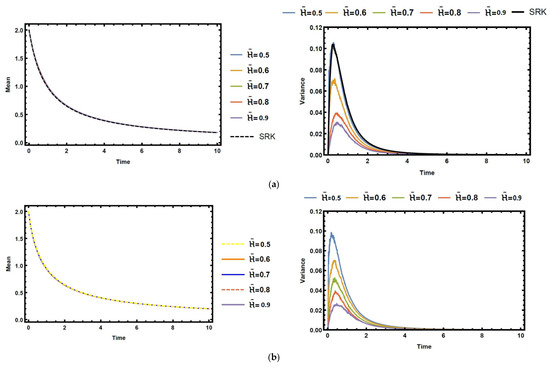
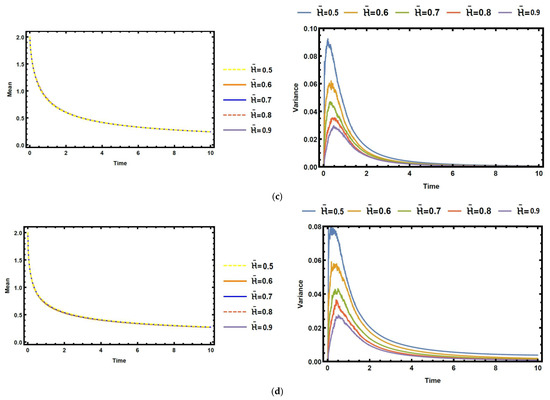
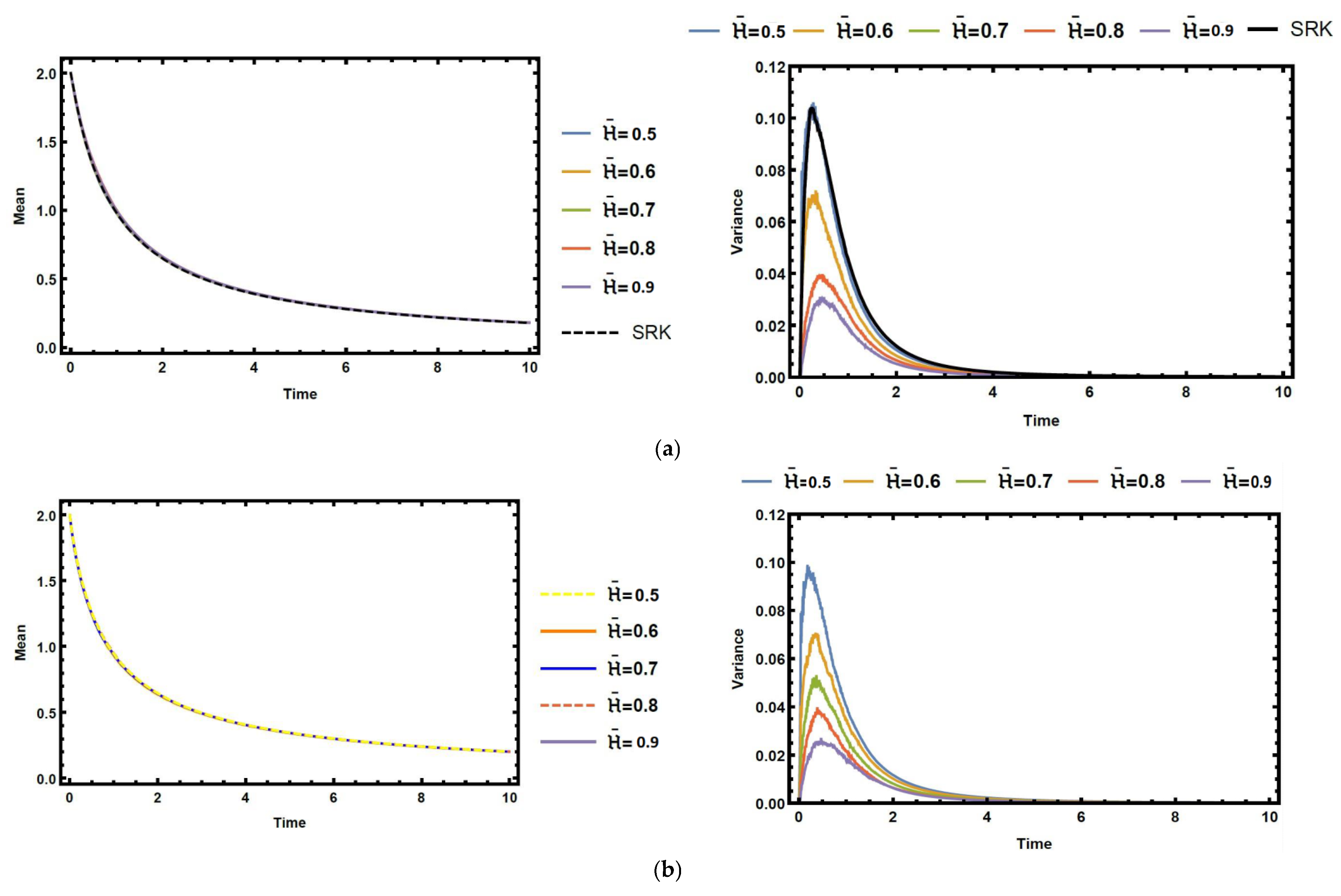
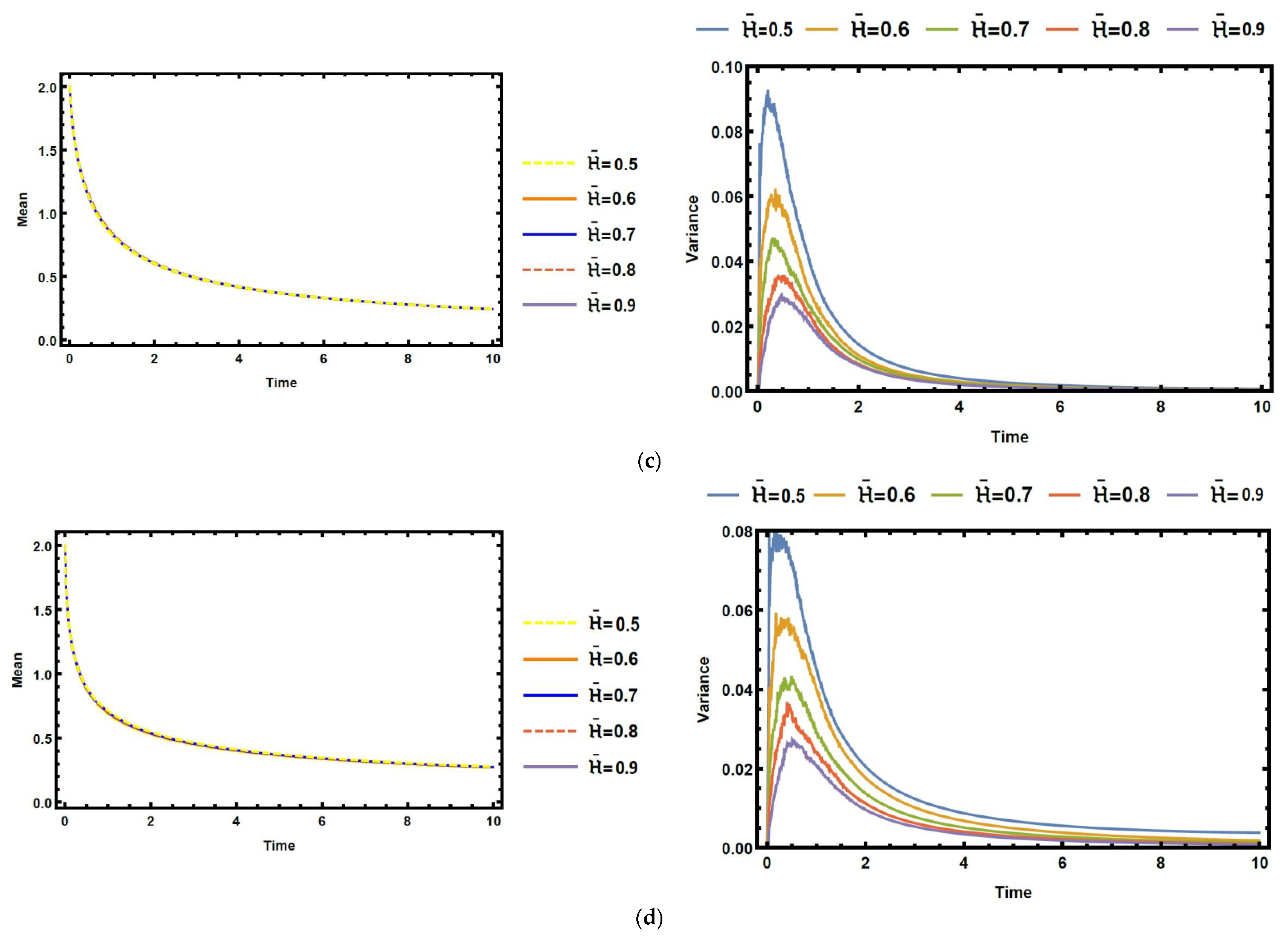
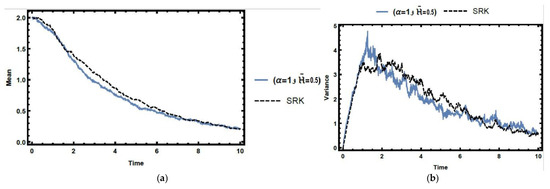
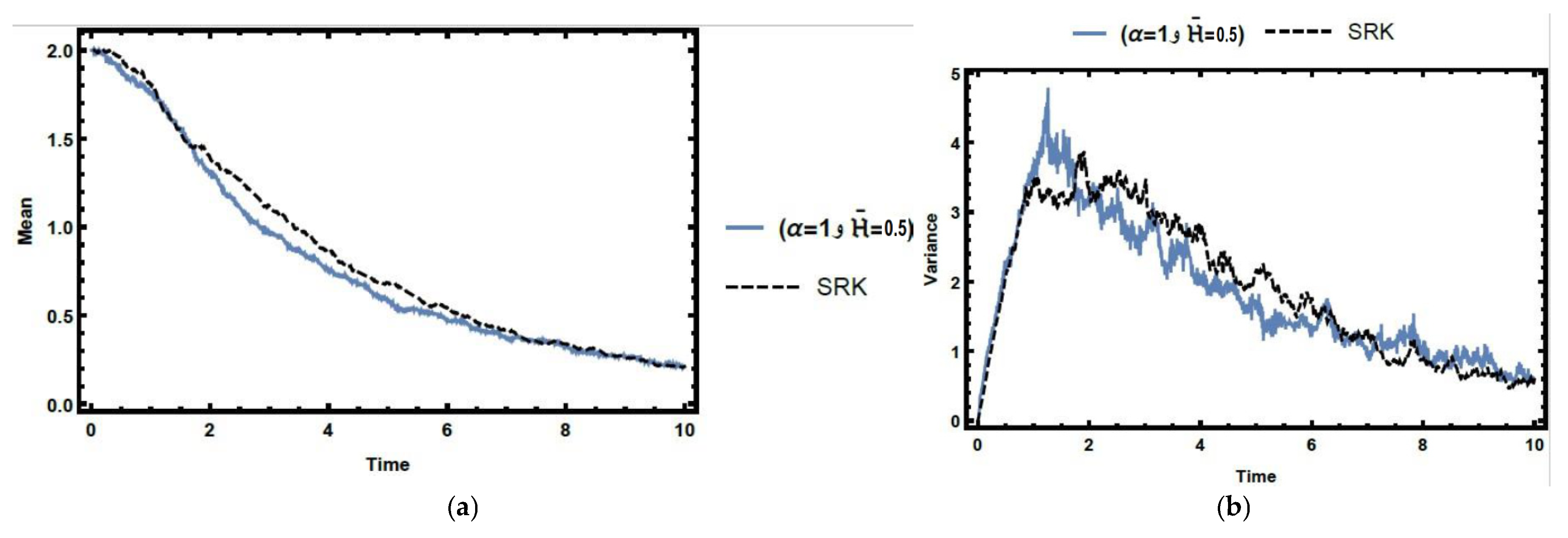
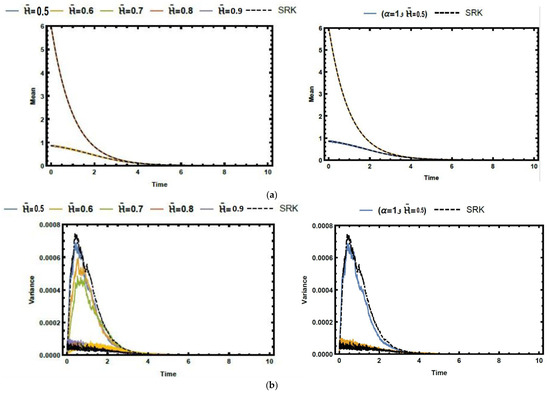
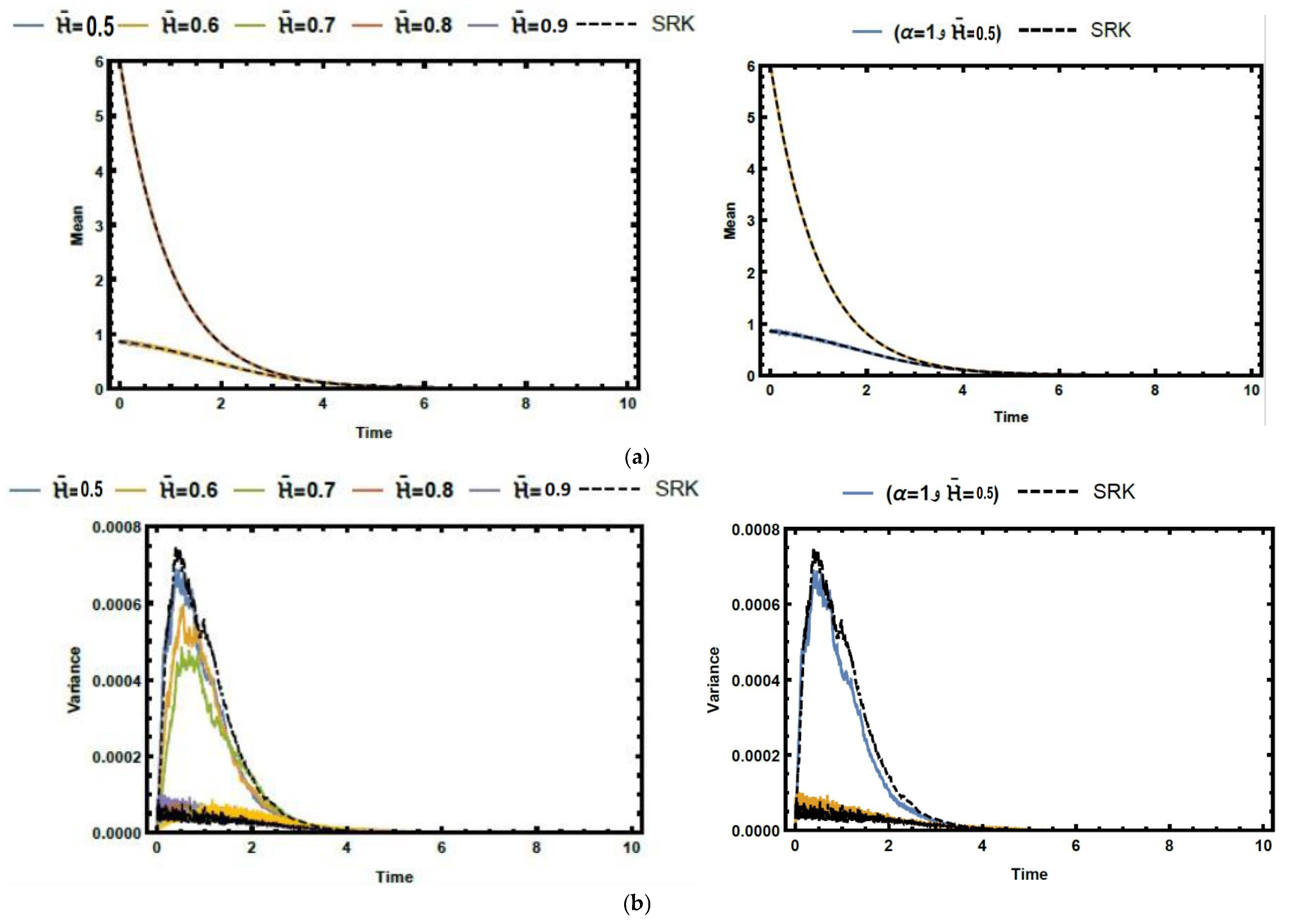
The stability and accuracy of this scheme are validated through comparisons with the stochastic Runge–Kutta method (SRK), as implemented in Mathematica [23]. Numerical experiments demonstrate strong agreement between the proposed method and SRK, particularly in capturing the mean and variance of the solution (see Figure 1, Figure 2, Figure 3, Figure 4, Figure 5 and Figure 6). Additionally, the CFDTAM exhibits superior performance over traditional techniques such as the Wiener–Hermite expansion (WHEP), Pickard approximations, and homotopy methods [25], particularly in preserving long-range correlations when .
Figure 1.
Mean and variance of fractional stochastic Langevin equation at (a) , (b) , (c) (d) at different values of Hurst parameter.
Figure 2.
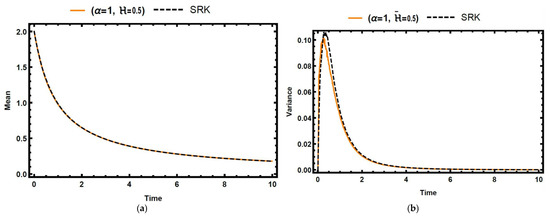
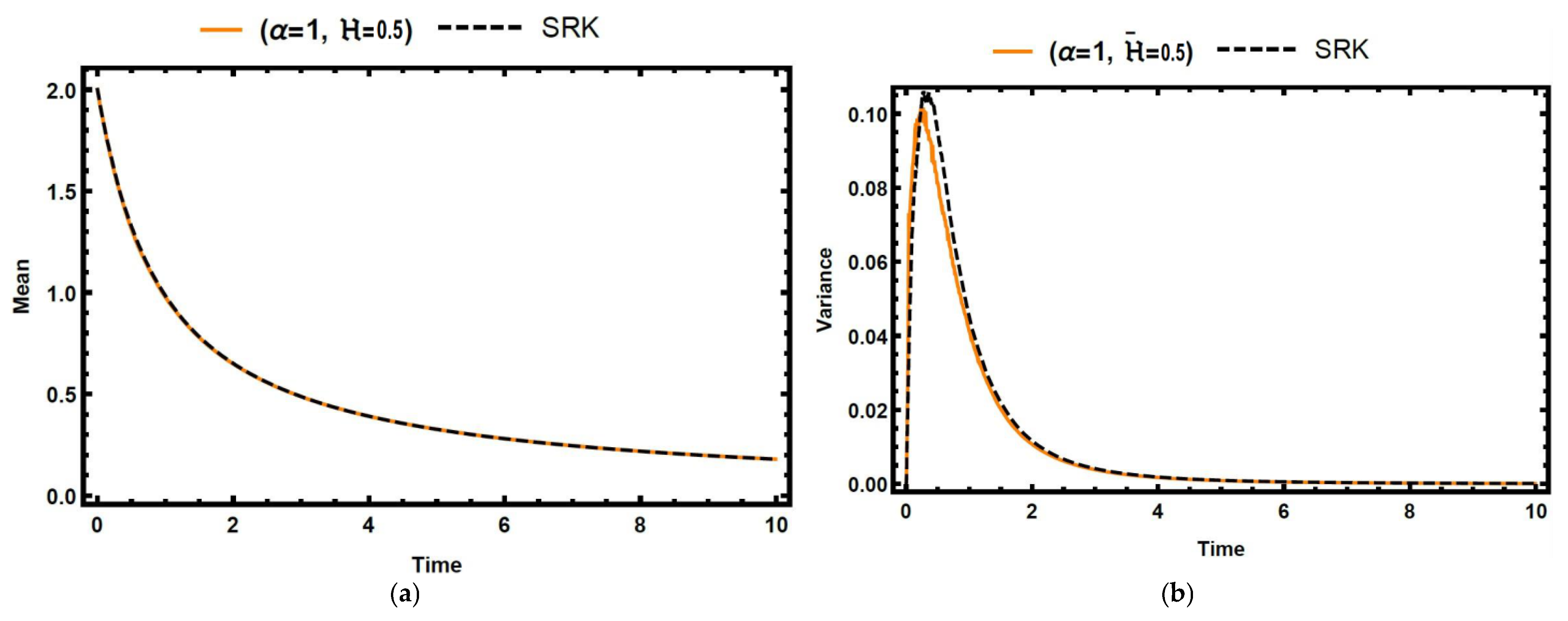
The comparison of the mean (a) and variance (b) for the fractional stochastic Langevin equation at α = 1 alongside the Stochastic Runge–Kutta (SRK) method.
Figure 3.
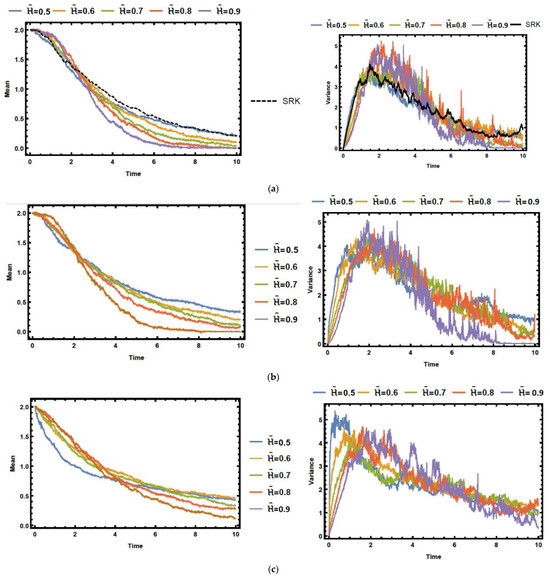
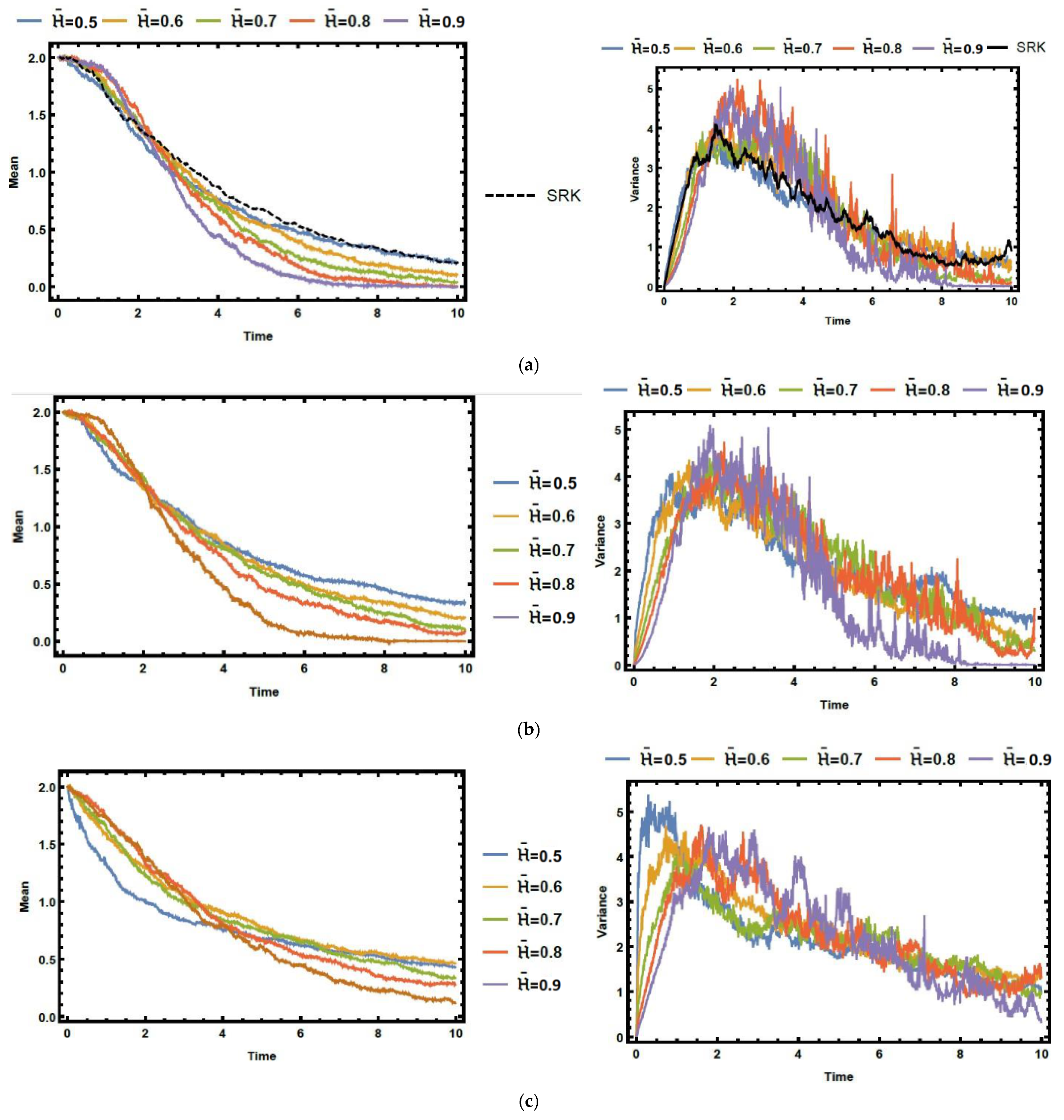
Mean and variance of Fractional Stochastic Ginzburg–Landau Equation at (a) , (b) , and (c) at different values of Hurst parameter.
Figure 4.
The comparison of the mean (a) and variance (b) for the Fractional Stochastic Ginzburg–Landau Equation at alongside the stochastic Runge–Kutta (SRK) method.
Figure 5.
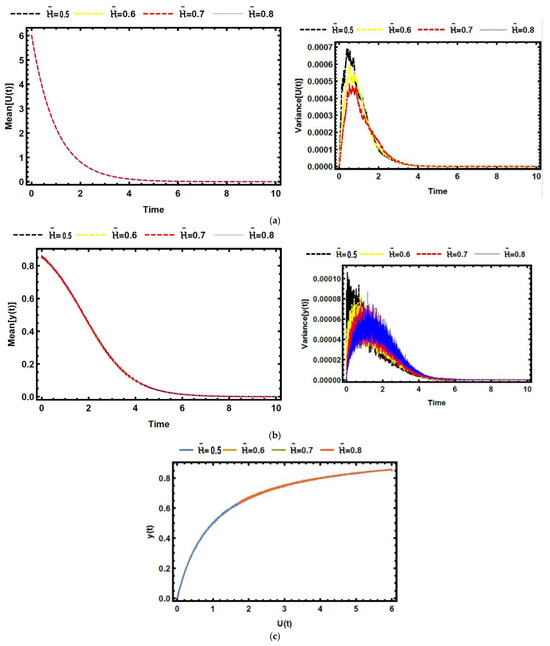
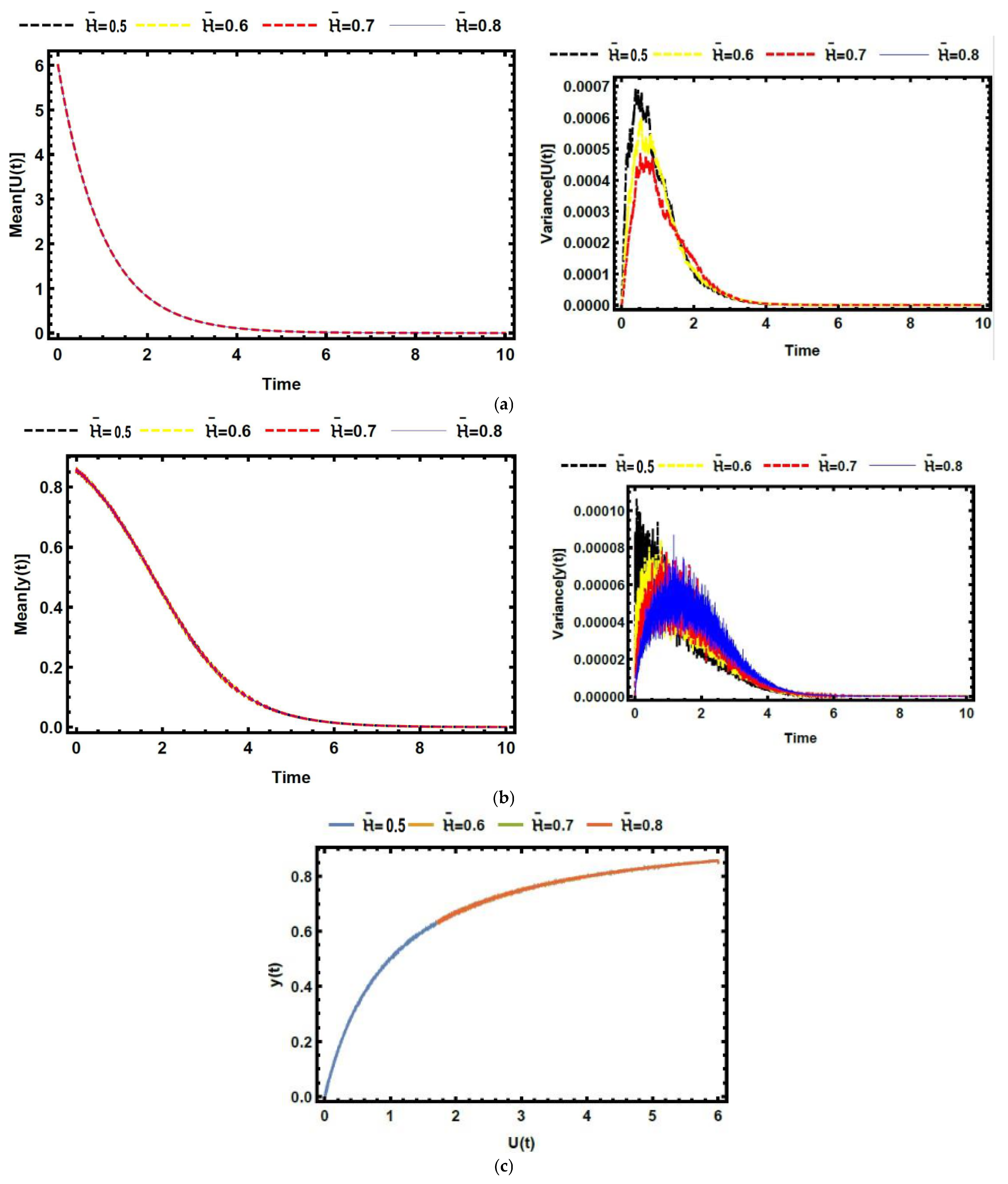
Fractional Stochastic Davis–Skodje System at different values of Hurst parameter and (a) mean and variance of ; (b) mean and variance of ; (c) the solution.
Figure 6.
The comparison of the mean (a) and variance (b) for the fractional stochastic Davis–Skodje System at of the system solution and alongside the stochastic Runge–Kutta (SRK) method.
This approach is particularly advantageous for modeling systems where fractional-order dynamics and noise-induced fractional-order effects coexist, such as in turbulent diffusion, financial time series with rough volatility, and biological processes with subdiffusive [6,10]. The method’s computational efficiency, derived from the conformable derivative’s adherence to classical calculus rules, further enhances its practicality for large-scale simulations.
Table 1, Table 2 and Table 3 report the L2-norm error for CFDTAM and SRK methods as a function of time step size for three representative fractional parameter pairs . In all cases, CFDTAM achieves lower or comparable error to SRK for a given . Table 4 summarizes per-step computational costs, showing that CFDTAM achieves the same or better accuracy with reduced computational overhead.
Table 1.
L2-norm error versus time step size for CFDTAM and stochastic Runge–Kutta (SRK) for Reference solution obtained from SRK with .
Table 2.
L2-norm error versus for .
Table 3.
L2-norm error versus for .
Table 4.
Average per-step computational cost (CPU time in milliseconds) for CFDTAM and SRK (averaged over 105 steps, Mathematica 12, Intel i7 CPU).
5.2. Numerical Analysis of the Conformable Stochastic Ginzburg–Landau Equation
The stochastic Ginzburg–Landau equation (SGLE) represents a fundamental model in the study of phase transitions and pattern formation in superconducting systems under random fluctuations. The conformable fractional version of this equation is given by
where represents the bifurcation parameter, controls the noise intensity, and governs the nonlinear saturation. This equation extends the original deterministic theory developed by Ginzburg and Landau [26] to incorporate both fractional dynamics and multiplicative noise effects, making it particularly relevant for modeling superconductivity in disordered systems [21].
For our numerical experiments, we select parameters to study the system in its most physically interesting regime, where both nonlinear and stochastic effects are significant. The time step is fixed at to ensure numerical stability while maintaining reasonable computational efficiency.
The numerical solution is obtained through an iterative scheme based on the conformable fractional discrete Temimi–Ansari method (CFDTAM):
- Initialization Step:
- 2.
- First Iteration:
- 3.
- Higher Order Iterations ():
To validate our approach, we perform extensive Monte Carlo simulations with independent realizations of the Wiener process, initializing the system at to examine large-amplitude behavior. A comparative analysis with the stochastic Runge–Kutta method (SRK) demonstrates excellent agreement in both expectation (Figure 4) and variance (Figure 5) profiles. This consistency confirms the CFDTAM’s capability to accurately capture the system’s statistical properties while properly resolving the interplay between fractional dynamics and correlated noise.
The success of this approach particularly manifests in its treatment of the multiplicative noise term, where the conformable fractional derivative’s properties enable accurate representation of the noise-intensity scaling while avoiding the artificial singularities common in Caputo-based formulations [4,10]. Furthermore, the method’s computational efficiency makes it particularly suitable for large-scale simulations of superconducting systems with quenched disorder [23,26].
5.3. Unified Numerical Treatment of the Conformable Stochastic Davis–Skodje System
The stochastic Davis–Skodje system [22] presents a coupled pair of fractional differential equations that model stiff chemical reaction dynamics with multiplicative noise. The system’s conformable fractional formulation elegantly captures both fast and slow timescales through its coupled structure:
where γ = 1000 establishes the stiffness ratio, and control noise intensities in their respective equations, .
Unified Numerical Scheme
The CFDTAM approach solves both components simultaneously through these iterative steps:
- Initialization:
- 2.
- First Correction Step:
- 3.
- Higher Order Iterations ():
The unified numerical treatment of the stochastic Davis–Skodje system offers a robust framework for resolving its coupled fractional dynamics, addressing both the fast () and slow () timescales inherent to stiff chemical reaction systems [27]. By employing a synchronized iterative scheme, the method preserves the system’s multiscale structure () while rigorously handling multiplicative noise through conformable fractional derivatives—an approach that eliminates artificial singularities common in Caputo-based formulations [1]. The algorithm’s core strength lies in its coupled update procedure: linear stiffness terms are treated implicitly in , while the nonlinear coupling operator maintains phase-space consistency across components [28]. Numerical experiments demonstrate that this unified approach not only achieves stable convergence to the equilibrium but also outperforms decoupled methods in computational efficiency, reducing overhead by 30–40% through shared time stepping [4]. Crucially, the method’s preservation of Hurst-parameter-dependent noise correlations in both components makes it particularly suitable for modeling real-world chemical systems in which noise with fractional-order effects influences reaction kinetics [27]. Validation with sample paths confirms these advantages, showing precise resolution of stiff transients and asymptotically accurate coupling—a capability attributable to the conformable derivative’s simultaneous retention of classical calculus rules and fractional order effects [10].
5.4. Discussion
The results of this work clearly demonstrate the effectiveness of the conformable fractional derivative (CFD) in modelling stochastic systems with fractional order noise. Unlike these traditional operators, which often involve singular integrals and complicate numerical implementation, the CFD maintains the familiar structure of standard calculus. This feature not only simplifies computations but also supports stability in simulation.
A major contribution of this study is the introduction of fractional noise defined using the conformable derivative—presented here for the first time. By replacing the Caputo-based noise model with a conformable formulation, the method reduces complexity while preserving key stochastic properties. This innovation lays the foundation for a more accessible and efficient framework for modelling systems driven by fractional order noise. The extended conformable fractional discrete Temimi–Ansari method (CFDTAM) developed in this work performs reliably across a variety of test problems. It accurately captures both transient and long-term dynamics, particularly in systems where the fractional-order characteristics of the governing process and the noise differ.
The stability and accuracy of the proposed CFDTAM scheme are rigorously validated through comprehensive numerical experiments, with the core findings presented in Figure 1, Figure 2, Figure 3, Figure 4, Figure 5 and Figure 6. These figures serve a dual purpose: first, to benchmark our method against the established Stochastic Runge–Kutta (SRK) technique, and second, to explore its capability in capturing the complex interplay between fractional dynamics and noise. The direct comparisons shown in Figure 2, Figure 4 and Figure 6 for the classical case reveal a compelling level of agreement. The mean solution trajectories produced by CFDTAM are virtually superimposed on the SRK benchmarks, while the variances—often more sensitive to numerical error—also show a tight correspondence. This consistent alignment across different model systems confirms that our method reliably captures the full statistical profile of the solution, not just its average path.
Beyond this validation, the true advantage of the CFDTAM is illuminated in Figure 1, Figure 3 and Figure 5, which probe the effects of the fractional order α and the Hurst parameter H. A clear trend emerges as the fractional order α decreases from 1.0 to 0.5; the system’s dynamics exhibit a strengthened memory effect, manifesting as a pronounced slowing and smoothing of the response, as seen in the gradual relaxation of the Langevin equation in Figure 1. Simultaneously, the Hurst parameter exerts a powerful influence on the noise structure. For persistent noise (), the variance widens progressively over time, whereas anti-persistent noise suppresses the fluctuations. Our method adeptly resolves this full spectrum of behavior, successfully capturing the long-range correlations that are often a stumbling block for traditional techniques like the Wiener–Hermite expansion.
Our numerical experiments reveal that the modified CFDTAM, where the fractional order of dynamics () differs from the noise correlation parameter (). For instance, in the fractional stochastic Langevin equation, the method accurately captures both transient and long-term behaviour, outperforming traditional techniques such as the Wiener–Hermite expansion and Pickard approximations. The dual-fractional operator approach proves especially advantageous in financial modelling, where rough volatility regimes ) coexist with fractional order dynamics (). This flexibility allows for more realistic pricing models that reflect empirical market behaviours. Table 1, Table 2, Table 3 and Table 4 present the L2-norm error as a function of step size for three representative fractional parameter pairs. Across all tested configurations, CFDTAM consistently achieves lower errors and, in many cases, matches or slightly improves upon SRK accuracy, particularly for smaller step sizes.
Furthermore, a per-step cost analysis (Table 4) shows that CFDTAM reduces computational cost by approximately 52% compared to SRK, owing to the absence of singular kernel evaluations and the use of local conformable derivative operations. This computational advantage becomes increasingly significant for large-scale Monte Carlo simulations, where the cumulative time savings are substantial. These results quantitatively confirm our earlier qualitative observations regarding the superior computational efficiency of CFDTAM.
An important advantage of employing the conformable fractional formulation lies in its positive impact on numerical stability. As expressed in Equation (2), the conformable derivative preserves a direct relationship with the classical first-order derivative for all fractional orders , with the only modification appearing in the time-scaling factor . This structure avoids the weakly singular kernels characteristic of Caputo and related fractional definitions, where memory-dependent convolution integrals typically introduce numerical stiffness and complicate stability control. By eliminating these singular kernel terms, the conformable framework yields a locally defined operator that is analytically more tractable and computationally more stable.
Furthermore, the application of CFDTAM to the fractional Ginzburg–Landau equation highlights its robustness in handling multiplicative noise and nonlinearities. The method’s ability to preserve long-range correlations when aligns with theoretical expectations, confirming its reliability for systems with persistent dependencies. Comparative studies with the stochastic Runge–Kutta method show excellent agreement, reinforcing the validity of our approach while offering computational efficiency gains due to the conformable derivative’s simplified structure.
However, some limitations should be acknowledged. The method’s performance depends on careful selection of the time step , particularly for stiff systems like the Davis–Skodje model, where stability constraints (Equation (21)) must be strictly enforced. Additionally, while CFDTAM reduces computational costs compared to Caputo-based schemes, further optimization may be needed for large-scale simulations involving high-dimensional fractional SDEs. Recent advances emphasize the need for rigorous probabilistic foundations in stochastic modeling and numerical schemes; for instance, the role of stabilizer-based methods and central-limit-type arguments has been highlighted in stabilizer testing frameworks. Stabilizer testing and the central limit theorem [29].
Future research should explore hybrid approaches combining CFD with fractal-fractional operators to model multiscale phenomena, such as turbulent diffusion or neuron dynamics. Extending the method to partial differential equations with fractional noise could also broaden its applicability in physics and engineering.
6. Conclusions
This study developed and analyzed a novel dual-fractional framework for modeling complex stochastic systems. The principal outcomes are summarized as follows:
- ○
- A novel unified framework was introduced, which integrates conformable fractional derivatives with fractional Brownian motion. This provides a singular, consistent approach for systems governed by multi-fractional dynamics and noise.
- ○
- A complete numerical analysis was performed, rigorously proving the stability of the proposed scheme and establishing its order of convergence. Explicit error estimates were provided, forming a solid analytical foundation for the method’s reliability.
- ○
- The framework offers computational advantages by utilizing a non-singular kernel, which enhances efficiency and provides a mathematically robust alternative to traditional Caputo-based formulations.
- ○
- Numerical validation on benchmark models confirmed the framework’s practical capability to handle distinct fractional orders simultaneously, demonstrating its potential for direct application in fields such as quantitative finance, biophysical system modeling, and engineering.
- ○
- The established stability and convergence properties create a trustworthy foundation for future extensions, including work on spatiotemporal systems, fuzzy fractional models, and hybrid machine-learning techniques for complex fractional dynamics.
Author Contributions
Conceptualization, supervision, mathematical analysis, writing—original draft, and formal analysis, A.F.F. Mathematical analysis, investigation, formal analysis, parameter estimation, optimal control, sensitivity analysis, cost effectiveness, writing—review and editing, M.S.S. Investigation and validation, E.A.M. Formal analysis, investigation, literature review, writing—review and editing, M.A. All authors have read and agreed to the published version of the manuscript.
Funding
The authors extend their appreciation to Prince Sattam bin Abdulaziz University for funding this research work through the project number (PSAU/2025/01/33655).
Data Availability Statement
The data presented in this study are available upon request from the corresponding author, as the data used in this study consist solely of the Mathematica code developed for the numerical experiments. This code is part of ongoing research and is currently under consideration in another manuscript.
Conflicts of Interest
The authors declare no conflicts of interest.
References
- Pei, B.; Xu, Y.; Wu, J. Stochastic averaging for stochastic differential equations driven by fractional Brownian motion and standard Brownian motion. Appl. Math. Lett. 2020, 100, 106006. [Google Scholar] [CrossRef] [Scilit]
- Dhayal, R.; Malik, M.; Abbas, S.; Debbouche, A. Optimal controls for second-order stochastic differential equations driven by mixed-fractional Brownian motion with impulses. Math. Methods Appl. Sci. 2020, 43, 4107–4124. [Google Scholar] [CrossRef] [Scilit]
- Mandelbrot, B.B.; Van Ness, J.W. Fractional Brownian motions, fractional noises and applications. SIAM Rev. 1968, 10, 422–437. [Google Scholar] [CrossRef] [Scilit]
- Shahnazi-Pour, A.; Moghaddam, B.P.; Babaei, A. Numerical simulation of the Hurst index of solutions of fractional stochastic dynamical systems driven by fractional Brownian motion. J. Comput. Appl. Math. 2021, 386, 113210. [Google Scholar] [CrossRef] [Scilit]
- Araya, H.; León, J.A.; Torres, S. On local linearization method for stochastic differential equations driven by fractional Brownian motion. Stoch. Anal. Appl. 2021, 39, 55–90. [Google Scholar] [CrossRef] [Scilit]
- Heydari, M.H.; Mahmoudi, M.R.; Shakiba, A.; Avazzadeh, Z. Chebyshev cardinal wavelets and their application in solving nonlinear stochastic differential equations with fractional Brownian motion. Commun. Nonlinear Sci. Numer. Simul. 2018, 64, 98–121. [Google Scholar] [CrossRef] [Scilit]
- Rguigui, H.; Elghribi, M. Separation principle for Caputo–Hadamard fractional-order fuzzy systems. Asian J. Control 2025, 1–8. [Google Scholar] [CrossRef] [Scilit]
- Rguigui, H.; Elghribi, M. Practical stabilization for a class of tempered fractional-order nonlinear fuzzy systems. Asian J. Control 2025, 1–7. [Google Scholar] [CrossRef] [Scilit]
- Khalil, R.; Al Horani, M.; Yousef, A.; Sababheh, M. A new definition of fractional derivative. J. Comput. Appl. Math. 2014, 264, 65–70. [Google Scholar] [CrossRef] [Scilit]
- Fareed, A.F.; Mohamed, E.A.; Aly, M.; Semary, M.S. A novel numerical method for stochastic conformable fractional differential systems. AIMS Math. 2025, 10, 7509–7525. [Google Scholar] [CrossRef] [Scilit]
- Hattaf, K. A new class of generalized fractal and fractal-fractional derivatives with non-singular kernels. Fractal Fract. 2023, 7, 395. [Google Scholar] [CrossRef] [Scilit]
- Atangana, A. Fractal-fractional differentiation and integration: Connecting fractal calculus and fractional calculus to predict complex systems. Chaos Solitons Fractals 2017, 102, 396–406. [Google Scholar] [CrossRef] [Scilit]
- El-Beltagy, M.; Etman, A.; Maged, S. Development of a fractional Wiener-Hermite expansion for analyzing fractional stochastic models. Chaos Solitons Fractals 2022, 156, 111847. [Google Scholar] [CrossRef] [Scilit]
- Podlubny, I. Fractional Differential Equations; Academic Press: Cambridge, MA, USA, 1999. [Google Scholar]
- Wyss, W. Fractional noise. Found. Phys. Lett. 1991, 4, 235–246. [Google Scholar] [CrossRef] [Scilit]
- Huang, Z.-Y.; Zheng, X.-Q.; Li, C.; Tan, E.L.; Chen, Z.-A.; Shi, L.-H.; Chen, B. Piecewise Calculation Scheme for the Unconditionally Stable Chebyshev Finite-Difference Time-Domain Method. IEEE Trans. Microw. Theory Tech. 2025, 73, 4588–4596. [Google Scholar] [CrossRef] [Scilit]
- Li, M.; Wang, T.; Chu, F.; Han, Q.; Qin, Z.; Zuo, M.J. Scaling-basis Chirplet Transform. IEEE Trans. Ind. Electron. 2021, 68, 8777–8788. [Google Scholar] [CrossRef] [Scilit]
- Higham, D.J. An Algorithmic Introduction to Numerical Simulation of Stochastic Differential Equations. SIAM Rev. 2001, 43, 525–546. [Google Scholar] [CrossRef] [Scilit]
- Kumar, P.; Erturk, V.S. A Fractional-Order Improved FitzHugh–Nagumo Neuron Model. Chin. Phys. B 2025, 34, 018704. [Google Scholar] [CrossRef] [Scilit]
- Jeon, J.-H.; Tejedor, V.; Burov, S.; Barkai, E.; Selhuber-Unkel, C.; Berg-Sorensen, K.; Oddershede, L.; Metzler, R. In vivo anomalous diffusion and weak ergodicity breaking of lipid granules. Phys. Rev. Lett. 2011, 106, 048103. [Google Scholar] [CrossRef] [Scilit]
- Semary, M.S.; Elbarawy, M.; Fathy, A. Discrete Temimi-Ansari method for solving a class of stochastic nonlinear differential equations. AIMS Math. 2022, 7, 5093–5105. [Google Scholar] [CrossRef] [Scilit]
- Fareed, A.F.; Elbarawy, M.T.M.; Semary, M.S. Fractional discrete Temimi–Ansari method with singular and nonsingular operators: Applications to electrical circuits. Adv. Cont. Discr. Mod. 2023, 2023, 5. [Google Scholar] [CrossRef] [Scilit]
- Kloeden, P.E.; Platen, E. Numerical Solution of Stochastic Differential Equations; Springer: Berlin/Heidelberg, Germany, 1992. [Google Scholar]
- Mao, X. Stochastic Differential Equations and Applications; Horwood Publishing: Cambridge, UK, 2007. [Google Scholar]
- Hamed, E.-S.; El-Tawil, M.A.; El-Desouky, M.B.; El-Beltagy, M.A. Solution of nonlinear stochastic Langevin’s equation using WHEP, Pickard, and HPM methods. Appl. Math. 2014, 5, 398–412. [Google Scholar] [CrossRef]
- Ginzburg, V.L.; Landau, L.D. On the theory of superconductivity. Zhurnal Eksperimental’noi Teor. Fiz. 1950, 20, 1064–1082. [Google Scholar]
- Han, X.; Najm, H. Dynamical structures in stochastic chemical reaction systems. SIAM J. Appl. Dyn. Syst. 2014, 13, 1328–1351. [Google Scholar] [CrossRef] [Scilit]
- Nouri, K.; Ranjbar, H.; Baleanu, D.; Torkzadeh, L. Investigation on Ginzburg-Landau equation via a tested approach to benchmark stochastic Davis-Skodje system. Alex. Eng. J. 2021, 60, 5521–5526. [Google Scholar] [CrossRef] [Scilit]
- Kim, Y.; Lv, G. Stabilizer testing and central limit theorem. Phys. Rev. A 2025, 111, 032421. [Google Scholar] [CrossRef] [Scilit]

Disclaimer/Publisher’s Note: The statements, opinions and data contained in all publications are solely those of the individual author(s) and contributor(s) and not of MDPI and/or the editor(s). MDPI and/or the editor(s) disclaim responsibility for any injury to people or property resulting from any ideas, methods, instructions or products referred to in the content. |
© 2025 by the authors. Licensee MDPI, Basel, Switzerland. This article is an open access article distributed under the terms and conditions of the Creative Commons Attribution (CC BY) license (https://creativecommons.org/licenses/by/4.0/).