Article

A Multi-Scale Approach for the Piezoelectric Modal Analysis in Periodically Perforated Structures
School of Mathematics, Sichuan University, Chengdu 610065, China
*
Author to whom correspondence should be addressed.
Mathematics 2025, 13(24), 3967; https://doi.org/10.3390/math13243967
Submission received: 1 November 2025 / Revised: 29 November 2025 / Accepted: 10 December 2025 / Published: 12 December 2025
(This article belongs to the Special Issue Multiscale Modeling in Engineering and Mechanics, 2nd Edition)

Abstract

Piezoelectric composites have found a wide range of applications in smart structures and devices and effective numerical methods should be developed to simulate not only the macroscopic coupled piezoelectric performances, but also the details of the local distributions of the stress and electric field. In this paper, we proposed a multi-scale asymptotic algorithm based on the Second-Order Two-Scale (SOTS) analysis method for the piezoelectric eigenvalue problem in perforated domain with periodic micro-configurations. The eigenfunctions and eigenvalues are expanded to the second-order terms and the homogenized eigensolutions; the expressions of the first- and second-order correctors are derived successively. The first- and second-order correctors of the eigenvalues are determined according to the integration forms of the correctors of the corresponding eigenfunctions. Explicit expressions of the homogenized material coefficients are derived for the laminated structures and the finite element procedures are proposed to compute the homogenized solutions and the correctors numerically. The error estimations for the approximations of eigenvalues are proved under some regularity assumptions and a typical numerical experiment is carried out for the two-dimensional perforated domain. The computed results show that the SOTS analysis method is efficient in identifying the piezoelectric eigenvalues accurately and reproducing the original eigenfunctions effectively. This approach also provides an efficient computational tool for piezoelectric eigenvalue analysis and can extend to other multi-physics problems with complex microstructures.

1. Introduction

Composite piezoelectric materials can be designed and manufactured by mixing piezoceramics with passive nonpiezoelectric polymers [1]. By utilizing the most profitable properties of each material, various types of structures have emerged. The piezoelectric material deforms mechanically and polarizes under mechanical load when exposed to an electric field [2]; the electroelastic properties are significantly impacted by nonpiezoelectric polymers, and this effect should not be disregarded [3]. However, the heterogeneity of the composite domain causes the piezoelectric coefficients to change rapidly, and classic numerical simulations are hard to apply because the computational mesh has to be fine enough to distinguish the constituent materials.
To overcome this limitation, the multi-scale expansion homogenization method (MEH) was proposed to gain a whole tensor of the effective properties of the piezocomposite and convert the piezoelectric equations in the complex domain to the equations with homogenized effective coefficients [4,5,6,7]. Since then, the multi-scale finite element method was introduced [8] and the optimal designing methods were also developed [9,10].
While early homogenization schemes were predominantly first-order, Cui and Cao [11] proposed the Second-Order Two-Scale (SOTS) method and built the corresponding finite element procedures that are of more engineering interest. This theoretical foundation has since been extended to static and dynamic piezoelectric problems under various configurations [12,13]. Furthermore, various multi-scale asymptotic approaches are exploited to give the proper expansions of the eigenpairs for composite or perforated materials [14,15,16,17], with theoretical convergence analyses confirming the validity of high-order expansions for inhomogeneous media [18,19].
From an application perspective, the engineering community has leveraged these theoretical advances to design and analyze practical piezoelectric composite structures. Early studies focused on composites with spherical, cylindrical, and layered inclusions, establishing correlations between polarization orientation, geometric architectures, and effective properties [20,21,22,23,24,25]. To simulate complex materials, Allik and Hughes [26] developed a universal approach to electroelastic analysis by adding the piezoelectric effect into a finite element model. Iovane and Nasedkin [27,28] introduced the finite element approach for eigenvalue problems in piezoelectric structures. For structured materials like periodic laminates, asymptotic homogenization techniques have been successfully applied to calculate periodical laminated piezocomposite’s effective elastic, piezoelectric, and dielectric [29,30]. Concurrently, finite element algorithms of the asymptotic homogenization were additionally constructed and analyzed [31,32,33,34,35,36], indicating that the analytical and numerical methods produced a good agreement.
Modal analysis of these coupled piezoelectric systems is important for accurately identifying the coupled resonance frequency caused by the coupled interactions between these two fields [37]. In this work, we consider the SOTS method to study the piezoelectric eigenvalue problem with periodic perforated structure, aiming at obtaining second-order asymptotic expressions of eigenvalues and corresponding eigenfunctions. The contributions of our work are twofold: (1) supplementing the theory and calculation of eigenvalue analysis for high-order homogenization methods of porous piezoelectric composites; (2) developing an associated finite element algorithm that efficiently and accurately captures the oscillatory behaviors which first-order asymptotic models cannot reveal.
Next, this essay is arranged as follows: Section 2 puts forward a piezoelectric eigenvalue issue and configures the perforated domain. In Section 3, firstly, the SOTS asymptotic expansions of eigenvalues and eigenfunctions are performed, next, the error estimates of eigenvalues are given, and then, for some special layered structures, the analytical expressions of homogenized material coefficients are derived. The SOTS finite element algorithm is established in Section 4 and a numerical example for a two-dimensional problem is given in Section 5. Section 6 discusses some concluding remarks and future expectations. Throughout this paper, the Einstein summation convention is utilized and the letters in bold denote the matrix/vector variable or functions.

2. Piezoelectric Modal Problem for Cellular Structure

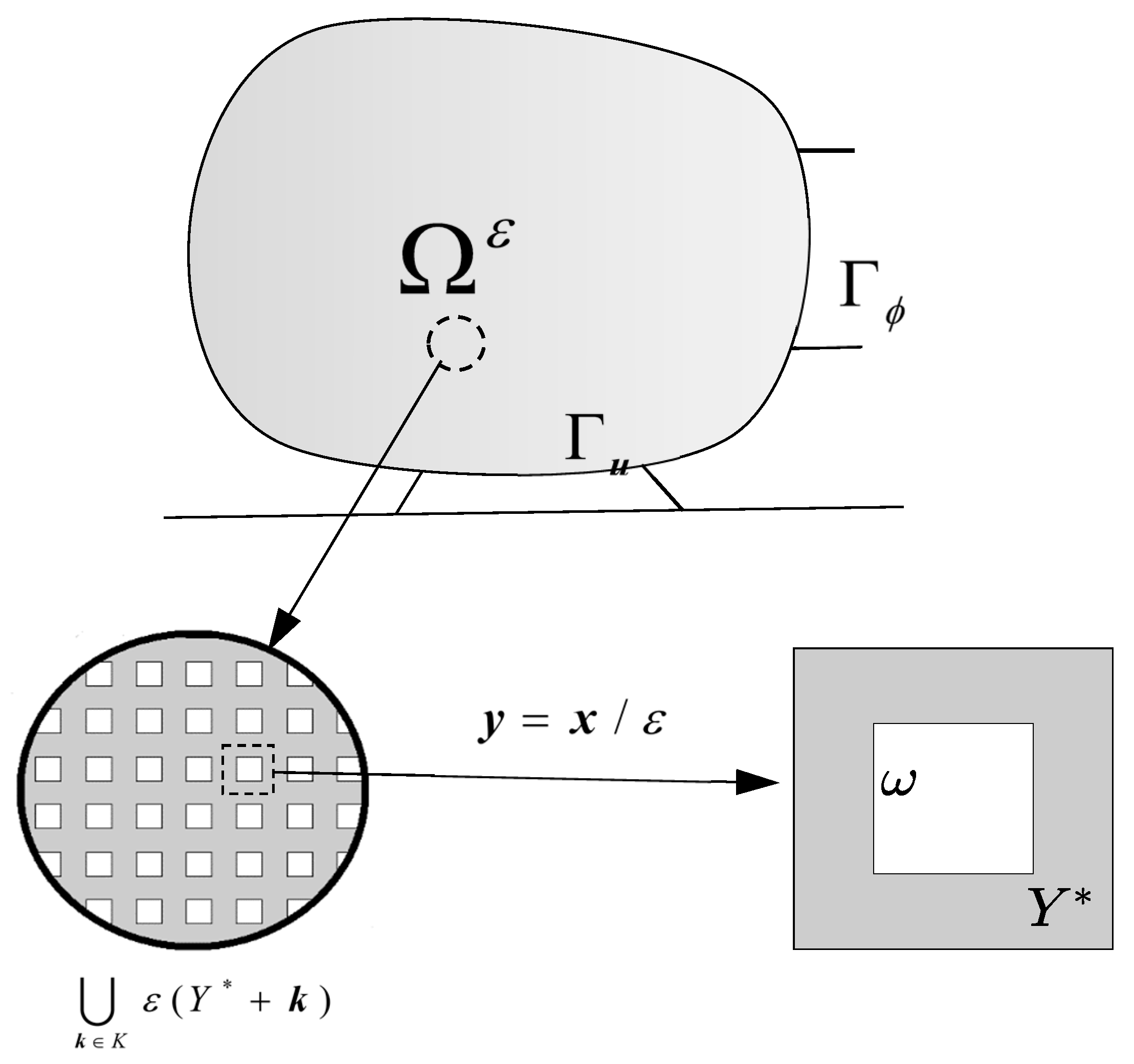
The perforated domain occupied by the piezoelectric materials is denoted by Ω ε ( x ) d , which can be shown typically in two dimensions in Figure 1, where d is the dimension and ε denotes a small parameter referring to the periodicity of the representative cell in macroscopic scale x . Generally, assume Ω ε is composed of many cells that are periodically arranged along the coordinate axis and can be characterized by a represented domain with cavities Y * . Suppose Y * ( y ) = Y S , where Y = 0 , 1 d and S is the cavity. We assume that the ω , the boundary of S , does not interest with Y , the boundary of Y , and then the boundary Y * can be expressed as
Y * = ω Y
Let y be the coordinate in microscopic domain, relating to the macroscopic location x by
y = x ε x ε ,
where denotes the round down operation.
By these settings, we can represent Ω ε by
Ω ε = Ω ( k k ε ( Y * + k ) ) ,
where Ω is a solid domain obtained by filling all the cavities in Ω ε and k is the index set such that
K = { k d | ε ( Y * + k ) Ω Ω ε } .
Moreover, for simplicity, assume the boundary Ω ε can be expressed as
Ω ε = Ω ω ε ,   ω ε = k k ε ( ω + k ) ,
which means that all the boundaries of the cavities do not interact with Ω .
The piezoelectric modal problem can be formulated in this porous domain as
x j ( C i j k l ε ( x ) u k ε ( x ) x l + e k i j ε ( x ) ϕ ε ( x ) x k ) = Λ ε ρ ε u i ε ( x ) in Ω ε , x i ( ϵ i j ε ( x ) ϕ ε ( x ) x j e i k l ε ( x ) u k ε ( x ) x l ) = 0 in Ω ε , u i ε ( x ) = 0 on Γ u , σ i j ε ( u ε ( x ) , ϕ ε ( x ) ) n j = 0 on ω ε Γ t , ϕ ε ( x ) = 0 on Γ ϕ , D i ε ( u ε ( x ) , ϕ ε ( x ) ) n i = 0 on ω ε Γ q ,
where Λ ε is the eigenvalue with units of s 2 and [ u ε , ϕ ε ] T   = [ u 1 ε , , u d ε , ϕ ε ] T is the corresponding eigenvector. The constitutive relationship for these two fields reads as
σ i j ε ( u ε ( x ) , ϕ ε ( x ) ) = C i j k l ε ( x ) S k l ε ( u ε ( x ) ) e k i j ε ( x ) E k ε ( x ) ,   D i ε ( u ε ( x ) , ϕ ε ( x ) ) = ϵ i j ε ( x ) E j ε ( x ) + e i k l ε ( x ) S k l ε ( u ε ( x ) ) ,
where σ i j ε denotes the stress and D i ε the electric flux. E j ε is the electric field and S i j ε the linear strain, which can be expressed by displacement u ε and electric potential ϕ ε as [2]
E j ε ( x ) = ϕ ε ( x ) x j , S i j ε ( u ε ( x ) ) = 1 2 ( u i ε ( x ) y j + u j ε ( x ) y i ) ,  
respectively. The definitions and units of variables are shown in Table 1. For the outer boundary Ω , we have
Ω = Γ u Γ t = Γ ϕ Γ q ,   Γ u Γ t = Γ ϕ Γ q = .
That is, the structure is fixed on Γ u , and free on both Γ t and ω ε . Analogously, the electric potential is prescribed on Γ ϕ and there is no free electric charge on Γ q . C i j k l ε , e k i j ε , and ϵ i j ε stand for the coefficients of elasticity, piezoelectricity, and dielectric constants, respectively; they have the symmetry as
C i j k l ε ( x ) = C j i k l ε ( x ) = C k l i j ε ( x ) ,   e k i j ε ( x ) = e k j i ε ( x ) ,   ϵ i j ε ( x ) = ϵ j i ε ( x )
ρ ε is the mass density. And these coefficients should satisfy the regularity
C i j k l ε ( x ) ,   e k i j ε ( x ) ,   ϵ i j ε ( x ) ,   ρ ε ( x ) L ( Y * ) , ρ 0 < ρ ε ( x ) M ,
α 1 ξ 2 C i j k l ε ( x ) ξ i j ξ k l α 2 ξ 2 ,   β 1 ξ η e k i j ε ( x ) η k ξ i j β 2 ξ η ,
γ 1 η 2 ϵ i j ε ( x ) η i η j γ 2 η 2 ,
ξ = ( ξ i j ) 1 i , j d , η = ( η i ) 1 i d ,   | ξ | = ( i = 1 d j = 1 d ξ i j 2 ) 1 / 2 ,   | η | = ( i = 1 n η i 2 ) 1 / 2 ,
in which M , α 1 , α 2 , β 1 , β 2 , γ 1 , γ 2 , and ρ 0 are positive constants. These material coefficients can be written using the periodic configuration in Equation (1) as
C i j k l ε ( x ) = C i j k l ( x ε ) = C i j k l ( y ) ,   e k i j ε ( x ) = e k i j ( x ε ) = e k i j ( y ) ,   ϵ i j ε ( x ) = ϵ i j ( x ε ) = ϵ i j ( y ) ,  
where C i j k l , e k i j , and ϵ i j are y -periodic functions.

3. Two-Scale Asymptotic Homogenization and Second-Order Expansion

3.1. SOTS Expansions of the Eigenvalues and Eigenfunctions

As is illustrated in Section 1, the SOTS expansions should be derived for the modal problem (2), and accordingly, the eigenfunctions u ε and ϕ ε and eigenvalue Λ ε are assumed to be expanded as
u ε ( x ) = u 0 ( x ) + ε u 1 ( x , y ) + ε 2 u 2 ( x , y ) + O ( ε 3 ) , ϕ ε ( x ) = ϕ 0 ( x ) + ε ϕ 1 ( x , y ) + ε 2 ϕ 2 ( x , y ) + O ( ε 3 ) , Λ ε = Λ 0 + ε Λ 1 + ε 2 Λ 2 + O ( ε 3 ) ,
with u j = [ u 1 j , , u d j ] T , j = 0 , 1 , 2 . The first terms u 0 ( x ) , ϕ 0 ( x ) , and Λ 0 are the homogenized eigensolutions independent of y . u 1 ( x , y ) , ϕ 1 ( x , y ) , and Λ 1 are called the first-order correctors, and u 2 ( x , y ) , ϕ 2 ( x , y ) , and Λ 2 are the second-order correctors. Note that partial differential operation for f ε ( x ) = f ( x , y ) should be changed by
f ε ( x ) x i = f ( x , y ) x i + ε 1 f ( x , y ) y i .
Substituting Equations (7) and (8) into the original Equation (2) and boundary conditions in ω ε in (2) and equating the power of ε leads to the first two systems of equations:
y j ( C i j k l u k 1 y l + e k i j ϕ 1 y k ) = C i j k l y j u k 0 x l + e k i j y j ϕ 0 x k in Ω × Y * , y i ( ϵ i j ϕ 1 y j e i k l u k 1 y l ) = e i k l y i u k 0 x l + ϵ i j y i ϕ 0 x j in Ω × Y * , σ i j ( u 1 , ϕ 1 ) n j = D i ( u 1 , ϕ 1 ) n i = 0 on Ω × ω ,
y j ( C i j k l u k 2 y l + e k i j ϕ 2 y k ) x j ( C i j k l u k 1 y l + e k i j ϕ 1 y k ) y j ( C i j k l u k 1 x l + e k i j ϕ 1 x k ) x j ( C i j k l u k 0 x l + e k i j ϕ 0 x k ) = Λ 0 ρ u i 0 in Ω × Y * , y i ( ϵ i j ϕ 2 y j e i k l u k 2 y l ) x i ( ϵ i j ϕ 1 y j e i k l u k 1 y l ) y i ( ϵ i j ϕ 1 x j e i k l u k 1 x l ) x i ( ϵ i j ϕ 0 x j e i k l u k 0 x l ) = 0 in Ω × Y * , σ i j ( u 2 , ϕ 2 ) n j = D i ( u 2 , ϕ 2 ) n i = 0 on Ω × ω .
From (9), it is suggested that the first-order correctors u 1 ( x , y ) and ϕ 1 ( x , y ) can take the following expressions:
u 1 ( x , y ) ϕ 1 ( x , y ) = N α 1 m ( y ) F α 1 ( y ) H α 1 m ( y ) R α 1 ( y ) x α 1 u m 0 ( x ) ϕ 0 ( x ) , α 1 ,   m = 1 , , d .
N α 1 m ( y ) = [ N α 1 1 m ( y ) , , N α 1 d m ( y ) ] T , F α 1 ( y ) = [ F α 1 1 ( y ) , , F α 1 d ( y ) ] T , H α 1 m ( y ) and R α 1 ( y ) are the so-called first-order cell functions, periodic in y , and solve the boundary value problems:
y j ( C i j k l N α 1 k m y l + e k i j H α 1 m y k ) = C i j m α 1 y j in Y * , y i ( ϵ i j H α 1 m y j e i k l N α 1 k m y l ) = e i m α 1 y i in Y * , σ i j ( N α 1 m , H α 1 m ) n j = D i ( N α 1 m , H α 1 m ) n i = 0 on ω , Y * N α 1 m d y = 0 ,   Y * H α 1 m d y = 0 ,
and
y j ( C i j k l F α 1 k y l + e k i j R α 1 y k ) = e α 1 i j y j in Y * , y i ( ϵ i j R α 1 y j e i k l F α 1 k y l ) = ϵ i α 1 y i in Y * , σ i j ( F α 1 , R α 1 ) n j = D i ( F α 1 , R α 1 ) n i = 0 on ω , Y * F α 1 d y = 0 ,   Y * R α 1 d y = 0 ,
respectively.
The homogenized eigenvalue problems for u 0 ( x ) and ϕ 0 ( x ) are obtained by the integral average over the cell Y * for the system in (10). Then, the homogenized piezoelectric problem is formulated by the form
x j ( C i j k l H u k 0 x l + e k i j H ϕ 0 x k ) = Λ 0 ρ H u i 0 in Ω , x i ( ϵ i j H ϕ 0 x j e i k l H u k 0 x l ) = 0 in Ω , u i 0 = 0 on Γ u , σ i j 0 n j = 0 on Γ t , ϕ 0 = 0 on Γ ϕ , D i 0 n i = 0 on Γ q .
where C i j k l H , e k i j H , ϵ i j H , and ρ H are the homogenized material coefficients with the following expressions:
C i j k l H = C i j k l + C i j m α 1 N l m k y α 1 + e α 1 i j H l k y α 1 ,   ϵ i j H = ϵ i j + ϵ i k R j y k e i k l F j k y l ,   ρ H = ρ , e k i j H = e k i j + C i j m α 1 F k m y α 1 + e α 1 i j R k y α 1 = e k i j + e k m α 1 N j m i y α 1 ϵ k α 1 H j i y α 1 ,
where denotes the integral average in Y * , i.e.,
u = 1 | Y * | Y * u d y .
Now we have obtained the zero-order terms u 0 ( x ) and ϕ 0 ( x ) and the first-order terms u 1 ( x , y ) and ϕ 1 ( x , y ) . Taking the expressions of u 1 ( x , y ) and ϕ 1 ( x , y ) in Equation (11) back into Equation (10), we can define u 2 ( x , y ) and ϕ 2 ( x , y ) formally as
u 2 ( x , y ) ϕ 2 ( x , y ) = N α 1 α 2 m ( y ) F α 1 α 2 ( y ) H α 1 α 2 m ( y ) R α 1 α 2 ( y ) 2 u m 0 ( x ) x α 1 x α 2 2 ϕ 0 ( x ) x α 1 x α 2 ,   α 1 ,   α 2 ,   m = 1 , , d ,
where these periodic cell functions N α 1 α 2 m ( y ) = [ N α 1 α 2 1 m ( y ) , , N α 1 α 2 d m ( y ) ] T , H α 1 α 2 m ( y ) , R α 1 α 2 ( y ) , and F α 1 α 2 ( y ) = [ F α 1 α 2 1 ( y ) , , F α 1 α 2 d ( y ) ] T satisfy the second-order boundary value problems as
y j ( C i j k l N α 1 α 2 k m y l + e k i j H α 1 α 2 m y k ) = y j ( C i j k α 2 N α 1 k m + e α 2 i j H α 1 m ) + C i α 2 k l N α 1 k m y l + e k i α 2 H α 1 m y k + C i α 2 m α 1 ρ ρ H C i α 2 m α 1 H in Y * , y i ( ϵ i j H α 1 α 2 m y j e i k l N α 1 α 2 k m y l ) = y i ( ϵ i α 2 H α 1 m e i k α 2 N α 1 k m ) + ϵ α 2 j H α 1 m y j e α 2 k l N α 1 k m y l e α 2 m α 1 + e α 2 m α 1 H in Y * , σ i j ( N α 1 α 2 m , H α 1 α 1 m ) n j = D i ( N α 1 α 2 m , H α 1 α 2 m ) n i = 0 on ω ,
y j ( C i j k l F α 1 α 2 k y l + e k i j R α 1 α 2 y k ) = y j ( C i j k α 2 F α 1 k + e α 2 i j R α 1 ) + C i α 1 k l F α 1 k y l + e k i α 2 R α 1 y k + e α 1 i α 2 ρ ρ H e α 1 i α 2 H in Y * , y i ( ϵ i j R α 1 α 2 y j e i k l F α 1 α 2 k y l ) = y i ( ϵ i α 2 R α 1 e i k α 2 F α 1 k ) + ϵ α 2 j R α 1 y j e α 2 k l F α 1 k y l + ϵ α 1 α 2 ϵ α 1 α 2 H in Y * , σ i j ( F α 1 α 2 , R α 1 α 1 ) n j = D i ( F α 1 α 2 , R α 1 α 2 ) n i = 0 on ω .
It is observed that the role of u 2 ( x , y ) and ϕ 2 ( x , y ) is to give a correction of the homogenized coefficients with respect to the local material coefficients in the microscopic cell.
In summary, the full second-order expansions of the eigenfunctions are written as
u ε ( x ) ϕ ε ( x ) = u 0 ( x ) ϕ 0 ( x ) + ε N α 1 m ( y ) F α 1 ( y ) H α 1 m ( y ) R α 1 ( y ) u m 0 ( x ) x α 1 ϕ 0 ( x ) x α 1 + ε 2 N α 1 α 2 m ( y ) F α 1 α 2 ( y ) H α 1 α 2 m ( y ) R α 1 α 2 ( y ) 2 u m 0 ( x ) x α 1 x α 2 2 ϕ 0 ( x ) x α 1 x α 2 + O ( ε 3 ) .
To obtain the expressions of Λ 1 and Λ 2 , the idea of “corrector equation” [18,19] can be applied. Now define a vector w ε ( x ) = [ w 1 ε , , w d ε ] T and a scalar w ϕ ε ( x ) that satisfy the static piezoelectric problem:
x j ( C i j k l ε ( x ) w k ε ( x ) x l + e k i j ε w ϕ ε ( x ) x k ) = Λ 0 ρ ε u i 0 ( x ) in Ω ε , x i ( ϵ i j ε ( x ) w ϕ ε ( x ) x j e i k l ε w k ε ( x ) x l ) = 0 in Ω ε , w i ε ( x ) = 0 on Γ u , σ i j ε ( x ) n j = 0 on Γ t , w ϕ ε ( x ) = 0 on Γ ϕ , D i ε ( x ) n i = 0 on Γ q .
The weak forms of Equations (2) and (20) are written as
a u ε , ϕ ε , u ¯ ε , ϕ ¯ ε = Λ ε ρ ε ; u ε , u ¯ ε Ω ε ,
a w ε , w ϕ ε , u ¯ ε , ϕ ¯ ε = Λ 0 ρ ε ; u 0 , u ¯ ε Ω ε ,
respectively, where
a u ε , ϕ ε , u ¯ ε , ϕ ¯ ε = Ω ε ( C i j k l ε u k ε x l + e k i j ε ϕ ε x k ) u ¯ i ε x j d x + Ω ε ( e i k l ε u k ε x l ϵ i j ε ϕ ε x j ) ϕ ¯ ε x i d x ,
( ρ ε ; u ε , u ¯ ε ) Ω ε = Ω ε ρ ε u i ε u ¯ i ε d x ,
and u ¯ ε = [ u ¯ 1 ε , , u ¯ d ε ] T V 1 Ω ε , ϕ ¯ ε V 2 ( Ω ε ) , with the Sobolev space
V 1 Ω ε = u | u = [ u 1 , , u d ] T , u i H 1 ( Ω ε )   ,   u i = 0   on   Γ u   , V 2 Ω ε = v | v H 1 ( Ω ε )   ,   v = 0   on   Γ ϕ   .
Similarly, the weighted Sobolev Space L 2 ρ ε ; Ω ε can be defined as
L 2 ρ ε ; Ω ε = u | u = [ u 1 , , u d ] T , Ω ε ρ ε u i u i d x < ,
with the induced norm being u L 2 ρ ε ; Ω ε = ρ ε ; u , u Ω ε .
Now taking u ¯ ε = w ε ,   ϕ ¯ ε = w ϕ ε in Equation (21) and u ¯ ε = u ε ,   ϕ ¯ ε = ϕ ε in Equation (22), by the symmetry of C i j k l ε , e k i j ε , and ϵ i j ε in Equation (4), we obtain
Λ 0 ρ ε ; u 0 , u ε Ω ε = Λ ε ρ ε ; u ε , w ε Ω ε .
For the periodic configuration of the problem (20), it can be derived that the first three expansion terms of w ε are same as those of u ε , i.e.,
w ε ( x ) = u 0 ( x ) + ε u 1 ( x , y ) + ε 2 u 2 ( x , y ) + O ( ε 3 ) .
Substituting the expansion of u ε and Λ ε in (7) and w ε in (24) into Equation (23), and also comparing the coefficients of the power of ε ,
O ( ε ) : Λ 0 u 0 L 2 ρ ε ; Ω ε 2 = Λ 0 ρ ε ; u 0 , u 0 Ω ε . O ( ε 1 ) : Λ 0 ρ ε ; u 0 , u 1 Ω ε = 2 Λ 0 ρ ε ; u 0 , u 1 Ω ε + Λ 1 ρ ε ; u 0 , u 0 Ω ε . O ( ε 2 ) : Λ 0   ρ ε ; u 0 , u 2 Ω ε = 2 Λ 0 ρ ε ; u 0 , u 2 Ω ε + Λ 0 ρ ε ; u 1 , u 1 Ω ε + 2 Λ 1 ρ ε ; u 0 , u 1 Ω ε + Λ 2 ρ ε ; u 0 , u 0 Ω ε .
We have the expressions of Λ 1 and Λ 2 successively as
Λ 1 = Λ 0 ρ ε ; u 1 , u 0 Ω ε u 0 L 2 ρ ε ; Ω ε 2 , Λ 2 = 2 ( Λ 1 ) 2 Λ 0 Λ 0 ρ ε ; u 2 , u 0 Ω ε + u 1 L 2 ρ ε ; Ω ε 2 u 0 L 2 ρ ε ; Ω ε 2 ,
in which it is seen that the correctors of eigenvalue only depend on the displacements.

3.2. Error Estimations of the Eigenvalue

In this section, we derive the following error estimates for the eigenvalues to estimate the error for the derived expansions.
Define the first-order two-scale (FOTS) and SOTS asymptotic approximations of eigenvalue as
Λ ε , 1 = Λ 0 + ε Λ 1 ,   Λ ε , 2 = Λ ε , 1 + ε 2 Λ 2 ,
respectively. Furthermore, let C denote a finite constant that is independent of ε but may vary in each inequality.
We can prove the following inequalities:
Λ ε Λ 0 C ε , Λ ε Λ ε , 1 C ε 2 , Λ ε Λ ε , 2 C ε 2 .
The detailed derivations of (27) are provided in Appendix A.
It should be noted that even though the errors for the FOTS and SOTS approximations have the same convergence order, Λ ε , 2 is more accurate than Λ ε , 1 in the practical computations, since the second-order terms u 2 ( x , y ) and ϕ 2 ( x , y ) are included in the computations of Λ ε , 2 and can give out much better approximations of the original eigenfunctions. Therefore, the integration form given by Λ ε , 2 contains more local details and the overall eigenvalues can be improved significantly, which will be observed more clearly in the numerical experiments in Section 5.

3.3. Layered Structures

For the general case in two and three dimensions, the homogenized piezoelectric coefficients are evaluated by firstly solving the first-order cell functions and performing numerical integration following the expressions in Equation (15). For some layered structures that are often encountered in engineering, it is possible to obtain analytical expressions, which are of importance for the design and optimization of piezoelectric composites.
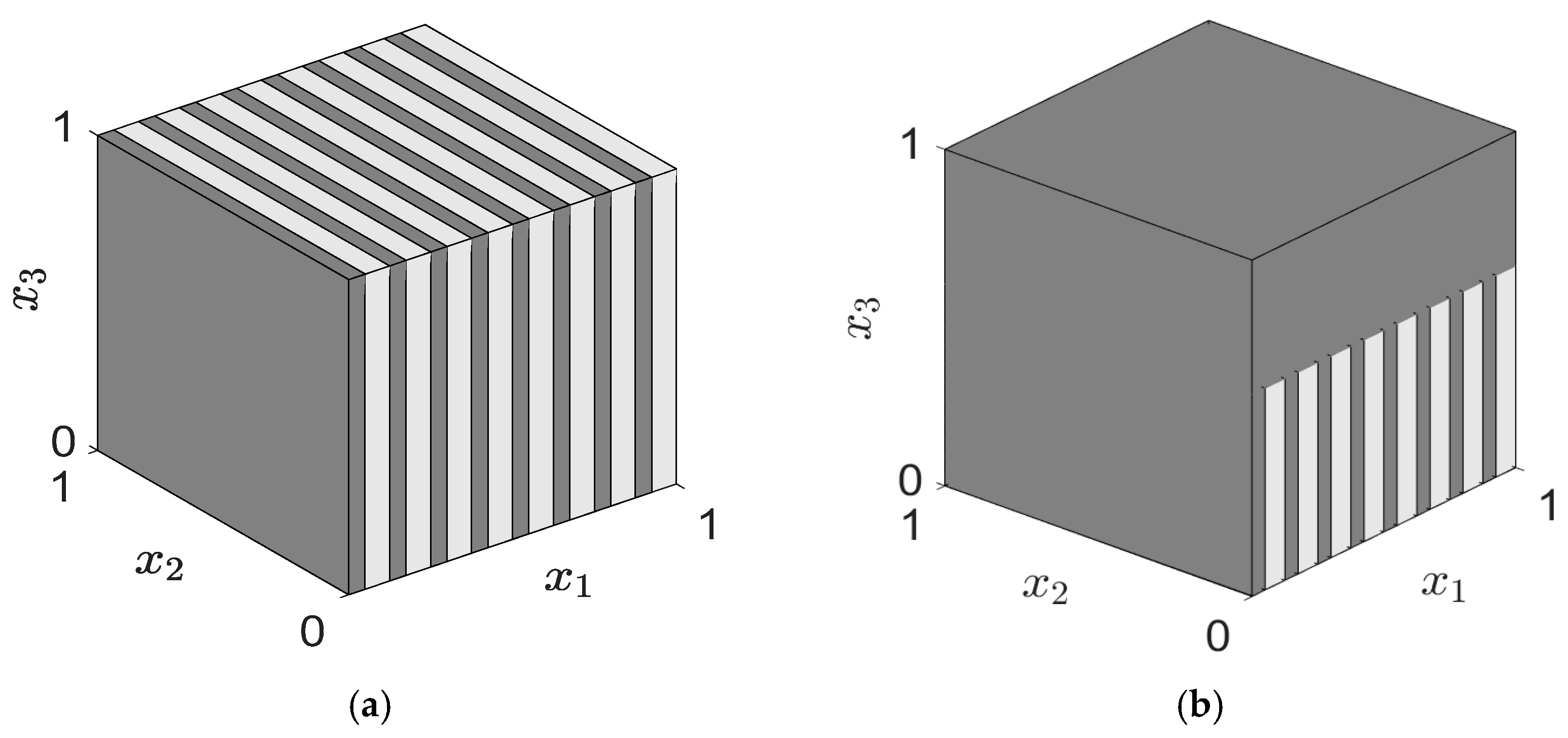
Two different layered structures composed of alternating layers of solid material and voids are depicted in Figure 2. We will calculate effective material coefficients for these two piezoelectric structures under different conditions.
The so-called Rank-1 structure, shown in Figure 2a, is made of alternating layers of solid materials and voids. Practically, the very soft materials, rather than voids, are employed to avoid singularity in the constitutive matrix. Considering a three-dimensional problem, the constitute matrix [2] can be given uniformly as
G ε = C 1111 ε C 1122 ε C 1133 ε 0 0 0 e 111 ε 0 0 C 2211 ε C 2222 ε C 2233 ε 0 0 0 e 122 ε 0 0 C 3311 ε C 3322 ε C 3333 ε 0 0 0 e 133 ε 0 0 0 0 0 C 2323 ε 0 0 0 0 0 0 0 0 0 C 1313 ε 0 0 0 e 313 ε 0 0 0 0 0 C 1212 ε 0 e 212 ε 0 e 111 ε e 122 ε e 133 ε 0 0 0 ϵ 11 ε 0 0 0 0 0 0 0 e 212 ε 0 ϵ 22 ε 0 0 0 0 0 e 313 ε 0 0 0 ϵ 33 ε .
when only the ceramics are considered; by assuming the transversely isotropy, let
C 2222 ε = C 3333 ε ,   C 1122 ε = C 1133 ε ,   C 1212 ε = C 1313 ε ,   e 122 ε = e 133 ε ,   e 313 ε = e 212 ε ,   ϵ 22 ε = ϵ 33 ε .
Then by Formula (15) (interchanging the subscripts 2 and 3), we obtain C i j k l H as
C 1111 H = V C ( V C V ϵ + V e 2 ) 1 , C 1122 H = ( C 1111 ϵ 11 + e 111 2 ) 1 C 1122 ( C 1111 H ϵ 11 + e 111 H e 111 ) + e 122 ( C 1111 H e 111 e 111 H C 1111 ) , C 1133 H = ( C 1111 ϵ 11 + e 111 2 ) 1 C 1122 ( C 1111 H ϵ 11 + e 111 H e 111 ) + e 122 ( C 1111 H e 111 e 111 H C 1111 ) , C 2211 H = ( C 1111 ϵ 11 + e 111 2 ) 1 C 2211 ( C 1111 H ϵ 11 + e 111 H e 111 ) + e 122 ( C 1111 H e 111 e 111 H C 1111 ) , C 2222 H = C 3333 H = C 2222 + ( C 1111 ϵ 11 + e 111 2 ) 1 ( C 1122 H C 1122 ) ( C 1122 ϵ 11 + e 111 e 122 ) , + ( C 1111 ϵ 11 + e 111 2 ) 1 ( e 122 H e 122 ) ( C 1122 e 111 C 1111 e 122 ) , C 3311 H = ( C 1111 ϵ 11 + e 111 2 ) 1 C 3311 ( C 1111 H ϵ 11 + e 111 H e 111 ) + e 133 ( C 1111 H e 111 e 111 H C 1111 ) , C 3322 H = C 2233 H = C 3322 + C 1111 ϵ 11 + e 111 2 1 ( C 1122 H C 1122 ) C 3311 ϵ 11 + e 133 e 111 , + C 1111 ϵ 11 + e 111 2 1 e 122 H e 122 C 3311 e 111 e 133 C 1111 , C 1212 H = C 1313 H = C 1212 1 1 ,   C 2323 H = C 2323 ,
respectively, where
V C = C 1111 C 1111 ϵ 11 + e 111 2 1 , V ϵ = ϵ 11 C 1111 ϵ 11 + e 111 2 1 , V e = e 111 C 1111 ϵ 11 + e 111 2 1 ,
and the homogenized piezoelectric coefficients e k i j H are analogously derived as
e 111 H = V e V C V ϵ + V e 2 1 , e 122 H = e 133 H = C 1111 ϵ 11 + e 111 2 1 e 111 H C 2211 ϵ 11 + e 122 e 111 + ϵ 11 H C 1111 e 122 C 2211 e 111 , e 212 H = e 313 H = C 1212 H e 212 / C 1212 ,
respectively, and the homogenized dielectric coefficients ϵ i j H are
ϵ 11 H = V ϵ ( V C V ϵ + V e 2 ) 1 , ϵ 22 H = ϵ 33 H = ϵ 22 + e 212 2 / C 1212 C 1212 H e 212 / C 1212 2 .
If the weak material represents the holes, then the constitute matrix degenerates to
G H = 0 0 0 0 0 0 0 0 0 0 C 2222 C 2233 0 0 0 0 0 0 0 C 2233 C 2222 0 0 0 0 0 0 0 0 0 C 2323 0 0 0 0 0 0 0 0 0 0 0 0 0 0 0 0 0 0 0 0 0 0 0 0 0 0 0 0 0 0 0 0 0 0 0 0 0 0 0 ϵ 22 0 0 0 0 0 0 0 0 0 ϵ 33 .
The constitutive matrix of the ceramics polarized in the x 3 direction is
G ε = C 1111 ε C 1122 ε C 1133 ε 0 0 0 0 0 e 311 ε C 2211 ε C 2222 ε C 2233 ε 0 0 0 0 0 e 322 ε C 3311 ε C 3322 ε C 3333 ε 0 0 0 0 0 e 333 ε 0 0 0 C 2323 ε 0 0 0 e 223 ε 0 0 0 0 0 C 1313 ε 0 e 113 ε 0 0 0 0 0 0 0 C 1212 ε 0 0 0 0 0 0 0 e 113 ε 0 ϵ 11 ε 0 0 0 0 0 e 223 ε 0 0 0 ϵ 22 ε 0 e 311 ε e 322 ε e 333 ε 0 0 0 0 0 ϵ 33 ε ,
where
C 1111 ε = C 2222 ε ,   C 1133 ε = C 2233 ε ,   C 2323 ε = C 1313 ε ,   e 311 ε = e 322 ε ,   e 223 ε = e 113 ε ,   ϵ 11 ε = ϵ 22 ε .
Interchanging indices 1 and 2, we also have the homogenized coefficients as
C 1111 H = C 1111 1 1 , C 1122 H = C 1111 H C 2211 C 1111 1 , C 1133 H = C 1111 H C 3311 C 1111 1 , C 2211 H = C 2211 C 1111 1 C 1111 H , C 2222 H = C 2222 + ( C 1122 H ) 2 / C 1111 H C 1122 2 / C 1111 , C 2233 H = C 2233 + C 1133 ( C 1122 H C 1122 ) C 1111 1 , C 3311 H = C 3311 C 1111 1 C 1111 H , C 3322 H = C 3322 + C 3311 ( C 1122 H C 1122 ) / C 1111 , C 3333 H = C 3333 + ( C 1133 H ) 2 / C 1111 H C 1133 2 / C 1111 , C 1212 H = C 1212 , C 1313 H = C 1313 + e 113 ϵ 11 1 e 113 e 113 H ,   C 2323 H = C 2323 , e 311 H = C 1111 H e 311 C 1111 1 ,   e 322 H = e 322 + e 311 C 1111 1 ( C 1122 H C 1122 ) , e 333 H = e 333 + e 311 C 1111 1 ( C 1133 H C 1133 ) ,   e 113 H = V ¯ e V ¯ C V ¯ e + V ¯ e 2 1 ,   e 223 H = e 223 , ϵ 11 H = V ¯ ϵ ( V ¯ C V ¯ ϵ + V ¯ e 2 ) 1 ,   ϵ 22 H = ϵ 22 ,   ϵ 33 H = ϵ 33 + e 311 2 C 1111 1 C 1111 H e 311 C 1111 1 2 ,
respectively, where
V ¯ C = C 1313 ( C 1313 ϵ 11 + e 131 2 ) 1 ,   V ¯ ϵ = ϵ 11 ( C 1313 ϵ 11 + e 131 2 ) 1 ,   V ¯ e = e 113 ( C 1313 ϵ 11 + e 131 2 ) 1 .
If the weak material denotes the holes, the constitute matrix will become
G H = 0 0 0 0 0 0 0 0 0 0 C 2222 C 2233 0 0 0 0 0 e 322 0 C 2233 C 2222 0 0 0 0 0 e 333 0 0 0 C 2323 0 0 0 e 223 0 0 0 0 0 0 0 0 0 0 0 0 0 0 0 0 0 0 0 0 0 0 0 0 0 0 0 0 0 0 0 e 223 0 0 0 ϵ 22 0 0 e 322 e 333 0 0 0 0 0 ϵ 33 .
For the Rank-2 structure, it is possible to derive the explicit expression of the homogenized matrix in the same way (see Appendix B).

4. SOTS Finite Element Algorithm

The finite element algorithms can be built in accordance with the results for the asymptotic piezoelectric modal problem from Equations (19) and (25). Let the FOTS and SOTS expressions of eigenfunctions be
u ε , 1 ( x ) = u 0 ( x ) + ε u 1 ( x , y ) ,   u ε , 2 ( x ) = u ε , 1 ( x ) + ε 2 u 2 ( x , y ) , ϕ ε , 1 ( x ) = ϕ 0 ( x ) + ε ϕ 1 ( x , y ) ,   ϕ ε , 2 ( x ) = ϕ ε , 1 ( x ) + ε 2 ϕ 2 ( x , y ) ,
respectively, and the SOTS finite element algorithm can be described as follows.
  • Finite element computation of the cell functions:
    • Configure the domain Y * , determine the coefficients C i j k l ε , e k i j ε , and ϵ i j ε for each constituent material, and construct the finite element mesh. Compute the first-order cell functions N α 1 m ( y ) , H α 1 m ( y ) , F α 1 ( y ) , and R α 1 ( y ) with the following weak forms:
      Y * ( C i j k l N α 1 k m y l + e k i j H α 1 m y k ) φ i y j d y = Y * C i j m α 1 φ i y j d y , Y * ( ϵ i j H α 1 m y j e i k l N α 1 k m y l ) φ ¯ y i d y = Y * e i m α 1 φ ¯ y i d y ,
      Y * ( C i j k l F α 1 k y l + e k i j R α 1 y k ) φ i y j d y = Y * e α 1 i j φ i y j d y , Y * ( ϵ i j R α 1 y j e i k l F α 1 k y l ) φ ¯ y i d y = Y * ϵ i α 1 φ ¯ y i d y .
    • Compute the homogenized coefficients C i j k l H , e k i j H , ϵ i j H , and ρ H from the expressions in Equation (15).
    • Compute the second-order cell functions N α 1 α 2 m ( y ) , H α 1 α 2 m ( y ) , F α 1 α 2 ( y ) , and R α 1 α 2 ( y ) with the following weak forms:
      Y * ( C i j k l N α 1 α 2 k m y l + e k i j H α 1 α 2 m y k ) φ i y j d y = Y * ( C i j k α 2 N α 1 k m + e α 2 i j H α 1 m ) φ i y j d y + Y * ( C i α 2 k l N α 1 k m y l + e k i α 2 H α 1 m y k + C i α 2 m α 1 ρ ρ H C i α 2 m α 1 H ) φ i d y , Y * ( ϵ i j H α 1 α 2 m y j e i k l N α 1 α 2 k m y l ) φ ¯ y i d y = Y * ( ϵ i α 2 H α 1 m e i k α 2 N α 1 k m ) φ ¯ y i d y + Y * ( ϵ α 2 j H α 1 m y j e α 2 k l N α 1 k m y l e α 2 m α 1 + e α 2 m α 1 H ) φ ¯ d y , Y * ( C i j k l F α 1 α 2 k y l + e k i j R α 1 α 2 y k ) φ i y j d y = Y * ( C i j k α 2 F α 1 k + e α 2 i j R α 1 ) φ i y j d y + Y * ( C i α 1 k l F α 1 k y l + e k i α 2 R α 1 y k + e α 1 i α 2 ρ ρ H e α 1 i α 2 H ) φ i d y , Y * ( ϵ i j R α 1 α 2 y j e i k l F α 1 α 2 k y l ) φ ¯ y i d y = Y * ( ϵ i α 2 R α 1 e i k α 2 F α 1 k ) φ ¯ y i d y + Y * ( ϵ α 2 j R α 1 y j e α 2 k l F α 1 k y l + ϵ α 1 α 2 ϵ α 1 α 2 H ) φ ¯ d y ,
  • Construct the finite element mesh on the homogeneous domain Ω and perform the eigenvalue computations of Homogenized Problem (14) using the weak form:
    Ω ( C i j k l H u k 0 x l + e k i j H ϕ 0 x k ) ϕ i x j d x = Λ 0 Ω ρ H u i 0 ϕ i d x , Ω ( ϵ i j H ϕ 0 x j e i k l H u k 0 x l ) ϕ ¯ x i d x = 0 .
  • Assemble the FOTS and SOTS approximations of the eigenvector [ u ε ,   ϕ ε ] T in Equation (28), and compute eigenvalue correctors Λ 1 and Λ 2 in Equation (25). Then, we obtain the approximations of the eigenvalues Λ ε , 1 and Λ ε , 2
The porosity of the domain Ω ε prevents us from obtaining the exact solution u ε ,   ϕ ε ,   Λ ε , so we also compute the classical FE solutions on a refined mesh. We refer to u ε ,   ϕ ε ,   Λ ε as the FE fine solutions in Ω ε and compare them with these approximations in Equation (28) numerically to show the effectiveness and correctness of the suggested SOTS model.

5. Numerical Example and Discussions

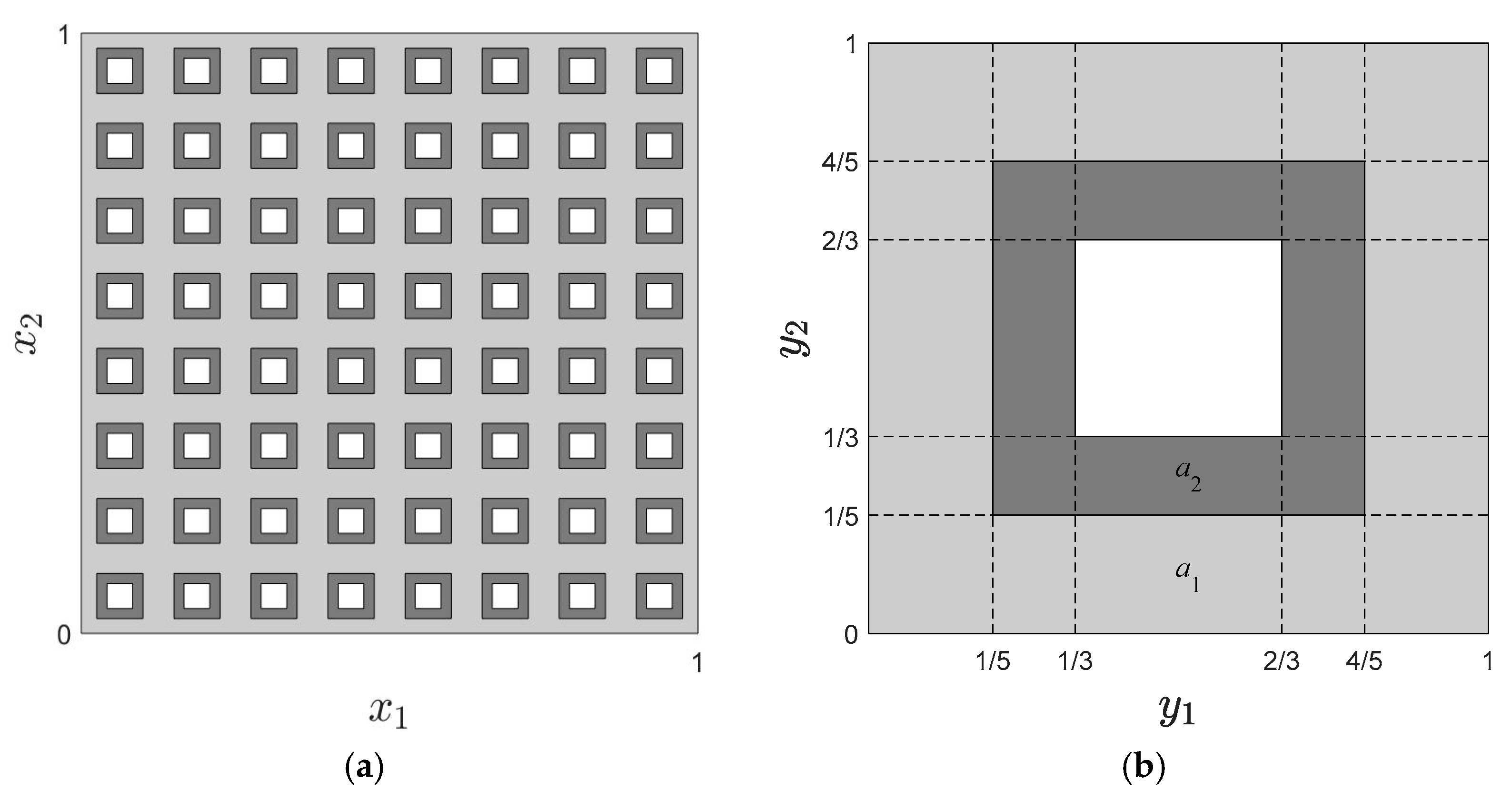
In the numerical computation, we consider a periodic domain Ω ε and the composite cell Y * illustrated in Figure 3. Y * shown in Figure 3b is occupied by two different materials, a 1 Epoxy and a 2 PZT-5 A . The constitutive matrices and mass density are given, respectively, as
G Epoxy = 8.0 × 10 9 4.4 × 10 9 0 0 0 4.4 × 10 9 8.0 × 10 9 0 0 0 0 0 1.8 × 10 9 0 0 0 0 0 3.717 × 10 11 0 0 0 0 0 3.717 × 10 11 , ρ 1 = 1100 ,
and
G PZT-5 A = 121 × 10 9 75.4 × 10 9 0 0 5.4 75.4 × 10 9 111 × 10 9 0 0 15.8 0 0 21.1 × 10 9 12.3 0 0 0 12.3 8.137 × 10 9 0 5.4 15.8 0 0 7.313 × 10 9 , ρ 2 = 7800 .
The mesh information and computation time for the classical finite element method and the proposed SOTS asymptotic method are presented in Table 2. It is shown that the classical method requires a substantial amount of computation time. In contrast, the SOTS method only requires computations on a single cell and a uniform domain, which can significantly reduce CPU time and memory requirements.
Let { Λ i ε } be the eigenvalues in ascending order and { u i ε , ϕ i ε } be corresponding eigenfunctions. Analogously, the asymptotic solutions are denoted by { Λ i 0 } , { Λ i ε , 1 } , { Λ i ε , 2 } , and u i 0 ,   ϕ i 0 ,   u i ε , 1 ,   ϕ i ε , 1 ,   u i ε , 2 ,   ϕ i ε , 2 respectively. Define the relative errors of eigenvalues by
e Λ , i j = Λ i ε Λ i j Λ i ε , i 1 , j = 0 , 1 , 2 .
The errors of the eigenfunctions are calculated by the least-squares strategy [38]. For the eigenfunction associated with a simple eigenvalue, the relative errors are calculated as follows:
e u , i j = min α u j u i ε α u j u i ε , j L 2 ( Ω ) u i ε L 2 ( Ω ) , e ϕ , i j = min α ϕ j ϕ i ε α ϕ j ϕ i ε , j L 2 ( Ω ) ϕ i ε L 2 ( Ω ) , i 1 , j = 0 , 1 , 2 .
where u i ε , 0 = u i ε , ϕ i ε , 0 = ϕ i ε . The scaling factors α u j and α ϕ j are chosen to minimize the relative errors as
α u j = u i ε , u i ε , j L 2 ( Ω ) u i ε , j L 2 ( Ω ) , α ϕ j = ϕ i ε , ϕ i ε , j L 2 ( Ω ) ϕ i ε , j L 2 ( Ω ) , i 1 , j = 0 , 1 , 2 .
where no summation is implied over the repeated index i and k.
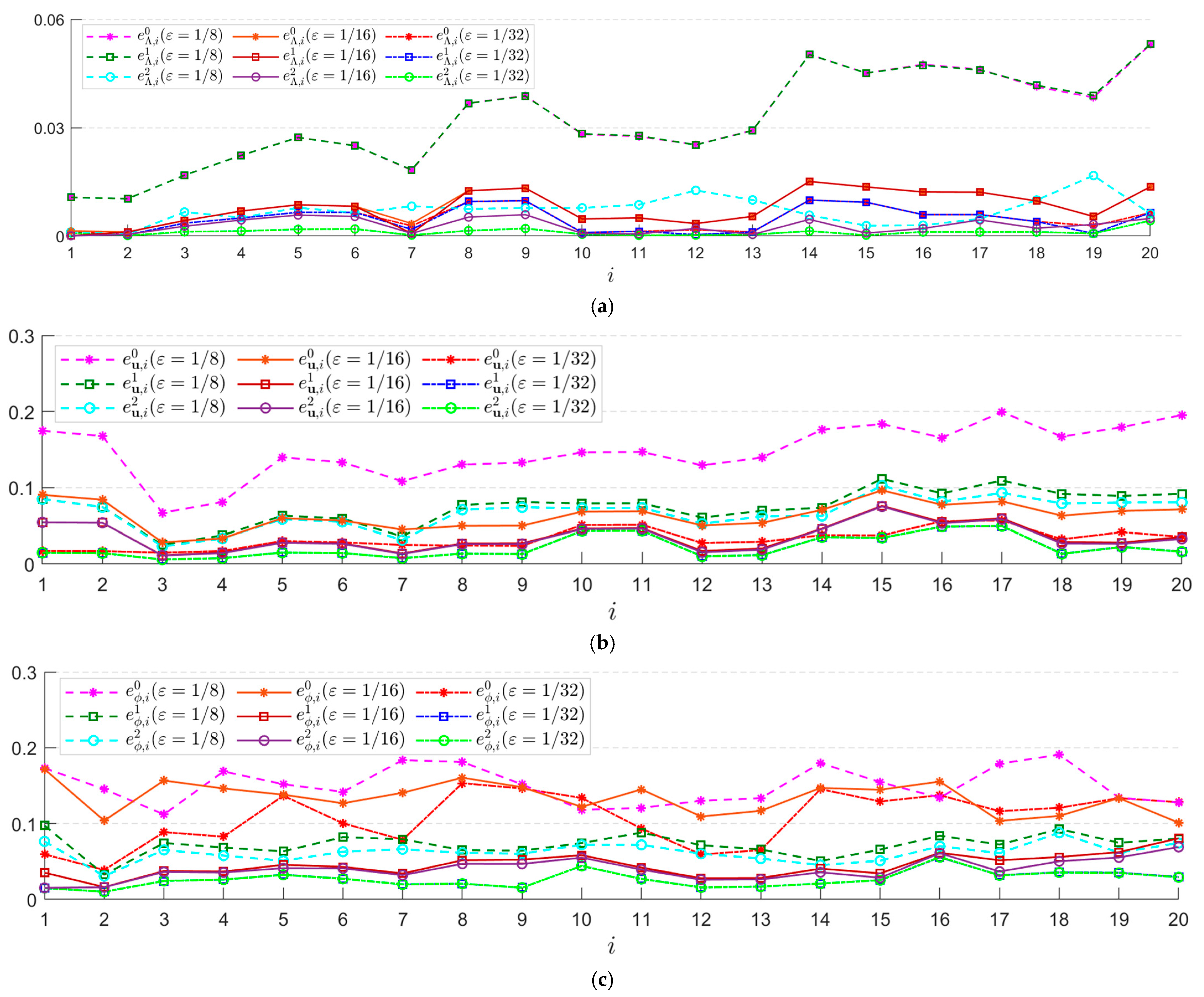
Table 3 and Table 4 present the relative errors of the first 20 calculations for eigenvalues in ε = 1 / 8 and ε = 1 / 16 . It can be seen that the calculation error in ε = 1 / 16 is smaller than that in ε = 1 / 8 . And the evolution of eigenpair relative errors with increasing mode number is graphically shown in Figure 4. As ε decreases, the SOTS approximation improves, which indicates that the correction factor can capture more oscillation details.
Although the error becomes smaller as ε decreases, it is not easy to verify the theoretical results in the convergence analysis. This may be due to interpolation errors when mapping the cell functions and homogenized solution from coarse to fine grids and numerical differentiation errors in calculating the high-order partial derivatives of the homogenized solutions. Obviously, we find that Λ i 0 gives good approximations and are greater than Λ i ε . By appending the correctors, the first- and second-order approximations Λ i ε , 1 and Λ i ε , 2 decrease the errors, which demonstrates that the SOTS method can provide better approximations of eigenvalue than homogenized results.
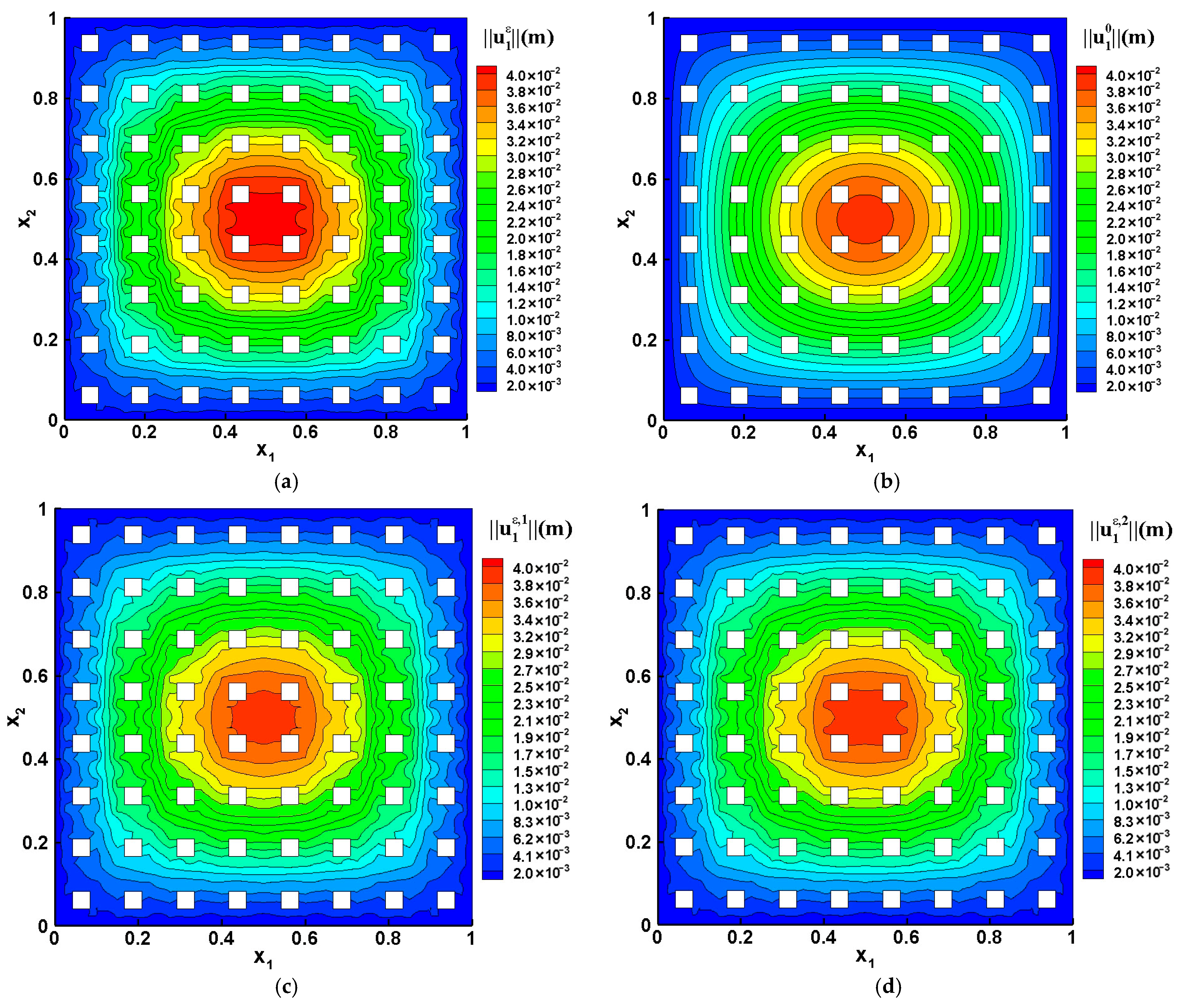
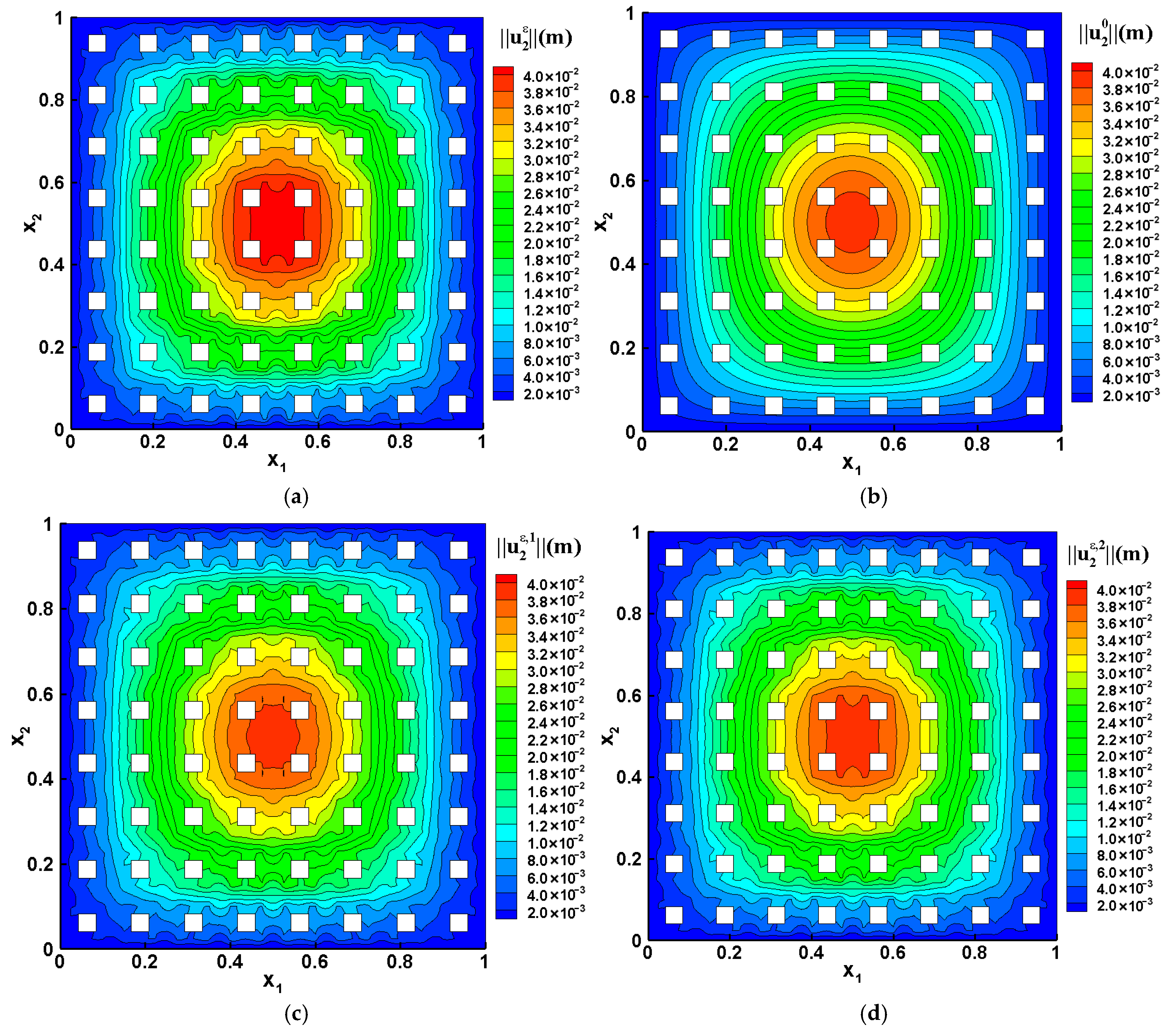
The displacement components of the eigenfunctions corresponding to the first eigenvalues are shown in Figure 5 and Figure 6 with ε = 1 / 8 . The homogenized eigenfunction u 1 0 in Figure 5b is smooth and u 1 ε , 1 and u 1 ε , 2 give a detailed description of the oscillation in the domain Ω ε , which can be seen in Figure 5c,d. In addition, u 1 ε , 2 in Figure 5d is closer to u 1 ε in Figure 5a than the other solutions. Similar conclusions can also be obtained from Figure 6.
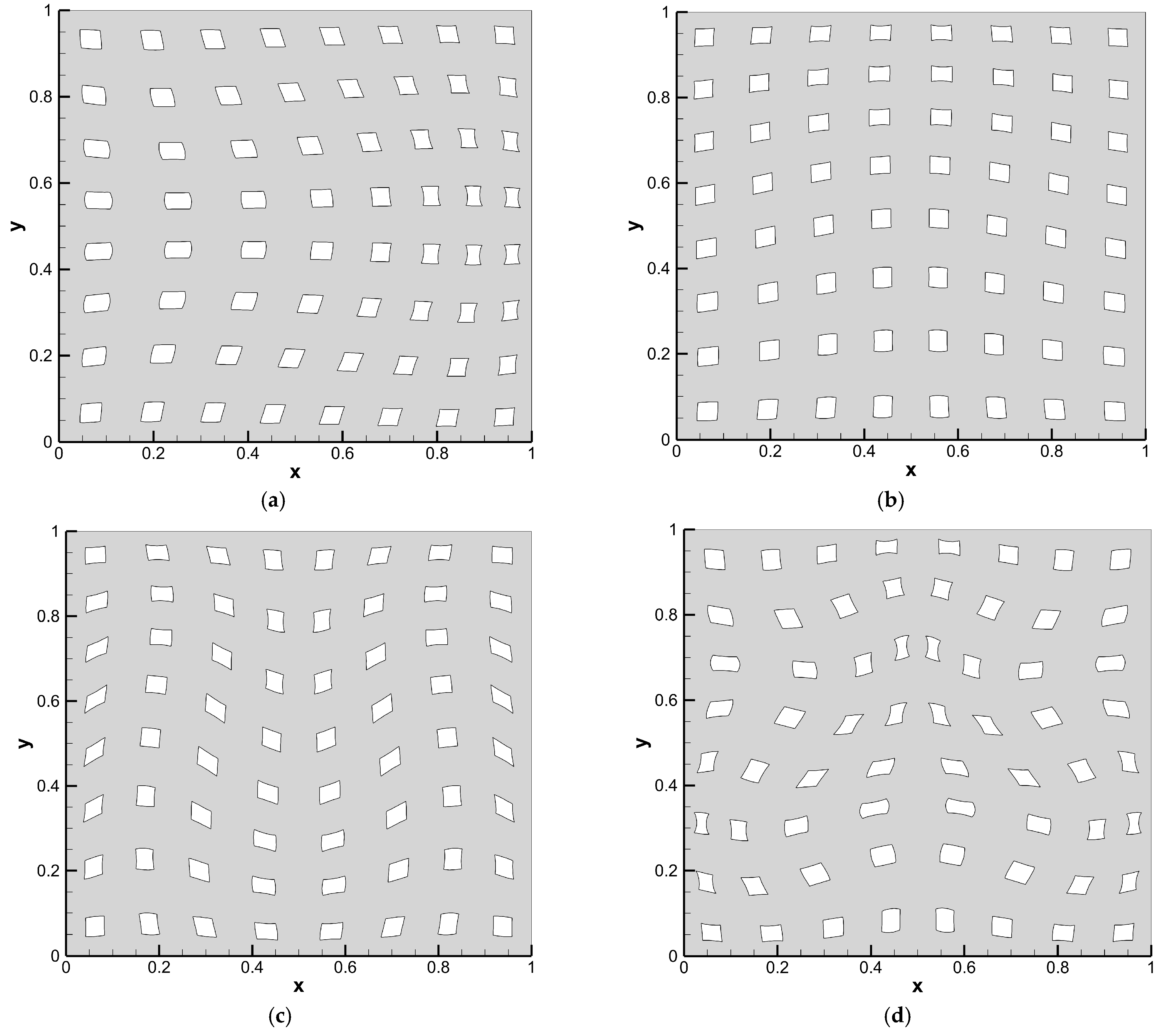
The deformed configurations caused by the displacement field are plotted in Figure 7; it is observed that the structure is stretched in the x 1 and x 2 direction, corresponding to the first and second eigenmode, respectively. For the higher modes, the deformation is complicated and cannot be described in terms of single bending or torsion. In addition, since the vibration exhibits a bigger wave number and becomes more complex in a higher mode, it necessitates that the computational meshes be finer. This is reason why the errors increase when the mode i becomes larger for a fixed mesh, which can be observed for all the eigenvalue computations.
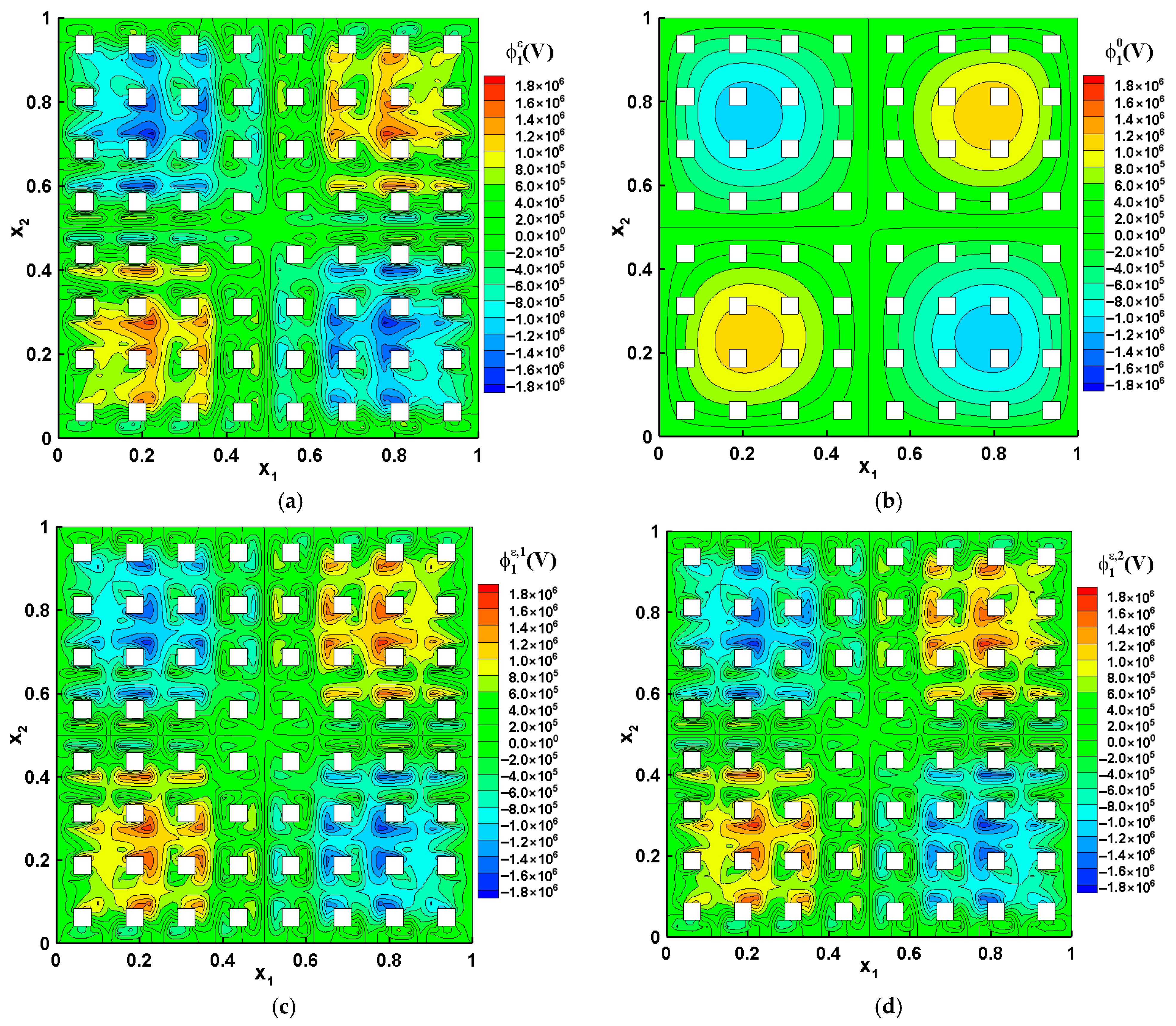
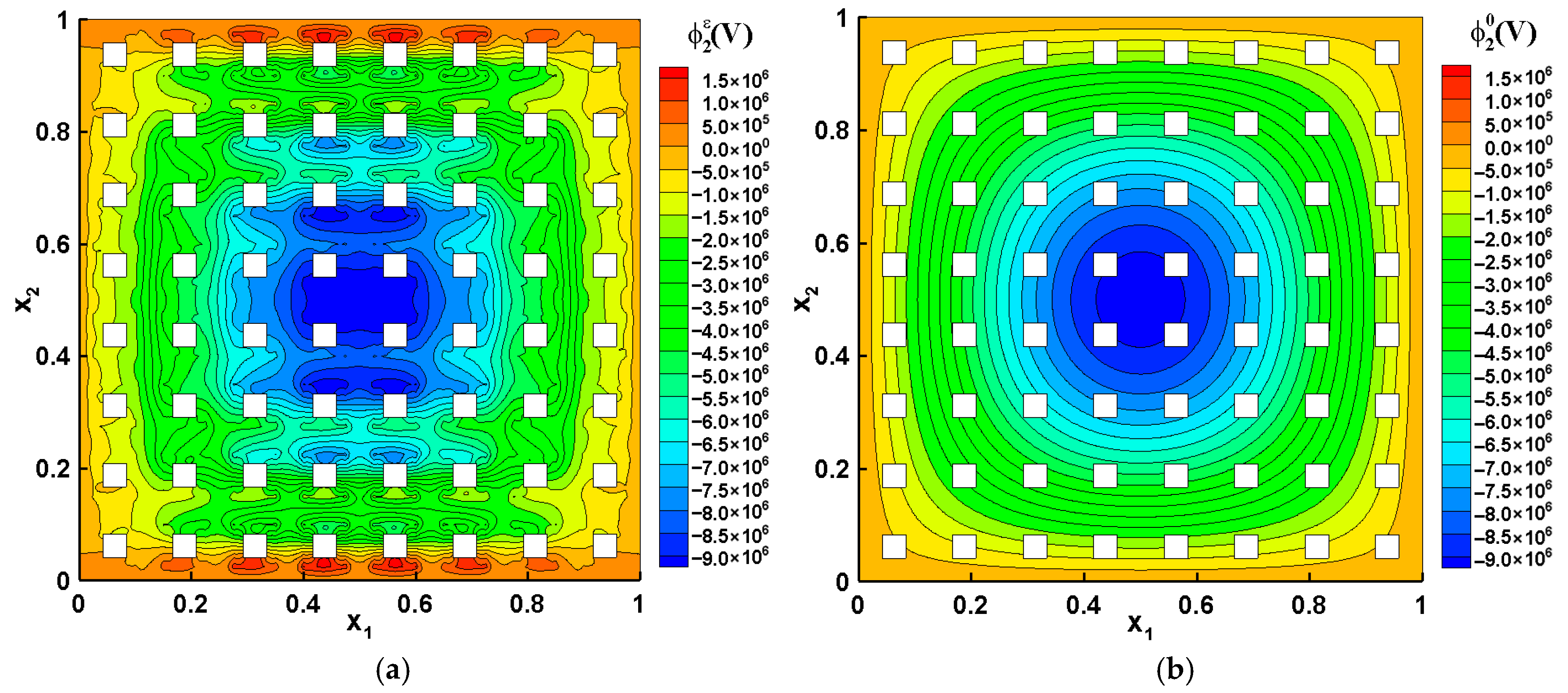
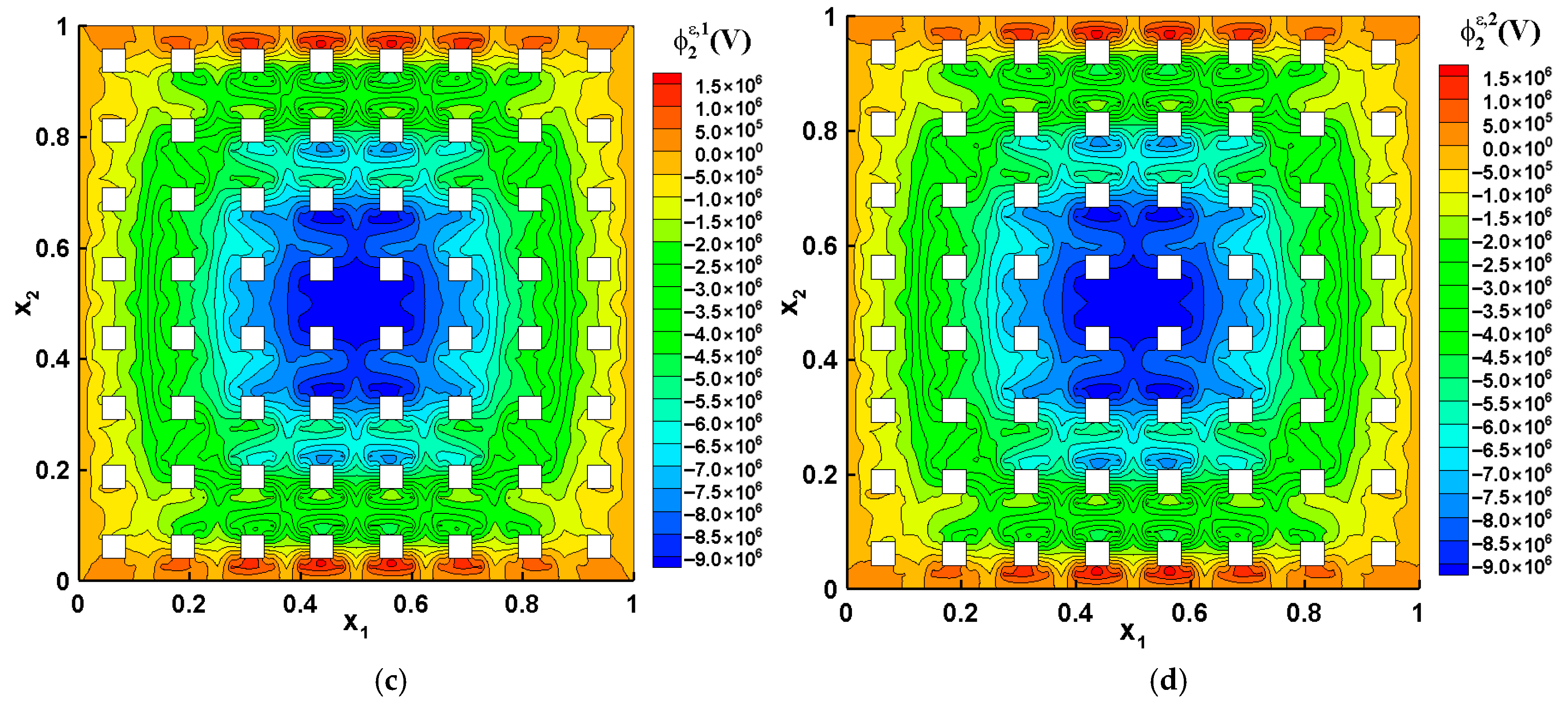
Figure 8 and Figure 9 show the asymptotic solutions of electric potential for the first and second eigenvalues and the fine solutions ϕ 1 ε and ϕ 2 ε with ε = 1 / 8 . It can be found that the values of electric potential ϕ 1 ε for these different solutions are point-symmetrical about the center of the entire plane and the values of the electric potential ϕ 2 ε are both point-symmetrical and symmetrical. This is because the electric potential is distributed symmetrically around the point charge.
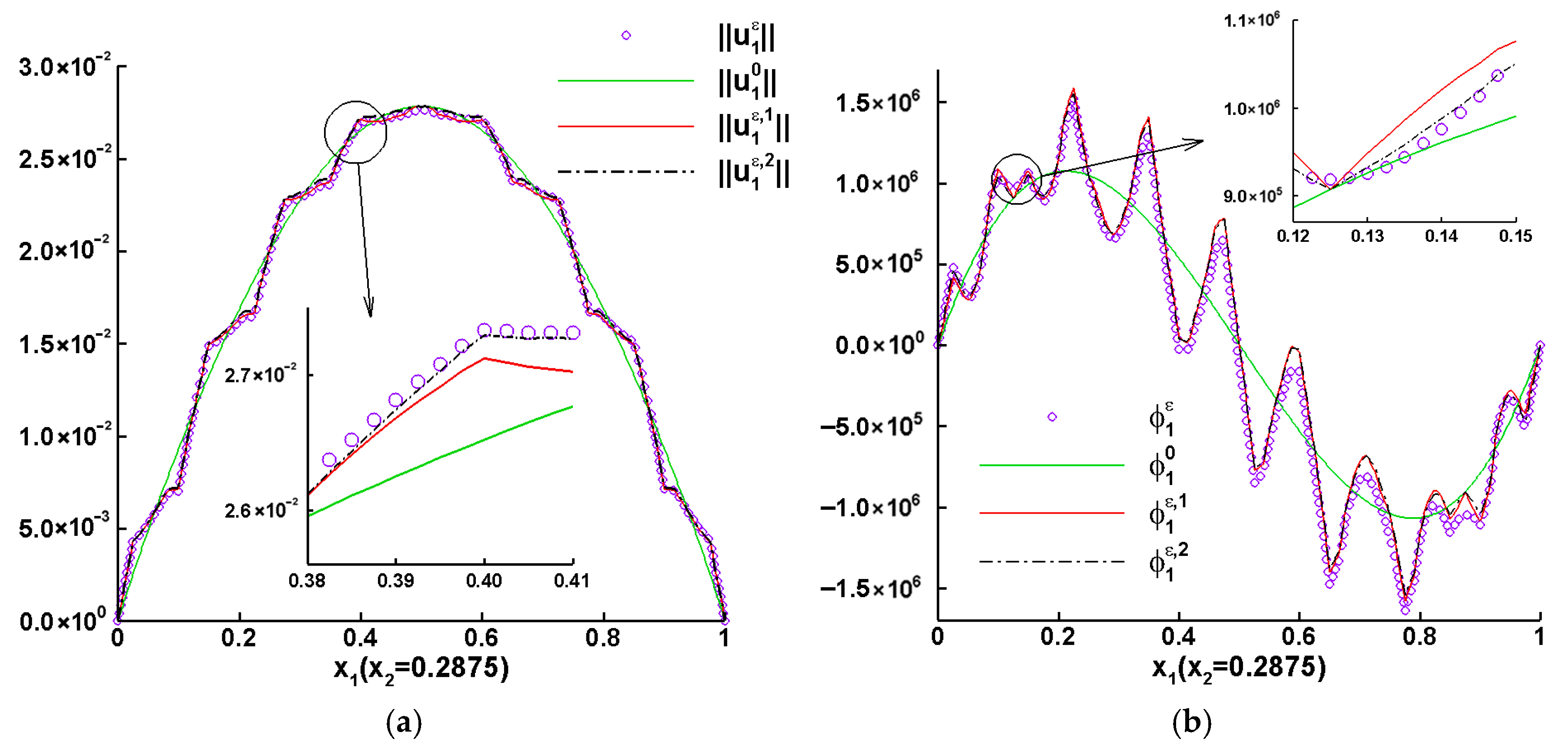
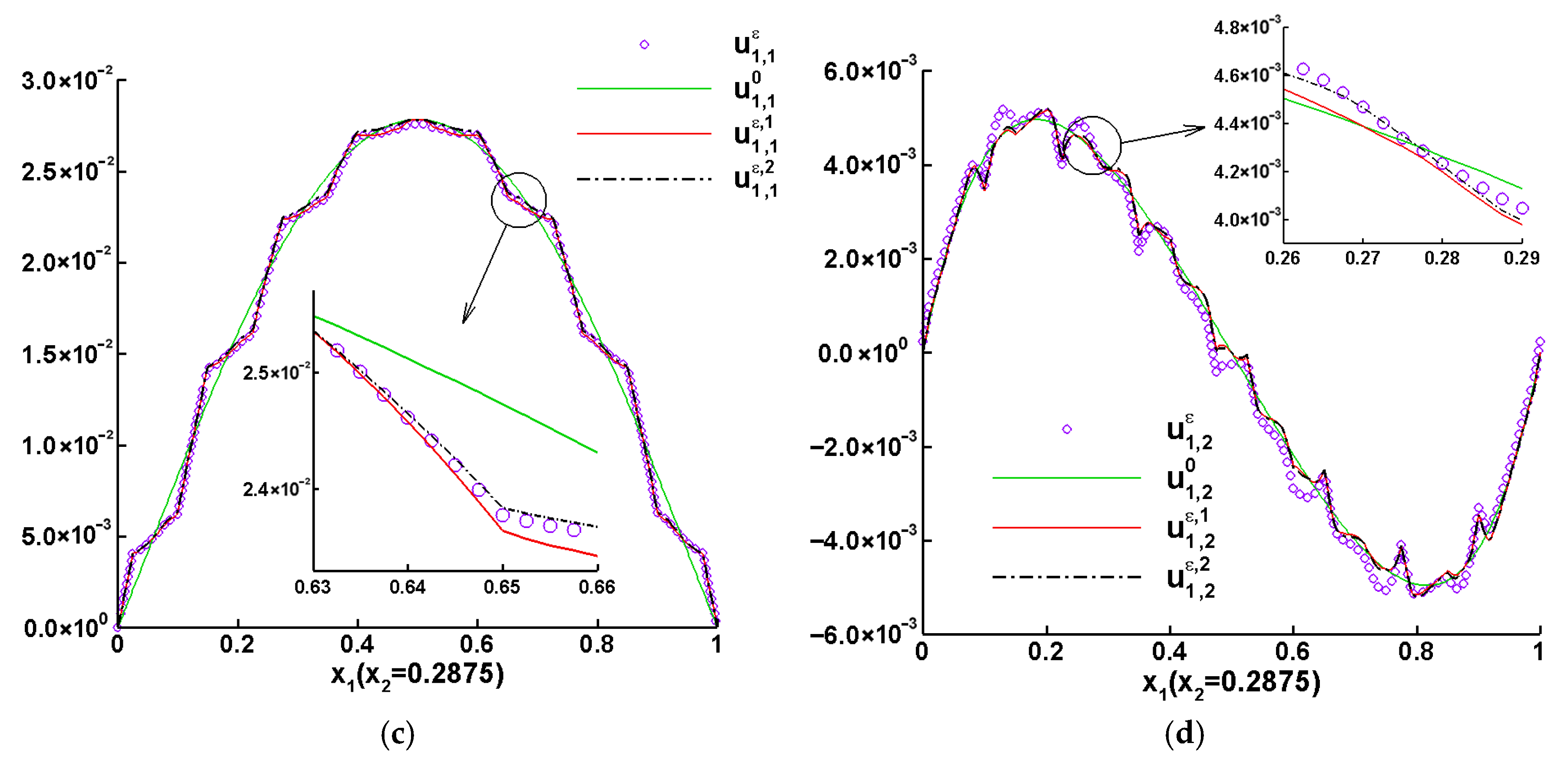
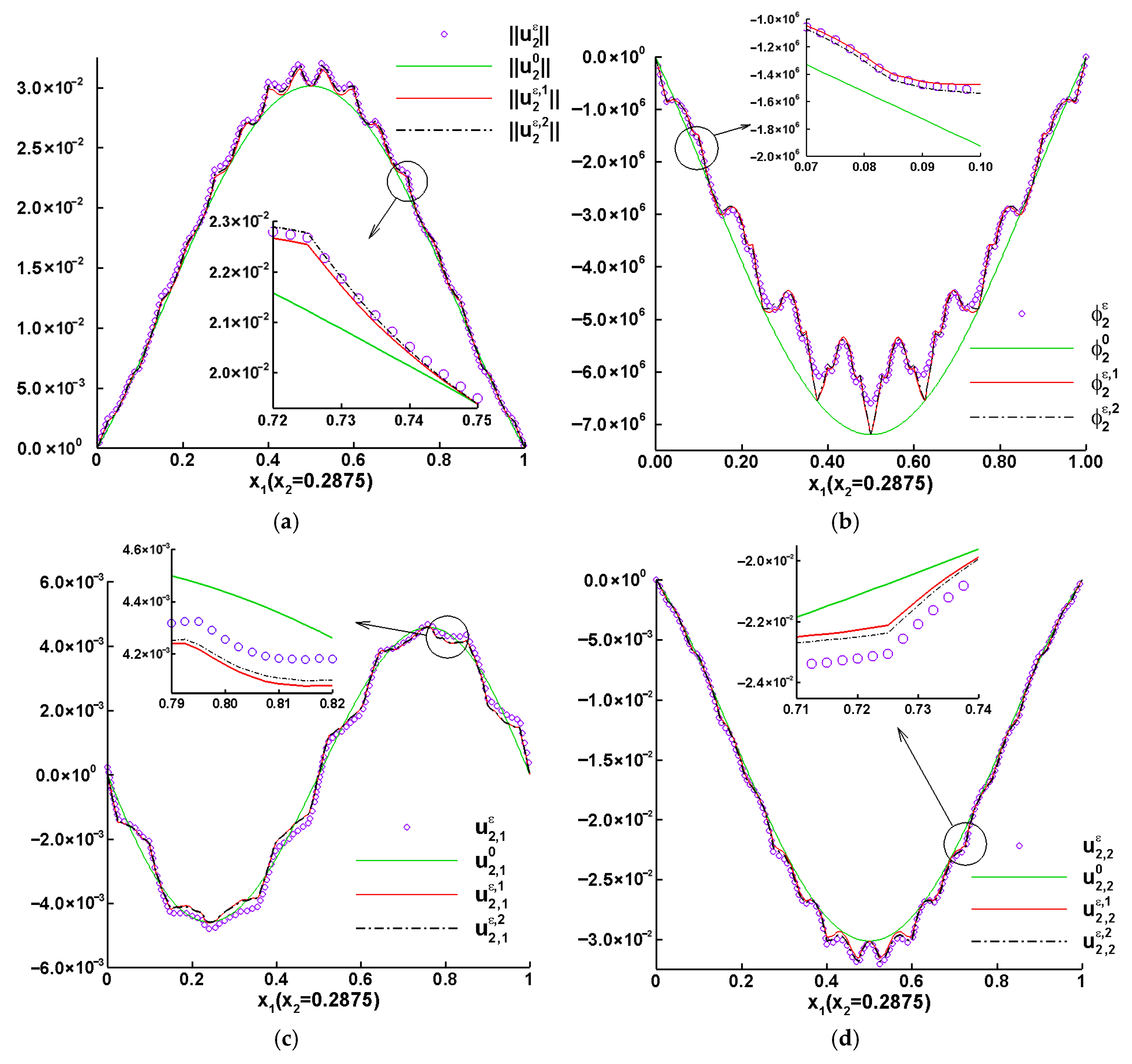
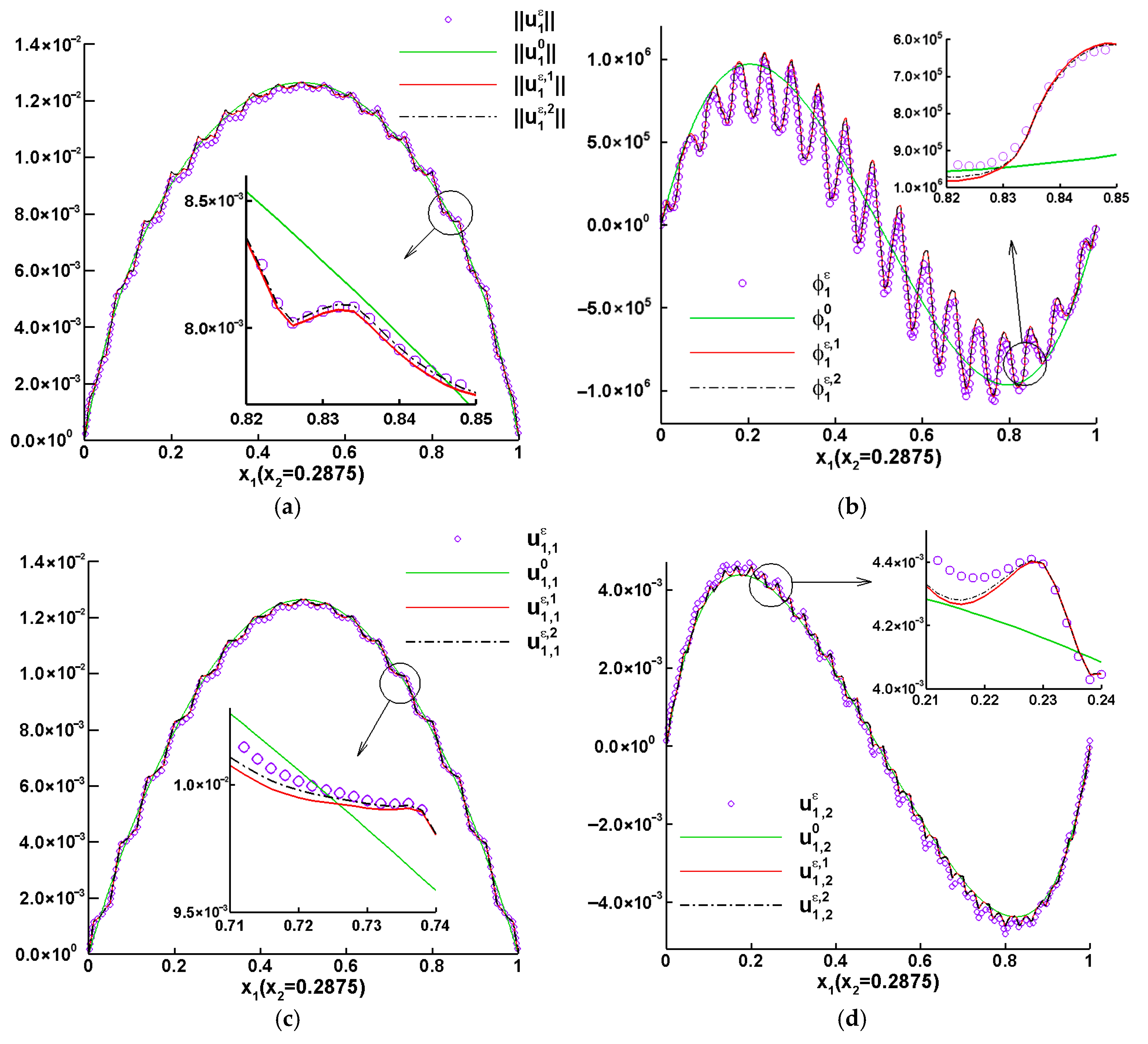
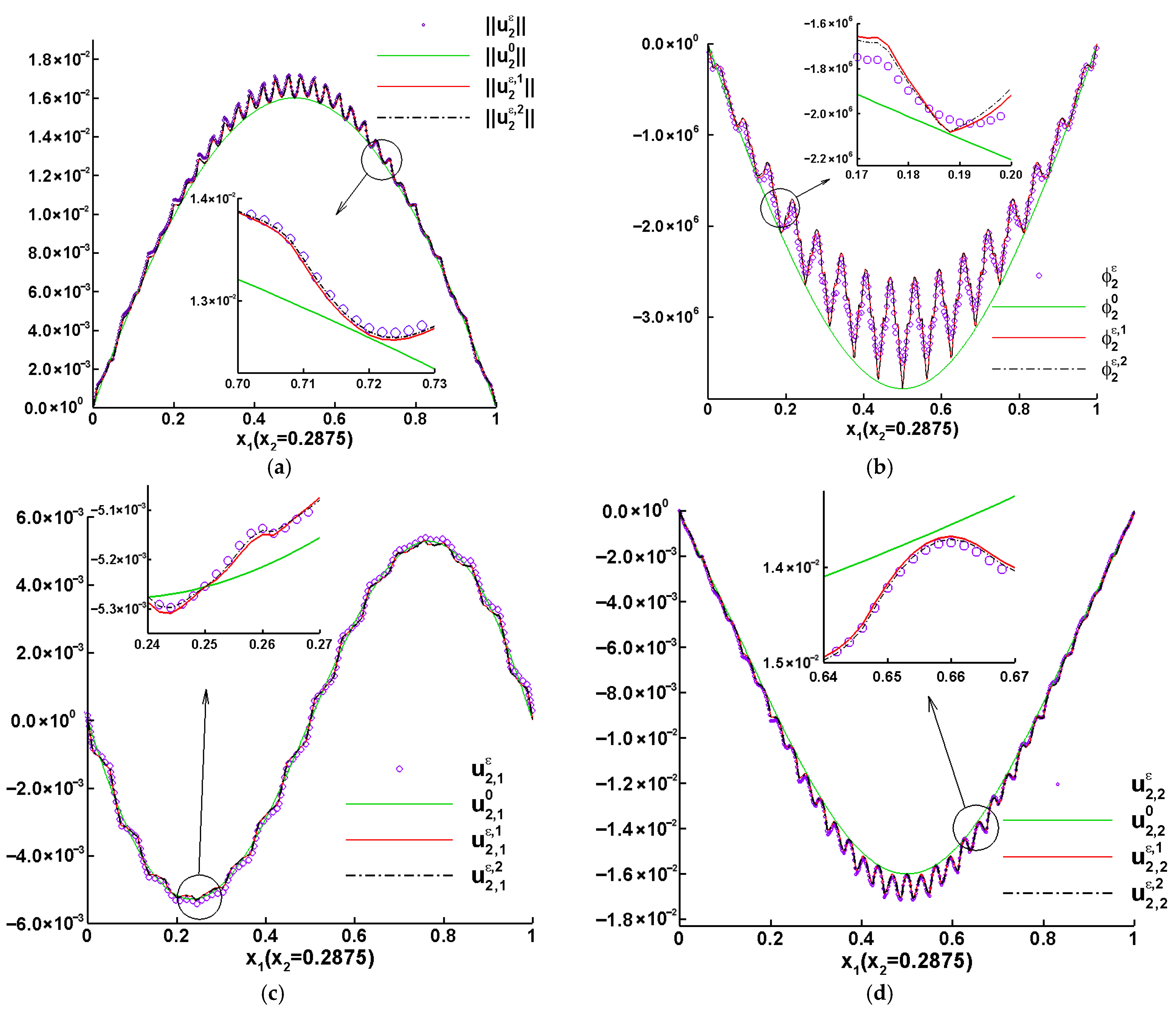
Figure 10 and Figure 11 show the displacement u 1 ε ,   u 2 ε and electric potential ϕ 1 ε ,   ϕ 2 ε on the line x 2 = 0.2875 . The graphs of | | u 1 ε | | and its first component u 1 , 1 ε differ just little, while the value of its second component u 1 , 2 ε is an order of magnitude smaller than theirs. For displacement u 2 ε , there is an opposite phenomenon. The macroscopic behavior of | | u 1 ε | | is best described by the homogenized solution | | u 1 0 | | and both | | u 1 ε , 1 | | and | | u 1 ε , 2 | | (shown in Figure 5a,b) exhibit good numerical results. From the detailed graph, it can be seen that the SOTS solutions yield a better approximation. Therefore, we think that the second-order correctors are essential for accurately capturing the locally oscillatory behaviors.
Moreover, the first and second eigenfunctions when ε = 1 / 16 are shown in Figure 12 and Figure 13. As ε decreases, the first- and second-order solutions get closer to the homogenized solutions. The agreement between the SOTS solution and the reference solution is more evident. In this section, the piezoelectric eigenvalue problem for the composite is validated, proving that the present SOTS algorithm can effectively approximate the eigenfunctions and eigenvalues.

6. Conclusions and Future Expectations

We developed a high-order asymptotic model to predict the piezoelectric vibration in a perforated composite domain. According to the “correct equation”, the integral forms of the first- and second-order correctors of the eigenvalues are derived. The SOTS finite element procedure is established for the piezoelectric eigenproblem, and a typical numerical example of composite materials with periodic perforations is presented. For modeling elastic displacement and electric potential in periodic arrangements, the second-order correctors are indispensable as the local oscillating of the physical field can be reproduced. From the piezoelectric eigenvalue problem presented in this paper, the advantage of our SOTS method is to reduce the computational amount and efficiently obtain more accurate local eigensolutions. Based on this approach, some new phenomena may be obtained when higher-resolution solutions are demanded in some areas. For instance, in Surface Acoustic Wave (SAW) device simulations, billions of degrees of freedom are required to obtain the distributions of the coupled elastic field and displacement so that the impedance curve with respect to the frequence can be correctly plotted within accepted computation time. In this situation, the SOTS method may be an alternative over the classical FE method, which is the main focus of our future work.
Although this work focuses on a special structural material with regular plane periodic arrangement, the proposed method holds significant potential for broader applications. These include simulating the piezoelectric behavior of some special structures with axisymmetric or spherically symmetric configurations. In our recent work, we have extended the asymptotic homogenization method to the nonuniform structures with generalized heterogeneity [39]. It is believed that this approach can also be applied to the coupled problem with nonlinear piezoelectric effects.
This method provides an efficient and accurate approach for the coupled vibration analysis and computational design of piezoelectric composite materials. Based on the SOTS algorithm, it can help to design the shape, size, and distribution of pores to simulate the effects on the fundamental resonant frequency for electromechanical systems by combination with the optimization method.

Author Contributions

Conceptualization, M.Z. and Q.M.; methodology, M.Z. and S.Y.; formal analysis, M.Z. and S.Y.; validation, Q.M. and M.Z.; software, S.Y. and Q.M.; investigation, S.Y.; data curation, Q.M. and S.Y.; visualization, M.Z., S.Y. and Q.M.; supervision, Q.M.; writing—original draft preparation, M.Z. and S.Y.; writing—review and editing, Q.M. and M.Z.; funding acquisition, Q.M. All authors have read and agreed to the published version of the manuscript.

Funding

This research was funded by the National Key R&D Program of China (No. 2024YFA1012803), National Natural Science Foundation of China (U24B2073), and the Natural Science Foundation of Sichuan Province (Grant No. 2024NSFSC0438).

Institutional Review Board Statement

Not applicable.

Informed Consent Statement

Not applicable.

Data Availability Statement

Data will be made available on reasonable request.

Conflicts of Interest

The authors declare no conflicts of interest.

Appendix A. Error Estimation

First, we start by estimating the error Λ ε Λ 0 . From the corrector equation in (23), we have
Λ ε Λ 0 = Λ 0 ρ ε ; u ε , u 0 w ε Ω ε ρ ε ; u ε , w ε Ω ε .
It is proven that when ε is sufficiently small, both u ε and w ε are approaching u 0 [18], leading to the terms ρ ε ; u ε , w ε Ω ε being constrained below, i.e., ρ ε ; u ε , w ε Ω ε C . Assume that all the eigenfunctions u ε are normalized, then it follows that
Λ ε Λ 0 C u ε L 2 ( ρ ε ; Ω ε ) u 0 w ε L 2 ( ρ ε ; Ω ε ) C u 0 w ε L 2 ( ρ ε ; Ω ε ) .
For estimating the error Λ ε Λ ε , 1 , we introduce the function z ε , ψ ε = z 1 ε , , z d ε , ψ ε T , z ε V 1 Ω ε , ψ ε V 2 Ω ε which is the only answer to the following problem:
a z ε , ψ ε , u ¯ ε , ϕ ¯ ε Λ ε ρ ε ; z ε , u ¯ ε Ω ε = Λ ε ρ ε ; w ε , u ¯ ε Ω ε Λ 0 ρ ε ; u 0 , u ¯ ε Ω ε , u ¯ ε V 1 Ω ε , ϕ ¯ ε V 2 Ω ε ρ ε ; z ε , u ¯ ε Ω ε = 0 , z ε ( x ) = 0 on Γ u , σ i j ε ( x ) n j = 0 on Γ t , ψ ε ( x ) = 0 on Γ ϕ , D i ε ( x ) n i = 0 on Γ q .
and define the u ˜ ε as
u ˜ ε = z ε + w ε ,
which is actually an eigenfunction of the original problem (2). From Vanninathan [16] and Kesavan [18], we can analogously have
z ε L 2 ( ρ ε ; Ω ε ) C Λ ε w ε Λ 0 u 0 L 2 ( ρ ε ; Ω ε ) ,
and then it follows that
z ε L 2 ( ρ ε ; Ω ε ) C Λ ε w ε u 0 L 2 ( ρ ε ; Ω ε ) + C Λ ε Λ 0 u 0 L 2 ( ρ ε ; Ω ε )     C u 0 w ε L 2 ( ρ ε ; Ω ε ) .
Thus, one has
u ˜ ε u 0 L 2 ( ρ ε ; Ω ε ) = z ε + w ε u 0 L 2 ( ρ ε ; Ω ε ) C w ε u 0 L 2 ( ρ ε ; Ω ε ) .
According to Equations (23) and (25), rewrite Λ ε Λ ε , 1 by
Λ ε Λ ε , 1 = Λ ε ρ ε ; u 0 , u 0 + ε u 1 w ε Ω ε ρ ε ; u 0 , u 0 Ω ε ε Λ ε Λ 0 ρ ε ; u 0 , u 1 Ω ε ρ ε ; u 0 , u 0 Ω ε + Λ ε ρ ε ; u 0 , w ε Ω ε ρ ε ; u 0 , u 0 Ω ε Λ 0 .
We have the following estimates:
Λ ε ρ ε ; u 0 , u 0 + ε u 1 w ε Ω ε ρ ε ; u 0 , u 0 Ω ε C u 0 + ε u 1 w ε L 2 ( ρ ε ; Ω ε ) , ε Λ ε Λ 0 ρ ε ; u 0 , u 1 Ω ε ρ ε ; u 0 , u 0 Ω ε C ε u 0 w ε L 2 ( ρ ε ; Ω ε ) .
Applying the result that u ε resolves the corrector Equation (23) and (A4), we have
Λ ε ρ ε ; u 0 , w ε Ω ε ρ ε ; u 0 , u 0 Ω ε Λ 0 = Λ ε ρ ε ; u 0 u ε , w ε u 0 Ω ε ρ ε ; u 0 , u 0 Ω ε + Λ ε Λ 0 ρ ε ; u 0 , u 0 u ε Ω ε ρ ε ; u 0 , u 0 Ω ε C u 0 w ε L 2 ( ρ ε ; Ω ε ) 2 .
so that we obtain
Λ ε Λ ε , 1 C u 0 + ε u 1 w ε L 2 ( ρ ε ; Ω ε ) + ε u 0 w ε L 2 ( ρ ε ; Ω ε ) + u 0 w ε L 2 ( ρ ε ; Ω ε ) 2 .
Similarly, according to the expression of Λ 2 in Equation (25), the following estimation is true:
Λ ε Λ ε , 2 C u 0 + ε u 1 + ε 2 u 2 w ε L 2 ( ρ ε ; Ω ε ) + ε Λ ε Λ ε , 1     + ε 2 u 0 w ε L 2 ( ρ ε ; Ω ε ) + ε 2 + u 0 w ε L 2 ( ρ ε ; Ω ε ) 2 .
According to the inequalities (A1), (A5), and (A6), we should calculate the errors between w ε and its three expansion terms in (24). It can be verified that w ε converges to u 0 in the norm     V 1 ( Ω ε ) and it holds that [4]
u 0 w ε L 2 ( ρ ε ; Ω ε ) C ε , u 0 + ε u 1 w ε L 2 ( ρ ε ; Ω ε ) C ε 2 , u 0 + ε u 1 + ε 2 u 2 w ε L 2 ( ρ ε ; Ω ε ) C ε 3 .

Appendix B. Rank-2 Structure

For the Rank-2 structure shown in Figure 2, two cases with different polarization directions are also considered for deriving the analytical homogenized coefficients:
When the polarization is along the x 1 direction, the constitutive rectangles of the two materials are
G H = 0 0 0 0 0 0 0 0 0 0 C 2222 C 2233 0 0 0 0 0 0 0 C 2233 C 2222 0 0 0 0 0 0 0 0 0 C 2323 0 0 0 0 0 0 0 0 0 0 0 0 0 0 0 0 0 0 0 0 0 0 0 0 0 0 0 0 0 0 0 0 0 0 0 0 0 0 0 ϵ 22 0 0 0 0 0 0 0 0 0 ϵ 33 and G ε = C 1111 ε C 1122 ε C 1133 ε 0 0 0 e 111 ε 0 0 C 2211 ε C 2222 ε C 2233 ε 0 0 0 e 122 ε 0 0 C 3311 ε C 3322 ε C 3333 ε 0 0 0 e 133 ε 0 0 0 0 0 C 2323 ε 0 0 0 0 0 0 0 0 0 C 1313 ε 0 0 0 e 313 ε 0 0 0 0 0 C 1212 ε 0 e 212 ε 0 e 111 ε e 122 ε e 133 ε 0 0 0 ϵ 11 ε 0 0 0 0 0 0 0 e 212 ε 0 ϵ 22 ε 0 0 0 0 0 e 313 ε 0 0 0 ϵ 33 ε .
Through the homogenization theory, we can obtain the effective elastic constants as
C 1111 H = C 1111 + C 1133 / C 3333 2 C 3333 H C 1133 2 / C 3333 , C 1122 H = C 1122 + C 1133 ( C 2233 H C 2233 ) / C 3333 , C 1133 H = C 3333 H C 1133 / C 3333 , C 2211 H = C 2211 + C 2233 ( C 1133 H C 1133 ) / C 3333 ,   C 3311 H = C 3333 H C 1133 / C 3333 , C 2222 H = C 2222 + C 2233 ( C 2233 H C 2233 ) / C 3333 , C 2233 H = C 3333 H C 2233 / C 3333 ,   C 3322 H = C 3333 H C 2233 / C 3333 , C 3333 H = C 3333 1 1 ,   C 1212 H = C 1212 , C 1313 H = V ˜ C ( V ˜ C V ˜ ϵ + V ˜ e 2 ) 1 ,   C 2323 H = C 2323 1 1 ,
respectively, where
V ˜ C = C 1313 ( C 1313 ϵ 33 + e 313 2 ) 1 ,   V ˜ ϵ = ϵ 33 ( C 1313 ϵ 33 + e 313 2 ) 1 ,   V ˜ e = e 313 ( C 1313 ϵ 33 + e 313 2 ) 1 ,
the effective piezoelectric coefficients are
e 111 H = e 111 + e 133 ( C 1133 H C 1133 ) / C 3333 ,   e 122 H = e 122 + e 133 ( C 2233 H C 2233 ) / C 3333 , e 133 H = e 133 C 3333 1 C 3333 H ,   e 212 H = e 212 ,   e 313 H = V ˜ e ( V ˜ C V ˜ ϵ + V ˜ e 2 ) 1 ,
respectively, and the effective dielectric constants are
ϵ 11 H = ϵ 11 e 133 ( e 133 H e 133 ) / C 3333 ,   ϵ 22 H = ϵ 22 ,   ϵ 33 H = V ˜ ϵ ( V ˜ C V ˜ ϵ + V ˜ e 2 ) 1 .
If the weak material represents the hole, the final homogenized constitutive matrix becomes
G R 1 = 0 0 0 0 0 0 0 0 0 0 C 2222 C 2233 0 0 0 0 0 0 0 C 2233 C 3333 0 0 0 0 0 0 0 0 0 C 2323 0 0 0 0 0 0 0 0 0 0 0 0 0 0 0 0 0 0 0 0 0 0 0 0 0 0 0 0 0 0 0 0 0 0 0 0 0 0 0 ϵ 22 0 0 0 0 0 0 0 0 0 ϵ 33 .
When the polarization is along the x 3 direction, the two materials are
G H = 0 0 0 0 0 0 0 0 0 0 C 2222 C 2233 0 0 0 0 0 e 322 0 C 2233 C 2222 0 0 0 0 0 e 333 0 0 0 C 2323 0 0 0 e 223 0 0 0 0 0 0 0 0 0 0 0 0 0 0 0 0 0 0 0 0 0 0 0 0 0 0 0 0 0 0 0 e 223 0 0 0 ϵ 22 0 0 e 322 e 333 0 0 0 0 0 ϵ 33
and
G ε = C 1111 ε C 1122 ε C 1133 ε 0 0 0 0 0 e 311 ε C 2211 ε C 2222 ε C 2233 ε 0 0 0 0 0 e 322 ε C 3311 ε C 3322 ε C 3333 ε 0 0 0 0 0 e 333 ε 0 0 0 C 2323 ε 0 0 0 e 223 ε 0 0 0 0 0 C 1313 ε 0 e 113 ε 0 0 0 0 0 0 0 C 1212 ε 0 0 0 0 0 0 0 e 113 ε 0 ϵ 11 ε 0 0 0 0 0 e 223 ε 0 0 0 ϵ 22 ε 0 e 311 ε e 322 ε e 333 ε 0 0 0 0 0 ϵ 33 ε .
In this case, the effective elastic, piezoelectric, and dielectric coefficients are, respectively:
C 1111 H = C 1111 + ( C 3311 H C 3311 ) ( C 1133 ϵ 33 + e 311 e 333 ) ( C 3333 ϵ 33 + e 333 2 ) 1 + ( C 1133 e 333 C 3333 e 311 ) ( e 311 H e 311 ) ( C 3333 ϵ 33 + e 333 2 ) 1 , C 1122 H = C 1122 + ( C 3322 H C 3322 ) ( C 2233 ϵ 33 + e 322 e 333 ) ( C 3333 ϵ 33 + e 333 2 ) 1 + ( C 2233 e 333 C 3333 e 322 ) ( e 322 H e 333 ) ( C 3333 ϵ 33 + e 333 2 ) 1 , C 2211 H = C 2211 + ( C 3311 H C 3311 ) ( C 2233 ϵ 33 + e 322 e 333 ) ( C 3333 ϵ 33 + e 333 2 ) 1 + ( C 2233 e 333 C 3333 e 322 ) ( e 311 H e 311 ) ( C 3333 ϵ 33 + e 333 2 ) 1 , C 2222 H = C 2222 + ( C 3322 H C 3322 ) ( C 2233 ϵ 33 + e 322 e 333 ) ( C 3333 ϵ 33 + e 333 2 ) 1 + ( C 2233 e 333 C 3333 e 322 ) ( e 322 H e 322 ) ( C 3333 ϵ 33 + e 333 2 ) 1 ,
C 1133 H = C 3333 H ( C 1133 ϵ 33 + e 311 e 333 ) ( C 3333 ϵ 33 + e 333 2 ) 1 + e 333 H C 1133 e 333 C 3333 e 311 ( C 3333 ϵ 33 + e 333 2 ) 1 , C 2233 H = C 3333 H ( C 2233 ϵ 33 + e 322 e 333 ) ( C 3333 ϵ 33 + e 333 2 ) 1 + e 333 H C 2233 e 333 C 3333 e 322 ( C 3333 ϵ 33 + e 333 2 ) 1 , C 3311 H = ( C 3311 ϵ 33 + e 333 e 311 ) ( C 3333 ϵ 33 + e 333 2 ) 1 V ¯ ¯ C / V ¯ ¯ + ( C 3311 e 333 C 3333 e 311 ) ( C 3333 ϵ 33 + e 333 2 ) 1 V ¯ ¯ e / V , ¯ ¯ . C 3322 H = ( C 3322 ϵ 33 + e 333 e 322 ) ( C 3333 ϵ 33 + e 333 2 ) 1 V ¯ ¯ C / V ¯ ¯ + ( C 3322 e 333 C 3333 e 322 ) ( C 3333 ϵ 33 + e 333 2 ) 1 V ¯ ¯ e / V ¯ ¯ , e 311 H = ( e 311 C 3333 C 3311 e 333 ) ( C 3333 ϵ 33 + e 333 2 ) 1 V ¯ ¯ ϵ / V ¯ ¯ + ( C 3311 ϵ 33 + e 311 C 3333 ) ( C 3333 ϵ 33 + e 333 2 ) 1 V ¯ ¯ e / V ¯ ¯ , e 322 H = ( C 3333 e 322 C 3322 e 333 ) ( C 3333 ϵ 33 + e 333 2 ) 1 V ¯ ¯ ϵ / V ¯ ¯ + ( C 3322 ϵ 33 + e 333 e 322 ) ( C 3333 ϵ 33 + e 333 2 ) 1 V ¯ ¯ e / V ¯ ¯ , C 3333 H = V ¯ ¯ C / V ¯ ¯ , C 1212 H = C 1212 ,   C 1313 H = C 1313 1 1 , C 2323 H = C 2323 1 1 , e 113 H = e 113 C 1313 1 C 1313 H ,   e 333 H = V ¯ ¯ e / V ¯ ¯ ,   e 223 H = e 233 C 2323 1 C 2323 H ,   ϵ 33 H = V ¯ ¯ ϵ / V ¯ ¯ , ϵ 11 H = ϵ 11 e 113 ( e 113 H e 113 ) / C 1313 ,   ϵ 22 H = ϵ 22 e 223 ( e 223 H e 223 ) / C 2323 ,
where
V ¯ ¯ ϵ = ϵ 33 ( C 3333 ϵ 33 + e 333 2 ) 1 ,   V ¯ ¯ e = e 333 ( C 3333 ϵ 33 + e 333 2 ) 1 , V ¯ ¯ C = C 3333 ( C 3333 ϵ 33 + e 333 2 ) 1 ,   V ¯ ¯ = V ¯ ¯ C V ¯ ¯ ϵ + V ¯ ¯ e 2 .
If again we consider that the weak material is full of holes, the final homogenized constitutive matrix is
G H = 0 0 0 0 0 0 0 0 0 0 C 2222 C 2233 0 0 0 0 0 e 322 0 C 2233 C 2222 0 0 0 0 0 e 333 0 0 0 C 2323 0 0 0 e 223 0 0 0 0 0 0 0 0 0 0 0 0 0 0 0 0 0 0 0 0 0 0 0 0 0 0 0 0 0 0 0 e 223 0 0 0 ϵ 22 0 0 e 322 e 333 0 0 0 0 0 ϵ 33

References

  1. Montoya, A.; Ocampo, A.; March, C. Piezoelectric Transducers and Applications; Springer: Berlin/Heidelberg, Germany, 2008. [Google Scholar]
  2. Yang, J. An Introduction to the Theory of Piezoelectricity; Springer: Cham, Switzerland, 2004. [Google Scholar]
  3. Fang, D.N.; Jiang, B.; Hwang, K.C. A model for predicting effective properties of piezocomposites with non-piezoelectric inclusions. J. Elast. Phys. Sci. Solids 2001, 62, 95–118. [Google Scholar] [CrossRef]
  4. Bensoussan, A.; Lions, J.L.; Papanicolaou, G. Asymptotic Analysis for Periodic Structures; North-Holland: Amsterdam, The Netherlands, 1978. [Google Scholar] [CrossRef]
  5. Cioranescu, D.; Donato, P. An Introduction to Homogenization; Oxford University Press: New York, NY, USA, 1999. [Google Scholar] [CrossRef]
  6. Allaire, G. Homogenization and two-scale convergence. SIAM J. Math. Anal. 1992, 23, 1482–1518. [Google Scholar] [CrossRef]
  7. Nguetseng, G. A general convergence result for a functional related to the theory of homogenization. SIAM J. Math. Anal. 1989, 20, 608–623. [Google Scholar] [CrossRef]
  8. Hou, T.Y.; Wu, X.H. A Multiscale Finite element method for elliptic problems in composite materials and porous media. J. Comput. Phys. 1997, 134, 169–189. [Google Scholar] [CrossRef]
  9. Silva, E.C.N.; Fonseca, J.S.O.; Kikuchi, N. Optimal design of periodic piezocomposites. Comput. Methods Appl. Mech. Eng. 1998, 159, 49–77. [Google Scholar] [CrossRef]
  10. Fonseca, J.S.O. Design of Microstructures of Periodic Composite Materials. Ph.D. Thesis, University of Michigan, Ann Arbor, MI, USA, 1997. [Google Scholar]
  11. Cui, J.Z.; Cao, L.Q. Finite element method based on two-scale asymptotic analysis. Math. Numer. Sin. 1998, 20, 89–102. [Google Scholar] [CrossRef]
  12. Deng, M.X.; Feng, Y.P. Two-scale finite element method for piezoelectric problem in periodic structure. Appl. Math. Mech. 2011, 32, 1525–1540. [Google Scholar] [CrossRef]
  13. Ma, Q.; Wang, H.; Yang, Z.Q.; Li, Z.H.; Cui, J.Z. Second-order asymptotic analysis and computations of axially and spherically symmetric piezoelectric problems for composite structures. J. Sci. Comput. 2019, 81, 689–731. [Google Scholar] [CrossRef]
  14. Douanla, H. Two-scale convergence of Stekloff eigenvalue problems in perforated domains. Bound. Value Probl. 2010, 2010, 853717. [Google Scholar] [CrossRef]
  15. Allaire, G.; Capdeboscq, Y. Homogenization and localization for a 1-D eigenvalue problem in a periodic medium with an interface. Ann. Mat. Pura Appl. 2002, 181, 247–282. [Google Scholar] [CrossRef]
  16. Vanninathan, M. Homogenization of eigenvalue problems in perforated domains. Proc. Indian Acad. Sci. Math. Sci. 1981, 90, 239–271. [Google Scholar] [CrossRef]
  17. Nandakumar, A.K. Homogenization of eigenvalue problems of elasticity in perforated domains. Asymptot. Anal. 1994, 9, 337–358. [Google Scholar] [CrossRef]
  18. Kesavan, S. Homogenization of elliptic eigenvalue problems: Part 1. Appl. Math. Optim. 1979, 5, 153–167. [Google Scholar] [CrossRef]
  19. Kesavan, S. Homogenization of elliptic eigenvalue problems: Part 2. Appl. Math. Optim. 1979, 5, 197–216. [Google Scholar] [CrossRef]
  20. Ding, S.; Hu, Y.; Jian, B.; Zhang, Y.; Xia, R.; Hu, G. A semi-analytical solution to incipient sliding contact on viscoelastic layer-elastic substrate with imperfectly bonded interface. Appl. Math. Model. 2024, 125, 35–58. [Google Scholar] [CrossRef]
  21. Benveniste, Y. Universal relations in piezoelectric composites with eigenstress and polarization fields, Part II: Multiphase media—Effective behavior. J. Appl. Mech. 1993, 60, 270–275. [Google Scholar] [CrossRef]
  22. Wang, H.M.; Ding, H.J.; Chen, Y.M. Dynamic solution of a multilayered orthotropic piezoelectric hollow cylinder for axisymmetric plane strain problems. Int. J. Solids Struct. 2005, 42, 85–102. [Google Scholar] [CrossRef]
  23. Gu, G.Q.; Wei, E.B.; Xu, C. Effective elastic properties of piezoelectric composites with radially polarized cylinders. Phys. B 2009, 404, 4001–4006. [Google Scholar] [CrossRef]
  24. Adeff, S.E. Simulation of axisymmetric piezoelectric devices. Appl. Math. Comput. 1994, 65, 355–369. [Google Scholar] [CrossRef]
  25. Lotnyk, A.; Roddatis, V.; Braun, N.; Voß, L.; Bryja, H.; Kienle, L. Atomic-scale investigation of layered Cu7Te4 nanostructures featuring two and three tellurium layers. ACS Appl. Nano Mater. 2025, 8, 11621–11628. [Google Scholar] [CrossRef]
  26. Allik, H.; Hughes, T.J.R. Finite element method for piezoelectric vibration. Int. J. Numer. Methods Eng. 1970, 2, 151–157. [Google Scholar] [CrossRef]
  27. Iovane, G.; Nasedkin, A.V. Modal Analysis of Piezoelectric Bodies with Voids. I. Mathematical Approaches. Appl. Math. Model. 2010, 34, 60–71. [Google Scholar] [CrossRef]
  28. Iovane, G.; Nasedkin, A.V. Modal Analysis of Piezoelectric Bodies with Voids. II. Finite Element Simulation. Appl. Math. Model. 2010, 34, 47–59. [Google Scholar] [CrossRef]
  29. Rodríguez-Ramos, R.; Sabina, F.J.; Guinovart-Díaz, R.; Bravo-Castillero, J. Closed-form expressions for the effective coefficients of a fiber-reinforced composite with transversely isotropic constituents—I. Elastic and square symmetry. Mech. Mater. 2001, 33, 223–235. [Google Scholar] [CrossRef]
  30. Bravo-Castillero, J.; Otero, J.A.; Rodríguez-Ramos, R.; Bourgeat, A. Asymptotic homogenization of laminated piezocomposite materials. Int. J. Solids Struct. 1998, 35, 527–541. [Google Scholar] [CrossRef]
  31. Qin, Q.H. Material properties of piezoelectric composites by BEM and homogenization method. Compos. Struct. 2004, 66, 295–299. [Google Scholar] [CrossRef]
  32. Fantoni, F.; Bacigalupo, A.; Paggi, M. Multi-field asymptotic homogenization of thermo-piezoelectric materials with periodic microstructure. Int. J. Solids Struct. 2017, 120, 31–56. [Google Scholar] [CrossRef]
  33. Martínez-Ayuso, G.; Friswell, M.I.; Adhikari, S.; Khodaparast, H.H.; Berger, H. Homogenization of porous piezoelectric materials. Int. J. Solids Struct. 2017, 113–114, 218–229. [Google Scholar] [CrossRef]
  34. Lenglet, E.; Hladky-Hennion, A.C.; Debus, J.C. Numerical homogenization techniques applied to piezoelectric composites. J. Acoust. Soc. Am. 2003, 113, 826–833. [Google Scholar] [CrossRef]
  35. Berger, H.; Gabbert, U.; Köppe, H.; Rodríguez-Ramos, R.; Bravo-Castillero, J.; Guinovart-Diaz, R.; Otero, J.A.; Maugin, G.A. Finite element and asymptotic homogenization methods applied to smart composite materials. Comput. Mech. 2003, 33, 61–67. [Google Scholar] [CrossRef]
  36. Fu, C.; Wang, Z.; Jin, X.; Zhu, X.; Zhu, J. Effective piezoelectric coefficients of cement-based 2–2 type piezoelectric composites based on a multiscale homogenization model. Compos. Struct. 2018, 194, 170–177. [Google Scholar] [CrossRef]
  37. Yang, J.S.; Batra, R.C. Free vibrations of a piezoelectric body. J. Elast. 1994, 34, 239–254. [Google Scholar] [CrossRef]
  38. Ma, Q.; Li, Z.H.; Cui, J.Z. Multi-scale asymptotic analysis and computation of the elliptic eigenvalue problems in curvilinear coordinates. Comput. Methods Appl. Mech. Eng. 2018, 340, 340–365. [Google Scholar] [CrossRef]
  39. Ma, Q.; Cui, J.Z. A third-order multiscale analysis and computation for the elliptic problem in arbitrarily heterogeneous domains. Appl. Math. Lett. 2026, 174, 109806. [Google Scholar] [CrossRef]
Figure 1. Periodically perforated composites with two scales.
Mathematics 13 03967 g001
Figure 2. Structures composed of alternating layers of solid material and voids. (a) Rank-1 structure; (b) Rank-2 structure.
Mathematics 13 03967 g002
Figure 3. Configurations of composite domain (a) and unit cell (b). (a) Ω ε ; (b) Y * .
Mathematics 13 03967 g003
Figure 4. The evolution of eigenpair relative errors with increasing mode number. (a) Eigenvalue Λ i ε ; (b) Displacement u i ε ; (c) Electric potential ϕ i ε .
Mathematics 13 03967 g004
Figure 5. The eigenfunctions for the elastic field corresponding to the first eigenvalue Λ 1 ε with ε = 1 / 8 . (a) Fine solution | | u 1 ε | | ; (b) Homogenized solution | | u 1 0 | | ; (c) First-order approximation | | u 1 ε , 1 | | ; (d) Second-order approximation | | u 1 ε , 2 | | .
Mathematics 13 03967 g005
Figure 6. The eigenfunctions for the elastic field corresponding to the second eigenvalue Λ 2 ε with ε = 1 / 8 . (a) Fine solution | | u 2 ε | | ; (b) Homogenized solution | | u 2 0 | | ; (c) First-order approximation | | u 2 ε , 1 | | ; (d) Second-order approximation | | u 2 ε , 2 | | .
Mathematics 13 03967 g006
Figure 7. Deformed configuration corresponding to the eigenmodes. (a) First eigenvalue u 1 ε ; (b) Second eigenvalue u 2 ε ; (c) Sixth eigenvalue u 6 ε ; (d) Tenth eigenvalue u 10 ε .
Mathematics 13 03967 g007
Figure 8. The eigenfunctions for the electrical potential corresponding to the first eigenvalue with ε = 1 / 8 . (a) Fine solution ϕ 1 ε ; (b) Homogenized solution ϕ 1 0 ; (c) First-order approximation ϕ 1 ε , 1 ; (d) Second-order approximation ϕ 1 ε , 2 .
Mathematics 13 03967 g008
Figure 9. The eigenfunctions for the electrical potential corresponding to the second eigenvalue with ε = 1 / 8 . (a) Fine solution ϕ 2 ε ; (b) Homogenized solution ϕ 2 0 ; (c) First-order approximation ϕ 2 ε , 1 ; (d) Second-order approximation ϕ 2 ε , 2 .
Mathematics 13 03967 g009aMathematics 13 03967 g009b
Figure 10. The local solutions of first eigenvector u 1 ε and ϕ 1 ε as well as u 1 ε ’s components u 1 , 1 ε and u 1 , 2 ε with ε = 1 / 8 . (a) Norm of displacement | | u 1 ε | | ; (b) Electric potential ϕ 1 ε ; (c) First component u 1 , 1 ε ; (d) Second component u 1 , 2 ε .
Mathematics 13 03967 g010aMathematics 13 03967 g010b
Figure 11. The local solutions of second eigenvector u 2 ε and ϕ 2 ε as well as u 2 ε ’s components u 2 , 1 ε and u 2 , 2 ε with ε = 1 / 8 . (a) Norm of displacement | | u 2 ε | | ; (b) Electric potential ϕ 2 ε ; (c) First component u 2 , 1 ε ; (d) Second component u 2 , 2 ε .
Mathematics 13 03967 g011
Figure 12. The local solutions of first eigenvector u 1 ε and ϕ 1 ε as well as u 1 ε ’s components u 1 , 1 ε and u 1 , 2 ε with ε = 1 / 16 . (a) Norm of displacement | | u 1 ε | | ; (b) Electric potential ϕ 1 ε ; (c) First component u 1 , 1 ε ; (d) Second component u 1 , 2 ε .
Mathematics 13 03967 g012
Figure 13. The local solutions of second eigenvector u 2 ε and ϕ 2 ε as well as u 2 ε ’s components u 2 , 1 ε and u 2 , 2 ε with ε = 1 / 16 . (a) Norm of displacement | | u 2 ε | | ; (b) Electric potential ϕ 2 ε ; (c) First component u 2 , 1 ε ; (d) Second component u 2 , 2 ε .
Mathematics 13 03967 g013
Table 1. Variable definition and unit table.
VariableUnitPhysical Meaning
u i ε mDisplacement
ϕ ε VElectric potential
Λ ε s−2Eigenvalue
ρ ε kg/m3Density
e k i j ε C/m2Piezoelectric coefficient
ϵ i j ε F/mDielectric coefficient
C i j k l ε   PaElastic stiffness
D i ε   C/m2Electric flux
E j ε V/mElectric field
σ i j ε PAStress
S i j ε -Linear strain
Table 2. The mesh information and CPU times.
Ω ε Y * Ω
ε = 1 / 8 ε = 1 / 16 ε = 1 / 32
No. of Nodes78,193311,6491,244,35315848192
No. of Elements152,576610,3042,441,216295616,641
Mesh size5.8732 × 10−32.9366 × 10−31.4683 × 10−34.0020 × 10−22.2097 × 10−2
CPU times(s)189.7082386.55510,969.144.4947.042
Table 3. Approximations of the first 20 eigenvalues by the asymptotic solutions and the computed relative errors with ε = 1 / 8 .
i
Λ i ε
Λ i 0
Λ i 1
Λ i 2
e Λ , i 0
e Λ , i 1
e Λ , i 2
15.2661 × 1075.3223 × 1075.3222 × 1075.2717 × 1071.0670 × 10−21.0661 × 10−21.0724 × 10−3
25.3939 × 1075.4494 × 1075.4493 × 1075.3964 × 1071.0286 × 10−21.0281 × 10−24.7619 × 10−4
35.7439 × 1075.8404 × 1075.8404 × 1075.7817 × 1071.6808 × 10−21.6811 × 10−26.5881 × 10−3
49.5413 × 1079.7544 × 1079.7542 × 1079.5894 × 1072.2329 × 10−22.2309 × 10−25.0331 × 10−3
51.0611 × 1081.0901 × 1081.0901 × 1081.0694 × 1082.7287 × 10−22.7271 × 10−27.7943 × 10−3
61.0691 × 1081.0958 × 1081.0958 × 1081.0759 × 1082.4994 × 10−22.4982 × 10−26.3768 × 10−3
71.4371 × 1081.4633 × 1081.4634 × 1081.4253 × 1081.8182 × 10−21.8281 × 10−28.2089 × 10−3
81.6295 × 1081.6894 × 1081.6894 × 1081.6416 × 1083.6780 × 10−23.6763 × 10−27.4778 × 10−3
91.7207 × 1081.7875 × 1081.7874 × 1081.7340 × 1083.8855 × 10−23.8756 × 10−27.7410 × 10−3
101.9365 × 1081.9909 × 1081.9912 × 1081.9214 × 1082.8139 × 10−22.8296 × 10−27.7486 × 10−3
111.9586 × 1082.0125 × 1082.0129 × 1081.9418 × 1082.7528 × 10−22.7706 × 10−28.6053 × 10−3
122.0096 × 1082.0603 × 1082.0602 × 1081.9842 × 1082.5264 × 10−22.5225 × 10−21.2594 × 10−2
132.0772 × 1082.1380 × 1082.1379 × 1082.0566 × 1082.9239 × 10−22.9189 × 10−29.9406 × 10−3
142.3611 × 1082.4797 × 1082.4798 × 1082.3746 × 1085.0248 × 10−25.0258 × 10−25.7048 × 10−3
152.3730 × 1082.4801 × 1082.4801 × 1082.3797 × 1084.5131 × 10−24.5128 × 10−22.8153 × 10−3
162.6545 × 1082.7806 × 1082.7801 × 1082.6467 × 1084.7519 × 10−24.7314 × 10−22.9231 × 10−3
172.6825 × 1082.8063 × 1082.8058 × 1082.6698 × 1084.6167 × 10−24.5985 × 10−24.7024 × 10−3
182.7455 × 1082.8590 × 1082.8601 × 1082.7183 × 1084.1308 × 10−24.1710 × 10−29.9075 × 10−3
192.9220 × 1083.0341 × 1083.0357 × 1082.8732 × 1083.8361 × 10−23.8907 × 10−21.6710 × 10−2
203.1367 × 1083.3030 × 1083.3034 × 1083.1175 × 1085.3010 × 10−25.3151 × 10−26.1318 × 10−3
Table 4. Approximations of the first 20 eigenvalues by the asymptotic solutions and the computed relative errors with ε = 1 / 16 .
i
Λ i ε
Λ i 0
Λ i 1
Λ i 2
e Λ , i 0
e Λ , i 1
e Λ , i 2
15.3160 × 1075.3086 × 1075.3160 × 1075.3160 × 1071.3786 × 10−31.7089 × 10−51.7067 × 10−5
25.4399 × 1075.4457 × 1075.4457 × 1075.4378 × 1071.0743 × 10−31.0743 × 10−33.8148 × 10−4
35.8077 × 1075.8322 × 1075.8322 × 1075.8232 × 1074.2239 × 10−34.2237 × 10−32.6614 × 10−3
49.6716 × 1079.7381 × 1079.7381 × 1079.7141 × 1076.8773 × 10−36.8766 × 10−34.3961 × 10−3
51.0787 × 1081.0880 × 1081.0880 × 1081.0849 × 1088.6054 × 10−38.6043 × 10−35.7417 × 10−3
61.0850 × 1081.0939 × 1081.0939 × 1081.0908 × 1088.1857 × 10−38.1845 × 10−35.3671 × 10−3
71.4616 × 1081.4566 × 1081.4626 × 1081.4626 × 1083.4053 × 10−36.7067 × 10−46.6842 × 10−4
81.6648 × 1081.6856 × 1081.6856 × 1081.6734 × 1081.2495 × 10−21.2493 × 10−25.1830 × 10−3
91.7602 × 1081.7835 × 1081.7835 × 1081.7705 × 1081.3234 × 10−21.3231 × 10−25.8670 × 10−3
101.9796 × 1081.9889 × 1081.9889 × 1081.9783 × 1084.6836 × 10−34.6863 × 10−36.7044 × 10−4
112.0011 × 1082.0110 × 1082.0110 × 1082.0001 × 1084.9561 × 10−34.9593 × 10−35.0851 × 10−4
122.0514 × 1082.0583 × 1082.0583 × 1082.0472 × 1083.3922 × 10−33.3926 × 10−32.0393 × 10−3
132.1250 × 1082.1364 × 1082.1364 × 1082.1242 × 1085.3798 × 10−35.3795 × 10−33.6217 × 10−4
142.4376 × 1082.4743 × 1082.4743 × 1082.4487 × 1081.5069 × 10−21.5066 × 10−24.5500 × 10−3
152.4417 × 1082.4748 × 1082.4748 × 1082.4435 × 1081.3557 × 10−21.3554 × 10−27.3713 × 10−4
162.7426 × 1082.7759 × 1082.7759 × 1082.7482 × 1081.2153 × 10−21.2149 × 10−22.0420 × 10−3
172.7688 × 1082.8023 × 1082.8023 × 1082.7810 × 1081.2093 × 10−21.2090 × 10−24.4090 × 10−3
182.8280 × 1082.8554 × 1082.8554 × 1082.8340 × 1089.6712 × 10−39.6768 × 10−32.1110 × 10−3
193.0166 × 1083.0328 × 1083.0329 × 1083.0071 × 1085.3653 × 10−35.3745 × 10−33.1553 × 10−3
203.2539 × 1083.2980 × 1083.2980 × 1083.2695 × 1081.3563 × 10−21.3565 × 10−24.8052 × 10−3
Disclaimer/Publisher’s Note: The statements, opinions and data contained in all publications are solely those of the individual author(s) and contributor(s) and not of MDPI and/or the editor(s). MDPI and/or the editor(s) disclaim responsibility for any injury to people or property resulting from any ideas, methods, instructions or products referred to in the content.