Innovation-Adjusted Dynamics of E-Waste in the European Union: Mathematical Modeling, Stability and Panel EKC Turning Points



Abstract
1. Introduction
2. Literature Review
3. Materials and Methods
3.1. Innovation-Augmented STIRPAT Dynamics
- α > 0—baseline intensity of waste generation associated with economic activity.
- β1, β2, β3, β4—elasticities of WEEE inflows with respect to income, population, urbanization, and trade openness.
- κ > 0—innovation-driven reduction factor that decreases effective waste inflows through improved design, extended product lifetime, and recycling efficiency.
- δ(I)—innovation-adjusted depreciation rate of the accumulated waste stock, assumed strictly increasing in innovation: 0 < δ ≤ δ(I) < 1, δ’(I) > 0.
- –minimum physical depreciation rate reflecting unavoidable obsolescence.
- Yit, Pit, Uit, Oit—income, population, urbanization, and openness, respectively, treated as slowly evolving relative to stock adjustment.
- Iit—innovation index (proxy based on composite index EEI which directly captures policy-driven green technology and circular economy activities, aligning precisely with our theoretical framework.
3.1.1. The Stock–Flow Bridge: Equilibrium Condition
- (i)
- a unique positive steady state exists;
- (ii)
- the dynamic sequence converges monotonically to from any initial condition.
3.1.2. Stability of the Dynamic System
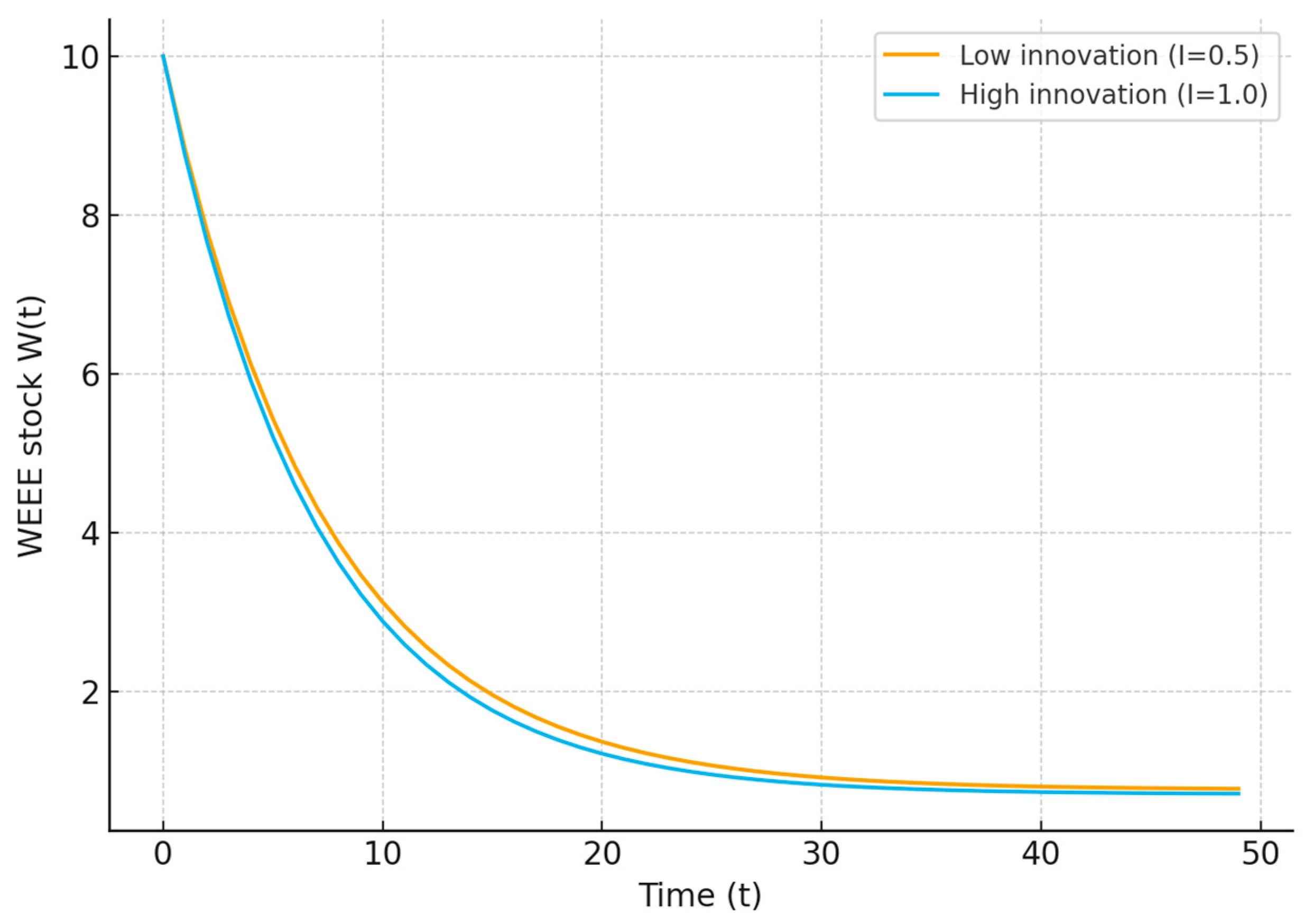
3.1.3. Numerical Simulations of the Dynamic System
3.2. Extended EKC Specification
3.3. Panel Data Estimation Strategy
3.4. Model Selection Tests
3.5. Diagnostic Validation
3.6. Data and Implementation
4. Results and Discussion
4.1. Descriptive Statistics
4.2. Panel Regression Results
4.3. EKC Turning Point and Policy Interpretation
4.4. Model Diagnostics and Robustness
4.5. Discussion of Findings
5. Conclusions
5.1. Limitations and Policy Implications
5.2. Directions for Future Research
Author Contributions
Funding
Data Availability Statement
Acknowledgments
Conflicts of Interest
Abbreviations
| AI | Artificial Intelligence |
| AIC | Akaike Information Criterion |
| C | Constant (regression coefficient) |
| CO2 | Carbon Dioxide |
| DW | Durbin–Watson |
| ECO | Economic Cooperation Organization |
| EEI | EU Eco-innovation Index |
| EKC | Environmental Kuznets Curve |
| EU | European Union |
| EU ETS | European Union Emissions Trading System |
| EUROSTAT | Statistical Office of the European Union |
| GDP | Gross Domestic Product |
| GEO | Government Emergency Ordinance |
| GHG | Greenhouse Gas |
| ICT | Information and Communication Technology |
| IPAT | Impact = Population × Affluence × Technology |
| OLS | Ordinary Least Squares |
| PLS | Pooled Least Squares |
| POP | Population |
| R2 | Coefficient of Determination |
| STIRPAT | Stochastic Impacts by Regression on Population, Affluence, and Technology |
| URB | Urbanization |
| VIF | Variance Inflation Factor |
| WEEE | Waste from Electrical and Electronic Equipment |
| OPEN | Trade Openness (Exports + Imports as % of GDP) |
Appendix A. Matrix Representation and Derivations of Panel Estimators
Appendix A.1. Within (Fixed-Effects) Transformation
Appendix A.2. Derivation of the Random-Effects Quasi-Demeaning Parameter
Appendix A.3. Feasible GLS Estimator
Appendix A.4. Relationship Among Estimators
Appendix A.5. Robust Quasi-Demeaning Under Cross-Sectional Dependence
Appendix A.6. Proof of Global Stability of the Dynamic System
Appendix B. Derivation of the Model Selection Statistics
Appendix B.1. F-Test for Fixed Effects Versus Pooled OLS
Appendix B.2. Breusch–Pagan Lagrange Multiplier Test for Random Effects
Appendix B.3. Hausman Test for Fixed Versus Random Effects
References
- Shittu, O.S.; Williams, I.D.; Shaw, P.J. Global E-waste management: Can WEEE make a difference? A review of e-waste trends, legislation, contemporary issues and future challenges. Waste Manag. 2021, 120, 549–563. [Google Scholar] [CrossRef] [PubMed]
- De Giudici, P.; Genier, J.C.; Martin, S.; Doré, J.F.; Ducimetiere, P.; Evrard, A.S.; Segala, C. Radiofrequency exposure of people living near mobile-phone base stations in France. Environ. Res. 2021, 194, 110500. [Google Scholar] [CrossRef] [PubMed]
- Ibanescu, D.; Cailean, D.; Teodosiu, C.; Fiore, S. Assessment of the waste electrical and electronic equipment management systems profile and sustainability in developed and developing European Union countries. Waste Manag. 2018, 73, 39–53. [Google Scholar] [CrossRef]
- Gohlke, O.; Martin, J. Drivers for innovation in waste-to-energy technology. Waste Manag. Res. 2007, 25, 214–219. [Google Scholar] [CrossRef]
- Martinho, V.D.; Mourão, P.R. Circular economy and economic development in the European Union: A review and bibliometric analysis. Sustainability 2020, 12, 7767. [Google Scholar] [CrossRef]
- Appiah-Otoo, I.; Song, N. The impact of ICT on economic growth-comparing rich and poor countries. Telecomm. Policy 2021, 45, 102082. [Google Scholar] [CrossRef]
- Mewes, L.; Broekel, T. Technological complexity and economic growth of regions. Res. Policy 2020, 51, 104156. [Google Scholar] [CrossRef]
- Hwang, W.; Shin, J. ICT-specific technological change and economic growth in Korea. Telecomm. Policy 2017, 41, 282–294. [Google Scholar] [CrossRef]
- Nicolae, C.A. Understanding sustainable purchasing behavior in Romania: Drivers, barriers, and environmental participation. Manag. Mark. 2024, 19, 362–381. [Google Scholar] [CrossRef]
- Panambunan-Ferse, M.; Breiter, A. Assessing the side effects of ICT development: E-waste production and management: A case study about cell phone end-of-life in Manado, Indonesia. Technol. Forecast. Soc. Change 2013, 35, 223–231. [Google Scholar]
- Ahirwar, R.; Tripathi, A.K. E-waste management: A review of recycling process, environmental and occupational health hazards, and potential solutions. Environ. Nanotechnol. Monit. Manag. 2021, 15, 100409. [Google Scholar] [CrossRef]
- Clodniţchi, R.; Tudorache, O. Resource efficiency and decarbonisation of economies in the European Union. Manag. Mark. 2022, 17, 139–155. [Google Scholar] [CrossRef]
- Chatterjee, A.; Abraham, J. Efficient management of e-wastes. Int. J. Environ. Sci. Technol. 2017, 14, 211–222. [Google Scholar] [CrossRef]
- Freitas, R.; Cardoso, C.E.D.; Costa, S.; Morais, T.; Moleiro, P.; Lima, A.F.D.; Pereira, E. New insights on the impacts of e-waste towards marine bivalves: The case of the rare earth element Dysprosium. Environ. Pollut. 2020, 260, 113859. [Google Scholar] [CrossRef] [PubMed]
- Forti, V.; Baldé, C.P.; Kuehr, R.; Bel, G. The Global E-Waste Monitor 2020: Quantities, Flows and the Circular Economy Potential; United Nations University (UNU)/United Nations Institute for Training and Research (UNITAR)—Co-hosted SCYCLE Programme, International Telecommunication Union (ITU) & International Solid Waste Association (ISWA): Bonn, Germany, 2020. [Google Scholar]
- Baldé, C.P.; Wang, F.; Kuehr, R.; Huisman, J. The Global E-Waste Monitor 2014: Quantities, Flows and Resources; United Nations University, IAS-SCYCLE: Bonn, Germany, 2015. [Google Scholar]
- Boubellouta, B.; Kusch-Brandt, S. Testing the environmental Kuznets curve hypothesis for e-waste in the EU28+2 countries. J. Clean. Prod. 2020, 277, 123371. [Google Scholar] [CrossRef]
- Williams, I.D. Global Metal Reuse, and Formal and Informal Recycling from Electronic and Other High-Tech Wastes. In Metal Sustainability: Global Challenges, Consequences, and Prospects; Reuter, M.A., Van Schaik, A., Eds.; Elsevier: Amsterdam, The Netherlands, 2016; pp. 23–51. [Google Scholar]
- Wath, S.B.; Vaidya, A.N.; Dutt, P.S.; Chakrabarti, T. A roadmap for development of a sustainable e-waste management system in India. Sci. Total Environ. 2010, 409, 19–32. [Google Scholar] [CrossRef]
- Awasthi, A.K.; Cucchiella, F.; D’Adamo, I.; Li, J.; Rosa, P.; Terzi, S.; Zeng, X. Modeling the correlations of e-waste quantity with economic increase. Sci. Total Environ. 2018, 613–614, 46–53. [Google Scholar] [CrossRef]
- Kumar, A.; Holuszko, M.; Espinosa, D.C.R. E-waste: An overview on generation, collection, legislation and recycling practices. Resour. Conserv. Recycl. 2017, 122, 32–42. [Google Scholar] [CrossRef]
- Maksimovic, M. Greening the future: Green Internet of Things (G-IoT) as a key technological enabler of sustainable development. In Internet of Things and Big Data Analytics Toward Next-Generation Intelligence; Tomar, G.S., Sahu, J.K., Guli, D.R., Eds.; Springer: Cham, Switzerland, 2018; pp. 283–313. [Google Scholar]
- Arduin, R.H.; Mathieux, F.; Huisman, J.; Blengini, G.A.; Charbuillet, C.; Wagner, M.; Perry, N. Novel indicators to better monitor the collection and recovery of (critical) raw materials in WEEE: Focus on screens. Resour. Conserv. Recycl. 2020, 157, 104772. [Google Scholar] [CrossRef]
- Cucchiella, F.; D’Adamo, I.; Rosa, P.; Terzi, S. Recycling of WEEE: An economic assessment of present and future e-waste streams. Renew. Sustain. Energy Rev. 2015, 51, 263–272. [Google Scholar] [CrossRef]
- Widmer, R.; Oswald-Krapf, H.; Sinha-Khetriwal, D.; Schnellmann, M.; Böni, H. Global perspectives on e-waste. Environ. Impact Assess. Rev. 2005, 25, 436–458. [Google Scholar] [CrossRef]
- Robinson, B.H. E-waste: An assessment of global production and environmental impacts. Sci. Total Environ. 2009, 408, 183–191. [Google Scholar] [CrossRef] [PubMed]
- Liu, Y.; Liu, W.; Li, C. Recycling models of waste electrical and electronic equipment under market-driven deposit-refund system: A Stackelberg game analysis. Mathematics 2024, 12, 2187. [Google Scholar] [CrossRef]
- Cucchiella, F.; D’Adamo, I.; Rosa, P. Policy and technological drivers for WEEE management. J. Clean. Prod. 2016, 132, 12–23. [Google Scholar]
- Sepúlveda, A.; Schluep, M.; Renaud, F.G.; Streicher, M.; Kuehr, R.; Hagelüken, C.; Gerecke, A.C. A review of the environmental fate of e-waste. Environ. Impact Assess. Rev. 2010, 30, 28–41. [Google Scholar] [CrossRef]
- Cucchiella, F.; D’Adamo, I. Environmental and economic impacts of WEEE recycling. Resour. Conserv. Recycl. 2017, 119, 55–67. [Google Scholar]
- Barbosa de Aquino, Í.R.; Ferreira da Silva Júnior, J.; Guarnieri, P.; Camara e Silva, L. The proposition of a mathematical model for the location of electrical and electronic waste collection points. Mathematics 2020, 8, 2225. [Google Scholar] [CrossRef]
- Ehrlich, P.R.; Holdren, J.P. Impact of population growth. Science 1971, 171, 1212–1217. [Google Scholar] [CrossRef]
- Dietz, T.; Rosa, E.A. Effects of population and affluence on CO2 emissions. Proc. Natl. Acad. Sci. USA 1997, 94, 175–179. [Google Scholar] [CrossRef]
- Wang, S.; Zeng, J.; Liu, X. Examining the multiple impacts of technological progress on CO2 emissions in China: A panel quantile regression approach. Renew. Sustain. Energy Rev. 2019, 103, 140–150. [Google Scholar] [CrossRef]
- Panayotou, T. Empirical Test and Policy Analysis of Environmental Degradation at Different Stages of Economic Development; World Employment Research Programme, Working Paper WP238; International Labour Office: Geneva, Switzerland, 1993. [Google Scholar]
- Grossman, G.; Krueger, A. Environmental Impacts of a North American Free Trade Agreement; National Bureau of Economic Research, Working Paper 3194; National Bureau of Economic Research: Cambridge, MA, USA, 1991. [Google Scholar]
- Choi, W.H.; Pae, K.P.; Kim, N.S.; Kang, H.Y.; Hwang, Y.W. Feasibility study of closed-loop recycling for plastic generated from waste electrical and electronic equipment (WEEE) in South Korea. Energies 2023, 16, 6358. [Google Scholar] [CrossRef]
- Echota, W.S.; Tabakov, P.Y. Development of domestic technology for sustainable renewable energy in a zero-carbon emission-driven economy. Int. J. Environ. Sci. Technol. 2021, 18, 1253–1268. [Google Scholar]
- Satrovic, E.; Muslija, A.; Abul, S.J. The relationship between CO2 emissions and gross capital formation in Turkey and Kuwait. S. East Eur. J. Econ. Bus. 2020, 15, 28–42. [Google Scholar] [CrossRef]
- Abbasi, M.A.; Parveen, S.; Khan, S.; Kamal, M.A. Urbanization and energy consumption effects on carbon dioxide emissions: Evidence from Asian-8 countries using panel data analysis. Environ. Sci. Pollut. Res. 2020, 27, 18029–18043. [Google Scholar] [CrossRef]
- Serpe, A.; Purchase, D.; Bisschop, L.; Chatterjee, D.; De Gioannis, G.; Garelick, H.; Kumar, A.; Peijnenburg, W.J.G.M.; Piro, V.M.I.; Cera, M.; et al. 2002–2022: 20 years of e-waste regulation in the European Union and the worldwide trends in legislation and innovation technologies for a circular economy. RSC Sustain. 2025, 3, 1039–1083. [Google Scholar] [CrossRef]
- Hossain, R.; Sahajwalla, V. Current recycling innovations to utilize e-waste in sustainable green metal manufacturing. Philos. Trans. R. Soc. A Math. Phys. Eng. Sci. 2024, 382, 20230239. [Google Scholar] [CrossRef] [PubMed]
- Neves, S.A.; Marques, A.C.; de Sá Lopes, L.B. Is environmental regulation keeping e-waste under control? Evidence from e-waste exports in the European Union. Ecol. Econ. 2024, 216, 108031. [Google Scholar] [CrossRef]
- Horobet, A.; Belascu, L.; Radulescu, M.; Balsalobre-Lorente, D.; Botoroga, C.-A.; Negreanu, C.-C. Exploring the Nexus between Greenhouse Emissions, Environmental Degradation and Green Energy in Europe: A Critique of the Environmental Kuznets Curve. Energies 2024, 17, 5109. [Google Scholar] [CrossRef]
- Bajwa, F.A.; Fu, J.; Bajwa, I.A.; Rehman, M.; Abbas, K. Digital financial inclusion and its dual impact on economic and environmental outcomes in ASEAN countries. Data Sci. Financ. Econ. 2025, 5, 53–75. [Google Scholar] [CrossRef]
- Ferreira-Filipe, D.A.; Hursthouse, A.; Duarte, A.C.; Rocha-Santos, T.; Patrício Silva, A.L. E-Waste Plastics in the Environment: Assessment, Characterisation, and Bioprocessing. Appl. Sci. 2025, 15, 2122. [Google Scholar] [CrossRef]
- Bovea, M.D.; Ibáñez-Forés, V.; Pérez-Belis, V.; Juan, P. Potential reuse of small household waste electrical and electronic equipment: Methodology and case study. Waste Manag. 2016, 53, 204–217. [Google Scholar] [CrossRef] [PubMed]
- Fontes, E.; Moreira, A.C.; Carlos, V. The influence of ecological concern on green purchase behavior. Manag. Mark. 2021, 16, 246–267. [Google Scholar] [CrossRef]
- Ardente, F.; Mathieux, F. Identification and assessment of product’s measures to improve resource efficiency in electrical and electronic equipment. Resour. Conserv. Recycl. 2014, 92, 158–171. [Google Scholar] [CrossRef]
- Reuter, M.A.; van Schaik, A.; Gutzmer, J.; Bartie, N.; Abadías-Llamas, A. Challenges of the circular economy: A material, metallurgical, and product design perspective. Angew. Chem. Int. Ed. 2018, 57, 7290–7297. [Google Scholar] [CrossRef]
- Cheng, C.; Ren, X.; Wang, Z.; Yan, C. Heterogeneous impacts of renewable energy and environmental patents on CO2 emission—Evidence from the BRIICS. Sci. Total Environ. 2019, 668, 1328–1338. [Google Scholar] [CrossRef]
- Shamim, A.; Mursheda, A.K.; Rafq, I. E-Waste trading impact on public health and ecosystem services in developing countries. Int. J. Waste Resour. 2015, 5, 188. [Google Scholar] [CrossRef]
- Bera, A.K.; Galvao, A.F.; Montes-Rojas, G.V.; Park, S.Y. Asymmetric Laplace regression: Maximum likelihood, maximum entropy and quantile regression. J. Econom. Methods 2016, 5, 79–101. [Google Scholar] [CrossRef]
- Croissant, Y.; Millo, G. Panel data econometrics in R: The plm package. J. Stat. Softw. 2008, 27, 1–43. [Google Scholar] [CrossRef]
- Gkika, M.; Stefanopoulos, V.; Katsikis, K. Relationship between economic growth and mismanaged e-waste: Panel data evidence from 27 EU countries analyzed under the Kuznets curve hypothesis. Environ. Sci. Policy 2025, 158, 103021. [Google Scholar]
- El-Gawhari, R.; Khedr, E.; Hassan, S. E-waste: The fastest-growing global waste stream and the imperative for urgent policy responses. J. Hazard. Mater. 2024, 470, 129758. [Google Scholar]
- Periyasamy, K.; Farazullah, K.M.; Raj, S.K.; Shriraam, M.S. Modern technological innovation in digital waste management. In Digital Waste Management; IGI Global: Hershey, PA, USA, 2024; pp. 310–329. [Google Scholar]
- Arslan, E.; Şanal, M.; Koyuncu, C.; Yilmaz, R. Unveiling the age factor: The influence of cabinet members’ age on waste electrical and electronic equipment recycling rates in European nations. Sustainability 2024, 16, 8202. [Google Scholar] [CrossRef]
- Janjua, L.R.; Panait, M.; Fernández-González, R.; Puime-Guillén, F. E-Waste Recycling Revolution: A fresh inside from determinant factors in European countries. In Global Pathways for Efficient Waste Management and Inclusive Economic Development; Shahbaz, M., Sharma, G.D., Gedikli, A., Erdoğan, S., Eds.; Springer: Cham, Switzerland, 2025; pp. 225–247. [Google Scholar]
- Masdek, N.R.N.; Wong, K.K.S.; Nawi, N.M.; Sharifuddin, J.; Wong, W.L. Antecedents of sustainable food waste management behaviour: Empirical evidence from urban households in Malaysia. Manag. Mark. 2023, 18, 53–77. [Google Scholar] [CrossRef]


| Variable | Mean | Max | Min | Std. Dev. | Skewness | Shapiro-Wilk | Jarque-Bera | N |
|---|---|---|---|---|---|---|---|---|
| ln(WEEE) a | 0.6912 | 1.5813 | −0.3975 | 0.3721 | −0.0432 | 0.0132 | 1.8932 | 297 |
| ln(GDP.cap) b | 10.1984 | 11.7456 | 8.1976 | 0.6985 | −0.0257 | 0.0275 | 1.9346 | 297 |
| ln(GDP.cap) b | 104.0074 | 137.9591 | 67.2006 | 0.4879 | −0.0037 | 0.0378 | 0.9427 | 297 |
| ln(POP) c | 16.0234 | 19.1242 | 12.7983 | 1.2947 | −0.0175 | 0.0876 | 1.0678 | 297 |
| ln(EEI) d | 1.7245 | 3.8976 | −2.7656 | 0.8759 | −0.9870 | 0.0976 | 1.1732 | 297 |
| ln(URB) d | 4.1975 | 4.6123 | 3.8976 | 0.1789 | −0.1267 | 0.0792 | 1.0487 | 297 |
| ln(OPEN) d | 4.6238 | 6.0367 | 3.7936 | 0.4655 | 0.5974 | 0.0678 | 1.2267 | 297 |
| Variabile | ln(WEEE) | ln(GDP.cap) | ln(POP) | ln(REC) | ln(URB) | ln(OPEN) |
|---|---|---|---|---|---|---|
| ln(WEEE) | 1.0000 | - | - | - | - | - |
| ln(GDP.cap) | 0.7231 *** | 1.0000 | - | - | - | - |
| ln(POP) | 0.5972 ** | 0.1093 | 1.0000 | - | - | - |
| ln(EEI) | 0.7245 ** | 0.2078 | 0.1645 | 1.0000 | - | - |
| ln(URB) | 0.6489 ** | 0.3025 | 0.2678 | 0.2085 | 1.0000 | - |
| ln(OPEN) | 0.4592 * | 0.0723 | 0.0578 | 0.3011 | 0.1658 | 1.000 |
| F-Statistics | 5.1678 |
| Probability | 0.2975 |
| Chi-squared | 1.8975 |
| Probability | 0.7956 |
| Cross Section | Time | Both | |
|---|---|---|---|
| Coefficients | 29.1034 | 45.7652 | 90.0256 |
| Probability | 0.1034 | 0.6783 | 0.2335 |
| Dependent Variable: ln(WEEE) Method: Pooled least squares Sample: 2013 2023 Total panel observations: 297 ln(WEEE) = C(1) + C(2)*ln(GDP,cap) + C(3)*(ln(GDP,cap))2 + C(4)*POP + C(5)*ln(EEI) + C(6)*ln(URB) + C(7)*ln(OPEN) | ||||
| Coefficient | Std. Error | t-Statistic | Prob. | |
| C | 2.933529 | 0.29958 | 9.786721 | 0.0013 |
| ln(GDP.cap) | 0.198276 | 0.05154 | 3.84892 | 0.0029 |
| (ln(GDP.cap))2 | −0.226595 | 0.054397 | 4.187639 | 0.0153 |
| ln(POP) | 0.208956 | 0.026458 | 5.973489 | 0.0037 |
| ln(EEI)) | 0.678962 | 0.0085971 | 7.897543 | 0.0029 |
| ln(URB) | 0.679543 | 0.107168 | 6.340956 | 0.0089 |
| ln(OPEN) | 0.150982 | 0.045905 | 3.289732 | 0.0379 |
| R-squared | 0.768356 | Mean dependent variables | 0.6952 | |
| Adjusted R-squared | 0.720983 | S.D. 2 dependent var | 3.41253 | |
| S.E. 1 of regression | 0.734564 | Akaike info criterion | 1.89365 | |
| Sum squared residual | 2.768923 | Schwarz criterion | 1.90382 | |
| Log likelihood | 102.7234 | Hannan–Quinn criterion | 1.92097 | |
| Durbin–Watson stat | 2.091560 | |||
| Prob (F-statistic) | 0.0000000 | |||
| Variance Inflation Factors Date: 9 August 2025 Time: 09:32 Sample: 2013 2023 Included observations: 297 | |||
| Variable | Coefficient Variance | Uncentered VIF | Centered VIF |
| C | 5.3401 | NA | |
| ln(GDP.cap) | 1.4789 | 3.2865 | 1.8963 |
| (ln(GDP.cap))2 | 1.9867 | 2.9856 | 1.7892 |
| ln(POP) | 2.0731 | 2.6745 | 1.2876 |
| ln(EEI) | 1.9765 | 2.5432 | 1.8965 |
| ln(URB) | 1.9865 | 2.7489 | 1.3892 |
| ln(OPEN) | 2.0976 | 1.2943 | 1.8797 |
| Feature/Model | Mathematical Model (Analytical) | Panel Data Model (e.g., Fixed Effects) | Panel EKC Model (Innovation-Adjusted) | Robustness Check (e.g., GMM/DOLS) |
|---|---|---|---|---|
| Model Focus | Dynamics of E-Waste (W) as a Stock-Flow System | Determinants of E-Waste Generation (W) | Testing the Innovation-Adjusted EKC Hypothesis | Validating Key Coefficients/Elasticities |
| Key Output/Hypothesis | Stability of Equilibrium Point (W*) | Impact of Innovation and GDP (Linear) | EKC Turning Point (GDPEKC) | Consistency of Long-Run Coefficients |
| Main Result for W* | Unique Positive Equilibrium Exists | [State main finding, e.g., GDP positive, Innovation negative] | EKC Hypothesis Confirmed/Not Confirmed | Results consistent/inconsistent with main model |
| Global Stability/Significance | Globally Asymptotically Stable | [State overall R-squared or F-stat significance] | [State significance of GDP2 term] | [State the significance of the long-run coefficient for innovation] |
| Critical Values/Points | W* = k/αβ | [N/A] | EKC Turning Point: [Insert Value] | [Insert key coefficient values from the robustness model] |
| Diagnostic Test 1 (e.g., Serial Correlation) | [N/A] | [State result, e.g., Passed/Failed Wooldridge test] | [State result, e.g., Passed/Failed Arellano–Bond test] | [N/A] |
| Diagnostic Test 2 (e.g., Cross-Sectional Dependence) | [N/A] | [State result, e.g., Passed/Failed Pesaran CD test] | [State result, e.g., Passed/Failed Pesaran CD test] | [N/A] |
| Policy Implication Highlighted | E-waste will stabilize if [Condition] | Need for more effective Innovation policies | EU has/has not reached the EKC peak for E-Waste | Policy recommendations are robust to alternative specifications |
Disclaimer/Publisher’s Note: The statements, opinions and data contained in all publications are solely those of the individual author(s) and contributor(s) and not of MDPI and/or the editor(s). MDPI and/or the editor(s) disclaim responsibility for any injury to people or property resulting from any ideas, methods, instructions or products referred to in the content. |
© 2025 by the authors. Licensee MDPI, Basel, Switzerland. This article is an open access article distributed under the terms and conditions of the Creative Commons Attribution (CC BY) license (https://creativecommons.org/licenses/by/4.0/).
Share and Cite
Busu, C.; Busu, M.; Grasu, S.; Ben Yahia, S. Innovation-Adjusted Dynamics of E-Waste in the European Union: Mathematical Modeling, Stability and Panel EKC Turning Points. Mathematics 2025, 13, 3940. https://doi.org/10.3390/math13243940
Busu C, Busu M, Grasu S, Ben Yahia S. Innovation-Adjusted Dynamics of E-Waste in the European Union: Mathematical Modeling, Stability and Panel EKC Turning Points. Mathematics. 2025; 13(24):3940. https://doi.org/10.3390/math13243940
Chicago/Turabian StyleBusu, Cristian, Mihail Busu, Stelian Grasu, and Sadok Ben Yahia. 2025. "Innovation-Adjusted Dynamics of E-Waste in the European Union: Mathematical Modeling, Stability and Panel EKC Turning Points" Mathematics 13, no. 24: 3940. https://doi.org/10.3390/math13243940
APA StyleBusu, C., Busu, M., Grasu, S., & Ben Yahia, S. (2025). Innovation-Adjusted Dynamics of E-Waste in the European Union: Mathematical Modeling, Stability and Panel EKC Turning Points. Mathematics, 13(24), 3940. https://doi.org/10.3390/math13243940