


Abstract
This article is the second part of the research project initiated last year, in which we introduced and investigated so-called periodicity shadows, i.e. special skew-symmetric integer matrices related to symmetric algebras with periodic simple modules. These matrices provide a new tool for describing the structure of quivers arising in the problem classification of all tame symmetric algebras of period four, an important class of algebras with various links to different branches of algebra. In the first part of the project, we focused on the theoretical aspects of this notion setting a general framework, and we obtained a few nice properties of these quivers. The part of the project described in this paper is devoted to complementary considerations concerning computational issues. We present here an algorithm for computing all tame periodicity shadows of a given size, briefly discuss the output for small sizes, i.e., up to , and provide some graphical visualizations. We also mention that by applying the computations for sizes up to , we obtained a classification of tame symmetric algebras of period four defined by quivers with at most 5 vertices.
Keywords:
symmetric algebra; tame algebra; periodic algebra; Gabriel quiver; Cartan matrix; adjacency matrix MSC:
05E16; 16D50; 16E20; 16G20; 16Z05
1. Introduction
This research project (and its first part [1]) can be placed in a general area of pure algebra. More specifically, we study combinatorial objects associated with algebras defined by certain homological properties. For a detailed theoretical framework justifying this study, we refer to [1]. This paper is organized as follows. In Section 2, we present the key algorithm together with a short discussion. The next section gives examples of shadows of small sizes (up to ) and some general remarks about larger outputs, including visualizations using dimensionality reduction techniques. The last section contains the list of shadows of size .
The Introduction consists of three parts. We first discuss the general algebraic context, and then introduce the notion of a shadow, explaining its role in the classification problem. In the third part of the Introduction, we give a short overview of the class of tame symmetric algebras of period four, which is at the heart of this research. We will use the acronym TSP4 algebras for the tame symmetric algebras of period four.
1.1. General Algebraic Context
By an algebra, we mean any indecomposable basic associative finite-dimensional K-algebra with identity over an algebraically closed field K. It has been known since the early 1970s that such algebras are determined by the unique connected quiver and a set of so-called relations, that is, K-linear combinations of paths in the quiver. Informally, a quiver is a finite directed graph with multiple arrows and loops allowed (see [2] for a formal definition). For a quiver Q, the path algebra of Q is the K-algebra (mostly infinite-dimensional) based on the paths in Q of length and multiplication given by the concatenation of the paths (those it is based on). By the classical results of Gabriel [3,4], any algebra can be presented as a quotient for some uniquely determined connected quiver Q (up to the permutation of vertices), called the Gabriel quiverof , denoted by . Moreover, the ideal I satisfies for some , where is the ideal of generated by all paths of length . Such ideals are sometimes called admissible, and they can be generated by a finite number of relations, i.e., linear combinations of paths of length in Q with the same source and target. More details can be found in books [2,5].
The problem of classifying algebras with certain properties boils down to a problem of finding all presentations , that is, describing the structure of Gabriel quivers Q and relations generating ideals I. This problem can be split into two problems: determining the quivers (the more combinatorial part) and relations and determining the particular properties of the algebras we try to classify. This is a matter of transferring properties defining a particular class of algebras into restrictions on the shape of their Gabriel quivers and relations defining them. It is a hard problem in general, even if we consider enough ‘nice’ properties.
Our general concern is the classification of TSP4 algebras, which is a challenging open problem discussed in the third part of the Introduction. The notion of a shadow gives us a new tool with which to attack this problem at the combinatorial level, i.e., describe all possible Gabriel quivers of such algebras. An algorithm that computes shadows can have a significant impact on solving this problem. First, it allows us to compute all shadows for small n, and then all Gabriel quivers of TSP4 algebras with n vertices. Computations for are presented in this paper (see Section 3 and Section 4), whereas in [6], we already applied them to obtain a classification of all TSP4 algebras with Gabriel quivers having at most 5 vertices. The case of will be the next natural step, which should improve the state of the art. This is a relatively new tool, but it seems to have further potential. For instance, we expect to apply the results for small n to obtain some knowledge of the local shape of the quivers for arbitrary n.
1.2. What Is a Shadow?
Recall that any quiver can be identified with its arrow matrix , where is the number of arrows in Q between a pair of vertices . The (signed) adjacency matrix of Q is the skew-symmetric integer matrix
whose entries count the differences between the number of arrows and the number of arrows in Q. Actually, any skew-symmetric integer matrix can be identified with the quiver , which is the smallest quiver Q with ( has arrows and 0 arrows in opposite direction, where negative number of arrows means reversed orientation). In particular, if Q is a quiver with , then is obtained from Q by removing all possible 2-cycles and loops. In other words, one can view a skew-symmetric integer matrix A as a class of all quivers obtained from the smallest one by adding 2-cycles and loops. In general, we can have an arbitrary number of quivers with a given adjacency matrix, but the number is significantly restricted in our specific algebraic setup.
For an algebra , by a shadow of , we mean the signed adjacency matrix of its Gabriel quiver, that is, the matrix . For an arbitrary , there is no hope to reconstruct the Gabriel quiver from the shadow , but in the case of TSP4 algebras, we have some precise rules restricting the position of 2-cycles in , and this reconstruction is within reach (see the main result of [1], called the Reconstruction Theorem).
The key idea is to classify all possible shadows of TSP4 algebras by looking at some properties they must satisfy. The main properties come from an equation involving a so-called Cartan matrix of an algebra.
We recall that for an algebra , we have a complete set of pairwise orthogonal idempotents , where i runs through the vertex set of Q and is the coset of the trivial path (of length 0) at vertex i. It induces a decomposition of the identity , and there is an associated decomposition of into a direct sum of indecomposable projective -modules, where the modules , for , form a complete set of pairwise non-isomorphic indecomposable projective -modules (see Section I.8, [5]). The Cartan matrix of an algebra is an matrix with natural coefficients, whose columns are dimension vectors of projective modules . This means that with . Note that is a symmetric matrix if the algebra is symmetric.
The study of shadows in the context of algebras was motivated by the property observed in Theorem 2.1, [1], where we proved that for any TSP4 algebra , its Cartan matrix satisfies the following identity:
Following [1], a matrix is called a periodicity shadow if the following holds=:
- (PS1)
- A is a singular skew-symmetric matrix.
- (PS2)
- A does not admit a non-zero row containing integers of the same sign.
- (PS3)
- There exists a symmetric matrix with non-zero columns, such that .
A periodicity shadow A is called tame if the following conditions hold:
- (T1)
- All entries of A are in .
- (T2)
- Each row of A does not simultaneously contain both 2 and entry or both and entry .
- (T3)
- Each row of A cannot have more than four 1s or more that four s.
We only mention that any symmetric algebra of period four induces a periodicity shadow , and is tame if is a tame algebra. In this way, by computing all tame periodicity shadows, we obtain access to all shadows of TSP4 algebras, and hence to the structure of their Gabriel quivers, according to the Reconstruction Theorem [1].
To compute all tame periodicity shadows of a given size, we will actually compute a bit more, namely, all matrices that are called shades. By a shade, we mean any integer matrix satisfying conditions (PS1)–(PS2) and (T1)–(T3). So, a shade is a (tame) periodicity shadow if and only if it satisfies PS3).
The main result of this paper is the algorithm computing all tame periodicity shadows of a given size n. This algorithm actually computes all basic shades of a given size n, where by basic we mean some subset of shades, from which every other shade can be obtained using a permutation of rows and columns. We mention that even for a small number n of vertices, say starting from , computations are already a challenge, whereas for larger n, it is intractable in practice. For , we can only say that there exists a set of tame periodicity shadows, and there is an algorithm (based on recursive generation) that could compute it, at least in theory. The idea is to first generate the set of all (basic) shades and then compute all solutions of with for any . Then, one can decide whether a given shade is a (tame) periodicity shadow, by verifying (PS3). We will denote by the list of all basic tame periodicity shadows obtained from by removing matrices not satisfying PS3).
In the smallest cases, we have and , and these lists are presented in Section 3. For , there are shades that are not tame periodicity shadows. Because of the length of lists and , we will not present and restrict only to a certain subclass of shadows, the so-called essential shadows (defined in Section 2). We note that any non-essential shadow is not a shadow of a tame algebra (see Section 2 for details), so it is naturally excluded in the context of classification. A complete list of essential shadows of size is presented in Section 4. Readers interested in complete lists and containing non-essential shadows and shades that are not shadows are referred to Appendix [7].
Though the algorithm is useless in practice for , this tool was invented specifically for small cases , to understand the structure of Gabriel quivers of small TSP4 algebras. On the other hand, it is conjectured that for , the picture becomes more stable, and known examples of families of exceptional TSP4 algebras appear only for ; see [8,9]. Last but not least, studying shades may also be important. However, shades that are not shadows (or essential shadows) cannot come from TSP4 algebras, but understanding the difference at the combinatorial level can lead us to new useful insights.
1.3. TSP4 Algebras
Let us briefly refer to the importance of the class of TSP4 algebras.
Recall that is a Frobenius algebra if there exists an associative non-degenerate K-bilinear form [10,11]. Every Frobenius algebra is self-injective, i.e., injective and projective -modules coincide (by a -module, we mean a finitely generated right -module). Note that in our setup, self-injective algebras are Frobenius since we assume all algebras are basic (see Proposition IV.3.9, [5]). Among self-injective algebras, we distinguish symmetric algebras, that is, those for which the bilinear form is symmetric, i.e., , for . Classical examples of symmetric algebras are blocks of finite-dimensional group algebras [12] or Hecke algebras associated with Coxeter groups [13].
A -module M is called periodic if it is periodic with respect to the syzygy operator . This means that , for some , where assigns to a module X its syzygy , i.e., the kernel of an arbitrary projective cover of X. Then, the minimal number d with this property is called the period of M. An algebra is called periodic (of period d) if is periodic (of period d) as a (-)-bimodule, or equivalently, is periodic as a module over its enveloping algebra . For a periodic algebra , all indecomposable non-projective -modules are periodic (see Theorem IV.11.19, [5]) and its Hochschild cohomology is periodic.
The notion of tameness is rather technical, and we practically do not use it in this paper. Let us only mention that the class of algebras may be divided into two two disjoint subclasses depending on the complexity of the category of indecomposable modules. This is the remarkable Tame and Wild Theorem of Drozd [14] (see also [15]). The first class is the class of tame algebras, whose indecomposable modules are possible to classify in a finite number of discrete or one-parameter families. In particular, tame algebras contain the class of representation-finite algebras, which admit only finitely many indecomposable modules (up to isomorphism). The remaining tame algebras are called representation-infinite. The second class is the class of wild algebras, for which the classification of indecomposable modules is hopeless. More details can be found in the Introduction of [16].
Finding and possibly classifying periodic algebras is an important problem with an impressive history and interesting connections with group theory, topology, singularity theory, and cluster algebras. Classical examples of periodic algebras (whose period divides 6) are the preprojective algebras of the Dynkin type [17,18]; see also [19] for a deformed version. Such algebras have also occurred as stable Auslander algebras of the categories of maximal Cohen–Macaulay modules over Kleinian two-dimensional hypersurface singularities (see [20,21]). There exists a rich literature concerning classifications of tame symmetric algebras that are periodic with polynomial growth (see [22,23,24]; see also Section 3 in [25]). Then (see the Introduction in [16]), it is conjectured that all tame symmetric algebras of non-polynomial growth, which are periodic, are of period four. This is the reason for studying only algebras of period four.
Other important sources of TSP4 algebras (of non-polynomial growth) come from the modular representation theory of finite groups, where such algebras appear as blocks of group algebras. These blocks can be tame and representation-infinite only over fields of characteristic 2, and their defect groups are dihedral, semidihedral, or (generalized) quaternion 2-groups. Motivated by the known properties of these blocks, Erdmann introduced and studied in [12,26,27] so-called algebras of quaternion type, which are by definition, representation-infinite tame symmetric algebras with a non-singular Cartan matrix and all non-projective -modules periodic with a period dividing 4; note that every algebra of the quaternion type has zero shadow, due to the identity . In particular, algebras of the quaternion type are classified by quivers and relations, and it has been shown that they are all periodic with period 4 (see [28]). We only mention that with the notion of a shadow, we obtained a complete description of Gabriel quivers of all algebras of the quaternion type as a direct corollary (see Corollary 5.3, [1]).
It is worth noting (see [29,30]) that a finite group G is periodic (with respect to the group cohomology ) if and only if all blocks of its group algebra with non-trivial defect groups are periodic algebras. Note that, by the famous result of Swan [31], a group is periodic if and only if it acts freely on a finite CW-complex homotopically equivalent to a sphere (more details in Section 4 of [19]).
Finally, more recent results show new interesting families of tame symmetric algebras with periodic module categories arising in the context of the theory of cluster algebras (introduced by Fomin and Zelevinsky [32]). First, recall that the Jacobian algebras of quivers with potentials were introduced by Derksen, Weymann, and Zelevinsky in [33,34], where they also established deep links to cluster algebras and representation theory. Moreover, we have two methodologically similar constructions in [35,36], which associate, respectively, a cluster algebra or a quiver with potential—hence a Jacobian algebra—to any ideal triangulation of a surface with marked points (a bordered surface in the first case). It was proved in [37] that the Jacobian algebras associated with the ideal triangulations of surfaces with punctures are tame symmetric algebras with singular Cartan matrices if the surface has an empty boundary. If it is additionally orientable (with minor exceptions), then the related Jacobian algebras are periodic with period four [38].
Motivated by the above-mentioned constructions, Erdmann and Skowroński introduced and investigated [8,9,16,39,40,41] a new class of algebras called weighted surface algebras, containing the class of Jacobian algebras associated with orientable surfaces without a boundary. Without going into technical details, they started with an arbitrary surface S together with a triangulation and arbitrarily chosen orientation of triangles in . These data allow us to construct a so-called triangulation quiver Q, whose vertices correspond to edges of and arrows reflect the chosen orientation of the triangles, and then define the weighted surface algebra , where relations defining I are uniquely determined through the combinatorics of Q (we omit integer weights and scalars from involved in the construction). Note that I may fail to be admissible, and then Q is not the Gabriel quiver of , but is always a subquiver of Q obtained by deleting certain 2-cycles and loops (depending on used weights), called virtual arrows. It has been proven that the weighted surface algebras are TSP4 algebras, except for in a few cases coming from triangulations of a disc or sphere (see Theorem 1.3, [41]). Actually, it was proven in [39] that weighted surface algebras exhaust almost all TSP4 algebras with 2-regular Gabriel quivers (2-regular means that exactly two arrows start and end at any vertex). The remaining TSP4 algebras that are not weighted surface algebras form a family of algebras called higher tetrahedral algebras [8], whose Gabriel quiver is a triangulation quiver in the above sense—it comes from the tetrahedral triangulation of a sphere with a coherent orientation of triangles. We expect that the notion of a shadow (and computations performed so far) can provide us a tool with which to capture the structure of Gabriel quivers of arbitrary TSP4 algebras and show, for example, that they admit a quasi-triangulated structure, as an analogue of the property for weighted surface algebras.
2. The Algorithm
In this section, we discuss technical issues around the computation of tame periodicity shadows and present the algorithm (together with the proof of its correctness).
First, a naive method would search through the set of all skew-symmetric matrices A with (any such a matrix has ) and check whether A is a tame periodicity shadow, which requires verifying conditions (T2)–(T3) and (PS1)–(PS3). This can be accomplished by hand, for , and with a little bit more effort, for , but for larger n, it becomes a challenge.
The idea of the algorithm is to give a recursive procedure that generates all tame periodicity shadows (up to a permutation of rows and columns and taking ) instead of performing a naive search. Additionally, the output list is sorted according to some natural order. This gives an effective algorithm that generates all tame periodicity shadows for . For , computations are possible, but take a lot of time, whereas for , given the computational capabilities of today’s computers (mainly due to the “exploding” numbers of both cases and results), it seems to be hopeless, or at least impractical. However, the tool was invented to specifically handle small cases, and it is not our aim to compute all shadows for larger n.
Let be the subset of all tame periodicity shadows. We note that is closed under the action of permutations, by which we mean that given , we have for any permutation matrix P. We denote by G the group of permutation matrices, and for any matrix A, we write for the G-orbit of A under this action. In other words, is a disjoint union of G-orbits, which are equivalence classes of congruence relation ∼, where if and only if , for some .
We will frequently identify a tame periodicity shadow A with the associated quiver , which is the smallest quiver with A as its signed adjacency matrix (see Section 2, [1]).
Moreover, there is a natural isomorphism between the spaces of solutions of and if (preserving symmetricity and natural coefficients). In the language of associated quivers, it means that and are the same up to a permutation of vertices encoded in P. Our aim is to find ‘basic’ shapes, so we want to identify matrices in , which belong to the same orbit of this action. Namely, we are interested in finding one particular set of representatives such that is a disjoint union of orbits:
Given one , any other subset with this property is determined up to permutation, that is, it consists of r matrices of the form for some permutation matrices .
Further, for any skew-symmetric integer matrix A, we have , so the nullspaces are equal: . Hence, matrices A and induce the same set of solutions of matrix equation in PS3). Clearly, all the other conditions (PS1)–(PS2) and (T1)–(T3) are also preserved in ; hence, , if . Note also that taking is compatible with the action of permutations, i.e., for , or equivalently, for . By definition, then, is the opposite quiver
of (obtained from by reversing the orientation of all arrows).
Now, using both of the above actions, we can define what are the basic (tame) periodicity shadows. We start with the list of all representatives of G-orbits and modify it using Algorithm 1 below.
| Algorithm 1 |
|
In this way, we remove from the representatives of G-orbits all matrices that are opposite to some earlier matrix , modulo permutation. The resulting list contains so-called basic tame periodicity shadows, and the corresponding subset in will be denoted by . Then, we have an induced partition
such that , ; for every matrix , we have , and for any , there is exactly one matrix with .
Of course, this set depends on the choice of , and whenever we use the term basic, we mean that we have a set constructed in the above way. In this paper, we give an algorithm that directly generates one particular set of basic tame periodicity shadows.
For every other choice of the set of representatives of G-orbits in , the resulting set induces the same partition, up to an exchange of matrices between sets and . More precisely, let
Then, we can order matrices in in such a way that for , for some and , and if . In particular, we counclude that , for any and for .
In summary, we may work with a fixed set of basic tame periodicity shadows, since every other set of basic shadows is obtained from by taking permutations or opposite matrices. In particular, any such set satisfies the following condition: for any tame periodicity shadow , there exists a unique such that or .
There is a related notion of the essential shadow, introduced to exclude some of the tame periodicity shadows, which cannot represent a Gabriel quiver of a tame algebra with 4-period samples. We have a special shadow with double arrows, called a Markov shadow, which has the following matrix:
Note that and the associated quiver is the Markov quiver (see Section 3).
Now, a basic shadow is called essential if is the Markov shadow or satisfies the conditions stated below:
- (PS4)
- Each row of does not contain both 2 and .
- (PS5)
- For any and k such that and , we have ; for any and , we have .
Note that condition (PS4) is equivalent to saying that the associated quiver has no vertex, which is a source and a target of double arrows. If is a tame symmetric algebra with simple modules of period 4 and , then its shadow must satisfy (PS4). This is a consequence of arguments presented in (Lemma 5.2, [39]), which can be repeated in general. Alternatively, one can prove this using (Lemmas 3.2 and 3.3, [1]) and the fact that if is tame, then given double arrows and an arrow in Q, one of the paths or must be involved in a minimal relation of I (see also Section 2, [1]).
Condition PS5) can be similarly rephrased in the language of quivers, namely, it is equivalent to say that the quiver has no subquiver of the form
such that there are no arrows or , respectively. It follows easily from (Lemma 3.3, [1]) that any such subquiver gives two paths and (or in the opposite case) not involved in the minimal relations of I, and hence, any algebra whose shadow does not satisfy PS5) is a wild algebra.
In conclusion, every algebra with a non-essential is a wild algebra. So, when we study tame algebras, we may restrict ourselves only to essential shadows. The lists of all essential shadows for are presented in Section 3 and Section 4. Shadows that are not essential can be found in the Appendix of [7].
The algorithm is organized in the following way. We start with a related notion of a shade, by which we mean an integer matrix satisfying conditions (PS1)–(PS2) and (T1)–(T3). So, the set of shades contains the set of all tame periodicity shadows . The strategy is to first generate the set of (basic) shades and for any such shade A, find all solutions of the system of linear equations and . Then, after checking if there exists a solution with and non-zero columns, we decide whether a given shade is a shadow, i.e., if it satisfies PS3). This gives the set of all basic tame periodicity shadows. The final step is to run through the list and check which of the shadows are essential.
Now, we present the algorithm. First, we introduce some preparatory notations.
Let denote the set of permutations of the set . For and , we denote by the matrix , which is exactly the matrix , where is the permutation matrix corresponding to .
Further, we define the binary relation ⪯ on as follows. For any and , we have if and only if either or there exist satisfying the following conditions:
- (i)
- for all and ;
- (ii)
- for all ;
- (iii)
- .
In the second case, we write .
Clearly, the relation ⪯ is a partial order, and for any , we have either or , so in fact is totally ordered by the relation ⪯. Observe also that for each matrix , there exists exactly one matrix B, which is of the form for some and for any other . Equivalently, one can treat B as a matrix obtained from A by permutations of rows and columns, which is the smallest with respect to the order ⪯. We denote such a matrix B by . Obviously, by definition, because for the identity permutation . Note also that matrix B is uniquely determined, but there may be many permutations realizing .
For convenience, we define also matrix , which is the largest element in the orbit with respect to the order ⪯. Clearly, we have , , and .
We want to generate matrices satisfying conditions PS1), PS2), T1), T2), and T3) recursively row by row. The main recursion takes as the input the size n and the sequence of the first r rows of a matrix that is a candidate for a shadow and recursively generates all shadows with these rows as the first r rows. In each step, the r rows form a piece of a potentially skew-symmetric matrix, by which we mean that the matrix R composed from these rows satisfies at an admissible range of entries , i.e., for . In the main code, we use the following auxiliary functions:
- IsTPS()—check if the given row satisfies conditions T2), T3), and PS2); it will follow from the construction that any such row trivially satisfies T1).
- ComposeRow(,)—take the sequence of rows and additional new entries and return the -th row of the form such that the new matrix composed from rows also satisfies ; note that in the case of , the last row is uniquely determined by the last column of matrix R, and the sequence of additional entries is empty.
- Matrix—construct the matrix from the given sequence of rows.
Now, the main recursion is realized by the procedure presented in Algorithm 2.
Finally, by applying the Algorithm 2 with initial data , we obtain Algorithm 3, providing the recursive algorithm generating the set of all basic shades.
We note that the key line 21 of the code of Algorithm 2 allows us to remove matrices obtained by permuting rows and columns, or the opposite matrices . More precisely, if some iteration takes a matrix M with , then , so was added to the set at some earlier step, and hence M can be skipped, as it is obtained from using some permutation of the rows and columns. Similarly, if , then (total order) , so was counted earlier and is its permutation. Observe also that the relation ≺ can be easily (and quickly) verified in an iterative manner. Moreover, the condition can be efficiently verified with a recursive procedure (we omit the details).
We also note that the above procedure gives us the sequence of matrices ordered with respect to ≺. In particular, we can speed up the algorithm by stopping it when it generates a zero matrix. But for simplicity, the above code omits this kind of optimization.
Let us also note that the presented algorithm can be easily parallelized because the iterations of the for loop in lines 29–36 are independent (apart from combining the obtained results into a list). This allows better calculation scaling.
Now, it remains to be shown that the algorithm is correct, i.e., it indeed generates one particular set of basic shades. Denote by the set generated by the procedure MatricesSatisfyingTPS. It is sufficient to prove that any shade belongs to or for some . Let A be an arbitrary shade.
| Algorithm 2 The main recursion. |
|
| Algorithm 3 The main algorithm. |
|
We have only one shade for or 2, and this is the zero matrix, so we can assume that . Since we start with , the first iteration in Algorithm 2 has , and it initiates the loop generating all possible first rows . As a result, we can guarantee that the first row of A is generated during this first step, and because A is a shade, its first row satisfies T2), T3), and PS2), and hence, function IsTPS() passes the first row to the next iteration. Similarly, the second row of A is reached in the second iteration, and by repeating this argument, we conclude that matrix M in the first if condition (line 16, ) is at some iteration equal to A. Because A is a shade, the condition or always holds true. Finally, if and , then A is counted in . If one of these conditions is not satisfied, then or is less (and different) from A in the order ⪯, and , since these matrices are permutations of or . This means that both and are shades, and hence, they appear as M in some other iteration. If and additionally , then , since we always have . If , but , then , because
Eventually, if but , then as above . Otherwise, we obtain .
As a result, we conclude that the recursive procedure MatricesSatisfyingTPS indeed generates a set of basic shades. Complete lists for are presented in the Appendix of [7]. Due to their sizes, we present full lists for and 4 (see Section 3), whereas for , we restrict the list only to essential shadows (see Section 4). Note that each item on the list in Section 4 is a triple , where A is an essential shadow, x is a generic vector of the nullspace (given in a parametric form), and C is a generic matrix satisfying and . Moreover, since each C is a symmetric matrix, we display only the coefficients over the main diagonal (including the main diagonal). In Section 3, we skip x and C, showing only shades (shadows); for the shape of x and C, we refer the interested reader to the Appendix of [7].
The final step is to run through the list and check whether a given shade A is a tame periodicity shadow, i.e., it satisfies PS3). To do this, we exploit the form of solutions C of linear system and , whose columns are vectors of the nullspace . Indeed, to obtain the list of basic tame periodicity shadows , we delete from all triples , for which one of the following conditions holds:
- x contains an entry equal to zero;
- x contains two entries of the form v and , where v is a parameter;
- x contains entries (not necesarily parameters) such that for some .
Note that each of these conditions implies that every solution C either has a zero column or a negative entry. It is obvious in the first case, since each column of C has a common entry equal to zero; thus, C has a zero row, and hence a zero column, due to symmetricity. In the second case, we have either in every column, and then we obtain a zero row (so a zero column), or there is one column for which , but then the column contains a negative entry . In the last case, if C has natural coefficients, we conclude that each of its columns has , because , and then C admits at least one zero row, and hence a column.
Finally, observe that after applying the above procedure, we obtain the set of all basic tame periodicity shadows. Indeed, all the removed triples certainly do not satisfy PS3), so they are not periodicity shadows. On the other hand, for any triple left in , one can directly verify that there is at least one C with coefficients in and non-zero columns. It is necessary to see that the condition is equivalent to a system of linear inequalities, which always has at least one solution with all and all columns of C non-zero. Verifying this is a matter of direct calculation (which can be performed by hand or with standard computational environments), which are not included here, for simplicity. From the list of all basic tame periodicity shadows, one can easily obtain the list of essential shadows by excluding matrices A not satisfying PS4) and PS5).
3. Periodicity Shadows of Small Size
In this section, we present the lists of basic tame periodicity shadows of size . Since the cases or 2 are trivial (there is only one tame periodicity shadow, which is the zero matrix), we will focus on the cases of and 4.
Applying the algorithm from Section 2, we obtain the list containing 5 matrices , where the last one is zero, and the first four are the following matrices:
We identify the above shadows with their corresponding quivers , , given as follows:
 |
Note that in this case, shadows coincide with shades, i.e., . Moreover, shadow is not essential since it does not satisfy condition PS4). Hence, we have four essential shadows: three non-trivial , and .
After running the algorithm for , we conclude that the list consists of the following 12 matrices :
The corresponding quivers , are given as follows:
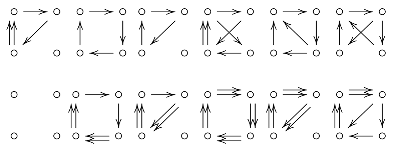 |
It is easy to see that shadows , for , do not satisfy PS4). Additionally, shadows and do not satisfy PS5). Thus, we obtain seven essential shadows, which correspond to seven essential quivers (including the empty one). In particular, we conclude that for every TSP4 algebra with having four vertices, its Gabriel quiver Q is obtained (modulo loops) from quivers by adding 2-cycles in a very restrictive way (as described in the main results of [1]). Due to (Corollary 5.3, [1]), we may exclude the empty shadow , since it has too many vertices.
The Table 1 below summarizes the numbers of shades and shadows (including essential ones) in the cases of , and 6. We point out that the number of shadows in the table means the number of basic ones, and all essential shadows are basic, by definition.

Table 1.
The numbers of shades, shadows, and essential shadows of size .
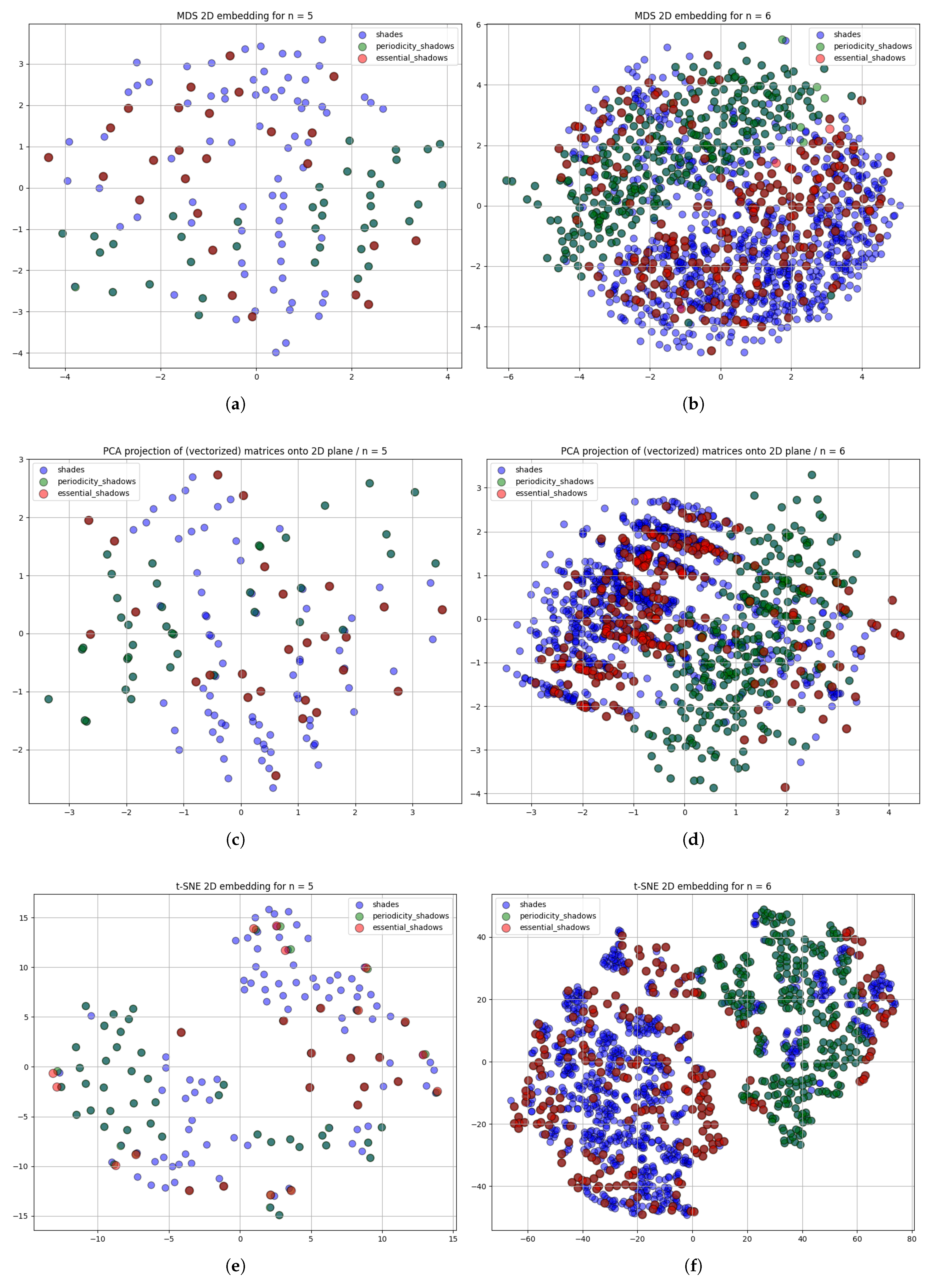
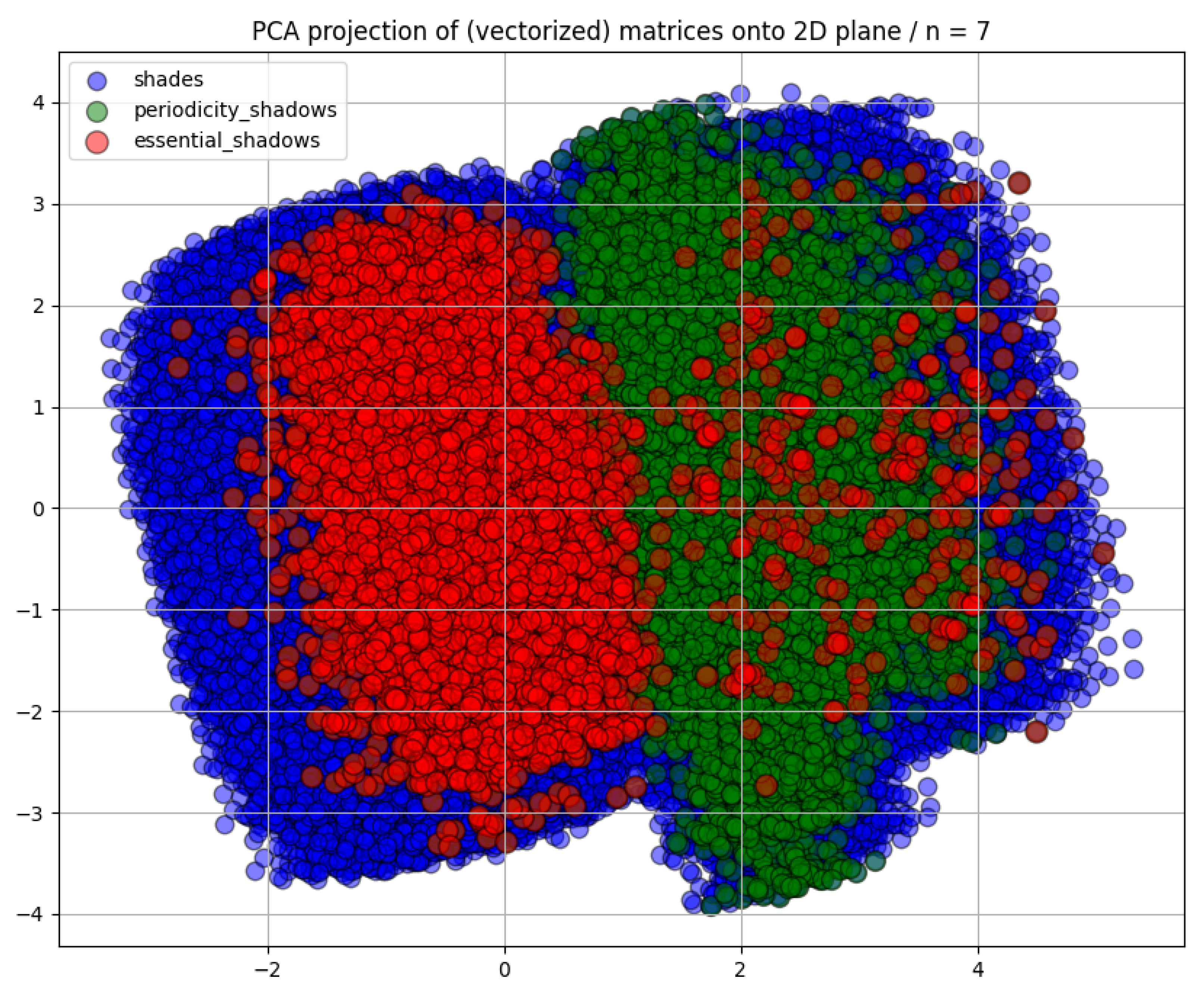
Finally, we present below some visualizations of the dataset representing matrices in for . In the following, we identify a matrix in with the integer vector in containing coefficients over the main diagonal. Using standard dimensionality reduction techniques (PCA, t-SNE, MDS), we may project the set onto the plane.
In Figure 1, we present three different projections of and . Especially for , the sets of essential and non-essential shadows seem to be roughly separated.
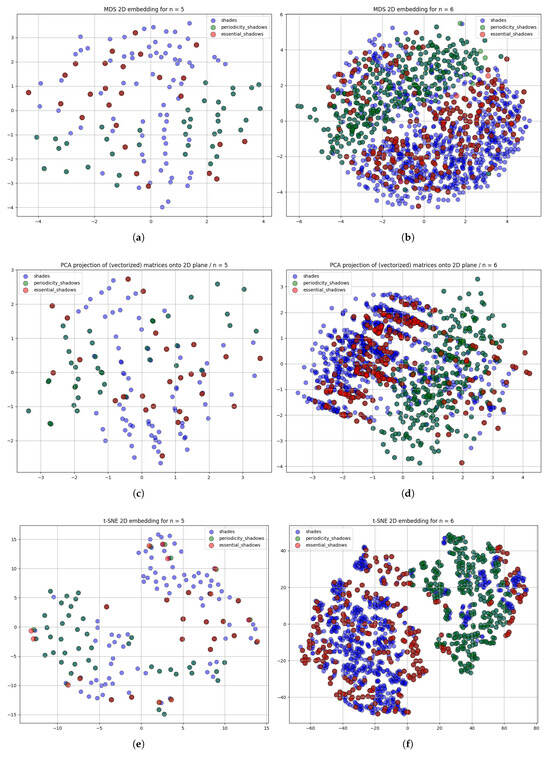
Figure 1.
(a) The 2-dimensional MDS projection of set . (b) The same for . (c) The 2-dimensional PCA projection of set . (d) The same for . (e) The 2-dimensional t-SNE embedding of set . (f) The same for . The pictures used in the figure are courtesy of Krzysztof Rykaczewski.
There seems to be an underlying structure of set , which is revealed with increasing n. As the following picture on Figure 2 shows, in the case of , we have quite reasonable evidence for it.
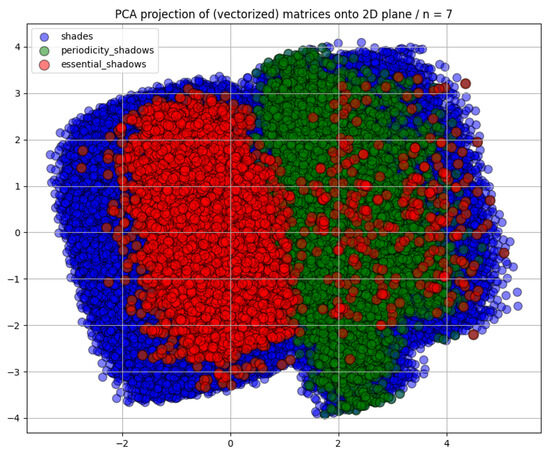
Figure 2.
This figure presents the PCA projection of set onto the plane. This picture is courtesy of Krzysztof Rykaczewski.
4. Periodicity Shadows of Size n = 5
The last section is devoted to illustrating the algorithm on one bigger example. We present here the list of all essential shadows of size , which is relatively short. In this case, we have exactly 26 essential shadows among all 65 (basic) tame periodicity shadows in . The remaining non-essential shadows and the complete list of all (basic) shades, including those that are not tame periodicity shadows, can be found in [7].
()
()
()
()
()
()
() ()
() ()
() ()
() ()
()
()
()
()
()
()
()
()
()
()
()
()
Author Contributions
Conceptualization, A.S.; software, J.B.; investigation, J.B.; writing—original draft, J.B. and A.S.; writing–review and editing, J.B. and A.S. All authors have read and agreed to the published version of the manuscript.
Funding
Both authors have been supported from the research grant no. 2023/51/D/ST1/01214 of the Polish National Science Center.
Data Availability Statement
The original contributions presented in this study are included in the article. Further inquiries can be directed to the corresponding author.
Conflicts of Interest
The authors declare no conflicts of interest. The funders had no role in the design of the study; in the collection, analyses, or interpretation of data; in the writing of the manuscript; or in the decision to publish the results.
References
- Skowyrski, A. Periodicity shadows I. A new approach to combinatorics of periodic algebras. J. Algebra 2026, 686, 1–37. [Google Scholar] [CrossRef]
- Assem, I.; Simson, D.; Skowroński, A. Elements of the Representation Theory of Associative Algebras 1: Techniques of Representation Theory; London Mathematical Society Student Texts; Cambridge University Press: Cambridge, UK, 2006; Volume 65. [Google Scholar]
- Gabriel, P. Des categoriés abéliennes. Bull. Soc. Math. Fr. 1962, 90, 323–448. [Google Scholar] [CrossRef]
- Gabriel, P. Unzerlegbare Darstellungen I. Manuscripta Math. 1972, 6, 71–103. [Google Scholar] [CrossRef]
- Skowroński, A.; Yamagata, K. Frobenius Algebras. I. Basic Representation Theory; EMS Textbooks in Mathematics; European Mathematical Society (EMS): Zürich, Switzerland, 2011. [Google Scholar]
- Jaworska-Pastuszak, A.; Skowyrski, A. Tame symmetric algebras of period four with small Gabriel quivers. J. Algebra 2026. [Google Scholar]
- Białkowski, J.; Skowyrski, A. Periodicity shadows: An appendix. arXiv 2024, arXiv:2411.19682v3. [Google Scholar]
- Erdmann, K.; Skowroński, A. Higher tetrahedral algebras. Algebr. Represent. Theory 2019, 22, 387–406. [Google Scholar] [CrossRef]
- Erdmann, K.; Skowroński, A. Higher spherical algebras. Arch. Math. 2020, 114, 25–39. [Google Scholar] [CrossRef]
- Brauer, R.; Nesbitt, C. On the regular representations of algebras. Proc. Nat. Acad. Sci. USA 1937, 23, 236–240. [Google Scholar] [CrossRef] [PubMed]
- Nakayama, T. On Frobeniusean algebras I. Ann. Math. 1939, 39, 611–633. [Google Scholar] [CrossRef]
- Erdmann, K. Blocks of Tame Representation Type and Related Algebras; Lecture Notes in Math. Springer: Berlin/Heidelberg, Germany, 1990; Volume 1428. [Google Scholar]
- Ariki, S. Hecke algebras of classical type and their representation type. Proc. London Math. Soc. 2005, 91, 355–413. [Google Scholar] [CrossRef]
- Drozd, Y.A. Tame and wild matrix problems. In Representation Theory II; Lecture Notes in Math.; Springer: Berlin/Heidelberg, Germany, 1980; Volume 832, pp. 242–258. [Google Scholar]
- Crawley-Boevey, W. On tame algebras and bocses. Proc. Lond. Math. Soc. 1988, 56, 451–483. [Google Scholar] [CrossRef]
- Erdmann, K.; Skowroński, A. Weighted surface algebras. J. Algebra 2018, 505, 490–558. [Google Scholar] [CrossRef]
- Auslander, M.; Reiten, I. DTr-periodic modules and functors. Represent. Theory Algebr. 1996, 18, 39–50. [Google Scholar]
- Erdmann, K.; Snashall, N. Preprojective algebras of Dynkin type, periodicity and the second Hochschild cohomology. Algebr. Modul. II 1998, 24, 183–193. [Google Scholar]
- Erdmann, K.; Skowroński, A. Periodic algebras. Trends Represent. Theory Algebr. Relat. Top. 2008, 201–251. [Google Scholar] [CrossRef]
- Auslander, M.; Reiten, I. McKay quivers and extended Dynkin diagrams. Trans. Amer. Math. Soc. 1986, 293, 293–301. [Google Scholar] [CrossRef][Green Version]
- Auslander, M.; Reiten, I. Almost split sequences for rational double points. Trans. Amer. Math. Soc. 1987, 302, 87–97. [Google Scholar] [CrossRef]
- Brenner, S.; Butler, M.C.R.; King, A.D. Periodic algebras which are almost Koszul. Algebr. Represent. Theory 2002, 5, 331–367. [Google Scholar] [CrossRef]
- Dugas, A. Periodic resolutions and self-injective algebras of finite type. J. Pure Appl. Algebra 2010, 214, 990–1000. [Google Scholar] [CrossRef][Green Version]
- Skowroński, A. Selfinjective algebras of polynomial growth. Math. Ann. 1989, 285, 177–199. [Google Scholar] [CrossRef]
- Skowroński, A. Selfinjective algebras: Finite and tame type. Trends Represent. Theory Algebr. Relat. Top. 2006, 406, 169–238. [Google Scholar]
- Erdmann, K. Algebras and quaternion defect groups I. Math. Ann. 1988, 281, 545–560. [Google Scholar] [CrossRef]
- Erdmann, K. Algebras and quaternion defect groups II. Math. Ann. 1988, 281, 561–582. [Google Scholar] [CrossRef]
- Erdmann, K.; Skowroński, A. The stable Calabi-Yau dimension of tame symmetric algebras. J. Math. Soc. Jpn. 2006, 58, 97–128. [Google Scholar] [CrossRef]
- Erdmann, K.; Skowroński, A. The periodicity conjecture for blocks of group algebras. Colloq. Math. 2015, 138, 283–294. [Google Scholar] [CrossRef]
- Holm, T. Derived equivalence classification of algebras of dihedral, semidihedral, and quaternion type. J. Algebra 1999, 211, 159–205. [Google Scholar] [CrossRef]
- Swan, R.G. Periodic resolutions for finite groups. Ann. Math. 1960, 72, 267–291. [Google Scholar] [CrossRef]
- Fomin, S.; Zelevinsky, A. Cluster algebras. I. Foundations. J. Am. Math. Soc. 2002, 15, 497529. [Google Scholar] [CrossRef]
- Derksen, H.; Weyman, J.; Zelevinsky, A. Quivers with potentials and their representations I. Mutations. Sel. Math. (N.S.) 2008, 14, 59–119. [Google Scholar] [CrossRef]
- Derksen, H.; Weyman, J.; Zelevinsky, A. Quivers with potentials and their representations II: Applications to cluster algebras. J. Am. Math. Soc. 2010, 23, 749–790. [Google Scholar] [CrossRef]
- Fomin, S.; Shapiro, M.; Thurston, D. Cluster algebras and triangulated surfaces. Part I. Cluster complexes. Acta Math. 2008, 201, 83–146. [Google Scholar] [CrossRef]
- Labardini-Fragoso, D. Quivers with potentials associated to triangulated surfaces. Proc. Lond. Math. Soc. 2009, 98, 797–839. [Google Scholar] [CrossRef]
- Ladkani, S. On Jacobian algebras from closed surfaces. arXiv 2012, arXiv:1207.3778. [Google Scholar] [CrossRef]
- Ladkani, S. From groups to clusters. Represent. Theory Curr. Trends Perspect. 2017, 427–500. [Google Scholar] [CrossRef]
- Erdmann, K.; Skowroński, A. Algebras of generalized quaternion type. Adv. Math. 2019, 349, 1036–1116. [Google Scholar] [CrossRef]
- Erdmann, K.; Skowroński, A. Weighted surface algebras: General version, Corrigendum. J. Algebra 2021, 569, 875–889. [Google Scholar] [CrossRef]
- Erdmann, K.; Skowroński, A. Weighted surface algebras: General version. J. Algebra 2020, 544, 170–227. [Google Scholar] [CrossRef]
Disclaimer/Publisher’s Note: The statements, opinions and data contained in all publications are solely those of the individual author(s) and contributor(s) and not of MDPI and/or the editor(s). MDPI and/or the editor(s) disclaim responsibility for any injury to people or property resulting from any ideas, methods, instructions or products referred to in the content. |
© 2025 by the authors. Licensee MDPI, Basel, Switzerland. This article is an open access article distributed under the terms and conditions of the Creative Commons Attribution (CC BY) license (https://creativecommons.org/licenses/by/4.0/).