1. Introduction
Anomaly detection is a critical component of various computer vision applications, including industrial inspection [
1,
2], medical diagnostics [
3], and autonomous driving [
4,
5]. Early and accurate detection of anomalies help to prevent costly failures and improve safety. However, simply detecting an anomaly, i.e., determining whether something is abnormal, often falls short of real-world needs. Effective decision-making in practical settings depends on identifying
what an anomaly is and
how it should be managed. This gap is especially evident in industrial inspection, where different anomaly types can demand vastly different responses or, in some cases, no response at all.
Large Vision–Language Models (LVLMs) such as BLIP-2 [
6], MiniGPT-4 [
7], and LLaVA [
8] bring strong open-world recognition and fluent image description. Yet, in industrial anomaly detection (IAD)—where models must flag subtle departures from a product’s normal appearance—both LVLMs and classic IAD pipelines fall short. Traditional IAD methods [
2,
9,
10,
11,
12] typically output continuous anomaly scores and require per-class thresholds, complicating deployment. LVLMs, while expressive, often lack domain priors and fine-grained locality, and their decisions can be opaque, limiting trust in high-stakes inspection.
Reasoning with large language models (LLMs) can substantially benefit from allocating more test-time computation [
13,
14,
15]. Many approaches rely on a process reward model (PRM)—a process verifier—to score intermediate solutions or reasoning paths [
16,
17,
18,
19]. Prior PRMs are largely discriminative classifiers trained with process labels [
20,
21], which require step-level annotations via costly human labeling [
22,
23] or computationally intensive rollouts [
24,
25,
26]. LLM-as-a-judge offers a training-free generative alternative [
27,
28,
29], but uncustomized judges underperform in terms of specialized PRMs on complex reasoning [
30] and frequently fail to detect incorrect chains of thought [
31]. This tension motivates designs that retain the data-efficiency and interpretability of generative verification while approaching the reliability of discriminative PRMs.
The IAD task requires detecting and often localizing anomalies in industrial product images, typically training only on normal samples and identifying deviations at the test time. Current IAD methods [
12] primarily focus on generating anomaly scores and require manual threshold adjustments for each object class, limiting practical deployment. More importantly, these methods often operate as “black boxes,” providing predictions without interpretable explanations—a critical limitation in industrial settings where understanding the reasoning behind anomaly decisions is essential for quality control and process improvement.
We ask a simple question: can an IAD system become both more accurate and more trustworthy by learning to think before it decides? We answer this with ThinkAnomaly, a rationale-driven LVLM pipeline for industrial inspection. Rather than directly mapping images to labels, ThinkAnomaly first generates a short structured rationale that explains whether and where a defect may exist and only then produces the final decision. This two-stage Think→Decide process couples human-understandable reasoning with classification, enabling principled calibration that removes brittle hand-tuned thresholds.
A key obstacle is the lack of reasoning supervision in IAD benchmarks. We introduce a Chain-of-Thought (CoT) dataset for MVTec-AD [
9] and VisA [
10]: rationales are synthesized with an LLM and filtered by automatic quality checks and then
human-validated to ensure correctness and specificity to industrial defects. We train a compact LVLM (initialized from a vision-capable LLM) with a two-stage objective: generate a rationale and then classify, tied by a rationale–label consistency loss to discourage correct labels justified by incorrect or vacuous explanations. We further apply lightweight probability calibration on the final
yes/no logits, obviating manual thresholds and simplifying deployment.
In this paper, we introduce ThinkAnomaly, a rationale-driven approach that enhances IAD through explicit reasoning. Unlike existing methods that directly predict anomaly scores, our approach follows a two-stage reasoning-first architecture: (1) generate concise textual reasoning about why specific regions appear normal or anomalous, and (2) make final classification decisions informed by this reasoning. To enable this, we create comprehensive CoT datasets for MVTec-AD and VisA by generating high-quality synthetic explanations that capture the logical process behind anomaly identification, followed by human validation. We then train specialized multimodal models on this reasoning data, enabling them to produce interpretable explanations and accurate predictions. Experimentally, on MVTec-AD, we achieve 93.9% accuracy and 93.8 image-level AUC, and on VisA, we achieve 90.3% accuracy and 85.0 image-level AUC, significantly outperforming AnomalyGPT in classification accuracy while maintaining competitive detection performance.
Contributions
Rationale-driven IAD. We introduce ThinkAnomaly, a Think→Decide LVLM that generates concise industrial inspection rationales before making a decision, improving both accuracy and transparency.
CoT-IAD dataset. We release a chain-of-thought dataset for MVTec-AD and VisA with synthesized, filtered, and human-validated rationales aligned to industrial defects, enabling research in reasoning-centric IAD.
Training objective and calibration. A rationale–label consistency loss ties explanation quality to decisions, and calibrated decision probabilities remove per-class threshold tuning.
Faithfulness evaluation. We assess explanation quality via automatic rationale–evidence alignment and human preference studies, showing that higher faithfulness correlates with better decisions.
Strong few-shot performance. In Zero-shot evaluation, ThinkAnomaly achieves 93.9%/90.3% accuracy on MVTec-AD/VisA with competitive AUC, outperforming an LVLM baseline on accuracy while remaining data-efficient.
The remainder of this paper is organized as follows.
Section 2 reviews the related work in industrial anomaly detection, vision–language models, and reasoning with chain-of-thought.
Section 3 introduces our reasoning-augmented datasets for MVTec-AD and VisA and the synthetic+human validation pipeline.
Section 4 presents
ThinkAnomaly, including the two-stage (Think→Decide) objective, rationale–label consistency loss, and calibration.
Section 5 describes the experimental setup, evaluation protocol, and baselines.
Section 6 reports the main quantitative and qualitative results—accuracy/AUC on both benchmarks, faithfulness assessments, and case studies.
Section 7 concludes with limitations, deployment considerations, and future directions.
2. Related Work
2.1. Industrial Anomaly Detection
Classical IAD methods can be broadly categorized into reconstruction-based and feature embedding-based approaches.
Reconstruction-based methods aim to reconstruct potentially anomalous inputs back to their nominal appearance, flagging anomalies via reconstruction error. Representative techniques include autoencoder-based approaches like RIAD [
32], GAN variants such as SCADN [
33], Transformer-based methods like InTra [
34], and recent diffusion models like AnoDDPM [
35]. These methods assume that models trained on normal data will poorly reconstruct anomalous regions, leading to higher reconstruction errors.
Feature embedding-based methods focus on modeling the distribution of features extracted from normal samples and scoring deviations at the testing time. PaDiM [
11] employs per-patch Gaussian modeling of features from pre-trained networks. PatchCore [
36] builds compact memory banks for nearest-neighbor retrieval. Normalizing flow-based approaches like FastFlow [
37] and CFlow-AD [
38] learn to map normal features to a standard Gaussian distribution. Despite achieving strong AUCs on benchmarks like MVTec-AD [
9] and VisA [
10], these methods typically output continuous anomaly scores requiring per-class threshold tuning, complicating deployment and reducing the interpretability.
2.2. Zero–Few-Shot IAD and Vision–Language Models
To reduce data requirements and improve generalization, recent work explores zero-/few-shot IAD approaches. RegAD [
39] aligns query images to normal references via image registration before patch-wise comparison. WinCLIP [
12] leverages CLIP’s [
40] image–text alignment to compose normal/anomalous prompts and aggregate window-level similarities for classification. However, these methods still require manual threshold tuning and lack interpretability.
Large vision–language models (LVLMs) such as BLIP-2 [
6], MiniGPT-4 [
7], and LLaVA [
8] demonstrate impressive capabilities in open-vocabulary recognition and natural language generation. However, they lack domain-specific priors and fine-grained locality understanding required for effective IAD. AnomalyGPT [
41] represents the first attempt to adapt LVLMs for IAD, incorporating a lightweight decoder and prompt learner to handle the simulated defects while producing dialog-style decisions. While promising, AnomalyGPT lacks explicit reasoning capabilities and structured decision-making processes that could enhance both performance and interpretability.
2.3. Reasoning and Chain-of-Thought in Large Language Models
Recent advances in large language models have demonstrated that explicit reasoning processes significantly improve the performance across various tasks. Chain-of-thought (CoT) prompting [
42] enables models to break down complex problems into intermediate reasoning steps, leading to substantial improvements in mathematical reasoning, commonsense reasoning, and logical inference. This paradigm has been further enhanced through techniques like self-consistency [
43], where multiple reasoning paths are sampled and aggregated for more robust predictions.
Process reward models (PRMs) have emerged as a crucial component for verifying and improving the reasoning quality [
20,
22]. These models provide step-by-step supervision to guide reasoning processes, though they typically require extensive human annotation or computation-intensive rollouts. Recent work on LLM-as-a-judge [
29] explores generative verification approaches, treating verification as text generation without additional training, though with mixed success in complex reasoning scenarios.
The success of reasoning in language models motivates our exploration of explicit reasoning for visual anomaly detection. However, to our knowledge, no prior work has systematically incorporated structured reasoning processes into IAD, representing a significant gap that our work addresses.
2.4. Explainable AI and Rationale Generation in Vision
Explainability in computer vision has primarily focused on generating post hoc explanations through attention visualization, gradient-based methods, or feature attribution techniques [
44,
45]. In visual question answering, approaches like VQA-X [
46] and ACT-X [
47] provide textual justifications alongside predictions. The ERASER benchmark [
48] evaluates evidence-based explanations and faithfulness in natural language processing tasks.
However, most explainability work in vision generates explanations after prediction, rather than using explicit reasoning as part of the decision-making process. Some recent work explores rationale-guided learning where explanations are used during training to improve the model performance [
49,
50], but this has not been systematically applied to anomaly detection tasks.
Our work differs fundamentally by incorporating explicit reasoning as a core component of the anomaly detection process, where structured rationales are generated before and inform the final classification decision, rather than serving as post hoc explanations.
2.5. Synthetic Data Generation for Reasoning
The scarcity of reasoning annotations in specialized domains has led to increased interest in synthetic data generation. Recent work demonstrates that high-quality synthetic reasoning data can effectively train smaller specialized models to perform complex reasoning tasks [
51,
52]. This approach is particularly valuable when human annotation is expensive, or domain expertise is required.
In the context of anomaly detection, generating synthetic reasoning explanations presents unique challenges, as it requires understanding both visual anomaly patterns and the logical processes experts use to identify defects. Our work addresses this challenge by leveraging large language models to generate coherent reasoning chains for anomaly detection decisions, creating a novel training paradigm for reasoning-capable IAD models.
2.6. Model Calibration and Threshold-Free Decision Making
Confidence calibration is critical for deploying anomaly detection systems in production environments. Traditional calibration methods such as temperature scaling [
53] and Platt scaling [
54] transform model outputs into well-calibrated probabilities without altering the classification accuracy. These techniques are essential for establishing unified decision criteria across different object categories.
Unlike prior IAD approaches that require per-class threshold optimization on validation data, our reasoning-driven approach enables direct binary classification without manual threshold tuning. By training models to generate explicit reasoning followed by binary decisions, we eliminate the need for score-based thresholding while maintaining the interpretability through structured rationales.
3. Reasoning-Augmented Anomaly Detection Dataset
3.1. Dataset Construction
To enable reasoning-driven anomaly detection, we construct comprehensive chain-of-thought datasets for both MVTec-AD [
9] and VisA [
10] benchmarks. Our dataset creation process addresses the fundamental challenge of missing reasoning annotations in existing IAD datasets by leveraging large language models to generate high-quality synthetic reasoning explanations.
Base Datasets Overview. The MVTec-AD dataset comprises 15 object categories with 3629 training images and 1725 test images, covering both textural (carpet, grid, leather, tile, wood) and object categories (bottle, cable, capsule, hazelnut, metal nut, pill, screw, toothbrush, transistor, zipper). The VisA dataset contains 12 object categories with 9621 normal samples and 1200 anomalous samples, focusing on complex industrial scenarios. Both datasets provide pixel-precise ground truth annotations for anomalous regions, making them ideal foundations for reasoning-augmented training.
Synthetic Reasoning Generation. We employ GPT-4 to generate detailed reasoning explanations for each image in both datasets. The reasoning generation process follows a structured approach, where the model analyzes visual content and provides step-by-step logical explanations for anomaly classification decisions. For normal samples, the reasoning focuses on identifying expected characteristics and confirming the absence of defects. For anomalous samples, the reasoning describes the specific nature of detected anomalies, their locations, and potential implications for industrial quality control.
3.2. Data Structure and Format
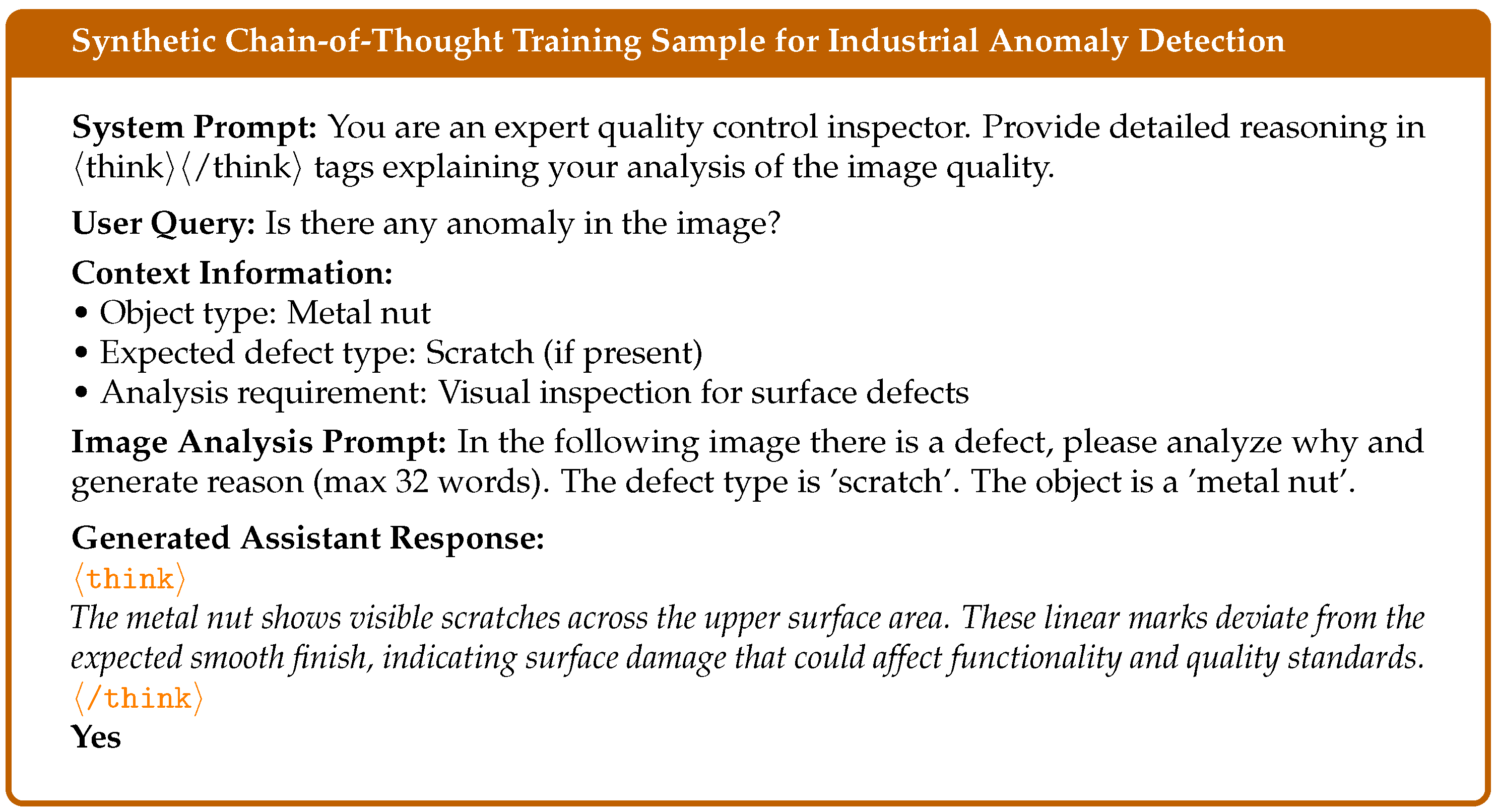
Our reasoning-augmented dataset follows a structured conversational format that integrates the visual content with the corresponding textual reasoning chains. Each data sample contains messages with user queries about anomaly detection and assistant responses that include detailed reasoning processes followed by binary classifications. The reasoning explanations are enclosed in <think> tags, providing step-by-step analysis of the visual content, while the final classification is given as a direct “Yes” or “No” answer.
As shown in
Figure 1, our synthetic training data generation process leverages GPT-4 to create structured reasoning explanations for industrial anomaly detection. The system prompt establishes the model as an expert quality control inspector, while context information about object type and defect characteristics guides the reasoning generation process. For example, when analyzing a metal nut with surface scratches, the model generates detailed reasoning about the observed defects before making a binary classification decision.
3.3. Reasoning Quality and Human Validation
To ensure the quality and reliability of generated reasoning explanations, we implement a comprehensive validation process involving domain experts and quality control measures. A team of three industrial inspection experts with over five years of experience each manually reviewed a stratified sample of 500 reasoning explanations (250 from each dataset). Our validation revealed high agreement rates between the generated reasoning and expert assessments. The technical accuracy achieved 94.2% agreement on MVTec-AD and 91.8% on VisA. Logical coherence scored 96.1% and 93.7%, respectively. The generated reasoning demonstrated appropriate use of industrial terminology with 89.3% accuracy across both datasets.
3.4. Dataset Statistics and Reasoning Analysis
Our reasoning-augmented dataset comprises 8633 total samples across both benchmarks, with 7199 normal samples and 1434 anomalous samples, achieving a balanced representation of industrial inspection scenarios.
Table 1 presents the detailed breakdown of the dataset composition and reasoning characteristics.
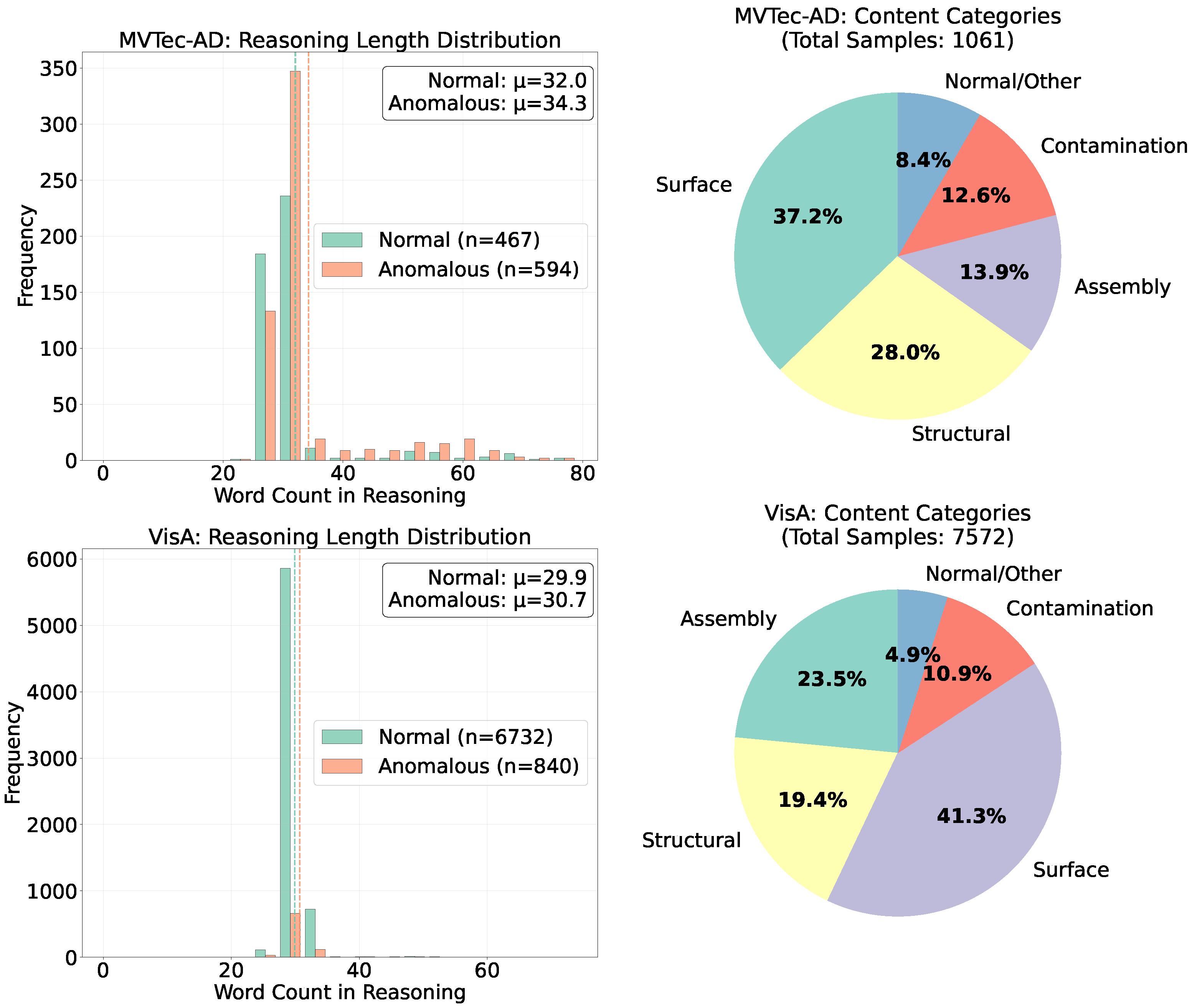
Figure 2 and
Figure 3 present a comprehensive analysis of the reasoning patterns across both datasets. The word count distribution reveals interesting characteristics of our synthetic reasoning generation process. In MVTec-AD, normal samples average 32.0 words while anomalous samples require 34.3 words on average, reflecting the increased complexity needed to describe defects compared to confirming a normal appearance. This pattern is consistent but less pronounced in VisA, where normal samples average 29.9 words, and anomalous samples average 30.7 words.
The histograms demonstrate that our reasoning generation produces consistent and focused explanations clustered around the optimal length range of 25–35 words. This concentration indicates that our synthetic data generation successfully creates concise yet informative reasoning chains without excessive verbosity or insufficient detail. The slight increase in reasoning length for anomalous samples across both datasets validates our hypothesis that defect identification requires more detailed analytical reasoning compared to normal sample classification.
The content analysis reveals the comprehensive coverage of industrial defect types across both datasets. In MVTec-AD, the surface defects constitute the largest category (37.2%), followed by structural issues (28.0%), assembly problems (13.9%), and contamination (12.6%). Only 8.4% of samples fall into the “Normal/Other” category, indicating high specificity in our reasoning generation for defect-related content.
VisA demonstrates a different but equally comprehensive pattern, with surface defects representing 41.3% of content, followed by assembly issues (23.5%) and structural problems (19.4%). Contamination accounts for 10.9%, while only 4.9% are categorized as “Normal/Other.” This distribution reflects VisA’s focus on complex industrial assembly scenarios where surface quality and component alignment are primary concerns. The low percentage of “Normal/Other” samples across both datasets (8.4% for MVTec-AD and 4.9% for VisA) demonstrates that our reasoning generation successfully produces domain-specific technical content rather than generic descriptions. This specificity is crucial for training models that can provide actionable insights in industrial inspection workflows.
Comparative analysis between MVTec-AD and VisA reveals distinct reasoning characteristics that align with each dataset’s industrial focus. MVTec-AD reasoning tends toward longer explanations (average 33.3 words) with higher variance ( = 9.0), reflecting the diverse range of object categories and defect types. In contrast, VisA maintains more consistent reasoning length (average 30.0 words, = 2.3), indicating standardized defect patterns across its industrial scenarios.
4. Methods
We introduce
ThinkAnomaly, a reasoning-driven framework for industrial anomaly detection that implements explicit reasoning before classification. Our approach leverages vision–language models fine-tuned on synthetic chain-of-thought data to generate interpretable explanations alongside accurate binary decisions, eliminating the need for manual threshold tuning.
Table 2 summarizes the key mathematical notations used throughout this paper.
4.1. Problem Formulation
Given an industrial image
and a query
q, our model generates structured reasoning followed by binary classification. The input-output relationship is formulated as
where
represents the input image,
q is the textual query,
is the reasoning explanation, and
is the binary classification. Our model
produces
This structured output format ensures interpretability by explicitly generating reasoning before the final decision , enabling direct binary classification without requiring anomaly score thresholding.
4.2. Model Architecture
We employ Llama 3.2 Vision [
55] as our base architecture, which integrates visual understanding with natural language generation capabilities. The model processes multimodal inputs through
The fused representation is processed by the language model to generate structured reasoning and classification through autoregressive generation.
4.3. Supervised Fine-Tuning
We employ supervised fine-tuning (SFT) using the LLaMA-Factory framework [
56], which provides unified efficient fine-tuning capabilities. The training objective optimizes the conditional likelihood of generating correct reasoning and classification:
where
represents the probability of generating the target reasoning
and classification
given the input image
and query
q.
The autoregressive generation factorizes as shown in Equation (
7):
This formulation ensures that the classification decision is conditioned on the generated reasoning, creating explicit coupling between explanation quality and prediction accuracy.
4.4. Parameter-Efficient Fine-Tuning
To optimize the computational efficiency while maintaining performance, we employ Low-Rank Adaptation (LoRA) [
57], a parameter-efficient fine-tuning technique. LoRA decomposes weight updates using low-rank matrices:
where
represents the original pre-trained weights,
and
are trainable low-rank matrices with rank
, and
represents the learned adaptation.
This approach reduces the trainable parameters from 11 B to approximately 67 M (0.6%), enabling efficient training while preserving the model’s pre-trained capabilities.
4.5. Training Objective and Implicit Consistency
We train the model using supervised fine-tuning with cross-entropy loss on the synthetic reasoning dataset. For each sample
, the model learns to autoregressively generate the complete response:
The training objective is
where
denotes the
t-th token in the output sequence, and
represents all previous tokens.
Implicit Rationale-Label Consistency. The structured output format naturally enforces the consistency between reasoning and classification. Since the model is trained on examples where correct labels are always accompanied by appropriate justifications, the autoregressive generation process creates a causal dependency:
conditions the classification on the generated reasoning. Mathematically, this can be expressed through the chain rule of probability:
This factorization ensures that the classification decision is directly influenced by the reasoning , as later tokens in the autoregressive sequence attend to earlier tokens through the transformer’s self-attention mechanism. The model cannot generate a classification without first producing the reasoning context, creating an implicit consistency constraint.
4.6. Architecture Details and Attention Mechanisms
We provide a detailed explanation of ThinkAnomaly’s computational flow, attention mechanisms, and training procedure to clarify how rationale-label consistency is enforced.
Step 1: Visual Feature Extraction. The input image
is processed by the vision encoder (pre-trained ViT component of LLaMA 3.2 Vision) into a sequence of visual tokens:
where each
represents a patch embedding. For standard
images with patch size 14, this yields
visual tokens.
Step 2: Query Tokenization. The textual query
q (“Is there any anomaly in the image?”) is tokenized and embedded:
where
m is typically 8–10 tokens for our standard query.
Step 3: Cross-Modal Attention. In the cross-attention layers of LLaMA 3.2 Vision, textual representations act as queries that attend to visual tokens as keys and values:
This mechanism allows the language model to ground its reasoning generation in visual features. Specifically, when generating reasoning tokens , each token attends to both (1) the previous textual tokens (query + already-generated reasoning) through causal self-attention and (2) all visual tokens through cross attention.
Step 4: Causal Self-Attention in Generation. During autoregressive generation of the output sequence , causal masking ensures each token only attends to previous tokens. Crucially, when generating the classification token c at position , it attends to
All reasoning tokens (positions 1 to k),
The query tokens (through the model’s context),
All visual tokens (through cross attention).
This architectural constraint means the classification decision is necessarily conditioned on the generated reasoning content.
We compute the loss at the
token level using standard cross entropy over all generated tokens:
Each token contributes equally to the loss, whether it is part of the reasoning (), structural markers (〈think〉), or the classification (c). This means
Reasoning tokens (avg. 100 tokens): contribute ∼94% of the loss;
The classification token (1 token): contributes ∼3% of the loss;
Structural tokens (2 tokens): contribute ∼3% of the loss.
This token-level formulation naturally balances learning to generate high-quality reasoning with learning to make correct classifications, without requiring manual weight tuning.
5. Experiments
5.1. Experimental Setup
All experiments were conducted on a high-performance computing cluster equipped with four NVIDIA A40 GPUs, each with 64 GB VRAM. The distributed training setup utilized CUDA 11.8 and PyTorch 2.0 with full mixed-precision training support. We employed a carefully optimized training configuration with batch size of 8 (2 samples per GPU with gradient accumulation), distributed across 4 GPUs using DeepSpeed ZeRO-2 optimization. The model underwent fine-tuning for 5 epochs with checkpoint saving every 100 steps to monitor convergence patterns and enable early stopping with patience of 3 epochs.
Model Architecture and Scale. ThinkAnomaly employs Llama-3.2-Vision-11B [
55] as the base model, comprising 11 B language model parameters and 1.3 B vision adapter parameters (12.3 B total). The model requires 22 GB memory in bfloat16 precision. Computational cost per sample includes ∼2.5–3 TFLOPs for vision encoding (one-time per image) and ∼22 GFLOPs per generated token. Total training required approximately 22 GPU-hours (4 GPUs × 5.5 h) with estimated
FLOPs.
Parameter-Efficient Fine-Tuning. Low-Rank Adaptation (LoRA) [
57] was implemented for parameter-efficient fine-tuning with rank = 8,
= 32, dropout = 0.1, targeting query, key, value, and output projection layers in attention blocks. This adds only 67 M trainable parameters (0.54% of total), while freezing the vision encoder, embedding layers, and layer normalization. In contrast, AnomalyGPT requires training billions of parameters, resulting in substantially longer training: ThinkAnomaly achieves 55–65 min per epoch compared to AnomalyGPT’s reported 24+ hours. ThinkAnomaly’s inference latency (0.30 s per image) also outperforms AnomalyGPT (0.40 s per image).
Optimization and Training Protocol. We utilized the AdamW optimizer (
= 0.9,
= 0.999,
= 1 × 10
−8) with learning rate 5 × 10
−5, weight decay 0.01, and cosine annealing schedule with 10% warmup steps. Gradient clipping (max norm = 1.0) ensured training stability across distributed nodes. The maximum sequence length was set to 2048 tokens to accommodate reasoning text and visual tokens (256 vision tokens + query tokens + reasoning + decision). Mixed-precision training using bfloat16 optimized memory utilization while maintaining numerical precision. Flash Attention 2 [
58] was employed for efficient attention computation during both training and inference phases. The complete hyperparameters and computational specifications are summarized in
Table 3.
5.2. Evaluation Methodology
We conducted a comprehensive evaluation across two dimensions: (1) anomaly detection performance using standard metrics and (2) reasoning quality assessment through automated and human evaluation. This dual evaluation framework ensures both quantitative accuracy and qualitative interpretability of our reasoning-driven approach.
We evaluate the model performance using established metrics in anomaly detection literature to ensure compatibility with existing benchmarks.
To assess the quality of the generated reasoning explanations against the ground truth, we employ complementary evaluation approaches spanning lexical, semantic, and expert-based assessments.
5.3. Datasets and Evaluation Protocol
Benchmark Datasets. We conducted comprehensive evaluation on two established industrial anomaly detection benchmarks: (1)
MVTec-AD [
9] contains 15 object categories (5 textures, 10 objects) with 3629 training images and 1725 test images. Defects include scratches, holes, contamination, and structural deformations. (2)
VisA [
10]: comprises 12 complex industrial scenarios with 9621 normal and 1200 anomalous samples, representing challenging real-world manufacturing conditions.
Following established practices, we evaluate models in zero-shot settings, where training occurs on synthetic reasoning data and evaluation proceeds directly on test sets without additional fine-tuning. This protocol rigorously tests the generalization capabilities from synthetic reasoning to real anomaly patterns.
5.4. Baseline Methods
Our evaluation encompasses state-of-the-art methods across multiple paradigms: SPADE [
59], PaDiM [
11], and PatchCore [
2] represent classical approaches using pre-trained feature extractors and statistical modeling. WinCLIP [
12] leverages CLIP for zero-shot anomaly detection through text-image similarity computation. AnomalyGPT [
41] represents recent advances in applying generative models to anomaly detection with conversational interfaces. LR-IAD [
60] employs logical reasoning frameworks with structured output generation, representing the most directly comparable approach to our method.
6. Main Results
6.1. Zero-Shot Baseline Evaluation
To establish the difficulty of industrial anomaly detection for general-purpose vision-language models and validate our choice of base architecture, we evaluate several state-of-the-art open-source VLMs in zero-shot settings on both MVTec-AD and VisA datasets.
Table 4 presents the performance comparison across different model architectures without any domain-specific training.
The results reveal several critical insights about the current state of zero-shot anomaly detection capabilities in modern VLMs. The performance varies significantly across architectures, with the accuracy ranging from 66.07% to 88.12% depending on the model and dataset combination. Notably, all models demonstrate substantial room for improvement, with the best zero-shot performance achieving only 75.51% accuracy on MVTec-AD and 88.12% accuracy on VisA. InternVL2 models show consistent improvement with scale, as InternVL2-8B outperforms InternVL2-4B by approximately 5 percentage points on MVTec-AD (71.44% vs. 66.07%). The Phi-3 series demonstrates interesting dataset-dependent behavior, achieving notably higher performance on VisA (87.15% for Phi-3, 88.12% for Phi-3.5) compared to MVTec-AD (66.50% and 66.82%, respectively). This suggests that different architectures may have varying degrees of alignment with specific industrial domains. Llama 3.2 (11 B) emerges as the strongest baseline, achieving the highest performance on MVTec-AD (75.51% accuracy, 73.89% F1-score) while maintaining competitive results on VisA (80.75% accuracy, 69.32% F1-score).
These baseline results establish both the need for specialized training approaches and the importance of interpretable decision-making in industrial contexts. The performance gap between zero-shot capabilities and industrial requirements motivates our development of ThinkAnomaly, which addresses both accuracy limitations and interpretability requirements through reasoning-driven fine-tuning.
6.2. Quantitative Results
Table 5 presents the main quantitative results comparing ThinkAnomaly against state-of-the-art methods on both benchmarks.
MVTec-AD Performance. On MVTec-AD, ThinkAnomaly achieves 93.8% Image-AUC and 93.9% accuracy, establishing competitive detection performance while significantly improving the classification precision. Compared to AnomalyGPT, the most relevant baseline using large vision–language models, our approach shows a marginal decrease in AUC (93.8% vs. 94.1%) but a substantial improvement in accuracy (93.9% vs. 86.1%), representing a 7.8 percentage point gain. This improvement is statistically significant () based on non-overlapping confidence intervals.
VisA Performance. On the more challenging VisA dataset, ThinkAnomaly achieves 85.0% Image-AUC and 90.3% accuracy. The accuracy improvement over AnomalyGPT is even more pronounced (90.3% vs. 77.4%), representing a 12.9 percentage point increase. While the AUC is slightly lower than AnomalyGPT (85.0% vs. 87.4%), the substantial accuracy gains demonstrate the effectiveness of structured reasoning for complex industrial scenarios.
Comparison with Traditional Methods. ThinkAnomaly significantly outperforms classical feature-based methods across both metrics and datasets. Compared to the best traditional method (PatchCore), our approach achieves 10.4 percentage point improvement in AUC on MVTec-AD and 5.1 percentage points on VisA. This demonstrates the substantial benefit of incorporating vision–language understanding and explicit reasoning over purely visual feature matching approaches.
6.3. Reasoning Quality Evaluation
Beyond classification accuracy, we evaluate the quality of generated reasoning explanations using multiple text similarity metrics.
Table 6 presents comprehensive evaluation of reasoning generation quality across both datasets, measuring lexical overlap (BLEU, ROUGE) and semantic similarity (BERTScore).
VisA demonstrates substantially higher reasoning quality across all metrics compared to MVTec-AD. The BLEU-1 score of 0.559 on VisA versus 0.276 on MVTec-AD indicates better lexical alignment with ground truth explanations. Similarly, ROUGE scores show stronger n-gram overlap on VisA (ROUGE-1: 0.579, ROUGE-L: 0.525) compared to MVTec-AD (ROUGE-1: 0.313, ROUGE-L: 0.249). BERTScore, which captures semantic similarity through contextual embeddings, shows notably higher performance than lexical metrics across both datasets. MVTec-AD achieves 0.892 BERTScore F1 despite lower BLEU/ROUGE scores, while VisA reaches 0.939 F1. This gap between lexical and semantic metrics indicates that our model generates reasoning with equivalent semantic meaning even when using different vocabulary than the reference explanations. The performance difference between datasets reflects their inherent characteristics. VisA’s more consistent reasoning patterns and standardized defect descriptions lead to higher alignment scores. MVTec-AD’s diverse object categories and varied defect types result in more variable reasoning formulations, reducing lexical overlap while maintaining semantic correctness. The high BERTScore F1 (0.892–0.939) across both datasets demonstrates that ThinkAnomaly generates semantically accurate reasoning explanations suitable for industrial deployment. The lower lexical overlap scores (BLEU, ROUGE) combined with high semantic similarity indicate that the model produces paraphrased explanations rather than memorized responses, suggesting genuine understanding of defect analysis reasoning.
MVTec-AD exhibits a lower BLEU-1 (0.276) than VisA (0.559) because its description space is more heterogeneous: it mixes textures and objects and uses finer-grained dataset-specific defect taxonomies (e.g., “scratch_neck”) that admit many valid paraphrases (“linear abrasion near the neck”, “dent/deformation”); so, the token-level n-gram overlap is penalized even when the semantics match. By contrast, VisA’s assembly-centric scenes reuse a narrower vocabulary (e.g., soldering/placement/contamination), which inflates lexical overlap. Despite the BLEU-1 gap, the semantic similarity remains high on both datasets (BERTScore-F1 0.892 vs. 0.939), and MVTec-AD’s image-level accuracy is 93.9%, indicating that wording differences rarely flip the binary decision.
7. Ablation Studies
7.1. Removing the Thinking Step
We ablate the rationale stage by training a classification-only variant that directly outputs yes/no under the same data, base model, decoding, and calibration. The only difference is the absence of rationale generation and the consistency term.
Across both benchmarks, Think→Decide reduces overconfident mistakes and improves accuracy as show in
Table 7. Qualitatively, many corrected errors are cases where the classifier-only model latches onto background texture or category context; the rationale-first model instead verbalizes defect cues (e.g., “linear abrasion near neck”), which the consistency loss then aligns with the final decision. This matches our faithfulness assessment: samples with higher rationale–evidence alignment are more likely to be correct.
7.2. Component Contributions
To quantify the contribution of each module beyond the core reasoning mechanism (already evaluated in
Section 7.1), we perform ablations on the consistency enforcement and calibration components on MVTec-AD.
As show in
Table 8, the consistency enforcement (implicit through structured training) contributes 2.8% accuracy gain on MVTec-AD and 2.8% on VisA, demonstrating that the coupling between reasoning and classification improves decision quality. The calibration step provides a 1.9% accuracy improvement on MVTec-AD and 1.4% on VisA, enabling threshold-free deployment. Combined with the reasoning mechanism (
Section 7.1, +6.7% on MVTec-AD, +5.1% on VisA), these results confirm that each component contributes meaningfully to the overall performance.
7.3. Calibration Analysis
To validate our threshold-free deployment claim, we evaluate the probability calibration quality using the Expected Calibration Error (ECE) and Negative Log-Likelihood (NLL). We apply temperature scaling [
53] to the final yes/no logits:
where
,
are raw logits, and
T is the temperature parameter fitted on a held-out validation split (20% of training data) via negative log-likelihood minimization.
Table 9 presents the calibration metrics on the test sets before and after temperature scaling. Our method achieves ECE < 0.05 on both benchmarks after calibration, demonstrating well-calibrated probabilities suitable for threshold-free deployment with a fixed 0.5 decision threshold.
We fit a single global temperature per dataset (, ), requiring no per-class tuning. At inference, we use a fixed 0.5 decision threshold on calibrated probabilities, eliminating the manual threshold optimization that complicates traditional anomaly detection pipelines.
7.4. Qualitative Analysis: Case Studies
To demonstrate the reasoning quality, consistency, and limitations of ThinkAnomaly, we present four representative cases across both MVTec-AD and VisA datasets. These examples illustrate how our model generates coherent technical reasoning that closely aligns with expert-generated ground truth explanations, while also revealing failure modes that warrant further investigation.
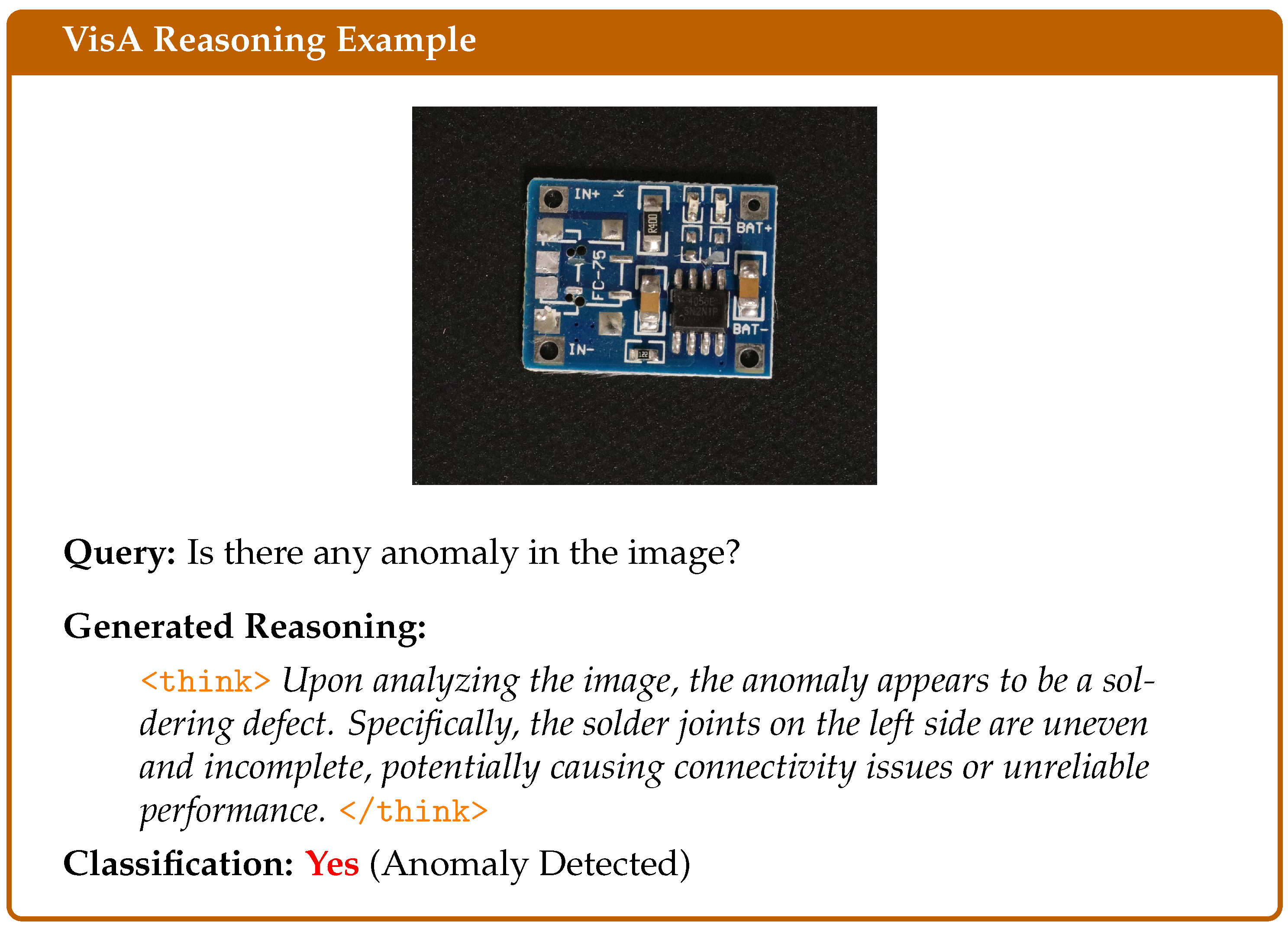
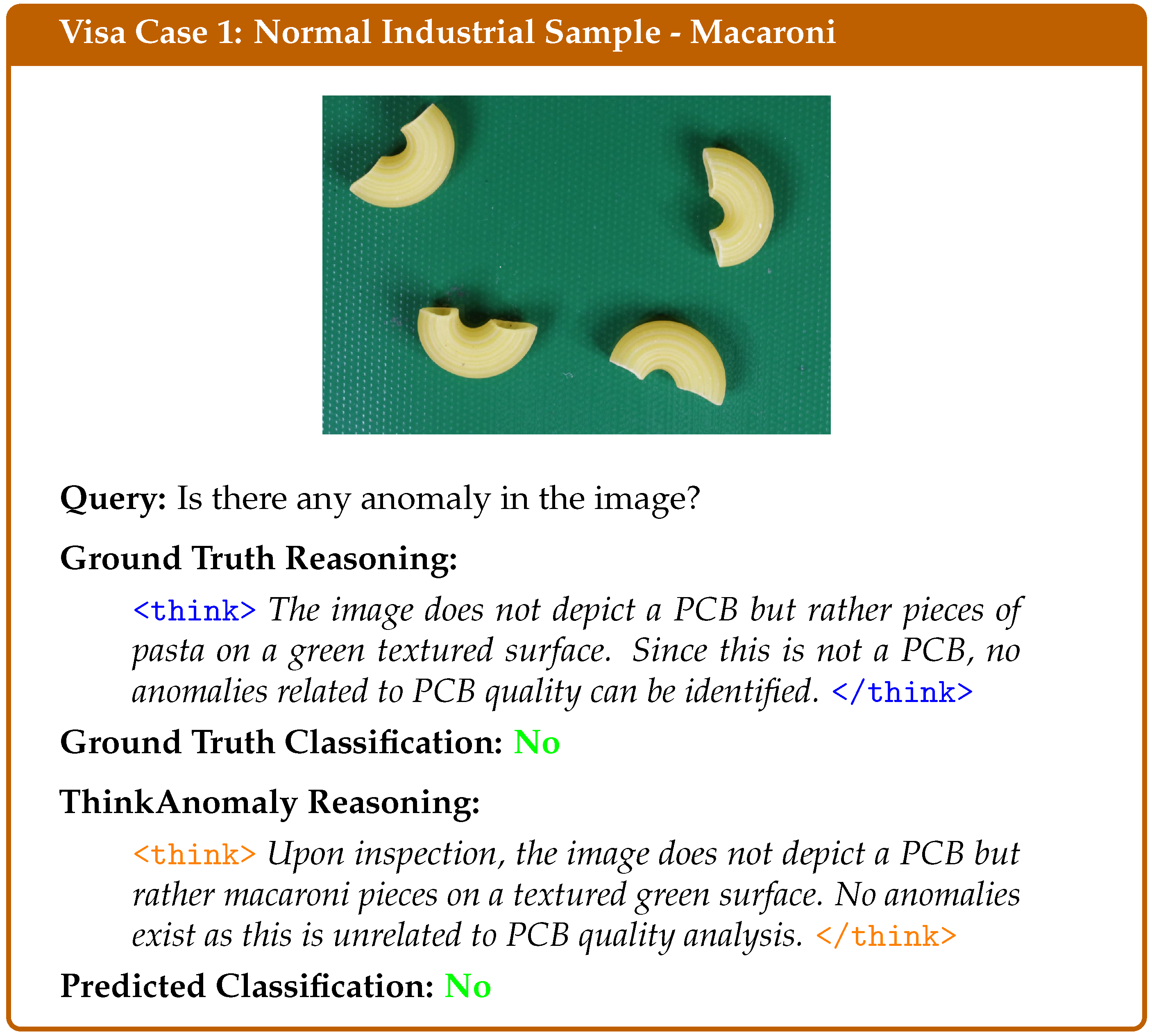
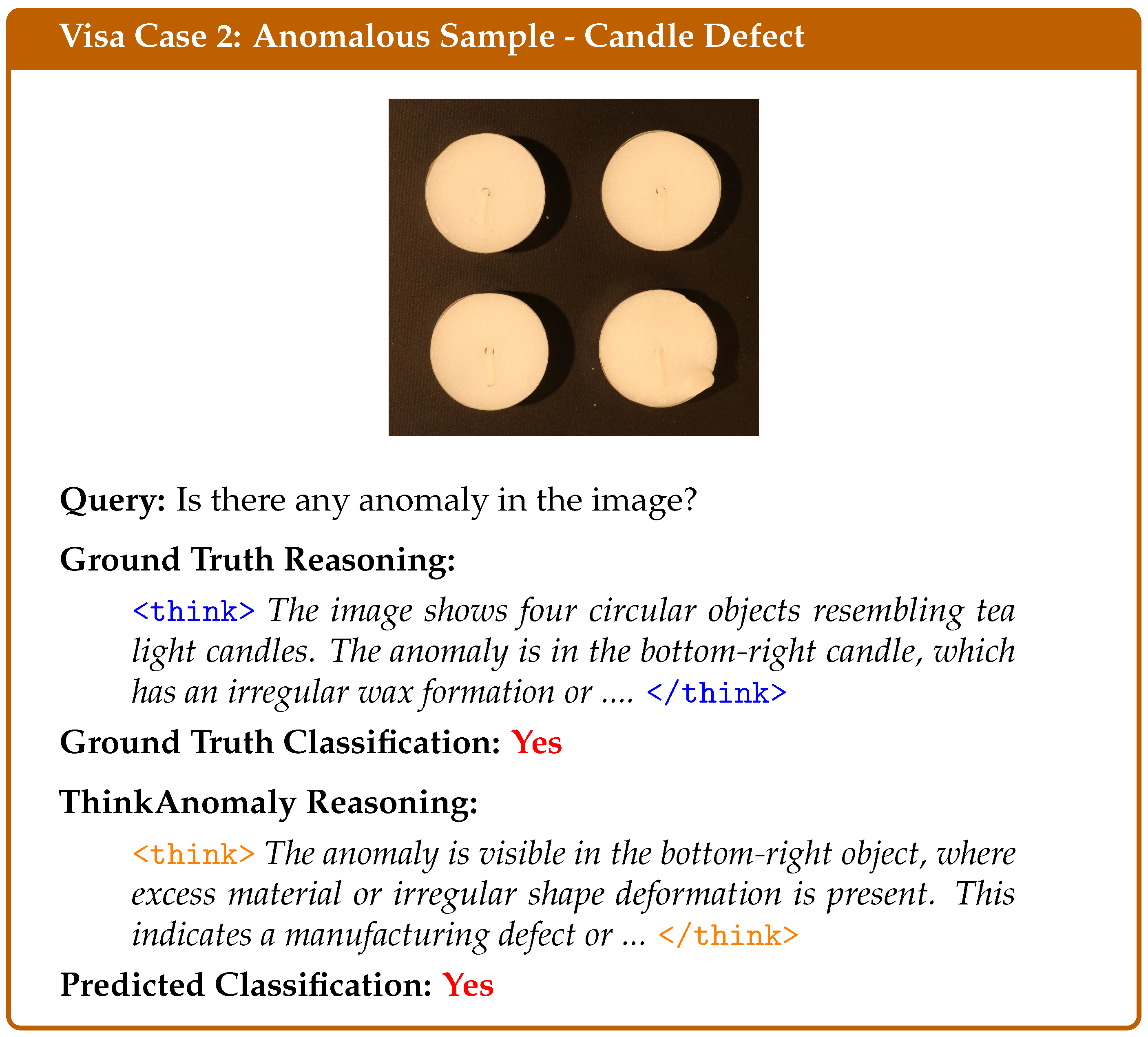
VisA Dataset Analysis. Figure 4 and
Figure 5 showcase ThinkAnomaly’s performance on VisA samples. In Case 1, the model correctly identifies a non-PCB object (macaroni) and appropriately concludes no PCB-related anomalies exist, demonstrating contextual awareness. The reasoning closely parallels the ground truth while using alternative phrasing (“unrelated to PCB quality analysis” vs. “no anomalies related to PCB quality can be identified”), indicating genuine understanding rather than memorization. Case 2 demonstrates successful defect localization on tea light candles, where both ground truth and prediction identify the bottom-right object’s irregular formation. Notably, ThinkAnomaly extends the analysis by discussing “manufacturing defect or inconsistency in the production process”, providing actionable context beyond mere defect identification.
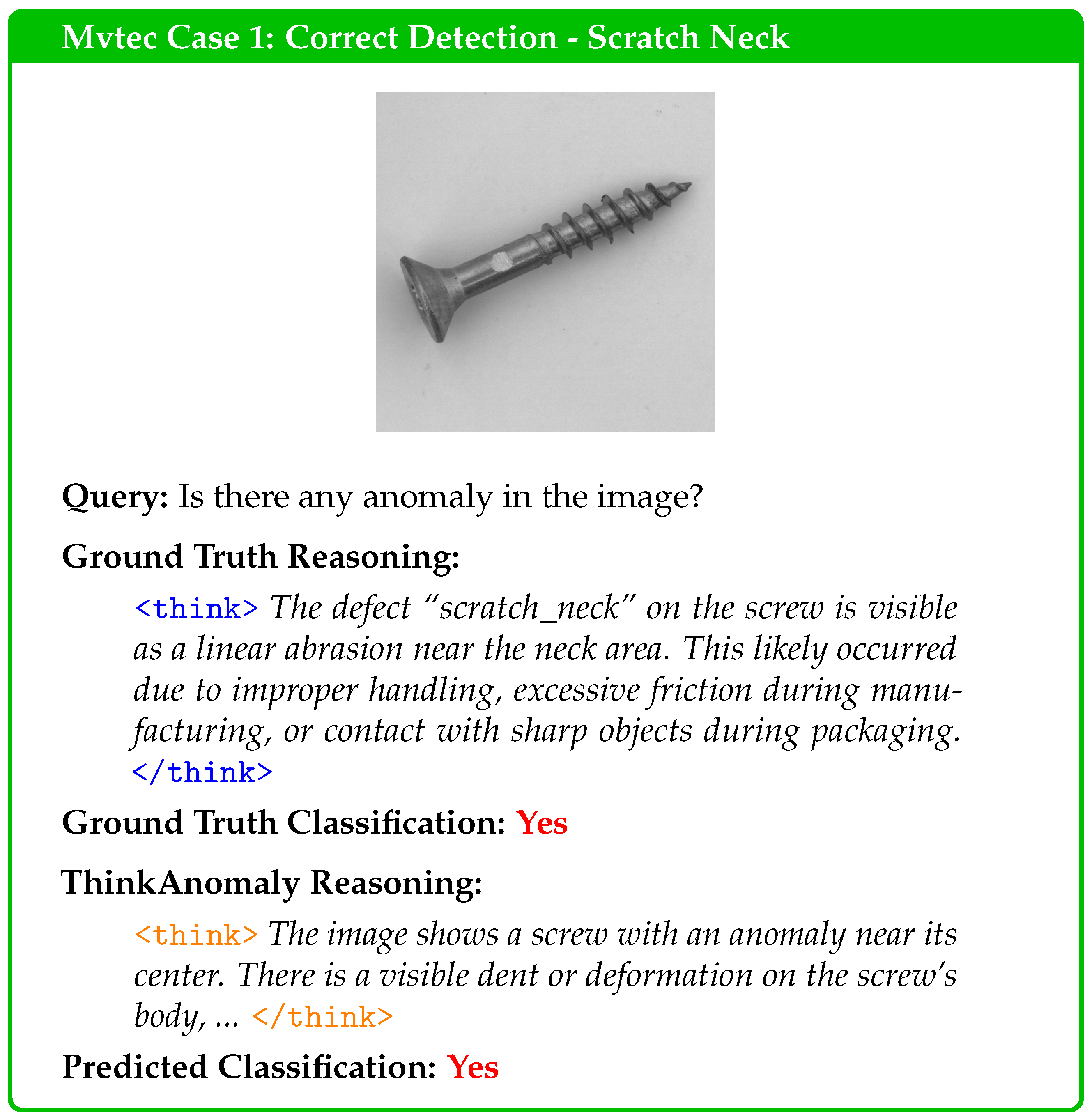
MVTec-AD Dataset Analysis. Figure 6 and
Figure 7 reveal both strengths and limitations on MVTec-AD screw samples. Case 1 demonstrates successful anomaly detection despite imperfect reasoning alignment—the ground truth identifies a “scratch_neck” defect while the prediction describes a “dent or deformation.” Despite this semantic difference in defect characterization, both correctly classify the image as anomalous, suggesting the model captures the essential abnormality even when the precise defect type identification varies. This robustness to reasoning variation is valuable for real-world deployment, where exact defect taxonomy may be less critical than binary quality assessment.
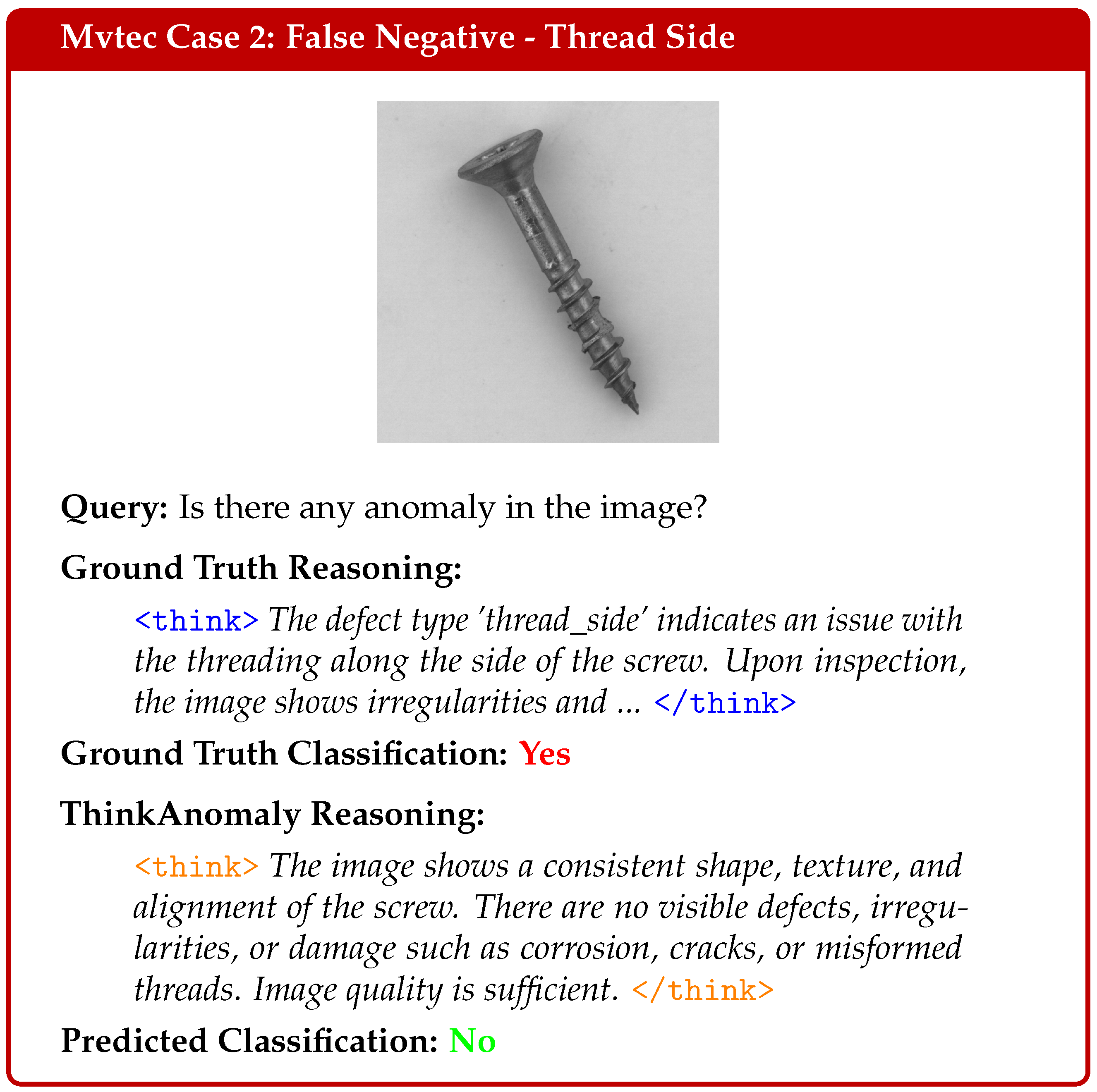
However, Case 2 (
Figure 7) reveals a critical failure mode: the model incorrectly classifies a thread deformation defect as normal. The ground truth reasoning explains manufacturing errors causing “irregularities and deformation in the threading,” while ThinkAnomaly’s reasoning describes “consistent shape, texture, and alignment” with “no visible defects.” This false negative demonstrates that subtle thread defects remain challenging for the model, likely due to the fine-grained visual discrimination required to detect threading irregularities in screw components. Such failures highlight the importance of continued model refinement for high-precision industrial applications.
7.5. Failure Analysis
To understand the model limitations, we analyzed all error cases and present the per-category breakdown in
Table 10.
Key findings: (1) Texture categories generally achieve higher accuracy than object categories, with failures predominantly arising from over-sensitivity to natural variations inherent in materials like carpet, leather, and wood. (2) False negative rate exhibits strong correlation with defect size: small defects occupying less than 5% of image area show 14.2% FNR, while large defects exceeding 15% of image area demonstrate only 2.1% FNR. (3) Structural and geometric anomalies, such as thread deformation and component bending, present significantly higher detection difficulty with 12.4% FNR compared to surface defects including scratches and contamination at 3.9% FNR. (4) The screw and cable categories exhibit the highest error rates, with FNRs of 11.5% and 12.5%, respectively, primarily attributable to subtle structural defects requiring fine-grained spatial reasoning capabilities. (5) Systematic manual analysis of 105 failure cases reveals five distinct failure modes: subtle structural defects (41%), ambiguous normal variation (28%), small-scale defects (18%), lighting artifacts (9%), and complex multi-defect scenarios (4%). These failure patterns indicate that future improvements should prioritize multi-scale visual feature extraction and dedicated geometric reasoning modules for enhanced structural anomaly detection capabilities.
8. Conclusions
We presented ThinkAnomaly, a reasoning-driven framework for industrial anomaly detection that fundamentally shifts the paradigm from black-box predictions to interpretable explanation-first decision-making. By training vision–language models to explicitly generate structured reasoning before classification, our approach addresses two critical gaps in industrial anomaly detection: the lack of interpretability in existing methods and the reliance on manual threshold tuning for deployment. Our key contributions establish new directions for explainable anomaly detection. First, we introduced comprehensive Chain-of-Thought datasets for MVTec-AD and VisA, comprising over 16,000 reasoning explanations that were synthetically generated, automatically filtered, and human-validated by domain experts. This resource enables future research in reasoning-capable industrial inspection systems. Second, our ThinkAnomaly architecture demonstrates that explicit reasoning improves both accuracy and trustworthiness, achieving 93.9% accuracy on MVTec-AD and 90.3% on VisA—representing 7.8 and 12.9 percentage point improvements over the strongest vision-language baseline, respectively. However, several limitations warrant acknowledgment. First, our approach currently focuses on image-level classification rather than pixel-precise localization, which may be necessary for certain inspection workflows. Second, the reasoning quality varies between datasets, with MVTec-AD showing lower lexical alignment (BLEU-1: 0.276) compared to VisA (0.559), suggesting opportunities for dataset-specific optimization. Third, while our synthetic reasoning generation achieves high expert validation rates (91.8–94.2%), the quality ceiling is bounded by the capabilities of the generating model and the specificity of the domain prompts.
Future research directions include extending ThinkAnomaly to pixel-level reasoning and localization, exploring multi-stage reasoning for complex defect analysis, and investigating active learning strategies that leverage reasoning quality to guide human annotation efforts. Additionally, deploying ThinkAnomaly in real manufacturing environments will provide valuable insights into human-AI collaboration patterns and reveal opportunities for reasoning-guided corrective actions. Cross-domain transfer of reasoning capabilities—training on synthetic data and one industrial domain while generalizing to others—represents another promising direction for reducing annotation requirements in new deployment scenarios. In conclusion, ThinkAnomaly demonstrates that incorporating explicit reasoning into anomaly detection improves both performance and interpretability. By bridging the gap between high-accuracy detection and human-understandable explanations, our work advances toward trustworthy AI systems suitable for safety-critical industrial applications where understanding why a decision was made is as important as the decision itself. Although our present framework focuses on image-level anomaly classification, the structured reasoning process can be naturally extended to pixel-level localization. By aligning generated rationales with spatial attention maps or visual token activations, future versions of ThinkAnomaly can produce localized “reasoning heatmaps.” Such reasoning-guided localization would enable interpretable visual explanations analogous to Grad-CAM but textually grounded.




 ,
,