Abstract
As an important basic material for modern industry, the performance and production energy consumption of medium and thick plates have an important impact on engineering quality, industry technological progress and economic benefits. However, traditional process parameter adjustment relies on manual experience, which is difficult to meet the dual needs of efficient production and energy conservation and emission reduction. This paper focuses on the energy consumption optimization problem in the production process of medium and thick plates. Under the premise of meeting the mechanical property constraints, a data-driven process parameter optimization method is proposed. Firstly, a comprehensive energy consumption prediction model for medium and thick plates is established. Secondly, based on historical data and knowledge, a data set covering chemical composition, physical parameters and process parameters is constructed, and a mechanical property prediction model is developed to achieve the prediction of actual performance. On this basis, the energy consumption minimization problem that satisfies mechanical property constraints is modeled as a constrained optimization problem, and a data-inspired initialized particle swarm optimization algorithm is designed to improve the global search capability and local convergence efficiency. Experimental results confirm that the proposed model provides more stable and accurate prediction of mechanical properties than conventional Random Forest and XGBoost models. Furthermore, compared with standard PSO, GA, SA, and ACO algorithms, the data-inspired initialized particle swarm optimization shows faster convergence and better energy-saving performance, demonstrating the overall effectiveness and practical potential of the proposed framework.
Keywords:
optimization design; medium and thick plates; energy saving; mechanical performance; data-driven modeling MSC:
68T20
1. Introduction
Medium and thick plates are important basic materials for modern industry and are widely used in construction, shipbuilding, energy, machinery manufacturing and other fields [1,2,3]. Its high strength, excellent toughness and reliable welding performance make it the preferred material for bearing heavy loads and high pressure. With the rise of renewable energy, marine development and intelligent manufacturing, the demand for medium and thick plates will grow further. For example, in wind turbine towers and offshore wind power foundations, ultra-thick, high-strength medium and thick plates have become core materials. To highlight the practical relevance of this study, several representative engineering applications of medium and thick plates [4,5,6] are summarized in Table 1. The performance of medium and thick plates is crucial, which not only affects the quality and safety of the project, but also affects the technological progress and economic benefits of the industry [7,8,9].
Table 1.
Recent practical applications of medium and thick steel plates in engineering.
In the production process of medium and thick plates, the selection of process parameters has a decisive influence on product performance and energy consumption level. Reasonable process parameters can not only optimize product performance, such as improving strength, toughness and uniformity, but also significantly reduce energy consumption, thereby reducing production costs, and are also related to resource utilization efficiency and environmental sustainability [10,11,12]. Therefore, achieving the organic unity of excellent performance and low cost has become the core goal of medium and thick plate production. This requires comprehensive consideration of material properties, production efficiency and energy conservation and emission reduction in process design to achieve a win-win situation of technical and economic benefits.
Traditional process parameter adjustment usually relies on experience or trial and error. This method not only consumes a lot of manpower and time, but may also lead to low production efficiency and waste of resources. With the rapid development of big data and artificial intelligence technology, process optimization has ushered in a new opportunity [13,14,15,16]. For example, Ref. [17] investigated the hot straightening process of medium-thick plates and found that both the straightening temperature and the platen speed significantly influence residual stress and curvature of the plate section during correction. Ref. [18] quantitatively demonstrated that optimizing the rolling temperature gradient from 850 °C to 950 °C in the gradient temperature rolling process refined the central grain size of ultra-heavy plates and improved the tensile strength by about 8%, indicating the strong influence of process parameters on plate performance. These technologies can quickly locate potential optimization directions by analyzing massive data and complex process variables, which not only saves time and cost, and significantly reduces the cost of trial and error, but more importantly, it can dig out the optimal parameter combination that is difficult to find by relying on experience or trial and error, thereby greatly improving production efficiency and product quality, and injecting new vitality into industrial manufacturing.
With the continuous advancement of hybrid and adaptive metaheuristic optimization algorithms, parameter estimation has played an increasingly important role in various energy systems such as fuel cells, batteries, and photovoltaic devices. For instance, Ref. [19] combined the Lambert W-function with a Weighted Velocity-Guided Grey Wolf Optimizer to accurately estimate the five unknown parameters of the solar photovoltaic single-diode model, demonstrating the method’s effectiveness in precise modeling of PV systems. Similarly, Ref. [20] developed a hybrid optimization framework integrating multi-physics modeling, AdaBoost-based machine learning, and an improved Grey Wolf Optimizer to optimize the channel structure of proton exchange membrane fuel cells, achieving high prediction accuracy and enhanced power density. Ref. [21] enhanced the Salp Swarm Algorithm with chaotic mapping and dynamic learning mechanisms to optimize the energy consumption of fuel cell cathode purge processes, achieving a 3.6–8.2% reduction in energy use under complex constraints. These studies demonstrate that accurate parameter estimation provides methodological feasibility for data-driven process parameter optimization, laying the foundation for intelligent manufacturing of medium and thick plates.
In recent years, data-driven approaches for process parameter optimization have been extensively explored, yielding remarkable results, benefiting from the rapid advancement of parameter estimation algorithms in energy systems [22,23]. For example, Ref. [24] demonstrated the application of an artificial neural network enabled over 94% prediction accuracy of the thermal stability of medium-thick aluminum alloy plates, reducing experimental workload and cost by more than 50%. Ref. [25] demonstrated that a data-driven modelling and optimization framework can significantly enhance the quality and efficiency of medium-thick plate products, achieving a geometric error of less than 0.29° and a structural weight reduction of 14.77%, thereby ensuring precise control and improved material utilization. Ref. [26] introduced a method that integrates neural networks with genetic algorithms to rapidly determine the optimal key process parameters for particle board production, taking into account the current operating conditions and production stages. Ref. [27] proposed a multi-input and multi-output injection molding process parameter optimization method based on soft computing, which can effectively help engineers determine the optimal process parameters. Ref. [28] proposed a variety of experimental and statistical design methods based on the fused deposition modeling (FDM) modeling technology to optimize FDM process parameters. Ref. [29] proposed a directional Gaussian smoothing evolutionary strategy, which improves training efficiency and avoids premature convergence through high-accuracy gradient estimation and nonlocal search directions. Ref. [30] established a process parameter optimization model for hot forged spur gears, the Kriging model and improved simulated annealing algorithm were used to optimize key parameters, successfully reducing the excess metal volume during the hot forging process. Ref. [31] employed variable-population evolutionary sampling and coordinate discretization to effectively transform continuous optimization into discrete optimization, thereby improving the efficiency and accuracy of solving multimodal complex problems such as logistics distribution.
However, energy-consumption-oriented process optimization for medium and thick plate production faces unique challenges due to strong coupling among chemical composition, deformation parameters, thermal history, and microstructure evolution. In industrial practice, mechanical performance is always the primary constraint, meaning that any energy-saving strategy must ensure reliable strength, toughness, and forming quality. Therefore, the core difficulty lies not merely in reducing energy usage but in achieving energy-efficient processing without compromising performance.
The key scientific problem is how to achieve performance-constrained energy consumption minimization under complex industrial process conditions. This involves three key problems:
- Existing models often describe mechanical properties and energy consumption separately. However, performance formation mechanisms are strongly correlated with energy usage. A unified predictive model that couples energy consumption and mechanical properties is required.
- The optimal solution must lie within a feasible space constrained by historical production data, rolling schedules, equipment capability, and quality standards. Constructing an industrial-feasible solution space that excludes invalid parameter combinations remains difficult.
- Even with data-driven prediction models, the optimization problem becomes a high-dimensional, non-convex, black-box search problem lacking analytic gradients. As a result, classical convex optimization methods are ineffective, requiring specialized heuristic algorithms capable of utilizing historical data to guide the search.
In order to optimize the process parameter selection problem with the minimum energy consumption in the production process of medium and thick plates, this paper constructs a data set covering chemical parameters, physical parameters and main process parameters based on historical data and domain knowledge, and establishes a mechanical property prediction model based on Local Cascade Ensemble (LCE) method, under the premise of satisfying mechanical property constraints. Since the index function and constraint conditions are derived from the model trained with historical data, the optimization process can make full use of the guidance of prior knowledge and historical data. Based on this, this paper proposes a heuristic optimization algorithm, which effectively integrates historical data and domain knowledge into the optimization process by designing high-quality initial particle distribution, gets rid of the dependence on the analytical properties of the objective function, and enhances the global search capability and improves the local convergence efficiency.
Based on the gas energy consumption prediction model and the electricity consumption prediction model, the energy consumption prediction model for medium and thick plates is established. A training data set for the mechanical properties prediction model of medium and thick plates is created, and a LCE prediction model is constructed, achieving accurate predictions of hardness, tensile strength, impact toughness, and yield strength. The energy consumption minimization problem, subject to mechanical property constraints, is modeled as a constrained optimization problem. A data-inspired initialized particle swarm optimization algorithm (DIIPSO) is designed. This algorithm reduces the feasible solution space by utilizing historical data and designs the initial position and initial velocity of particles based on historical data, thereby improving the efficiency and accuracy of the optimization process.
The rest of this paper is organized as follows: Section 2 gives the prediction model of the medium and thick plate energy consumption. Section 3 establishes a medium and thick plate mechanical property prediction model based on LCE. Section 4 provides a modeling method and solution method for process parameter optimization problems aimed at energy saving and mechanical property requirements. Section 5 is an experimental verification and result analysis. Section 6 summarizes the contents of this paper and looks forward to future work.
2. Establishment of Energy Consumption Prediction Model for Medium and Thick Plates
The production of medium and heavy plates involves multiple forms of energy consumption, including gas consumption, electricity consumption, nitrogen consumption, compressed air consumption, and water energy consumption. Among these, gas consumption accounts for about 80%, and electricity consumption ranges between 10% and 15%, which together constitute the majority, while other forms of energy consumption account for a smaller proportion, they also have a significant impact on production costs. This section establishes a predictive model for the overall energy consumption of medium and heavy plates.
For a specific steel grade, let , , and represent the gas energy consumption, electricity energy consumption, and other energy consumption of a steel billet, respectively. And represents the predicted value of , . Assume that these units have been standardized (e.g., all in kilojoules). Therefore, the predicted energy consumption per ton of steel is given by:
where , , and m represents the mass of the steel billet.
The values of and can be given based on mechanisms and data. Below is the method for calculating . Due to the complex mechanism, it can only be modeled from a data-driven perspective. Assume we have a historical dataset:
where represents the total energy consumption per ton of steel, represents the gas energy consumption per ton of steel, and represents the electricity energy consumption per ton of steel. Based on these dataset, we provide the method for calculating . The following model is established:
where represents the ratio of other energy consumption to gas energy consumption, and is a random variable representing the error; represents the ratio of other energy consumption to electricity energy consumption, and is a random error term.
Construct the following matrices:
Using the least squares algorithm, the estimates of and can be obtained:
Based on this, and Equations (3) and (4), we can give the fusion algorithm for calculating :
where is a weight that can be adjusted based on actual conditions and expert experience.
By combining Equations (1) and (8), the predictive model for the total energy consumption per ton of steel is:
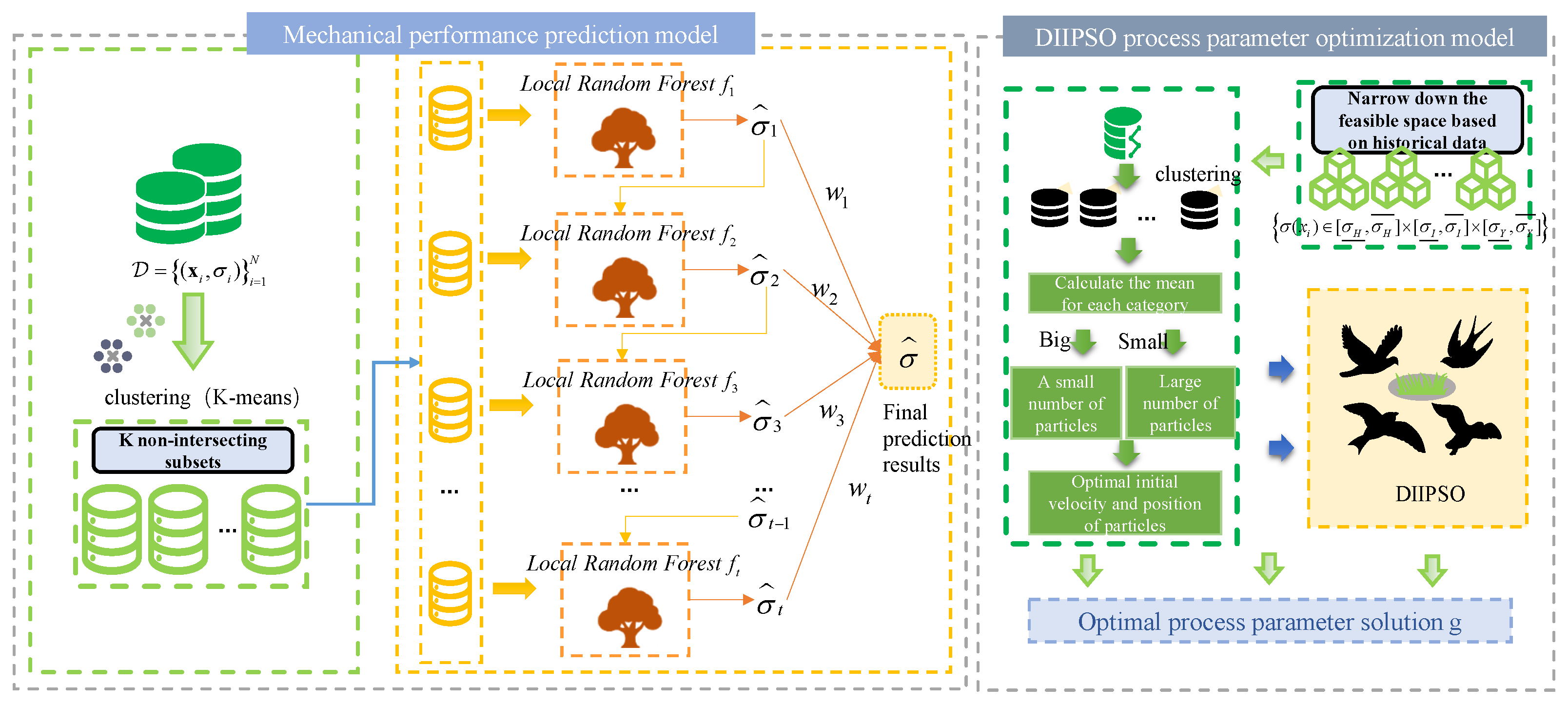
Based on the above research, this paper is structured around two core components. The first component focuses on the construction of data-driven prediction models, including an energy consumption prediction model and a mechanical property prediction model. The energy consumption model comprehensively considers the relationships among gas consumption, electricity consumption, and other types of energy usage to evaluate the total energy consumption under different process parameters. The mechanical property prediction model, based on the LCE method, is developed to predict hardness, tensile strength, impact toughness, and yield strength. The second component is the process parameter optimization module. Supported by the prediction models, the energy consumption minimization problem is formulated as a constrained optimization problem under mechanical property requirements. A DIIPSO is proposed, which enhances optimization efficiency and accuracy by constructing a feasible solution space and high-quality initial particle distribution. The overall research framework is illustrated in Figure 1, representing a complete closed-loop process from modeling to optimization, and offering a systematic solution for intelligent process parameter optimization in medium and heavy plate production.
Figure 1.
Overall Framework Diagram.
3. Construction of Mechanical Properties Prediction Model for Medium and Thick Plates Based on LCE
3.1. Dataset Creation
The chemical composition, physical parameters and process parameters of a steel billet can be expressed as:
where represents the mass fraction of carbon, silicon, manganese, phosphorus, sulfur, nickel, vanadium, titanium, molybdenum and chromium contained in the steel billet. m represents the mass of the steel billet. Indicates the length, width, thickness, out-of-furnace temperature and in-furnace temperature of the steel billet. , . Here, is a vector representing various temperatures specified in the rolling schedule, such as the start rolling temperature, the final rolling temperature, etc.; Indicates the set reduction amount for each pass of rough rolling; Indicates the set reduction amount for each pass of finishing rolling; , Indicates the set width in each pass of rough rolling and finishing rolling; and represent the initial thickness and target thickness of rolling, respectively.
Consider the mechanical properties of the finished product after billet rolling: Hardness (Hardness, ), Tensile Strength (Tensile Strength, ), Impact Toughness (Impact Toughness, ), Yield Strength (Yield Strength, ). To express the correlation between these properties and the chemical composition, physical parameters and process parameters of the billet, we also record , , , , and write them as a vector, i.e.,
Based on historical data, create a data set:
This data set has N pieces of data, each piece of data represents the corresponding relationship between various parameters of a steel billet and the mechanical properties of the finished product after rolling. Before using the data set, necessary preprocessing is very important, which will not be described here.
3.2. Construction of LCE Prediction Model for Mechanical Properties of Medium and Thick Plates
Considering that LCE has strong flexibility and adaptability, and is suitable for complex nonlinear regression problems [32], this section uses LCE to establish a mechanical properties prediction model for medium and thick plates. LCE captures local and global patterns of data in layers through local modeling and cascade fusion, and improves overall performance by optimizing the objective function.
LCE combines the boosting-bagging approach to deal with the bias-variance trade-off faced by machine learning models. In addition, it adopts a divide-and-conquer approach to personalize the prediction errors of different parts of the training data.
The detailed formulation of the LCE model is outlined in Appendix A.
4. Process Parameter Optimization for Energy Saving and Mechanical Performance Requirements
4.1. Modeling of Process Parameter Optimization Problems
When calculating the energy consumption prediction value of steel billet , we need to calculate the gas energy consumption and the electricity consumption separately, and then combine them according to (9). When calculating , not all elements of are used, but the used elements are selected according to the prediction algorithm of and a new vector is formed, and then the calculation is given. The calculation of is similar. To show the corresponding relationship between the prediction value and the steel billet, is also written as .
How to select process parameters to minimize energy consumption while meeting mechanical performance requirements? This can be described as the following constrained optimization problem:
These constraints ensure that the optimized parameters do not compromise product quality. Specifically, the hardness , tensile strength , impact energy , and yield strength must all fall within their required specification ranges, denoted by . The feasible set represents the allowable parameter space for . is the expected range of mechanical properties, .
In the above optimization problem, the determination of the feasible space is usually divided into two steps: (1) Give an initial feasible set based on experience; (2) Take the convex hull of as the feasible space , i.e.,
where represents the set of positive integers.
4.2. DIIPSO Solution Algorithm Design
Hybrid meta-heuristic optimization algorithms have shown great effectiveness in the energy sector by combining the global search capability of swarm intelligence with the local refinement ability of evolutionary strategies. For instance, the integration of Particle Swarm Optimization with Grey Wolf Optimizer has been successfully applied to optimize Solid Oxide Fuel Cell operating parameters, achieving higher prediction accuracy, faster convergence, and more stable performance compared with single optimization methods [33]. Hybrid optimization algorithms combining global and local search strategies, such as the integration of the Flower Pollination Algorithm with the Nelder–Mead simplex method and opposition-based learning, have been proven effective for accurately estimating parameters of solar cells and photovoltaic modules [34]. This section solves the optimization Problem (13)–(17). Due to the lack of clear analytical forms for the expressions of and , traditional optimization methods that rely on gradient or second-order information (such as gradient descent or quasi–Newton method) are difficult to apply directly. Such methods usually require the objective function to have good differentiability or clear gradient expressions in order to determine the update direction and step size in each iteration. However, in the face of the complexity of the current problem and the non-analytical characteristics of the objective function, we need to adopt a more flexible method. Based on this, this paper chooses a heuristic optimization algorithm to get rid of the dependence on the analytical properties of the objective function so as to effectively solve the problem and find the optimal solution.
The particle swarm optimization algorithm has the advantages of being simple and easy to implement and having strong global search capabilities. It can efficiently handle continuous, discrete, multimodal and non-differentiable optimization problems, and does not rely on gradient information. It has fast convergence and good robustness, and is suitable for parallel computing and dynamic optimization scenarios [35]. This paper selects it as the basic algorithm.
The selection of initial particles is crucial in the particle swarm optimization algorithm, and has a direct impact on the convergence speed, global search capability, and quality of the final solution. High-quality initial particles can not only accelerate the convergence of the algorithm, but also effectively reduce invalid search operations, thereby improving the optimization efficiency. In this paper, and are both models trained based on historical data, which means that the optimization process can use prior knowledge or historical data information to guide the distribution of initial particles.
The heuristic initialization strategy can be used to reasonably distribute particles in the potential optimal solution area, which helps to significantly improve the algorithm performance. However, in order to take into account both global exploration capabilities and local search efficiency, the initial particle distribution must strike a balance between diversity and concentration. On the one hand, particles need to cover the entire search space to ensure the possibility of a global optimal solution; on the other hand, particles need to be concentrated in the area near the optimal solution to accelerate the local search and optimization process. Therefore, a hybrid strategy combining random initialization and domain knowledge can effectively improve the search efficiency and solution quality of the particle swarm algorithm.
Based on the above analysis, this section proposes a data-inspired initialization particle swarm optimization algorithm (DIIPSO). This method uses historical data and domain knowledge to design the distribution of initial particles, taking into account both global search and local convergence requirements, thereby greatly improving optimization performance and stability.
DIIPSO is divided into the following steps:
Step 1: Use historical data to narrow down the feasible space
For a given set of constraints , , , , , , Select data that meet these conditions from the training set of , i.e.,
In the above formula, × represents the Cartesian product of the set. This means that the data outside does not satisfy the constraints and cannot be the solution to the optimization problem. Therefore, the convex hull of is used as the feasible space of the optimization Problem (13)–(17). So,
Comparing the above formula with (18), we can find that the feasible space has been reduced. This adjustment can improve the optimization efficiency, reduce invalid search operations, accelerate the convergence process of the algorithm, and further improve the quality of the solution and the stability of the algorithm.
Step 2: Use historical data to select the initial state and initial velocity of the particle
According to the actual computing resources, the population size is given. The position of the jth particle is recorded as ; The speed (update direction and amplitude) is recorded as .
Since and are models obtained from data training, their values in the training set are known and accurate. Therefore, the training set can be fully utilized to give the initial state and initial velocity of the particle. Suppose the training set of is (The training of is actually divided into the training of and , and the training of these two uses different parts of for learning. According to the process in Section 2 and Section 3, it can be seen that the two together just cover the entire vector . The training set of mentioned here is obtained by merging the separately trained data sets). Take
then is a subset of the feasible solution space of the optimization problem (13)–(17), and the values of and on it are known.
Generally speaking, the number of elements in is much larger than . Cluster , set the number of clusters to:
where represents the upper integer function. According to the size of the cluster center, the clustered set is sorted in descending order, and the sorted set is recorded as . According to these sets, is classified, i.e.,
The goal of the optimization problem is to minimize , and the value of on , , …, shows a decreasing trend. This indicates that the potential optimal solution is more likely to be located in the area close to . Therefore, when initializing particles, according to the decreasing characteristics of , the number of particles is reasonably allocated, so that the distribution of particles in , , …, shows an increasing trend, thereby more efficiently guiding the search to the optimal solution area and improving the optimization effect. According to this idea, randomly select elements from , ; randomly select elements from , i.e.,
Taking these extracted elements as the initial state of the particle , the closer to the potential optimal region, the greater the number of initial particles. When is an integer, the distribution of the initial particles can be seen:
Since the optimal solution is more likely to be located in the area close to , then the initial velocity is directed to this area, i.e.,
where is an adjustment coefficient, which is adjusted according to the specific situation; represents any initial state located at .
Step 3: Iterative update for obtaining the optimal solution
(1) Velocity and position update:
To prevent excessive updates, a velocity cap is imposed. If the updated position exceeds the feasible domain , it is projected back to the boundary of .
(2) Individual best update:
with initialized as .
(3) Global best update:
The algorithm terminates when the maximum iteration number is reached or the improvement of falls below a threshold, and the final is taken as the approximate optimal solution of problem (13)–(17).
The above can be summarized into the following Algorithm 1:
| Algorithm 1: DIIPSO algorithm |
![]() |
5. Experimental Setup and Results Analysis
5.1. Experimental Setup
The data used in the experiment comes from the medium and thick slab production line of a steel plant. A total of 19,616 data were collected during a certain period, including process parameters such as the furnace discharge temperature, furnace entry temperature, rolling time, rolling pass, etc. of the medium and thick slab during the production process, as well as the mechanical properties and energy consumption of each finished slab.
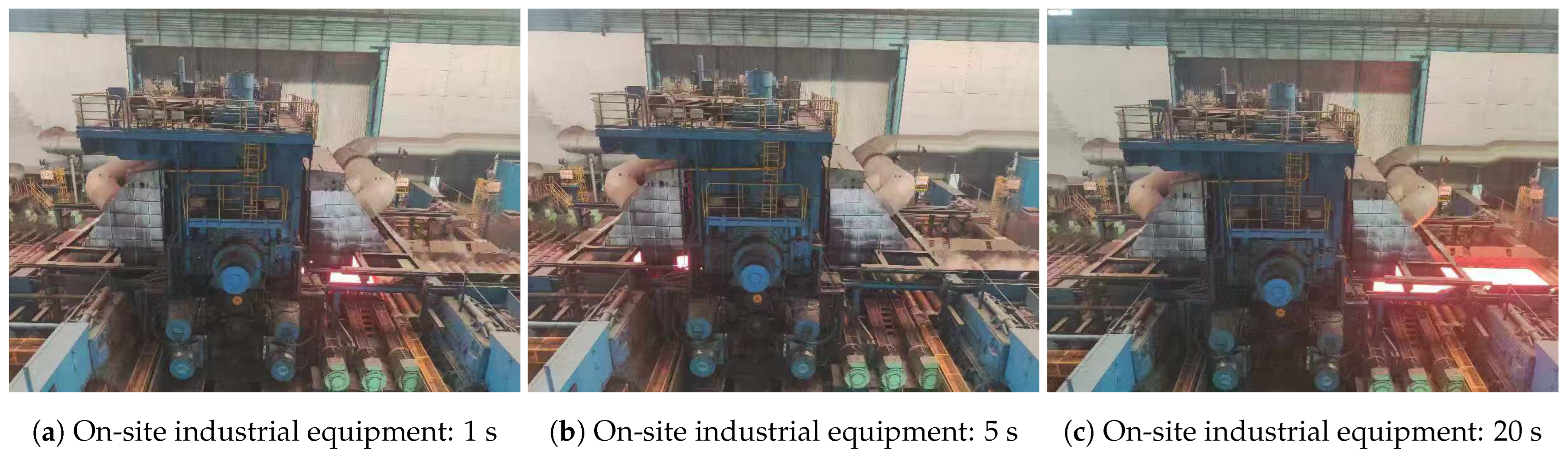
The experimental data were collected directly from on-site industrial equipment in the medium and thick plate production line. To provide a clearer understanding of the production environment where the data were obtained, the photographs of the actual on-site equipment are shown in Figure 2. The figure consists of three subfigures, illustrating different sections of the production setup.
Figure 2.
On-site industrial equipment.
Two experiments were set up to verify the above content. The internal parameters of the algorithms used in this study are given as follows:
- GA: Population size = 50, Crossover rate = 0.8, Mutation rate = 0.05, Max iterations = 300, Selection method: Roulette, Crossover method: Two-point.
- PSO: Population size = 50, Cognitive factor , Social factor , Inertia weight w: , Max iterations = 500.
- DIIPSO: Population size , Maximum iterations , Stop threshold , Energy consumption training set , Mechanical property training set D.
- SA: Population size = 1, Initial temperature , Cooling rate , Max iterations = 600, Acceptance criterion: Boltzmann.
- ACO: Number of ants = 40, Pheromone importance , Heuristic importance , Evaporation rate , Max iterations = 500, Pheromone update: Global.
- RF: Number of trees , Maximum depth , Minimum samples per split .
- XGBoost: Number of estimators , Learning rate = 0.1, Maximum depth = 6, Subsample ratio = 0.8.
- LCE: Number of local models , Local model type: RF (, , ), Cascade layers , Initial weights .
Experiment 1: LCE mechanical properties prediction model performance
This paper uses the LCE model to predict the yield strength, tensile strength, hardness and impact toughness of medium and thick slabs, and compares them with the true values for error analysis. At the same time, the prediction effect of the LCE model is compared with the prediction effect of traditional XGboost and random forest to highlight the advantages of this model.
Experiment 2: DIIPSO solution algorithm performance
This paper compares DIIPSO with the classic particle swarm algorithm (PSO), genetic algorithm (GA), simulated annealing (SA), and ant colony algorithm (ACO). The performance of the DIIPSO algorithm is verified from the two aspects of iteration speed and iteration effect. Since there are many process parameters in the production process of medium and thick plates, here we use the furnace temperature as a representative for experimental demonstration. Since there are many process parameters in the production process of medium and thick plates, here we use the furnace temperature as a representative for experimental demonstration. These four benchmark algorithms were selected because they have wide industrial applications, represent different categories of metaheuristic optimization, perform well on non-convex and black-box problems, and are commonly used in related literature. Additionally, their familiarity among industrial practitioners ensures practical interpretability and engineering feasibility. In this article, the evaluation indicators used are mean absolute error (MAE), root mean square error (RMSE) and accuracy. MAE is used to measure the accuracy of model prediction. It gives the average absolute value of the prediction error, which can intuitively reflect the accuracy of the predicted value deviating from the true value, as given by the following formula:
RMSE is a commonly used metric that measures the difference between the predicted values and the actual values of a model. It reflects the overall level of prediction error—the smaller the value, the better the model’s prediction performance.
The accuracy rate will be calculated by the proportion of samples whose yield strength and tensile strength are within the range of plus or minus 30 MPa, hardness is within the range of plus or minus 2 HRC, and impact energy is within the range of plus or minus 40 J.
5.2. Experimental Results and Analysis
(1) Experimental results and analysis of LCE mechanical properties prediction model
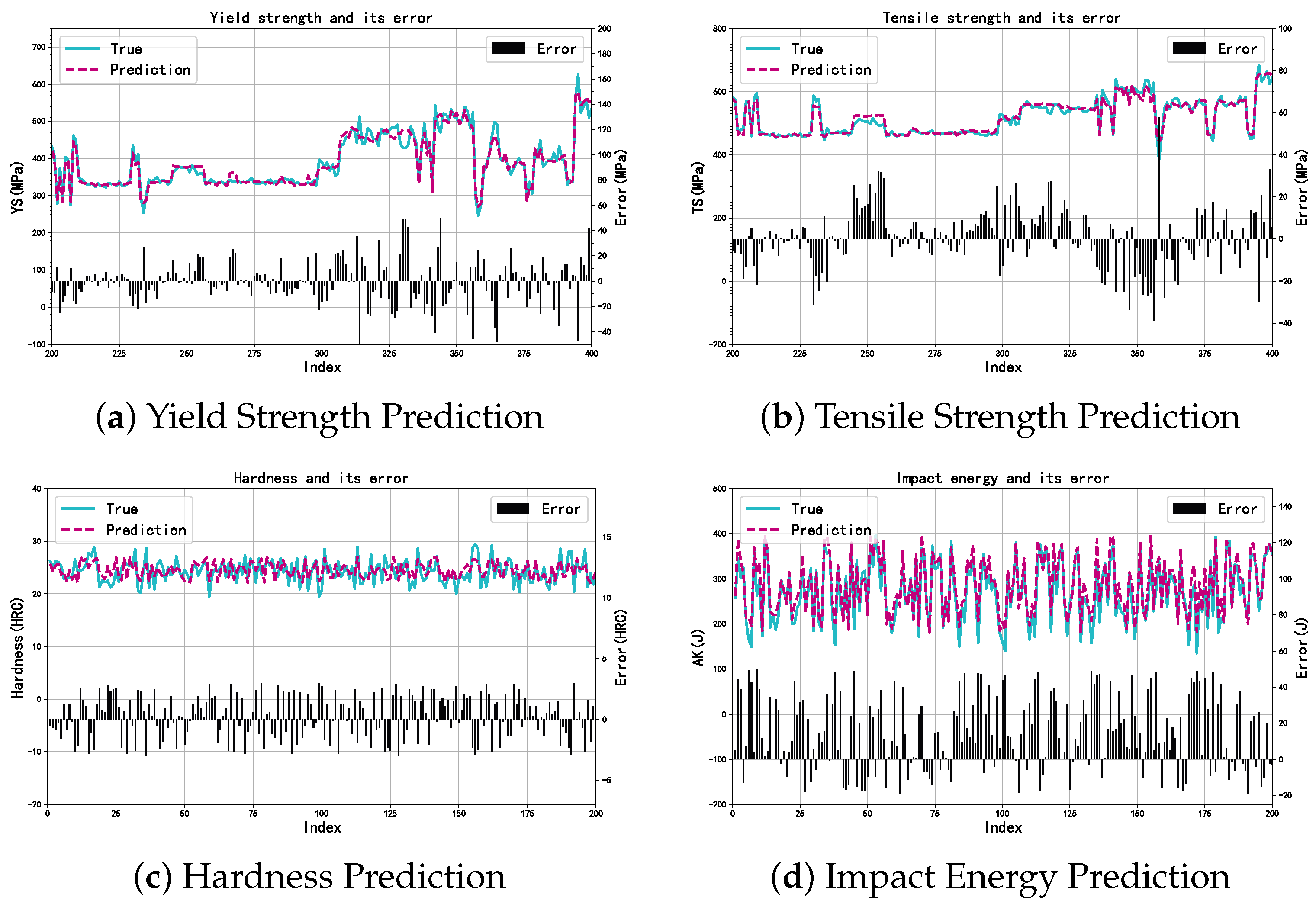
Figure 3 illustrate the prediction performance of the LCE model for yield strength (YS), tensile strength (TS), hardness, and impact toughness (AK). In all four cases, the predicted curves align closely with the corresponding true values, but several important trends and differences can be observed that further clarify the model’s behavior.
Figure 3.
Predictions of Mechanical Properties.
For YS and TS, the predicted values follow the overall shape and fluctuations of the true curves, accurately capturing both the rising and declining trends across different samples. The LCE model reproduces not only the global variation but also the local oscillations around peak and valley regions, suggesting that it successfully learns the underlying nonlinear relationships between process variables and mechanical properties. The deviations between prediction and ground truth remain small and relatively uniform, indicating stable generalization across different strength levels.
For hardness, the LCE model maintains high agreement with the true data while showing slightly larger deviations at several sharp transition points. However, the model consistently preserves the direction and magnitude of the changing trend, especially around sudden increases or decreases. This demonstrates the model’s ability to track rapid mechanical property changes, which are often more challenging to predict due to their sensitivity to process disturbances.
For AK, the prediction accuracy remains high even though impact toughness typically exhibits stronger randomness and larger dispersion. The LCE predictions capture major turning points and maintain consistent proximity to the true values. Notably, the model reduces the prediction error in regions where the true AK values fluctuate significantly, highlighting its robustness when handling properties with inherently higher variability.
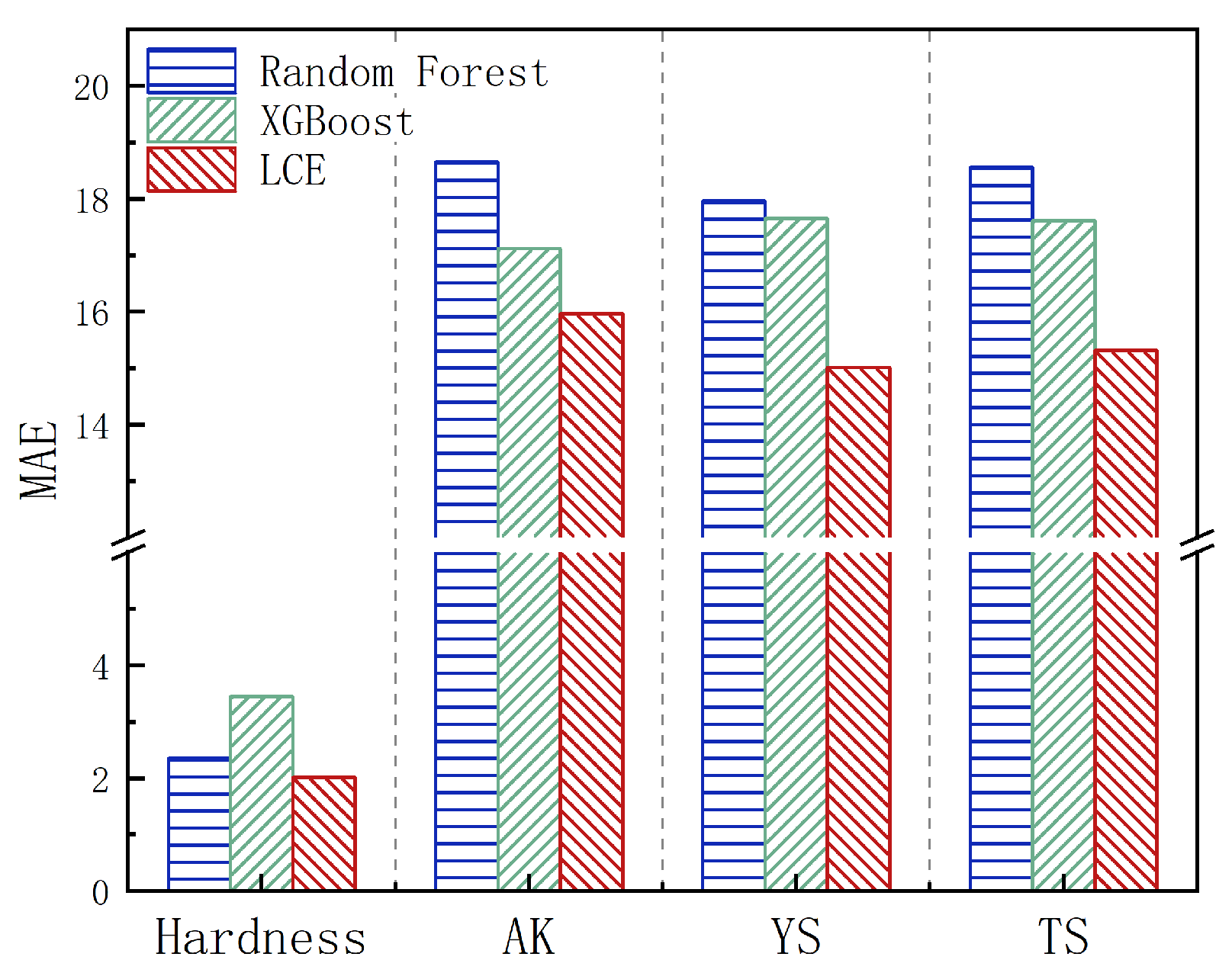
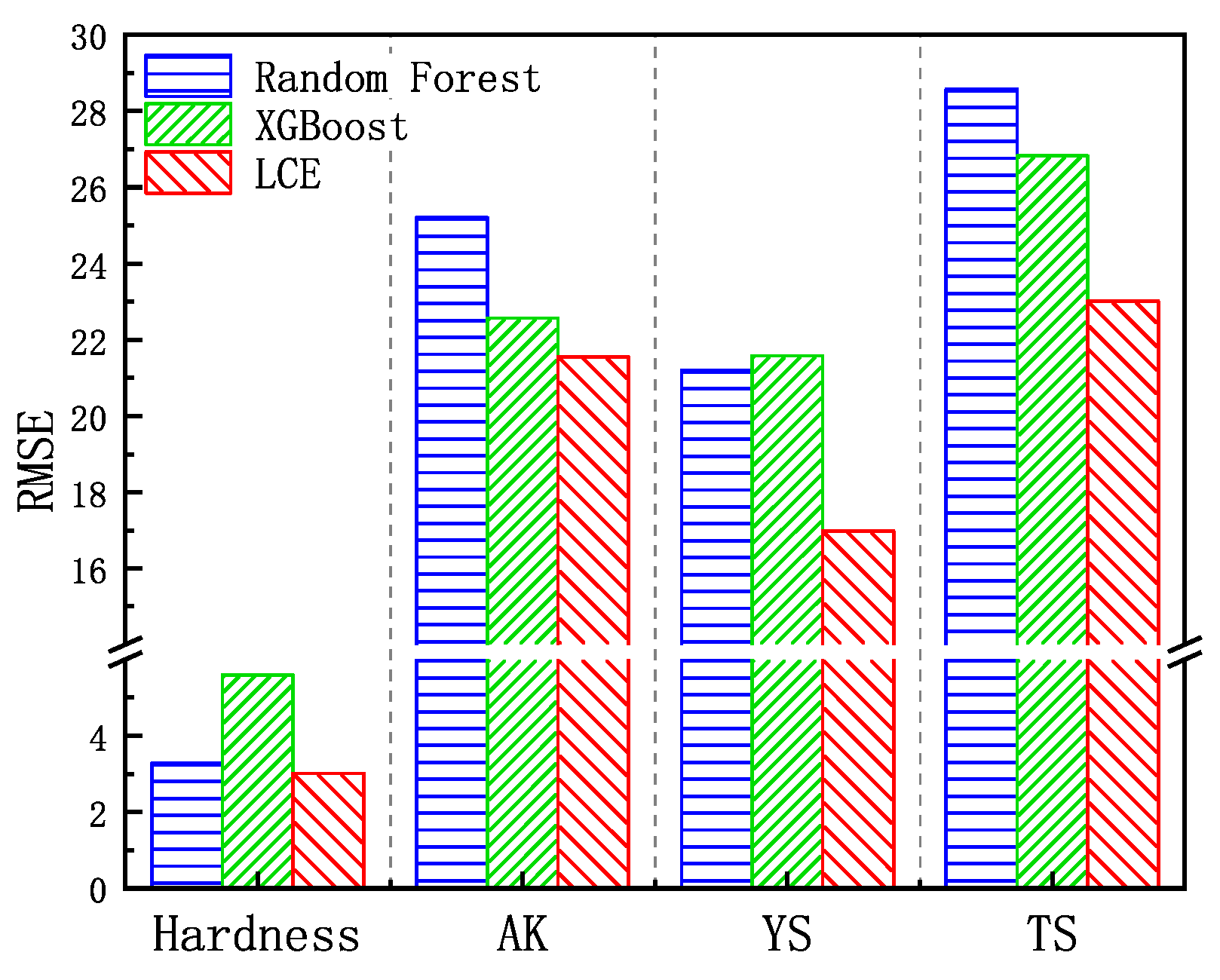
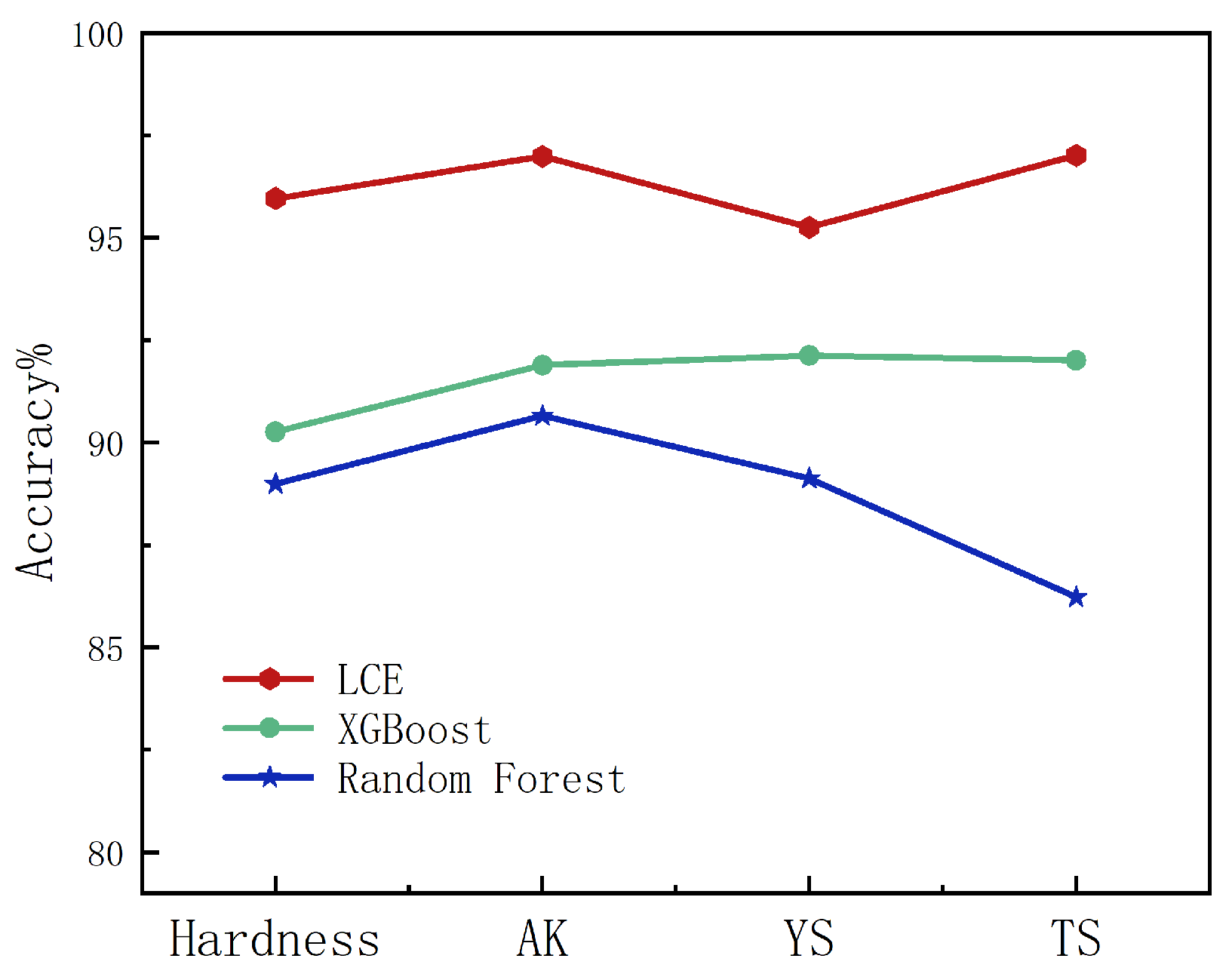
Figure 4 is a comparison of the mean absolute error of the LCE algorithm with that of the random forest and XGBoost in prediction. The results show that the LCE algorithm performs best among all the compared algorithms, and its MAE value is significantly lower than that of the other two algorithms, which verifies the superiority of the LCE algorithm in dealing with the problem of predicting the mechanical properties of medium and thick slabs. As shown in Figure 5, the RMSE values of the LCE model are significantly lower than those of Random Forest and XGBoost. Considering that RMSE penalizes larger errors more heavily due to the square term, this result indicates that the LCE model not only achieves higher overall prediction accuracy but also exhibits better robustness by reducing large deviation cases. Figure 6 is a comparison of the LCE algorithm with the other two algorithms in terms of prediction accuracy. As can be seen from the figure, the LCE algorithm can provide more accurate prediction results.
Figure 4.
MAE comparison chart of LCE, random forest and XGBoost.
Figure 5.
RMSE comparison chart of LCE, random forest and XGBoost.
Figure 6.
Accuracy comparison of LCE, random forest, and XGBoost.
(2) Experimental verification and result analysis of DIIPSO solution algorithm
Table 2 provides a detailed comparison of the iteration speed of five optimization algorithms under different convergence thresholds. A smaller iteration count indicates faster convergence. Several clear trends can be observed:
Table 2.
Comparison of iteration speed of each optimization algorithm on furnace temperature.
- DIIPSO consistently converges with the fewest iterations at all error thresholds. For example, at the strictest threshold (<0.01), DIIPSO requires only 91 iterations, whereas PSO, GA, SA, and ACO require 126, 103, 118, and 115 iterations, respectively.
- The performance gap becomes increasingly significant as the required precision increases. DIIPSO’s iteration count grows at a slower rate than the other algorithms. This indicates stronger stability and convergence efficiency when handling high-precision optimization tasks.
- Traditional algorithms (PSO, GA, SA, ACO) show noticeable sensitivity to precision tightening, with iteration counts increasing sharply at lower error limits (especially PSO and SA). In contrast, DIIPSO maintains a more gradual increase, reflecting more reliable optimization behavior.
Table 3 compares the optimization quality of the five algorithms under fixed iteration numbers, with gas energy consumption used as the performance metric. A lower value indicates better optimization quality.
Table 3.
Comparison of optimization quality of each optimization algorithm on furnace exit temperature.
The following key trends emerge:
- DIIPSO achieves the lowest gas energy consumption at all iteration counts (50, 100, 150, 200). At 200 iterations, DIIPSO attains 208.76, which is significantly lower than PSO (236.47), GA (225.67), SA (220.71), and ACO (221.58).
- DIIPSO demonstrates a faster and more efficient convergence process compared with the other benchmark algorithms.
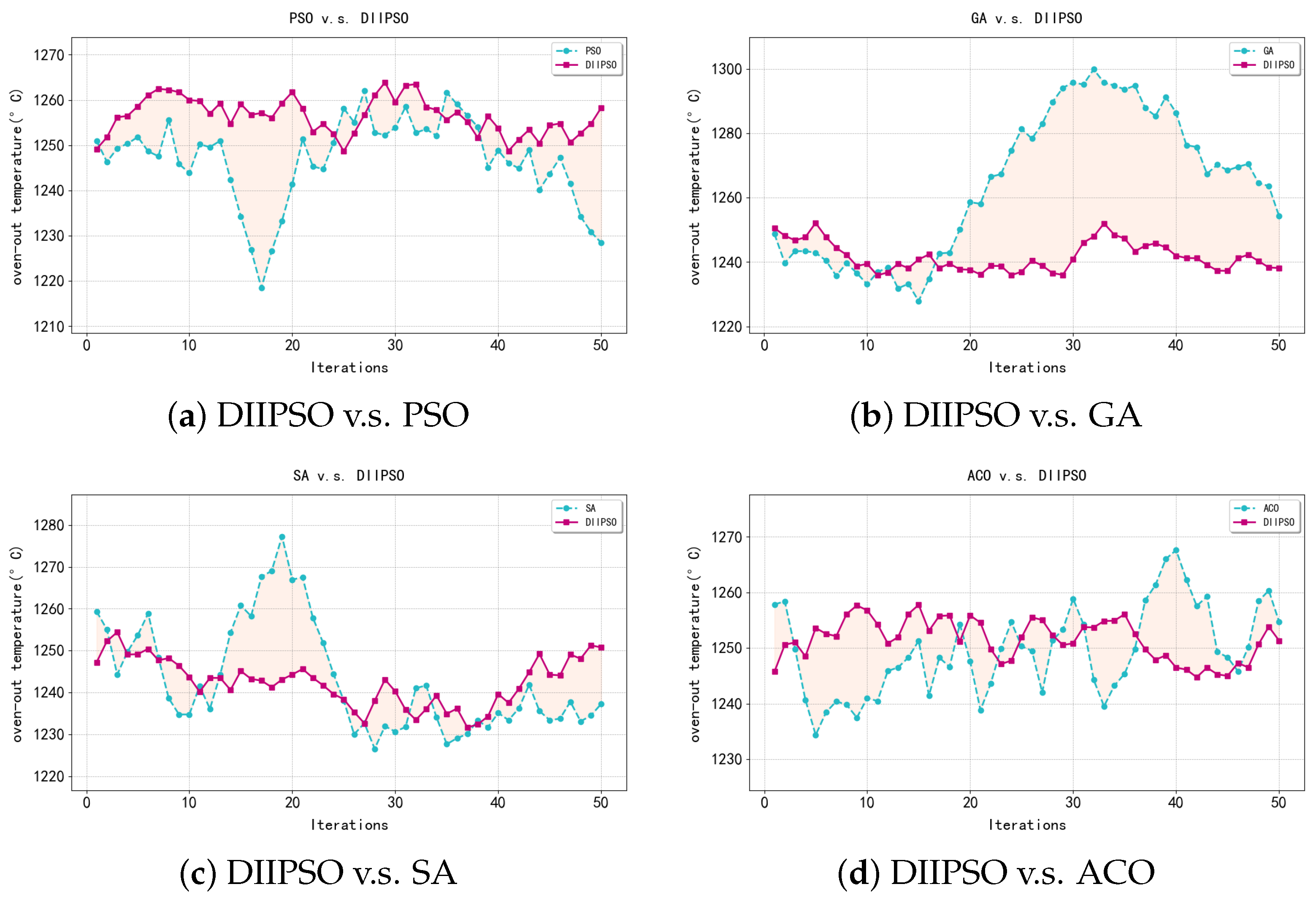
Figure 7a–d shows the performance of DIIPSO in iteration more vividly. The results show that it has obvious advantages in both prediction accuracy and optimization efficiency. Especially in the energy consumption optimization task, the DIIPSO algorithm can effectively reduce energy consumption while ensuring accuracy, and improve the energy-saving effect of the production process.
Figure 7.
Comparison of DIIPSO with four classical optimization algorithms: (a) PSO, (b) GA, (c) SA, and (d) ACO.
To begin with, DIIPSO maintains a smoother and more stable convergence curve, with noticeably fewer fluctuations than GA and SA. This demonstrates better control over the balance between exploration and exploitation, enabling the algorithm to avoid premature local optima. Additionally, the final convergence values achieved by DIIPSO are consistently lower than those of the other algorithms, as shown by the bottom plateaus in each subplot. This means that DIIPSO not only converges faster but also identifies solutions of higher quality, directly aligned with the numerical trends reported in Table 2 and Table 3.
From the algorithmic perspective, this advantage arises from three key mechanisms. First, DIIPSO reduces the search space by constructing a constrained feasible region based on the historical data set and its convex hull, thereby eliminating invalid exploration and accelerating convergence in early iterations. Second, DIIPSO employs a data-driven initialization strategy, where samples are clustered based on predicted energy consumption and particles are initialized within clusters with higher optimization potential. The initial velocity direction is further aligned toward these promising regions, enabling the algorithm to rapidly locate high-quality candidate solutions. Third, DIIPSO balances global exploration and local exploitation through adaptive information interaction and multi-population cooperation, maintaining solution diversity while ensuring continuous refinement, which preserves its performance advantage throughout later iterations.
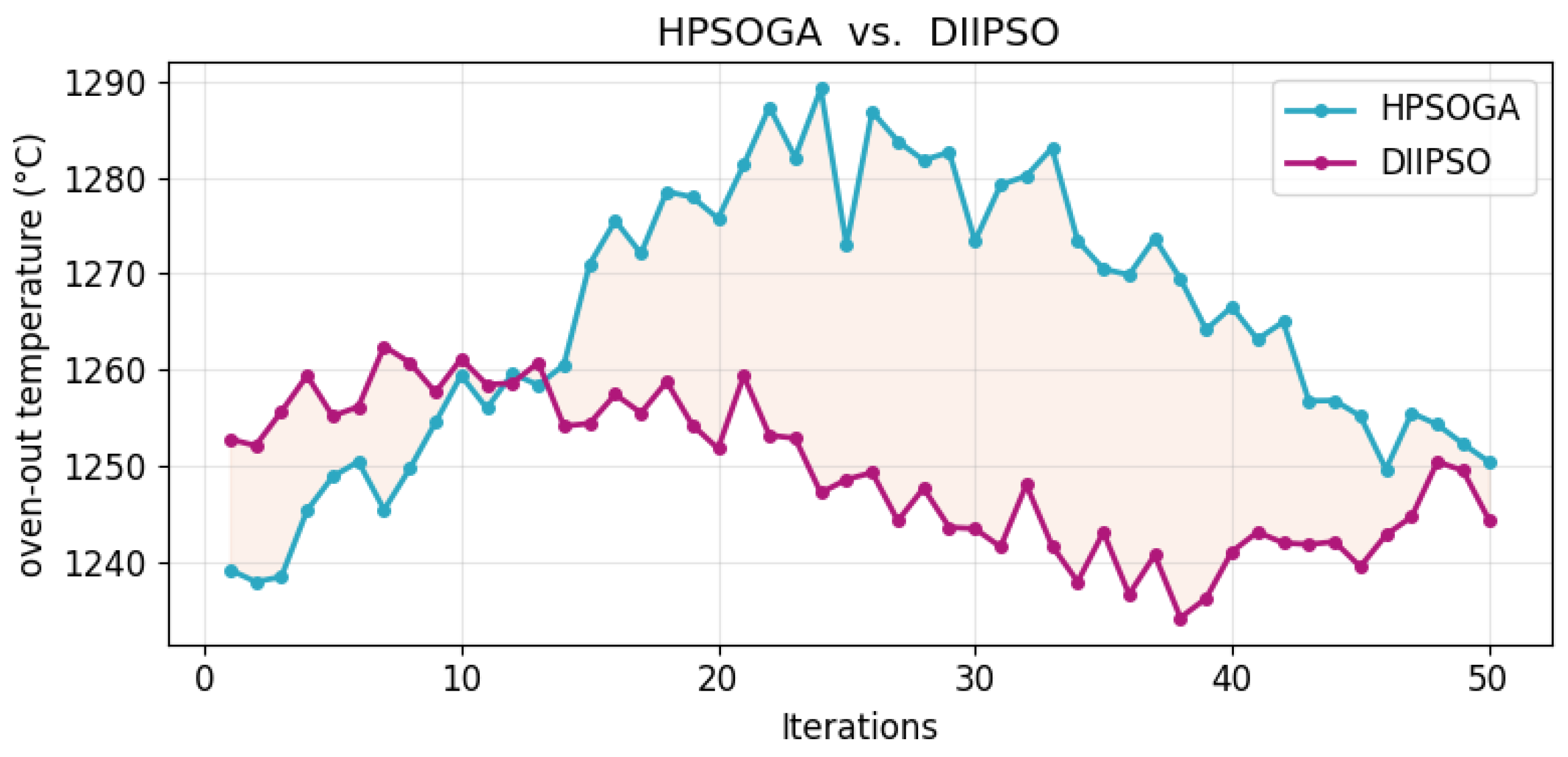
Figure 8 compares the performance of the proposed DIIPSO algorithm with the hybrid HPSOGA method. HPSOGA is a representative composite optimization strategy that integrates the global search capabilities of PSO with the diversification ability of GA, DIIPSO begins with a slightly higher objective value due to its broader initial exploration, but quickly stabilizes with small and consistent fluctuations. This stability indicates that DIIPSO is able to exploit promising regions efficiently without being affected by excessive randomness.
Figure 8.
Comparison of DIIPSO with HPSOGA.
6. Conclusions
Aiming at the energy-saving requirements and mechanical performance constraints of medium and thick plates, this study proposes a process parameter optimization method that integrates data-driven predictive models with heuristic algorithms. Based on historical production data, a comprehensive energy consumption prediction model and an LCE-based mechanical property prediction model were developed. For the four key mechanical properties—Yield Strength, Tensile Strength, Hardness, and Impact Energy—the model achieves four sets of evaluation metrics, with RMSE values of (16.98, 23.01, 3.01, 21.55), MAE values of (15.01, 15.31, 2.01, 15.96), and Accuracy values of (89.12%, 86.22%, 88.99%, 90.65%), demonstrating high predictive accuracy across all target properties. Experimental analysis on furnace exit temperature shows that the process parameters optimized by DIIPSO exhibit substantially improved stability compared with conventional optimization algorithms. When evaluating the optimization quality of furnace exit temperature, DIIPSO consistently outperforms PSO, GA, and SA at multiple iteration checkpoints. At 50, 100, 150, and 200 iterations, DIIPSO achieves improvements of at least 12.10, 12.14, 14.00, and 11.95 GJ, respectively. These findings confirm that DIIPSO yields higher-quality optimization results and maintains reliable convergence performance throughout the optimization process.
Future research can be extended to multi-objective optimization problems that consider production efficiency and quality stability simultaneously, while incorporating real-time production data to enable dynamic online optimization. Model accuracy may be further improved by expanding the training dataset and applying deep learning techniques to enhance generalization across different production environments. In addition, future work will integrate carbon-emission-based modeling and optimization to support green manufacturing and sustainable development.
Author Contributions
Q.G.: conceptualization, methodology, writing—original draft; J.G. (Jingjie Gao): validation, formal analysis, writing—original draft; X.L.: software, writing—review and editing; L.S.: data curation, formal analysis; F.J.: conceptualization, resources, data curation, writing—review and editing; J.G. (Jin Guo): investigation, writing—review and editing. All authors have read and agreed to the published version of the manuscript.
Funding
This research received no external funding.
Institutional Review Board Statement
Not applicable.
Informed Consent Statement
Not applicable.
Data Availability Statement
The data presented in this study are available on request from the corresponding author due to confidentiality restrictions on enterprise production materials.
Conflicts of Interest
Author Lei Song was employed by the SINOMACH-HE Chengdu Heavy Machinery Co., Ltd. We confirmed that there are no conflicts of interest related to the research itself.
Appendix A. Construction of LCE Model
The process of building an LCE model is divided into the following steps:
Step 1: Local Partitioning
Using the K-Means algorithm, divide the data set into K non-overlapping subsets, that is
Each subset contains similar data points, and the goal is to train a model that can capture local patterns.
Step 2: Local Model Training
For each local region , train an independent random forest model : . The prediction results of the basic model are expressed as:
Step 3: Cascade Structure
The prediction output of the local model is used as a feature to build a cascade model layer by layer. At the t layer, the input of the model contains the output of the previous layer:
where is the output of the kth local model in the th layer. The prediction model of the tth layer is:
The cascade iterations continue until a certain convergence criterion is met or a preset number of layers T is reached.
Step 4: Global Prediction Fusion
In the last layer of the cascade, the prediction results of all local models are weighted and fused to obtain the final output:
where is the weight of the t-layer, which can be determined from the validation dataset.
Step 5: Objective Function Optimization
The objective function of the entire model is:
where includes the parameters of all local models and cascade models.
References
- Lachmund, H.; Schwinn, V.; Jungblut, H.A. Heavy plate production: Demand on hydrogen control. Ironmak. Steelmak. 2000, 27, 381–386. [Google Scholar] [CrossRef]
- Zhou, D.; Zhou, Y.; Zhang, X.; Xu, K. Surface quality evaluation of heavy and medium plate using an analytic hierarchy process based on defects online detection. ISIJ Int. 2022, 62, 1461–1468. [Google Scholar] [CrossRef]
- Daigo, I.; Murakami, K.; Tajima, K.; Kawakami, R. Thickness classifier on steel in heavy melting scrap by deep-learning-based image analysis. ISIJ Int. 2023, 63, 197–203. [Google Scholar] [CrossRef]
- Jia, J.; Jeong, H.K.; Dou, H. Study on the Structural Strength Assessment of Mega Offshore Wind Turbine Tower. Energies 2025, 18, 69. [Google Scholar] [CrossRef]
- Zhang, J.; Li, H.; Yang, F.; Ji, L.; Feng, Y. Effect of Heat Treatment Process on Mechanical Properties and Microstructure of a 9% Ni Steel for Large LNG Storage Tanks. J. Mater. Eng. Perform. 2013, 22, 3867–3871. [Google Scholar] [CrossRef]
- Gao, Q.; Qian, L.; Bai, L.; Xiao, D.; Zhou, W.; Yu, Q.; Xie, Z. Multiphase microstructure regulation and its influence on the mechanical properties of EH500-grade ultraheavy plate steel for marine engineering. Chin. J. Eng. 2024, 46, 2017–2025. [Google Scholar] [CrossRef]
- Li, W.; Wang, X.; Liu, X.; Pei, X.; Li, Y.; Shi, L.; Shen, Z.; Shi, S.; Ni, Z. Elucidation of microstructure, mechanical properties and wear behavior in double-sided vortex flow-based friction stir welds of medium-thick titanium alloy plates. J. Mater. Process. Technol. 2025, 342, 118951. [Google Scholar] [CrossRef]
- Tao, P.; Wang, C.; Mi, G.; Huang, Y.; Zhang, X. Formation, microstructure, and mechanical properties of oscillating laser-welded joints of 8-mm 304 stainless steel. Int. J. Adv. Manuf. Technol. 2024, 130, 2899–2913. [Google Scholar] [CrossRef]
- Yang, J.; Zhu, S.; Zhai, W. A novel dynamics model for railway ballastless track with medium-thick slabs. Appl. Math. Model. 2020, 78, 907–931. [Google Scholar] [CrossRef]
- Zou, J.; Xiong, Y.; Zhang, W.; Tang, C.; Li, R.; Sun, D.; Zhang, W. Process-performance integrated modeling to virtually optimize parameters for preforming of multi-layer woven fabric composite prepregs. Compos. Part A Appl. Sci. Manuf. 2025, 197, 109032. [Google Scholar] [CrossRef]
- Ruiz, E.; Ferre no, D.; Cuartas, M.; Arroyo, B.; Carrascal, I.A.; Rivas, I.; Gutiérrez-Solana, F. Application of machine learning algorithms for the optimization of the fabrication process of steel springs to improve their fatigue performance. Int. J. Fatigue 2022, 159, 106785. [Google Scholar] [CrossRef]
- Guo, Q.; Zhou, Z.; Li, J.; Jing, F. Mechanism- and data-driven algorithms of electrical energy consumption accounting and prediction for medium and heavy plate rolling. Electron. Res. Arch. 2025, 33, 381–408. [Google Scholar] [CrossRef]
- Wang, S.; Li, J.; Zuo, X.; Chen, N.; Rong, Y. An optimized machine-learning model for mechanical properties prediction and domain knowledge clarification in quenched and tempered steels. J. Mater. Res. Technol. 2023, 24, 3352–3362. [Google Scholar] [CrossRef]
- Yin, R.; Xing, J.; Mo, P.; Zheng, N.; Liu, Z. BO-B&B: A hybrid algorithm based on Bayesian optimization and branch-and-bound for discrete network design problems. Electron. Res. Arch. 2022, 30, 3993–4014. [Google Scholar] [CrossRef]
- Deng, M.; Liu, Y.; Cheng, L. AI-driven innovation in ethnic clothing design: An intersection of machine learning and cultural heritage. Electron. Res. Arch. 2023, 31, 5793–5814. [Google Scholar] [CrossRef]
- Cabrera, M.; Ninic, J.; Tizani, W. Fusion of experimental and synthetic data for reliable prediction of steel connection behaviour using machine learning. Eng. Comput. 2023, 39, 399–4011. [Google Scholar] [CrossRef]
- Xue, Z.; Guan, B.; Zhang, Y. Research on the Hot Straightening Process of Medium-Thick Plates Based on Elastic–Viscoplastic Material Modeling. Materials 2024, 17, 2385. [Google Scholar] [CrossRef]
- Cong, J.; Zhao, J.; Wang, X.; Wu, Z. Effect of a Gradient Temperature Rolling Process on the Microstructure and Mechanical Properties of the Center of Ultra-Heavy Plates. Metals 2024, 14, 199. [Google Scholar] [CrossRef]
- Premkumar, M.; Shankar, N.; Sowmya, R.; Jangir, P.; Kumar, C.; Abualigah, L.; Derebew, B. A reliable optimization framework for parameter identification of single-diode solar photovoltaic model using weighted velocity-guided grey wolf optimization algorithm and Lambert-W function. IET Renew. Power Gener. 2023, 17, 2711–2732. [Google Scholar] [CrossRef]
- Li, H.; Wang, L.; Liu, J.; Yang, Y.; Lu, G. Maximizing power density in proton exchange membrane fuel cells: An integrated optimization framework coupling multi-physics structure models, machine learning, and improved gray wolf optimizer. Fuel 2024, 358, 130351. [Google Scholar] [CrossRef]
- Wang, R.; Li, K.; Ming, Y.; Guo, W.; Deng, B.; Tang, H. An enhanced salp swarm algorithm with chaotic mapping and dynamic learning for optimizing purge process of proton exchange membrane fuel cell systems. Energy 2024, 308, 132852. [Google Scholar] [CrossRef]
- Kang, Y.; Qin, J.; Ma, Q.; Gao, H.; Zheng, W. Cluster Synchronization for Interacting Clusters of Nonidentical Nodes via Intermittent Pinning Control. IEEE Trans. Neural Netw. Learn. Syst. 2017, 29, 1747–1759. [Google Scholar] [CrossRef] [PubMed]
- Kang, Y.; Zhai, D.; Liu, G.; Zhao, Y. On Input-to-State Stability of Switched Stochastic Nonlinear Systems Under Extended Asynchronous Switching. IEEE Trans. Cybern. 2015, 46, 1092–1105. [Google Scholar] [CrossRef] [PubMed]
- Wang, X.; Ai, Y.; Zhang, W.; Ji, S.; Wang, H. Predicting the medium-temperature thermal stability of impact-strengthened medium-thick plate aluminum alloy using a back propagation artificial neural network. Heliyon 2023, 9, e23018. [Google Scholar] [CrossRef]
- Li, H.; Li, Z.; Cheng, Z.; Zhou, Z.; Wang, G.; Wang, B. A data-driven modelling and optimization framework for variable-thickness integrally stiffened shells. Aerosp. Sci. Technol. 2022, 129, 107839. [Google Scholar] [CrossRef]
- Cook, D.F.; Ragsdale, C.T.; Major, R.L. Combining a neural network with a genetic algorithm for process parameter optimization. Eng. Appl. Artif. Intell. 2000, 13, 391–396. [Google Scholar] [CrossRef]
- Chen, W.C.; Fu, G.L.; Tai, P.H.; Deng, W.J. Process parameter optimization for MIMO plastic injection molding via soft computing. Expert Syst. Appl. 2009, 36, 1114–1122. [Google Scholar] [CrossRef]
- Sheoran, A.J.; Kumar, H. Fused deposition modeling process parameters optimization and effect on mechanical properties and part quality: Review and reflection on present research. Mater. Today Proc. 2020, 21, 1659–1672. [Google Scholar] [CrossRef]
- Zhang, J.; Zhang, H.T.G. Accelerating reinforcement learning with a Directional-Gaussian-Smoothing evolution strategy. Electron. Res. Arch. 2021, 29, 4119–4135. [Google Scholar] [CrossRef]
- Le, S.T.; Nguyen, T.N.; Linforth, S.; Ngo, T.D. Safety investigation of hydrogen energy storage systems using quantitative risk assessment. Int. J. Hydrogen Energy 2023, 48, 2861–2875. [Google Scholar] [CrossRef]
- Ren, B.; Ma, H. Global optimization of hyper-parameters in reservoir computing. Electron. Res. Arch. 2023, 30, 2719–2729. [Google Scholar] [CrossRef]
- Fauvel, K.; Fromont, É.; Masson, V.; Faverdin, P.; Termier, A. XEM: An explainable-by-design ensemble method for multivariate time series classification. Data Min. Knowl. Discov. 2022, 36, 917–957. [Google Scholar] [CrossRef]
- Rajeyyagari, S.R.; Nowduri, S. Optimizing Solid Oxide Fuel Cell Performance Using Advanced Meta-Heuristic Algorithms. Adv. Eng. Intell. Syst. 2024, 3, 106–126. [Google Scholar] [CrossRef]
- Xu, S.; Wang, Y. Parameter estimation of photovoltaic modules using a hybrid flower pollination algorithm. Energy Convers. Manag. 2017, 144, 53–68. [Google Scholar] [CrossRef]
- Pathak, V.K.; Gangwar, S.; Dikshit, M.K. A comprehensive survey on seagull optimization algorithm and its variants. Arch. Comput. Methods Eng. 2025, 32, 3651–3685. [Google Scholar] [CrossRef]
Disclaimer/Publisher’s Note: The statements, opinions and data contained in all publications are solely those of the individual author(s) and contributor(s) and not of MDPI and/or the editor(s). MDPI and/or the editor(s) disclaim responsibility for any injury to people or property resulting from any ideas, methods, instructions or products referred to in the content. |
© 2025 by the authors. Licensee MDPI, Basel, Switzerland. This article is an open access article distributed under the terms and conditions of the Creative Commons Attribution (CC BY) license (https://creativecommons.org/licenses/by/4.0/).