Appendix A
This section lists the theorems, propositions, and lemmas of
Section 4 along with their detailed proofs.
Proof of Theorem 1: The proof of Theorem 1 is shown by contradiction. Conceptually, given an optimal action
such that
, we obtain a set of different relations (necessary optimality conditions) by acknowledging that
for the different possible values of
, except in the case of increasing the system’s capacity to level
. Now, if in states
, where
, there exist better actions than increasing the system capacity to reach the same capacity level
, we obtain a second set of relations. However, it will be shown that this set of relations will contradict the first set; hence, the optimal action is to reach capacity level
. Next, we provide the detailed proof of this theorem:
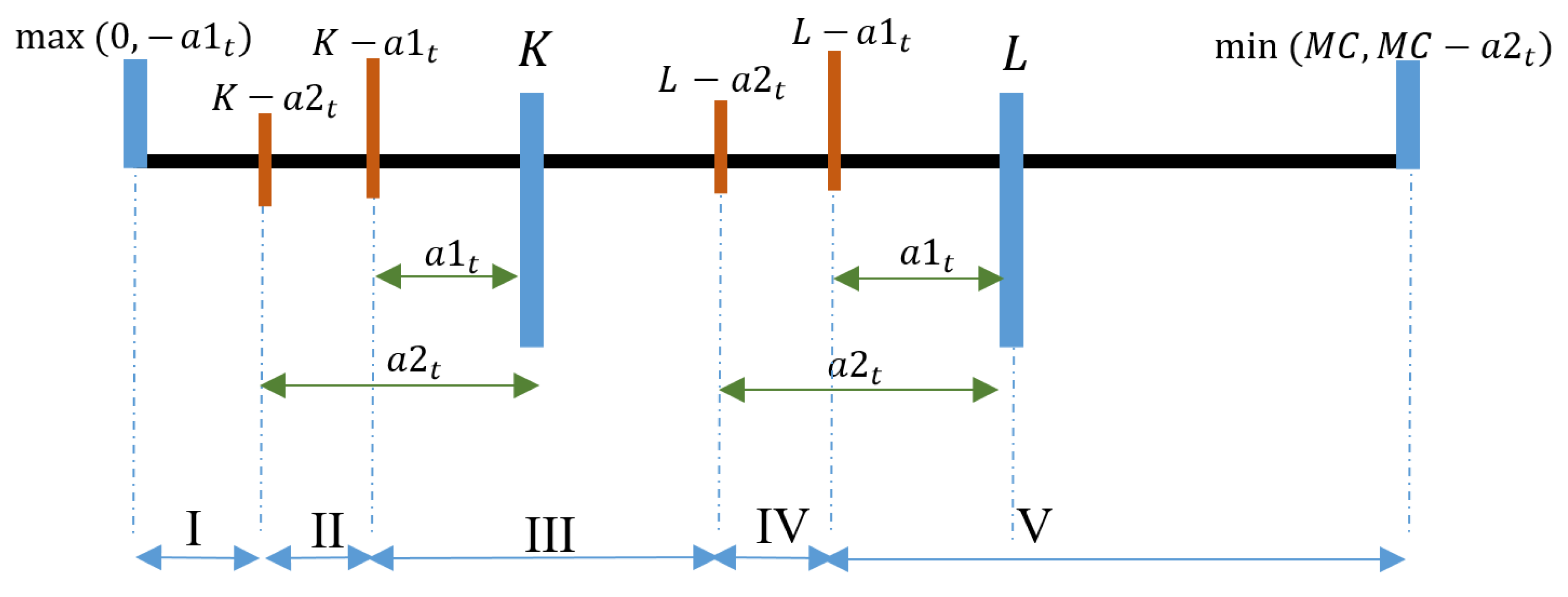
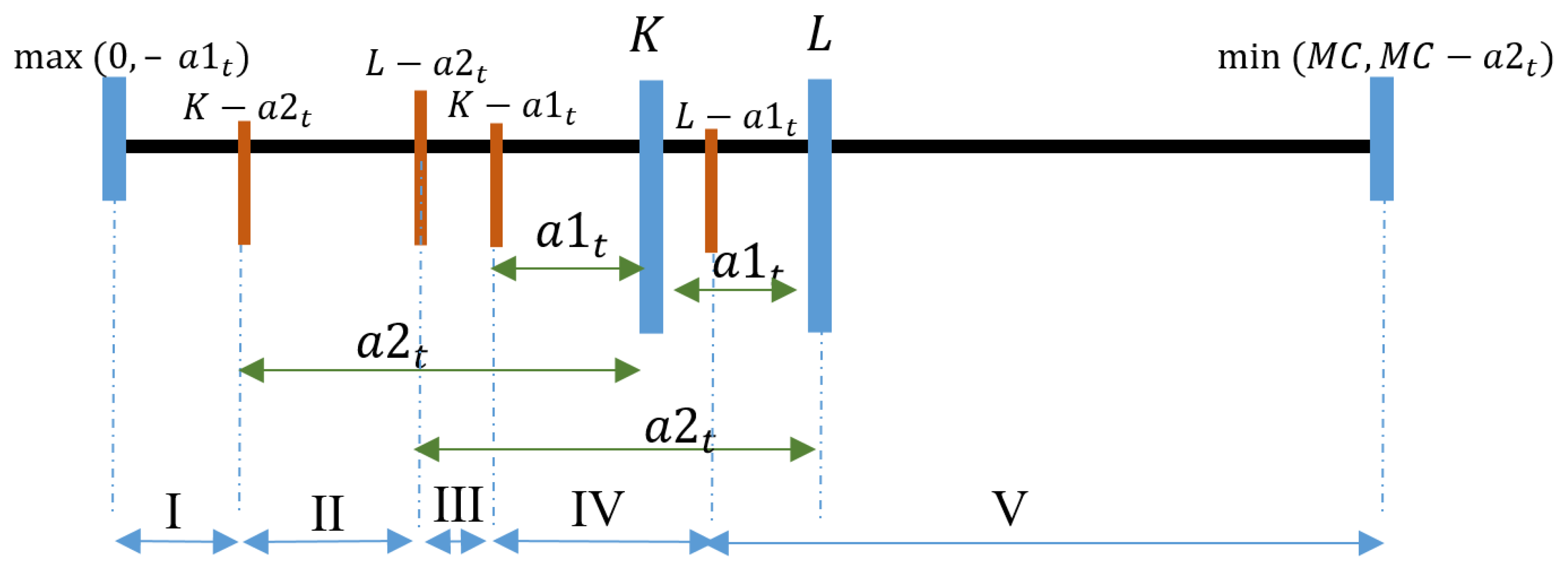
Figure A1.
Theorem 1 capacity level illustration.
Figure A1.
Theorem 1 capacity level illustration.
Graphically,
Figure A1 represents a set of capacities
, where
Given the optimal action
and
, referring to
Figure A1, let us consider all possible alternative actions:
Let be any action such that
Let be any action such that
Let be any action such that
Let be any action such that
Based on this, since is the optimal action at , we are left with the following four relations (necessary optimality conditions on ):
- (1)
.
- (2)
.
- (3)
.
- (4)
.
Relations 1–4 imply that, in any time period, the value function when the optimal action is carried out will be always less than or equal to the value function at the time when any other action is carried out.
Taking one relation at a time:
- (1)
.
By substituting in Equation (7), using Equation (3), and simplifying, we get
By applying the same approach to the remaining relations, we get
- (2)
,
- (3)
,
- (4)
,
Given a capacity CS2 such that , let us consider all possible actions available for the state (other than the action ):
Action Subset 1: This is an action such that
Action Subset 2: Let be any action such that
Action Subset 3: Let be any action such that
Action Subset 4: Let be any action such that
Let be the action such that
If in state
an action in action Subset 1 yields a better value function than that corresponding to action
, then
By writing the value function Equation (7) and using Equation (3), we get
We can see that Equation (A5) contradicts Equation (A1). This implies that action cannot be better than action
Similarly, for action subsets 2, 3, and 4, we get the following relations:
It is obvious that Equations (A6)–(A8) contradict Equations (A2)–(A4), respectively. Hence, actions
, or
cannot be better than action
Thus, is the optimal action at . This completes the proof of Theorem 1. □
Proof of Theorem 2: Similar to Theorem 1, the proof of Theorem 2 is shown by contradiction. Conceptually, given an optimal action such that , we obtain one set of relations (necessary optimality conditions) by acknowledging that . Now, if in states , where , there exist better actions than decreasing the system capacity to reach the same capacity level , we obtain a second set of relations. However, it will be shown that this set of relations will contradict the first set. Hence, the optimal action is to reach capacity level. Next, we provide the detailed proof of this theorem.
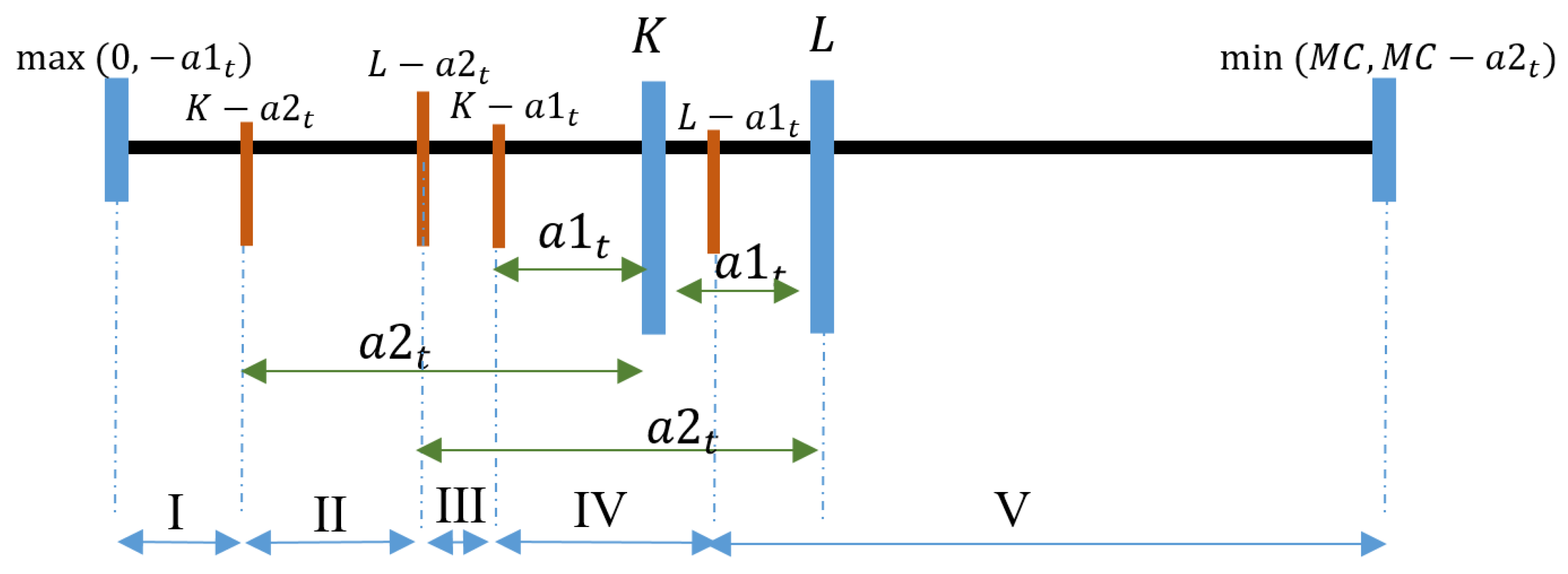
Figure A2.
Theorem 2 capacity level illustration.
Figure A2.
Theorem 2 capacity level illustration.
Graphically,
Figure A2 represents a set of capacities
, where
Given the optimal action and
Referring to
Figure A2, let us consider all possible alternative actions:
Let be any action such that
Let be any action such that
Let be any action such that
Let be any action such that
Since is the optimal action at , we are left with the following relations (necessary optimality conditions on ):
- (1)
.
- (2)
.
- (3)
.
- (4)
.
Relations 1–4 imply that, in any time period, the value function for the optimal action will always be less than or equal to the value function for any other action.
We will employ one relation at a time:
- (1)
.
By substituting in Equation (7), using Equation (3), and simplifying, we get
- (2)
Doing the same with the remaining relations, we get , which yields
- (3)
yields
- (4)
yields
Given a capacity CS1 such that , let us consider all possible actions available for the state
Action Subset 1: Let be any action such that
Action Subset 2: Let be any action such that
Action Subset 3: Let be any action such that
Action Subset 4: Let be any action such that
Let be the action such that
If in state
an action in action subset yields a better value function than that corresponding to action
, then
By writing the value function Equation (7) and using Equation (3), we get
We can see that Equation (A13) contradicts Equation (A9). This implies that action
cannot be better than action
.
Similarly, we get the following relations for action subsets 2, 3, and 4:
Equations (A14)–(A16) are in contradiction to relations (A10)–(A12), respectively.
Hence, there cannot exist a better action at than . This completes the proof of Theorem 2. □
Proof of Lemma 2: superadditive in ∀ means that for any in :
is nondecreasing in
It can be observed that as increases, can have at most three regions in the following order:
- (1)
- (2)
- (3)
Region 1:
Note that based on the cost parameter assumption
, the relation
is implicit. Hence, in region 1,
is a constant with a negative value
Region 2:
Since
,
increases with an increase in
. However, as
, the value is negative.
Region 3:
From the above analysis, we get
is nondecreasing in
.
This completes the proof of Lemma 2. □
Proof of Proposition 1: The proof of this proposition is established using mathematical induction. This starts from the last time epoch , where the capacity is to be salvaged. We work our way up, showing that the value function and its components are superadditive in ∀
From Equation (2),
Since
for any
and for any combination of
and
,
is superadditive in
∀
. Note that in practice, there is virtually no other option in the last epoch but to salvage the capacity. We simply make this manipulation to lay out the proof.
Writing Equation (7)
Considering the elements of this equation,
from Equation (3):
This is because
is a constant independent of
∀
. We have
as a superadditive in
∀
.
Hence, will be superadditive in , if is superadditive in
Moreover, if is superadditive in , then will be superadditive in
In conclusion, if is superadditive in , then will be superadditive in ∀
This will be shown to be true for our problem definition via induction:
Since
, we have
as a superadditive in
, because for any two actions
and
in
such that
, we have
The term
is independent of
.
By employing Equation (7) for
and substituting Equations (3) and (A17), we acquire
We can see that
is superadditive in
.
From Equation (A18), based on the assumption on the cost parameters , there are three possible optimal actions at depending on the measurement of with respect to and :
if
; we thus get
if
, so we have
if
, so we have
Next, we have the Bellman optimality equation for
, which depends on
, as follows:
As shown earlier, if
is superadditive in
, then
will be superadditive in
∀
.
Let be two actions such that
We have
for the three cases as follows:
The first parts in Equation (A19)
are constants. By studying the second part of Equation (A19), , based on Lemma 2, we find that it increases in
This means is increasing in . This gives the superadditive in
So far, the following results have been established:
- 1.
are superadditive in , respectively.
- 2.
are superadditive in , respectively.
This gives the first step of the induction proof of Proposition 1. Next, assuming that and are both superadditive in we need to prove that is superadditive in to prove that is superadditive in
That is, we need to check if is nondecreasing in for any
Let the optimal action in time epoch
and state
be
This implies that when in state
,
, based on Theorem 1.
And let optimal action in time epoch
and state
be
This implies that when in state
,
, based on Theorem 2. Moreover, Theorems 1 and 2 imply that
.
Let ( and are special cases of this).
To study the nature of with an increase in for a given , we have two possibilities depending on the selection of and :
Possibility 1: When
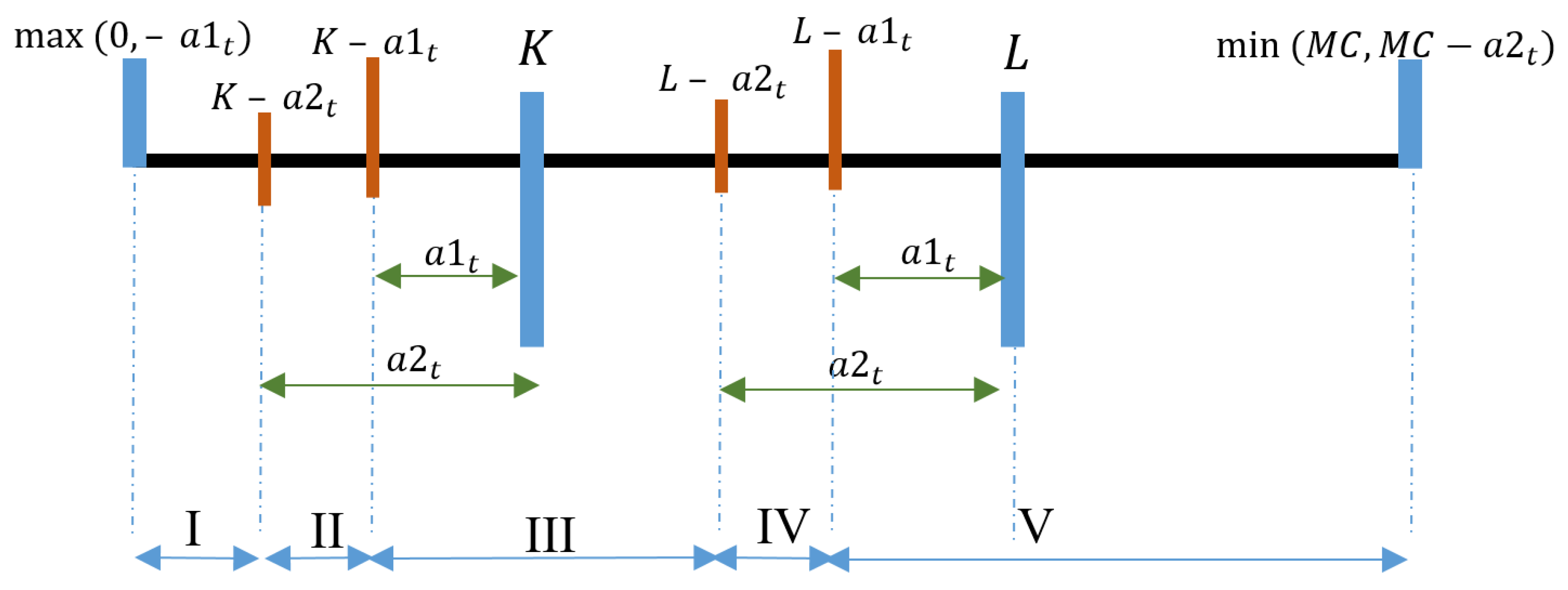
Figure A3.
Proposition 1: Possibility 1— regions.
Figure A3.
Proposition 1: Possibility 1— regions.
As shown in
Figure A3 for Possibility 1, the resulting regions are considered:
Region I:
In this region, in both functions
This implies
Based on Theorem 1, the optimal action would be to go to capacity
for both states
and
; hence,
Simplifying
Lemma 2 shows that is nondecreasing in
Hence, in region I, is superadditive in
Region II:
in the function and in the function
This implies
Based on Theorems 1 and 2, the optimal action would be to go to capacity
for states
and to choose action
for states
We study Equation (A20) in parts:
- 1.
is fixed in this region.
- 2.
Lemma 2 shows is nondecreasing in .
- 3.
The last part is as follows:
In this region,
This gives
Equation (A22) implies that for a unit increase in , the decrease in in Equation (A21) will not be more than
This shows that in the last part, is nondecreasing in
Hence, in region II, is superadditive in .
Region III:
in both the functions and
This implies
is a fixed value. Lemma 2 shows
is nondecreasing in
.
is nondecreasing in
, because
is superadditive in
Hence, in region III, is superadditive in
Region IV:
in the function and in the function .
Equation (A23) is studied in parts:
- 1.
is fixed in this region.
- 2.
Lemma 2 shows is nondecreasing in .
- 3.
The last part is as follows:
In this region,
This gives
Equation (A25) implies that for a unit increase in
, the last part (Equation (A24)) is nondecreasing in
Hence, in region IV, is superadditive in .
Region V:
in both functions and
This implies
does not change with an increase in
. Lemma 2 shows
is nondecreasing in
. Hence, in region V,
is superadditive in
This completes the proof of Possibility 1 when . □
Now, we move onto Possibility 2 when . The proof process is the same as in Possibility 1, which we just addressed.
Possibility 2: When
Figure A4.
Proposition 1, Possibility 2— regions.
Figure A4.
Proposition 1, Possibility 2— regions.
As shown in
Figure A4 for Possibility 2, the resulting regions are considered:
Region I:
in both functions .
This is the same as region I for Possibility 1.
Hence, in region I, is superadditive in .
Region 2:
in the function
, and
in the function
. This implies
The region is the same as region II of Possibility 1.
Hence, in region II, is superadditive in .
Region III:
in the function
and
in the function
. This implies
We study Equation (A26) in parts:
- 1.
is a fixed value in this region upon an increase in .
- 2.
Lemma 2 shows is nondecreasing in
- 3.
increases with , considering the assumption that .
Hence, in region III, is superadditive in .
Region IV:
in the function
, and
in the function
. This implies
The region is given the same consideration as region IV of Possibility 1.
Hence, in region IV, is superadditive in
Region V:
The same consideration is given for region V for Possibility 1. Hence, in region V, is superadditive in
This completes the proof of Possibility 2. □
We have thus shown that is superadditive in in the given model if and are superadditive in
We have thus proved by induction that is superadditive in ∀
Proof of Theorem 4: From Equations (3) and (7),
; this gives
And
; this gives
Considering the assumption
,
is nondecreasing in
if
is nondecreasing in
From the Proof of Proposition 1, we have shown that is superadditive in
Thus, ∀
such that
and
; it follows
Let
. This yields
Equation (A27) implies that
is nondecreasing in
, thus completing the proof of Theorem 4. □
Proof of Lemma 3: To state is subadditive in ∀ means ∀ in :
is nonincreasing in .
has three regions:
- (1)
- (2)
- (3)
Region 1:
Region 2:
Note that based on the cost parameter assumption
, the relation
is implicit. Hence, the above relation decreases with
.
Region 3:
Hence, we have
nonincreasing in
. □
Proof of Proposition 2: The proof of this proposition is quite similar to the proof of Proposition 1 and is also established using mathematical induction. This starts from the last time epoch T, where the capacity is to be salvaged. □
From Equation (2),
for any
, and any combination of
and
. Hence, we find that
is subadditive in
∀
.
We write Equation (7) as follows:
Considering the elements of this equation,
is subadditive in ∀ because
is a constant independent of (∀).
Hence, will be subadditive in , if is subadditive in .
Moreover, since shows first-order stochastic dominance will be subadditive in if is subadditive in .
In conclusion, will be subadditive in ∀ , if is subadditive in .
This will be shown by induction:
Starting with the last period
, since
,
is subadditive in
, as for
:
is independent of
.
From Equation (A18),
It is evident that
is subadditive in
.
From Equation (A19), it is shown for
:
The first parts of Equation (A19) are constants. The second part of Equation (A19) is known to be nonincreasing in from Lemma 3. Similar arguments can be made for cases and . The proofs are straightforward and hence skipped here.
This means is nonincreasing in . This shows that is subadditive in
So far, the following results have been established:
- 1.
is subadditive in , respectively.
- 2.
is subadditive in , respectively.
This results in the first step of the induction proof of the proposition. Next, assuming that and are subadditive in we need to prove that is subadditive in to prove that is subadditive in
That is, we must check if is nonincreasing in for any
Let the optimal action in time epoch
and state
be
And let the optimal action in time epoch
and state
be
The understanding here is the same as explained for Proposition 1.
From Theorems 1 and 2, it is understood that
Let (and will be special cases of this).
The following steps in the proof are parallel to those explained in the proof of Proposition 1; again to study the nature of with an increase in for a given , we have two possibilities depending on the selection of and :
Possibility 1: When
Figure A5.
Proposition 2, Possibility 1— regions.
Figure A5.
Proposition 2, Possibility 1— regions.
As shown in
Figure A5 for Possibility 1, the resulting regions are considered:
Region I:
In this region, in both functions
This implies
Based on Theorem 1, the optimal action would be to go to capacity
for both states
and
; hence,
Lemma 3 shows is nonincreasing in
Hence, in region I, is subadditive in .
Region II:
in the function
, and
in the function
; this implies
Based on Theorems 1 and 2, the optimal action would be to go to capacity
for states
and to choose action
for states
:
We study Equation (A28) in parts:
- 1.
is fixed in this region.
- 2.
Lemma 3 shows is nonincreasing in .
- 3.
The last part is as follows:
- 4.
is nonincreasing in because shows first-order stochastic dominance and is subadditive in .
Hence, in region II, is subadditive in .
Region III:
in both the functions and
is a fixed value. Lemma 3 shows is nonincreasing in . is shown to be nonincreasing in , because is subadditive in .
Hence, in region III, is subadditive in .
Region IV:
in the function , and in the function .
This implies
We study Equation (A29) in parts:
- 1.
is fixed in this region.
- 2.
Lemma 3 shows is nonincreasing in .
- 3.
The last part is as follows:
is nonincreasing in
because
shows first-order stochastic dominance and
is subadditive in
Hence, in region IV, is subadditive in
Region V:
in both functions and
This implies
is constant with an increase in
. Lemma 3 shows
is nonincreasing in
. Hence, in region V,
is subadditive in
This completes the proof of Possibility 1 when . □
Now we move onto Possibility 2 when . The proof process is the same as in Possibility 1, which we just addressed. Again, the steps are parallel to the proof of Proposition 1.
Possibility 2 When .
Figure A6.
Proposition 2, Possibility 2 regions.
Figure A6.
Proposition 2, Possibility 2 regions.
As shown in
Figure A6 (above) for Possibility 1, the resulting regions are considered:
Region I:
in both functions .
This implies
This is the same as region I for Possibility 1.
Hence, in region I, is subadditive in .
Region II:
in the function and in the function
This implies
The region is given the same consideration as region II of Possibility 1.
Hence, in region II, is subadditive in .
Region III:
in the function , and in the function
This implies
We study Equation (A30) in parts:
is a fixed value in this region.
Lemma 3 shows is nonincreasing in
is nonincreasing with because shows first-order stochastic dominance and is subadditive in
Hence, in region III, is subadditive in .
Region IV:
in the function , and in the function
The region is given the same consideration as region IV of Possibility 1.
Hence, in region IV, is subadditive in
Region V:
This is the same as region V of Possibility 1.
Hence, in region V, is subadditive in . This completes the proof of Possibility 2.
We have now shown that under first-order stochastic dominance of demand transition matrix and if is subadditive in and is subadditive in then is subadditive in , showing that is subadditive in
This completes the proof of Proposition 2. □